



Abstract
Background/Objective
Neonatal Opioid Withdrawal Syndrome (NOWS) requires advanced and often prolonged medical care in the neonatal intensive care unit (NICU). We examined the effect of NICU design on treatment and NICU length of stay (NICU-LOS) for infants with NOWS.
Methods
A retrospective chart review of eligible infants with NOWS was conducted from 2013 to 2018. We collected and analyzed data on demographics, medication, and NICU-LOS characteristics. A multivariable linear regression on log-transformed NICU-LOS was performed for comparison between the open-bay design (OBD) for 2013–2015 (August) and the new single-family-room (SFR) NICU for September 2015–2018.
Results
There were 118 neonates analyzed in OBD and 138 neonates in the SFR. Among infants in the SFR NICU, 86% received pharmacotherapy, compared to 76% of infants in the OBD (p = 0.059). The breastfeeding rate was 26% in the SFR and 6% in the OBD (p =< 0.001 ). Infants in the SFR NICU had 1.3 times longer mean NICU-LOS (p = 0.0163) than infants in OBD after adjusting for covariates including small for gestational age. The median (1Q, 3Q) cumulative doses of morphine (mg/kg) among the SFR and OBD groups were 6.4 (2.3,17.3) and 8.7 (3.2,19.3) p: NS, respectively.
Conclusions
The SFR NICU was associated with longer NICU-LOS for infants with NOWS despite higher rates of breastfeeding and no difference in morphine dosage. While providing more privacy and possible improved patient satisfaction, there may be unintended consequences of the SFR design.
Introduction
Neonatal Opioid Withdrawal Syndrome (NOWS) is a growing public health issue in the United States. 1 NOWS is a clinical diagnosis that follows in utero opioid exposure with subsequent withdrawal symptoms shortly after birth. 1 Clinical manifestations of NOWS including tremors, excessive crying, increased tone, fragmented sleep, and loose stools occur within the week following birth but typically emerge within the first 72 hours. 2 The modified Finnegan scoring (MFS) system is one scale used to assess the severity of symptoms associated with NOWS, which reflects neuro-irritability and gastrointestinal symptoms. 3 The mainstays of therapy include nonpharmacologic therapy like low stimulation environments, feeding, swaddling, rocking, as well as pharmacotherapy with opioids. 4 As more infants are exposed to prenatal opioids and exhibit signs of withdrawal, there is an interest in finding ways to decrease opioid administration and maximize nonpharmacologic interventions.4,5
One intervention that has gained traction is promoting rooming-in of the mother and infant dyad to encourage bonding, breastfeeding, and reduce the need for opioid administration.2,6,7 Rooming-in is generally achieved when the mother-infant dyad has their own room and in most cases this takes place in the maternity ward where the mother is still admitted to the hospital. In contrast, traditional neonatal intensive care units (NICUs) have had an open bay design (OBD) in which there are no physical barriers between neonate bedsides. 8 Since the 1990s, there has been a shift towards single family rooms (SFR) to provide families more privacy, and in 2013, the consensus committee that develop design standards for advanced neonatal care recommended increasing space for each patient bedside to facilitate more SFR designs. 9 In September 2015, our institution made such a change and renovated the previous OBD which consisted of 40 beds spaces located in one room to a new 52-bed SFR design consisting of continuous rooms in a horseshoe configuration on one floor of the hospital. Theoretically, the SFR design could better facilitate rooming-in by allowing the mother to stay at the infant’s bedside. In studies examining rooming-in for NOWS treatment, neonates received less pharmacotherapy and had a shorter length of stay.2,5,7 There was also less noise in an NICU after implementing the SFR model from an open ward which may help lower stimulation and aid in the nonpharmacologic treatment of infants with NOWS. 10 Along with benefits of an SFR design, there are also potential risks including parental isolation and nursing stress and isolation.11–13 In this paper, we aim to further examine the proposed benefits and risks of SFRs vs OBDs by specifically focusing on the differences in pharmacotherapy, cumulative dose, and length of stay between the two design models.
Methods
In this retrospective cohort study, we reviewed the charts for infants admitted to our Level IV NICU located in the eastern US from 2013 to 2018. The study was approved by the university’s Institutional Review Board #HP-00089966. Infants were identified using diagnostic codes “Neonatal Abstinence Syndrome (NAS),” “drug withdrawal,” and “drug exposure.” The term “Neonatal Abstinence Syndrome” was searched rather than the now more commonly used “Neonatal Opioid Withdrawal Syndrome” because of a lack of consensus in terminology during the dates of retrospective review. 1 Electronic medical records were reviewed to identify infants 35-week gestation or greater with in utero drug exposure and subsequent NICU admission. In-utero exposure to opioids was identified based on maternal and infant toxicology results or by maternal history. At our institution, it is a standard practice for every expectant mother and every infant to receive a urine drug screen.
Charts were reviewed for 256 infants with in-utero substance exposure and NICU admission in infants with gestational age ≥35 weeks. Infants with gestational age <35 weeks or major anomalies were excluded. OBD data was collected from January 2013 through August 2015 (N = 118) and SFR data from September 2015 through December 2018 (N = 138).
At our institution, infants with in-utero drug exposure are routinely cared for in the mother-baby unit and newborn nursery and then discharged following 5 days of withdrawal scoring. If infant’s withdrawal signs increase, they are transferred to the NICU for evaluation and treatment. Only infants who met escalation criteria and were subsequently transferred to the NICU were included in this review. Infants are treated using the institutional NOWS protocol. Our protocol uses MFS every 3-4 h and recommends initial treatment with nonpharmacologic measures such as swaddling, minimizing external stimuli, breastfeeding, and rooming-in. Infants with two consecutive MFS ≥9 are started on first-line therapy using neonatal dilute morphine (0.4 mg/mL) at a dose of 0.2 mL every 3 hours as a straight dose and not based on weight in this study period. If MFS remained ≥9, clonidine 1 mcg/kg was added as a second-line agent. Occasionally, adjuvant agents like midazolam or phenobarbital were administered to attain score control if there were documented prenatal exposure to benzodiazepines. Infants are generally monitored 1-2 days following discontinuation of pharmacotherapy. All providers and staff received training on MFS and NOWS protocol to ensure consistency in scoring and protocol adherence. In general, NICU nurses at our institution have a nursing patient ratio of 1:2 or 1:3 depending on census and acuity. Treatment protocols are the same for the institution’s NICU and newborn nursery and did not change during the study period for both the OBD and SFR design.
The primary outcome measure was NICU length of stay (NICU-LOS). For this review, days spent in the newborn nursery or mother-baby unit were not included. NICU-LOS and information regarding pharmacotherapy were recorded for each infant. Secondary outcomes included cumulative doses of morphine, types of substance exposure, number of pharmacologic agents administered for treatment, and breastfeeding rates.
Statistical analysis
Descriptive statistics were obtained and stratified by NICU design. Continuous variables were summarized as mean/median (range), as appropriate, and categorical variables as frequency (percentage) and compared between discharge locations. Continuous variables were compared using the two-sample t-test/ Mood’s median test, and categorical variables were compared using the chi-squared test. Multiple linear regression on natural log-transformed NICU-LOS was performed with NICU design as the primary predictor variable. The log-transformation was performed to satisfy normality assumptions required for the linear regression procedures, and the interpretation of the results was made on the mean response variables on the original scale. The analysis was adjusted for other a priori covariates based on clinical importance. The covariates included gestational age, birthweight, small for gestational age, gender, breast feeding, and use of methadone, buprenorphine, heroin, marijuana, tobacco, alcohol, cocaine, and other opioids. Use of barbiturates, amphetamines, antipsychotics, and SSRIs was not included in the analysis as less than 10 patients were exposed. A step-wise regression was performed with both forward inclusion and backward elimination based on Akaike Information Criteria (AIC) to derive the final set of predictors. A two-sided level of significance of 0.05 was used, and the results are reported as adjusted estimates with 95% confidence intervals. All statistical analyses were performed using R 4.2.0 (R Core Team, 2022) and RStudio interface (2022).
Results
Baseline demographic characteristics of mother and infants admitted to OBD and SFR-NICU.
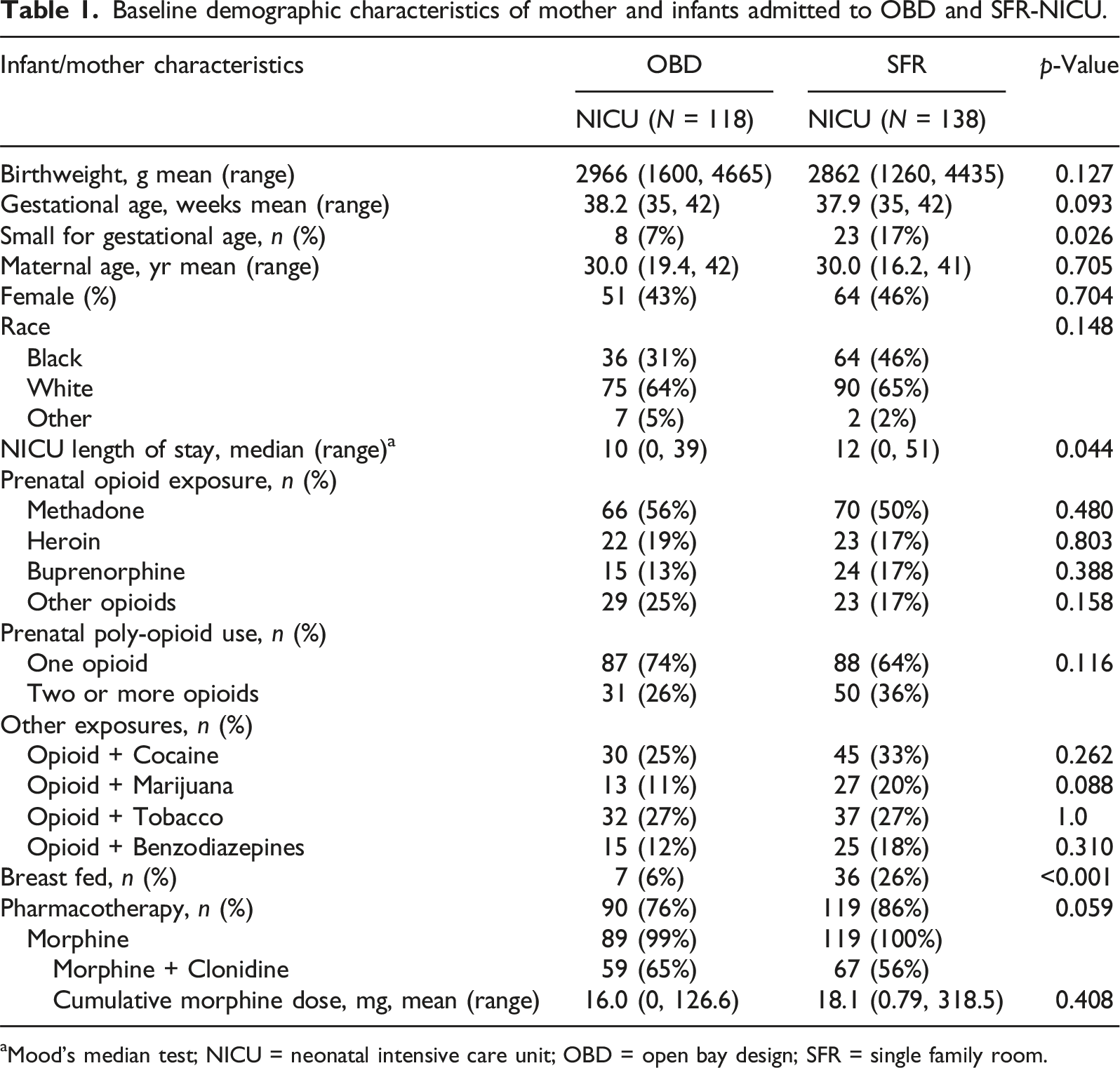
aMood’s median test; NICU = neonatal intensive care unit; OBD = open bay design; SFR = single family room.
Prenatal exposure to methadone, heroin, buprenorphine, and other opioids did not differ significantly between the two groups. In both groups, prenatal exposure to methadone was the highest (50% in SFR, 56% in OBD, p = 0.480).
Admission to the SFR was associated with a higher trend of infants requiring pharmacotherapy (86%) than to the OBD and however was not statistically significant (76%, p = 0.059). Among the infants who administered pharmacotherapy, the percentage requiring one medication in the SFR and OBD was 45% and 33%, respectively; the percentage of infants requiring two medications increased to 64% in the SFR NICU and 50% in the OBD. The median (1Q, 3Q) cumulative doses of morphine (mg/kg) among the SFR and OBD groups were 6.4 (2.3, 17.3) and 8.7 (3.2, 19.3), respectively (p = 0.31).
Multivariable linear regression analysis of NICU length of stay.

NICU = neonatal intensive care unit; LOS = length of stay; SFR = single family room; OBD = open bay design; # Since the regression analysis was performed on log-transformed variables, the adjusted regression coefficient needs to be exponentiated for interpretation. For example: exp(0.246) = 1.27, implies that mean NICU-LOS was 1.3 times higher for SFR than for OBD.
1. Upon adjusting for gestational age, birthweight, small for gestational age, gender, methadone use, buprenorphine use, heroin use, breastfeeding status, tobacco use, marijuana use, alcohol use, and other opioid use, the significant predictors were use of pharmacotherapy, NICU status, buprenorphine use, and body weight.
2. Given the significant predictors, compared to open-bay NICU, babies in SFR-NICU had 1.3 times longer mean NICU-LOS.
3. Adjusting for other significant predictors, infants born to mothers on buprenorphine had a 30% shorter mean NICU-LOS than infants born to mothers not on buprenorphine.
Discussion
Overall, the main outcome of NICU-LOS was longer in the SFR group than in the OBD without any difference in cumulative opioid dose. In this study population, breast feeding rates were low in both groups but were significantly higher in the SFR group. While in theory the NICU design of SFR should help facilitate rooming-in and lower NICU-LOS, this was not found in our retrospective analysis. In our study, the median NICU-LOS for the SFR and OBD groups was 12 and 10 days, respectively. Most rooming-in studies that reported a significant decrease in NICU-LOS defined it as the mother and infant staying together 24 hours a day unless separation was necessary for safety or medical reasons. Although this model would be ideal in the SFR design, the presence of the mother or family is not mandatory in practice. This lack of requirement for parental presence in the SFR may explain the longer NICU-LOS, possibly due to increased isolation and limited contact with a low-stimulation environment. It is important to acknowledge that parental presence and engagement are crucial elements of non-pharmacological care.2,5,7 Clinical trials such as the Eat, Sleep, and Console (ESC) initiative, which made parental rooming mandatory, have shown a significant decrease in NICU-LOS. For example, a recent multicenter ACT NOW study reported an average LOS of 8.2 days in the ESC group compared to 14.9 days in the usual care group, demonstrating a significant reduction of 6.7 days. 14
Additionally, evidence from systematic reviews suggests that rooming-in is superior to NICU care in terms of reducing the need for drug therapy and duration of admission. 7 Rooming-in is not a standalone measure; however, other cointerventions such as skin-to-skin care, breastfeeding, parental engagement, and modified scoring systems have contributed to improved outcomes. It was not possible upon retrospective chart review to determine the percentage of time the family or mother spent with the infant in the SFR. Although the OBD NICU lacks privacy for families and makes it more challenging for the mother to stay easily, the shorter NICU-LOS in this group may be attributed to the increased presence of caregivers and providers.
Moreover, the open layout of the OBD can also facilitate greater nurse-to-nurse peer support than the SFR. 15 While there is evidence of reduced parental stress in the SFR design, it can lead to increased nursing stress and a perceived increase in workload compared to the OBD. 15 Studies collecting perceptions from nurses have found less communication with the medical team and with nursing peers, and more difficulty monitoring multiple patients.15,16 This decrease in nursing support can particularly impact infants with families who cannot be consistently present in the NICU. In a study involving 104 NICUs, parents of withdrawing neonates required additional nursing time compared to parents of non-withdrawing infants (83% vs 76%), primarily due to the need for complex social support. 17 The SFR’s spread-out patient rooms and limited staffing can make it challenging to provide soothing as the first line of treatment for NOWS. In contrast, the OBD’s geographic availability of experienced nurses can help mitigate variability in subjective scoring and provide support and oversight for newer nurses. However, the expansion of SFR units may have resulted in lower density of experienced nurses, which could also contribute to the observed differences. 18
The increased privacy of the SFR group, however, likely facilitated breastfeeding compared to the OBD group. Multiple studies and reviews have shown that breastfed infants with NOWS experience reduced mean Finnegan scores, shorter NICU-LOS, and fewer pharmacological interventions.19–21 Our results indicate that despite significantly higher breastfeeding rates in the SFR group, these infants had a longer NICU-LOS of approximately 2 days.
We acknowledge that other factors besides NICU design also affect length of stay and may have contributed to our results, such as parental presence, engagement in care, frequency of breastfeeding, as well as other external factors like comorbidities or additional NICU diagnoses. 15 A recent study at the same institution reported that opioid-withdrawing infants had 2.5 times longer mean NICU-LOS when transferred from the NICU to another rehabilitation institution. 18 This was likely due to the interruption in standardized care, waiting time until transfer and the additional time required for new healthcare providers to become familiar with the transferred infants. Therefore, care for NOWS is more efficient when received in a single institution with consideration for early discharge home on medication wean, which, although reduces NICU-LOS, is also associated with prolonged treatment. 22 Although the protocols did not change, the change in medical teams could have impacted our findings and newer attending in the SFR period could have contributed to the longer NICU-LOS.
This study was limited to using retrospective chart review data based on a limited number of patients. Furthermore, we did not have complete data regarding families with limited versus extensive involvement in the SFR due to the lack of parental visitation information. In a pilot study of 18 infants with NOWS in the same institution, the average parental time was 2.1 hours per day, and combined parental and cuddler hours were 5.7 hours per day in the SFR; this study was done in 2019 and has not been published at this time. This falls significantly short of the recommended 24-hour period for rooming-in. Because this is pilot data for a small number of infants, it is not possible to compare the parental time in the OBD design. In the future, this information would be valuable to discern whether infants whose families cannot consistently be present in the NICU are at a disadvantage in the SFR and may explain the discrepancy found in this chart review.
Independent of NICU design, our findings also revealed that prenatal exposure to buprenorphine, in comparison to other opioid substances, was associated with a shorter NICU-LOS, consistent with emerging literature indicating NICU-LOS is shorter for infants with exposure to buprenorphine than for those exposed to other substances.23–25 Although our study found a longer NICU-LOS for infants treated for NOWS in the SFR group, this does not necessarily diminish other benefits of this design. Despite a statistically higher NICU-LOS, the increase of 2 days may not be clinically significant, and there was no significant difference in pharmacologic treatment. Additionally, there are still positives of increased parental satisfaction, less parental stress, infection prevention, reduction in environmental stressors (e.g., noise and light), and fewer work interruptions for nurses.8,15
Conclusion
Our study focused on overall NICU-LOS and cumulative dose of pharmacotherapy. This study highlights the need for a multifactorial approach to support nurses, families, and infants in the treatment of NOWS. For families unable to consistently room-in, cohorting these infants in an area conducive to nursing interventions and peer support may be beneficial. The use of volunteers as “cuddlers” can promote infant soothing without burdening nursing and medical staff. Further studies should investigate the impact of family bedside time and explore barriers such as childcare, transportation, or maternal health concerns which can provide opportunities for better familial support and research. Increasing nursing peer support in SFR, such as having a resource nurse or buddy system, may help alleviate nursing isolation. Additionally, the adoption of new NOWS treatment strategies like ESC may contribute to reducing NICU-LOS regardless of NICU design.
Statements and declarations
Footnotes
Acknowledgments
The authors acknowledge the constructive feedback of the reviewers, which helped improve the manuscript.
Conflicting interests
The authors declared no potential conflicts of interest with respect to the research, authorship, and/or publication of this article.
Funding
The authors received no financial support for the research, authorship, and/or publication of this article.
