



Abstract
Background:
Due to exposure to overwhelming work stressors, approximately half of emergency department (ED) physicians and nurses experience burnout, leading to lower productivity, lower quality of care, higher risk of medical errors, higher rates of absenteeism, and eventually turnover. Growing evidence suggests that the physical environment can be leveraged to support healthcare workers’ well-being.
Objectives:
This study aimed to identify (1) self-care behaviors that healthcare workers engage in to help them cope with job-related stress, (2) where they engage in those behaviors, (3) attributes of the built environment that may support coping behaviors.
Methods:
A mixed-methods study was conducted in three EDs, using online questionnaires (n = 85) and interviews (n = 20).
Results:
Job-related stress was derived from interruptions, workload and inability to take breaks, insufficient workspace, lack of privacy, unpredictability of EDs, and security concerns. Talking with a colleague, getting something to eat or drink, listening to music, and taking a walk were considered destressing activities. The bathroom was considered a place for destressing by the majority of participants, followed by outside areas, physician-only areas, and care team stations. Supportive environmental features included sufficient workspace, maximized privacy, reduced noise and clutter, controlled temperature and lighting, spaces for decompressing, spaces for documentation, close-by breakrooms with enough eating space and massage chairs, chairs with back support, standing desks, food options, and convenient bathrooms.
Conclusions:
Design decisions play an important role in supporting stress reduction among healthcare workers. This study provides several strategies to achieve this aim.
Work stress, also known as job-related stress, is defined as “the harmful physical and emotional responses that happen when the requirements of a job do not match the capabilities, resources, or needs of the worker” (National Institute for Occupational Safety and Health, 2016). If not managed, chronic job-related stress may result in burnout syndrome, which is associated with several negative consequences such as high levels of anxiety, depression, and substance abuse (Prasad et al., 2021).
Burnout is more prevalent in emergency departments (EDs) because of higher exposure of healthcare workers to severe cases such as violence, trauma, and sudden death (De Almeida Vicente et al., 2016). COVID-19 has brought this long-standing crisis in EDs to the fore. According to the Medscape Physician Burnout and Depression Report for 2022, burnout among emergency physicians jumped from 43% in 2020 to 60% in 2021. This elevated rate leads to lower productivity, lower quality of care, higher risk of medical errors, higher rates of absenteeism, and eventually turnover (Jun et al., 2021).
Several interventions exist to potentially mitigate burnout, including individual-focused (e.g., emotion regulation, mindfulness, meditation), structural or organizational (e.g., workload or schedule-rotation, debriefing sessions), and combined interventions (e.g., resiliency training, stress management workshops; Zhang et al., 2020). These interventions are aimed at either optimizing work and reducing exposure to sources of stress or helping workers cope with job-related stress that they experience. However, there is little research on the coping strategies that physicians and nurses actually utilize while on the job and how the physical environment may be supportive. There is a growing body of evidence demonstrating that the design of the physical environment can be leveraged to support the well-being of healthcare workers (Valipoor & Bosch, 2021). Strategies such as reducing noise (Blomkvist et al., 2005), having adequate privacy (Nejati et al., 2016), having access to natural light (Alimoglu & Donmez, 2005; Zadeh et al., 2014), and adding natural elements (e.g., indoor plants, views to nature; Nejati et al., 2016; Pati et al., 2008) have been associated with different measures of well-being such as stress, mood, and perceived pressure and strain in different healthcare settings. Wingler and Keys (2019) developed a framework for how the physical healthcare environment may impact nurse fatigue and associated effects like burnout. They classified the environmental variables into ergonomic, sensory, layout, and restorative factors, encapsulating consistent findings from previous studies under each category. The framework provided an understanding of environmental factors as a unique dimension within the multifaceted construct of nurse fatigue and called for addressing different types of fatigue, including cognitive fatigue which was directly linked to stress and anxiety.
Based on a gap in the literature regarding the relationships between environmental design and stress-coping behaviors among healthcare workers, the objectives of this study were to (1) identify self-care behaviors that healthcare workers engage in to help them cope with job-related stress, (2) find where they engage in those behaviors, and (3) identify attributes of the built environment that may support coping behaviors. The long-term goal is to enhance physician and nurse well-being and therefore improve patient care.
Methods
Data Collection
We adopted a mixed-methods, modified explanatory sequential research approach using a questionnaire (primarily quantitative) and interviews (qualitative). Interviews were conducted with healthcare workers from the same EDs. Institutional review board approval was obtained, and participants provided written informed consent. Participants were clinicians working in three EDs (two free-standing and one hospital-based) affiliated with an academic medical center in the Southeastern United States. The hospital-based ED was a Level 1 trauma center for adults, with 37,000 sq. ft. and an annual census of over 65,000 patients. Two of its three main cores (care modules) comprised 29 private treatment rooms, and the third core comprised 14 cubicles. The trauma unit had six trauma care rooms. The other two were free-standing EDs with 10,881 sq. ft. (0.6 miles from the main ED) and 8,500 sq. ft. (10 miles away from the main ED) both featuring 10 treatment spaces for patients, one trauma care room, and their own lab and diagnostic radiology services to provide the same 24/7 level of emergency care provided in the main hospital-based ED.
Questionnaire
The online questionnaire was developed around study objectives by the research team that included design researchers and an emergency medicine physician, then pilot tested by two additional providers before being distributed. It was distributed, using Qualtrics, to physicians, residents, nurse practitioners, and nurses working in the three EDs. The self-administered questionnaire, accessed using a link to the online survey, collected descriptive information about caregivers’ job-related stress, coping behaviors, and perceived environmental qualities that may facilitate those behaviors. The questionnaire included the following: (1) five multiple-choice demographic questions asking about participants’ roles, length of experience, typical shifts, work location, and workload; (2) four matrix table job-related stress questions asking about sources of stress, frequency of feeling stressed at work, coping activities, and spaces used to destress; and (3) a combination of multiple-choice and matrix table questions regarding possible reasons for not being able to physically step away from work demands, helpful environmental attributes in supporting coping behaviors, existing supportive environmental attributes in their work environment, and changes that they would like to see made to their physical work environment to help them cope with stress while at work. In the last part, participants were asked about their perceptions regarding their safety at work, their satisfaction with patient/family access to their immediate work area, and environmental attributes that may compromise their safety. This part included Likert-type scale and open comment text box questions.
Interviews
Face-to-face interviews were conducted to gain deeper insights into healthcare workers’ coping behaviors and to understand how environmental attributes may influence those behaviors. Participants who completed the survey received contact information to reach out to one of the researchers if they were willing to participate in an interview. Additionally, participants were recruited from a regularly scheduled medical education meeting. We interviewed participants in their workplace, and each session lasted between 15 and 25 min. After collecting basic demographic information, interviewees were asked about job-related stress (e.g., frequency and sources of stress), behaviors around destressing, and to describe an ideal place where they might go to destress.
Data Analysis
Questionnaire data were subjected to descriptive and inferential statistical analysis. We attempted regression analysis, and we also tried to do bootstrapping, but were limited by the number of observations. However, we successfully generated two-way and three-way contingency tables, which provided cross-classification of observations by the levels of two and three categorical variables of importance to provide insight around our research questions.
Interviews were recorded, transcribed, and coded in NVivo 11 (QSR International Pty Ltd., 2015). Two researchers coded the transcripts using a hybrid approach. Initially, the principal investigator developed a series of categories/nodes (e.g., Stress, De-stress, Ideal Spaces), and subcategories (e.g., Stress-frequency, Stress-sources, De-stress-location, De-stress-when, Ideal Spaces-privacy) were created using a deductive approach, based on the semi-structured interview protocol. High interrater reliability was ultimately achieved by having two researchers perform coding on a couple of transcripts independently, cross-check the code set, and discuss the discrepancies. Using an inductive (i.e., open coding) approach, new categories and subcategories were added prior to final coding, where the pair of coders conducted line-by-line coding for all their assigned transcripts. Each researcher coded 12 interview transcripts (from the 20 total); therefore, 16 transcripts were coded by one researcher and four transcripts coded by both. Coding from those four (20%) were used to calculate interrater reliability, which exceeded 90%. After coding was complete, one researcher reviewed coded text to identify patterns and generate initial themes. These themes were reviewed and refined twice by the lead author and two coders before deriving the final theme names reported here.
Results
Questionnaire Findings
A total of 85 responses were received from the online survey. The majority of respondents were registered nurses (65%). Around 65% of respondents identified themselves as female. The job distribution of the participants is shown in Figure 1. The most common age range was 30–50 years (64%), with around 8% over 50 years. More than 27% of respondents had over 10 years of working experience in an ED setting, with around 14% with 8–10 years of experience and 19% with 4–7 years of experience. Attempts to ascertain differences in responses based on participant roles (physician, physician assistant, nurse practitioner, registered nurse) were made, but there were not enough data points for each role to compare these appropriately, given that 65% of respondents were registered nurses.

Job distribution of the questionnaire respondents (n = 85).
The analysis of the second category of questions showed that 43% of respondents frequently felt overworked and 36% frequently were exhausted or emotionally fatigued (Figure 2). For most of the respondents, job-related stress was derived from “interruptions when trying to complete other tasks” (87% of the sample) and “the amount of work that must be completed during a shift” (73% of the sample). Other major sources of stress were related to organizational policies (65%), needs of patients’ family members (63%), and insufficient workspace (54%). More than 50% of respondents identified noise levels as contributing to stress. About 40% of the respondents indicated that stress originated from a lack of visual and auditory privacy (Figure 3).
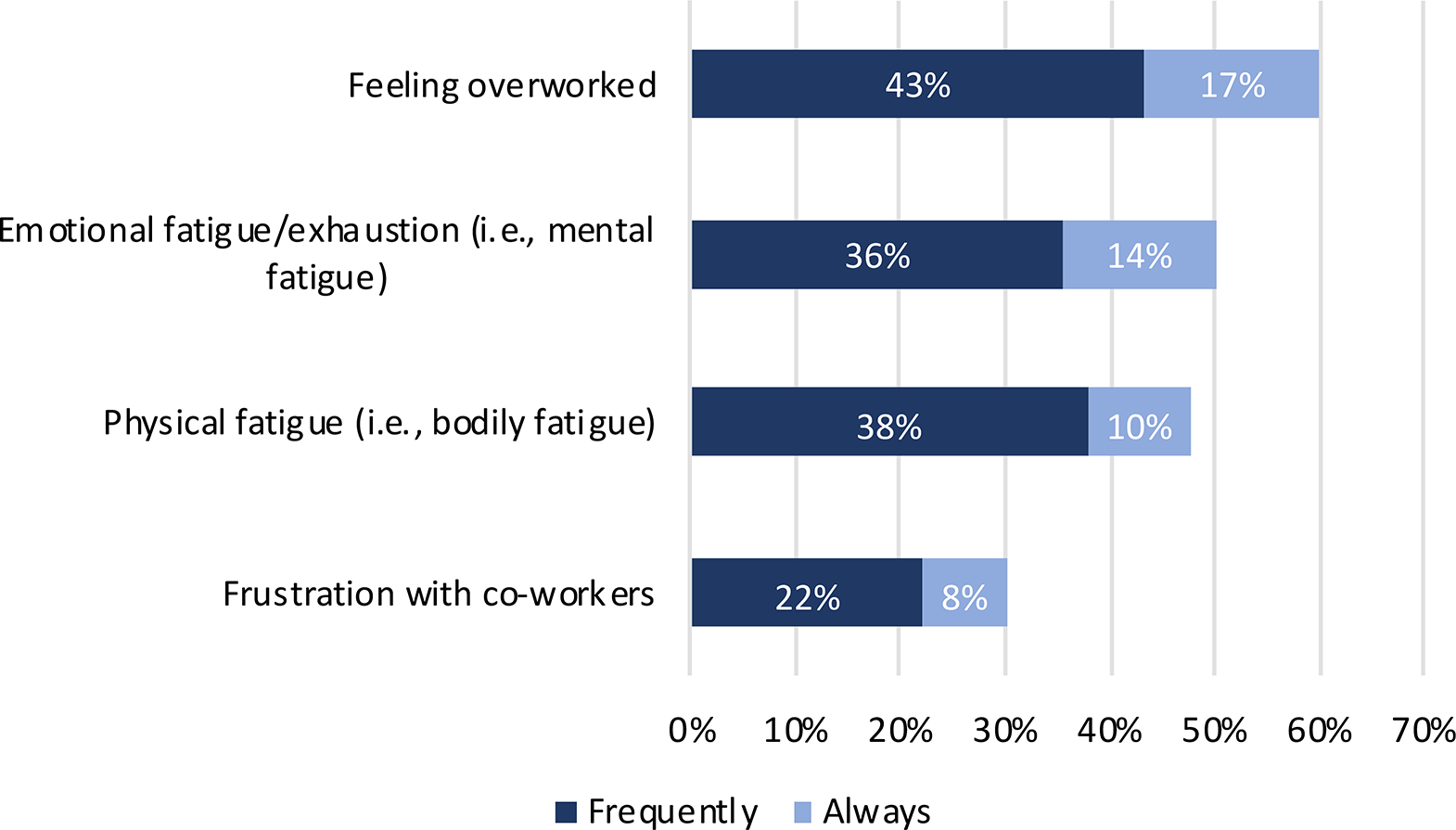
Frequency of job-related stress types (n = 85).
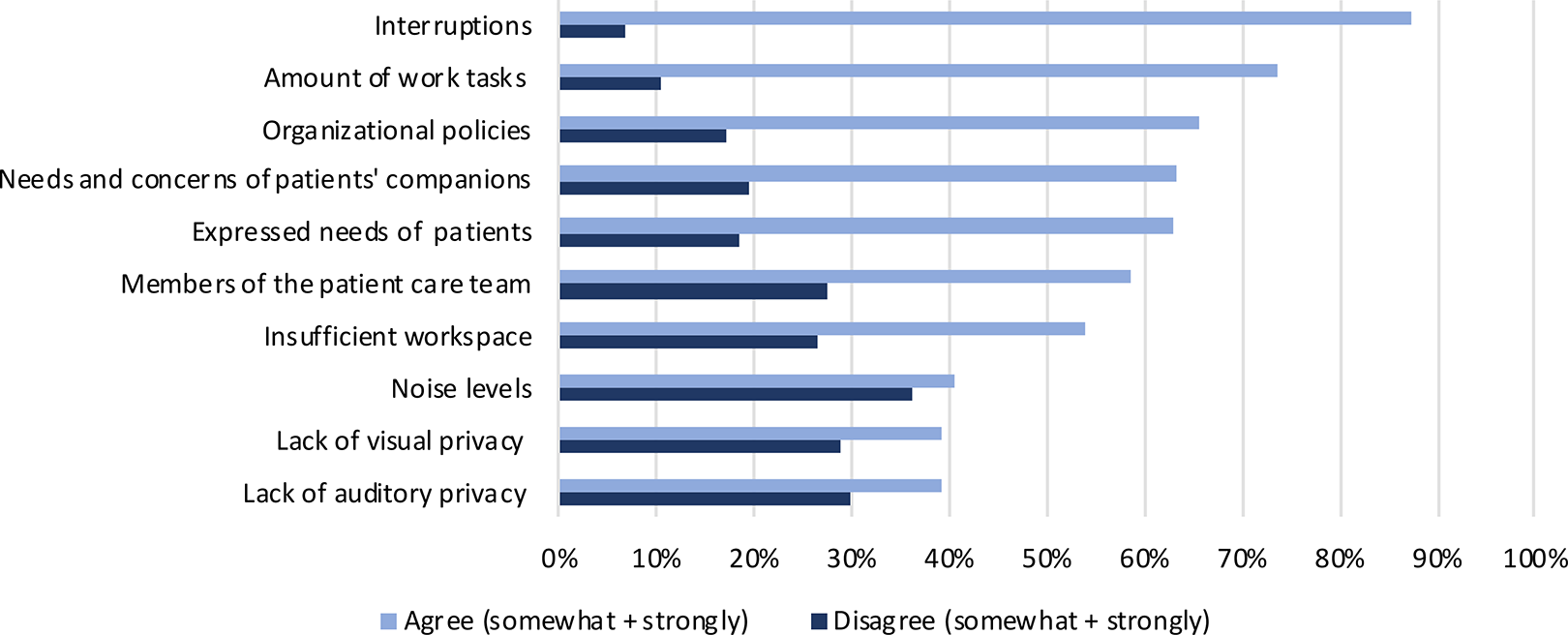
Sources of stress (n = 85).
In response to the question about activities in which participants engaged to destress at work, 90% agreed that it is somewhat likely or extremely likely that they talk with a colleague. As shown in Figure 4, this was the only activity that more than 58% of participants believed they would be extremely likely to do to destress. From a physical environment perspective, this result shows the importance of having a place where those sensitive conversations could occur. The next highly selected activities were getting something to eat or drink, listening to music, and taking a walk (more than 50%). Most comments by respondents who selected “other” implied that they believe they have no time to think about stepping away from work. This finding is also supported by interview data in which several participants noted that they do not have time to take a break and that they can barely find time to use the restroom, when necessary. The inability to take breaks appears to be part of a culture of acceptance among clinicians that their needs are not particularly important.

Likelihood of engaging in specific activities to destress while working in the emergency department (n = 85).
One of the most surprising findings was that the majority of respondent identified the bathroom as the place to go to step away from work demands (somewhat likely or extremely likely for 70%). Participants in the hospital-based ED who were interviewed stated that there is an insufficient number of staff restrooms. When someone would lock themselves inside to catch their breath or cry, almost immediately someone would jiggle to handle, attempting to enter. Second to the bathroom, participants would step outside for fresh air (50%). Over 25% also agreed that they are somewhat likely or extremely likely to go to the physician-only area or the care team station to destress. Only a bit more than 20% identified the breakroom as a place of respite (Figure 5).

Locations where staff are likely to go to step away from work demands (n = 85).
Analysis of questionnaire data demonstrated that over 90% of respondents found comfortable furniture, convenient access to snacks/beverages, and minimizing unwanted noise helpful in supporting coping behavior. Overall, every single identified environmental attribute was perceived as supportive by over 50% of respondents (Figure 6). None of the attributes listed was identified by more than 12% of respondents as being present in their current workplace. Of those attributes present, comfortable furniture in work areas and the ability to dim or brighten lights were most available to respondents, while the ability to change the color of lighting, aromatherapy, or soothing scents were available to the least number of respondents (less than 1%), followed by visual privacy (2%) and comfortable furniture in the breakroom (3%). In response to the open-ended question about possible changes to their physical environment to enhance their ability to cope with job-related stress, participants mentioned having the ability to control temperature and lighting, more private spaces, reduced noise and clutter, spaces for decompressing and grieving, dedicated spaces for documentation, close-by breakrooms with enough eating space and massage chairs, chairs with back support, standing desks, food options for night shifts, convenient bathrooms, and anything to reduce interruptions.

Perceived potential of environmental attributes as helpful in creating a work environment that supports healthcare professionals coping with job-related stress (n = 85).
Responses to the last category of questions demonstrated that security issues were a concern in EDs because of agitated patients and consequent violence against healthcare workers. The importance of safety cannot be overstated. Twenty-five percent of them felt somewhat unsafe at work and more than 14% felt extremely unsafe in their workplace. The vast majority of clinicians who reported feeling unsafe were female (78%). When asked about anything related to their physical environment that may compromise their safety, responses included lack of constant security presence in the ED and lack of privacy from patients in workstation, protection for lobby staff, and metal detectors. Interviews with clinicians also demonstrated that they often felt threatened by patients and their companions in the workplace, especially when working out of sight from their colleagues or in areas that are highly accessible.
Interview Findings
The questionnaire was followed by 20 interviews with staff who expressed interest in participating, to gain a deeper understanding of questionnaire findings. Interviewees included eight registered nurses, four attending physicians, six residents, and two physician assistants. Generally, clinicians seemed perceive the physical environment as an important factor in their environment of care. One participant worded it as, “I do strongly believe that there are aspects of the physical surrounding that can directly influence our ability to work.” After transcripts were coded, content analysis resulted in four themes named: Culture of Acceptance, Physician Centricity Versus Staff Integration, Privacy Please, and No Place for Refuge.
Culture of acceptance
Participating ED clinicians seemed resigned to the fact that the ED will be short-staffed, there is a high probability that they will feel threated, and they will not have time to take breaks, even for lunch or dinner. Two recurring subthemes were identified: “We don’t take breaks” and “We often feel threatened.”
We don’t take breaks
Participants, especially nurses, talked about stress resulting from the fast-paced nature of working in the ED and having numerous demands that must be handled at once. As a nurse, especially in the emergency department, you are always needed. So, it’s basically 12 hours of being constantly needed, and there is no way to escape being needed or nowhere to go and not being needed even for 2 min to go to the bathroom because you have that sense in the back of your head like Yes, I’m going to the bathroom, but I have all these three patients that all need something.
Another clinician noted, “We get irritable because we can’t eat. We can barely pee and stuff like that.”
Healthcare workers in the ED setting often feel as though the work culture does not encourage them to step away from work demands, and they are concerned about being viewed as a “slacker” if they are found taking a break. Furthermore, they are simply too busy throughout their shifts to take necessary breaks. For example, in response to the question “Do you typically take breaks?” one attending physician said: You can’t take breaks in the ER. We don’t get a break. You can go in the break room, but you might get a phone call, or you might get a trauma, or you might get [inaudible] so there’s no designated protected break. See, we’re allowed to take breaks if you can take a break, but you’re always on your phone. If I go and get coffee, they may say, “We have a trauma coming in in five minutes,” and I have to run right down there.
Other participants also noted that stepping away to decompress is simply not feasible, so the spaces in which they work must be supportive. One interviewee stated, “We never get time to step outside or take breaks, so who cares how nice those areas are if we can never use them.” Another clinician stated: We don’t work in an environment we can step away from. We need to make the place we are in most frequently (nurses station/provider area) more inviting, accommodating, and conducive to constantly be in…because that is the reality! We can’t just leave to destress. Our work area needs to be rethought and [incorporate] intentional interventions to handle our typical ED stressors.
Participants indicated that the constantly changing work environment in the ED and fluctuating patient volume creates an unpredictable situation that increases stress among care providers and patients. Participants referred to a lack of prior patient information and dealing with patients across the spectrum of acuity and disease complexity as stress-inducing factors, especially for physicians who must act on the information that they have at the time. Unexpected increase in patient volume due to different circumstances, sometimes throughout a work shift, was frequently cited by participants as a major stress-inducing factor. A resident from the hospital-based ED noted that pods with lower acuity patients may create more stressful environments because they tend to have higher patient volumes.
Inevitably, those working in the ED setting will lose patients after struggling to save them and immediately jump into the next urgent case without taking time to process or decompress. One nurse commented: I’ve been in the ER for 10 years. We still don’t have anything set up for any of the nurses, anybody, to debrief, any way to just de-escalate and talk about what could we have done better. We sometime, after a code, will talk about what could we have done, but it’s not consistent. We just bury it down, just try to go about our day.
We often feel threatened
Some respondents said they felt unsafe every day in their work environment. Clinicians indicated that dealing with angry companions, violent patients, or unstable and/or armed random visitors is often seen as just being “part of the job.” A clinician working in one of the free-standing ED’s noted, “…so that’s another potential security concern, too, just that because you’re so physical removed from everyone else, that there’s no security where we are. It’s completely open access. There’s no physical barrier, or at least any hint of it.”
Furthermore, there are often few consequences for those who become aggressive. It’s inevitable. You are gonna get into those situations, I think. People get angry…I pressed charges on [a woman] because she lunged at me like she was going to hit me. That’s threatening behavior to me. I filed charges. It doesn’t go anywhere though.
Some participants suggested installing Plexiglass-type barriers around the care team stations to protect the frontline staff, while the administration did not like the idea because it did not seem welcoming to the patients. Some participants suggested that the presence of armed security officers would boost feelings of security and prevent people from misbehaving. Participants noted the risks associated with having enclosed staff areas that have just one entrance/exit. One commented: There’s been some incidents. Sometimes it’s scary. You are kind of locked in that box. If someone comes in there, there’s no other way out. There’s one way in and one way out.
Another participant noted that sometimes they need to tell residents not to put themselves in harm’s way where they find an angry patient or family member between them and the door.
Physician centricity versus staff integration
Participants talked about an existing debate over whether there should be a physical barrier between doctors and nurses. In the hospital-based ED, there is a separate glassed-in space, sometimes referred to as the “doc box,” for physicians, physician assistants, and nurse practitioners only. The physical barrier was perceived as a hindrance to physician–nurse communication by nurses, who would prefer that it be removed. Most physicians, however, strongly advocated for having a separate space for themselves to reduce interruptions and unwanted noise when they need to concentrate. One physician stated that doctors and nurses are undergoing different types of stress and expressed their opinion that ultimately doctors are responsible for patients’ conditions, incidents, and so on. Therefore, having a separate space should be understandable. However, some physicians stated that having a shared space for physicians and nurses might foster communication flow and ultimately improve patient care quality. One physician said she wished the fourth wall of the “doc box” (a four-walled glass room) was removed and integrated a bit more into the nursing station, because overhearing nurses often draws doctors’ attention to important issues about patients that might seem unimportant to nurses and therefore not shared with physicians. She also noted that she was definitely in the minority, having this opinion. I think that communication with the nurses is nice to have a little more clearly and it’s very exclusive and very fancy to have the docs all in their own box but you don’t get to overhear the nurses saying stuff that’s really important. The nurse will casually mention something that turns out to be really important and they didn’t think it was important enough to tell you because they don’t know.
Another physician noted although she supports having a separate space for doctors, there are advantages of sitting close to nurses in terms of overhearing issues and avoiding incorrect orders and miscommunication, commenting, “Well, one of my favorite things about that space out there is the fact that we sit so close to the nurses that we can easily identify issues, wrong orders, miscommunications.”
The discussions on whether physicians should have their own workspace, separate from nurses, revealed a power dynamic that has existed for decades. Physicians perceived their roles as being different enough from nurses to warrant greater privacy and less accessibility to others, to enhance their ability to concentrate. Nurses were described, at times, as being noisy and engaging in a lot of “social talk.” This finding raises the question as to whether designing integrated staff teamwork areas, which the literature recommends, will result in the desired outcomes as long as these perceptions, which may or may not be accurate, persist. Perhaps physicians will find a way to segregate themselves anyhow. The first author has observed, during postoccupancy evaluations, labeling of several computers in a shared workspace as being “for physician use only.”
Whether or not clinicians work in separate areas based on their role, participants noted that adequately sized care team stations would help reduce stress. Care team stations are often crowded because they are too small to accommodate all staff members who need to use them at the same time (e.g., nurses, physicians, scribes). Some staff areas, like offices, have been converted to storage spaces. In fact, any space that is viewed as superfluous is turned into a storage area for equipment and supplies. Participants mentioned needing additional touchdown spaces, such as small offices, to focus on work with minimum distractions and to communicate with others.
Privacy please
Statements around the issue of privacy, including visual, acoustic, and physical accessibility were pervasive. Some participants noted that patients and their companions have too much access to staff. One physician stated that it is difficult to provide corrective instruction to colleagues for fear of being overheard. For example, one physician stated: There is no barrier for us to discuss patients or difficult parents without wondering if they [family members] are standing on the other side of the wall listening. So, some of those conversations that you would like to have with the residents maybe don’t occur because you don’t know who’s right around the corner.
Another clinician noted that they find themselves pulling residents into a makeshift storage area in a staff-only corridor to let them know how they could have handled a situation better.
Clinicians need visual as well as auditory privacy. One participant noted, “I’d appreciate if patients couldn’t see me and bang on the window for my attention, like I’m a zoo animal.” Healthcare workers in the ED setting spend most of their shift “on-stage” with limited visual and acoustical privacy. Not only can this cause stress among staff members, but they also perceived that constant visibility by patients and companions hinders vital staff-to-staff communication. Participants noted that open layouts provide high visibility to patients and perceived control over the care environment, too much openness may make physicians too accessible to patients or visitors. One participant stated that nurses prefer to sit where they have good visibility of the “sick kid room” but “We’re the first ones people see when they come around the corner. So…angry parents come and are like ‘Why am I still here? What are we doing? You’re not doing your job.’”
Many respondents noted that constant interruptions and distractions caused stress, citing numerous examples. This was most obviously expressed by physicians who worked in the hospital-based ED. When asked what they needed to help them cope with job-related stress, one participant commented, “The biggest thing would be to be interrupted less. Interruptions are the biggest stressor.” Several doctors stated that being able to concentrate without interruption is a necessary component of optimum care delivery, but it is lacking in their work environment. Nurses also complained of distractions. One commented, “There is nowhere for nurses to document in quiet without interruption,” and another mentioned the need for “a private area where nurse charting can be uninterrupted by patients and families.”
Other staff members are a source of interruptions and distractions. Although some distractions are helpful, like overhearing important patient information, frequent interruptions can be detrimental to both job performance and patient well-being (Coiera et al., 2002; Weigl et al., 2020; Westbrook et al., 2018). One participant stated: It’s a very small space that we all are jammed up in, working. There’s a lot of noise, distraction, patients coming through, nurses constantly interrupting. We cannot even talk to a doctor without being interrupted every few seconds, and when we work, the noise distraction just from social talk and laughing…it’s just distracting. I actually put ear plugs in my ears.
Some participants blamed having an open layout for the barrage of distractions and interruptions. Although noted as enhancing communication between physicians and nurses, it can also contribute to the amount they, specifically physicians, get interrupted, minimizing their attentiveness. Regarding interruptions, one physician stated, “You might have to go back like hours later and be like, ‘I totally missed something. Now I have to redo everything that I just did because I got interrupted at the critical time when I was putting in orders.’”
No place of refuge
Although the clinicians who were interviewed seemed to accept the fact that they do not have time to take a break, they also acknowledged that sometimes it is imperative to momentarily step away from work demands. One participant noted, “There is nowhere for us to retreat to.” At one of the free-standing EDs, a physician stated, “We’ll do a lap, walk around, especially if there’s tension among staff. I’m like, ‘You need to go outside and go do a lap.’ Our building is so small. We don’t have a lot of places to go that are private.” This comment about taking a walk supports findings from the questionnaire indicating that taking a walk was selected by approximately half of all participants as an activity in which they engage to destress.
Some participants described work environment attributes that would make it easier for them to cope with job-related stress. For example, staff members frequently mentioned that they often seek a quiet moment to decompress in the restroom, yet several interviewees in the hospital-based ED stated that there are simply not enough staff restrooms available to them that are proximal to their work areas. Often, they step inside, lock the door, and seconds later someone else is there needing to use the restroom. Restrooms should be sufficient in number, conveniently located and provide olfactory, auditory, and visual privacy from patients, visitors, and other staff members.
Staff areas (e.g., break rooms, cafeteria, and EMS room) located outside the unit were considered too far away because staff cannot be far from their patients. There was a common perception among staff that they are viewed as “slackers” if they spend time in a “break room.” One participant stated, “Many times we end up eating at the nurse station, and while doing so family/patients/staff are constantly coming up to us.” However, taking a short walk to a coffee shop in the lobby was perceived as an effective way to step away from work demands momentarily. Physicians and nurses noted a lack of private spaces to take quick pauses throughout the day and places to compose themselves after losing a patient. Many participants expressed that there is a need for a dedicated and accessible space inside the ED where staff can go to unwind when they are experiencing job-related stress. Having a welcoming, safe, quiet place where staff can pop in for at least a couple of minutes was perceived as being helpful. Break rooms are often considered to be too far away from workstations for a momentary pause. A few participants noted that there is some sort of a secret place in the hospital where staff sometimes go when they need to cry, but the location of that place, which is not a designated respite space, was undisclosed.
Participants clearly articulated how one might design a respite space where they could step away from job-related stress. They often noted the importance of visual and auditory privacy, easy access (adjacency to ED), noise control, lockable doors, and access to and ability to control natural light. Some mentioned that it would be nice to have a massaging chair available to them. Several participants commented on the benefits of having an outdoor place to take a few minutes to relax, eat, drink, or put their feet up. They talked about how such a place, close to the ED and with comfortable seating, could help them destress by changing the scenery and allowing them to get some fresh air.
Discussion
Our findings demonstrated that interruptions, lack of privacy, the inability to take breaks, security concerns, as well as overworking and fatigue were common issues in the three participating EDs. Distractions from patients and family members were identified as interruptions to participants’ workflow. Working in the care team station or in physician-only areas did not deter family members from interrupting the professionals. Lack of privacy, both visual and auditory, affected their ability to accomplish tasks and provide optimal care. EDs are shown to be highly interrupt-driven workplaces (Brixey et al., 2008; Chisholm et al., 2001) associated with significantly increased rates of prescribing errors among physicians (Westbrook et al., 2018), which could have a substantial negative impact on patient safety. Emergency room physicians are interrupted as many as 6–11 times per hour (Blocker et al., 2017). Interruptions are demonstrated in experimental studies to reduce individuals’ task performance due to the additional cognitive demands they incur (Foroughi et al., 2014). The reported lack of privacy and overworking often contributes to multitasking which leads to errors (Westbrook et al., 2018).
Physical environmental strategies suggested to mitigate interruptions go hand in hand with improving privacy, including developing “no interruption” zones or quiet rooms locating medication dispensing machines in closed versus open areas (Chaudhury et al., 2009), designing enclosed physician workstations (Joshi et al., 2021), and incorporating private workspaces as well as glass partitions between care team areas (Gunn et al., 2015). Despite a high emphasis on teamwork, collaboration, and communication in healthcare design literature (Morley & Cashell, 2017; Schneider, 2012), findings about high levels of interruptions and their negative consequences in the healthcare environments (Blocker et al., 2017; Monteiro et al., 2015) call for revisiting open work environments and seeking solutions that achieve a balance between collaboration and concentration. The same pattern is observed in office design, where companies have been trying to beef up spaces that support collaboration and minimize areas for individual work. The trend toward more openness and greater transparency has led to a pressing need for privacy at work and studies that advance our understanding of interior spatial boundaries. In healthcare workplaces, while access and visibility are essential for promoting collaboration, privacy is crucial for reducing distractions. To strike a balance, designers may consider providing different levels of privacy to support a range of work, allowing workers to move from open workstations to more private spaces once they need to have more focus or sustained attention (Valipoor & Bosch, 2021). This strategy can meet the needs of physicians who raised concerns about not having physician-only spaces in this study. If workspaces with different levels of privacy are not labeled to indicate a specific group, care team members, regardless of their roles, may use them based on their work type (e.g., solo, collaborative).
Generally, healthcare professionals in this study were too busy throughout their shifts to step away from their work, and a work culture that did not support taking necessary breaks prevented them from doing so. When staff members were able to “catch their breath,” this often occurred outside of the unit by taking a walk or going to the coffee shop. They also used the bathroom to momentarily step away from work demands. Having a snack or drinking a beverage were common coping strategies, but the facilities surveyed offered a limited selection of healthy snack options. A work culture that does not support taking breaks corresponds to findings of previous studies on healthcare professionals in hospitals (Monaghan et al., 2018), but some interventions are suggested to encourage stepping away from work. These include adding 5- to 10-min timeouts to the work shifts when needed (Harris & Griffin, 2015), engaging in daily recovery behaviors, such as using relaxation techniques (Botha et al., 2015; Smith, 2014), and providing opportunities for social support (Woodhead et al., 2016). To facilitate these interventions, it is imperative to consider spaces that provide rest and rejuvenation for individuals and groups. Our findings regarding staff’s preference for walking outside for fresh air and snacking to cope with stress is in line with other reports (Markwell et al., 2016; Sachs, 2019). Another interesting finding is that while the most desired locations for stepping away from work demands were places for solo activities (such as bathroom with the highest rate of 70%), the majority of questionnaire respondents chose “talking with a colleague” as an activity for destressing while at work. This finding underlines the importance of providing spaces for both solo time and conversation with a colleague. There may be times that someone needs to run into a space to be alone (e.g., to cry, to have a spiritual moment, to vent to a close person on the phone) or to talk with a colleague. Designers may consider providing opportunities for both scenarios.
Another finding is that those working in ED settings are quite concerned about their own safety. This finding is in line with several studies that argue there is a culture of “violence-acceptance” in the ED (Wolf et al., 2014). It is vital that designers make informed design decisions with respect to security when designing an ED. The safety risks, and associated stress, are a grave concern. Our finding regarding the presence of armed security officers, which was perceived to boost feelings of security and prevent people from misbehaving, was consistent with the research suggesting that the visibility of security stations may deter patients or visitors from committing violent acts (Fay et al., 2017; Pati et al., 2016; Shaw, 2015).
Our findings also highlighted the existing debate about whether care team stations should be enclosed for safety or open and accessible, providing a more human-centered, welcoming environment (Platt et al., 2017). Although patients and their companions seem to prefer greater accessibility to staff (Southard et al., 2012), healthcare workers often view open workstations, with limited barriers between them and patients, as a potential threat to their own safety.
Mohammadigorji and colleagues (2021), based on a review of pertinent literature, recommended design-related strategies to prevent or mitigate violence against healthcare workers. These included approaches for providing natural surveillance (e.g., visible presence of security personnel, larger pods to reduce staff isolation), access control (e.g., lockable double door between reception/waiting and patient care areas, automatic doors that do not stay open longer than necessary), and territoriality (e.g., adequate privacy for patients and staff, human-centered care team stations with enough of a barrier to protect staff). Other strategies include providing two doors in triage rooms so that staff can evade an aggressor, if necessary; locating an area devoted to behavioral health patients away from entrances and exits so as to reduce triggering situations; and ensure that ambient conditions (e.g., noise levels, temperature) and furniture are comfortable. A closely related design concept that allows staff to have access to a second door is the “On-stage/Off-stage” layout that separates patients/visitors from staff with dedicated patient corridors leading to exam rooms (on-stage) with doors on two sides and enclosed staff work cores (off-stage; Freihoefer et al., 2018). This layout is shown to provide a higher level of security for staff compared to those with a central or one common hallway (Gosavi et al., 2016) and improve staff workflow, reduce travel distances, and increase communication compared with linear layouts (Freihoefer et al., 2018). The off-stage area may also offer other stress-reducing advantages related to the findings of this study, including opportunities for care team discussions or spaces for respite and decompression in proximity but private from patient care areas.
For future research, having a larger sample size for each of the various clinician roles (physician, resident, physician assistants, nurse practitioners, and registered nurses) to ascertain possible differences in their experiences coping with job-related stress will further expand the body of knowledge and understanding of this important research topic. One physician interviewed stated that physicians carry the ultimate weight of responsibility for patient well-being, which might suggest that they may experience higher levels of stress. More data points would also provide insight as to whether those working in free-standing EDs experience and cope with stress differently from those working in hospital settings. Future research will include a more diverse representation of EDs, as this study was confined to one academic health system only. However, the data acquired in this study has provided important insight into the important question of how ED clinicians experience stress in their workplaces.
Conclusions
With growing concerns for healthcare worker well-being and burnout during and following the COVID-19 pandemic, the need to find ways to help them cope with job-related stress has never been more urgent. Although environmental design cannot solve the greatest source of stress identified—understaffing—design decisions play an important role in supporting stress reduction among healthcare workers, especially those working in high-stress emergency settings. Healthcare designers should strive to ensure that staff members have sufficient workspaces and can work without constant interruptions, that their workspaces are adequately sized and support efficiency in workflows, and that staff members have an informal place where they can interact with each other. Given the adverse effects of stress among healthcare workers and the potential for design to help them cope with job-related stress, there is a good business case for healthcare providers to invest in these types of strategies.
Implications for Practice
Healthcare workers frequently feel overworked, exhausted, or emotionally fatigued. When designing EDs, providing sufficient workspace can facilitate handling heavy workloads, a primary source of stress.
Strategies to minimize work interruptions and maximize visual and auditory privacy may enhance healthcare workers’ ability to cope with job-related stress.
Designers should consider creating a refuge-like space in the ED where workers can step away from job-related stress. Privacy, easy access (adjacency to ED), noise control, lockable doors, and access to and ability to control natural light and temperature should be considered for such space.
Designing an outdoor place with comfortable seating can provide opportunities for getting fresh air, changing the scenery, relaxing, and eating or drinking.
Establishing places for solo activities, such as convenient bathrooms, and places where sensitive conversations could occur among workers should be considered. Access to food and beverages, music, and places to take a walk among colleagues could facilitate destressing.
Footnotes
Declaration of Conflicting Interests
The author(s) declared no potential conflicts of interest with respect to the research, authorship, and/or publication of this article.
Funding
The author(s) disclosed receipt of the following financial support for the research, authorship, and/or publication of this article: This work was supported by a faculty seed grant from the College of Design, Construction and Planning at the University of Florida.
