



Abstract
Hospitality employees inevitably face emotional exhaustion when performing their jobs. The purpose of this study was to investigate dispositional antecedents of hospitality employees’ emotional exhaustion, including self-instability, pessimism, and affect variability, and how employees’ affect variability mediates the relations between self-instability and pessimism and emotional exhaustion. In addition, we explored the moderating role of positive work reflection on the relation between affect variability and emotional exhaustion. A total of 224 frontline employees in 18 four- and five-star hotels in Ecuador responded to surveys about their emotions and work lives. The findings suggest that (a) emotional exhaustion was influenced by affect variability, (b) affect variability mediated the relations between self-instability and pessimism and emotional exhaustion, and (c) the relation between affect variability and emotional exhaustion was weakened by positive work reflection. The results highlight the importance of potential low-cost and easily trainable interventions that could help in attenuating the negative effects of highly variable emotions and the resulting exhaustion that are prevalent in the hospitality industry. This research is among the first to examine the dispositional antecedents of emotional exhaustion, and the first to highlight the role of positive work reflection as a moderating variable that can buffer the negative effect of affect variability on emotional exhaustion.
The quality of the interaction between customers and frontline employees has a profound impact on customers’ satisfaction levels, their intentions to repatronize, and their willingness to share positive word-of-mouth about an organization. Hospitality organizations require employees to focus on flawless service to maintain success in the industry. Employee demeanor plays an important role in that process, and managing employee emotions and involving employees in frequent and intense interpersonal contact with customers have both been recognized as important aspects of maintaining loyal customers (Lee & Ok, 2012). However, employees are not always good at managing their emotions, and they often feel exhausted (Grandey, 2000). They are confronted with emotional exhaustion, which is a key aspect of employee burnout (Maslach & Jackson, 1981) and is defined as “the extent to which employees feel emotionally overwhelmed and drained by their work” (Janssen, Lam, & Huang, 2010, p. 788).
Emotional exhaustion gives rise to a number of negative job-related consequences, including decreased job satisfaction (Lewig & Dollard, 2003), low job performance (Halbesleben & Bowler, 2007), low organizational citizenship behavior (Cropanzano, Rupp, & Byrne, 2003), poor general health and psychological and physiological well-being (Khamisa, Oldenburg, Peltzer, & Ilic, 2015), and eventually high propensity to leave their jobs (Kraemer & Gouthier, 2014). Against this backdrop, it is critical to understand the factors that predict emotional exhaustion. Identifying the antecedents of emotional exhaustion will help hospitality organizations solve of the riddle of why employees remain exhausted and complain about the workplace. This study sheds light on the ways in which various factors affect emotional exhaustion and can help hospitality managers to take measures to reduce employee emotional exhaustion.
Research has shown that one of the influential predictors of emotional exhaustion is negative valenced affect because emotional exhaustion involves feelings of negative tone, being emotionally overextended, and drained by one’s work (e.g., Burke, Brief, & George, 1993; Wright & Cropanzano, 1998). In addition to negative affect, affect variability is an understudied affective disposition that is likely to be related to emotional exhaustion. To illustrate the meaning of affect variability, an individual characterized by higher levels of affect variability experiences affect that reaches higher extreme levels and shows greater deviations from the mean level of affect. Affect variability plays a significant role in predicting individuals’ psychological and physical functioning, above and beyond average levels of affect (Eid & Diener, 1999; Gruber, Kogan, Quoidbach, & Mauss, 2013).
Little research has examined the antecedents of affect variability, and what factors can protect employees who experience a high level of fluctuations of emotions. Using the cognitive appraisal theory of emotions (Frijda, 1986), we propose self-instability and pessimism to be critical factors related to affect variability and, in turn, related to emotional exhaustion. Another important element to consider is how employees’ nonwork experiences during leisure time could attenuate the negative effect of affect variability on emotional exhaustion. As such, we introduce a potential buffer to reduce the effect of affect variability on emotional exhaustion: positive work reflection during leisure time. The conceptual model of this research is depicted in Figure 1.
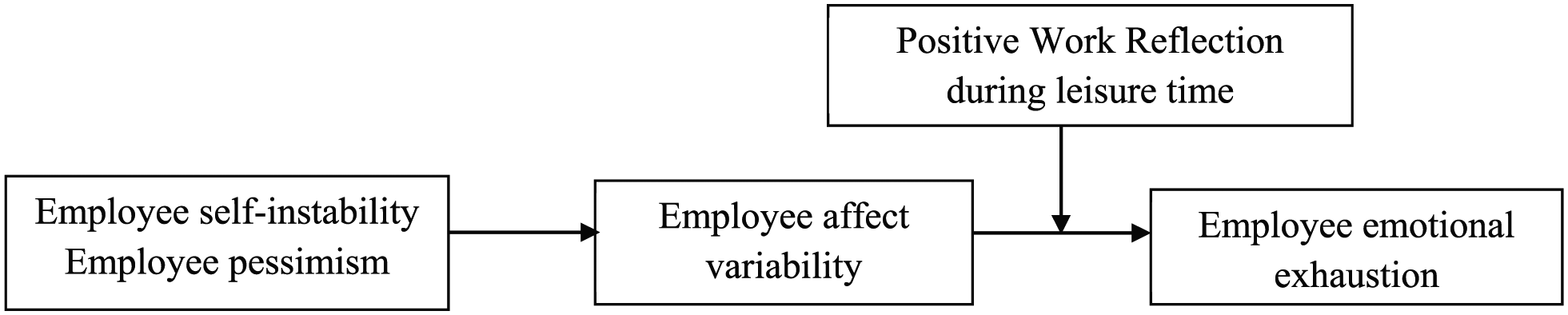
Conceptual Model of the Antecedents of Hospitality Employee Emotional Exhaustion.
Conceptual Model and Hypotheses
Affect Variability and Emotional Exhaustion
We anticipated that employees’ emotional exhaustion would be influenced by affect variability. Affect variability is defined as the frequency, speed, and magnitude of fluctuations in affective states (Oliver & Simons, 2004). Some individuals are stable in terms of their affect, whereas others experience fluctuations in their affect that may include extreme emotional states. High degrees of affect variability render individuals vulnerable to the sufferings of everyday life. For example, feeling very happy one moment and very unhappy the next could trigger a physiological stress response, which could alter cortisol profiles (Human et al., 2015) and have negative long-term consequences for both psychological and physical health (e.g., Houben, Van Den Noortgate, & Kuppens, 2015). This could then further translate into emotional exhaustion, job dissatisfaction, and absenteeism, which have been shown to negatively affect customer/employee interactions in service contexts (Grandey, 2000).
Emotional exhaustion is characterized by feelings of being overextended, drained, and depleted of one’s resources (Maslach, Schaufeli, & Leiter, 2001). According to theory on personal resource depletion (e.g., Hobfoll, 1989), individuals have limited personal resources that allow them to engage in various taxing events throughout a day. Completing a variety of emotional activities—especially in hospitality contexts requiring an effortful regulation of emotions—could be particularly draining because of the depletion of psychological resources (e.g., Shani, Uriely, Reichel, & Ginsburg, 2014). Individuals with higher affect variability are more likely to have to engage in affect regulation to fulfill the emotional requirements of the job, relative to those with lower affect variability. Therefore, employees whose affective states are more variable and erratic could experience a higher depletion of their psychological resources at work, in comparison with employees whose affective states are more stable. Excessive consumption of resources is related to unfavorable results, such as lower levels of motivation, task focus, well-being, and psychological health (Hobfoll, 2010), which could ignite a downward spiral of further emotional exhaustion. Given the aforementioned argument, it is expected that affect variability would be positively associated with emotional exhaustion because of emotional resource depletion, and therefore, it is hypothesized as follows:
Antecedents of Affect Variability
In this study, we examine how self-perceptions are related to affect variability, which is in turn associated with emotional exhaustion. Self-perceptions are important to understand emotional traits (Dizen & Berenbaum, 2011). The cognitive appraisal theory of emotions (Frijda, 1986) conceptualizes self-perceptions as the antecedents to emotional reactions, which elicit, differentiate, and influence the intensity of different emotions (Dizen & Berenbaum, 2011). Most of the previous literature has used the cognitive appraisal theory of emotions to examine which specific cognitive appraisal dimensions predict which discrete emotions (e.g., a perception of self-blame predicts guilt and fear; Lutwak, Panish, & Ferrari, 2003). This study was based on the expectation that cognitive appraisal theory could also help in explaining affect variability, as individuals tend to be relatively stable in many important aspects of their appraisals and perceptions of events (e.g., Peterson & Villanova, 1988), which in turn contributes to their being relatively stable in how they respond emotionally. Based on the cognitive appraisal theory of emotions, it is posited that affect variability will be positively associated with instability of self-concept and pessimism.
Self-instability
Self-instability refers to the instability of one’s self-concept (e.g., perceived personal attributes), self-perceived inconsistency, and temporal instability of self-aspects (Dizen & Berenbaum, 2011). Individuals higher in self-instability have a less clearly and confidently defined self-concept, or they have a less organized knowledge of traits, values, and episodic and semantic memories about the self, and have little control of the processing of self-relevant information (Campbell et al., 1996). According to Conley (1984), self-instability is an opinion about the self, a type of individual difference that can be assessed as a trait, and a state that is susceptible to environmental influences.
Most relevant literature on the relation between self-instability and emotional reactions is part of the extensive research on self-esteem variability, which is defined as the magnitude of fluctuations in one’s level of self-esteem (Dizen & Berenbaum, 2011). The existing research suggests that the extent to which people’s self-esteem fluctuates contributes to changes in their affect. Someone whose self-esteem is consistently threatened or bolstered differentially over time will experience the concomitant affective reactions associated with these negative and positive experiences. For instance, Kernis, Grannemann, and Barclay (1989) demonstrated that self-esteem instability was positively related to variability in mood. In addition, past research has also found that self-esteem instability was positively related to variability in both positive and negative affect (e.g., Rhodewalt, Madrian, & Cheney, 1998).
However, the specific relation between self-instability and affect variability has rarely been examined (Dizen & Berenbaum, 2011). Based on cognitive appraisal theory, we argue that a higher level of affect variability will be related to a higher level of instability in perceptions of self-concept. Individuals higher in self-instability tend to be more vulnerable to external events. The theory assumes that specific events trigger thoughts and feelings in one’s self-concept that are most relevant to the immediate context, and are also likely to similarly stimulate simultaneous arousal and emotions as a natural response to these events. Therefore, the affect of individuals higher in self-instability will be more positive after positive events and be more negative after negative events, thus producing higher affect variability over time (Campbell, Chew, & Scratchley, 1991).
Researchers (e.g., Lee-Flynn, Pomaki, DeLongis, Biesanz, & Puterman, 2011) have argued that individuals with less self-instability may be less affected by and more able to deal with the external events or stressors. For instance, individuals who are certain of their self-concepts (i.e., low self-instability) are more likely to seek out information that verifies self-beliefs that they are certain about (Arkin, Oleson, & Carroll, 2013) and less likely to change their self-beliefs (Swann, Pelham, & Chidester, 1988). Therefore, they are more resilient to external events. When they deal with external events that are threatening and uncontrollable, they would respond more effectively by using the clear and certain aspects of the self, resulting in less affect variability. On the contrary, individuals with unstable self-concepts, or high self-instability, are more likely to show intense reactions to external events, because their self-concepts cannot provide them with effective and consistent knowledge of how to respond (Kernis, Paradise, Whitaker, Wheatman, & Goldman, 2000), resulting in higher affect variability. Thus, individuals higher in self-instability who feel inauthentic across different contexts or across different time periods will likely experience higher fluctuations in affect as well (Campbell et al., 1996). Thus, it is hypothesized as follows:
Pessimism
In addition, we examine the relation between affect variability and pessimism. Pessimism is defined as holding negative expectations about future events, or the belief that adverse results will occur in the future (Kuppens, Van Mechelen, Nezlek, Dossche, & Timmermans, 2007). Kaiser, Major, and McCoy (2004) argued that a pessimistic outlook involves threatening appraisals and is associated with greater psychological vulnerability. We believe that investigating sources of vulnerability, such as pessimism, could help to make sense of variability in employees’ affective responses to work events.
Pessimism has been theorized to influence individuals’ adjustment through its impact on cognitive appraisals, and has been found to be negatively associated with psychological adjustment because pessimists tend to appraise stressful events as more taxing and threatening and are not as able to cope with the events, compared with optimists (Brissete, Scheier, & Carver, 2002). Generally, theories on emotion regulation and self-development suggest that people with poor psychological adjustment are characterized by higher levels of variability of reported affective experiences over time (Ram, Gerstorf, Lindenberger, & Smith, 2011). In addition, individuals who are high in pessimism tend to hold low self-beliefs about their own affect and are low in their capacity to regulate mood. When they feel confused about their emotional knowledge capability and have low confidence in their own emotional regulation ability, they would lose control over stressful situations, showing lower psychological health functioning and higher affect variability (Extremera, Durán, & Rey, 2007). Thus, we predict the following:
The Moderating Effect of Positive Work Reflection
Scholars addressing physiological (Linden, Earle, Gerin, & Christenfeld, 1997) and organizational (Trougakos, Beal, Green, & Weiss, 2008; Westman & Eden, 1997) strategies have argued that exposure to processes associated with recovery are crucial for tackling emotional exhaustion at work. For instance, Trougakos et al. (2008) demonstrated that self-regulatory breaks (such as low-effort activities and socializing) can help employees replenish resources and experience more positive affect, compared with breaks that are used for chores. Research also has shown that several nonwork experiences can alleviate the negative effect of emotional exhaustion and benefit individuals’ well-being. For example, psychological detachment, or refraining from thinking about work-related events during employees’ leisure time, predicted decreased emotional exhaustion and increased work engagement (Sonnentag, Binnewies, & Mojza, 2010). In addition, K. Lee, Choo, and Hyun (2016) found that recovery experiences such as psychological detachment, relaxation, and learning a new skill during off-job hours can benefit employees’ subjective well-being.
One type of nonwork recovery experience that has received relatively little attention is thinking about the positive side of one’s job during leisure time. According to O’Neill and Davis (2011), working in hospitality jobs can be especially stressful due to the combination of coworker-, work overload–, and customer-related stressors. Because of these stressful situations in hospitality contexts, employees might need to actively think about the positive side of work during leisure time to replenish their energetic and psychological resources. Engaging in this type of behavior has been found to reduce blood pressure and health complaints and to buffer the negative effect of high job demands on well-being (Bono, Glomb, Shen, Kim, & Koch, 2013).
Positive work reflection during leisure time can assist to build resources and thereby decrease the experiences of stress (Fritz & Sonnentag, 2006). Positive work reflection involves realizing the positive side of work and considering what one likes about it. However, empirical research on positive work reflection during leisure time is scant (Binnewies, Sonnentag, & Mojza, 2009; Fritz & Sonnentag, 2005, 2006). The lack of literature is surprising because literature has demonstrated that capitalizing on positive events (e.g., by considering the good aspects of work) is beneficial for employees’ psychological and physiological health (Binnewies et al., 2009). Positively reflecting on one’s work is argued to be resource-providing and it benefits employees’ health and well-being for several reasons (Bono et al., 2013). First, positively reflecting about work involves a positive reappraisal of work events or experiences, which can reduce the negative consequences of job-related strain (Lazarus & Folkman, 1984). Second, positive work reflection involves thinking about achieved goals, pleasant events, or supportive relationships when doing one’s job (Fritz & Sonnentag, 2006). As a result, positive work reflection could build up or increase ones’ resources, such as positive emotions, sense of competence, and self-efficacy, which, in turn, would benefit employee well-being. Therefore, positive work reflection works as a mechanism to regain lost valuable resources and facilitate further resource gains (Westman, 1999).
We anticipate that positive work reflection will weaken the relation between affect variability and emotional exhaustion. When not positively reflecting about work during leisure time, the variability in affect remains mentally present and may elicit exhaustion reactions, including fatigue, anxiety, or impaired sleep. Positive work reflection, however, entails thinking about fulfilled tasks and other positive events in the workplace, allowing one to recover and to rebuild psychological resources; hence, helping employees with high affect variability reduces emotional exhaustion. As a result, positive work reflection should attenuate the positive relation between affect variability and emotional exhaustion: When levels of positive work reflection during leisure time are high, the relation between affect variability and emotional exhaustion should be weaker than when levels of reflection are low. Thus, we predict the following:
Based on above discussions and hypotheses, it is expected that affect variability would act as a mediator such that self-instability and pessimism will be related to affect variability, which will, in turn, be related to emotional exhaustion. Furthermore, it is expected that this mediation would be moderated by positive work reflection, such that the mediation effect would be weakened by positive work reflection.
Method
Data Collection
A total of 224 frontline employees in 18 four- and five-star hotels in the three largest cities in Ecuador participated in a Spanish-language survey. Three of the authors approached the general managers via personal connections and invited them to distribute the paper-and-pencil surveys to their employees. The employees were instructed to refer to their current employment experiences. They were informed that the research was for academic purposes only, and that their participation was on a voluntary and anonymous basis. The average age of the respondents was 31.83 years (SD = 9.12) and 60% of them were male. Approximately 10% of the respondents had not finished high school, 30% had high school degrees, 30% had some university classes completed, and 30% had a bachelor’s degree or higher. The average tenure in the current organization was 4.73 years (SD = 5.74).
Measures
To make sure that the Spanish survey accurately reflected the original survey in English, we utilized a back translation method (Brislin, 1980). Specifically, one bilingual author and one bilingual expert translated the questionnaire from English to Spanish. Next, two additional bilingual authors translated the Spanish questionnaire back to English to verify the accuracy of the Spanish version. All measures utilized 7-point Likert-type scales ranging from 1 = strongly disagree to 7 = strongly agree. The survey contained the following sections, each derived from previous literature.
Emotional exhaustion
To measure emotional exhaustion, the nine-item Maslach Burnout Inventory developed by Maslach and Jackson (1981) was used. One sample item is “I feel used up at the end of the workday.” Cronbach’s alpha for emotional exhaustion was .89.
Affect variability
To measure levels of affect variability, we used the 18-item Affective Lability Scale (Oliver & Simons, 2004). A sample item is “At times I feel just as relaxed as everyone else and then within minutes I become so nervous that I feel light-headed and dizzy.” Cronbach’s alpha for affect variability was .93.
Self-instability
We measured self-instability using a 12-item scale developed by Campbell et al. (1996). A sample item from this scale is “My beliefs about myself seem to change very frequently.” Cronbach’s alpha for self-instability was .81.
Pessimism
We used the Pessimism Scale (Kuppens et al., 2007), which consists of three items that assess the inclination to believe things that will turn out to be negative. A sample item is “I often expect the worst.” Cronbach’s alpha for pessimism was .81.
Positive work reflection
We measured positive work reflection during leisure time with one item developed by Fritz and Sonnentag (2005, 2006; that is, “During leisure time, I consider the positive aspects of my job”). Earlier research has argued that a single well-chosen item is sufficient when individuals are asked to rate straightforward unidimensional constructs in terms of recent experiences (Fisher & To, 2012).
Data Analysis
As shown in Figure 1, we proposed a moderated mediation model, in which affect variability serves as a mediator and positive work reflection serves as a moderator. Thus, Hayes’s (2013) PROCESS macro was utilized to analyze the data. Because we have two independent variables, we ran separate PROCESS models such that one included self-instability as an independent variable and pessimism as a control variable and the other included these variables reversed (see Hayes, 2013).
Results
Means, standard deviations, intercorrelations, and reliability estimates for the key constructs in this study are provided in Table 1. As can be seen, affect variability was positively related to self-instability (r = .67, p < .01) and pessimism (r = .61, p < .01), and emotional exhaustion was positively related to affect variability (r = .51, p < .01). These findings provided preliminary support for Hypotheses 1 to 3.
Descriptive Statistics and Correlations Among Variables (n = 224).

Note. The internal consistency reliability estimates are presented on the diagonal.
p < .05. **p < .01.
Hypotheses Testing
Affect variability was significantly related to emotional exhaustion, b = 0.41, p < .01, supporting Hypothesis 1. Self-instability and pessimism were both significantly related to affect variability, b = 0.55, p < .01, and b = 0.20, p < .01, respectively, supporting Hypotheses 2 and 3. These results are summarized in Table 2. By definition, these relations are the same regardless of which variable is entered as the independent variable and which one is entered as the control variable in the PROCESS model.
Results for Moderated Mediation (n = 224).

Note. LLCI = 95% lower level confidence interval; ULCI = 95% upper level confidence interval; AV = affect variability; PWR = positive work reflection.
p < .05. **p < .01.
Hypothesis 4 proposed that positive work reflection would moderate the relation between affect variability and emotional exhaustion. The predicted interaction (Affect Variability × Positive Work Reflection) was statistically significant, b = −0.10, p < .01, supporting Hypothesis 4. The simple slope for affect variability at higher levels of positive work reflection (1 SD above the mean) was 0.42, p < .01, and at lower levels of positive work reflection (1 SD below the mean) was 0.85, p < .01. This moderation effect is graphically depicted in Figure 2, such that the effect of affect variability on emotional exhaustion was weaker when individuals have higher positive work reflection.
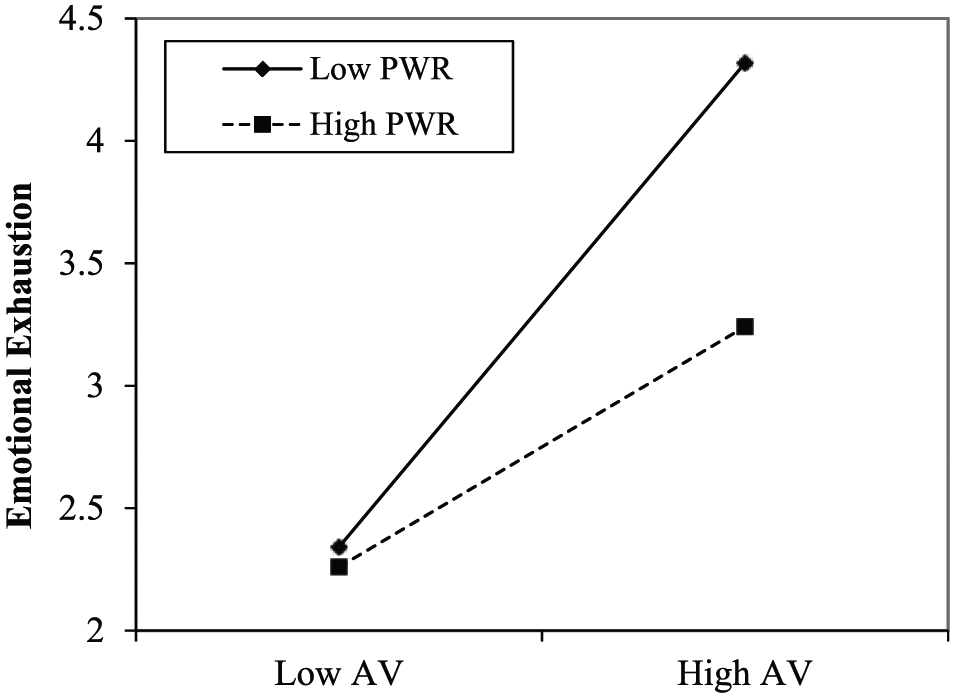
The Moderating Role of PWR.
Hypothesis 5 proposed the conditional indirect effects such that the indirect relations between self-instability/pessimism and emotional exhaustion would be moderated by positive work reflection. The conditional indirect effects are presented in Tables 3 and 4. Specifically, the indirect effects of self-instability and pessimism under higher levels of positive work reflection, b = 0.12 and b = 0.04, respectively, are lower than those of under lower levels of positive work reflection, b = 0.33 and b = 0.12, respectively. Hayes’s (2013) index of moderated mediation also provides a test for the strength of the mediator at different levels of the moderator. The index was found to be significant when self-instability was entered as the independent variable (controlling for the effect of pessimism), effect = −0.05, SE = .02, 95% confidence interval (CI) = [−0.09, −0.02], and when pessimism was entered as the independent variable (controlling for the effect of pessimism), effect = −0.02, SE = .01, 95% CI = [−0.04, −0.01]. Thus, these tests indicate that the impact of self-instability and pessimism on emotional exhaustion through affect variability decreases as positive work reflection increases, in support of Hypothesis 5.
Conditional Effect of Self-Instability on Emotional Exhaustion Through Affect Variability for Various Values of Positive Work Reflection.

Note. LLCI = lower level confidence interval; ULCI = upper level confidence interval.
Conditional Effect of Pessimism on Emotional Exhaustion Through Affect Variability for Various Values of Positive Work Reflection.

Note. LLCI = lower level confidence interval; ULCI = upper level confidence interval.
Discussion
The purpose of this study was to investigate the antecedents of emotional exhaustion and the interactive effect of affective dispositions and positive work reflection on employee emotional exhaustion in a hospitality context. Based on prior research, we anticipated that emotional exhaustion would be influenced by affect variability, and affect variability would be more prevalent among employees with higher self-instability and pessimism. In addition, we expected that positive work reflection during leisure time would weaken the relation between affect variability and emotional exhaustion. The results of the empirical tests fully supported the research model: Self-perception variables (i.e., self-instability and pessimism) predicted affect variability and that greater variability in affect was related to increased emotional exhaustion. In addition, positive work reflection weakened the positive relation between affect variability and emotional exhaustion.
The results are helpful in understanding the swinging of the “emotional pendulum” and its association with emotional exhaustion. Specifically, individuals whose affect varied more exhibited higher levels of emotional exhaustion compared with individuals with lower variability in affect. The evidence suggests that less emotional exhaustion is characterized by lower affective fluctuations that are more homeostatically tied to baseline levels. It is plausible to assume that individuals with stable affective trajectories have a sense of control and security, relating to an optimal level of well-being. If one’s emotions are characterized as swinging and dramatically changing, one’s life becomes less coherent and more exhausting. This contributes to resource depletion theory: In a hospitality setting, individuals with higher affect variability are more likely to have to engage in effortful emotion regulation to match display rules and therefore expend their emotional resources; thus, a depletion of resources as a consequence of affect variability evokes emotional exhaustion.
Our results also suggest a moderating role of positive work reflection during leisure time. This finding is consistent with the framework of positive psychology that discusses positive conditions and processes that contribute to one’s optimal functioning (Binnewies et al., 2009; Gable & Haidt, 2005; Seligman & Csikszentmihalyi, 2000). Capitalizing on positive work reflection as a positive appraisal of work experience could serve as activating cognitive behaviors that help to build personal and social resources to benefit employees (Daniel & Sonnentag, 2014). The resources were found to help to buffer the negative effect of affective variability on emotional exhaustion in this study. In addition to this moderating effect, we also found that positive work reflection was significantly and negatively correlated with emotional exhaustion. Therefore, the more employees think about the positive aspects of their jobs during leisure time, the less likely it is that they will experience emotional exhaustion. This finding indicates that positive work reflection, as a unique construct, functions as a fundamental basis for other job-related attitudes and perceptions.
Practical Implications
Practitioners can benefit from this study in understanding the antecedents of emotional exhaustion in hospitality organizations and finding ways to manage it more effectively. The results suggest that affect variability was influenced by self-instability and pessimism. Managers could use the current results in selection and hiring processes, and identify those candidates who are prone to be less emotionally variable and pessimistic and have less self-instability. HR managers could measure applicants’ self-instability, pessimism, and affect variability in the application forms or employment tests. There are other behavioral indicators that may be easier to observe. For example, selfish behaviors could indicate pessimism (Salekin, 2002), and attentional difficulties could indicate self-instability (Parnas & Sass, 2001). Affect variability could be indicated by difficulties in remembering details, making decisions or concentrating (Wender, 1998). Managers could use those behavioral indicators to infer the applicants’ traits. There are also other related traits that HR may already measure, such as neuroticism (Griffith et al., 2010) and emotional intelligence (Leible & Snell, 2004). Those indicators could help managers to detect whether the applicants are more prone to become exhausted in the workplace and make hiring decisions.
Managers could actively use interventions to reduce emotional exhaustion and promote well-being and psychological health for their employees. Specifically, it is suggested that psychological interventions could be most successful in companies when these interventions reduce variability in affective states, as opposed to only concentrating on enhancing employees’ peak positive experiences. For instance, implementing innovative practices such as regularly practicing on-site yoga and encouraging meditative breaks would help employees to reduce affect variability and stress (Deshpande, 2012). Employers may also assist employees to schedule micro-breaks to help them regulate emotions (Trougakos et al., 2008), such as a paid 15-min rest period for each 2-hr work period. Additional training in deep acting and how to deal with difficult customers can also be implemented, so that employees feel more in control and thus less likely to suffer from ups and downs (Sawyerr, Srinivas, & Wang, 2009). Managers could also provide supportive management or coaching to reduce affective variability and emotional exhaustion (Gyllensten & Palmer, 2005). Although the difficulty to estimate the return on investment of such programs could not be ignored, we suggest that it is an important step that managers should make to broaden their role in enhancing employees’ quality of life, even though those programs may not directly tackle hazards including work overload or lack of control (Gyllensten & Palmer, 2005). In fact, those programs are not initially difficult for organizations and implementing these types of programs can be efficacious in the long run (see Long & Christian, 2015; Wenk-Sormaz, 2005). In addition, Lourijsen, Houtman, Kompier, and Gründemann (1999) demonstrated that the estimated benefits exceeded costs of such emotional exhaustion reducing interventions within a hospital context.
In addition, it is vital that positive work reflection during leisure time should be encouraged because it not only directly reduces emotional exhaustion but also buffers the negative effect of affect variability and may prevent emotional exhaustion before it occurs. Managers should encourage employees to reflect about the positive side of work during leisure time, and those efforts should especially be targeted at emotionally labile employees. Interventions could include providing positive feedback (Battmann, 1988), rewarding employees for important achievements and enhancing a supportive group climate (Elovainio, Kivimäki, Eccles, & Sinervo, 2002), encouraging employees to have fun at work, and generating positive events for employees (Tews, Michel, & Allen, 2014; Tews, Michel, & Stafford, 2013). Organizations could also provide updates to their employees (e.g., newsletters) that highlight the positive aspects of the job (e.g., employee benefits or positive guest experiences) in an effort to elicit positive reflections about their jobs. Such interventions should also be timed to follow events of emotional upheaval among employees, such as layoffs and crisis situations.
Limitations and Future Research Directions
The authors acknowledge the following limitations of this study and identify some future research directions. This research used a cross-sectional approach. Future research can utilize an experience sampling methodology (ESM; Hektner, Schmidt, & Csikszentmihalyi, 2007), which permits researchers to track employees’ levels of state emotions over time to investigate within-person processes and allows a better understanding of the contingencies of behavior (Scollon, Prieto, & Diener, 2003). Utilizing ESM also helps researchers to address limitations associated with retrospective methods. Future research could also use latent growth curve modeling (Preacher, Wichman, MacCallum, & Briggs, 2008) to identify the change trajectories of employees’ emotions.
Future research could examine whether perceived instability regarding one’s significant others (parents or close friends) cause affect variability in the individual. In addition, our study focused on emotional exhaustion as a dependent variable. In the future, researchers may want to extend the scope of the dependent variables and include behavioral or physiological measures that are important in hospitality research (e.g., physical/mental health, absenteeism) that are also likely to be affected by affect variability. Other moderators such as psychological detachment (Sonnentag & Bayer, 2005) and respite activities during work (Trougakos et al., 2008) that could weaken the relation between affect variability and emotional exhaustion are also worthy of investigation.
Conclusion
The dispositional antecedents of emotional exhaustion is a topic that has not been fully investigated in the hospitality literature. By examining the antecedents of emotional exhaustion with a sample of frontline employees in Ecuador, we demonstrated that self-instability and pessimism were positively associated with affect variability, which, in turn, increased emotional exhaustion. In addition, it is demonstrated that positive work reflection weakened the relation between affect variability and emotional exhaustion. Those findings have implications for managing employee’s exhaustion and understanding affect with a unique sample of frontline employees.
Footnotes
Declaration of Conflicting Interests
The author(s) declared no potential conflicts of interest with respect to the research, authorship, or publication of this article.
Funding
The author(s) received no financial support for the research, authorship, or publication of this article.
