



Abstract
This study aims to broaden knowledge about the effects of green (environmentally responsible) advertising images on consumer behavior in the context of the hotel industry. A 5 (ad type: non-green vs. green with text vs. green with logos vs. green with visuals vs. green with the combination of all) × 2 (hotel segment: luxury vs. budget) between-subjects experimental design was developed. The purpose of this research, within the foundations of dual coding theory, is to investigate the influence of different types of green (textual, visual, green certification logos, and combination of all) versus non-green ads on advertising effectiveness operationalized as attitude toward the ad (AAd), attitude toward the hotel (AHot), and purchase intention (PI) for budget and luxury hotel segments while controlling the effects of environmental involvement. The results demonstrate that green text, green certification logo, green with visual cues, and green combination ads were more effective than non-green ads in terms of AAd, attitude toward the brand, or PI. The study also reveals that the effectiveness of green hotel ads will vary with the budget and luxury hotels as the results provide encouraging results for luxury hotels to increase ad effectiveness via using green certification in their advertising strategy. Overall, the findings provide implications for budget and luxury hotels in terms of designing green and sustainability messages in their communication strategies.
Keywords
Introduction
The hospitality industry, concerned with providing exceptional service to their patrons, contributes to environmental degradation through a high amount of energy and water consumption, and waste generation (Al-Aomar & Hussain, 2017; Singh et al., 2014). Furthermore, hotel consumers have become more sensitive to eco-friendly practices (Han & Hyun, 2018), and thus, hotels’ environmental practices are an important determinant of consumers’ purchase decisions (Kularatne et al., 2019; Millar & Baloglu, 2011). Accordingly, hotels adopt environmental, also called green, initiatives (Borden et al., 2017; Kim, Lee, & Fairhurst, 2017; Nicholls & Kang, 2012; Truong, 2014) for promoting green involvement, reducing costs, responding to green customer needs, and obtaining local government support (Dimara, Manganari, & Skuras, 2017; Gao & Mattila, 2014; Han et al., 2018; Jiang & Kim, 2015; J. S. Lee et al., 2010; Manaktola & Jauhari, 2007; Rahman, Reynolds, & Svaren, 2012; Singh et al., 2014). According to statistics, by recycling, hotels can save approximately US$21,372.45 for 5 years on food and beverage (Rhou & Singal, 2020; Manaktola & Jauhari, 2007; Rahman, Reynolds, & Svaren, 2012; Singh et al., 2014). Kularatne et al. (2019) demonstrate that Sri Lanka hotels increased their technical efficiency approximately by 61% through waste and water management practices for the period 2010 to 2014.
But what is equally important is how hotels communicate their environment-friendly or green practices to their target markets effectively to build more favorable brand image and influence guest behavior. In a survey of the hotels and motels industry in the United States, it was found that in 2018, the industry spent US$1.66 billion on advertising, and based on these data, it was projected that the expenditures would rise to US$2.11 billion in 2020 (Schonfeld & Associates, 2019). Advertising influences consumers’ mental and cognitive evaluations through different representations such as context, verbal, visual, company logo, and endorsement (Dangelico & Vocacelli, 2017; Petty & Cacioppo, 1981; Ruth, 2001; Sparks et al., 2013; R. Stafford, 1996). Green advertising has increasingly been adopted by hotels for addressing environmental issues, promoting company green image, communicating eco-friendly product aspects, and influencing purchase decisions (W. H. Kim et al., 2019; Leonidou et al., 2011; Millar & Baloglu, 2011). A survey of 1,300 U.S. travelers by TripAdvisor has shown that about 62% of travelers often or always consider the environment when choosing hotels. More importantly, the survey has also revealed that hotels could do a better job of publicizing their green practices as “sixty-four percent of respondents said that they rarely or never feel informed about whether hotels are truly eco-friendly” (Bender, 2013). However, consumers’ evaluations of different green initiatives and appeals may change across different involvement levels (Hu, 2012; Wang et al., 2017) and hotel segment (Kang et al., 2012).
Advertising effectiveness has extensively been studied in general marketing and consumer behavior literature. In the same vein, a significant and increasing number of studies have focused on green advertising effectiveness by manipulating various cues such as functional versus emotional appeals, textual versus visual message types, message framing, or imagery (Barbarossa & De Pelsmacker, 2016; Bickart & Ruth, 2012; Chan et al., 2006; T. Green & Peloza, 2014; Grimmer & Woolley, 2014; Hartmann et al., 2016; Kong & Zhang, 2013; Matthes et al., 2014; Schmuck et al., 2018; Segev et al., 2015). As those cues would affect consumers’ reactions differently depending on their involvement level, some of these studies have integrated the concept of involvement in their model to provide more reliable and valid results (Atkinson & Rosenthal, 2014; Kong & Zhang, 2013; Matthes et al., 2014; Xue & Muralidharan, 2015).
Despite the significant empirical works on green advertising effectiveness in marketing and consumer behavior, the topic has drawn little attention in the hospitality literature (Chan et al., 2006; Hu, 2012; W. H. Kim et al., 2019). The purpose of this research, within the foundations of dual code theory, is to investigate the influence of different types of green (textual, visual, green certification logos, and combination of all) versus non-green ads on advertising effectiveness operationalized as attitude toward the ad (AAd), attitude toward the hotel (AHot), and purchase intention (PI) for budget and luxury hotel segments while controlling the effects of environmental involvement (EI).
In this respect, the study addresses several research gaps identified in both general and hospitality marketing literature. First, previous studies have studied the advertising effectiveness based on several green cues or manipulations—textual, visual, and ecolabel—on a piecemeal basis. This study, however, provides a more comprehensive experimental study and use all combinations for both non-green and green ads, which extend the knowledge from practical and theoretical standpoints. Second, green advertising effectiveness was not tested for low- and high-end product classes. The study has used both budget and luxury hotel context in the ads as customers would associate green initiatives with cost savings and as a compromise on luxury in the hotel industry (Dodds & Holmes, 2016; Tzschentke et al., 2008). Third, very limited studies have assessed the impact of ecolabel or green seal on advertising persuasion and trust (Atkinson & Rosenthal, 2014; Bickart & Ruth, 2012). This study is the first attempt to examine the impact of green certification on advertising effectiveness. Finally, the majority of hotel green advertising studies have focused on consumers in Asian countries (Chan et al., 2006; Hu, 2012). This study used a sample of U.S. hotel consumers as cultural influences, in individual- and country-level studies, are found to form different environmental attitudes and behaviors (Gelissen, 2007; Milfont, 2012), and the level of environmental concern may be different in other countries due to national cultures (Kang et al., 2012).
Literature Review and Theoretical foundation
Green Consumerism
Environmental sustainability is a key issue in the lodging industry as the members, including hotels, have a major contribution to waste production (Jones et al., 2014). With the purpose of engaging customers in environmental behaviors such as conserving water and electricity, hotels have been implementing sustainability strategies including towel and linen reuse programs (Nisa, Varum, & Botelho, 2017; S. Lee & Oh, 2014). However, these stakeholders are willing to satisfy their customer needs through green initiatives and to communicate that they are taking responsibility for their detrimental impact on the natural environment. Hotel customers, who have become more sensitive and conscious about environmental degradation, are demanding to stay in hotels that take responsible green actions (M. Chen & Tung, 2014; Han, 2015; Han et al., 2010). These individuals are also referred as green consumers who perform proenvironmental behaviors including reusing and recycling, with the intent of protecting natural resources (Barbarossa & De Pelsmacker, 2016). These ecologically conscious patrons are changing their consumption practices toward an environmentally sensitive one when given opportunity and are willing to reduce their harm to our natural resources (Han et al., 2018). A recent survey conducted by Nielsen (2018) reveals that almost 48% of U.S. consumers stated that they are willing to adopt more eco-conscious consumption habits. According to the survey results of TripAdvisor (Pathak, 2015), nearly 62% of travelers prefer to stay in environmentally responsible hotels.
EI
Consumer involvement has frequently been included in the analyses of non-green or green advertising effectiveness research as a control or confounding variable (e.g., Atkinson & Rosenthal, 2014; Kong & Zhang, 2013; Matthes et al., 2014; Schmuck et al., 2018; R. Stafford, 1996; Xue & Muralidharan, 2015; D. Yoon & Kim, 2015). Involvement reflects the degree of association of an individual with a product in a specific context (Flynn & Goldsmith, 1993; Gotlieb et al., 1992; Hu, 2012; Zaichkowsky, 1985). EI refers to the level of being concerned about the environment (D’Souza &Taghian, 2005; Mohr et al., 1998; Schuhwerk & Lefkoff-Hagius, 1995). EI level of customers is one of the significant factors that influence their responses to green advertising appeals (Atkinson & Rosenthal, 2014; C. Chang, 2011; Mohr et al., 1998; Schmuck et al., 2018).
High-involvement customers tend to be more motivated to process the content of the ad, whereas low-involvement customers tend to be less motivated to process the appeal (Petty & Cacioppo, 1990). Some studies reveal that the more the individuals express their willingness to participate in environmental activities, the more they perform related behaviors (Fraj & Martinez, 2007; Grimmer & Bingham, 2013; Pickett-Baker & Ozaki, 2008). Specifically, those highly involved in environmental issues are more receptive to environmental ads than those lowly involved (Hu, 2012). As a result, consumers who have high involvement have a more favorable AAd, attitude toward the brand, and PI for the advertised product.
Green Advertising in General Consumer Behavior and Hospitality Research
The growing concern for the environment and the related activities performed by many industries increased the importance of green marketing strategies of their products (Schmuck et al., 2018). The claims including “eco-friendly,” “sustainable,” and “green” have been used by marketers to communicate the sustainable aspects of their products and brand, and encourage consumers to conserve (Baum, 2012; Parguel et al., 2015; D. Yang et al., 2015). Green advertising emerged as a result of increased public concern and media’s interest for environmental issues (Hartmann & Apaolaza-Ibáňez, 2009), and has the purpose of communicating proenvironmental aspects of an organization (Ahmad et al., 2010) and persuading customers to involve them in green consumption practices (Hu, 2012). It promotes an environmentally conscious lifestyle and helps organizations to communicate their sustainability-related corporate social responsibility (CSR) image with its customers (Banerjee et al., 1995; Mo et al., 2018; Nyilasy et al., 2014).
Iyer and Banerjee (1992) classified environmental ads as green and non-green. The ads that contain environmental aspects and ecological implications of the advertised product are called green ads. They promote an environmentally conscious and friendly lifestyle and emphasize the organizations’ green image (Banerjee et al., 1995; Schmuck et al., 2018). Those that provide environmental information and also emphasize the additional attributes of the product, such as financial (specific dollar amounts, cost saving, or financial gain information related with green practice), are called non-green ads (Cho, 2015). Schuhwerk and Lefkoff-Hagius (1995) compared the persuasiveness of green and non-green appeals, and found that green appeals have a stronger influence on customers than non-green appeals have. Furthermore, using green appeals increase the credibility and honesty of the ad and, in turn, would increase the persuasiveness of the ad by providing accurate and green-related information to customers (Atkinson & Rosenthal, 2014; Case, 2004).
The main focus in green advertising literature has been on the impact of different green appeals on consumer behavior (Atkinson & Rosenthal, 2014; Bickart & Ruth, 2012; C. T. Chang, 2012; T. Green & Peloza, 2014; Hartmann et al., 2016; Xue & Muralidharan, 2015). Some examples are ads with visuals, text, and ecolabels comparing the differences between visual and verbal content or between different ecolabels. The findings demonstrate that green ads with both verbal and visual communication had a stronger impact on advertising effectiveness compared with other appeals (S. B. Kim et al., 2016; Yang et al., 2017). Different message framing such as gain versus loss (positive vs. negative) messages has been another research stream in green advertising (H. Chang et al., 2015; Kareklas et al., 2012; Segev et al., 2015; Xue, 2015). The studies documented mixed findings of the effects of message framing. Some studies reveal gain-framed messages more effective, whereas others suggested loss-framed messages more effective.
M. Stafford et al. (1996) investigated green appeals from a different perspective and tested the ad impact on advertising effectiveness based on demographics such as age and gender. Health, waste, and wildlife issues were the three most important appeals, respectively, in regard to purchasing intention specifically for females, whereas health, energy awareness, and popular issues for males. Overall, females seemed to be more responsive to green appeals, and health appeal was found to be consistently the most important appeal regardless of age and gender. The differences in the effects of green appeals versus non-green appeals have been another research stream with limited studies (Kong & Zhang, 2013; Meijers, Noordewier, Verlegh, Willems, & Smit, 2019; Schuhwerk & Lefkoff-Hagius, 1995). The majority of the articles indicated that green appeals led to more favorable ad attitudes, brand attitudes, and PI than non-green ones (Bailey et al., 2018; Bickart & Ruth, 2012; Grimmer & Woolley, 2014; Kong & Zhang, 2014; Schuhwerk & Lefkoff-Hagius, 1995; Xue & Muralidharan, 2015). According to the findings, green ads encourage individuals to buy green products and, in turn, make them feel like a good person who saves the environment.
Green advertising has been a popular approach among hospitality members to promote favorable green behaviors and customers’ purchase decisions (Ham & Han, 2013; Hu, 2012; W. H. Kim et al., 2019). For promoting environmental protection through green advertising, the type of appeal plays an important role. The hospitality literature demonstrates positive evaluations toward green appeals. However, investigating the effects of green versus non-green ads has not drawn attention in hospitality literature. Study of Chan et al. (2006) reveals that environmental claims enhance the effectiveness of advertising for hospitality institutions such as hotels and restaurants. Their study findings indicate a more positive AAd and more favorable brand evaluations when individuals are exposed to a green appeal. W. H. Kim et al. (2019) showed that green ads lead to positive consumer attitudes in the convention segment of hospitality. Another study reveals that green ads contribute to the environmental image of the hotel and lead to higher PI (Hu, 2012). Emphasizing the environmental aspects of the brands and products through green appeals can improve consumers’ brand attitudes (Sarkar, Sarkar, & Yadav, 2019). In turn, these appeals can influence consumers’ PIs in a positive way (Hartmann & Apaolaza-Ibáňez, 2012; Schmuck et al., 2018). Thus, we propose the following:
Increased awareness of consumers about environmental issues does not by itself turn into an automatic higher and favorable response to environmental advertising (C. Chang, 2011). Many consumers in many countries are still skeptical about the credibility of green advertisements (Leonidou et al., 2011; Pfanner, 2008). The green label may not be convincing consumers about the impactful improvements on the environment (Bonini et al., 2008; Kalafatis & Pollard, 1999; Peattie, 2010). This could have been caused by a myriad of green advertisements with false or associative claims by many companies and by the increased number of complaints to government agencies about misleading green advertisements (Leonidou et al., 2011). This problem can be alleviated by using substantive claims and showing endorsement by third-party environmental associations in the advertisements. In other words, the content and design are important determinants for obtaining higher effectiveness from green advertising (Hartmann & Apaolaza-Ibáňez, 2009). Previous studies demonstrate that an ad with different executional elements is a powerful approach to engage individuals in the objective of the ad (Goldstein et al., 2008; Segev et al., 2016; Wagner & Hansen, 2002; D. Yang et al., 2015). These designs consist of various components including symbols, labels, logos, background images, and styles (Canadian Standards Association, 2008; Phillips et al., 2014). It has been found that each type of appeal differs in its impact on customers’ prosocial behaviors (S. B. Kim et al., 2016). As an example, images are considered an effective tool to draw consumers’ attention, whereas text designs are helpful to transmit the information to these individuals (Decrop, 2007). However, findings of past research studies challenging the superiority of visual cues over verbal ones are undeniable (David, 1998; R. Stafford, 1996). Xue and Muralidharan (2015) investigated the effects of visual and textual environmental appeals, and found that textual appeals lead to more favorable responses toward an ad. However, some studies show that the sole use of visual information is not sufficient to influence consumer responses to advertising. According to some studies, the combination of both visual and textual claims leads to stronger effects (S. B. Kim et al., 2016; W. H. Kim et al., 2019; Walters et al., 2007). In addition, green logos and icons would be helpful to communicate the environment-saving message (Rametsteiner & Schwarzbauer, 1999; Sparks et al., 2013). The research indicates that green logo is an environmental accreditation label and emphasizes the overall environmental qualities of both brand and company (Thøgersen, 2002). Individuals are willing to pay more for the products with a seal (Atkinson & Rosenthal, 2014; Cason & Gangadharan, 2002). Furthermore, environmental logo on claims was found to have a favorable influence on PI than textual information (Spack et al., 2012). From all of the above, comparison of green ads with text, visual, and logo is missing in the literature and the studies provide mixed findings (Park & Lee, 2015).
Thus, we hypothesize the following:
Dual Coding Theory
The advertising literature shows that the combination of different designs such as logo text, image text, or all is superior to the sole use of each design. Hartmann and Apaolaza-Ibáňez (2009) investigated the influence of text only and the combination of text and green image ads on brand attitude, emotional response, and environmental concern. They found that the combination of text and image had a stronger effect on the outcome variables than the text-only ad. Sparks et al. (2013) focused on the effects of different types of online travel reviews on attitude toward the resort and PIs for an ecological resort. Their results revealed that the combination of a logo and award mark is the most effective appeal type on positive consumer behavior.
Dual coding theory proposes that individuals have two cognitive subsystems that process verbal and non-verbal information (W. H. Kim et al., 2019; Paivio, 1986). Non-verbal cues (picture) are processed through peripheral routes, which require less cognitive thinking, whereas verbal cues (text) require activating central routes, which lead to systematic and effortful thinking (Pieters & Wedel, 2004). Based on the focus of this study and the foundations of dual coding theory, it is suggested that the ads that include both image and text, might be more successful at conveying the message to consumers (Flores et al., 2014; Paivio, 1971). When both text and image are used, the ad can be more effective on individuals by communicating the message more persuasively (S. B. Kim et al., 2016; Mayer, 2001; Yang et al., 2017; S. J. Yoon, 2012). Best recall and absorption of information may occur when both visual and verbal cues are activated to store information. In addition to the ads with a combination of both text and visual information, those with green logos lead to favorable consumer responses as well (Atkinson & Rosenthal, 2014). Green logos are also considered visual cues that provide information about an environmentally friendly aspect of the product (Whitson et al., 2014). Thus, we propose the following:
Consumers’ green behavior is also influenced by some hotel attributes such as hotel segment (Knezevic Cvelbar et al., 2017; Millar et al., 2012). These individuals have different service expectations from different hotel segments, such as budget and luxury (Barber, 2014; Kucukusta et al., 2013). Accordingly, their responses toward hotels’ green practices change based on the segment type (Barber & Deale, 2014; W. Yang et al., 2016). According to a study conducted in U.S. hotels, patrons who prefer to stay in a luxury and/or mid-priced hotel are usually more willing to pay higher prices for green practices of these properties than those in budget hotels (Kang et al., 2012; Serra-Cantallops et al., 2018). With their affect-based complementarity framework, Strahilevitz and Myers (1998) argued that luxury products lead to higher PI within the environmental CSR domain. Another study findings revealed that the products in the superior segment increase the attitudes toward the organizations that perform CSR activities compared with those in the budget segment (Folkes & Kamins, 1999). However, some studies suggest that customers associate green initiatives with cost savings and as a compromise on luxury in the hotel industry (Dodds & Holmes, 2016; Tzschentke et al., 2008). Based on the mixed propositions regarding green practices perceptions for budget and luxury product classes in the literature, we propose the following:
Method
Research Design
For this research, a 5 (ad type: non-green vs. green with text vs. green with logos vs. green with visuals vs. green with combination of all) × 2 (hotel segment: luxury vs. budget) between-subjects design was utilized.
Sampling
The participants were recruited from Qualtrics, an online survey and consumer panel company. Data collection continued until an adequate cell size was reached for the appropriate analysis. A minimum of 50 respondents in each cell was sought in this study. Data were collected from a total of 504 respondents. Respondents in each cell were exposed to a manipulated ad of either a budget hotel or a luxury one. After exposure to one of the 10 ad manipulations, each participant was asked to respond to the scale items to measure their ad effectiveness.
Ad Manipulations
The two independent variables were manipulated (see the appendix). Ad type was manipulated as non-green, green with text, green with logos, green with visuals, and green with combination. Hotel segment was manipulated as budget and luxury. A total of 10 (5 × 2) ads were designed to carry out the experiment. The ad types are provided in Figure 1. The ad copies were designed by a professional graphic designer following the instructions of the researcher. A fictitious hotel chain name was adopted to use in the ads for minimizing the potential bias that could be introduced by an actual brand name.
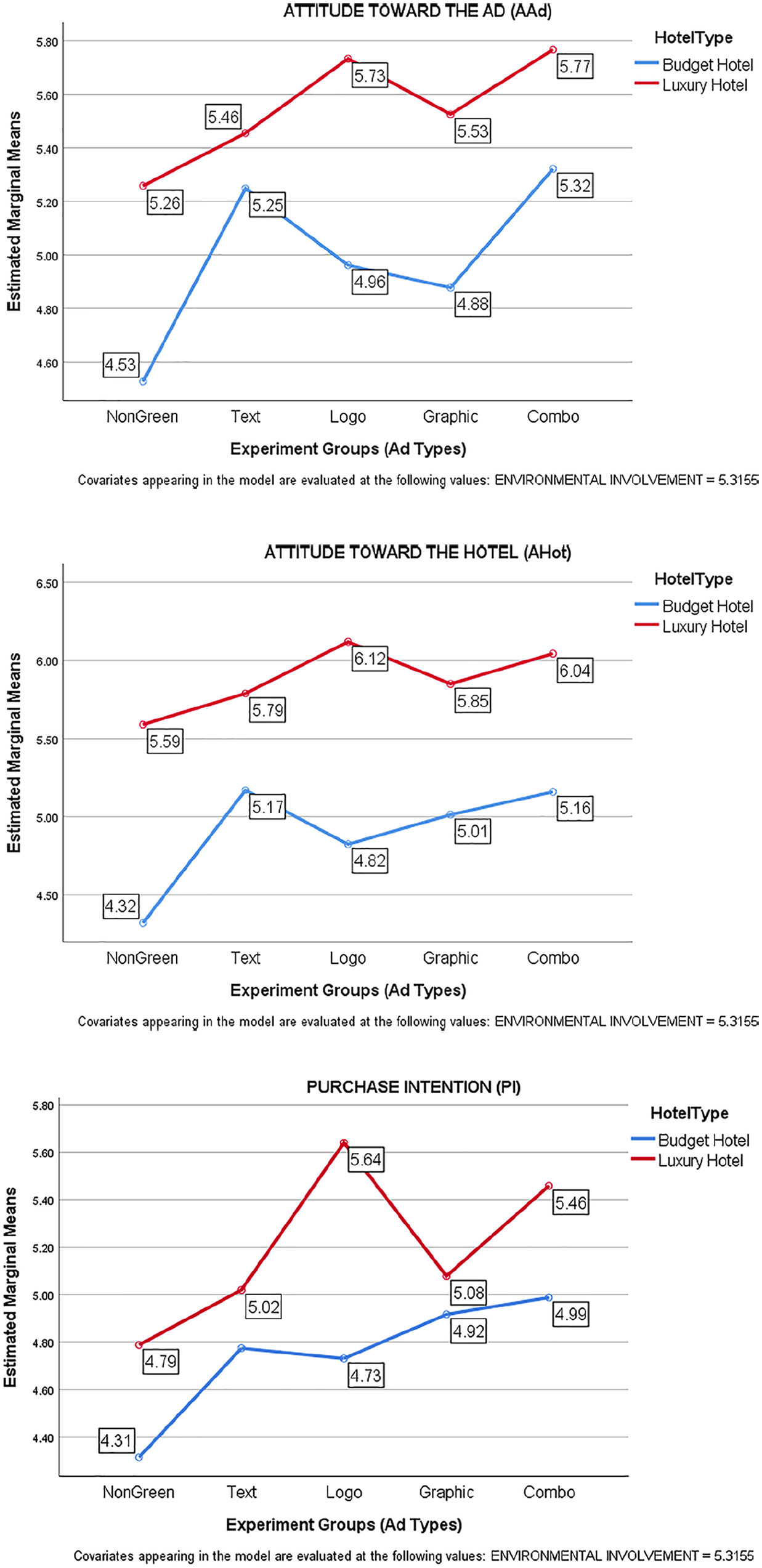
Adjusted Group Means of Ad Types by Hotel Segments.
Data Collection
Each respondent was randomly exposed to one of the 10 different ads. The participants responded to an online self-administered survey. The first section included questions about the residence and hotel stay frequency of the respondents for screening purposes. Only those living in the United States and who stayed in a hotel at least once in the last 2 years were allowed to participate in the study. The second section started by briefing the respondents about the study and asked them to give adequate attention to the stimuli and the following questions. Then, the stimulus material, one of the 10 manipulated ads, was randomly shown to the respondents. Once the respondents clicked the arrow on the screen to continue, the ad disappeared and the scales measuring dependent variables appeared on the screen. This happened after respondents viewed the ad and were exposed to the stimulus variable. Then, the respondents answered the questions that measured their ad effectiveness through AAd, AHot, and PI scales. The fourth section measured the participants’ EI. The last section included demographic questions, including gender, age, ethnicity, income, and education.
Manipulation Check
A manipulation check was conducted in the second section of the survey. Instructional manipulation check (IMC) was used to exclude participants who failed to pass questions. IMCs asking participants to confirm that they read the instructions have been shown to increase the validity of a data set (Oppenheimer et al., 2009). The respondents were asked two questions to verify that each stimulus communicated the intended message to the viewer and to check the participants’ attention. The first question asked the segment of the hotel that was shown in the ad (budget vs. luxury). The second one asked the green status of the ad (non-green, green with text, green with logo, green with graphic images, or green with combination of all). Only those who answered these questions correctly were included in the data analysis.
Measures
Independent variables
EI scale as a covariate was adapted from Schuhwerk and Lefkoff-Hagius (1995). It measured overall involvement with environment by four items using 7-point Likert-type scale. Schuhwerk and Lefkoff-Hagius (1995) reported that this four-item scale resulted in a Cronbach’s alpha of .90 and validated with the New Environmental Paradigm (NEP) scale (Dunlap & Van Liere, 1978).
Dependent variables
Based on the previous research findings, advertising effectiveness was captured by using three multi-item constructs: AAd, AHot, and PI. AAd scale was adapted from the study of MacKenzie and Lutz (1989). AHot was measured with the scale adapted from Bruner and Hensel (1992) and Goldsmith and Lafferty (1999). The PI scale was adapted from Goldsmith and Lafferty (1999) and Hu (2012).
Validity
To ensure construct validity, only the scales validated by previous research were used and also tested in this study. To maximize internal validity, respondents were randomly assigned to one of the 10 experimental cells to prevent any potential bias that might have been created by carryover effect. In addition, strict manipulation rules were followed in designing the ads, while keeping all other aspects identical.
Data Analysis
Data were analyzed using the Statistical Package for the Social Sciences (SPSS) version 23. The reliabilities of the multi-item constructs were assessed based on Cronbach’s alpha. A confirmatory factor analysis (CFA) was applied to test discriminant validity of the measures of the dependent variables. For hypotheses testing, a multivariate analysis of covariance (MANCOVA) was conducted to examine whether participants rate the three dependent variables differently across the 10 ads while controlling for participants’ EI. EI was entered as a covariate in the model to remove its effect on the dependent variables across all experimental groups. The assumptions of MANCOVA were checked to detect any possible violation. For significant effects, follow-up univariate analyses of covariance (ANCOVAs) with estimation of marginal means were used.
The MANCOVA test evaluates whether means of the dependent variables, adjusted for differences on the covariate, are the same across groups of experimental design, or simply stated, whether the adjusted group means are the same. Metric variables that are not part of the experimental manipulation but have an influence on the dependent variable are known as covariates. There are two reasons for using MANCOVA in a random or non-random experiment: (a) to reduce within-group error variance and (b) elimination of confounding variables other than the experimental manipulation that affect the outcome variable (Field, 2013; S. B. Green & Salkind, 2005). Not surprisingly, MANCOVA is one of the most widely used techniques in advertising effectiveness research to control consumer involvement or other potential confounding variables (e.g., Bhutada et al., 2017; Cinafrone et al., 2008; Danaher & Mullarkey, 2003; Moorman & Harrison, 2016; R. Stafford, 1996; Teo et al., 2019; D. Yoon & Kim, 2015).
Results
Demographics
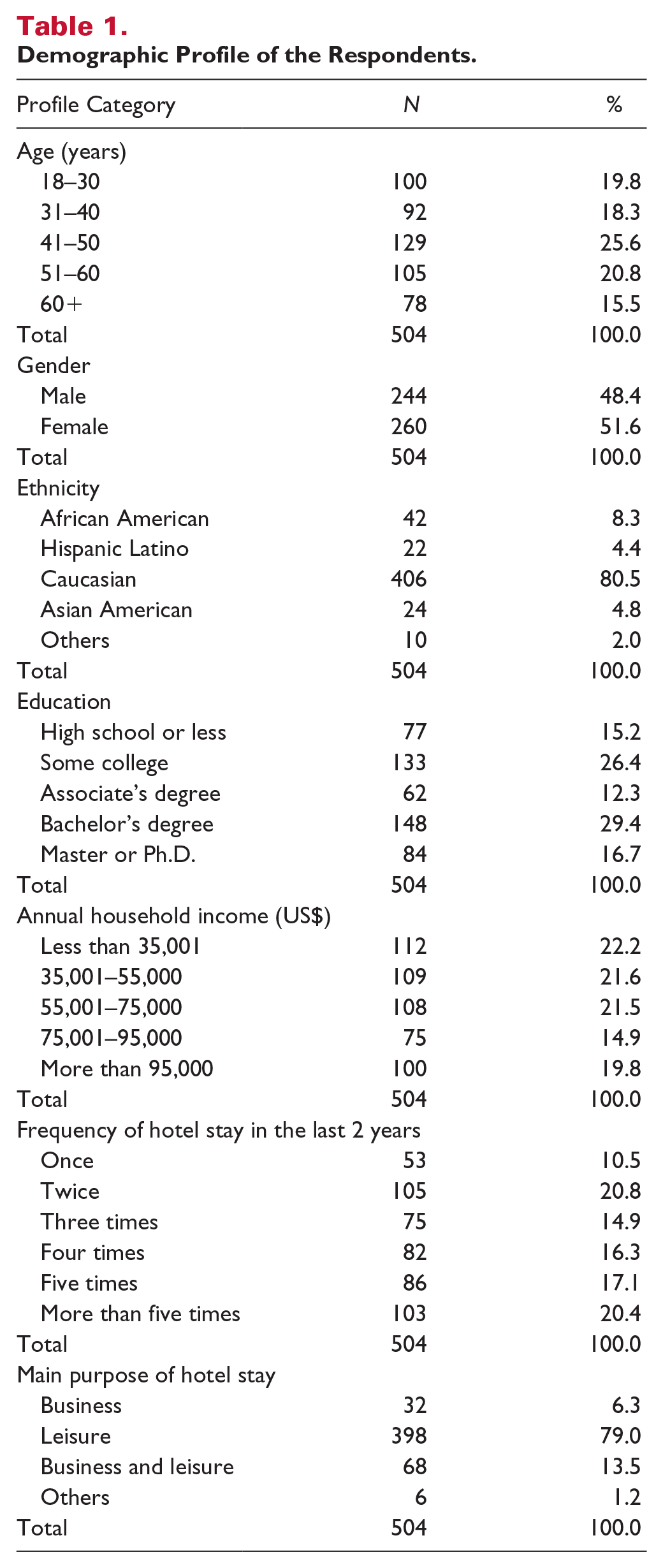
Demographic profile of the respondents is reported in Table 1. Age was measured by asking respondents to report their exact age. The age variable was later grouped into age brackets for reporting purposes. A balanced age distribution was observed; about 20% of the sample was between the ages of 18 and 30 years, 18% was between 31 and 40 years, 25.6% was between 41 and 50 years, 21% was between 51 and 60 years, and 15.5% was above 60 years. Gender was also distributed almost equally. Females constituted slightly more than half of the sample with 51.6%, and the remaining 48.4% were males. Most of the respondents were Caucasians with 80.6%, followed by African Americans with 8.3%, Asian Americans with 4.8%, and by Hispanic Latinos with 4.4%. The level of education appeared to be relatively high. More than 58% of the respondents reported having an associate degree, or higher, such as a bachelor’s, master’s, or doctoral degree. A somewhat equal distribution was observed among the income measuring brackets. Except for the ethnicity and level of education, the demographic profile of the respondents adequately reflects various groups in the U.S. population. Those who stayed in a hotel only once in the last 2 years constituted 10.5% of the respondents, whereas 20.8% stayed twice, 15% 3 times, 16.3% 4 times, 17% 5 times, and 20.4% stayed more than 5 times. The fact that most of the respondents stay at hotels frequently makes the findings and implications more realistic. The most common purpose of a hotel stay was leisure with 79%, distantly followed by business and leisure with 13.5%, and by business with 6.3%.
Demographic Profile of the Respondents.
Reliability and Validity
The reliabilities of the scales were very good, ranging from .91 to .96. The reliability scores for the dependent variables were higher than the correlation coefficients between them (r = .75–.88). CFA was used to assess the measurement of the dependent variables. The measurements showed acceptable fit indices (normed χ2 = 4.4, goodness-of-fit index [GFI] = 0.93, comparative fit index [CFI] = 0.97, root mean square error of approximation [RMSEA] = 0.08). The unity test was utilized to assess the discriminant validity statistically by treating these constructs as one construct, that is, setting the correlations among them to unity. The unity model exhibited very poor fit indices (normed χ2 = 34, GFI = 0.65, CFI = 0.79, RMSEA = 0.24). The chi-square indifference test was also significantly worse (p < .0001), providing support for the discriminant validity of the measures of the dependent variables. Before hypotheses testing, composite scores were created for the covariate and dependent variables.
Hypotheses Testing
MANCOVA assumes that the covariate must be linearly related to the dependent variables for all levels of the factors. It was expected that the consumers with high levels of EI are expected to be more positively responsive to green messages in advertising with all else being equal. As Table 2 presents, the relationship between the EI as the covariate and the combined dependent variables was found significant, Wilks’s Λ = .893, F(3, 491) = 19.6, p <.000, partial η2 = .107. This justified the inclusion of the covariate EI in the study and adjustment of its influence on the dependent variables to equalize the differences of EI among the experimental groups.
Multivariate Analysis of Covariance and Hypotheses Tests.

Note. AAd = attitude toward the ad; AHot = attitude toward the hotel; PI = purchase intention; EI = environmental involvement.
The MANCOVA indicated that the main effects were significant for advertising types (Table 2). Significant differences were detected for ad type, Wilks’s Λ = .95, F(12, 1299) = 1.99, p = .021, partial η2 = .016, on the combined dependent variables. Hypothesis 1 was tested as part of the planned comparisons to identify the existing significant differences between non-green ads and ads using a green manipulation. The main effect of hotel green ads on AAd was stronger than that of non-green ads. The ads with green text (p = .011, Mgreentext = 5.35 vs. Mnon-green = 4.89), with certification logos (p = .013, Mgreenlogo = 5.35 vs. Mnon-green = 4.89), with combined messages (p < .05, Mgreencombo = 5.54 vs. Mnon-green = 4.89) had a significant main effect on AAd except those with visual graphic message (p > .05). Green hotel ads with green text (p < .05, Mgreentext = 5.48 vs. Mnon-green = 4.96), with certification logos (p = .011, Mgreenlogo = 5.47 vs. Mnon-green = 4.96), with visual graphic message (p = .02, Mgreengraphic = 5.42 vs. Mnon-green = 4.96), and with combined messages (p = .002, Mgreencombo = 5.60 vs. Mnon-green = 4.96) had a stronger main effect on AHot. Also, green ads versus non-green ads had a stronger main effect on PI. The green ads with certification logo (p = .005, Mgreenlogo = 5.18 vs. Mnon-green = 4.55), with visual graphic message (p = .047, Mgreengraphic = 5.00 vs. Mnon-green = 4.55), and with the combined message (p = .003, Mgreencombo = 5.22 vs. Mnon-green = 4.55) except with green text (p > .05) had a stronger effect on PI. Thus, Hypothesis 1 was supported.
Hypothesis 2 stated that there will be effectiveness difference(s) across three green representations in ads using text, logos, and visual images. Comparisons of three dependent variables among the three strategies failed to yield support for Hypothesis 2 in all the nine possible comparisons (p > .05), indicating that these three greening strategies can be considered equally effective regarding Hypothesis 3. Although the green combination ads consistently generated the most positive results in all of the three dependent variables, they were not found to be significantly different than any of the other three greening strategies (p > .05). Thus, Hypothesis 3 was not supported (Table 3).
ANCOVA Results—Main Effects.
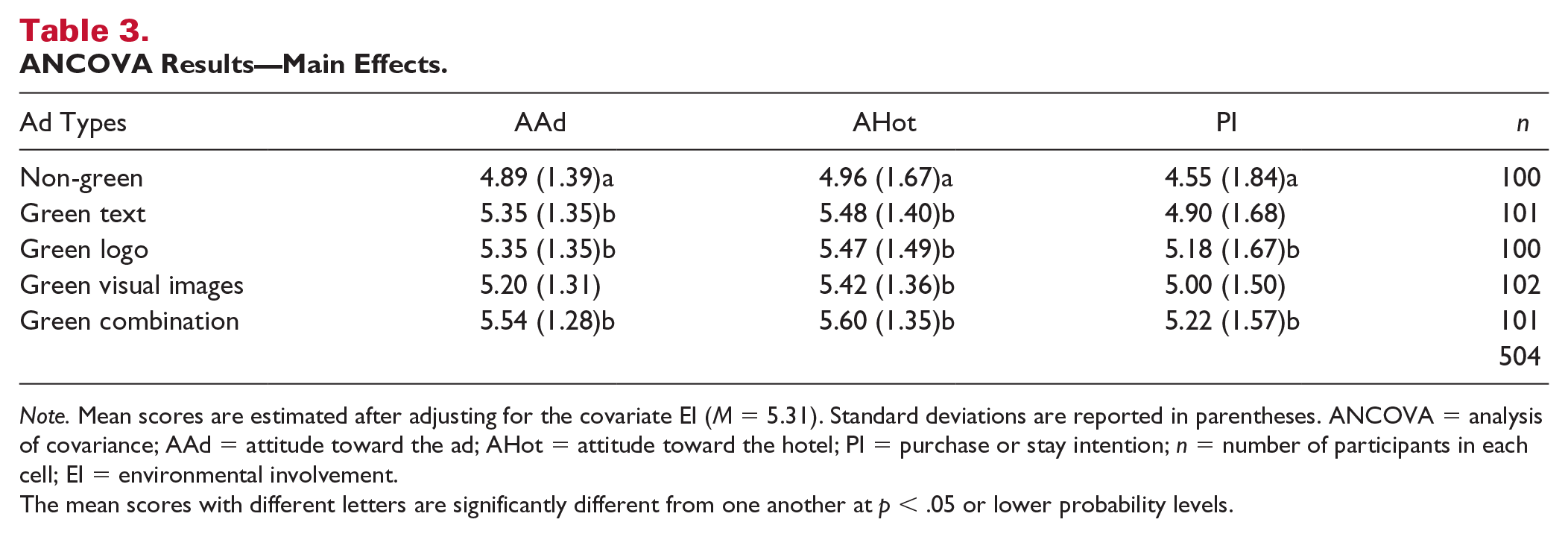
Note. Mean scores are estimated after adjusting for the covariate EI (M = 5.31). Standard deviations are reported in parentheses. ANCOVA = analysis of covariance; AAd = attitude toward the ad; AHot = attitude toward the hotel; PI = purchase or stay intention; n = number of participants in each cell; EI = environmental involvement.
The mean scores with different letters are significantly different from one another at p < .05 or lower probability levels.
Hypothesis 4 proposed that the effectiveness of green hotel green ads will vary with the budget and luxury hotels. This hypothesis was tested by the interaction term (Ad Type × Hotel Type) in the MANCOVA model (Table 2).
However, as far as the main effects of the hotel type were concerned (Table 2), the differences between budget and luxury hotels in terms of AAd, AHot, and PI were significant at .001 probability level, Wilks’s Λ = .82, F(5, 1355) = 6.9, p < .000, partial η2 = .065. Figure 1 reveals that luxury hotel ads were consistently rated higher than budget hotel ads. But, at the same time, it also clearly shows existence of an ordinal interaction for all dependent variables (AAd, AHot, and PI) in a way that luxury hotel ads were rated significantly higher than budget hotels ads for the green certification ad manipulation. This was particularly the case for the PI variable when non-green ads were not significantly different between luxury and budget hotels. Thus, Hypothesis 4 was supported.
Univariate ANCOVA detected no significant difference regarding green text message for the AAd (p = .437, Mgreentext budget = 5.23 vs. Mgreentext luxury = 5.42) and the PI (p = .462, Mgreentext budget = 4.75 vs. Mgreentext luxury = 4.97). However, a significant difference was found on the AHot (p = .018, Mgreentext budget = 5.16 vs. Mgreentext luxury = 5.76). The luxury green ad with text was found to be more effective than the budget one with text, on the AHot only, but not on the AAd and the PI. The luxury hotel green ad with green certification logo was found to be significantly more effective than the budget hotel green ad with the logo on all three dependent variables: the AAd (p = .003, Mgreenlogo budget = 5.01 vs. Mgreenlogo luxury = 5.78), the AHot (p = .000, Mgreenlogo budget = 4.87 vs. Mgreenlogo luxury = 6.16), and the PI (p = .006, Mgreenlogo budget = 4.80 vs. Mgreenlogo luxury = 5.70). Also, the luxury green ad with green visual images was found to be more effective than the budget green ad on two of the three dependent variables, AAd and AHot, but not on the PI. A univariate ANCOVA detected significant differences for the AAd (p = .018, Mgreenvisual image budget = 4.92 vs. Mgreenvisual image luxury = 5.54), the AHot (p = .004, Mgreenvisual image budget = 5.05 vs. Mgreenvisual image luxury = 5.85), but not the PI (p = .665, Mgreenvisual image budget = 4.97 vs. Mgreenvisual image luxury = 5.10). Also, for the ads with green combination of text, logo, and visual images, the difference between luxury and budget hotel ads was significant for the AHot (p = .000, Mgreencombo budget = 5.21 vs. Mgreencombo luxury = 6.01). However, no significant difference between the luxury and budget hotel green combo ads was found for the AAd (p = .066, Mgreencombo budget = 5.36 vs. Mgreencombo luxury = 5.74) and the PI (p = .118, Mgreencombo budget = 5.04 vs. Mgreencombo luxury = 5.42). The luxury ad with green combination of text, logo, and visual images was found to be more effective than the budget one, on AHot only, but not on the AAd and the PI. Thus, Hypothesis 4 was supported for AHot, but not for AAd and PI.
Given the variations due to the hotel segments, the ads using green manipulations (text, logo, and combo) were also compared with the non-green ad within each hotel segment at .05 probability level (Table 4). For budget hotels, green combo ad was the only green manipulation that was rated more effectively than the non-green ad for the AAd and PI, whereas the green combo, green graphic image, and green text were rated more effectively than the non-green ad for the AHot. For luxury hotels, however, both green combo and green certification logo ads were rated more effectively than the non-green ad for the AAd and AHot. As far as the PI is concerned, the green combo, green certification logo, and green text ad representations were rated more positively than the non-green ad, while the ad with green certification logo was also rated more positively than the ad with green text.
ANCOVA Results of Advertising Effectiveness for Each Hotel Segment.
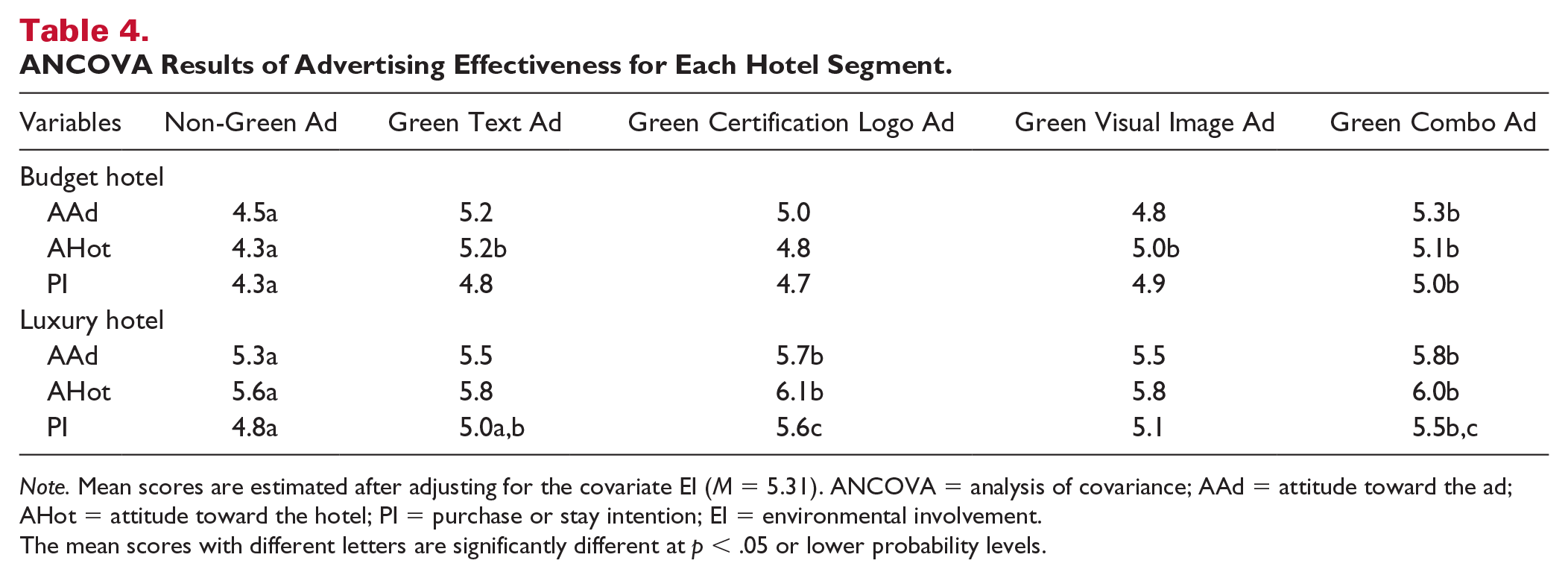
Note. Mean scores are estimated after adjusting for the covariate EI (M = 5.31). ANCOVA = analysis of covariance; AAd = attitude toward the ad; AHot = attitude toward the hotel; PI = purchase or stay intention; EI = environmental involvement.
The mean scores with different letters are significantly different at p < .05 or lower probability levels.
Discussion and Implications
The study demonstrated the effects of different types of green ads (textual, visual, green certification logos, and combination of all) versus non-green ads on advertising effectiveness—operationalized as AAd, AHot, and PI—for budget and luxury hotel segments. As consumers’ attitudes and behavior toward green messages are influenced by their environmental concerns and involvement, we controlled the EI of respondents and removed its effects from all experimental groups.
The findings revealed that all four types of green advertising messages were found to have stronger effects on at least one of the advertising effectiveness variables than non-green advertising. For example, green text, green certification logo, and green combination ads were more effective than a non-green ad for the AAd. For the AHot, all green ads were found to be more effective. However, only green certification logo and green combination ads were more effective than their non-green ads for the PI. Therefore, it can be concluded that hotels could choose, depending on their specific objectives, at least one of the green message representations, to communicate their greening initiatives to their target markets and show how responsible they are for the environment. This finding was contrary to some other studies suggesting environmental or green claims in company’s communication would create negative perceptions or “greenwashing,” that is, unsubstantiated or misleading claim about the environmental benefits of a product or brand (Parguel et al., 2015; Schmuck et al., 2018).
The study also found that the effectiveness of green hotel ads will vary for budget and luxury hotels. Dual coding theory postulates that both verbal communication and visual representation should be used in combination for more effective delivery of advertising messages and persuasion. The findings of this study did not provide such support in terms of the AAd and AHot. The only support found was the fact that the green certification ad was more effective than the green text for the PI for luxury hotels. A theoretical implication for this would be that the dual coding theory would work differently for different product classes, that is, basic or complex product. One potential reason for the green certification being as effective as the green combo ad would be due to the intangibility of hospitality service as certification tangibilizes the service element and adds more credibility to the ad as luxury hotels are high-involvement decisions. Also, the green certification, as an umbrella representation, might have triggered many associations, both verbal and visual codes and information in consumer minds.
Our findings provide encouraging results for luxury hotels to increase ad effectiveness via using green certification in their advertising strategy. For a luxury hotel, both green combo and green certification ads were rated more positively than the non-green ad for all dependent variables included in the study—the AAd, AHot, and PI. The fact that the green certification logo worked as more effectively as the green combo ad for luxury hotels would enable them to use the ad space more effectively in terms of the cost of ad size and the adoption of multiple communication objectives. There is a growing trend in sustainable luxury (D. Lee, 2017). As such, some luxury boutique hotel group has recently partnered with EarthCheck, a sustainability benchmarking and certification provider in the hospitality industry (“How Green Rankings Benefit Hotels,” 2018).
However, green certification logos alone do not seem to be an effective strategy for budget hotels. A plausible explanation would be that it might have been perceived as a more cost-cutting approach and sacrificing the quality of the guest experience for profits. Other green ad representations, combo green ad, in particular, seemed to be more effective than the non-green ad in terms of AHot and PI for budget hotels.
Hotels should employ green advertising strategies to increase favorable consumer AHot, positive brand evaluations, patronage intentions, and to have a stronger green brand image. This research provided some practical implications on how hotel managers can effectively use textual, visual, and green certification in their communication strategy. Green logo used in the green appeals would communicate the overall environmental aspect of the hotel, and thus, it would be helpful to differentiate the company and the brand among competitors. By adding more credibility to the brand, a green logo could reduce the perceived risk of purchasing the hospitality products that are considered intangible (Chen, Jai, & Yuan, 2017; Kim, Qu, & Kim, 2009). As green logo was found to have a positive effect on consumer behavior, hotels and the other hospitality institutions should earn a green certificate. Also, luxury and budget hotels should create different environmentally responsible strategies to obtain positive outcomes from their customers. As consumers have different expectations from hotels in different segments, this expectation should be considered a whole. In other words, luxury and budget category hotels should develop and implement green advertising strategies based on the different expectations and values of each segment’s customer. This approach will be helpful for a successful accomplishment of green goals and for increasing the ad effectiveness on both organization and customer-related outcomes.
Limitations and Future Research
This study has several limitations that offer future research paths. The 10 ads tested in this study, other than the pictures, were not actual hotel ads and were developed by a professional graphic designer. A future study can investigate the effects of the ads created by professional advertising agencies. Second, the education level of the respondents was high, which might have contributed to numerous insignificant differences between green ad using all message cues in combination and any green ad using message cues individually. The study used a sample of U.S. hotel guests, and thus generalizing the findings to other geographic locations would not be appropriate.
Footnotes
Appendix
Declaration of Conflicting Interests
The author(s) declared no potential conflicts of interest with respect to the research, authorship, or publication of this article.
Funding
The author(s) received no financial support for the research, authorship, or publication of this article.
