




Abstract
The purpose of this study is to examine how varying levels of brand familiarity and photographic image quality of hotel pictures influence consumers’ perceptions about luxury hotel services and attitudinal responses and whether their visual aesthetic experience and inferential beliefs about service quality can mediate such effects. This is a 2 (brand familiarity: familiar vs. unfamiliar brand) × 2 (image quality: high vs. low image resolution) factorial design randomized experiment and the proposed model was tested using a structural equation model (N = 430). The proposed model was confirmed that consumers viewed the visual appearance of a hotel suite room (varying in image quality) and brand name (varying in brand familiarity), experienced processing fluency, drew inferential beliefs (about tangible and intangible service quality), formed attitudes toward the brand, and purchase intentions. The study presents an explanatory framework that delineates how varying hotel-related cues in an online setting can shape consumers’ perceptions and judgments of a luxury hotel brand. To one’s best knowledge, no research has examined the impact of both brand familiarity and photographic image quality of a hotel room. More importantly, this study reveals to what extent consumers’ inferential beliefs about service quality can be influenced by the heuristic cues and provides direct evidence for the mediating role of processing fluency and aesthetic appreciation.
Keywords
Introduction
The luxury-hotel market is growing faster than ever, with consumers more likely to seek lavish vacations due to their increasing purchasing power and thriving tourism industries around the world (Deloitte, 2019). Recent reports indicate that the global luxury hotel market will grow at a rate of 4.7% between 2018 and 2023 (Mordor Intelligence, 2019) and reach US$115.8 billion by 2025 (Grand View Research, 2018). To gain competitive advantage, major luxury hotel brands in the market have focused on improving infrastructure and adopting advanced technology to enhance the customer experience. For instance, hotels have not only simplified the reservation process but also substantiated online booking systems with information such as descriptions and photos of the property (Mordor Intelligence, 2019).
Prior studies on tourism and hospitality have already examined the visual effects of photos on travelers’ perceptions and judgments (Pan et al., 2014; Ren et al., 2020). It was found that richer picture presentations on the hotel websites (e.g., computer-generated images of hotel rooms) can improve consumers’ satisfaction (Bogicevic et al., 2017) and that visual images of a destination’s website can influence their tourist choice (Romanazzi et al., 2011). Another research showed that website quality (e.g., content, colors, or font on the website) positively influenced sensorial and cognitive online brand experience which, in turn, affects attitude toward the website and intentions to visit the destination (Jiménez Barreto et al., 2019). However, studies have also demonstrated the negative visual effects. For instance, ad photos portraying a risky vacation situation can have a negative effect on consumers’ intentions to visit the destination (Hem et al., 2003). Inappropriate visual elements (e.g., background, text, and color) can compromise the credibility of the websites (Law & Ngai, 2005).
While hotel photo is a well-studied topic, relatively little is known about the visual effects in the context of luxury brands. One study showed that misleading hotel photos (i.e., perfect representation) can negatively affect consumer trust, especially when the hotel is upscale (Kuo et al., 2015). A more recent content analysis revealed that high-rating hotels (four- and five-star) had more photos than lower rating (two- and three-star) hotels (i.e., more hotel features and facilities to be included; Ren et al., 2020). Other implications, however, have yet to be investigated, such as the effect of photographic quality of upscale hotel photos online and the extent to which luxury hotel-related heuristic cues can shape a consumer’s aesthetic experience, attitudinal and behavioral responses to the brand. Indeed, tourism researchers have also noted how visual images and photographic elements have been underexplored despite their importance (Jenkins, 2003; Park & Kim, 2018).
In addition, most luxury-consumption research has relied heavily on products rather than services (Chen & Peng, 2018) and, even within the luxury hotel service industry, academic attempts have been limited to identifying determinants of consumer satisfaction and attitudes (Sukhu et al., 2019). Especially in an online environment, in which direct contact with the physical property and service provider is limited, potential consumers may have to rely on what is available, such as the hotel’s brand and photos of facilities. In this study, we examine how varying hotel-related cues in an online setting can shape consumers’ perceptions and judgments of a luxury hotel brand. To one’s best knowledge, no research has examined the impact of both brand familiarity and photographic image quality of a hotel room. Perhaps more important, we propose and test an explanatory framework that delineates the extent to which consumers’ inferential beliefs about service quality can be influenced by the heuristic cues and provides direct evidence for the mediating role of processing fluency and aesthetic appreciation.
Conceptual Background
Image Quality, Brand Familiarity, and Processing Fluency
In an online environment—where consumers have no direct access to the facility and only limited access to service providers—visual presentation is critical to defining the reputation of a hotel. Indeed, photographic elements often play a decisive role in consumers’ processing and evaluation experiences. Beyond the expertise necessarily exercised when selecting representative imagery for online contexts, particular consideration must also be given to image quality. Perceived image quality varies in accordance with the resolution of the picture. Resolution refers to the amount of visual information an image can display, where a higher resolution image is perceived as being more detailed (Hunt, 2016). Although other factors, such as color mode (i.e., how individual color components are combined), do influence image quality on a technical level, resolution is arguably the main determinant of perceived image quality (Galer & Horvat, 2005). High-resolution photographs convey greater visual detail and information, enhancing the clarity of the distinct elements comprising the full image. This ease of identifying physical forms is called perceptual fluency; image clarity is one significant source of perceptual fluency when processing visual stimuli (Jacoby et al., 1989). Because higher clarity makes the objects in an image more recognizable and easier to process (Reber et al., 1998), clearer visual displays facilitate increased recognition speed, which has undeniable relevance in the visual-input-dominant context of online consumer experience. While perceptual fluency itself has been extensively researched (see, e.g., Graf & Landwehr, 2015; Reber et al., 2004), the specific role and influence of image quality remain relatively underexplored. Only a few studies have empirically examined the impact of image resolution on perceptual fluency. One intergroup study measured changes in perceptual fluency relative to manipulations of image resolution; fluent faces, manipulated through image resolution, were recognized as ingroup members (Claypool et al., 2012). A more recent study in the field of design by Mayer and Landwehr (2018) explored image resolution as a proxy for design typicality and processing fluency. For the present study, we measured image quality in terms of image resolution to test whether hotel pictures with higher resolutions were visually registered as being of higher quality and positively affected perceptual fluency among viewers.
People prefer visual stimuli that can be easily processed (Jacoby et al., 1989; Reber et al., 2004). Ease of perception is inherently affective—that is, psychologically and emotionally significant—and enhanced perceptual fluency, therefore, contributes to a more favorable interactive experience (Bornstein & D’Agostino, 1994). This is because people tend to misattribute the error-free processing of a stimulus to the likeability and/or quality of that stimulus (Winkielman et al., 2003). This fundamental fluency–liking relationship—the idea that affective judgments are a function of perceptual fluency—may help to explain how consumers make aesthetic judgments in an online setting. According to their processing fluency theory of aesthetic pleasure, Reber et al. (2004) propose that aesthetic appreciation of a visual stimulus derives primarily from the perceiver’s positive processing experience: the more fluently a stimulus is processed, the more aesthetic pleasure that stimulus provides. In addition to judgments of aesthetic value, processing fluency is also known to positively affect attitudinal responses in viewers. Im et al. (2010) manipulated image contrast, image size, font style, and font color on a website to increase perceptual fluency and found that greater perceptual fluency positively influenced participants’ affective and behavioral reactions to the website. Their findings suggest that factors allowing for more fluent processing should, in turn, engender a more favorable audience response. It therefore follows that clearer pictures, or images of higher resolution, should reasonably improve judgments of aesthetic appreciation by facilitating increased perceptual fluency. Thus, we hypothesize that hotel photographs of higher resolution viewed in an online context will be visually perceived as images of higher quality and processed more fluently. We further propose that the experience of high processing fluency will positively affect aesthetic appreciation and brand attitudes among participants, leading them to evaluate the hotel more favorably from a consumer perspective.
Along with visual clarity, prior exposure to a stimulus may facilitate ease of perception and result in more favorable evaluation. Numerous studies have shown that familiar materials are processed more fluently and evaluated more positively (see, e.g., Labroo & Lee, 2006; Reber et al., 2004; Schwarz, 2004; Zajonc, 1986). The results of these studies indicate that prior exposure to a stimulus enhances ease of processing its physical features, which in turn positively impacts viewers’ liking of the stimulus and their perceptions of its overall quality. The connections to marketing principles are evident: brand familiarity refers to the extent of consumer experience or degree of acquaintance with a brand and reflects the strength of consumers’ belief or trust in the brand (Alba & Hutchinson, 1987; Kent & Allen, 1994), and it is well-established that consumers respond more favorably to familiar brands than to unfamiliar ones (Dawar & Lei, 2009; Lin, 2013). While prior research has already demonstrated the positive effects of brand familiarity on attitudinal responses, its effect on consumers’ visual processing experience in an online setting has not been explored. Do consumers find the imagery on a hotel’s website easier to process when the hotel name is more familiar? Due to extensive evidence in the literature of the positive correlation between brand familiarity and brand evaluation, we narrowed the scope of our study to focus on the link between brand familiarity and perceptual fluency. In line with the existing theories that both brand familiarity and perceptual fluency positively affect attitudinal reactions to a brand, we predict that photographs of hotels with familiar brand names will be processed with higher perceptual fluency by participants.
Intriguingly, little to no research has explored the relationship between brand familiarity and visual-specific appeal. A recent tourism study showed that overall familiarity with the destination had positive effects on both cognitive and affective image, which ultimately led to increased loyalty (i.e., cognitive image refers to an evaluation of the perceived attributes, whereas affective image refers to an emotional feeling toward the destination; Stylidis et al., 2020). In addition, customers often make brand awareness-quality inferences, namely, that a familiar brand must be of higher quality than an unfamiliar brand (Janiszewski & Van Osselaer, 2000; Rubio et al., 2014). Certainly, it is possible that consumers would feel less uncertain about a well-known hotel brand than a unfamiliar one, particularly when the image’s condition is compromised (which may increase perceived risks). Thus, we propose that brand familiarity will interact with an online hotel picture’s image quality such that the effect of low image quality will be increased for an unfamiliar brand than a familiar one.
Inferential Beliefs about Tangible and Intangible Service Quality
Service quality reflects a customer’s evaluation or attitude about the overall superiority of the service (Zeithaml, 1988). An overview of prior studies suggests that a consumer’s impression of the service provider partially derives from the social interaction/relationship between them, which has a combination of tangible and intangible elements (Burgess, 1982; Hepple et al., 1990; Reuland et al., 1985). The tangible aspect is related to physical characteristics such as spatial layout, décor and artifacts, ambient conditions, appearance, and equipment (Han & Ryu, 2009; Line & Hanks, 2020; Marić et al., 2016). Examples include hotel facilities, accommodations, building exteriors, and parking areas (Kim et al., 2006). However, the intangible aspects related to service delivery include friendliness, courtesy, knowledge, and the competence of the service provider (Kim et al., 2006; Rauch et al., 2015). For instance, intangible services include the relationship between the service provider and customer, communication with customers (e.g., newsletters), and reward programs (Kim et al., 2006; Rauch et al., 2015).
In an online hotel booking environment, customers may have to infer information about service quality due to a lack of direct physical contact. Because services are often available only after payment, consumers may feel uncertain about the quality of the provided service or the credibility of the service provider. According to signaling theory, consumers tend to rely on certain signals of quality to make judgments and they do so more often when lacking complete information about products or services (Kirmani & Rao, 2000; Spence, 1978). More generally, this inference process is known as inferential beliefs (Kardes et al., 2004) or compensatory inferences (Chernev & Hamilton, 2008). Inferential beliefs reflect assessments about the probability of an outcome occurring based on acquired cues (Dover, 1982). Consumers often estimate the likelihood that a product possesses a particular benefit or believe that a product claim or a relationship between a brand and an attribute is true (Kardes et al., 2004). Because product-related information is rarely complete, consumers frequently infer the value of missing, undescribed attributes based on available information about a product (Simmons & Lynch, 1991).
Prior consumer research has examined inferential beliefs between two factors such as price and quality (i.e., expensive products are of high quality; Monroe & Krishnan, 1985; Shiv et al., 2005), and warranty and durability (i.e., a longer warranty represents greater durability; Broniarczyk & Alba, 1994). Consumers tend to hold beliefs about relationships between a product’s attribute and its benefit to the extent that the two components are perceived correlated. One may decide to purchase through readily available cues (e.g., the service’s price or physical facilities) that serve as substitute indicators of service quality (Cox, 1967; Reimer & Kuehn, 2005; Zeithaml, 1981). In this study, we examine how consumers draw inferential beliefs about service quality (and form attitudes toward the brand) in response to heuristic cues in an online setting in which direct physical contact is limited. Although we investigate both the photographic element of an online hotel picture and the familiarity of the hotel brand name, we focus on the role of visual cues in shaping consumers’ inferential belief formation. This approach is taken because prior studies have already provided extensive evidence about brand familiarity as an indicator of service quality (Brucks et al., 2000; Foroudi, 2019). Due to extensive prior evidence, the link between brand familiarity and inferential beliefs about service quality is included in the proposed model without an additional hypothesis. Instead, we focus on how consumers draw inferences about service quality based on their judgments of aesthetic appreciation.
Influence of Visual Aesthetic Appreciation on Inferential Beliefs about Service Quality
Consumers may form different inferences and expectations for service quality, depending on the degree of visual aesthetic appeal. Aesthetic appreciation refers to the pleasure derived from objects. One example is the packaging of a product (Blijlevens et al., 2012). Beauty plays a key role as a starting point of the inference process because the sensory stimulation it evokes occurs immediately (Hassenzahl & Monk, 2010). Prior studies found a positive relationship between judgments of beauty and perceived usability (Hassenzahl, 2004). For instance, customers tend to evaluate service quality based on servicescapes such as light (Baker & Cameron, 1996), color (Sherman et al., 1997), furniture (I. Y. Lin & Mattila, 2010), layout (Bitner, 1992), artifacts (Han & Ryu, 2009), and design (West & Purvis, 1992). Because consumers interpret visual cues from servicescapes as indicators of service quality (Cox, 1967; Kirillova & Chan, 2018; Reimer & Kuehn, 2005), it is predicted that their aesthetic appreciation in response to online visual cues has a positive effect on inferential beliefs about service quality. Thus, we propose the following:
Inferential Beliefs, Brand Attitudes, and Purchase Intentions
Brand attitudes refer to an overall evaluation of a specific brand (Mitchell & Olson, 1981). Prior research has already demonstrated a casual flow among beliefs, attitudes, and behavioral intentions. The expectancy-value approach, one well-known theory of attitude formation, posits that a person’s attitude is a function of belief strength and belief evaluation (Ajzen & Fishbein, 1977). Indeed, there is little doubt that beliefs influence attitudes (Hale et al., 2002) and the correlation between the two is strong, between .55 and .80 across a variety of attitude objects (O’Keefe, 1990). In addition to the directional relationship between beliefs and attitude, Fishbein and Ajzen (1975) also proposed that attitude influences behavior through behavioral intentions. In fact, consumer research has yielded extensive empirical evidence for the causal relationship between attitudes toward the brand and purchase intentions (MacKenzie et al., 1986; Mitchell & Olson, 1981; Spears & Singh, 2004). Following the literature, it is predicted that consumers’ inferential beliefs about service quality will positively influence brand attitudes which will also lead to purchase intentions in the end.
Methods
Design and Experimental Stimuli
This is a 2 (brand familiarity: familiar vs. unfamiliar brand) × 2 (image quality: high vs. low image resolution) factorial design randomized experiment. Levels of brand familiarity and image resolution were confirmed through pretests. Fifty-one participants were recruited from Amazon Mechanical Turk (MTurk) for pretesting the image quality and brand familiarity manipulations. Participants were randomly assigned to see, and rate, one of the two visual experimental stimuli intended for use in the main study. We used the Ritz-Carlton name for familiar brand conditions and created a fictitious name, del Luna, for unfamiliar brand conditions. The Ritz-Carlton name was chosen because the brand is often considered as one of the top luxury hotel chains (Barsky & Nash, 2002). Indeed, recent reports also indicate that the North American region dominated the luxury hotel market in which luxury hotel chains including The Ritz-Carlton Hotel Company are expanding (Mordor Intelligence, 2019), and The Ritz-Carlton was rated the best luxury hotel as of May 2019 (Statista, 2019). The pretest confirmed that the Ritz-Carlton brand is evaluated as prestigious, high status, and upscale; a one-sample t-test indicates that the name was statistically different from the scale midpoint of 4, M = 6.32, SD = .87, 95% CI = [2.01, 2.63], t(50) = 15.04, p < .001. The fictitious name, del Luna, was tested if only the level of brand familiarity is successfully manipulated without compromising the sound of luxuriousness. The pretest confirmed that the fictitious brand name sounds prestigious, high status, and upscale, M = 4.54, SD = .54, 95% CI = [.14, .94], t(50) = 2.73, p < .01, but no one has heard of the brand name before. This suggests that only the brand familiarity was successfully manipulated without being confounded with other luxury-related constructs (Perdue & Summers, 1986).
Next, the hotel suite room visuals were manipulated in terms of image resolution. With respect to visual stimuli, the size of each image (image dimensions: 1,280 × 768 pixels) and hotel suite room descriptions (i.e., room features, beds and bedding, hospitality, internet and phone, entertainment, food and beverages) were identical across all four experimental conditions. In high image quality conditions, the hotel images were set at “maximum” resolution, whereas low image quality conditions were set at “low” resolution (using the image resolution function in Adobe Photoshop software; see Appendix for experimental stimuli). Image quality was measured with four items on 7-point scales (anchored by blurry/sharp, low/high resolution, lossy/lossless, low/high image quality). The ratings were averaged to form a single image quality index. An independent samples t-test showed that image quality was successfully manipulated, Mlow = 2.74, SDlow = 1.47, Mhigh = 5.71, SDhigh = 1.09, 95% CI = [2.24, 3.70], t(49) = 8.22, p < .001, Cohen’s d = 2.05.
Procedure
We recruited 480 research participants from MTurk. Fifty inattentive respondents were excluded from data analysis based on response time, long-string analysis, and odd-even consistency to address the issue of careless/insufficient responses (e.g., the total time for completing the study was less than 2 min, consistency check with reverse worded items, and a lengthy sequential string of the same response; Curran, 2016), so a total of 430 responses were analyzed. Respondents’ ages ranged from 20 to 76 years old (M = 37.10, SD = 11.04). Two hundred and forty-four participants were male (56.7%), 186 participants were female (43.3 %). MTurk participants were randomly assigned to one of the four visual conditions in which hotel information was identical across all four conditions; C1familiar, high (N = 113), C2unfamiliar, high (N = 103), C3 familiar, low (N = 109), and C4unfamiliar, low (N = 105). Then, they were asked to respond to the dependent measures, manipulation check, and some demographic questions. Respondents’ demographic information is presented in Table 1.
Demographic Information.
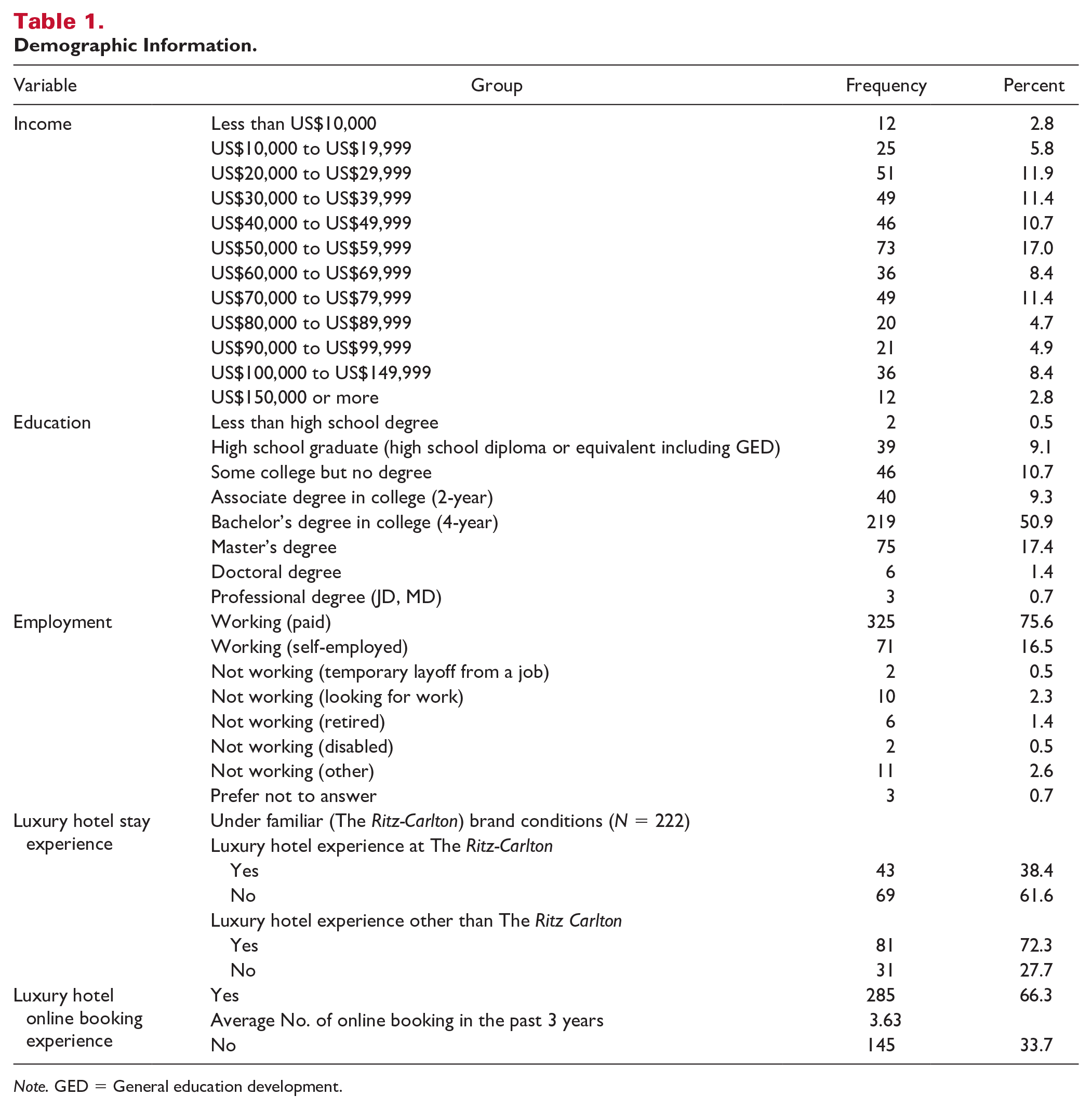
Note. GED = General education development.
Measures
For dependent variables, participants’ brand familiarity, experienced processing fluency, visual aesthetic appreciation, inferential beliefs about service quality (both tangible and intangible service), attitudes toward the brand, and purchase intentions were measured on seven-point scales. Means and standard deviations of all measures across four visual conditions are presented in Table 2. All measurements were borrowed from the prior literature and modified to fit into the research context (i.e., hotel information in an online setting). See Table 3 for item details, reliability, and validity. Participants’ brand familiarity was measured with one item (anchored by: very unfamiliar/very familiar) and two items (anchored by: not known at all/very well-known and never heard of/heard of a lot) borrowed from Kwun and Oh (2007). Participants’ experienced fluency was measured with three items that represent visual clarity and ease of perception borrowed from Reber et al. (2004). Participants’ visual aesthetic appreciation was measured with four items (anchored by: poor-/nice-looking, unattractive/attractive, bad/good appearance, ugly/beautiful; Lam & Mukherjee, 2005). Participants’ inferential beliefs about service quality were measured with 29 items that represent tangible and intangible elements of service quality, with end points labeled as “very low/very high.” Twelve items about tangible service quality were borrowed from Mei et al. (1999) and Wu and Ko (2013) and modified to fit into an online environment (i.e., “the likelihood that the room is clean is” implying no physical contact with the property instead of asking whether the room is clean). Seventeen items about intangible service quality were borrowed from Qu et al. (2000) and Wu and Ko (2013), and also modified to fit into an online environment (i.e., “the likelihood that the employees are friendly is” implying no physical contact with the service provider instead of asking whether the employees are friendly). Participants’ attitudes toward the brand were measured with five items (anchored by: unappealing/appealing, bad/good, unpleasant/pleasant, unfavorable/favorable, unlikable/likable; Crites et al., 1994; Spears & Singh, 2004; Voss et al., 2003). Participants’ purchase intentions were measured with two items and modified to fit into the hotel context (Spears & Singh, 2004). They were asked to indicate their likelihood of purchasing it if they needed to stay at a luxury hotel and the brand were available and affordable, with end points labeled as “very low/very high” and “do not intend to buy it/intend to buy it.” The manipulation check questions were identical to those used in the pretest. Finally, participants were asked to answer questions about their demographic information such as gender, age, luxury hotel experience, luxury hotel online booking experience, education, employment status, and income.
Means and Standard Deviations of Dependent Variables.

Note. CI = confidence interval.
Reliability and Validity of Measurement Scales.
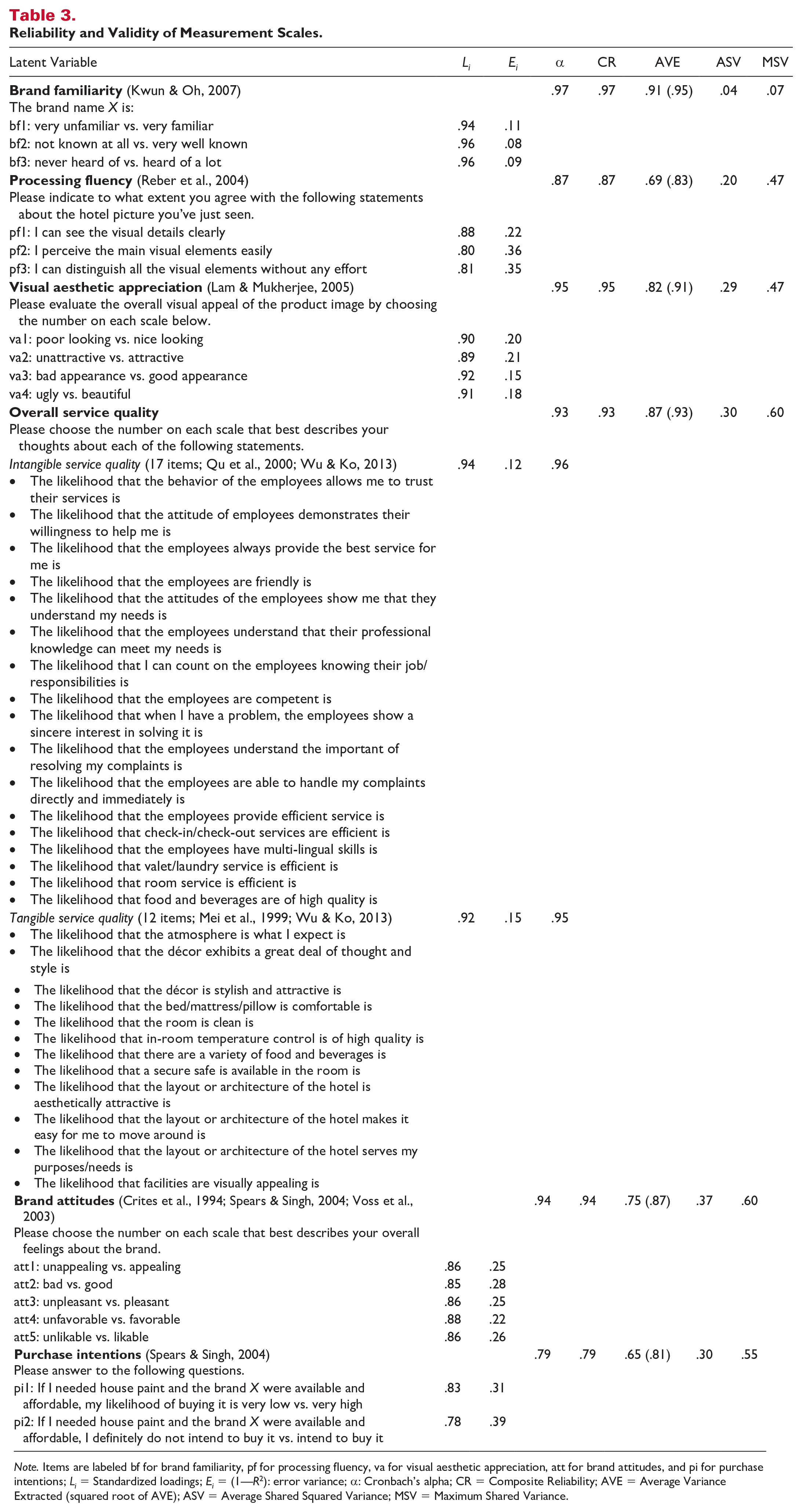
Note. Items are labeled bf for brand familiarity, pf for processing fluency, va for visual aesthetic appreciation, att for brand attitudes, and pi for purchase intentions; Li = Standardized loadings; Ei = (1—R2): error variance; α: Cronbach’s alpha; CR = Composite Reliability; AVE = Average Variance Extracted (squared root of AVE); ASV = Average Shared Squared Variance; MSV = Maximum Shared Variance.
Results
In the actual experiment, manipulation checks confirmed that participants perceived the level of brand familiarity and image quality as intended. The ratings were averaged to form a single-brand familiarity index and a single-image quality index. Independent samples t-tests showed that both independent variables were successfully manipulated. Participants who were assigned to familiar brand conditions perceived the Ritz-Carlton name as familiar, whereas those who saw a fictitious hotel name, del Luna, as unfamiliar, Munfamiliar = 3.56, SD unfamiliar = 2.01, Mfamiliar = 5.94, SDfamiliar = 1.32, 95% CI = [2.03, 2.72], t(353.94) = 14.40, p < .001, Cohen’s d = 1.40. Likewise, participants who were assigned to high image quality conditions perceived the hotel pictures as high image quality and those in low image quality conditions evaluated the pictures as low image quality, Mlow = 3.40, SDlow = 1.95, Mhigh = 6.00, SDhigh = .86, 95% CI = [2.31, 2.87], t(292.89) = 17.81, p < .001, Cohen’s d = 1.73.
To examine the hypothesized effects, two analyses were conducted. First, contrast analyses were performed to examine the main effects of image quality (H1) and brand familiarity (H3a), and interactive effects of image quality with brand familiarity (H4). Second, structural equation modeling analysis was conducted to test the proposed conceptual model and explore the underlying mediating processes responsible for conditional differences in consumer behaviors (H2a, H2b, H3b, H5, H6).
Contrast Analysis Results
A one-way ANOVA was conducted to see whether the manipulations affected consumer responses. Both Welch’s Test and Brown-Forsythe confirmed significant experimental effects on all dependent variables (all ps < .001). Given that the overall effect of conditions was significant, a contrast analysis was conducted to examine the pattern of results and find out which conditions differed without inflating the Type 1 error rate (Field, 2009). It was a full-sample procedure including all four conditions and we used three mutually orthogonal planned contrasts to test the main effects of image quality (Ψ1) and brand familiarity (Ψ2), and interaction effects of image quality with brand familiarity (Ψ3). The significance of contrasts was assessed using bootstrapped estimates of effects with 1,000 bootstrap samples. The results of the contrast analyses across all constructs and effect sizes for each contrast (rcontrast) are presented in Table 4.
Results of Contrast Analysis.
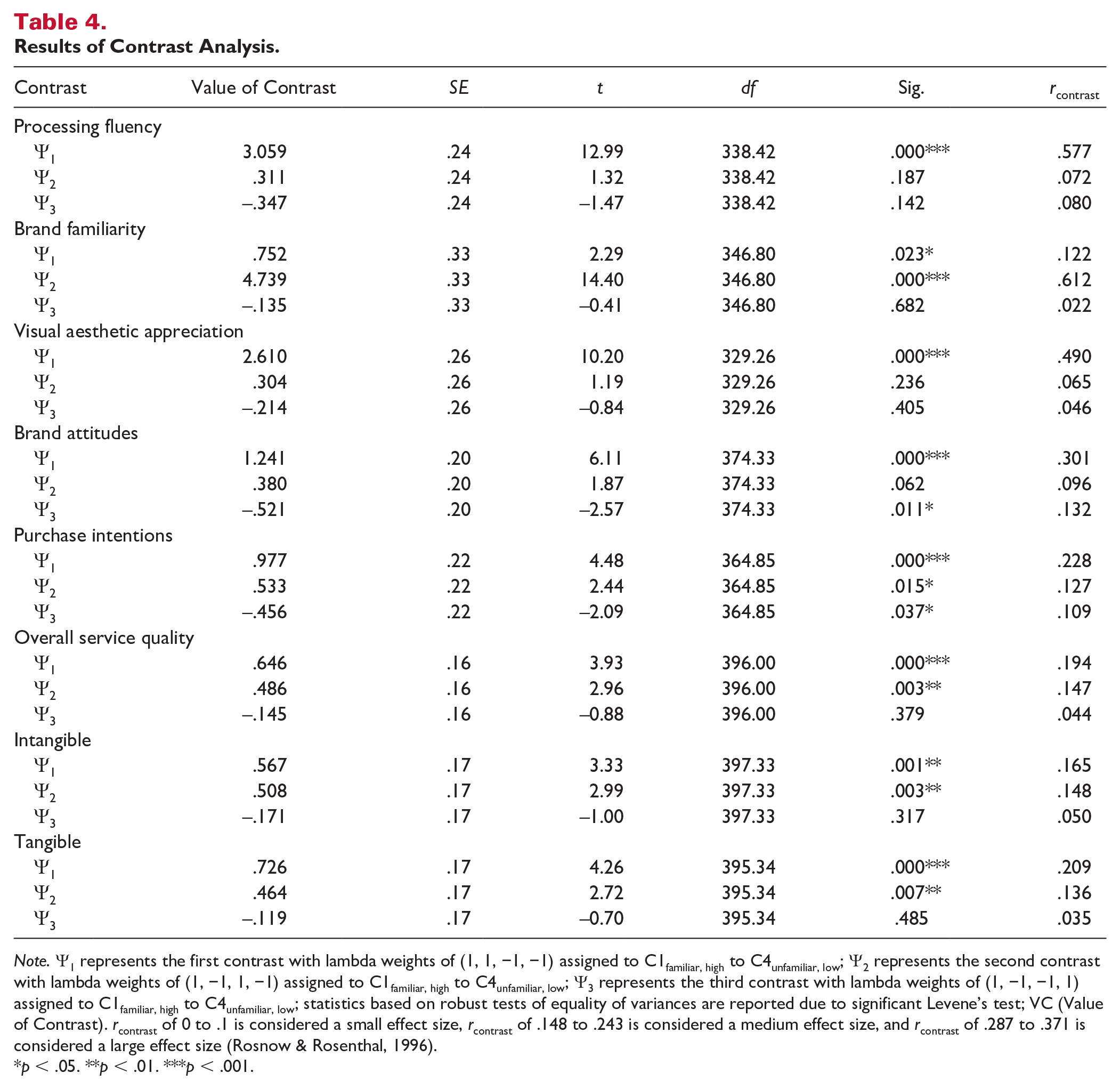
Note. Ψ1 represents the first contrast with lambda weights of (1, 1, −1, −1) assigned to C1familiar, high to C4unfamiliar, low; Ψ2 represents the second contrast with lambda weights of (1, −1, 1, −1) assigned to C1familiar, high to C4unfamiliar, low; Ψ3 represents the third contrast with lambda weights of (1, −1, −1, 1) assigned to C1familiar, high to C4unfamiliar, low; statistics based on robust tests of equality of variances are reported due to significant Levene’s test; VC (Value of Contrast). rcontrast of 0 to .1 is considered a small effect size, rcontrast of .148 to .243 is considered a medium effect size, and rcontrast of .287 to .371 is considered a large effect size (Rosnow & Rosenthal, 1996).
p < .05. **p < .01. ***p < .001.
The first planned contrast revealed that high image quality conditions were rated significantly higher on processing fluency, t(338.42) = 12.99, rcontrast = .58, visual aesthetic appreciation, t(329.26) = 10.20, rcontrast = .49, inferential beliefs about intangible service quality, t(397.33) = 3.33, rcontrast = .17, inferential beliefs about tangible service quality, t(395.34) = 4.26, rcontrast = .21, inferential beliefs about overall service quality (i.e., ratings on tangible and intangible service quality were averaged to form a single service quality index), t(396) = 3.93, rcontrast = .19, brand attitudes, t(346.80) = 2.29, rcontrast = .12, and purchase intentions, t(364.85) = 4.48, rcontrast = .23, compared with low image quality conditions (all ps < .05). Perceptual fluency experienced while processing visual stimuli was positively correlated with participants’ aesthetic appreciation of the stimuli. That is, hotel pictures with high image resolution were processed more fluently and evaluated as being aesthetically more pleasing compared with those with low image resolution.
In addition, participants who saw hotel pictures with high image resolution drew more favorable inferences about overall hotel service quality as well as tangible and intangible services. This finding indicates that even under the same brand name, those who saw clearer hotel pictures inferred that the featured hotel would have better facilities and provide better hospitality services. They also formed more positive brand attitudes as well as higher purchase intentions. These results successfully supported H1. The second planned contrast was conducted to test the main effects of brand familiarity on processing fluency. The results failed to support H3a that familiar brands were not processed more fluently than unfamiliar brands, t(338.41) = 12.99, rcontrast = .58, p > .05. Participants did not process the hotel pictures differently depending on the brand familiarity. The third planned contrast examined the interactive effects of image quality with brand familiarity. The results showed significant interactive effects between the two on brand attitudes, t(374.33) = 1.87, p = .062, rcontrast = .10, and purchase intentions, t(364.85) = 2.44, p = .015, rcontrast = .13. To further examine the nature of interactions, simple effect analyses were conducted. This approach revealed a simple main effect of brand familiarity under low image quality conditions on brand attitudes, F(1, 426) = 6.64, p = .01, and purchase intentions, F(1, 426) = 4.40, p = .04, but no effect under high image quality conditions (all Fs < .07, all ps > .05). Participants rated the familiar hotel brand Ritz-Carlton more favorably (Mdifference = .14, SDdifference = .14, p = .002) and had higher purchase intentions (Mdifference = .49, SDdifference = .15, p = .001), compared with the unfamiliar brand del Luna, under the low image quality condition. The brand familiarity effect was robust only when the image resolution was low, whereas it disappeared under high image resolution conditions. This indicates that the detrimental effects of low image quality are greater for unfamiliar brands. These results fully support H4.
Structural Equation Model Results
To assess reliability and validity of the measurement model we performed confirmatory factor analysis (CFA) based on data from 430 participants from MTurk with the sem package and lavaan package in R; there were no missing data. Composite reliability (CR), average variance extracted (AVE), maximum shared squared variance (MSV), and average shared squared variance (ASV) were used to assess the reliability, convergent validity, and discriminant validity (see Table 3). In all items, Cronbach’s alpha and CR were higher than the cut-off criteria of .7. All the parameters were statistically significant with a good measure of convergent validity, AVE greater than .5 and smaller than CR. Discriminant validity was also confirmed, AVEs greater than MSVs and ASVs (Hair et al., 2010). The overall fit indices indicate an excellent model fit to the data, χ²(137) = 223.09, χ²/df = 1.63 < 2, p < .001; CFI = .99 > .95; TLI = .99 > .95; SRMR = .02 < .08; RMSEA = .04 < .06 with 90% CI = .029, .047, Pclose > .05 (Hooper et al., 2008; Hu & Bentler, 1999; Tabachnick & Fidell, 2007).
Next, structural equation model (SEM) analysis was conducted to test the proposed conceptual framework. It was conducted with the maximum likelihood mean adjusted estimation (MLM). The overall fit indices indicate an excellent model fit to the data, χ²(196) = 317.13, χ²/df = 1.62 < 2, p < .001; CFI = .98 > .95; TLI = .98 > .95; SRMR = .046 < .08; RMSEA = .038 < .06 with 90% CI = .031, .045, Pclose > .05 (Hooper et al., 2008; Hu & Bentler, 1999; Tabachnick & Fidell, 2007). The standardized path coefficients as well as estimates and R2 for the model are presented in Table 5. The SEM results are also graphically described in Figure 1. Only three conditions appear in Figure 1 because three dummy-coded variables were used to represent the total number of visual conditions (i.e., d – 1 dummy-coded variables should be used in the group code procedure in SEM, where d is the number of conditions in the experiment; Russell et al., 1998). C4unfamiliar, low is the reference group in the following analysis; each of the three conditions in Figure 1 is presented in comparison to the reference condition.
Results of Structural Equation Model.
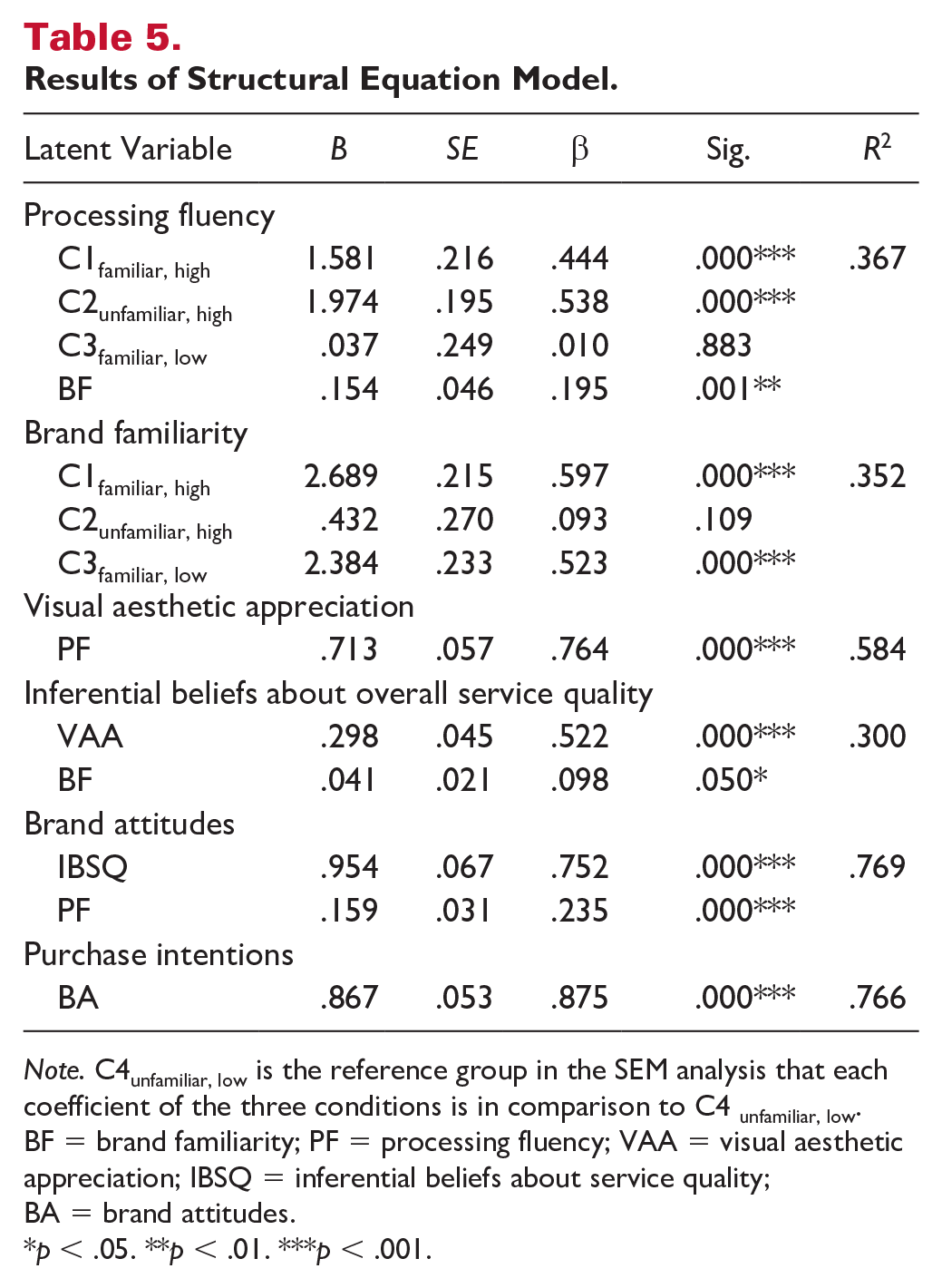
Note. C4unfamiliar, low is the reference group in the SEM analysis that each coefficient of the three conditions is in comparison to C4 unfamiliar, low. BF = brand familiarity; PF = processing fluency; VAA = visual aesthetic appreciation; IBSQ = inferential beliefs about service quality; BA = brand attitudes.
p < .05. **p < .01. ***p < .001.
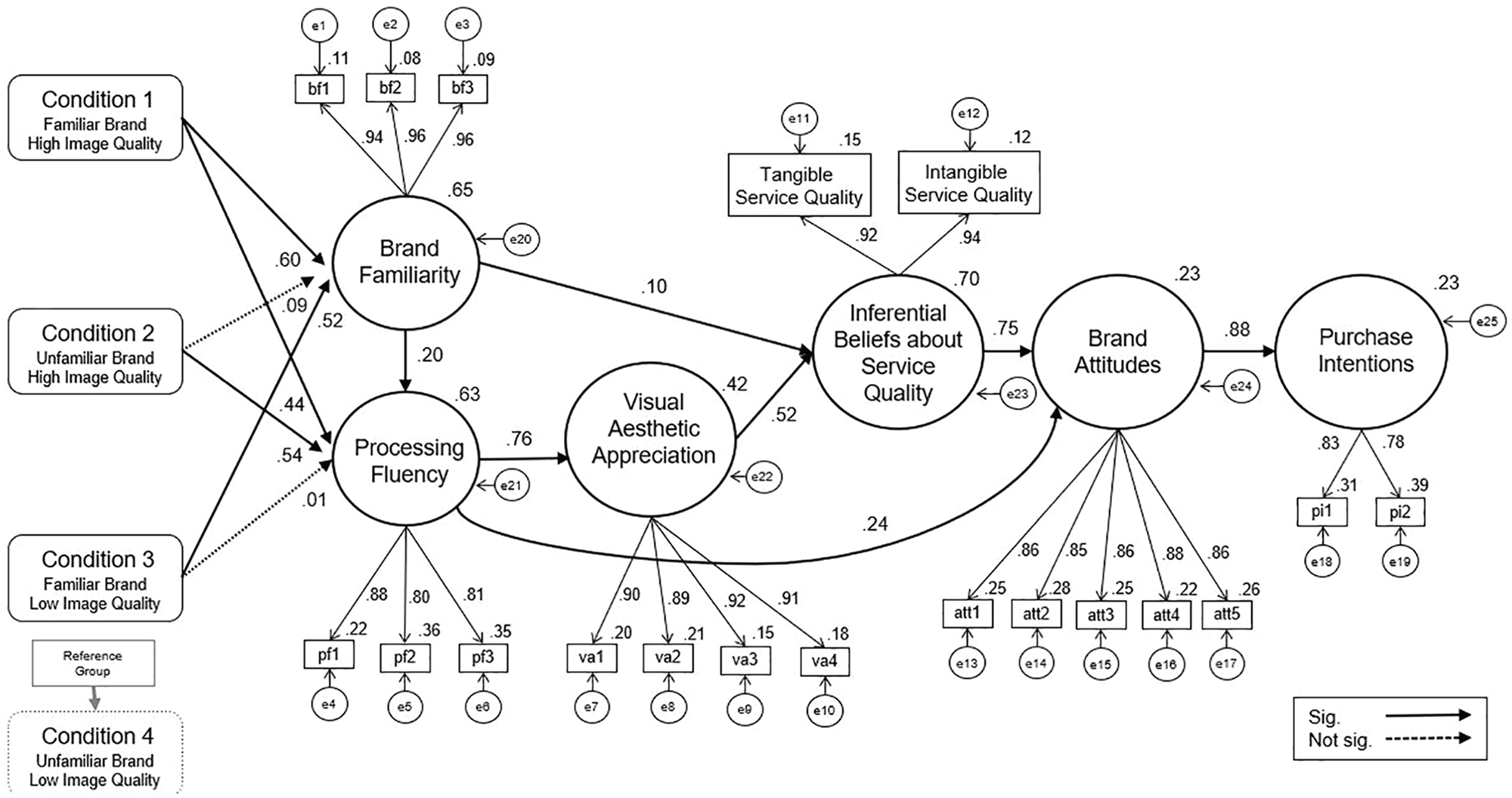
Results of Structural Equation Modeling.
First, the effects of experimental conditions on processing fluency were consistent with the results from contrast analysis. Both C1familiar, high (β = .44, p < .001) and C2unfamiliar, high (β = .54, p < .001) had significantly greater effects on processing fluency, whereas the effects of C3familiar, low (β = .01, p > .05) were not significant, compared with the reference condition C4unfamiliar, low. This confirms the main effects of image quality on processing fluency. This is consistent with H1.
To begin with, it was predicted that processing fluency would have positive effects on visual aesthetic appreciation and brand attitudes. The results confirmed that processing fluency was positively associated with visual aesthetic appreciation (β = .76, p < .001) as well as brand attitudes (β = .24, p < .001), supporting H2a and H2b.
Next, brand familiarity was predicted to have positive effects on processing fluency. The results fully support H3b that brand familiarity was positively associated with processing fluency (β = .20, p < .01). Then visual aesthetic appreciation was expected to be positively associated with inferential beliefs about service quality which, in turn, leads to brand attitudes as well as purchase intentions. The results also showed that visual aesthetic appreciation had a positive effect on inferential beliefs about service quality (β = .52, p < .001), fully supporting H5. Finally, H6 was also supported that inferential beliefs about service quality were positively associated with brand attitudes (β = .75) that subsequently affected purchase intentions (β = .88, all ps < .001). The results successfully confirmed the proposed model that lays out the directional effects of image quality and brand familiarity on consumers’ perceptions and judgments about luxury hospitality and services. Upon exposure to clearer hotel pictures and familiar brand names, consumers tend to feel more fluent, draw more favorable beliefs about hotel service, form more positive attitudes toward the featured brands and higher purchase intentions.
Discussion
Implications
The current research investigated how consumers respond to brand familiarity and the image quality of a photograph of a luxury hotel room, and to what extent consumers’ aesthetic experience and inferential beliefs about service quality are influenced by those factors. The results of a contrast analysis confirmed the main effects of image quality on all dependent variables: processing fluency, visual aesthetic appreciation, inferential beliefs about service quality (both tangible and intangible), brand attitudes, and purchase intentions. Participants who saw high-image-quality photographs experienced higher levels of processing fluency and were more favorable in terms of visual aesthetic appreciation, inferential beliefs about service quality, attitudes toward the brand, and purchase intentions. This indicates that image quality is an important factor that can greatly impact users’ perceptions and judgments of the luxury brand when browsing hotel information online and their aesthetic experience can explain the link between the two. Consumers who see a luxury hotel room picture with visual clarity tend to find it aesthetically appealing, draw positive inferences about the hotel’s service quality, and ultimately form more favorable brand attitudes and purchase intentions. However, the effects of brand familiarity on processing fluency were not significant in that the familiar luxury hotel brand Ritz-Carlton did not facilitate visual fluency. Hotel pictures were not processed more fluently just because the featured luxury brand is well known. This finding may be due to the fact that perceptual fluency effects are known to be highly specific to the stimulus and that past research studied perceptual priming (e.g., a match between the semantic prime and the target; Labroo et al., 2008). In addition, image effects interacted with brand familiarity such that the familiar hotel brand Ritz-Carlton was rated more favorably, and resulted in greater purchase intentions than the fictitious brand designed for the study, only when image quality was low. This indicates that the robustness of a well-known brand name becomes stronger especially when the photographic quality of a hotel picture is in question. While more fluent processing yields more positive affective responses (Reber et al., 2004), any parameter that impedes perceptual fluency may eventually lead to more negative responses. For instance, people deferred showing their preference when the font of a product description was difficult to read (Novemsky et al., 2007). In the current research, participants may have misattributed the difficulty of processing a hotel picture as indicative of disliking the brand. During the process, however, the familiarity of a luxurious brand name may have been robust to such negative judgments.
Perhaps more importantly, the proposed conceptual model was confirmed. This study not only examines the effects of hotel photos and brand names but also provides empirical evidence for the mediating role of processing fluency on aesthetic appreciation, which, in turn, affects inferential beliefs about service quality, brand attitudes, and, ultimately, purchase intentions. The results of structural equation modeling showed the connection between the visual appearance of a hotel suite (high vs. low image quality) and its brand name (familiar vs. unfamiliar brand), and the experience of aesthetic appreciation and processing fluency, the generation of inferences (about perceived tangible and intangible service quality), the formation of attitudes toward the brand, and the development of purchase intentions. Consumers use image quality and brand name to infer the luxury hospitality service and form attitudes as well as purchase intentions toward the hotel brand.
This study has major theoretical contributions. The research findings use foundations in fluency theory and the theory of attitude formation to present a comprehensive framework. Previously, these theories had been applied in more traditional consumer behavior contexts, including physical service environment (Orth & Wirtz, 2014), product package (Janiszewski & Meyvis, 2001), and product imagery (e.g., inward- vs. outward-facing direction of a product in the ad; Leonhardt et al., 2015). In this study, we empirically validate the combined model in the realm of luxury service as well as in the online environment in which consumers may have to heavily rely on readily available heuristic cues to infer the quality of luxury service. While the role of visual elements has received increasing attention in the luxury brand literature (Berger & Ward, 2010; Sharma, 2016), this study is the first to establish the explicit linkages between perceptual fluency and consumer responses to luxury hotel service in the online setting. In addition, brand familiarity and image quality have been considered peripheral cues that would be influential, especially when people are less involved or not thinking carefully (see elaboration likelihood model; Petty & Cacioppo, 1986). We demonstrate how consumers’ perceptions and judgments about luxury hospitality services that often involve high stakes can be susceptible to such heuristic cues.
This research also has important implications for the field of hospitality management. Despite its practical importance, relatively little is known about how consumers use luxury-hotel-related heuristic cues in an online booking environment, leaving gaps in the knowledge about how consumer response is changed by the appearance of a photo of a hotel room online and how the image effect differs depending on the hotel’s brand. These questions demand attention because online reservation has been increasingly popular for luxury hotel brands and consumers are more likely to rely on online information provided by hotel brands due to the lack of physical contact with the property and the service provider. For instance, while luxury consumption, especially in an online setting, is typically associated with high financial risks where people have to think about their choices to some extent, the current research findings suggest that people can glance at a blurry hotel picture and form unfavorable evaluations at the moment. This study suggests that even subtle, peripheral cues like the pictorial quality of a hotel room picture can have a tangible impact on consumer perceptions about luxury service quality and their purchase intentions in the end.
The research findings should also be of great interest to hotel industry professionals. The interactive effects of image quality with brand familiarity provide lessons for hotel brand managers and marketers aiming to target international guests. Besides global hotel companies like Ritz-Carlton Hotel Company or Four Seasons Hotels Limited, it is likely that foreign customers looking for upscale hotels may not be familiar with local luxury brands. For instance, the Shilla Hotel is a prestigious hotel brand affiliated with Samsung Group; its high price is comparable to other global luxury hotel brands yet it only exists in South Korea. In a situation where a potential customer is considering both a well-known global hotel brand Ritz-Carlton and a local hotel like the Shilla Hotel, a foreign consumer planning to visit Korea may not be familiar with the hotel brand Shilla. According to the results of this study, the impact of unclear, blurry pictures of the hotel’s rooms is greater for the Shilla Hotel than for the Ritz-Carlton hotel. Moreover, it was also found that even for the same hotel brand, consumers make different inferences and evaluations about the brand depending on the image quality of its room picture. In fact, advanced media technology such as 3-D product visualization (Lee, 2012) and 360° panoramic pictures (Choi et al., 2018) are known to allow greater imagery vividness and have positive effects on users’ attitudinal and behavioral responses. Advertisers or brand managers should consider using higher quality imagery on the hotel brand website so that the potential guests can see accommodations and facilities online more clearly and infer other aspects of the hotel service in a favorable manner. However, hotel pictures with low image resolution can compromise consumer behaviors. The existence of poor-quality hotel images for luxury brands may raise questions but it is not so difficult to find such photos on the internet (e.g., as a result of uploading a picture without confirming its compression level). Moreover, the online visual representation of a hotel property may depend not only on the luxury brand itself but also on previous guests. For example, third-party travel websites like TripAdvisor provides an interactive platform where users can upload their own photos of the hotel property. This means that the quality of hotel photos varies considerably; some user-generated pictures suffer from low image resolution and poor quality, with a subsequent impact on aesthetic experience and the ultimate behavior of consumers. Depending on the image’s quality, consumers experience varying levels of processing fluency and make different inferences about the likelihood that the service quality is high, which ultimately affects brand attitudes as well as purchase intentions. Therefore, it is suggested that hotel brands, especially unfamiliar brands, take extra caution when uploading hotel photos, managing their websites, and monitoring user-generated content to a greater extent.
Limitations
The present research does have some limitations. First, our predictions about the impact of image quality on consumer evaluations may seem straightforward. However, even seemingly axiomatic predictions—heavy things fall faster than light things—have been found not true and deserve empirical testing. Certainly, it is possible that the pictorial representation of hotel images online makes no difference whatsoever in consumer behaviors. In fact, image quality is not logically related to either the physical condition of the hotel property or the service quality provided by employees. Because the most predictable and obvious findings are considered most important (Richard et al., 2001), the current research findings are merited. Second, among various theoretical explanations, the theory of processing fluency was employed to explain the underlying mechanisms behind the consumer response to hotel visuals. While processing fluency is most relevant to photographic image quality, other constructs such as arousal may also provide a theoretical groundwork (i.e., people prefer a stimulus with a moderate level of novelty; Berlyne, 1971). However, because arousal better explains the aesthetic appreciation of the beauty represented by an image, future research may explore how the interior design of hotel rooms activates distinct levels of arousal and affects subsequent preferences and attitudinal responses. In addition, the physical environments featured in the experimental stimuli were exclusively hotel suites. Future studies can further investigate whether the visual effects found in this study vary depending on whether other hotel areas, such as the lobby or grounds, are featured. Moreover, with the advancement of communication technology, mobile-based applications have become increasingly popular in recent years. User response to the visual cues within social media or branded applications could be another future research topic. Finally, there may be individual differences in the level of significance visuals hold for a particular consumer. This individual difference has been labeled centrality of visual product aesthetics such that consumers with high CVPA are better able to recognize and appreciate the quality of visual appearance of a product (CVPA; Bloch et al., 2003). In addition, it attempts to capture consumers’ individual significance or importance of visual product aesthetics rather than preferences for or attitudes toward a particular style. Future research may investigate to what extent consumers perceive and feel differently about luxury hotels’ website aesthetics depending on their individual personality traits.
Footnotes
Appendix
Author’s Note
I confirm that the paper has not been published previously, is not under consideration for publication elsewhere, and is not being simultaneously submitted elsewhere.
Declaration of Conflicting Interests
The author(s) declared no potential conflicts of interest with respect to the research, authorship, or publication of this article.
Funding
The author(s) disclosed receipt of the following financial support for the research, authorship, or publication of this article: This work was supported by the research fund of Hanyang University (HY-2019).
