



Abstract
In light of current industry imperatives and growing scholarly attention, this study was conducted to provide a thoroughly updated bibliometric overview of how service innovation research has evolved. A total of 133 papers across 42 hospitality and tourism journals over 18 years (2003–2020) were extracted and analyzed. We first examined the publication outlets and trajectories of service innovation. Next, we applied several state-of-the-art bibliometric techniques, including co-citation and keyword co-occurrence analysis. Based on the results of co-occurrence analysis, we proposed a flowchart of the service innovation process combining organizational and customer perspectives while considering the service design, process, and outcome phases. We then summarized the major findings and limitations of service innovation studies in hospitality and tourism. A series of critical future research directions were presented accordingly.
Creativity is thinking up new things. Innovation is doing new things.
Introduction
Over the past 20 years, service innovation—particularly technology-driven advances in the global consumer environment—has fundamentally changed the way consumers travel. These innovations have shaped consumers’ information searches, purchase and consumption of hospitality and tourism services, and postpurchase evaluations. A report from the United Nations Conference on Trade and Development (2020) indicated that the share of services in developing countries’ gross domestic product has grown from 42% to 55%, whereas the share in developed countries has grown from 61% to 75%; services are clearly an essential part of the world’s economic prospects. Given the role of services in modern society, implementing effective service innovation is key to better performance: organizations that excel in most of these practices earn 2.4 times more economic profit than those that do not (Am et al., 2021). Moreover, the COVID-19 pandemic has called for breakthroughs in the hospitality and tourism industry (Kim et al., 2022; Sharma et al., 2021). New technologies, coupled with rapidly evolving consumption patterns, could shore up customers’ confidence amid COVID-19 (Jiang & Wen, 2020). Innovations also have the potential to disrupt the marketplace while profoundly altering competitive dynamics, economic systems, and society. As a result, today’s consumers are searching for, making decisions about, and using products and services in new ways (Moorman et al., 2019). Current academic and practical attention to service innovation speaks to its promise.
The literature suggests that service innovation in hospitality and tourism can enhance business performance (Mattsson & Orfila-Sintes, 2014) and produce competitively sustainable service experiences (King et al., 2019). Innovation can also drive customer satisfaction, advocacy, and intended behavioral loyalty (Hollebeek & Rather, 2019). Recent research has shown that the extent of innovation varies by the hospitality and tourism sector, and the effects of innovation strategies on performance are sector-specific (Martín-Rios & Ciobanu, 2019). In particular, emerging technologies such as service robots, self-service technology (SST), and smart systems reportedly offer hospitality and tourism organizations valuable opportunities (Shin & Perdue, 2019). These innovations have been found to boost brand image (Kuo et al., 2017), deliver cost benefits (Buhalis & Leung, 2018), and facilitate product and service delivery (Law et al., 2018). In parallel with such findings, hospitality and tourism organizations such as hotels, airlines, and destinations have sought to innovate in their business operations and service offerings; doing so can increase performance efficiency and improve customers’ experiences. The theoretical and practical importance of innovation has garnered increasing attention in the hospitality and tourism literature, to the point that innovation has hence become a major topic of interest in the field.
Vargo and Lusch (2004) defined the service concept as the application of specialized competences (e.g., knowledge and skills) for the benefit of another. Building on this angle, Toivonen and Tuominen (2009) described service innovation as “a new service or such a renewal of an existing service which is put into practice and which provides benefit to the organization that has developed it” (p. 893). Scholars have further argued that due to the intangibility, heterogeneity, and perishability nature of service (Sampson & Spring, 2012), service innovation differs from that in manufacturing; that is, innovations in service are relatively simple to mimic even with patent protection (Miles, 1995). The inherent diversity of service innovation also requires offerings to be tailored to specific service contexts (Geum et al., 2016). Technology has come to play a key role in fostering service innovation as well (Nylén & Holmström, 2015): as a tool to promote transformative market development, technology represents an essential—and often mandatory—service innovation resource (Barrett et al., 2015).
Service innovation has also been classified categorically. Coombs and Miles (2000) divided the concept into three types: assimilation, demarcation, and synthesis. Snyder et al. (2016) proposed that service innovation can be defined based on four traits: (a) degree of change, (b) type of change, (c) newness, and (d) means of provision. In addition, Den Hertog (2000) outlined four key dimensions of service innovation, namely, the service concept, client interface, service delivery system, and technological options. Overall, many prior studies viewed service innovation based on the extent of standardization versus specialization (Hipp et al., 2000). Yet researchers have suggested that the hospitality and tourism sector possesses characteristics that can inform definitions and typologies of service innovation (Gomezelj, 2016). In this setting, Hjalager (1997) and Vila et al. (2012) identified four types of tourism innovation (product innovations, process innovations, market knowledge, and management innovations). However, most scholars agree that much remains to be learned about service innovation in hospitality and tourism (Gomezelj, 2016).
Within the hospitality and tourism literature, valuable findings have emerged around sustainable service innovation (Horng et al., 2018), management innovation (Nieves & Segarra-Ciprés, 2015), employee creativity and innovation (Hon & Lui, 2016), innovative service behavior (Kim et al., 2013), service innovation implementation (Enz, 2012) and co-creation (Verma et al., 2012), and innovation and business performance (Martín-Rios & Ciobanu, 2019). Technology-driven advances such as artificial intelligence (AI; Lu et al., 2019), service robots (Tung & Law, 2017), internet-facilitated peer-to-peer consumption (So et al., 2018), virtual/augmented reality (Tussyadiah & Park, 2018), gamification (Xu et al., 2017), smart tourism (Buhalis & Leung, 2018), and the internet of things (Sparks et al., 2016) have been extensively examined.
Even with growing academic attention and noteworthy industry imperatives, review studies examined subcategories of service innovation separately, including SST (Shin & Perdue, 2019) and collaborative innovation (Marasco et al., 2018). The COVID-19 pandemic has led to a severe social and economic recession affecting both demand and capacity in the hospitality industry. Organizations and customers have been forced to reframe the service ecosystem as a result (Sharma et al., 2021). The pandemic has also brought attention to service innovation as a means of enhancing service provision by reengineering service design, process, and potential outcomes (Heinonen & Strandvik, 2020). Despite the importance of organizational and customer perspectives on service innovation, a holistic synthesis of related literature in hospitality and tourism is lacking. A bibliometric study can map an intellectual and structural landscape of service innovation research by visualizing the evolution of this line of literature. This approach can also synthesize the knowledge structure of service innovation research and identify potential avenues for future work.
In this article, bibliometric analysis—as a quantitative approach to scientific review—was adopted to synthesize service innovation studies in hospitality and tourism. Following Moher et al.’s (2009) recommendation, we employed a multistage article selection process to identify, choose, and critically evaluate relevant scholarly papers. Using this method, 133 papers published across 42 hospitality and tourism journals spanning 18 years (2003–2020) were extracted and analyzed. We adopted several state-of-the-art bibliometric techniques (i.e., co-citation analysis and keyword co-occurrence analysis). Results revealed the knowledge domain and interrelation patterns of service innovation topics in hospitality and tourism. We then comprehensively synthesized critical findings and limitations in service innovation studies. Finally, we identified a series of fruitful directions for future work.
Method
Data Collection
To synthesize service innovation research in hospitality and tourism, we gathered data from the Web of Science (WoS). This platform houses an influential and reliable database of studies in mainstream marketing (e.g., Dzikowski, 2018) as well as tourism (e.g., Hall, 2011) and hospitality (e.g., Mulet-Forteza et al., 2020). Following Moher et al.’s (2009) approach, we first screened articles using the keywords “service” and “innovation” in all fields. This search yielded 3,055 articles published between 2000 and 2020. Second, we refined our results by limiting the search parameters to “hospitality leisure sport tourism.” Given the suggestion that “bibliometric studies should not focus only on leading journals” (Koseoglu et al., 2016, p. 190), we did not filter out specific journals aside from those related to sport. This filtering process resulted in a list of 356 articles. Third, the sources’ titles, abstracts, and keywords were screened; duplicate articles, those for which no full text was available, and those not fitting the selection criteria, were manually excluded (Agapito, 2020). Each publication’s abstract and keywords were first analyzed to determine the source’s eligibility during this identification procedure. All articles that passed the selection process were then reviewed. Ultimately, 133 journal articles related to service innovation were retained.
Data Analysis
We performed bibliometric analysis to reveal the evolution and structure of research on service innovation in hospitality and tourism. In particular, we conducted co-citation analysis and keyword co-occurrence analysis. We extracted our final data set (i.e., 133 papers) from WoS and created a network file using BibExcel; this program prepares network files that are compatible with Gephi and VOSviewer (Persson et al., 2009). We next used VOSviewer to map network analyses (Bastian et al., 2009).
Results
Co-Citation Analysis
Co-citation is a means of evaluating the similarity between articles, authors, or journals (Zupic & Čater, 2015). If two papers appear together in a reference list, they are highly likely to have something in common (Small, 1973). Based on McCain’s (1990) suggestion to apply a cutoff point to determine the most influential papers, we chose 11 citations as the threshold (Leung et al., 2017). In total, 112 papers were thus included in co-citation analysis.
As depicted in Figure 1, the co-citation network generated three clusters based on shared references in the chosen articles. The red cluster outlines the conceptualization and determinants of service innovation in hospitality and tourism. Notably, Hjalager (2010) reviewed the broad concept of innovation in tourism and defined service innovation as changes directly observed by visitors and considered novel. Omerzel (2015) proposed a classification and measurement of several key service innovation concepts, including entrepreneurial orientation, customer orientation, and organizational culture. Other studies (e.g., Camisón & Monfort-Mir, 2012; Divisekera & Nguyen, 2018) identified the antecedents of service innovation, including collaboration, human resources, funding, and investment. Rodriguez et al. (2014) empirically examined tourism innovation policies at local, regional, and national levels, addressing mixed results (i.e., negative and positive trajectories) and highlighting the role of polycentricity in efficient policy design and execution.
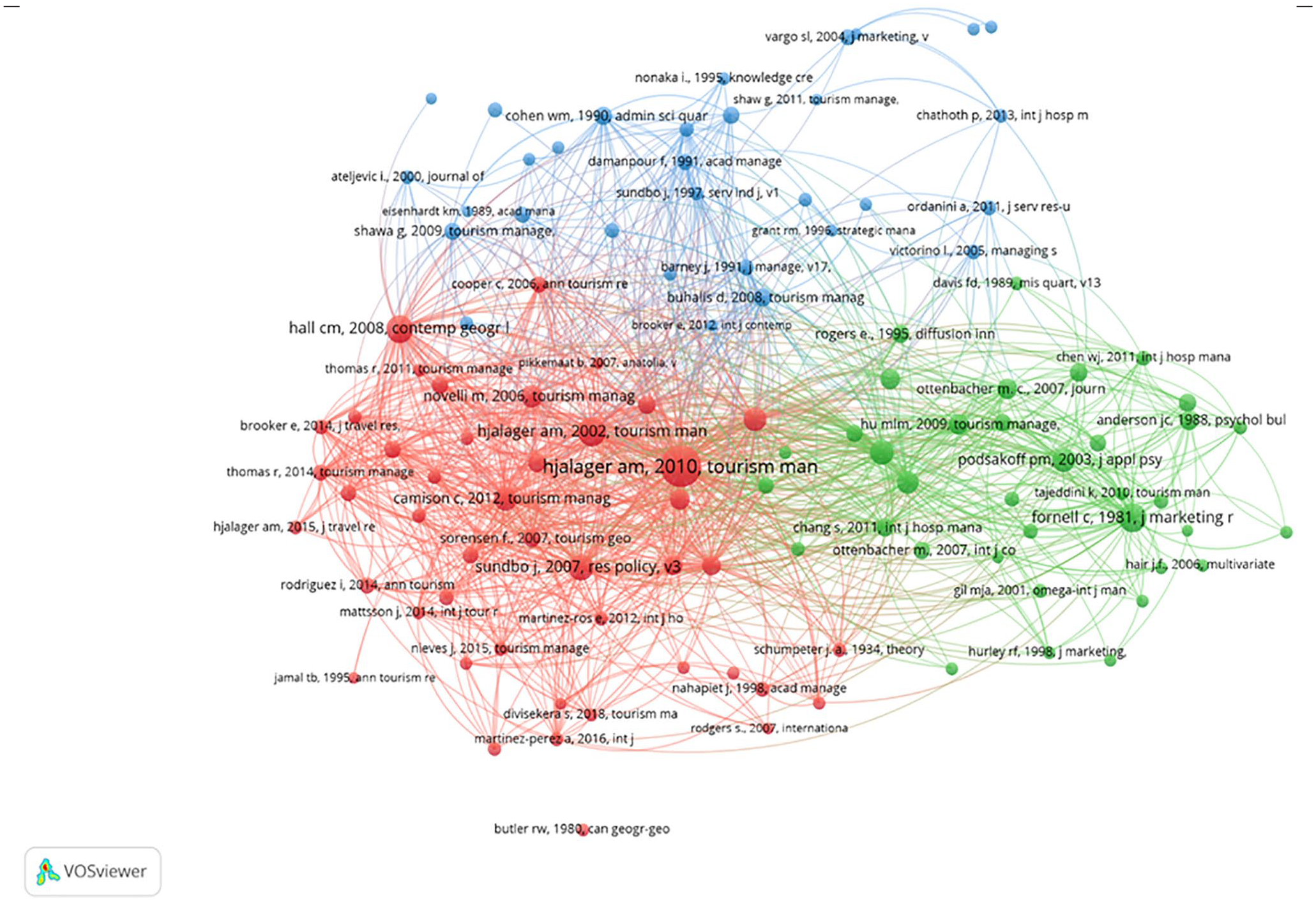
Visualized Co-Citation Network.
The blue cluster identifies several emerging trends in service innovation research in hospitality and tourism. Popular topics include service-dominant logic (Vargo & Lusch, 2004) and service innovation as a co-production/co-creation matrix (Chathoth et al., 2013). Vargo (2008) illustrated the evolution of service-dominant logic along with co-creation. Chathoth et al. (2013) pointed out that co-production represents a firm-centric view within goods-dominant logic, whereas co-creation moves away from this perspective in favor of emphasizing greater customer participation; more specifically, firm–customer interaction is managed in such a way as to encourage firms to co-create value with customers. Shaw et al. (2011) additionally argued that customers, as an operant resource, play a collaborative role in hotel service delivery to ensure innovation.
The green cluster describes the outcomes of service innovation based on methodological/analytical techniques applied in empirical service innovation research. Structural equation modeling (Fornell & Larcker, 1981) seemed common, as many articles were highly cited sources related to this methodology. Such papers identified structural relationships between service innovation and its outcomes. For example, Chou et al. (2012) examined the effects of adopting green innovations (e.g., in terms of compatibility, observability, and social influence) by combining the theory of planned behavior and innovation adoption theory in the restaurant industry. To develop effective hospitality innovations, Ottenbacher and Gnoth (2005) stressed the tangible nature of service, service advantages, the consistency of service delivery, and innovative technology. Podsakoff et al.’s (2003) literature review and recommendations regarding common method biases in behavioral research were also frequently cited, as was Nunnally’s (1978) overview of psychological measurement. Psychological and statistical studies composed the green cluster, capturing the most prominent approaches to service innovation research in hospitality and tourism. Building on robust methodological/analytical techniques, Grissemann et al. (2013) empirically investigated the relationships between service innovation and business performance (i.e., as indicated by financial performance, customer retention, and reputation).
Co-Occurrence Analysis
As keywords are considered appropriate representations of scholarly articles (Comerio & Strozzi, 2019), we analyzed keyword co-occurrence to generate a network of key themes and their relationships. This network can describe a field’s conceptual scope (Mulet-Forteza et al., 2020). Out of 1,973 keywords, 163 met the inclusion cutoff for the minimum number of keyword occurrences (n = 5). Figure 2 portrays the temporal evolution of keyword co-occurrence identified in the lexical network. To explore changes in the themes of service innovation research from 2003 to 2020, the 18-year study horizon was broken into three subperiods: 2003–2015, 2016–2018, and 2019–2020. The main keywords—“competitiveness,” “diffusion,” “diversification,” “policy,” “productivity,” “resource-based view,” “strategy,” and “technological acceptance model”—were bluish between 2003 and 2015. Subsequent keywords, including “absorptive capacity,” “competitive advantage,” “collaboration,” “coproduction,” “employee creativity,” “information technology,” “integration,” and “market orientation,” were greenish between 2016 and 2018. Since 2019, the main keywords (in yellow) have been related to co-creation, disruptive innovations, dynamic capabilities, eco-innovation, the environment, the future, and the sharing economy. This analysis illustrates the development of topics of interest across different timeframes.

Keyword Co-Occurrence Network Keyword in the Literature (Temporal Network).
In addition, Figure 3 illustrates the keyword co-occurrence network, which consists of five clusters: (a) purple cluster: organizational drivers of service innovation; (b) red cluster: organizational outcomes of service innovation; (c) green cluster: customer outcomes of service innovation; (d) blue cluster: the central role of the customer; (e) yellow cluster: technological service innovation and theoretical framework.

Keyword Co-Occurrence Network Keyword in the Literature (Lexical Network).
Purple cluster—Organizational drivers of service innovation
The purple cluster pertained to the organizational drivers of service innovation. Chosen studies largely investigated service innovation design from organizational perspectives, namely, the resource approaches, capability approaches, and orientation approaches.
Resource approaches
Based on our analysis and the extant literature, three types of resources (i.e., human, social capital, and cultural resources) contribute to building innovative designs through organizational lenses (Mohamed, 2016; Tajeddini & Trueman, 2012). Human resources encompass a firm’s experience, knowledge, skills, and employee commitment, including workers’ relationships with others within the organization as well as those externally (Qehaja & Kutllovci, 2015). Managers are responsible for making innovation-related decisions, and employees are motivated to implement innovation strategies. In hospitality and tourism settings, frontline employees play a key part in the delivery of services and new products (Melton & Hartline, 2013). Workers are therefore paramount to service innovation (Tajeddini, Martin, & Ali, 2020). Consequently, employees are encouraged to exhibit commitment (Tajeddini, Martin, & Altinay, 2020), passion (Luu, 2019), and innovative behavior in their jobs (M. Li & Hsu, 2016). A lack of capable human capital has tempered the innovative potential of hospitality and tourism practices (Camisón & Monfort-Mir, 2012). According to Tajeddini et al. (2020), human resources play a vital role in maximizing employee creativity, which is the foundation of organizational innovation. Human resources have also been considered major gears that companies use to initiate specific business outcomes, which can in turn contribute to group innovation (Úbeda-García et al., 2018). Hu et al. (2009) suggested that knowledge sharing and team culture can influence service innovation performance as well.
Another primary resource is social capital; this attribute can influence knowledge sharing, which is crucial to service innovation and can enhance small- and medium-sized tourism enterprises (N. Kim & Shim, 2018). Social capital refers to “the ability of actors to secure benefits by virtue of membership in social networks or other social structures” (McGehee et al., 2010, p. 487). Studies have shown that reciprocity, trust, and cooperation constitute the main features of social capital. These characteristics can produce opportunities for community building and capacity improvement (Zhao et al., 2011). From a resource-based perspective, social capital links a company with agents in the hospitality and tourism sector who can help identify possible first-mover benefits in service innovation design (T. T. Kim et al., 2013). Social capital includes a set of resources embedded within a system of social associations as well as all resources available through this system (C. Lee & Hallak, 2020). García-Villaverde et al. (2020) identified the relationship between market dynamism and social capital as a driver of service innovation. Hospitality and tourism researchers have largely considered social capital as an enduring resource, consisting of reciprocity, trust, cooperation, respect, friendship, norms, a shared language, centrality, connectivity, and an established hierarchy (Peters & Kallmuenzer, 2018; Marasco et al., 2018).
In addition to human and social capital resources, cultural resources such as an entrepreneurial culture, climate, and knowledge can shape motivation for organizational innovation. Tajeddini and Trueman (2012) reported that three cultural factors—individualism, power distance, and long-term orientation—are positively associated with hotels’ innovation. An environment that is perceived as safe and free from criticism, aptly termed an “innovative climate,” can further encourage service innovation (Mathisen & Garnes, 2015). Knowledge is a critical cultural resource for innovation diffusion as well. For example, while hospitality and tourism organizations temporarily ceased operations during the pandemic, firms continued to store and share organizational practices and information (i.e., transferring knowledge) to innovate their service offerings in response to COVID-19 (Dillette & Ponting, 2021).
Capability approaches
Researchers have also investigated the capabilities required for organizational innovation. According to Zahra and George (2002), the notion of dynamic capability reflects an organization’s competence in responding to strategic change by rebuilding its fundamental capacities. Of note, firms’ absorptive capacity to acquire knowledge and adopt new technologies is pivotal to fostering service innovation (M. Lee et al., 2019). This capacity is particularly vital in hospitality and tourism, as enterprises’ innovation activities depend heavily on obtaining exploitative knowledge along with filtering, incorporating, or amalgamating current intellectual knowledge (Wu, 2020). Another important capacity relevant to innovation is collaborative ability. Thomas and Wood (2015) noted that innovative organizations are likely to collaborate with external stakeholders in various ways to secure current and up-to-date knowledge. Collaboration reinforces the connection among hospitality and tourism enterprises, which can boost organizational innovation capacity (Pongsathornwiwat et al., 2019). Moreover, collaboration within and beyond organizations involves stakeholders such as customers and employees (Shulga & Busser, 2020) who enhance firms’ capacity to innovate and thus promote a competitive advantage and sustainability.
Orientation approaches
Three orientations, specifically the entrepreneurial orientation (Tajeddini, 2010; Tang et al., 2020), customer orientation (Y. H. Li et al., 2009; Tang, 2014), and sustainable orientation (Horng et al., 2018), have dominated service innovation research. The overall concept of orientation refers in this case to organization-oriented knowledge gathering, sharing, and use (Tang, 2014). The entrepreneurial orientation entails the processes, practices, philosophy, and decision-making activities that guide organizations’ innovation (Y. H. Li et al., 2009). From an operational perspective, service innovation can improve firms’ performance. Specifically, Tang et al. (2020) discovered that small and medium tourism enterprises can leverage their core competencies to promote service innovation under the entrepreneurial orientation (i.e., operational activities and decision-making patterns). More broadly, this orientation has been examined based on three dimensions: risk-taking, proactiveness, and innovativeness (Tajeddini, 2010). Entrepreneurially driven companies take the initiative to produce and provide new services to the hospitality and tourism market and evaluate negative consequences in advance (Jogaratnam, 2017). A business with a strong entrepreneurial orientation primarily focuses on business performance by establishing a value-creating approach, the benefits of which other competitors struggle to replicate (Tajeddini, Martin, & Ali, 2020). Entrepreneurship thus represents an organizational strategic orientation grounded in the pursuit of benefits and greater risk possibilities (Tang et al., 2020). These companies proactively generate innovative services and creatively outpace competitors (Jogaratnam & Ching-Yick Tse, 2006).
The customer orientation emphasizes consumers’ involvement in service design innovation, such as firms learning from dissatisfied customers to generate innovative service ideas (Duverger, 2012). The marketing orientation is customer-centered, focusing on customers’ needs and generating revenue through customer satisfaction (Lombardi et al., 2019). Tajeddini (2011) argued that the customer is the most significant external element when establishing a market orientation; as such, firms should adhere to a customer-focused strategy. The customer orientation can also function as a bridge to access data about customers’ desires (Tajeddini, 2010): customer-oriented firms tend to implement products and services that meet customers’ needs and wants in service innovation design (Tang, 2014). Al-Hawari et al. (2020) further identified the customer orientation as a moderator in the positive relationship between employees’ outcomes of abusive supervision and their silence.
Finally, the sustainable orientation encourages organizations to adopt sustainable strategies and green technology to reduce the hospitality and tourism industry’s environmental, economic, and social impacts on communities (Horng et al., 2018). Despite the importance of sustainable competitive advantages in hospitality and tourism, the emerging sustainable orientation in service innovation design has not been thoroughly examined.
Red cluster—Organizational outcomes of service innovation
The red cluster depicts the effects of service innovation on hospitality and tourism organizations. Organizations evaluate service innovation via multiple metrics including firm performance, innovation capability, and service innovation performance (Sipe, 2021). Firm performance is the most straightforward way for firms to assess service innovation outcomes (B. T. Chen, 2017; Tajeddini, Martin, & Ali, 2020). Studies have shown that organizational innovation efforts can enhance hospitality firms’ financial and market performance both directly and indirectly (Dai et al., 2015). Organizations are also interested in how to evaluate and promote dynamic innovation, such as by adopting new technology and absorbing knowledge (Pongsathornwiwat et al., 2019). External openness is closely tied to innovation management in hospitality and tourism (Iglesias-Sánchez et al., 2020). Service innovation performance refers to how service innovation is executed; this concept has been operationalized as employees’ service behavior (B. T. Chen, 2017) or employees’ creativity (Horng et al., 2015). Overall, organizational outcomes typically involve considerations of firm performance (B. T. Chen, 2017), innovation capability (Pongsathornwiwat et al., 2019), and service innovation performance (Horng et al., 2015).
Green cluster—Customer outcomes of service innovation
The green cluster reflects how customers assess service innovation. Customers’ outcomes of innovative services in hospitality and tourism may manifest as perceptions and attitudes. Variables such as customer engagement and satisfaction (Yen et al., 2020), loyalty (Cheema et al., 2019), and behavior have been examined to identify how innovative services influence customers. For example, tourists using QR codes at heritage sites were found to be highly satisfied (Tardivo et al., 2015). Yen et al. (2020) surveyed chain coffee shop customers in Taiwan and discovered that innovativeness directly affects customer engagement. Furthermore, service providers’ innovativeness has been identified as an antecedent of customer loyalty (Cheema et al., 2019). Thus, loyalty and satisfaction are key evaluative outcomes of customers’ perceptions of service innovation.
Blue cluster—The central role of the customer
The blue cluster features research on customers’ central role in service innovation design. Based on service-dominant logic (Vargo & Lusch, 2004), several key concepts (i.e., operant resources, consideration of value-in-use, and co-creation in service design) have been examined to explain how customers co-create value in service innovation design. Vargo and Lusch (2016) deemed customers the co-creators of value, which is actualized in use. Consideration of value-in-use refers to how customers shape or design the value of goods and services based on personal usage experiences (Vargo & Lusch, 2004). Customers’ central role also involves the exchange and integration of operant resources (e.g., skills and knowledge; Lei et al., 2019), which are vital to service innovation (H. Xu et al., 2018). J. S. Chen et al. (2017) stressed service innovation as a key element of organizations’ competitive edge based on operant resources. In addition, H. Xu et al. (2018) proposed that the degree of customers’ co-creation (i.e., through their involvement in service innovation) enhances the outcome of new services. Value co-creation in service design further captures customers’ tendency to assume an active role in collaborating with a firm. Customers’ roles in service innovation are hence both guided by and shape value propositions, ultimately boosting firms’ financial performance.
Yellow cluster—Technological service innovation and theoretical framework
The yellow cluster revolves around technological service innovation. Studies within this cluster relate to the impacts of technology on firms and customers in service process. Technology continues to inform industry practices by seizing and redistributing idle capacities to make potential offerings accessible to more people (Daunorienė et al., 2015). One example of this opportunism in hospitality and tourism is the sharing economy. Airbnb, a popular peer-to-peer sharing accommodation platform, mediated by technology, has become an especially intriguing topic as shown in our analysis: scholars have considered divergent experiences in Airbnb rentals and traditional hotels as well as Airbnb hosts’ and guests’ disparate perspectives. In addition to the sharing economy, the yellow cluster features organizational and customer perspectives as technological service innovation continues to redefine service delivery. For example, information and communication technology (ICT) such as mobile phone applications have begun to mediate interactions between service providers and customers; in fact, ICT fosters dynamic resource integration by actively reshaping organizations and encouraging value co-creation from pre- to postdelivery (Troisi et al., 2019). SST (e.g., self-check-in and check-out systems) also facilitates service delivery (Kaushik & Kumar, 2018). Technology adoption promotes hospitality and tourism organizations’ participation in the sharing economy as well (Camilleri & Neuhofer, 2017). On a broader scale, technology accelerates the diffusion of innovation and knowledge transfer (Shaw & Williams, 2009).
In addition, this cluster captures the several theoretical frameworks and theories, which have been adopted to describe service innovation mechanisms and to explain motivations behind service innovation adaptation by incorporating organizational and customer perspectives across multiple phases including service design, process, and outcome. Diffusion of innovation theory (Rogers, 1995) and the technology acceptance model (TAM; Davis, 1989) are especially popular when scrutinizing new technology adoption from organizational and customer points of view. The diffusion of service innovation involves an emergent process of co-construction and sense-making by companies, customers, and other partners (Corsaro et al., 2017). As far as TAM is concerned, individuals’ technology adoption depends on their intentions to use a particular technology, which in turn relies on two impressions: the technology’s perceived ease of use and perceived usefulness (Stock & Merkle, 2017). TAM has been applied in various settings within hospitality and tourism. Gursoy et al. (2019) expanded traditional TAM theory to the context of AI to explain and predict customers’ intentions to use AI devices. Lin et al. (2020) adopted the framework of artificially intelligent device use acceptance (Gursoy et al., 2019) to investigate the antecedents of users’ willingness and objection to use artificial intelligence in the hospitality context. From an organizational standpoint, research on service design theory has revealed four design levels: (a) the design of product features, (b) the design of customer experiences, (c) the design of processes, and (d) the design of service business approaches, strategies, and policies. Figure 4 provides a visual synopsis of the five clusters covering the service design, process, and outcome phases from organizational and customer perspectives. In addition, Table 1 delivers the key findings and limitations of the existing service innovation studies in hospitality and tourism.

Clusters of Service Innovation Research in Hospitality and Tourism.
Key Findings and Limitations of Previous Studies.

Discussion
Conceptual Definition and Theorization of Service Innovation
Through a systematic review of the literature, our findings provide an interesting snapshot of service innovation research in hospitality and tourism. These results showcase organizational and customer perspectives on the service design, process, and outcome phases. Even with this holistic view of the service innovation process, few conceptual studies on service innovation have addressed the use of the term “service innovation” from a theoretical perspective. Little work has also considered how this term is conceptually distinct from similar concepts, including technological innovation (Buhalis et al., 2019), breakthrough innovation (Kizildag et al., 2019), and hospitality innovation (Martín-Rios & Ciobanu, 2019). A pressing question that remains unanswered is thus “How should service innovation be defined?” Relatedly, how does service innovation differ from other concepts? What underlying theories can better describe and categorize service innovation in hospitality and tourism? According to Gomezelj’s (2016) systematic review of research on innovation, service innovation is considered a subcategory of innovation alongside product innovation, process innovation, marketing innovation, and organizational innovation. However, our findings suggest that service innovation in hospitality and tourism is closely tied to other innovations, which could facilitate the entire service innovation process—from service design and process to outcome. Accordingly, to extend the service innovation literature, hospitality and tourism researchers should strive to systematically classify service innovation and to clarify the nature, similarities, and differences among relevant innovations. The service innovation concept would greatly benefit from theoretical advancement. Specific angles to ponder include the following: How can service innovation be classified along with other forms of innovation (e.g., process innovation and organizational innovation)? How does service innovation meaningfully differ across hospitality and tourism settings (e.g., restaurants and hotels) and when compared with other service contexts (e.g., retail, health care services)?
Customers’ Evolving Roles
Customers’ roles in service innovation are inherently dynamic. As customers play a pertinent role in value co-creation throughout the service innovation process, researchers and managers should contemplate ways to effectively involve customers in various stages of this process (i.e., service design, process, and outcome). Understanding customers’ roles in each stage can shed light on how resources are exchanged—and how service innovation can improve this exchange to benefit all stakeholders within the service ecosystem. In addition, although co-creation is favored for empowering customers in service innovation, future research should consider possible downsides of customer involvement (e.g., Camilleri & Neuhofer, 2017; Dolan et al., 2019) and under what conditions customers are reluctant to engage in co-creation. Studies in hospitality and tourism have established that co-created negative experiences have a more significant negative impact on behavioral intention when tourists encounter service failure following more active participation (Abbes et al., 2019). It is similarly essential to consider co-destruction when practitioners generate innovative service, as poor co-creation service contributes to lower satisfaction with service delivery (Camilleri & Neuhofer, 2017). Thus, what are the optimal roles of customers in the service design, process, and outcome phases of service innovation? How does involving customers in the process influence organizational and customer outcomes?
Organizational Drivers and Outcomes of Service Innovation
Scholars have identified several organizational drivers (i.e., the resource, capability, and orientation approaches) and organizational outcomes (i.e., firm performance, innovation capability, and service innovation performance) in the service innovation process. Organizations can therefore boost their own capacities and allocate resources to orchestrate service innovation. Although multiple studies have investigated certain organizational drivers that affect organizational outcomes, findings remain fairly fragmented: researchers have yet to fully capture the dynamics of how different organizational forces (e.g., absorptive capacity and collaborative ability) may inform organizational outcomes (e.g., firm performance and innovation capability). Based on our conceptual framework, subsequent studies should empirically investigate how organizational drivers determine organizational outcomes. More concretely, how can organizational drivers influence organizational outcomes in different hospitality and tourism settings? Which organizational drivers are most impactful? Which variables can play mediating or moderating roles in the relationship between organizational drivers and organizational outcomes of service innovation?
Dynamic Actor Relationships in Service Innovation
Although studies have largely assumed an organizational (e.g., Mohamed, 2016; Pongsathornwiwat et al., 2019) or consumer perspective (e.g., J. S. Chen et al., 2017), several other actors are involved in real service innovation settings. An array of promising research avenues hence remains to be explored. As firms increasingly open their service ecosystems to engagement among diverse actors, service innovation should go beyond the customer–organization relationship to incorporate partners, suppliers, distributors, government personnel, and citizens. Scholars should therefore seek to reconcile dynamic actor relationships. A missing piece in service innovation research is the role of institutions in terms of governance and its effects on innovation in hospitality and tourism. Recent service-dominant logic research involving institutions (Vargo & Lusch, 2016) has referred to the institutional conditions behind the emergence of distinct service innovations. Thus, future studies should consider interactive stakeholder relationships. Actors are continuously redesigning, evolving, and adapting to innovative services to capitalize on emerging opportunities in an organization’s service ecosystem (Carlborg et al., 2014). Furthermore, organizations are strongly influenced by institutions; service innovation is naturally embedded within an institutional environment or a set of rules (Camisón & Monfort-Mir, 2012). It is accordingly necessary to understand which institutions (e.g., the legal system, norms, standards) shape the service innovation process and organizational outcomes. In particular, how can firms foster innovation when cooperating with other actors?
Capturing the Impact of Service Innovation on Market Success
The outcome of service innovation is of significant interest to researchers and managers. However, scarce empirical research has aimed to capture or quantify market success as a result of service innovation, whether using visible (e.g., profit growth and return on investment) or invisible (e.g., relationship quality and emotional brand attachment) performance indicators. Studies have measured tangible outcomes of service innovation, including business performance (i.e., return on investment, sales growth, profit growth) and perceived financial performance (i.e., profit goals, sales goals, return on investment, return on sales, return on assets, market share) (Tajeddini, Martin, & Ali, 2020). However, alternative measures to assess the impact of service innovation should be considered to capture different layers of such innovation. For example, the coefficient of a viral loop or the speed of market growth might be useful when measuring service innovation outcomes (see Snyder et al., 2016). Moreover, N. Kim et al. (2021) adopted multiple measures to evaluate firms’ innovative performance, such as research and development intensity, the number of mergers and acquisitions, and patent class diversity. The impact of service innovation on an organization may not always be readily apparent, as the results of service innovation manifest through intangible customer perceptions including customer loyalty, customer satisfaction, and customer retention (Tajeddini, Martin, & Ali, 2020). More visible metrics, such as return on sales and market share, are only one piece of the puzzle and do not paint a complete picture of service innovation (Rubalcaba et al., 2012). Studies have demonstrated that innovation positively enhance customer satisfaction, service quality, and co-creation (e.g., J. S. Chen et al., 2017; Hollebeek & Rather, 2019). As such, knowledge gaps in service innovation run parallel to methodological gaps in ways to measure nontraditional innovation and performance. These technical issues warrant closer attention from hospitality and tourism scholars to advance service innovation research.
Cutting-Edge Technologies in Service Innovation
Innovative technologies, including ICT, SST, and the sharing economy, have played prime roles in mediating the organizational drivers and outcomes of service innovation. Given the importance of technological service innovation, scholars are encouraged to investigate the effects of emerging technologies, such as blockchains, AI, and virtual reality, on organizational drivers and outcomes of service innovation. Studies should also center on customers’ outcomes of service innovation, which are shaking up the traditional service ecosystem and propelling customers’ relationship dynamics and experiences. Prior studies underlined the critical role of the customer in different stages of service innovation, including preconsumption, consumption, and consumption. Thus, emerging and innovative research methods and analytical techniques such as unstructured video-, image-, and text-based big data could offer substantial insight into the focal customer. Similarly, cutting-edge technologies could become organizational capabilities; with these assets, firms could more easily discern customers’ demands and deliver tailored experiences.
Service Innovation in the Post-COVID-19 Era
The ongoing pandemic has triggered dramatic growth in service innovation to counterbalance restrictions in physical environments and minimize customers’ perceived risks associated with service consumption in hospitality and tourism. COVID-19 may serve as a catalyst for reframing service innovation. Future studies should therefore examine how current innovative practices (e.g., digital concierges, mobile check-in and welcome apps in hotels, and contactless payment and digital menus in restaurants) influence firms’ financial performance as well as customers’ emotions, attitudes, and behavioral intentions before and after COVID-19. Adopting innovative solutions, which some firms in the hospitality and tourism industry were previously reluctant to do, is now widely considered a must. This shift has birthed a set of interrelated questions: How might the digital transformation and contactless services change organizational structures, ranging from organizational resources (e.g., human, social, and cultural) to capabilities (e.g., collaboration and absorptive capacity), in the short and long term? How do new technologies influence firm performance? How does the acceptance of innovative technologies inform customers’ outcomes (e.g., risk perceptions, vulnerability, perceived safety, and trust) of service innovations?
Conclusion and Limitations
The pandemic has brought attention to service innovation, namely in terms of enhancing service provision and creating resources by integrating or reengineering service design, process, and outcome (Heinonen & Strandvik, 2020). Despite the importance of organizational and customer viewpoints on service innovation, a full synthesis of relevant literature in hospitality and tourism is lacking. This study covered the structural landscape of service innovation research by visualizing nearly two decades of literature. Co-citation analysis revealed the foci of service innovation studies, revealing that hospitality scholars have identified service innovation determinants, applied service-dominant logic, and examined service innovation outcomes using empirical techniques. We also described service innovation research streams through temporal and lexical network analyses. The temporal network demonstrated how service innovation research has developed over 18 years—from prioritizing firm-oriented strategies (e.g., policies, productivity, and a resource-based view) to emphasizing competitive advantages and collaboration (e.g., among customers, employees, technology, and the environment) to facilitate the exchange and integration of operant resources such as skills and knowledge. We further profiled emerging areas in service innovation, including dynamic capabilities and eco-innovation in the face of COVID-19. Our lexical network revealed the intellectual slant of the service innovation literature, highlighting organizational and customer perspectives on service design, process, and outcome. Five clusters captured this knowledge structure, encompassing organizational drivers of service innovation, organizational and customer outcomes of service innovation, the central role of the customer, and technological service innovation. Results informed a conceptual framework (Figure 4) and a summary of key study findings and limitations (Table 1). Most importantly, we outlined several fertile directions for future service innovation research.
Footnotes
Declaration of Conflicting Interests
The author(s) declared no potential conflicts of interest with respect to the research, authorship, or publication of this article.
Funding
The author(s) received no financial support for the research, authorship, or publication of this article.
