




Abstract
Cumulative impacts, as both a concept and an assessment tool, are critical to environmental justice efforts and provide meaningful context to the inequitable burdens historically excluded groups endure. How can we further strengthen our understanding of time within the context of cumulative impacts, so that we can enact meaningful and timely change, particularly within local policies? We draw on critical environmental justice and intergenerational justice activism and scholarship to propose intergenerational environmental justice as an emerging evaluative framework that employs intersectionality, considerations of age, time, and place, life course theory, and multiple forms of justice to analyze local policymaking within the context of environmental harms. We first provide a brief overview of the framework. Then, we center our discussion of cumulative impacts within the context of intergenerational environmental justice, paying particular attention to racialized time, a key aspect of the framework. Using Louisville, Kentucky’s Anti-Displacement Law as an example, we argue that an explicit inclusion of racialized time within cumulative impact analysis is necessary in addressing the unevenness of environmental harm within and across generations.
Keywords
BACKGROUND
Louisville, Kentucky, has a long history of racialized residential segregation, proximity to toxic land use and emissions, homeownership rates, and health inequities1,2,3,4,5,6,7,8,9 across the life course. In 2022 and 2023, the Louisville Metro Council 10 passed ordinances addressing the intersection of environmental and housing concerns. The 2022 Lead Hazard Safety Law 11 aimed to reduce lead exposure in pre-1978 housing through a rental registry and mandatory lead testing, while the 2023 Anti-Displacement Law 12 sought to prevent displacement in historically Black neighborhoods through public investment. These measures aimed to address cumulative, long-term impacts on environmental health and housing. However, in 2025, state pressure weakened the lead ordinance, removing key landlord requirements 13 and placing the burden on tenants, particularly harming marginalized families in Louisville’s West End. Delays in addressing housing-related environmental hazards perpetuate generational harm. 14 As the Anti-Displacement Law and its implementation evolve, we see an opportunity to examine the extent to which it addresses cumulative impacts.
Cumulative impact analysis helps decision-makers identify and assess environmental exposures across individuals’ lifetimes, revealing disproportionate environmental harms to minoritized and disinvested communities across space and time. However, implementation is challenging; federal procedural justice15,16,17 remains stagnant, 18 and state and federal policies often overlook complex, localized environmental burdens. 19 Shifting political dynamics further highlight the need for local action.
While useful, cumulative impact assessments often ignore racialized and intergenerational dimensions of time.20,21,22,23 In this article, we consider the undertheorized concept of intergenerational environmental justice (IntEJ) and propose an IntEJ framework that addresses this gap by examining how policies such as the Anti-Displacement Law 24 can better reflect the long-term, cumulative, and racialized effects of environmental harm, such as intergenerational lead exposure and systemic barriers. We focus on housing and examine the emergence of this law because housing issues intersect with environmental policy and offer a promising avenue for addressing cumulative impacts through local land use and zoning decisions.25,26,27 Precarious housing leads to individuals living in “proximity to toxicity,”28,29 where environmental, psychological, and health concerns, as well as discriminatory practices, collectively impact families and communities across generations. Louisville is no exception, as its history of residential segregation is well-documented. 30 Although local government and community efforts have and are attempting to combat displacement and other housing issues, pivotal events in Louisville, such as the murder of Breonna Taylor in 2020 and subsequent community protests, gave advocates additional justification for the urgency for structural change in local policy and governance on issues such as housing.31,32
We argue that an explicit consideration of racialized time, a key component of IntEJ, will make local policies more just. In doing so, we first introduce the need for an IntEJ framework by drawing upon existing literature from critical environmental justice and intergenerational justice. Next, we offer a brief discussion on how time is considered within existing cumulative impact policies. Then we examine racialized time literature through cumulative impacts and the larger IntEJ framework. We provide the case of Louisville, Kentucky’s Anti-Displacement Law, and illustrate how IntEJ can be used to evaluate local policymaking, particularly as it relates to cumulative impacts. Finally, we conclude by analyzing the usefulness of this framework moving forward.
INTERGENERATIONAL ENVIRONMENTAL JUSTICE FRAMEWORK
Why intergenerational environmental justice framework?
Research underscores the importance of critical environmental justice scholarship in examining how power structures create and reinforce social dynamics that stratify minoritized groups’ lives.33,34,35,36,37,38,39,40 Critical environmental justice is deeply intersectional, highlighting the indispensability of historically disinvested groups in imagining environmentally just futures. For communities to be environmentally just, local policymaking must focus on age, aging, and intergenerational relationships. Although scholarship exists on these topics,41,42,43,44,45 most of this work is not explicit within critical environmental justice. Intergenerational justice46,47,48 centers these conversations. To our knowledge, little research critically examines questions of disparities in time, human development, and intergenerational relationships, especially as it relates to critical environmental justice’s key pillars. Although an intergenerational environmental justice lens is present within environmental studies,49,50,51,52,53,54 it is an under-examined tool in local governance.
First, we present a time-focused IntEJ framework that includes key concepts from critical environmental justice and intergenerational justice scholarship that can contribute to theoretical discussions centering justice between and within generations among historically excluded groups. We briefly discuss how core elements of critical environmental justice and intergenerational justice shape IntEJ. We then detail IntEJ’s four components—intersectionality55,56; the intersection of age, time, and place57,58; life course theory59,60; and centering multiple forms of justice61,62—and introduce the concept of racialized time. Next, we discuss how time is considered within cumulative impact assessments and how racialized time, within IntEJ, can offer additional insight into cumulative impacts before examining the Louisville case.
The importance of critical environmental justice and intergenerational justice to an intergenerational environmental justice framework
IntEJ is a framework for evaluating local governance in relation to environmental harms (see Fig. 1), examining their cumulative and disparate impacts across past, present, and future generations. Grounded in critical environmental justice and intergenerational justice, it emphasizes how environmental harms are understood and addressed over time, highlighting the need to consider intersecting identities and power structures (intersectionality).63,64,65,66,67,68,69,70 Critical environmental justice efforts emphasize that a multi-scalar approach to environmental justice issues is warranted. Just as the causes and ramifications of environmental injustices are complex, so are the approaches employed by organizations, communities, and administrations. Environmental justice decisions must consider intersectionality, particularly in how the scope and scale of these issues are “racialized, gendered and classed” (p. 227). 71 These inequalities are a product of the racialization of organizations 72 and their control of their members’ time. As critical environmental justice underscores, underserved communities’ collective voices and knowledge are indispensable to addressing inequities and building equitable futures. We add to critical environmental justice work by engaging research focused on the intersection of age, time, and place.73,74 As scholars have noted,75,76 age-related housing policies explore the aging process, especially the ability for one to age in place. However, age-inclusive policies often lack diverse perspectives on how older adults think about and utilize spaces,77,78 leading to unclear housing solutions. IntEJ calls attention to the creative79,80 and Black81,82,83,84,85,86,87,88,89,90,91 placemaking literature, to examine the collective creation of spaces of belonging (i.e., collective placemaking) as people age and engage with others across generations.
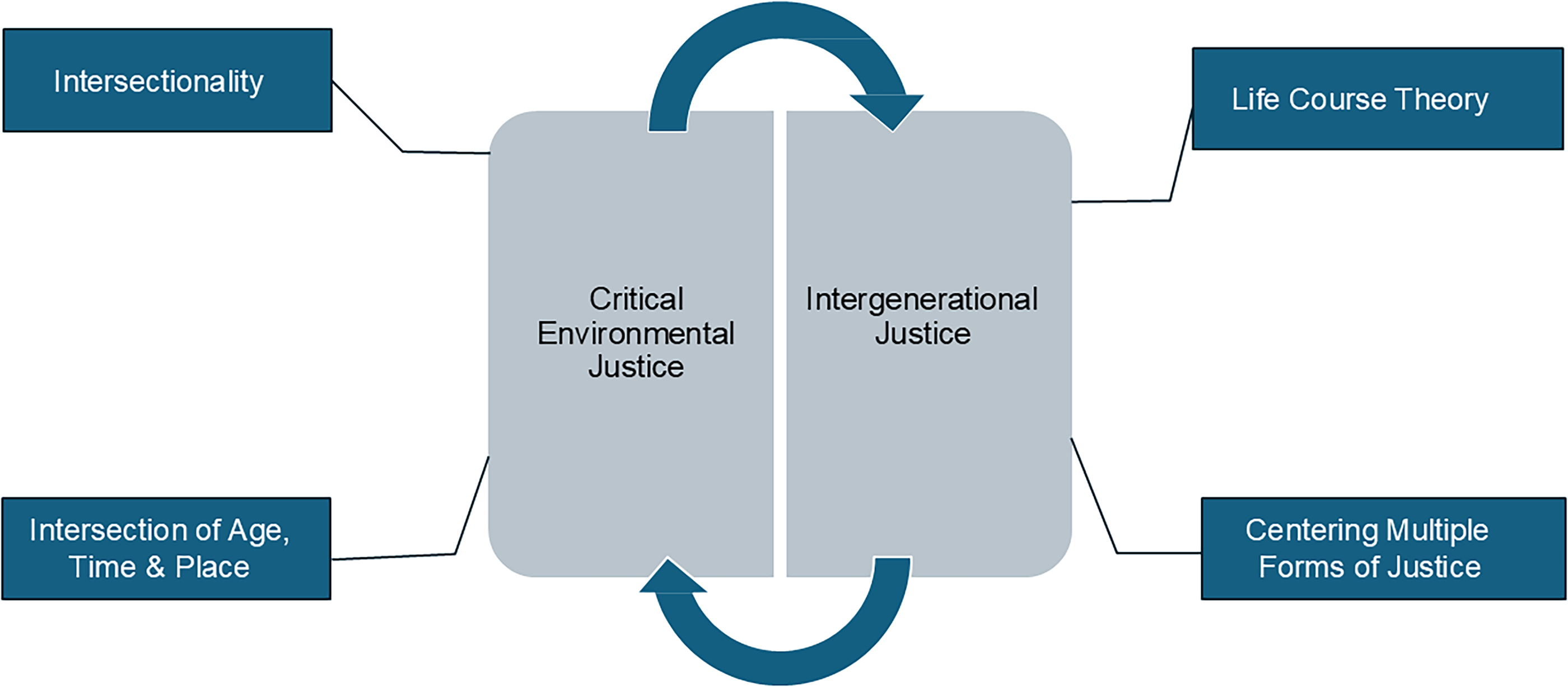
Intergenerational environmental justice framework. The framework consists of four key areas: intersectionality (relationality and social context, analysis of systems of power and injustices), the intersection of age, time, and place (collective placemaking, collective proximity to toxicity, racialized time and administrative burdens), life course theory (the interdependency or “linkage” of lives; the importance of sociohistorical context, time, and place; human agency), and centering multiple forms of justice (importance of various forms of justice [procedural, distributive, reparative], interrogating uneven attention to forms of justice within cumulative impacts discussions).
Intergenerational justice scholarship highlights ethical obligations across and within generations, especially when current policies prioritize present interests over future equity.92,93,94,95 Intergenerational justice raises critical environmental justice questions about intergenerational conflict, housing demand, 96 and wealth transmission through homeownership. 97 A life course approach 98 strengthens this framework by emphasizing the significance of time, sociohistorical context, and the cumulative impact of relationships, opportunities, and constraints. For example, age and place intersect over time to produce disparate outcomes, as environmental harms can affect individuals differently and over varying durations. The unevenness of time, both real and perceived, across lives, generations, and policy efforts undoubtedly impacts our understanding of cumulative impacts as well as the limits to policies and one’s agency in responding to environmental concerns. 99
Racialized time exacerbates impacts of exposure and proximity to environmental hazards. Furthermore, racialized spaces span generations and influence individuals in similar ways, where racialized groups get “stuck in a time machine” (p. 500) 100 within segregated neighborhoods, due to redlining, reverse redlining, and racial steering. 101 Additionally, time is racialized for Indigenous groups who have experienced the dispossession of Indigenous lands, forced relocation, and exposure to environmental burdens on reservation lands. These time-related, racialized burdens are embedded within administrative structures. 102
To address intergenerational environmental issues, policymakers should uphold citizens’ rights to place and incorporate distributive, procedural, and reparative justice 103 for historically excluded communities (centering multiple forms of justice). IntEJ integrates these principles into policy and goal setting, ensuring policies reflect the impacts of racialized practices within racial capitalism,104,105,106 considering their past, present, and future impacts across generations and age groups, 107 and the cumulative environmental risks over time. Additionally, IntEJ-informed policies would address intergenerational concerns related to displacement.108,109,110,111
Cumulative impacts and time
Biased systems and policies exacerbate cumulative impacts and situate sources of environmental harm near and among low-income communities and communities of color. Cumulative impact policies and regulations center on environmental and health issues in analyses. They consider intersections of environmental, health, and socioeconomic characteristics (intrinsic and extrinsic) to identify vulnerable populations who are more likely subjected to adverse effects from exposure to pollutants,112,113 but without standardized sets of factors in assessment models. 114 Addressing cumulative impacts is complex, as the historic accumulation of structural inequality burdens has been used to undermine cumulative impacts policy and research that seeks to identify those responsible for both the exposure and regulatory solutions. 115 Additionally, most efforts identify spatial concentrations without substantive consideration of time. Newark, New Jersey’s environmental justice ordinance requires developers to inform the city of potential cumulative environmental impacts of geographically concentrated polluting industries when requesting or renewing permits.116,117 However, these ordinance and federal discussions of cumulative impacts limit considerations of time to future impacts, leaving out discussions of past impacts. 118
Recent federal recommendations regarding cumulative impacts also begin to consider time. The Environmental Protection Agency (EPA) 2022 recommendations define cumulative impacts as the combined effects of chemical and nonchemical stressors on health and well-being, emphasizing the need for analysis across a person’s lifetime and at individual, community, or population levels. 119 Here, time is a function of life outcomes and over lifetimes. The scale of impacts can occur at multiple levels or be aggregated across groups. The 2024 EPA cumulative impacts recommendations integrate environmental stressors with social vulnerabilities using various methods. 120 These tools help assess and prioritize community impacts by identifying relevant concerns and targeting resources, but oversimplify structural inequalities, overlook the compounding effects of harm over time, and fail to sufficiently consider changes across time.
Understanding time: Racialized burdens, intergenerational environmental justice, and cumulative impacts
Environmental justice scholarship emphasizes the urgency and temporality of sustainability and environmental efforts. 121 Cumulative impacts frameworks contextualize environmental justice concerns by exposing the long-term, disproportionate harms faced by disinvested communities. Integrating an IntEJ framework reveals how time is racialized at individual, organizational, and community levels, highlighting how unequal access to time worsens systemic environmental inequities.
The racialization of time offers insight into historically disinvested groups who continue to face environmental and other inequities. Time is a valuable resource, driven by Eurocentric ideals and expectations of how one should use their time. 122 Racism, and specifically anti-Blackness, defines, dictates, and redistributes time differentially. Racialized groups’ time is considered less valuable than their white counterparts, as these groups often must spend more time seeking out basic necessities.123,124,125,126 Time use is also racialized in mundane activities that can have deadly consequences. 127 Understanding community and local policymakers’ conceptions of time can provide additional context for assessing cumulative impacts in areas such as housing.
Housing discrimination wastes minoritized groups’ time by creating disinvested neighborhoods that lack the financial, educational, and social resources needed to navigate daily living. Minoritized groups experience more administrative time burdens as they face racialized, 128 intersectional129,130,131 environmental injustices, from redlining’s link to lending discrimination 132 to racial gatekeeping 133 by landlords. 134 Aging and routine dilapidation of homes are time, financial, and environmental burdens that are disproportionately borne by low-income Black older women homeowners. 135
Perceptions of free time can also be racialized. For example, burdens faced by racialized groups can limit their ability to imagine, plan, or enjoy unstructured, leisure time. Colen and colleagues 136 note that Black Americans’ time is highly regulated, restricting their capacity to dream and explore personal growth, contributing to negative health outcomes and premature death. IntEJ posits that minoritized groups deserve time, freedom, and opportunity to envision and plan for just, sustainable communities.
Cumulative impacts are best understood through the intergenerational and multidimensional lens of time and space. Considering time as social means examining how it shapes the multiple meanings, expectations, and values that people, institutions, and societies place on the temporal patterns of day-to-day life.137,138,139 Social timing is important to life course theory because age influences roles and beliefs. It reflects the synchronicity, or asynchronicity, of individual life paths with sociohistorical events and relationships over time. 140 Considering the racialization of space, race and space influence individuals’ perception and navigation of spaces, individuals’ expectations of how they are and want to be treated, policies impacting places (e.g., welfare, public housing), and the potential for creating “spaces of solidarity, respite, and resistance for people of color” (p. 1527). 141
Environmental justice efforts to consider cumulative impacts benefit from understandings of race, space, and time that contextualize the overarching and intergenerational aspects of environmental risks. 142 Just as material goods are passed down across generations, racialized time burdens can span generations. Racialized time and the larger IntEJ framework reveal administrative and lived burdens that underscore the urgency of justice-oriented environmental action that targets harmful cumulative impacts. Exploring IntEJ and racialized time within the context of Louisville’s emerging Anti-Displacement Law serves as an excellent case in which to explore how local policymakers are attempting to remedy the cumulative effects of long-standing housing inequities.
ANTI-DISPLACEMENT IN LOUISVILLE, KENTUCKY
Anti-displacement efforts are an interesting area of housing policy that has environmental consequences. We chose to examine Louisville’s Anti-Displacement Law through an IntEJ lens because it is the first of its kind in the United States and is lauded as a model for addressing racialized displacement.143,144,145,146 This law includes components that target racialized historical cumulative impacts of housing and other disparate injustices while simultaneously protecting current and future residents. We place the law into the historical context of Louisville’s broader environmental and housing policy landscape and discourse 147 to reveal how time is racialized and contributes to disparate cumulative impacts. Time and racialized space are connected in this law. We explore the law’s components guided by IntEJ framework’s four areas: intersectionality; intersection of age, time, and place; life course theory; and centering multiple forms of justice.
Louisville, Kentucky’s environmental and housing landscape
Environmental policy and advocacy in Louisville intertwine with housing efforts. Louisville’s housing efforts are ultimately the result of racial capitalism, and the slow response to ongoing and cumulative environmental and housing burdens in Black and brown communities highlights the importance of considering racialized time.
Situated on the Ohio River, Louisville has faced a myriad of issues related to flood control, with the 1937 flood sparking major flood control and land use management efforts, including displacement in flood-prone areas. 148 Historically Black neighborhoods disproportionately experience aging sewer systems, raw sewage overflows, vapor intrusion, and sewer backups.149,150,151 Since 1997, the Louisville Metropolitan Sewer District has used Federal Emergency Management Agency’s buyout program to acquire and demolish 389 flood-damaged homes, mostly in West Louisville’s historically Black communities. 152 Flooding produces cumulative, economic, social, and health impacts that, over time, are compounded due to repeated flooding. Additionally, Louisville’s concentration of industry along the river and rail corridors led to contamination, abandoned land, and disinvestment in areas with marginalized, under-resourced residents. Land remediation gained attention through the EPA’s Superfund program in the early 1980s and brownfields programs followed in the late 1990s. These programs identified barriers to remediation using private market economic incentives. 153 Many of the cleanup and redevelopment projects have only resulted in market rate and luxury housing. 154 In 2022, federal brownfield grant criteria added consideration of displacement due to gentrification. 155 Louisville Metro Government (LMG) now has an incentive to prioritize cleanup assistance based on location of historical disinvestment, along with considering who benefits from the investment now and into the future.
Metro Council has yet to consider legislation to address cumulative impacts related to exposures from toxic and hazardous substances. 156 Explicit discussion of racialized cumulative impact assessment occurs in Louisville through policy discourse and advocacy regarding air pollution and industrial permitting. Policy and advocacy around air pollution dates back to its 1945 smoke ordinance and continued with legislation at local (1950s), state (1960s), and federal (1970s) levels. 157 Community-based organizations, led by Black residents, demanded better air monitoring and analysis of impacted Black neighborhoods, leading to a risk assessment and the first local air regulations. 158 In 2020, after demand to address cumulative impacts of multiple chemicals emitted from multiple sources, LMG and APCD convened a Multi-Pollutant Workgroup and produced recommendations to include environmental and health impacts in planning decisions, driven by the city’s comprehensive plan. The report recommended updates to the Land Development Code, requiring analysis of air quality cumulative impacts. 159 While LMG made some progress in air quality improvements, 160 Black and brown residents are still more likely to be near industrial polluters than white residents.161,162,163 Cumulative impacts related to environmental harms compound with other harms that Black households and neighborhoods disproportionately experience. The time over which the impacts are experienced, time spent advocating, and time spent waiting for interventions showcase how time is racialized in environmental decision making. This time spent cannot be returned.
Housing justice advocacy and policymaking emerged over time from the open housing movements of the late 1950s and early 1960s. 164 The resulting local fair housing policies focused on documenting racialized practices and disparities in housing programs aimed at promoting homeownership. 165 Since 1990, LMG has demolished several public housing complexes through Hope VI grants 166 and continues redevelopment, resulting in the displacement of residents in various ways. In response to affordable housing advocacy, the city established the Louisville Affordable Housing Trust Fund in 2014, the first dedicated local budget for affordable housing outside federal and state programs.
Louisville’s 2020 Comprehensive Plan identified housing as a priority, leading to updates in the Land Development Code to improve access to homeownership. This included initiatives to address historic redlining and help residents build wealth through homeownership. Because federal fair housing laws prohibit specifying funds based on racialized categories, some efforts rely on spatial proxies to account for racialized inequity. 167 These proxies capture how racialized and other systems of inequality intersect, addressing disparities without naming them directly. They also acknowledge that wealth and homeownership produce unequal outcomes over individuals’ lifetimes, shaping long-term community impacts.
Louisville’s environmental and housing policy and advocacy history informed efforts to establish and implement anti-displacement strategies, including the passage of the law. Our examination of the emerging law in this historical context sets the stage for IntEJ-informed insights.
Anti-displacement discourse and policy within an intergenerational environmental justice framework
The 2023 Anti-Displacement Law was passed after substantial grassroots advocacy regarding rising homelessness, eviction rates, housing cost burdens, and gentrification of historically Black neighborhoods. Advocates wanted transparent economic development decisions, particularly in West Louisville. They feared that public incentives fueling development would displace longtime Black residents, contributing to gentrification. They worked with Metro Council members to draft the law, amending the Land Development Code. The initial draft focused solely on historically Black neighborhoods. The law now applies citywide, erasing the explicit focus on racialized neighborhoods. It includes three components: making investigations of discriminatory practices public, creating an Anti-Displacement Commission, 168 and requiring that developers seeking public funds submit an anti-displacement assessment of their project using a new assessment tool.
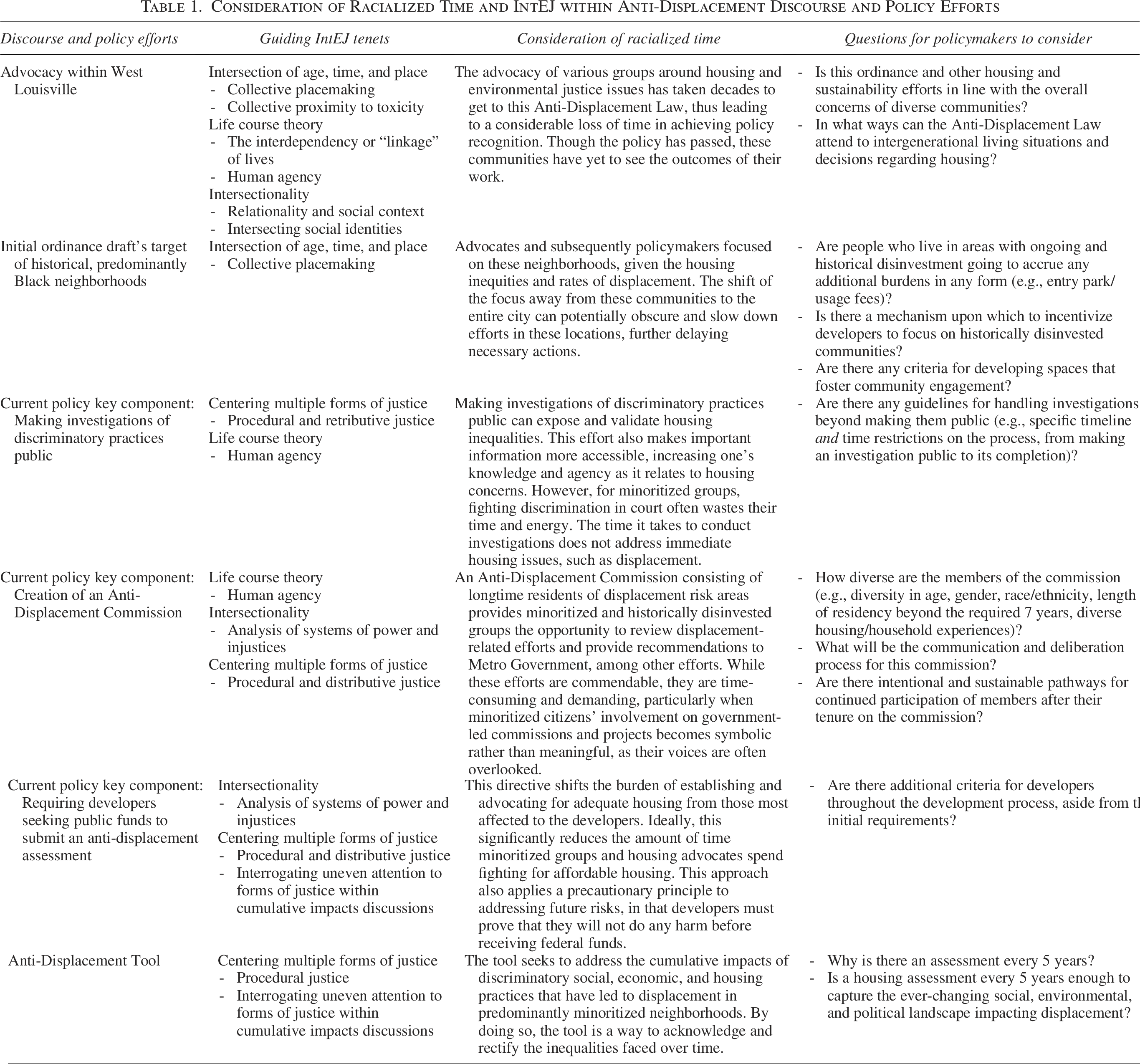
From the law’s initial draft to the final version and its assessment tool, IntEJ tenets help us evaluate the progression of the law and its components. Table 1 169 provides an overview of how we map them onto the four IntEJ tenets, with attention to racialized time and questions policymakers should consider more broadly. The law requires that the results of all LMG-led discrimination investigations be publicly accessible through open records requests, promoting procedural justice. This clarifies that the public has a right to know if a landlord or housing-related agency has a record of discrimination. It facilitates renters’ agency through a procedural path for protection against those with a record of discrimination (life course theory). However, the burden of discovery remains substantial, including costs in time, effort, and knowledge to submit open records requests and time waiting for the information. This cost is borne by those most impacted by real and perceived discrimination and in neighborhoods with larger shares of Black residents, where the added time burdens accumulate.
Consideration of Racialized Time and IntEJ within Anti-Displacement Discourse and Policy Efforts
The law creates the Anti-Displacement Commission, staffed by the LMG Human Relations Commission 170 and consisting of nine unpaid members appointed by the mayor. Members are residents from nine “areas of displacement,” defined as areas with “higher renter rates”; membership is updated every 5 years. 171 The commission is tasked with reviewing the Anti-Displacement Tool and program, examining discriminatory cases involving LMG, and prioritizing harmed parties for LMG resources. Presumably, the commission will be diverse, as areas with higher shares of renters also have higher shares of Black households. Members have an opportunity to use their diverse perspectives of and experience with intersectional systems of power to evaluate decisions pertaining to discriminatory practices. However, while this commission empowers residents’ agency in decision making, it simultaneously extracts unpaid labor, local expertise, and members’ time that could be spent elsewhere.
The law requires developers to include an assessment produced by the Anti-Displacement Tool for approval for public funding. 172 This tool evaluates proposed developments in three areas—real estate market pressure, housing stress, and gentrification risk 173 —with indicators of high, medium, and low for each and an overall combined score of high, medium, or low risk for the project under consideration. The output includes area-wide profiles and project area profiles with compositional changes over time for several variables. 174 The tool calculates the share of renters in the project area and what share of those can afford units at 50% of Area Median Income (AMI). The project units must be affordable to a majority of renters in high- and medium-risk areas, and the number of units must equal the share of cost-burdened households in the project area. The tool relies on Louisville’s 2024 Housing Needs Assessment data 175 to establish the percentage of affordable units required in a project. More affordable units are required as risk increases. Positive recommendations require that projects in low-risk areas include at least 10% of units that are affordable to households earning 50% of AMI or below. Therefore, all projects seeking public funding must include affordable housing to be recommended. 176 The requirements should change with each 5-year Housing Needs Assessment.
The tool relies on quarterly real estate data, 177 such as asking rents at block group and market area geographies alongside the Housing Needs Assessment, conducted every 5 years, reflecting an awareness of changing cumulative impacts that may vary by project place over time. This may help capture intergenerational risks, but 5-year assessment cycles, aligned with policy timelines, may be too infrequent to address external shocks that disproportionately impact Black households. IntEJ emphasizes that time is experienced unevenly across minoritized groups and age cohorts (the intersection of age, time, and place). Thus, more frequent assessments and adaptive governance structures are likely necessary to respond to the urgent and uneven challenges faced by impacted communities.
The tool’s use of a place-based composite risk measure aligns with methods used in cumulative impact and risk assessments, allowing consideration of how populations are affected by overlapping systemic inequalities (intersectionality). Although federal law prohibits using race directly in funding decisions, place is often used as a proxy to address racialized disparities. By including measures of place-based racial demographic change and displacement risk, the tool may offer greater protection to communities where these risks intersect.
The law was originally drafted to protect historically Black neighborhoods facing disinvestment and environmental harm, whose hard-earned assets are threatened by predatory investment. The original draft intended to address multiple forms of justice—reparative, procedural, and distributive—for Black residents thought to be at most risk of displacement. However, the final version that passed applies to the entire city. 178 This policy serves all residents equally and is attentive to some form of distributive justice; however, this assumes cumulative impacts uniformly affect all communities. The empirical record proves otherwise. Applying the law to the entire city means limited resources originally intended for Louisville’s historically Black neighborhoods will likely have a diluted impact across the city.
The law places responsibility for evaluating development impacts on developers and local officials, rather than on residents at risk of displacement. This approach parallels the logic of the precautionary principle 179 where benefits and safety must be proven before approval, placing the burden on project proponents and funders. This is an aspect of distributive justice that shifts burdens of proof and time onto those in power. IntEJ warns against focusing on one form of justice at the expense of others. Thus, policymakers must assess whether implementation addresses the full scope of injustices and cumulative impacts of racialized land use, as intended by the law’s advocates.
CONCLUSIONS
We introduce IntEJ to examine local policymaking that centers critical environmental justice and intergenerational justice, emphasizing intersectionality; the intersection of age, time, and place, life course theory; and centering multiple forms of justice. A key IntEJ concept, racialized time, adds critical depth to cumulative impacts assessments. Using Louisville’s Anti-Displacement Law, we illustrate how explicitly addressing time in cumulative impacts-oriented tools and policy can offer deeper insights into the social context of Black and historically disinvested communities. IntEJ can provide a necessary focus on time and highlight the significance of deeply intersectional and intergenerational relationships that underscore the meaning of home in historically devalued communities. Our example of displacement speaks to the intersections of age, time, and place, in that being forced from one’s home, albeit from a natural disaster or increasing gentrification, is time-consuming. Displacement disrupts communities, erases cultural familiarity in locales, 180 and weakens aging Black communities. 181
Louisville’s history of intersecting housing and environmental policymaking offers valuable lessons for incorporating socioeconomic, environmental, and health-related cumulative impacts into future policy. It is unclear if the law and related efforts will achieve intergenerational environmental justice. However, examining the development and legitimation of these efforts reveals opportunities for policy decisions that move Louisville toward such outcomes.
While IntEJ is promising for policymakers and scholars, the framework requires further refinement. Though we acknowledge advocacy in this framework, we have yet to explicitly explore it. Advocacy is crucial to the law’s existence. Given the slow pace of rectifying displacement efforts, there are no incentives from politically conservative state legislatures to fully solve these issues. With uncertainty at the federal level, we must continue to think about the role of grassroots advocacy and organizing in local policymaking.
Uncertainty at the federal level only solidifies the significance of prioritizing housing and environmental issues locally from an IntEJ perspective. One way to further connect IntEJ more broadly and racialized time specifically to cumulative impacts assessments is to apply the framework and concept methodologically in housing and other societal contexts. Intersectionality as a theoretical framework and methodological tool is well-documented.182,183,184,185,186,187,188 Although it remains largely underexplored in public policy analyses, scholars are increasingly exploring ways to apply these perspectives to large-scale data in policy analysis. Our hope with the IntEJ framework is to expand on these increasingly diverse methodological approaches to offer an applicable evaluative structure for cumulative impact assessments.
AUTHORS’ CONTRIBUTIONS
L.E.B.: Conceptualization (lead), project administration, writing—original draft, writing—review and editing, and visualization. L.C.H.: Conceptualization, writing—original draft, and writing—review and editing. J.G.: Writing—original draft and writing—review and editing.
Footnotes
ACKNOWLEDGMENT
The authors would like to thank Charles Davis and Boston College’s Work, Health,Family, and Life Course Working Group for feedback on an earlier version of this article.
AUTHOR DISCLOSURE STATEMENT
No competing financial interests exist.
FUNDING INFORMATION
No funding was received for this article.