




Abstract
The NYC Climate Justice Hub, a collaborative partnership between the New York City Environmental Justice Alliance (NYC-EJA) and the City University of New York (CUNY), aims to support NYC-EJA’s efforts to achieve climate justice for New York City’s underserved, working-class communities of color through equitable, frontline-led research, education, and leadership. Drawing on a legacy of community-university partnerships, the Hub confronts historical power imbalances that have often hindered these collaborations. By adhering to the Jemez Principles of Democratic Organizing and prioritizing community needs, the Hub ensures that local voices shape and guide its practices. This model offers a framework for how an urban university engages in climate justice work that centers on relational accountability, shared power, and sustainable outcomes for communities.
Keywords
INTRODUCTION
Grassroots organizations are at the forefront of advancing the national climate justice agenda. The community-led NYC Environmental Justice Alliance’s (NYC-EJA) Climate Works for All coalition was instrumental in the passage of the 2019 NYC Climate Mobilization Act (Local Law 97) to reduce cumulative emissions from large buildings citywide by at least 40% by 2030 and by 80% by 2050, arguably the most ambitious municipal climate legislation enacted by any major U.S. city. NY Renews, another grassroots NYC-EJA coalition, helped pass the Climate Leadership and Community Protection Act (CLCPA), an aggressive climate action plan to achieve 100% zero-emission electricity by 2040 and reduce emissions by at least 85% below 1990 levels by 2050.1 Successful climate change mitigation policies like these often begin as a coordinated, hyperlocal response to the lived experience of climate inequality faced by environmental justice (EJ) communities. But communities can mobilize universities—especially (though not exclusively) public universities—to extend their reach and impact. Higher education institutions offer an abundance of human, economic, and political resources that grassroots organizations can leverage to build capacity and enhance the credibility of their work.
The NYC Climate Justice Hub represents such a community-university partnership between the City University of New York (CUNY)—the nation’s largest public, urban university—and NYC-EJA, an alliance of grassroots organizations from the city’s most environmentally burdened neighborhoods that has led the fight for environmental and climate justice in NYC since 1991. In this article, we share our model and responsive practices, with the hope of inspiring other, similar models around the nation to flourish in their respective urban contexts.
ABOUT THE NYC CLIMATE JUSTICE HUB
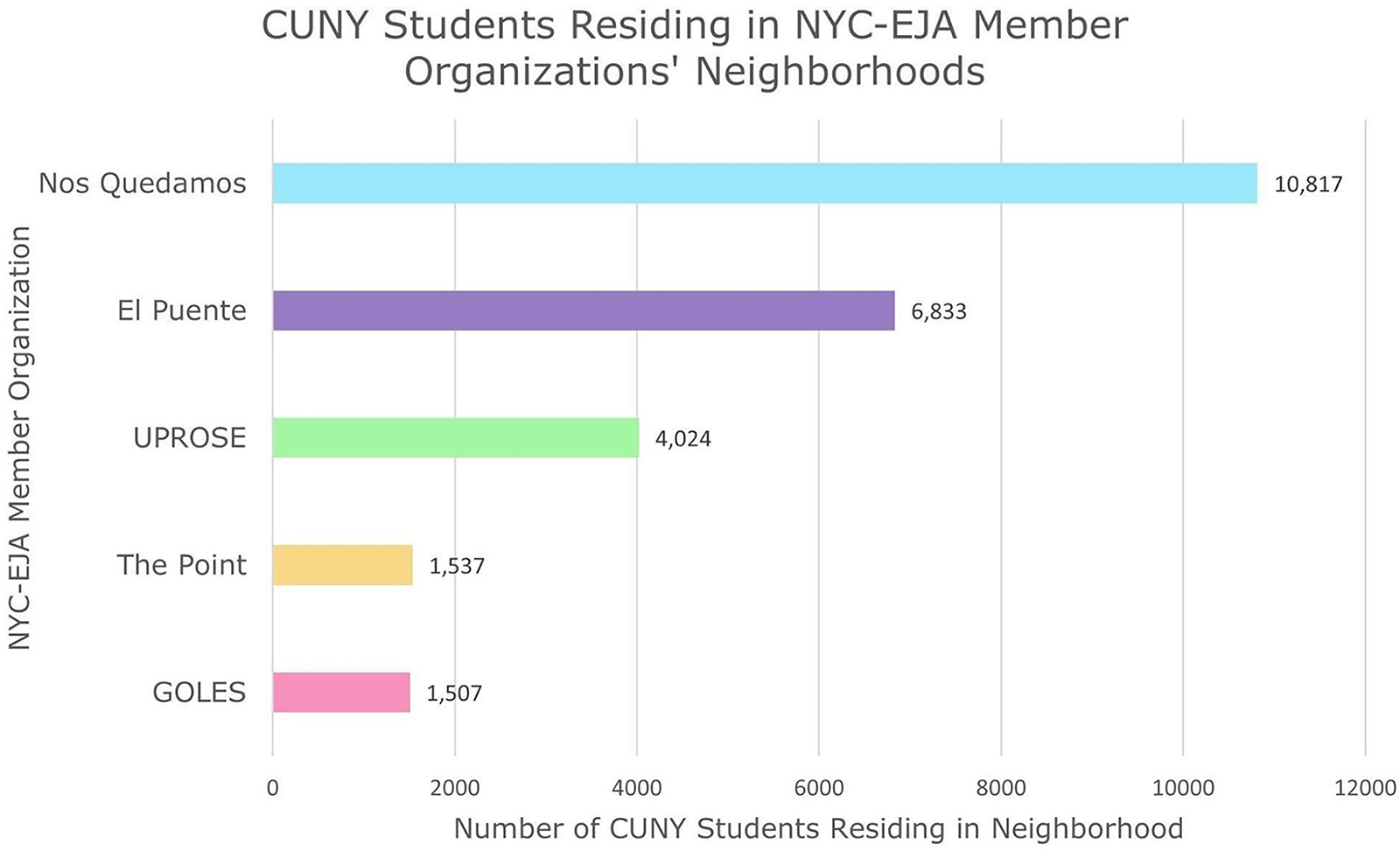
The map below (Fig. 1) illustrates the locations of the 25 CUNY campuses that the NYC Climate Justice Hub works with relative to the “catchment areas” (communities) that the Hub’s participating NYC-EJA member organizations serve. CUNY comprises over 225,000 students and employs approximately 40,000 staff, including 18,000 full-time and part-time faculty across 25 campuses throughout NYC’s five boroughs. Nearly 80% of CUNY students are people of color, 60% are first-generation college students, and 38% speak a language other than English at home.2 According to 2024 data from the CUNY Office of Applied Research, Evaluation, and Data Analytics (OAREDA), 67% of CUNY students live in zip codes that make up disadvantaged communities, and 13% (more than 25,000 students) live in the frontline communities served by our partnering member organizations (Fig. 2). At the time of writing this article, five organizations
3
that are members of NYC-EJA participate in the Hub: UPROSE (Sunset Park, Brooklyn), Good Old Lower East Side (GOLES) (Lower East Side, Manhattan), We Stay/Nos Quedamos (South Bronx), El Puente (Williamsburg, Brooklyn), and The Point CDC (Hunts Point, South Bronx).
NYC-EJA member organizations’ catchment areas. CUNY students residing in NYC-EJA member organizations’ neighborhoods.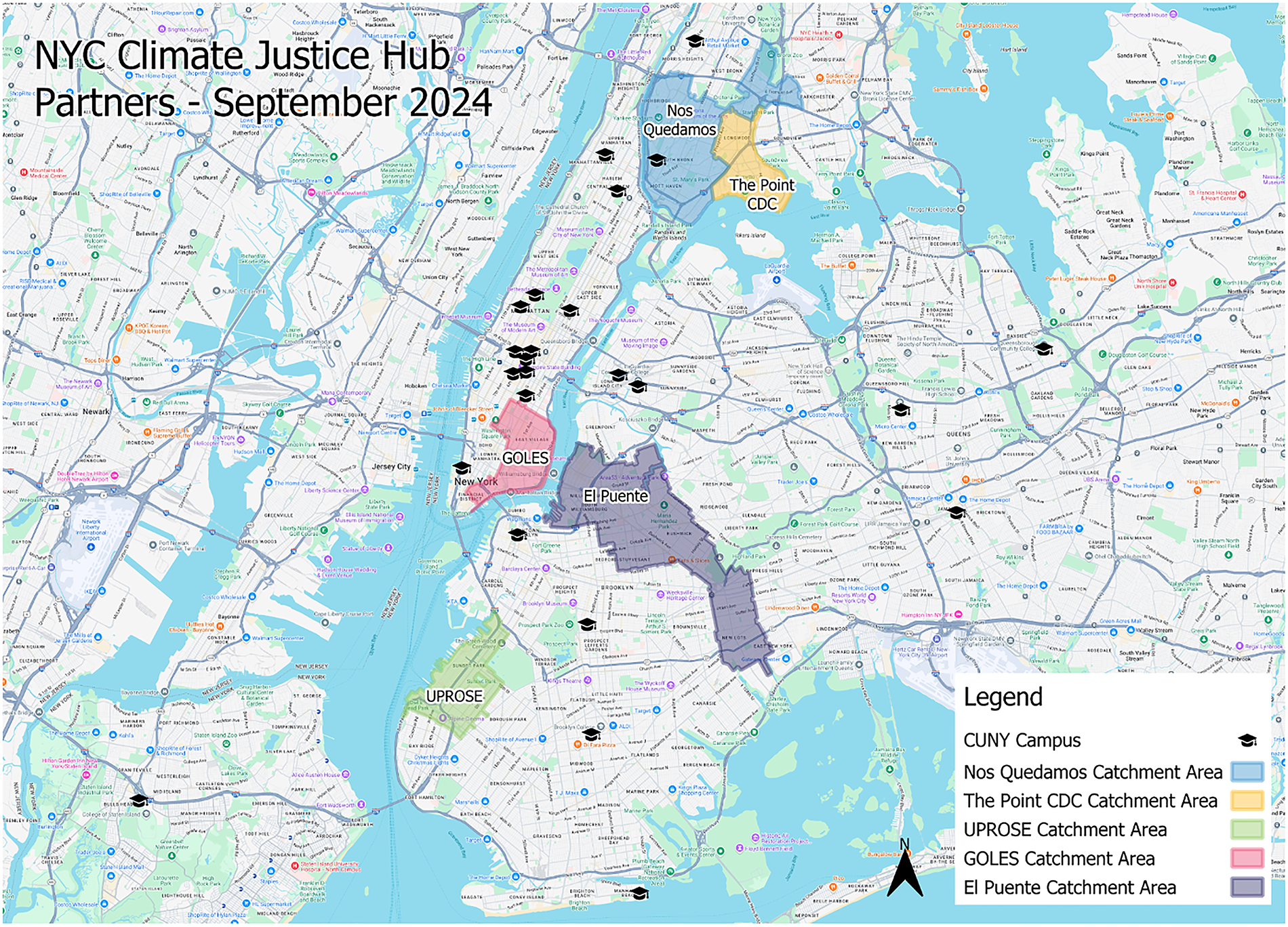
Through the development of a cross-sectoral coalition between CUNY and NYC-EJA, the Hub has begun to advance just transitions for our students and faculty at CUNY, for our organizational partners working with NYC-EJA, and for the city that both entities serve. The pillars of our work are anchored by community-based knowledge, new models of resistance, and policy opportunities. With its homebase at the Center for the Humanities at the CUNY Graduate Center and at the NYC-EJA office in Sunset Park, Brooklyn, the Hub has created:
To produce these pillars, the NYC Climate Justice Hub draws inspiration from a rich legacy of successful community-university research partnerships and a set of guiding principles that privilege community knowledge and power: the Jemez Principles for Democratic Organizing, the Principles of Environmental Justice, and the Freirean tradition of critical pedagogy rooted in place-based education.4 These guiding principles facilitate the Hub’s understanding of climate justice and education from within the context of racialized histories of oppression.
The Hub also works against a largely unreckoned-with history of extractive community-university dynamics by confronting and counteracting several “provocations.”5,6,7,8,9,10 These provocations represent some of the most problematic assumptions that have characterized ineffective or harmful community-university relationships in the past, including:
University students’ learning being prioritized over the needs of the community organization; Engagement that is structured around an academic calendar that may not suit community organizations’ needs; A focus on global issues over local, place-based issues; Elitist institutions, increasingly engaged with climate justice research and advocacy, being inaccessible to the low-income youth and Black and Brown youth most impacted by EJ issues; A lack of institutional support for faculty developing public scholarship with social, racial, or EJ aims.
In the following sections, we highlight the ways the Hub’s “response-ability” toward its community and university collaborators has fortified the pillars of our partnership along with the core principles that guide our work. Where provocations and historic harms committed against Black, Brown, and Indigenous communities have become points of tension, we share how we reorganize along tension lines to strengthen the partnership. Our work begins by centering the knowledge of Black, Brown, and Indigenous communities who have been most effective in navigating EJ issues and climatological disruptions through activist-embodied knowledge.
DIVERSE COMMUNITY OF PRACTICE
The NYC Climate Justice Hub addresses Provocation #4 by operating through an inclusive structure that incorporates a heterogenous body of perspectives. The majority of the Hub Staff identify as People of Color and hail from all parts of New York City, the United States, and around the world. This diverse team brings a highly interdisciplinary approach to building climate justice solutions that center equity and humanity above colonial legacies and discriminatory histories. All of our programs and initiatives offer resources to ensure that the Hub’s approach is comprehensible, accessible, and adhered to by all of our partners. These include research orientations, climate justice peer learning communities, and frequent check-ins, as well as workshops offered on a quarterly or monthly basis for our participants. In addition, the Hub partners with the Center for the Humanities to offer monthly mindfulness sessions with a certified meditation facilitator catered specifically for climate justice activists.
The Hub hosts a variety of public-facing events to expand our outreach and network to those most impacted by EJ issues. In February 2025, we hosted the first-ever CUNY-wide, student-centered, community-led Climate Justice Summit. The Summit brought together more than 400 attendees from across all five boroughs and convened 24 panelists and speakers, including some of NYC’s esteemed elected officials. One of the highlights of the event, the Hub Showcase, collectively exhibited the work of the more than 90 CUNY students, CUNY faculty/staff, and staff members of NYC-EJA organizations who actively participate in the Hub’s programs. Because there are CUNY campuses across every borough and the CUNY student body is so diverse, events such as these allow us to reach an abundance of young climate justice activists who are primed and eager to engage in EJ work. The Hub intends to channel this energy into building a Climate Justice Student Caucus, which will serve as a space and structure for CUNY students to work together and promote environmental and climate justice on- and off-campus.
CLASSES AND CURRICULUM
The Hub’s Classes & Curriculum (C&C) collaborations are critical to our efforts to combat Provocation #5 and the elitism that many universities instill in their approach to climate justice work. C&C brings together NYC-EJA member organizations and CUNY faculty to design and implement place-based climate justice curricula based on EJ communities’ evolving needs. The Hub hosts a biannual symposium (Fig. 3) for CUNY faculty to meet with NYC-EJA member organization staff to learn about their priorities, establish shared definitions of climate and EJ, and share best practices for bidirectional partnerships. Through C&C, CUNY faculty ground course content in community-based climate justice priorities through one of three types (or “tiers”) of engagement.
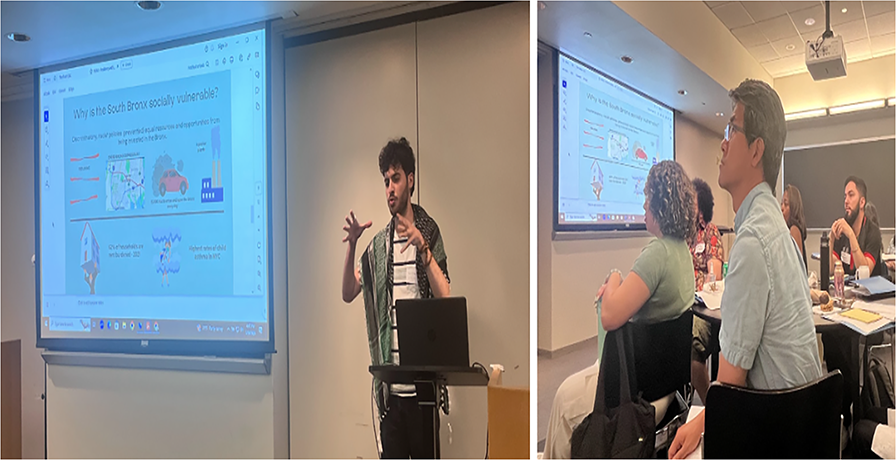
Nos Quedamos Hub Advocate Basil Alsubee presents to CUNY faculty at the Classes and Curriculum Spring Symposium May 2024. Photo Credit: Pierina Pighi Bel.
The first tier involves faculty ideating with one another on how to incorporate EJ and climate justice themes into their curricula. An example of a tier-one engagement is the work of Brooklyn College professor (and Co-Director of the Hub) Dr. Michael Menser in his course on Environmental Ethics. In Fall 2024, Dr. Menser led his class through an examination of the Community Heat and Air Mapping Project for Environmental Justice (CHAMP-EJ) report by NYC-EJA with the objective of developing his students’ understanding of the intersections between EJ and racial justice.
C&C’s second and third tiers of engagement require the submission of project proposals reviewed by NYC-EJA, its relevant member organizations, and Hub staff. Dr. María Teresa “Mariposa” Fernandez’s Climate & Black Arts Movement course at Lehman College exemplifies a tier-two level engagement. In Spring 2024, Dr. Fernandez hosted an event that shared climate poems, oral histories, and insights on the role of poetry in the EJ movement (Fig. 4). Award-winning poet Jesús Papoleto Mélendez; The Point CDC’s Director of Community Development, Dariella Rodriguez; and their Hub Advocate, Maria Reyes, spoke at the event. Another example of a successful longer-term engagement is Dr. Shelly Eversley’s Climate Justice course held within the Black and Latino Studies department of Baruch College, an example of a tier-three project. This months-long collaboration culminated in the production of climate justice documentaries, which aired on CUNY TV in July 2024. One of these documentaries features interviews with GOLES Hub Advocate, Shaheeda Smith, and NYC-EJA Climate and Health Programs Manager, Victoria Sanders.
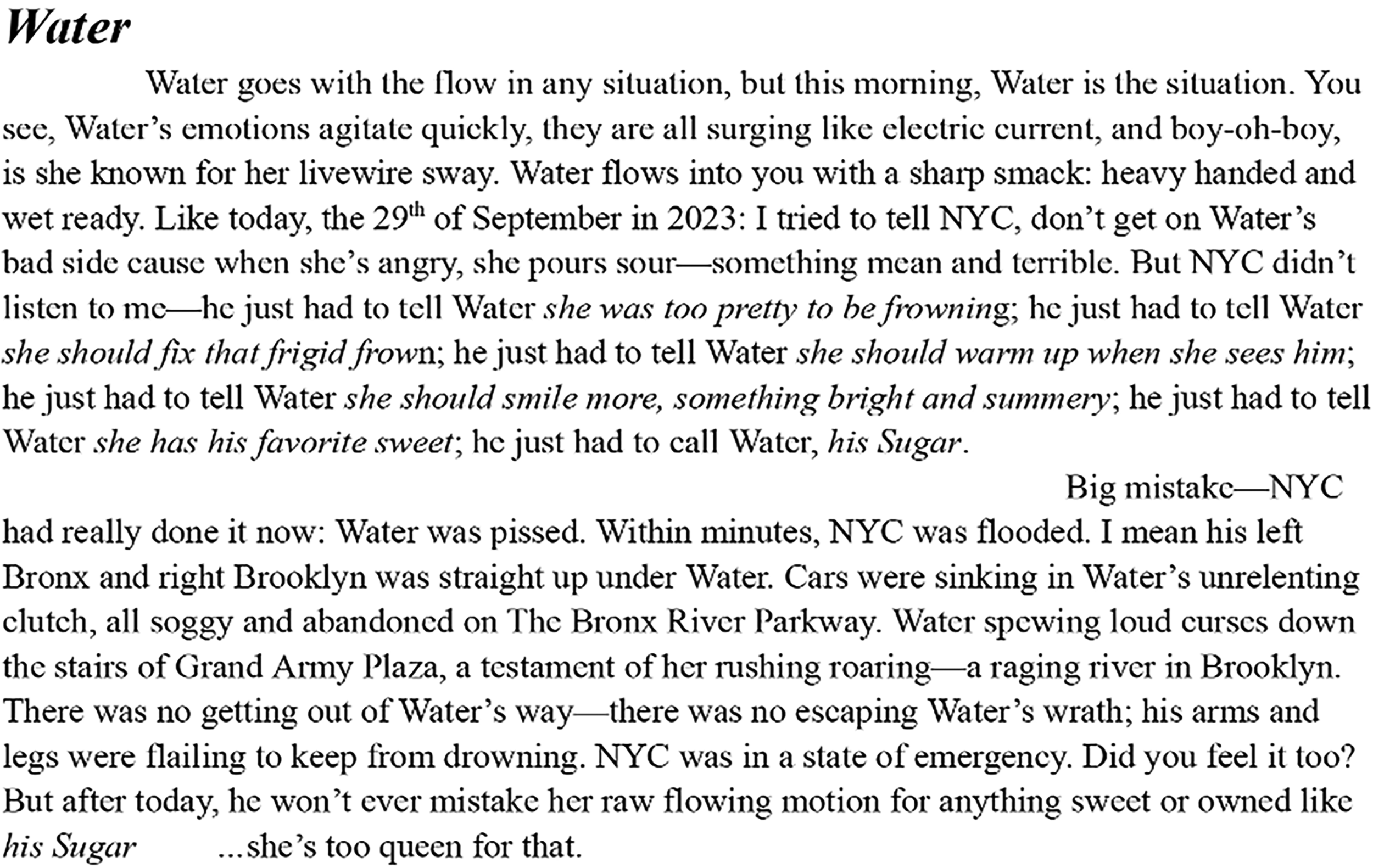
“Water” by Nicole Assenza, a student in Dr. Fernandez’ Climate and Black Arts course in Spring 2024.
CLIMATE JUSTICE FELLOWSHIP AND ACADEMY PROGRAM
The Climate Justice Hub Fellowship & Academy Program was designed to recruit and nurture student talent to provide direct services to grassroots organizations. This pillar of the NYC Climate Justice Hub addresses Provocation #2 by fostering student engagement that is structured around NYC-EJA member organizations’ needs and not just around the academic calendar. For example, during the initial presentation of the internship program to the leadership of the NYC-EJA member organizations, the Hub staff received feedback that a 2-day-per-week intern commitment would be more effective for the organizations than the originally proposed one-day-per-week arrangement. The NYC-EJA member organization executive directors also requested flexibility in the interns’ start dates to best accommodate their organizational calendars. This feedback was promptly adhered to and instrumental in shaping the 2024–2025 Climate Justice Hub Fellowship & Academy Program.
Five interns were ultimately selected from nearly 200 applicants for the year-long fellowship. All shortlisted candidates participated in an interview with staff members of the NYC-EJA member organizations who were interested in hiring them. It was ultimately the NYC-EJA member organizations—and not the Hub—who selected their respective interns based, first and foremost, on their organization’s priorities and needs. To prepare the students to begin working with the organizations, the Hub arranged an Academy orientation program where the interns—along with 20 other selected Climate Justice Fellows—heard from knowledge-holders from each of the NYC-EJA member organizations (Fig. 5). Through interactive seminars, they learned about the origins of student activism at CUNY and received advanced training on ethical community-university partnerships and power mapping.
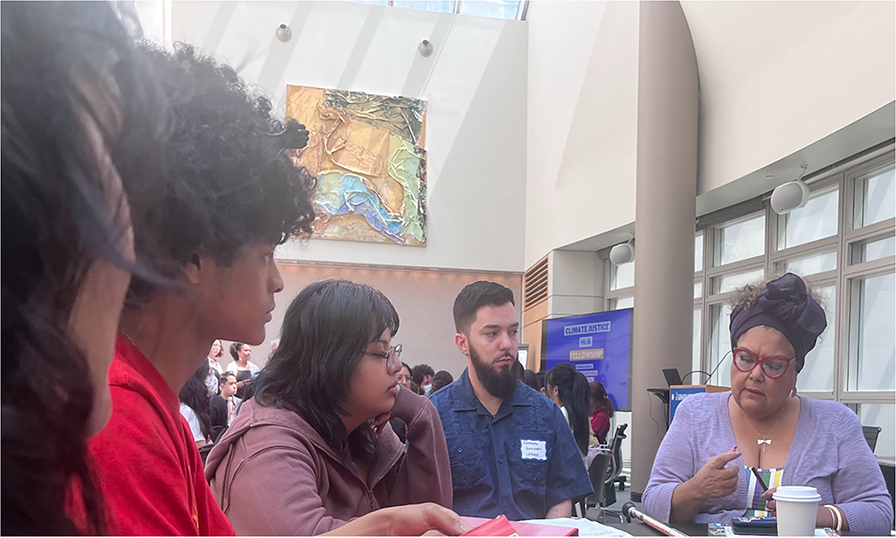
The Research Teams Midyear event. Photo Credit: Pierina Pighi Bel.
RESEARCH TEAMS
Too often, university-led research projects and methodologies are based on what a professor, researcher, or educational institution is looking for and not on what communities are interested in or need. Historically, communities have been exploited for their local knowledge, and the findings of the research do not benefit them.11 The Research Teams initiative addresses Provocation #1 by centering the research agendas of the Hub’s participating member organizations instead of the interests of the university. At the Hub, NYC-EJA member organizations work closely with carefully vetted CUNY faculty and students who provide the technical assistance the organizations need to advance their climate justice agendas. The current cohort of research teams consists of 11 CUNY professors from 6 campuses working across 11 different disciplines and 10 CUNY graduate students from four campuses working across 10 different disciplines (Fig. 6).
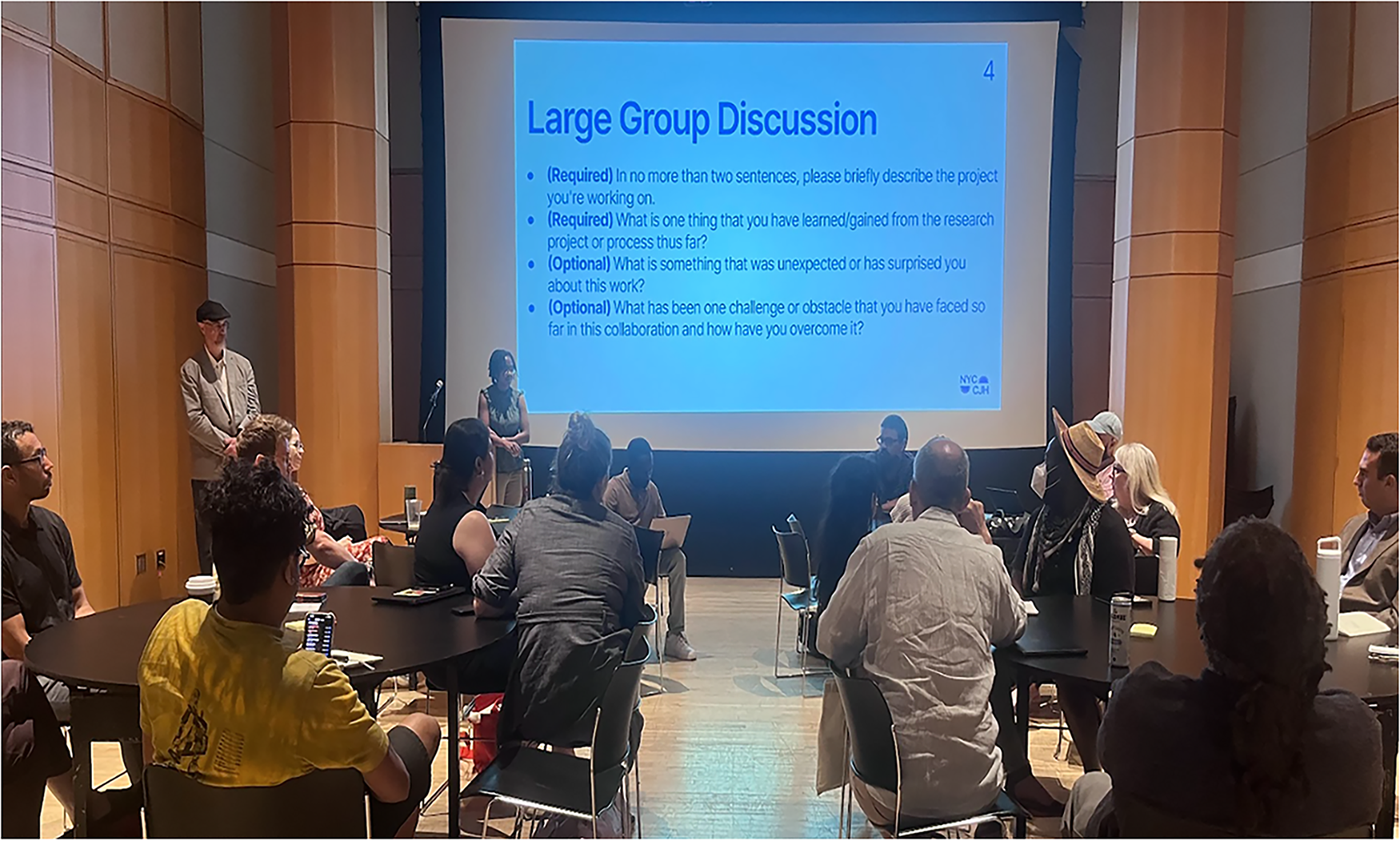
The Research Teams Midyear event. Photo Credit: Pierina Pighi Bel.
Once the initial match is made between professors and community organizations, the Hub offers tools to facilitate the partnership and ensure that the goals of the project are met to the satisfaction of the NYC-EJA member organizations. Two important tools for establishing an ethical, mutually respectful partnership are the project contract and community agreements. The Project Contract template helps the researchers understand the scope and deliverables of the research project the organization envisions. It also sets up critical logistical agreements (e.g., meeting frequency, key milestones). The Community Agreements template enables community partners and professors to establish their values and co-develop guiding fundamental principles (e.g., modes of communication). Additionally, a project tracker template helps research teams keep track of deliverables and clearly communicate progress with the organizations they serve.
ORGANIZATION INFRASTRUCTURE
At its heart, the NYC Climate Justice Hub is a partnership based in the largest city in the country and one of the most diverse in the world, where over 200 languages are spoken. Engaging two hyper-local entities within New York City—CUNY and NYC-EJA—ensures that the Hub actively addresses Provocation #3 and that NYC’s residents are always at the forefront of the Hub’s mission and service.
CUNY has the unique opportunity of being a minority-serving institution with nontraditional and commuter students hailing from all corners of the world convened right in New York City. Based on a spatial analysis conducted using recent data from OAREDA, we found that approximately 67% of currently enrolled CUNY students reside in zip codes contained within disadvantaged communities, those considered among the most vulnerable to the adverse impacts of climate change in NYC. Climate precarity happening right here only exacerbates existing food and housing insecurity rates across the city, as 40% of CUNY students already experience low or very low food security.12 With such a large population of CUNY students hailing from disadvantaged and EJ communities served by the five NYC-EJA member organizations, the NYC Climate Justice Hub helps build critical mass around NYC-EJA member-driven campaigns that benefit the next generation of EJ leaders in their very own neighborhoods.
CONCLUSION
CUNY is the nation’s largest public urban university, with 25 campuses and thousands of students who live, work, and learn on the front lines of climate change in New York City. It is our socio-geographical proximity to community-based organizations coupled with the strength of their intellectual, activist engagement that makes us unique actors, partners, and leaders in the fight for just transitions. However, according to data analyzed from OAREDA, currently, less than 4000 CUNY students (less than 2% of the total number of enrolled students) are actively pursuing degrees in disciplines with strong inherent environmental science and social justice implications. 13 Of these students, 83% identify as people of color (compared to 78% of all CUNY students), and 13% are students who reside in the communities that NYC-EJA’s member organizations serve (compared to 13% of all CUNY students).
These figures indicate the deep potential to nurture students of color hailing from the communities served by NYC-EJA to pursue studies with strong inherent EJ/CJ components. Each semester, dozens of courses address sustainability and resilience, green sector workforce development and regenerative economies, environmental and geological sciences, environmental humanities and law, urban planning, climate change, climate justice, and other climate justice-adjacent content. An important goal of the Hub is to ground EJ/CJ content in the knowledge systems of our NYC-EJA partners, ensuring students acquire the expertise they need to advance the climate justice agendas important to their communities as professionals and practitioners. By learning from and working with NYC-EJA, CUNY can truly function as a civic asset, accelerating climate justice in the lives of everyday New Yorkers throughout the city. The NYC Climate Justice Hub offers a glimpse of how powerful an allyship between NYC-EJA and the nation’s largest public urban university can be if resourced abundantly and sustainably for the long haul.
AUTHORS’ CONTRIBUTIONS
Conceptualization: D.-M.H., K.S., E.K.; Supervision: D.-M.H.; Methodology: D.-M.H.; Data Curation: J.B. and I.G.; Writing original draft: D.-M.H., J.B., and K.S.; Writing review: J.B., A.M., E.K., and E.B.; Visualization: I.G.
Footnotes
AUTHOR DISCLOSURE STATEMENT
No competing financial interests exist.
FUNDING INFORMATION
No funding was received for this article.
Supplemental Material
Supplementary Material
Please find the following supplemental material available below.
For Open Access articles published under a Creative Commons License, all supplemental material carries the same license as the article it is associated with.
For non-Open Access articles published, all supplemental material carries a non-exclusive license, and permission requests for re-use of supplemental material or any part of supplemental material shall be sent directly to the copyright owner as specified in the copyright notice associated with the article.
