




Abstract
In the past decade, as environmental justice activist-scholars have engaged with critical social theories including the Black Radical Tradition, decolonial scholarship, urban political ecologies, and abolitionist thinking, they have debated whether the movement’s longstanding state-focused strategies can truly bring about a just and sustainable future. In the context of this debate, as well as the Trump administration’s evisceration of environmental and EJ regulations, this article investigates how state funding has affected climate justice advocacy in Stockton, California. Stockton is in many ways typical of environmental justice communities: racially diverse, working class, and facing multiple forms of toxicity and climate precarity. I argue that, in a region generally ignored by philanthropy, state funding has galvanized community-based climate justice advocacy, bringing organizations focused on kindred social justice issues into the climate space, drawing national organizations to the region, and providing opportunities for paid work in advocacy and decarbonization. This has led to substantial community engagement as well as tangible results. However, although this funding has become essential to implement just and sustainable alternatives, it cannot be used to oppose new, dangerous land uses. Thus, state funding provides some mitigation and improves local green infrastructure amid worsening environmental and climate conditions. And yet, by raising organizational capacity, providing tangible, observable benefits, and engaging thousands of local residents, Stockton’s past decade of climate justice advocacy may lay the groundwork for future movement building.
INTRODUCTION
The critical turn in environmental justice research has brought about a vibrant academic debate about how activists should relate to the state. Prominent scholars emphasize the breathtaking failure of the neoliberal racial state to meaningfully address environmental justice and advocate for approaches that confront the state or walk away it. 1 In contrast, others argue for a more relational approach that maintains the possibility that government officials and regulatory agencies can and must be compelled to act in the interest of environmental justice. 2
In the context of this debate, this intervention examines state-funded, community-based climate justice activism in the predominantly working-class, racially diverse, frontline city of Stockton, California, asking what this funding has made possible and what it elides. Community-based organizations have received planning and implementation grants from the proceeds of California’s cap-and-trade regulations (AB 32), which, in response to substantial pressure from environmental justice activists, designates 35% of proceeds to environmental justice communities, and later from a climate justice bond approved in 2024. 3 Based on three years of community-engaged research with local activists, I argue that this funding has galvanized Stockton’s community-based climate justice sector, increasing the number, size and capacity of organizations doing this work. However, although state funding has been marshalled to plan and implement just and sustainable alternatives in frontline neighborhoods, Stockton continues to approve new and dangerous land uses. Thus, despite the inspiring work of local activists, environmental conditions may worsen. And yet, by raising organizational capacity, developing new partnerships, providing observable benefits and engaging thousands of local residents, Stockton’s past decade of climate justice advocacy may lay the groundwork for future movement building.
In the past few decades, cities and states have emerged as important sites to understand climate change as they experiment with ways to mitigate impacts and foster adaptation. 4 But questioning how environmental and climate justice movements should approach the state takes on new meaning as the Trump administration demolishes the federal policy and regulatory infrastructure, rescinding executive orders 12898 and 14096 and shuttering the Environmental Protection Agency’s Office of Environmental Justice and Civil Rights, a significant intensification of the anti-environmental efforts during his first term. 5 Pragmatically, the impossibility of federal progress necessitates that movements turn toward states that might respond to their advocacy. California is especially instructive here because of its size, diverse population, economic heft, and histories of environmental regulation and environmental justice activism, all of which have inspired Biden’s Justice40 policy that directs federal agencies to ensure that benefits are targeted to frontline communities. 6 But more broadly, this is an essential political moment to understand what state support might make possible in the present, and how activists can demand an even more supportive state in the future. Despite our despair at the current political climate, we need to dream about what more capacious forms of environmental justice we might build in the wake of what Trump has destroyed. My hope is that by offering a critical understanding of “what is,” I might contribute to our collective imagining of “what might become.”
CRITICAL ENVIRONMENTAL JUSTICE AND THE STATE
Environmental justice scholarship emerged within, alongside, and to serve the goals of the environmental justice movement, establishing the undue toxic burden faced by communities of color 7 and chronicling movement emergence, lineages, and struggles. 8 Collectively, this scholarship made an incisive case for an environmentalism grounded in the lived experiences of working class Black, Indigenous and People of Color (BIPOC) communities.
Although there have long been critical strands within this research, the past decade has seen significant engagement with radical social theory including the Black Radical Tradition, decolonial scholarship, critical race theory, Latinx geographies, urban political ecologies, and abolition. 9 This encounter has led to what Pellow and others have termed critical environmental justice studies. 10 By unearthing the social processes through which structures of oppression produce unequal environments, this intersectional approach theorizes environmental racism as more insidious than intentional discrimination or correlation, positioning it instead as “constituent of racial capitalism” 11 and settler colonialism. 12 The activism that inspired and sits in dialogue with this critical turn has become an essential thread in what Diné activist Dallas Goldtooth calls an interconnected “movement of movements” to challenge systems of oppression and bring about more liberatory futures. 13 In the pursuit of this interconnected vision, scholars have explored intersections between environmental justice and movements for Black lives, Indigenous sovereignty, reparations, prison abolition, and Palestinian liberation. 14
Critical environmental justice scholarship contains a damning critique that federal and state regulatory frameworks perpetuate environmental racism, unearthing the inextricable interconnections between environmental damage and racial capitalism, settler colonialism, uneven urban development, carcerality, and militarism, among other oppressive processes. 15 While there is general consensus on what Miyake calls the racial environmental state 16 as a cause of wide-ranging and unequal environmental harm, there is significant debate about how activists should pursue more emancipatory and environmentally just futures. The most prominent critical theorists take strong stands against state-oriented strategies such as the pursuit of policy change, legal redress, and regulatory enforcement. Pulido, Kohl, and Catton offer significant evidence for this line of critique, highlighting the staggering losses garnered by state-focused strategies such as lawsuits and describing “such consistent failure [as] truly breathtaking in scope.” 17 They cite further evidence that the implementation of Executive Order 12898, for example, contains “significant problems and shortcomings” and its success has been limited to creating an infrastructure for public participation rather than improving material conditions. 18 Moreover, scholars have long decried the “industry capture” of environmental justice regulations. 19 In her careful history of environmental justice activism in the southern part of California’s Central Valley, Perkins chronicled activists’ shift from disruptive tactics to insider strategies including service on government advisory committees, employment within government agencies, and working to craft new laws. 20 Although Perkins herself is more nuanced, other scholars decry this sort of shift as a process of co-optation, creating community buy-in while side-stepping potential movement pressure for significant change. Citing the failure of legal and regulatory strategies, industry capture and co-optation, critical scholars assert that “the track record of state-based regulation and enforcement of environmental and civil rights legislation in communities of color has not been promising.” 21
These scholars push activists toward an array of outsider responses. Along with their co-authors, both Pulido and Pellow call on activists to “refuse to participate in regulatory charades” and to instead be inspired by the uprisings of Black Lives Matter. “It’s not about being respectable, acknowledged, and included… It’s about raising hell for both polluters and the agencies that protect them. Given the planetary crisis we are facing, we need a radicalized EJ movement more than ever.” 22 Pellow also praises Black Lives Matter (BLM)’s “rigorous and critical approach to the state” but then pushes them even further, arguing that their demand to defund the police in order to increase social safety net functions such as housing and education “can unintendedly legitimate state power, including its regressive dimensions. 23 In this framework, progressive legislation, even when brought about by social movement organizing, is reduced to a mere structure of consent. 24 Instead of state-focused strategies, McKane, Greiner, and Pellow suggest that we turn toward “alternative forms of critical infrastructure and care organized and provided beyond the state,” especially in the context of authoritarian and anti-democratic state formation. 25 Citing past and present examples of localized relief from socioecological disasters, they call for mutual aid practices that provide care for communities harmed by socioecological violence. They describe mutual aid work as explicitly political, as it aims to name and overturn material oppression, is managed through direct democracy, and operates independently of the state and private philanthropy. 26
In contrast, other scholars who share these critical understandings of the production of environmental injustice argue that we should not abandon the state entirely. For example, Jill Lindsey Harrison argues that critical theorists tend to “treat the state as a wholly and inevitably repressive instrument of capital, and that this leads them to make politically problematic recommendations that dismiss the ways in which states also serve other ends, can be made to do so more meaningfully, must be made to do so, and are being made to do so. These authors too easily dismiss the prospects for change through engaging with the state—including achieving reforms that are modest but nevertheless reduce harm and building coalitions and knowledge toward more substantial “nonreformist reforms” that more fundamentally support EJ.” 27 Similarly, after praising Pellow’s primer What is Critical Environmental Justice? for its expansive approach, Purucker critiques Pellow’s anarchist theory of the state, arguing that his understanding of “the state as a functional, monolithic entity that can only be opposed from the outside or evaded entirely… risks pushing the movement away from a politics that could win and utilize state power for socio-environmental ends.” 28 Although these scholars condemn the state’s many failures, they urge us toward an understanding of the state as a plurality of relational sites of contestation that can sometimes provide significant material benefits for communities experiencing the toxic burdens of environmental racism and climate precarity. 29 Megan Ybarra, for example, describes how in the organizing she observed to oppose immigrant detention in the tar pits of Tacoma, Washington, “it is the nitty gritty of municipal codes and ordinances that tears down cages and makes space for abolition ecologies in their place.” 30 Moreover, as a generation of political ecologists has argued, movements that turn away from the state cede important ground, leaving regulatory agencies and policy-making processes even more open to roll-back neoliberalism and further industry capture, if not the wholesale destruction at stake in the current political moment. 31
Scholars who highlight progressive possibilities within the state describe how activists simultaneously deploy insider and outsider strategies. They engage with the state through policy advocacy, demands for enforcement, lawsuits, data collection, engaging in planning processes and even accepting positions on advisory committees and employment in agencies themselves. 32 At the same time, activists work to build alternative, climate-friendly infrastructure such as parks, playgrounds, and community gardens, improve public transportation and bicycle safety, and offer discounted solar panels and energy efficiency. 33 Some activists simultaneously engage in policy advocacy and disruptive tactics, demonstrating the environmental justice movement’s “ability to collaborate with and also work against policymakers, businesses, and regulators.” 34 Lindsey Dillon’s detailed account of decades of environmental justice activism among Black residents of San Francisco’s Bayview–Hunter’s Point neighborhood is one such example, as it investigates how activists assess and respond to varying conditions of possibility in distinct political moments. 35 In this and many other cases, activists navigate a state that is “both a cause of their problems and, at times, at least a partial solution to them.” 36
The community-based climate justice activists I worked with in Stockton have embraced critical perspectives as to the causes of environmental and climate injustice, as is increasingly common among environmental justice activists globally. 37 From the beginning, they have understood that “racial and ecological violence are interwoven and inextricable from one another” and that this intersection creates “uneven landscapes of risk and resilience.” 38 In their earliest applications for state funding, Rise Stockton described environmental and health inequities as the result of the city’s practices of racial planning 39 including redlining, white flight, and urban renewal. 40 This history has become a common feature among local community-based organizations’ reports, workshops, events and public-facing documents. 41 Additionally, when activists work to build just and sustainable futures in formerly redlined communities, they enact a capacious vision of constructive reparations that can “rebuild the world order in terms of justice.” 42 The analysis and framing deployed in Stockton demonstrates a deep commitment to antiracism, intersectionality, historically grounded analysis, and the centering of lived experiences.
And yet, these organizations receive significant funding from various state grants, most notably through cap-and-trade funds set aside for disadvantaged communities and the 2024 climate bond, and they collaborate with city and county officials in their work to improve local conditions. This article seeks to contribute to debates on the role of the state by asking how this state funding has affected climate justice advocacy in Stockton. I argue that state funding has galvanized a sector of community-based climate and environmental justice activism that did not exist prior, and has built their capacity to function within the nonprofit sector. At the same time, Stockton’s climate justice advocacy is disciplined by the state’s logics, emphasizing tangible, deliverable projects over oppositional strategies that might lessen environmental harms. Still, climate justice organizations are improving community members’ lives in tangible ways and bringing them together to envision and enact more just and sustainable futures. Indeed, the careful community engagement conducted by Stockton’s climate justice activists could lay the groundwork for movement building toward more oppositional strategies.
RESEARCH APPROACH
I first learned of the climate justice work described in this article in 2019 when the Rise Stockton collaborative published its initial Sustainable Neighborhood Plan report. Rise Stockton is a collaborative of community-based organizations and the City of Stockton that has come together to pursue and eventually receive funding from the California Strategic Growth Council for climate justice planning in disadvantaged communities. I had met some of Rise Stockton’s members over the 15 years that I taught at [university name redacted for peer-review]. They had spoken in my classes, hosted us for field trips, and sponsored internships for my students. I began to follow their work more closely as they received several rounds of implementation funding, and their programming and infrastructure development began to take shape.
In the summer of 2021, I was asked to join a subgroup of these activists as they expanded their work through a Regional Climate Collaborative that would include additional frontline communities in San Joaquin County. Since that time, I have attended regular meetings, first to draft collaborative guidelines and apply for funding, and then to plan and execute various activities. I also sit on the community engagement subcommittee and attend meetings of our paid community advisory board. Approximately once per quarter, I travel to Stockton to attend a workshop or meeting in person and to maintain a sense of community and connections with my colleagues. My primary charge is the evaluation required by our funders, but I also help out whenever my skills seem useful, designing a needs assessment survey, revising a report, or taking meeting minutes. During our meetings, I also take field notes in order to document relevant conversations and debates in detail. In addition, I have conducted 13 individual or group interviews with 16 activists, which were recorded and transcribed via zoom, as well as countless informal conversations.
Community-engaged research has tremendous potential to contribute to environmental justice through the research process as well as its findings (Raphael and Matsouka, 2024), and the environmental justice movement has a long history of scholar activism and activist scholarship (Bullard, 1990; Bullard and Wright, 2023; Bryant and Mohai, 1992). 43 But conducting ethical, community-engaged research requires deep and ongoing reflections on our positionality, power, and insider/outsider dynamics (Lopez et al., 2024; Lucero et al., 2024). 44 Although I am an “outsider” in every sense of the word—a white woman in BIPOC led climate justice work, an academic working with community-based organizations, and a non-resident of Stockton or San Joaquin County––I would describe our relationships as warm and collaborative. Having previously experienced even minor challenges navigating academic/activist tensions across race, I’ve been somewhat surprised by this ease. It seems possible to me that these activists’ generally positive experiences working with state funders and local government may prime them to enjoy working with scholars as well. In addition, this group consists almost entirely of first-generation college students who believe deeply in the transformative potential of university education and see value in contributing to academic work.
GALVANIZING THE MOVEMENT
My introduction to environmental justice in Stockton took place in 2006–2007 when, as a graduate student, I worked as a research assistant to construct an overview of literature and activism in California’s Central Valley. In Stockton, I learned of citizens’ efforts to prevent water privatization in 2003, as well as a few attempts to ensure that signage warning residents not to eat fish from contaminated water be translated into various Southeast Asian languages. But my colleagues and I found no active environmental justice organizations nor any ongoing campaigns. A few years later, when I began teaching in Stockton, I connected with Catholic Charities Environmental Justice Program, which encouraged parishioners to comment on the environmental impacts of various plans and permits. But this program was small and alone in the environmental justice space. Indeed, scholars have described Stockton as an organizational desert because it has minimal and very small nonprofit or community groups and is generally ignored by the philanthropy sector. 45 The few progressive groups that did exist in the 2000s tended to focus on poverty and violence.
A central contention of this article is that the organizational landscape for community-based climate justice advocacy has been transformed by the infusion of state funding, especially but not exclusively from California’s Climate Investment programs. Oakland’s Greenlining Institute is a policy think tank and one of the initial cosponsors of the proposal to designate cap-and-trade to frontline communities. According to their Director of Capacity Building, Emi Wang, much of the Central Valley lacked the organizational capacity to apply for and administer these funds:
We were working at the policy level to structure California Climate Investments from cap-and-trade that are meant to benefit frontline communities, but then there was also the work to actually make sure that [the funding] was reaching and hitting communities. 46 So we had a really broad mandate around trying to increase community engagement and education around these investments… Stockton was a place where, even though none of the groups articulated their work in terms of green investments and in terms of climate and resiliency at that time––they really focused on issues like jobs, basic security, violence, and much more everyday issues. But also, these issues are on the margins–asthma, the freeways. There were these longstanding environmental issues, too.
We just came in and met with a bunch of community organizations. We had a pitch like, this kind of funding is available. Do you know about it? Do you want to know about it? And do you want to potentially try to apply for some of it? Stockton was the place where people were down. And so that kind of kick started this whole process.
This is the origin story of the Rise Stockton Coalition. They applied for and received first a planning grant and then implementation funds for their climate work. Notably, none of the community groups had the administrative capacity to serve as the lead applicant, and so the city manager’s office was invited to lead the group. Rise Stockton’s success has led to additional climate justice initiatives such as the Stockton Mobility Collective, which increases access to public transportation and subsidized, shared electric vehicles in South Stockton, and the San Joaquin Regional Climate Collaborative, which connects Stockton’s climate justice work to other similarly stratified areas in San Joaquin County. Both of these projects were also funded by California Climate Investments.
Public Health Advocates (PHA) was one of the organizations that Wang met with in her early days in Stockton, and exemplifies how state funding drew organizations with related missions into climate justice work. Founded in 1999, PHA had passed a wide range of health-related state legislation such as banning sales of soft drinks in schools and increasing access to hearing screenings, but had not focused on environmental health per se. PHA had previously collaborated with Catholic Charities, who suggested that they join the Rise Stockton Coalition. According to William Mutzenberg, who served as program director for PHA’s climate work:
PHA has built a strong reputation in Stockton around community engagement and trust-building. That’s why we were brought into the fold. Through the planning grant, we’ve come to understand the nexus between how the environment affects public health and vice versa, how public health, in turn, shapes environmental discussions.
The relationship between health and environmental justice is both intuitive and well established in the academic literature. But still, PHA made a strategic choice to develop climate justice programming. This was facilitated by the availability of state funding.
Another example of a community-based organization that has been drawn into climate justice work is Little Manila Rising (LMR). LMR was initially formed in 1999 by two recent Filipinx college graduates to preserve what remained of their once thriving neighborhood, which had been gutted by urban renewal and highway construction. 47 Little Manila initially entered into climate justice work through urban forestry, planting trees to mitigate South Stockton’s poor air quality and urban heat island effects. State funding has allowed for significant expansion of this program and for a more supportive relationship with the city. LMR has also accessed state funding to develop a program that increases mitigation and access to care for community members with asthma, which it directly links to the freeway.
State funding has also drawn national organizations to work in Stockton and the Central Valley region. For example, GRID Alternatives is a national nonprofit solar installer and workforce development organization that began working in Stockton due to state funding. Founded in the Bay Area in 2001, they had their first installation in Stockton in 2017. GRID is largely funded by a California Public Utilities Commission program for disadvantaged communities, but California Climate Investment funding has also been instrumental in bringing their work to Stockton. According to co-Executive Director Achini Bandara:
The funding decisions really shaped where we went. Grant Kirkpatrick [from the city manager’s office], who manages the Transforming Climate Communities program in Stockton, will tell you that GRID just showed up at a [Rise Stockton] meeting one day with a proposal. We didn’t need to be recruited. We were ready and knew the program.
State funding has enabled local organizations working on related issues to expand through climate justice work, and larger, national organizations to begin working in South Stockton.
This infusion of state funding has significantly expanded opportunities for paid work in the climate justice sector. The Central Valley is a region where there is very little philanthropic investment, which makes it difficult for nonprofit organizations to expand their capacity and for committed young people to find careers in climate justice. Jasmine Peterson, who was raised in Stockton, describes how difficult it was to return from college in the mid-2010s and find the kind of work she was looking for.
I was a young person trying to find my way in Stockton, trying to find opportunities that aligned with my values. Those things weren’t really as available when I first moved back home.
Jasmine went on to found her own nonprofit that focused on encouraging civic participation, and was an essential partner in the Rise Stockton coalition. She currently serves as the climate action director at LMR.
But now, after almost a decade of significant state funding, it has become much easier to find work in the climate justice movement. Nearly all of the activists I worked with were raised in or around Stockton, either left for college or attended locally, and then found careers in this field. For example, Gloria Alonso Cruz describes her trajectory:
When we immigrated here, we settled in Stockton, and then in my first years of high school I came across this [ethnic studies] program that Little Manila Rising was running. Then when I graduated, I started doing immigrant rights advocacy with them. And then later on, after I graduated from Sacramento State, I landed this job with Little Manila Rising doing EJ advocacy.
State funding has allowed LMR to expand from three employees in 2017 to 50 in 2025, opening numerous opportunities for paid work. This is in addition to the larger-scale workforce development initiatives funded through Rise Stockton’s programming, which respond to the need for urban greening to be rooted in economic development and employment opportunities. To be clear, I am not arguing that these organizations are merely following the money through mission creep. They are learning about new ways that the issues they care about manifest in their communities, and expanding their expertise to include them.
Critical environmental justice scholars debate whether the environmental justice movement should concentrate its efforts on reforming state policies or reaching beyond the state for more transformative goals. In Stockton, there were few and sporadic environmental or climate justice campaigns prior to the widespread availability of state funding; California Climate Investment programs have significantly increased the vibrancy of local environmental and climate justice advocacy. Funding has drawn kindred organizations to develop climate justice programs, incentivized national organizations to focus on the city and region, and created opportunities for careers within the sector.
WHAT’S BEEN ACCOMPLISHED
The Rise Stockton Collaborative has used this state funding to create tangible environmental and climate justice benefits. Although urban greening tends to be focused in more privileged communities, and can even lead to environmental gentrification and displacement, 48 state funds mandate that projects be developed in designated disadvantaged communities. Moreover, the grant requires an anti-displacement plan to ensure that long-term communities reap the benefits of these improvements. Figure 1 summarizes Rise Stockton’s major achievements as of 2024. 49
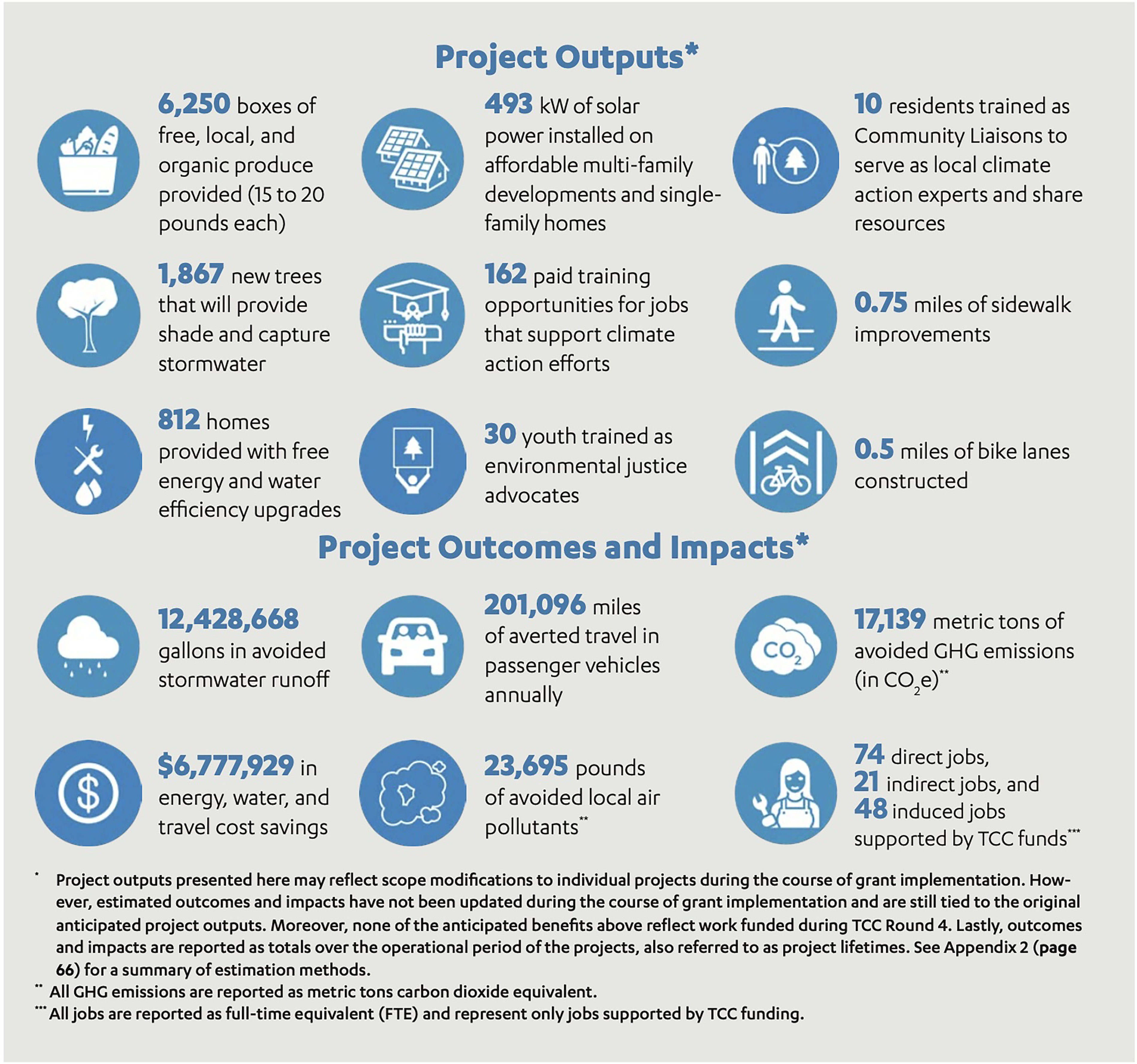
As Figure 1 demonstrates, Rise Stockton’s work has affected the city’s infrastructure through bike and sidewalk improvements, lessened household energy demand through energy efficiency and water upgrades as well as solar installation, improved access to healthy food and green space through tree planting and produce distribution, and trained residents for advocacy and climate careers. UCLA’s Lusk Center estimates that this has avoided over 17,000 metric tons of greenhouse gas emissions and 23,000 pounds of air pollutants while saving the city and its residents nearly 7 million dollars. This is especially noteworthy given that this work took place during the COVID-19 pandemic, which disproportionately affected environmental justice communities, especially places like South Stockton that already suffer from poor air quality. 50 Grant Kirkpatrick, the Environmental and Sustainability Officer for Stockton’s city manager’s office speaks to the impact of this work:
I think the State and us have agreed that the progress we’ve made has exceeded where we had hoped we’d be. Just in terms of number of households that received solar installation, energy and water efficiency retrofits, the community supported agriculture boxes that have been distributed––thousands upon thousands of pounds of fresh produce have gone out––hundreds of trees already planted, hundreds more going to be planted before the end of the grants, jobs created through the workforce plan, communities connected through the community engagement plan. Despite all the hindrances, and despite a global pandemic, we have achieved so much in the community.
It’s clear that these state-funded programs have not only galvanized climate justice advocacy in Stockton, but despite occurring amid the limitations of a global pandemic, have made meaningful differences in both the city’s green and gray infrastructure, where gray infrastructure refers to technological or systemic interventions such as transportation and solar infrastructure. 51 This is noteworthy because most urban climate planning emphasizes only green interventions, where gray developments are less aesthetic but more closely linked to equity concerns. 52
Another program funded by California Climate Investments, as well as the California Air Resources Board is the Stockton Mobility Collective. Led by the San Joaquin Council of governments in partnership with over 30 community-based organizations, the program includes subsidized e-car and e-bike rental services, and funded the development of an ap called “Vamos” for public transportation planning and payment. In the program’s inaugural year, Stockton residents drove more than 335,000 miles and biked more than 12,000 miles in these shared electric vehicles. They also used Vamos to purchase more than 85,000 tickets for public transportation. In addition, nearly 1000 qualified residents received disbursements to be used for these car-share, bike-share and regional public transit services. There is also funding for workforce development, through which local residents have been trained to maintain electric cars and bikes.
State funding has clearly contributed to the growth of community-based climate justice advocacy in Stockton. Importantly, each of these programs includes community engagement, helping residents who are not directly affiliated with these nonprofit organizations to influence and benefit from climate justice investments in their city. Activists have met thousands of their neighbors through town halls, meetings, workshops, presentations to other community groups, door-to-door canvassing and one-on-one conversations, ensuring that many Stocktonians can contribute to their work. Additionally, the above-described programs include workforce development initiatives that provide full-time, paid work in climate-related industries. In an area with high exposure to environmental toxins and significant risk of multiple climate disasters, the importance of this employment and outreach cannot be overstated, as they lay the groundwork for increased public participation in future climate campaigns. However, as the next section of this article will describe, state funding also constrains the kinds of climate justice work that can be done.
BUT CAN THE REVOLUTION BE FUNDED?
California Climate Investment funding has had a significant impact on the growth of climate justice advocacy in Stockton. But there are also drawbacks and limitations in terms of how this funding model disciplines organizational capacity. These findings align with previous research that shows that equity-focused climate urbanism fails to unsettle the influence of racial capitalism on climate adaptation and mitigation planning. 53
First, CCI funding is tied to particular projects and deliverables, and the billing and reporting requirements of state grants are significant. This means that they cannot be used for general overhead, as well as for organizations to plan and strategize for long-term campaigns, movement cohesion, and growth. This leads to significant overwork and burnout. In the three years that I’ve been working with the San Joaquin Regional Climate Collaborative, nearly every organizational partner lost at least one staff member to exhaustion. Davis Harper Zapata, currently the Carbon Management Program Manager with Restore the Delta, summarizes this challenge nicely. “Everyone is underwater and over capacity,” he explained. “People continue to think about big things and partnership development with groups [but] community-based organizations are just getting the bare minimum, scraping together to make it through the months and do what they need to do.” It is worth noting, however, that this critique is not unique to state funding, and has been rightly levied at philanthropy as well. 54
In addition, although state funding makes climate mitigation and environmental benefits more available and accessible in disadvantaged communities, the state does not fund activism that could oppose the toxic land uses that have made environmental health so precarious in the first place. This is also the case for climate and sustainability work funded by major philanthropies such as Bloomberg. 55 Funding access to so-called sustainable infrastructure like solar panels and parks while failing to oppose the spread of environmental harms leads to a condition where sustainable alternatives can exist alongside increases in toxicity and climate risk. In her book A Just Transition for All, Mijin Cha emphasizes the necessity of a transition away from industries and practices that contribute to climate change, as well as the creation of just alternatives. She argues that this is currently not the case nationally, as fossil fuel use expands alongside alternatives. 56
This is also the case in Stockton. For example, in 2022, Catholic Charities organized members of their diocese and other local residents to attend a community meeting to oppose the development of a seven-story, 3.6 million square foot warehouse in South Stockton. In this instance, however, despite community opposition, the city approved the warehouse. According to journalist Mike Fitzgerald, who writes for a nonprofit online magazine called Stocktonia, “It looks ltcike the Planning Commission rubber-stamped the project, a throwback to the bad old days when Stockton developers got everything they wanted and gave too little back.” Following the approval, in an editorial for Stocktonia, Catholic Charities EJ Program Coordinator Tanisha Raj laid out the case against these warehouses. She highlighted the health and environmental costs of the warehousing boom in California’s Inland Empire, on the southern end of the Central Valley, including a staggering 50 million pounds of carbon dioxide and an increase in unhealthy air days from 15% to 20%. San Joaquin County has the next highest concentration, and she predicted that local environmental health conditions such as asthma were likely to worsen if this continued. In addition, Tanisha criticized the city’s approval process, arguing that “local community members were left out of the process and were not given a fair chance to object. The communication efforts and outreach were very minimal before the city council’s approval, and what little communication existed was not in their native language” (Raj and Alkon, 2021). 57
Despite all of the above-described community-involvement efforts initiated or funded by state grants, and the city’s positive role in convening and managing them, when it came time for Stockton to make development decisions, environmental justice communities continue to fight for procedural inclusion, let alone justice and environmental health. It is also worth noting that the Catholic Charities Environmental Justice Program has only five people to take on all of these issues in both San Joaquin and Stanislaus Counties. Given the ties between state funding and deliverables, it is difficult for them to coordinate and sustain the kind of well-planned, strategic campaigns that might successfully push back against warehouse expansion and other carbon-intensive land uses. Seen in this way, state funding can pull activists away from other activities and diminish their capacity for climate justice activism (see also Perkins, 2022).
And yet, there are signs that community-based organizations may be building their capacity to challenge the state. At the time of this writing, Little Manila Rising is serving as the community engagement lead for the City of Stockton as it updates its climate action plan, tabling, holding events and conducting surveys, as well as recruiting members for an advisory committee which will help select priority actions. LMR is funded in this work through grants from both the State of California and the federal EPA. The city initially imagined an advisory committee with a seat for each of five stakeholders: labor, business, developers, community nonprofits, and environmental. However, local activists have successfully shifted this balance. According to LMR’s Climate Action Director Jasmine Peterson:
They felt that community and environmental groups were at a disadvantage. The city agreed to make a change, adding an extra seat for both community nonprofits and environmental groups. So now, there are two seats for each of those groups, and one seat for the other stakeholder groups. The clerk’s office and the mayor agreed on this balance.
Although the committee has only recently been formed and has not taken formal action beyond selecting a chair and vice chair, it is worth noting that these positions went to representatives from community and environmental groups. Hopefully, the committee can push the city toward adopting a climate action plan that not only fosters green development in South Stockton, but can give the city legal grounding to reject environmentally unjust development proposals in the future.
CONCLUSION
As the Trump administration dismantles federal climate and environmental justice policy, it is essential to understand the influence of state-level environmental governance on community-based advocacy in California’s disadvantaged communities. This will aid activists and scholars in assessing what may be possible and replicable on a state-by-state basis. California has previously passed environmental regulations that are stricter than at the federal level, and this has eventually raised standards nationwide. Thus, climate justice activists may be able to continue to move forward in progressive states, even as federal windows for action close. Moreover, a grounded examination of the effects of particular state policies can help us to determine whether activists should think with them as we envision and strategize for federal environmental governance if and when future political opportunities arise.
Stockton’s community-based climate justice advocacy has been galvanized by funding from California’s cap-and-trade program and a subsequent climate bond. This funding has brought organizations working on related issues into climate justice advocacy, increased the capacity of small nonprofits, brought national organizations into the city and region, and created opportunities for employment in advocacy and green energy. This advocacy has produced tangible benefits—increasing frontline communities’ access to green amenities such as healthy food, green space, shade cover and public and shared transportation, as well as opportunities for further involvement in local policymaking. It is guided by deep community engagement, as activists are primarily young people of color with deep roots in the city or region, and community engagement has been required from many of the state grants. These important forms of harm reduction decrease carbon emissions and improve the lives of those subject to disproportionate harms. And yet, this funding does not translate to sustained campaigns to oppose environmentally harmful land uses such as warehouses. Thus, toxicity and climate precarity may worsen despite activists’ best efforts.
In the context of critical academic debates about how activists should relate to the state, this article argues for a nuanced, empirical approach that assess the results of insider strategies. Although the most prominent critical scholars argue eloquently for approaches that confront the state or walk away it, others advocate for a relational approach to the state that maintains the possibility that officials and regulatory agencies can and must be compelled to act. 58
The advocacy I have observed in Stockton would not be happening were it not for the state. And yet, it does treat the state as a site of struggle, as Pulido and others have instructed. State-wide environmental justice opposition to California’s cap-and-trade program fought for and won the designation of significant funds to environmental justice communities, creating the object of analysis for this research. 59 Subsequently, several of the early RISE Stockton partners actively pressured California to structure their climate investments in ways that would increase the capacity of local, community-based groups who would otherwise be excluded. These local community-based organizations are currently working to pressure the City of Stockton to create a climate action plan that might guide the city toward rejecting proposed toxic land uses in the future. This “blend of support and critique” 60 (Pastor et al., 2024, 3) can create opportunities for community-based organizations to work with the state to create meaningful changes on the ground as well as opportunities for movement building. Through their coalitions and engagement work, organizations can deepen relationships with one another and with community members, developing the capacity to engage in transformative campaigns to build just and sustainable futures.
Footnotes
ACKNOWLEDGMENTS
With thanks to all of the activists who shared their time and perspectives with me.
AUTHOR DISCLOSURE STATEMENT
No competing financial interests exist.
FUNDING INFORMATION
This research was not externally funded.