




Abstract
Prior work shows that passive news engagement, such as selection and consumption, exhibits strong news selectivity. Far less attention has been given to more active forms of news engagement, however. News commentary, an active form of engagement, may reflect cross-cutting engagement rather than pro-attitudinal selectivity, given its expressive and often confrontational nature. Using ten years of commenting data from South Korea’s largest news aggregator—amounting to over 250 million comments posted by approximately six million users—and a deep-learning content analysis to classify political attitudes and hostility, we examine whether hostile commentary is indeed characterized by cross-cutting patterns across both content and source levels. We specifically analyze whether users comment on counter-attitudinal news stories and whether hostile commenters are structurally confined within fragmented outlet clusters in co-engagement media networks. Findings show that hostile commenters are more likely to cross boundaries by targeting opposing news stories and exhibit weaker echo chamber structures, reflecting cross-cutting engagement beyond their clusters. This pattern is especially pronounced in political and societal domains. In today’s media environment, hostility and opposition may ironically disrupt, rather than reinforce, echo chambers.
Keywords
Introduction
The theory of selective exposure posits that individuals prefer to consume information aligned with their existing beliefs. A large body of work has shown that people tend to select or consume pro-attitudinal content, thereby reinforcing ideological segregation and contributing to the formation of echo chambers (e.g., Iyengar and Hahn 2009; Peterson et al. 2021).
Emerging evidence suggests, however, that this pattern may not hold uniformly across all forms of engagement, especially in today’s digital media environment. Digital news engagement unfolds in phases—exposure, selection, consumption, and active response—that are conceptually and behaviorally distinct. Users may be exposed to stories they never select, select content they do not read, or comment on stories they did not seek out or read. While more passive behaviors such as selection and consumption tend to reflect information-seeking behavior consistent with users’ reading preferences, active engagement may reflect different motives, namely, a desire to express, confront, or reject.
Most research on user selectivity has focused on passive forms of news engagement. Far less is known about how more active forms fit into the broader picture of selective or cross-cutting news use. Commenting, as an active form of engagement, represents the most public and expressive mode of news engagement. It requires effort and time (Krebs and Lischka 2019) and is thus distinguished from other activities such as sharing or liking (Guo and Sun 2020). It is also often a venue for aggressive or uncivil expression (Coe et al. 2014; Masullo et al. 2021). This raises the possibility that comments may not occur in echo chambers but rather in response to counter-attitudinal content, motivated by disagreement and hostility.
To examine this possibility, we analyze ten years of user commenting behavior on Naver News, South Korea’s largest news aggregation platform. Naver enables commenting across nearly all major outlets without paywalls, offering a unique opportunity to assess how hostile users engage with news content at both the story and source level. We ask whether users are more likely to comment on counter-attitudinal content, whether hostile users are less confined to outlet-based echo chambers, and whether cross-cutting engagement is more common in domains with higher hostility.
Our findings suggest that hostile commentary often reflects boundary-crossing engagement. Hostile users are more likely to target content they disagree with and exhibit weaker echo chamber structures within engagement networks. In today’s media environment, hostile commentary may thus signal not a deepening of ideological silos but rather an active disruption of what might otherwise be predominantly pro-attitudinal news engagement.
Media Selectivity and News Engagement Types
A substantial body of literature has documented individuals’ tendency toward selective news engagement, that is, a preference for pro-attitudinal information or ideologically aligned news outlets (Prior 2013). This pattern has been repeatedly demonstrated in empirical research, particularly through studies showing that people are more likely to seek out or engage with information that reinforces their existing views (e.g., Iyengar and Hahn 2009; Peterson et al. 2021; Stroud 2008, 2011). Selective exposure has also been linked to the formation of echo chambers, informational environments in which individuals are surrounded primarily by like-minded perspectives (e.g., Benkler et al. 2018; Flaxman et al. 2016; Tokita et al. 2021), further reinforcing attitudinal consistency and limiting exposure to cross-cutting content.
Much of the empirical evidence for selective exposure comes from studies that focus on more passive types of news engagement. Studies of selection behavior have typically examined headline choices or click-through decisions in experimental settings (e.g., Iyengar and Hahn 2009; Jang 2014; Kim and Lu 2020; Stroud 2011), for instance, or have tracked domain-level browsing patterns using web-tracking data (e.g., Flaxman et al. 2016; Peterson et al. 2021; Tyler et al. 2022). Similarly, consumption, another relatively passive form of news engagement, has been analyzed through self-reported measures of newspaper reading (e.g., Stroud 2008, 2010) or through behavioral data such as time spent reading articles in experimental environments (e.g., Jang 2014; Knobloch-Westerwick 2012; Knobloch-Westerwick and Kleinman 2012).
Although many studies confirm the general pattern of media selectivity, there is still debate regarding its strength and scope. When relying on web visit data, for instance, Guess (2021) found that most individuals, regardless of political orientation, tend to consume a relatively moderate mix of media sources, whereas Tyler et al. (2022) and Peterson et al. (2021) observed clear patterns of partisan selectivity, particularly when attention was narrowed to political news content. Experimental studies have produced similarly complex findings. Several experiments have shown a non-avoidance tendency, where individuals do not systematically steer clear of counter-attitudinal political information (Garrett 2009; Garrett and Stroud 2014), while others find that although people may not actively avoid opposing views, they still exhibit stronger tendencies to approach pro-attitudinal information (Jang 2014; Kim and Lu 2020).
Prior studies also suggest that story- and source-level news engagement can reveal different patterns of audience selectivity. For example, previous work has shown that echo chambers are often more pronounced at the story level than at the source level (González-Bailón et al. 2023), particularly on digital media platforms where user curators play an active role in organizing content that aligns with their predisposition (Green et al. 2025). Green et al. (2025) further theorize the process of “curation bubble,” in which user curation involves unbundling discrete pieces of information from their parent sources and re-bundling them into individualized streams of content. This process produces patterns of engagement that appear integrated at the source level but are, in fact, highly segregated at the story level.
More active forms of engagement, such as sharing or commenting, nevertheless remain relatively underexplored in the context of media selectivity. There is reason to believe that active forms of engagement may follow different patterns and deserve closer conceptual and empirical attention. Specifically, exposure, selection, consumption, and participation (e.g., commenting or sharing) may vary in how intentional they are and what they reveal about user intent and behavior. One may be exposed to information without choosing it, select information without fully consuming it, or react to content they never actively sought out or consumed. These distinctions may matter, particularly in today’s digital media environment where users are constantly presented with a high amount of information but ultimately engage with only a small portion of it. Digital platforms allow, and may even encourage, these phases to unfold independently of one another. Research on media selectivity, however, has often assumed behavioral consistency across these phases, treating selection or consumption as sufficient to infer broader engagement patterns. This risks overlooking meaningful variation, particularly in active engagement, where expressive, emotional, or oppositional motives may underlie responses that diverge from more passive behaviors. Disentangling these phases is therefore critical to understanding the layered dynamics of audience selectivity in digital information behavior.
Cross-Cutting Potential in Active News Engagement
Compared to passive engagement, active engagement provides greater potential for animosity or hostility to emerge. This is because, whereas passive engagement primarily reflects quiet or implicit preferences, active engagement involves, by definition, users’ explicit expression of opinions and reactions; and individuals’ attitudes are more likely to be expressed when they are hostile or aggressive, as such negative emotional states tend to provoke greater engagement (Huddy et al. 2021; Valentino et al. 2011).
Importantly, hostility is associated with an action-oriented tendency to oppose. It is defined as negative or antagonistic attitudes or beliefs toward others (Barefoot et al. 1994; Ermakov et al. 2016), reflecting a general disposition of mistrust, resentment, or ill will (Powell and Williams 2007), and it is often accompanied by the emotion of anger (Fabiansson and Denson 2016). Anger, an emotional state closely associated with hostility, is known for its high arousal potential (Russell 1980) and its strong association with increased engagement and participation (Berger 2011; Brady et al. 2017; Crockett 2017). It also carries an antagonistic impulse—a motivation to confront or fight against an object or target of hostility (Carver and Harmon-Jones 2009). Young et al. (2011) found that this emotional state may even lead users to deliberately seek out counter-attitudinal information to challenge it, due to its “move against” tendency. This suggests that anger or hostility may influence not only how people engage with news, but also what they choose to engage with in the first place.
Active forms of engagement may consequently have a high potential to reveal cross-cutting news engagement because of their association with hostility. Hostile commentary—the focus of this study—is a verbal, behavioral manifestation of hostility. It seems likely that hostile commentary will be directed at counter-rather than pro-attitudinal information—although this expectation warrants empirical testing. In short: when users encounter counter-attitudinal information, it may trigger emotional reactions such as anger, leading them not to avoid it but instead to respond to it—not to endorse, but to oppose or disconfirm it. Active engagement, therefore, may exhibit cross-cutting patterns shaped not only by what users support but also by what they reject or oppose. 1
Indeed, prior work finds evidence of cross-cutting behavior in active forms of news engagement. The literature has mostly focused on sharing rather than commenting, but even so, it finds evidence of cross-cutting patterns that appear to be driven by non-preferences or animosity. For instance, Eady et al. (2019) found that retweets are more ideologically balanced than authored tweets, suggesting that sharing can involve not only pro-attitudinal but also counter-attitudinal content. Similarly, Rathje et al. (2021) showed that Facebook and Twitter posts about political out-groups were shared and retweeted approximately twice as often as those about in-groups, and these posts tended to provoke more “angry” reactions. Yu et al. (2024) similarly found that Twitter users are more likely to share negative tweets about an out-party than positive tweets about their in-party.
Commenting behavior is likely to be at least as expressive as sharing, and likely more so. Commenting allows users to directly express their perceptions rather than merely forwarding content. Commenting may also provide a clearer window into users’ attitudes than more passive forms of news engagement, where underlying motivations often remain ambiguous. These passive behaviors may reflect partisan selective exposure to ideologically aligned content (Iyengar and Hahn 2009; Stroud 2008, 2011), information utility (Knobloch-Westerwick and Kleinman 2012; Valentino et al. 2009), or biased self-reports (Prior 2013). Given the expressive and relatively unambiguous nature of news commentary, cross-cutting patterns may be more readily apparent.
The discussion thus far suggests that commentary may be closely associated with cross-cutting engagement, as hostile responses are often directed at counter-attitudinal content. We nevertheless lack clear evidence about the structure of this hostility in news commentary: Does it typically occur within ideologically selective echo chambers, where users criticize opposing views without ever leaving their in-group media environments? Or do users frequently cross ideological or outlet lines to leave hostile commentary on content they disagree with? These are open empirical questions—and ones this study seeks to address.
To do so, we draw on large-scale digital trace data to examine selective or cross-cutting patterns of news commentary at both the story and source levels, in two respective studies. At the story level, we examine whether users are more likely to comment on counter-attitudinal news stories than on pro-attitudinal ones (RQ1). The source-level analysis then assesses whether individuals who post hostile comments are less likely to form echo chambers (RQ2), and whether cross-cutting commentary is more prevalent in news domains where hostility occurs more frequently (RQ3).
This approach helps fill a gap in the literature by focusing on the most active and expressive forms of news engagement—largely underexplored in the context of media selectivity—and by engaging with ongoing debates about how selectivity may differ across levels of analysis.
Data
Both of the studies that follow rely on ten years of news comment data, from January 2011 to September 2020, collected from Naver News, the largest online news aggregating platform in South Korea. South Korea is known for high levels of digital news consumption, and Naver News stands as the leading online news aggregation platform, handling most of the country’s digital news traffic. As of 2021, approximately 87% of portal site users accessed news through Naver (Korea Press Foundation, 2021, p. 87).
This dataset offers two key benefits for studying news engagement. First, the platform gathers articles from virtually every major national outlet and allows users to read, react to, and comment on news content directly within the platform, without being redirected to external sites. To post a comment, users click on a headline, scroll to the bottom of the story, and write and submit their comment after signing in. This open-access structure enables engagement across outlet boundaries, making Naver an ideal setting for studying large-scale public news commentary. Second, because Naver assigns identification codes to each user (distinct from their actual account IDs), we are able to track individual-level news engagement over time. This granularity, combined with the platform’s scale and open structure, allows for a rare examination of cross-cutting or selective engagement patterns in online news commentary within a national media ecosystem.
Note that, unlike social media platforms where algorithmic systems actively curate content that aligns with users’ preferences, news aggregators are often designed to compile stories from a wide range of outlets. This facilitates at least some cross-cutting exposure. News commentary still requires a series of deliberate user actions, however: clicking on an article, scrolling through it, writing a comment, and posting it. Initial exposure to opposing headlines may thus be incidental or involuntary, but users are under no obligation to engage further. They can simply ignore incongruent headlines, as assumed in prior selective exposure studies in which individuals are expected to avoid clicking on dissonant news (e.g., Iyengar and Hahn 2009). If our data reveal cross-cutting patterns in news commentary, then, our inference is that such behavior reflects deliberate user decisions rather than outcomes driven merely by the platform’s design.
During the study period, Naver News published a daily list of the thirty most-read articles (“Ranking News”) in each of six news domains (defined by Naver News): Politics, Society, Economy, World, IT/Science, and Life/Culture. These lists, including 180 articles each day, were compiled from January 2011 to September 2020. Every news comment for all listed articles was then collected, including the user identification code of the commenters, as well as information on the news sources, articles, and the six news domains.
While we recognize the interactive nature of comment sections—where user comments, rather than news itself, can trigger subsequent replies—our dataset includes only parent comments (those posted directly under news stories) and not child comments (replies to other users). On this platform, child comments are automatically hidden and remain collapsed unless a user actively clicks to view them. Because our focus is on the interaction between news stories and commenters, rather than commenter-to-commenter exchanges, we analyze only parent comments. These are more likely prompted by the news content itself, whereas users responding to others’ remarks would typically post replies within subthreads rather than as new parent comments.
Also, while most comments were posted on the day the news articles appeared on the most-read list, some comments were posted much later. These late comments may not share the same context as those made on the day of peak attention for the news stories. Comments posted more than three days after the article’s listing date (less than .03% of the sample) are accordingly excluded from the analyses that follow. 2
Naver News introduced a feature in March 2017 allowing users to express various reactions to news articles, including an “angry” reaction. In April 2016, Naver News also began disclosing story-level aggregate demographic information about commenters, such as generation and gender, once an article received at least one hundred comments. Our data include counts of angry reactions and aggregate demographic information from the time that each was available.
Our final working dataset includes 251,876,173 comments posted by 5,818,356 unique users over a period of ten years. There are more comments and users from later in the time period. Figure 1 shows the number of comments and unique commenters over time. 3

This figure shows the monthly number of news comments (panel a) and unique commenters (panel b) on Naver News from January 2011 to September 2020. Both measures increase steadily over time, indicating the platform’s growing scale of user participation in public news commentary. (a) Number of comments. (b) Number of commenters.
Study 1: Content-Level Engagement
Examining cross-cutting patterns across news content requires identifying both the stance of the news and that of the users. To do this, we focus on users’ commenting behavior on a subset of politically salient news stories on a politically divisive policy issue in the country: the phasing out of nuclear power. This policy was implemented by a liberal government in South Korea in 2017 and sparked opposition from conservatives, who favored the cost-effective electricity supply provided by nuclear power plants. Liberals, in contrast, exhibited strong support for the policy, viewing it as a step toward transitioning the country’s energy supply system to renewable energy sources (For further background on this issue, see, e.g., Nam et al. 2022).
Methods
To measure content-level news engagement, we first identify articles on the issue by searching for article titles containing relevant nuclear power keywords published during the peak of policy debates in 2017. There are 108 such articles. We then examine the 102,256 comments attached to those articles.
Each article and comment is categorized as either (1) opposing the policy, (2) supporting the policy, or (3) taking a neutral stance towards the policy. The articles were manually coded, resulting in thirty-two policy-opposing articles, thirty policy-supportive articles, and forty-six policy-neutral articles. Comments were then classified as policy-supporting or policy-opposing using a transformer-based model trained on a manually coded sample comprising 5 percent of the comments. 4 This process yielded 66,747 policy-opposing comments and 35,509 policy-supportive comments. 5 Individual users were categorized as either proponents or opponents of the policy, depending on the balance of policy positions evident in their comments. If the majority of an individual’s comments supported the policy, for instance, that individual was categorized as a proponent (16,126 users); if a majority of their comments opposed the policy, they were categorized as an opponent (21,671 users). 6 If cross-cutting engagement dominates, proponents should comment more on policy-opposing news stories, while opponents should comment more on policy-supportive ones. 7
We measure hostility in news commentary using the same transformer-based model, trained in this instance to replicate Cleanbot, an automated moderation system developed by Naver. The Cleanbot system was introduced in June 2020 to detect and flag offensive or inappropriate comments. Our model allows us to extend the detection of hostile comments to the full ten-year dataset, including periods before the official launch of Cleanbot. The model was trained on a sample of 61,440 comments labeled by Cleanbot from its initial implementation and the four months following. Model performance was validated against 7,680 randomly sampled comments from the same period, achieving 95.1 percent classification accuracy. Using this classifier, each comment in our dataset was categorized as either hostile or non-hostile. The monthly percentage of hostile comments was calculated for aggregate-level data. For user-level data, the total number of hostile comments by each individual in a given month was counted. 8
Note that we rely on Cleanbot-labeled data in part because of its ready availability in our corpus, even as we recognize the categorizations made by Cleanbot may capture comment hostility imperfectly. That said, Naver’s description of Cleanbot is largely in line with our conception of overtly hostile commentary. The feature was intended to automatically hide potentially offensive comments, creating a more civil and less hostile news engagement environment for any user who activated it. According to Naver, it uses deep-learning techniques to detect six types of hateful and denigrating speech in the news comment section: (1) common swear words from a predefined dictionary, (2) offensive vulgar language, (3) sexually provocative expressions, (4) language implying physical threats, (5) language that discriminates based on region, race, nationality, etc., and (6) humiliating and deprecating language.
While there may be concerns about repetitive commenting behavior—where the same users repeatedly post to support one side or intentionally disrupt the other, potentially biasing the estimation of cross-cutting engagement—such behavior is negligible in our study. Duplicated comments (those that appear more than once during the Study 1 period) account for only 3.6 percent of all comments.
Results
To assess content-level news engagement, we examine whether users commented more on policy-supportive or policy-opposing articles. Figure 2 displays the average number of total comments (top panels) and hostile comments (bottom panels) posted by opponents (left panels) and proponents (right panels) of phasing out nuclear power. In each cell, the average number of comments is presented separately for articles categorized as either opposing or supporting the policy. And within each article category, the comments themselves are separated by whether they were supportive or opposing the policy.
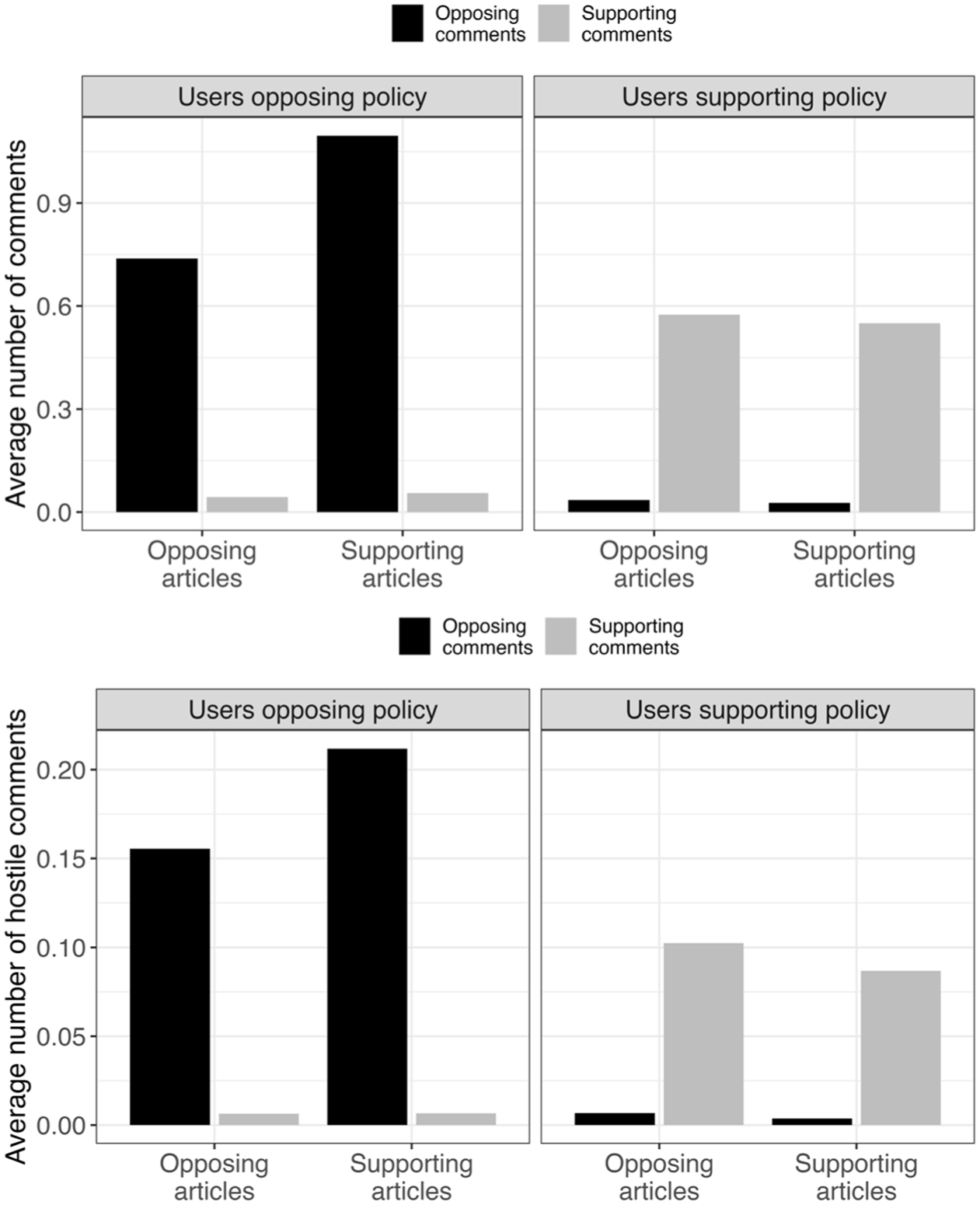
This figure compares commenting patterns on news articles about the nuclear power phaseout policy. The top panels show the average number of total comments, and the bottom panels show the average number of hostile comments, made by users opposing (left) and supporting (right) the policy.
The pattern in Figure 2 is relatively clear: users are more likely to comment on counter-attitudinal news articles than on pro-attitudinal ones. Both opponents and supporters of the nuclear phaseout policy disproportionately commented on stories that opposed their own stance—often to challenge the article. Notably, this pattern holds not only in total comments, but also in the subset of comments identified as hostile.
Individuals who opposed the policy (top-left panel) left comments that were nearly universally opposed to the policy. Our categorization of these policy-opposing users is defined by their comments, of course—so we should expect there to be a greater number of opposing than supporting comments in this panel. Even so, the fact that there are nearly no supporting comments here (and nearly no opposing comments in the right panel) makes clear the degree of polarization on the issue. Note in the top-left panel that policy-opposing comments were attached to both opposing and supporting articles, but more frequently to policy-supporting articles (p < .001). The top-right panel shows the same data for supporters of the policy. Supporters left fewer comments than did users who opposed the policy; however, supporters also made more policy-supporting comments on articles that oppose the policy than on articles that support the policy. (This difference is barely perceptible in the figure, but it is statistically significant at p < .001). The same pattern is observed when the results are restricted to hostile comments (bottom panel).
To confirm that results for nuclear power are not anomalous, we conducted a second case study focused on the Terminal High Altitude Area Defense missile system—a contested policy that arose under a conservative rather than liberal government. Due to space constraints, results are reported in detail in Supplemental Material S8. Those results reflect very similar patterns to Figure 2.
In sum, our findings suggest that users are not merely passive when encountering opposing viewpoints: they respond to such content with a greater frequency than they do when they encounter content reflecting similar viewpoints. News consumers’ greater tendency to engage with counter-attitudinal stories indicates cross-cutting engagement, reflecting the fact that commenting behavior extends beyond users’ ideologically congruent spaces.
Study 2: Source-Level Engagement
Study 1 was focused on analyses of story-level engagement; Study 2 shifts the focus to source-level analyses. Using the full dataset, this study examines whether hostile users are less confined to fragmented outlet clusters and whether domains with higher hostility exhibit more cross-cutting engagement.
Methods
We assess news engagement at the source level using network analysis to capture the structural patterns of news commentary. To do so, we construct a co-engagement media network that captures the structure of user engagement across news outlets. Each node in the network represents a media outlet, and weighted edges between nodes reflect the number of unique users who commented on both outlets during a given time window. In this co-engagement network, higher edge weights indicate greater audience overlap between outlets.
We use this network to calculate modularity scores, a widely used measure of community structure that reflects the degree of audience fragmentation. Prior studies suggest that selective news engagement tends to produce a fragmented media network, where outlets or their audiences cluster based on shared viewpoints, forming distinct and insulated communities (e.g., Barnidge et al. 2021; González-Bailón et al. 2023; Majó-Vázquez et al. 2019; Mukerjee et al. 2018; Webster 2014). In this context, high modularity suggests that users primarily comment within tightly connected clusters of outlets—what can be considered echo chambers (Majó-Vázquez et al. 2019). Low modularity, in contrast, indicates a more integrated information ecosystem, where users regularly engage across outlet boundaries. 9
To build these networks, we first created adjacency matrices for pairs of media outlets by month. Each matrix cell was filled with the count of co-commenters for the pairs, and commenters were identified using unique user codes. After constructing these audience overlap networks (referred to as “media networks” hereafter), we then extracted the network’s backbone, following the approach suggested by Mukerjee et al. (2018). This step eliminates any links that do not reach the significance level for a probability value of p < .01. Since not all the links are equally important for understanding the media consumption pattern, removing non-significant links can help avoid overestimating the audience overlap between media outlets.
Network fragmentation is then calculated using modularity scores for each monthly media network. We adopt a community detection method that identifies the optimal media clusters, maximizing modularity across all possible partitions (Brandes et al. 2007). Modularity is a metric that reflects the ratio of connections within a cluster to total connections, in comparison to what would be expected from a random distribution of connections. This score thus controls for the number of commenters (which varies over time), allowing for comparisons across different networks.
Unlike simple source-count metrics (e.g., the number of outlets visited), modularity captures the structural organization of media use by showing how tightly users are grouped and how distinct those groups are from one another. This makes modularity a more meaningful indicator of echo chambers, especially in large-scale, multisource environments. Figure 3 illustrates this distinction: Panel a shows a relatively less fragmented network (cross-cutting engagement), while panel b depicts a more fragmented network (selective engagement).
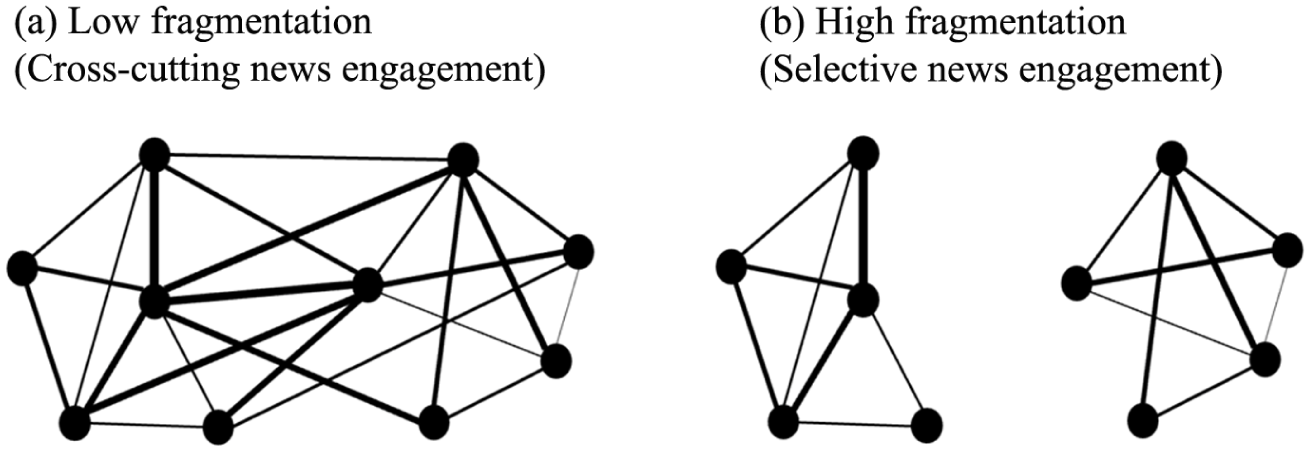
Illustrative examples of media network fragmentation. Panel (a) shows a low-fragmentation co-engagement network, representing cross-cutting news engagement in which users comment across outlets. Panel (b) shows a high-fragmentation network, reflecting selective news engagement in which users remain concentrated within distinct outlet clusters, forming echo chambers.
Importantly, this modularity-based approach does not require predefined ideological labels for news outlets. Rather, it reflects latent clustering patterns based on actual user behavior. Existing studies suggest that such clusters are likely to align with partisanship, given evidence of growing ideological polarization in South Korea’s media landscape (Lee et al. 2024) as well as among political elites and the public (Cheong and Haggard 2023). Regardless of the underlying dimension, however, the more users cross-cut between outlet clusters, the lower the modularity score.
The same measure of hostile commentary used in Study 1 is applied here. In addition, Study 2 incorporates users’ use of the “angry” reaction feature as a secondary indicator. Introduced by Naver in March 2017, this feature allows users to express anger, an emotional state closely associated with hostility, toward news articles.
To address whether hostile users exhibit less fragmented engagement patterns and whether higher hostility corresponds to greater cross-cutting interaction across news outlets, we first compare hostility and modularity scores across news domains using t-tests, Kruskal–Wallis tests, and post hoc Dunn’s tests for pairwise significance. To further examine these relationships at the individual level, we estimate a Generalized Linear Mixed Model (GLMM). The dependent variable is source diversity, measured as the percentage of media outlets commented on (out of all available in a given domain and month), and the key predictor is the number of hostile comments posted. Given the considerable size of the dataset, we randomly sample 1,000 cases where each case is a unique user-month combination. This results in a dataset of 11,656 comments over ten years. Since users can appear more than once when they post comments over multiple months, random slopes for users and months are included to account for repeated observations. The model uses a gamma distribution to account for the positive, right-skewed distribution of the dependent variable, while controlling for differences across issue domains. To assess the robustness of the fixed-effect estimates from this model, we conduct a parametric bootstrap with 1,000 iterations; the results are reported in Supplemental Materials S6.
Results
Across the ten-year dataset, the overall level of comment hostility on Naver seems relatively high. From April 2017 onward, each article across all issue domains received an average of 975 angry reactions per month. Over the entire period, 19.4 percent of monthly comments were classified as hostile, and 31.6 percent of users posted at least one hostile comment a month. 10 On average, there are 44,382 hostile and 49,520 non-hostile users commenting each month.
Figure 4 shows the monthly average modularity scores of co-engagement networks built separately for hostile and nonhostile users. Hostile users, defined as those who posted at least one hostile comment in a given month, consistently exhibit lower modularity scores than nonhostile users (p < .001), indicating that their engagement spans more outlets and is less confined to clustered, like-minded environments. Figure 5 illustrates this difference during a high-modularity month (November 2015) in the Politics domain, using identical node positions for easy comparison: the network of hostile users is visibly more interconnected and less fragmented (modularity = .004 for 35,663 users) than that of nonhostile users (modularity score = .266 for 46,833 users).
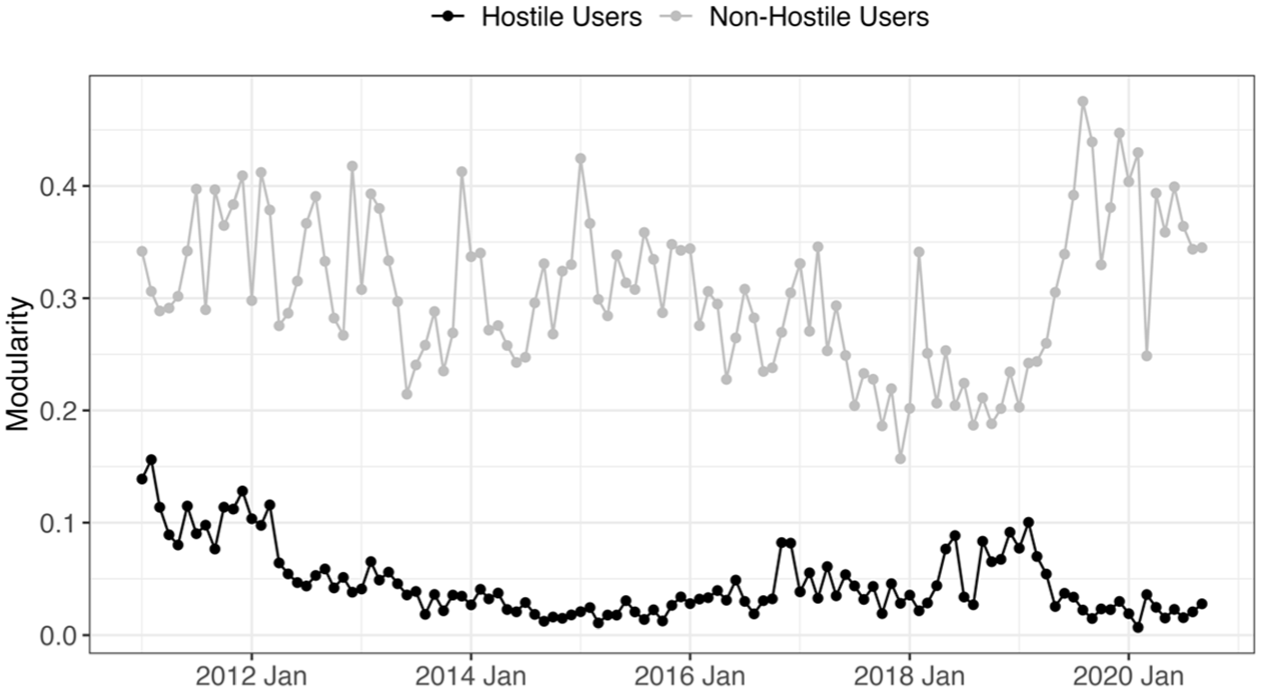
The figure shows monthly modularity scores for hostile and non-hostile users from 2011 to 2020. Lower modularity among hostile users indicates that their engagement spans a wider range of outlets, suggesting less fragmented and more cross-cutting patterns of news engagement compared to non-hostile users.
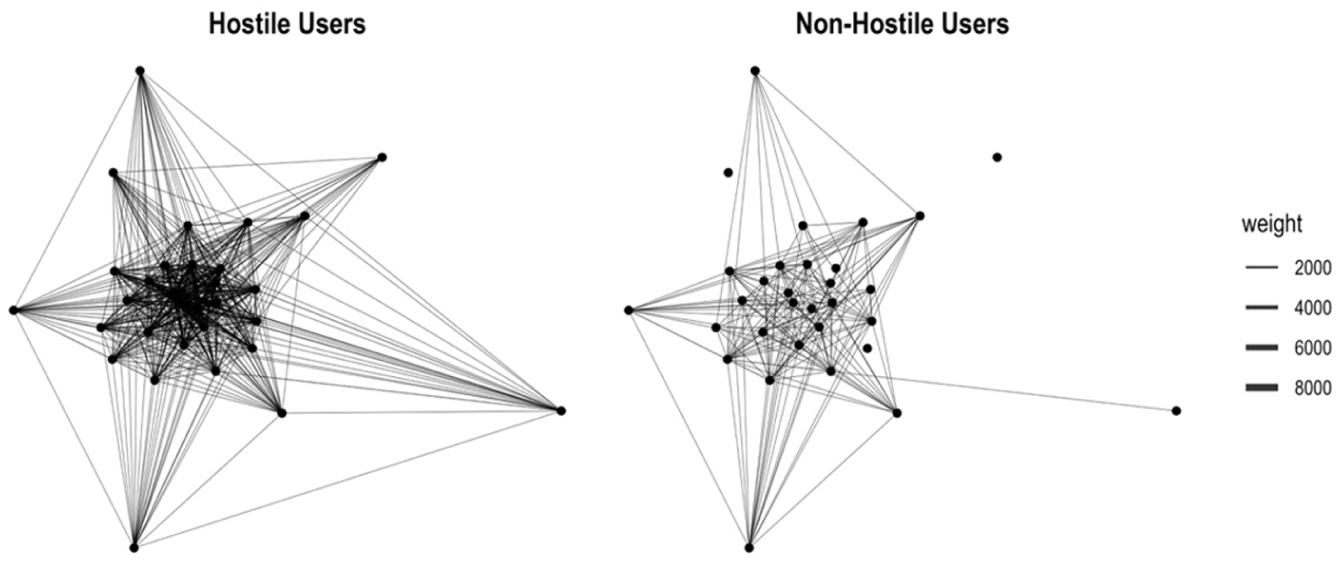
This figure shows a visualization of media engagement networks of hostile and non-hostile users in the politics domain during the month with the highest modularity. The network for hostile users (left) appears denser and more interconnected, reflecting cross-cutting engagement across outlets, whereas the network for non-hostile users (right) shows more distinct clusters, indicating selective engagement within fragmented communities.
Figures 6 and 7 present domain-level comparisons. Figure 6 shows the Politics and Society domains have the highest average number of angry reactions per article (2,117 and 1,662, respectively) and the highest percentage of hostile comments from audiences (22.2 and 20.2 percent). The same pattern appears in the proportion of hostile users, with Politics and Society showing the highest monthly averages (32.4 and 29.8 percent). Importantly, Figure 7 reveals that these domains have the lowest modularity scores (.017 and .024), indicating less fragmented and more cross-cutting engagement. 11 These findings consequently suggest an inverse relationship between hostility and modularity (RQ3): news domains with higher hostility tend to exhibit more cross-cutting interactions in news commentary. In other words, reacting angrily to political or societal content is associated with active engagement across outlet boundaries. 12

This figure compares the average number of angry reactions (top panel) and the percent of hostile comments (bottom panel) across six news domains. Bars indicate statistically significant pairwise differences based on Dunn’s tests. It shows that political and societal news elicits the highest levels of anger and hostile engagement.
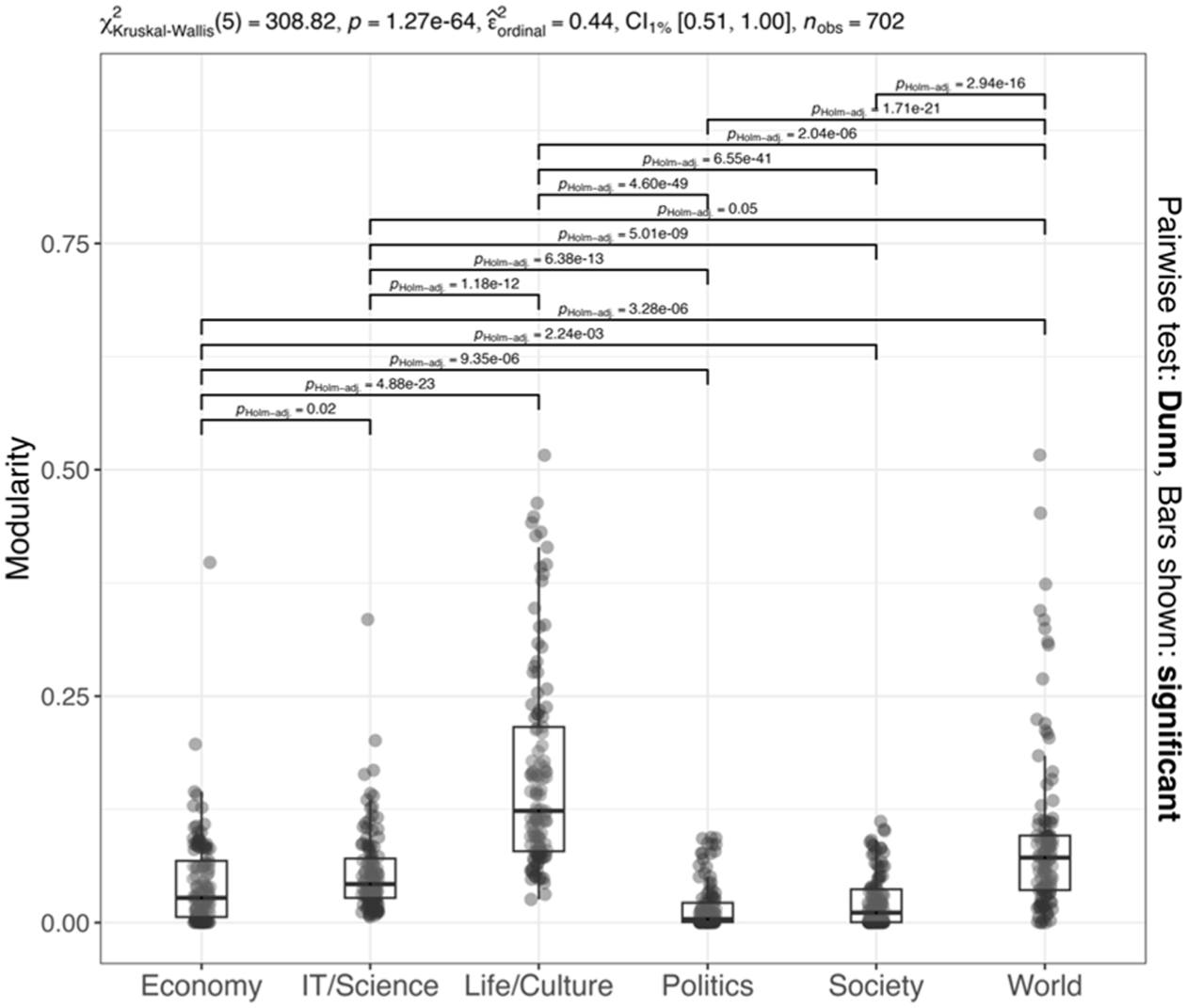
This figure compares average modularity scores across six news domains. Bars indicate statistically significant pairwise differences based on Dunn’s tests. Lower modularity in politics and society suggests less fragmented, more cross-cutting engagement, whereas higher modularity in life/culture indicates more selective engagement confined within outlet clusters.
To validate these findings at the individual level, we estimate a GLMM with the sampled data described in the Methods section. Figure 8 presents the fixed-effect estimates from this model. Estimates show differences across five issue domains relative to the reference domain, Life/Culture. Although these results cannot establish causality, hostile commentary and source diversity are quite clearly related. Even after accounting for differences across news domains, hostility is a strong positive predictor of source diversity (p < .001). A one-unit increase in individual-level hostility is associated with a .16-unit increase in the diversity of outlets a user comments on in a given period (bootstrapped mean coefficient = .162, 95% CI [0.150, 0.177]). 13
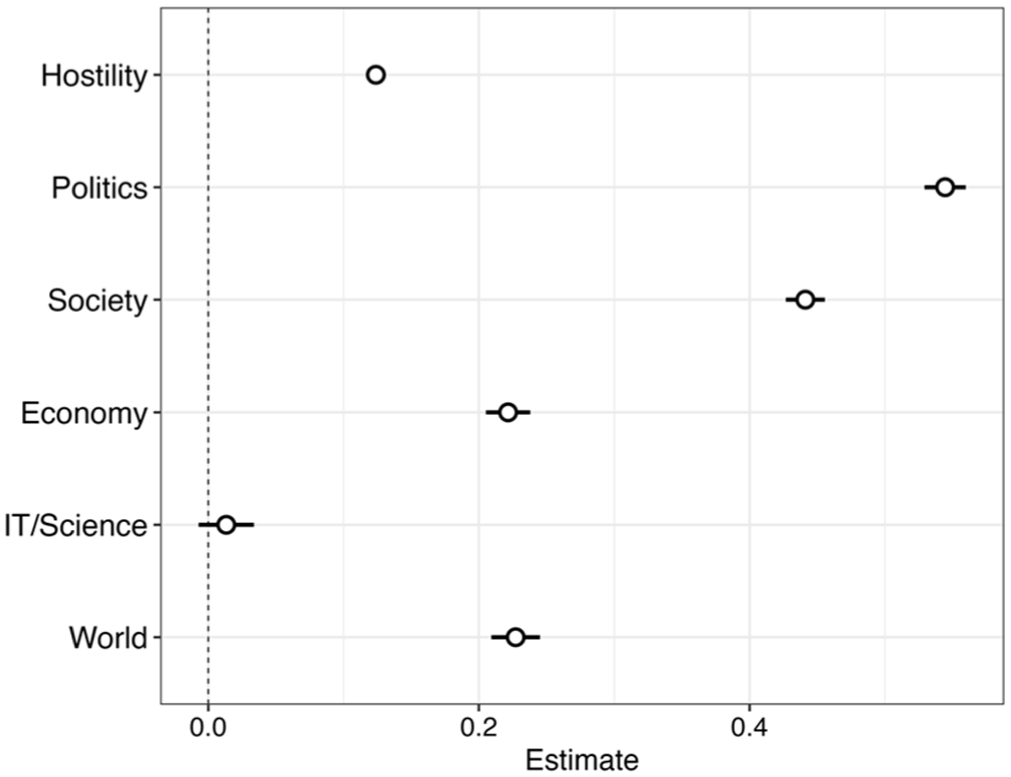
This figure presents results from the Generalized Linear Mixed Model (GLMM) estimating the relationship between hostility, news domains, and source diversity. Positive coefficients indicate that higher values of the corresponding variable are associated with greater diversity in the outlets users engage with.
To further assess the robustness of these findings, we conducted two supplemental analyses at different levels of aggregation. First, a multilevel model regressed monthly modularity scores on hostility and angry reactions while controlling for issue domain and time (see Supplemental Material S5.1–S5.2). Results confirm the negative association between hostility and source-level fragmentation, reinforcing the link between hostile engagement and lower modularity. Second, analysis of monthly user-level averages shows a strong positive correlation between hostility (number of hostile comments) and media diversity (percentage of media outlets a user commented on; r = .715), suggesting that more hostile users engage with a broader set of news sources (see Supplemental Material S5.3).
These findings consistently indicate that hostile engagement is associated with more cross-cutting patterns of news commentary. At both aggregate and individual levels, hostile users are less likely to be confined to echo chambers and more likely to engage across clusters of news outlets. We consider the implications of these findings below.
Discussion
Drawing on ten years of large-scale digital trace data from Naver, this study examined whether news commentary—an active form of news engagement—reflects cross-cutting rather than selective patterns of audience behavior across both content and source levels.
Study 1 indicated that users frequently crossed ideological boundaries at the content level by posting confrontational comments on counter-attitudinal news stories rather than supportive comments on pro-attitudinal ones. Interestingly, this pattern holds for commenting behavior in general, regardless of tone. Even non-hostile users appeared motivated to express disagreement, albeit in more civil language, when issues were salient or highly polarizing. This suggests that, for widely publicized and divisive issues, cross-cutting engagement may not always stem from emotional activation but may also arise from reasoned or deliberative expression. Such expressions nevertheless tend to occur disproportionately when users disagree rather than agree—and, importantly, on counter-attitudinal rather than pro-attitudinal news.
Study 2 extended the analysis to the broader media ecosystem and found evidence that users who posted hostile comments engaged across clusters of news outlets, exhibiting weaker structural fragmentation (and thus more cross-cutting engagement). Cross-cutting patterns in news commentary were most pronounced in the Politics and Society domains, where hostility was most prevalent.
These findings complicate the common and often implicit assumption that online hostility reflects ideologically insular spaces that reinforce selective news engagement. Instead, they suggest that expressive and oppositional motives in active engagement may broaden, rather than narrow, users’ interactions with diverse perspectives.
These findings have implications for how we understand digital news engagement. Much of the literature, shaped by theories of confirmation bias and motivated reasoning, emphasizes alignment between preferences and behaviors. Our findings show that active engagement, especially commenting, does not always follow this logic. Hostile users often engage with content they reject, not to affirm it but rather to challenge it.
From a behavioral standpoint, this suggests that news engagement is shaped not just by what users support, but also by what they oppose. Hostile commentary may reflect oppositional attention, where disagreement becomes a motivator for interaction. In high-choice digital environments, such behavior may be a marker of cross-cutting engagement, not ideological isolation.
The normative implications of these findings are mixed. While cross-cutting engagement is often seen as democratically beneficial, engagement driven by hostility may amplify animosity rather than promote understanding. Hostile engagement may serve expressive or identity-signaling functions without promoting deliberation or mutual understanding. As such, the presence of cross-cutting engagement does not necessarily imply constructive discourse.
Empirically, our results build on a growing literature showing that echo chambers are not as impermeable as once feared. Prior studies have found that users often encounter diverse perspectives through platform architecture, interpersonal networks, or incidental exposure (e.g., Bakshy et al. 2015; Flaxman et al. 2016). Our findings contribute to this literature by showing that users themselves may play an active role in breaking echo chamber boundaries, even when that engagement is characterized by opposition and hostility rather than curiosity or open-mindedness.
Still, several limitations remain. The data are observational, and while the patterns are robust, they do not allow us to make strong causal claims. While Naver News offers a rich and unique environment for studying large-scale news engagement, it remains an open question whether similar patterns hold in other media systems or platform contexts. Moreover, while we observe behavior, we cannot directly measure users’ underlying motivations. Future work should explore whether hostile engagement reflects deliberate confrontation or other intentions not captured in this study.
In sum, this study suggests that hostility does not always reinforce selective engagement—it may challenge it. Far from being confined to ideologically aligned spaces, hostile users engage across boundaries, reacting to content they disagree with. This behavioral tendency points to an important, if uncomfortable, possibility: that hostility and opposition may drive some of the most cross-cutting forms of digital news engagement in today’s media environment.
Supplemental Material
sj-docx-1-hij-10.1177_19401612261416569 – Supplemental material for Engaging to Oppose: Cross-Cutting Patterns in Hostile News Commentary
Supplemental material, sj-docx-1-hij-10.1177_19401612261416569 for Engaging to Oppose: Cross-Cutting Patterns in Hostile News Commentary by Seonhye Noh and Stuart Soroka in The International Journal of Press/Politics
Footnotes
Acknowledgements
The authors have no acknowledgments to declare.

Ethical Considerations
This study was based on publicly available data and did not involve direct interaction with human participants.
Informed Consent
Because the study analyzed publicly accessible data and did not constitute human subjects research, institutional review board approaval and informed consent were not required.
Author Contributions
Seonhye Noh designed the study, conducted the analysis, and drafted the manuscript. Stuart Soroka contributed to the conceptual framing and provided critical revisions throughout the writing process. Both authors approved the final version of the manuscript.
Funding
The authors received no financial support for the research, authorship, and/or publication of this article.
Declaration of Conflicting Interests
The authors declared no potential conflicts of interest with respect to the research, authorship, and/or publication of this article.
Data Availability Statement
Due to ethical and privacy concerns related to user identification codes included, the data cannot be publicly shared. However, an anonymized version of the data suitable for some research purposes can be provided by the corresponding author upon request.*
Supplemental Material
Supplemental material for this article is available online.