



Abstract
The essence of authentic leadership is alignment of actions with an identity grounded in the “true self.” Theoretically, achieving such alignment requires self-awareness of discrepancies between current leadership capacity and elements of aspirational identity. Using personal constructs psychology, this study explores evidence that doctoral education serves as a catalyst for developing authentic leader identity. Repertory grid technique was used to elicit the implicit leadership theories of students enrolled in their first and final Leadership Core courses in an interdisciplinary doctoral program. Data analysis revealed significant differences in the complexity and integration, but not differentiation of leader identity.
Keywords
Introduction
The essence of authentic leadership is alignment of actions with an identity grounded in the “true self” (George, 2003). Authenticity is promoted to the extent this “true self” becomes integrated with other dimensions of identity (Ladkin & Taylor, 2010). Such alignment requires a sense of self that is free of deception, blind spots, and unconscious motives (Arbinger Institute, 2010). The first step toward achieving such alignment is self-awareness of discrepancies between manifest leadership capacity (“current self”) and aspirational leader identity (“ideal self”) (Marcus & Nurius, 1986). This “ideal self” may also reflect elements of other aspirational ideals such as “admired leader” and “effective leader” (Hall, 2004). Theoretically, authentic leader identity results from “trigger events,” planned or unplanned, which serve to draw attention to aspects of self that fall short of these ideals (Gardner, Avolio, Luthans, May, & Walumbwa, 2005).
The perspective on authentic leader development described above reflects a recognition that identity is not a single, integrated entity, but is actually constituted of multiple “selves,” each associated with distinct roles, differentially activated by circumstances and evoking concomitant behavioral responses (Stets, 2006). Leadership development is said to occur as those facets of self-identity associated with leadership roles become more integrated and increase in complexity while becoming differentiated from other, non-leader identities (Hall, 2004). The “true self” represents an ideal image of identity within this multitude of selves that is thought to motivate and inspire individuals to strive for positive psychological processes, ethical behavior, and high moral standards (Chan, Hannah, & Gardner, 2005). Authenticity is promoted to the extent this “true self” becomes integrated through alignment with other aspirational dimensions of identity; thus, authentic leadership results when elements of the “true self” become incorporated into core aspects of leader identity.
Recent models of leadership development that incorporate elements of identity development assert that self-awareness arising from traditional leadership development strategies can serve as trigger events for fostering leadership development, prompting individuals to seek out subsequent developmental experiences, thus fueling an “identity development spiral” (Day, Harrison, & Halpin, 2009). Yet while traditional approaches to developing leadership capacity (i.e., assessment and feedback, 360° evaluation, mentoring, stretch assignments, hardships, and career setbacks) can set the stage for triggering insights into discrepancies between current and ideal leader identities, these techniques do not explicitly map the conceptual distance between current and aspirational manifestations of self (McCauley & Van Velsor, 2004). Rather, in the cyclical processes that scholars describe, self-insights come in piecemeal fashion over an extended period of time, resulting in a protracted period of meandering development (Kegan, 1982).
Moshman (2003) asserted that adult development is a function of reflection and internal coordination, resulting in qualitative, progressive change. A fundamental implication of his analysis is that development can only result from self-directed effort; it cannot be affected by an outside actor. Specifically, with respect to identity development, Moshman concludes, Constructing an identity involves creating a unique structure of self-understanding that enables me to explain my most fundamental commitment and actions . . . Identities are formed in social contexts, and are highly constrained by the social and vocational roles available in those contexts, but they are not simply internalize from one’s environment. Rather, in the course of our social interactions, we construct our identities . . . [they] are internally generated. (p. 53)
Interventions designed to heighten self-awareness of discrepancies between existing and ideal images of self are theorized to promote the internal processes underlying development of authentic forms of leadership (Avolio, 2004; Gardner et al., 2005).
Although higher education has been shown to promote various aspects of student identity development (Mayhew et al., 2016), limited research has been conducted on doctoral students explicitly (Ilin, 2016; Reinharz, 1984; Zambo, Buss, & Zambo, 2015). The case study reported here was conducted to explore whether doctoral study in leadership may promote development of authentic leader identity, as reflected in the complexity of self-identity, the integration of current self with aspirational ideals, and the differentiation of current self from undesirable images of leadership.
Doctoral education is generally recognized as fostering student development, and doctoral study in leadership promotes development of leadership capacity, directly or indirectly, depending upon programmatic objectives and curricular strategies (Allen & Middlebrooks, 2013; Buss & Avery, 2017; Ginsberg, Knapp, & Farrington, 2014; Walker, Golde, Jones, Bueschel, & Hutchings, 2008). But whether doctoral study in leadership specifically promotes development of authentic leader identity, or merely the acquisition of a variety of possible leader identities that mirror alternative leadership theories, has not been empirically assessed. As authentic leadership is theorized to be the added component enabling leaders to act in accordance with their own moral compass regardless of what form(s) of leadership are practiced (Gardner et al., 2005; George, 2003), academic program directors can benefit from increased understanding of the degree to which doctoral education in leadership promotes authentic leader identity development.
Research Questions
A cross-sectional, mixed-methods case study was conducted to begin to disentangle discrete aspects of leader identity development fostered by doctoral study in leadership: Repertory grid technique was used to compare the complexity and degree of integration and differentiation reflected in the leader identities of students enrolled in their first and final Leadership Core courses in a doctoral program at a midsized, private university located in Midwestern United States. This exploratory study was guided by a single overarching research question: Do students enrolled in the final Leadership Core course demonstrate greater complexity, integration, and differentiation with respect to their authentic leader identity profiles relative to students enrolled in the first core course? Specific hypotheses focused analysis on three dimensions of leader identity development in this exploratory case study: Compared with doctoral students enrolled in their first Leadership Core course, students enrolled in the final core course were predicted to: Hypothesis 1 (H1) Complexity - Exhibit a greater number and complexity of constructs in their authentic leader identity profiles; Hypothesis 2 (H2) Integration - Exhibit greater alignment of their current self with aspirational leader identities (ideal, admired, and effective); and Hypothesis 3 (H3) Differentiation - Exhibit less alignment of their current self with undesirable leader identities (ineffective, despised). Figure 1 portrays the conceptual dimensions of leader identity examined in this case study.

Hypothesized changes in complexity, integration, and differentiation of aspirational and undesirable elements of leader identity.
The increased complexity of personal constructions of leader identity hypothesized for students enrolled in the final core course, relative to those enrolled in the first, is illustrated by the expansion and overlap of the shaded circle representing “ideal self” with both the similarly expanded circles representing “admired leader” and “effective leader.” The hypothesized integration of these aspirational images of leader identity is depicted by their increased overlap with the circle representing “current self.” Similarly, the hypothesized differentiation of undesirable dimensions of leader identity is depicted by the reduced amount of overlap between “current self” and both “ineffective” and “despised” leaders. Each of these effects was assessed using data collected using the repertory grid, a technique based on the psychological theory of personal constructs (Kelly, 1955). The repertory grid is a flexible tool for eliciting personal constructions of reality, and probing how components of these meaning-making frameworks function to interpret and inform interaction with the world (Fransella & Bannister, 1977). Grid technique was used to elicit and compare elements of leader identity embedded in the implicit leadership theories (ILTs) of doctoral students enrolled in their first and final Leadership Core courses.
Repertory Grid Technique
Repertory grids are constructed through a structured elicitation process. Each grid focuses on a designated topic. Once the topic has been determined, construction of the grid proceeds through five sequential steps: (a) Selecting or providing elements, (b) Eliciting constructs, (c) Rating or ranking grid elements, (d) Analyzing grid data, and (e) Interpreting grid results (Beail, 1985a). The process of grid construction allows individuals to explore how their own mental models and thoughts relating to specified topics are organized. The elicitation process is especially useful for revealing tacit knowledge (Catania & Randall, 2015) and studying “the subjective ways in which individuals interpret and explain their perceptions to themselves” (Lambert, Kirksey, & McCarthy, 1997, p. 3). Although repertory grids capture individual constructions of reality, insight can also be gained by comparing the content and structure of grids constructed by people who have shared a common experience (Beail, 1985a). Such comparative grid analysis can reveal commonalities in the personal construct systems that inform the interpretation of events and guide collective action (Latta & Swigger, 1992).
Grid analysis
Although Kelly’s (1955) original methods of grid analysis were designed to promote self-awareness and track developmental change in clinical settings (Beail, 1985b; Neimeyer & Neimeyer, 1990), analytic techniques were subsequently developed to extend the utility of the grid technique to a wide range of applications (Latta & Swigger, 1992; Shaw & Gaines, 1981; Slater, 1976, 1977). Cluster analysis and principal components analysis have become the two primary approaches to analyzing grid data employed by social scientists. Both methods produce graphical displays illuminating patterns in the construct ratings captured during grid construction. Both analyses can be used to interpret individual grids and conduct comparative analysis; each offers advantages, depending upon the intent of a particular application (Bell, 1990, 2003). For research purposes, it is advantageous to use multiple methods of grid analysis concurrently to ensure triangulation of results (Bektas, 2014; Bell, 2016; Hewitt, 2005).
Theoretical Framework
The theory of personal constructs psychology provides a basis for illuminating the nature and influence of implicit leadership theories (ILTs) on leader authenticity and effectiveness. ILTs are the informal notions of leadership individuals possess, which operate subconsciously to shape expectations and guide behavior between leaders and followers in a variety of contexts (Lord, Footi, & De Vader, 1984). ILTs encompass “the concept of ‘leader’ different people have in their minds” comprising a set of “beliefs about how leaders behave, in general, and what is expected of them” (Bass & Bass, 2008, p. 47). Since being introduced by Eden and Leviatan (1975), ILTs have only been marginally explored in the field, primarily with respect to the effect of follower’s ILTs on perceptions of leaders (Schyns & Meindl, 2005).
While typically considered naive conceptions of leadership, it is reasonable to assume many individuals elevated to leadership positions operate on the basis of their own ILTs, rather than formal, empirically validated theories of leadership. Moreover, there is little reason to believe leaders who have studied leadership theory, or gone through leadership development programs, are any less likely to be influenced by their ILTs than those who lack exposure to formal theories of leadership. The study reported here explored the extent to which the ILTs of working professionals enrolled in an interdisciplinary Leadership Studies doctoral program were shaped by their exposure to leadership theory through the curriculum of the Leadership Core. Personal constructs psychology (Kelly, 1955), which focuses on people’s implicit constructions of reality, provided an apt conceptual framework for eliciting these students’ multifaceted leader identities, and analyzing them for evidence of complexity, integration, and differentiation.
Personal Constructs Psychology
Personal constructs psychology provides both the conceptual framework and a technical apparatus for assessing the cognitive complexity of leader identity, including the alignment of current self-image with aspirational ideals and differentiation from undesirable conceptions of leadership. Personal constructs theory (PCT) is premised on the notion that human beings are inherently meaning-making organisms innately endowed with rational cognitive impulses to codify and manufacture implicit theories about the world based on individual experiences (Kelly, 1955). Kelly asserted that these meaning-making mechanisms operate implicitly, independent of learned strategies for information processing, scientific methods, or theory development. To Kelly, every individual functions as a lay scientist, continually collecting evidence from experience and assembling it into personally meaningful cognitive structures (Beail, 1985a). Once created, these “personal constructs” are endowed with both form and function, providing a basis for interpreting and assigning meaning to experience, predicting future events, informing decisions, and dictating behavioral responses to both familiar and novel stimuli.
Kelly proposed PCT as an alternative to the dominant psychological schools of thought based on stimulus-response or Freudian principles, both of which he found inadequate (Kenny, 1984). He framed his theory in terms of a single fundamental principle, which states, “a person’s processes are psychologically channelized by the ways in which he anticipates events” (Kelly, 1955, p. 46) and 11 corollaries. The Individuality Corollary states, “persons differ from each other in their construction of events,” whereas the Experience Corollary asserts that we continually revise our personal constructs as a result of experience: “a person’s construction system varies as he successively construes the replication of events” (Kelly, 1955, p. 4) Thus, Kelly maintained that personal construct systems are subject to continual validation and revision to accommodate experiences that either confirm or undermine one’s existing construal of reality. The Modulation Corollary clarifies that although not all new experiences provide a basis for this reconstrual, “to the extent constructs are permeable they are subject to change through experience” (Kelly, 1955, p. 588). Finally, the Organization Corollary affirms, “each person characteristically evolves, for his convenience in anticipating events, a construction system embracing ordinal relationships between constructs” (Kelly, 1955, p. 8). Together, these propositions capture the developmental manner in which the personal construct systems that people create continually evolve to make it possible for them to anticipate and interpret future experiences.
Despite the active role that Kelly (1955) considered systems of personal constructs to have in guiding thought and behavior in daily life, implicit theories operate largely outside conscious awareness. Asked to explain their actions, most individuals struggle to articulate the underlying conceptual frameworks informing their behavior. So Kelly developed the Repertory Grid as a tool to elicit the unique tacit content and structure of individual personal construct systems (Catania & Randall, 2015). Rendering these implicit systems of meaning explicit provided a basis for examining and exploring their impact on the lives of clients, students, and professionals in a wide range of contexts (Fransella, 2003; Winter & Reed, 2016). Subsequently, these cognitive frameworks were found to have consequence in both clinical and educational settings.
Originally, personal constructs psychology and the repertory grid technique were used to enhance self-understanding and promote developmental well-being among individuals through psychological counseling. More recently, PCT has been used to explore dimensions of cognitive complexity (for a review, see Kovarova & Filip, 2015). The literature applying PCT to the study of education (Gilbert, 1990; Hewitt, 2005; Middleton, 1995; Reitano & Green, 2013), including higher education (Latta & Swigger, 1992; Kozikoglu, 2017; Kreber, Castleden, Erfani, Lim, & Wright, 2003; Weingarten, 2007), is extensive, but few studies have been conducted at the doctoral level (Ilin, 2016). Similarly, PCT has been applied to the study of business (Armour, 2016; Birt & Vigar, 2002; Brook & Brook, 1989; Catania & Randall, 2015; Pattakos & Dundon, 2017) and organizational culture (Coopman, Hart, Allen, & Haas, 1997; Langan-Fox & Tan, 1997), but appropriation of the theory for the study of leadership has been limited.
Applications of PCT in education date back to the theory’s conception. A review of recent studies found that the repertory grid has been used to promote active learner engagement (Pope, 1982), to foster intrinsic motivation for learning mathematics (Middleton, 1995), to probe perceived attributes of the “ideal teacher” (Kozikoglu, 2017), and elucidate principals’ conceptions of the “ideal principal” (Bektas, 2014). Among undergraduates, PCT has been used to explore similarities among students’ and professors’ conceptual knowledge of science (Kreber et al., 2003), to promote mastery of research methodologies (Hamid, Stapa, Mustafa, & Hashim, 2012; Zuber-Skerrittt, 1987), and to construe the creativity of college professors (de Sousa, 2007). Researchers have adopted PCT to study students’ aesthetic responses to musical compositions (Gilbert, 1990) and secondary school teachers’ perceptions of music students (Hewitt, 2005).
In the field of leadership, one early study found support for predicting the prototypicality of leaders based on constructions of the ideal group member (Cravens, 1954). More recently, in an exploratory study of nonprofit organizations, Kearns, Livingson, Scherer, and McShane (2015) elicited the personal constructs of chief executive officers and codified the technical, conceptual, and interpersonal skills employed by these leaders. In another study of nonprofit leadership, Kearns (1995) elicited the personal and professional attributes chief executive officers and chairs find desirable among their board members. Comparing the elicited constructs with criteria for selecting new board members revealed discrepancies between norms of practice and the implicit theories these leaders employed. Such studies illustrate the potential for applying PCT to the study of leadership, but not specifically within the domain of leadership development.
Method
Participants in this case study were drawn from an interdisciplinary doctoral program in Leadership Studies specifically designed to produce graduates who “understand the complexities of effective leadership and change, with an eye toward discerning and directing purposeful, authentic collective action rooted in ethical, character-based dimensions of leader identity and responsible influence” (Program website, redacted). The repertory grid technique was employed to elicit and analyze the personal construct systems of doctoral students enrolled in their first and final courses in the Leadership Core. Analysis focused on three dimensions indicative of authentic leader identity development: The complexity and integration of the current self with aspirational dimensions of leader identity (ideal self, admired leader and effective leader) and the simultaneous differentiation of the current self from undesirable conceptions of leadership (desprised leader and ineffective leader).
Data Collection
Grids were completed by all students enrolled in the first and final Leadership Core courses in an interdisciplinary Leadership Studies doctoral program during the Spring 2018 semester. Courses in the 15-credit-hour Leadership Core include: Comparative Leadership Theory; Psychosocial Dimensions of Leadership; Leading Organizational Culture and Change; Ethical, Spiritual, and Character-based Leadership; and Developing Leadership Capacity. Each three-credit, evening course is taught face-to-face by a tenure-track leadership scholar, published in these respective content areas, using Socratic and constructivist andragogic methods. The entire interdisciplinary doctoral faculty consists of three core and six contributing faculty; the first and final core courses were taught by the same senior core, tenure-track professor. Students in the program are all mid-career professionals working in business, education, health care, government and nonprofit arenas. Students in both courses completed grids reflecting the same six elements of leader identity: current self, ideal self, admired leader, despised leader, effective leader, and ineffective leader (see Figure 2). Data collection occurred during the first class meeting, prior to distribution of the syllabus.

Repertory grid data collection form (truncated).
Repertory Grid Analysis and Interpretation
A total of 26 grids were submitted; two partially completed grids (one from each course) were eliminated from analysis. The remaining 24 grids were roughly equal in number of constructs elicited (average first core course = 15, n = 12; average final core course = 14, n = 11). Prior to analysis, all ratings were converted to a zero-centered scale, with a positive pole rating of 3 and a negative pole rating of −3. Cluster analysis of each grid was then performed using Idiogrid software (Grice, 2008); Figure 3 presents a sample cluster analysis of one student’s grid data.
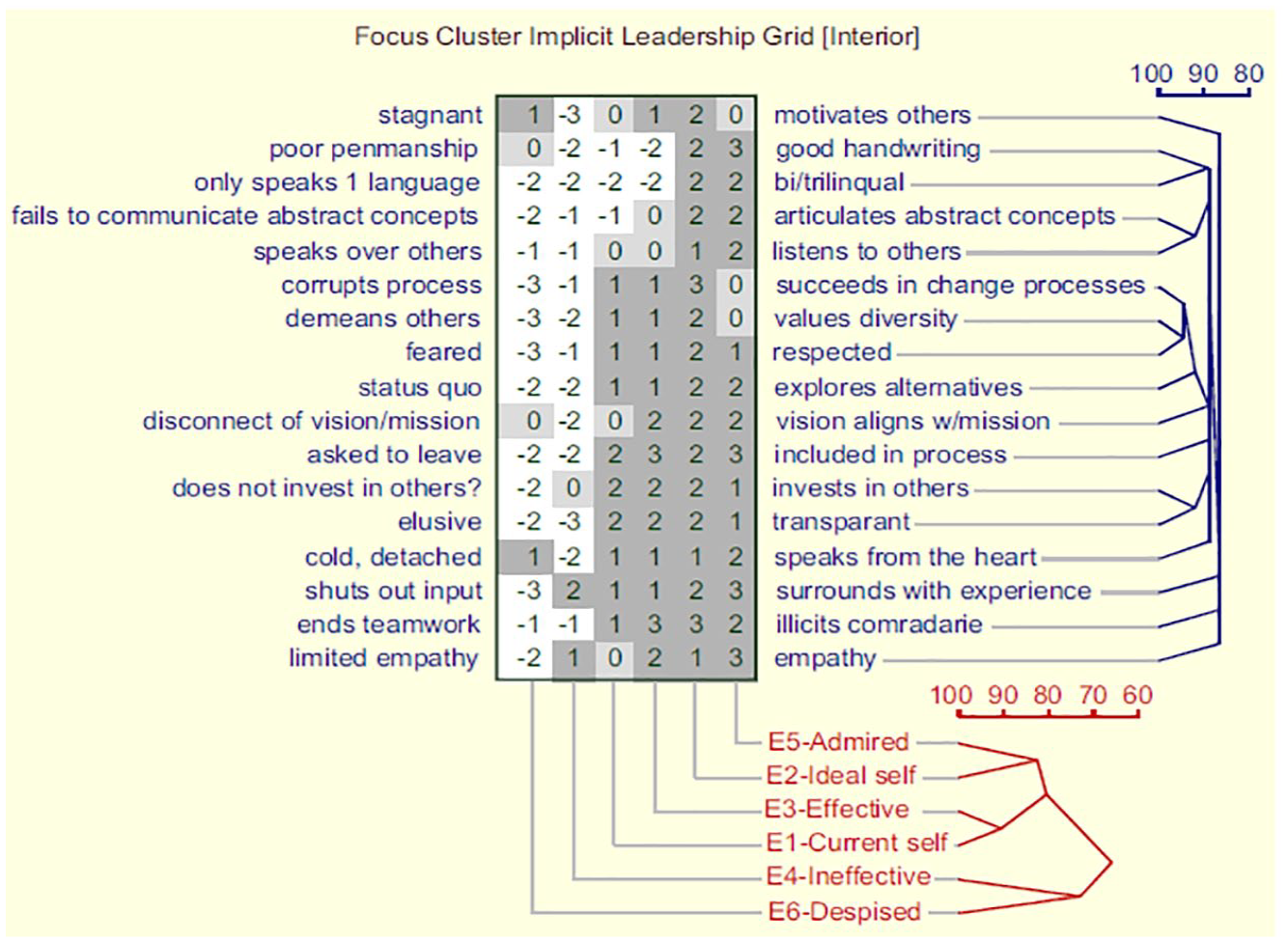
Sample cluster analysis of repertory grid data.
Principal components analysis was subsequently carried out using RepPlus software (Gaines & Shaw, 2018). This specialized software is designed to plot both constructs and elements, positioning both ends of the construct pairs on the same graph. Figure 4 presents the principal components graph resulting from analysis of the same grid data presented in Figure 3.

Sample principal components analysis of repertory grid data.
In all applications of repertory grid, interpretation of the extracted personal construct systems is guided by the purpose of grid analysis (Bell, 2016). In this case study, the purpose of analysis was to determine the complexity of personal constructs elicited, the integration of current self with aspirational aspects of leader identity, and the differentiation of current self from undesirable leader identities, calling for a variety of qualitative and quantitative analyses. Qualitative analyses were used to examine the content of participants’ grids, whereas quantitative analyses traditionally employed by Kelly (1955) probed the structural aspects of students’ meaning-making systems of personal constructs. Due to the small sample size, statistical analyses were employed to assess differences between student groups in this case study, but not to draw inferences about populations beyond study participants.
Identity complexity
The assumption underlying repertory grid analysis is that meaning is contained in both the content of the constructs elicited during grid construction and the way ratings are assigned to elements based on these constructs (Bell, 2003). Content analysis of the dichotomous constructs themselves can reveal linguistic commonalities in the terminology elicited from participants, capturing similarities and differences perceived among elements of the grid (Dyson, 1996). Such analysis is indicated by Kelly’s (1955) Commonality Corollary, which asserts that individuals will construe common experiences similarly, to the extent their underlying psychological processes are the same. However, content analysis necessarily imposes an external interpretation that may distort the meaning inherent to the personal constructs elicited (Beail, 1985a). Since Kelly insisted the meaning of personal constructs was contained in the way these rating systems are used by the individuals who construct them, and not the terminology itself, he developed alternative methods of grid interpretation based on the ratings assigned (Bell, 1990).
One of those methods, cluster analysis, has become the most common approach to grid analysis, often used in combination with content analysis to assess the degree of conceptual commonality and overlap among constructs in a set of grids (Dyson, 1996). Although content analysis provides a means of consolidating constructs across multiple grids, cluster analysis extracts relationships among constructs unique to each grid prior to comparing between and among study participants. Cluster analysis was used in this study to identify patterns of personal meaning embedded in how constructs elicited from students were differentially applied to grid elements using the 7-point Likert-type ratings scale. The clusters of constructs that emerged from this analysis shed light on how students in the two core courses combined constructs to reflect their emergent understanding of their own and others’ leader identity. The results of content analysis will be presented first to afford context for interpreting the metrics derived from cluster analysis.
Content analysis
Content analysis was conducted on both sets of grids simultaneously, with student identity and course enrollment masked throughout the coding process. To ensure conceptual clarity, each similarity–difference dichotomy was coded as a single unit and, for consistency, the positive pole determined the code label (i.e. empowers vs. diminishes others). Constructs were recorded on note cards exactly as stated by participants, and then conceptually similar constructs were grouped into thematic clusters under a single code. Theoretical coding (Whitley & Kite, 2013) was subsequently applied to these themes, specifying what elements of leadership theory each represented, based on the following taxonomy: causal constructs (behavior/skills), moderators (traits/attributes), mechanisms (knowledge/capabilities), and antecedents (attitudes/perspectives) (Jaccard & Jacoby, 2010). The resulting taxonomy was subsequently examined for overlap and distinctiveness among grids constructed by students in the first and final courses in the doctoral Leadership Core. The results are summarized in Table 1.
Taxonomy of Theoretical Themes Identified in the Personal Constructs Elicited From Students Completing Repertory Grids in the First and Final Leadership Core Courses

Key: + more prevalent – less prevalent; = equally prevalent; o = not present.
A total of 379 constructs were coded: 210 elicited from students in the first core course and 169 from students in the final core course. Constructs were grouped into 28 themes; these themes were then grouped under four theoretical categories corresponding to broad dimensions of leadership theory reflecting what leaders do to cause leadership to occur (behaviors/skills), what moderates leader success (traits/attributes), what mechanisms explain how leaders lead (knowledge/capabilities), and what antecedents leaders possess (attitudes/perspectives). Seven of the themes extracted from students’ constructs were equally reflected in the grids constructed by students in both courses: Facilitating change, motivating others, being innovative, taking decisive action, embodying integrity, humility, and work–life balance.
Of the remaining themes, 10 were more prevalent in the grids of students in the first core course, whereas 11 were more prevalent in the grids of students in the final core course; these differences were evident across all theoretical categories. Students in the first core course construed leaders as: Hard working, charismatic, ambitious, respected, pragmatic, empowering and serving others, taking risks, and communicating effectively; for these students, gender mattered. Final core course students construed leaders as: Authentic, professional, open-minded, listening deeply, creating vision, organized against chaos, possessing expert knowledge, engaging in self-reflection, acknowledging flaws, and being optimistic, resilient, and empathetic. These differences were evident in students’ personal construction of leader identity across all theoretical categories, reflecting antecedents, causes, moderators, and mechanisms of leadership.
These results provide preliminary evidence to support H1: With respect to causes (behaviors/skills), students in both classes emphasized leaders’ essential roles in motivating others and facilitating change, but the emphasis shifted from leaders having and giving power by telling, directing, and challenging (among students in the first core course), to receiving input and creating compelling and strategic vision (among students in the final core course). Similarly, with respect to the mechanisms of leadership (knowledge/capabilities), both groups construed leaders as demonstrating innovation, creativity, and decisive action. But students in their first core course saw leaders primarily as employing pragmatic and goal-oriented (a priori approach) approaches to leadership, whereas students in the final core course characterized leadership as more knowledge-based and systemic (a posteriori approach), valuing and relying upon expertise gained from both learning and experience to combat chaos in complex situations (see Table 1).
These two groups of students, at different stages of their doctoral education, also characterized the moderators (traits/attributes) of leader success differently, although both groups saw integrity (moral grounding) and humility as essential ingredients of leader identity. Beyond this similarity, more students in the first core course identified charisma, ambition, confidence, being success-oriented, and respected as essential moderators of leader success, whereas students in their final core course viewed authenticity, open-mindedness, flexibility, humor, having an approachable demeanor, and embodying their professional role appropriately as elements of leader identity that moderate success. Finally, with respect to antecedents of leadership (attitudes/perspectives), all students included work–life balance and self-care as part of their leader identity, and the grids of both student groups reflected an element of others-orientation although, for students in the first core course, this was expressed more as service and self-sacrifice, whereas students in their final core course placed more emphasis on attributes of empathy and compassion that mediate service. The latter also identified optimism, positivity, resilience, self-reflection, and acknowledging personal flaws as essential antecedents of leader identity.
Cluster analysis
Cluster analysis was also carried out on each student’s grid individually. The output of this analysis consisted of both a graphical display (see Figure 3) and a statistical report detailing the number and strength of construct matches identified. Construct ratings sharing 80% of variance or more were included in the report. Based on these scores, a metric of construct complexity was computed for each student’s grid, reflecting the ratio of construct matches divided by the number of constructs elicited. As each student was free to state as many constructs as necessary to capture his or her own implicit theory of leader identity, this metric provided a standardized measure of the number of construct matches resulting from the cluster analysis of each individual participant’s grid. Results of this analysis are summarized in Table 2.
Complexity Scores for Repertory Grids Completed in Two Doctoral Leadership Core Courses

Complexity ratio: t(22) = 2.28, p < .05 (equal variance assumed F = .423 ns), gHedges = .936.
The analysis of construct complexity revealed a 36% difference in average complexity among students enrolled in the first 2.58 (SD = 1.06) and final 3.51 (SD = 0.959) Leadership Core courses, a statistically significant difference, t(22) = 2.28, p < .05, reflecting a large effect size, assessed using Hedges’ g due to unequal sample sizes, gHedges = .936 (Hedges & Olkin, 1985). While not a measure of longitudinal change, these quantitative results contribute cross-sectional evidence to support H1, indicating that the grids of students in the final core course reflected a larger number of discrete construct clusters relative to the number of constructs elicited. This finding indicates that students who had been exposed to more of the core leadership curriculum constructed more varied bi-polar constructs and employ them in a more nuanced manner in rating elements of leader identity. Taken together, the comparative analyses of grid constructs using content and cluster analysis provides evidence consistent with the hypothesis that doctoral study in leadership influences both the conceptual and structural complexity of students’ leader identity.
Identity integration
Cluster analysis was also used to assess the degree of identity integration reflected in students’ repertory grids, with the focus of analysis shifting from the clustering of constructs to the clustering of elements based on the ratings assigned by participants using their own elicited similarity–difference pairs (Beail, 1985a). Cluster analysis reveals the hierarchical relations among elements based on these ratings, displayed in a dendrogram (or tree) diagram (see Figure 3), in which elements rated most similarly join together first (Latta & Swigger, 1992). Clusters of elements (in this case “identities”) are formed as those rated most similarly join together in discrete groups. Interpretation of the resulting dendrograms centers on the order in which elements join together in each participant’s grid (Bell, 1990, 2003). Although all elements cluster together eventually, the analysis in this study examined two metrics: (a) the presence or absence of “current self” in the first cluster formed by participants’ grids, and (b) which other elements clustered with “current self” in the overall hierarchical cluster pattern, as these represent the most conceptually similar (i.e. most integrated) leader identities in participants’ systems of personal constructs (Bell, 2016).
To determine the degree to which participants’ self-identity was integrated with other dimensions of leader identity, the pattern of clustering in each student’s grid was examined to discern how many included their “current self” in the first cluster defined by the dendrogram, and which other elements were combined with “current self” in these students’ cluster diagrams. Based on these calculations, an overall integration score was computed for each participant, revealing a statistically significant difference between group means, t(15) = 2.30, p < .05, with a large effect size (gHedges = .989), lending cross-sectional evidence to support H2 (see Table 3).
Aspirational Identities Initially Clustered With “Current Self”

Integration Score t test, t(15) = 2.30, p < .05, gHedges = .989. Equal variances not assumed, F(22) = 4.59, p < .05.
Integration scores ranged from 1 to 2, reflecting the number of aspirational leader identities participants clustered with their “current self.” Integration scores were statistically higher among students in their final leadership core course (M = 1.0, SD = 0.894) compared with the first core course (M = 0.31, SD = 0.480), t(15) = 2.30, p < .05, with a large effect size, g Hedges = .989. Among students enrolled in their first core course, only 31% (4 of 13) included their “current self” in the first cluster defined by their grid data, compared with 64% (7 of 11) students enrolled in their final core course. Examining the content of these element clusters revealed that students in their final core course most often clustered “effective leader” with their “current self” (71%), whereas none enrolled in their first core course did so. Students in the final core course were also more likely to cluster their “ideal self” with their “current self” (45% vs. 15%), while approximately the same number of students in both courses clustered their “current self” with their “admired leader” (15% first core course vs. 9% final core course). Finally, twice as many students enrolled in the first versus the final core course clustered all aspirational leader identities together (ideal self, admired, and effective leader) before incorporating their “current self” (8 vs. 4, or 62% vs. 36%, respectively), reflecting greater separation between “current self” and these aspirational ideals among first core course students.
Principal components analysis
Principal components analysis was employed to further explore the emergent patterns of identity integration derived from the hierarchical cluster analysis of participants’ repertory grids. Examination of individual scree plots revealed no systematic differences between the grids produced by students in the first and final core courses with respect to the number of dimensions accounting for 90% of the variance (Whitley & Kite, 2013). In each core course, 90% of the variance in 50% of the grids was accounted for with two dimensions. A two-dimensional graph was produced for each participant, reflecting both elements and constructs on the same diagram (see Figure 4). Analysis of these plots focused on identifying which elements of leader identity were located in the same quadrant as “current self” (identity integration) versus the opposite quadrant (differentiation). See Table 4.
Differentiation and Integration of Current Self With Dimensions of Aspirational and Undesirable Leader Identity

With respect to identity integration, results of the principal components analysis revealed statistically significant differences, in the predicted directions, for students enrolled in the first and final Leadership Core courses, lending further cross-sectional support for H2. The grids of students in the final core course reflected statistically greater integration of aspirational identities, t(20) = 2.18, p > .05, gHedges, = .852, and less integration of undesirable leader identities, t(12) = 2.31, p > .05, gHedges = .874, both metrics reflecting adjusted degrees of freedom due to rejection of the test for equal variances, and large effect sizes assessed by Hedges’ g for unequal sample sizes. However, although there is strong evidence of greater identity integration among students in the final core course in this case study, causal inferences cannot be drawn from these findings due to the cross-sectional nature of the data.
Identity differentiation
Hierarchical cluster analysis was also examined for evidence of differentiation between current or aspirational identities (ideal, admired, and effective) and undesirable (ineffective and despised) leader identities. One student in each core course included “ineffective leader” among the elements of leader identity clustered with their “current self.” This result is consistent with previously reported grid research reporting evidence that doctoral education increases students’ awareness of how much more they have to learn, inducing them to “leave even more room than before . . . to develop professionally” (Ilin, 2016, p. 416). There was no evidence in either participant group of students’ “current selves” clustering with their “despised leader” identity.
Statistical tests of identity differentiation resulting from the principal components analysis were also in the predicted directions, but failed to reach significance. Students in the final core course showed no statistically greater differentiation of “current self” from undesirable leader identities, t(20), 1.34 ns, and no less differentiation of “current self” from aspirational identities, t(22) = 0.893 ns (see Table 4). Taken together, these results provide marginal support for H3 and clearly indicate more research is needed to determine whether doctoral education in leadership studies is effective in helping students identify and differentiate themselves from aspects of self that contribute to being ineffective or despised by others.
Conclusion and Limitations
Results of this case study provide consistent, cross-sectional evidence to suggest doctoral study in leadership may promote development of authentic leader identity as reflected in both the content and structure of students’ ILTs, as well as the integration of current self with aspirational leader identities. These results provide preliminary evidence to support the stated hypotheses. Results fell short of affirming hypothesized effects of doctoral education on the differentiation of students’ ILTs from undesirable leader identities. The study is most significant because it demonstrates the utility of the repertory grid and personal construct psychology as a theoretical and methodological framework for researching leader identity development through analysis of students’ ILTs. Together, these results lay the groundwork for a research agenda to advance our understanding of the role of ILTs in mediating the effects of formal study of leadership on authentic leadership development.
With respect to the content of students’ implicit theories of leadership, the systems of personal constructs elicited provide evidence that doctoral study may shift students’ views away from agentic, leader-centric theoretical perspectives toward a more holistic understanding of leadership capacity as a function of entire systems. Significantly, students just starting their formal study of leadership theory in this case study construed their leader identity in far more conventional terms (e.g., charisma, service, empowering, collaboration, communication, and risk-taking), emphasizing what they do and give, whereas those nearing the end of their studies constructed their leader identity around what they receive and understand (e.g., listening, visioning, self-reflection, authenticity, open-mindedness, and resilience), reflecting more constructs that align with authentic leadership theory (Gardner et al., 2005).
From a theoretical perspective, the most notable distinctions between personal constructs elicited from students in their final versus their first Leadership Core courses concerned the presence (or absence) of constructs integral to authentic leadership: transparency, being genuine, acknowledging flaws in self, taking ownership, admitting when wrong/mistaken, asking for help when doesn’t know, seeking self-improvement, studying self, and being self-reflective. These elements of leader identity, prevalent in the grids of students in their final core course, replaced notions of leader agency such as charisma, persuasion, empowerment, and ambition, which dominated the construct systems of students in the first core course. Similarly listening replaced speaking effectively among students further along in their doctoral study of leadership. At the same time, some constructs integral to authentic leadership, such as the capacity to spur innovation, motivate and facilitation change, take decisive action, act with integrity and humility, exude positivity, embody optimism, demonstrate resilience, and achieve work–life balance were equally present in the grids of students in both courses (Gardner et al., 2005; George, 2003; Ladkin & Taylor, 2010).
Additional indicators of increased cognitive complexity emerged from the cluster analysis of grid elements, which revealed greater integration of aspirational dimensions of leader identity among students further into their doctoral studies compared with students enrolled in their first Leadership Core course. These students’ grids reflected more similarities between their “ideal self” and other exemplars of leadership they perceived as “effective” and “admired.” Although not conclusive evidence of causality, this outcome is consistent with predictions derived from theories of adult identity development (Day et al., 2009; Moshman, 2003).
Cluster analysis of grid elements also revealed findings consistent with the hypothesized integration of leader “current self” with elements of aspirational identity, and these findings were corroborated by results of the principal components analysis. The integration effect was particularly prominent with respect to the alignment of “current self” with perceptions of “effective” leader identity, consistent with theories of leader identity development (Hall, 2004). The magnitude of alignment was less dramatic between “current self” and “ideal self” among students further into their doctoral studies, but the direction of change was in the hypothesized direction and was corroborated by results of the principal components analysis. These findings, while preliminary due to the cross-sectional nature of this case study, are consistent with theoretical perspectives on authentic leadership development (Gardner et al., 2005), suggesting that doctoral study in leadership may potentially serve as a “trigger event” (p. 348) spurring the development of authentic leader identity.
This study produced inconclusive results regarding predicted effects of doctoral study on the differentiation of “current self” self from undesirable conceptions of leader identity. Content and cluster analyses provided some preliminary evidence of identity differentiation, and principal components analysis of students’ implicit leadership grids revealed differences in the predicted direction that failed to reach significance. Further research is needed to clarify whether the effects of doctoral education on leader identity development are consistent with predictions about identity differentiation derived from developmental theories of leader identity development (Day et al., 2009; Hall, 2004).
Interpretation of the results of this study is subject to several limitations germane to the scope and design of this research. First, it should be noted that the repertory grid is a self-report method of assessment and therefore subject to first person bias (Bell, 2003); there was some evidence of both self-deprecating and aggrandizing in a small number of the grids analyzed. Additionally, some early concerns were expressed about the internal consistency and test–retest reliability of the grid methodology (Jackson & Paunonen, 1981). Although the purpose in using repertory grid technique in this study was to avoid imposing researcher bias on respondents’ conceptions of identity, the potential exists for a “halo effect” when asking for self-ratings, even on dimensions elicited from the individuals completing the grids (Whitley & Kite, 2013). However, this effect was mitigated to some degree because the repertory grid technique solicits simultaneous ratings of both self and others. Despite these limitations, repertory grid is an established research methodology ideally suited for eliciting individual constructions of reality known to influence behavior, and was employed consistent with recommended protocols for assessing cognitive complexity among adult populations (Beail, 1985a; Bell, 2003, 2016).
More significant to the interpretation of these results, however, is the small scale, cross-sectional design of this case study. Longitudinal data are needed to satisfy the temporal requirements for drawing causal conclusions from observed differences between students in the first and final Leadership Core courses similar to those reported here. Larger, cross-institutional studies could help determine if the effects obtained in this case study generalize to other doctoral programs. Confirmation of similar outcomes resulting from other types of curricular and non-curricular leadership development programs is needed to establish whether authentic leader identity development can be triggered by other approaches to leadership education. Until corroborating evidence substantiates the findings reported, the small scale and cross-sectional design of this case study precludes generalizing results beyond the institution studied.
Although nothing explicitly promoting authentic identity development was incorporated into the courses taken by participants in this study, the overall design of the program, along with its emphasis on self-reflection and intellectual discernment, reflecting institutional mission, as well as the instructor’s theoretical expertise, leadership orientation, psychological background and andragogic teaching strategies, are all confounds in the outcomes documented. In addition, given that heightened self-reflection is theorized to promote authentic leadership development (Gardner et al., 2005), the repertory grid technique used to assess ILTs in this study may itself have served to enhance the developmental impact of doctoral study in leadership on self identity among study participants.
Implications for Research and Practice
The promising nature of these preliminary results provides impetus for future research and applications of personal constructs psychology in the context of authentic leadership development. In this case study, significant differences were observed between students just starting the Leadership Core and those further along in their doctoral studies, which could be evidence of developmental change in leader identity. Differences were observed with respect to both the content and integration of doctoral students’ implicit theories of leader identity. Further research using longitudinal methods is needed to confirm whether these differences represent true developmental changes, not just differences between two convenience samples. Similarly, research using factorial designs is called for to begin the process of determining what causal factors account for the observed differences documented in this study. Are the developmental changes reported a function of the core curriculum, or are other aspects of program content or design responsible for the oberved outcomes of leadership education? Perhaps, it is the applied cognate portion of the program, which explores applications of leadership theory and includes opportunities for internships and independent study that either alone or through interaction with the Leadership Core accounts for the developmental changes observed in this study. To what degree did the interdisciplinary nature of the doctoral program contribute to the observed developmental outcomes documented in this study? Other moderating factors to be controlled for in these follow-up studies include the implicit theories of faculty role models and the influence of peers, as well as opportunities for stretch assignments available to students through their employers by virtue of the fact that they are engaged in doctoral study. From a theoretical perspective, each of these factors may be hypothesized to contribute to developmental changes in leader identity that doctoral students exhibit during the course of their leadership studies.
The developmental differences observed in this case study also invite research exploring the effects of curricular and programmatic innovations in doctoral education. In this study, leadership development was assessed among doctoral students in the absence of any explicit developmental strategies aimed at fostering authentic leader identity. Yet previous applications of PCT, in both clinical and educational settings (Kreber et al., 2003; Middleton, 1995), suggests that the repertory grid could potentially serve as a “planned trigger event” (Avolio, 2004, p. 83) for purposes of activating the self-regulatory processes underlying authentic leadership development. Current research is underway to assess the impact of using the repertory grid as a means of providing doctoral students with feedback throughout their program of study regarding their own implicit theories of leadership and the alignment of their current leader identity with both aspirational and undesirable elements of leadership theory and practice. Such feedback may serve as a catalyst for these working professionals to identify and target aspects of their current leader identity for development to achieve greater alignment with their “true selves” (Chan et al., 2005; George, 2003).
Study results further suggest the utility of extending this research to determine whether the emergence of authentic leader identity continues to progress throughout the dissertation phase of doctoral study in leadership. Upon beginning their dissertation, students advance from the structured part of their studies to a more self-directed task involving individual coaching from a faculty advisor who must both challenge and create the necessary developmental holding environment for their student advisees (Zepeda, 2010). A predicted increase in authentic leader identity at the end of the dissertation process would be consistent with the liminal moments and self-reflection that typify this phase of doctoral education (Reinharz, 1984). One longitudinal study of particular interest would capture the leader identity profiles of doctoral candidates at various points along the journey of designing and executing of their dissertation research. A comparison of leader identity among students at the outset of writing their research proposals and after their final defense would shed light on the efficacy of the dissertation phase of doctoral education for developing leader identity and the factors contributing to successful outcomes.
Results of the content analysis of constructs elicited from participants in this case study may be extended to other research paradigms and contexts beyond the higher education arena. Constructs elicited and themes identified in this study could serve as a basis for developing a self-report instrument for tracking developmental changes among professionals targeted for leadership training. Once validated, such an instrument could be used to conduct broader studies of developmental change among doctoral students to ascertain whether preliminary results of this study generalize to other institutions. Conducting research trials with such a normative instrument would permit researchers to determine whether the differences documented in this study reflect developmental changes that occur among all students of leadership, at all levels, or whether specific aspects of development are tied to particular programmatic elements.
Using personal constructs psychology to extend the study of authentic leadership identity development beyond the context of the academy holds promise for improving the efficacy of training and development efforts in a way that could increase return on investment for organizations wishing to enhance their leadership capacity. The recently developed the Professional Identity and Values Organisation Tools (PIVOT), which utilize a personal constructs approach to promoting lifelong professional development, may have utility for advancing the application of PCT to this area of research and practice (Cooper & Pickering, 2010). PIVOT is a suite of repertory grid-based reflexive tools developed by researchers at The Open University’s Centers for Excellence in Teaching and Learning, designed to “help [post-secondary] students critically reflect upon, identify and explore their developing sense of professional identity” by enhancing dialogue with a tutor or mentor (retrieved from: http://www.open.ac.uk/opencetl/pbpl-cetl). A pilot study in 2008 found these tools to be challenging but effective at promoting the “deep, as opposed to surface, learning [that] requires both time and concentrated reflective thought” (Cooper & Pickering, 2009, p. 7). Collectively, the research agenda outlined here would contribute to the advancement of theory and practice in authentic leader development and inform the educational community regarding best practices in doctoral education and the continuing professional development of leadership scholars and practitioners.
Finally, the application of repertory grid to the study of leadership holds promise for advancing the field along new methodological dimensions. Leadership development is an inherently individual process (McCauley & Van Velsor, 2004). Recent identity-based theories (Day et al., 2009; Hall, 2004; Ladkin & Taylor, 2010) open new pathways for understanding the interaction of external cues with internal processes of integration and regulation essential for affecting developmental change in adulthood (Moshman, 2003). Personal constructs psychology represents a new theoretical approach to understanding the complex cognitive processes that account for these developmental changes. This study demonstrates the potential of the repertory grid technique for capturing the unique constructions of reality that undergird crucial intrapsychic changes required for leader identity development, and the contributions of doctoral eduction to triggering such development.
Footnotes
Declaration of Conflicting Interests
The author declared no potential conflicts of interest with respect to the research, authorship, and/or publication of this article.
Funding
The author disclosed receipt of the following financial support for the research, authorship, and/or publication of this article: The author received a $500 Teaching as Research mini-grant from Xavier University’s Center for Teaching Excellence in partial support of this research; no funding was received to support the authorship or publication of this article.