




Abstract
The EU-border agency Frontex is one of the main actors involved in the bordering of the EU. Its practice reaches from the deployment of border police and equipment to the production of knowledge about the border and migration. Departing from a critical analysis of the documentaries "Frontex – Einsatz gegen Flüchtlinge – Festung Europa" (2013) and “Die Frontex-Recherche: Eine EU-Agentur und der Umgang mit Menschenrechtsverletzungen” (2019) on Frontex, this article examines the mutual interrelations of discursive and material bordering. Based on a combined reading of Laclau's work on difference and Mezzadra and Neilsons concept of borders as tools of structuring social reality through difference, the reproduction of the border is discussed. The border becomes the place where the border is enacted and reproduced on a material and discursive level. This practice of bordering is rooted in a reproduction of capital and of racist imaginations of refugees.
EU-border practice: Claims, reality, and contradictions
In September 2021, Greek border guards allegedly pushed back an employee of the European border agency Frontex, mistaking him for an asylum seeker. The interpreter was beaten and stripped by the Greek border police, put in a dinghy, and eventually pushed across the Evros River to Turkey (Stevis-Gridneff, 2021). Pushbacks are illegal according to international law, and the practice of pushbacks at the European Union's (EU) border is well documented. However, authorities of the EU deny the involvement of border guards from EU member states and Frontex.
This incident reveals two interdependent functions of the EU border: Firstly, the border is a tool of physical control governing the mobility and immobility of people. Secondly, the frontier is where narratives over the border are created and where the border policy is legitimized. In the case of the Greek–Turkish border, asylum seekers are restricted from accessing the EU through pushbacks. The political institutions—responsible for restricting physical movement—simultaneously deny the existence of this well-documented practice and uphold the narrative of a liberal EU in support of human rights.
In this article, I will analyze the reproduction of the EU border by investigating the interaction of the material and discursive formation of the EU border based on the example of Frontex. I start my analysis with the two documentaries “Frontex – Einsatz gegen Flüchtlinge – Festung Europa” (2013) and “Die Frontex-Recherche: Eine EU-Agentur und der Umgang mit Menschenrechtsverletzungen” (2019) (“Frontex – mission against refugees – fortress Europe” and “The Frontex investigation: A EU-agency and the handling of human rights abuses”). I will investigate the practice of physical bordering, focusing on the work of Frontex and the use of technology. Then, I will discuss the framing through which Frontex approaches the border.
Theoretical and methodological considerations: Borders, difference, and discourse
As a theoretical framework, I will connect the theoretical work of Laclau with the one of Mezzadra and Neilson, focusing on the production of difference at borders. Before, I provide a brief overview of the academic discourse on borders and migration.
Literature review: Borders and migration
The literature on migration and borders is heterogeneous and interdisciplinary. Scholars, especially from academic-activist backgrounds, analyze the strategies and practices of bordering. Processes such as the externalization of borders, militarization, and deportations are scrutinized (e.g. Bensaãd, 2006; Csernatoni, 2018; Cuttitta 2018). Another direction focuses on refugee camps. Often influenced by Foucauldian notions of power, the functions of camps and detention centers are analyzed (Pallister-Wilkins, 2020; Ticktin, 2005). Agamben's notion of bare life is a major reference for discussion of the governance of illegalized migrants who are denied being part of the state to whose power they are subjected to (Agamben, 1998). Also influenced by the work of Foucault, scholars critically engage with the humanitarian support of illegalized migrants. The commonality of the border police's gaze at refugees as threats to security and the humanitarian gaze at refugees as recipients of help both reproduce an objectification of illegalized migrants and power over them (e.g. Betscher 2017). Further, Pallister-Wilkings points out how humanitarianism has emerged in a context of colonialism, global capitalism, and slave trade and eventually supports the border regime (Pallister-Wilkins, 2022). Political economic approaches analyze the role of borders in governing different mobilities of goods, people, and capital and in the production of profit, for instance, by the security industry or by smugglers (Andersson, 2012; Mezzadra and Neilson, 2013). The autonomy of the migration framework focuses on migrant mobility. It is seen as a form of resistance and a potential for social movements. Lastly, mobility justice promotes not only the right to move but also the right to dwell. In distinction to approaches that see illegalized mobility as resistance, the idea of mobility justice builds on decolonial concepts and shifts the gaze from bordering to creating an environment in which forced migration is countered (e.g. Vukov, 2015).
The different approaches explain different functions of borders, yet they often remain limited in a theoretical narrow framework. For instance, discourse-oriented critiques of the border as a tool for “othering” migrants mainly deal with identities and rarely discuss the material reproduction of borders. Illegalized migration thus becomes a discourse that needs to be deconstructed, while the foundational role of borders and its embeddedness in global relations of imperialism and capitalism often remain untouched. On the other hand, political-economic lenses focus on the role of the border in the constitution of markets and movements. Especially in Neo-Marxist frameworks, imaginations of refugees or collective identities often are neglected as part of the discursive superstructure.
Similarly, in activist spaces, the autonomy of migrants and their strategies for border crossing is often centered, but more analytical lenses on the role of the border for global economic and political relations are ignored. In more research-oriented circles, discussions and reflections from the practice, including strategies and perspectives from the field, often lack and turn these discussions into abstract debates with small relevance for activism.
My approach attempts to build an interrelated framework, seeing discursive and material practices as part of one process without prioritizing one over the other. For this, I will bring the political-economic lens on borders by Mezzadra and Neilson in dialogue with discourse-theoretical reflection of Laclau. I am aware of the underlying discussions between different strands of theory, which cannot be simply resolved through a combined reading in this case study. Yet, I believe that there is not a lack of debate within different approaches, but the need for constructive engagement.
Theoretical framework: Borders and the enactment of difference
Mezzadra and Neilson (2012, 2013: 18) argue that borders are not simply segregations but embed the function of differential inclusion. Borders structure social reality through an openness for some goods, people and capital and closure for others. Borders are “ parameters that enable the channelling of flows and provide coordinates within which flows can be joined or segmented, connected or disconnected.” (Mezzadra and Neilson, 2012). Following a Marxist understanding, Mezzadra and Neilson argue that the practice of bordering creates different social realities on both sides of a border (Mezzadra and Neilson, 2013: 16). Borders are a tool of territorial control, shaping mobilities, markets, economies, identities, and lived realities.
Laclau (1990: 90) based his theory on the idea of difference: He argues that meaning emerges through distinction. Based on a Post-Foundationalist understanding, this process of meaning-making takes place in an overall contingency. Without a determining outside, discourse becomes a "play of differences" in which identities are relationally constituted in opposition to others. This is based on power (Laclau, 1990: 32). Different from Post-Colonial approaches that critique the creation of the eastern “other” in distinction to the western self, Laclau's discourse-theoretical conceptualization sees difference as an objective necessity for any emergence of meaning or identity. For him, the point is not, whether the difference is created but where and how.
Borders, in a combined reading of Laclau, Mezzadra, and Neilson, are characterized by their ability to create a difference. The practice of bordering, thus is neither a solely linguistic act nor a merely material practice. Laclau described the practice of building a wall with another bricklayer. Asking for a brick is a linguistic act, adding it to the wall is extralinguistic. However, the two movements cannot be separated as partial movements, but are both parts of the practice of building the wall (Laclau, 1990: 100).
Continuities of bordering
In European public discourse, 2015 is often perceived as a year of migration. After revolutions in West Asia and North Africa and the civil war in Syria, migration became more present, while a so-called welcoming culture was widely promoted in Germany. In 2016, this shifted toward a more hostile and racist attitude toward migrants, while the EU increased the militarization and externalization of the border regime. Finding a response to the increased migration often was discussed as a severe test for the EU.
While parts of the policy and discourse on migration changed within the past decades, the framing of 2015 as a year of change veils the continuities. In different EU countries, stereotypical frames of migrants dominate before, during, and after the “crisis” of 2015. Negative framings of migrants as threats are accompanied by humanitarian pity (Greussing and Boomgaarden, 2017; Mustafa-Awad and Kirner-Ludwig, 2021; Siapera, 2019). Krzyżanowski argues that racism toward refugees in Poland existed before 2015, and was simply normalized within a general rise of right-wing politics (2020). Zaborowski and Georgiou identify a shift from humanitarianism toward securitization (2016). In Denmark, Norway, and Sweden, Hagelund observes different public responses to the “crisis” in terms of social support for refugees, yet questions on the legitimacy of the border and autonomy of movement are largely absent before, during, and after 2015 (2020).
I begin my analysis with two documentaries, one from the year 2013, and the other from 2019. While scrutinizing the reproduction of the border in the case of Frontex, I present the continuities in the representation of Frontex and the border before and after the alleged “crisis.”
Background on the documentaries
My analysis of the border is based on a close and critical analysis of the documentaries "Frontex – Einsatz gegen Flüchtlinge – Festung Europa" (2013) and “Die Frontex-Recherche: Eine EU-Agentur und der Umgang mit Menschenrechtsverletzungen” (2019) (“Frontex – mission against refugees – fortress Europe” and “The Frontex investigation: A EU-agency and the handling of human rights abuses” from 2013. "Frontex – Einsatz gegen Flüchtlinge – Festung Europa" was directed by Michael Richter and produced on behalf of the German TV-Channel “Norddeutsche Rundfunk” in collaboration with ARTE. Michael Richter is a relatively unknown documentary director, focusing mainly on international politics. His documentary on Frontex was unique, as the topic of migration was not widely discussed during this time and no other documentary of this length was publicly available.
“Die Frontex-Recherche: Eine EU-Agentur und der Umgang mit Menschenrechtsverletzungen” was produced by Niklas Nau and Anna Tillack for the German TV channel “Bayerischer Rundfunk” for the programme “report München.” While Niklas Nau is not publishing a lot, Anna Tillack is an active journalist who worked for several public broadcasters. She mainly reports on the topic of migration, especially in Southeast Europe and West Asia, as well as on topics of Islam in Germany and integration. During the year of publication, 2019, there already exist many media works on illegalized migration. The specific documentary was chosen because it as well focuses on Frontex and is a state-media-funded production, too.
Both documentaries are part of the discourse and position themselves critically against the practice of Frontex. They highlight the role of Frontex in human rights abuses and the political support by the EU for the border regime. Frontex employees are interviewed alongside politicians, human rights activists and to a smaller extent people negatively affected by the border regime.
All three involved TV-channels are part of public service broadcasting, carrying an educational task in the formation of public opinion. They are largely financed by the German state and have the mandate of a plural and balanced spectrum of expressed opinions and perspectives. Right-leaning politics critique the state-funded media for an alleged dominance of liberal-left journalists. State-funded media in Germany is under critique, especially from the far-right but also more general, due to scandals of untransparent wages and businesses. Yet it receives a general high trust from the public. The two documentaries in this sense represent the larger public spectrum of opinions and have reached relatively many people with an explicitly educational task. The analysis, therefore, informs about a more general representation of the EU-border within German society.
Analysis: Frontex and the bordering of the European Union
Frontex is one of the leading actors in the EU border regime. It deploys police officers accompanying national forces on its naval, land and air borders and provides guards, technology, and intelligence to EU member states and third countries.
The annual budget of Frontex in 2022 is 754 mllion Euros, a rapid increase since the first budget of 6 million Euros in 2005. Frontex employs around 1900 staff members, including over 900 members of the standing corps, who are primarily deployed in the agency's operations (Frontex, 2022). For years, Frontex's involvement in illegal pushbacks has been documented, yet the political support for the agency remains strong. Frontex stands in an EU tradition, in which humanitarian crises at the border are replied to with an increasingly militarized and securitized border (Davitti, 2018: 1179). The EU responds to rising deaths at the border with Frontex, an organization that understands itself as a security organization, not a rescue organization (Perkowski, 2018: 7). One of their geographic focuses, the Mediterranean, is the deadliest border in the world—more than 24,000 humans drowned between 2014 and 2022 (International Organisation for Migration, 2021).
In the subsequent chapters, I analyze Frontex's practice of bordering based on scenes from the documentaries. I highlight how Frontex becomes an antagonist to illegalized migrants, how detention centers function as a place of physical and discursive exclusion, how the border structures difference of “here” and “there” and shapes the very basis of thinking and lastly, how Frontex and other actors actively produce knowledge about the border.
An antagonism of Frontex and illegalized migrants
Both documentaries start with a scene in which border guards monitor a border, looking for illegalized migrants. Within the first minutes, a border guard with a night division device and the black-and-white images of the surveillance tool appear. (see Figure 1). In the documentary "Frontex – Einsatz gegen Flüchtlinge – Festung Europa," shortly after a self-claimed "success" is portrayed: a human smuggler is captured, and around a hundred refugees are put into detention or reception centers.
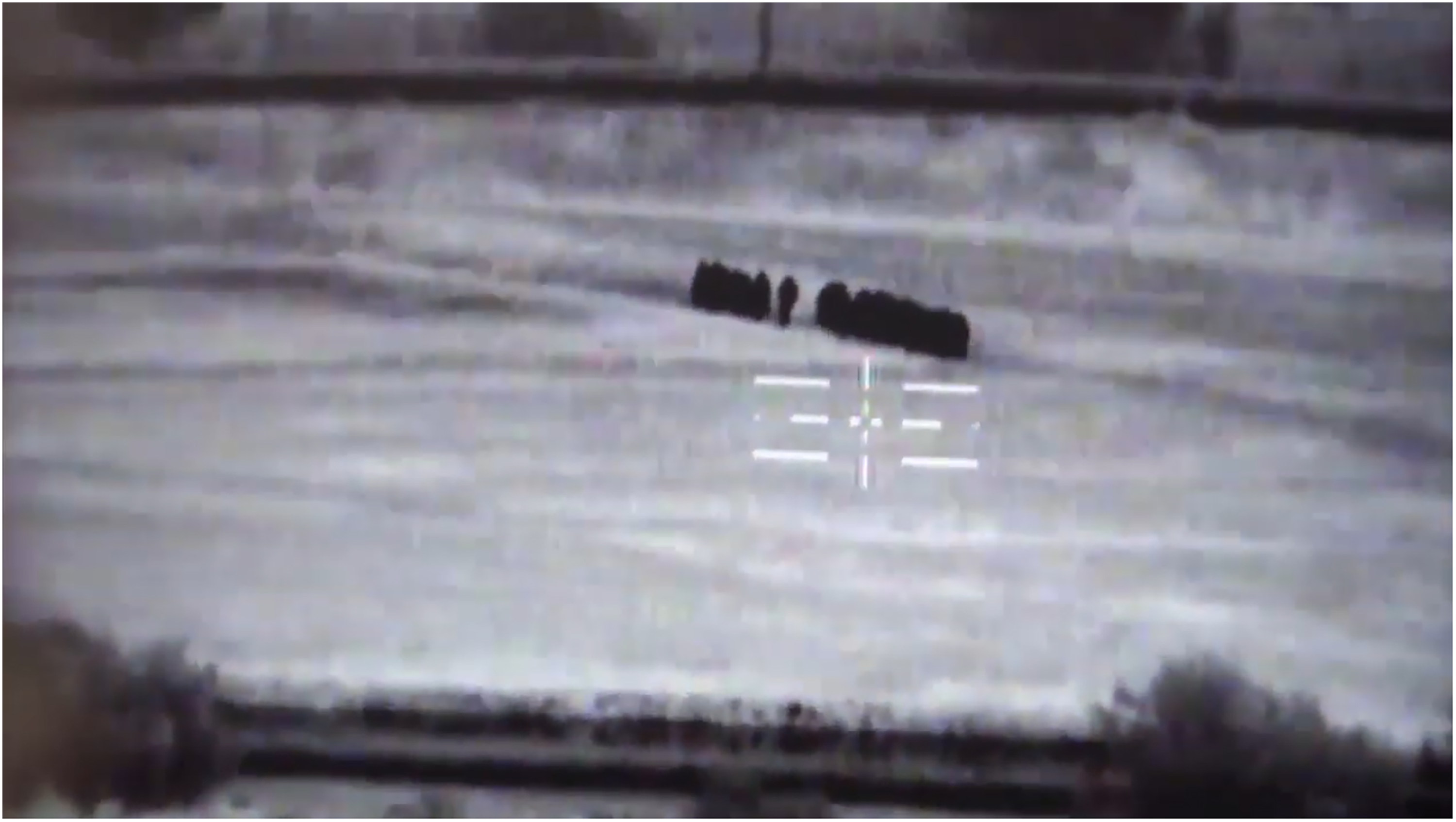
A group of refugees is shown through a night vision camera. Source: Richter (2013).
In this visual representation and in the eyes of the border guards, the border is an area to be guarded and protected against arriving illegalized migrants. The border and its apparatus are portrayed by fences, walls, handcuffs, weapons, uniforms, monitoring equipment, and drones, representing the physical dimension of the EU border (see Figure 2). Frontex becomes an antagonist of illegalized migrants: The latter attempt to cross the border, and the former restricts this movement. Both exist in negative relation to each other: Without Frontex or border police, refugees could simply come to the EU by bus or plane. Without illegalized migrants, Frontex would not have its mandate to protect the border against “illegal migration.” The practice of bordering by Frontex and its contestation by illegalized migrants is based on this antagonistic and dialectical relation.

Barbed wire at a border. Source: Nau and Tillack (2019).
The basis of Frontex's practice is the exclusion of people from EU territory based on colonial, capitalist, and racist categories. This creation of difference is inherently political, as it enacts the segregation of people along the “Global Colour Line” (Pallister-Wilkins, 2022: 21). Yet, the agency frames itself as apolitical. For instance, a Frontex employee states that his task is "to save refugees in the Mediterranean and fight any criminal activity"; however, he elaborates that political matters do not concern him (Richter, 2013: 00:24:15). For the border guard, the bordering act becomes natural. This again fits into the self-understanding of Frontex as a bureaucratic apolitical executor of power.
The documentary “Die Frontex-Recherche: Eine EU-Agentur und der Umgang mit Menschenrechtsverletzungen” centers the practice of push-backs. Those are the most apparent illustration of how the border differs between people. Often the image of criminal smugglers is at the core of the legitimization of border police practices (Jones, 2015). However, in both documentaries, smugglers only play a minor role compared to illegalized migrants.
At the beginning of both documentaries, the camera accompanies two Frontex workers that look for refugees through a night vision camera (see Figures 1 and 4). This gaze is produced through the interaction of technology and the political mandate of the border police: Refugees are pictured as black targets. Later, a border guard is displayed navigating air surveillance. He looks at displays full of technology and, with a neutral facial expression, searches for people risking their lives while migrating (see Figure 3). Again, the practice of bordering for Frontex becomes a seemingly neutral technocratic practice, veiling the inherently exclusionary essence of borders.
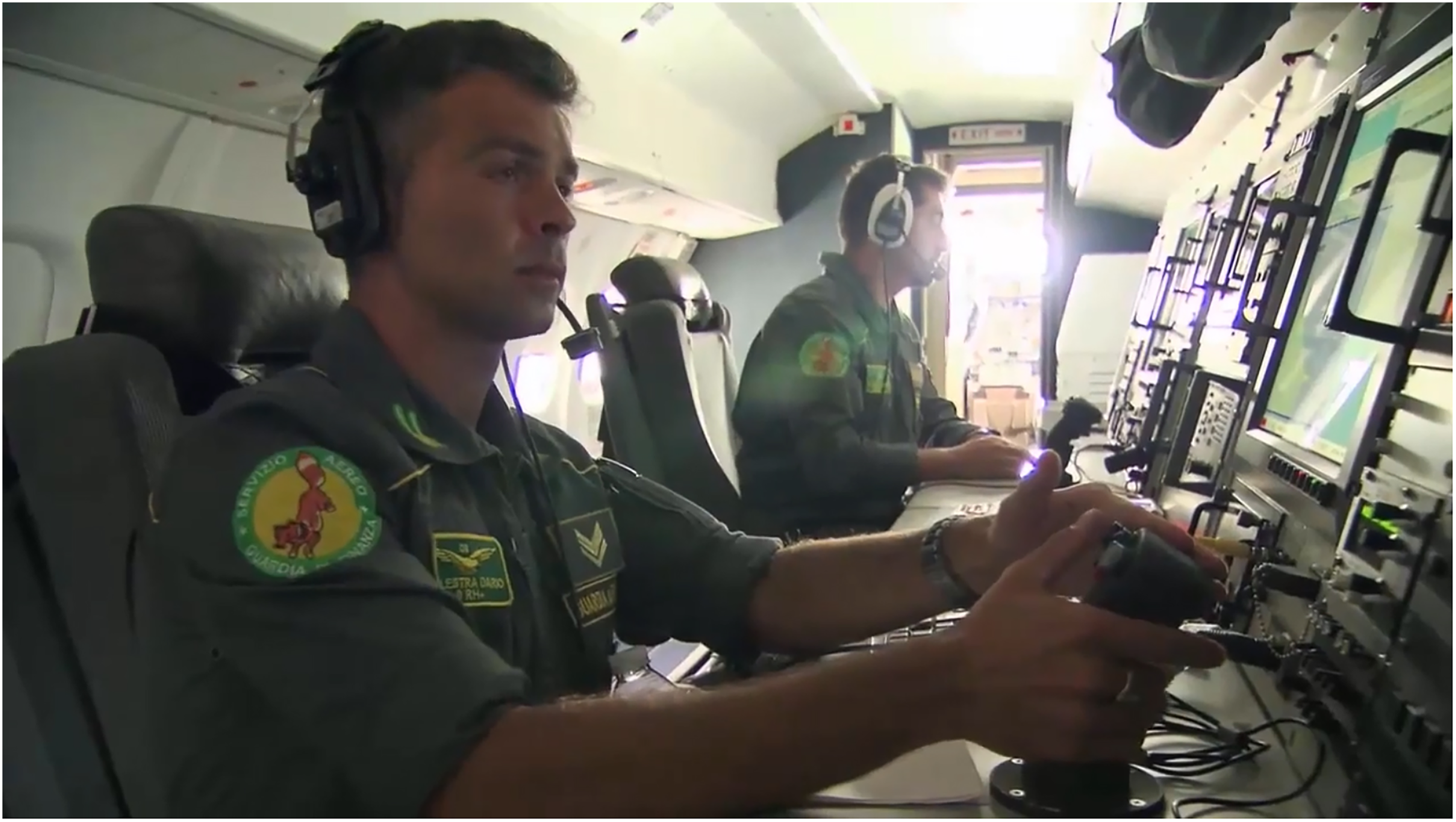
Frontex border guard navigating air surveillance. Source: Richter (2013).
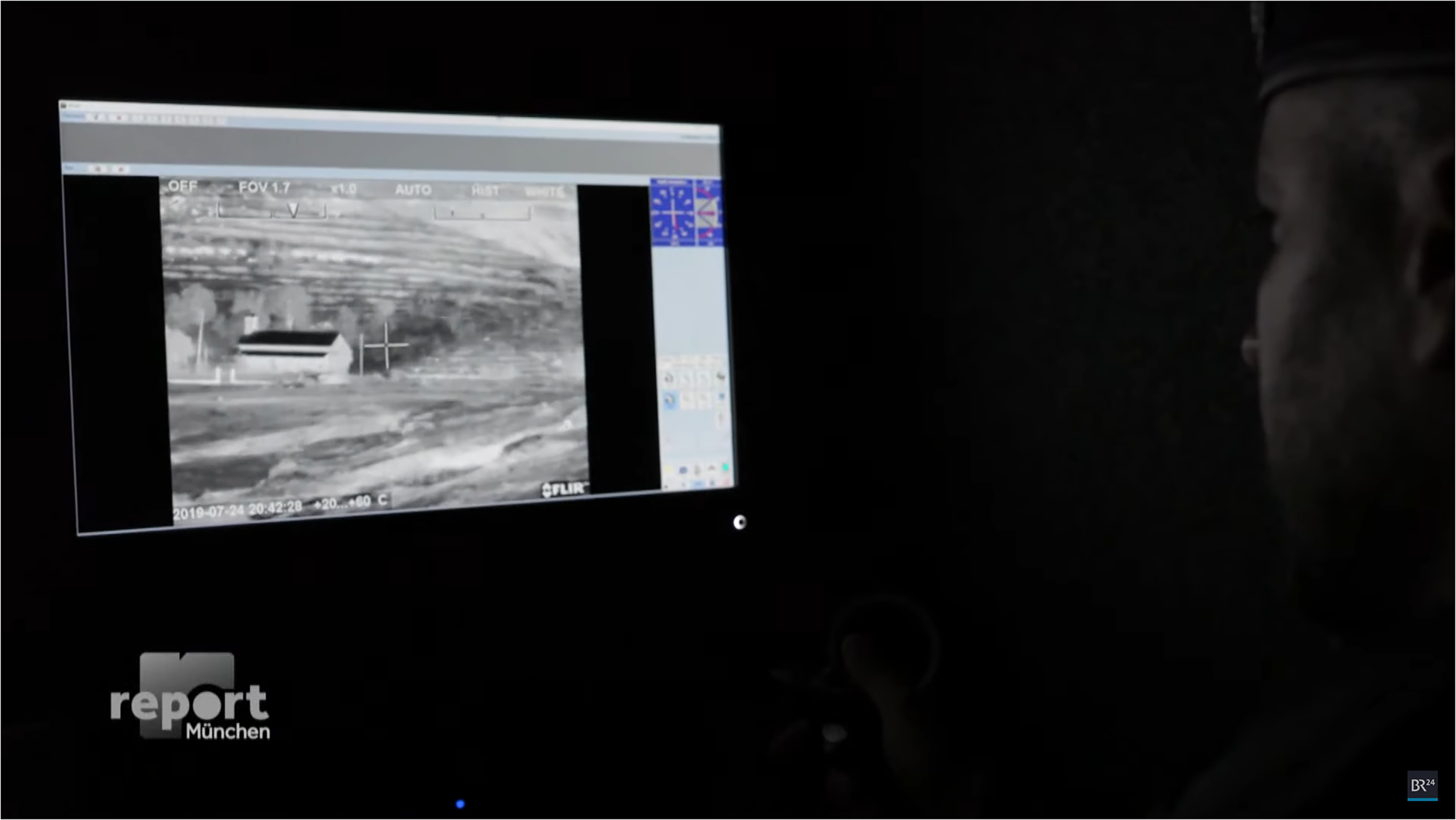
Frontex border guard surveiling the border with a night vision device. Source: Nau and Tillack (2019).
These frames resemble a military operation, unsurprisingly as much technology used by border police is developed by the military industry (Douo et al., 2021). This gaze of the documentaries through the surveillance technology on the refugee positions the viewer along with the border guard and takes their positionality, instead of an illegalized migrants’ gaze at the violent border guard (see Figure 4). The journalists producing the documentary and the viewers here take a position and are not neutral observers.
Spaces of non-being
Early in the documentary "Frontex – Einsatz gegen Flüchtlinge – Festung Europa," the viewer accompanies a human rights lawyer to a detention camp. While the lawyer can pass the guard with permission to enter, the camera must remain outside. Separated by a fence, the viewer is excluded from the inside of the camp, while its detainees are excluded from the outside world (see Figure 5).

A human rights lawyer behind a gate. Source: Richter (2013).
While the interest of this scene lies on the inside of the camp, all attempts to catch the inside scratch on the outside of the building. The camera attempts to grasp any symbol of human life, such as hands or signs. The fence and barbed wire not only hinder the people inside from reaching the outside; they also hinder the camera, the public, from seeing the inside. The material execution of power, the barbed wire, fence, and police officers prevent access or leaving the detention center and limit the possibility of speaking about the mechanisms of the border regime (Weber, 2017: 212). Yet, the people inside the camp attempt to be heard. They hold shields and hands out of the window (see Figure 6). Closed military zones, as present at the Polish–Belarusian border or around Bojna at the Bosnian–Croatian border, are larger-scale examples of how the border limits the access for journalists and people in solidarity and prevents images from within the border regime from reaching the "outside."
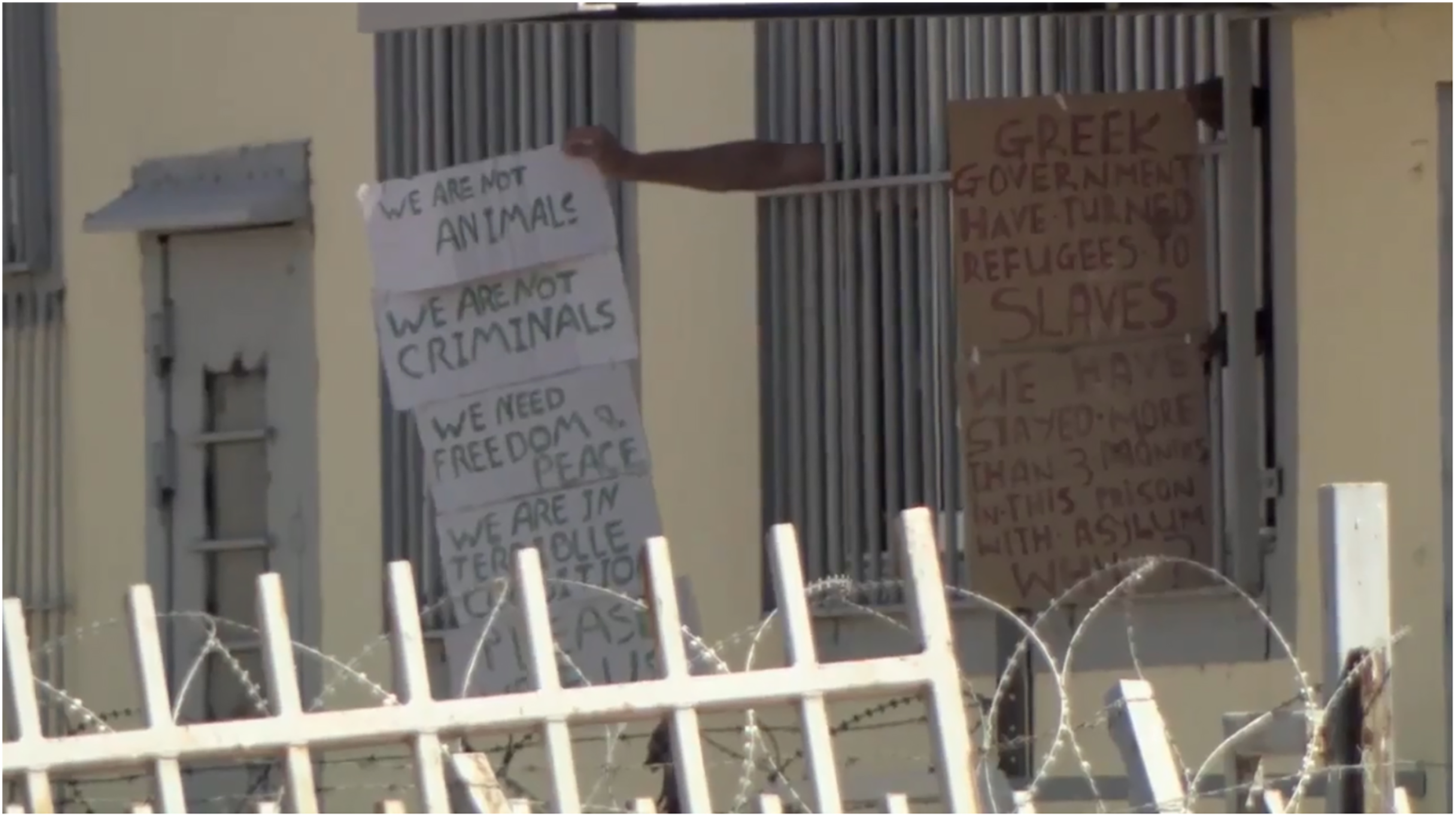
People holding posters out of a detention center. Source: Richter (2013).
Judith Butler's work on war reporting focuses on the framing of discourses. She states that the "framing of the framing" is "constituted by what is left out, maintained outside the frame within which representations appear" (Butler, 2016: 73). The detention camp, in this sense, is part of the story around the EU border, which is commonly left out. It is the place of discursive non-being where cameras hardly can access and, in the case of detention camps, the people inside cannot leave. The border's power lies in the capacity to deny the viewer the ability to access, see and represent. Through this segregation of who is able to narrate one's story and build an archive and who is not, the detention camp, and in a broader sense also the Mediterranean as a mass grave, become places of non-being. Agamben argues that camps are characterized by the state enacting power over people who are on its territory, but to whom the state denies belonging to the state. People in the camps are within a state of exception, inside the territory but outside the rule of law (Agamben, 1998). As places of non-being, the camp is not only outside of the rule of law, as Agamben pointed out, but also outside of the discursive reality of the state's public. McConnachie approaches refugee camps through their main function of containment. A defining feature of a refugee camp is the segregation of residents from the surrounding population (2016). In this sense, the function of the border—producing difference—also applies to camps.
Many illegalized migrants manage to pass the border regime and possess an archive about the functions and exclusions of the border. Yet migrants’ perspectives remain marginalized. In the documentary "Frontex – Einsatz gegen Flüchtlinge – Festung Europa" it takes 39 out of 52 min until an illegalized migrant is portrayed as an individual subject. Several individual refugees then speak about the refugee camp's bad conditions and their horrible experiences at the border. They confirm the previously cited analysis and political explanations of experts—all of them are white humanitarian and security professionals who likely have no personal flight experience. In “Die Frontex-Recherche: Eine EU-Agentur und der Umgang mit Menschenrechtsverletzungen” only 1 out of 20 min, a person who actually crossed the border as illegalized migrant speaks. Again, predominantly white professionals analyze the situation, one person even is identical in both documentaries. Public discourse, in this sense, often is a place of non-being for illegalized migrants, too.
Since the antique, the concept of non-being is discussed. Thinkers argue, whether something that does not exist, yet has certain features or a structure and whether essence of things exists, and therefore non-beings differ in their way of not-being. Thinking about non-being from Laclau's formation of meaning and identity through difference creates a paradox. Meaning emerges through difference, through what is not, therefore the non-existent makes the existent possible and again exists in a negative relation to the existent. Illegalized migrants in the example of the racist discourse in Germany fulfill the function of differing the “German self” from the non-white “other.” At the same time, illegalized migrants are silenced, marginalized, and made invisible—non-existent. Thereby, illegalized are created as an identity category, but also as a lived reality of being illegalized by the border regime and potentially pushed-back at the border or put into a detention center. The exclusion of the border regimes denies illegalized migrants the existence as political subjects with agency and self-determination, which are only obtained through illegalized migrants’ struggles. Non-being, as Grosfoguel argues, is “not a geography but a position in global power racial/ethnic hierarchies” with spatial manifestations (Grosfoguel, 2019: 265). The detention camp expresses this spatiality of exclusion and of non-being. Beyond material exclusion, leftist and rightist social theories in the zone of being both contain an imperial/colonial epistemology (Grosfoguel, 2019: 270). The autonomy of subjects in the zone of non-being thereby is not only denied materially but also in the realm of self-definition and meaning-making.
Borders in the head—difference in thinking and imagining
Both documentaries take a relatively critical position toward Frontex, highlighting the violence and human rights abuses the agency is part of. Yet both documentaries portray the border with vocabulary and framings that align with the border regime. For instance, the documentary “Die Frontex-Recherche: Eine EU-Agentur und der Umgang mit Menschenrechtsverletzungen” ends with images of an apparently calm border and the words “Everything seems to be running according to the rules here, Frontex should push for it to be like this everywhere.” After portraying how Frontex is complicit in structural physical violence, it still holds on to an idea of bordering, in which “the rules” are fulfilled. What these rules are, however, is not stated. The same documentary cites Gyde Jensen, chairwoman of the committee on human rights and humanitarian aid and member of the liberal party. She proposes to extend the power and mandate of Frontex and the EU, to safeguard human rights. Frontex, part of this inherently exclusive border regime, is proposed as a solution. Such claims only are possible on an ontological ground, in which different standards for different groups are accepted.
Frontex claims to implement a "Free Movement of people" (Neal, 2009: 344), and security. What Frontex actually does is the opposite; it stops illegalized migrants, harms live and is responsible for deaths. The possibility of claiming to enact free movement or security only works through the mere validity of these notions for the in-group, in this case, EU citizens. The securitization of borders requires prior segregation of whose security and mobility count. The proposed solutions are stuck inside the logic of the border regime, for instance when the well-known green politician Erik Marquart in “Die Frontex-Recherche: Eine EU-Agentur und der Umgang mit Menschenrechtsverletzungen” demands an allocation of 1% of the budget of Frontex for the protection of human rights (Nau and Tillack, 2019: 3:05). To uphold the border regime's legitimacy, it creates the narrative of a rule-based border or the possibility of humane borders. The legitimacy of the border is then discussed in this pre-set discursive ground.
Imaginations of social groups, security, and solidarity are built on the border's distinction between "us" and "them."
Foucault describes this underlying structure of meaning-making, “the dispositif as a structure which shapes and connects our thinking and perception of the world. The dispositif includes for instance institutions, architecture, laws, or science which results into strategies of relations of forces supporting, and supported by, types of knowledge” (Gordon and Foucault, 1980: 194–196).
The EU border, in its discursive and physical form, separates the EU's inside from the non-EU outside. This onto-epistemological power of the border turns the space outside of the border into a place of non-being, similar to the prior described mechanism of the camp.
As outlined before, the hegemonic discourse on borders and migration is dominated and structured by a gaze at the illegalized migrant, and not by self-representation of refugees. Within the dispositif of the border, the viewer takes the viewpoint of the border regime or the savior of refugees (Betscher, 2017: 120).
This framing of narrations around the border and illegalized migration is crucial because the border reproduces within this meta-level. Concerning the pictures of torture in the military prison of Abu Ghraib, Butler argues that "it is not just that the photographer and/or the viewer actively and deliberately interpret, but that the photograph itself becomes a structuring scene of interpretation" (Butler, 2016: 67). The gaze at the illegalized migrant from the perspective of the border guard or the humanitarian worker follows the direction from the north to the south, not vice versa. This pattern structures the thinking about the refugee as a subject of Western state intervention or humanitarian assistance. In a similar fashion, Ksenika Vidmas Horvat pointed out that the visual dramatization of the suffering, combined first with the images of dangerous seas and overcrowded boats, and second with the follow-up scenes focusing on the aid workers in protective clothing, paints the figure of the refugee as both a subject in need of help and a subject presenting a threat – whether to security, health or culture. (Horvat, 2020: 68)
Humanitarian NGOs, through the presentations of refugees as helpless subjects, underline Frontex's narrative of a racialized "other" in antagonism to the figure of the EU citizen (Perkowski, 2018: 12). The documentaries, mainly rely on humanitarian and security-related images and narratives reproduce those institutions’ underlying perspectives and their positionality.
Frontex and other producers of knowledge about the border
Aside from these relational processes, Frontex as an organization directly produces a distinct knowledge of the border. Through reports, PR work and indirectly through political support, they present themselves as guards against the irrupting refugees (Betscher, 2017: 121). In addition, Frontex publishes the annual "Risk analysis reports." This knowledge production about the border is remarkable, as similar national security institutions do not have a comparable branch for research (Huke et al., 2014: 179).
Frontex pictures migration as a powerful natural force. For instance, one of the Frontex employees stated that "despite danger for their live, the refugees cannot be hindered" and referred to refugees as a "permanent flow of arrivals" (Richter, 2013: 00:22:10). This flood framing is widely used and part of a collective imagination of flight, but it is also a general metaphor for threat (Benert and Beier, 2016: 11). Floods and waves are seen as natural and apolitical dangers and demand a wall for protection. Frontex produces this picture of migration as a natural phenomenon by not-speaking about the motivation for migration and by positioning itself as protection.
The documentaries need to be understood as a production of knowledge about the border. Despite a relatively critical standpoint toward Frontex, both documentaries reproduce perspectives and assumptions legitimizing the border. At the end of “Die Frontex-Recherche: Eine EU-Agentur und der Umgang mit Menschenrechtsverletzungen,” the involved journalists are portrayed. They state that their investigation made waves as now everyone talks about this topic. One journalist says “We are very happy with the results” (Nau and Tillack, 2019: 17:05). Illegalized migrants for decades testify the violence deployed at the border and politically mobilize. The imagination that this topic could be new silences people actually affected by the border regime. Calling the observation of thousands of cases of violence and death positive results indicates the positionality of the journalists as allegedly third-party observers who are not negatively affected by the border regime. The journalists’ wage labor is the production of knowledge, in this case about the border, and despite probably noble intentions, the journalists economically profit from the reporting about the border regime. Anna Tillack, the producer of “Die Frontex-Recherche: Eine EU-Agentur und der Umgang mit Menschenrechtsverletzungen” is one of the many examples of journalists’ careers built on the topic of migration. This applies as well to paid and voluntary humanitarian work, on which thousands of organizations and careers are built and who as well produce a certain knowledge about the border. Similarly, academic writing about the border, this article included, is part of knowledge production of the border, which as well reproduces certain parts of the border regime despite claims of being critical.
Discussion: The political economy of bordering and the reproduction of borders
In the analysis of the two documentaries different functions of the border in producing differences and the reproduction of the border become visible. First, the practice of bordering creates an antagonism between those protecting the border and those whose crossing is illegalized. The technologized border, for instance through night vision devices or drones is a tool for surveillance of refugees and at the same time produces a gaze at refugees as threats. Second, the practices of segregation, especially in the camp and at the border produce an exclusion of people and their perspectives and archives. As those are made inaccessible, the documentaries lack the perspective of illegalized migrants from the detention camp onto the border regime, and instead reproduce framings from the gaze of the border regime at illegalized migrants. Third, the presented logic of the border, of security and freedom of movement in both documentaries are largely built on the pre-defined segregation of citizens inside the border, and those “outside.” The documentaries again reproduce this ontological and epistemological difference. Fourth, the documentaries, in addition to Frontex, NGOs, and academia, produce distinct knowledge about the border. The positionalities of the documentaries—funded and produced by Germans for a German audience—again reproduce the hegemonic discourse and knowledge on borders and Frontex, despite an attempted critical perspective. In the following part, I will outline what I call the political economy of bordering, and illustrate how these different processes reproduce the border regime as one multi-layered and interrelated process.
Frontex does not operate in a vacuum. The agency has relations with states, the EU, research institutions, and with the security-industrial complex (Huke et al., 2014: 179). Frontex works as a link between research, politics, policing, technological development, and the sale of equipment (Andersson, 2012: 10). Between 2017 and 2019, Frontex "met with 108 companies to discuss topics such as guns and ammunition, biometrics, maritime and aerial surveillance, heartbeat detectors, and document inspection systems" (Douo et al., 2021). The private market has an interest in a higher budget for Frontex, as this means increased sales for companies. The practice of bordering is a fundamental part of this private–public relationship between the security-industrial complex and politics. At the EU level the European Commission, the European Parliament, and the Council of Ministers decide the budget for Frontex. The security-industrial complex lobbies the EU, especially through the advisory council at the EU level, whose risk scenarios are impacted by the technology vendors (Betscher, 2017: 123). While the securitization of migration is a discursive formation, it is also an object of interest of the security-industrial complex, driven by the materialist, capitalist logic: "As if by a conjuring trick, a migrant boat has become a source of risk sold on to industrial investors" (Andersson, 2012: 11).
Frontex's construction of the border as a vulnerable object produces the problem and, in line with research and lobbying, the solution (Madörin, 2019). The centrality of security technology as means to protect the border is embedded in the neoliberal capitalist claim in which a "technological fix" can solve any problem (Harvey, 2011). While “technology” de facto does not end the movement into the EU, it provides superficial solutions legitimizing itself. The underlying contradiction of the border is the creation of inequality through borders, and at the same time the movement of people across borders because of inequality. This contradiction is not solved by the “technological fix” of security industry, yet new technologies continue to claim to be the new solution and the cycle continues. As a report on the lobbying of Frontex stated, "one theme unified all of industry's positions: technology is the solution to any and every problem" (Douo et al., 2021). However, the securitization of the European border does not follow any larger historical determinism. Constructing the border as an object under threat relies on the images of a materially militarized border. Fences, barbed wire, and surveillance technology are part of the symbolic communication around the border, constructing it as an object under risk and therefore again legitimizing the increased budget on Frontex and security. Economization and securitization, therefore, work together. Border regimes are fields of action that are transformed into border spaces only through the control and oversight of border officials and patrols. The measure of these fields of action only indirectly depends on local spaces. […] [M]ediatized debates […] discursively transform or reorganize the border space under regimes of management (economization) and control (securitization) (Rheindorf and Wodak, 2018: 20).
Security is not the appropriate solution to a political crisis. This is especially true if considered that the actual subjects under threat were refugee seekers, and not the border or Europe. However, the claim that Frontex can solve the declared catastrophe at the EU border is not a misperception or accidental mistake. The question is not whether Frontex solves the crisis at the border because the border is the space of the dialectical reproduction of the crisis. Andersson recites the conversation of a Frontex employee, Antonio, in a Navy control center in Spain, where the local staff presented to him a specific technology. ‘How nice!’ I said. ‘But what is the use of this?’ ‘Oh, we show it to the visitors,’ they said! He shook his head. 'Why should we be exchanging this [information]?' Industry lobbying was to blame for this excess of technology, according to Antonio. […] 'But the industries are happy and the Commission is happy because they are subsidizing them' (Andersson, 2012: 10).
This example illustrates how the relationship between the construction of the threat and the production of technology is, to a certain extent, independent of a material threat or the need for technology. The border from a dialectical angle is not only placed in a discursive contingency. It exists in an interrelation with materialist production and reproduction, in this case, capitalism, which is as well placed in a material contingency, in this case, the actual situation of the border and the role of technology. Similarly, Madörin (2019: 704) pointed out how "the use of fake or anticipated numbers contributes to the hardening of borders along Europe," as they are still used as legitimization for increasing border monitoring. To a certain extent, the claimed threat by refugees is a narrative independent from material reality. The EU's answer to illegalized migration—militarizing the border—obviously fails to prevent the dying at the border. Many politicians repeatedly propose securitization and militarization as a solution to the dying at the border, even though the impact is often counter-productive. The increased air surveillance through drones pushed migrants to use small dinghies to remain undetected by the surveillance technology. This puts illegalized migrants into an increasingly dangerous situation and further increases the death toll. The discourse around the EU border legitimizes the security intervention, while the apparent failure of its declared goal does not seem to matter, nor is seriously questioned how military equipment developed for wars can stop the dying at borders. Much more, the disappearance of migrant boats became the basis for demanding new surveillance technology, "creating a closed circuit of technological solutions in which the security and defense industry takes on the role of both demand and supply" (Madörin, 2019: 705). The border becomes the place for capitalist reproduction, in which the security-industrial complex inventions are deployed and legitimized.
The dialectical analysis of the EU border brings discourse scholars into a "position to analyze discursive and material processes, and to examine how they are co-constitutive" instead of prioritizing one process (Hardy and Thomas, 2015: 683). The production of difference at the border is not only a discursive act but, as such, also a material practice (Flatschart, 2017: 287). Within this understanding, the “othering” of migrants becomes more than discourse. If the practice of segregation is understood as a multi-scalar process, a deconstruction of imaginations of a European self and its “other” is not possible simply through discursive interventions, but it must tackle the cycle of reproduction of the border in its totality. Importantly, the border's reproduction is not an abstract process, but especially for illegalized migrants a direct and violent intervention into their lives.
This approach to the political economy of the border positions any journalist, solidarity activist or researcher as part of the cycle of reproduction. If the border is understood as a tool for political economic organization, as Mezzadra and Neilson propose, any EU citizen is part of the border. Through the regulation of capital, commodities, and people, everyone inside the EU is affected by labor markets, the available consumer products, the pricing, etc. Journalists, humanitarians, and researchers produce knowledge within a market for spectacle and attention for migrants and borders. Approaching the border regime as interrelated reproduction dissolves the idea of a neutral position. Analyzing borders through a lens of the political economy of bordering not simply aims to critique certain media productions that reproduce hegemonic framings about the border, such as the idea that there can be a good, rules-based process of bordering. Instead, it provides a starting point for acknowledging the embeddedness of researchers in the subject of research and opens possibilities for developing political practices that do not see refugees as an object for pity but target the underlying structures producing and reproducing what borders inherently are: A tool for segregation.
Conclusion
The analysis of the two documentaries “Frontex – Einsatz gegen Flüchtlinge – Festung Europa” and “Die Frontex-Recherche: Eine EU-Agentur und der Umgang mit Menschenrechtsverletzungen” demonstrates the reproduction of the EU border. Through a combined reading of the discourse-analytical approach of Laclau and a political-economic understanding of borders by Mezzadra and Neilson, I approached borders as tools to create difference: Borders separate territories, identities, people, goods and capital and produce (i) mobilities. The external EU border is thus not only a physical obstacle but also a discourse, shaping the understanding of the border: both dimensions, physical and discursive, are inherently interrelated and reproduce themselves in the political economy of bordering. This cycle of reproduction consists of a complex web of actors, including political institutions, the private market, universities and research institutions, border agencies, and humanitarians. Within this cycle, an antagonism emerges, in which border police as defenders of the border are positioned against those attempting to cross the border illegally. This “othering” of migrants is embedded in the border's segregation of people, goods, identities, access to rights and discourses, and so on. Migrants’ experiences are silenced in this practice of segregation, as the example of the camp shows. The borders differentiation of inside and outside includes the “framing of the framing,” such as the vocabulary and logic used. The knowledge production about the border is part of the border regime, for instance through Frontex and security professionals, but also documentaries or academia. In the broader public, 2015 is often imagined as a changing experience in relation to migration. But a closer look into the cycle of reproduction of the border illustrates many continuities in the practice of the bordering.
The approach of a political economy of borders combines different strands, currently debated in migration and border theory. In this article, I started a dialog between Foucauldian notions of power and materialist viewpoints. New materialist approaches to conceptualizing discourse and matter as part of one process helped to understand the interrelated process happening at the border. For academia, such an approach could help as a framework to bring different strands of research and theory, despite differences, into a closer dialog. Contestations of the border regime, for instance through illegalized migration, are a part of borders which especially the “migration as resistance” framework promotes. In an understanding of the border as a reproductive process, resistance through migration is simultaneously subverting the border regime, while the structural reasons for migration, such as war, poverty climate change, or economic inequality, are again connected to the border as a tool for ordering global political economy. In that sense, there does not exist outside, only different insides, through which migration and borders need to be understood.
Footnotes
Acknowledgments
I would like to thank Dr Tobias Ebbrecht-Hartmann, Affiliation Department of Communication and Journalism at the Hebrew University of Jerusalem, for the advice and support—from the research conception to the publishing process.
Declaration of conflicting interests
The author declared no potential conflicts of interest with respect to the research, authorship, and/or publication of this article.
Funding
The author received no financial support for the research, authorship, and/or publication of this article.
