




Abstract
We problematise the concepts of ‘infrastructure’ and ‘sabotage’ using a decolonial lens based on insights from recent acts of political resistance in Aotearoa. 1 By tracing three case studies we ask: what is the infrastructure? Who is the saboteur? And how do temporalities inform these questions? We hold infrastructure as a contested concept in settler-colonial states that incorporates both state infrastructure which acts as the vehicle for colonial violence, and Indigenous infrastructures which have been subject to, and resist, that violence. This understanding provides the potential to read the state as a saboteur that continues to implement ways to challenge, undermine, and reduce Indigenous sovereignty, perpetuating colonial processes and world views. Using publicly available documents and media reports, we mobilise these insights using three case studies in Aotearoa that relate to debates about the place of the Treaty of Waitangi, Aotearoa's key constitutional document, in contemporary politics. We use these examples as a heuristic to trouble the boundaries of the concept of infrastructure sabotage in the context of settler-colonialism. We argue that there is value in considering how our understandings of infrastructure and sabotage enact colonial violence, and demonstrate this by examining state sabotage and resistance to it, while avoiding applying colonial terms to Indigenous movements for justice.
Introduction
In an unjust world constructed and maintained by the infrastructure of colonial capitalism, debates about whether to sabotage that infrastructure to prevent its expansion, disrupt its operation, and construct alternatives are vitally important (Aalders and Kioko, 2025; Cuyler, 2020; Malm, 2021; Tremblay, 2024). However, in our contribution to this special issue, we step back from this question and, drawing on a temporal perspective from a settler-colonial context, problematise the terms ‘infrastructure’ and ‘sabotage’ that are at the centre of this debate. While acts of infrastructure sabotage may be construed positively in some contexts by constructing or redirecting attention toward new or alternate futures that are more just, we argue that this understanding requires significant care in settler-colonial contexts. We suggest that the concepts ‘infrastructure’ and ‘sabotage’ reflect hegemonic colonial power structures, rendering colonial infrastructure as ‘normal’ relative to Indigenous infrastructure, and this risks making invisible the role of the settler-colonial state as both original and continuing saboteur of Indigenous infrastructure. We therefore explore infrastructure and sabotage as heuristic devices to challenge the boundaries of debates about infrastructure sabotage, asking three questions. First, who is the saboteur? Second, what is infrastructure? And third, how does temporality affect our understandings of infrastructure and sabotage given the historical and ongoing imposition of material and immaterial economic, legal, political, and social infrastructures of colonial violence?
We present three case studies that highlight how a settler-colonial superstructure creates an uneasy infrastructural space. We understand superstructure as ideological, cultural, political, legal, and social institutions which are built on and support an inequitable economic base (Harman, 1986). It is in this superstructural space where clashes over ownership of a nation's cultural memories and political power, as represented in infrastructure, are sources of ongoing tension and debate. We draw on Doreen Massey's (2005) notion of space as a ‘simultaneity of stories-so-far’, to draw out how these spaces are constituted and reconstituted through conflicting narratives, cultural memories, and political power. These stories extend through time and across space, are contested and always in process. In particular, we draw on Foucault's (1983: 211) theorisation of the subject and power to use resistance ‘as a chemical catalyst so as to bring to light power relations, locate their position, find out their point of application and the methods used’. Two of the case studies are therefore acts of resistance and we use these incidents to highlight how state power sabotages Indigenous sovereignty. We notes critiques of Foucault's understandings of colonisation and decolonisation as largely drawing on Western epistemologies, and his ‘fatalistic views about the omnipresence of power’ that challenge the project of decolonisation (Deveaux, 1994: 233; Mignolo, 2011; Rainsborough, 2018; Said, 1986). So, we position ourselves unsteadily in this space of trying to simultaneously use and critique Foucault's theories, adapting his tools and concepts of power that are valuable to our analysis while working within, recognising, and/or acknowledging (as appropriate) plural (including Indigenous) ontologies and epistemologies.
All three case studies revolve around the Treaty of Waitangi, an 1840 covenant between representatives of the British Crown 2 and Māori tribal leaders which is Aotearoa's founding constitutional document. As outlined below, this document consists of Māori and English texts which have different meanings. From this point on we follow Turei et al. (2024), among others, in referring to ‘te Tiriti’ as the Māori text, ‘the Treaty’ for the English text, and ‘the Treaty of Waitangi’ as both versions or unspecified. The Treaty of Waitangi, particularly the Māori text, te Tiriti, is a focus of Māori claims to sovereignty and redress for injustices (Clavé-Mercier, 2024; Walker, 1989).
The first case study is the introduction to Parliament of the Principles of the Treaty of Waitangi Bill (hereafter Treaty Principles Bill). The second is the defacement of a representation of the English Treaty text at Aotearoa's national Museum, Te Papa Tongarewa (commonly referred to as Te Papa). The third is the act of ripping up the Treaty Principles Bill and an accompanying statement at the time it was voted on in its first reading in Parliament. These case studies draw attention to past and present injustices and open a space where different future worlds might be imagined and created through Māori and Pākehā 3 resistance to settler-colonial infrastructure and the state's past and present sabotage of Māori sovereignty.
We begin by outlining our understanding of infrastructure and sabotage, situating these concepts in the settler-colonial context of Aotearoa. We consider how this context informs and enables the problematisation of infrastructure sabotage. Our positioning and methodology follows. We then analyse the three case studies, interrogating how each event constructs and undermines thinking about infrastructure sabotage. The final section outlines the implications of rethinking infrastructure sabotage.
The problematic nature of infrastructure sabotage in settler-colonial contexts
Sabotage is the disruption of infrastructure, through physical damage or acts of refusal to work, produce, or comply, preventing normal operation for a political purpose (Abbey, 1985; Barney, 2019; Cuyler, 2020; Tremblay, 2024; Veblen, 2001). 4 Infrastructure is built networks or systems which facilitate the flow of goods, services, or people, reproducing and extending systems and the communities that form around them (Barua, 2021; Berlant, 2016; Larkin, 2013; Latham and Layton, 2019; Pasternak et al., 2023). Infrastructure sabotage has a significant history in worker, anticolonial, environmental, and climate movements where it is often assumed that sabotage disrupts unjust dominant infrastructures and works towards emancipatory alternatives (Aalders and Kioko, 2025; Cuyler, 2020; Malm, 2021). We contend that this is an overly positive and narrow reading of infrastructure sabotage for three reasons. First, it emphasises the act of sabotage against the dominant system, thereby reinforcing the marginality of the saboteur, and the dominance of the system, rather than putting its dominance into question. Second, in doing so, it flattens out unjust power relations that maintain dominant systems, and fails to make visible co-existing infrastructures such as those of Indigenous peoples in settler societies. Third, it focuses on the built environment, ignoring the superstructural systems which can be read as infrastructure, such as political and epistemological systems. Reading infrastructure sabotage more widely through an exploration of the implications of a narrow reading highlights how the definition of sabotage given above could be read into the colonial tools used to dismantle Indigenous social and political systems.
We suggest instead that there is a need to think about infrastructure sabotage through a decolonial and temporal lens to critique how these terms are used to construct and maintain colonial hierarchies of power. The language that we use to analyse political events, including ‘infrastructure’ and ‘sabotage’, is entangled with the superstructure of colonisation, facilitating the domination of Indigenous peoples by a European settler majority through a ‘colonial matrix of power’ across four domains: knowledge; governance; the economy; and the idea of humanity (Clavé-Mercier and Wuth, 2023; Getachew and Mantena, 2021; Mignolo, 2021, 2023). The colonial matrix of power conceals the violence and inequity of colonisation with modernity's promises of ‘civilisation’, technology, and access to global networks (Appel et al., 2018; Mignolo, 2023; Veracini, 2010).
That ‘promise’ is often delivered through infrastructure, but it is constructed and critiqued in terms of the future (Anand et al., 2018). We instead aim to broaden this temporal lens to analyse how the colonial past informs our understanding of infrastructure. Infrastructure enacts colonisation through racialised ‘infrastructural violence’, that is, structural forms of violence which flow through material infrastructural forms, creating injustice and asserting sovereignty (Clavé-Mercier, 2024; Cowen, 2020; Dunlap, 2020; Edmonds and Johnston, 2016; Erakat, 2023; LaDuke and Cowen, 2020; Pavoni and Tulumello, 2024; Rodgers and O’Neill, 2012). Within 5 years of signing te Tiriti o Waitangi, facilitated by colonial legislation, British troops and allied forces instigated 27 years of militarised violence against Māori communities, followed by decades of systematic attempts through legislation and policy to extinguish Māori land rights and culture. These efforts included the invasion of tribal territories, land confiscation, a systematic and concerted attempt to erase Indigenous language and knowledge, and the imposition of colonial political, social, and economic systems (O’Malley, 2019; Orange, 2020). The confiscation of Māori land by successive settler governments was sometimes justified as needed for various forms of infrastructure such as military bases, civil infrastructure, farms, and housing (Boast and Hill, 2009). By 2000, Māori landholdings were reduced to approximately two percent of the land mass of Aotearoa (Manatū Taonga, 2021). Infrastructure also facilitates colonisation. The 1863 invasion of Māori communities in the Waikato by British troops and militia, for example, was preceded by the building of a road to facilitate their passage into the region and secure the flow of weapons and supplies (O'Malley, 2019). These and other acts of colonial violence are the original act of colonial state sabotage in Aotearoa.
Māori have resisted the last 185 years of infrastructural violence through active assertions of sovereignty (Clavé-Mercier, 2024). We list some examples to indicate the variety of this resistance:
1840s: Hōne Heke, a Northern rangatira (tribal leader), repeatedly chopped down a British flagstaff – a symbol of the British empire – as an expression of tribal anger about the Crown's breaches of te Tiriti o Waitangi in the region. 1878–1881: The village of Parihaka engaged in nonviolent actions to disrupt the theft of Māori land, ultimately resulting in hundreds of arrests by the Armed Constabulary (Buchanan, 2018). 1970s: Groups of Māori activists, particularly Ngā Tamatoa (young warriors), instigated a wave of radical protest (Walker, 1984). 1994: Activist Mike Smith (Ngāpuhi and Ngāti Kahu) attacked an iconic exotic pine tree which sat atop Maungakiekie (One Tree Hill) in Tāmaki Makaurau Auckland with a chainsaw to draw attention to government attempts to put a fiscal limit on compensation for historical acts of land theft (Poata-Smith, 1996). 2020: Waikato-Tainui elder Taitimu Maipi defaced and then threatened to pull down a statue of a colonial military figure after whom the city of Hamilton is named, prompting the city council to remove it from public view (Aikman and Azarmandi, 2023).
Māori have also engaged in armed resistance, land occupations, and large-scale protest marches known as hīkoi (Harris, 2004; Walker, 2004). These acts of resistance can be reactive – to acts that seek to sabotage Māori sovereignty – and/or proactive – creating Indigenous political infrastructure such as He Whakaputanga (the 1835 Declaration of Independence) and the Kingitanga (Māori king) Movement from 1858.
We consciously label these acts as ‘resistance’ despite some of them (Hōne Heke, ploughing up farmland at Parihaka, Mike Smith) possibly falling under standard definitions of sabotage, and situate the following as a heuristic device to encourage decolonial thinking and questioning in relation to infrastructure sabotage rather than a deterministic analysis that categorises particular acts. This is for two reasons. First, we avoid naming acts of Indigenous resistance to colonial violence as ‘sabotage’ because those instigating those struggles have not used that term. We make this choice in light of Paulo Freire's (2005) argument that one should not name another person's act of resistance, thereby robbing them of their choice of label. For Indigenous peoples, an act of resistance that might be termed sabotage of a process, or an object, could be an act based on an expression of Indigenous identity. To label this as sabotage is problematic, as it may impose dominant understandings even as it disrupts or redirects. We instead seek to understand Indigenous resistance as a constructive act that disrupts violent settler-colonial infrastructures and by being Indigenous presents alternatives.
Second, we suggest that identifying resistance to settler-colonial state violence as sabotage ignores the validity of resistance to the settler-colonial state and supports the state delegitmising that resistance discursively by labelling Indigenous resistance as ‘sabotage’. How sabotage is represented and named, particularly through legislation, reflects settler-colonialism, colonial violence, and the restriction of Indigenous resistance through a focus on ‘security’ (Aikman, 2019; Neocleous, 2011). The concept of sabotage functions, legally and discursively, to distinguish between ‘valid’ and ‘invalid’ forms of resistance to the state, normalising some behaviour and criminalising resistance which targets colonial infrastructures, covering up the original colonial infrastructural violence by pointing to and labelling Indigenous resistance as invalid (Crosby and Monaghan, 2018; Gobby and Everett, 2022; Neocleous, 2011). For example, Pearless (2009: 8) argues that the state's policing of Māori communities at Parihaka (1881), Maungapōhatu (1916), and Rūatoki (2007) were attempts by the settler-colonial state to ‘forestall continued occupation of tribal lands, purge Māori leadership and disavow Māori self-determination’.
We wish instead to open up space for alternative understandings of what is ‘normal’ by raising the possibility that settler-colonial violence can be read as state sabotage of Indigenous physical, economic, and social infrastructure. Similar arguments have been made by critical terrorism scholars about the need to understand state violence, such as the global ‘war on terror’, as state terrorism (Blakeley, 2012; Jackson et al., 2009). Settler-colonial states have a long history of intentional sabotage of Indigenous infrastructures, including relationships with land and water, food production, social and political systems, language, and systems of knowledge. Aotearoa's settler-colonial government, like settler governments elsewhere, was built on dispossession of Indigenous land, the installation of colonial institutions of government and large-scale migration of settler peoples (Elkins and Pedersen, 2005; Mikdashi, 2013; Terruhn, 2019; Veracini, 2010; Wolfe, 2006). By excluding the possibility of the state as saboteur, these actions are discursively minimised. This allows the state to justify the repression of Indigenous resistance to colonisation by labelling it as ‘sabotage’, while simultaneously justifying its actions by excluding them from the definition of sabotage. We therefore leverage these acts of contestation over infrastructure to problematise the concept of infrastructure sabotage and raise questions about the ways sabotage is understood by state and non-state actors.
Positionality and methodology
The co-authors reside in Aotearoa, a settler-colonial state where the direct and indirect violence of colonisation is an intergenerational reality for Māori. We bring our own ‘simultaneity of stories-so-far’ to this analysis. Kyle, Sophie, and Karen are Pākehā scholars. Joanna is a Tainui scholar with tribal affiliations to Ngāti Maniapoto and Ngāti Raukawa. We are each politically engaged in upholding Māori rights to sovereignty as guaranteed in te Tiriti. Here, we raise questions about how the key concepts of this special issue – infrastructure and sabotage – are named and defined, and how definitions informed by colonial epistemologies maintain colonial hegemonies by limiting what is considered infrastructure and who is capable of committing sabotage.
The three case studies were selected because of their centrality to key contemporary debates in Aotearoa about the Treaty of Waitangi, which are taking place in a political environment that is often taking that debate backwards. The introduction of the Treaty Principles Bill (case study one) dominated politics in Aotearoa in the latter half of 2024 and early part of 2025. Cases two and three are a direct response to this retrograde step in Treaty relations which enable us, in Foucault (1983) terms, to understand it better. Case study two at Te Papa, which we have previously written about (Matthews et al., 2024), called into question the forthcoming debate about the Treaty Principles, asking why Aotearoa is not instead working to enact te Tiriti. When the Bill was introduced to Parliament almost a year later the resulting disruption (case study three), along with a hīkoi of at least 50,000 people to Parliament a week later, demonstrates the varied and powerful forms of resistance that Māori, often with non-Māori allies, have led to resist colonisation. All three cases also enable us to ask, from a settler-colonial context, questions which challenge understandings of infrastructure and sabotage in useful ways.
We analysed the cases using public texts from mainstream media, social media, activist publications, and internal and external correspondence generated by Te Papa and posted online in response to public requests made under Aotearoa's Official Information Act 1982 (Bowen, 2009). We also incorporate our personal responses to the three case studies as we interrogate how our positionalities inform our analysis.
State sabotage: the Treaty Principles Bill
In the first example of the Treaty Principles Bill, we draw attention to the ways that the state operates as saboteur through acts of colonial violence which extinguish infrastructures of Māori sovereignty by rewriting constitutional guarantees in te Tiriti made to Māori since 1840 and recognised via the Principles of the Treaty of Waitangi since 1975. We begin with an introduction to the Treaty of Waitangi, its Māori and English texts, and the Principles of the Treaty of Waitangi. We then outline the Treaty Principles Bill which sought to amend those Principles, and offer three ways that the introduction of this Bill to Parliament can be read as an act of state sabotage of Māori sovereignty.
The Treaty of Waitangi was signed by the British Crown and over 500 rangatira (Māori tribal leaders) in 1840. It was a means by which the Crown would assert sovereignty over Aotearoa, enable settlement by Europeans at scale, dispossess Māori of land, and establish a local settler-dominated parliament and government. The Treaty of Waitangi consists of two texts – one in te reo Māori, the Māori language, referred to as te Tiriti, and one in English referred to as the Treaty. The relative status of the two texts is fundamental to constitutional and political debates in Aotearoa because of key differences between them. These differences include what Māori granted to the Crown in Article One (Māori text: all the control of British subjects in their lands; English text: all rights and powers of sovereignty) and what was guaranteed to Māori in Article Two (Māori text: ultimate power and authority over lands, villages, and treasured possessions; English text: full and undisturbed possession of their lands, forests, fisheries and other properties) (Mutu, 2010). Māori therefore argue that sovereignty was never ceded when te Tiriti was signed, but instead that the Treaty of Waitangi was, by ratifying the Crown as a political infrastructure to manage settlers and facilitate economic and other opportunities, a way to protect ancestral lands, people, and ways of life (McCreanor et al., 2024; Mutu, 2010; Ruru and Kohu-Morris, 2020; Waitangi Tribunal, 2014). This claim of Indigenous sovereignty threatens the Crown's claim to full sovereignty over all peoples in Aotearoa (Clavé-Mercier, 2024).
The United Nations (2019: 12) stresses ‘the importance of interpreting and implementing treaties in accordance with their original spirit and intent and as understood by indigenous peoples … in a way that strengthens their right to self-determination’. Additionally, almost all of the 500 rangatira who signed, signed te Tiriti rather than the English text (William Hobson, the Crown's representative, signed both versions). We therefore understand that te Tiriti carries legal authority and that Māori did not cede sovereignty when signing the Treaty of Waitangi. The Treaty of Waitangi and the subsequent history of colonisation therefore positions Māori in the position of being ‘sovereign within sovereignty’, a common position for Indigenous peoples in settler-colonial states (Clavé-Mercier, 2024; Simpson, 2014).
After 135 years of Māori activism and political lobbying to secure formal recognition of their sovereignty rights, the Government passed the Treaty of Waitangi Act 1975. This statute created the Waitangi Tribunal to address contemporary and (due to an 1985 amendment) historical breaches of the Treaty of Waitangi. However, rather than recognise te Tiriti as the guiding constitutional document in the 1975 Act, the Government chose to manage the differences between the two texts by reference to the ‘Principles of the Treaty of Waitangi’. The principles are not specified in legislation but instead left to state institutions such as the courts and the Waitangi Tribunal to interpret through a variety of statutory interpretation techniques, including understanding the intentions of both Treaty partners (the Crown and Māori) in 1840. The principles are often reduced down to three ‘Ps’ – partnership, participation, and protection – but there are many more, including sovereignty, governorship, reasonableless, the duty to be informed, active protection, mutual benefit, equity, and redress (Hille et al., 2023). These principles are now relatively well defined in case law, referred to in dozens of pieces of legislation which direct the state's various institutions to meet the obligations the principles impose, and have advanced how the Treaty of Waitangi is recognised. However, Māori and the Waitangi Tribunal have challenged the use of the principles rather than te Tiriti text, pointing out differences in meaning and that Māori never agreed to any principles when signing te Tiriti (Burns et al., 2024).
After a general election in October 2023, a right-wing coalition Government was formed between the National, ACT, and New Zealand First parties. 5 This Government has systematically sought to remove what they deem as ‘race-based’ laws, agencies, and policies by adopting an ahistorical narrative of equality and removing any programmes or initiatives that seek to address the statistics that very clearly demonstrate the long-term effects of colonisation on Māori across health, education, and justice. The Coalition contends these programmes benefit Māori over non-Māori. Three opposition parties – Labour, Greens, and Te Pāti Māori (The Māori Party) – are largely aligned in opposition to these policies.
One of the most contentious of these policies was a commitment in the National-ACT coalition agreement to ‘introduce a Treaty Principles Bill based on existing ACT policy and support it to a Select Committee as soon as practicable’ (New Zealand Government, 2023). This was despite the other two coalition partners, the National and New Zealand First parties, not supporting its passage into law. The Bill was introduced to Parliament on 14 November 2024 (see case study three below). It would not have rewritten either text of the Treaty of Waitangi, but would have put to referendum a rewritten set of Treaty Principles which would have fundamentally changed how Aotearoa implemented the Treaty of Waitangi in legislation, policy, and practice, challenging and undermining Māori sovereignty. We compare an accepted English translation of te Tiriti and the related principles proposed by the Bill above (Table 1). 6
Comparison of translation of te Tiriti and the principles of the Treaty of Waitangi bill.
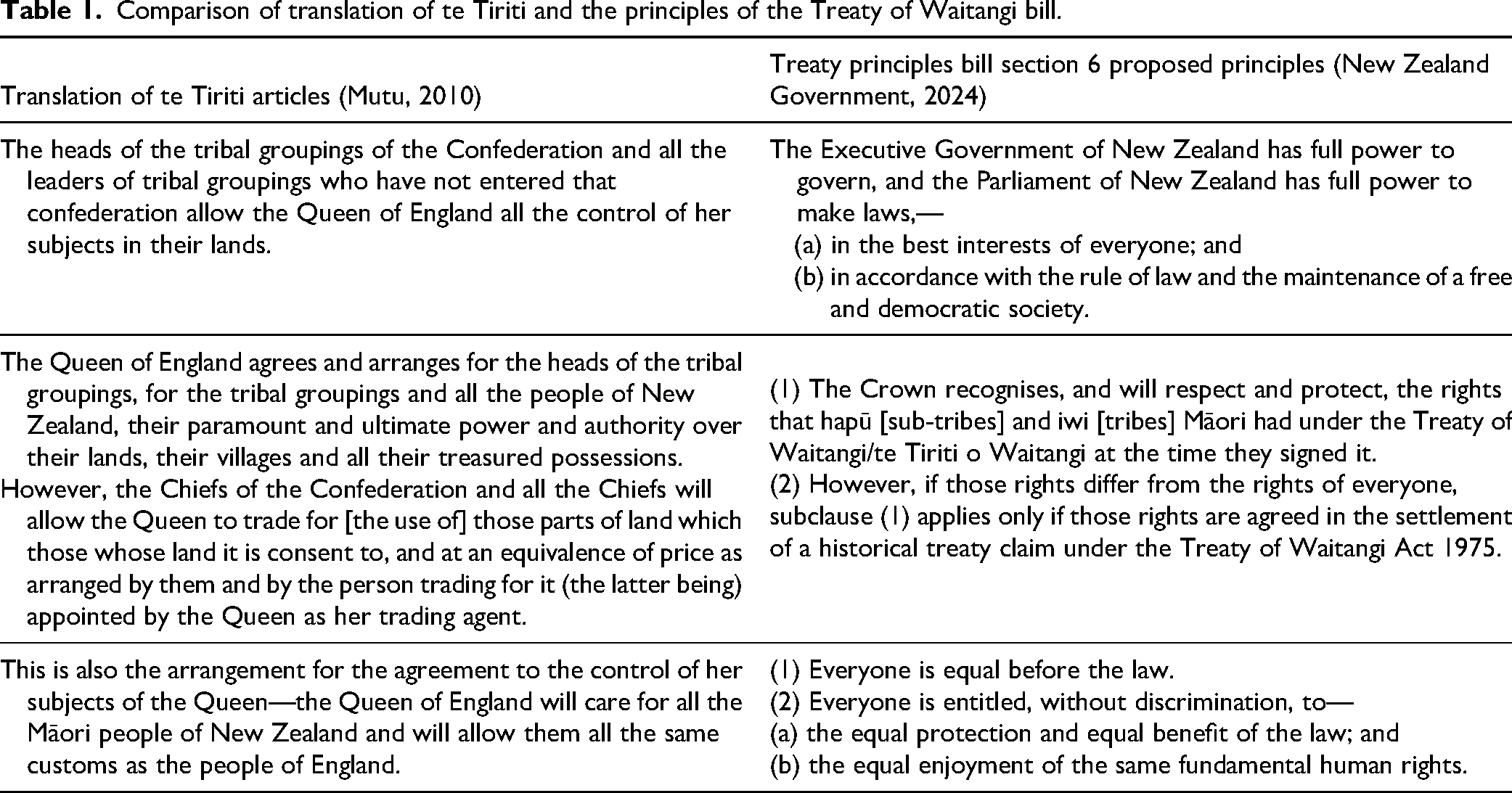
We argue that, despite there being no possibility of the Treaty Principles Bill passing into law, the introduction of the Bill was an attempted act of state sabotage of Māori sovereignty by the coalition Government. The Bill was an attempt to sabotage established social and political infrastructures built on the constitutional foundations of Aotearoa, particularly the Principles of the Treaty of Waitangi, in three ways.
First, the Bill was intended to undermine the constitutional status of the Treaty of Waitangi by rewriting the Treaty Principles based on a historically and constitutionally ill-informed understanding of the Treaty texts. This would threaten the existing and growing public understanding of those texts and how they should be implemented to enact justice. Scholars and legal experts have pointed out that the proposed principles contained within the Bill did not relate to either Treaty text, and that the arguments made by the Bill's sponsor, ACT Party leader David Seymour, were not historically or legally accurate (Hanley, 2024; Jones, 2024; Palmer, 2024; Salmond, 2024; Young, 2024). The first and second proposed principles, for example, affirmed Parliament's settler-colonial sovereignty and ignored the fact that Māori sovereignty was never ceded, limiting Māori sovereignty rights to those granted by a Treaty of Waitangi settlement.
7
The Waitangi Tribunal (2024: xvii) stated that the bill was: … “novel” in its Treaty interpretations; it is fashioned upon a disingenuous historical narrative; its policy rationales are unsustainable; and its current text distorts the language of the Treaty/Te Tiriti.
Second, the wording of the Bill showed a clear intention to subvert the sovereignty rights of Māori guaranteed by te Tiriti based on arguments that focus on ‘equality’. This matches a tendency for majorities to use the language of equality in referenda to prevent minorities holding ‘special rights’, particularly in settler-colonial states where Indigenous peoples are numerically less (Eisenberg, 2004; Gamble, 1997). Arguments of equality are visible in the Bill's text, particularly the proposed third principle. This simplistic understanding of equality was justified by the Bill's sponsor with claims that previous governments assigned rights on the basis of racial ancestry. The ACT Party's website promoting the Bill claimed that the Principles of the Treaty have been used to justify offering different access to taxpayer-funded services, guaranteed positions on government boards, and the creation of a separate healthcare authority, all based on people's ancestry (ACT Party, 2024). These arguments ignore the ways that previous governments have approached the challenges of Māori over-representation in negative statistics across multiple sectors with affirmative action.
Third, by introducing the Bill, the Government encouraged debates that portrayed a systemically disadvantaged community as unfairly advantaged, and amplified harmful narratives against Māori, including white supremacist discourses that Māori are ‘privileged’ and Aotearoa is likely to face a ‘civil war’ or ‘great replacement’ (Hattotuwa, 2024a, 2024b, 2024c). Joanna's submission spoke to the impact of these narratives: The introduction of the Treaty Principles Bill has already caused enormous mamae (hurt) and division in our communities. It should never have been introduced to Parliament and now needs to be emphatically rejected by it.
'Sabotage’ of infrastructures of cultural memory at Te Papa
In the second example, we further problematise the nature of infrastructure and sabotage in the context of Māori-led resistance to colonisation and cultural forgetting, this time focused on activism at Te Papa, Aotearoa's national museum.
Te Papa sits in an uneasy space in relation to Aotearoa's colonial past. Infrastructures of cultural memory like Te Papa function temporally to ‘settle and habituate routines of social order’ (Barua, 2021: 1468) by promoting settled and harmonious futures while ‘culturally forgetting’ (Kidman, 2017) difficult knowledge of the past, such as state violence against Māori, which challenge those futures (Anand et al., 2018; Dawney, 2021; Laurajane, 2006; Mills, 2007; von Schnitzler, 2016). Te Papa contributes to colonial hegemonies that define and celebrate an ‘imagined community’ of apparently ‘settled’ power relations between Indigenous and settler populations (Anderson, 2020; Bell, 2006; Macdonald, 2009).
But, as Macdonald (2009: 31) observes, ‘the creation of national memory takes place in the contested present’. Infrastructures that ‘settle’ cultural memory not only promises imagined futures but also, because narratives of progress cannot be separated from the ‘other’ of those narratives, reminds us of futures that have been lost (Berlant, 2016; Dawney, 2021). Actors can therefore use infrastructures of cultural memory and political power to bring to the fore difficult knowledge from the past that challenges infrastructures and the hegemonic representations of history that they promote (Edkins, 2003; Lai, 2020). This includes acts of Indigenous resistance which damage or transform cultural icons that uphold or exemplify colonial mythologies of European discovery, pioneering tales, or the assumed right to govern Indigenous populations. Museum exhibits, artworks, colonial era statues of military leaders and politicians, national commemorations, and political events provide a focus for protest (Ballantyne, 2021; Harris, 2004). These acts disrupt colonial hegemonies by raising awareness of how the simultaneity of competing histories, stories, and memories in settler-colonial states reflect unequal power relations at work in superstructural arrangements. They therefore challenge what is often understood as ‘infrastructure’ and ‘sabotage’.
In the late twentieth century, Te Papa shifted slightly away from these colonial roles to reflect a new understanding of museums which focused on telling stories of national identities that visitors could participate in (Williams, 2015). However, we still identify Te Papa as part of this colonial infrastructure of cultural memory because it remains a state institution whose work constructing a national identity often ‘papers over’ a long history of colonial violence in Aotearoa, thereby granting legitimacy to ongoing state sovereignty and cultural forgetting. For example, the legislation which established Te Papa identifies two of its roles as acting as a ‘statement of New Zealand's identity’ and to ‘ensure that the Museum is a source of pride for all New Zealanders’ (Museum of New Zealand Te Papa Tongarewa Act 1992: s 8). We suggest that constructing national identity in ways which New Zealanders can be proud of involves ‘culturally forgetting’ (Kidman, 2017) colonial violence and promoting settled and harmonious futures. Therefore, Te Papa assists the state in constructing a settled national identity by affirming which memories are valid and widely endorsed, and which are minimised or erased because they present the history of colonial violence and its connection to contemporary society and privilege (Azarmandi, 2016; Bell, 2006; Kidman, 2017; MacDonald et al., 2022; Tsai, 2016).
The Signs of a Nation exhibition, we suggest, was central to cultural forgetting at Te Papa. ‘Signs’ sits in a large space between ‘Indigenous’ and ‘settler’ wings, creating a message of the coming together of two peoples through the ‘sacred’ object of the Treaty of Waitangi (Kidman, 2017). The exhibition was dominated by two large wooden re-creations of te Tiriti and the Treaty texts which sit opposite each other. In between, is a reproduction of the signed Treaty text from Waitangi and various smaller informational panels and historical artefacts which provide further context to Crown and Māori understandings of and motivations for signing the Treaty of Waitangi. The history of colonial violence in Aotearoa is strangely absent in Signs. Originally there was a further set of panels which outlined Aotearoa's colonial history but these were removed in a redesign (Bell, 2006). There was also no translation of the text of te Tiriti into English.
This omission was the basis for a key critique made by Te Waka Hourua
8
(TWH) of Signs in 2021. TWH is a Māori-led activist group which campaigns for just decolonial and climate futures. TWH argued that the exhibition presented the two versions of the Treaty of Waitangi as equivalent to each other, giving the impression that they were direct translations of each other. TWH argued that, through the Signs exhibition, Te Papa was reinforcing as truth particular settler-colonial understandings of the Treaty which had enabled 180 years of colonisation in Aotearoa (Te Waka Hourua, 2024). A TWH spokesperson argued: … the majority of visitors will not understand the Māori version, and will look at the English version. They will leave thinking the English version is accurately reflecting what the Māori version says … We're trying to bring attention to the fact our national museum is misrepresenting history. (Fuller et al., 2021)
TWH's initial actions in relation to Signs involved official information requests, a petition, lobbying Te Papa staff, and a peaceful protest at the exhibition. These received a limited response from Te Papa with no promise of updating the exhibition. In November 2023, the Government's announcement of a future Treaty Principles Bill raised the significance of TWH's campaign. TWH argued that ‘the new Government is calling into question basic truths and undoing generations of hard-earned recognition of Te Tiriti and the clawing back of Māori rights by Māori’ (Te Waka Hourua, 2024: 26).
The group decided on further action to ‘redact’ or ‘enhance’ the English text in the exhibition. On 11 December 2023, a group of Māori and Pākehā activists entered the museum. One abseiled down from the top of the English text panels, covering most of the words with spray paint while others used power tools to attack the text at the bottom. Others engaged with the public and the police when they arrived. By the time the activists were arrested almost all of the panel was blacked out, leaving a series of short phrases, including ‘ration the Queen's vegetables’, a critique of the impacts of colonisation and climate change on the ability of Māori to grow food (see Figure 1). Twelve protesters were arrested, two of whom have been charged by police.
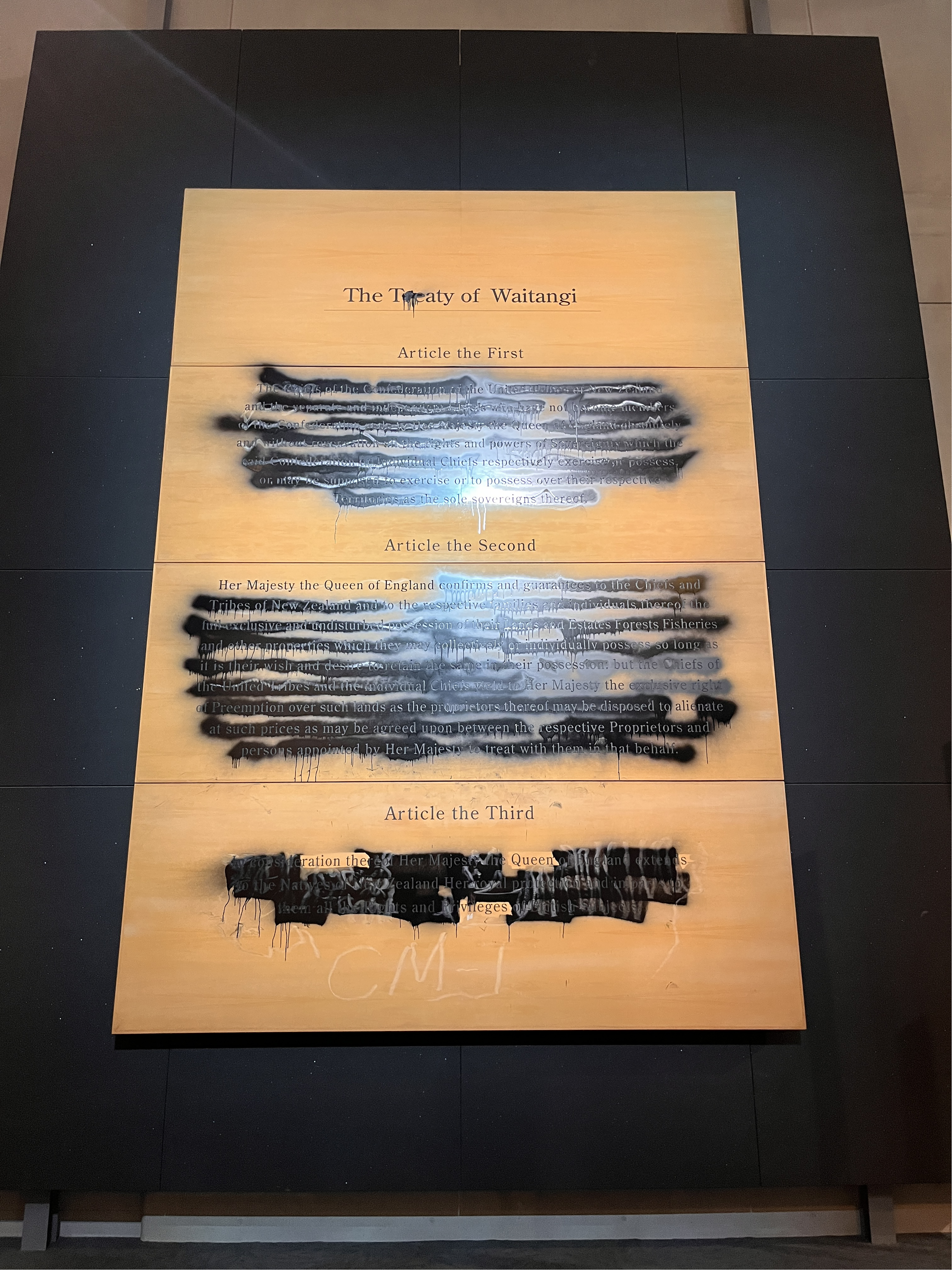
Photograph of the defaced English text (Kyle R. Matthews).
Three of us (Karen, Kyle, Joanna) visited the defaced exhibition a month later. Karen recalled her reaction: I had seen images of the English version of the Treaty blacked out by Te Waka Hourua but it was quite different to sit with Joanna and Kyle at Te Papa and look at it alongside Te Tiriti. The full import of what Te Waka Hourua had achieved was palpable around us. The large-scale display of the te reo text of Te Tiriti alongside the English version, as though they were somehow equivalent, was no more. Instead, a sense of awe at Te Waka Hourua's bold actions and the change that might now be possible, lifted my spirits.
The action at Te Papa explicitly highlighted the hypocrisy of the current Government. This was best captured by a Rod Emmerson cartoon which appeared in Aotearoa's largest paper, The New Zealand Herald, 2 days later. This cartoon contrasts TWH's ‘illegal’ act of vandalism of a symbolic representation of the Treaty with the ‘legal’ vandalism being conducted by the Government in how the Treaty is to be implemented across Aotearoa (Figure 2). 9
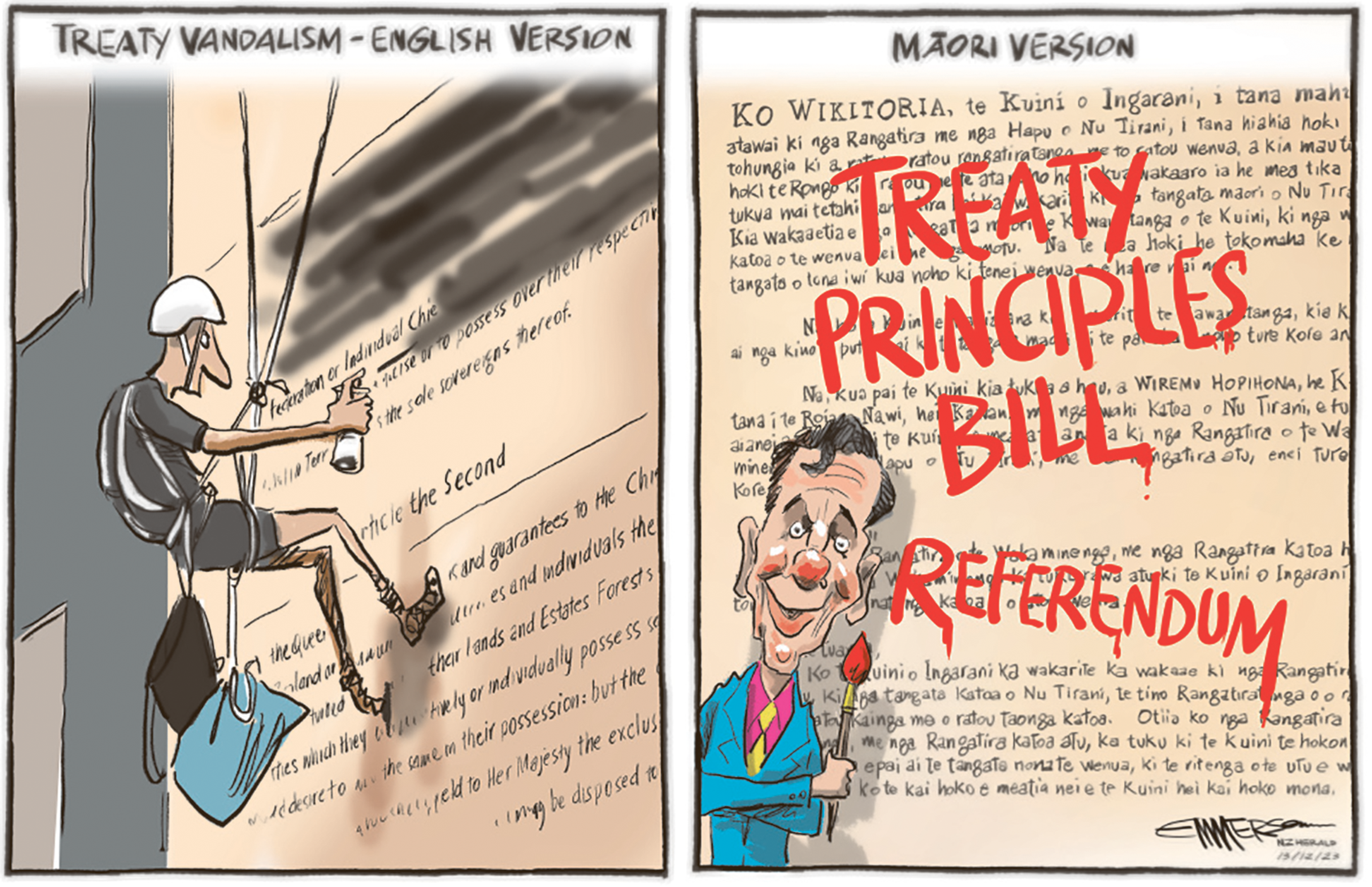
Rod Emmerson Cartoon, The New Zealand Herald, 13 December 2023.
TWH's act of resistance led Te Papa to rethink Signs of a Nation, with the damage causing a ‘surge’ of interest in the exhibition and the percentage of surveyed visitors identifying it as a highlight jumping from 18 to 43 percent in the first month (RNZ, 2024). Te Papa Chief Executive Courtney Johnston and Māori Co-leader Dr Arapata Hakiwai said that Te Papa had ‘heard the message of this protest action, and we have heard the many and varied responses to it’, including the discussions that the defaced panel provoked among visitors (Campbell, 2023; RNZ, 2024). The redacted panel was initially left in place with a sign below explaining its status while discussions were held with interested parties, including TWH and other Māori representatives. Five months after the protest, the redacted panel was replaced with a large digital screen which cycled through the English text, Sir Hugh Kawharu's (1989) translation of the Māori text into English, and the differences between the two texts. The new digital presentation highlights how rangatira had signed the Māori text and did not cede sovereignty, and finishes with the words ‘Aotearoa New Zealand is a treaty nation. It was founded on a promise of partnership that we all have a responsibility to honour’. This update to the exhibition is temporary, but signals a possible direction that Te Papa will take with the final redesign.
We resist calling TWH's redactive action ‘sabotage’, instead suggesting that their resistance highlights how Te Papa's representation of the Treaty of Waitangi texts at Signs as equal supports and perpetuates the state's original sabotage of Māori sovereignty via colonial violence. The two significant omissions in the exhibit – a representation of Aotearoa's violent past and depicting the differences between the two Treaty of Waitangi texts – means that Te Papa replaces colonial violence and ‘illegitimate usurpation of power with a feelgood rhetoric of Treaty-based good faith and Crown honour’ that maintains settler supremacy (Jackson, 2019). TWH's actions at Te Papa highlight how colonial infrastructure like museums enacts and perpetuates infrastructural violence that maintains state sovereignty over Indigenous sovereignty. But through the resistive act of redaction the flows of cultural memory were not prevented but instead rerouted and reorganised temporally, shifting the discussion from the one that Te Papa had orchestrated for 25 years, to one initiated by TWH which reached back 183 years to challenge how the Museum was representing the relative legal status of the two Treaty of Waitangi texts. Te Papa is now more engaged with the difficult knowledge of the Treaty of Waitangi texts, though it has a long way to go in terms of representing Aotearoa's history of colonial violence and the role of the state as saboteur of Māori sovereignty. The action reprioritised which stories are dominant in the settler-colonial context, leading to responses such as Emmerson's cartoon which highlights a shift in thinking about who can be the saboteur from the activist to the state.
'Sabotage’ of infastructures of political power at parliament
Our discussion so far supports the argument that, in allowing the Treaty Principles Bill to be presented to Parliament, the Government engaged in sabotage against the historical and contemporary understandings of the Treaty of Waitangi, and therefore against Māori sovereignty. In this third example, we examine resistance to this state sabotage as the Bill went through its first reading in Parliament.
Both Parliament and the Government are key parts of the infrastructure of settler-colonialism in Aotearoa. They have been sovereign since 1852, at which point the United Kingdom delegated its powers over the territory to the colonial government, allowing it to hold elections and pass legislation. Aotearoa's constitutional arrangements place few limits on Parliament's power, with a unicameral single-house system and an unwritten constitution. The Crown is represented by a local Governor-General who is largely a figurehead (Ruru and Kohu-Morris, 2020). Parliament authorised the invasion of Māori territories, land theft, and the punishment and incarceration of Māori ‘rebels’ (O'Malley, 2019; Orange, 2020).
For Māori, Parliament's power is complicated. It is both a major source of colonial violence, but also a site of redress, as it is the key institution representing the Crown as the Treaty of Waitangi partner, and passes the legislation that finalises settlements which compensate Māori for historical breaches of the Treaty of Waitangi (via the return of land, financial redress, and apologies by state representatives). It is also the place where Members of Parliament (MPs), including seven MPs from Māori electorates, 10 speak for their people inside the highest colonial institution in the land. But not all Māori feel represented by Parliament, or Te Pāti Māori (The Māori Party, an Indigenous-led political party with six MPs). It is therefore a complicated place of colonial power where sometimes colonial redress is afforded.
Hana-Rawhiti Maipi-Clarke, Te Pāti Māori MP, is part of a wave of young bilingual Māori engaged in politics. As votes were called for during the first reading of the Treaty Principles Bill on 14 November 2024, she registered her party's six votes against in te reo Māori. Then, rather than sitting down in her seat, she chanted ‘Kawana! Ka whakamanuwhiritia koe e au’ (Government! You are my guest!), ripping her copy of the bill in half and throwing it to the floor before beginning the haka ‘Ka Mate’ directly in front of the ACT Party MPs who had introduced the Bill. 11 Several other MPs from opposition parties joined her, either on the floor of Parliament or from their seats, as well as many in the public gallery. Within a week their actions had been viewed hundreds of millions of times across a range of social media platforms and picked up by international media (Manhire, 2024). Maipi-Clarke was suspended (including loss of pay) for a day, and four Māori MPs including Maipi-Clarke were referred to Parliament's Privileges Committee for breaching Parliament's rules (Campbell, 2024). By June 2025 Parliament, in response to Privileges Committee hearings, had suspended Maipi-Clarke for a week, two of her Te Pāti Māori colleagues for 3 weeks, and instructed a Labour MP to apologise (RNZ Gallery, 2025). In this case study, we focus on Maipi-Clarke's statement and act of ripping her copy of the Bill.
Maipi-Clarke explained her actions as upholding the Crown's commitment to te Tiriti: If there's anything in this Parliament … that's non negotiable, it's te Tiriti o Waitangi. So, that's why I said no, it's not even worth it. Rip it up. (Maipi-Clarke in Campbell, 2024)
We were inspired by her powerful act of resistance to the Government's efforts to sabotage accepted practice around the Principles of the Treaty of Waitangi: On the day that it happened I watched it three times on the train home. By the end of that night I had watched it at least a dozen times. In the months since dozens more. It feels like a defining political act to claim that space, in defiance of the rules imposed on you, in a way that's so associated with the complicated nature of identity in Aotearoa. (Kyle) I find it hard to articulate how I felt, it was a kind of emotional embodied response, a strong sense of hope after so much anger. It was powerful and beautiful. For me it wasn’t a challenge or act of defiance against the rules of the house, or even the Bill, but a demand to remember that the House and Parliament and the right to make law exists by virtue of te Tiriti and that Pākehā are manuhiri (guests) here. (Sophie)
Like the action at Te Papa, above, this act of defiance in Parliament highlights how colonial infrastructures enact and perpetuate violence, but also how the stories that hold this violence in place are always open to being reminagined, reconfigured, and replaced by stories that have been marginalised, suppressed, and rendered invisible. Parliament was both the vehicle for a Bill which would undermine Māori sovereignty, and the place where Māori and their supporters – both inside and outside – defied colonial violence and proposed alternatives. Although the Government, and the ACT Party in particular, continue to attempt to redefine how the Treaty of Waitangi is implemented in Aotearoa through a range of policies and amendments to legislation that are ongoing, the actions of Maipi-Clarke and her supporters present in Parliament that day sent a clear signal that Māori continue to oppose further acts of sabotage of Māori sovereignty (Clavé-Mercier, 2024).
Conclusion
By exploring infrastructure and sabotage as heuristics we have problematised the question of what is infrastructure and who is the saboteur in the context of a settler-colonial state. We suggest that infrastructures are the channels through which power relations flow within the superstructure, supporting culturally, socially, politically and economically embedded understandings of what is normal, such as historical and contemporary colonialism. By raising the question of who engages in sabotage, and taking seriously the spatial and temporal context in which that sabotage occurs, we aim to avoid reproducing hegemonic colonial power structures which label Indigenous resistance as ‘sabotage’, rendering the thing that is sabotaged normal and the saboteur an ‘outsider’. In this context, if acts of resistance to colonial violence are normalised the injustices and wrongs that they seek to counter are rendered more visible.
We argue that the original act of sabotage is a series of historical breaches of te Tiriti o Waitangi by successive governments. The ongoing affirmation of the state's legitimacy and sovereignty over that of Māori and the construction of a universal national identity of harmonious unity perpetuates systemic cultural violence via institutions such as Parliament and Te Papa. The attempt to enact the Treaty Principles Bill by the minority ACT party, enabled by the Prime Minister, is only a recent example of how governments can act as saboteur in settler-colonial contexts. The Bill intentionally sought to undermine the established Treaty Principles and their partial recognition of Māori sovereignty. The actions of TWH at Te Papa and Maipi-Clarke and colleagues in Parliament contested those infrastructures of colonial memory and political power, affirming that te Tiriti is the key constitutional document, and that the Crown still has obligations from 1840 to fulfil.
We draw three conclusions. First, we join others in suggesting that there is value in challenging understandings of infrastructure to consider how it enacts colonial violence (Cowen, 2020; Dunlap, 2020; Edmonds and Johnston, 2016; Erakat, 2023; LaDuke and Cowen, 2020; Rodgers and O’Neill, 2012). This requires a critical examination of what constitutes infrastructure, keeps it in place, its effects, and how context matters. These questions are spatial and temporal, interrogating past, present, and future, and require thinking relationally and contextually about what constitutes the spaces in which actions – sabotage or resistance – occur. As Indigenous peoples and their allies challenge and transform infrastructures, these understandings open up ways of thinking about how resistance, such as that undertaken at Te Papa and Parliament, forces transformation of infrastructures of cultural memory and political power into forms which – in part at least – present alternative understandings of Aotearoa's colonial past, present, and future.
Second, we open up questions about the nature and purpose of ‘sabotage’ in settler-colonial contexts by looking closely at the possibility that the state or government can be saboteurs. We suggest such actions are often made visible by resistance to them. Resistance to actions that undermine Māori sovereignty, such as undertaken by TWH and Maipi-Clarke, focuses our attention on the settler-colonial state as saboteur. TWH opposed colonial state sabotage that sought to define the Treaty of Waitangi in terms of the English text by critiquing how Te Papa represented the two texts as equal. Maipi-Clarke challenged state attempts to sabotage Māori sovereignty rights as the Treaty Principles Bill was presented. One of the ways that the settler-colonial state maintains itself is by defining, in legal and discursive terms, ‘inappropriate’ forms of resistance as sabotage, thereby criminalising them (Getachew and Mantena, 2021). By refusing to label acts of Indigenous-led resistance at Te Papa and Parliament as sabotage, we not only raise questions about who the saboteur is, but also try to avoid applying colonial terms to Indigenous movements for justice, recognising their rights to define and name the terms of protest and engagement (Freire, 2005). If defining and naming is part of colonial violence then we must resist complying with those processes. This does not negate sabotage as part of an Indigenous repertoire of resistance against the settler-colonial state, but instead recognises Māori resistance on its own terms.
Third, we test how a temporal lens affects our understandings of infrastructure and sabotage given the imposition of infrastructures of colonial violence which have and continue to sabotage Indigenous sovereignty. In this we are inspired by the actions and statements of TWH and Maipi-Clarke who highlighted how contemporary political debates about the relative status of the two Treaty texts and the Treaty Principles Bill continue a history of state sabotage of Māori sovereignty rights in Aotearoa. A temporal lens helps us view resistance as ongoing attempts to defend Māori sovereignty rights from state colonial violence that attempts to sabotage that sovereignty.
As scholars who struggle with and sit inside settler-colonialism in Aotearoa, we hope that our perspective on infrastructure sabotage offers value. Too often we see academic disciplines write about struggles for justice without engaging in questions of colonisation and decolonisation. Our examples and analysis from Aotearoa are but one perspective on colonisation, and others, particularly across a range of settler-colonial states, will differ. Our engagement with questions of infrastructure and sabotage as heuristics opens a door to further discussions about the problematic nature of infrastructure and sabotage in colonial contexts, and how Indigenous resistance highlights entanglements between colonial infrastructures and colonial violence.
Footnotes
Acknowledgements
The authors thank three anonymous reviewers, the editors of this special issue, and participants at the POLLEN 2024 conference in Lund, Sweden.

Ethical considerations
The author(s) declared that ethical approval was not necessary for this study.
Consent for publication
Figure 2 (Emmerson cartoon) provided by the artist with consent to publish.
Funding
The authors received no financial support for the research, authorship, and/or publication of this article.
Declaration of conflicting interests
The authors declared no potential conflicts of interest with respect to the research, authorship, and/or publication of this article.
Data availability
Data is not available.