




Abstract
Head nodding and shaking are bodily signals of approval and disapproval, respectively. Previous research has shown that these movements can be used to shape attitudes by means of evaluative conditioning. In the present experiment, the authors studied the conditions under which evaluative conditioning with head movements can alter social attitudes. Specifically, the authors investigated whether the evaluative conditioning effect depends on the order in which the target stimulus and the head movement are presented. The results showed that repeated coupling of head nodding with out-group names reduced negative implicit associations with this out-group only when the head nodding movement followed the target name. No effects were found when the movement preceded the name in the conditioning procedure. The authors conclude that embodied evaluative conditioning effects are constrained to a sequence of the target stimulus and head movement that corresponds to the natural temporal script in which the stimulus precedes the evaluative embodied reaction.
Head nodding and shaking are strong communicative signals that people use to convey their thoughts and feelings. Not only do we nod or shake our heads in response to a question that requires a simple “yes” or “no.” After hearing something to our approval or agreement, we may also—inadvertently—nod our head, or we may shake in disagreement when we disapprove of a person or message. 1 These examples show that head nodding and shaking are often used as responses signaling how we feel or think about something. Interestingly, growing empirical evidence suggests that it may also work the other way around. That is, our bodily movements influence what we think and feel (see for an overview, Niedenthal, Barsalou, Winkielman, Krauth-Gruber, & Ric, 2005). To illustrate, we may like a person or message better, because we nod our heads.
Indeed, in earlier studies it was found that when people made a head nodding movement while listening to a persuasive message, they agreed more with the message as compared to when they had shaken their heads (Wells & Petty, 1980). More generally, it has been shown that head nodding can enhance preferences for neutral objects that are presented while nodding the head (Tom, Pettersen, Lau, Burton, & Cook, 1991). In sum, the co-occurrence of head nodding with a neutral or novel stimulus can result in a spillover of the positivity of head nodding to the stimulus, whereas the co-occurrence of stimuli with head shaking can result in more negative evaluations. These findings are in line with evaluative conditioning effects, in which the valence of a stimulus can change as a result of repeated pairing with another positive or negative stimulus (De Houwer, Thomas, & Baeyens, 2001).
Thus, it seems that head nodding or shaking movements can color our evaluations through an embodied form of evaluative conditioning. However, how does the embodied evaluative conditioning of attitudes work? One possibility is that the valence of the bodily movement spills over to stimuli that are presented in close temporal and spatial proximity to the movement. As demonstrated in a recent review, the order of the pairing does not play a significant role in evaluative conditioning effects (Hofmann, De Houwer, Perugini, Baeyens, & Crombez, 2010). From this perspective, the association of head nodding with positivity and head shaking with negativity could change the valence of stimuli shown simultaneously with or directly before or after the movement.
However, people have learned to use head nodding and shaking movements in a script-like fashion. 2 The natural sequence of head movements is to follow rather than to precede a stimulus encounter. For example, when listening to a presentation, we nod our heads after hearing something to our liking, and not before. Therefore, order information seems particularly relevant for the embodied experience underlying the evaluative meaning of head movements. The natural sequence of these movements following a target should be encoded during the original experience (online), and may then be reenacted (offline) when encountering a similar situation (see Barsalou, 2008). Reasoning from this perspective, it may be argued that evaluative conditioning as a function of head movements is bounded to the temporal script we have for these movements. Therefore, the order in which the target stimulus (i.e., the conditioned stimulus [CS]) and the head movement (i.e., the unconditioned stimulus [US]) appear in the evaluative conditioning paradigm should matter a great deal. Specifically, head nodding and shaking should affect evaluations only when the movements follow rather than precede a target. After all, only in this case, the stimulus can be perceived as causing the movement. As noted in early attribution studies (e.g., Michotte, 1946/1963), ordinal relations are of importance for the perception of causality, in that “effects ordinarily are assumed to occur closely after their causes” (Kelley, 1973, p. 109).
To recap, if embodied evaluative conditioning by head nodding and shaking works through mere proximity principles, the order in which the US and CS are presented should not matter. However, in case temporal scripts play a role, embodied evaluative conditioning effects should be obtained only when the movement is presented after the appearance of the stimulus. Which of these processes applies to embodied evaluative conditioning cannot be derived from existing research. In previous studies, the head movement and the attitude object were always presented simultaneously (Tom et al., 1991; Wells & Petty, 1980), after which an evaluation of the stimulus object was measured. This simultaneous presentation of stimulus object and movement allows for the movement to be attributed as a response to the stimulus that is presented at the same time. The lack of a manipulation of presentation order of the object and the movement prevents us from drawing conclusions on the role of order in embodied evaluative conditioning.
Interestingly, research on evaluative conditioning effects of approach and avoidance movements consists of studies in which the movement either is also presented simultaneously with the stimulus (e.g., Cacioppo, Priester, & Berntson, 1993) or always follows the stimulus (e.g., Kawakami, Phills, Steele, & Dovidio, 2007; Wiers, Rinck, Kordts, Houben, & Strack, 2010). As an example of the latter, it has been shown that repeatedly performing approach movements after seeing a picture of a Black person reduces implicit prejudice of White participants (Kawakami et al., 2007). All in all, as yet, it is unknown how bodily movements affect stimulus evaluations when the movement precedes the presentation of the stimulus object.
The Present Research
The goal of the present experiment was to investigate the role of the order of the CS and US in evaluative conditioning of social attitudes by means of head movements. In previous studies on embodied evaluative conditioning, the movement and attitude objects was either presented in a simultaneous fashion or the movement always followed the attitude object. In order to investigate effects of temporal contiguity, we manipulated the order in which the movement and the target stimulus were presented. In line with previous research on embodied evaluative conditioning, we focused on out-group attitudes (cf. Kawakami et al., 2007). We studied Dutch participants’ implicit evaluations of people of Moroccan descent (a highly stigmatized ethnic out-group in the Netherlands; see Verkuyten & Zaremba, 2005).
To this end, we employed a single-target implicit association test (ST-IAT; e.g., Bluemke & Friese, 2008; Dotsch, Wigboldus, Langner, & van Knippenberg, 2008) twice; once before and once after an evaluative conditioning procedure using head movements. In the conditioning procedure, the US (i.e., head nodding or shaking) was repeatedly coupled with the CS (i.e., Moroccan names), either by following or preceding these names. Control participants did not receive the conditioning procedure. We hypothesized that head nodding would result in reduced negativity toward the out-group, whereas head shaking and no movements were not expected to alter out-group attitudes (cf. Kawakami et al., 2007). Importantly, if this embodied evaluative conditioning works through mere proximity, we should find these effects of head nodding for both conditioning orders. In case temporal order is crucial, we should find these effects only for the conditioning order in which the movement followed the presentation of the out-group name and not in the reversed order.
Method
Participants
One-hundred and thirty-eight students (31 males, 107 females, M age = 21.61, SD age = 3.47, age range: 17–40) of Radboud University Nijmegen participated in this study with a 2 (movement condition: nod to Moroccan vs. shake to Moroccan) × 2 (conditioning order: forward vs. backward) between-subjects design, including a premeasure and postmeasure of implicit prejudice, and a no movement control condition. Forward conditioning refers to the order in which the movement (US) follows the out-group name (CS), whereas backward conditioning refers to the procedure in which the movement precedes the out-group name.
Procedure
Participants were seated behind a computer with a webcam attached to the screen, which was explained to record only during the head movement task. In fact, the webcam did not record anything, but was used to ensure participants would believe the purpose of the task and participate seriously.
Participants started with an ST-IAT to measure implicit attitudes toward people of Moroccan descent. The ST-IAT started with a block in which 20 words had to be categorized as positive or negative, in order to get used to the task. A congruent block followed, in which 20 positive words had to be categorized using one key, and 10 negative words and 10 Moroccan names using the other key. The next block was an incongruent block in which participants had to categorize 20 negative words using one key, and 10 positive words and 10 Moroccan names using the other key. 3
After an unrelated filler task, participants performed the head movement conditioning procedure. Participants in the control condition completed several unrelated tasks, keeping the time between the two ST-IATs constant across conditions. The head movement task was introduced as a study on the influence of head movements on the pronunciation of words. Participants’ task was to pronounce words presented on the screen. At the same time, they had to look at a circle that appeared on the screen and were explicitly asked to follow the circle with their entire head, in order to prevent them from merely moving their eyes. Participants were instructed to place their chair close to the table, and sit straight.
For half of the participants, a forward conditioning procedure was used, in which the target name always preceded the movement. A trial started with a fixation cross in the center of the screen, for a random time between 1,500 and 2,500 ms. Then, a name appeared in the center of the screen, and after 500 ms a circle appeared in the center of the screen that immediately started to move. In nodding trials, the circle moved up, down, up again, and stopped in the middle. In shaking trials, the circle moved left, right, left again, and stopped in the middle. The word remained in the center of the screen, until it disappeared 575 ms after movement onset, when the circle ended the first movement. The movement of the circle lasted 2,300 ms in total. For the other half of the participants, a backward conditioning procedure was used, in which the target name always followed the movement. The procedure was the same as for the forward conditioning group, but now the fixation cross was followed by the moving circle. The name appeared 575 ms before the ending of the movement (i.e., when the circle started the last movement). The name remained on the screen for another 500 ms after the circle disappeared.
The head movement training consisted of 120 trials, of which 60 included a horizontally moving circle (shaking) and 60 a vertically moving circle (nodding). In the nod to Moroccan condition, participants received 40 trials with Moroccan names, and always made a nodding movement on trials with a Moroccan name. They also nodded 20 times and shook 60 times to other words (neutral words or Dutch names). A similar procedure was used for the shake to Moroccan condition, but now participants always shook their heads on the 40 trials with Moroccan names. 4 In total, there were 10 Moroccan names (the same as in the ST-IAT; e.g., Ahmed, Mohammed, Youssef), all of which were presented 4 times. Furthermore, there were 10 Dutch names (e.g., Arthur, Richard, Paul) and 10 neutral words (e.g., chair, floor, market) that were all also presented 4 times.
Finally, participants again performed an ST-IAT, following the same procedure. Furthermore, we included some open questions at the end of the study to check for demand awareness. These questions tapped into participants’ ideas on the purpose of the study. Specifically, we asked participants what they thought was being investigated in the series of studies, and what they thought was being investigated in the task in which they had to follow the moving circle with the head.
Results
Incorrect trials on the ST-IATs were recorded as missing values (5.9% of the pretest data and 5.8% of the posttest data), as well as reaction times faster than 300 ms and slower than 3,000 ms (less than 0.1% of the pretest and posttest data). Subsequently, reaction times were log transformed. Note that for clarity, we report the untransformed mean latencies.
We calculated an ST-IAT score for both the pretest and the posttest by subtracting the mean log-transformed latencies in the congruent block from the mean log-transformed latencies in the incongruent block. This way, higher ST-IAT scores as compared to lower ST-IAT scores reflect more negative implicit attitudes toward people of Moroccan descent. As often found in Dutch student populations (cf. Dotsch et al., 2008; Dotsch & Wigboldus, 2008), the mean ST-IAT pretest score (M = 48.26, SD = 68.34) was significantly higher than zero, t(137) = 8.41, p < .001, indicating that on average people’s implicit attitudes toward people of Moroccan descent were negative. No significant differences in the pretest scores were observed between conditions, F < 1.
In order to test whether our conditioning procedure changed implicit attitudes toward the out-group, we calculated an ST-IAT difference score for each participant by subtracting the ST-IAT pretest score from the ST-IAT posttest score. Negative difference scores thus reflect a reduction in negativity of implicit attitudes on the posttest as compared to the pretest. First, we tested whether backward and forward conditioning resulted in different effects on attitude change for the nodding and shaking movement condition. A 2 (movement condition: nod to Moroccan vs. shake to Moroccan) × 2 (conditioning order: backward vs. forward) analysis of variance revealed a significant interaction effect between movement condition and conditioning procedure, F(1, 96) = 4.04, p = .047, η p 2 = .04.
To investigate the direction of this interaction effect, we tested the simple effect of the nod versus shake condition within the two conditioning order procedures. This analysis revealed a main effect of movement condition within the forward conditioning procedure, F(1, 95) = 7.37, p = .008, but not within the backward conditioning procedure, F(1, 96) = 0.04, p = .832. When the movement followed the target stimulus, a significant reduction of negativity was obtained for the nod to Moroccan condition (M = −39.37, SD = 75.30) as compared to the shake to Moroccan condition (M = 8.15, SD = 67.31). No such difference was found between the nod to Moroccan (M = −8.21, SD = 43.24) and shake to Moroccan condition (M = −8.92, SD = 80.34) within the backward conditioning procedure.
To further investigate these effects, we conducted simple contrast analyses including the control condition. These contrast tests showed that the change in attitudes within the nod to Moroccan condition for forward conditioning differed significantly (p = .036) from the control condition (M = −1.86, SD = 91.71), whereas all other conditions did not differ from the control condition (all ps > .492). In addition, the nod to Moroccan forward conditioning group was the only group for whom the attitudes changed from the pretest to the posttest, as revealed by testing the ST-IAT difference score against zero, t(25) = −2.59, p = .016 (for the other conditions, ts < 1.08 and ps > .289). Figure 1 displays the means for change of evaluation in the different movement conditions, for the two conditioning order procedures separately, as well as the control condition.
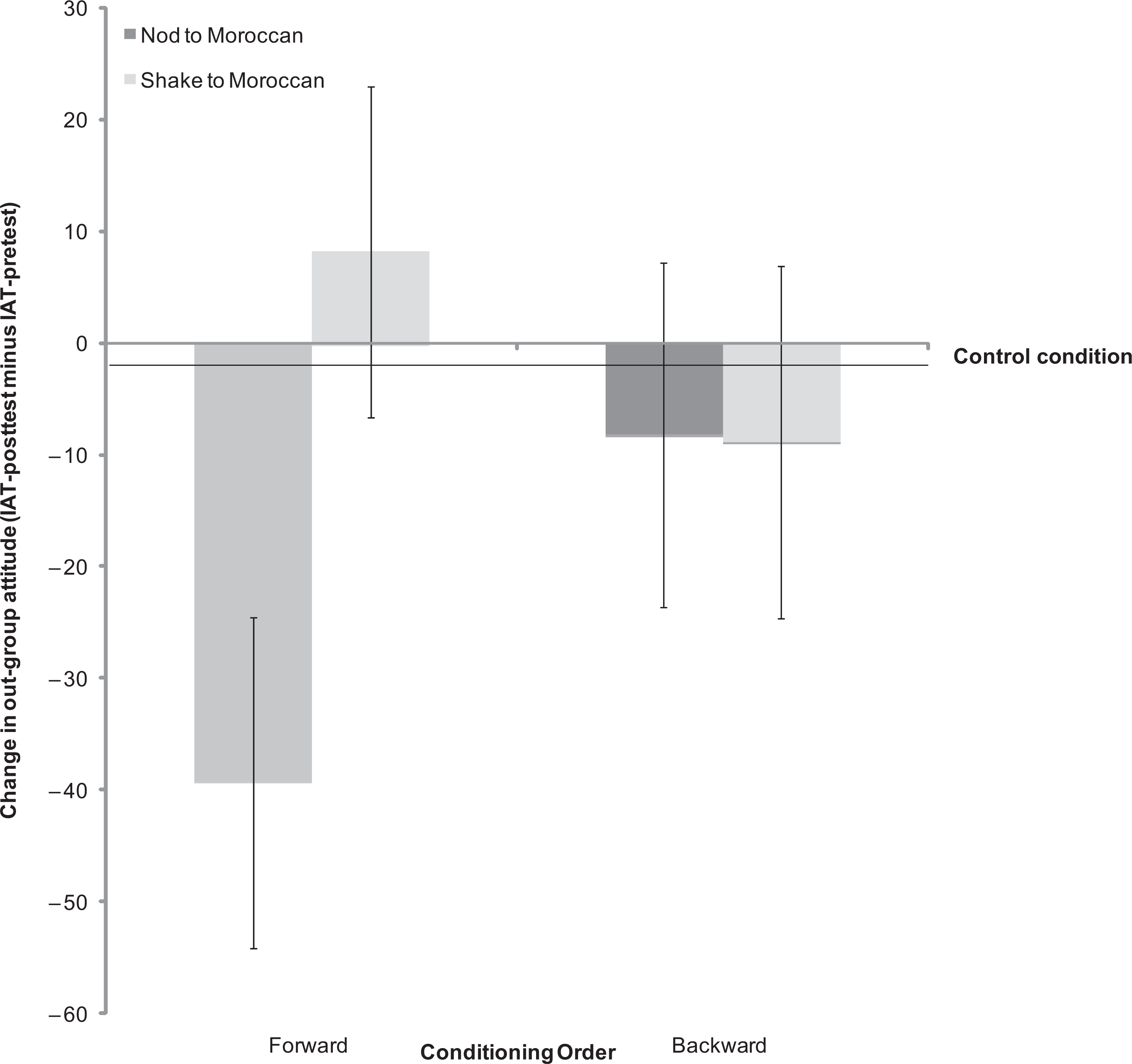
The mean change (and standard error) in implicit evaluations of the out-group as a function of conditioning with nodding or shaking. A negative difference score reflects a reduction of negativity, a positive difference score shows an increase of negativity, and scores around zero denote stable evaluations from the pretest to the posttest. The left-hand side of the graph shows results for forward conditioning (the movement follows the name), and the right-hand side results for backward conditioning (the movement precedes the name). The straight line reflects the results for the no movement control condition.
Finally, we checked for the influence of demand awareness by analyzing participants’ answers to our spontaneous measure on their ideas about the purpose of the study. Four participants revealed high awareness of our research purpose; that is, they reported that they noticed to have been nodding or shaking the head in combination with Moroccan names and thought we were looking for effects of this coupling on the implicit attitude measure afterward. In addition to these four highly aware participants, another 17 participants showed some indication of contingency awareness (i.e., they reported noticing that Moroccan names were consistently coupled with a certain movement). Thus, in sum, 21 participants indicated some awareness of coupling of Moroccan names with a specific head movement. Excluding these 21 participants did not affect the pattern of significant and nonsignificant results.
Discussion
In the present research, two possible processes by which head movements can alter attitudes were pitted against each other. On one hand, a mere proximity explanation implies that head movements affect attitudes when they are presented in close proximity to the stimulus. On the other hand, a temporal contiguity explanation suggests that head movements alter attitude valence only when the movement is presented after the stimulus has been encountered. The present data support the latter explanation. Our results show that embodied evaluative conditioning effects of head nodding are obtained only when the stimulus (e.g., the name Ahmed) precedes the participant’s positive embodied evaluative reaction (i.e., the head nodding movement) and not when the same stimulus and movement occur in the reverse order. As we argued in the Introduction, this particular stimulus-movement order matches the natural sequence of events in which embodied signs of agreement with a stimulus are typically expressed after the stimulus is perceived.
Theoretically, the observed effect of temporal order suggests that causal misattribution underlies the obtained embodied evaluative conditioning effect. The most parsimonious explanation for the finding that target stimuli evaluations were enhanced after repeated exposure to target stimuli followed by head nodding is that participants attributed their head nodding movements (as an expression of approval) to the preceding stimulus instead of correctly attributing them to the instruction to follow the moving circle on the screen. The finding that this misattribution of the source of the nodding takes place only when the stimulus precedes the movement is in line with principles of causal inference. Specifically, a cause must precede the effect in order to be perceived as cause (Michotte, 1946/1963).
Recently, Jones, Fazio, and Olson (2009) proposed a misattribution account to explain evaluative conditioning effects. In their argument, the causal misattribution originates from confusion about whether the US or the CS is the source of an evaluative reaction. To illustrate, when a CS (e.g., a Chinese character) and a US (e.g., a flower) are presented in close temporal and spatial proximity, the positive evaluative reaction evoked by the flower may be mistakenly attributed to the Chinese character. Note that our misattribution explanation differs from the misattribution account presented by Jones et al. (2009). In our case, the misattribution is not a consequence of confusion between the CS (e.g., Ahmed) and the US (i.e., head nodding) as the source of the evaluation. Instead, the confusion is about what causes participants to nod their heads. That is, a misattribution is made to the CS being the cause of the US, instead of to our instruction to follow the moving circle. In a way, this specific misattribution process resembles the misattribution proposed in the self-perception literature, in which it is argued that people may infer their attitudes from their behavior (cf. Bem, 1972). In our case, participants seem to have (spontaneously) inferred their positive evaluation of the stimulus (i.e., their attitude) from their head nodding movements upon perceiving the stimulus (i.e., their behavior).
In a recent meta-analysis on evaluative conditioning (Hofmann et al., 2010), temporal order was not identified as a moderating factor in the production of evaluative conditioning effects. However, in the paradigms reviewed in this meta-analysis the unconditioned stimuli were all external stimuli while in our study evaluative bodily reactions of the participants constituted the US. It may be tentatively suggested that the involvement of one’s own evaluative response (US) to an outside event (CS) may have contributed to the critical role of temporal order. Subjectively, our evaluative response clearly pertains to the preceding stimulus, and not to a stimulus that appears immediately after our response. In contrast, when passively observing two external stimuli in close proximity, their temporal order may be less crucial in distinguishing which of the stimuli exactly caused the positive or negative affect experienced by the observer. This would explain why in most evaluative conditioning studies the temporal order of CS and US does not seem to play a role, while it clearly does in the present paradigm.
Aside from accounts based on misattribution, several other processes for conditioning effects have been proposed, ranging from signal learning accounts or Pavlovian conditioning (e.g., Rescorla, 1988) to explanations involving propositions about the relation between the CS and the US (e.g., De Houwer, 2009). First, from a propositional perspective our effects should be explained by means of explicit evaluations involving propositions about the relation between the CS and the US. This explanation requires participants’ awareness of the experimentally manipulated relationship between the nodding movement and Moroccan names. On the basis of our spontaneous reports of awareness, it seems unlikely that awareness of contingencies plays a crucial role in our effects. That is, excluding participants spontaneously reporting awareness of contingencies between the movements and Moroccan names did not alter our effects.
Although our present results do not provide direct evidence for a propositional account, we should be careful in drawing strong conclusions concerning the role of contingency awareness, because we did not include sensitive measures or manipulations of awareness in our study (see Field, 2000). It may thus be conceivable that propositional cognitions such as “I nodded upon seeing Ahmed” or simply “I like Ahmed” have played a mediating role in the production of our effects. Future studies should shed more light on this issue by measuring contingency awareness more directly, or by obscuring awareness, for example by subliminal presentation of the names or by including more trials in which people nod or shake for other words, as well as trials with Moroccan names in which people do not make a certain movement.
Our method and findings for the forward conditioning procedure resemble a Pavlovian form of conditioning (Rescorla, 1988). That is, the Moroccan names are always coupled with one type of movement (100% statistical contingency), and the names may therefore be perceived as a signal for the movement to occur. However, the type of US we use in our procedure (head movements) is quite different from the hedonic states that are used in Pavlovian forms of conditioning. The “hedonic” state in our case is caused by one’s own movement rather than brought about by a pleasant outside event (e.g., food). Future research should test whether the 100% statistical contingency is a prerequisite for the present effect to occur, or whether the effects would also be obtained if the Moroccan names were sometimes presented without the nodding movement following it.
In the present research, we have studied how embodied expressions of agreement and disagreement affect evaluations. Thus, the term “embodied” evaluative conditioning here refers to our evaluative conditioning procedure using embodied unconditioned stimuli. The question may rise how these embodied expressions differ from coupling out-group names with the verbal expressions of agreement and disagreement; that is, the words “yes” and “no”. From the perspective of temporally scripted events, one might predict evaluative conditioning effects to be similarly constrained by order effects when using verbal evaluative reactions of participants instead of bodily movements. It may, however, be more difficult to conceal the meaning of these verbal reactions than in the case of movements, which may give rise to enhanced demand effects. Future research should shed more light on whether the explicit expression of agreement has similar effects on evaluations as the more subtle expression of moving the head in a vertical way. Moreover, it would be interesting to test the role of order information in these more explicit expressions of positivity and negativity.
The goal of the present article was to shed more light on the process underlying embodied evaluative conditioning effects. Our finding that evaluative conditioning effects occur only when the movement follows the stimulus does not imply that the opposite order does not yield any effects. From the literature on bodily induced mind-sets, we know that the performance of approach and avoidance movements can affect cognitive control on a trial that follows the movement (Koch, Holland, Hengstler, & Van Knippenberg, 2009). Here, the movements function as a general signal that the environment is safe or that caution is needed.
Head nodding and shaking have also been found to affect attitudes in other ways than through evaluative conditioning. First, nodding and shaking can guide evaluations about persuasive messages by functioning as internal cues to either have confidence or doubt in one’s own thoughts (Briñol & Petty, 2003, 2009). In these studies, either nodding or shaking head movements are made while listening to a message. Participants display more confidence in their thoughts that are evoked by the message when they have been nodding their heads while listening to it as compared to shaking. Such a deliberate cognitive process is less applicable to our present paradigm, in which there was not much room for elaboration. Second, head shaking can make negative things more negative, and head nodding can make positive things more positive (Förster, 2004). In the latter study, participants made extended and very slow up and down or sideways movements while watching an extremely positive or negative product. Their attitude toward the negative product became more negative after the sideways movements, whereas their attitude toward the positive product became more positive after the up and down movements. These up and down and sideways movements may respectively have had a positive and a negative connotation, but also may represent natural nodding or shaking to a lesser extent than in our paradigm, which is characterized by repeated and faster head movements. All in all, the self-validation paradigm and the compatibility study may have brought about different dynamics than our evaluative conditioning paradigm, resulting in different processes by which head movements can alter attitudes.
By studying attitudes toward a social out-group, the present study also enhances our insights concerning embodiment effects in the area of prejudice. Our results extend recent findings that approach arm movements can lead to lower levels of prejudice than avoidance and control movements (Kawakami et al., 2007). Specifically, we show that head nodding can serve as a positive signal in a conditioning paradigm to alter out-group evaluations. Note that we used the same out-group names in the ST-IATs as in the conditioning procedure. Although the category in an IAT often overrides the influence of individual features of presented exemplars (e.g., De Houwer, 2001; Mitchell, Nosek, & Banaji, 2003), we cannot exclude the possibility that we changed attitudes to these specific exemplars only, and not to the out-group in general.
In line with the absence of negative effects of avoidance training on prejudice, we also did not find effects of head shaking on out-group attitudes, possibly because the attitude was already predominantly negative (cf. Kawakami et al., 2007). For social attitudes that are predominantly positive, evaluative conditioning effects of head shaking should occur. Additionally, it would be interesting to see whether temporal order also moderates the influence of approach and avoidance arm movements on attitude change, because these movements are used in the same scripted manner as head movements.
To conclude, the present results show that temporal contiguity plays an important role in embodied evaluative conditioning of social attitudes, in that these effects are bounded to the natural sequence in which head movements occur in daily life. Thus, in order for head nodding to influence attitudes by means of evaluative conditioning, we should “first see, then nod”.
Footnotes
Acknowledgments
The authors wish to thank Thijs Verwijmeren for his help in programming the head movement conditioning procedure.
The author(s) declared no potential conflicts of interest with respect to the research, authorship, and/or publication of this article.
The author(s) received no financial support for the research, authorship, and/or publication of this article.