




Abstract
Life satisfaction (LS) is prospectively associated with the occurrence of several major events in work and family life. Analyzing longitudinal data from three nationally representative panel studies (Ns between 2,321 and 18,692), the authors found that higher LS is associated with a higher likelihood of marriage and childbirth, and with a lower likelihood of marital separation, job loss, starting a new job, and relocating. These effects held even after controlling for gender, age, socioeconomic status, and the Big Five, and were highly consistent across the three samples. Discrete-time survival analyses indicated that for most of these events, temporary rather than stable mechanisms account for the prospective effect of LS. Together, these findings provide evidence that LS is an important predictor of major life outcomes.
Longitudinal studies show that higher life satisfaction (LS) is prospectively associated with greater occupational success, better health, and even delayed mortality (Diener & Chan, 2011; Lyubomirsky, King, & Diener, 2005; Oishi, Diener, & Lucas, 2007). But is LS also associated with specific life events? Previous research has mainly focused on the short-term and long-term effects of life events on LS (e.g., Luhmann, Hofmann, Eid, & Lucas, 2011). The reversed effect, however, has not received much attention. The few studies that have considered prior LS levels suggest that LS might indeed be associated with the occurrence of certain events. Specifically, these studies found negative prospective effects of LS on divorce (Luhmann & Eid, 2009; Marks & Fleming, 1999), unemployment (Graham, Eggers, & Sukhtankar, 2004; Luhmann & Eid, 2009; Marks & Fleming, 1999), and work disability (Koivumaa-Honkanen et al., 2004), and a positive prospective effect of LS on marriage (Lucas, Clark, Georgellis, & Diener, 2003; Marks & Fleming, 1999). Overall, however, the predictive power of LS on different live events has not yet been tested in a comprehensive fashion. In the present article, we examine whether LS is prospectively related to the occurrence of events in work life (job loss, changing jobs, retirement, relocating) and family life (marriage, marital separation, widowhood, childbirth), and whether these effects are driven by temporary or by stable mechanisms.
Temporary mechanisms include short-term, situation-specific processes. For instance, the event might be a direct behavioral consequence of low satisfaction because dissatisfaction serves as a strong motivator to change whatever is the source of dissatisfaction. This effect has frequently been shown in organizational psychology (people who are dissatisfied with their current jobs are more likely to search for new jobs; Griffeth, Hom, & Gaertner, 2000), health psychology (people who are dissatisfied with their bodies are more likely to start dieting; Stice & Shaw, 2002), and consumer psychology (dissatisfied customers are less likely to repurchase; Szymanski & Henard, 2001). Generalizing this effect to LS, we can therefore assume that people who are currently dissatisfied with their lives are more likely to actively change their life circumstances, for instance by ending the current relationship. Alternatively, people might anticipate the event months or even years before it actually occurs, and this anticipation could cause a change in LS (Clark, Diener, Georgellis, & Lucas, 2008; Lucas et al., 2003). In sum, the temporary explanation assumes that LS is a leading indicator of life events (in a temporal sense), which means that LS prospectively indicates events that will occur in the near future.
Stable mechanisms include all processes that are independent of the situational circumstances and therefore stable within a person. LS is a trait-like construct (Diener, Suh, Lucas, & Smith, 1999) that is moderately stable over time (Eid & Diener, 2004; Fujita & Diener, 2005; Lucas & Donnellan, 2007). An individual’s average level of LS is denoted as a set point (Diener, Lucas, & Scollon, 2006) or habitual level of LS (Eid, 2008). People might be more or less likely to experience certain events because of their particular set point. For instance, highly satisfied persons are more likable and more socially active (Okun, Stock, Haring, & Witter, 1984) and are therefore more likely to have satisfying social relationships, which increases the chance to get married and decreases the chance to break up.
In addition to this direct stable mechanism, a prospective effect of LS on life events could also reflect two stable mechanisms that are related to but not directly affected by LS. The first mechanism is personality. Personality, particularly neuroticism and extraversion, is correlated with LS (Steel, Schmidt, & Shultz, 2008). Personality has also been associated with the frequency of life events. Neuroticism is associated with a higher frequency of undesirable events, and extraversion is associated with a higher frequency of desirable events (Headey, 2006; Magnus, Diener, Fujita, & Payot, 1993; Saudino, Pedersen, Lichtenstein, McClearn, & Plomin, 1997). Moreover, previous research has shown that high neuroticism increases the risks of divorce, whereas high agreeableness and high conscientiousness decrease the risks of divorce (Roberts, Kuncel, Shiner, Caspi, & Goldberg, 2007). Hence, personality is a potential stable cause of both LS and life events that might explain a prospective effect of LS on life events. If this mechanism exists, controlling for personality should reduce the effect of LS on life events significantly.
The second mechanism concerns stable life circumstances such as socioeconomic status (SES). SES (i.e., income and education level) has been associated with the occurrence of some life events (Roberts et al., 2007) as well as with LS (e.g., Luhmann, Schimmack, & Eid, 2011). Hence, SES is another potential stable cause of life events that might account for the effects of LS on life satisfaction. As an illustration, we might find a negative effect of LS on job loss because lower SES is associated with decreased LS as well as with an increased likelihood to get fired. If this mechanism exists, controlling for SES should reduce the effect of LS on life events significantly.
In short, stable and temporal mechanisms lead to different predictions on how far into the future LS might predict life events. Specifically, stable mechanisms imply that LS predicts life events, regardless of how much time lies between the initial LS assessment and the events. If, for instance, people low in LS are prone to job loss, we should find this effect regardless of whether we predict job loss 1 year or 5 years later. In contrast, temporary effects should, by definition, only be detected within short time periods, and the predictive power of LS on life events should diminish with increasing time lags. In the present article, we examine whether LS prospectively predicts life events in the next 5 years, and whether this effect changes with increasing time lag between baseline and the event. In addition, we examine whether these effects are altered after controlling for personality and SES.
The Present Study
We used data from three large nationally representative panel studies: the Household, Income and Labour Dynamics in Australia (HILDA) Survey (Wooden & Watson, 2007), the British Household Panel Survey (BHPS; Taylor, Brice, Buck, & Prentice-Lane, 2009), and the German Socioeconomic Panel (SOEP; Wagner, Frick, & Schupp, 2007). These data sets have many strengths, including prospective data on LS and life events, generalizability of the findings to the national population, and sample sizes large enough to examine rare life events. By replicating our analyses in different samples, we were able to examine the consistency of the results across three nations. We studied eight life events that varied in life domain (family or work), controllability (e.g., relocating as a high-control event, job loss as a low-control event), and desirability (e.g., getting married as a desirable event, getting widowed as an undesirable event). To minimize potential bias due to selective memory (Seidlitz & Diener, 1993) and selective reporting of life events (Brett, Brief, Burke, George, & Webster, 1990), we only examined the following objective life events (Magnus et al., 1993): marriage, marital separation, widowhood, childbirth, job loss, starting a new job, retirement, and relocating.
For each event, we conducted two sets of analyses. First, we examined the prospective effect of LS on the event over a 5-year span 1 using discrete-time survival analysis models (Singer & Willett, 2003). Second, we examined whether controlling for income, education, and the Big Five personality traits would alter the effects of LS on life events. Since personality was only assessed in 2005 in all three samples and life events can lead to changes in personality (Specht, Egloff, & Schmukle, 2011), only life events that occurred in 2006 or 2007 were examined in this second set of analyses.
Method
Samples
In each sample, data were collected annually and the latest available wave of data was collected in 2007. We analyzed data from the years 2002 to 2007 for the SOEP and the BHPS and from 2003 to 2007 for the HILDA. 2 The first year of these time periods will be referred to as the baseline year. For each event, we selected those individuals who had valid LS scores for the baseline year and who were immediately at risk to experience the event (e.g., only married people for marital separation). In addition, individuals with incomplete data on any of the covariates were excluded. Hence, the sample sizes varied from event to event. For the survival analyses, the sample size ranged from N = 2,321 (HILDA, retirement) to N = 18,205 (SOEP, relocating). For the short-term analyses, the sample sizes ranged from N = 2,318 (BHPS, retirement) to N = 18,692 (SOEP, relocating). Sample sizes and demographic statistics for all subsamples are provided in supplementary Tables S1 and S2 (see Online Supplemental Material found at http://spps.sagepub.com/supplemental).
Measures
Life events
In the HILDA, all life events were assessed with a checklist that included items such as “Got married” or “Fired or made redundant by an employer.” Participants checked all events they had experienced in the past 12 months. In the BHPS, participants were asked to indicate their current marital status as well as whether their marital status had changed in the past year. These variables were used to derive whether marriage, marital separation, or widowhood occurred. Becoming a parent was not assessed directly; therefore, the difference in the number of children in the household from one wave to the next was taken as a proxy for childbirth. For each working participant, data on when the current job was started were available. These data were used to derive whether the participant had started a new job in a specific year. Job loss and retirement were derived from occupational spell data available in the BHPS. Relocation was derived from data on whether or not the participant had lived at the present address in the last year. In the SOEP, marital status was assessed each year, and data on marriage, marital separation, and widowhood were derived by comparing the marital status in 1 year to the marital status in the previous year. Childbirth was derived from data on the year of birth of any children of adult participants. Data on job loss, new jobs, and retirement were derived from occupational spell data. Relocation was assessed directly by asking whether the participant had moved in the past year. Event frequencies are reported in supplementary Tables S1 and S2 (see Online Supplemental Material found at http://spps.sagepub.com/supplemental).
Life satisfaction
In each sample, LS was assessed with a single item (e.g., How satisfied are you with your life overall?) that was rated on an 11-point scale in the SOEP and in the HILDA (ranging from completely dissatisfied to completely satisfied) and on a 7-point scale in the BHPS (ranging from not satisfied at all to completely satisfied). The average LS scores were M = 5.25, SD = 1.30 (BHPS 2002), M = 5.18, SD = 1.29 (BHPS 2005), M = 6.93, SD = 1.75 (SOEP 2002), M = 6.95, SD = 1.83 (SOEP 2005), M = 7.97, SD = 1.54 (HILDA 2003), and M = 7.93, SD = 1.45 (HILDA 2005).
Personality
In the HILDA, the Big Five were assessed with 28 adjectives adapted from the Big Five Mini-Markers (Saucier, 1994). These items were rated on a 7-point scale ranging from 1 (does not describe me at all) to 7 (describes me very well). Internal consistencies ranged from α = .74 (openness to experiences) to α = .81 (neuroticism). In the SOEP and the BHPS, personality was assessed with the 15-item Big Five Inventory Short Version (BFI-S; Gerlitz & Schupp, 2005) which is based on the Big Five Inventory (John & Srivastava, 1999). Items were rated on a 7-point scale ranging from 1 (does not apply to me at all) to 7 (applies to me perfectly). Internal consistencies ranged from α = .51 (agreeableness) to α = .66 (extraversion) in the SOEP and from α = .52 (conscientiousness) to α = .68 (neuroticism) in the BHPS. In all samples, the items were reversed if appropriate and averaged within each subscale. Higher scores indicated higher extraversion, neuroticism, conscientiousness, agreeableness, and openness to experiences, respectively.
Income
Net household income was assessed in terms of Australian Dollars per year in the HILDA, British Pound per week in the BHPS, and Euro per month in the SOEP. In all samples, the natural logarithm of income was analyzed to account for the skewness of the income distribution.
Education
In the BHPS and the HILDA, education was measured as the highest degree in that specific year. Educational degrees were dummy coded; the lowest degree (no high school degree) was the reference category. In the SOEP, education was measured as years of education.
Demographics
We included gender (1 = female, 0 = male), age at baseline, and age-squared as covariates in all analyses.
Data analysis
We used discrete-time survival analysis (Singer & Willett, 2003) to examine the prospective effects of LS on life events. This analysis is a specific type of longitudinal logistic regression analysis where the occurrence of the event in a specific year (0 = event did not occur, 1 = event did occur) is predicted by the specific time period (here: 2003, 2004, etc.) and by other variables (here: LS, gender, age). To estimate whether the effect of LS on the event occurrence varies as a function of time, we calculated the interactions between LS and each time period. Hence, the main effect represents the effect of LS on the event in the first year after the baseline, and the interaction effects represent whether the effect of LS on the event in that particular year differs from the effect of LS on the event in the first year after the baseline. In the short-term analyses, we examined whether controlling for personality and SES would alter the prospective effects of LS. Specifically, we conducted logistic regression analyses to predict whether the event occurred in 2006 or 2007 (0 = event did not occur, 1 = event did occur in at least one of these years).
Results
Prospective effects of LS on life events
The odds ratios (ORs) presented in Table 1 reflect the prospective effects of LS on the event in each year. Across the three samples, higher LS is consistently associated with an increased likelihood to get married and to become a parent (ORs > 1), and with a decreased likelihood of marital separation, job loss, starting a new job, and relocating (ORs < 1), controlling for gender and age. The effects were inconsistent or nonsignificant for widowhood and retirement.
Results for the Survival Analyses (Reduced Output)
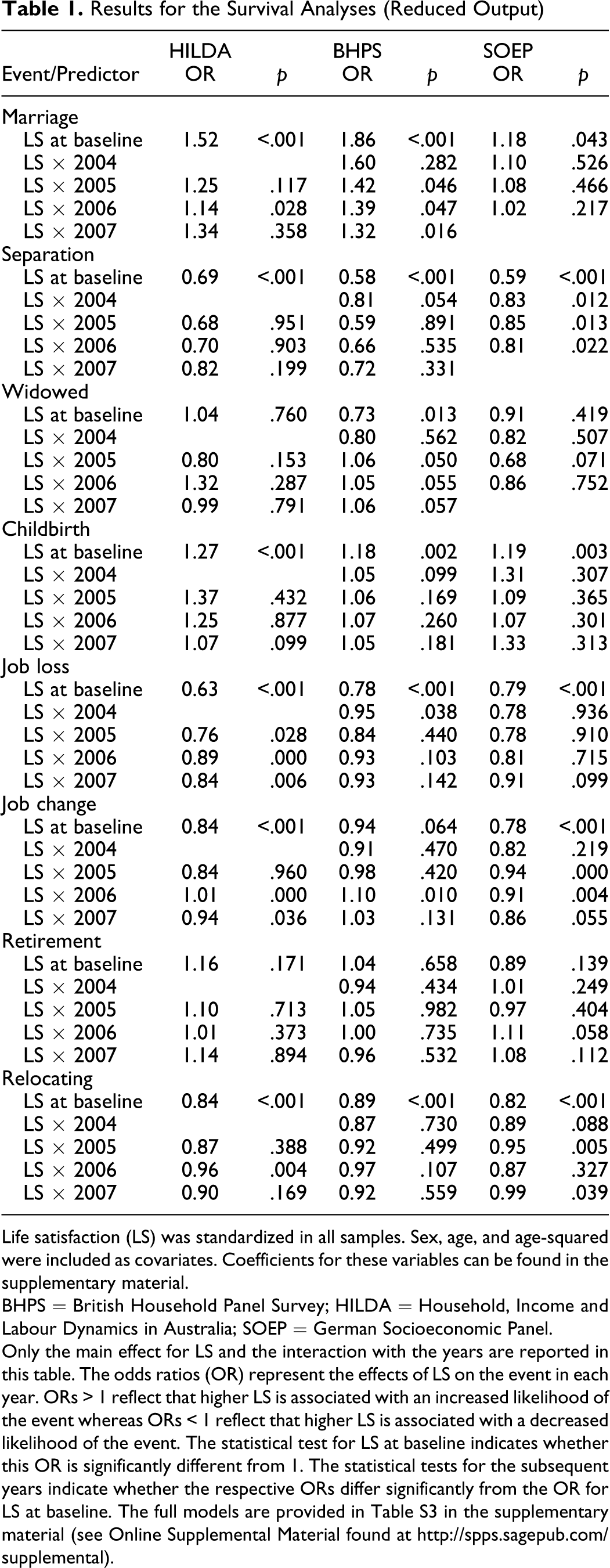
Life satisfaction (LS) was standardized in all samples. Sex, age, and age-squared were included as covariates. Coefficients for these variables can be found in the supplementary material.
BHPS = British Household Panel Survey; HILDA = Household, Income and Labour Dynamics in Australia; SOEP = German Socioeconomic Panel.
Only the main effect for LS and the interaction with the years are reported in this table. The odds ratios (OR) represent the effects of LS on the event in each year. ORs > 1 reflect that higher LS is associated with an increased likelihood of the event whereas ORs < 1 reflect that higher LS is associated with a decreased likelihood of the event. The statistical test for LS at baseline indicates whether this OR is significantly different from 1. The statistical tests for the subsequent years indicate whether the respective ORs differ significantly from the OR for LS at baseline. The full models are provided in Table S3 in the supplementary material (see Online Supplemental Material found at http://spps.sagepub.com/supplemental).
Do the prospective effects of LS change over time? We found evidence for at least some temporary effects (meaning that the predictive power of LS decreases over time) for marriage, starting a new job, and relocating. For these events, the prospective effect of LS was significantly weaker in at least one subsequent wave in at least two of the three samples (see p values for the ORs in the subsequent years in Table 1). The prospective effect of LS on job loss was stable in the SOEP and the BHPS but significantly weaker in subsequent years in the HILDA (baseline OR = .63 vs. later ORs > .76), suggesting that stable characteristics might affect the risk of job loss in Germany and the United Kingdom, but not in Australia. The prospective effect of LS on separation was stable in the HILDA and the BHPS but significantly weaker in subsequent years in the SOEP (baseline OR = .59 vs. later ORs > 0.81), indicating that in at least two of the three samples, less satisfied people are more likely to experience marital separations. Finally, we found evidence for a completely stable effect of LS on childbirth as none of the interactions between time and LS were significant.
Controlling for Personality and SES
In a second set of analyses, we examined whether the prospective effects of LS on life events hold after controlling for SES and the Big Five. This was clearly the case. As above, higher LS was associated with a higher likelihood to get married and to become a parent (except in the SOEP) and with a lower likelihood of marital separation, job loss, changing jobs, or relocating (see ORs in Table 2), controlling for demographics, SES, and the Big Five. Moreover, we again did not detect any prospective effects of LS on becoming widowed or retired (although the effect of LS on becoming widowed in the SOEP was marginally significant, OR = .82, p = .051).
Logistic Regression Analyses Reflecting the Effects of Life Satisfaction (LS) in 2005, Gender and Age, Socioeconomic Status (SES), and the Big Five on Different Life Events
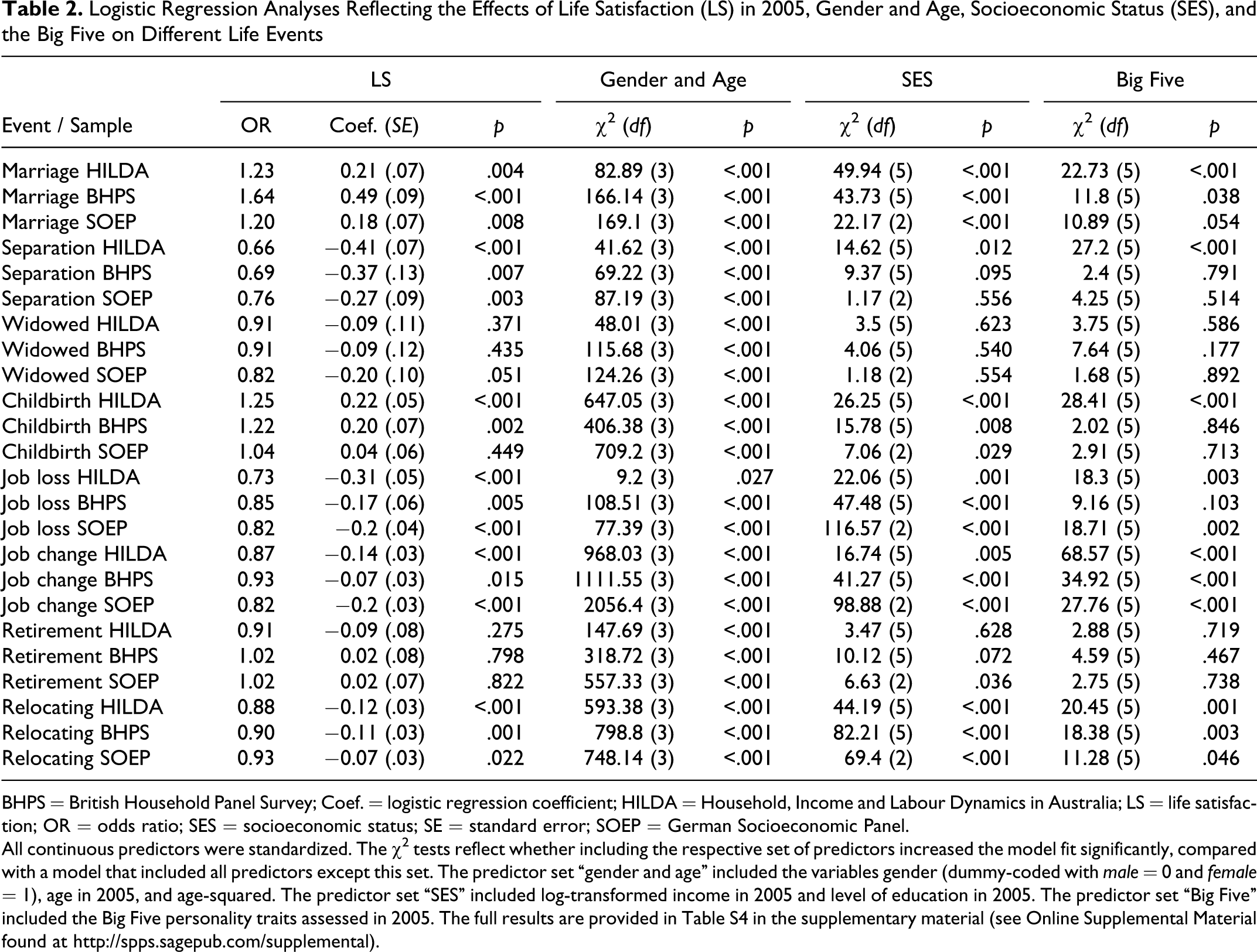
BHPS = British Household Panel Survey; Coef. = logistic regression coefficient; HILDA = Household, Income and Labour Dynamics in Australia; LS = life satisfaction; OR = odds ratio; SES = socioeconomic status; SE = standard error; SOEP = German Socioeconomic Panel.
All continuous predictors were standardized. The χ2 tests reflect whether including the respective set of predictors increased the model fit significantly, compared with a model that included all predictors except this set. The predictor set “gender and age” included the variables gender (dummy-coded with male = 0 and female = 1), age in 2005, and age-squared. The predictor set “SES” included log-transformed income in 2005 and level of education in 2005. The predictor set “Big Five” included the Big Five personality traits assessed in 2005. The full results are provided in Table S4 in the supplementary material (see Online Supplemental Material found at http://spps.sagepub.com/supplemental).
Discussion
Satisfied people are more likely than dissatisfied people to get married or become parents in the next 5 years, and they are less likely to separate from their spouse, lose their job, start a new job, or relocate in the next 5 years. These effects were consistent across three nationally representative samples from Australia, Germany, and Great Britain, and held after controlling for gender, age, income, education, and the Big Five.
We proposed that LS might affect life outcomes through stable or temporary pathways. We found evidence for both of these mechanisms. For instance, the effect of LS on subsequent childbirth does not diminish as a function of increasing time lag, indicating that this effect is mainly driven by stable mechanisms. For this event, stable mechanisms could affect the decision to start a family (e.g., more likely for couples in stable favorable economic circumstances) as well as the probability to conceive (cf. findings on the detrimental effects of stress on fertility; Buck et al., 2011).
For most of the other events that were affected by LS, however, temporary effects were detected in at least one of the samples. For example, the effect of LS on relocating is significantly stronger in the first years after the baseline than in later years. Further evidence for temporary effects comes from our short-term analyses where we controlled for personality and SES. If only stable mechanisms were at work, we would have expected the prospective effects of LS to disappear or at least to be substantially reduced when personality and SES are controlled. This was not the case. Indeed, the effects of LS on life events were more consistent across the samples than the effects of personality.
According to set point theory (Diener et al., 2006), momentary LS fluctuates around a stable set point. Our findings indicate that while the set point might predispose people to certain life events, momentary fluctuations reflect and affect the temporary life situation which in turn can lead to specific life events. These temporary effects can be caused by at least two processes. First, people might anticipate the event and react to it even before it occurs (causal effect of the anticipated event on LS). The direction of the effect should be consistent with the desirability of the event: Higher LS should be associated with a higher likelihood of desirable events (positive effect) and with a lower likelihood of undesirable events (negative effect). In our study, the data on marriage, childbirth, marital separation, and job loss were consistent with this effect. Second, people might actively initiate the event to overcome their (low) level of LS (causal effect of LS on the event). This mechanism is only plausible for events that are to some degree controllable (e.g., relocating), but not for events that are not controllable (e.g., widowhood). Contrary to the anticipation effect, the direction of this effect should always be negative. Life events that were initiated to change something in life should be more likely for dissatisfied people than for satisfied people, regardless of the desirability of the event. Regarding our findings, this effect might explain why low LS increases the likelihood of starting a new job and relocating, two life events of unclear desirability. Moreover, the data on marital separation and job loss are also consistent with this effect. Note that these two short-term mechanisms are not mutually exclusive but can occur together. Our data were limited as they did not provide sufficient information about the individual circumstances of the event, including data on whether the event was anticipated and whether it was actively initiated. A direct test of these effects must therefore be postponed to future research.
There are further limitations in our data that need to be mentioned. First, the measures used in these samples do not all meet optimal standards. For instance, LS is assessed with single items that might be less reliable than multiitem measures. Moreover, the Big Five were assessed with short scales with less-than-ideal reliabilities. Second, measures of the same variables differed between the samples (e.g., life events checklist vs. proxy variables, different response formats for the LS item), potentially limiting the comparability of the findings across samples. Third, we found cultural differences with respect to the average LS levels and the duration of the prospective effects of LS on life events. Since we analyzed data from only three countries, we were not able to examine whether the reported effects vary systematically across cultures. A task for future research is therefore to examine cultural differences in the perception, likelihood, and normativity of different events in family and work life. It might also be worthwhile to examine whether national levels of LS influence how people interpret their individual level of LS. Finally, we found distinct patterns for different life events, but our sample of life events was too small to test whether these differences are systematically related to specific event features such as desirability or controllability.
In sum, our study shows that LS is a valuable supplement to personality and sociodemographic variables in the prediction of life outcomes. Only by examining temporary causes and stable causes in conjunction will we be able to answer to which degree life events are subject to our own will, to an uncontrollable genetic lottery, or to pure chance.
Footnotes
Acknowledgments
The data used in this article were made available by the German Socioeconomic Panel Study, Deutsches Institut für Wirtschaftsforschung, Berlin, Germany; the British Household Panel Survey, Institute for Social and Economic Research, Colchester, United Kingdom; and the Household, Income and Labour Dynamics in Australia (HILDA) Survey, Melbourne Institute, University of Melbourne, Australia. The HILDA Project was initiated and is funded by the Australian Government Department of Families, Housing, Community Services and Indigenous Affairs (FaHCSIA) and is managed by the Melbourne Institute of Applied Economic and Social Research (Melbourne Institute). The findings and views reported in this article, however, are those of the author and should not be attributed to either FaHCSIA or the Melbourne Institute.
Declaration of Conflicting Interests
The author(s) declared no potential conflicts of interest with respect to the research, authorship, and/or publication of this article.
Funding
The author(s) received no financial support for the research, authorship, and/or publication of this article.
Notes
References
Supplementary Material
Please find the following supplemental material available below.
For Open Access articles published under a Creative Commons License, all supplemental material carries the same license as the article it is associated with.
For non-Open Access articles published, all supplemental material carries a non-exclusive license, and permission requests for re-use of supplemental material or any part of supplemental material shall be sent directly to the copyright owner as specified in the copyright notice associated with the article.
