




Abstract
This research examined how the typicality of gender cues in politicians’ faces related to their electoral success. Previous research has shown that faces with subtle gender-atypical cues elicit cognitive competition between male and female categories, which perceivers resolve during face perception. To assess whether this competition adversely impacted politicians’ electoral success, participants categorized the gender of politicians’ faces in a hand-tracking paradigm. Gender-category competition was indexed by the hand’s attraction to the incorrect gender response. Greater gender-category competition predicted a decreased likelihood of votes, but only for female politicians. Time-course analyses revealed that this outcome was evident as early as 380 ms following face presentation (Study 1). Results were replicated with a national sample, and effects became more pronounced as the conservatism of the constituency increased (Study 2). Thus, gender categorization dynamics during the initial milliseconds after viewing a female politician’s face are predictive of her electoral success, especially in more conservative areas.
In 2008, Sarah Palin was the first female Republican nominee for vice president in U.S. history. In that same year, Hillary Clinton narrowly lost the Democratic presidential bid. These two women highlight the steadily increasing role of women in U.S. politics, yet their contrast also underscores the variability in feminine appearance among female politicians. The current research examines one reason why these politicians might have varying success with conservative and liberal voters. We focus on cues to femininity, and how these cues might facilitate or hinder political success depending upon the political leanings of the constituency.
Sexually dimorphic facial cues emerged long ago in human evolutionary history. Larger eyes and rounded features convey femininity (Cunningham, 1986), whereas lateral bone growth and prominent upper brows signal masculinity (Perrett et al., 1998). In addition to these biologically determined cues, individuals can electively display and/or enhance their gendered appearance through culturally specific gender cues. For instance, in modern Western cultures, it is common for females to enhance their femininity by applying makeup and maintaining longer hair (Russell, 2009). Thus, both biological and social factors may contribute to gendered differences in facial appearance.
Despite robust gender differences, most faces contain physiognomic overlap between gender categories (e.g., 90% feminine and 10% masculine), and the relative ratio between the two varies across individuals. Accordingly, perceivers can encounter instances of temporary uncertainty about another’s gender. For example, men with longer hair, or females with short hair, can initially elicit uncertainty during the gender categorization process (Freeman, Ambady, Rule, & Johnson, 2008; Macrae & Martin, 2007).
Recent theoretical models of person perception suggest that multiple facial cues—including masculine and feminine features—are perceived in parallel and that their perception is integrated over hundreds of milliseconds to yield ultimate categorizations (Freeman & Ambady, 2011a). Such parallel processing triggers the partial activation of multiple categories, and thus, a face that contains conflicting cues, such as a heavier brow (activating a male representation) paired with larger eyes (activating a female representation), might initially elicit partial commitments to multiple categories. But as additional facial information (e.g., feminine jaw and longer hair) is integrated, initial uncertainty gives way to a stable representation of a single category (e.g., female). Thus, a face’s unique mixture of cues may trigger competing social categories, in turn producing temporary uncertainty in a perceiver that is resolved in fractions of a second.
The goal of the current research was to test the viability of these theoretical models in predicting real-world outcomes. Specifically, we used computer mouse tracking to examine whether gender uncertainty in the initial milliseconds of person perception predicted electoral outcomes in the political domain. This technique is highly sensitive to the partial parallel activation of social categories not typically revealed in more traditional measures like explicit ratings or reaction time (Dale, Kehoe, & Spivey, 2007; Freeman, Dale, & Farmer, 2011; Song & Nakayama, 2008). For instance, in one series of studies using computer mouse tracking, participants categorized faces’ gender by moving the mouse from the bottom-center of the screen to “male” or “female” responses in either top corners (Figure 1). When categorizing gender-atypical faces (e.g., a long-haired man), participants’ mouse trajectories exhibited a spatial attraction toward the “female” response on the opposite side of the screen before selecting the “male” response (Freeman et al., 2008). Many studies have now shown that such mouse trajectory deviations toward an unselected category reflect the partial parallel activation of that category, before another ultimately selected category comes to fully stabilize (Dale et al., 2007; Freeman & Ambady, 2011a; Spivey, Grosjean, & Knoblich, 2005). However, potential downstream consequences of such covertly activated social categories remain unexplored. This technique is therefore uniquely suited for capturing initial uncertainties during gender processing early in the perceptual stream, permitting a direct test of how these uncertainties relate to politicians’ electoral success.
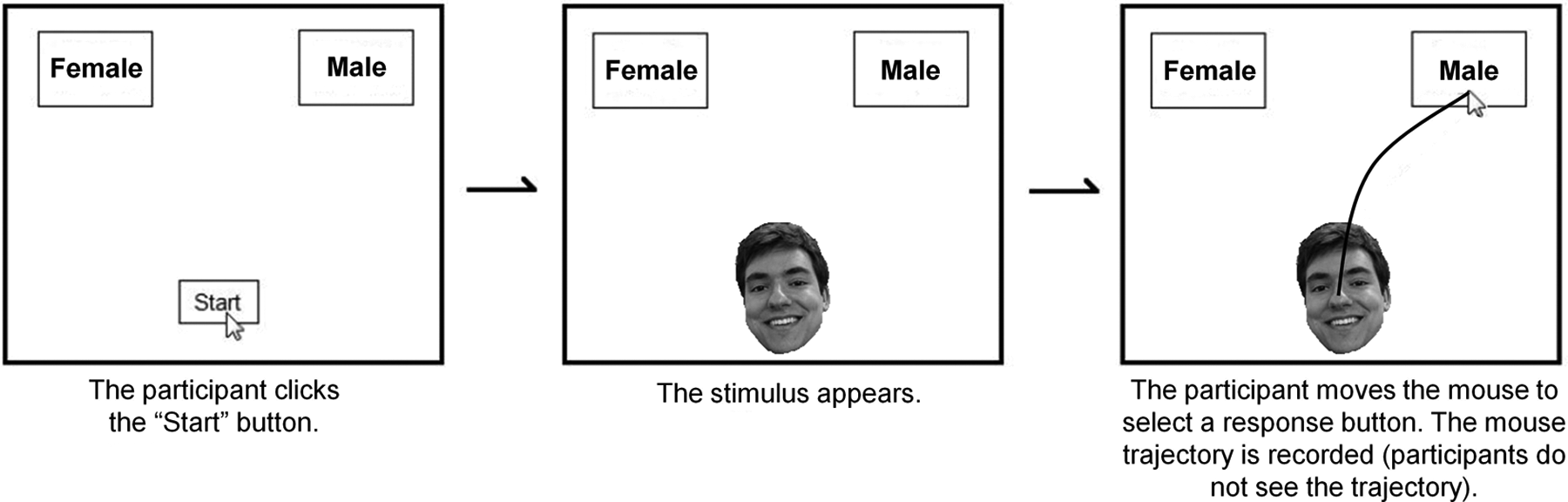
Example mouse-tracking trial.
Uncertainty, in general, is an aversive state that individuals are motivated to resolve (Gao & Gudykunst, 1990), though there is considerable variation in the extent to which individuals tolerate it (Webster & Kruglanski, 1994). For example, conservatives are less tolerant of uncertainty, which is thought to reflect a relatively rigid cognitive style and value placed on adhering to traditional gender roles (Carney, Jost, Gosling, & Potter, 2008; Jost et al., 2007; Lye & Waldron, 1997). In contrast, liberals exhibit greater tolerance of ambiguity and cognitive flexibility (Carney et al., 2008; Jost et al., 2007). Within the domain of person perception, this prior work suggests that conservatives, relative to liberals, might exhibit increased aversion for the temporary uncertainty triggered by gender-atypical faces that simultaneously activate male and female categories.
Differences between conservatives and liberals’ tolerance for uncertainty may create a volatile situation for female politicians. Despite associations between masculinity, competence, and leadership (Eagly & Steffen, 1984), conservatives’ preference for traditional gender roles and low tolerance for uncertainty (Jost et al., 2007; Lye & Waldron, 1997) mandates that female politicians’ leadership aspirations are tempered by strong associations with femininity, particularly in their appearance. Accordingly, female politicians who appear less feminine might fare poorly in conservative constituencies that value more traditional gender appearances. Consistent with this possibility, recent research measured the gender typicality of U.S. Congressional representatives and found that conservative women, in particular, were uniquely gender typical (Carpinella & Johnson, 2013a). These women may have been more successful, in part, because their gender-typical appearance affirmed the value of the traditional gender norms of the conservative constituencies that elected them. If correct, this implies that subtle facial cues to masculinity and femininity might influence important electoral outcomes differently depending on the conservatism or liberalism of politicians’ constituencies.
That facial cues impact electoral success is by now a well-documented phenomenon, as traits inferred from these cues exert a large impact on a range of politically relevant evaluations (Hehman, Leitner, Deegan, & Gaertner, 2013; Hehman, Leitner, & Gaertner, 2013; Todorov, Mandisodza, Goren, & Hall, 2005; Zebrowitz & McDonald, 1991). For instance, a large literature has revealed how observers’ judgments of facial competence track politicians’ electoral success (for review, see Olivola & Todorov, 2010). Furthermore, other research has demonstrated how the facial cues predictive of electoral success differ for male and female politicians (Chiao, Bowman, & Gill, 2008; Poutvaara, Jordahl, & Berggren, 2009). However, while the way in which preferences for leaders with masculine and feminine cues are shaped has been studied (Spisak, Dekker, Krüger, & van Vugt, 2012; Van Vugt & Spisak, 2008), as well as the link between gender and perceived leadership traits (Huddy & Terkildsen, 1993), the direct relationship between uncertainties elicited by gendered facial cues and electoral success has remained unexplored. Moreover, how this relationship may be moderated by top-down perceiver characteristics, such as conservatives’ ambiguity aversion and preference for gender typicality, is unknown.
In the current work, we test how initial gender uncertainty—specifically the partial parallel activation of gender categories proposed by recent theoretical models—predicts real-world electoral outcomes. We do so by recording mouse trajectories during gender categorization, where deviations in trajectories reflect initial uncertainty during the perceptual process. Furthermore, we examine the interactions between top-down perceiver characteristics (state-level conservatism) and the bottom-up perception of gender in determining electoral success.
Study 1
Here, we used computer mouse tracking to test how gender-category competition, or the simultaneous activation of both male and female categories in the first few hundred milliseconds of person perception, influenced individual-level subjective voting using a local laboratory sample, probing whether this relationship varied by politician gender.
Furthermore, this laboratory approach provided the resolution to capture the time course of mouse trajectory deviations, indexing at what point during the gender categorization process winners of an electoral competition might be differentiated from losers. The timing of mouse trajectory deviations has been used as a millisecond resolution measure of the time course of category activations (Dale & Duran, 2011; Freeman & Ambady, 2010). Facial cue processing early in the perceptual stream drives social categorization processes (Cloutier, Mason, & Macrae, 2005), and we were additionally interested in examining when during gender categorization would sensitivity to gendered facial cues be associated with voting outcomes. Accordingly, we used the millisecond resolution of mouse tracking to index when mouse trajectories during gender categorization might differentiate winners from losers.
Method
Stimuli
Photos of the winner and runner-up politicians in Senate and gubernatorial electoral contests between 1998 and 2010 were collected from politicians’ websites and Wikipedia. Thus, the photos used were those released by the politicians (i.e., not candid), controlling for self-presentation. Politicians who were particularly well known, non-White, and those who ran unopposed were omitted, resulting in 198 usable targets (80 female). Photos were cropped to show only politicians’ face and hair, gray-scaled, and standardized for size (Figure 2).
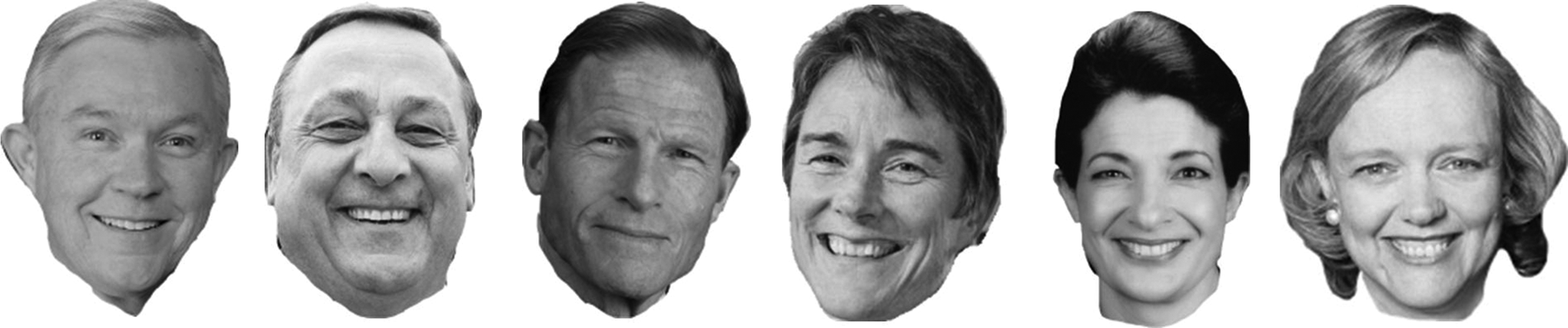
Example target stimuli.
Normed Ratings
Given the role of competence and attractiveness in political decisions based on facial appearance (Budesheim & DePaola, 1994; Todorov et al., 2005), we collected ratings of competence (N = 22) and attractiveness (N = 32) from separate samples on Mechanical Turk for use as a statistical control. Participants rated each politician’s face on a 1 = Not at all [competent, attractive] to 7 = Very [competent, attractive] scale for monetary compensation.
Participants and Procedure
Thirty-two (21 female) 1 undergraduate students at Dartmouth College participated for partial course credit. Following five practice trials, participants categorized politicians’ faces as male or female in a gender categorization task (see Figure 1). During this process, we recorded the streaming x, y coordinates of the mouse (sampling rate ≈ 70 Hz). A total of 198 trials were presented in random order. Left/right placement of “male” or “female” response alternatives was counterbalanced across participants. The MouseTracker software package recorded and processed mouse trajectories (see Freeman & Ambady, 2010, for details on preprocessing, analytic techniques, and validation). To ensure trajectories were online and capturing participants’ decision process, we encouraged participants to begin initiating movement early. As in previous research (Freeman & Ambady, 2011b; Freeman et al., 2008), if initiation time (the moment the mouse was first moved) exceeded 400 ms, a message appeared after participants made their response, encouraging them to start moving earlier on future trials even if not fully certain about their response. Prior to analysis, all trajectories were rescaled into a standard coordinate space (top-left: [−1, 1.5]; bottom-right: [1, 0]). For comparison, all trajectories were remapped rightward.
Measures
For each trial of the gender categorization task, we computed area under the curve (AUC): the geometric area between the observed trajectory and an idealized straight-line trajectory drawn from the start and end points (Freeman & Ambady, 2010). A larger AUC is indicative of greater attraction to the opposite category during categorization. AUCs ± 3 SD were removed. Following the gender categorization task, participants indicated how likely they would be to vote for each politician in an election on a 1 = Not at all to 6 = Very likely scale.
Time-course analyses were conducted on trajectories’ x-coordinates in equally spaced bins of 20 ms, comparing the upper tertile with the bottom tertile of politicians receiving a high and low likelihood of participant vote. This comparison was done at the level of the individual vote, rather than averaged across specific politicians. Thus, mouse trajectories categorizing the same politician might appear in both the upper and lower tertile if different participants individually indicated a high versus low likelihood of vote, respectively.
Results
To account for the interdependence of mouse trajectories within each participant, we analyzed data using multilevel modeling (Hierarchical Linear Modeling: Raudenbush, Bryk, & Congdon, 2004). Participants were treated as random, and thus the trajectory data were examined while accounting for between- and within-participant variance.
Variance in AUC was heteroscedastic as a function of politician gender, χ2(31) = 170, p < .001, indicating greater variance among female than male politicians in gender-category competition. Accordingly, a heterogeneous framework was used to accurately model the data. To examine how gender-category competition related to subjective votes above and beyond perceptions of competence and attractiveness, ratings of participant voting likelihood were regressed on contrast-coded target gender, group-centered AUC, competence, attractiveness, and their higher order interactions.
Main effects revealed that male politicians overall were more likely to be voted for (π20 = .508, standard error [SE] = .184, p = .010). Of primary interest to our hypotheses, the effect of gender-category competition on subjective votes was moderated by politician gender, as evidenced by the AUC × Target Gender interaction (π40 = .059, SE = .062, p = .018; Figure 3). Simple slope analyses revealed that AUC was unrelated to likelihood of votes for male politicians (π = .036, SE = .041, p = .381) but negatively associated with votes for female politicians (π = −.082, SE = .032, p = .017). Subsequent analyses including candidates’ perceived competence and attractiveness in the model did not impact the relationship between gender-category competition and voting intentions. 2 Thus, female politicians who elicited greater gender-category competition were rated as less likely to be voted for.
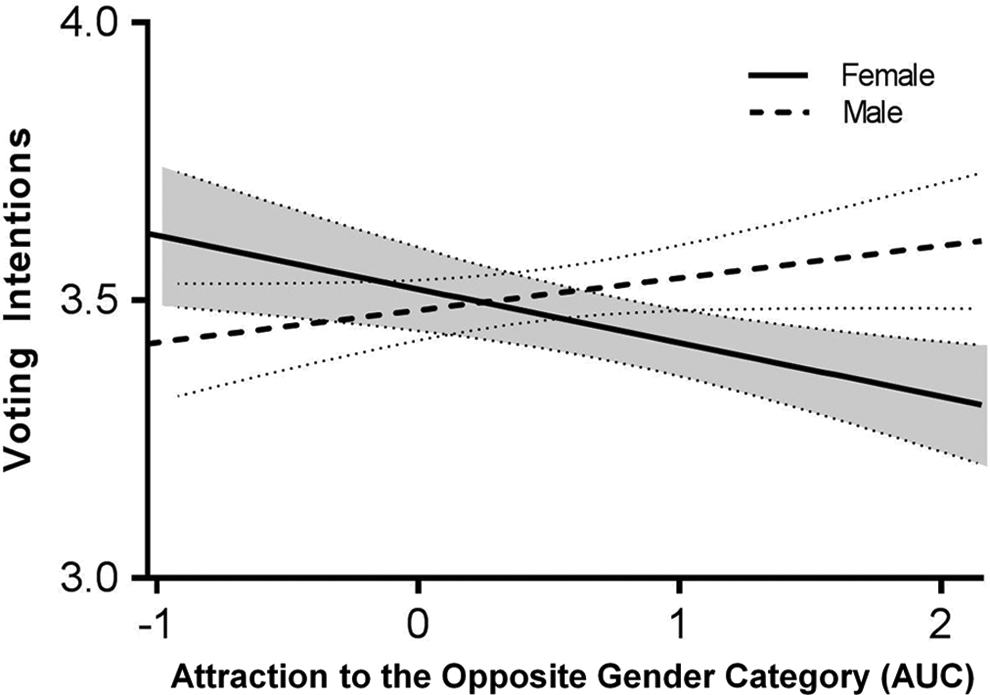
The association between gender-category competition among male and female politicians and subjective voting intentions. Error bands represent 95% confidence intervals.
Time-Course Analysis
We were also interested in the time course of mouse trajectory deviations to gain insight into when during the real-time perceptual process the winners of an electoral competition might be differentiated from losers. To inspect into this time course, mouse trajectories’ coordinates along the x-axis from every trial were averaged into 20 ms intervals from 1 to 1,000 ms following politician face presentation, consistent with prior work (Dale & Duran, 2011; Freeman & Ambady, 2011b). We focused time-course analyses on female politicians since AUC was related only to female voting outcomes. Following remapping (see Method), negative values reflected mouse movement toward the unselected category (male), and positive values mouse movement toward the selected category (female). A correlation between the x-coordinates of mouse trajectories and likelihood of vote was then conducted for every 20-ms time interval (Figure 4). X-coordinates were significantly associated with an increased likelihood of vote by 380 ms after face presentation and remained significantly associated (all ps < .05) until the end of the trajectory. Thus, greater activation of the male category as early as 380 ms following face presentation was associated with the reduced likelihood of a female politician receiving a participant’s vote.
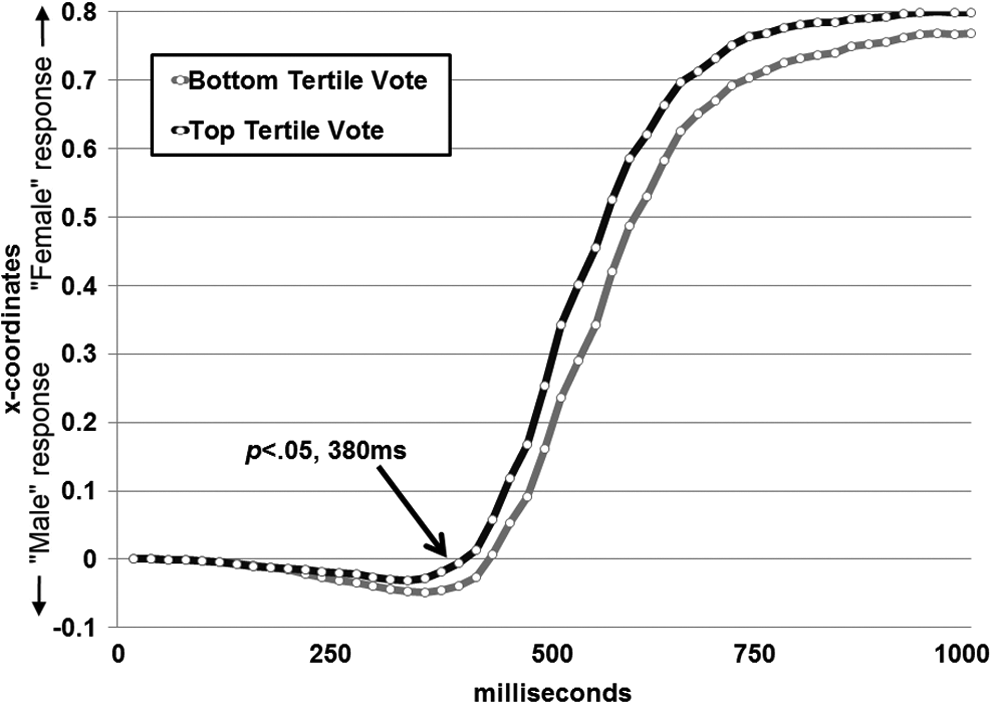
X-coordinates of mouse trajectories plotted over time for female politicians most likely to be voted for (top tertile) versus those least likely to be voted for (bottom tertile) by participant. Note. Tertiles are for visualization purposes only.
Study 1 therefore demonstrated that less feminine female politicians (i.e., those who partially activated the male category) were less likely to be voted for. In addition, these preferences were stable after only 380 ms of visual exposure, indicating that subtle biases early in the perceptual stream might influence the outcomes of critical decisions. In contrast, gender-category competition did not influence voting behavior regarding male politicians.
Study 2
Study 2 extended these results to a more ecologically valid domain to permit greater generalizability. Participants in Study 1 based their voting decisions only on politicians’ faces, in the absence of any additional information about the politician. In a real-world election, however, additional politician information (e.g., proposed policies and politician background) is available and influences voting behaviors (Abramowitz, 1988). Thus, while it was important to assess individual voting behavior in a controlled environment, Study 2 provided a more rigorous test of the relationship between gender-category competition and voting behavior by examining whether mouse trajectories were associated with real-world electoral outcomes, rather than subjective voting.
Second, as discussed earlier, conservatives tend to be less tolerant of uncertainty and place greater value on traditional gender roles (Carney et al., 2008; Jost et al., 2007). Study 2 therefore assessed a more diverse sample to examine whether electoral outcomes across the United States were associated with gender-category competition. Importantly, we examined how politicians’ success might be moderated by their constituencies’ political ideology. To do so, we developed software allowing us to capture remote participants’ mouse trajectories during a gender categorization task through their Internet browser.
Method
Participants
Participants were required to complete the task with a mouse rather than track pad or touch screen, and those with trajectories indicative of non-mouse usage were removed (n = 15). This criterion left 260 participants (119 female and 10 unreported) across the United States (Figure 5) for analysis, and they categorized faces in a computer-based task accessed through Amazon Mechanical Turk for monetary compensation.

Depiction of states ranging from most conservative (White) to most liberal (Black). White dots represent the location of participants in Study 2.
Stimuli and Procedure
Stimuli were identical to Study 1. The procedure of Study 2 was additionally similar to Study 1, with several exceptions. First, participants completed the gender categorization task through an Internet browser on their personal computer. Furthermore, an in-house JavaScript-based implementation of the MouseTracker software (Freeman & Ambady, 2010) recorded and processed mouse trajectories. Following the task, participants reported their gender and zip code for geolocation.
Measures
AUC was calculated identical to Study 1, and AUCs ±3 SD were again removed. The margins of victory for each politician were derived from the outcomes of their Senate and gubernatorial races. Like previous research (Todorov et al., 2005), we calculated the difference in the percentage of votes the politician received (Electoral Outcome), relative to their primary opponent. For example, a politician was assigned a “5” if receiving 5% more of the votes during their electoral contest than their opponent, and a “−5” if receiving 5% fewer of the votes. The percentage of votes for politicians that had competed in multiple contests was averaged. To quantify each state’s conservative to liberal distribution, the margins of victory in each state from the five presidential elections between 1992 and 2008 were averaged and overlaid onto a 7-point continuum resulting in a variable (State Conservatism) ranging from conservative to liberal (Figure 5). The number of participants living in liberal to conservative states was comparable, as reflected by the mean of State Conservatism being close to the midpoint (M = 4.43, SD = 1.69).
In addition, due to concerns that the countrywide sample might be familiar with the identity of politicians and that such familiarity might influence mouse trajectories during gender categorization, a separate sample of participants collected on Mechanical Turk (N = 32) viewed all target stimuli and reported how many targets they were able to identify. This number was very low (mode = 0, M = 3.2), comprising .02% of the target stimuli. Accordingly, we concluded that explicit recognition of politicians was unlikely to have influenced our conclusions.
Results
A heterogeneous multilevel statistical framework was again implemented, as variance in AUC was heteroscedastic as a function of politician gender, χ2(259) = 9,507, p < .001. To examine how gender-category competition related to electoral outcomes for male and female politicians in conservative to liberal states above and beyond perceptions of competence and attractiveness, electoral outcome was regressed on contrast-coded Target Gender, and group-centered State Conservatism, AUC, and their higher order interactions, while controlling for group-centered Competence and Attractiveness. The three-way Target Gender × State Conservatism × AUC interaction on Electoral Outcome was significant (π90 = −.142, SE = .070, p = .043) and was decomposed by examining effects for male and female politicians separately.
Among female politicians, a main effect of State Conservatism (π30 = .339, SE = .076, p < .001) was qualified by an AUC × State Conservatism (π60 = .212, SE = .074, p = .005) interaction, indicating that the influence of gender-category competition (AUC) on electoral outcomes varied between conservative- to liberal-leaning states. Decomposition of this interaction (Preacher, Curran, & Bauer, 2006) revealed that for female politicians running in more conservative states, gender-category competition (AUC) was associated with receiving a decreased percentage of votes (π = −.636, SE = .190, p < .001). Gender-category competition was not associated with outcomes in more liberal states (π = .113, SE = .208, p = .588; Figure 6). Thus, more feminine female politicians, eliciting less gender-category competition, were more likely to win the more traditionally conservative the state. 3 Importantly, the relationship between gender-category competition and electoral success varied by state, rather than sensitivity to facial cues alone, since State Conservatism was unrelated to AUC (π10 = .004, SE = .004, p = .359). As in Study 1, subsequent analyses including the perceived competence and attractiveness of female politicians in the statistical model did not change the relationship between gender-category competition and electoral outcome. 4 Moreover, gender-category competition had no relationship with electoral outcomes among male politicians. Instead, their electoral outcomes were influenced only by perceived Competence and Attractiveness. 5
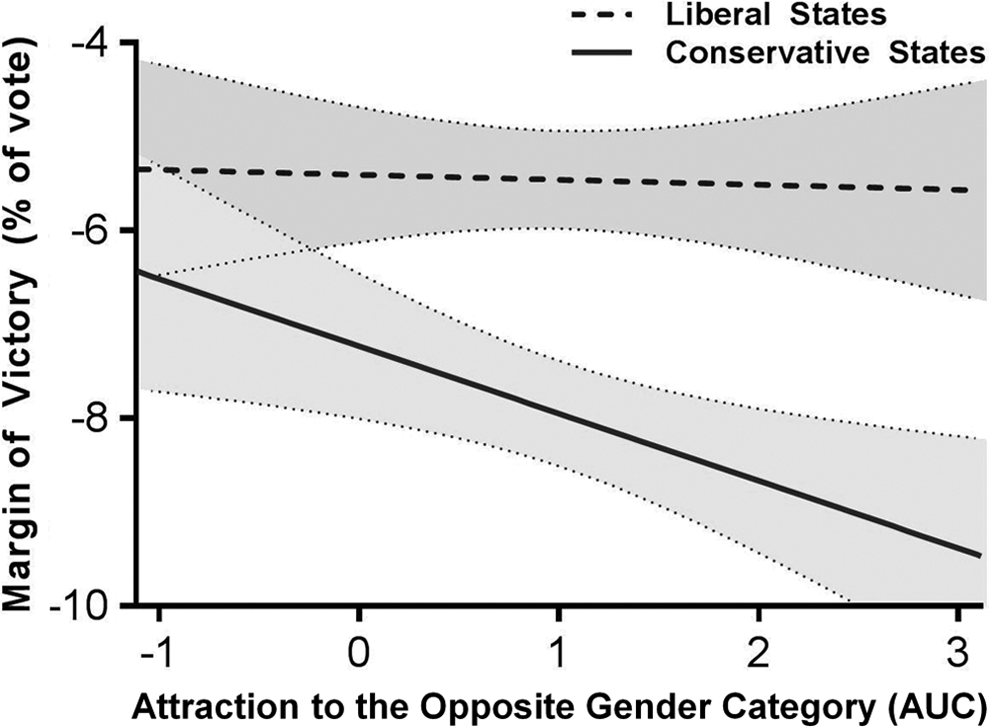
The association between gender-category competition among female politicians and margin of victory in more conservative (−1 SD) versus more liberal (+1 SD) states. Error bands represent 95% confidence intervals. Note. Female politicians’ average margin of victory is negative because the overwhelming majority of races in which females ran were against a male competitor, and on average, males won races against female opponents.
Thus, the present study’s findings are consistent with Study 1 in that female politicians appearing both competent and gender typical have increased odds of electoral success, thereby replicating the effects at the level of statewide outcomes, rather than individual votes, though noteworthy differences between the studies emerged. Effects in Study 1 were consistent across all participants, whereas effects in Study 2 were increasingly larger in more conservative states. Important methodological differences between Studies 1 and 2 are likely to underlie this seeming inconsistency. In Study 2, the dependent variables were the actual political outcomes of real-world electoral contests in which multiple factors were likely to influence votes. Thus, Study 2 provided a conservative test of the relationship between facial cues and electoral outcomes, because any detectable effects would have had to emerge above and beyond the numerous other influences on electoral outcomes. In contrast, Study 1 found that gender-category competition was negatively associated with voting decisions, but in the absence of other politician information. Together, the findings suggest that gender-atypical female politicians may be deemed as less suitable for leadership, overall. In real-world elections, however, when gender typicality is considered alongside additional politician information, the weight afforded to gender typicality for electoral success persists only among those who more strongly value gender typicality: conservatives.
Discussion
In two studies, we demonstrated that gender atypicality undermines the electoral success of women, particularly those with conservative constituencies. Specifically, our findings linked subtle biases occurring in the earliest moments of person perception to electoral outcomes, both in individual vote choices (Study 1) and at the aggregate level with a national U.S. sample (Study 2). First, there was greater variability, and a greater absolute level, of gender-category competition among female than male politicians. Most importantly, female politicians who activated the male category to a greater extent received less electoral support, an effect exacerbated in more conservative constituencies, and individual voting behavior was predicted by this partial activation of the male category only 380 ms after the presentation of a female politician’s face. These effects were independent of other social dimensions previously implicated in political decision making, such as competence, attractiveness, and familiarity.
These findings augment existing research by uncovering a novel mechanism through which facial cues impact electoral outcomes. Though perceptions of competence and attractiveness from politicians’ faces have been previously linked to political success (Ballew & Todorov, 2007; Budesheim & DePaola, 1994; Rule et al., 2010; Todorov et al., 2005), the current research demonstrates that gendered cues uniquely predict female politicians’ electoral success beyond these factors, suggesting a discrepancy between traits used to evaluate male and female politicians. Supportive of this possibility, recent research finds that media coverage of female politicians, at the expense of covering political records and policies, focuses more so on character traits than male politicians (Dunaway, Lawrence, Rose, & Weber, 2013).
Exactly why such a gender discrepancy exists remains unclear. One possibility is that, due to the historical association between males and leadership in U.S. politics, leader-like characteristics may be automatically conferred upon male politicians (thus weakening the impact of gendered cues); but for female politicians, gendered cues may remain influential in perceptions. If true, the gender discrepancy should change depending on the societal context, such as a context in which “male” is no longer the default association. Another possible explanation involves the variance differences between men and women. We found greater variance in the severity of gender-category competition induced by female than male targets. This heteroscedasticity might indicate that primary campaigns or a career in politics “weeds out” candidates who elicit gender-category competition among men more so than women. Future research could directly test these possibilities.
Although our results indicate that gender-typicality has a unique impact on female politicians’ success, competence and attractiveness exerted a strong influence as well. The tandem effects of these characteristics suggest that electoral success for women may require a delicate balance between retaining associations with traditional femininity and attractiveness while additionally evoking perceptions of competence, a masculinity-associated trait (Eagly & Steffen, 1984). Recent research has found that gender typicality is negatively correlated with perceptions of competence among conservative female politicians (Carpinella & Johnson, 2013b), demonstrating the potential difficulty of achieving such a balance. Indeed, this difficulty might help explain the more pronounced underrepresentation of Republican women holding political office (Eagleton Institute of Politics, 2013). Finally, previous research has found that facial familiarity can aid the categorization process (Quinn & Macrae, 2005) and to ensure our effects were independent of familiarity, in a separate sample, we tested how many stimuli were recognized, on average. While this number was quite low (.02% of the stimuli), explicit recognition is distinct from vague familiarity, and the current research cannot conclude definitively that vague familiarity with some politicians is not partly contributing to the effects (though we note it is unclear why familiarity would influence results only for females and not males). Future research using foreign politicians likely to be totally unfamiliar to participants might address this issue.
In contrast to previous research finding that characteristics such as competence are somewhat universally valued in leadership (Antonakis & Dalgas, 2009; Rule et al., 2010), the present studies instead focused on a factor varying between geographic regions: state-level conservatism. It is important to note that participants across these different regions were equally sensitive to gendered facial cues. Rather, what varied was the relationship between this partial activation and electoral success, as more masculine female politicians received a lower percentage of votes in more conservative constituencies.
That the association between gendered facial cues and electoral success varied between regions suggests that ideologically based differences in cognitive processing may exert an influence on politicians’ electoral contests. Only in conservative states, the more a female politician elicited uncertainty and challenged traditional gender norms, the less likely she was to succeed. This finding could be explained either by conservatives’ appreciation of traditional gender norms (Lye & Waldron, 1997), their aversion to uncertainty (Carney et al., 2008; Jost et al., 2007), or both. Previous research has found that evaluations of politicians become more negative as individuals view them as nontraditional or “un-American” (Hehman, Gaertner, & Dovidio, 2011; Yogeeswaran & Dasgupta, 2010), and therefore, it is possible that uncertainty and being nontraditional have independent effects on electoral success. Future research might disentangle these effects by examining voter preferences for targets that are nontraditional in the historical context of the United States, yet elicit no uncertainty along certain dimensions (e.g., the racial dimension for a male African American politician).
In summary, our findings show that the category competition induced by gendered facial cues in the first moments of perception influences politicians’ electoral success, and these effects are more pronounced in conservative constituencies. In doing so, the current research bridges millisecond-level categorization dynamics with important societal consequences and bolsters an emerging literature documenting how even the early processing of one’s facial appearance may significantly impact real-world outcomes.
Footnotes
Acknowledgment
The authors thank Zachary A. Ingbretsen for the development of the web-based software critical to data collection.
Declaration of Conflicting Interests
The author declared no potential conflicts of interest with respect to the research, authorship, and/or publication of this article.
Funding
The author received no financial support for the research, authorship, and/or publication of this article.