




Abstract
Self-control allows people to curb destructive behavior and behave more pro-socially in relationships. Thus, individuals generally trust partners with high dispositional self-control more. However, it is not clear whether partner self-control influences individuals’ responses to acutely risky situations, such as when partners are rejecting. A daily diary study of married and cohabiting couples examined whether actors with high self-control partners behave less self-protectively in risky situations. On days partners were highly rejecting, actors were less likely to retaliate against and more likely to value high self-control partners. On days after partners had been rejecting, actors also reported that high self-control partners behaved more responsively. Actors also trusted partners with high self-control more regardless of risk. Taken together, our findings suggest that partners’ greater self-control may help foster more positive interaction cycles in romantic relationships.
One unpleasant reality of interdependence cannot be escaped: Partners inevitably behave badly (Kelley, 1979). Ben might rebuff Leslie’s need for support because he’s engrossed in a favorite TV show; she might criticize his parenting skills after a sleepless night. To sustain satisfaction and commitment, people must inhibit destructive self-protective inclinations to respond in kind to rejecting partner behavior and instead accommodate (Rusbult, Verette, Whitney, Slovik, & Lipkus, 1991). This article examines how partners’ dispositional capacity for self-control affects actors’ self-protective responses to perceived rejection.
Risk Regulation in Relationships
Being the target of a partner’s rejecting behavior creates the goal conflict central to the risk regulation model (Murray, Holmes, & Collins, 2006). Feeling rejected motivates people to self-protect and push their partner away (Murray, Bellavia, Rose, & Griffin, 2003). But, simultaneously wanting to connect motivates people to instead accommodate and inhibit such self-protective inclinations to distance from their partner (Rusbult et al., 1991).
According to the risk regulation model, people rely on trust in their partner’s caring to help resolve such goal conflicts (Murray et al., 2006). When Ben rebuffs Leslie’s request for support, trusting in his care gives Leslie reason to expect him to redeem himself. Questioning his caring, however, gives her reason to expect continued ill treatment. By shaping Leslie’s expectations for Ben’s repentant or unrepentant behavior, trust guides Leslie’s response to his rejecting behavior. Expecting him to be unrepentant and rejecting motivates her to retaliate and push him away to self-protect against future hurts. Expecting Ben to be repentant and conciliatory instead allows her to curb such self-protective inclinations and gives him the opportunity to redeem himself (Murray et al., 2003).
Prior research has uniformly focused on dispositional qualities in actors that dispose them to be more or less trusting and likely to self-protect in risky interpersonal situations. For instance, low self-esteem people are less trusting than highs (Murray, Holmes, Griffin, Bellavia, & Rose, 2001) and more likely to derogate their partners in situations where they seem rejecting (Gomillion & Murray, 2014; Murray, Rose, Bellavia, Holmes, & Kusche, 2002). Similarly, insecurely attached people derogate their partners when caught in situations that necessitate depending on them (Overall & Sibley, 2009). But the dyadic nature of risky situations raises a new perspective on risk regulation: Dispositional qualities in partners might also lead actors to be more or less likely to self-protect in response to rejecting partner behavior.
The Importance of Partner Self-Control
Partners’ dispositional self-control may be one such quality. Self-control refers to the capacity to inhibit unwanted impulses and align behavior with one’s ideals or goals (Baumeister & Vohs, 2007). People differ in the chronic capacity for self-control (Tangney, Baumeister, & Boone, 2004), but situational factors can also deplete this resource (Baumeister, Bratslavsky, Muraven, & Tice, 1998). Greater self-control allows partners to put relational concerns ahead of self-interested concerns and long-term goals ahead of short-term pleasures (Baumeister & Vohs, 2007; DeWall, Baumeister, Gailliot, & Maner, 2008; Heatherton & Vohs, 1998; Luchies, Finkel, & Fitzsimons, 2011; Tangney et al., 2004). For instance, people with high self-control are more likely to keep promises (Peetz & Kammrath, 2011) and more faithful to their partners (Pronk, Karremans, & Wigboldus, 2011). They also accommodate rather than retaliate in response to a partner’s bad behavior (Finkel & Campbell, 2001) and are less likely to physically aggress against their partners (Finkel, DeWall, Slotter, Oaten, & Foshee, 2009).
In daily interactions, actors with high self-control partners are probably more likely to witness their partner overcoming temptations in order to achieve personal goals (Tangney et al., 2004) and making amends for their transgressions peaceably and constructively (DeHue, McClintock, & Liebrand, 1993; Yovetich & Rusbult, 1994). These observations may provide a basis for gauging whether partners will prioritize meeting actors’ needs. Consistent with this logic, people report trusting spouses and strangers with stronger self-control more than partners with weaker constitutions (Righetti & Finkenauer, 2011). When Ben inevitably behaves in a rejecting way, Leslie might also use trust-relevant insights gained from his past demonstrations of self-control to gauge her need to self-protect. If Ben has greater self-control, Leslie may expect him to repair the situation and behave responsively in the aftermath of his rejection. However, if Ben is deficient in self-control, she may perceive him as less able to engage in reparative behavior. Thus, expectations based on Ben’s greater self-control might allow Leslie to curb her self-protective inclinations to devalue or treat him badly.
Overview and Study Hypotheses
We examined these risk regulation dynamics in a daily diary study of married and cohabiting couples. Participants completed chronic measures of dispositional self-control and trust; they then completed 14 daily reports on their own behavior, their partner’s behavior, and their feelings toward their partners. We expected actors to report greater trust in high than low self-control partners on both daily and chronic measures of trust. We also expected actors’ reports on partners’ rejecting behavior and partners’ dispositional self-control to interact in predicting actors’ tendencies to self-protect in response to partner rejection. We operationalized self-protection through diminished daily reports of partner valuing and increased daily tendencies to engage in rejecting behavior of one’s own.
When actors had low self-control partners, we expected actors to devalue their partner and engage in more rejecting behavior of their own on days they perceived partners as especially rejecting (as compared to low rejection days). In contrast, when actors had high self-control partners, we expected such self-protective inclinations to be attenuated, although not completely overturned. Even though high self-control partners better inhibit their destructive behavioral inclinations (Luchies et al., 2011), being targeted by their rejecting behavior should still hurt enough to provoke some degree of self-protection (Murray et al., 2003). We reasoned that actors would curb self-protective behavior toward high self-control partners because they perceived these partners as better able to repair the relationship in the aftermath of their rejecting behavior. Thus, we also expected actors to report that high self-control partners behaved more responsively on days after actors perceived partners as highly rejecting. Finally, we examined whether actors’ greater chronic trust in high self-control partners could explain why actors with high self-control partners might be better able to inhibit self-protective behavior as hypothesized. That is, we tested for mediation.
Method
Participants
One hundred fifty-four married or cohabiting couples from the Buffalo, NY, community participated. 1 Twelve couples were dropped for not returning for a follow-up appointment or for completing less than seven daily diaries, leaving 142 couples (136 married, 4 engaged, and 2 cohabiting). Participants averaged 36 years of age and had been involved in their relationships 6.89 years on average. Only diaries completed within the designated time frame (i.e., 5:00 p.m. to 5:00 a.m.) were retained for analyses (87%). Couples were paid US$150.
Procedure
Couples were recruited through newspaper and online ads. Those who met the screening criteria (i.e., married or cohabiting 2–15 years; at least 18 years old; living in the same residence) attended an initial lab session. Each participant completed background measures, including measures of dispositional self-control and chronic trust in the partner. Next, the research assistant instructed couples to complete the daily diaries separately before bed each night. Participants were e-mailed a personalized web link to the diary every day for 14 days. The diaries assessed perceptions of the partner’s rejecting and responsive behaviors, participants’ own rejecting behaviors, partner valuing, and trust (among measures unrelated to the current study).
Measures
Self-control
Dispositional self-control (M = 3.35, standard deviation [SD] = .69) was measured with a 13-item scale (α = .85; Tangney et al., 2004) assessing the ability to self-regulate and resist temptation (e.g., “I am able to work effectively toward long-term goals”; 1 = not at all; 5 = very much).
Chronic trust
Global feelings of trust (M = 6.87, SD = 1.51) were measured with an 18-item scale (α = .94) assessing participants’ confidence in their partners’ caring (e.g., “I feel that my partner can be counted on to help me”) and willingness to sacrifice (e.g., “My partner is willing to make significant sacrifices for me”; 1 = not at all true; 9 = completely true).
Daily trust
This 3-item scale (α = .86) assessed actors’ feelings of acceptance from their partners (i.e., “My partner loves me”; “My partner accepts me just as I am”; “My partner sees the best in me”) on a 7-point scale.
Actors’ perceptions of partner rejecting behaviors
This 10-item index measured actors’ daily reports on partners’ rejecting or nonresponsive behavior (e.g., “My partner criticized or insulted me”; “My partner hurt my feelings”; “My partner snapped or yelled at me”; “My partner misled or lied to me”; “My partner contradicted me in front of others”; Yes/no).
Own rejecting behaviors
This 9-item index measured actors’ daily reports on their own rejecting behavior (e.g., “I criticized or insulted my partner” Yes/no). 2
Perceived partner responsive behaviors
A 3-item index assessing actors’ reports on partners’ communal behaviors (e.g., “My partner put my tastes (e.g., food, music, movie) ahead of his or her own tastes”) and a 7-item index assessing comforting behaviors (e.g., “My partner listened to and comforted me”; Yes/no) were standardized and summed to create a measure of partners’ responsive behavior.
Partner valuing
This 5-item scale (α = .82) assessed actors’ daily evaluations of their partner, encompassing feelings of love, satisfaction, and affection (e.g., “In love with my partner”; “Happy with my partner”) as well as negative feelings toward partners (e.g., “Irritated by my partner’s faults”; “My partner won’t admit when he or she is wrong” reversed). Participants reported the extent to which they experienced each feeling on a 7-point scale (1 = not at all; 7 = especially).
Alternative explanations
At the initial lab session, participants completed several personality and relational measures that were examined as potential alternative explanations to our predicted effects. Participants completed the Rosenberg (1965) Self-Esteem Scale (α = .89) and the Adult Attachment Scale (Collins & Read, 1990), which assessed participants’ attachment anxiety (α = .84) and avoidance (α = .84). Participants also completed measures of their commitment to their partners (α = .88) and their satisfaction (α = .92; Rusbult, Martz, & Agnew, 1998).
Results
We first examine whether actors report greater chronic trust in high than low self-control partners. We then turn to the diary data to examine whether actors are also more likely to trust high self-control partners on a daily basis. We then examine whether actors with high self-control partners are less likely to self-protect on days when they experience more rejecting partner behavior and whether actors with high self-control partners perceive their partners as more responsive in the aftermath of the partner’s rejection. Finally, we examine alternate explanations for the effects and test whether chronic trust mediates the predicted daily effects.
Actors’ Chronic Trust and Partners’ Self-Control
Because data from two members of the same couple are not independent (Kenny, 1996), we utilized structural equation modeling to estimate the association between partners’ self-control and actors’ chronic trust. 3 Estimating a model predicting actors’ chronic trust in the partner from both actors’ and partners’ dispositional self-control revealed the expected main effect of partners’ self-control. Actors reported significantly greater trust in partners with greater self-control, b = .27, z = 2.11, p < .05, 95% CI [0.015, 0.525]. 4
Daily Hypotheses
Because daily reports from members of the same couple involve three levels of dependence, we used the multilevel modeling program MLWin (Goldstein et al., 1998) to test our daily hypotheses. We modeled our data as a bivariate outcome model with a two-level nested structure with day of the week at the lowest level and person at the highest level. This approach simultaneously estimates separate regression equations for women and men, controlling for dependence within dyad members. It also permits testing of gender differences (for all intercepts and slopes) and pooling of coefficients in the absence of such differences. In all multilevel analyses, we centered daily predictors (e.g., daily perceptions of the partner’s rejection) on the person’s overall mean for that variable and between-person predictors (e.g., self-control) on the sample means for men and women separately. This approach is essentially identical to the data structure in classic studies by Barnett and colleagues (e.g., Barnett, Marshall, Raudenbush, & Brennan, 1993; Barnett, Raudenbush, Brennan, Pleck, & Marshall, 1995; Raudenbush, Brennan, & Barnett, 1995), except that it exchanges the use of multiple dummy variables indicating gender for a multivariate command that controls how effects are estimated simultaneously for men or women within a couple.
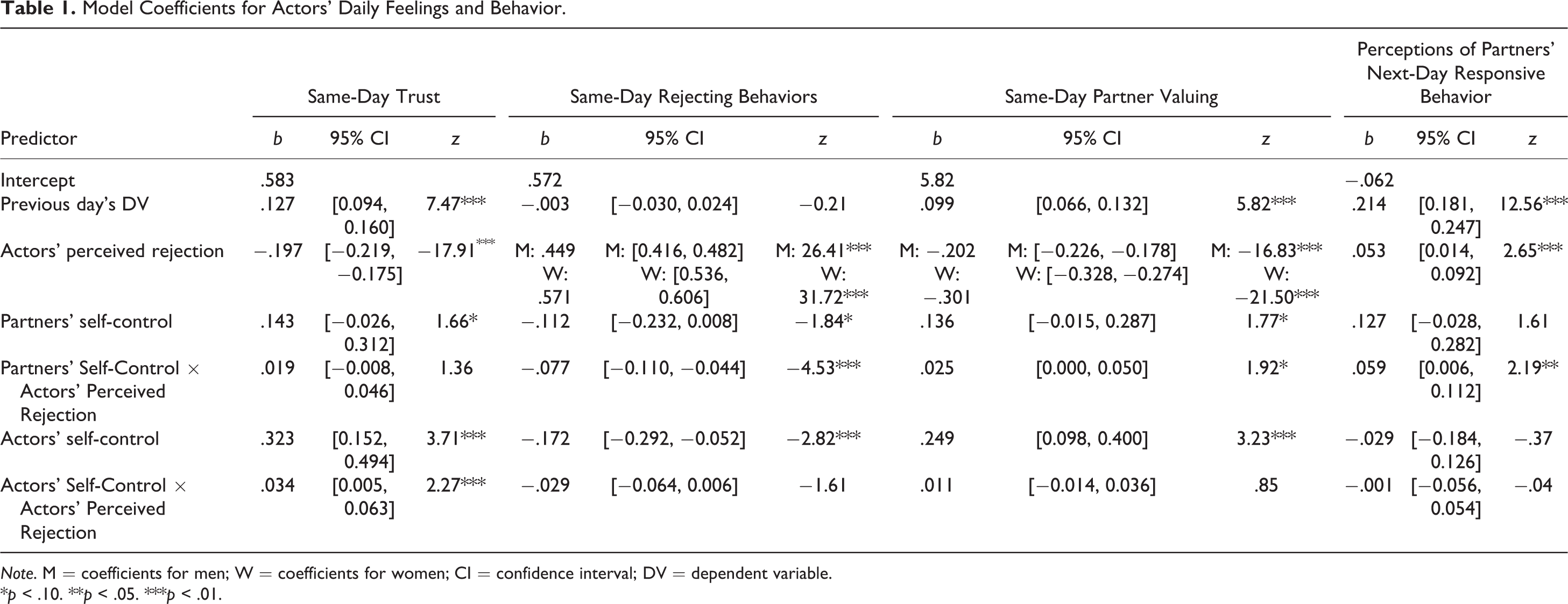
Table 1 lists the predictors and model estimates for the multilevel equations predicting each of the four daily dependent variables (i.e., actor-reported daily trust, self-protective behavior, partner-valuing, and responsive partner behavior). For each dependent variable, we predicted actors’ daily reports from (1) an average level term, B 0, (2) actors’ value of the dependent variable the prior day, B 1, (3) actors’ daily reports on partners’ rejecting behavior, B 2, (3) partners’ dispositional self-control, B 3, (4) the cross-level interaction between actors’ daily reports on partners’ rejecting behavior and partners’ self-control, B 4, and (5) two error terms, one reflecting each participant’s deviation on the dependent variable from the overall average and other reflecting each participant’s daily deviation from their own average level of the dependent variable. To establish that the influence of partner self-control was independent of actors’ own self-regulatory capacity, we also controlled for actors’ own dispositional self-control and its interaction with actors’ daily reports on partners’ rejecting behavior. 5
Model Coefficients for Actors’ Daily Feelings and Behavior.
Note. M = coefficients for men; W = coefficients for women; CI = confidence interval; DV = dependent variable.
*p < .10. **p < .05. ***p < .01.
Daily trust
Table 1 reveals that actors reported greater daily trust in high than low self-control partners, although this expected effect of partner self-control predicting daily trust was only marginally significant (p = .096). Not surprisingly, actors also reported significantly less trust in partners on days they perceived partners to be especially rejecting (as compared to low rejection days). The cross-level interaction between daily perceptions of the partner’s rejection and partner self-control was not significant. 6 Consistent with our intuitions, partner self-control does not fully protect actors against feeling hurt on days their partner was especially rejecting.
Partner Self-Control and Self-Protection
Nevertheless, we still expected perceivers to better resist inclinations to self-protect in the face of rejecting partner behavior when they had high self-control partners. We examined self-protective behaviors on the same day that actors reported partner rejections to index immediate, rather than delayed, responses to perceived rejection.
Own rejecting behavior
As predicted, the two-way interaction between actors’ perception of partners’ rejecting behavior and partners’ dispositional self-control predicting actors’ own rejecting behavior was significant. Figure 1 presents the predicted scores.

Actors’ own rejecting behavior as a function of their perceived partner rejection and partners’ self-control.
We first decomposed this interaction at high and low levels of partner self-control (1 SD above/below the mean). When actors had low self-control partners, they were more likely to self-protect; actors’ tendency to behave badly when partners were more rejecting was stronger when partners were low, b = .580, z = 30.53, p < .001, 95% CI [0.543, 0.617], than high in self-control, b =.433, z =19.68, p <.001, 95% CI [0.390, 0.476]. We next decomposed the interaction at high and low levels of perceived rejection (1 SD above/below the mean). On days partners were especially rejecting, actors engaged in less rejecting behavior themselves when their partner was higher rather than lower in self-control, b = −.228, z = −2.85, p < .01, 95% CI [−0.385, −0.071]. On days partners were less rejecting, there was no association between partner self-control and actors’ rejecting behavior, b = 0.011, z = 0.21, ns, 95% CI [−0.093, 0.115].
Partner valuing
The two-way interaction between actors’ perception of partners’ rejecting behavior and partners’ self-control was marginally significant predicting partner valuing, p = .055 (see Figure 2). The tendency for actors to self-protectively devalue a highly rejecting partner was greater when partners had low self-control, b = −.270, z = −18.00, p < .001, 95% CI [−0.299, −0.241] than when partners had high self-control, b = −.218, z = −12.82, p < .001, 95% CI [−0.251, −0.185]. On days partners were especially rejecting, actors also valued high self-control partners more than low self-control partners, b = .188, z = 2.19, p < .05, 95% CI [0.019, 0.357]. But, on days actors perceived partners as less rejecting, there was no association between partner self-control and actors’ evaluations of their partners, b = .094, z = 1.27, ns, 95% CI [−0.051, 0.239].
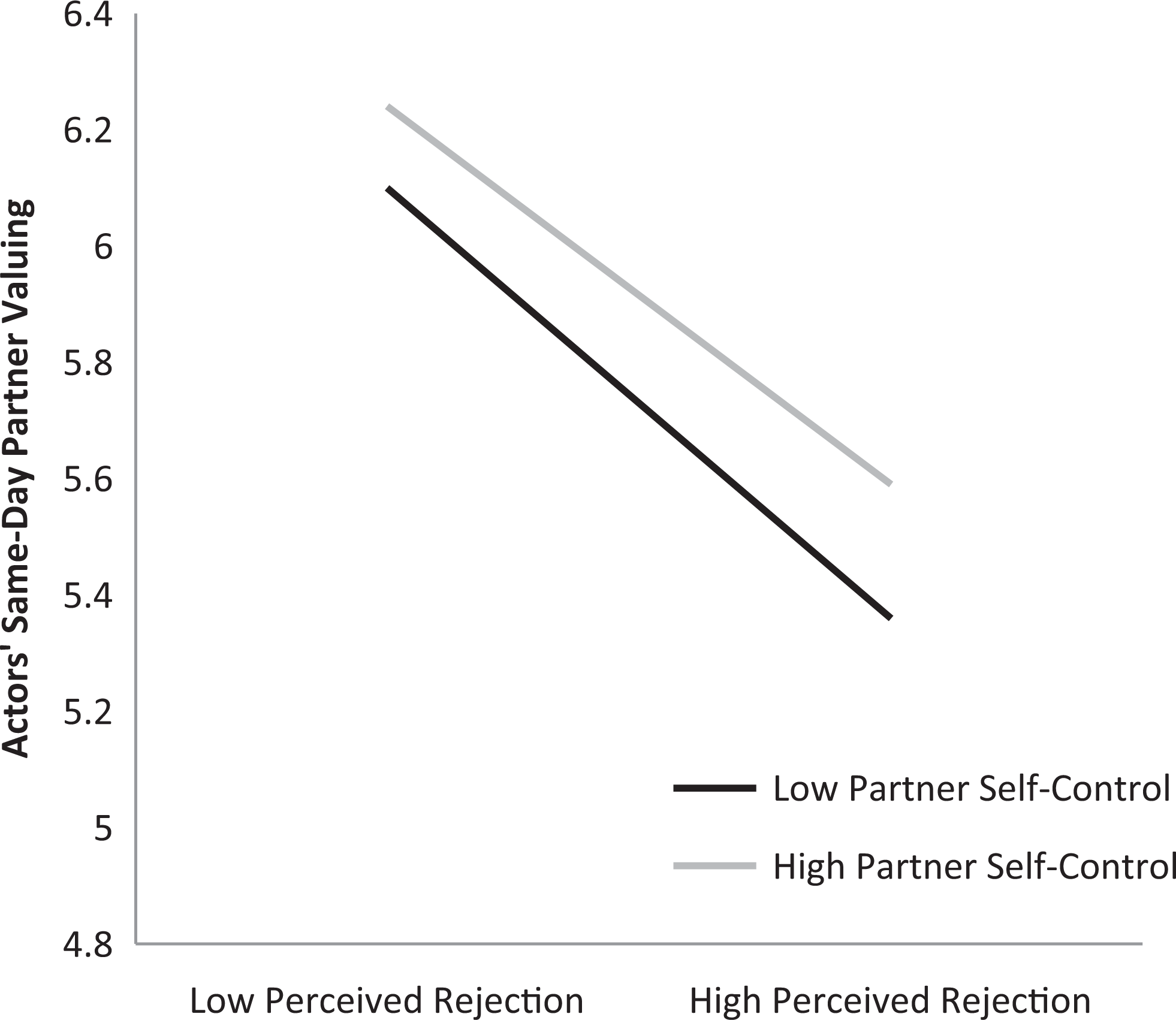
Actors’ partner valuing as a function of their perceived partner rejection and partners’ self-control.
Partner Self-Control and Perceived Responsive Behavior
We next examined the influence of partner self-control and actors’ perceptions of partners’ rejecting behavior on actors’ reports on partners’ responsive behavior the following day. We examined next-day reports of these behaviors because we were interested in predicting actors’ perceptions of partners’ behavior in the aftermath of their perceived rejection. The models predicting responsive behavior were the same as the models predicting the same-day outcomes, except that actors’ reports on partners’ rejection was entered as a lagged variable.
The predicted partner self-control by actors’ perceptions of partners’ rejecting behavior interaction was significant (see Figure 3). Actors perceived high self-control partners as engaging in more responsive behavior on days after their partner had been highly rejecting as compared to days after they had been less rejecting, b = .093, z = 2.66, p < .01, 95% CI [0.024, 0.162]. Actors with low self-control partners did not perceive such compensatory behavior; the simple effect of partners’ perceived rejection on the prior day was not significant, b = .014, z = .47, ns, 95% CI [−0.045, 0.073]. On days after partners had been highly rejecting, actors reported that high self-control partners behaved more responsively than low self-control partners, b = .184, z = 2.24, p < .05, 95% CI [0.023, 0.345]. On days after actors perceived partners as less rejecting, there was no relationship between partner self-control and perceived responsiveness, b = .083, z = 1.00, ns, 95% CI [−0.080, 0.246].
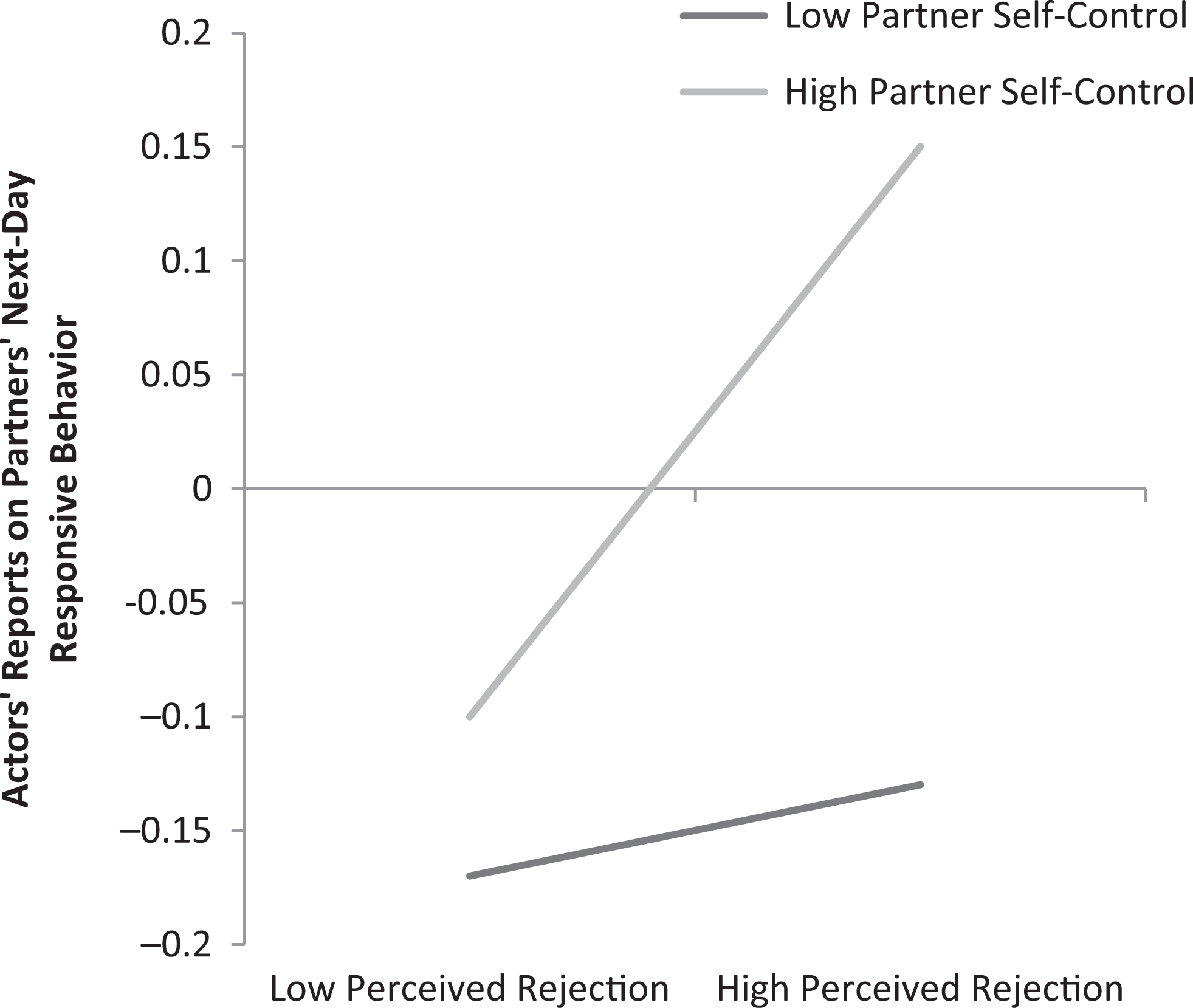
Actors’ perceptions of partners’ responsive behavior as a function of perceived partner rejection and partners’ self-control.
Alternative Explanations
We believe partner self-control moderated these risk regulation dynamics because actors use observations of partners’ self-control successes or failures to forecast whether partners will be repentant and responsive. But, self-control could simply be a proxy for another dispositional variable that promotes better partner behavior (Feeney & Collins, 2001). To examine this possibility, we reestimated the multilevel equations predicting own rejecting behavior, partner valuing, and next-day perceived responsiveness, but we controlled for self-esteem and attachment anxiety and avoidance and their cross-level interactions with actors’ perceptions of partners’ rejecting behavior. Table 2 summarizes these control analyses. The predicted partner self-control by perceived rejection interactions remained robust for all three daily outcomes. Partner self-control might also simply reflect partners’ motivation to behave responsively, as captured by their commitment or satisfaction. But, all Predicted Partner Self-Control × Perceived Rejection interactions were significant or marginally significant when partners’ commitment and satisfaction and their cross-level interactions with perceived rejection were controlled.
Coefficients for Models Controlling for Alternative Variables.

Note. M = coefficients for men; W = coefficients for women; CI = confidence interval.
*p < .10. **p < .05. ***p < .01.
Mediation by Chronic Trust
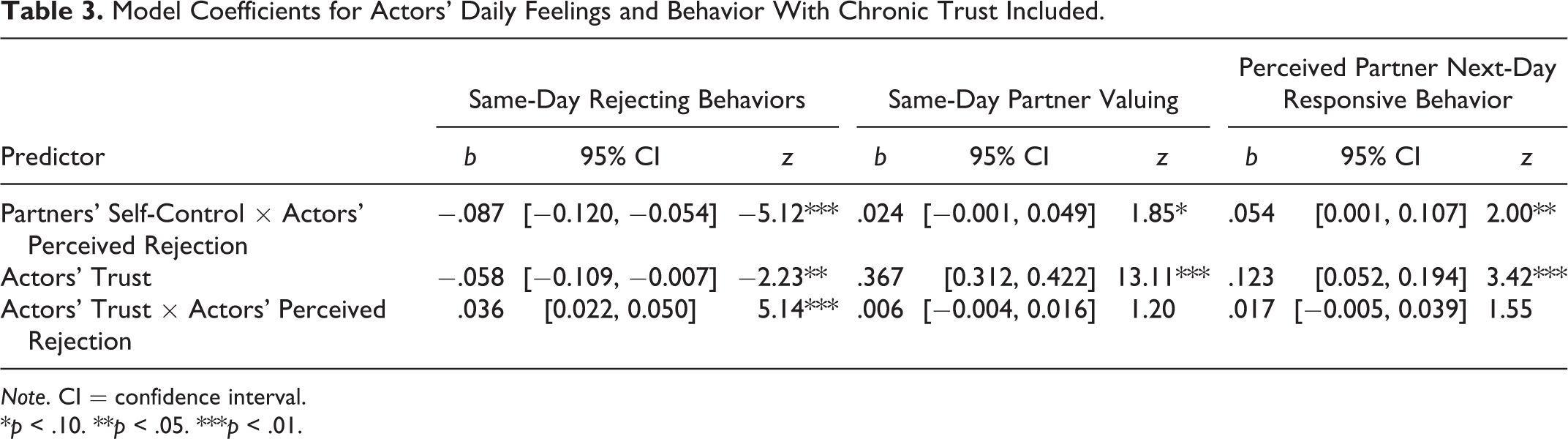
We reasoned actors with high self-control partners might respond less self-protectively to rejection because actors have greater trust in partners with high self-control. Thus, we tested whether chronic trust mediated the partner self-control by actors’ perceptions of partners’ rejection interaction for our three outcomes (i.e., Model 15, Hayes, 2013). Specifically, we entered chronic trust and its cross-level interaction with actors’ perceived partner rejection into our multilevel models (see Table 3). The results were not consistent with mediation. Actors’ chronic trust did not mimic the effects of partners’ self-control in moderating responses to perceived rejection; moreover, the size of each of the three obtained partner self-control by actors’ perceived partner rejection interactions was not altered by the inclusion of the actors’ chronic trust by perceived partner rejection interactions.
Model Coefficients for Actors’ Daily Feelings and Behavior With Chronic Trust Included.
Note. CI = confidence interval.
*p < .10. **p < .05. ***p < .01.
Discussion
When partners behave hurtfully, trusting in a partner’s responsiveness helps curb inclinations to self-protect and pull away from the partner (Murray et al., 2006). Although past research has profitably explored dispositional features of actors that afford trust and inhibit self-protection, the current research is among the first to examine how a partner’s dispositional characteristics shape self-protective behavior.
As we predicted, actors seemed to rely on partners’ dispositional self-control as a heuristic to gauge their trustworthiness. On both daily and chronic measures of trust, actors reported greater trust in high than low self-control partners. On days when partners were perceived as especially rejecting, actors were also more likely to curb self-protective inclinations to devalue and treat their partner badly when they had high versus low self-control partners. In fact, partner self-control predicted actors’ attenuated self-protection in response to rejection even though actors with high self-control partners still experienced their rejecting behavior as acutely hurtful. Thus, a partner’s self-control does not appear to provide a panacea against the acute experience of distrust. Instead, partner self-control might afford a more general sense of optimism in partners’ future behavior that helps actors resist self-protectively retaliating when they feel hurt.
Indeed, we believe these effects emerged in part because witnessing a partner successfully exert self-control gives actors reason to expect that their partner has sufficient capacity to make amends should actors attempt to reconnect (Finkel & Campbell, 2001). Consistent with this assumption, actors reported that high self-control partners were significantly more responsive on days after they were perceived as highly rejecting. Over time, actors’ willingness to curb their self-protective behavior toward high self-control partners may create a self-fulfilling prophecy that fosters more positive interaction cycles in relationships. Namely, actors’ expectations that high self-control partners will make amends for their rejecting behavior may motivate actors to inhibit their own impulse to retaliate. In turn, actors’ more magnanimous behavior toward high self-control partners may allow partners to meet actors’ expectations by behaving responsively. Through such dynamics, conflicts may resolve before they become too destructive.
Limitations and Directions for Future Research
Although our findings provide solid support for our primary hypotheses, this study does have limitations. Our findings were correlational. We ruled out several alternate explanations for our results by controlling for actors’ own self-control and by demonstrating that the effects of partner self-control are not due to dispositional factors such as self-esteem or attachment insecurity or to motivational factors such as commitment or satisfaction. Nonetheless, a yet-to-be identified third variable could account for the effects of partner self-control. Future research might experimentally manipulate perceived partner rejection and partner self-control to provide causal evidence to complement our correlational findings.
The current study also failed to identify a clear mechanism for the effects. Chronic trust did not mediate the effects of partner self-control on actors’ self-protective responses to risk as we reasoned it might. However, trust has both explicit and implicit forms, either of which can govern self-protective behavior (Murray, Pinkus, Holmes, Harris, Gomillion, Aloni, Derrick, & Leder, 2011). Thus, it is possible that trust may still drive the effects of partner self-control on actors’ self-protective responses to risk but that this process may not be conscious. Witnessing a partner’s demonstrations of self-control may condition greater implicit trust in partners’ responsiveness, whereas witnessing a partner’s self-control failures may condition lower implicit trust. These differences in actors’ implicit trust may in turn become contextually activated when actors experience their partners’ rejection (Rydell & Gawronski, 2009), leading to differences in actors’ self-protective responses.
The current findings also suggest a clear limitation to the benefits of having a high self-control partner. Actors still distanced from high self-control partners when they were rejecting, although this effect was somewhat attenuated. This fact raises the possibility that we might have operationalized partner self-control in an overly conservative manner. We utilized the partner’s self-reported self-control because we expected actors to witness partners’ self-regulatory successes and failures and reach an assessment of partners’ capacity for self-control that mirrored partners’ self-perceptions. However, given the biases inherent in social perception (Griffin & Ross, 1991), actors might reach different conclusions about their partner’s self-control than their partner does. Future research might directly examine actors’ judgments of partners’ self-control to see whether perceiving a partner as high in self-control actually allows people to completely overturn inclinations to self-protect in the face of rejection.
Conclusion
Navigating risky situations can be a daunting feature of romantic life. Fortunately, partners’ self-control may signal that they will ultimately be responsive even when they have behaved badly. In the face of acute rejection, actors respond less self-protectively when their partners are high in self-control than when partners are low in self-control. High self-control partners, in turn, redeem themselves by behaving responsively following their hurtful actions. Potentially, such dynamics may curb negative interaction cycles and lead to more positive relationship outcomes for people with high self-control partners.
Footnotes
Acknowledgment
The authors thank John Holmes and Shira Gabriel for their comments on an earlier draft of this article and their undergraduate research assistants for their assistance in data collection.
Declaration of Conflicting Interests
The author(s) declared no potential conflicts of interest with respect to the research, authorship, and/or publication of this article.
Funding
The author(s) disclosed receipt of the following financial support for the research, authorship, and/or publication of this article: This work was supported by the National Science Foundation (BCS-1143747).
Notes

References
Supplementary Material
Please find the following supplemental material available below.
For Open Access articles published under a Creative Commons License, all supplemental material carries the same license as the article it is associated with.
For non-Open Access articles published, all supplemental material carries a non-exclusive license, and permission requests for re-use of supplemental material or any part of supplemental material shall be sent directly to the copyright owner as specified in the copyright notice associated with the article.
