




Abstract
A daily diary study of married couples tested the hypothesis that automatic partner attitudes regulate self-protection for low, but not high, self-esteem people. For 14 days both partners reported trust in the other’s caring and perceived and actual rejecting and selfish behavior. On days after low self-esteem people reported less trust in their partner’s caring, those with more positive automatic partner attitudes perceived their partner to be less rejecting and selfish. They also engaged in less rejecting and selfish behavior toward their partner and their partner engaged in less selfish and rejecting behavior toward them. The current findings present the first evidence that automatic partner attitudes may help low self-esteem people inhibit the rejection sensitivity and distancing behaviors that too often undermine their relationships.
The prospect of being rejected by a romantic partner is painful enough to keep the very people who need acceptance most from getting too close. While high self-esteem people unabashedly pursue connection, lows cautiously self-protect against the possibility of rejection. They are quick to perceive rejection in even benign partner behavior (Bellavia & Murray, 2003; Cameron & Robinson, 2010; Murray, Holmes, MacDonald, & Ellsworth, 1998), and they respond to feeling hurt and rejected by pushing their partner away (Cavallo, Holmes, Fitzsimons, Murray, & Wood, 2012; Ford & Collins, 2010; Murray, Rose, Bellavia, Holmes, & Kusche, 2002).
In the risk regulation model, generally trusting in a partner’s caring normally affords the sense of security needed to connect rather than self-protect in risky situations (Murray, Holmes, & Collins, 2006). Although trusting in a partner’s caring is more difficult for low than high self-esteem people (Murray, Holmes, Griffin, Rose, & Bellavia, 2001), lows might still find the impetus to connect rather than self-protect without such explicit confidence. This article tests the hypothesis that positive automatic partner attitudes short-circuit low self-esteem people’s motivation to self-protect, providing a resource that inhibits destructive thoughts and behavior.
Automatic Partner Attitudes: A Basis for Connection?
Automatic attitudes summarize the evaluative history of one’s experience with specific social objects (Banaji & Heiphetz, 2010). By encapsulating the desirability of past encounters, automatic attitudes effectively mobilize motivations to approach desirable and avoid undesirable objects the next time they appear (Fazio, 2007; Fazio, Ledbetter, & Towles-Schwen, 2000; Towles-Schwen & Fazio, 2004; Stanley, Sokol-Hessner, Banaji, & Phelps, 2011; Young & Fazio, 2013). For instance, positively evaluated objects automatically elicit arm movements associated with drawing desirable objects closer, whereas negatively evaluated objects elicit arm movements associated with pushing undesirable objects away (Chen & Bargh, 1999).
In relationships, automatic partner attitudes similarly encapsulate the evaluative history of interactions with the partner (Murray, Gomillion, Holmes, Harris, & Lamarche, 2013). For instance, newlyweds exposed to more responsive partner behavior in the initial months of marriage evidenced more positive automatic attitudes toward their partner on the implicit association task (IAT) 4 years later (Murray, Holmes, & Pinkus, 2010). By summarizing the partner’s past value as a source of reward versus punishment automatic partner attitudes can also mobilize motivations to approach versus avoid the partner (LeBel & Campbell, 2009). For example, newlyweds with more positive automatic attitudes toward their spouse reported more stable satisfaction over 4 years (McNulty, Olson, Meltzer, & Shaffer, 2013).
The power automatic partner attitudes have to mobilize approach is especially evident when ongoing situations threaten trust in a partner’s caring (LeBel & Campbell, 2013; Murray et al., 2011, 2013). Such low-trust situations activate the competing goals to connect to the partner and to self-protect against the partner’s rejection (Murray, Derrick, Leder, & Holmes, 2008). In such situations, prioritizing the goal to connect requires inhibiting the competing goal to self-protect (Fishbach, Friedman, & Kruglanski, 2003; Murray et al., 2006). Possessing more positive automatic partner attitudes appears to facilitate such inhibition (Murray et al., 2011).
Specifically, in situations that threaten trust in a partner’s caring, experiencing more positive affective associations with the partner strengthens the goal to connect, which makes it easier to suppress the competing goal to self-protect. As a consequence of such inhibition in threat situations, people with more positive automatic partner attitudes can paradoxically think and behave better in high- than in low-risk situations, especially when limited self-regulatory capacity increases their susceptibility to automatic partner attitudes. For instance, believing a partner has just provided a copious list of one’s faults actually decreases physiological threat reactions and evaporates apprehension about a partner’s criticism for people who are low in working memory capacity and possess more positive automatic partner attitudes (Murray, Lupien, & Seery, 2012). Such attitudinally resilient people also draw closer to their partner on days after they report less trust in their partner’s caring (Murray et al., 2013).
Will Low Self-Esteem People Set Aside Self-Protection?
Stronger unfulfilled desires to approach versus avoid a specific object can also increase behavioral susceptibility to automatic attitudes (Hofmann & Van Dillen, 2012). Low self-esteem people desire strong interpersonal connections (Leary & Baumeister, 2000) but feel devalued by others, including their spouse (Murray et al., 2001). In situations that put trust in the partner’s caring in question, unfulfilled desires for connection should heighten low self-esteem people’s attention to internal cues that suggest connecting to the partner is still possible (DeWall, Maner, & Rouby, 2009; Gardner, Pickett, & Brewer, 2000; Murray et al., 2008). Indeed, lows typically seize safe opportunities for connection despite eschewing risky ones (Cameron, Stinson, Gaetz, & Balchen, 2010; Forest & Wood, 2011; Marigold, Holmes, & Ross, 2007, 2010).
For lows, positive automatic partner attitudes may provide one such internal cue. Even though lows explicitly question their partner’s caring, they are just as loved and valued as highs (Murray et al., 2001); their partners even go out of their way to behave solicitously and protect them from negative feedback (Lemay & Dudley, 2011). Such positive relationship interactions could subliminally condition highly favorable affective associations with the partner. In situations that threaten trust in a partner’s caring, such activated associations could then strengthen the goal to connect for lows, making it easier to inhibit the competing goal to self-protect and distance from the partner. In contrast to lows, high self-esteem people usually find sufficient incentive to forego self-protection in generally trusting beliefs about their partner’s caring (Cavallo, Murray, & Holmes, 2013). In fact, highs are so practiced at inhibiting self-protection that they automatically turn their attention away from their partner’s faults when acute questions about their caring arise (Lamarche & Murray, 2014).
Overview and Hypotheses
This daily diary study of married couples tests the hypothesis that automatic partner attitudes regulate self-protection for low, but not high, self-esteem people. We indexed self-protection through perceptual and behavioral processes known to inoculate against hurt: (1) being suspicious and quick to detect a partner’s rejecting and selfish behavior and (2) engaging in rejecting and selfish behaviors that push the partner away (Murray et al., 2006). Each day, we measured acute feelings of trust in the partner’s caring (as a barometer of situational risk), perceptions of the partner’s rejecting and selfish behavior, and reports on one’s own behavior.
Rather than affording a chronic motivation to approach (or avoid) a partner, automatic partner attitudes typically are activated when acute concerns about a partner’s caring arise (Murray et al., 2011, 2013). Accordingly, on days after people reported acute doubts about their partner’s caring (i.e., low-trust days), we expected more positive automatic partner attitudes to inhibit self-protective perceptions and behaviors for low, but not high, self-esteem people.
That is, following low-trust days, we expected low self-esteem people with more positive automatic partner attitudes to (1) perceive their partner as being less rejecting and selfish and (2) engage in less rejecting and selfish behavior themselves relative to lows with more negative automatic attitudes. We also expected people to be less rejecting and selfish when they were paired with low self-esteem partners who had more positive automatic attitudes toward them (relative to those paired with lows with more negative attitudes). We expected this dyadic effect because (1) their greater capacity for responsiveness likely conditioned their partner’s positive automatic attitude toward them (Murray et al., 2013; Simpson & Overall, 2014) and (2) their partner inhibiting negativity should make it even easier for them to behave well (Kelley, 1979).
Further, we expected more positive automatic partner attitudes to inoculate relationships against the typical costs of low self-esteem. Following low-trust days, we expected a risk-regulation effect, such that low self-esteem people with more negative automatic partner attitudes would (1) perceive their partner as being more rejecting and selfish and (2) engage in more rejecting and selfish behavior relative to their high self-esteem counterparts. However, more positive automatic partner attitudes inhibit self-protection (Murray et al., 2013). Therefore, following low-trust days, we expected low self-esteem people with more positive automatic attitudes to appear just as resilient as highs because inhibiting self-protection goals allows lows, like highs, to act on the basis of strong goals to connect to the partner.
Method
Sample
One hundred fifty-four couples participated. Twelve were dropped because they did not complete the study or completed fewer than 7 days of diaries, leaving 142 couples (136 married, 4 engaged, and 2 cohabiting). Their mean age was 36.3 years; average relationship duration was 6.9 years. Each couple received US$150. Participants completed 87% of the diaries within the allowable time (i.e., between 5 p.m. and 5 a.m.). Only allowable diaries were analyzed. 1
Procedure
Couples who responded to newspaper ads were screened for eligibility (i.e., at least 18, married 15 years or less or cohabiting between 2 and 15 years, and living in the same residence). Each member of the couple separately completed background measures, including the Rosenberg’s Self-Esteem Scale (1965) and a partner-specific IAT. The research assistant explained that participants would receive a personalized weblink to the diary each day by e-mail, to complete the diary before bed, and to refrain from discussing their diaries. Participants later returned to the laboratory to complete follow-up measures.
Automatic Partner Attitudes
The IAT measure contained seven blocks (Murray et al., 2011, 2013). Participants categorized words belonging to four categories as follows: (1) pleasant words (e.g., vacation, pleasure), (2) unpleasant words (e.g., bomb, poison), (3) words associated with the partner (e.g., partner’s first name, last name, nickname), and (4) words not associated with the partner (e.g., first name not associated with partner). The words in the latter two categories were generated idiographically. The critical blocks consisted of the compatible pairing blocks (practice and test blocks), in which participants used the same response key to respond to pleasant and partner words, and the incompatible pairing blocks (practice and test blocks), in which participants used the same response key to respond to unpleasant and partner words. We computed IAT scores for each participant following the improved scoring algorithm procedure recommended by Greenwald, Nosek, and Banaji (2003). Higher scores reflect more positive automatic attitudes.
Daily Diary
The daily diary included 82 events, tapping experiences at work, interactions with the spouse, and household/family responsibilities, and 42 feelings, tapping self-esteem, mood, trust in the partner’s caring, perceptions of the partner, and evaluations of the relationship. The presentation of items was randomized each day. This study utilizes the items included to capture trust in the partner’s caring and all rejecting and selfish behavior items with parallel actual (e.g., I snapped or yelled at my partner) and perceived (e.g., My partner snapped or yelled at me) reports. We assigned a 1 to occurred events and a 0 to nonoccurred events and summed these scores to provide a continuous index of the behavior in question on each day.
Trust in the partner’s caring
Three items (α = .86; M = 6.87, SD = 1.51) indexed daily trust in the partner’s caring and love (i.e., “My partner … “loves me”; “accepts me just as I am”; “sees the best in me”, 1 = not at all, 7 = especially).
Own rejecting behavior
Nine items indexed how often participants described themselves as engaging in rejecting behavior toward the partner that day (e.g., “I criticized or insulted my partner”; “I ignored or did not pay attention to my partner”). 2
Own selfish behavior
Four items indexed how often participants described themselves as ignoring their partner’s needs (e.g., “I did what I wanted to do instead of what my partner wanted me to do”; “I did not do something I told my partner I would do”).
Perceived rejecting behavior
Nine items indexed how often participants identified their partner as engaging in rejecting behavior toward them (e.g., “My partner criticized or insulted me”; “My partner ignored or did not pay attention to me”).
Perceived selfish behavior
Four items indexed how often participants identified their partner as ignoring their needs (e.g., “My partner did what he/she wanted to do instead of what I wanted him/her to do”; “My partner did not do something he/she told me he/she would do”).
Alternate Explanations
To index explicit partner and relationship attitudes, participants described their partner on the interpersonal qualities scale (Murray, Holmes, & Griffin, 1996; α = .89) and completed a global measure of relationship satisfaction (Murray, Holmes, & Griffin, 2000; α = .92).
Results
We expected the interaction between self-esteem and automatic partner attitudes to predict self-protective perceptions and behavior following low- but not high-trust days. We created separate indices of self-protective perceptions and behavior by summing standardized responses to the perceived “rejecting” and “selfish” behavior scales and the actual rejecting and selfish behavior scales, respectively. We then tested the hypothesized 3-way interactions using the multilevel modeling program MLWin (Goldstein et al., 1998) because daily reports from both members of a couple involve three levels of dependence.
We modeled our data as a bivariate outcome model (women vs. men) with a two-level nested structure, with day at the lowest level and person at the highest level. This approach estimates one regression equation for women and one for men, controlling for dependence within dyads. 3 We simultaneously estimated both actor (e.g., the effect of Gayle’s automatic attitudes on her own behavior) and partner effects (e.g., the effect of Ron’s automatic attitudes on Gayle’s behavior). We centered daily-level predictors (e.g., trust) on the person’s daily mean. For trust, more negative scores on a given day capture low-trust or high-risk days on which people reported less trust in their partner’s caring than was typical for them. We centered between-person predictors (e.g., self-esteem) on the sample mean for women and men. We present coefficients that are pooled across gender unless model tests revealed a significant gender difference, which the tables denote through W/M subscripts.
Reports on Perceived Behavior
On days after people reported less than usual trust in their partner’s caring, we expected automatic partner attitudes to predict sensitivity to perceiving rejection for low, but not high, self-esteem people. We predicted actors’ perceptions of their partner’s rejecting and selfish behavior today from (1) an intercept term, (2) actors’ perceptions of the partner’s behavior on the prior day, and the main, two-way, and three-way interactive effects of actors’ self-esteem, automatic partner attitudes, and trust on the prior day, and (3) partners’ perceptions of actor’s behavior on the prior day, and the main, two-way, and three-way partners’ self-esteem, automatic partner attitudes, and trust on the prior day. 4 To isolate daily or within-person changes in trust from between-person differences in trust, we also included actors’ and partners’ average levels of trust across days (as well as their respective interactions with self-esteem and daily trust). Finally, we included error terms that captured the deviation of each person’s average from the overall average and each person’s daily deviation from his or her mean on Y.
Table 1 lists the variables and model estimates. The actor effects index whether actors’ self-esteem and automatic attitudes predict their sensitivity to perceiving rejection on days after they reported less than usual trust in their partner’s caring. The expected three-way interaction was significant for actors. The actors’ automatic partner attitudes by self-esteem interaction was significant following low-trust days, b = .372, z = 2.51, p = .01, 95% confidence interval (CI) [082, .662], but not high-trust days, b = .05, z = .34, ns, 95% CI [−.236, .336]. Figure 1 presents the predicted scores, plotted using 1 SD above/below the mean for self-esteem and automatic partner attitudes. 5
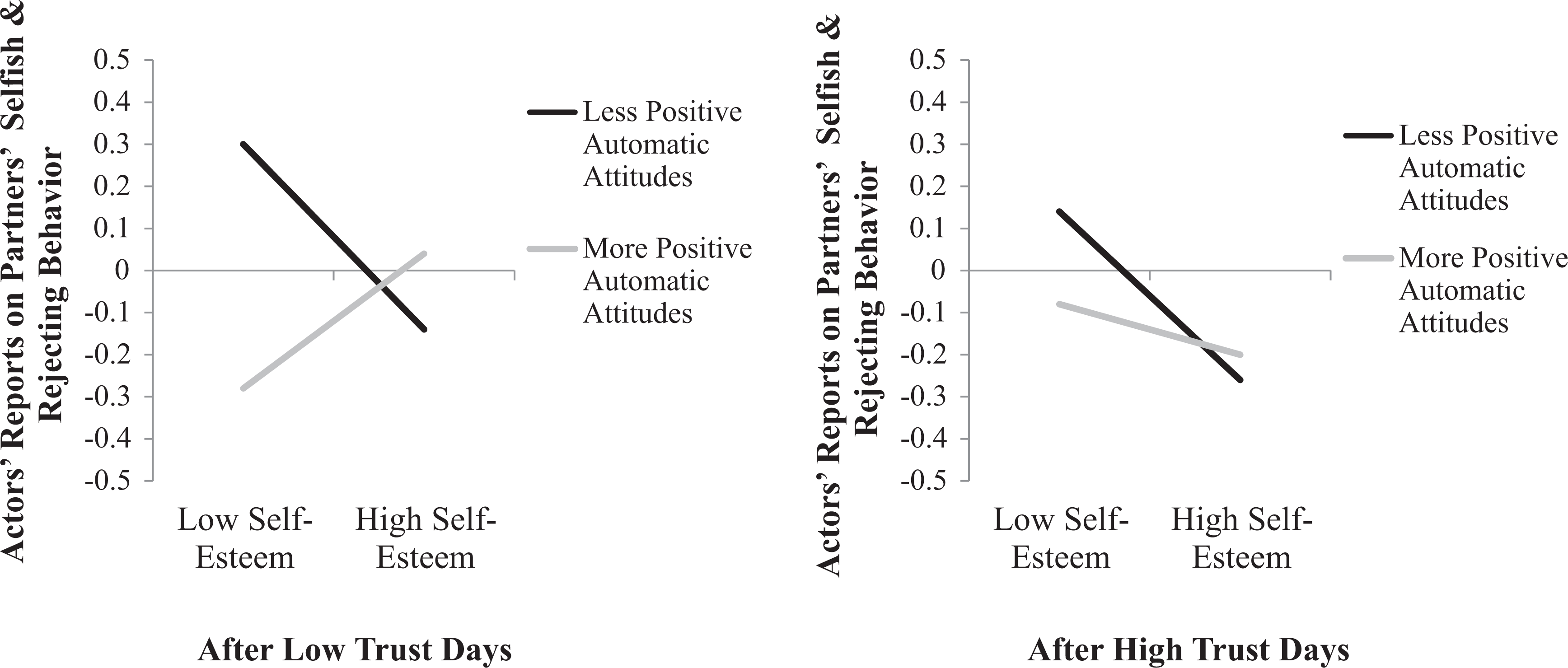
Actors’ perceptions of partners’ selfish and rejecting behavior as a function of actors’ self-esteem, automatic partner attitudes, and the prior day’s trust.
Reports on Perceived Behavior.
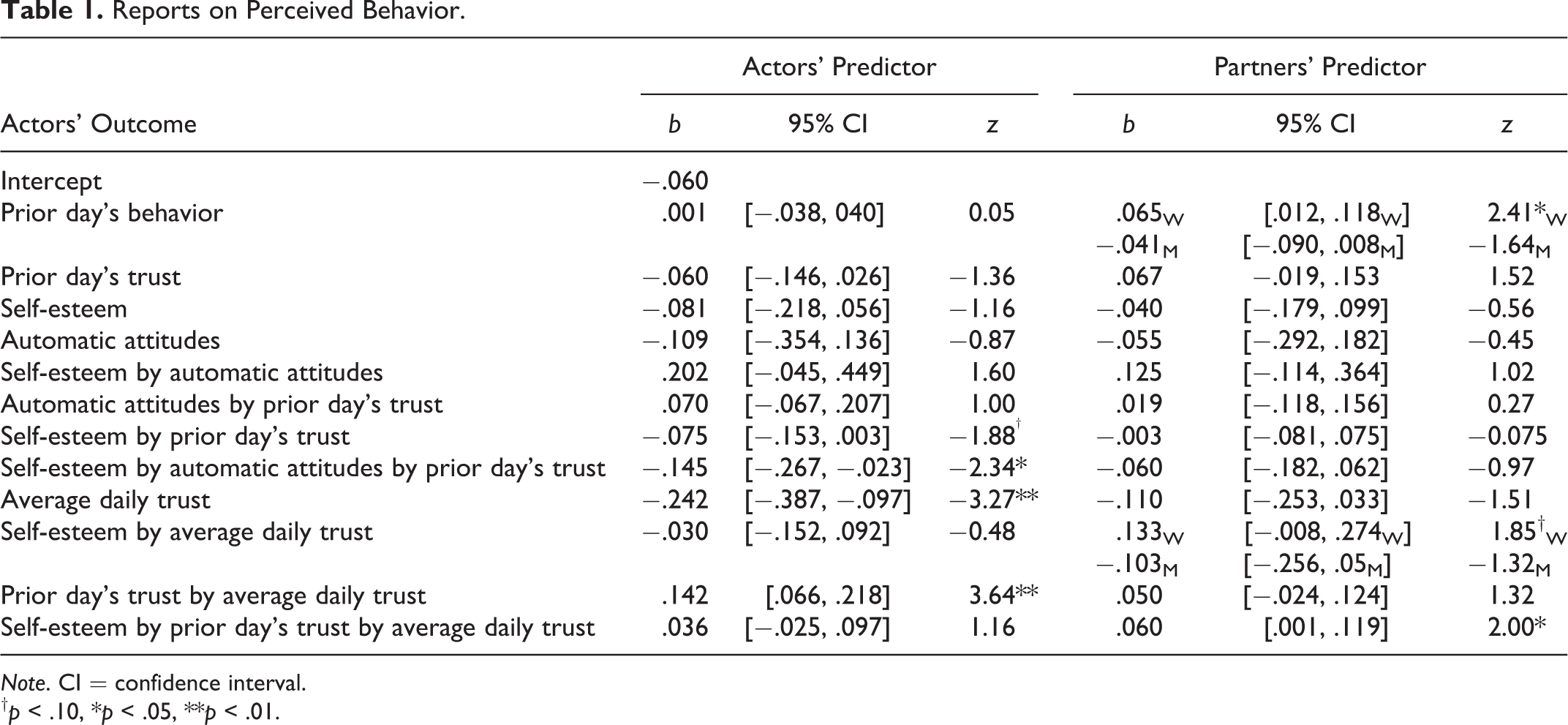
Note. CI = confidence interval.
† p < .10, *p < .05, **p < .01.
The left side of Figure 1 illustrates the effects on days after actors reported greater than usual doubts about their partner’s caring. Inspecting the simple effects revealed that low self-esteem actors with more positive automatic attitudes inhibited self-protection. That is, after low-trust days, lows with more positive automatic attitudes perceived their partner to be less rejecting and selfish than lows with more negative automatic attitudes, b = −.483, z = −2.50, p = .01, 95% CI [−.861, −.105]. Automatic attitudes did not predict perceptions for high self-esteem actors, b = .102, z = .53, ns, 95% CI [−.274, .478]. Following low-trust days, low self-esteem actors with more negative automatic partner attitudes tended to perceive their partner as more rejecting and selfish than high self-esteem actors with more negative automatic partner attitudes, b = −.201, z = −1.70, p = .09, 95% CI [−.432, .030]. However, low self-esteem actors with more positive automatic partner attitudes actually tended to perceive their partner to be less rejecting and selfish than highs with more positive automatic partner attitudes following low-trust days, b = .202, z = 1.70, p = .09, 95% CI [−.031, .435]. The right side of Figure 1 illustrates the main effect of self-esteem that emerged after high-trust days. Low self-esteem people perceived their partner to be more rejecting and selfish than highs even on days after they reported greater than usual trust in their partner’s caring, b = −.176, z = −2.04, p = .04, 95% CI [−.345, −.007].
Reports on Actual Behavior
Following low-trust days, we expected low self-esteem people to engage in less rejecting and selfish behavior when they had more positive automatic partner attitudes. Following low-trust days, we also expected people to engage in less rejecting and selfish behavior when their low self-esteem partners had more positive automatic attitudes. The logic of these analyses parallels the first, except that the dependent measure is actors’ reports on their own behavior. Table 2 lists the predictors. The actor effects index whether actors’ behavior differs as a function of their own self-esteem, automatic partner attitudes, and trust on the prior day. The partner effects index whether actors’ behavior differs as a function partners’ self-esteem, automatic partner attitudes, and trust on the prior day. The predicted and significant three-way interactions emerged for actors (Figure 2) and partners (Figure 3).
Reports on Actual Behavior.
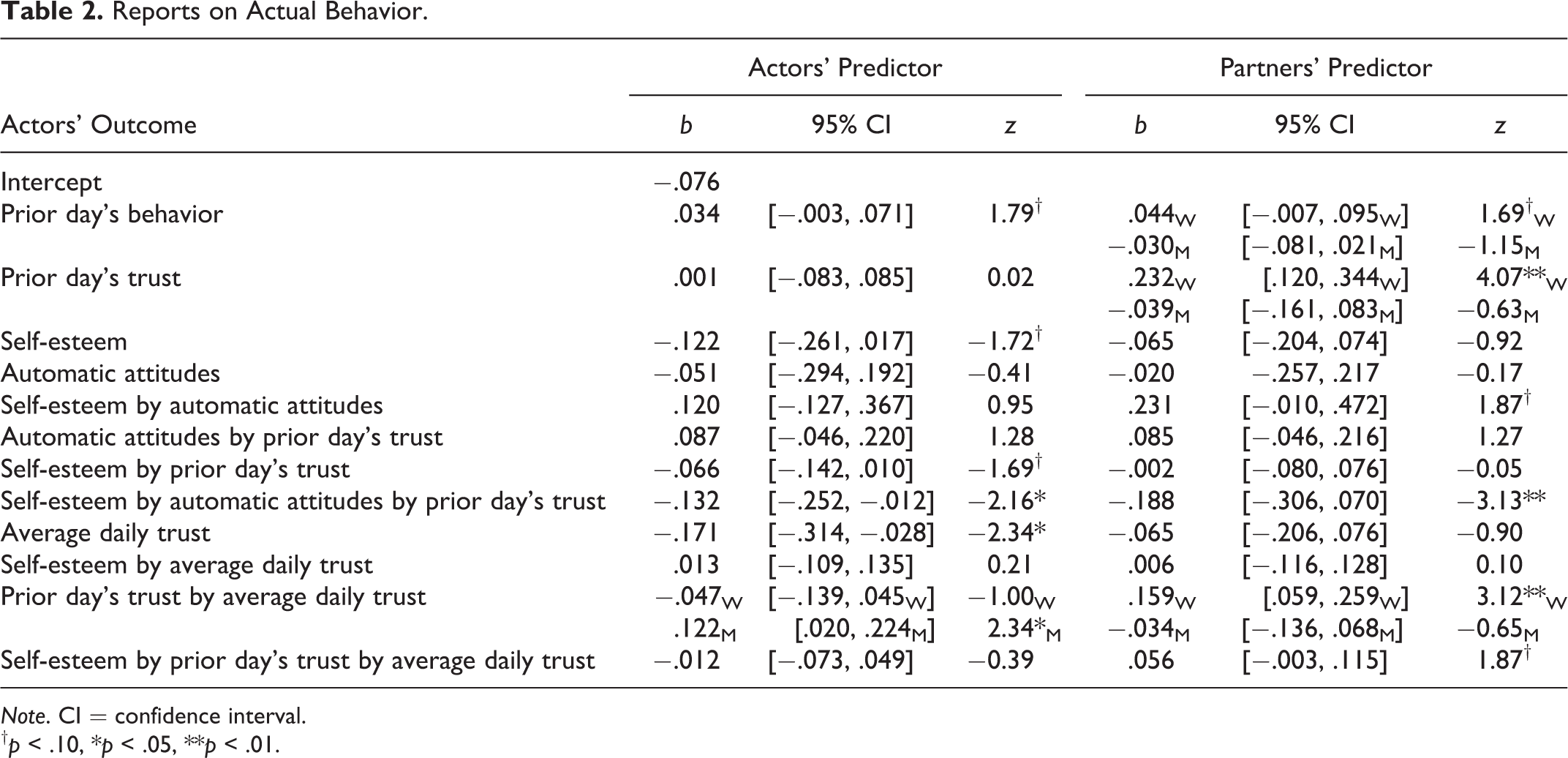
Note. CI = confidence interval.
† p < .10, *p < .05, **p < .01.
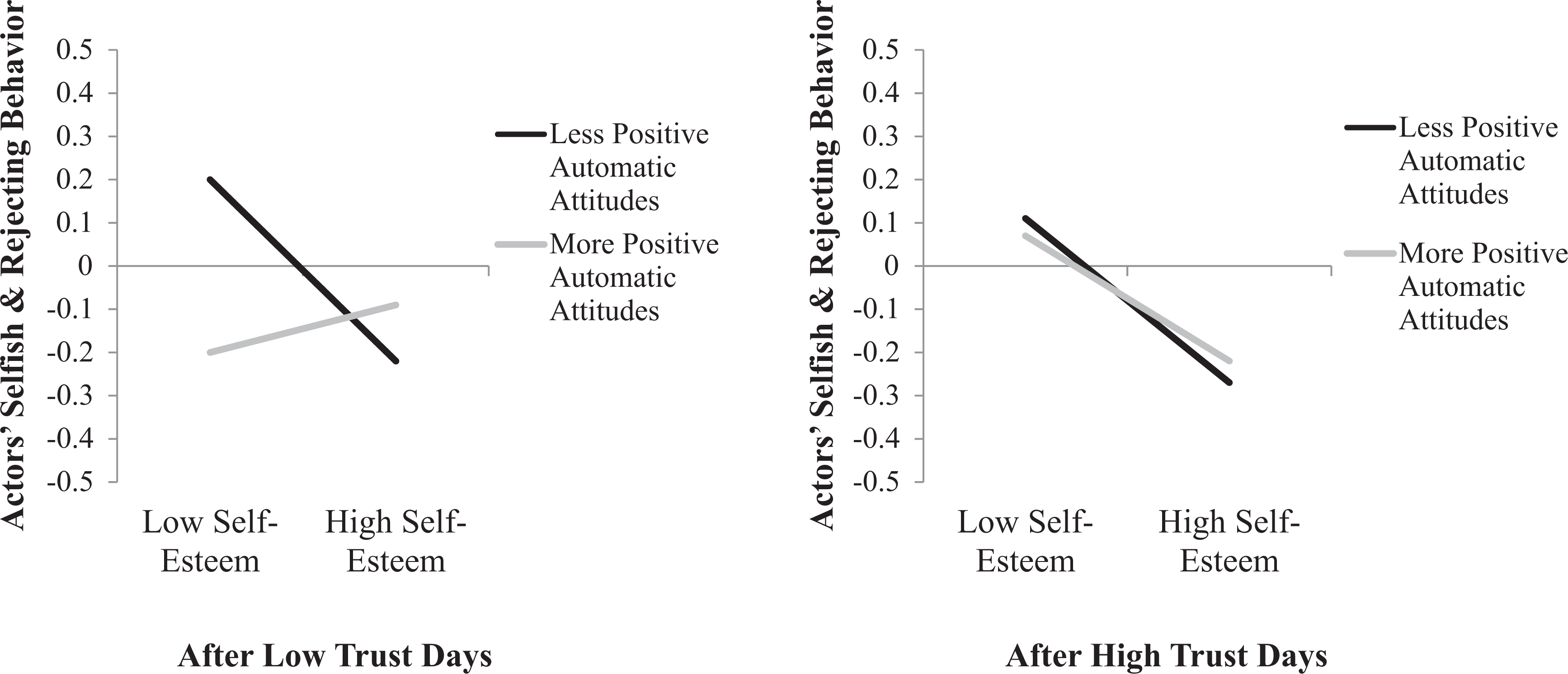
Actors’ reports on their own selfish and rejecting behavior as a function of actors’ self-esteem, automatic partner attitudes, and the prior day’s trust.
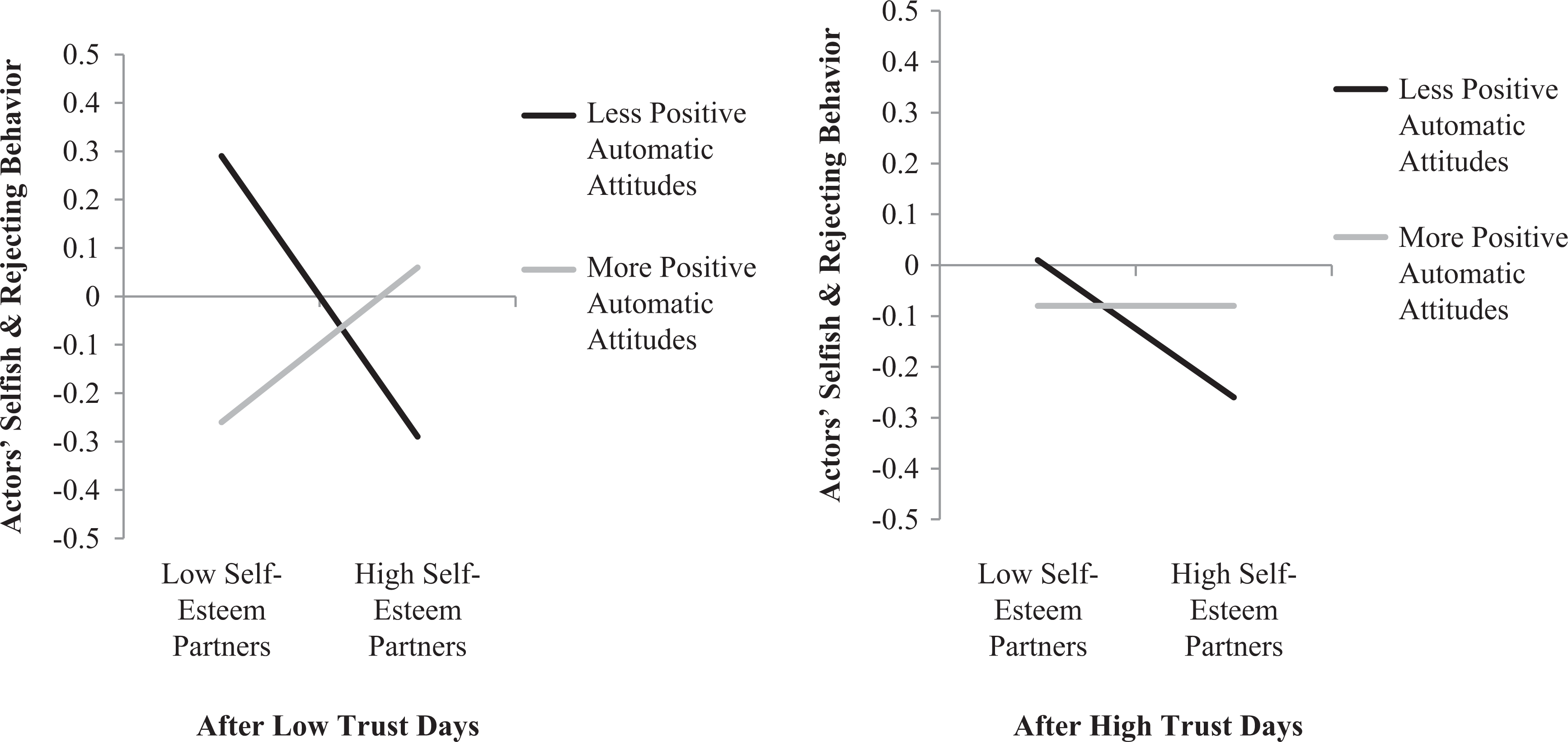
Actors’ reports on their own selfish and rejecting behavior as a function of partners’ self-esteem, automatic partner attitudes, and the prior day’s trust.
Actor effects
The actors’ automatic partner attitudes by self-esteem interaction was significant, albeit marginally, following low-trust days, b = .217, z = 1.64, p = .10, 95% CI [−.042, .476] but not high-trust days, b = .029, z = 0.22, ns, 95% CI [−.232, .290].
The left side of Figure 2 illustrates the effects on days after actors reported greater than usual doubts about partners’ caring. Inspecting the simple effects revealed that low self-esteem actors with more positive automatic attitudes inhibited self-protective behavior after low-trust days. That is, lows with more positive automatic attitudes tended to engage in less rejecting and selfish behavior than lows with more negative automatic attitudes, b = −.328, z = −1.71, p = .09, 95% CI [−.704, .048]. Automatic attitudes did not predict behavior for high self-esteem actors after low-trust days, b = .124, z = .65, ns, 95% CI [−.248, .496]. When automatic attitudes were more negative, low self-esteem actors also tended to engage in more rejecting and selfish behavior than highs after low-trust days, b = −.198, z = −1.89, p = .06, 95% CI [−.404, .008]. However, self-esteem did not predict self-protective behavior when automatic attitudes were more positive, b = .040, z = .38, ns, 95% CI [−.164, .244]. The right panel of Figure 2 illustrates the simple main effect of self-esteem that emerged after high-trust days. Low self-esteem people engaged in more rejecting and selfish behavior than highs even on days after they experienced greater than usual trust in their partner’s caring, b = −.169, z = −2.22, p = .03, 95% CI [−.318, −.020].
Partner effects
The partners’ automatic partner attitudes by self-esteem interaction predicting actors’ behavior was significant following low-trust days, b = .345, z = 2.67, p = .008, 95% CI [.092, .598], but not high-trust days, b = .121, z = 0.93, ns, 95% CI [−.134, .376].
The left side of Figure 3 illustrates the effects on days after partners reported greater than usual doubts about actors’ caring. Inspecting the simple effects revealed that actors also inhibited rejecting and selfish behavior on days after low self-esteem partners with more positive automatic attitudes experienced greater acute uncertainty about actors’ caring.
That is, after low-trust days, actors also engaged in less rejecting and selfish behavior when they were paired with low self-esteem partners with more positive automatic partner attitudes (as compared to low self-esteem partners with more negative automatic attitudes), b = −.439, z = −2.37, p = .02, 95% CI [−.802, −.076]. However, high self-esteem partners’ automatic attitudes did not predict actors’ behavior, b = .282, z = 1.51, ns, 95% CI [−.085, .649]. Following low-trust days, actors also engaged in more rejecting and selfish behavior when paired with low self-esteem partners with more negative automatic attitudes (as compared to high self-esteem partners with more negative automatic attitudes), b = −.262, z = 2.50, p = .01, 95% CI [−.468, −.056]. However, partners’ self-esteem did not predict actors’ behavior when automatic attitudes were more positive, b = .122, z = 1.17, ns, 95% CI [−.082, .326]. No significant effects emerged for high-trust days (see the right panel of Figure 3).
Alternate Explanations
There are at least three possible alternate explanations. The first is that people with more positive automatic partner attitudes also possess more positive explicit ones and explicit attitudes actually protect low self-esteem people. The second is that people with more positive automatic attitudes are more satisfied and these more positive relationship attitudes protect lows. The third is that people with more positive automatic attitudes might possess partners who are more satisfied or evaluate them more positively and such positive partner sentiments might foster generous behavior that protects low self-esteem people. To examine these possibilities, we redid the analyses while including the appropriate actor and partner effects for the confounding variable (e.g., explicit partner attitudes) and its interaction with self-esteem and trust on the prior day. Table 3 reveals that all reported three-way interactions were still significant.
The Self-esteem by Automatic Partner Attitudes by Prior Day’s Trust Interactions With Alternatives Controlled.
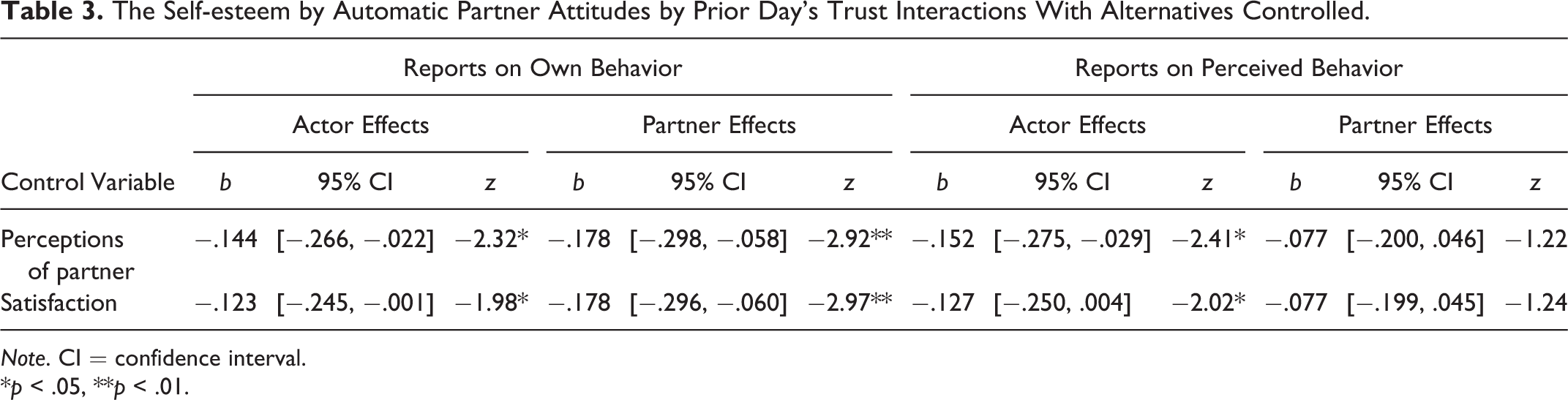
Note. CI = confidence interval.
*p < .05, **p < .01.
Discussion
Low self-esteem people often seem to be the architects of their romantic misfortune. They underestimate their partner’s love and caring and are quick to push their partner away in the face of potential hurt (Cavallo et al., 2013). Indeed, in the current study, low self-esteem people perceived their partner to be more rejecting and selfish and engaged in more rejecting and selfish behavior even following high-trust days. Happily, such vulnerabilities are not cast in stone. This study is the first to reveal that positive automatic partner attitudes improve low self-esteem people’s relationship fates under the right circumstances. When daily interactions shook trust in a partner’s caring, lows with more positive automatic partner attitudes inhibited both (1) self-protective perceptions that amplify rejection and (2) behaviors that push partners away.
Following low-trust days, low self-esteem actors with more positive automatic partner attitudes perceived their partner to be engaging in less rejecting and selfish behavior relative to lows with more negative automatic attitudes and even relative to high self-esteem actors with more positive automatic partner attitudes. Following low-trust days, low self-esteem actors with more positive automatic partner attitudes also engaged in less rejecting and selfish behavior than lows with more negative automatic attitudes. In fact, when actors’ automatic partner attitudes were more positive, low self-esteem actors behaved just as well as highs after low-trust days.
Following low-trust days, actors also reported engaging in less rejecting and selfish behavior when paired with low self-esteem partners with more positive automatic partner attitudes (relative to actors paired with lows with more negative automatic attitudes). When partners’ automatic attitudes were more positive, actors paired with low self-esteem partners also behaved just as well in the aftermath of low-trust days as actors paired with high self-esteem partners.
The power automatic partner attitudes had to inoculate low self-esteem people against uncertainty was not shared by explicit partner or relationship evaluations. In risky situations, positive associations with the partner that lows cannot readily control or dispute might afford their best hope for pursuing connection (Murray et al., 2008). In these situations, such associations can intensify the goal to connect, making it easier to inhibit the opposing goal to self-protect. Indeed, automatic partner attitudes only predicted behavior in the wake of low-trust days. Such selective accessibility supports our original assertion that automatic partner attitudes specifically come on line to solve the motivational quandary lows face when the potential gains and losses of connection both become salient. Future research should examine whether self-protection goals are less accessible for attitudinally resilient low self-esteem people in risky situations.
Future research might also explore the limits that more positive automatic attitudes have to repair the relationships of low self-esteem people. When partners are hurtful, inhibiting the automatic impulse to retaliate is the first line of defense in protecting the relationship bond (Rusbult, Verette, Whitney, Slovik, & Lipkus, 1991). Thus, we focused on rejecting and selfish behavior rather than supportive and communal behaviors (which we also measured). Unreported analyses revealed that low self-esteem people with more positive automatic attitudes were not more likely to engage in supportive and communal behavior after low-trust days. Future research might examine whether automatic partner attitudes are more likely to regulate constructive behavior when the situation, such as capitalizing on a partner’s good news, better affords it. The potential effects that automatic partner attitudes could have on high self-esteem people also need to be identified. It is possible that more positive automatic partner attitudes might also inhibit self-protective behavior when professed high self-esteem masks implicit self-doubt (Jordan, Spencer, Zanna, Hoshino-Browne, & Correll, 2003).
Conclusion
When daily interaction threatened trust in a partner’s caring, low self-esteem people with more positive automatic partner attitudes effectively inhibited self-protective perceptions and behavior. Rather than sabotaging relationships, lows might be buoyed by them when positive automatic associations with their partner provide supplemental motivation to connect.
Footnotes
Declaration of Conflicting Interests
The author(s) declared no potential conflicts of interest with respect to the research, authorship, and/or publication of this article.
Funding
The author(s) disclosed receipt of the following financial support for the research, authorship, and/or publication of this article: A National Science Foundation (BCS-1143747) grant awarded to S. Murray supported this research.
Notes

References
Supplementary Material
Please find the following supplemental material available below.
For Open Access articles published under a Creative Commons License, all supplemental material carries the same license as the article it is associated with.
For non-Open Access articles published, all supplemental material carries a non-exclusive license, and permission requests for re-use of supplemental material or any part of supplemental material shall be sent directly to the copyright owner as specified in the copyright notice associated with the article.
