




Abstract
Members of stigmatized social groups are typically more authoritarian than their nonstigmatized or higher status counterparts. We draw on research demonstrating that authoritarianism compensates for the negative effects of stigma to predict that this endorsement will be more psychologically beneficial (and less harmful) for the stigmatized compared to their high-status counterparts. Consistent with this idea, data from the 2008 (N = 2,322) and 2012 (N = 5,916) American National Election Study indicate that for members of stigmatized social groups (low income, low education, and ethnic minority), authoritarian child rearing values have more positive psychological effects than for members of high-status groups. These results were robust to covariates, including demographics, religiosity, political ideology, and cognitive style.
Members of stigmatized groups are often more authoritarian than their nonstigmatized and high-status counterparts, a relationship that holds across a number of different dimensions of stigma including income (Napier & Jost, 2008a), education (Farnen & Meloen, 2000; Lipset, 1959; Napier & Jost, 2008a), gender (Brandt & Henry, 2012), and ethnicity (Henry, 2011). One explanation for these differences in authoritarianism suggests that authoritarianism helps the stigmatized compensate for their threatened sense of social worth, a defining feature of stigma (Brandt & Henry, 2012; Henry, 2011). In the current investigation, we test one implication of this explanation: If authoritarianism serves as a compensation strategy it will have a psychological benefit (with fewer harmful effects) for members of stigmatized groups compared to members of high-status groups.
The experience of stigmatization, low social status, and being a member of a disadvantaged group is threatening to the sense of social worth of those who are stigmatized, have low social status, and who are disadvantaged in society (e.g., Henry, 2009; Major & O’Brien, 2005). These persistent threats can lead to psychological defensiveness (e.g., Henry, 2009; Schumann & Ross, 2010) and the adoption of a variety of psychologically compensatory beliefs that have the potential to assuage these threats, including authoritarianism (Brandt & Henry, 2012; Henry, 2011). Members of nonstigmatized groups, however, do not experience these same chronic threats to their sense of social worth, instead receiving a sense of social worth from society at large.
Authoritarian beliefs orient a person to obedience and conformity to group norms and values and can be contrasted with autonomy and other beliefs that orient a person to independence and freedom from group constraints (Feldman, 2003; Stenner, 2005). This contemporary view of authoritarianism is more circumscribed than the syndrome of attitudes that characterized earlier views (e.g., Altemeyer, 1996) and avoids including the political, prejudicial, religious, and traditionalism constructs that often overlap with older conceptualizations of authoritarianism (Brandt & Henry, 2012; Brandt & Reyna, 2014; Feldman, 2003; Henry, 2011; Stenner, 2005).
Authoritarianism can help people compensate for threats through the group cohesion it promotes and the stable set of values it provides (Adorno, Frenkel-Brunswik, Levinson, & Sanford, 1950; Onraet, Van Hiel, Dhont, & Pattym, 2013; Sales, 1973), features that make authoritarianism attractive to the socially excluded, but not the already socially included (Brandt & Henry, 2012; Shaffer & Duckitt, 2013). Extending this idea, recent work has found that stigmatized groups are more likely to be more authoritarian than nonstigmatized and high-status groups when they face greater degrees of stigmatization and threats to their social worth (Brandt & Henry, 2012; Henry, 2011). These studies find that authoritarianism is associated with stigma, that this association varies depending on the degree of stigma experienced, and that authoritarianism may be one way the stigmatized compensate for the long-term experience of stigma.
We test how authoritarianism and stigma interact to predict life satisfaction. Given that social exclusion can lead to decrements in mental health and life satisfaction (Aydin et al., 2012; Cacioppo & Hawkley, 2009; Stillman et al., 2009; van Beest & Williams, 2006), if authoritarianism helps people compensate for chronic social exclusion and threats to their sense of social worth by providing a sense of group cohesion and belonging (Brandt & Henry, 2012), then endorsing authoritarianism should have psychological benefits (and fewer harmful effects)—in our study, higher levels of life satisfaction—for the stigmatized compared to their high-status counterparts. If our perspective on the association between stigma and authoritarianism is correct, there should be an interaction between stigmatized status and authoritarianism when predicting psychological well-being. There is some initial support for our hypothesis. Work has found that for people undergoing stressful life events, measures of authoritarianism have been linked to better psychological health, but for people with lower levels of stress there is no association between authoritarianism and psychological health (Van Hiel & De Clercq, 2009).
Our hypothesis is that authoritarianism and stigma will interact when predicting life satisfaction, such that the effect of authoritarianism will be more beneficial (and less harmful) for members of stigmatized groups than it will be for their high-status counterparts. We adopt a measure of authoritarian child rearing values, the dominant measure of authoritarianism in political science, as our primary measure because this measure focuses more clearly on the group cohesion of authoritarianism compared to traditional measures of right-wing authoritarianism (e.g., Feldman & Stenner, 1997; Hetherington & Weiler, 2009; Stenner, 2005). Whether authoritarianism is a net positive predictor, negative predictor, or null predictor of life satisfaction likely depends on the particular political context (cf. Mandel & Omorogbe, 2014). We will return to this issue in the Discussion.
Method
Participants and Procedure
Data were from the American National Election Study 2008 (ANES08) and the 2012 (ANES12) Time Series of the ANES. The ANES is conducted using a random probability sampling procedure and a mixture of online and face-to-face interviews to obtain a sample representative of the voting-age population. Responses from ANES08 included 2,322 participants (1,323 women and 999 men; M age = 47.0, SD = 17.2) and responses from ANES12 included 5,916 participants (3,069 women and 2,847 men; M age = 45–49, SD = 3.3 on a 13-point interval scale). By using large representative samples, we are able to ameliorate the methodological problems associated with student samples (Henry, 2008).
Measures
All continuous predictor and outcome variables were standardized to range from 0 to 1 to aid the interpretation of the unstandardized regression coefficients we report in the results. The measures were similar across the ANES08 and ANES12 and differences between the studies will be highlighted.
Outcome variable: Life satisfaction
One item was available in the ANES to measure life satisfaction, “All things considered, how satisfied are you with your life as a whole these days? Would you say that you are extremely satisfied, very satisfied, moderately satisfied, slightly satisfied, or not satisfied at all?” Responses ranged from 1 = not satisfied at all to 5 = extremely satisfied, so that higher scores indicate greater life satisfaction. This measure is similar to those used in other studies of life satisfaction (e.g., Kahneman & Krueger, 2006; Napier & Jost, 2008b).
Predictor variables: Measures of stigmatization and authoritarian child rearing values
Social psychologists have focused on demographic factors of income (e.g., Henry, 2009; Johnson, Richeson, & Finkle, 2011), education (e.g., Stephens, Markus, & Townsend, 2007), and ethnicity (e.g., Crocker, Voelkl, Testa, & Major, 1991; Henry, 2011; Pinel, 1999) as indicators of stigmatization and social status in the United States. 1 Following this previous research, we used indicators of income, education, and ethnicity to indicate stigmatization. In ANES08, income was measured on a 25-point scale ranging from 1 = none or less than US$2,999 to 25 = US$150,000 and over. In ANES12, income was measured on a 23-point scale ranging from 1 = under US$5000 to 28 = US$250,000 or more. In ANES08, education was measured on a 7-point scale ranging from 1 = 0–8 grades to 7 = advanced degree. In ANES12, education was measured on a 5-point scale ranging from1 = less than a high school credential to 5 = graduate degree. In ANES08, ethnicity was recoded using 4 Helmert contrast codes, where our primary contrast of interest compared Whites (coded 4) to ethnic minorities (coded −1). The additional codes were Asian American versus other ethnic minorities (3 = Asian Americans, −1 = other non-White groups), Blacks versus Hispanics and other ethnicities (2 = Blacks, −1 = Hispanics and other ethnicities), Hispanics versus other ethnicities: (1 = Hispanics, −1 = other ethnicities). In ANES12, ethnicity was recoded using three Helmert contrast codes, where our primary contrast of interest compared Whites (coded 3) to ethnic minorities (coded −1). The additional codes were Blacks versus Hispanics and other ethnicities (2 = Blacks, −1 = Hispanics and other ethnicities) and Hispanics versus other ethnicities (1 = Hispanics, −1 = other ethnicities).
Authoritarianism was measured with 4 items assessing authoritarian child rearing values, consistent with a number of recent studies in social psychology, political psychology, and political science (Brandt & Reyna, 2014; Federico, Fisher, & Deason, 2011; Feldman & Stenner, 1997; Henry, 2011; Hetherington & Weiler, 2009; Stenner, 2005). 2 Participants are asked to choose between four pairs of “desirable qualities” and to indicate which quality is more important for a child to have. In each pair, one quality represented the authoritarian option (“respect for elders,” “good manners,” “obedience,” and “well-behaved”) and one quality represented the nonauthoritarian or autonomous option (“independence,” “curiosity,” “self-reliance,” and “being considerate”). The authoritarian options were coded in the ANES as 5 and the nonauthoritarian options were coded as 1. Participants received a score of 3 if they volunteered that “both were important.” The items were averaged (ANES08 α = .59; ANES12 α = .60). 3
Covariates
We included additional demographic and attitudinal covariates that are often associated with life satisfaction, stigma/social status, and authoritarianism and so constitute plausible third variables that may account for the predicted interaction. The measure of age was mean centered and squared to control for its curvilinear effect on life satisfaction (Stone, Schwartz, Broderick, & Deaton, 2010). Marital/partnered status (−2 = not married/partnered and 1 = married/partnered) was included because people with higher income and social status are more likely to be married (Gibson-Davis, 2009) and have higher life satisfaction (Mroczek & Spiro, 2005). A second orthogonal code was also included to rule out possible effects of divorce or separation (−1 = not married/widowed, 0 = married/partnered, and 1 = divorced/separated) because divorce has been associated with more liberal political attitudes and life satisfaction (Edlund & Pande, 2002; Härkönen & Dronkers, 2006; Lucas, 2005). Political ideology was included to control for its association with life satisfaction (Jetten, Haslam, & Barlow, 2013; Napier & Jost, 2008b) and authoritarianism (Stenner, 2005), using an indicator that combined party identification (1 = strong democrat to 7 = strong republican) with political conservatism (1 = extremely liberal to 7 = extremely conservative) to form a reliable scale, ANES08 r(1,605) = .53, p < .001; ANES12 r(5,290) = .60, p < .001. Worship service attendance (0 = never attended to 5 = every week) was used to control for the tendency for the religious to be more authoritarian (Brandt & Reyna, 2014; Hetherington & Weiler, 2009), to have lower social status (Ruiter & van Tubergen, 2009), and to rate their lives as more satisfying (Lim & Putnam, 2010; Witter, Stock, Okun, & Haring, 1985). Gender was also included (−1 = women and 1 = men).
Two measures of cognitive style were included to rule out the possibility that psychological benefits of authoritarianism are a function of a clear, rigid view of the world or a low effort style of thinking associated with authoritarianism, rather than the group cohesion associated with authoritarianism. Two measures of cognitive style used in previous research (e.g., Federico, 2004) were available, namely the need for cognition (Cacioppo, Petty, & Kao, 1984) and the need to evaluate (Jarvis & Petty, 1996). The need for cognition was measured with 2 items that read “Do you like having responsibility for handling situations that require a lot of thinking, do you dislike it, or do you neither like it nor dislike it?” (reverse scored to range from 1 = like it a lot to 5 = dislike it a lot) and “Some people prefer to solve simple problems instead of complex ones, whereas other people prefer to solve more complex problems. Which type of problem do you prefer to solve: simple or complex?” (with two response options coded by the ANES as 1 = simple and 5 = complex). They were averaged to form a reliable scale, ANES08 r(2,062) = .44, p < .001. (Need for cognition was not measured in ANES12.) The need for evaluation was measured with 2 items that read “Would you say you have opinions about almost everything, about many things, about some things, or about very few things?” (reverse coded to range from 1 = almost everything to 4 = very few things) and “Compared to the average person do you have fewer opinions about whether things are good or bad, about the same number of opinions, or more opinions?” (ranging from 1 = a lot fewer opinions to 5 = a lot more opinions). They were standardized and then averaged to form a reliable scale, ANES08 r(2,082) = .43, p < .001; ANES12 r(5,506) = .38, p < .001.
Results
For all of the analyses reported subsequently, we estimated regression equations using maximum likelihood estimation and replaced missing data using 50 multiple imputation data sets with MPlus Version 6.11 (Muthén & Muthén, 1998–2011).
The Stigmatized Are More Authoritarian
We first replicated the stigma differences in authoritarianism found in the literature. While including all of the covariates and measures of stigma in a single regression analysis, income (ANES08: b = −.08, SE = .03, p = .001; ANES12: b = −.06, SE = .01, p < .001), education (ANES08: b = −.31, SE = .03, p < .001; ANES12: b = −.28, SE = .01, p < .001), and the White versus ethnic minority contrast code (ANES08: b = −.09, SE = .02, p < .001; ANES12: b = −.13, SE = .01, p < .001) all showed the predicted association between stigma and authoritarianism. That is, consistent with the literature cited above, the stigmatized were more authoritarian than the nonstigmatized, and this association was independent of other measures of stigma and the influence of the control variables. 4
Authoritarianism Interacts With Stigma When Predicting Life Satisfaction
Our primary hypothesis was that authoritarianism would interact with stigma when predicting life satisfaction. Specifically, we expected a significant negative interaction between authoritarian child rearing values and the measures of stigma. This hypothesis was tested with three multiple-regression models, one for each interaction between authoritarianism and a stigma dimension (see Tables 1 and 2). All continuous predictor variables were mean centered and all dichotomous predictor variables were contrast coded (see coding in the section on methods). Consistent with our hypothesis, in ANES08, for the income (p = .01) and ethnicity (p = .02) indicators of stigma there were significant negative interactions with authoritarianism. For the education dimension of stigma, the interaction was negative and marginally significant (p = .09). In ANES12, for the education (p = .03) and ethnicity (p = .03) indicators of stigma, there were significant negative interactions with authoritarianism. For the income dimension of stigma, the interaction was negative and marginally significant (p = .07). These negative interaction coefficients suggest that for members of stigmatized groups, the effects of authoritarianism are more positive than for members of high-status groups.
Unstandardized Coefficients (Standard Errors) from Regression Models Predicting Life Satisfaction (ANES08).
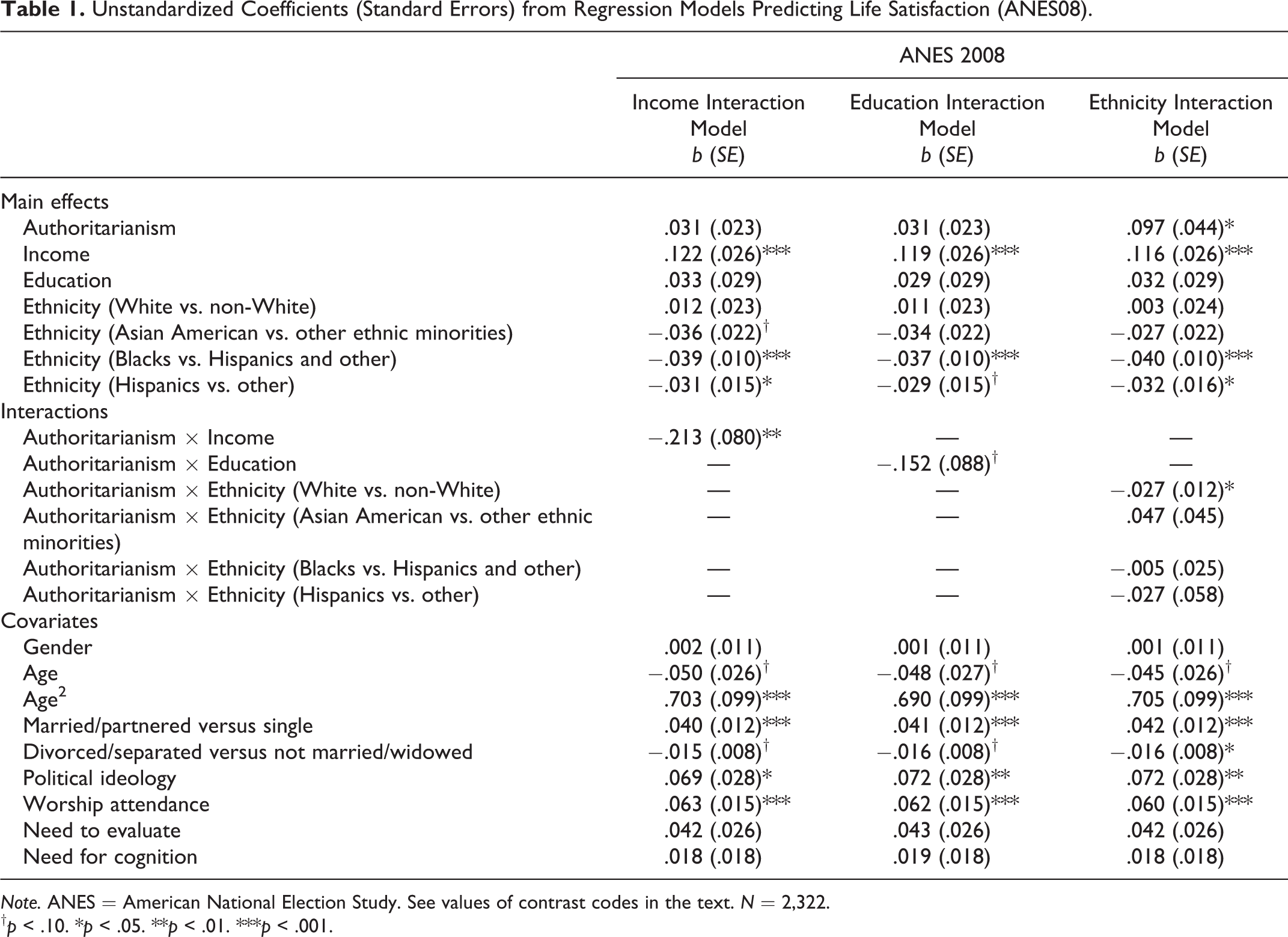
Note. ANES = American National Election Study. See values of contrast codes in the text. N = 2,322. † p < .10. *p < .05. **p < .01. ***p < .001.
Unstandardized Coefficients (Standard Errors) From Regression Models Predicting Life Satisfaction (ANES12).
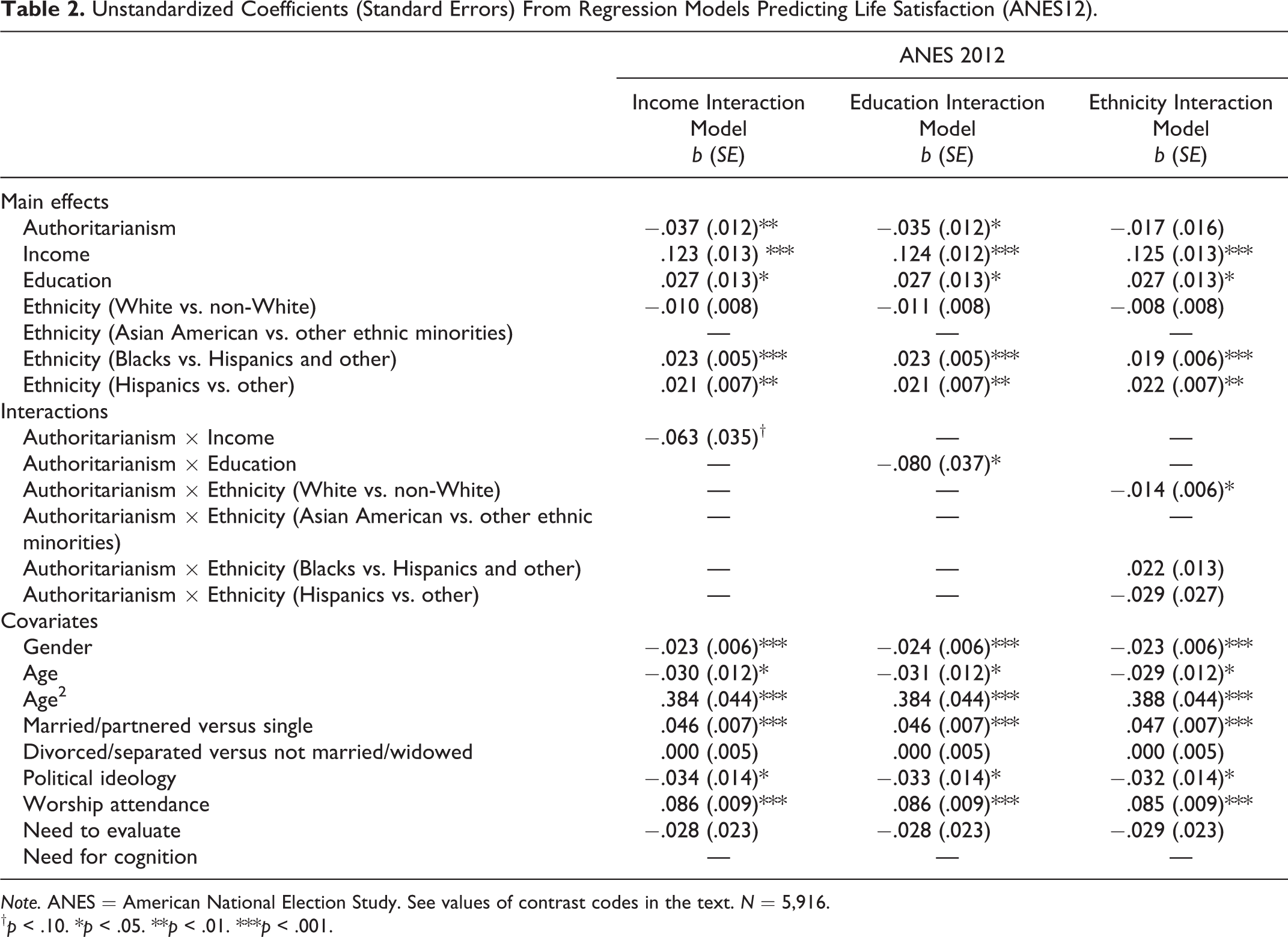
Note. ANES = American National Election Study. See values of contrast codes in the text. N = 5,916.
† p < .10. *p < .05. **p < .01. ***p < .001.
To further understand the nature of the psychological payoff of authoritarianism, the measures of income and education were probed at ±1 SD from the mean and the measure of ethnicity was probed for non-White and White participants. In ANES08, across the three measures, authoritarianism was associated with increased life satisfaction for stigmatized individuals (income: b = .09, SE = .03, p = .009; education: b = .07, SE = .04, p = .051; and ethnicity: b = .13, SE = .05, p = .02). In contrast, authoritarianism endorsement was not associated with life satisfaction for high-status individuals (income: b = −.03, SE = .03, p = .38; education: b = −.01, SE = .03, p = .76; and ethnicity: b = −.01, SE = .03, p = .68). Figure 1 shows an example of these effects in a scatterplot of the raw (i.e., no covariates and no estimated missing data) association between authoritarianism and life satisfaction at varying levels of income in ANES08 (Figure 1, top panel; for additional figures, see Online Supplemental Material found at http://spps.sagepub.com/supplemental). At lower levels of income, authoritarianism appears to have a psychological benefit by predicting higher levels of life satisfaction; however, the association between authoritarian child rearing values and life satisfaction does not have the same beneficial effect among high-status groups. Visualized another way, the negative effects of income on life satisfaction are less clear among those with higher levels of authoritarianism compared to lower levels of authoritarianism (Figure 1, bottom panel).
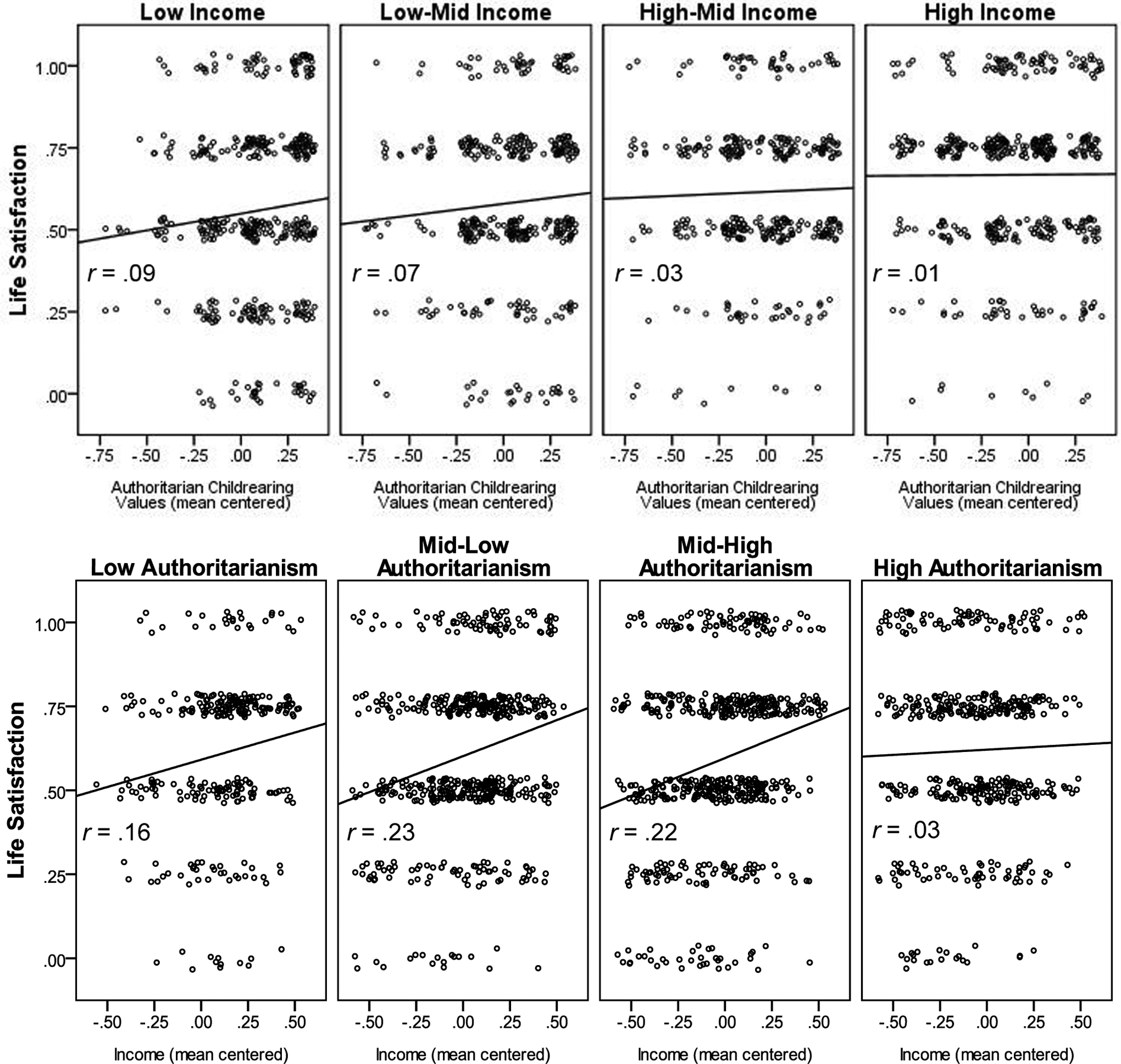
Scatterplots of the association between authoritarian child rearing values and life satisfaction at four levels of income (top panel) and between income and life satisfaction at four levels of authoritarianism (bottom panel) in the ANES 2008.
In ANES12, across the three measures, authoritarianism endorsement was negatively associated with life satisfaction for high-status individuals (income: b = −.06, SE = .02, p < .001; education: b = −.06, SE = .02, p < .001; and ethnicity: b = −.06, SE = .01, p < .001). In contrast, authoritarianism was not associated with life satisfaction for stigmatized individuals (income: b = −.02, SE = .02, p = .28; education: b = −.01, SE = .02, p = .54; and ethnicity: b = −.003, SE = .02, p = .89). For people with the highest levels of status, the effect of authoritarianism is negative, but the effect is flatter for people with the lowest levels of status. Figure 2 shows an example of these effects in a scatterplot of the raw association between authoritarianism and life satisfaction at varying levels of income in ANES12 (Figure 2, top panel; for additional figures, see Online Supplemental Material found at http://spps.sagepub.com/supplemental). At higher levels of income, authoritarianism appears to be a psychological harm, whereas it does not have a negative psychological effect at lower levels of income. Visualized another way, the negative effects of income on life satisfaction are less clear among those with higher levels of authoritarianism compared to lower levels of authoritarianism (Figure 2, bottom panel). In general, these results suggest that endorsing authoritarian beliefs have a positive effect (ANES08) and not a negative effect (ANES12) for members of stigmatized groups compared to high-status groups and reduce the negative effect of stigma on life satisfaction. 5
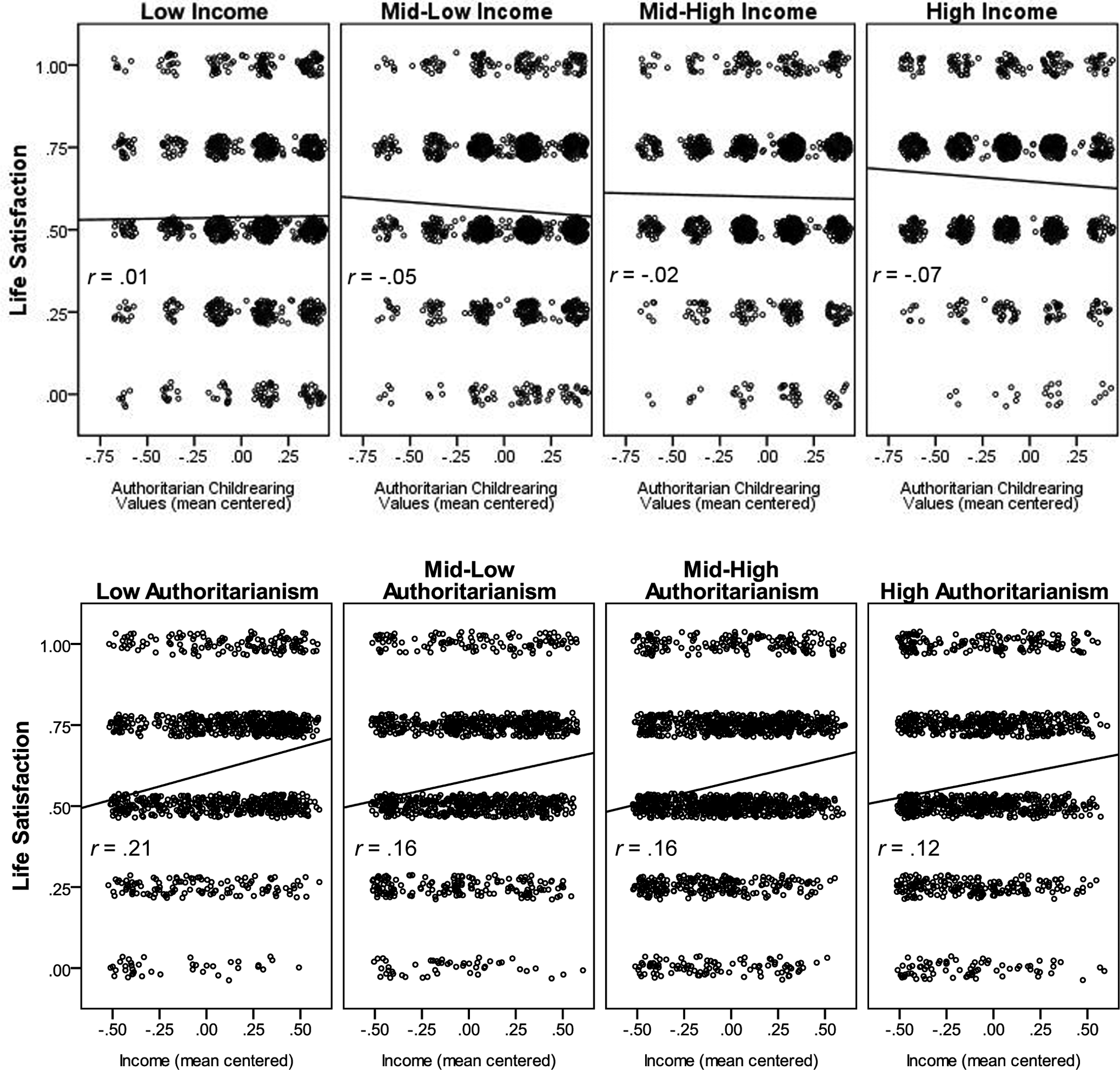
Scatterplots of the association between authoritarian child rearing values and life satisfaction at four levels of income (top panel) and between income and life satisfaction at four levels of authoritarianism (bottom panel) in the ANES 2012.
Authoritarianism ≠ Just Politics | Just Religiosity | Just Cognitive Style
Authoritarianism is a complex construct that is correlated with a number of different belief systems and cognitive styles. Our idea is that this association is due to the group-focused aspect of authoritarianism, but we do not have evidence for this mechanism (and unfortunately, the ANES does not include measures of this mechanism). To rule out other constructs related to authoritarianism—political ideology, church attendance, need to evaluate, and need for cognition—that might contribute to the effects we found, we conducted a number of additional moderated regression analyses. There were only two significant interactions (ANES08: Income × Church Attendance and Ethnicity × Need for Cognition) and two marginally significant interactions (ANES08: Ethnicity × Need for Evaluation and Income × Political Ideology); however, these interactions were not consistent across each authoritarianism alternative and they do not replicate in ANES12 (see Online Supplemental Material found at http://spps.sagepub.com/supplemental).
Discussion
We proposed that authoritarian values would interact with stigma when predicting life satisfaction such that authoritarianism would be more positive (and less negative) for stigmatized groups compared to high-status groups. Consistent with past work, members of stigmatized groups endorsed more authoritarian child rearing values than their high-status peers, and the association between authoritarian child rearing values and life satisfaction differed between members of stigmatized and high-status groups. In ANES08, this interaction indicated that authoritarian child rearing values were positively associated with life satisfaction among stigmatized groups and not associated with life satisfaction among high-status groups. In ANES12, this interaction indicated that authoritarian child rearing values were associated with decreases in life satisfaction for high-status group members, but it was not related to life satisfaction for members of stigmatized groups. These results go beyond previous demonstrations of stigma’s effects on authoritarianism to test some of the downstream effects of authoritarianism on life satisfaction.
The results of ANES08 and ANES12 were conceptually similar—they both indicated that authoritarianism had a more beneficial and fewer harmful effects for members of stigmatized groups compared to high-status groups—but not exactly the same. The important effects of interest, the interaction effects, are consistently negative and replicate; however, the overall main effect of authoritarianism is negative in the ANES12 sample but not significant in the ANES08 sample. It may be that in 2012 people who endorsed authoritarianism (and who typically endorse more traditional values and authorities) were less satisfied with life overall because of recent social changes in the United States such as same-sex marriage and the legalization of marijuana. This pattern is consistent with research that shows, for example, that religiosity is only associated with psychological well-being in relatively religious countries where religiosity is a “cultural fit” (Gebauer, Sedikides, & Neberich, 2012; Okulicz-Kozaryn, 2010) and recent work finding that the association between political beliefs and life satisfaction changes depending on political context, such that conservatives have greater life satisfaction but only in contexts of conservatism (Mandel & Omorogbe, 2014). Of key importance for our perspective is that the negative effects of authoritarianism that we observed do not appear for members of stigmatized groups. It may be that the competing effects of decreased life satisfaction due to rapid and nontraditional social change versus the psychological benefit of authoritarianism due to increased group belonging for stigmatized groups result in a null effect. Whether this idea explains the divergent main effect of authoritarianism between the two data sets remains speculative and beyond the scope of the current data.
We were also able to demonstrate that the pattern of results we report is not due to the overlap between authoritarian child rearing values and other related constructs such as political ideology and cognitive style. These findings suggest that the group-based and social worth affirming qualities of authoritarianism are not qualities necessarily shared with political ideology and rigid cognitive styles. The distinction between authoritarianism, political ideology, and cognitive style is important for the discriminant validity of these findings and interpretations, but it also adds to the growing literature highlighting the theoretical and empirical distinction between political ideology broadly and authoritarianism specifically (e.g., Feldman, 2003; Stenner, 2005).
Strengths and Limitations
This study used two large nationally representative samples to conduct high-powered tests of our hypotheses without succumbing to the limitations of student samples. We uncovered the same general pattern of results across three different dimensions of stigma suggesting that the results we report are due to stigma as generally conceived, rather than any idiosyncrasy associated with any one particular dimension of stigma. Finally, although past research has identified a large number of variables that influence life satisfaction, we observed our predicted results even while taking into account several of these alternative variables.
There are also limitations to the current study. First, we were limited to the measures that are included in the ANES. For example, there are many alternative conceptualizations of life satisfaction and psychological well-being that make for a conceptually broader and a psychometrically more precise measure of life satisfaction than the single-item measure we relied on. However, this single-item measure has been used in other research on life satisfaction (e.g., Kahneman & Krueger, 2006; Napier & Jost, 2008b). Second, the ANES data is cross-sectional so the normal prohibitions on firm causal arguments apply. We imply that authoritarianism is causally prior to life satisfaction. Although it is possible that for the stigmatized, life satisfaction causally precedes higher levels of authoritarianism, there is no theoretical reason we know for this pattern or why that pattern would be consistent across the three stigma dimensions considered here. Moreover, this alternative causal model conflicts with research that finds that threats (and not a satisfied life) often causally predict authoritarianism (Onraet & Van Hiel, 2014). Nevertheless, the precise causal nature of these relationships awaits further empirical tests, perhaps with the use of longitudinal data.
We do not mean to imply that the effects we showed in this study will hold in all times and places. There are several factors that we believe are necessary for our results (and therefore necessary for their replicability). First, as we have explained elsewhere (e.g., Brandt & Henry, 2012), we do not think that all manifestations of authoritarianism will serve a psychologically protective function for members of stigmatized groups. Our effects require measures of authoritarianism that are free from a politicized content, such as the measure of authoritarian child rearing values that we use here. Second, authoritarianism will only emerge as a psychological benefit (like in ANES08) in contexts where holding authoritarian values is not in itself marginalizing. In these settings, endorsement of authoritarian values that are otherwise resistant to normative changes may actually make people feel like they do not fit in, which could lead to decrements in life satisfaction. We believe that this may explain the differences between the 2008 and 2012 results. Although research is growing concerning the relationship between various dimensions of stigma, the endorsement of authoritarian values, and their effects on other attitudes and perceptions, less is known at this point concerning the boundary conditions that circumscribe these effects.
Conclusion
Scholars have observed elevated levels of authoritarianism among members of low-status and stigmatized groups ever since social scientists began to study authoritarianism (e.g., Adorno et al., 1950). Recent research has further confirmed these findings and has suggested that authoritarianism may help members of stigmatized groups compensate for chronic threats to their sense of social worth and belongingness (e.g., Brandt & Henry, 2012; Henry, 2011). The current study demonstrated that adopting authoritarian beliefs may also have downstream effects on life satisfaction and helps extend work on authoritarianism beyond its relationship to prejudice and discrimination to help understand other motives for adopting these beliefs.
Footnotes
Declaration of Conflicting Interests
The author(s) declared no potential conflicts of interest with respect to the research, authorship, and/or publication of this article.
Funding
The author(s) received no financial support for the research, authorship, and/or publication of this article.
Notes

References
Supplementary Material
Please find the following supplemental material available below.
For Open Access articles published under a Creative Commons License, all supplemental material carries the same license as the article it is associated with.
For non-Open Access articles published, all supplemental material carries a non-exclusive license, and permission requests for re-use of supplemental material or any part of supplemental material shall be sent directly to the copyright owner as specified in the copyright notice associated with the article.
