




Abstract
When groups receive negative feedback on their progress toward a set goal, they often escalate rather than temper their commitment. To attenuate such escalation, we suggest initiating a self-distancing response (i.e., taking the perspective of a neutral observer) by forming implementation intentions when, where, and how to act (i.e., making if-then plans). Implementation intentions should help groups to translate a self-distancing intention into action. In line with this reasoning, only groups that had added implementation intentions to their goal to make optimal investment decisions reduced their high levels of investment (Study 1) or maintained their moderate levels of investment (Study 2) after negative feedback. Groups that had merely formed goal intentions, however, escalated even when their decision goal was supplemented with self-distancing instructions (Study 1), and they escalated as much as control groups without such a goal (Study 2). Implications for improving group decision making by implementation intentions are discussed.
When individuals or groups receive failure feedback on a chosen course of action, they often prefer to persist rather than to disengage (i.e., escalation of commitment phenomenon; Bazerman, Guiliano, & Appelman, 1984; Smith, Tindale, & Steiner, 1998; Whyte, 1993; meta-analysis by Sleesman, Conlon, McNamara, & Miles, 2012). To attenuate the escalation of commitment in group decisions, far-reaching measures have been suggested, such as removing initial decision makers from subsequent decisions (Staw, 1981). Recent findings, however, suggest that individuals can also de-escalate commitment in a self-regulatory manner by using self-affirmation (Sivanathan, Molden, Galinsky, & Ku, 2008) or regulatory focus strategies (Molden & Hui, 2011). Another effective self-regulation strategy might be planning in advance when, where, and how one wants to act in order to avoid escalation of commitment (i.e., forming respective if-then plans or implementation intentions; Gollwitzer, 1993, 1999, 2014). Consequently, the present research tests whether forming implementation intentions to adopt the perspective of a neutral observer (i.e., to self-distance) can empower groups to reduce their commitment to faltering projects.
Escalation of Commitment: The Relevance of Self-Justification Processes
In typical escalation of commitment situations, negative performance feedback raises the question of whether one should increase or decrease one’s investments (e.g., Staw & Ross, 1987). The dilemma arises that further increasing one’s investments might be throwing good money after bad, whereas terminating one’s investments might mean that the already invested money would have been invested in vain. In response to this dilemma, people have been observed to maintain or even increase their investments rather than reducing the level of investment until they ascertain whether the unfavorable state is temporary (one should continue investing) or permanent (one should disengage from the project). Because such failures to reduce one’s commitment to faltering projects endanger the successful attainment of positive outcomes, they are commonly considered to be maladaptive (e.g., Staw, 1981).
The many determinants of the escalation of commitment (Sleesman et al., 2012; Staw & Ross, 1989) have been categorized into project-related (e.g., expected utility), social (e.g., public evaluation of decisions), and psychological determinants (e.g., perceived proximity to project completion). Among the psychological determinants, self-justification processes play a prominent role (Staw, 1976). Building on cognitive dissonance theory (Festinger, 1957), the self-justification hypothesis states that people escalate their commitment in order to avoid the dissonance between choosing an initial investment and the realization that this was a mistake. In line with this hypothesis, it has been found that the failure to reduce commitment in response to negative feedback is positively related to (a) being personally responsible for the initial decision, (b) having previously expended resources (i.e., sunk cost, time invested), and (c) feeling personally threatened by the negative feedback (i.e., ego threat). The present research examines whether taking a self-distanced perspective can reduce such self-justification processes.
Reducing Self-Justification by Self-Distancing
The potential merit of taking a neutral perspective to affect an individual’s reasoning about experienced events has been highlighted by research on self-distancing (overview by Kross & Ayduk, 2011). When it comes to coping with negative feedback and adverse experiences, people often attempt introspection in order to better understand their feelings (e.g., Why did we choose this initial investment? How can we save the faltering project?). Such introspection entails the disadvantage that the threatened self and the reasoning self are one and the same. Introspecting from this self-immersed perspective increases the risk of maladaptive outcomes (e.g., impaired problem solving; Kross & Ayduk, 2011). In the process of self-distancing, on the other hand, the self assumes an observer’s perspective and can thereby neutrally reflect on otherwise threatening feedback and experiences (e.g., Why did the decision group choose this initial investment? How can they save the faltering project?). Unlike the self-immersed perspective, self-distancing has also been observed to facilitate balanced reasoning (e.g., pro and con reasoning), constructive attitudes (e.g., cooperation-related attitude assimilation), and integrative behavior (e.g., willingness to join a bipartisan group; Kross & Grossmann, 2012). It was even found to be associated with lower emotional and cardiovascular reactivity (Ayduk & Kross, 2010). We therefore suggest that self-distancing by taking on the perspective of a neutral observer should minimize self-justification concerns in decision groups and thereby prevent the escalation of commitment when having to decide on further investments in light of negative feedback on an ongoing project.
The Importance of Self-Regulation for the Enactment of Self-Distancing
At this point, one might argue that simply assigning decision-making groups the intention to assume a neutral observer’s perspective when faced with negative feedback would suffice to prevent the escalation of commitment. However, from a self-regulation standpoint, forming the intention to take the perspective of a neutral observer is only the first step (i.e., setting a goal; Locke & Latham, 2002). Actually enacting the goal intention requires effective self-regulation strategies, since both individuals and groups commonly fall prey to the notorious intention-behavior gap (e.g., Sheeran, 2002; Sheeran & Webb, 2012; Wieber, Thürmer, & Gollwitzer, 2012, 2013). If-then planning, however, is known to reduce this gap (meta-analysis by Gollwitzer & Sheeran, 2006).
Planning with implementation intentions
Goal intentions such as “I want to take a neutral perspective!” relate to a desired outcome. They direct and energize an individual’s actions primarily by effortful, top-down control processes. In contrast, forming implementation intentions such as “If I receive negative feedback, then I will take a neutral perspective!” strategically automates the initiation of the goal-directed response once the critical situation is encountered (i.e., action is now controlled by bottom-up processes; reviews by Gollwitzer, 2014; Gollwitzer & Oettingen, 2011). The mental representation of the critical future situation specified in the if-part becomes highly accessible (e.g., Wieber & Sassenberg, 2006), and a strong associative link between this mental representation and that of the specified response is established (e.g., Webb & Sheeran, 2007, 2008). As a consequence, if-then planners more quickly detect critical situations and initiate the linked responses (e.g., Parks-Stamm, Gollwitzer, & Oettingen, 2007), even when they are cognitively busy (e.g., Brandstätter, Lengfelder, & Gollwitzer, 2001) or the critical situation is presented subliminally (Bayer, Achtziger, Gollwitzer, & Moskowitz, 2009).
Cognitive models of group interaction (e.g., De Dreu, Nijstad, & van Knippenberg, 2008; Hinsz, Tindale, & Vollrath, 1997) and cognitive interference effects such as production blocking in group brainstorming and social inhibition in free recall (overview by Stroebe, Nijstad, & Rietzschel, 2010) suggest that group interactions are effortful and draw on group members’ cognitive capacities. Because self-regulation by goal intentions also requires these resources, it is likely to be unsuccessful in such group settings. Implementation intentions, however, draw less on these resources and should therefore ensure the initiation of a self-distancing response during group interactions. Recent research on group decision making provides support for the assumption that even the complex cognitive responses associated with reflection can be preplanned with implementation intentions. Groups made better decisions in situations that required the exchange and integration of individual information within the group when they formed implementation intentions rather than goal intentions to review the advantages of alternative decision options before making a joint decision (Thürmer, Wieber, & Gollwitzer, in press, Study 2). Moreover, research on individual goal pursuit has shown that implementation intentions (but not goal intentions) can facilitate reflective thinking (e.g., Henderson, Gollwitzer, & Oettingen, 2007; Schweiger Gallo, McCulloch, & Gollwitzer, 2012). We therefore hypothesized that forming implementation intentions to take the perspective of a neutral observer should enable groups to attenuate the escalation of commitment in response to negative feedback whereas mere goal intentions should not.
The Present Research
In two studies, intention effects on group decision making were examined using a City Council investment scenario1 (Haslam et al., 2006; see also Dietz-Uhler, 1996). Prior to the task, we manipulated participants’ intentions: Triads formed either an implementation intention to take a neutral observer’s perspective when making their decisions or a goal intention (Studies 1 and 2) or no such intention (i.e., control; Study 2). In the scenario, the groups acted as a city council committee. In each of three consecutive phases, they received information on the actual state of the project, discussed it, and made a unanimous investment decision. Although the information in Phase 1 (4 pros, 0 cons) supported initial investments, the information in Phases 2 (2 pros, 2 cons) and 3 (1 pro, 3 cons) called for more moderate investments. The amount of money invested in the project in each phase served as the dependent measure.
In addition to these similarities between both studies, there were also procedural differences. Study 2 added a control condition, modified the intention manipulation and the investment task, and assessed participants’ experiences and emotions. Despite these differences, however, we expected an Intention × Phase interaction effect in both studies such that the intention groups would not differ in Phase 1 but would diverge in Phases 2 and 3.
Study 1: Reducing Investments in Response to Negative Feedback
Study 1 examined intention effects on the escalation of commitment with a focus on the contribution of the if-then format. Implementation intention and goal intention groups were made aware of the self-distancing strategy, but only implementation intention groups linked the initiation of this strategy to a decision-making situation using the if-then format. Thus, Study 1 tested whether knowing an effective response suffices to attenuate the escalation of commitment when faced with negative feedback or if this knowledge needs to be included in an implementation intention (i.e., an if-then plan) in order for it to be acted on.
Method
Participants and Design
About 39 triads comprising 117 students (73 female) with a mean age of 22 years (SD = 3.74, range 18–54) participated in exchange for €13 or course credit (available for first-year psychology students). The study employed a 2 between (intention: goal intention vs. implementation intention) × 3 within (phase: Phase 1 vs. Phase 2 vs. Phase 3) mixed factorial design.
Procedure
Participants were informed that they would act as a city council committee responsible for the kindergarten project. To promote group identification, triads first created a group name (e.g., Pinter & Greenwald, 2011).
Intention manipulation
In a subsequent paper-and-pencil training, all participants formed the collective goal “We want to make the optimal investment decision in each phase!” In the implementation intention condition, they added “If we are about to make an investment decision, then we will judge the project as neutral observers who are not responsible for earlier decisions!” In the goal intention condition, they added “We want to judge the project as neutral observers who are not responsible for earlier investment decisions!” All participants were asked to learn their respective intention by repeating it silently, mentally envisioning its enactment, and writing it down twice.
Investment scenario
Next, participants worked on three consecutive phases of the investment scenario. In each phase, group members individually read information on the current state of the project before they collaboratively discussed the information and made a unanimous investment decision.
The information on the project consisted of four pros (e.g., land donation) in Phase 1, two pros (e.g., scooter donation) and two cons (e.g., the land had not been inspected before construction) in Phase 2, and one pro (i.e., kindergarten opening) and three cons (e.g., oil contamination in the sandbox) in Phase 3.
The city councils’ budget was €350,000 (Phase 1), €250,000 (Phase 2), and €350,000 (Phase 3). In each phase, triads learned that, according to the original approximations, the kindergarten project would need at least 50% of the available budget in order to be continued as planned. They also learned that the residual money would be used for other public investments (i.e., maintenance for schools and hospitals), but they did not receive any information about how spending more or less money would affect the project (low perceived investment efficacy). In their decisions, triads could choose to invest between €0 and the maximum of each phase’s budget in steps of €50,000.
Following the task, group members indicated their acquaintance with the other group members (1 = not at all to 3 = very well), provided demographic information, and were debriefed, thanked, and compensated.
Results and Discussion
Equivalence of conditions
The intention conditions did not differ regarding the control variables (Tables 1 and 2).
Summary of Information-Processing Time in min and Project Evaluations by Phase.
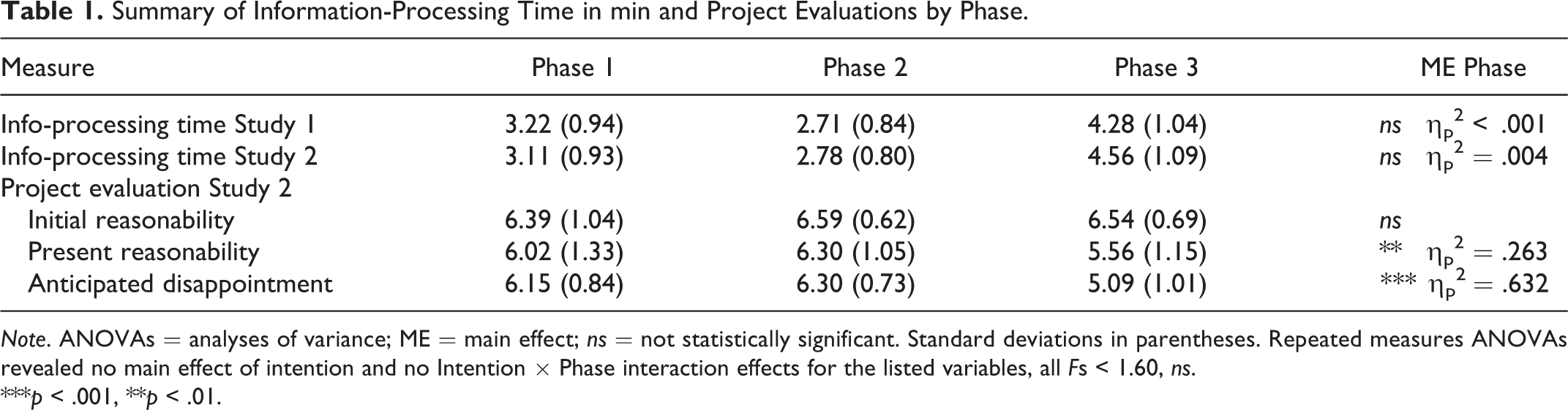
Note. ANOVAs = analyses of variance; ME = main effect; ns = not statistically significant. Standard deviations in parentheses. Repeated measures ANOVAs revealed no main effect of intention and no Intention × Phase interaction effects for the listed variables, all Fs < 1.60, ns.
***p < .001, **p < .01.
Summary of Participants’ Acquaintance, Group Identification, Commitment, and Affect.
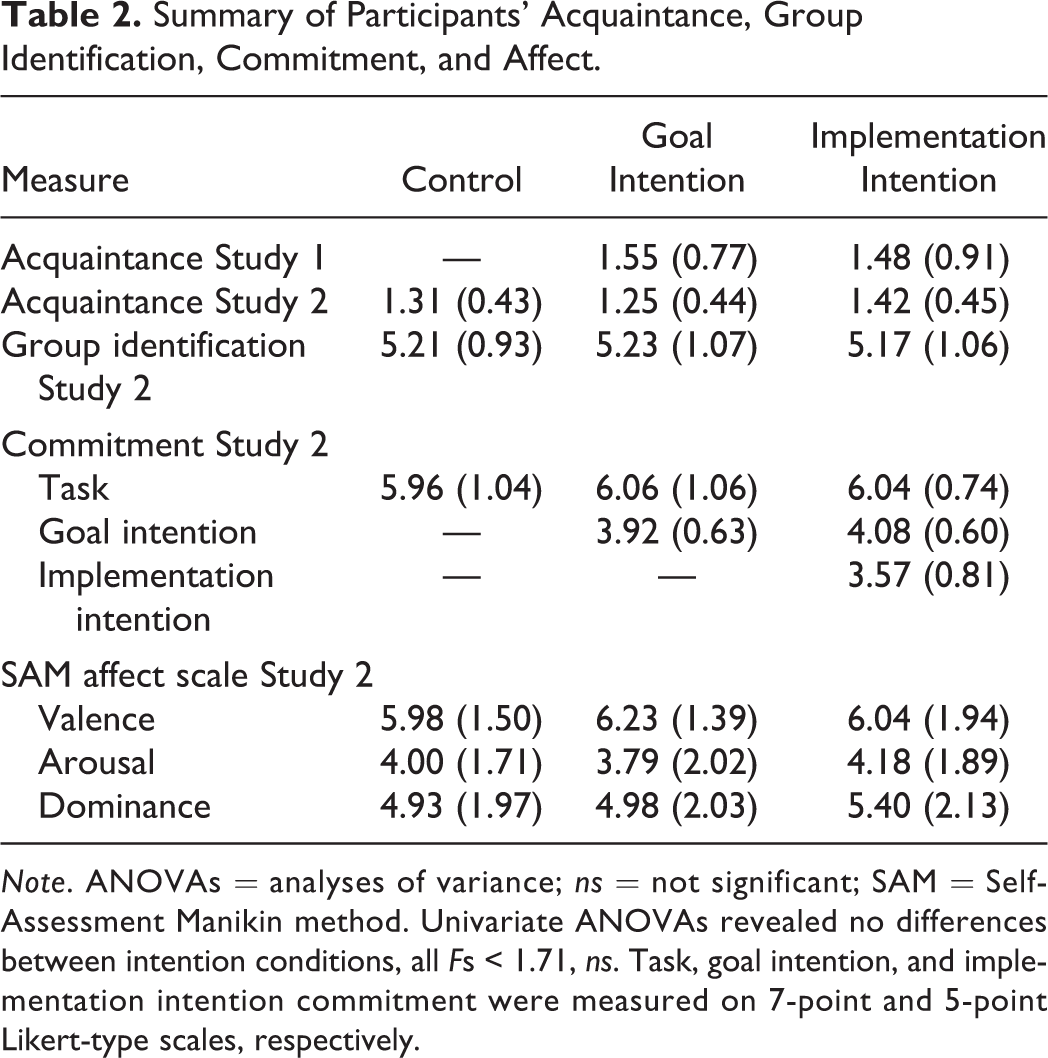
Note. ANOVAs = analyses of variance; ns = not significant; SAM = Self-Assessment Manikin method. Univariate ANOVAs revealed no differences between intention conditions, all Fs < 1.71, ns. Task, goal intention, and implementation intention commitment were measured on 7-point and 5-point Likert-type scales, respectively.
Investment decisions
Entering each triad’s invested proportion of the available budgets into a 2 × 3 repeated measure analysis of variance (rANOVA) revealed a main effect of intention, F(1, 37) = 13.27, p = .001, ηp 2 = .264 (Figure 1), that was qualified by the predicted Intention × Phase interaction effect, F(2, 36) = 3.85, p = .031, ηp 2 = .176, all other Fs < 1, not statistically significant (ns). Pairwise comparisons showed that triads in both intention conditions invested equal proportions in Phase 1, t(37) = 1.33, ns. In Phases 2 and 3, however, implementation intention groups invested less than goal intention groups, both ts(37) > 2.26, p < .030, ηp 2 > .121. Moreover, implementation intention triads invested less in Phases 2 and 3 than in Phase 1, p = .004 and p = .039, respectively. Goal intention triads, in contrast, tended to invest more in Phases 2 and 3 than in Phase 1, albeit not significantly, p = .125 and p = .334. A comparison of the investments in each of the three phases to the minimum investment required to continue the project as originally planned (i.e., spending at least 57%, 60%, and 57%, respectively) revealed that goal intention groups spent more than the minimum in Phase 3, t(20) = 5.77, p < .001, but implementation intention groups did not, t(17) < 1.10, ns.

Mean investment (percentage of the available budget) by intention and phase (N = 39 triads) in Study 1. Error bars represent standard errors.
Overall, Study 1 shows that implementation intentions are an effective self-regulation strategy to attenuate the escalation of commitment in group decision making relative to mere goal intentions. All groups added a self-instruction to use a neutral observer strategy for their goal of making optimal decisions but only implementation intention groups included this strategy in an if-then format. As only implementation intention groups reduced their investments in response to negative feedback, these findings suggest that the initiation of self-distancing responses needs to be automated to attenuate the escalation of commitment. These findings highlight the importance of the automation of action control by implementation intentions (Webb & Sheeran, 2007, 2008) and of planning in an if-then format (Prestwich & Kellar, 2014).
However, several issues remain unsolved: How do groups without an explicit goal act relative to groups that form the goal to make optimal investment decisions and relative to groups that form self-distancing implementation intentions? Do implementation intentions also reduce escalation when making continuous instead of categorical investment decisions? Do participants think that reduced investments would only slowdown the project? And how do participants experience the task in terms of their commitment, affect, group identification, and project evaluations? Study 2 addresses these questions.
Study 2: Maintaining Moderate Investments in Response to Negative Feedback
Study 2 tests the central hypotheses that self-distancing implementation intentions help groups to attenuate the escalation of commitment and notably expands Study 1 in three ways: First, Study 1 demonstrated the importance of the if-then format for the translation of the self-distancing strategy into action. To contextualize these findings, it would be important to examine the implementation intention effects relative to a mere goal intention to make the optimal decision and relative to not forming a goal intention at all. Study 2 thus includes a goal intention condition without any reference to the self-distancing strategy and a no-goal control condition.
Second, Study 1 examined categorical investment decisions where groups had to choose from five to seven investment options. These options did not allow groups to choose the minimum investment of exactly 50% to continue the project as planned. Study 2 addressed this limitation by examining continuous investment decisions where groups were free to invest any amount of the available budget. In addition, in Study 1, groups did not know whether decreased investments would only slow down the project or deteriorate it qualitatively. This ambiguity may have contributed to a low perceived investment efficacy. Study 2 therefore rules out the possibility that decreased investments compromise the project by explicating that investing less money would only slow down the project, whereas investing more money would speed it up. Moderate investments were thus more obviously the optimal decision.
Finally, Study 1 did not assess individuals’ experiences and emotions during the investment task. Study 2 therefore measures individuals’ group identification, affect, commitment, and project evaluations. These measures allow for a more comprehensive understanding of the groups’ experiences.
Method
Participants and Design
About 46 triads comprising 138 students (82 female) with a mean age of 22.94 years (SD = 4.85, range 19–58) participated in exchange for €13 or course credit (available for first-year psychology students). The study employed a 3 between (intention: control vs. goal intention vs. implementation intention) × 3 within (phase: Phase 1 vs. Phase 2 vs. Phase 3) mixed factorial design.
Procedure and Materials
As in Study 1, triads acted as a city council committee responsible for the kindergarten project and first created a group name.
Intention manipulation
Next, goal intention group members formed the goal “We want to make the optimal investment decision in each phase!” Implementation intention group members formed this goal and added the plan “If we are about to make an investment decision, then we will judge the project as neutral observers who are not responsible for earlier decisions!” Goal and implementation intention participants recapitulated their intentions as described earlier for Study 1. Control triads skipped this training, forming neither goal nor implementation intentions. An ostensibly unrelated lexical decision task followed (see 2 and online supplement).
Investment scenario
Afterward, participants worked on the modified investment scenario. In each of the three project phases, participants individually read the information on the current state of the project before collaboratively discussing the information, evaluating the project, and making a unanimous investment decision.
Project evaluation
Triads answered the following questions: “How reasonable is [was] the original idea of building the kindergarten? How reasonable is it to build [continue building] the kindergarten? How disappointed would the community be if the kindergarten were not realized [no longer existed]? (1 = not at all to 7 = very much)”
Investment decision
In each phase, the information, the budget, and the statement that 50% of available funds would be required to complete the project as planned were identical to Study 1. In contrast to Study 1, triads were free to invest any amount of the available budget (i.e., no €50,000 steps), and the consequences of investing more or less money in the project were explained to reduce ambiguity. Participants learned that investing less (more) money than the 50% would slow down (speed up) the kindergarten project and speed up (slow down) other public investments (moderate investment efficacy).
Additional measures
After the investment decision in Phase 3, participants’ group identification was measured using 4 items (e.g., “I identify with my group”; 1 = not at all to 7 = very much, α = .89; adapted from Brown & colleagues, 1986). Next, participants’ affect (valence, arousal, and dominance) was assessed using the Self-Assessment Manikin method (SAM; 1 = unhappy, calm, and not in control to 9 = happy, agitated, and in control; Lang, 1980). Thereafter, participants’ respective commitment was measured by 1 item focused on the task (“How hard did you try to make optimal investment decisions?”; 1 = not at all to 7 = very much), 5 items on goal intention commitment (1 = not at all to 5 = very much, α = .68; Klein, Wesson, Hollenbeck, Wright, & DeShon, 2001), and 3 items on implementation intention commitment (e.g., “I am strongly committed to my plan”; 1 = not at all to 5 = very much, α = .88).
Demographics and funneled debriefing
Participants then provided demographic information, rated their level of previous acquaintance with the members of their group, and were asked to guess the purpose of the study. None of the 138 participants guessed the hypotheses. Finally, participants were debriefed, thanked, and compensated.
Results and Discussion
Equivalence of conditions
The intention conditions did not differ on control variables (Tables 1 and 2). In support of the validity of the investment scenario, participants evaluated the initial reasonability of the project as being high throughout the three project phases. The ratings of the present reasonability and the anticipated disappointment if the project fails, however, dropped from high levels in the first and second phases to moderate levels in the last phase.
Investment decisions
Entering the invested proportion of the triads’ budgets into a 3 × 3 rANOVA revealed no main effect of intention, F < 1, ns, but a main effect of phase, F(2, 42) = 12.08, p < .001, ηp 2 = .365 (Figure 2). As expected, this main effect was qualified by an Intention × Phase interaction effect, F(4, 86) = 2.58, p = .043, ηp 2 = .107. Pairwise comparisons revealed that implementation intention triads’ investments in Phases 2 and 3 did not differ from Phase 1, F(2, 42) < 1, ns. For goal intention and control triads, however, investments in Phases 2 and 3 increased relative to Phase 1, both Fs(2, 42) > 5.68, p = < .007, ηp 2 > .212. Further, triads in the three intention conditions invested equal amounts in Phases 1 and 2, both Fs(2, 43) < 1, ns, but tended to differ in Phase 3, F(2, 43) = 2.60, p = .086, ηp 2 = .108. Here, the implementation intention groups invested less than the control groups, p = .039, and tended to invest less than goal intention groups, p = .081; goal intention groups did not differ from the control groups, p = .711. A comparison of the investments of the intention groups in each of the three phases to the minimum investment required to continue the project as originally planned (i.e., 50%) revealed that goal intention and control groups spent more than the minimum in Phase 3, both ts > 4.17, both ps < .002, but implementation intention groups did not, t(14) = 1.00, ns.
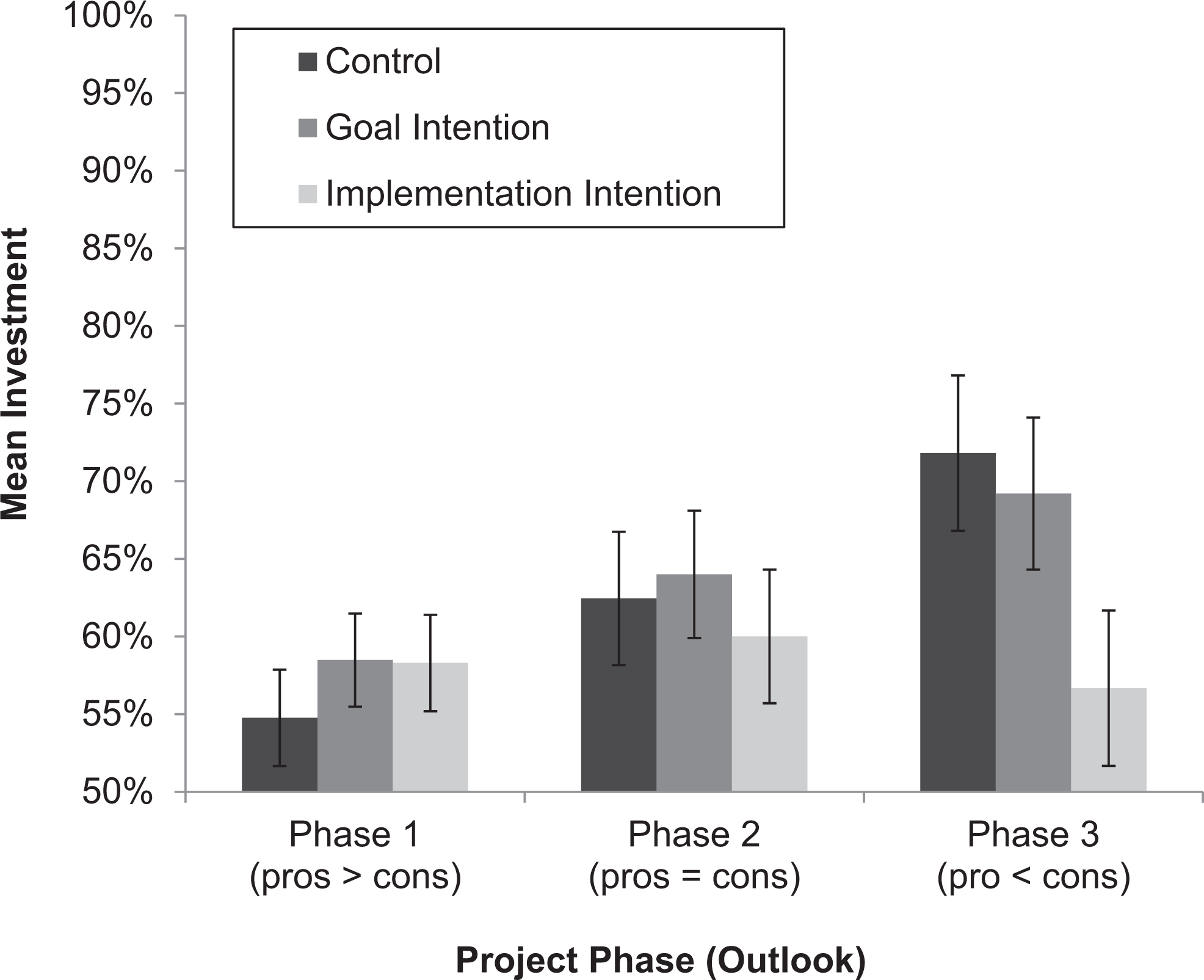
Mean investment (percentage of the available budget) by intention and phase (N = 46 triads) in Study 2. Error bars represent standard errors.
Overall, Study 2 shows the importance of effective self-regulation strategies to attenuate the escalation of commitment in group decision making. Mere goal intention groups escalated as much as control groups without a goal intention. Implementation intention groups, however, did not escalate their commitment.
General Discussion and Conclusion
The current research shows that implementation intentions to engage in self-distancing (i.e., to take the perspective of a neutral observer) but not mere goal intentions help groups attenuate their escalation of commitment to a faltering project. Although implementation intention groups responded to negative project feedback by reducing high investments (Study 1) or maintaining moderate investments (Study 2), groups with the mere goal intention to make optimal decisions maintained high investments (Study 1) or increased their investments as much as control groups without a goal intention (Study 2). In fact, goal intentions did not attenuate the escalation of commitment even if they were supplemented with self-instructions to take a neutral observer perspective (Study 1). These findings point to the difficulty in bridging the intention-behavior gap and imply that interventions that focus on groups’ goal intentions and provide information on best practices might not always attenuate the escalation of commitment. Moreover, these findings highlight the effectiveness of the automation of action control that is attained by planning with implementation intentions. 2
With regard to the generalization of the findings to different decision contexts, the present studies show that implementation intentions but not mere goal intentions attenuate the escalation of commitment in decision contexts with categorical and continuous decision options and with different levels of perceived investment efficacy. With respect to the latter, Study 1 provided only very little information about the decision consequences, potentially leading to low perceived investment efficacy. Under such conditions, both intention groups started with high levels of investment, the challenge being to reduce these high levels in response to negative feedback. Study 2 provided more information on the decision consequences, potentially leading to moderate perceived investment efficacy. Under such conditions, all groups started with moderate levels of investment, the challenge being to maintain these moderate levels in response to negative feedback. 3 Together, Studies 1 and 2 thus show that implementation intentions attenuate the escalation of commitment in various decision contexts.
The self-report measures in Study 2 show that participants in all three conditions strongly identified with their group, were highly committed, felt relatively positive, and evaluated the project realistically. Thus, differences in these dimensions cannot account for the observed intention effects. Furthermore, the lack of differences in individuals’ affect ratings suggests that self-distancing may impact decision making by reducing the experienced responsibility for the initial decisions rather than the amount of negative affect experienced in response to negative feedback. One option to follow-up on this question would be to compare the effectiveness of neutral observer implementation intentions to implementation intentions that instruct users to not feel threatened by negative feedback (i.e., ignoring worries about failure; Thürmer, McCrea, & Gollwitzer, 2013) or to stay calm and relaxed.
Regarding the relation of the present findings to other approaches in research on the escalation of commitment, the fact that all intention groups examined the information equally long supports the argument that a biased information evaluation rather than a biased information search mediates self-justification effects on commitment (Schultze, Pfeiffer, & Schulz-Hardt, 2012). The present results are also congruent with the explanation of escalating commitment that views people’s previous decisions as reflections of their personal preferences (Schulz-Hardt, Thurow-Kröning, & Frey, 2009). Taking the perspective of a neutral observer should weaken the impact of these personal preferences.
In conclusion, the present findings provide further evidence that self-regulation strategies can be successfully applied to address the tenacious problem of escalating commitment. Groups can simply plan to self-distance in an if-then format. These findings highlight the power of groups’ intentional action control.
Footnotes
Declaration of Conflicting Interests
The author(s) declared no potential conflicts of interest with respect to the research, authorship, and/or publication of this article.
Funding
The author(s) disclosed receipt of the following financial support for the research, authorship, and/or publication of this article: This work was supported by the German Research Foundation [DFG, GO 387/14-3].
Notes

References
Supplementary Material
Please find the following supplemental material available below.
For Open Access articles published under a Creative Commons License, all supplemental material carries the same license as the article it is associated with.
For non-Open Access articles published, all supplemental material carries a non-exclusive license, and permission requests for re-use of supplemental material or any part of supplemental material shall be sent directly to the copyright owner as specified in the copyright notice associated with the article.
