



Abstract
Research suggests that musical preferences are linked to personality, but this research has been hindered by genre-based theories and methods. We address this limitation using a novel method based on the actual attributes that people perceive from music. In Study 1, using 102 musical pieces representing 26 genres and subgenres, we show that 38 perceived attributes in music can be organized into three basic dimensions: arousal, valence, and depth. In Study 2 (N = 9,454), we show that people’s preferences for these musical attributes reflected their self-ratings of personality traits. Importantly, personality was found to predict musical preferences above and beyond demographic variables. These findings advance previous theory and research and have direct applications for the music industry, recommendation algorithms, and health-care professionals.
The trick is if you listen to that music and you see me, you’re not getting anything out of it. If you listen to that music and you see yourself, it will probably make you cry and you’ll learn something about yourself and now you’re getting something out of it.
The study of musical preferences has a long history. It was initially thought that preferences provided a window to the psychological unconscious, but today, contemporary researchers take an interactionist approach which posits that preferences are indicative of explicit personal characteristics (Bonneville-Roussy, Rentfrow, Xu, & Potter, 2013; Buss, 1987; Cattell & Anderson, 1953; Cattell & Saunders, 1954; Rentfrow et al., 2011, 2012; Swann, Rentfrow, & Guinn, 2002). Previous research on the links between musical preferences and the Big Five personality traits has supported this theory and shown consistent trends across studies and cultures including the United States, United Kingdom, the Netherlands, Germany, and Japan (Brown, 2012; Delsing, ter Bogt, Engels, & Meeus, 2008; Dunn, de Ruyter, & Bouwhuis, 2011; George, Stickle, Rachid, & Wopnford, 2007; Langmeyer, Guglhör-Rudan, & Tarnai, 2012; Rentfrow & Gosling, 2003; Zweigenhaft, 2008). In general, people high on extraversion and agreeableness prefer pop, soundtrack, religious, soul, funk, electronic, and dance genres and those high in openness to experience prefer blues, jazz, classical, and folk genres (Rentfrow & McDonald, 2009).
This evidence, however, has been hindered by genre-based methodologies that rely on preference ratings for a list of genres. This presents serious problems for researchers because genres are broad classifications with illusive definitions and social connotations. Participants of different ages, geographic regions, and socioeconomic backgrounds differ in the way that they conceptualize the genres presented to them. Also, people may indicate that they like a certain genre because of the stereotypes linked to it, but the sounds that they actually like and the music they listen to when alone may be different. Even researchers who measure preferences using musical stimuli do not explicitly measure the perceived attributes in the music they administer but rather group the stimuli into a single category based on its (often superficial) genre or style designation (e.g., Langmeyer, et al., 2012; Rawlings, Barrantes-Vidal, & Furnham, 2000; Vuoskoski, Thompson, McIlwain, & Eerola, 2012). Therefore, in neither approach have researchers been able to form conclusions about the actual musical attributes that people like.
Aims
The design of the present research is displayed in Figure 1. Our goal was to observe people’s preferential reactions to recorded musical pieces and to link their self-ratings of personality with their preferences for the specific attributes expressed by the music. However, these observations are difficult with the large number of attributes that are perceived from music. Therefore, in Study 1, judges rated perceptions of 38 psychological attributes for 102 excerpts of studio-recorded music that represent 26 genres and subgenres (Step 1 in Figure 1). We labeled these attributes “psychological” because they include descriptors that refer to the emotional (happy, sad, and angry) and cognitive (intelligent and sophisticated) aspects of the music. We then treated the musical piece (rather than the person) as the unit of analysis and used principal component analysis (PCA) to condense the mean attribute ratings into smaller components (Step 2). In Study 2, we measured preferential reactions to a subset of the 50 excerpts used in Study 1. We then used the attribute information from Study 1 to examine participants’ preferences for the attributes featured in the music they listened to. Finally, in Steps 3 and 4, we linked participants’ preferential reactions to the musical attributes with self-reported personality.

Study design.
Study 1
The aim of this study was to identify the structure underlying perceived attributes in music across a variety of genres.
Method
Participants and Procedures
Seventy-six judges with no formal music training independently rated 102 musical excerpts of mixed genres based on their perceptions of psychological attributes expressed from the music. To reduce the impact of fatigue and order effects, judges were divided into eight groups to code subsets of attributes for 25–26 excerpts each. Agreement for the 38 attributes was high (Mα = .82) with the lowest agreement for inspiring (α = .60) and the highest agreement for abrasive (α = .94).
Musical Stimuli and Attribute Selection
We used 102 pieces selected by Rentfrow, Goldberg, and Levitin (2011) and Rentfrow et al. (2012), representing 26 genres and subgenres (Table S1). The pieces were systematically selected to represent the wide spectrum of musical space that people are exposed to in their everyday lives but were not widely known to the general public. Roughly half of the pieces (52) had been commercially released, but had low sales figures, and the remaining 50 pieces were unreleased songs that had been purchased from Getty Images. The 38 perceived psychological attributes were obtained from Rentfrow et al. (2012), 2 who systematically selected them to represent the breadth of musical characteristics featured across the multidimensional musical space.
Results
For each of the 102 pieces, we calculated the mean judges’ ratings for each of the 38 perceived attributes. We then performed PCA with varimax rotation at the song level for the 38 attributes. The Kaiser–Meyer–Olkin measure of sampling adequacy was .87, indicating the data were suitable for PCA. Multiple criteria, including parallel analysis of random data and analysis of the scree plot (Figure S1), suggested that we retain no more and no less than three components. These three components together accounted for 73% of the variance explained in perceived psychological attributes.
We next examined the hierarchical structure of the one- through three-component solutions using the procedure proposed by Goldberg (2006). The resulting hierarchical structure is displayed in Figure 2 (the hierarchical diagrams in this article were created in part by the Factor Diagrammer Version 1.1b; Levitin, Schaaf, & Goldberg, 2005). Attributes that loaded highly on the arousal dimension were intense, forceful, abrasive, and thrilling, and those that had high negative loadings were gentle, calming, and mellow. This component remained virtually unchanged through the three-component solution. Attributes that loaded highly on the valence component were fun, happy, lively, enthusiastic, and joyful, and those that had high negative loadings were depressing and sad. In the three-component solution, the valence component split into two subcomponents that differentiated intellectual and emotional depth from valence. Attributes that loaded highly on the “depth” component were intelligent, sophisticated, inspiring, complex, poetic, deep, emotional, and thoughtful attributes, and those that had high negative loadings were party music and danceable attributes. Attribute loadings onto each of the three components are displayed in Table 1.
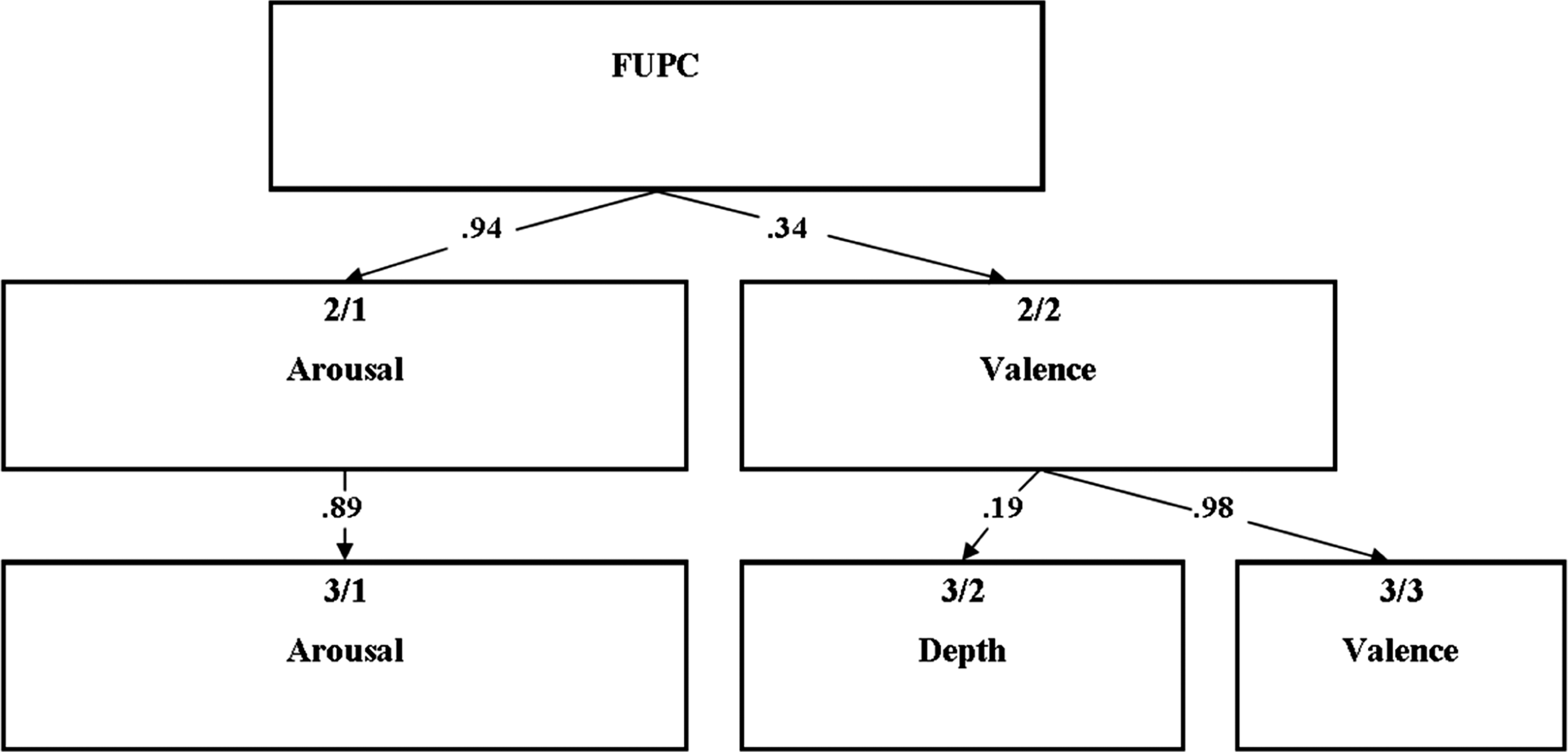
Varimax-rotated principal compoents derived from ratings for 38 percieved attributes in mixed genre excerpts. The figure begins (top box) with the first unrotated principal component and displays the genesis of the derivation of the three components obtained. Numbers within boxes indicate the number of components extracted for a given level (numerator) and the component number within that level (denominator; e.g., 2/1 indicates the first component in a two-component solution). Numbers within the arrow paths indicate the absolute value correlation between components at the respective levels of analysis. For example, when expanding from a two-component solution to a three-component solution (rows 2 and 3), we see that component 2/2 “valence” splits into two new components, “depth” (which correlates .19 with the parent component) and valence (which correlates .98 with the parent component).
Three Varimax-Rotated Principal Components Derived From Perceptions of 38 Psychological Attributes in 102 Mixed Genre Excerpts.
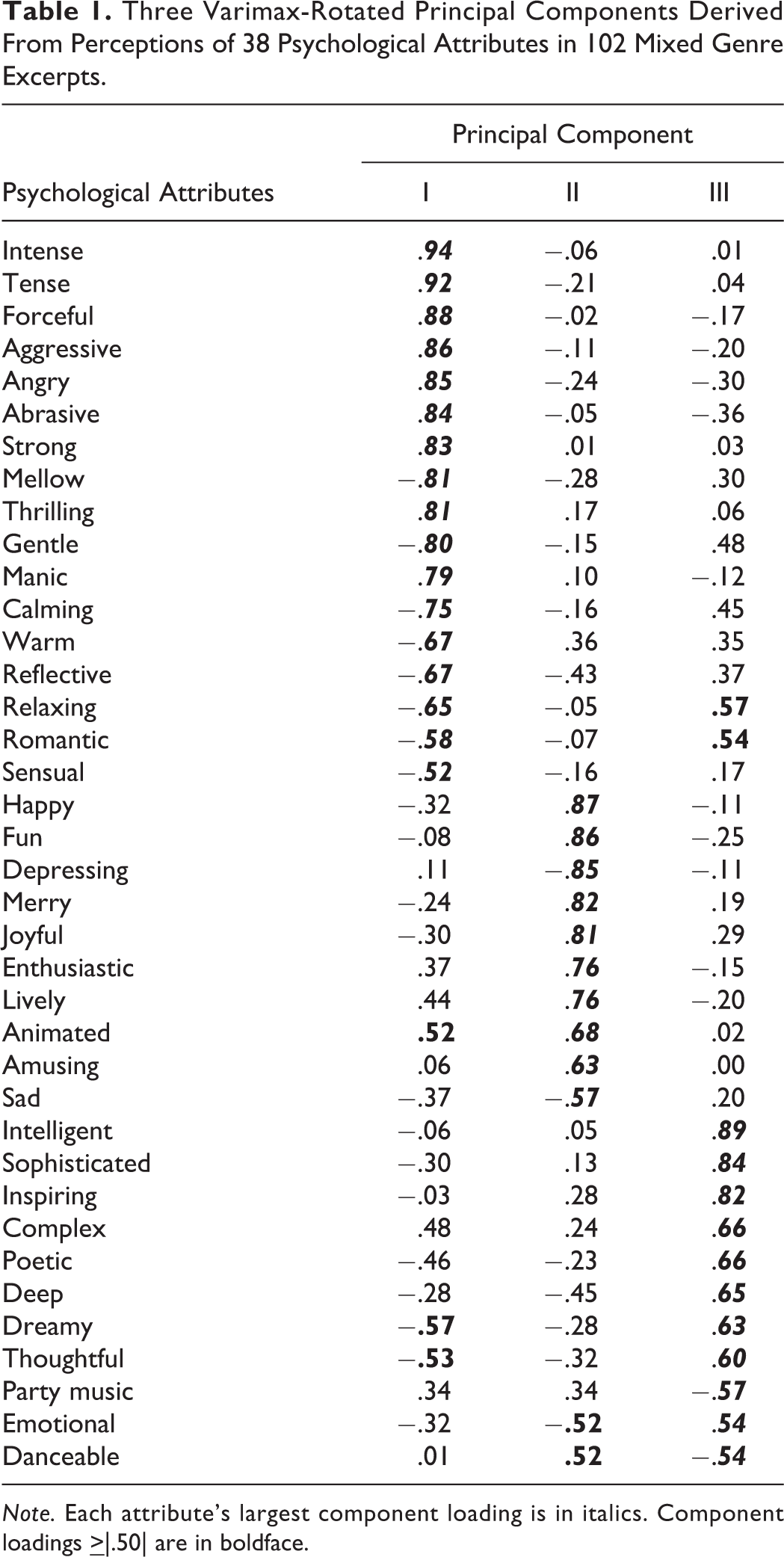
Note. Each attribute’s largest component loading is in italics. Component loadings
To get a sense of the types of excerpts that loaded onto each component, we explored the principal component scores of the excerpts. Excerpts that scored high on the arousal component were “White Knuckles” by Five Finger Death Plunge (heavy metal), “Rock the Clock” by Ornette Coleman (acid jazz), and “Straight Outta Junior High” by Over Now (punk) and excerpts that scored low were “Children of Spring” by Bruce Smith (adult contemporary) and “Birth” by Human Signals (soft rock). Excerpts that scored high on valence were “Mambo Numero Cinco” by Hilton Ruiz (Latin), “Razzle Dazzle” by Bill Haley and His Comets (rock-n-roll), and “Heute Nact” by Brigitte (Europop) and excerpts that scored low were “Just Walk Away” by Karla Bonoff (soft rock) and “Sweet scene” by Ali Handal (soft rock). Excerpts that scored high on depth were “Piano quintet No 1 in A minor” performed by Farrenc, “Waxing Moon” (classical) by Jah Wobble (world beat), and “Symphony No. 3” performed by Philip Glass (avant-garde classical) and excerpts that scored low were “Sexy” by Robert LaRow (Europop), “Newsreel Paranoia” by Babe Gurr (bluegrass), and “Get the Party Started” by Sammy Smash (Rap).
To examine the generalizability of these components, we performed PCA’s separately on 50 rock excerpts and 50 jazz excerpts, which separate judges had rated on the same 38 perceived psychological attributes in previous research (Rentfrow et al., 2012). In each case, a similar three-component structure emerged (see Supplemental Materials: Figure S2 and Tables S2 and S3). These results show the replicability of the three-component structure within a single genre of music.
Study 2
The aim of this study was to observe preferential reactions to musical stimuli and to link self-ratings of personality with preferences for perceived attributes expressed by the music.
Method
Participants, Procedures, and Measures
To ensure that the results were reliable and generalizable, we aimed to recruit a large Internet sample. Nine thousand four hundred and seventy-eight Facebook users volunteered through the myPersonality Facebook application (Kosinski, Matz, Gosling, Popov, & Stillwell, 2015) in exchange for feedback about their preference scores. Due to increases in hearing deficits in older age, we applied the same age cutoff (65-years-old) that has been used in previous research on this topic (Bonneville-Roussy et al., 2013). Only 24 (0.25%) participants indicated they were older than 65 and were excluded, leaving 9,454 participants. The sample ranged from 18 to 65 years of age with a mean of 25.82 (SD = 8.38). Of those who indicated, 5,408 (61%) were female and 3,463 (39%) were male. Each participant reported their preferences for 50 excerpts (Table S1). Participants were unlikely to be familiar with those excerpts, as they were purchased from Getty Images and were not commercially released. Participants completed a 20- to 100-item International Personality Item Pool (IPIP; Goldberg et al., 2006) proxy measure of the Revised NEO Personality Inventory (Costa & McCrae, 1992) that was administered in 10-item blocks (75% completed the full 100-item version). Seven hundred and ninety seven completed the full 336-item version of the IPIP that captures facet scores of the five-factor model.
Attribute Preferences
To compute participant preferences for the three attribute dimensions, we calculated the cross product between excerpt-component loading matrix and “users-preference for excerpts” matrix. Specifically, for each of the three attribute dimensions, we multiplied the participant’s preference rating for each excerpt by the excerpt’s component loading (from Study 1) on the specific dimension in question. We then added the weighted preference of each excerpt and divided that sum by the sum total of preference ratings for all of the excerpts.
Results
Demographics
Table A1 in the appendix reports correlations between musical preferences and personal characteristics, including demographic characteristics, and personality domains and facets. In terms of demographics, preferences for arousal were negatively correlated with age and education and were lower among women than men. Preferences for valence were positively associated with age and lower among women than men. And preferences for depth in music were positively associated with age and education and were lower among men than women.
Personality
Associations between personality and musical preferences are reported in Table A1 and displayed in Figure 3. Neuroticism was positively associated with preferences for arousal in music and negatively associated with valence. In terms of facets, arousal was positively associated with anger and depression, valence was negatively associated with self-consciousness and vulnerability, and depth was negatively associated with immoderation and vulnerability.
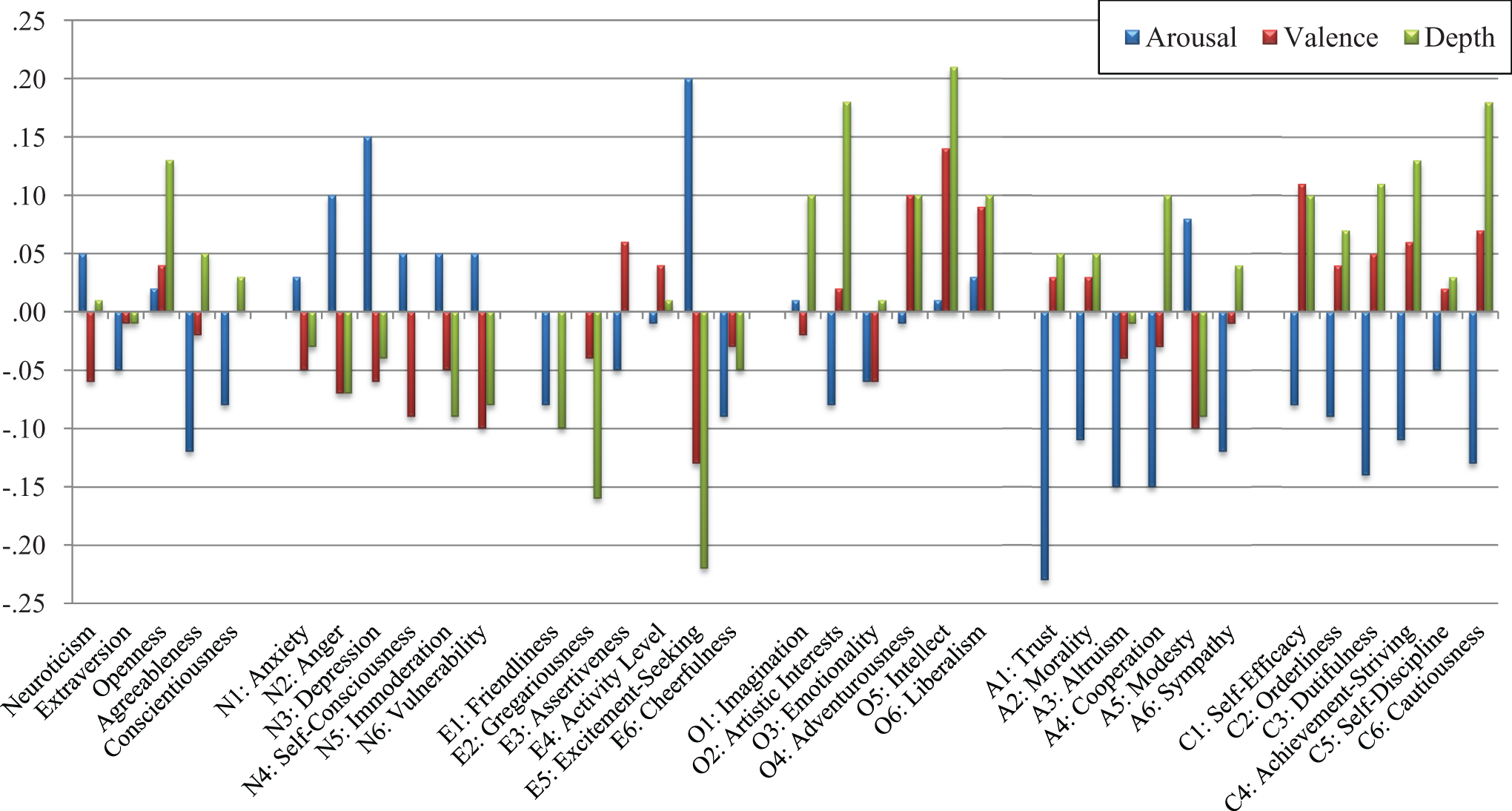
Correlations between personality and preferences for musical attributes.
Extraversion was negatively correlated with arousal (r = −.05); however, the direction of the correlation was differentiated in terms of facets. Preferences for arousal was positively correlated with excitement-seeking (r = .20) and negatively associated with friendliness and cheerfulness. Preferences for valence were negatively associated with excitement-seeking, and preferences for depth were negatively associated with friendliness, gregariousness, and excitement seeking.
Openness was positively associated with preferences for valence and depth in music. In terms of facets, preferences for arousal in music was negatively associated with artistic interests; valence was positively associated with adventurousness, intellect, and liberalism; and depth was positively associated with all of the openness facets except for emotionality (r = .01).
Agreeableness was negatively associated with preferences for arousal and valence in music and positively associated with depth. In terms of facets, preferences for arousal was positively associated with modesty but negatively associated with trust, morality, altruism, cooperation, and sympathy. Valence was negatively associated with modesty. Preferences for depth was positively associated with cooperation but negatively associated with modesty.
Conscientiousness was negatively associated with preferences for arousal in music and positively associated with depth. In terms of facets, arousal was negatively associated with all of the conscientiousness facets except for self-discipline (r = −.05). Valence was positively associated with self-efficacy and cautiousness, and depth was positively associated all of the conscientiousness facets except for self-discipline.
We also examined whether having diverse musical preferences was linked to personality. Specifically, we correlated average preference ratings computed across all the musical excerpts with personality. Preferences for all types of music was positively correlated with openness (r = .13) as well as extraversion (r = .11), agreeableness (r = .10), and conscientiousness (r = .03). Neuroticism was negatively correlated with diverse preferences (r = −.05). Personality correlates with specific musical attributes is listed in Table S4.
Does Personality Predict Preferences Beyond Demographic Variables?
We performed multiple regressions to examine whether personality predicted musical preferences over demographic variables. Preferences for each musical attribute dimension were regressed onto demographic variables in Step 1 (age, sex, and education) and the five personality domains in Step 2. Results are reported in the appendix in Table A2. In Step 1, demographic variables accounted or significant proportions of variance for preferences for each of the musical attribute dimensions, Fs(3, 2, 302) = 35.73, 31.30, and 11.18, ps < .001; for arousal, valence, and depth, respectively. In Step 2, personality significantly increased multiple correlations for preferences for each of the three musical attributes dimensions: from .21 to .26, ΔF(8, 2, 297) = 10.50, p < .001, for arousal; .20 to .21, ΔF(8, 2, 297) = 3.28, p < .01, for valence; and .12 to .19, ΔF(8, 2, 297) = 10.36, p < .001, for depth. These results show that personality predicts musical preferences over and above demographic variables. In particular, personality accounted for the largest increase in explained variance for the depth component. This suggests that the musical elements expressed by depth (particularly the themes, symbolism, and lyrics expressed in music with emotional depth) are more closely and explicitly reflective of personality features than arousal and valence dimensions.
Attribute- Versus Style-Based Approaches
The attribute-based approach presented in this article proposes an alternative to other approaches previously used to conceptualize musical preferences such as the MUSIC model, which organizes preferences based on musical style (Rentfrow, Goldberg, & Levitin, 2011). Therefore, we examined the extent to which attribute preferences accounted for more unique variance in individual differences in musical preferences compared to preferences based on the MUSIC model. Multiple regression analyses showed that both models accounted for unique proportions of variance in musical preferences and each provided significant increases in variance beyond the other. We conducted further regressions examining whether the attribute preference model was more strongly linked to demographic and personality variables than the MUSIC model. Results from these regressions suggested there was no discernable difference in predictive power of demographic or personality variables for attribute preferences compared to style preferences. These results are reported in detail in the Supplemental Materials.
General Discussion
Summary of Our Findings
We sought to overcome limitations from previous research into musical preferences to provide a more detailed and nuanced account of the personality correlates of music preferences. By treating the song as the unit of analysis, Study 1 examined 38 perceived musical attributes in 102 mixed genre excerpts to reveal a three-component structure underlying perceived attributes in music: arousal, valence, and depth. These dimensions reflect previously established psychological models such as the circumplex model of affect (Russell, 1980) and the positive and negative affect framework used to conceptualize mood states (Watson, Clark, & Tellegen, 1988). This evidence suggests that perceptual processing of music may be an extension of psychological processes that occur in daily life. For example, the arousal dimension appears to reflect physiological processes such as stimulation and relaxation, valence reflects emotion and mood processes, and depth reflects cognitive processes.
In Study 2, we linked personality traits to preferences for perceived attributes in music. Preferences for low arousal in music were associated with agreeableness and conscientiousness, preferences for negative valence were associated with neuroticism, and preferences for positive valence and depth were associated with openness. Examination of personality facets as well as preferences for individual attributes in music provided nuanced information into the relationship between personality and preferences. Importantly, personality traits were found to predict musical preferences beyond demographic variables. The magnitude of the correlations observed in the present work is small to modest compared to benchmarks often used in behavioral science research (Cohen, 1988). However, the present results are generally of the same order of magnitude compared to previous studies linking musical preferences to psychological constructs (e.g., Delsing et al., 2008; Dunn et al., 2011; George et al., 2007; Langmeyer, et al., 2012; Rentfrow & Gosling, 2003; Zweigenhaft, 2008), and considering the comparatively large sample size used, the correlation estimates we observed should be quite stable (Ioannidis, 2008; Schönbrodt & Perugini, 2013).
Future Directions and Implications
DNA of musical attributes
Although the three attribute dimensions are robust and transparent, they are also broad. This is in part due to the length of the excerpts and the number of perceived attributes that we examined. Indeed, music is a highly complex medium, and future research should extend this work to grasp both a larger and more intricate understanding of perceived attributes. One way of expanding the scope of musical attributes is to examine the sonic attributes in music (e.g., timbre and instrumentation). This is similar to how the Music Genome Project codes music for Pandora, the Internet radio, and streaming interface. Indeed, sonic attributes and psychological attributes are likely interrelated. Following with the metaphor of examining the genetic makeup of music, it can be argued theoretically that sonic attributes act as the genotype and the expressed psychological attributes act as the phenotype. Extended further, the broader genres or styles that comprise configurations of these attributes (Rentfrow et al., 2012) may play the role of the larger species. The validity and usefulness of this theoretical model should be empirically tested. Further, because the results from Study 1 show there is a robust structure underlying attributes in music, it suggests that it may not be necessary for those who code and categorize music (in both industry and research) to code a plethora of attributes for each musical piece, and that it may be quicker and just as accurate to code music based on the three dimensions found in the present research.
Big music data
The use of big data by social scientists has rapidly changed the scope in which researchers are able to observe people’s everyday behaviors (e.g., digital footprints on Facebook; Kosinski, Stillwell, & Graepel, 2013). However, the science of music has yet to use these tools to their full advantage. Research shows that people spend a considerable amount of time listening to music: nearly 17% of their waking lives (Rentfrow, 2012). Yet, big data on the uses, effects, and habits of music listening is missing from the music literature. With technological advances such as headphones that personalize playlists based on learned preferences from the users’ actions (www.aivvy.com), earbuds that record physiological metrics (www.bragi.com), and mobile applications that track location and mood (www.emotionsense.org), it is possible to link people’s daily music listening with their physiological and affective reactions on a very large scale. If researchers can easily extract the psychological and sonic attributes in music from mobile records of the music that people listen to, the possibilities of linking nuanced musical characteristics to everyday behavior are vast.
Industry
Decades ago, people’s music listening choices used to be largely determined by radio, home record collections, and local events. Today, however, platforms such as Internet radio have had an increasing influence on the music people listen to by creating musical environments that are tailored to the users’ personal preferences. Many of these interfaces (e.g., YouTube) use the person’s previous selection habits as a means of interpreting their preferences and recommending music to them. However, the present research provides strong evidence that people’s personal characteristics, namely, their personality traits, are a predictor of their musical preferences. These traits can be assessed with as little as five questions (e.g., Five Item Personality Inventory; Gosling, Rentfrow, & Swann, 2003) or automatically using digital footprints (Kosinski, Graepel, & Stillwell, 2013). Understanding the extent to which information about personality provides a more accurate method of recommending music to its users is an important avenue for future research.
Health-care professions
The mental and physical benefits of music listening are pervasive. Research showing the mental and physical health benefits of music listening outside of music therapy settings is compounding. For example, a recent meta-analysis of 73 randomized control trials showed that music listening prior, during, and after surgery increased patient recovery rates in adults. A smaller scale meta-analytic study extended these findings for children who had pediatric surgery (van der Heijden, Araghi, van Dijk, Jeekel, & Hunink, 2015). Although we know that implementing music into mental and physical health-care settings is beneficial, the role that musical preferences play in these scenarios is less clear. Is it the act of listening to preferred music that drives improved health outcomes (regardless of the attributes featured in the music), or rather, is there a specific constellation of musical attributes (regardless of whether they are preferred by the patient) that lead to improvements more than others? These questions need to be tested in both physical and mental health settings, and with patients with different types of conditions. Rigorous testing in these areas can lead to evidence-based protocols that can inform health-care professionals how to use music effectively with their patients.
Conclusion
Certainly, Kern and Hammerstein did not intend to make any significant contributions to the field of psychology when they composed “The Song is You,” yet even so, the song poses several important hypotheses for psychology which have been explored in this article. Results from linking personality traits to preferences for perceived musical attributes suggest that we are the music and the music is us. Future research should build on these findings to further explore how people use music to express, reinforce, and communicate their dispositional, situational, and cultural characteristics in their everyday lives. Importantly, we encourage science and industry to work together to advance knowledge and the application of this important topic.
Footnotes
Appendix
Multiple Correlations of Musical Preferences With Demographic Variables and Personality as Predictors.

| Predictors | Musical Attribute Dimension | ||
|---|---|---|---|
| Arousal | Valence | Depth | |
| Step 1: Demographics | .21 | .20 | .12 |
| R 2 | .04 | .04 | .01 |
| F |
|
|
|
| Step 2: Personality | .26 | .21 | .19 |
| R 2 | .07 | .05 | .04 |
| ΔF |
|
|
|
Note. N = 2,305. Cell entries are multiple Rs except where indicated as R 2, F, or ΔF. Cell entries in boldface are significant at the p < .05 level.
Declaration of Conflicting Interests
The author(s) declared no potential conflicts of interest with respect to the research, authorship, and/or publication of this article.
Funding
The author(s) disclosed receipt of the following financial support for the research, authorship, and/or publication of this article: DMG was supported by the Cambridge Commonwealth, European and International Trust during this period of work.
Notes

References
Supplementary Material
Please find the following supplemental material available below.
For Open Access articles published under a Creative Commons License, all supplemental material carries the same license as the article it is associated with.
For non-Open Access articles published, all supplemental material carries a non-exclusive license, and permission requests for re-use of supplemental material or any part of supplemental material shall be sent directly to the copyright owner as specified in the copyright notice associated with the article.
