




Abstract
Intergroup contact at the individual level is robustly associated with lower prejudice, but intergroup contact occurs within a greater regional context. Multilevel examinations thus far have focused on interethnic contact, where both individual- and contextual-level contact are associated with lower explicit prejudice. Given that ethnicity is visible, two lingering questions concern whether (a) contextual contact effects only apply to visible outgroups and (b) contextual contact effects predict implicit prejudice in addition to explicit prejudice. In two studies, we tested these questions in the domain of sexual orientation. Individual- and contextual-level contact were simultaneously (uniquely) associated with lower implicit and explicit prejudice: Individuals having more contact with gay men/lesbians were less prejudiced toward gay men and lesbians, and individuals living in areas with greater contact with gay men/lesbians were less prejudiced toward gay men/lesbians. It seems that people need not directly witness intergroup contact in their region for contextual contact effects to occur.
Intergroup contact—interactions between members of different social groups (e.g., Whites and Blacks; heterosexuals and gay men/lesbians)—is consistently associated with lower prejudice (Hodson & Hewstone, 2013; Pettigrew & Tropp, 2006). This pattern has largely been observed at the individual level—the more intergroup contact an individual experiences, the lower the prejudice expressed—and exists across several group domains including ethnicity (Pettigrew & Tropp, 2006) and sexual orientation (Smith, Axelton, & Saucier, 2009). Leading intergroup contact researchers have called, however, for studies examining individual- and contextual-level contact (such as region or neighborhood) simultaneously (Christ & Wagner, 2013; Pettigrew & Tropp, 2006, 2008; Pettigrew & Tropp, 2011). The opportunities for contact that are provided by living in a more or less diverse region could, for example, predict systematically different relationships between individual contact and prejudicial attitudes. Because intergroup contact is inherently social in nature, multilevel studies of intergroup contact allow us to consider individual contact experiences within the greater contact context. We employ publicly available data from the U.S. General Social Survey and the Project Implicit demonstration website, including geolocation data (obtained with special permission for General Social Survey data) to perform such a multilevel investigation.
In particular, we examine how both individual- and contextual-level intergroup contact are associated with prejudice toward gay men and lesbians. To date, multilevel approaches to intergroup contact have focused on contact and prejudice among different ethnic groups, where both individual- and contextual-level interethnic contact are negatively associated with prejudice across several ethnic group domains including White–Asian relations, White–Hispanic relations (Dixon, 2006), White–Muslim relations (Hewstone & Schmid, 2014), White–ethnic minority relations (Christ et al., 2014; Schmid, Al Ramiah, & Hewstone, 2014), and Black–“colored” relations (Christ et al., 2014). Not all studies have demonstrated consistent findings across levels of analysis, however. The aforementioned studies created averages of individual-level contact for each region, thus contextual-level contact represented the amount of contact people experienced within a region. When the contextual level was operationalized as opportunity for contact (i.e., higher proportion of Blacks in the county), without reference to actual contact, individual-level contact (i.e., knowing and feeling close to Blacks) was associated with less prejudice toward Blacks, but contextual-level contact was associated with greater prejudice toward Blacks (Dixon, 2006). To ensure that we are capturing the degree of contact experienced within a region and maintain consistency with most multilevel contact research, we opted for the more common approach of aggregating individual contact at the regional level.
As ethnicity is a visible characteristic of a person, it seems natural that people would be aware of their own contact with other ethnic groups, the amount that their neighbors interact with other ethnic groups, and the more general diversity of their region. However, many intergroup domains are less readily visible (e.g., sexual orientation, Herek & Capitanio, 1996; political orientation, Chambers, Schlenker, & Collisson, 2013; religion, Gervais, Shariff, & Norenzayan, 2011). Although we know that individual-level contact with people of other sexual orientations is associated with less prejudice (Pettigrew & Tropp, 2006; Smith et al., 2009), it is unclear whether people have a generalized sense of how much people in their region interact across group lines when they cannot readily estimate proportions of outgroup members while walking down the street. Thus, a fundamental lingering question is whether contextual contact effects only apply to visible outgroups or whether they are also observable in less visible intergroup domains. In two studies, we test this question in the domain of sexual orientation. Similar to previous multilevel research, contextual-level contact with gay men and lesbians may be more strongly associated with prejudice than is individual-level contact if people have a sense of how much contact with other sexual orientations occurs in their region. However, given that it may be more difficult for people to intuit the extent to which contact with gay men and lesbians (vs. ethnic minorities) occurs in their region, contextual-level contact may not overshadow individual-level contact as has been seen in previous multilevel contact research. We examine this question as well as test the potential interaction between individual- and contextual-level contact for exploratory purposes.
Another lingering and previously unexplored question is whether, when examined simultaneously, individual- and contextual-level contact are associated with lower implicit bias. Implicit attitudes are relatively difficult to consciously access and control, whereas explicit attitudes are those that are easily accessible and controllable (Greenwald, McGhee, & Schwartz, 1998). Although there is less research on intergroup contact and implicit (vs. explicit) bias, several studies have observed relations between individual-level higher intergroup contact and lower implicit bias (e.g., Aberson, Shoemaker, & Tomolillo, 2004; Turner, Hewstone, & Voci, 2007), including in the domain of sexual orientation (e.g., Dasgupta & Rivera, 2008; Lemm, 2006). All multilevel examinations of the contact-bias relationship to date, however, have focused on explicit bias. In Study 2, we will extend previous work by examining the influence of both individual- and contextual-level contact with gay men and lesbians on implicit bias toward gay men and lesbians. Given that implicit attitudes are considered more difficult to change than explicit attitudes (Wilson, Lindsey, & Schooler, 2000), it is unknown whether contextual-level contact, particularly with a less visible group, is powerful enough to influence implicit bias.
Study 1
We identified variables in the General Social Survey (GSS; Smith, Marsden, Hout, & Kim, 2012) relevant to our hypotheses. The GSS, conducted by the National Opinion Research Center (NORC), assesses social trends in the United States and is designed to yield a representative sample of American households. Variables assessing intergroup contact with and intergroup bias toward “homosexuals” were present in the 2006 GSS data set. We downloaded data subsets containing the variables of interest from the GSS website.
In addition to these publically available GSS data, we obtained permission from NORC to access GSS geo-coded data that provide participant locations, as critical to our hypotheses. We merged our subsets of GSS data with the geo-coded data. As such, some of the data used in this analysis are derived from Sensitive Data Files of the GSS, obtained under special contractual arrangements designed to protect the anonymity of respondents. These data are not available from the authors. Persons interested in obtaining GSS Sensitive Data Files should contact the GSS at
Participants
The 2006 GSS data subset consists of 4,510 participants, but not all participants are asked all questions. Participants with data on at least one bias variable and at least one contact variable were included in our analyses (N = 853, M age = 48.28, SD age = 17.44, M income = US$34,150.26, SD income = 32,629.64, M education = 13.59, SD education = 2.99, 57% women, 77.4% White). This included data from 387 census tracts. Although we determined our sample size based on the GSS data available to us, post hoc power was estimated at 0.83 for the contextual-level sample of 387 and 1.00 for the individual-level sample of 853, indicating suitable power to detect the relevant effects.
Variables
Intergroup bias
Participants indicated whether a homosexual individual should be allowed to make speeches in their community (allowed/not allowed), a homosexual individual should be allowed to teach college (allowed/not allowed), homosexual sex is wrong (1 = always wrong to 4 = not wrong at all), homosexual books should be allowed in the library (remove/not remove), and homosexuals should have the right to marry (1 = strongly agree to 5 = strongly disagree). After standardizing (i.e., to account for different response scales) and reversing scoring necessary items, items were averaged with higher scores indicating greater bias (α = .80).
Intergroup contact
Participants indicated the number of gay family members, gay people they are associated with, gay people in their neighborhood, gay people in their voluntary organization, gay people in their current or previous work, and gay people they trust on scales ranging from 1 (0) to 5 (more than 10). These items were averaged with higher scores representing more individual-level contact (α = .73). Average contact with homosexuals within each census tract was calculated from this to represent contact at the census tract level.
Demographic control variables
Participants indicated their age, sex, income, and education (see Online Supplemental Table 1).
Analytic Strategy
Multilevel modeling was employed with individual respondents nested within census tracts. To disentangle within- and between-tract effects (Zhang, Zyphur, & Preacher, 2009), individual intergroup contact was group-mean centered around one’s census tract’s mean (i.e., an individual’s degree of contact relative to other respondents from their census tract) to capture within-tract variation, and the between-tract variation was represented by grand-mean centering census tract contact (i.e., a census tract’s average contact relative to other census tracts in the United States). Our model predicted intergroup bias from individual contact, census tract contact, and the interaction between individual contact and census tract contact, with a random intercept and random slope of individual contact estimated for each census tract. We controlled for individual age, individual sex, individual income, and individual education in the model. Covariates were group-mean centered around their census tract’s mean. For syntax used, see https://osf.io/enf9u/.
Results
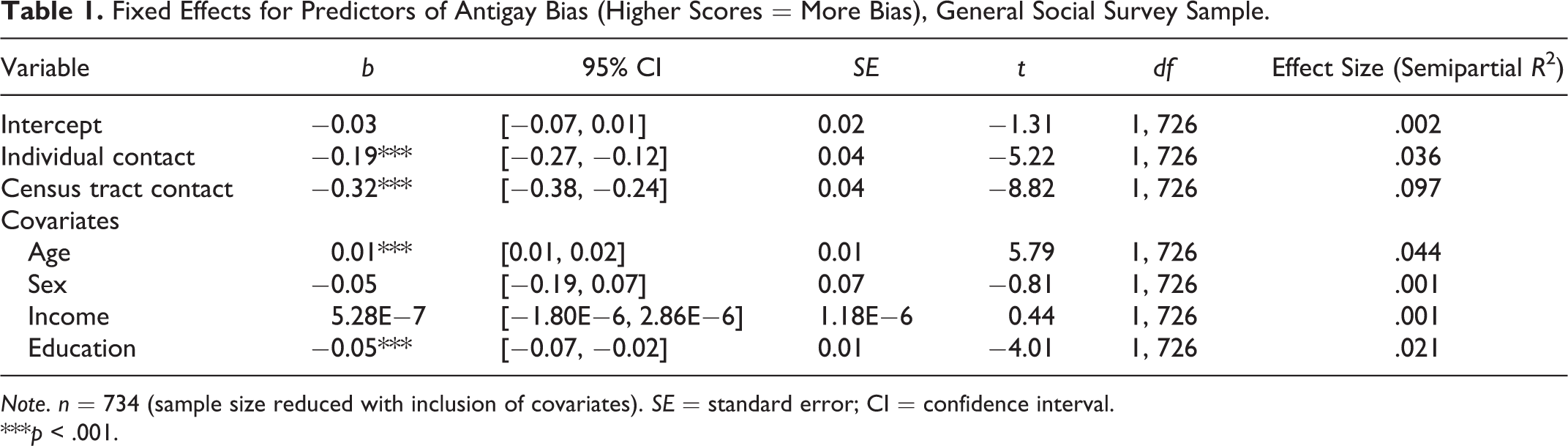
No significant interaction between individual and census tract contact was observed, b = .07, t(726) = .94, p = .347, so the interaction was trimmed from the model. Full results of the trimmed model are presented in Table 1. More individual-level contact with gay men and lesbians was associated with lower bias toward gay men and lesbians, b = −.19, t(726) = −5.22, p < .001. That is, individuals having more contact with gay men and lesbians were less biased toward gay men and lesbians.
Fixed Effects for Predictors of Antigay Bias (Higher Scores = More Bias), General Social Survey Sample.
Note. n = 734 (sample size reduced with inclusion of covariates). SE = standard error; CI = confidence interval.
***p < .001.
Statistically independent from this lower level effect, more contact at the census tract level was also associated with less antigay bias. That is, individuals living in census tracts where there is more contact with gay men and lesbians were less biased toward gay men and lesbians, b = −.32, t(726) = −8.82, p < .001. The slope of this contextual-level effect was reliably greater than the individual-level slope, with neither estimate falling within the 95% confidence interval of the other (see Table 1). Effect sizes were small (individual-level contact) or small-to-medium (contextual-level contact) and reliable (see Table 1), as indicated by semipartial R 2s (Edwards, Muller, Wolfinger, Qaqish, & Schabenberger, 2008). Such effect sizes are common in the intergroup contact literature (Pettigrew & Tropp, 2006). Both individual and census tract-level contact were associated with less bias when models were tested without covariates (see Online Supplemental Table 2).
Study 2
Consistent with evidence from ethnic domains, we demonstrated that individual- and contextual-level contact are associated with lower explicit prejudice in the domain of sexual orientation. To corroborate this novel observation, however, we next tested our model in three additional samples that included both explicit and implicit prejudice. As with previous research in ethnic domains and in light of our GSS-based geolocation analyses in Study 1, we expected to find negative contact-attitude relations at both the individual and contextual level. Further, we sought to extend our own and previous findings by testing our model as it predicts implicit prejudice.
We identified variables in the publically available Project Implicit demonstration website data sets relevant to our hypotheses. Project Implicit is a research collaboration with the goal of disseminating research and collecting data on implicit social cognition (Project Implicit, 2016). Project Implicit’s demonstration website (https://implicit.harvard.edu/implicit/index.jsp) is a “virtual laboratory,” where people can complete implicit association tests online. The implicit association test (IAT; Greenwald, Nosek, & Banaji, 2003) was developed to tap relatively inaccessible evaluative associations. IATs typically involve sorting images and words, where reaction times for “congruent” trials (e.g., pairing images of an ingroup with positive words and images of an outgroup with negative words) and “incongruent” trials (e.g., pairing images of an ingroup with negative words and images of an outgroup with positive words) are compared (see Greenwald et al., 1998, 2003). Higher scores on IAT measures indicate more implicit preference for one’s ingroup (vs. outgroup). Of the IATs available, the Sexuality IAT is most relevant to our interests. The Sexuality IAT assesses preferences for “straight” over “gay” and involves sorting images/words representing gay or straight as well as positive and negative words.
Data sets for Sexuality IATs completed between 2004 and 2015 are publically available and include not only implicit bias data but also variables assessing intergroup contact with and explicit bias toward gay men and lesbians. Additionally, in the 2013, 2014, and 2015 data sets, data on participant locations are also publically available, critical for testing multilevel effects. 1 We downloaded Sexuality IAT data sets from the Project Implicit demonstration website archive for 2013, 2014, and 2015, as these data sets included all variables necessary to test our hypotheses. We selected Metropolitan Statistical Area (MSA) as our location (Level 2) variable for these analyses. MSAs are geographic regions used for U.S. Federal Statistics, with each MSA containing 50,000 or more people (U.S. Census Bureau, n.d.).
Participants
The 2013 Project Implicit data set consists of 177,296 participants. Of these, participants with data on implicit bias, at least one explicit bias variable, and at least one contact variable were included in our analyses (n = 52,668, M age = 25.25, SD age = 10.21, M education = 5.82, SD education = 2.24, 63% women, 73.8% White, 77.7% heterosexual, 50% completed an IAT with gay stimuli, 50% completed an IAT with lesbian stimuli, 74.3% completed 1 or 0 IATs previously). This included data from 418 MSAs. Although we determined our sample size based on the data available, post hoc power was estimated at 0.85 for the contextual-level sample of 418 and 1.00 for the individual-level sample of 52,668, indicating suitable power.
The 2014 Project Implicit data set consists of 188,115 participants. Of these, participants with data on implicit bias, at least one explicit bias variable, and at least one contact variable were included in our analyses (n = 51,700, M age = 25.28, SD age = 10.30, M education = 5.92, SD education = 2.33, 61.7% women, 70.4% White, 73.9% heterosexual, 49.9% completed an IAT with gay stimuli, 50.1% completed an IAT with lesbian stimuli, 73.1% completed 1 or 0 IATs previously). This included data from 422 MSAs. Although we determined our sample size based on the data available, post hoc power was estimated at 0.86 for the contextual-level sample of 422 and 1.00 for the individual-level sample of 51,700, indicating suitable power.
The 2015 Project Implicit data set consists of 372,880 participants. Of these, participants with data on implicit bias, at least one explicit bias variable, and at least one contact variable were included in our analyses (n = 89,656, M age = 24.17, SD age = 10.21, M education = 5.73, SD education = 2.41, 62.1% women, 72.1% White, 67.7% heterosexual, 50.1% completed an IAT with gay stimuli, 49.9% completed an IAT with lesbian stimuli, 76.2% completed 1 or 0 IATs previously). This included data from 425 MSAs. Although we determined our sample size based on the data available, post hoc power was estimated at 0.86 for the contextual-level sample of 425 and 1.00 for the individual-level sample of 89,656, indicating suitable power.
Variables
Explicit intergroup bias
Participants indicated their feelings toward gay men and their feelings toward lesbians on thermometer scales ranging from 0 (coldest feelings) to 10 (warmest feelings). These items were averaged and reversed such that higher scores indicated greater bias toward gay men and lesbians (2013: α = .77; 2014: α = .79; 2015: α = .79).
Implicit intergroup bias
As described earlier, the Sexuality IAT involves sorting images/words representing gay (e.g., image of two men holding hands) or straight (e.g., image of a man and a woman holding hands) as well as positive (e.g., superb) and negative (e.g., tragic) words. There are two congruent trials and two incongruent trials. Following initial transformations, a score is created where the mean reaction times for congruent trials (i.e., gay paired with bad/straight paired with good) are subtracted from mean reaction times for incongruent trials (i.e., gay paired with good/straight paired with bad). Higher scores represent faster reaction times on congruent trials, indicative of stronger implicit preference for straight over gay.
Intergroup contact
Participants indicated whether they interact with gay people on a regular basis, whether they have a family member who is gay, whether they have a friend who is gay, whether they have friendly interactions with gay people on a regular basis, and whether they have ever met a gay person (yes/no scales). These items were averaged such that higher scores represented more individual-level contact. However, the gay family member item was removed from the scale, improving reliability (2013: α = .72; 2014: α = .72; 2015: α = .74). 2 Average contact with homosexuals within each MSA was calculated to represent MSA-level contact.
Demographic control variables
Participants indicated their age, sex, education, and sexual orientation. Income was not available, but two additional covariates were added to analyses predicting implicit bias: number of IATs completed previously and stimuli of IAT presented (see Online Supplemental Table 1).
Analytic Strategy
We followed the same multilevel modeling strategy as used with the GSS data (Zhang et al., 2009). Our model predicted intergroup bias from individual contact, MSA contact, and the interaction between individual contact and MSA contact, with a random intercept and random slope of individual contact estimated for each MSA. We controlled for individual age, sex, education, and sexual orientation in all the models. In the models predicting implicit bias, the number of IATs completed and IAT stimuli presented were also added as covariates (group-mean centered around their MSA’s mean). For syntax used, see https://osf.io/enf9u/.
Results
Explicit bias
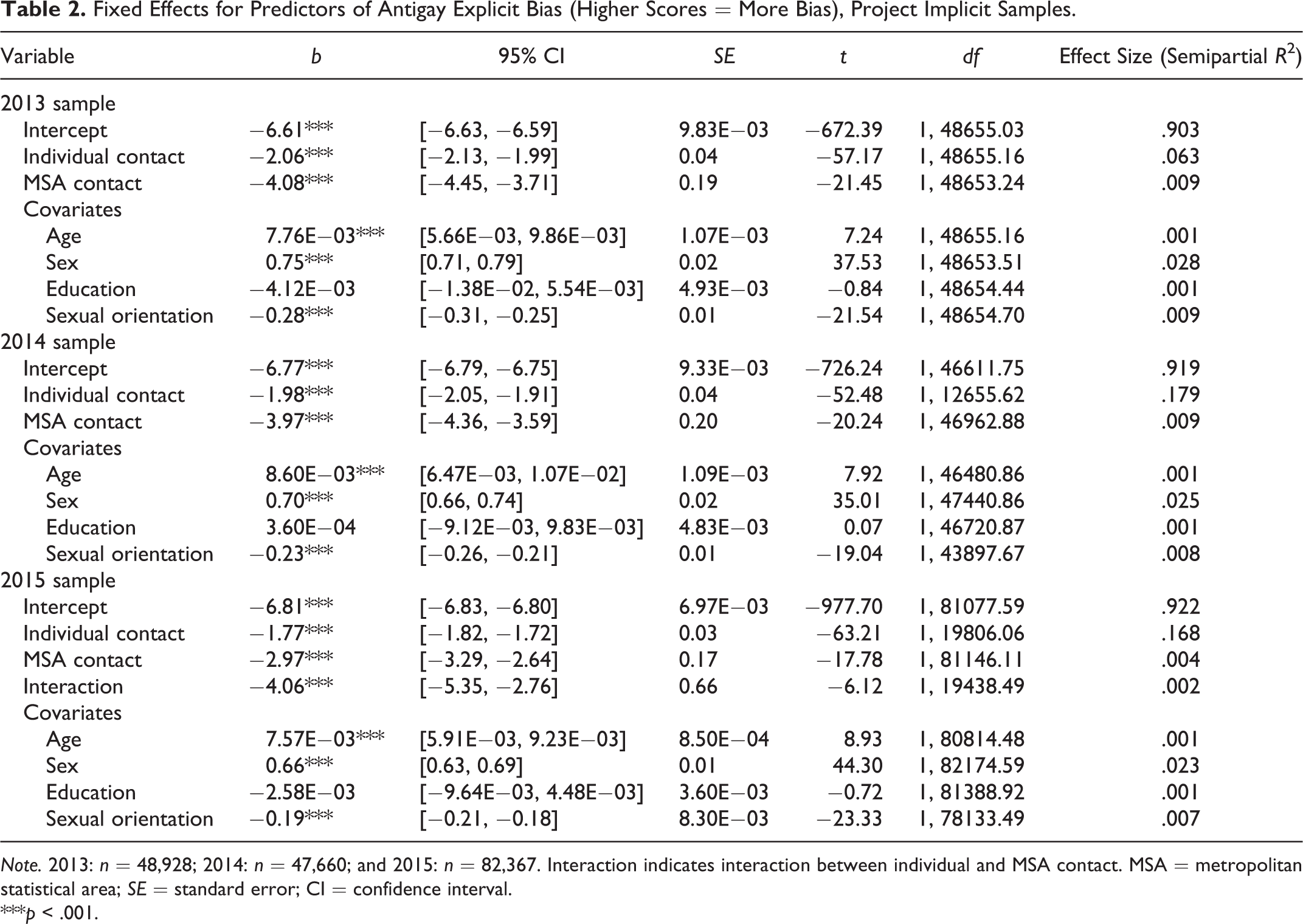
No significant interaction between individual and MSA contact was observed in the 2013 and 2014 samples, 2013: b = .61, t(680) = .83, p = .405; 2014: b = .92, t(13,047) = .1.18, p = .236, respectively, so the interaction was trimmed from these specific models. Replicating the results observed with the GSS sample, more individual-level contact with gay men and lesbians was associated with lower explicit bias toward gay men and lesbians in all the three Project Implicit samples, 2013: b = −2.06, t(48,655) = −57.17, p < .001; 2014: b = −1.98, t(12,655) = −52.48, p < .001; 2015: b = −1.77, t(19,806) = −63.21, p < .001. That is, individuals having more contact with gay men and lesbians were less explicitly biased toward gay men and lesbians. Statistically independent from this lower level effect, more contact at the MSA level was also associated with less explicit antigay bias. That is, individuals living in MSAs where there is more contact with gay men and lesbians were less explicitly biased toward gay men and lesbians, 2013: b = −4.08, t(48,653) = −21.45, p < .001; 2014: b = −3.97, t(46,962) = −20.24, p < .001; 2015: b = −2.97, t(81,146) = −17.78 p < .001. Thus, the results observed in the GSS sample were replicated. In a departure from the GSS samples, however, the slopes of the individual-level effects were reliably greater than the contextual-level slopes, with neither estimate falling within the 95% confidence interval of the other for all of the Project Implicit samples (see Table 2). Effect sizes were small (contextual-level contact, all samples; 2013 individual contact) or medium (2014 and 2015 individual-level contact) as indicated by semipartial R 2s.
Fixed Effects for Predictors of Antigay Explicit Bias (Higher Scores = More Bias), Project Implicit Samples.
Note. 2013: n = 48,928; 2014: n = 47,660; and 2015: n = 82,367. Interaction indicates interaction between individual and MSA contact. MSA = metropolitan statistical area; SE = standard error; CI = confidence interval.
***p < .001.
Additionally, in the 2015 sample, there was a significant interaction between individual and MSA contact, b = −4.06, t(19,438) = −6.12, p < .001. Simple slopes analyses were performed using Preacher, Curran, and Bauer’s (2006) computational tools for probing interactions in multilevel models. Simple slopes were examined at high (+1 SD), medium (M), and low (−1 SD) MSA contact for lower (−1 SD) and higher (+1 SD) individual contact. Slopes for all the three levels of MSA contact were significantly different from 0, low: t(89,652) = −56.79, p < .001; medium: t(89,652) = −75.62, p < .001; high: t(89,652) = −52.55, p < .001. The slopes for lower individual contact, t(89,652) = −7.29, p = <.001, and higher individual contact, t(89,652) = −18.45, p < .001 were also significantly different from 0. Thus, the association between higher MSA contact and lower explicit bias was observed at both low and high individual contact but amplified at high individual contact (see Online Supplemental Figure 1). Given that this interaction was observed only in 1 of 4 samples; however, we interpret these results with caution.
Implicit bias
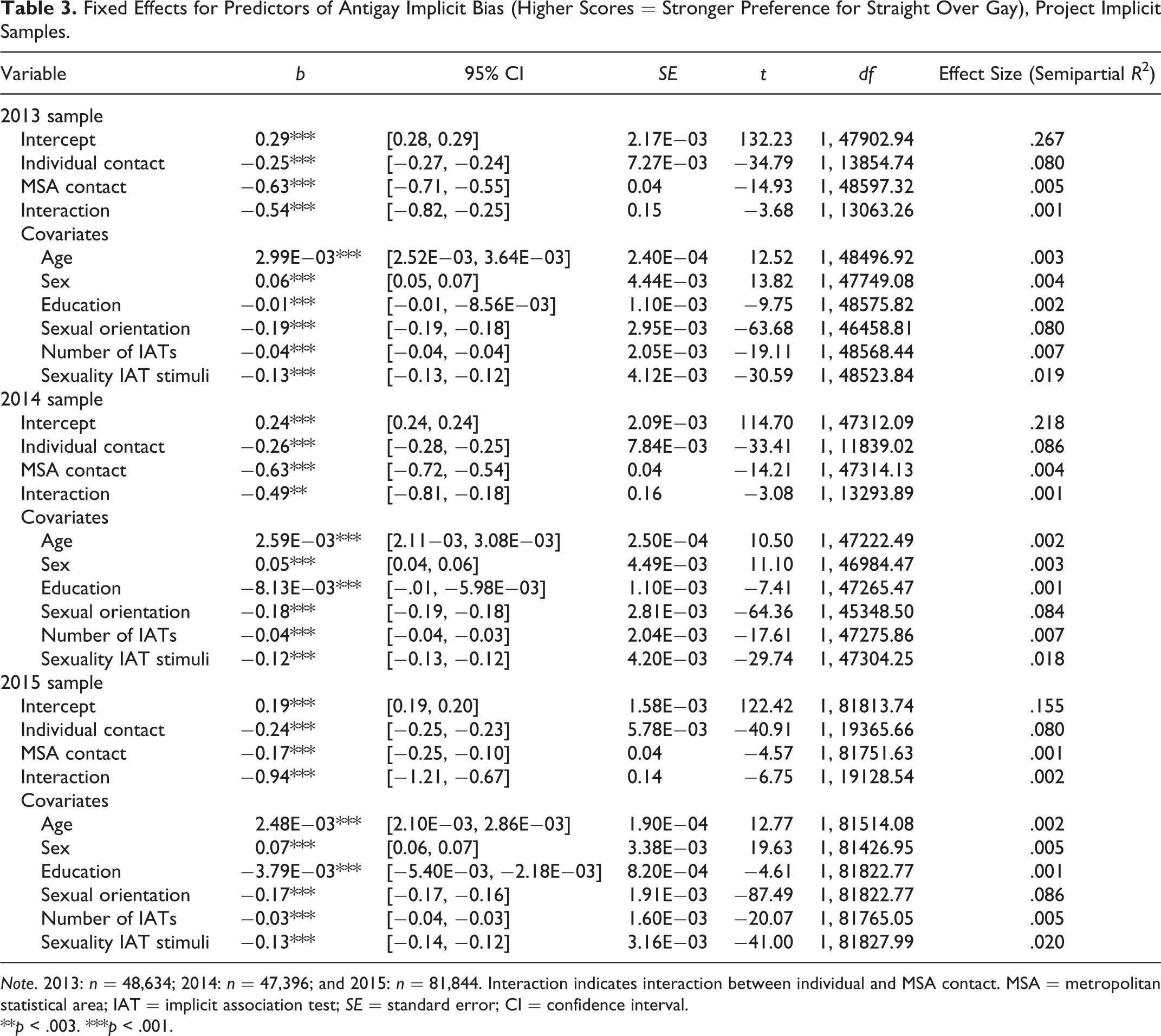
Similar patterns were observed for the implicit attitudes. More individual contact with gay men and lesbians, 2013: b = −.25, t(13,854) = −34.79, p < .001; 2014: b = −.26, t(11,879) = −33.41, p < .001; 2015: b = −.24, t(19,365) = −40.91, p < .001, and more contextual-level contact with gay men and lesbians, 2013: b = −.63, t(48,597) = −14.93, p < .001; 2014: b = −.63, t(47,314) = −14.21 p < .001; 2015: b = −.17, t(81,751) = −4.57, p < .001, were associated with lower implicit bias toward gay men and lesbians in all the three samples. This replicated our previous findings but using implicit bias measures. As with Project Implicit results for explicit bias, the slopes of the individual-level effects were reliably greater than the contextual-level slopes, with the exception of the 2015 sample, where individual-level slope fell within the 95% confidence interval of the MSA-level slope (see Table 3). Effect sizes were small (contextual-level contact) or small to medium (individual-level contact) as indicated by semipartial R 2s. Both individual and MSA-level contact were associated with less explicit (see Online Supplemental Table 3) and implicit (see Online Supplemental Table 4) bias when models were tested without covariates.
Fixed Effects for Predictors of Antigay Implicit Bias (Higher Scores = Stronger Preference for Straight Over Gay), Project Implicit Samples.
Note. 2013: n = 48,634; 2014: n = 47,396; and 2015: n = 81,844. Interaction indicates interaction between individual and MSA contact. MSA = metropolitan statistical area; IAT = implicit association test; SE = standard error; CI = confidence interval.
**p < .003. ***p < .001.
In all the three samples, there was a significant interaction between individual and MSA contact when predicting implicit bias, 2013: b = −.54, t(13,063) = −3.68, p < .001; 2014: b = −.49, t(13,293) = −3.08, p < .001; 2015: b = −.94, t(19,128) = −6.75, p < .001. These interactions were probed as described above. For all the samples, slopes for low, 2013: t(52,664) = −37.38, p < .001; 2014: t(51,696) = −32.23, p < .001; 2015: t(89,652) = −40.85, p < .001; medium, 2013: t(52,664) = −49.85, p < .001; 2014: t(51,696) = −46.42, p < .001; 2015: t(89,652) = −57.43, p < .001; and high, 2013: t(52,664) = −35.31, p < .001; 2014: t(51,696) = −31.65, p < .001; 2015: t(89,652) = −41.69, p < .001, MSA contact were significantly different from 0. The slope for lower individual contact was significantly different from 0 in all the three samples, 2013: t(52,664) = −7.25, p < .001; 2014: t(51,696) = −6.05, p < .001; 2015: t(89,652) = 3.26, p = .001, as was the slope for higher individual contact, 2013: t(52,664) = −12.77, p < .001; 2014: t(51,696) = −12.23, p < .001; 2015: t(89,652) = −7.29, p < .001. Thus, in all the samples, there was a reliable amplification pattern, whereby the association between MSA contact and lower implicit bias was observed when individual contact is high. In the 2013 and 2014 samples, this pattern was also observed at low individual contact. In the 2015 sample, an unexpected pattern was observed; whereby at low individual contact, higher MSA contact was associated with more implicit bias. Simple slopes plots are depicted in Online Supplemental Figures 2–4.
Discussion
Even in a low visibility group domain (i.e., sexual minority membership), both individual- and contextual-level contact were associated with less prejudice. Although a negative relationship between individual contact with gay men and lesbians and prejudice is well established (Smith et al., 2009), individual contact in this group domain had not yet been examined simultaneously with contextual-level contact. Contextual-level contact, independent of individual-level contact, was associated with lower prejudice: Simply living in a region where there is more contact between heterosexuals and gay men and lesbians is associated with less prejudice toward gay men and lesbians. Notably, this applied to both explicit and implicit prejudice. Presumably, consistent with research in ethnic domains (Christ et al., 2014), greater contextual-level contact stimulates social norms favoring contact between sexual orientations and hence less prejudice. Given that sexual orientation is less visible, perhaps people need not actually witness intergroup contact occurring within their region to develop norms favoring contact; rather, these norms can be otherwise communicated. Further research can examine social norms as a mediator of this relationship and the means by which these norms develop.
Findings regarding the relative strength of individual- and contextual-level effects on prejudice varied by sample. Contextual- (vs. individual) level effects were stronger in the GSS sample, but individual- (vs. contextual) level contact effects were stronger in the Project Implicit samples. Bias was conceptualized differently across samples, however. Bias in the GSS sample largely tapped beliefs about the behavior of homosexuals and gay rights, whereas bias in the Project Implicit samples tapped simple affect toward gay men and lesbians (explicit) and associations between homosexuality versus heterosexuality and positivity/negativity (implicit). Perhaps only some forms of bias (e.g., stereotypes) are predicted more strongly by contextual than individual-level contact. There could also be a methodological explanation because the GSS questions were asked verbally by an interviewer, whereas the Project Implicit questions were answered privately through the Internet. Regardless, across samples, significant individual and contextual–context effects on bias were simultaneously observed. Future research can test whether relative strength of contextual contact varies as a function of bias measure or collection method.
For implicit bias, findings were qualified by a significant cross-level interaction, whereby the influence of higher contextual contact on implicit bias was largely observed when individual contact was high. This reveals that if an individual has a high level of intergroup contact in a region where there is a low level of intergroup contact, the individual’s implicit bias is relatively low, but if the individual has a high level of intergroup contact in a region where there is a high level of intergroup contact, their bias is even lower. At low levels of individual contact, findings were less consistent: In the 2013 and 2014 samples, when individual contact was lower, higher contextual contact was nonetheless associated with lower implicit bias, but in the 2015 sample, when individual contact was lower, higher contextual contact was associated with more implicit bias. These less consistent findings may be spurious as may be the interaction observed in the 2015 sample for explicit bias. If they are not spurious, however, then they suggest that there may be a weak tendency for people who avoid contact in high-contact regions to be particularly prejudiced.
Our investigation represents a unique contribution to the study of intergroup contact and intergroup bias. First, it answers calls in the literature to examine individual- and contextual-level contact simultaneously through multilevel analyses. Second, we examine individual- and contextual-level contact as predictors of bias in a domain that has not yet been examined: sexual orientation. Despite some progress, bias toward gay men and lesbians remains a problem in modern society, with a substantial percentage of Americans still opposing gay marriage (40%, McCarthy, 2015) or homosexuality generally (37%, Gallup, 2016). Thus, examining the predictors of this bias is important. Further, sexual orientation is a unique domain for the study of intergroup contact, given that homosexuality is a less visible stigma (Herek & Capitanio, 1996; Quinn & Earnshaw, 2013). It was hitherto unknown how contact operates in domain, where the level of contact in a given context may not be readily detectable. Finally, our investigation contributes to the literature by assessing not only the influence of individual- and contextual-level contact on explicit bias but also on implicit bias. We demonstrate novel findings that individual- and contextual-level contact predict less bias on relatively more resistant to change implicit measures of bias, something previously unexamined in any group domain. There have been no prior multilevel examinations of the association intergroup contact and implicit bias in any group domain.
Our findings suggest that homophobia-reduction strategies should not only focus on the individual but also on the contextual level (e.g., public service announcements, school-based interventions). Both individual- and contextual-level contact predicted lower explicit and lower implicit bias. Implicit bias can be more impervious to intervention than explicit bias, demonstrating the potential power of contact interventions at the regional level to reduce this pervasive form of prejudice. Both individual- and contextual-level prejudice reduction strategies are a priority area for future research.
Footnotes
Declaration of Conflicting Interests
The author(s) declared no potential conflicts of interest with respect to the research, authorship, and/or publication of this article.
Funding
The author(s) disclosed receipt of the following financial support for the research, authorship, and/or publication of this article: This research was undertaken, in part, thanks to funding from the Canada Research Chairs program and was sponsored by a Social Sciences and Humanities Research Council of Canada grant (#435130767) to the second author.

Notes
References
Supplementary Material
Please find the following supplemental material available below.
For Open Access articles published under a Creative Commons License, all supplemental material carries the same license as the article it is associated with.
For non-Open Access articles published, all supplemental material carries a non-exclusive license, and permission requests for re-use of supplemental material or any part of supplemental material shall be sent directly to the copyright owner as specified in the copyright notice associated with the article.
