




Abstract
There is a widely held folk belief that a woman needs to have children in order to live a fulfilled life. This article tests whether or not endorsing this folk belief—or the motherhood norm—has an impact on subjective well-being. With data from 49 countries, Study 1 shows that those who endorsed the motherhood norm experienced greater subjective well-being than those who did not, an effect that was especially true in countries with high gender inequality. Study 2 establishes that this norm exaggerates the impact of motherhood on subjective well-being. After accounting for the situation of women’s lives, motherhood status did not explain differences in self-reported life satisfaction, and mothers reported only slightly greater happiness than women who were not mothers. These findings support a series of preregistered hypotheses designed to test the palliative function of endorsing system-justifying norms, though these data may be consistent with other theories.
Despite mounting evidence that having children is a mixed blessing (for review, see Nelson et al., 2014), there is a widely held folk belief that a woman needs to have children in order to live a fulfilled life. This article explores a collection of Western and non-Western samples to test whether or not endorsing this folk belief—herein referred to as the motherhood norm—has an impact on women and men’s subjective well-being. First, a system justification lens is applied to consider whether there is a palliative association among those who endorse the motherhood norm: Specifically, is thinking women must have children in order to live a fulfilled life associated with greater subjective well-being? Second, this article asks whether the palliative association between endorsing the motherhood norm and subjective well-being is particularly strong in countries with greater gender inequality—that is, in countries where there is more inequality to justify, will there be more to palliate? Finally, in Study 2, the veracity of the motherhood norm is questioned—most simply put, are mothers in these countries experiencing more subjective well-being than nonmothers? This final question allows us to contextualize what it means for women and men to endorse a motherhood norm.
Palliative Function of System Justification
Why might endorsing the motherhood norm be associated with greater subjective well-being? According to system justification theory, people have a fundamental motive to view their social system as just, fair, and good (Jost & Banaji, 1994; Jost et al., 2004). Believing that society is fair—which can be achieved by justifying existing inequalities—provides a sense of order, certainty, meaning, and security. Together, this strengthened sense that the system is working can serve a palliative function insofar as it promotes subjective well-being (Bahamondes et al., 2019; Napier & Jost, 2008; Napier et al., 2010; Suppes et al., 2018).
One way to justify the system and the status hierarchies that exist within that system is to affirm the values that lead to inequality. Evidence suggests that affirming system-serving values about gender inequality both serve a larger system-justifying end and can palliate those who engage in this affirmation. For example, ambivalent sexism, comprised of both “benevolent” sexism (seemingly positive yet paternalistic ideology about women) and “hostile” sexism (more aggressive beliefs about women; see Glick & Fiske, 1996, 2001), has been argued to be a system-justifying ideology in its own right (Sibley et al., 2007). To this point, life satisfaction was found to be higher among both men and women in New Zealand who endorse benevolent sexism (Hammond & Sibley, 2011), among low status school children in Chile who endorse hostile sexism (Vargas-Salfate, 2017), and globally among women and men who endorse both forms of sexism (Napier et al., 2010). Importantly, this body of research shows that both men and women benefit from endorsing system-serving beliefs about gender.
Another way to justify the system and the status hierarchies that exist within that system is to affirm the norms that lead to inequality (e.g., to agree that women must behave a certain way; see Jost et al., 2015). For women, a central value and normative expectation is that they “ought” to become mothers (see Russo, 1976). To cite only a few examples, in Australia, motherhood is thought to be an essential component of being a woman (e.g., Holton et al., 2009); in both Mexico and the United States, it is seen as a gender role that “completes” women (Chrisler et al., 2013); and for women in India, it is seen as normative (Das & Zumbyte, 2017) and “ordinary and natural” (Riessman, 2000). Consequentially, in the United States, women who do not have children are seen as cold (Cuddy et al., 2004), are judged to be less satisfied with their life, and to even elicit moral outrage from others (Ashburn-Nardo, 2017).
Might there be a palliative association between endorsing the motherhood norm and subjective well-being? Evidence in research on injunctive norms—beliefs about what people “ought” to do—has shown that individuals experience positive emotions when they endorse and adhere to social norms (see Christensen et al., 2004).
As social norms vary greatly from country to country, the palliative association between endorsing the motherhood norm and subjective well-being may vary given the larger sociopolitical context. Previous work suggests that the palliative function of system justification may work in proportion to the inequality that needs to be justified; among Europeans and Maori with lower socioeconomic status in New Zealand, Sengupta and colleagues (2017) found that those living with greater income inequality experienced the greatest palliative relief from endorsing system-justifying beliefs. They argued that greater levels of inequality in the environment call for increased need to justify that inequality and that in a context of heightened inequality, system-justifying beliefs are most palliative. Might the same apply for gender inequality? As both objective measures of gender inequality and group-level norms of gender equality vary greatly across the world (Napier et al., 2010), a multinational data set allows for a natural opportunity to observe whether people facing greater (vs. less) gender inequality experience a palliative association between endorsing the motherhood norm subjective well-being. By looking at a broad spectrum of countries, this article asks whether the palliative association of norm endorsement functions in proportion to how unjust the system is in which it operates. That is, as environments become more hostile toward women, is there more to palliate?
In sum, this article examines whether endorsing the motherhood norm is associated with greater subjective well-being among women and men and whether this association is magnified in countries that are more hostile to women. The following hypothesis was preregistered on OSF.IO:
Is Motherhood Satisfying?
In addition to testing the palliative association of endorsing the motherhood norm, the veracity of the norm is tested: Do mothers experience greater subjective well-being than nonmothers? Research on the effect of motherhood on women’s subjective well-being is mixed. On the one hand, motherhood enhances a sense of meaning in life, providing women with new social roles and the opportunity to experience positive emotions. On the other hand, motherhood comes with heavy burdens, including financial, professional, and marital strain, and restricted leisure time, all of which are known to decrease subjective well-being (for review, see Nelson et al., 2014). In sum, a woman’s subjective well-being depends on many factors about her life unrelated to her status as a parent.
The Present Studies
Two studies look at the impact of the motherhood norm and motherhood on subjective well-being in a global content. This work extends previous work in three important ways.
First, what is understood about the impact of motherhood and norms about motherhood comes almost entirely from data collected in the West, and those reviewing the literature have cautioned to not extend conclusions to a global setting (see Nelson et al., 2014; Williams et al., 2016). While it has been important to establish that women, and mothers in particular, experience greater subjective well-being in countries with greater gender equality (Tesch-Ro¨mer et al., 2008), this work needs to be fleshed out in a global context, where gender roles and general country-level development vary more greatly (see Batz-Barbarich et al., 2018). This perspective responds to the call to not only focus on Western, educated, industrialized, rich, and democratic societies (WEIRD countries) in psychological research (Henrich et al., 2010).
Second, as norms likely affect both those who comply and those who do not, this article considers the impact of gender inequality on both mothers and nonmothers alike as well as both men and women. Third, this article considers gender inequality in two ways. While objective moves toward greater gender equality are likely linked to evolving gender norms, it is important to consider how policies and norms can act independently. It has been noted that advances toward greater gender equality do not necessary lead to better outcomes for women because social norms can continue to discriminate against them (see Duflo, 2012). As such, I will capitalize on the diversity between countries to look at gender equality as measured by objective differences in outcomes for women (e.g., through a country-level index of gender inequality) and as reflected in group-level norms about women (e.g., through country-level attitudes about gender equality).
Study 1
Method
Participants
To test Hypothesis 1, data from representative samples included in Wave 1–4 of the World Values Survey were used (WVS; ranging from 1981 to 2004 http://www.worldvaluessurvey.org). Subsequent waves of the WVS did not ask the motherhood norm item. In total, samples from 49 countries were analyzed (see Table 1 for demographics by country).
Wave 1–4: Demographics and Descriptive Statistics.
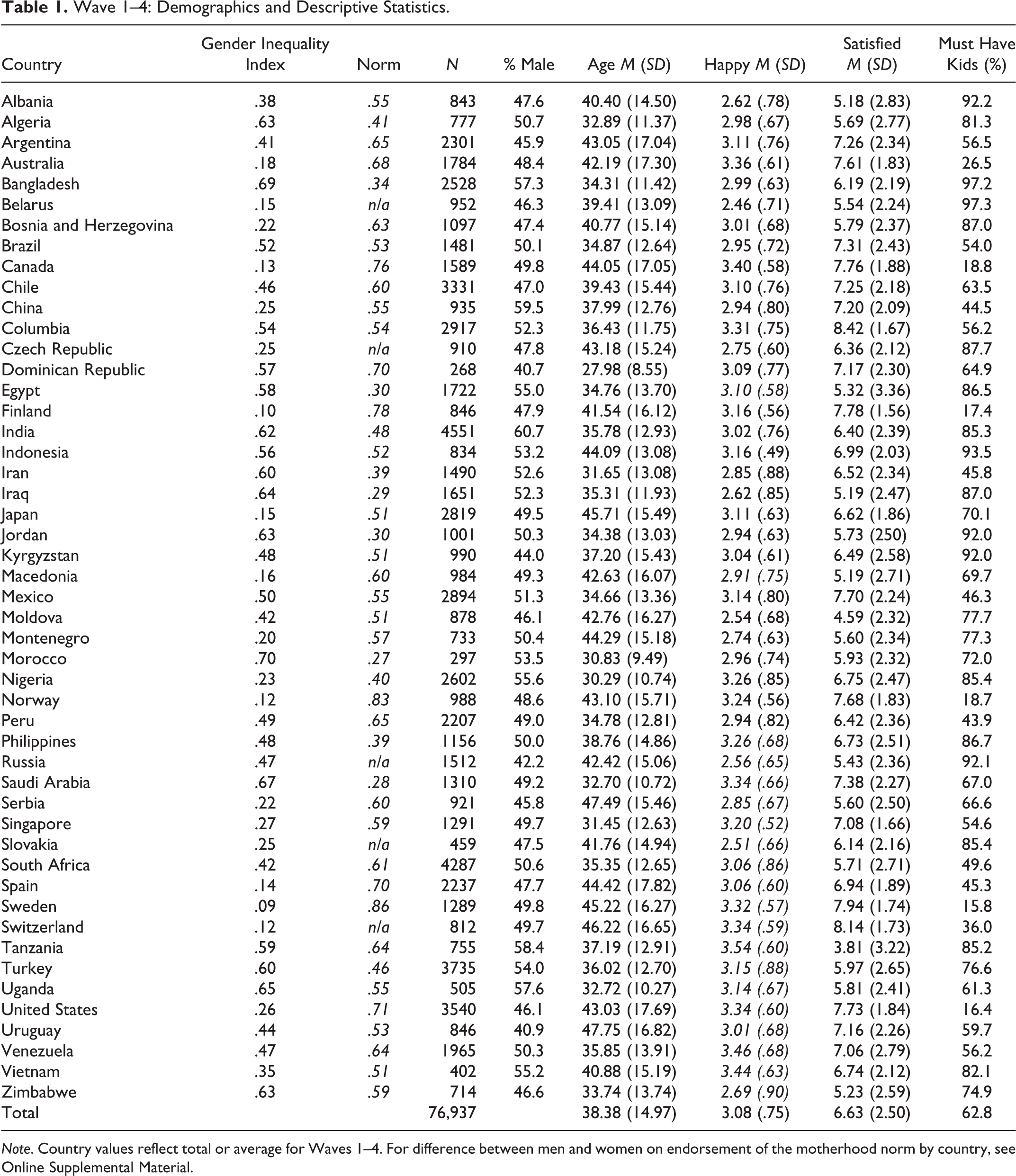
Note. Country values reflect total or average for Waves 1–4. For difference between men and women on endorsement of the motherhood norm by country, see Online Supplemental Material.
Individual-Level Indicators
For the mean and standard deviation (or percentage endorsement) for each country, see Table 1.
Subjective well-being
Subjective well-being was measured with 2 items (r = .45): “Taking all things together, would you say you are (1) very happy, (2) rather happy, (3) not very happy, (4) not at all happy?” (reverse coded so that higher values equal greater happiness), and “How satisfied are you with your life as a whole?” (from 1 = completely dissatisfied to 10 = completely satisfied).
Motherhood norm
The system-justifying belief about motherhood was measured in Wave 4 with 1 item: “A woman has to have children to be fulfilled” (not necessary = 0) or (needs children = 1).
Country-Level Indicators
Gender Inequality Index (GII)
Collected by the UN since 1995, the GII measures gender disparity in three key areas: reproductive health, empowerment, and labor market participation. Scores range from 1 (full inequality) to 0 (gender parity). For each wave, the nearest year of GII was matched.
Gender Equality Norms
Wave 3 and 4 of WVS calculates a Welzel equality sub-index for each respondent based on 3 items: (1) Men should have more right to a job than women when jobs are scarce; (2) men make better political leaders than women do; (3) university education is more important for a boy than for a girl. These values range from 0 (no gender equality) to 1 (gender equality). To estimate a given country’s gender equality norms, an aggregate of mean responses of both men and women was calculated for each country.
Control Variables
Features known to be associated with subjective well-being were controlled for. Specifically, age, age squared, education (clustered into 10 levels), income (10 levels), marital status (divorced, widowed, single, living together, separated vs. married), frequency of attending religious services (8 levels), and a given country’s Human Development Index score (United Nations Development Program, 2018).
Data Analytic Procedure
A random coefficient multilevel model with respondents nested within countries was applied (Raudenbush & Bryk, 2002).
The following analyses were preregistered on OSF.IO. All predictors were added in two steps for each of the two dependent variables. To test Hypothesis 1, in the first step, the associations of (1) the individual-level main effect of endorsing the item that women must have children in order to be fulfilled and (2) the main effect of country-level indicators of gender inequality and (3) the interaction of the two were added. This process was repeated twice for each of the country-level indicators of gender inequality (GII and country-level gender equality norms). In the second step, all control variables were added to test the strength of the variables of interest. Given the large sample size available for these analyses, p values are less informative than regression coefficients and the corresponding confidence intervals (CIs). These coefficients and CIs should be interpreted to claim support for the hypotheses. In order to make meaningful comparisons about relative size of effects, all independent variables and covariates were standardized on a 0–1 scale and mean centered (or dummy coded 0–1).
Results and Discussion
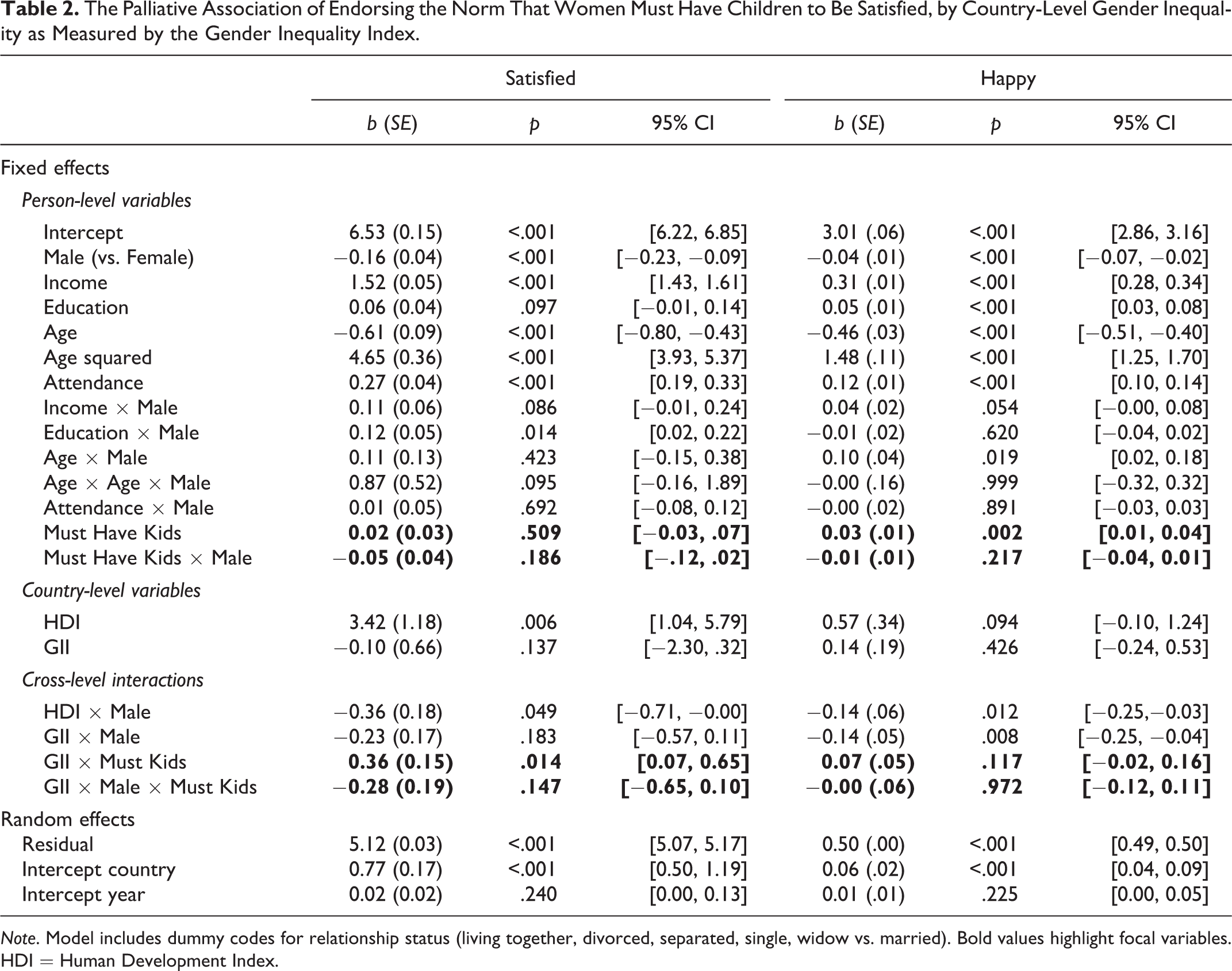
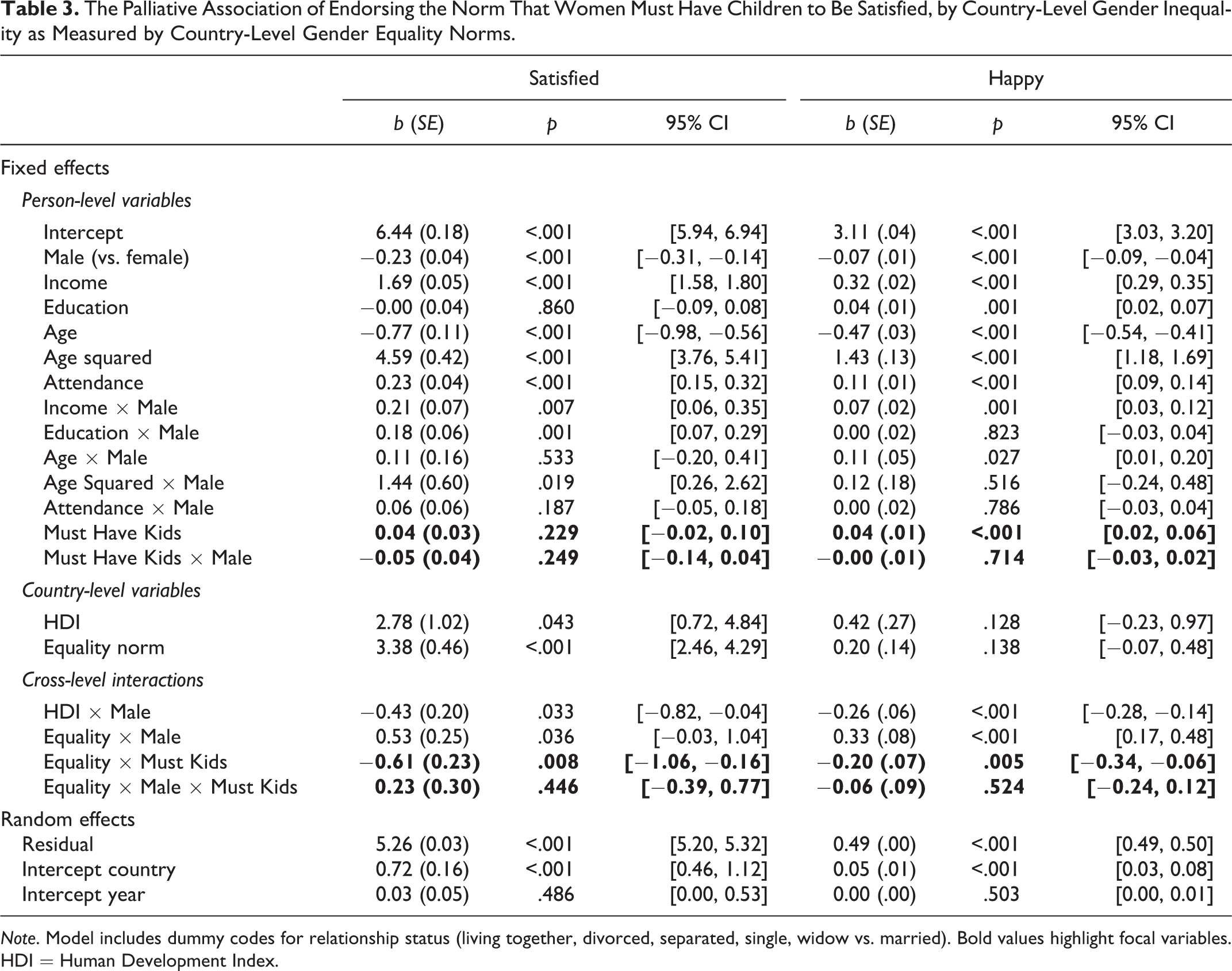
As can be seen in Tables 2 and 3, there was partial support for the notion that endorsing the system-justifying belief that women must have children in order to be fulfilled has a palliative association with subjective well-being. For happiness, above and beyond either country-level GII (Table 2) or country-level gender norms (Table 3) respondents who endorsed the motherhood norm reported being happier than those who did not. Turning to the regression coefficients, the association of endorsing the motherhood norm was small, b = .03 (.01); CI [0.01, 0.04] in Table 2 and b = .04 (.01); CI [0.02, 0.06] in Table 3. However, these values are comparable to having the fewest (vs. most) years of education, b = .05(.01); CI [0.03, 0.08] in Table 2, and in Table 3, b = .04 (.01); CI [0.02, 0.07]. These models did not detect a main effect of endorsing the motherhood norm on self-reported life satisfaction. Additionally, these models did not detect a difference between men and women in the strength of the relationship between endorsing the motherhood norm and well-being.
The Palliative Association of Endorsing the Norm That Women Must Have Children to Be Satisfied, by Country-Level Gender Inequality as Measured by the Gender Inequality Index.
Note. Model includes dummy codes for relationship status (living together, divorced, separated, single, widow vs. married). Bold values highlight focal variables. HDI = Human Development Index.
The Palliative Association of Endorsing the Norm That Women Must Have Children to Be Satisfied, by Country-Level Gender Inequality as Measured by Country-Level Gender Equality Norms.
Note. Model includes dummy codes for relationship status (living together, divorced, separated, single, widow vs. married). Bold values highlight focal variables. HDI = Human Development Index.
There was support for Hypothesis 1—that subjective well-being is more strongly associated with endorsing the motherhood norm in more gender unequal countries. Shown in Table 2, the strength of the palliative association between endorsing the motherhood norm and life satisfaction grew with increased country-level inequality, b = .36, SE = .15, p = .014, 95% CI [0.07, 0.65]. Simple slopes analyses adjusting for the multilevel nature of these data (Preacher et al., 2006) showed that in countries with greater gender inequality (+1SD GII), endorsing the motherhood norm was positively and significantly related to satisfaction, b = .08, SE = .03, z = 2.31, p = .021. By contrast, in countries with relative gender parity (−1SD GII), there was no reliable relationship between endorsing the motherhood norm and satisfaction, b = −.04, SE = .05, z = −1.06, p = .291. Comparing interclass correlations of a model with and without this cross-level interaction through a deviance statistic suggested that including the interaction improved the fit of the model, χ2 = 8.66, p = .013. This model did not detect a difference in this effect between men and women, b = −.28, SE = .19, p = .147, 95%CI [−0.65, 0.10].
Additional support for Hypothesis 1 was found when looking at the cross-level interaction of endorsing the motherhood norm and country-level gender equality norms in Table 3. The strength of the palliative association was reduced as a country reached parity on gender equality norms. This was observed with life satisfaction, b = −.61, SE = .23, p = .005, 95% CI [−1.06, −0.16], and happiness, b = −.20, SE = .07, p = .005, 95% CI [−0.34, −0.06].
Simple slopes analyses showed that in countries where people hold norms that go against the value of gender equality (−1SD), endorsing the motherhood norm was positively and significantly related to life satisfaction, b = .12, SE = .05, z = 2.38, p = .017, and to happiness, b = .06, SE = .01, z = 4.07 p < .001. By contrast, in countries with relatively high gender equality norms (+1SD), there was no reliable relationship between endorsing the motherhood norm and satisfaction, b = −.03, SE = .04, z = −1.00, p = .314, or happiness, b = .01, SE = .01, z = 0.98, p = .329. This was parallel to the findings on GII. Deviance statistic suggests that including this interaction improved the fit of the model predicting satisfaction, χ
Results provide support for the preregistered hypothesis that endorsing the system-justifying motherhood norm has a palliative association. These findings indicated a small but robust direct relationship between the motherhood norm and subjective well-being. Specifically, endorsing the norm that women need to become mothers in order to live fulfilled lives was associated with greater happiness among women and men. The difference between those who endorse the motherhood norm and those who do not was comparable in size to education, which is a known predictor of subjective well-being (Michalos, 2008; VanderWeele, 2017). Additionally, this phenomenon is particularly true in countries with greater gender inequality: The association of endorsing the motherhood norm was especially strong for those who live in more gender unequal (vs. equal) countries.
Study 2
In Study 2, I ask: Is the motherhood norm correct? That is, must women have children in order to live a fulfilled life?
Applying the logic laid out for endorsing the motherhood norm in more (vs. less) unequal environments, I consider whether mothers in more unequal countries are buffered from the “parenthood penalty” that leads some women to experience worse subjective well-being as mothers. That is, is there a palliative function to motherhood for women in more (vs. less) unequal counties? The following hypothesis was preregistered with OSF.IO.
Method
To Test Hypothesis 2, data from representative samples included in Wave 1–6 (1984–2014) were used (WVS; http://www.worldvaluessurvey.org). In total, samples from 89 (n = 98,550) countries were analyzed (see Online Supplemental Materials for demographics by country).
Measures
All key variables were the same as Study 1. Means and standard deviations are listed in Online Supplemental Materials.
Motherhood status
Respondents indicated how many children they had (have no kids = 1 or have at least one child, mothers = 0).
Data Analytic Procedure
Data Analytic procedure was the same as Study 1 though one key variable—status as a mother (vs. not)—was supplemented over endorsement of the motherhood norm. Because I am interested in the effect of motherhood, I only analyzed data for self-identified female respondents.
Results and Discussion
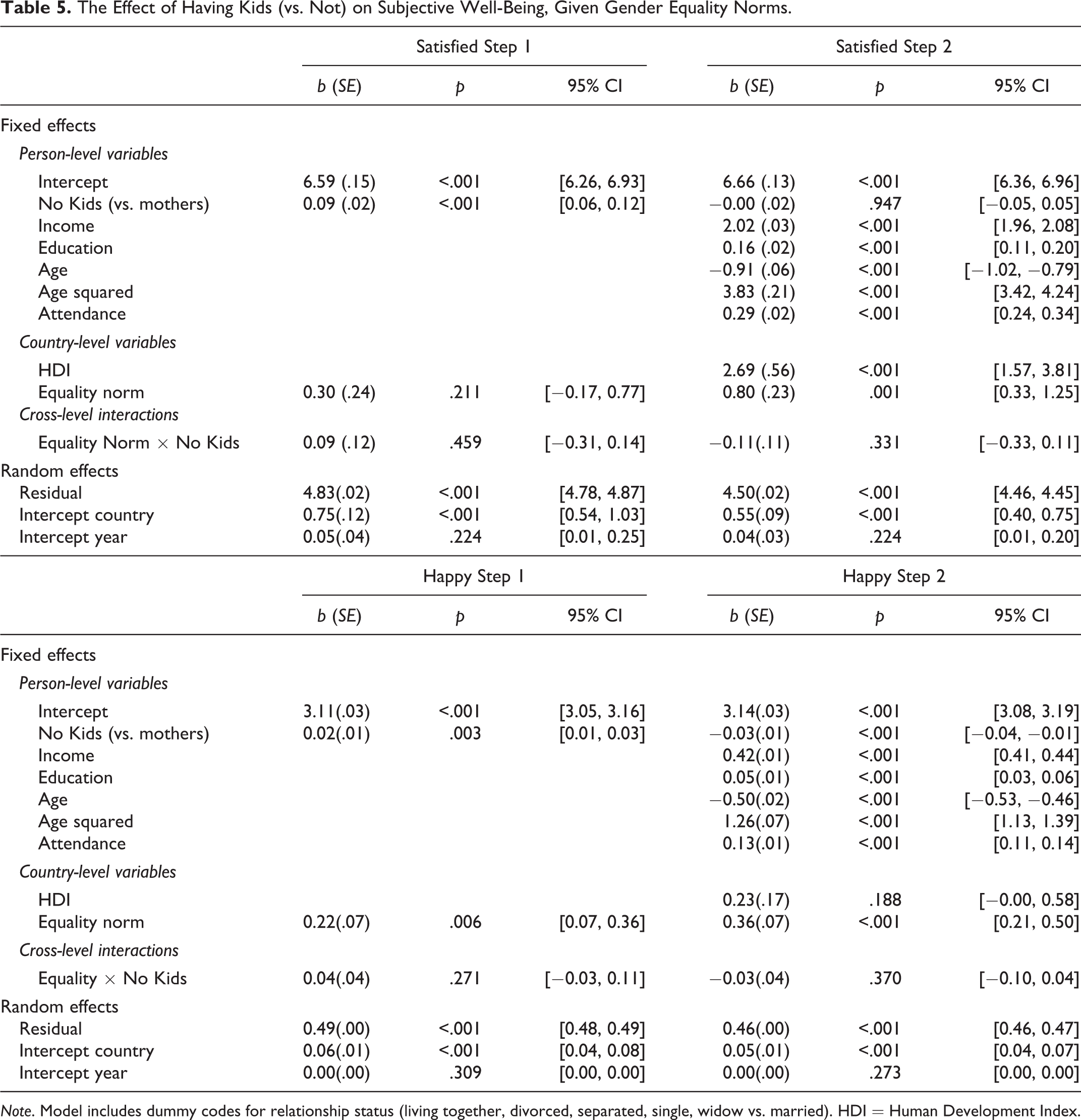
Shown in Step 1 of Tables 4 and 5, before considering situational factors of a woman’s life (represented by the covariates), women without children (vs. mothers) reported being happier and having greater life satisfaction. After adding covariates in Step 2 of Tables 4 and 5, there was no longer a main effect of motherhood status on women’s life satisfaction.
The Effect of Having Kids (vs. Not) on Subjective Well-Being, Given Gender Inequality Index (GII).

Note. Model includes dummy codes for relationship status (living together, divorced, separated, single, widow vs. married). HDI = Human Development Index.
The Effect of Having Kids (vs. Not) on Subjective Well-Being, Given Gender Equality Norms.
Note. Model includes dummy codes for relationship status (living together, divorced, separated, single, widow vs. married). HDI = Human Development Index.
Partial support for the motherhood norm’s veracity comes when considering women’s happiness. Step 2 of Tables 4 and 5 reveal that after controlling for demographic covariates, women without children report lower happiness than mothers, b = −.03, SE = .01, p < .001 95% CI [−0.04, −0.01]. This was about half the size of the effect of having the lowest (vs. highest) education level, b = .06, SE = .01, p < .001 95% CI [0.04, 0.07].
While these analyses were able to detect a small difference between mothers and women without children in self-reported happiness, I did not find support for Hypothesis 2, that women with at least one child would report greater satisfaction or happiness if they lived in countries with higher (vs. lower) gender inequality. The main effect of motherhood status on happiness did not interact with country-level gender inequality, as measured with either the GII in Table 4 or gender equality norms in Table 5. Additional analyses were run to test whether motherhood norms interacted with motherhood status—for example, did mothers who endorse (vs. not endorse) the motherhood norm experience different levels of subjective well-being. These models did not detect a significant interaction between motherhood norm endorsement and motherhood status on either life satisfaction or subjective well-being, nor did they detect a three-way interaction with either GII or gender equality norms.
Country-level gender inequality was associated with women’s subjective well-being. Shown in Table 4, there was a significant main effect of country-level objective gender inequality (GII) on respondent’s happiness; women reported lower happiness in more gender unequal countries, b = −.44, SE = .09, p < .001 95% CI [−0.62, −0.26]. The size of the effect was larger than the highest (vs. lowest) level of income, b = .40, SE = .09, p < .001, 95% CI [0.38, 0.42] or the highest (vs. lowest) age, b = −.49, SE = .02, p < .001, 95% CI [−0.52, −0.46]. Similarly, Table 5 shows that women in countries with greater gender equality norms reported greater subjective well-being as measured by life satisfaction, b = .80, SE = .23, p < .001, 95% CI [0.33, 1.25], and happiness, b = .36, SE = .07, p < .001, 95% CI [0.21, 0.50].
In sum, these results do not strongly support the folk belief that women must have children in order to be fulfilled. They do suggest that, at the population level, there was a small but robust elevation in happiness among women who have (vs. do not have) children. However, women’s subjective well-being was not predicted by an interaction of her motherhood status and country-level gender inequality—measured either objectively or through social norms about gender equality. Therefore, I did not find support for Hypothesis 2, that there will be a palliative association for women who are mothers (and therefore conforming to the motherhood norm) in countries with greater gender inequality.
General Discussion
The current studies provided support for the preregistered hypothesis that those who endorse the system-justifying norm that women must have children experience greater subjective well-being. Specifically, endorsing the norm that women need to become mothers in order to live fulfilled lives was associated with greater happiness among both women and men. Furthermore, the association between endorsing the motherhood norm on happiness and life satisfaction was especially strong for women and men who live in more gender unequal (vs. equal) countries. Applying a system justification theory lens to these data suggests that those living in more unjust systems have more to inequality to justify, which leaves greater room for a palliative association to emerge.
This article further suggests that the motherhood norm is overstated: While women who endorsed the motherhood norm report higher levels of happiness, the effect was very small. Furthermore, motherhood status was unrelated to life satisfaction. In sum, given the small difference in happiness between mothers and nonmothers, coupled with the lack of difference in life satisfaction, it is incorrect to say that women “must” have children in order to be fulfilled. At best, mothers report a slight boost in happiness at the population level compared to women without children.
Connections and Contributions to the Literature
System Justification Theory
By looking at both men and women, and those in countries with more and less equality, this work situates itself within a debate about who is more (or less) likely to system justify and to benefit from system justification. First, according to system justification theory, individuals with more inequality in their environment have a stronger need to justify the conditions of that environment, suggesting that people who live in countries with more inequality appear to benefit the most from endorsing system-serving norms that help frame inequality as fair (see Sengupta et al., 2017). In the current work, I observed a palliative association in countries with greater gender inequality (vs. gender parity), suggesting inequality functions and potentially motivates people to more readily endorse system-serving norms and potentially benefit from that norm endorsement.
Second, as with many psychological phenomena suggesting men and women are more similar than they are different (see Hyde, 2005), the observed palliative association of norm endorsement was found for men and women. Taken together, this work suggests that system-justifying norm endorsement—and its palliative association—is more a product of the context of gender inequality than of one’s relative position within an unequal system.
Future research should explore the antecedents of system-serving norm endorsement. This could illustrate whether or not norm endorsement has a palliative function within a system justification framework, as I put forward. For example, Hammond and Sibley (2011) found that while both men and women experienced a palliative benefit from endorsing benevolent sexism, benevolent sexism allowed women (but not men) to rationalize existing inequalities. It is also possible that endorsing the motherhood norm helps women feel more in control of their reproductive outcomes—that they chose or will one day choose to have children—which is in line with work showing that system-serving ideologies potentially help the disadvantaged feel more in control (Laurin et al., 2011).
The present data suggest that future work should examine the effects of norm endorsement on system justification directly. It is plausible that framing beliefs as widely held and normative (vs. rare) could increase support for the system, and, reciprocally, experimentally heightening (vs. lowering) people’s motivation to justify the system may lead them to perceive beliefs as more widely held and normative than they actual are.
How Much Does Motherhood Matter?
It is valuable to consider why motherhood status was not a stronger predictor of subjective well-being in these data. First, measuring motherhood status may not be sufficient to capture women’s experience of being a mother. How a woman feels she is doing as a mother may be meaningful—in America, greater endorsement of an “idealized motherhood” has been associated with worse subjective well-being (Henderson et al., 2016). Second, the available data do not provide insight into the reason that a woman has children. For example, involuntarily (relative to voluntarily) childless women may experience regret over not becoming mothers (see Nelson et al., 2014). Third, the number of children a woman may mater. Among European women, having more children is associate with worse subjective well-being (e.g., Aassve et al., 2012). Fourth, while leading a fulfilled life is a laudable goal, in many parts of the world, having children serves the more practical need of providing financial security in old age (e.g., Suwanrada, 2008) such that as countries adopt stronger safety nets and pension systems, fertility rates tend to decline (Boldrin et al., 2015). For women from more economically disadvantaged countries, motherhood might be “fulfilling” in a more pragmatic sense.
Limitations
As with all survey research, an important limitation for these findings is causality. In the West, research has found that happy people are more likely to have children (Aassve et al., 2016; Luhmann et al., 2013). It may also be the case that happier people endorse the motherhood norm. However, even if this is the case, recent longitudinal research has shown that the palliative benefits of system justification may emerge and hold over time, suggesting that system-justifying beliefs serve as a potent coping mechanism to the realities of injustice (Vargas-Salfate et. al., 2018).
Implications for Global Gender Equality
One of the best predictors of shifts in norms within a country is economic development (Inglehart & Baker, 2000). This is true for endorsement of the motherhood norm: Citizens of richer countries were less likely to endorse the norm. But exceptions to this rule suggest that norms about how women ought to behave may not simple change with a country’s wealth. For example, despite having quite different economic and gender systems, Spain, Iran, and Mexico have relatively similar endorsement of the motherhood norm (hovering around 45%). One interpretation of this may be that as endorsement of a value falls below 50%—as was the case in 13 of the 49 countries—it ceases to be a norm. This is unlikely, as people readily perceive norms to be more common among members of their culture than they actually are—and this is one mechanism by which norms persist (see Morris et al., 2015). This line of thinking opens up for future research on the context of people who endorse unpopular opinions, and whether the palliative association holds in these cases.
This article joins dialogue about the changing role of women around the world. In America, Stevenson and Wolfers (2009) showed that men’s self-reported happiness has been stable since the 1970s, whereas women’s happiness has been on the decline. One interpretation of the present data is that women are successfully coping with inequality by endorsing traditional norms about how they ought to behave. Such an interpretation would miss the full picture of these data: While results from Study 1 uncover a positive side effect of endorsing system-legitimizing norms for individuals, at the aggregate level, greater gender inequality and anti-egalitarian gender norms are negatively associated with subjective well-being.
Alternatively, these findings highlight that subjective well-being may not always be an indicator of progress—instead the present data suggest that subjective well-being could be a symptom of justifying inequality. Interestingly, while men and women didn’t differ in rates of endorsing the motherhood norm overall, in a few countries with relatively high gender inequality (Colombia, Moldova, Philippines, Uganda, and Zimbabwe), a higher percentage of women (vs. men) endorsed the motherhood norm. This speaks to how inequality is often maintained by having subordinate group members (e.g., women) internalize system-maintaining ideologies (Jackman, 1994). Lastly, the fact that there may be a benefit from endorsing a system-serving norm suggests just how pernicious norms can become: Challenging these norms may come at a personal cost to subjective well-being, naturally motivating people to accept what they assume they cannot change.
Supplemental Material
Supplemental_Tables - Do Women Need to Have Children in Order to Be Fulfilled? A System Justification Account of the Motherhood Norm
Supplemental_Tables for Do Women Need to Have Children in Order to Be Fulfilled? A System Justification Account of the Motherhood Norm by Alexandra Suppes in Social Psychological and Personality Science
Footnotes
Acknowledgements
The author is grateful to Jaime L. Napier, Maria Laura Bettinsoli, PJ Henry, and the NYUAD Gender Brown Bag for their helpful comments on earlier drafts of this paper.
Declaration of Conflicting Interests
The author(s) declared no potential conflicts of interest with respect to the research, authorship, and/or publication of this article.
Funding
The author(s) received no financial support for the research, authorship, and/or publication of this article.

Supplemental Material
The supplemental material is available in the online version of the article.
References
Supplementary Material
Please find the following supplemental material available below.
For Open Access articles published under a Creative Commons License, all supplemental material carries the same license as the article it is associated with.
For non-Open Access articles published, all supplemental material carries a non-exclusive license, and permission requests for re-use of supplemental material or any part of supplemental material shall be sent directly to the copyright owner as specified in the copyright notice associated with the article.
