




Abstract
In this prospective longitudinal study, we examined whether and how lack of intimacy or meaningful connection to a romantic partner (i.e., low social reward) and concerns over negative evaluation by the partner (i.e., high social threat) each predict dissolution of a relationship as well as adjustment when a breakup occurs. Our results showed that those who perceived lower levels of reward during the relationship were more likely to experience a breakup. This effect remained significant controlling for global relationship satisfaction and individual differences in attachment insecurity. The degree of reward also predicted experiencing less emotional attachment to the partner (now an ex-partner) postbreakup, but this effect diminished when controlling for satisfaction. In contrast, threat perceptions during the relationship did not predict breakup or emotional attachment to the ex. Our findings suggest that reward perceptions during the relationship have important consequences for relationship dissolution. Implications for breakup recovery are discussed.
One way to understand how people experience romantic relationships is to consider the independent operation of forces that motivate people to approach and avoid a relationship. In previous studies, two central forces in this regard have been conceptualized as intimacy and meaningful connection (social reward) 1 and concern over negative evaluation (social threat; Spielmann et al., 2012). Although previous research has demonstrated the independent role of each on decisions about emotional investments (Spielmann et al., 2012) as well as commitment-related processes (Gere et al., 2013), a fundamental premise of this perspective remains to be tested. Namely, do people stay in a relationship to the extent that it provides reward and leave it to the extent that it delivers threat? In this research, we used longitudinal data in which individuals in romantic relationships were tracked weekly (up to an average of 10 weeks) to predict the likelihood of relationship dissolution. Further, we examined the longer term consequences of reward and threat perceptions by following postbreakup attachment to the ex-partner. Specifically, we predicted that those who perceived their relationship as less rewarding and/or highly threatening would “get over” their partner relatively easily when they break up.
The Role of Social Reward and Threat in Breakups
Neuroimaging studies have shown that intimate interactions with others can be experienced as “rewarding” in the same way as primary appetitive stimuli such as food (see Krach et al., 2010, for a review). Indeed, theoretical perspectives such as self-determination theory (Deci & Ryan, 2000) propose that a primary motivator of behavior for humans is an innate desire for intimacy and belonging. Thus, it is not surprising that emotional intimacy (e.g., experiences of love, bonding, and connection) is by far the most common mentioned reason people indicate for wanting to stay in a romantic relationship (Joel, MacDonald et al., 2018). When these rewarding experiences are lacking, people may be more inclined to end their relationship. Importantly, perceiving strong reward in a relationship is distinct from generally feeling satisfied in the relationship as there are different bases (e.g., the extent to which a partner facilitates one’s personal growth or provides instrumental support; Li & Fung, 2011) on which people judge their levels of satisfaction. Indeed, Gere and colleagues (2013) have demonstrated that although related, reward and satisfaction represent distinct constructs. Further, they showed that when a relationship is less rewarding, people are less satisfied and invested in the relationship and perceive higher quality of alternatives, which all uniquely contribute to less commitment to maintaining the relationship (Rusbult et al., 1998). This provides support for the idea that lack of reward may predict dissolution of a relationship.
While relationships can be a source of rewarding experiences, the desire to connect with someone inevitably comes with concerns about getting rejected (Murray et al., 2008). Thus, people often have to navigate some degree of social threat (i.e., rejection and negative evaluation; Spielmann et al., 2012) in their relationship, which can also influence the stability of the relationship. Existing research has shown that chronic tendencies to perceive threat in a relationship (Le et al., 2010) or the degree of threat observed between partners during an interaction (i.e., hostile, rejecting behaviors; Matthews et al., 1996) can predict relationship dissolution. However, given that these indicators may also be associated with low levels of reward, it is not clear to what extent high threat independently contributes to relationship dissolution when accounting for reward.
Although the impact of reward and threat perceptions on relationship maintenance processes has largely been examined in separate literatures, it is a theoretically important question whether and to what extent they independently contribute to major relationship decisions. Specifically, from a reinforcement sensitivity theory perspective (Gray & McNaughton, 2000), behavior across species and contexts is regulated based on the simultaneous presence or absence of both reward and threat cues. Yet, little research has examined their simultaneous operation in the regulation of relationship investment. Understanding the independent roles of reward and threat also has important practical implications; the effective tailoring of couple therapies or interventions would benefit from clear evidence about which force (i.e., increasing reward or downregulating threat) is more consequential for critical relationship decisions. In this research, we assess reward and threat perceptions using a scale developed to capture each aspect in a relatively independent manner (Spielmann et al., 2012) and examine their effects on relationship dissolution simultaneously.
We also sought to examine longer term consequences of reward and threat perceptions by examining their role in predicting individuals’ adjustment following a breakup. Conceivably, low levels of reward and high levels of threat perceptions during a relationship may not only predict the likelihood of breakup but also how easily the individual detaches from the ex-partner. Indeed, previous research has shown that the less emotional closeness people recall feeling in a previous relationship (Davis et al., 2003) or expect when asked to think about reuniting with an ex-partner (Spielmann et al., 2012), the less they report pursuing or being emotionally attached to the ex. Although little is known about the role of threat in the coping process, these findings suggest that reward during the relationship may indeed be linked with how people detach from an ex-partner.
Nevertheless, one limitation of the previous research is that all assessments were made after the breakup occurred and may thus be confounded with people’s biases (Walker et al., 2003). That is, a possible alternative interpretation of the positive link between reward and emotional attachment is that people recalled the previous relationship as less rewarding to the extent that they currently feel less emotionally attached to the ex-partner. A similar bias could also exist in retrospective assessments of threat, with those less attached to an ex recalling greater threat during the relationship, thus resulting in a negative link between threat and emotional attachment. Prospective research is needed to evaluate these alternative possibilities.
The Role of Attachment Insecurities
One important factor to consider when examining the effects of reward and threat in a relationship is individual differences in stable tendencies to perceive each type of cue (MacDonald et al., 2013). Previous research has shown that attachment insecurities, represented along the dimensions of attachment avoidance and anxiety, may be important in this regard. Whereas people high in attachment avoidance who place great importance on independence and feel discomfort around intimacy (Mikulincer & Shaver, 2016) tend to experience low levels of reward in their relationships, individuals high in attachment anxiety who have chronic concerns about being rejected tend to perceive high levels of threats in their relationships (MacDonald et al., 2013). Attachment insecurities are not only associated with reward/threat perceptions but also with likelihood of breakup and emotional attachment to an ex-partner (Fagundes, 2012; Le et al., 2010), the very outcomes we examine in this research. Thus, it is important to separate the effects of attachment insecurities out in order to understand the unique role of reward/threat in a specific relationship above and beyond the role of general individual characteristics.
Research Overview
We used a prospective longitudinal design to examine whether and how reward and threat perceptions predict the likelihood of breakup as well as ensuing emotional adjustment. Specifically, we examined how reward and threat perceptions are linked with emotional attachment to the ex-partner in people’s day-to-day lives and over the longer term. We followed individuals in a romantic relationship until they broke up (an average of 10 weeks) and asked those who broke up to participate in a 27-day daily diary study. We recontacted all participants 1 month after the diary study to assess their lingering attachment to the ex-partner.
In all our analyses, we first ran models with reward and threat perceptions as well as background covariates (gender, age, and relationship length) included as predictors. Second, we ran the same models with relationship satisfaction added. Although previous research has shown that reward (assessed with the measure used in the present research) captures a different construct from relationship satisfaction (Gere et al., 2013), we sought to distinguish and demonstrate the unique effects of reward by controlling for satisfaction. Third, we controlled for attachment insecurities to separate the effects of relationships characteristics from those of individual characteristics. Lastly, we ran exploratory models in which we tested for interactions with gender and attachment insecurities, given previous work suggesting differences in desire for and valuing closeness between men and women (Thelen et al., 2000) and between secure and insecure individuals (Ren et al., 2017). Nevertheless, these interaction models are exploratory and should be interpreted carefully.
Method
Participants and Procedure
A total of 4,105 participants in romantic relationships were recruited via Mechanical Turk and the undergraduate participant pool in a large Canadian University (between April 2011 and August 2012). Sample size was determined based on the goal to collect data from as many participants as possible during the study period. Participants who were not involved in a romantic relationship or were under 18 years old were excluded. After completing a battery of questionnaires that included measures relevant to the present study, participants were invited to respond to weekly emails regarding their relationship status. On average, participants responded to our emails for 10 weeks (range = 1–29 weeks), and a sample of 1,345 participants (875 men, 455 women, and 15 unidentified) who reported their relationship status at least once during the second phase of the study are used for the present analyses.
Participants were 26.02 years old on average (SD = 7.97, range = 18–68) and had been in a relationship for an average of 1 year and 11 months (SD = 2 years and 8 months, range = 1 month to 30 years). A majority of the participants (n = 1,025) identified their relationship as exclusively dating, 99 as common-law, 96 as casually dating, 93 as open relationships, 13 as married, and 11 as engaged. By the end of the first phase of the study, there were 239 participants (18%) who reported breaking up. A power analysis using powerSurvEpi package (Qiu et al., 2012) in R showed that this sample size provides 82% power to detect a hazard ratio (HR) of 0.75, assuming a squared multiple correlation coefficient of .20 between our variable of interest and other covariates, in a two-tailed test with an α of .05.
Following the breakup, participants were invited for a 27-day daily diary study. After excluding those without data on our primary variables, the final sample included 111 participants (57 men, 51 women, and 3 unidentified). Participants were 27.20 years old (SD = 9.29) on average and had been in their previous relationship for an average of 12.79 months (SD = 11.90) at baseline. Among individuals who broke up, there were no differences in reward, t(237) = 0.15, p = .88, or threat perceptions, t(237) = −0.48, p=.63, at background between those who participated in the diary portion of the study and those who did not. Participants completed 1,932 diaries in total, and each completed 17 diaries on average.
One month after the diary, participants were invited to complete a short follow-up survey. Seventy-six participants (70%) completed the survey. There were no significant differences in reward/threat perceptions or emotional attachment (aggregated during the diary) between those who did versus did not complete the follow-up survey, |t|s < 1.25, ps > .17. Figure 1 depicts the entire study procedure. All data, measures, and R code for analyses are available on https://osf.io/k4ra8/.
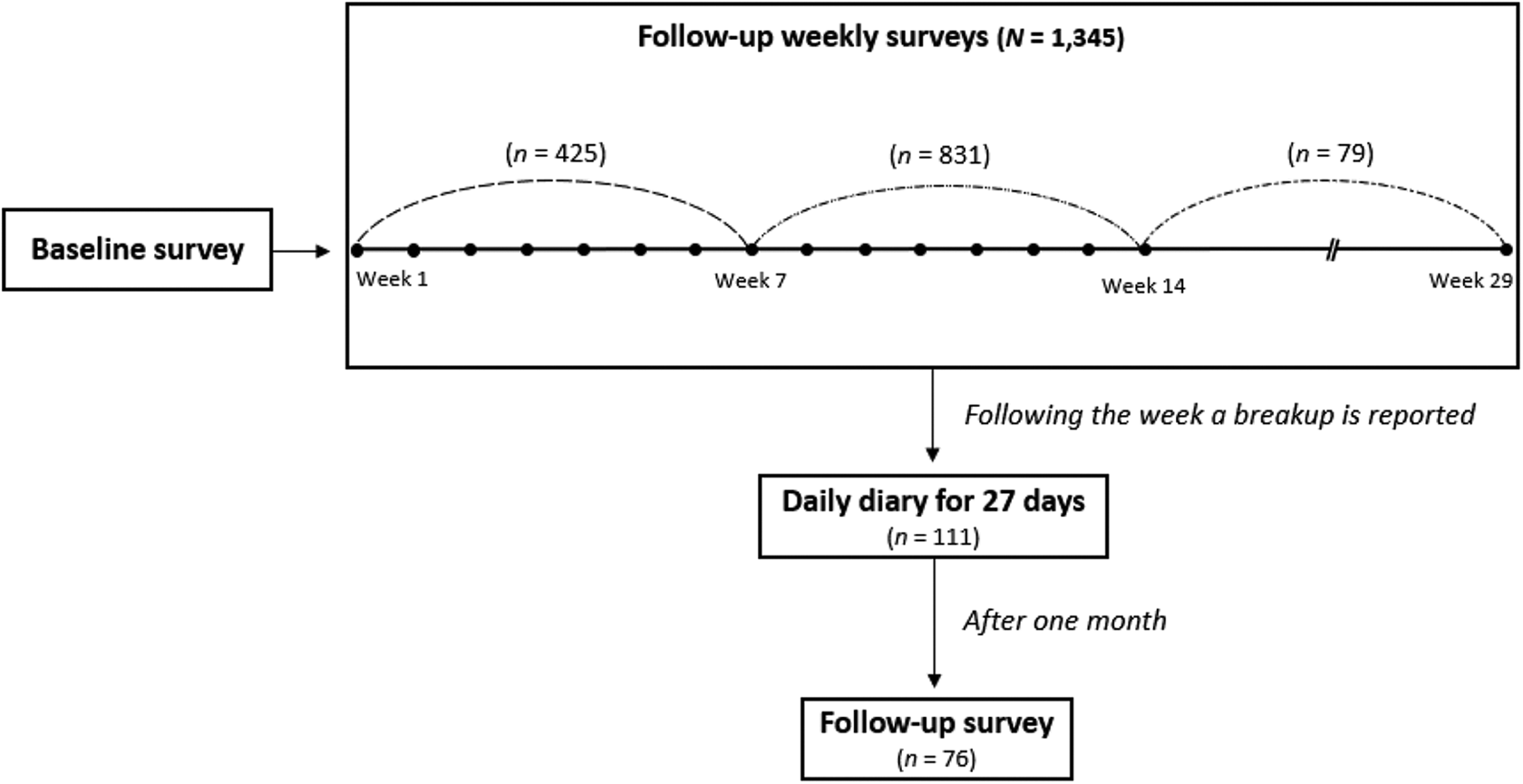
Study procedure. Note. Values in parentheses in the follow-up weekly survey section indicate the number of participants who stopped responding during each interval.
Baseline Measures
Reward and threat perceptions
Participants’ perceptions of reward and threat in their current relationship were measured using the Social Threat and Reward Scale (Spielmann et al., 2012). Nine items assessed reward perceptions (e.g., “I feel closer with my partner than I’ve ever felt to somebody”; α = .90), and 6 items assessed threat perceptions (e.g., “I worry about what my partner thinks about me”; α = .81); all items rated on 5-point scales ranging from 1 (strongly disagree) to 5 (strongly agree).
Attachment insecurities
The Attachment Style Questionnaire (Feeney et al., 1994) was used to assess attachment insecurities. The measure includes 13 items assessing attachment anxiety (e.g., “I find that others are reluctant to get as close as I would like”; α = .82) and 16 items assessing attachment avoidance (e.g., “I prefer to depend on myself rather than other people”; α = .86). Responses were given on 6-point scales (1 = totally disagree to 6 = totally agree).
Relationship satisfaction
Satisfaction was assessed with 5 items (e.g., “My relationship is close to ideal”; α = .94) from the Investment Model Scale (Rusbult et al., 1998) measured on 9-point scales (1 = disagree completely to 9 = agree completely).
Weekly Measures
Breakup and initiation of a breakup
Each week, participants were asked whether they were still in the same relationship and responded with a “yes” or “no.” Participants who indicated “no” were asked about who initiated the breakup (1 = entirely my decision, 3 = mutual decision, and 5 = entirely partner’s decision). Those who answered 1, 2, or 3 were coded as initiating the breakup in the analyses (Joel, Impett et al., 2018). Of the 239 participants who broke up, 146 indicated that they initiated the breakup (26 refused to answer). In order to more precisely address the question of whether reward and threat played a role in making the decision to leave a relationship (rather than being subjected to a partner’s decision), we also ran analyses using a subsample of participants who were classified as initiating the breakup.
Postbreakup Diary Measures
Breakup responsibility
Immediately after participants agreed to participate in the diary study, they were asked to what extent they were responsible for the breakup occurring (estimated responsibility from 0%–100%).
Emotional attachment to the ex-partner
Every night, participants reported their feelings toward the ex-partner on 4 items (e.g., “I am still in love with him or her”; Spielmann et al., 2009) on scales ranging from 1 (strongly disagree) to 5 (strongly agree). Within-person reliability of the items (indicated by Rc; Bolger & Laurenceau, 2013) was .70.
Two-Month Follow-Up Measures
Emotional attachment to the ex-partner
Two months following the breakup (i.e., 1 month following the completion of diary study), the same 4 items were used to assess participants’ emotional attachment to the ex-partner (α = .84). Descriptive statistics and correlations among the variables are presented in Table 1.
Descriptive Statistics and Correlations Among Variables (Study 1).
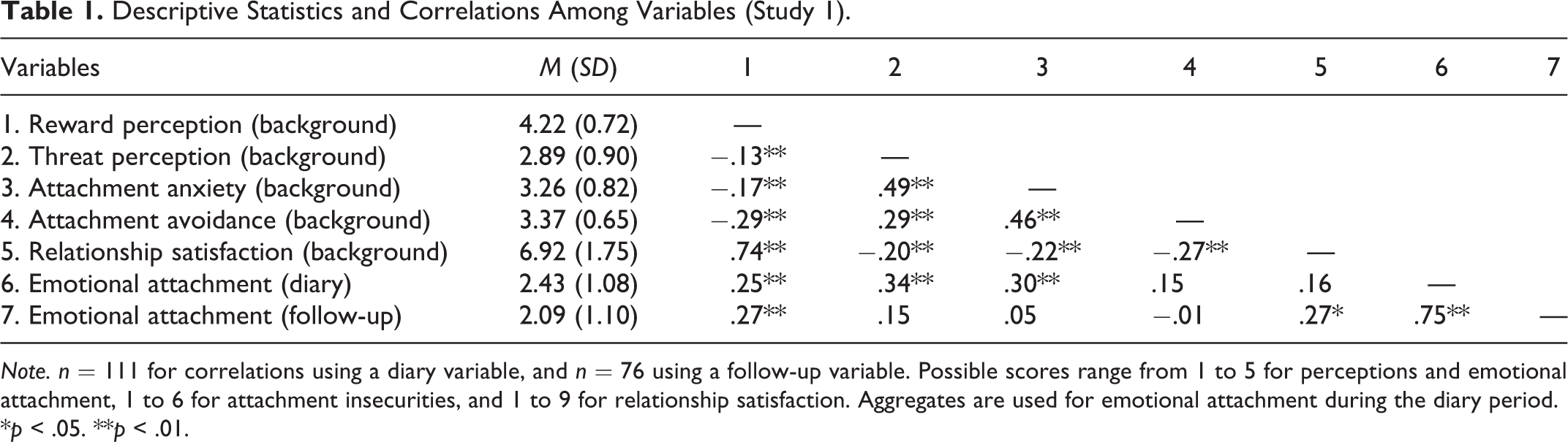
Note. n = 111 for correlations using a diary variable, and n = 76 using a follow-up variable. Possible scores range from 1 to 5 for perceptions and emotional attachment, 1 to 6 for attachment insecurities, and 1 to 9 for relationship satisfaction. Aggregates are used for emotional attachment during the diary period.
*p < .05. **p < .01.
Results
Breakup Analyses
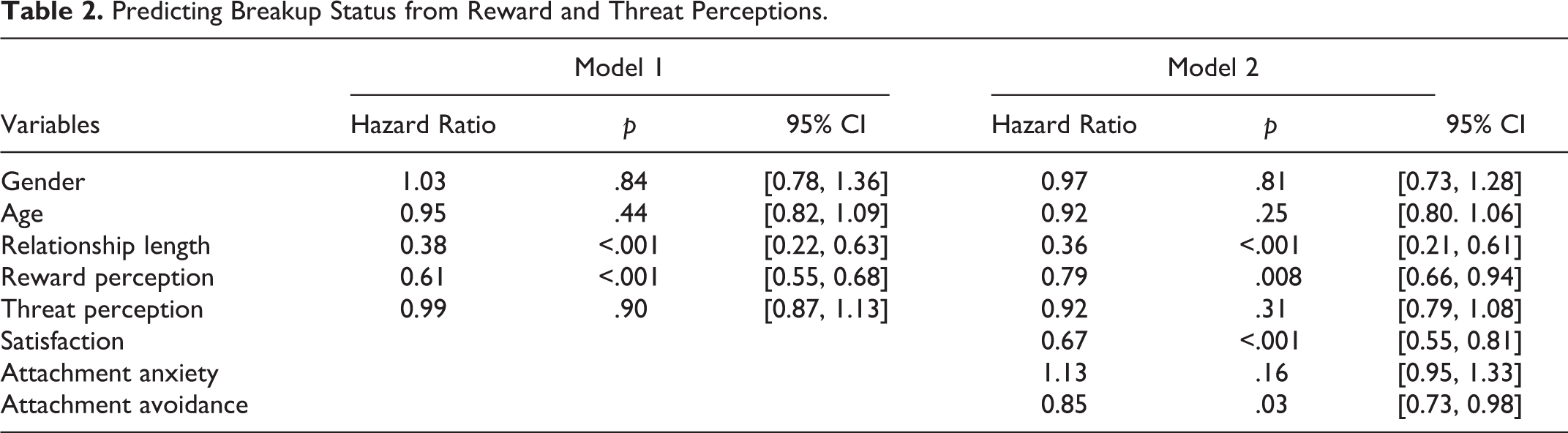
We conducted Cox proportional hazard regression analyses using the survival package (Therneau & Lumley, 2017) in R to test the effects of reward and threat perceptions on the likelihood of breakup. As shown in Table 2, reward perceptions significantly predicted whether or not participants continued to stay with their partner, controlling for gender, age, and relationship length. 2 Specifically, those who reported reward perceptions at least one standard deviation higher than the mean had a 39% lower likelihood of experiencing a breakup at any given point in the study (Figure 2). Threat perceptions, on the other hand, did not significantly predict the breakup. The results remained the same when analyzing a subsample of participants who were the initiator of the breakup.
Predicting Breakup Status from Reward and Threat Perceptions.
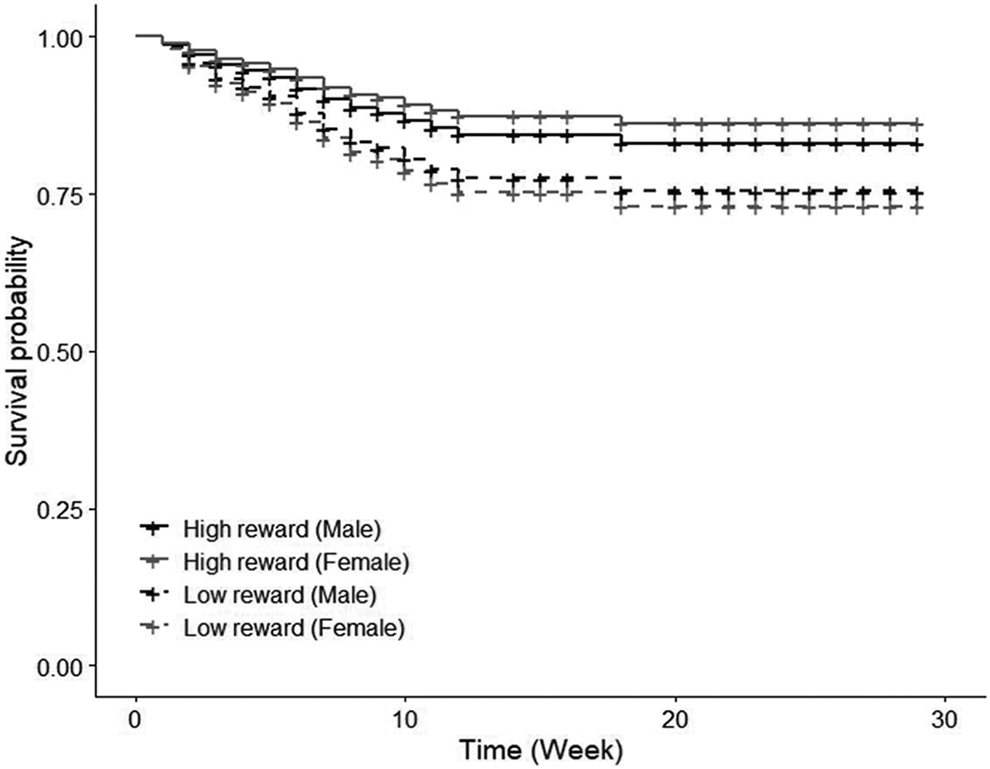
Survival curves for the cumulative proportion of the sample remaining in a relationship since the baseline assessment, adjusting for threat perceptions, age, and relationship length. Note. High and low reward indicate one standard deviation above and below the mean of reward perceptions.
Further, as a conservative test for discriminant effects of reward perceptions, we included satisfaction in the model. The results showed that although low satisfaction (HR = 0.67, 95% CI = [0.56, 0.81], p < .001) also significantly predicted greater likelihood of breakup, the effect of reward remained significant (HR = 0.81, 95% CI = [0.68, 0.97], p < .001). Similarly, in a model additionally controlling for attachment insecurities (presented as Model 2 in Table 2), high attachment avoidance as well as low satisfaction emerged as significant predictors of breakup but the effect of reward remained robust.
Exploratory moderation analyses
We also explored whether the effects of reward/threat perceptions vary depending on gender and/or attachment insecurities. Our first model included gender, reward/threat, and their interactions with gender, as well as two other covariates, age and relationship length. Results showed a significant interaction between threat perceptions and gender (p = .007) such that high threat perceptions were not linked with men’s breakup status over time (HR = 1.12, 95% CI = [0.95, 1.32]) but were linked with women’s lower likelihood of breakup (HR = 0.75, 95% CI = [0.59, 0.95]).
In our second model including interactions between attachment anxiety/avoidance and reward/threat as well as their main effects and covariates (gender, age, and relationship length), we found one significant interaction between reward and attachment avoidance, p = .03. The extent to which reward was predictive of breakup was significantly weaker among individuals high in attachment avoidance (HR = 0.67, 95%CI = [0.57, 0.80]) compared to those low in attachment avoidance (HR = 0.51, 95% CI = [0.43, 0.60]).
Diary Analyses
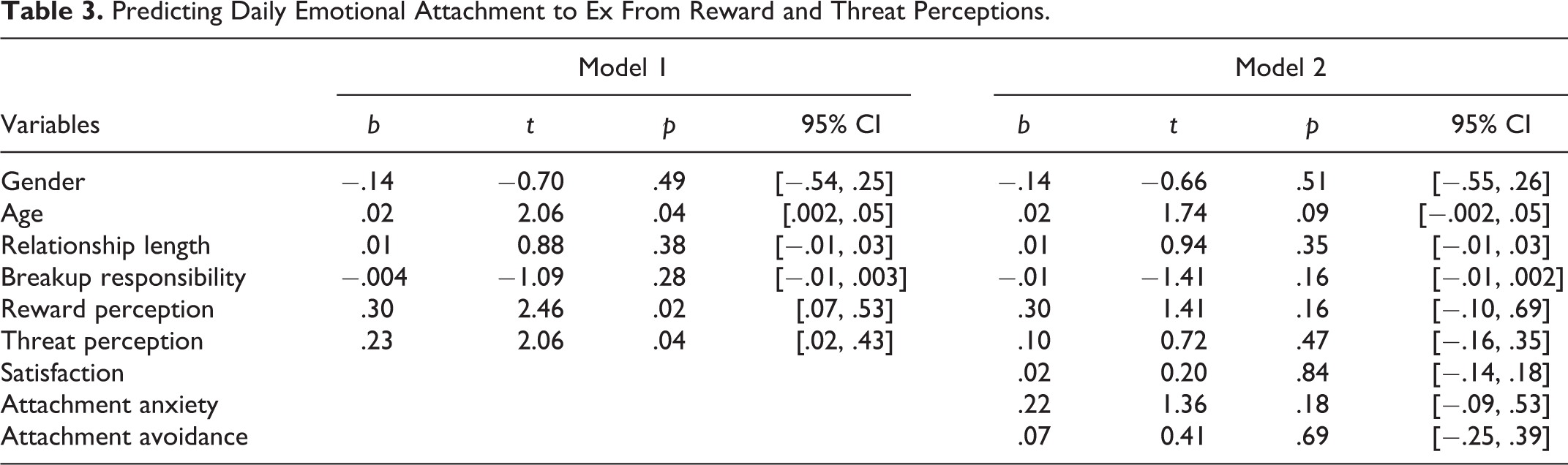
Next, we used multilevel modeling to examine the effects of reward and threat perceptions on postbreakup emotional attachment to the ex-partner. 3 All analyses were conducted using the lme4 package in R (Bates et al., 2014). Controlling for gender, age, relationship length, breakup responsibility, both reward and threat perceptions (measured at background) positively predicted emotional attachment to the ex (Model 1, Table 3). However, when we included satisfaction in the model as a conservative test, only threat emerged as significant (b = .23, t = 2.04, p = .04), and neither reward (b = .28, t = 1.35, p = .18) nor satisfaction (b = .01, t = 0.14, p = .89) was significant. In the final model that additionally controlling for attachment insecurities, as shown in Table 3 (Model 2), the effect of threat dropped to nonsignificance. Lastly, none of these effects were moderated by gender or attachment insecurities.
Predicting Daily Emotional Attachment to Ex From Reward and Threat Perceptions.
Follow-Up Analyses
Lastly, we conducted a multiple regression analysis predicting emotional attachment to the ex-partner at the follow-up with reward/threat perceptions at baseline as predictors. As shown in Table 4, reward perception was significantly associated with emotional attachment to the ex such that those who perceived high reward in the relationship when it was intact were more likely to be attached to the ex-partner even 2 months after the breakup. On the other hand, threat perception had no significant effect. However, as in the diary analyses, the effect of reward dropped in significance with satisfaction included in the model (β = .06, t = 0.23, p = .82 for reward and β = .17, t = 1.45, p = .15 for satisfaction). Similarly, none of the predictors emerged as significant in the final model including satisfaction and attachment insecurities as shown in Table 4. Finally, none of these effects were moderated by gender or attachment insecurities.
Reward and Threat Perceptions During the Relationship Predicting Emotional Attachment to Ex 2 Months After the Breakup.

Discussion
Using a prospective design, this research showed that perceiving lower levels of reward predicted dissolution of the relationship above and beyond the predictive power of other factors such as satisfaction and attachment insecurities. Although reward also predicted being less emotionally attached to the ex-partner at a daily level and 2 months following the breakup, these effects diminished when controlling for the effects of satisfaction. Combined, our data suggest that people are more likely to break up the less rewarding the relationship is, but their postbreakup attachment to the ex-partner may not depend specifically on the level of reward. On the other hand, the degree of threat perception was not a significant predictor of relationship dissolution or how much the person was emotionally attached to the ex-partner after the relationship ended.
Given our operationalization of reward that focused on capturing different aspects of intimacy (i.e., love, connection, depth of interactions, and self-disclosure), the present results speak to the importance of having needs for intimacy met in a romantic relationship, echoing previous findings that people report intimate connection to be one of the key reasons for staying in a relationship (Joel, Macdonald et al., 2018). Nevertheless, to the extent that people vary in how much they value intimacy or consider it as a “reward” (Ren et al., 2017), the predictive power of reward for breakup may also vary. Our exploratory analyses provided tentative evidence for this possibility by demonstrating that reward did not predict breakup as strongly for individuals high in attachment avoidance (who place less value on intimacy; Ren et al., 2017).
We observed interesting differences in results regarding the role of reward in shaping pre- and postbreakup outcomes in a relationship. Specifically, in contrast to its unique role in predicting breakup, the degree of reward experienced in the relationship did not have discriminant effects on how easy it was to let go of the ex-partner. One potential explanation for this discrepancy relates to the shift in abstractness of people’s memories over time (Pansky & Koriat, 2004; Schul, 1983). Just as specific details of an event or information are lost over time and only a global meaning or summary is retained, memories from the previous relationship that are left to affect postbreakup outcomes may be a global sense of how satisfying or positive the relationship experience was rather than specific aspects of the relationship. Thus, this abstraction may have contributed to the overlap between the effects of reward and of global relationship satisfaction on postbreakup outcomes.
Nevertheless, we may be able to gain insight into how people can better cope with breakups by approaching breakup recovery from the perspective of lost reward, rather than, or in addition to, understanding it as a reflection of dispositional insecurities (Fagundes, 2012), loss of self-concept clarity (Slotter et al., 2010), or perceiving a breakup as a threat to achieving higher order life goals (Cupach & Spitzberg, 2004). LeRoy et al. (2019) proposed a model based on the work of Sbarra and Hazan (2008) that argues that the key psychological task after relationship loss is to reorganize one’s attachment hierarchy, so that satisfaction of the needs fulfilled by the lost relationship can now be directed to other partners. One key idea in this model is that social reward is associated physiologically with the release of endogenous opioids (e.g., Inagaki et al., 2016; Tchalova & MacDonald, 2020). The feelings of psychological pain that motivate attachment hierarchy reorganization arise in part because the loss of the socially rewarding relationship induces endogenous opioid withdrawal (LeRoy et al., 2019). After an initial stage of disorganization, this pain motivates protest responses underpinned by both PANIC/GRIEF and SEEKING motivational systems (Panksepp & Watt, 2011) that motivate active pursuit of the lost relationship partner physically and/or symbolically. Successful grieving of the relationship involves movement toward a despair stage in which SEEKING motivation toward the lost relationship decreases, and ultimately other relationship figures are sought to replace the lost reward.
Although LeRoy et al.’s (2019) model is compelling and instructive, it treats the loss of social reward as a constant. Our research suggests that the degree of reward lost in a relationship is, in fact, an important variable that may have implications for successful movement through the stages of grief (as marked by degree of emotional attachment to the ex-partner in our data). The extent to which this is uniquely contingent on the degree of reward experienced in the relationship or broader markers of positivity (e.g., retrospective evaluations of satisfaction) warrants future research. However, it seems reasonable that more rewarding, or satisfying, relationships would result in more withdrawal-motivated disorganization as well as stronger activation of the SEEKING system during the protest phase and more resistance to downregulating SEEKING motivation as a means of entering the despair phase. LeRoy et al.’s model suggests that such movement through these phases is key to successful coping, but our data suggest that highly rewarding or satisfying relationships may slow down movement through all of these stages until the relationship is fully grieved.
One implication our work has for maintaining long-lasting relationships is that boosting rewarding experiences may be as important as downregulating threats. Although many couple therapies and interventions have focused on reducing threat perceptions and insecurities in a relationship (e.g., Johnson et al., 2016), our findings make it clear that a key determinant of staying with a partner is the degree of reward that the relationship offers. This is also consistent with the findings from self-expansion perspectives that show that engaging in novel activities (i.e., reward-boosting activities) can have positive effects such as increasing sexual desire and thus satisfaction in the relationship (Muise et al., 2019). Our data add to this literature showing that intimate connection is more than a relationship luxury and may in fact be crucial to relationship longevity.
Our research does have important limitations and leaves several questions open for future research. First, although we focused on an individual’s own reward and threat perceptions as predictors of breakup, examining how a partner perceives reward and threat or how people think their partner perceives each from the relationship will be important to gaining a more complete understanding of the breakup process. Indeed, it would not be surprising if laypeople have an intuitive sense that just as they will experience difficult postbreakup coping when the relationship offered high reward, so too will their partner. As people are motivated to avoid hurting partners, perceiving that a partner finds a relationship highly rewarding may also promote relationship stability even in cases of low personal reward (Joel, Impett et al., 2018). Second, as our research does not speak to the precise mechanisms underlying the link between reward/threat perceptions and breakup, future research will benefit from examining how each may affect the way people navigate daily interactions with a partner. Perhaps, the degree of reward and threat perceptions shape daily goals and behaviors around a partner (Impett et al., 2010), which in turn affect their long-term intention to maintain a relationship. Of course, people’s feelings during these daily interactions may also feed back into their reward and threat perceptions. Third, our postbreakup analyses were based on a relatively small sample size (given that our initial sample was reduced to those who broke up and who were still willing to participate in a diary study). Thus, these results should be interpreted with caution and replicated in a large-scale survey. Given the difficulty of collecting this type of data, future research will benefit from collaborative efforts to follow a large number of couples and track their relationship status over time.
Lastly, it is important that our data do not necessarily speak against the power of threats in a relationship. Possibly, the processes by which threats contribute to long-term relationship motivation involve forces working in different directions and thus cannot be simplified as resulting in higher or lower likelihood of breaking up. For example, according to a general process model of threat and defense (Jonas et al., 2014), high perceptions of threats may prompt immediate reactions that are oriented toward avoiding and distancing from the relationship (e.g., concealing or suppressing negative emotions; Richards et al., 2003) but also elicit distal defenses that function to actually relieve the heightened anxiety (e.g., confronting disagreement; Overall et al., 2009). This suggests the need to explore several potential mechanisms through which threats may impact one’s motivation to stay in a relationship in short run and long run.
Alternatively, our operationalization of social threat could have also been key to the null effects. Rejection and negative evaluation, what we deem social threat, are not intended to represent the broad range of aversive experiences in relationships although they may comprise an important facet, particularly when it comes to the regulation of emotional investment. Indeed, social-evaluative threats have long been considered as powerful stressors and previous research studying “social threats” (e.g., Dandeneau et al., 2007) has similarly focused on experiences that elicit feelings of rejection or being criticized. Nevertheless, there are other aversive perceptions in relationships (e.g., concerns about incompatibility) that can play an important role in relationship stability. Future research will benefit from examining whether operationalizing threats in different ways affects the conclusions from our research.
Footnotes
Declaration of Conflicting Interests
The author(s) declared no potential conflicts of interest with respect to the research, authorship, and/or publication of this article.
Funding
The author(s) disclosed receipt of the following financial support for the research and/or authorship of this article: This article received funding from Social Sciences and Humanities Research Council of Canada (Grant No. SSHRC IG #435-2014-0645).
