




Abstract
The current research investigates the role of racialized work ethic stereotypes on attitudes toward welfare. We hypothesized that work ethic stereotypes shape both people’s attitudes toward welfare and their perceptions of who benefits from these policies. Consistent with hypotheses, when the demographic composition of welfare recipients was majority Black (vs. White), participants thought recipients were lazier and were less positive to welfare programs and policies (Study 1). Describing welfare recipients as hardworking (vs. no information control) mitigated this effect, even when the demographic composition of welfare recipients was majority Black (Study 2). Finally, we investigated whether work ethic stereotypes shape both attitudes toward welfare and spontaneous mental images of recipients. Images generated when participants were asked to envision hardworking (vs. lazy) recipients were rated by a separate sample as more representative of White Americans and garnered more support for providing welfare benefits (Study 3).
Dog-whistle politics highlight racial stereotypes while sidestepping the overt discussion of race. Attitudes toward welfare have become a prime example of dog-whistle politics at work. Broadly speaking, “welfare” encapsulates a range of programs that provide benefits to people who are unemployed or underemployed. Because people stereotypically assume the benefits go to people who are not working but could work, discussions about welfare recipients emphasize stereotypes that recipients are lazy and wanting of “handouts,” without mentioning the fact that many people assume welfare recipients are Black (e.g., Brown-Iannuzzi et al., 2017; Gilens, 1996).
Critically, who is considered “lazy” is often influenced by racial stereotypes whereby Black = lazy and White = hardworking (e.g., Devine & Elliot, 1995; Dupree et al., 2020; Katz & Braly, 1933). Thus, racialized beliefs that welfare recipients are lazy may shape people’s attitudes toward welfare programs and policies without directly mentioning the race of the recipient. Because work ethic beliefs are racialized, having people think of hardworking welfare recipients might increase support for welfare by shifting the perceived race of welfare recipients to be more representative of White Americans. Together, this suggests a pernicious cycle whereby work ethic stereotypes shape people’s attitudes toward welfare and their perceptions of who benefits from these policies. In the current work, we investigate this cycle.
Race, Work Ethic, and Welfare Attitudes
As Black Americans began receiving rightful access to welfare benefits due to the repeal of discriminatory laws, White politicians and the media began racializing welfare recipients, policies, and programs by stereotypically linking welfare recipients with Black people (Gilens, 1996, 1999). Decades later, these racial stereotypes about welfare persist, such that the average mental representation of a welfare recipient (vs. nonwelfare recipient) is more representative of Black Americans (Brown-Iannuzzi et al., 2017; Gilens, 1996). Together, this suggests that racial stereotypes of welfare recipients remain robust.
The racialization of welfare emphasizes several interconnected stereotypes about welfare recipients to engender negativity toward these policies (Gilens, 1999). One central stereotype is that welfare recipients are lazy (Gilens, 1999)—a stereotype that (1) violates the protestant work ethic—a value thought to underlie attitudes toward welfare (Furnham, 1982; Leiby, 1978), (2) underscores the public’s fear that people will remain dependent on the government because they prefer receiving benefits as opposed to working (MacLeod et al., 1999), and (3) is racially charged (e.g., Devine & Elliot, 1995; Katz & Braly, 1933). Thus, when politicians began creating the stereotype that lazy, Black Americans receive welfare benefits, it engendered the notion of the “undeserving poor”—Black people who do not try to pull themselves out of poverty (e.g., Edsall & Edsall, 1991; Gilens, 1999; Henry et al., 2004). Critically, because of well-known stereotypes that Black = lazy and White = hardworking (e.g., Devine & Elliot, 1995) and the stereotype that welfare recipients are Black, the overt racial discussion of welfare was supplanted by racially coded language about work ethic (Gilens, 1999).
Addressing Racially Coded Welfare Stereotypes
At first pass, it may seem that addressing racially coded laziness stereotypes about welfare recipients may be a promising route to reduce racial biases in attitudes toward welfare. Indeed, one paper investigated a stereotype related to perceived laziness of welfare recipients—perceived dependence of welfare recipients on the government (Cooley et al., 2019). This research investigated whether telling participants that the majority of welfare recipients were able to exit the welfare program within a year of receiving welfare assistance and obtain a full-time, well-paying job (vs. no information) would influence attitudes toward welfare. The results revealed an interaction between the race of the majority of welfare recipients (Black vs. White) and information about recipients’ ability to obtain financial independence: When no information was provided, participants thought White (vs. Black) welfare recipients would be more successful and participants had more positive attitudes toward the welfare program. However, when participants were provided information that most recipients were able to gain independence from the government, the pattern of results reversed. This suggests that racialized perceptions of welfare recipients’ ability to eventually gain financial independence may contribute to racial biases in welfare attitudes.
Although this research provides an important first step to understanding a stereotype about welfare recipients that is related to laziness—perpetual dependence on government benefits—there are several limitations with the previous work. First, this work manipulates whether recipients exit welfare programs and remain independent of government support—a reality that is relatively rare and difficult to obtain for numerous reasons including the fact that exiting and remaining independent of welfare programs depends on having a robust economy (e.g., Moffitt & Garlow, 2018). As such, this independence expectation, regardless of one’s work ethic, is particularly unrealistic in the context of the Great Recession and the current pandemic. Second, although independence and being hardworking are related, they are separate constructs (e.g., Gilens, 1995; Kitayama & Imada, 2010; Peffley et al., 1997). And, we reason that gaining a full-time job and financial independence is likely to increase support for welfare because such an outcome connotes hard work (Cooley et al., 2019; Peffley et al., 1997). If so, attitudes toward welfare programs may be more centrally related to work ethic stereotypes, as opposed to whether or not a recipient exits a welfare program—a possibility we directly examine. Finally, given that work ethic stereotypes are both subjective and racialized (e.g., Devine & Elliot, 1995; Katz & Braly, 1933), we reason that leading people to imagine “hardworking” welfare recipients may increase welfare support but may also lead people to envision Whiter recipients. Such a finding would suggest a pernicious psychological process that perpetuates racialized work ethic beliefs, even in the face of stereotype-inconsistent information.
Research Overview
Extending from previous work, the current research investigates the interrelated nature of work ethic stereotypes, race, and attitudes toward welfare programs and policies. First, we test whether learning about a welfare program that primarily benefits White (vs. Black) people influences perceptions that recipients are hardworking, that recipients are independent, and attitudes toward welfare programs and policies (Study 1). We hypothesize that when the majority of recipients are White (vs. Black), participants will think recipients are more hardworking, independent, and will have more positive attitudes toward welfare programs and policies. We also hypothesize that work ethic stereotypes (rather than independence stereotypes) will be a more central predictor of attitudes toward welfare programs and policies. In Study 2, we test whether describing welfare recipients as hardworking (vs. no information control) influences attitudes toward welfare programs and policies. We hypothesize that when recipients are described as hardworking (vs. no information provided), participants will have more positive attitudes toward welfare programs and policies. Finally, we investigate a previously unexamined possibility that work ethic stereotypes are interconnected with race and attitudes toward welfare benefits by examining mental representations of hardworking (vs. lazy) welfare recipients (Study 3). Due to racialized work ethic stereotypes that Black = lazy and White = hardworking (e.g., Devine & Elliot, 1995), we hypothesize that when participants imagine a hardworking (vs. lazy) welfare recipient, their mental visualization of this person will be perceived as more representative of White Americans. As a result, participants may be more supportive of giving welfare benefits to the pictured person.
All measures, manipulations, and exclusions, if any, are reported below. 1 For exact wording of all measures and additional analyses, see Online Supplemental Material. For each study, we conducted an a priori power analysis to recruit samples large enough to detect a small-to-medium effect size (d = 0.30) with adequate power (1 – β ≥ 80; G*Power v.3, Faul et al., 2009). This effect size determination was based on previous research on racialized attitudes toward welfare that suggest small-to-medium effect sizes (e.g., Cooley et al., 2019; Gilens, 1996).
Study 1
Method
Participants
To account for various forms of attrition, we recruited a representative sample of 550 U.S. participants from Lucid Theorem (https://luc.id/theorem/). 2 To improve data quality (Oppenheimer et al., 2009) and to ensure that participants attended to the race/ethnicity information in the manipulation, we included an attention check that asked participants to report the race/ethnicity of the majority of recipients on the specified welfare program. If participants failed to correctly answer this item, they were immediately terminated from the survey.
We obtained a sample of 480 participants (244 women, 236 men) who passed robot checks (CAPTCHAs), the attention check, consented to have their data used, and completed the dependent variables of interest. The average age of the sample was 45.42 (standard deviation [SD] = 16.90). For race, the sample composition was as follows: 74.0% White, 12.9% Black, 5.2% Asian, 1.7% Native American, 1.9% more than one race, 2.3% another race, and 2.1% did not report.
Procedure
Participants were told about an ostensible welfare program called SPIN—Supporting Persons in Need—that gave cash-based assistance to needy people. In a between-subjects manipulation, participants were told that “The demographics of people on SPIN are similar to the demographics of people on other types of welfare programs: 80% of the people on SPIN are African American [White], 15% are Hispanic, and 5% are White [African American].”
Next, participants were asked whether they thought SPIN recipients had strong work ethic and were independent. We provided definitions (modified from Merriam-Webster’s Dictionary) to ensure participants understood the terms. For strong work ethic, participants were told: “To have a strong work ethic means that someone works very hard with commitment and conscientiousness. That is, people with a strong work ethic are attentive and persistent in doing anything.” Then participants were asked to determine whether two work ethic statements were representative of SPIN recipients: “SPIN recipients work very hard with commitment and conscientiousness” and “SPIN recipients are attentive and persistent” (0 = totally unrepresentative, 100 = totally representative; Spearman–Brown = .93). For independence, participants were told: “To be independent means that someone is not influenced or controlled by others in matters of opinion, conduct, or behavior. That is, independent people think and act for oneself.” Again, participants were asked to determine the representativeness of the following two statements as pertaining to SPIN recipients: “SPIN recipients are not influenced or controlled by others” and “SPIN recipients are free to think and act for themselves” (0 = totally unrepresentative, 100 = totally representative; Spearman–Brown = .72). To avoid order effects, the order of the work ethic and independent items were randomly presented.
Then participants reported the extent to which they agreed with the following two statements: “I support programs like SPIN” and “SPIN is a good program” (1 = strongly disagree, 6 = strongly agree). We averaged these items into one index assessing positive attitudes toward SPIN (Spearman–Brown = .93).
Next, participants were told to imagine they had a say in making up the federal budget for the next fiscal year and were asked (1) “Would you want more or less money dedicated to programs like SPIN” (1 = much less money, 6 = much more money)? and (2) “Would you want to increase or decrease the federal budget dedicated to programs like SPIN” (1 = greatly decrease, 6 = greatly increase)? We averaged these items into one index assessing support for policies like SPIN (Spearman–Brown = .87).
We also measured explicit racial prejudice using the Symbolic Racism Scale (Henry & Sears, 2002; α = .86) and a feeling thermometer difference score (positivity toward White people minus positivity toward Black people). Additionally, participants indicated their political ideology on social and economic issues (1 = very liberal, 7 = very conservative; Spearman–Brown = .87). We investigated whether findings are robust to and moderated by these variables (see Supplemental Analyses). Finally, participants completed demographic items including race/ethnicity, political party affiliation, and political ideology.
Results
Preliminary Analyses
We investigated the correlations between the dependent variables of interest (see Table 1). As anticipated, perceptions that SPIN recipients were hardworking were associated with perceptions they were independent, positive attitudes toward SPIN, and more support for SPIN policies.
Correlations and Descriptive Statistics for Variables of Interest, Study 1.

Note. The p values for all correlations were p < .01.
Primary Analyses
We hypothesized that participants (1) would think recipients were more hardworking, (2) would have more positive attitudes toward programs like SPIN, and (3) would be more supportive of policies that funded these programs when the majority of recipients were White, as opposed to Black. Further, to demonstrate the unique role of work ethic stereotypes, we hypothesized that the effect of condition on perceptions that recipients are hardworking would be stronger than the effect of condition on perceptions that recipients are independent. See Table 2 for means, inferential statistics, and effect size results. Consistent with our hypotheses, participants perceived SPIN recipients to be more hardworking, had more positive attitudes toward programs like SPIN, and were more supportive of policies which funded SPIN and similar programs when the majority of recipients were White, as opposed to Black. The difference between perceived independence of recipients when the majority of SPIN were White versus Black was not significant.
Means, Inferential Statistics, and Effect Sizes, Study 1.
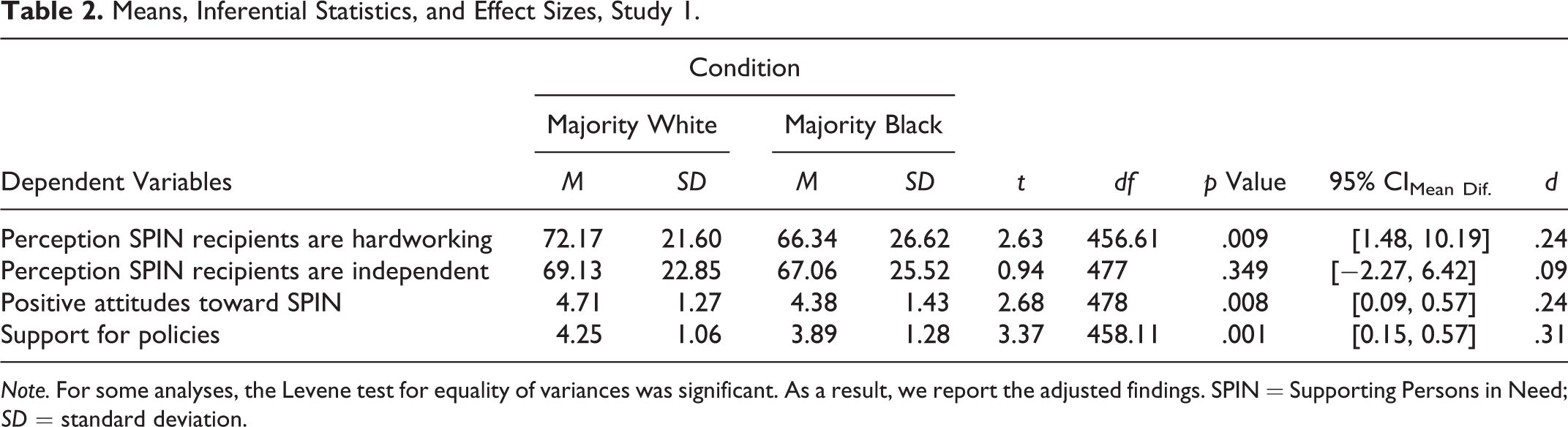
Note. For some analyses, the Levene test for equality of variances was significant. As a result, we report the adjusted findings. SPIN = Supporting Persons in Need; SD = standard deviation.
Mediation Analyses
Finally, extending beyond previous work (e.g., Cooley et al., 2019; Peffley et al., 1997), we investigate the central role of work ethic stereotypes using two mediation models. First, we tested whether perceived work ethic mediated the relationship between SPIN demographic condition and attitudes toward SPIN recipients and policies. 3 We also controlled for the potential mediation via perceived independence by using simultaneous mediation. Second, we ran the same model but predicted support for redistribution through taxation. For both mediations, we used PROCESS and 5,000 bootstrapped resamples (Model 4; Hayes, 2017). All continuous variables were standardized prior to analysis.
When predicting attitudes toward SPIN, results revealed a significant indirect effect through the perception that recipients were hardworking, b = −.09, 95% CI [−0.18, −0.02] (see Figure 1). In contrast, the indirect effect via perceived independence was not significant, b = −.01, 95% CI [−0.04, 0.01]. Similarly, when predicting support for policies like SPIN (see Figure 2), the results revealed a significant indirect effect through the perception that recipients were hardworking, b = −.11, 95% CI [−0.21, −0.03], but the indirect effect through perceptions that recipients were independent was not significant, b = −.005, 95% CI [−0.03, 0.01].
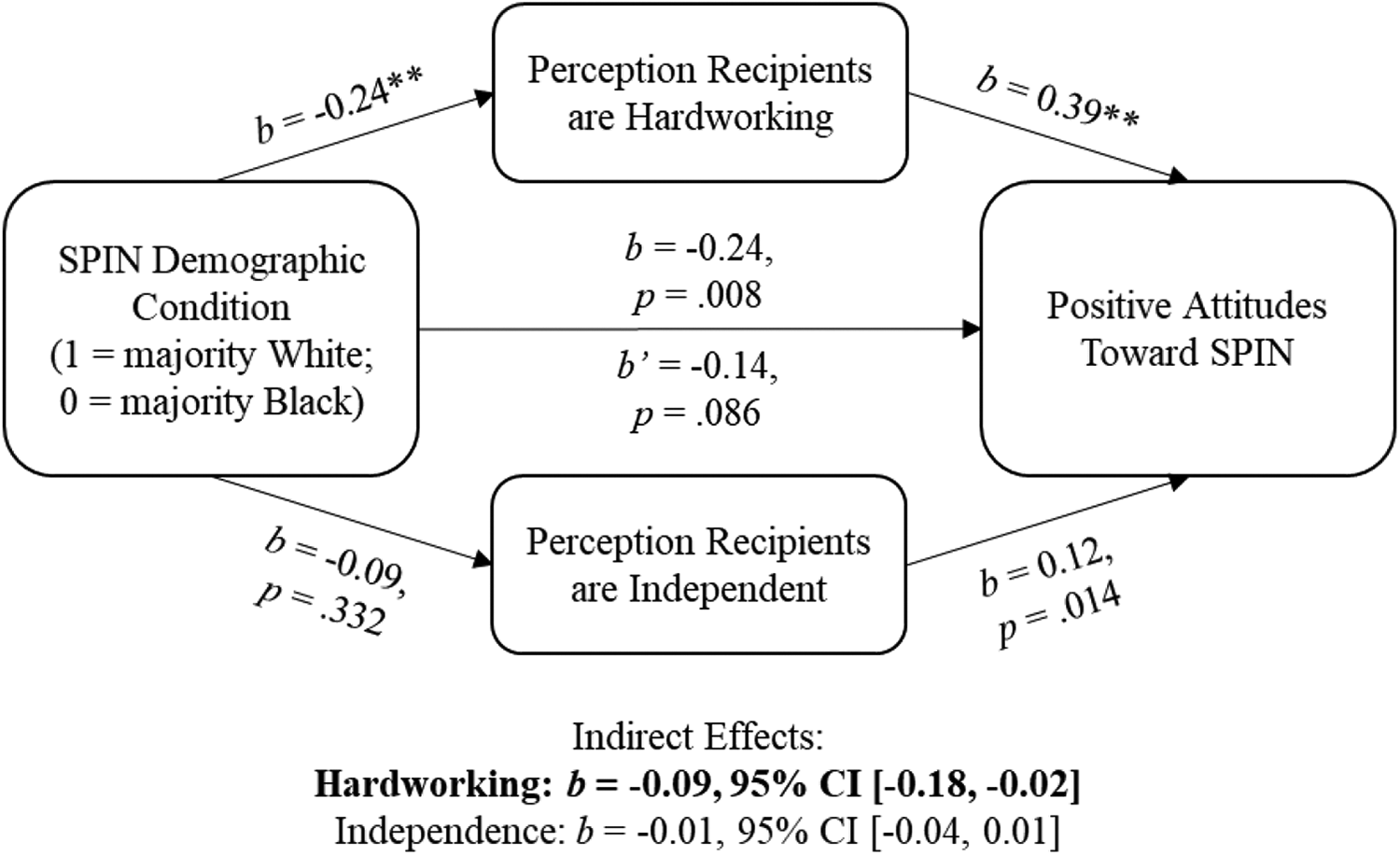
Mediation results investigating whether perceptions that Supporting Persons in Need (SPIN) recipients are hardworking and independent mediated the association between demographic condition and positive attitudes toward SPIN, Study 1. **p value < .01.
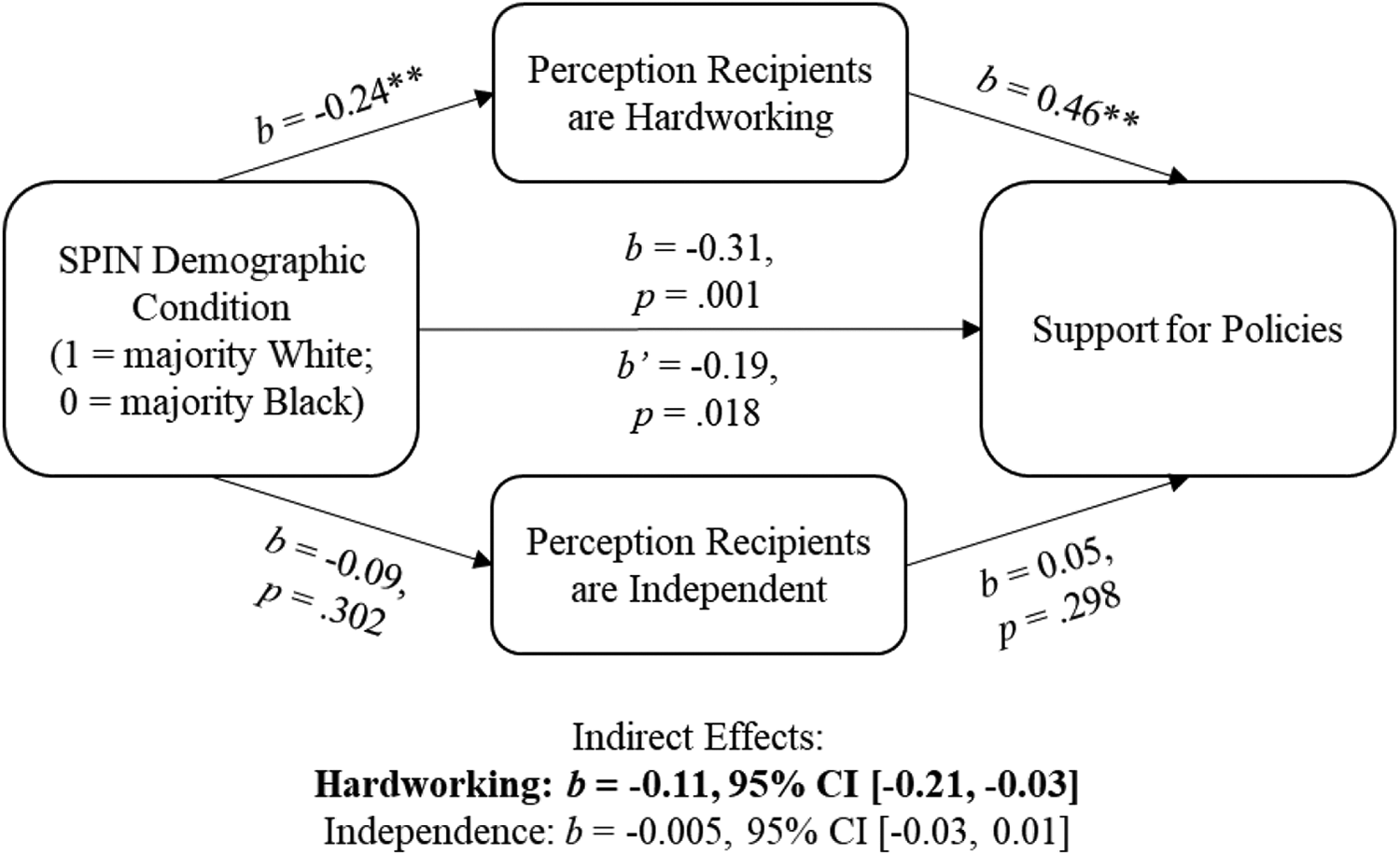
Mediation results investigating whether perceptions that Supporting Persons in Need (SPIN) recipients are hardworking and independent mediated the association between demographic condition and support for policies like SPIN, Study 1. **p value < .01.
Discussion
Together, these results suggest that when the majority of welfare recipients are Black (vs. White), participants perceived recipients to be less hardworking, had more negative attitudes toward this program, and were less supportive of welfare policies. Extending beyond previous work (Cooley et al., 2019), the key mediating effect seemed to be through perceptions of work ethic rather than recipient independence. Next, we investigated whether directly manipulating work ethic may influence attitudes toward this welfare program and support for welfare policies.
Study 2
Method
To simplify the design, all participants were told the majority of recipients were Black. Then half the participants learned SPIN recipients were hardworking, whereas the other half of participants did not receive this information, leaving them to rely on their own work ethic stereotypes of welfare recipients. We hypothesized that when provided work ethic information (vs. no information), participants would have more positive attitudes toward this program and would be more supportive of policies like this program. 4
Participants
To account for various forms of attrition, we again recruited a representative sample of 550 U.S. participants from Lucid Theorem. To improve data quality (Oppenheimer et al., 2009), we included the same attention check as in Study 1 and a check to ensure participants correctly reported the work ethic information (e.g., 8.23/10) in that condition. If participants failed to correctly answer these items, they were immediately terminated from the survey.
We obtained a sample of 518 participants (267 women and 251 men) who passed robot checks (CAPTCHAs), the attention check, consented to have their data used, and completed the dependent variables of interest. The average age of the sample was 46.31 (SD = 16.68). For race, the sample composition was as follows: 70.3% White, 12.7% Black, 4.6% Asian, 3.9% Native American, 3.9% more than one race, 2.5% another race, and 2.1% did not report.
Procedure
All participants were told the majority of recipients were Black. Half of the participants were randomly assigned to learn that because SPIN is a government program, temporary employers of SPIN recipients are asked to report on their employees’ work ethic. Employers ostensibly rated recipients as relatively hardworking on average (8.23 of a 10-point scale).
The rest of the study was the same as Study 1, except that we dropped the items investigating perceptions that recipients are independent (Spearman–BrownHardworking = .92; Spearman–BrownPos. Att. = .94; Spearman–BrownSupport Policy = .94). 5
Results
Preliminary Analyses
First, we investigated the relationship between the dependent variables of interest (see Table 3). As anticipated, perceptions that SPIN recipients were hardworking were associated with positive attitudes toward SPIN and more support for SPIN policies.
Correlations and Descriptive Statistics for Variables of Interest, Study 2.
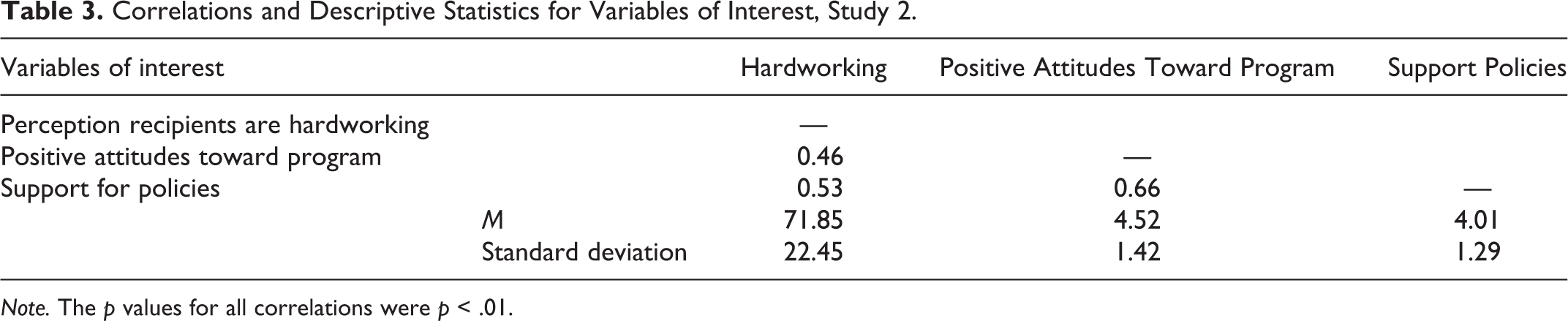
Note. The p values for all correlations were p < .01.
Primary Analyses
We hypothesized that participants (1) would think recipients were more hardworking, (2) would have more positive attitudes toward SPIN, and (3) would be more supportive of SPIN policies when given the work ethic information, as opposed to no information. See Table 4 for means, inferential statistics, and effect size results. Participants in the work ethic information condition (vs. no information condition) thought SPIN recipients were more hardworking. Critically, participants had more positive attitudes toward SPIN when they were in the work ethic information condition (vs. no information condition). Inconsistent with our hypotheses, the difference in support for SPIN policies by condition was not significant. However, there was an indirect effect of condition on support for SPIN policies through shifts in attitudes toward SPIN (see Online Supplemental Material).
Means, Standard Deviations (SDs), and Inferential Statistics Investigating Differences Between Condition on Dependent Variables of Interest, Study 2.
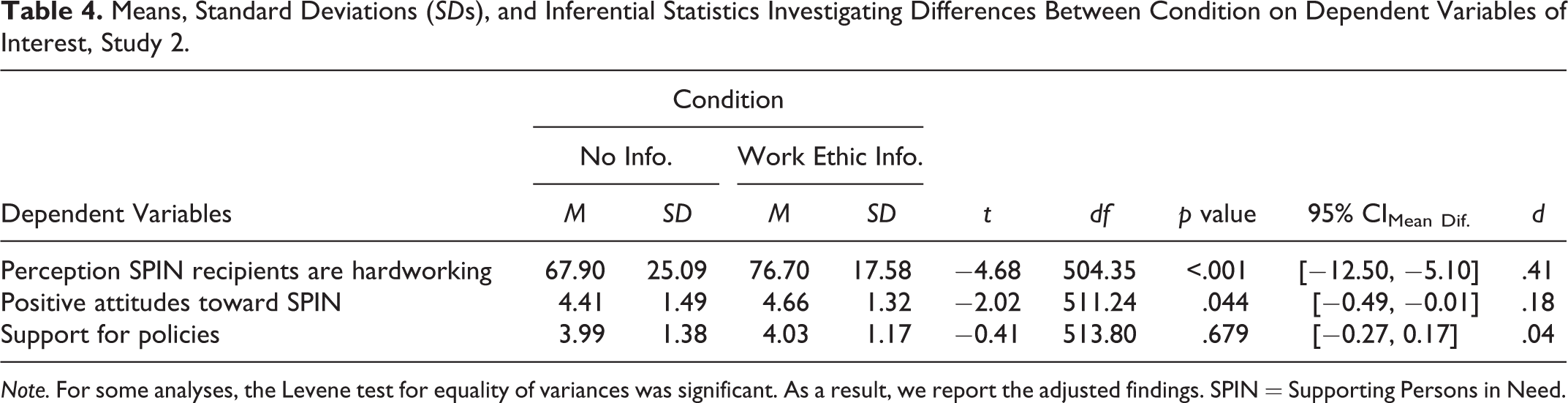
Note. For some analyses, the Levene test for equality of variances was significant. As a result, we report the adjusted findings. SPIN = Supporting Persons in Need.
Discussion
Overall, these findings provide some support for our hypotheses. When participants were given work ethic information (vs. no information), they had more positive attitudes toward SPIN. However, an additional study presented in the Online Supplemental Material, which did find a direct effect of condition on attitudes toward policies like SPIN, along with meta-analytic results across that study and the current study, suggests this lack of effect may be due to sampling error, Mr = 0.17, Z = 2.57, p = .010, 95% CIMr [0.04, 0.30]. Together with Study 1, these findings suggest that perceptions of being hardworking may be critical in shaping people’s attitudes toward welfare programs and policies.
So far, Studies 1 and 2 have explicitly stated the race of the majority of welfare recipients and measured perceptions the recipient is hardworking. However, being hardworking is stereotypically linked with being White (e.g., Devine & Elliot, 1995; Katz & Braly, 1933; Kay & Jost, 2003). Thus, when people are determining their welfare policy attitudes without direct information about recipients’ race, work ethic information may shift the perceived race of the recipients to be more representative of White (vs. Black) Americans. If so, then providing work ethic information would not mitigate racial biases in welfare attitudes; instead, work ethic information may simply shift people who are imagining benefits from these policies, which then shifts support. To test this possibility, in a final study, we investigate the spontaneous mental visualizations of hardworking (vs. lazy) welfare recipients.
Study 3
Method
To provide a visual approximation of the average hardworking and lazy welfare recipient, we used a reverse correlation task (Brinkman et al., 2017; Mangini & Biederman, 2004). This task uses a three-phase design. During the image generation phase, participants were randomly assigned to select images representative of hardworking or lazy welfare recipients. In the image creation phase, we use the data from the previous phase to create subgroup images—a visual approximation for a random subset of participants within a condition. Finally, in the image rating phase, a sample—unaware of how these images were generated—rated these images.
We also created individual images—a visual approximation for each participant—and had a separate sample rate these images. For exploratory purposes, we investigated the relationship between image generators’ attitudes and perceived race ratings of individual images (see Online Supplemental Material).
Image Generation Phase
Participants
Although no formal power analyses exist for the image generation portion of the reverse correlation task, we aimed to collect at least 150 participants to generate images which did not capitalize on chance due to sampling. Data were retained for participants who completed the reverse correlation task to ensure equivalent comparisons across individual images.
The final sample included 184 participants (103 women, 80 men, and 1 did not answer) from MTurk. The average age was 36.77 years (SD = 12.72). The racial/ethnic composition was as follows: 73.4% White, 9.2% Black or African American, 7.1% Hispanic or Latino, 0.5% Native American, 6.5% Asian or Pacific Islanders, 2.7% other, and 0.5% did not report.
Procedure
This task begins with a single “base face,” which, for our study, was a morphed composite of a Black man, Black woman, White man, and White woman. 6 We added random visual noise to this base face to create 800 unique variants. On each critical trial (N = 400), image pairs were randomly presented, and participants were asked to select the image that most resembled a hardworking (vs. lazy) welfare recipient, in a between-subjects design. Finally, participants completed several individual difference measures (see Online Supplemental Material). Participants also completed demographic questions (such as age, gender, and race/ethnicity).
Image Creation Phase
Following best practices (Cone et al., 2020), we created 10 subgroup images per condition using the R package rcicr 0.3.0 (Dotsch, 2015). Subgroup images are created by taking a random subset of participants within a condition and aggregating their individual images together (see Figure 3 for example images). Advantageously, subgroup images control type I error while maximizing statistical power (Cone et al., 2020).

A random selection of three subgroup images from the lazy and hardworking conditions, Study 3.
Image Rating Phase
Participants
We utilized a within-subjects design where all participants rated all subgroup images. No participants were excluded from analyses. Participants (N = 185; 104 men, 62 women, 1 another gender identity, 18 did not respond) were recruited from MTurk. The average age was 36.69 years (SD = 10.01). The racial/ethnic composition was as follows: 60.5% White, 5.9% Latinx, 18.4% African American, 2.2% Native American, 2.7% Asian, 0.5% multiracial, and 9.7% did not respond.
Procedure
Participants were told they would see a series of “fuzzy” images of real people. Participants were not told how the images were generated but instead were told that the images look distorted because the researchers were hoping to protect the privacy of individuals who have applied for welfare benefits. Ostensibly, some of the applicants turned out to be responsible recipients of welfare benefits, while others were not.
Participants rated all subgroup images on perceived work ethic and race (measured on a 1–6 scale, higher numbers meant more representative of White Americans and more hardworking). Participants also rated whether the pictured person would use food stamps and cash assistance responsibly (1 = extremely irresponsible, 6 = extremely responsible) and how supportive they would be to give the pictured person food stamps and cash assistance (1 = completely unsupportive, 6 = completely supportive). To avoid order effects, images were presented in a random order. Finally, participants reported demographic information.
Results and Discussion
We hypothesized that mental images of hardworking (vs. lazy) welfare recipients would be rated as (1) more hardworking, (2) more representative of White (vs. Black) Americans, (3) more responsible with food stamps and cash assistance, and (4) that participants would be more supportive of giving the people depicted in these images food stamps and cash assistance. To test these hypotheses, we conducted paired t tests. See Table 5 for means, SDs, and inferential statistics.
Means, Standard Deviations (SDs), and Inferential Statistics for Subgroup Image Ratings, Study 3.
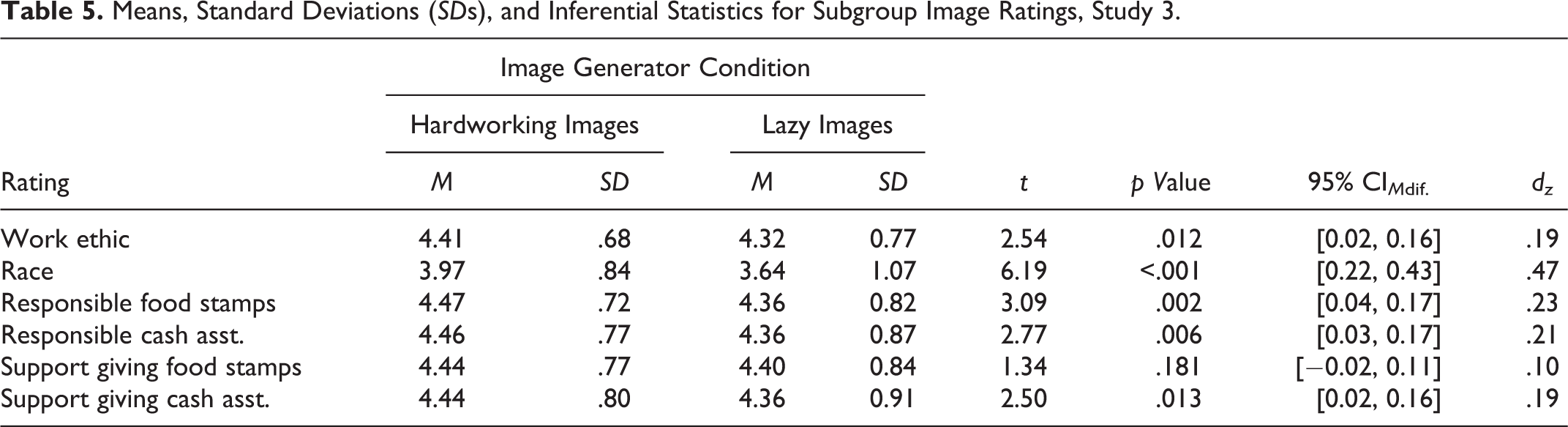
Overall, the results were consistent with our hypotheses. On average, participants thought the hardworking welfare images were more hardworking, more representative of White Americans, and more responsible with food stamps and cash assistance than the lazy welfare images. Inconsistent with our hypothesis, there was no difference in support for giving food stamps to the hardworking (vs. lazy) welfare images. Participants were, however, more supportive of giving cash assistance to hardworking (vs. lazy) welfare images. Further, in the Online Supplemental Material, we found a pattern of sequential mediation such that perceived race of the image informed perceptions of being hardworking which, in turn, informed support for giving welfare benefits. Together, these findings suggest that countering work ethic stereotypes of welfare recipients may provide a method to increase support for giving welfare benefits but may also shift the race of whom people are imagining will receive these benefits, a possibility previously unexamined. 7
General Discussion
Across three studies, we found evidence that work ethic stereotypes are particularly important when considering the relationship between recipients’ race and attitudes toward welfare. When the majority of welfare recipients were Black (vs. White), participants thought recipients were lazier, had more negative attitudes toward welfare programs, and reported less support for welfare policies (Study 1). Further, perceived laziness mediated the relationship between welfare demographics and attitudes toward welfare programs and policies, whereas perceived independence did not. Relatedly, when participants were told welfare recipients were hardworking (vs. no information), they had more positive attitudes toward welfare programs, even when the majority of recipients were Black (Study 2). In the absence of information about recipients’ race, however, when people imagine a hardworking (vs. lazy) welfare recipient, they tend to imagine a recipient who is more representative of White Americans (Study 3). Further, people with stronger system-justifying beliefs (for example) tend to imagine lazy welfare recipients are more representative of Black Americans, but this association is not present when people imagine hardworking welfare recipients (see Online Supplemental Material). This suggests that imagining a hardworking welfare recipient may lead to an overall shift in racialized mental representations of the welfare recipient regardless of participants’ individual attitudes. Such a shift in perceived race due to work ethic information conveys a problematic link that reinforces the social construction of race and racial stereotypes (Richeson & Sommers, 2016).
Previous work has suggested that Americans often envision welfare recipients to be Black people (Brown-Iannuzzi et al., 2017) and lazy (e.g., Gilens, 1995; Leiby, 1978) and that both visualizations predict reduced welfare support. This research extends upon previous findings by investigating the unique and interconnected role of work ethic stereotypes, race, and attitudes toward welfare policies and programs. Critically, we find that people support welfare less when it is perceived as benefiting Black versus White people and that this effect is driven by expectations that Black recipients are lazier, above and beyond beliefs about recipients’ ability to be independent (as emphasized in Cooley et al., 2019). Likewise, we also find that portraying welfare recipients as hardworking increases welfare support, even when recipients are mostly Black people. Such findings reinforce the integral link between work ethic stereotypes and welfare attitudes and suggest that shifting work ethic stereotypes may be an effective way to influence welfare support. However, less optimistically, we also find that interventions that portray welfare recipients as hardworking may inadvertently lead people to envision Whiter recipients—a process that may perpetuate existing racialized work ethic stereotypes in problematic ways. Together, this suggests that an approach which both highlights the hardworkingness of welfare recipients and provides demographics of recipients may be one way to mitigate opposition to welfare.
Conclusion
Stereotypes of lazy welfare recipients are often used to justify opposition to welfare, while sidestepping the overt discussion of race. Although providing information that recipients are hardworking may improve attitudes toward welfare, because work ethic is stereotypically associated with race, people may imagine hardworking recipients are more representative of White (vs. Black) Americans. This suggests a pernicious cycle whereby work ethic stereotypes shape both people’s attitudes toward welfare and their perceptions of who benefits from these policies.
Supplemental Material
Supplemental Material, Supplemental_Materials_11.16.2020 - Investigating the Interplay Between Race, Work Ethic Stereotypes, and Attitudes Toward Welfare Recipients and Policies
Supplemental Material, Supplemental_Materials_11.16.2020 for Investigating the Interplay Between Race, Work Ethic Stereotypes, and Attitudes Toward Welfare Recipients and Policies by Jazmin L. Brown-Iannuzzi, Erin Cooley, Christopher K. Marshburn, Stephanie E. McKee and Ryan F. Lei in Social Psychological and Personality Science
Footnotes
Declaration of Conflicting Interests
The author(s) declared no potential conflicts of interest with respect to the research, authorship, and/or publication of this article.
Funding
The author(s) received no financial support for the research, authorship, and/or publication of this article.

Supplemental Material
The supplemental material is available in the online version of the article.
Notes
References
Supplementary Material
Please find the following supplemental material available below.
For Open Access articles published under a Creative Commons License, all supplemental material carries the same license as the article it is associated with.
For non-Open Access articles published, all supplemental material carries a non-exclusive license, and permission requests for re-use of supplemental material or any part of supplemental material shall be sent directly to the copyright owner as specified in the copyright notice associated with the article.
