



Abstract
Although research on meetings generally regards them as noteworthy organizational events, studies tend to focus on an individual or group level of analysis, conceiving of meetings as a phenomenon that happens in organizations but does not shape them. Integrating research on work meetings, structuration theory, and organizational culture, this paper develops the concept of organizational meeting cultures and suggests structuration theory as a framework for explaining their emergence, reproduction, and alteration. We propose a model of organizational meeting culture that theorizes work meetings as a foundational activity that shapes and reifies organizational cultures over time, contributing to their distinctiveness, and influencing patterns of perception regarding what is valued, expected, rewarded, and supported in specific work environments. It concludes with an agenda to be pursued in future research on the structuration of meeting culture.
Plain Language Summary
Although research on meetings seems to assume they are an important element of organizational life, studies tend to focus on an individual or group level of analysis, which results in theories that only construe meetings as a group phenomenon that happens in organizations but does not constitute them. We propose a model of organizational meeting culture that portrays work meetings as a foundational activity that doesn't just happen to occur within “already organized organizations” but instead also shapes organizational cultures over time, influencing their distinctiveness, shared views of what is valued, expected, rewarded and supported in specific work environments. Integrating research on meetings, structuration theory, and organizational culture, this paper develops the concept of meeting culture and proposes structuration theory as a way to explain how meeting cultures emerge, are sustained, and changed. It concludes with suggestions for future research.
For decades, scholars of organizations, groups, and teams avoided studying meetings as a distinct phenomenon in their own right, theorizing their place in organizational life, and developing evidence-based approaches to improving practice (Schwartzman, 1989; Tracy & Dimock, 2004). However, scholarly interest has grown considerably in the last 20 years (Allen et al., 2018). Academic journals have produced special issues on the topic (e.g., this issue; Scott et al., 2011), and the first handbook on work meetings has been published (Allen et al., 2015).
The recent flurry of research on meetings has been overwhelmingly applied in focus, and the lack of robust organizational theory on the topic is a common lament (Allen et al., 2018; Scott et al., 2015). This is not to say that recent work has been atheoretical. Indeed, meetings research has employed a range of existing theoretical traditions, from sensemaking theory (Dunn et al., 2016) to conservation of resources theory (Luong & Rogelberg, 2005) to affective events theory (Rogelberg et al., 2010), to job-demands resources models (Lehmann-Willenbrock & Allen, 2018), and so on. However, none of these theories were intended to address meetings as a phenomenon that is closely tied to the organizational settings in which they occur.
Although much of the literature implicitly regards meetings as a common activity in organizations (e.g., Scott et al., 2015) related to their cultures or climates, studies of meetings typically stay at the group or individual level of analysis and stop short of examining interrelationships among group- and organization-level meeting patterns. Group level research and theorizing is certainly necessary. It has brought this literature forward in important ways and will no doubt continue to do so. But scholarship may also benefit from a view of meetings as something more than just one among many group processes contained within static “already organized organizations” (Axley, 1984; Hawes, 1974). We contend that meetings are a foundational type of work activity that constitutes organizational cultures over time, influencing their distinctiveness and shaping perceptions of what is valued, expected, rewarded, and supported across the organization (Cooren, 2007; Duffy & O’Rourke, 2015).
Scholars wishing to examine meetings from an organizational vantage point would also benefit from coherent frameworks explaining interdependencies among group and organization level meeting phenomena, including how distinctive patterns of meeting norms and behavior emerge and endure over time, wither away, or are purposefully abandoned. The lack of organizational theory on meetings (Scott et al., 2015) may be one reason such frameworks have yet to emerge in scholarship, a shortcoming this article seeks to address. One pathway scholars may take in addressing this gap is to focus on explaining within-organization similarities and between-organization differences in how group meetings are conducted and how these similarities and differences may change over time. Some recent scholarship has begun to address the distinctive ways meetings occur in some organizations and their relationship to organizational values and assumptions (Hansen & Allen, 2015). For example, the typical way a new idea is presented and the circumstances in which meetings are (or are not) viewed as necessary is likely to be far different in an advertising agency than in an engineering organization or an accounting firm. However, this work so far has stopped short of providing a robust theoretical framework for explaining how distinctive organization-level meeting patterns are developed, maintained, or transformed.
Contrasting disciplinary emphases on particular levels of analysis may also explain the paucity of organizational theory on meetings. Meeting researchers trained to examine organizations from a more psychological point of view are most likely to focus on micro-level meeting behaviors and processes (e.g., multi-tasking, psychological safety, decision making procedures). Meeting researchers trained to examine organizations from a more sociological perspective tend to focus on the relationship between meeting activity and more macro-oriented social patterns that also make up organizational and institutional life (e.g., organizational culture and climate, collective minding). Frameworks that examine micro and macro explanations in tandem are absent (Scott et al., 2015).
Organizational theories of meetings, then, should ideally reflect a more balanced approach that neglects neither the micro nor the macro, examining how micro phenomena enable and constrain macro phenomena and vice versa (Conrad & Haynes, 2001; Scott & Myers, 2010). A micro-oriented theory might posit that meeting cultures are produced in voluntaristic, “bottom up” fashion based on the assumption that what happens in group meetings is largely explained by the groups that hold them, an explanation that excludes the influence of organizational factors. Alternatively, at the other extreme, a macro-oriented approach would suggest that meeting cultures are developed and sustained in a primarily “top down” manner in which group-level meeting behavior results from the influence of the institutional or organizational structures, leadership practices of senior management, or cultural indoctrination. This explanation ignores the agency of individual employees, the impact of individual characteristics, and the capacity of employees to influence their work environments. Rather than pursuing either of these views to the exclusion of the other, a practice that appears to result in groups of scholars talking past one another, the framework proposed here uses the concept of organizational meeting culture and the theory of structuration to pursue a “both/and” approach in which micro and macro meeting processes mutually influence one another (Conrad & Haynes, 2001; Giddens, 1984).
Improved synthesis between theory and practice would also seem to result from this more integrative approach. The most cursory search of the literature reveals that practitioners have had much more to say about the concept of meeting culture than academic theorists. For example, popular press accounts of meeting effectiveness highlight as positive examples those organizations that have improved meetings by establishing ground rules about meeting design, facilitation, and participation intended to increase standardization and consistency (e.g., Tellis, 2020). Thus, efforts to use what is already known about meetings to improve everyday practice would be enhanced if our theories addressed them as an organizational phenomenon as many practitioners do. How do the norms that guide the conduct of meetings develop and endure over time? How do those norms reflect and sustain the organization's culture? How can they be changed? Practical, organization-level interventions intended to improve the effectiveness of meetings need to be informed by organizational theory. If firms wish to improve meetings across the organization, then interventions should be grounded in a realistic set of assumptions about the relationships between meetings, organizational structure, and organizational culture.
We propose an organizational theory of meetings that conceives of meetings as a work activity that powerfully shapes and reflects an organization's culture. The paper begins by establishing the concept of meeting culture and distinguishing it from meeting orientation. Next, it proposes structuration theory as an explanation for organizational meeting culture. Then, combining research and theory on meetings, structuration theory, organizational culture, and communication genre, it presents a structurational framework for explaining how organizational meeting cultures emerge, become reified and endure, or change over time. The paper concludes with theoretical propositions and an agenda to be pursued in future research on the structuration of meeting culture.
Meeting culture and meeting orientation
Although meeting culture has been intimated in a few different articles and books (e.g., Allen et al., 2015; Meinecke et al., 2020), the closest construct to the notion of meeting culture that has received empirical attention is meeting orientation. We assume that all organizations have meeting cultures, but not all organizations have meeting orientations, an index of an organization's policies, procedures, and practices that emphasize, promote, or lead to meetings (Hansen & Allen, 2015). Recent research found that an organization's meeting orientation is related to their teams’ meeting effectiveness as well as individual employee's job-related attitudes (e.g., intentions to quit and employee engagement) (Mroz et al., 2019).
Meeting orientation is composed of four facets: policy focus, rewards for meetings, strategic use of meetings, and overuse of meetings (Hansen & Allen, 2015). Organizations with a high meeting orientation implicitly or explicitly encourage employees to use group and team meetings as an important form of interaction and the overall work process. Likewise, organizations with low meeting orientation may hold fewer meetings. Meeting orientation, it should be noted, does not necessarily describe the quality of an organization's meetings.
Meeting orientation has been described as an outcome or a downstream indicator of an organization's overall culture. For example, Hansen and Allen (2015) discuss how an organizational culture that values storytelling may have a more salient meeting orientation. Based upon our assumptions, characteristics of the organizational culture combine with the norms within meetings to enact a meeting culture, which then potentially establishes a meeting orientation. However, the key message from the meeting orientation literature seems to be that all organizations have a meeting culture, which is potentially manifest in a meeting orientation (Mroz et al., 2019). Thus, this paper develops the idea of organizational meeting culture and proposes a structuration theory-based approach to explaining how organizational meeting cultures endure and evolve over time as well as how they reflect and reinforce the larger organizational cultures in which they operate.
Deliberate effort in building an orientation is what distinguishes meeting orientation from our postulation of meeting culture. That is, all organizations have an observable meeting culture, or the way meetings are done “around here,” as a facet of their overall organizational culture. That is true even as subunits (e.g., teams, divisions) may have variations upon the organizational-level meeting culture. In developing meeting culture as a concept, we follow Schall (1983) in defining organizational culture as: a relatively enduring, interdependent symbolic systems of values, beliefs, and assumptions evolving from and imperfectly shared by interacting organizational members that allows them to explain, coordinate, and evaluate behavior and to ascribe common meanings to stimuli encountered in the organizational context; these functions are accomplished through the mediation of implicit and explicit rules that act as cultural warrants. (p. 557)
Although this view of organizational culture attends to the importance of formal or informal rules that endure and can be more or less directly observed, a topic we address later in this paper, it also recognizes that culture is emergent and perishable. Thus, an organization's values, beliefs, and assumptions can only be maintained if they are continually reinforced through the communicative actions of its members (e.g., in meetings). For example, if an organization truly values employee empowerment and participative decision making, those values will be reflected to one degree or another in how meeting facilitators across the organization include or exclude members from meetings where decisions are made, how they elicit involvement in the group's deliberations, and the interactive processes they use to allow employees to influence decisions about their work (Barker et al., 1993).
They may vary in their strength and uniqueness, but meeting cultures are present at all organizations. But few organizations have a meeting orientation. Not all organizations are deliberate in their attempts to establish meeting policies, procedures, and practices. Thus, organizations that work on their meeting culture likely develop a meeting orientation, whereas those that do little or nothing to strategically shape or reinforce their organizational meeting environment, instead allowing their meeting culture to develop organically over time, likely do not establish a meeting orientation.
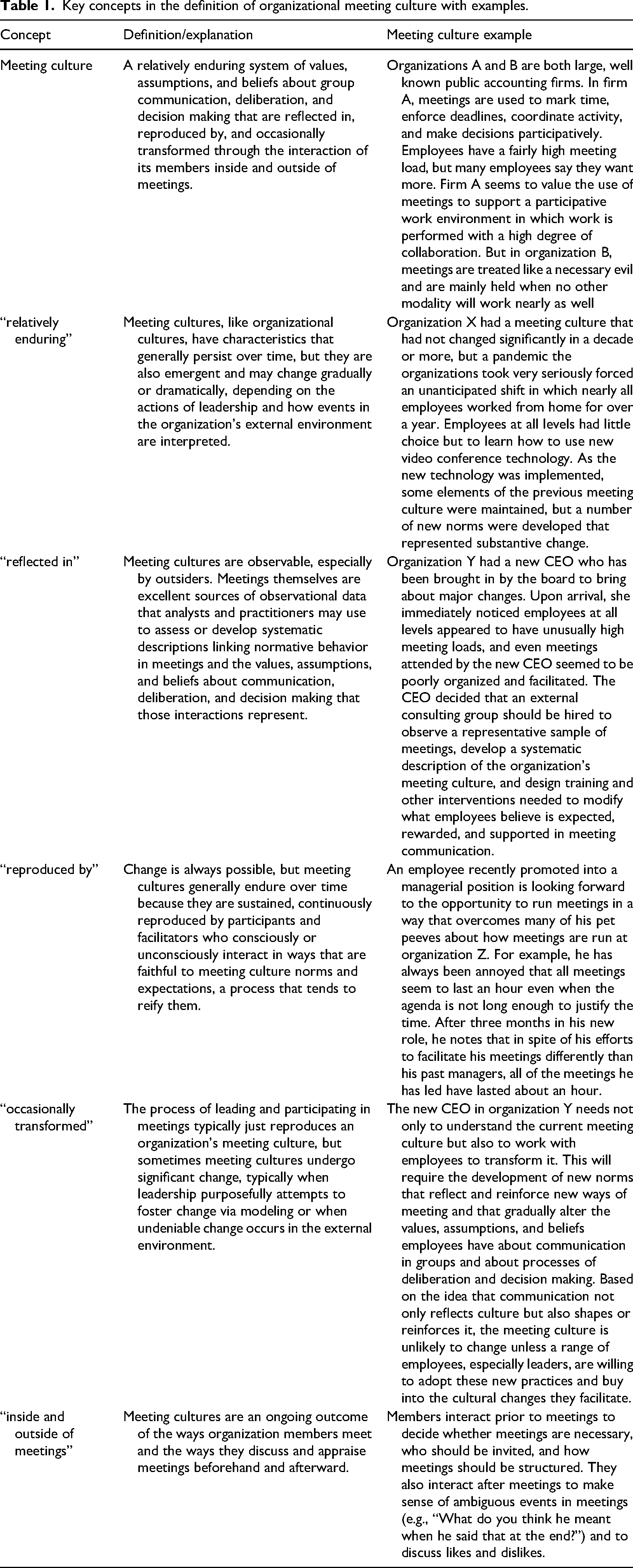
Thus, in the context of the current theoretical framing, meeting culture is the organizational-level construct related to how meetings are done in any given organization. Incorporating the distinctions we describe above along with key elements of Schall’s (1983) definition of organizational culture, we define meeting culture as a relatively enduring system of values, assumptions, and beliefs about group communication, deliberation, and decision making that are reflected in, reproduced by, and occasionally transformed through the interaction of its members inside and outside of meetings. Meeting cultures enable and constrain how members interpret, evaluate, coordinate, explain, and develop shared meanings for what occurs in meetings through the use of implicit and explicit rules that apply to specific meeting genres (e.g., the staff meeting, the decision-making meeting, etc.). In doing so, meeting cultures mediate the relationship between groups and teams within organizational subunits and the larger organizational cultures in which they operate. For more details and examples of the subconcepts within this definition, please see Table 1.
Key concepts in the definition of organizational meeting culture with examples.
Meeting orientation, in contrast, is likely the attempt by organizational leaders and followers to introduce structure overtly into the meeting environment by prescribing, modeling, and providing feedback on what meeting practices and design characteristics are expected, rewarded, and supported. Meeting structuration then becomes both naturally occurring and emerging (i.e., meeting culture) as well as intentionally contrived and created (i.e., meeting orientation).
Meeting culture and structuration theory
Structuration theory assumes a mutual relationship between micro- and macro-level behavior and the reproduction or occasional transformation of social systems (e.g., organizational cultures, institutions). Giddens (1984) proposed a broad but complex explanatory framework that suggests micro and macro phenomena not be understood, as most social science suggests, in conceptual isolation (either/or) but rather in ongoing, mutually influential loci of control. Rather than suggesting that phenomena of interest are mainly influenced by micro factors (individual differences, behavioral choices that occur in dyads and groups) or macro factors (national culture, societal norms, organizational structure, organizational culture, economic trends), the metatheory of structuration is an attempt to explain how macro and micro factors influence one another simultaneously. Macro phenomena operate the way they do because they are enabled and constrained by micro phenomena, and micro phenomena unfold in ways that reflect and reproduce macro forces. Structurational approaches have become mainstream in fields such as management information systems, organizational communication, sociology, and organizational studies that emphasize explanations stemming from relations between social actors as well as between group, organizational, and institutional levels of analysis (McPhee et al., 2014).
Meeting culture as medium and outcome of communicative action
When applied to meeting communication, structuration theory suggests a dual relationship between meeting culture and organizational culture. That is, meeting phenomena should be considered both an enabling socio-symbolic resource for (medium) and a consequence (outcome) of organizational culture activity more broadly, much as meeting outcomes can be considered both a cause and outcome of meeting processes (Canary & Cantú, 2012; Schwartzman, 1989; Scott et al., 2015; Tracy & Dimock, 2004). We suggest a shift away from the common representational view of meeting activity as merely reflecting (but not influencing) an organization's culture toward the assumption that a recursive relationship exists between meetings and organizational cultures such that the cultural activity of meetings also plays an important role in producing, reproducing, and occasionally altering the organization's culture (Riley, 1983; Scott et al., 2015, pp. 31–33). It is through this process that organizational meeting cultures develop, are reproduced, or are altered.
As other structuration theorists have noted (Eckensberger, 1995; Overton, 1994), the famous lithograph “Drawing Hands” by Dutch artist M.C. Escher illustrates the symbiotic, mutually constitutive relationship assumed to exist between social action and organizational structures, between micro and macro phenomena, and, in this case, between meetings and organizational culture. The artist's image is that of two hands, each holding a pencil and each at work attempting to complete a drawing of the other hand. One might think it reasonable to focus on the enabling or causal impact of the left hand on the right hand or the right hand on the left hand. The problem is that the influence of each hand cannot be separated from the other because each hand is still in process or under construction while simultaneously shaping the other. Similarly, we might say that meeting communication typically reflects the culture or subculture of an organization. Organizations with cultures higher in formality probably tend to have meetings that are also higher in formality, for example. At the same time, the culture of the organization is not static but instead produces ongoing adaptations to external change over time (Smirchic & Calas, 1987). This is driven by the ritualistic communication processes that occur in meetings at various levels as participants attempt to select and retain interpretations of an enacted environment in relation to shared cultural values (Battles et al., 2006; Goretzki & Messner, 2016; Schwartzman, 1989). The organization high in formality will reify this value to the extent that its meetings reinforce it through communication practices that emphasize power distance, hierarchy, and bureaucratic impersonality or potentially modify this value through communication practices that emphasize the opposite (Morand, 1995). Meeting communication, then, not only reflects aspects of an organization's culture but also either reproduces the values and norms of the culture or serves to modify them. Consistent with this approach, the metatheory of structuration has been particularly useful in addressing the relationships among interaction or communication at different levels of analysis in the study of organizations (Poole & McPhee, 2005), making it especially appropriate for research seeking to examine interrelationships among meetings and the organizational cultures within which they occur (Witmer, 1997).
Although most research on work meetings generally conceptualizes meetings as a group level phenomenon with individual level socio-psychological antecedents and outcomes (e.g., Allen & Rogelberg, 2013), we suggest that there is also added value in supplementing this more micro-oriented view of meetings with a macro-oriented perspective that acknowledges meetings are also a collective organizational activity, one that shapes and is shaped by the organization's meeting culture.
Structuration theorists who study organizations often express this same idea with the claim that organizational structures (e.g., meeting cultures) are both “medium and outcome” of communicative action (e.g., Scott & Myers, 2010), a phrase that is grounded in at least two key principles and related analytic frames. First, if the action-oriented behavioral content of meetings is an outcome of the structure of meeting culture, this suggests that the values, norms, and artifacts of organizational meeting cultures are reflected in the communicative content of meetings (meeting culture → meeting content). That makes the micro-level utterances, nonverbal cues, and verbal content of meetings an important source of empirical insight into what is and is not normative in a given meeting culture. However, since organizational and meeting cultures are emergent, perishable, and always to some degree in flux, a focus on meeting content as an outcome of meeting culture does not tell the analyst how a given meeting culture was developed or is maintained, or how it could be changed, which limits the potential to use this analytic frame in interventions to make meetings more effective.
Given the shared interest among scholars and practitioners in improving meeting practice, a second and arguably more important principle is that the values, norms, and artifacts of a meeting culture are not merely represented or reflected in meeting communication. Rather, they are shaped by it (meeting content → meeting culture). In this analytic frame, the locus of control for meeting culture as an organizational structure is the behavioral action of meeting participants and facilitators, meaning that meeting communication is the medium through which meeting cultures and larger organizational cultures are developed, maintained, and transformed. Meeting communication here is not merely the observable surface of meeting culture but also the site through which desired characteristics are maintained, undesired elements are mitigated, and the culture of an organization is sustained or altered (Cooren, 2007). Whether improvisational or purposeful, our choices about how we communicate in meetings reproduce or modify the culture in ways that are more or less observable. Members consciously and unconsciously draw upon their subjective experiences with the norms and practices that comprise their organization's meeting cultures as they do the work of meeting, and in doing so, reproduce or potentially modify meeting cultures and relevant elements of organizational cultures. Importantly, this frame suggests organizations can employ leadership modeling, the development and tracking of meeting best practices, and training programs about meeting communication to not just influence the meeting culture but the general organizational culture more broadly.
In structuration theory, organizational structure is defined much more expansively than the relatively narrow idea of organizational structure that one would glean from an organizational chart or diagram depicting how the divisions of an organization are arranged or who reports to whom. Instead, some structures can be understood as virtual properties of social systems (e.g., organizational meeting cultures), meaning they only exist as “memory traces” employees have developed during interactions within those systems. As Scott & Myers (2010) suggest, structures are: [p]roduced and reproduced through human symbolic activity. Structures guide social interaction by enabling and constraining behavior. Structures are best thought of as formal and informal rules, symbolic resources, and sets of transformational relations found in ongoing social interactions and practices … (p. 81)
Thus, we propose that meeting cultures are an emergent macro organizational structure that is not only reflected in the communicative micro action that comprises meetings (e.g., message content, length, and types of utterances, interactive group processes) but is also produced and reproduced through that very action as members participate in meetings.
Balancing action and structure: the impetus of structuration theory
A primary goal of structuration theory is to give roughly equal weight to action and structure as explanatory factors in the production, reproduction, and alteration of social structures. The purpose of this theoretical balancing act is to avoid the extremes of voluntarism and determinism (Conrad, 2004; Scott & Myers, 2010). Overemphasizing action to the exclusion of structure would result in excessively voluntaristic explanatory frameworks that fail to account for macro structures that enable and constrain action. For example, suggesting that patterns of interaction in meetings are mainly or exclusively the product of the behavioral choices of the groups that hold them or the individuals who participate in them would, in a fairly voluntaristic way, gloss over the role of top-down macro processes like organizational politics and the societal, institutional, and organizational norms that no doubt shape (and are simultaneously sustained by) micro-level behavioral choices of individual meeting participants (Riley, 1983). Individuals and groups decide what they will and will not talk about in meetings and how they will do so, but those micro-level choices are of course influenced by the established norms actors perceive in the work environment. People do have freedom to make micro-level choices about how to behave in meetings, but they cannot choose the macro-level circumstances in which they do so (Giddens, 1984). An employee may choose to correct a factual error in a statement made by their supervisor in an important team meeting, but that choice is made with an understanding of cultural (national, organizational) norms about superior-subordinate interaction, social status, and the degree to which maintaining face is prioritized.
Overemphasizing macro structural features of organizational life to the exclusion of the micro interactive processes through which they are sustained, on the other hand, runs the opposite risk of overly deterministic explanations in which meeting participants are mere “cultural dopes” without the agency to choose otherwise (Winchester & Bailey, 2012). The tongue-biting meeting participant who chooses not to correct their supervisor is indeed making a relatively knowledgeable choice and could have decided otherwise, something meeting theory should not overlook in spite of the undeniable influence of structural norms and organizational culture.
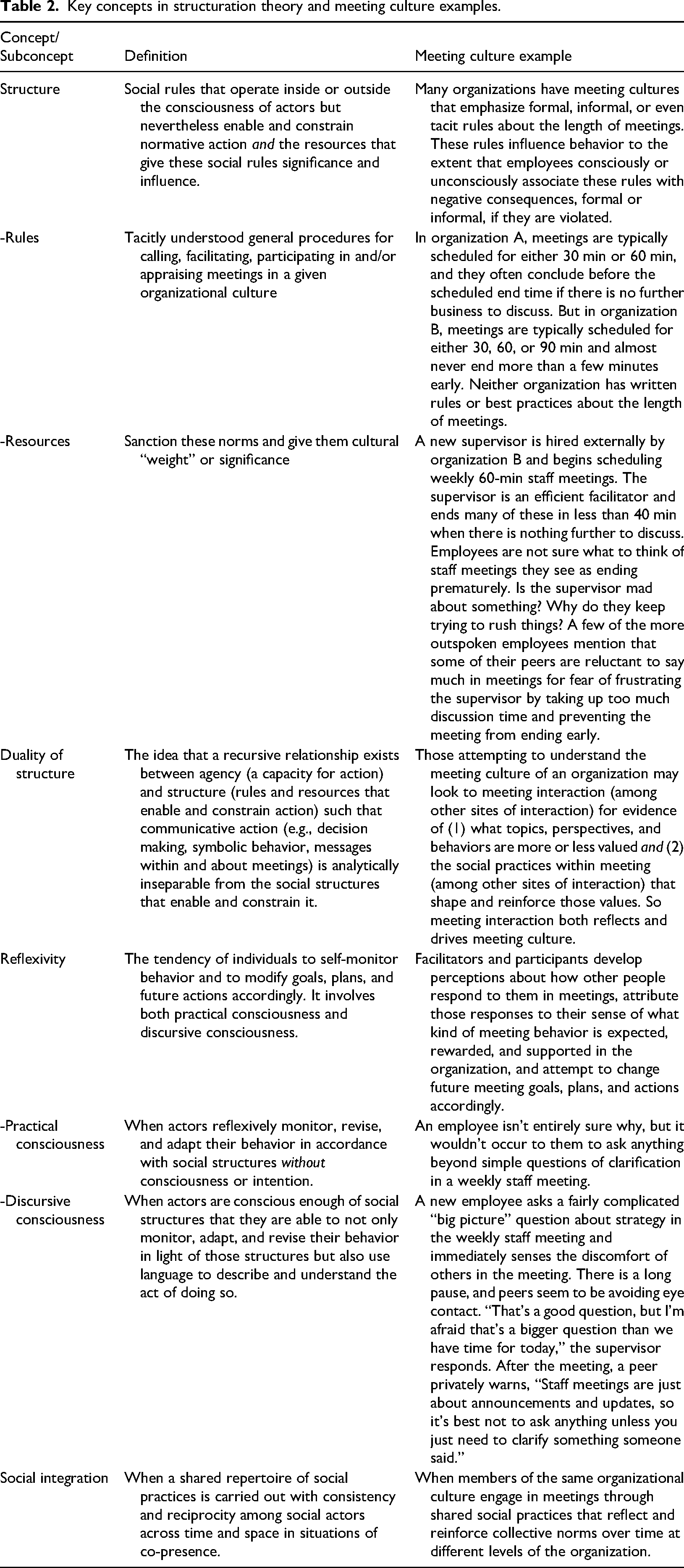
This tricky balancing act unique to structuration theory is enabled by a series of concepts we describe next that index a coherent set of assumptions related to social structure, agency, social integration, and interaction that explain how social action in a given setting (e.g., organizational meetings) reflects, reproduces, and occasionally alters the social norms of that setting over time. See Table 2 for conceptual definitions and examples.
Key concepts in structuration theory and meeting culture examples.
Components of structuration theory
Structuration is defined as “the production and reproduction of a social system in interaction,” the process through which structures are created, recreated, and occasionally transformed over time (McPhee et al., 2014, p. 76). If organizational cultures are macro systems of interconnected structures of meaning, then structurational approaches to organizational culture explain how these structures are reflected, reproduced, and occasionally transformed through symbolic action inherent to communication activity (e.g., meeting communication) (Riley, 1983). Structuration research does so with frameworks that balance social action and social structure as explanatory factors (Conrad & Haynes, 2001).
Structure
In structuration theory, structure is “medium and outcome of the reproduction of social practices” (Giddens, 1979, p. 66), meaning that structure is sustained or modified by the very social practices it shapes. We define the structures of meeting culture as obtrusive and unobtrusive social rules that operate inside or outside the consciousness of actors and enable normative communicative action in meetings (Ford et al., 2021; Nicotera & Clinkscales, 2010). Structure may either enable or constrain the actions people take in organizations. Structuration research sometimes refers to formal (tangible) structure, such as organizational charts, rules, and standard operating procedures (McPhee, 1985). In the meeting context, a shared meeting agenda specifying what topics are to be discussed is a classic example of formal structure. But structure may also include “virtual” phenomena of interaction only observable in the social practices and “memory traces” of social actors (Giddens, 1979, p. 17). For example, people in the same organization may develop a similar sense of what it means to be late or on time to a meeting even though there may be no formal rules about meeting punctuality. Whether formal or virtual, structures both influence and are sustained or modified by the people's actions and behaviors, as they become sources of human cognition whether or not actors are completely aware of them (Giddens, 1984).
Rules and resources
In structuration theory, structure (e.g., meeting culture) is composed of sets of rules and resources. The formal or informal rules that shape social action are influential to the extent that sociological resources exist to enable them. Rules do not matter much if there are no formal and informal resources for sanctioning them and making them meaningful. In the context of meeting culture and following Giddens (1984), we define rules as tacitly understood general procedures for calling, facilitating, participating in, and appraising meetings in a given organizational culture. For example, a meeting organizer would need to have an unusually good reason to hold a meeting that lasts longer than an hour or 30 min or 90 min, depending on the temporal aspects of a given organizational culture. Similarly, Canary and Cantú’s (2012) study of independent educational plan meetings between teachers and parents of students with unique educational needs similarly concluded that the meeting norms of the teachers facilitating these discussions diminished the potential influence of parents, including their ability to make persuasive claims related to their observations of their child in his or her family system. The authors note that the implicit and explicit meeting norms teachers followed appeared to be regarded as difficult or impossible for parents to question or resist because of the ways in which teachers used meeting communication to sanction these rules: for example, deploying the role of knowledgeable professional and invoking legitimizing institutional structures.
Thus, we define resources as those cultural properties and behaviors that sanction these norms by making them authoritative, meaningful, and impactful by giving them normative “weight” or significance. This means that members generally recognize with varying degrees of consciousness that expectations around a particular meeting behavior are widely shared and should be met if one wishes to be viewed as a credible member of the culture. Although organizational psychology often attends to the issue of resources by considering the ways in which individuals’ efforts to conserve quantifiable resources (e.g., effort, time) may explain their behavior and its outcomes (Hobfoll, 2001; Rogelberg et al., 2014), structuration theory defines resources in very different, less linear terms. Here, resources are more symbolic, less finite, less quantifiable, and exist at the organizational rather than individual level.
To say that resources are symbolic is to suggest that they are interpreted and have meanings that reflect the values and interactive norms of a particular setting (Blumer, 1969). Attention to and compliance with the rules symbolizes adherence to cultural norms and their underlying values (Schall, 1983). Symbolic resources exist within the culture to sanction these rules and informal consequences for failing to comply with their spirit. Consider the new chair of the large academic department at a well-established state university who decides that the way her department holds its meetings needs to change and chooses not to request suggestions for agenda items or to distribute an agenda at all, violating a longstanding department norm (rule). Violation of normative expectations and historical precedent and a value for shared governance are among the main reasons at least some of her colleagues may object. These objections will be given additional weight by a department bylaw that specifies agendas for such meetings, one that is echoed by the bylaws of the college in which it is embedded (resources). Similarly, if a chair violated a long held expectation that department faculty meetings be scheduled at a time when full time faculty are not teaching (rule), similar objections would likely result whether this is specified in bylaws or not because it violates the norm that all full time faculty members have the opportunity to prepare for and participate in governance activity (resource). In either case, the complaints of objectors will be persuasive to the extent that they reference (and as a result, reify) established norms and espoused values.
Duality of structure
When defined this way, social actors are never fully in control of the structures that enable and constrain action (e.g., meeting culture), but they are never fully controlled by those structures either. Meeting participants, for example, are not “cultural dopes” who mindlessly behave in accordance with structures that they lack awareness of, but neither are they completely knowledgeable of the ways in which their actions reflect, sustain, or conflict with the structural systems in which they are embedded. This particular understanding of the relationship between agency and structure is commonly referred to as the duality of structure, the idea that a recursive relationship exists between agency (a capacity for action) and structure (rules and resources that enable and constrain) such that communicative action (e.g., decision making, symbolic behavior, messages within and about meetings) is analytically inseparable from the social structures that enable and constrain it (Giddens, 1984). In the context of meeting culture, this means that individual and collective behavior in and about meetings both reflects and typically reifies the structures of meeting culture that enable it. As Banks and Riley (1993) note, structurational analysis tends to suggest that “there is a lot of ‘what has come before’ in present actions” (p. 186). Indeed, the repertoire of culturally acceptable meeting behavior that has developed over time functions as a kind of template that shapes meeting interaction (Yates & Orlikowski, 1992). Nevertheless, the structures of meeting culture are not static but emergent, revisable, resistable, and always in process. So the structures that comprise meeting culture are either sustained by meeting communication processes or altered by it. Thus, meeting communication behavior has consequences for meeting culture, regardless of the awareness or intent of members who enact it.
Social integration
From this social practice perspective (Gherardi, 2000; Lave, 1988), organizations are not “given” or objective entities unrelated to our communication about them but are instead constituted and reified over time through the context-based social practices (e.g., how people communicate in meetings about particular topics, in the presence of specific members, within particular situations and historical moments) that produce the kind of social integration in organizational life needed for unified action (McPhee & Zaug, 2000; Taylor & Van Every, 1999). Giddens (1984) defined social integration as “the reciprocity of practices between agents in circumstances of copresence, understood as continuities in and disjunctions of encounters” (p. 376). When meeting participants recognize the normative rules for participating in a particular type of meeting and reciprocate by attending to the same or similar rules (e.g., only asking questions of clarification in a weekly staff meeting), the significance and relevance of the rules is sustained along with a relatively shared expectation that people follow them, which allows for the kind of unity of action often associated with organizational cultures.
Knowledgeability and reflexivity
When applied to organizations, structuration theory suggests that communication practices (e.g., meetings, memos, watercooler talk, proposals, email correspondence, interviews, presentations, etc.) are dynamic drivers of organization rather than merely a secondary reflection of values, attitudes, and beliefs of collections of individuals. But with what degrees of awareness, knowledgeability, and intention do employees engage with these normative practices and the rules they entail?
Structuration theory suggests that individuals draw upon, sustain, or modify the normative structures of a given setting with varying degrees of consciousness and intention. Giddens (1984) distinguished between discursive consciousness and practical consciousness. In discursive consciousness, agents reflexively monitor social action in various settings and apply shared social knowledge they have acquired through past experiences, including encounters with explicit norms, such as when newcomers are told by peers they should not be afraid to ask questions during team meetings. Here, employees are engaging with normative structures intentionally and with a degree of knowledgeability that allows them to articulate the rules for others. Alternatively, in other situations, social actors comply with the normative structures of a given setting in a manner that is less conscious, less intentional, and more habitual, what Giddens (1984) called practical consciousness. Just as many employees drive from work to their homes at the end of the day “on autopilot” without having to consciously focus or reflect on the navigational decisions they are making, meeting participants may comply with the written and unwritten rules of a given type of meeting purely out of habit. This lower level of consciousness and knowledgeability may mean that actors are unable to articulate these rules for others unless they are explicitly broken. For example, an employee may raise their hand to indicate a desire to speak in a meeting purely out of habit rather than conscious choice. Participants may not be aware of this interactive norm until it is violated.
Meeting genres and structuration of organizational meeting culture
One useful framework for explaining continuity and change in communication norms that is popular among scholars in organizational behavior, organizational communication, and organization studies is genre theory (Orlikowski & Yates, 1994). That framework is based in part on the idea that episodic workplace interactions are shaped in part by employees’ understandings of how a particular genre of organizational communication (e.g., a pitch meeting, a performance evaluation, a job interview, an email, etc.) is normally performed in the interaction that reflects and reproduces an organization's culture (Yates & Orlikowski, 2002). They define genre as “typified communicative action invoked in response to a recurrent situation” (p. 301). Communication that responds to a recurring situation and comprises a genre type tends to take on similar substance and form, where substance includes “the social motives, themes and topics being expressed” (e.g., acceptable rationales and purposes for meeting, acceptable topics of discussion) and form refers to the observable physical and linguistic features of the communication (e.g., verbal and nonverbal communication, language used to frame problems and solutions) (Yates & Orlikowski, 1992, p. 301). This theory is relevant to our task because (1) it is grounded in assumptions held in common with structuration theory (Yates & Orlikowski, 1992), (2) it moves beyond representational models to conceive of communication as constitutive of organizations (Orlikowski & Yates, 1994), (3) its proponents often point to meetings as a prototypical example of organizational genre (Yates & Orlikowski, 1992), and (4) the theory shares our assumption that meetings are a group activity that responds to “socially defined demand for … interaction underlying organizational culture” (p. 301).
Scholars have often related the idea of culture to an organization's distinctiveness. As Pacanowsky and O’Donnell-Trujillo (1983) put it, “Each organization has its own way of doing what it does and its own way of talking about what it is doing” (p. 128). The content and enactment of meeting genres varies from organization to organization, functions as a source of cultural distinctiveness, and thus is among those communication processes that reflect and reproduce organizational cultures. From this perspective, “Meetings are more than just meetings. They carry important aspects of organizational culture” (Morgan, 2006, pp. 141–142). Genre theory provides a framework for understanding how specific meeting types emerge in organizations and become associated with rules that are culturally significant and distinctive but often unwritten and unspoken.
The concept of genre allows us to consider in more specific terms the “what” and the “how” of organizational meeting culture. For example, consider Yates & Orlikowski’s (1992) description of work meetings as one example of a genre of organizational communication: To illustrate, consider the meeting genre. Individuals invoke this genre in response to a recurrent organizational situation, defined generally by the set of organized group practices emerging from the socially defined demand for face-to-face interaction underlying contemporary organizational culture. In staging and participating in the meeting, participants draw on the characteristic features that constitute meetings: substance, defined generally as the participants’ joint execution of assigned tasks and responsibilities, and form, including prearrangement of time and place, the face-to-face medium within which the meeting is typically executed, and structuring devices such as an agenda and the chairperson's role. (p. 302)
Although Yates and Orlikowski never fully develop the idea of meeting genre repertoire, they clearly position work meetings both as a group phenomenon and as a cultural product of the ways in which employees enact the repertoire of communication behavior they believe is valued and accepted in their work environment.
We propose that different types of meetings (e.g., debriefs, staff meetings, decision making meetings, etc.) commonly held in an organization comprise distinct genres of meeting communication. Consistent with the approach to structure espoused in structuration theory, meeting cultures in general and meeting genres specifically are comprised of largely unspoken and unwritten rules and the symbolic resources that sanction their normative significance (Schall, 1983; Witmer, 1997). These rules regard the circumstances in which types of meetings should be used normatively in the culture of an organization and the specific ways in which meeting participation and facilitation should be enacted in accordance with an organization's identity and values (Yates & Orlikowski, 2002). For example, in some organizations, meetings may be understood as post hoc forums for sharing, rationalizing, and celebrating ideas mainly developed by a smaller number of individuals in another setting (Cohen et al., 1972). In others, meetings may also be employed as vehicles for not just sharing and celebrating ideas but also developing, questioning, and refining them (Deetz, 1994).
In contrast with the focus on individual motives, group processes, and an individual level of analysis that pervades much of the literature on meetings, genre as a concept focuses on socially constructed, collective purposes for communicating in typical situations faced by an organizational community (Yates & Orlikowski, 2002). Once established in an organization's culture, genre “serves as an institutionalized template for social interaction,” one that shapes the ongoing communication of members through their use of it across time and space (p. 15). In some situations, members may draw upon genre tacitly out of habit (e.g., using what has become a standard agenda for Monday morning staff meetings). In other episodes, people may employ genre norms more deliberately (e.g., a leader recognizes the need for brainstorming in a meeting and facilitates a particular brainstorming exercise because it is popular with the group).
The repertoire of a genre (e.g., meetings) includes the acceptable purposes, means, processes, and behaviors from which individuals may choose as they propose, design, facilitate, participate, and interpret meetings in a given organizational culture. Genre includes expectations about how a particular form of communication (e.g., work meetings) should be normatively executed. Following Yates & Orlikowski (2002), these expectations can be understood in terms of why, what, who, how, when, and where.
The question of why considers the recognized purpose of using a genre. For what purposes do we have meetings in this culture? How do those purposes vary from meeting genre to meeting genre? The question of what concerns the content of the genre. What are acceptable topics of conversation to focus on in a meeting around here? How does the acceptability of topics vary from meeting genre to meeting genre? The question of who regards expectations about which participants are expected to be involved in a particular enactment of genre. Who can call a meeting? Who can instigate particular types of meetings? What people from which organizational levels and subunits can they typically invite? Who may reasonably decline a meeting invitation, and in what situations? Of critical importance is the how question, which is about the form genre enactment may take. This includes expectations about, for example, what counts as natural, normal, and “good” meeting design characteristics for particular meeting genres as well as choices around technology use and the language used to frame key concepts, ideas, and processes. The question of when considers the temporal expectations associated with a genre in a culture. When do members expect meetings or types of meetings to be held and not held? How and to what extent should meetings be used to punctuate the flow of work by, for example, providing deadlines for project milestones? Finally, the question of where regards the setting in which certain genres of meetings should be held and in what situations. Should performance review meetings always take place in a private office? Are there types of meetings that should always be held in a face-to-face setting versus an electronic meeting platform?
Genre theory also allows sufficient conceptual dimension to accommodate the idea that genres may also consist of subgenres (Rowland & Jerome, 2004), specific subtypes of organizational communication that are typified in a given organizational culture. Consistent with the idea that there are different types of work meetings held for different purposes (Allen et al., 2014), research indicates that sets of characteristics common to a genre are more or less likely to be found together within a subgenre on the basis of contextual factors related to the type of problems the communication is intended to address as well as situational characteristics of the organization and its environment (e.g., information sharing in staff meetings, vs. decision making in problem solving meetings).
Key propositions
Based on the theoretical assumptions and concepts outlined above, we turn to a series of theoretical propositions illustrating the central conceptual relationships of the framework we propose for explaining how meeting cultures develop and endure. Following Cornelissen’s (2017) suggestion, the following propositions are purposefully broad in scope and intended to reflect the assumptions and line of argument developed above. Just as a theory is not a hypothesis, these propositions are purposefully conceived at a higher level of abstraction than variable analytic hypotheses. Although some of these propositions are potentially testable as hypotheses in the traditional hypothetico-deductive sense if articulated in much more specific terms, we present them mainly as conceptual relationships based on the integration of theoretical assumptions that, like much in the realm of organizational culture and structuration, cannot be verified empirically but are generally accepted in prior research and intended to spur further research and theoretical speculation (McPhee et al., 2014; Smirchic & Calas, 1987). For propositions that cannot be verified with testing of specific variable analytic hypotheses because the phenomenon of interest does not lend itself to quantification or experimentation, research that employs systematic description, analytic induction and abduction, and theoretical sampling with qualitative data will be needed to fill the gap. A number of the following propositions include constructs from genre theory to develop the concept of meeting culture. Although research with an explicit focus on genre repertoires in meeting culture has yet to be conducted, we employ the concept in our model of organizational meeting culture for purposes of prospective conjecture (Hallier & Forbes, 2004) and as a means of linking theoretical concepts and propositions.
Meeting genres develop within specific socio-historical contexts and are reified over time as they are enacted credibly in recurrent meeting situations by members who have been socialized into organizational cultures.
As with organizational cultures (Smirchic & Calas, 1987), meeting genres emerge and take form not in a vacuum but in relation to a particular surrounding cultural context. Although they may endure for reasons related to different cultural moments and context, the established norms that comprise meeting cultures originally develop as a result of the actions of founders and other influential members and in response to both local and institutional conditions (Yates, 1989a, 1989b). For example, Schwartzman (1989) and later Van Vree (1999) discussed how meetings emerge as part of the socio-historical context within which they occur. Schwartzman discussed the idea from an anthropological perspective, demonstrating with observational data how tribes in various cultures developed norms concerning who arrived to meetings and when, with the most important individuals often arriving later and later, signifying their importance. Van Vree took a perspective on meetings focused more on civilization and the origins of modern government, demonstrating that the emergence of Robert's Rules of Order was an outgrowth of an expanding need to organize the disorganized argumentation within government meeting processes. In both examples, early socio-historical factors exert a long term influence on meeting genres.
Meeting cultures are institutionalized structures of organizations that are reproduced through meeting communication processes when employees draw upon genre rules more or less persuasively in the process of enacting meetings.
As organizational cultures develop over time in relation to shifting environmental and institutional conditions, members become indoctrinated to genre rules, the repertoire of communication practices befitting a genre through socialization and meeting participation processes that indicate seemingly natural, normal, and good ways of calling meetings, participating in them, and evaluating their efficacy. With varying degrees of knowledgeability, members act upon what they have learned about the use of genre rules as they instigate and participate in their own meetings. Assuming they do so in ways that are deemed culturally appropriate, the ongoing enactment of meeting subtypes and associated behaviors reifies meeting genre rules, bolstering their significance and expectedness as well as the social costs of violating them (Witmer, 1997).
The structures of meeting culture both shape and are sustained by the communicative choices meeting participants make as organizational actors who either draw upon and reify, modify, or violate genre rules as they carry out meetings.
Rather than conceiving of meeting cultures as static or fixed, we see meeting cultures as fluid, emergent, perishable, and continuously reaccomplished through the behavioral choices meeting participants make. How members choose to meet in response to recurrent situations and problems either reinforces existing meeting genre rules or changes them by introducing and normalizing new variations of their substance and form. This is not only in line with structuration theory, which conceives of social structure as emergent and ongoing (Barley & Tolbert, 1997; Witmer, 1997) but also with descriptive approaches to organizational culture that see the cultural elements as emerging from formal and informal symbolic phenomena (e.g., mission statements, rituals and ceremonies, meetings, gossip, organizational heroes and villains). For example, Witmer's structurational analysis of Alcoholics Anonymous meetings demonstrated how local meeting groups interacted in ways that often reflected organizational norms and values while also sustaining them when groups and individuals engaged in authentic local performances of sobriety in the course of their meetings.
Meetings are disembedding mechanisms through which features of the surrounding organizational culture (e.g., meeting genre norms) are disembedded and appropriated faithfully or ironically at the group level.
Work meetings typically happen within organizational subgroups that may have their own group cultures that, to one degree or another, overlap with the broader organizational culture. When groups get together, their meetings function as disembedding mechanisms to the extent that members appropriate (often reproducing, sometimes changing) normative elements of the organization's culture in group level meeting interactions. For example, Witmer’s (1997) study of Alcoholics Anonymous meetings demonstrated how group meeting norms included rituals that drew upon and sustained features of that organization's cultural value system. When genre rules are observed and reflected in the social action (i.e., behavioral choices, content, and form of communication) that occurs in meetings, an organization's cultural norms about what communication behavior is more or less valued are reinforced.
When employees appropriate meeting genre rules faithfully without alteration, they sustain an organization’s meeting culture by reinforcing existing structures.
As structuration theory suggests, members may draw upon existing structures in interactions in ways that are either faithful, consistent with the original intentions behind the structure, or ironic, intentionally or unintentionally at odds with structural intention (Poole & Desanctis, 1992). For example, a leader may encourage a group to use a particular decision-making procedure by highlighting its traditional use in the organization historically and its track record of being used to make decisions regarded as successful. The rationale may be genuine, or it may serve the leader's interests by increasing the likelihood that the group will make the decision they prefer. And both could be true at the same time. Although faithful appropriation of structure may be more effective in reifying an organization's meeting culture regardless of whether this was the leader's intention, ironic appropriation may also produce similar results.
When employees consistently alter genre rules slightly to meet novel conditions and situations but do not depart significantly from their original substance, they are elaborating existing genre rules.
Organizational meeting culture may also be sustained in times of change and transition, such as when environmental conditions or when groups face unusual situations. Rather than reproducing the structures of meeting culture, groups may intentionally or unintentionally alter existing genre rules through elaboration (Yates & Orlikowski, 1992). The impact of such micro level elaboration on the macro structures of meeting culture may not be significant or long lasting unless a group employs the elaborated structures somewhat consistently in similar circumstances over time and unless other groups in the same culture do the same. Elaboration is possible because as institutional, technological, or cultural shifts in the organizational environment occur, the symbolic resources that sustain genre rules become less influential or relevant, enabling rule violations. For example, groups in many organizations resisted the regular use of teleconferencing applications like Zoom and Webex until the COVID-19 pandemic arrived in 2020, producing circumstances that required alternate meeting platforms if organizations were to continue functioning. New norms regarding the degree to which colocation was required for authentic meetings developed, and existing genre rules were modified in ways that elaborated meeting cultures more or less faithfully. The format of many meetings changed, but the underlying values and norms of meeting cultures were not altered dramatically.
When employees consistently violate genre rules significantly and repeatedly over time, meeting genres are modified, enabling potential change to an organization's meeting culture.
Although meeting cultures, like the organizational cultures of which they are a part, typically change slowly through elaboration and resist change, there are circumstances in which the genre rules of a meeting culture may change significantly when they are violated to a significant degree over an extended time frame (Yates & Orlikowski, 1992), such as when organizations experience new leadership or when change programs involve the purposeful adoption of new interactive norms (e.g., Barker et al., 1993). A recent example of this occurred for most organizations when the COVID-19 pandemic hit in March 2020 (Reed & Allen, 2021). Granted, this is a bit larger scale than a leadership change or program change, but the result was a dramatic and sudden shift in how meetings occur, from face-to-face to online. That shift likely changed meeting culture in many organizations the world over. Furthermore, these sorts of genre rule violations (e.g., switching meeting formats) are one way in which meeting culture may function as a driver of organizational change rather than as a barrier.
Future research on meeting culture
The framework developed above will hopefully lead to future work providing empirical description, validation, elaboration, and extension. Like most topics in the domain of structuration and organizational culture, meeting culture is a highly contextual, interpretive, and symbolic phenomenon, and many, though not all, of the above propositions are difficult or impossible to validate with experimental methods designed to isolate phenomena from situated social and historical organizational contexts (Yates & Orlikowski, 1992). Quantitative field research may be used, for example, to examine relationships between the distinctiveness of an organization's culture, established dimensions of organizational culture, and elements of meeting culture that may be quantified, such as the distinctiveness of the meeting culture itself. Where hypothetico-deductive research is not feasible, other methodological traditions, such as those commonly used in interpretive research on organizations (Putnam, 1983) emphasizing systematic description and analytic induction and abduction (Tracy, 2019) may be needed to incorporate the normative scope of specific organizational cultures.
We anticipate that future work will need to involve synchronic and diachronic study (Yates & Orlikowski, 1992). Synchronic analysis would be well positioned to develop systematic description of existing genre elements that comprise specific organizational meeting cultures, including the forms of meeting communication, commonly associated meeting content, and situational characteristics that lead to the espoused need for meetings and specific meeting purposes. Diachronic studies, in turn, could be used to analyze how meeting cultures develop, are reproduced, and are transformed over time in response to changes in organizational and institutional environments (e.g., technological or regulatory change).
Whether synchronic or diachronic, application of structuration theory to the topic of meeting culture would not only illuminate meeting culture as a phenomenon, but also provide opportunities to extend, revise, or enrich structuration theory. This may involve incorporation of other theoretical frameworks that can be combined harmoniously with structuration. For example, recent work on structuration theory by Haslett (2012) extended it by incorporating micro concepts from frame theory and Goffman's interaction order, which she argues provides an expanded view of the impact of local organizational context and the relationship between practical consciousness of members and the behavioral choices they make in interaction.
Cultural distinctiveness
Some approaches to organizational culture, especially those associated with variable analytic traditions, consider organizational cultures not just in terms of the qualitative content of their characteristics but also their strength, which is often understood as degree of distinctiveness. Although assumptions behind research on strong organizational culture have been criticized (Smirchic & Calas, 1987), most would acknowledge that some organizational cultures and subcultures are more distinctive than others and that the degree of distinctiveness may be associated with particular outcomes (Gordon & DiTomaso, 1992). Is there a relationship between the distinctiveness of an organizational culture and the distinctiveness of the social practices enacted within its meeting culture? Are there relationships to be found between the distinctiveness of the meeting culture of an organization and the attitudes members have about their meetings (e.g., meeting satisfaction; Rogelberg et al., 2010)?
Dimensions of organizational culture
Throughout the discussion of meeting culture, we have touched on the belief that organizational culture is enacted, maintained, and sustained by the meetings that occur within the organization and between organizational members and key external stakeholders. An important area for future inquiry includes investigating how these two cultural domains, meetings and organizations, interact. Perhaps it is as described in this paper. However, there are a variety of aspects of organizational culture that we did not discuss that may be important for the way in which meetings, meeting genres, and genre rules governing communication in meetings are enabled or constrained (Ginevičius & Vaitkūnaite, 2006; Hansen & Allen, 2015). Thus, a key question to be explored with future research is the extent to which the quality and strength of meeting culture interacts with the primary characteristics of organizational culture. What does this look like? How does it occur? And what theories support the bi-directional relationship between organizational and meeting culture that we believe exists? We anticipate these questions will require both quantitative and qualitative research methods to be fully investigated. For example, quantitative surveys could provide assessment of both meeting culture and organizational culture. The dimensions of both could be related to see how they potentially connect. However, qualitative research is needed to help discover the nature of those relationships in addition to the correlations that emerge from the quantitative survey results.
Institutionalization
The theoretical traditions from which our frameworks emerge acknowledge that organizational cultures exist in a symbiotic relationship with the institutional environments (i.e., occupational, regulatory) in which they are embedded (Barley & Tolbert, 1997; Van Maanen & Barley, 1984). Unfortunately, there is limited research on the relationship between institutions and the conduct of meetings in local organizational cultures. However, as Canary and Cantú’s (2012) structurational account of meetings between special education teachers and the parents of their students demonstrated, meeting participants may simultaneously draw upon cultural and institutional structures (e.g., interactive norms, checklists, governmental regulations) in ways that powerfully enable and constrain how these meetings unfold while also sustaining those structures. Meeting participants in a variety of contexts, from school districts to financial services organizations to health care organizations, regularly deal with and reify institutional constraints in their meetings, and more research is needed to understand why some institutional structures are more powerful than others and how they may be appropriated, resisted, or transformed by organizational actors.
Power and politics
Finally, future research on meeting culture should clarify the role of meetings in shaping the dynamics of power and politics in organizational life. Power and politics are certainly not new topics in the study of organizations. Although many studies of these topics have involved the data collected from meetings, this work has generally avoided using meeting data to examine meeting participation and leadership specifically as a means of enacting or resisting domination. Structuration theory specifically calls for attention to the role of interaction in the production and reproduction of political dynamics and power asymmetries, and it has been used to study the political cultures of organizations (Riley, 1983). For example, Banks and Riley’s (1993) analysis of language games in meetings in the American factory of a Japanese manufacturing organization concluded that meetings reproduced discursive structures that enabled specific political dynamics and sustained fragmentation and conflict between organizational subgroups. This kind of research, especially if it is focused on the meeting as a particular cultural context in which power and politics surface, has the potential to illuminate how power and status work together to reproduce or challenge past patterns of action.
Conclusion
Research on meetings has flourished in recent years, and there is a growing recognition that meetings are related to important outcomes for individual employees and the groups and organizations in which they work. We have argued that this important research stream would benefit from theory that conceives of meetings not just as activity that happens in organizations but also a critical factor in the ongoing production and transformation of organizational cultures. Our hope is that the framework we presented here will spur future research that does even more to acknowledge the role of meetings in shaping the texture and experience of organizational life.
Footnotes
Declaration of conflicting interests
The author(s) declared no potential conflicts of interest with respect to the research, authorship, and/or publication of this article.
Funding
The author(s) received no financial support for the research, authorship, and/or publication of this article.
