




Abstract
The current research conceptualizes workplace meetings as socially embedded forms of organizing and proposes that cross-cultural comparisons of workplace meetings offer insights into differences in meeting structures and processes. This provides a deeper understanding of how meetings drive organizing in different cultural settings. Specifically, we build programmatic theory proposing cognitive and behavioral scripts as a promising theoretical lens through which to capture and integrate sociocultural influences on workplace meetings. We adapt Cramton et al.'s (2021) cultural coordination scripts formulation (consisting of the task setting, role structure, temporal structure, and cues) to develop an interpretive framework for workplace meeting processes that orients future research on cross-cultural meetings. We further integrate existing research on cross-cultural meeting differences to develop a generic prototype meeting script and two illustrative examples of culturally specific meeting scripts (for German and U.S.-American meetings) to demonstrate the practical usefulness and usability of this programmatic theory.
Plain Language Summary
Workplace meetings are used by organizations to maintain their overarching goals and purpose. They are an important, maybe the most important, tool through which members of the organization ensure its functioning and the pursuit of its purpose. The form of meetings and the processes involved in carrying out meetings are influenced by the cultural context(s) in which the meeting is held and the organization resides. Previous research has identified meeting characteristics and processes that differ across cultures. Comparisons of meeting structures and processes embedded in different cultural contexts can help researchers explore how variations in meeting characteristics contribute to organizing in organizations. This in turn allows researchers to better illuminate, explain, and guide the management of meetings to support their core goals and purpose. In the current paper, we propose a novel way of conceptualizing, capturing, and studying cross-cultural variations in meeting structures and processes, using the lens of cognitive and behavioral scripts. Scripts are cognitive structures that organize knowledge around how events typically unfold and provide prescriptions for the ways in which actors should interact over time to achieve coordinated action in a task situation. We employ Cramton et al.'s (2021) cultural coordination scripts formulation to create a definition of meeting scripts as well as prototype meeting scripts that can provide the foundation for future meetings research and for improved facilitation of cross-cultural meetings in organizations. Furthermore, we build an overarching, integrative theoretical framework for understanding cross-cultural meeting differences, which will guide future research endeavors into and theorizing about meetings in different cultural contexts.
Introduction
In her foundational work, Schwartzman (1986) defined the workplace meeting as “a social form that organizes interaction in distinctive ways” (p. 241). She elaborates that “a meeting does more than just symbolize the organization-it also may be the major social form that constitutes and reconstitutes the organization over time” (Schwartzman, 1986, p. 250). In fact, meetings’ “most important function may be to serve as homeostats in the system to validate the current social structure and to regulate and maintain the status quo” (Schwartzman, 1986, p. 251). A similar view of meetings as a representation of an organization's social structures, processes, and institutional norms was proposed by Orlikowski and Yates, who suggest that meetings represent a specific genre of organizational communication (Orlikowski & Yates, 1994). Orlikowski and Yates understand meetings as institutions embedded in the social interactions between organizational members, which produce the recognized purpose of the organization through guiding employees’ communication behaviors (Im et al., 2005; Orlikowski & Yates, 1994). Along the same lines, Van Vree (2011) recognizes meetings as places in which an organization's vision, mission, and goals are being constituted, enacted, and reenacted through the social action and interaction of organizational members.
In this way, it can be argued that workplace meetings establish and maintain the organization and its purpose through the daily enactment of norms, values, and shared expectations embedded in the interactions between its organizational members. According to Yates and Orlikowski (1992), these interactions are governed by genre rules, which specify expectations about acceptable content and form of meetings while discouraging behaviors that are inacceptable. What exactly constitutes these underlying expectations, however, is often invisible to organizational members because the underlying norms, values, and expectations are rarely explicitly communicated and are usually taken for granted (Yates & Orlikowski, 1992). We propose that cross-cultural comparison of the meeting form can bring these underlying expectations to light by identifying differences in values, norms, and behaviors that produce meeting structures and guide meeting interactions in different cultural settings. A cross-cultural comparison of meetings and their enactment may thus offer unique theoretical insights.
In the current paper, we draw on a sociocultural view, which conceptualizes culture as “patterns of representations, actions, and artifacts that are distributed or spread by social interaction” (Markus & Hamedani, 2007, p. 11). These patterns are embedded in ecological contexts, such as a certain time, geographical, and social space (Atran et al., 2005; Oyserman & Lee, 2007), are historically derived, represent selected ideas that are embodied in institutions, and are enacted and reenacted (Kroeber & Kluckhohn, 1952; Oyserman & Lee, 2007). The sociocultural view focuses on “how psychological processes may be implicitly and explicitly shaped by the worlds, contexts, or cultural systems that people inhabit” (Markus & Hamedani, 2007, p. 11). Individuals embedded in these cultural contexts function within the structures that these contexts create, for example, through interpersonal interactions or institutional practices (Markus & Hamedani, 2007). The conceptual similarities between this view of culture and the view of meetings as a socially embedded and enacted form of organization are particularly useful for pursuing a stronger theoretical understanding of workplace meetings and their role in organizations.
Despite the wealth of existing research on meeting differences across cultures, programmatic theory (Cronin et al., 2021) that offers a unifying theoretical lens capturing the influence of cultural differences on meetings is largely missing (e.g., Köhler & Gölz, 2015; Scott et al., 2015). Such a programmatic theory would firstly need to provide an integrative explanation for the nature and origins of culturally different meeting expectations and practices. Furthermore, it would need to explain how cultural differences are embedded in the interactions between organizational members during meetings, produce the structure and form of meetings, and cause meeting breakdowns in cross-cultural contexts. In this conceptual paper, we specifically offer cognitive and behavioral scripts as programmatic theory through which to capture and integrate sociocultural influences on meetings.
Scripts have been defined as a “coherent sequence(s) of events expected by (an) individual involving him either as a participant or observer” (Schank & Abelson, 1977, p. 33). Similarly, Gioia and Poole (1984) defined a script as a cognitive schema that “describes events or behaviors (or sequences of events or behaviors) appropriate for a particular context” (p. 450). In short, scripts are cognitive structures that organize knowledge around how events typically unfold and provide prescriptions for the ways in which actors should interact over time to achieve coordinated action in a given task situation. Prior research has shown that scripts offer a useful theoretical lens to understand processes such as decision-making (Sutcliffe & McNamara, 2001), coordination and task accomplishment (Poole et al., 1990), and employee interaction patterns (Cramton et al., 2021). All of these processes are central to meeting functioning.
Furthermore, a scripts lens has important benefits above and beyond conceptualizing cultural differences and their influence on meetings via the traditional cultural values approach. Leung and Morris (2015) argue that scripts, norms, and schemata are more appropriate and meaningful for capturing cultural differences in behaviors and practices than differences in general attitudes and values. In their most recent work, Cramton et al. (2021) have proposed that scripts offer a uniquely useful way to capture culture-driven coordination and communication expectations in global project work, which are at the heart of meeting breakdowns. As such, taking a scripts lens offers a promising avenue to better understand meeting differences and breakdowns of meetings in cross-cultural settings. The practical usefulness and usability associated with the scripts framework allows for good programmatic theory (Cronin et al., 2021).
In the current paper, we provide a brief review of existing theorizing about the influence of cultural differences on the way meetings are held and on meeting breakdowns. We then introduce the scripts construct and use Cramton et al.'s (2021) cultural coordination scripts formulation to integrate findings from existing research concerning cultural differences in meetings regarding timing, hierarchies, and participant interaction. This assessment of cross-cultural meeting differences through a scripts lens allows researchers to determine the institutional structures and processes, norms, values, and expectations that make workplace meetings the core driver of organizing. It also demonstrates how a systematic comparison of culturally different meeting scripts helps understand and theorize meeting breakdowns. This integration of existing knowledge and theorizing on cross-cultural meetings and reconciliation within contextual boundaries (such as institutional structures) is the hallmark of programmatic theory development (Cronin et al., 2021).
Theorizing cultural differences in workplace meetings
For this paper, we adopt and integrate Rogelberg's (2007), Kello and Allen's (2020), and Schwartzman's (1989) definitions of workplace meetings. Workplace meetings involve members of the organization, i.e., they are intra-organizational, are held to accomplish specific organizational goals and functions (such as direction-giving, informing, regulating, coordinating), can happen face-to-face or online, are generally scheduled (rather than ad-hoc), contain engagement and talk of multiple organizational members in an episodic fashion (e.g., turn-taking, reporting, discussion), and have a formal or informal facilitator (Kello & Allen, 2020; Rogelberg, 2007; Schwartzman, 1989). Following the lead of much of the existing research on meetings (e.g., Kello & Allen, 2020; Rogelberg et al., 2006) in our paper, we focus predominantly on theorizing meetings that are scheduled, formal meetings of two or more organizational members in workplace settings.
A wealth of existing research has shown that workplace meetings vary considerably across cultures. Variations of meetings exist in their structure, predominant purposes, meeting processes and characteristics (such as scheduling, use of agendas, expectations around the involvement of organizational members), and typical interaction patterns between meeting participants (e.g., Brannen & Salk, 2000; Köhler, 2009; Köhler et al., 2012; Lehmann-Willenbrock et al., 2014; Meyer, 1993; Millhous, 1999; Shaw, 1990; Svennevig, 2011; Tenzer et al., 2021; van Eerde & Buengeler, 2015). A comprehensive review of this literature goes beyond the scope of this paper. For a systematic review of the ways in which cultural differences affect characteristics of workplace meetings we refer readers to Köhler and Gölz (2015).
Despite showing persistent cultural differences in meeting expectations and processes, previous research largely lacks a strong theoretical lens that explains how and why culture affects workplace meetings and what these cultural differences in meetings can tell us about meetings as a socially embedded form of organizing (e.g., Köhler & Gölz, 2015). Specifically, there are several limitations inherent in existing cross-cultural meeting research that restrict a more programmatic theorizing of workplace meetings.
Alongside much of the mono-cultural research on meetings, most of the cross-cultural meeting research focuses predominantly on pragmatics, for example, how meetings are carried out, features of meetings that differ across contexts, typical interaction patterns, or drivers of meeting satisfaction (e.g., Köhler & Gölz, 2015; Scott et al., 2015; van Eerde & Buengler, 2015). Insights from this research remain descriptive, focused on identifying differences in meeting processes and characteristics, without providing deeper insights into the theoretical meaning of these cultural differences (Köhler & Gölz, 2015; McPhee & Zaug, 2000; Schwartzman & Berman, 1994; Scott et al., 2015). Much of the existing work—cross-cultural and mono-cultural—does not conceptualize meetings as a central form of creating and reinforcing institutionalized processes and structures which in turn maintain the organization (Köhler & Gölz, 2015; Schwartzman, 1986; Scott et al., 2015). In this paper, we build programmatic theory to address this shortcoming.
Furthermore, existing research largely fails to conceptualize meetings as embedded in a cultural context which shapes meeting processes and characteristics through institutionalized structures and pressures. Much of the existing research on cross-cultural differences in meetings has subscribed to a view of culture that locates cultural differences purely in the individual (e.g., through an assessment of cultural value differences, Köhler & Gölz, 2015; Köhler et al., 2012). This view of culture predominantly looks for ways in which individuals from different cultures generally behave and focuses on arguments that people from culture X work differently from people from culture Y (e.g., Leung & Morris, 2015; Markus & Hamedani, 2007). The sociocultural view of culture we employ in the current paper, on the other hand, emphasizes that individuals are embedded within their cultural contexts, derive meaning from these cultural contexts (such as ideas, values, attitudes, prototypes, or stereotypes), and function within the structures that these contexts create, for example, through interpersonal interactions or institutional practices (such as meetings) (Markus & Hamedani, 2007). This in turn offers an opportunity to theorize more deeply and programmatically about meetings as a socially embedded form of organizing.
In this paper, we follow Cronin et al.'s (2021) distinction between unit theory and programmatic theory. Unit theory attempts to derive causal models related to a specific phenomenon which describe why or how something works. Programmatic theory, on the other hand, “provides the sense-giving framework for what has been published or presented in a domain” (Cronin et al., 2021, p. 668). More specifically, the purpose of programmatic theory is to find a novel way to organize existing knowledge and theorizing on more bounded concepts (i.e., unit theorizing) and to determine “the correspondence among related unit theories, which is why programmatic theory is described as ‘the context of interrelated theories within which unit theoretical work occurs’ (Wagner & Berger, 1985, p. 704).” (Cronin et al., 2021, p. 670). In writing a programmatic theory paper, Cronin et al. (2021) suggest that “scholars survey, organize, and integrate what the current state of knowledge is with respect to a topic” (p. 670). This type of paper focuses on an integration and reconciliation of a number of unit theories relevant for the understanding and sense-making of a particular topic of study. To achieve such integration, programmatic theory needs to offer an “organized and coherent interpretive framework for a topic” (Cronin et al., 2021, p. 671).
In our paper, we provide a coherent and comprehensive review of the existing literature on cultural differences in workplace meetings which we integrate into an overarching programmatic theory, using cognitive and behavioral scripts as the unifying, conceptual framework to bring together different unit theories and empirical findings on cultural differences in meeting characteristics and processes. Employing the theoretical lens of cognitive and behavioral scripts affords researchers a programmatic conceptualization of the cultural embeddedness of meetings and an integration of the culturally normative and institutionally embedded aspects of meetings in their respective cultural context (Orr & Scott, 2008). Most importantly, the scripts construct allows for a conceptual integration and sense-making of cultural and contextual influences on the specific unfolding of meetings, expected behavioral sequences, and inputs from meeting participants.
While the scripts concept in itself is not new, its application to understanding and making sense of the larger body of research on meetings across cultures is a novel way to conceptualize existing work. To achieve this, we employ techniques of integration and reconciliation to demonstrate how unit theories and empirical findings across different studies fit into the larger programmatic theory. Our integration includes unit theorizing related to behavioral norms and expectations, roles and role conflict, values, communication and coordination patterns and preferences, conceptualizations of time, leadership preferences and prototypes, institutional pressures, and contextual meeting differences. By offering different components of scripts and organizing previous research into these components, we create useful categorizations of existing work, identify relationships between existing unit theories, and define boundaries around different research topics and streams within existing work. This aids in “chunking” (Cronin et al., 2021, p. 674) available knowledge, which in turn provides a more parsimonious and more easily interpretable overview of existing work.
Furthermore, according to Cronin et al. (2021, 2022), the more practical a programmatic theory is, the more “interesting” or useful and useable it is. Cronin et al. (2021) highlight that programmatic theories are useful to managers as they help them conceptualize a particular practical problem and offer easy application of theoretical implications to their problematic situation. As we demonstrate in our paper, the scripts lens is a highly useful way to capture the practical problems and challenges associated with cross-cultural meetings. By breaking down behavioral event sequences, it offers a direct assessment of the interaction patterns involved in meetings and subsequently a deeper understanding of the ways in which they can lead to collaboration breakdowns. A study of scripts makes visible the underlying, taken-for-granted genre rules (i.e., norms, values, and expectations) that drive meetings and can help researchers uncover the cultural patterns that shape the organization's institutionalized meeting structures and practices. Furthermore, a programmatic analysis and interpretation of meeting breakdowns through a scripts lens—for example, when different cultural scripts clash and conflict arises—demonstrates how meetings are typically used by organizational members to reinforce the core purpose and institutional practices of the organization. As a particularly useful conceptualization of culture-driven scripts, we extend Cramton et al.'s (2021) cultural coordination scripts framework from its application in project work to the cross-cultural meeting context.
Meeting scripts
Schwartzman (1989) determined a number of crucial research questions that a science of meetings needed to address to study meetings in their own right as a social form of organizing. The first among those is how participants identify an event as a meeting. She writes: This requires developing an understanding of what local knowledge participants use to produce and recognize a meeting as a significant event and what the meaning of meetings is to actors in an organization or community. These questions focus on the form of the meeting as a social gathering and the type of talk, actions, and processes that must occur for participants to produce an activity that is recognized as “a meeting.” (Schwartzman, 1989, p. 7).
Conceptualizing meetings through cognitive and behavioral scripts allows researchers to do exactly that (e.g., Ashforth & Fried, 1988; Gioia & Poole, 1984; Poole et al., 1990). Scripts are cognitive structures that encode experiences and expectations about sequences of behavior (Gioia & Poole, 1984; Schank & Abelson, 1977). They are a type of mental schema specific to the unfolding of events and actions. Analogous to a theater play, a script defines the input of action from different actors at different points in time, following a range of cues that define handovers between actors.
Cognitive scripts offer an explanation for how organizational members represent meetings in memory and identify an organizational event as a meeting based on contextual cues. Once an event is identified as a meeting, behavioral scripts then define the appropriate behaviors for that type of meeting and the expected order in which these behaviors should be displayed while the meeting unfolds. Ashforth and Fried (1988), for example, specify that scripts include a temporal ordering and “are cued by stimuli that originate in the task environment (a request for a meeting) or by the individual him or herself (deciding to call a meeting)” (p. 306). Gioia and Poole (1984) further state that: “Almost any task-oriented meeting is likely to involve script-based behavior” (p. 455).
Consequently, we propose that meeting scripts define the expected and appropriate behaviors and interaction patterns of meeting participants in a particular setting and help meeting participants identify, interpret, and understand the behaviors of others during the meeting. In doing so, scripts draw on a multitude of other psychological processes that capture expectations for how these behavioral sequences unfold (e.g., routines, information processing activities, communication, coordination, and many more, which we summarize below). Moreover, meeting scripts are shaped by cultural norms and conventions, which are reinforced when the script is enacted. In the current paper, we extend Cramton et al.'s (2021) concept of coordination scripts to meeting scripts to capture how differences in culture-driven expectations and norms affect meeting structures and processes. Cramton et al. (2021) define three components of scripts that are often at the heart of collaboration breakdowns when the scripts of two parties do not align: Role structure, temporal structure, and cues. Role structure is defined as: […] a set of social expectations that are created, or developed in interaction, to complete reoccurring tasks or to fulfill organizational goals. […] A role structure consists of a set of positions or functions, the activities expected of actors who occupy each position or function, and the property rights that are vested in each role. (Cramton et al., 2021, p. 63)
Property rights are the set of rights and duties (e.g., Hare, 1994; Jones, 1983) inherent in specific roles and functions. A script's temporal structure offers behavioral prescriptions for how actors need to interact and when they need to provide their input over the course of the unfolding episodes of action included in task accomplishment. Finally, cues “regulate the timing of inputs – persons, information, and materials – and the beginnings and ends of episodes” (Cramton et al., 2021, p. 66). The content and enactment of these three components are specific to a setting, such as a type of a meeting (e.g., staff meeting, project team meeting; versus debrief meeting). We propose that when observing meeting scripts in their cultural settings, these three components of scripts can be used to recognize and describe expectations for how meetings are supposed to unfold.
Using scripts to capture cultural differences in meeting structures and processes
Table 1 displays a general (prototypical) meeting script extrapolated from the features outlined below. It incorporates how cultural differences in cues, role structure, and temporal structure may affect the unfolding of a generic workplace meeting. The content of Table 1 is derived from a comprehensive review of existing literature and empirical findings and from a synthesis and reconciliation of relevant existing unit theories related to meeting interactions and processes. Figure 1 provides a graphic display of our proposed programmatic theory using the scripts framework to integrate and reconcile relevant, existing unit theories.

Scripts as an integrative programmatic framework of existing unit theorizing of meetings across cultures.
Impact of cultural differences on a generic meeting script.
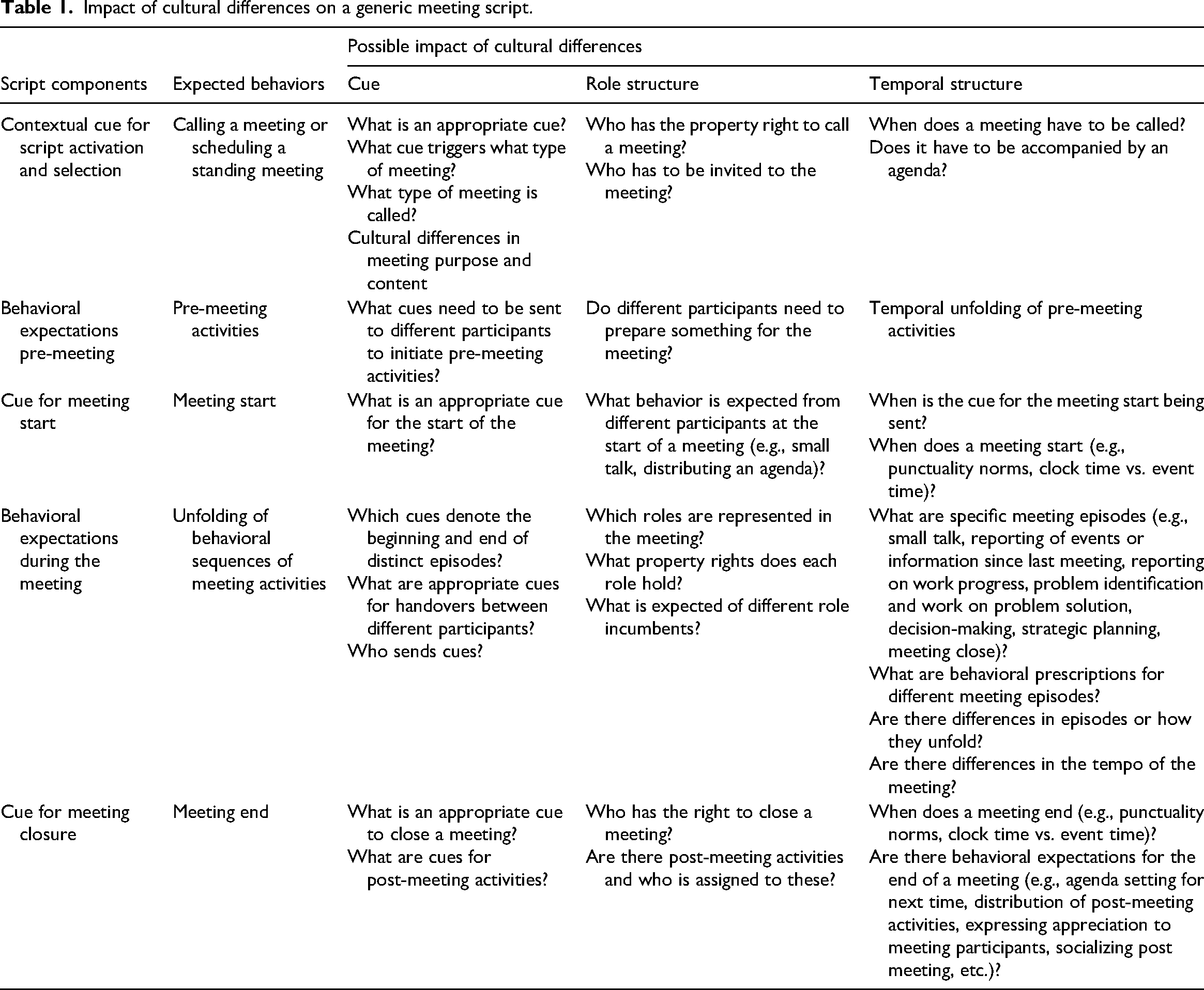
Scripts allow for a wide range of variation and adaptation which makes them suitable to study a range of settings. Consequently, the outline below is not meant to constitute a definitive description of what every script in organizational settings should look like. Rather, the description illuminates the components that meeting scripts share, the specifics of which vary by task setting, cultural context, and potentially organizational or even industry context. We provide examples of potential variations below. It is exactly the cross-cultural comparison of scripts variations that allows researchers to theorize about the meaning of observed meeting differences.
Contextual setting of meetings
A script is usually task or context specific (Barley & Tolbert, 1997; Schank & Abelson, 1977) such that the script for visiting a restaurant looks different from a script for attending a university lecture or the script for holding a meeting. Furthermore, different scripts usually exist for specific settings (e.g., a debrief meeting) within a larger context (e.g., workplace meeting) (e.g., Shaw, 1990; Shetzer, 1993). This means that all workplace meetings share core similarities that can be captured in a prototypical meeting script, which in turn allows individuals to correctly identify the category of event (i.e., a workplace meeting) in which they are participating (e.g., Crocker et al., 1984), providing an answer to Schwartzman's (1989) question how individuals recognize a meeting. At the same time, different types of workplace meetings likely have different, more specific scripts attached to them that capture core differences in meeting purpose and expected meeting structures and processes. Individuals then determine the subordinate category (or track according to Poole et al., 1990) to correctly derive behavioral prescriptions for the relevant subcategory (such as a debrief meeting or general staff meeting).
Kello and Allen (2020) have recently provided a taxonomy of seven meeting types, which differ regarding necessary pre-work, common design characteristics, typical leader approach, usual in-process steps, and expected outcomes. For example, a generic staff meeting is defined as a regularly recurring, scheduled meeting amongst a common group of employees, led by a boss or manager, with the purpose to “provide updates, forecast upcoming events, coordinate activities, and address current issues” (Kello & Allen, 2020, p. 32). On the other hand, a project team meeting only contains employees necessary to accomplish the set task, can be scheduled flexibly and around project completion necessities, is highly structured, and usually contains discussions about “planning, status updates, change control, and project review” (Kello & Allen, 2020, p. 32). In contrast, a crew formation meeting only contains a small number of people who may not know each other and change regularly, is led by a leader, and contains discussions of procedural guidelines before commencing work. Given the differences between the purposes and meeting characteristics between these meetings, their scripts will look different.
Analogous to different meeting types, previous research has identified different meeting purposes and content. Rogelberg (2007) defines five principal purposes of meetings: information-giving meetings, training meetings, recognition meetings, routine monitoring and decision-making meetings, and problem-solving meetings. Allen et al. (2014) identified 16 categories of meeting purposes, which include discussing new products or services to be introduced, financial matters, employment contract issues, employee performance, project work, problem identification and solution, and brainstorming. Depending on the core purpose of the meeting, scripts can differ substantially in terms of the behavioral sequences considered appropriate. At the same time, meetings can contain multiple purposes, which may take up different parts of the meeting, with several subscripts being activated at different times during the meeting. It is thus important that individuals correctly interpret contextual cues to pick the relevant meeting script to perform the expected behaviors and to accurately interpret the behavior of others.
As previous research has shown, however, the expected dominant purpose and content of meetings vary across different cultural contexts. Köhler et al. (2012) and Köhler and Gölz (2015), for example, have found that meeting content and purpose differed in Germany, the USA, the UK, and Japan. Meetings in the three Western cultures all contained elements of information-sharing and problem-solving yet differed in other core purposes. Meetings in Germany were held frequently for decision-making and consensus-building purposes, while meetings in the USA were often held for direction setting and role assignments and meetings in the UK for decisions about future tasks and relationship building. Japanese meetings, in contrast, were held for presentation and consensus-building purposes after much of the decision-making, conflict resolution, and related activities had already happened in informal pre-meetings. These observations were echoed by DiStefano and Maznevski (2000): In the United States, a team meeting is held to make decisions. […] In Japan, a team meeting is held to publicly confirm decisions that were discussed among members in smaller groups as they developed their analyses. […] In Mexico, a meeting is a time to build relationships and trust with each other. […] In the Netherlands, a meeting may be a time to identify all the weaknesses and criticisms of a particular approach or plan. (p. 53)
These different cultural expectations for the overarching purpose, goal, and content of meetings will likely determine which meeting script is selected when a meeting is called (e.g., Shaw, 1990). For example, German employees may expect the purpose of a meeting to focus on decision-making and hence, will select a meeting script that includes behavioral routines for problem analysis, decision-making, and consensus-building. Japanese employees may expect the purpose of the meeting to be information sharing about decisions that have already been made. Their script, therefore, may mainly contain active listening behaviors. Accordingly, the identified purpose and content of the meeting will impact expectations about participants’ roles and sequences of appropriate behaviors.
Role structure in meeting scripts
A role structure is constructed out of expectations for how incumbents of functional roles (leaders, project or committee members, department heads, professional staff) are supposed to interact, given their task function as well as their property rights. Expectations concerning role structure and the property rights of roles define the functions and activities participants are expected to fulfill in a meeting script (e.g., due to position power, expertise, legitimacy). Role structures in our programmatic scripts framework integrate theories on roles and role expectations, hierarchy, power, legitimacy, autonomy, interdependency, norms, and many other related theories that define expectations about the formal structure of how individuals interrelate in a given setting.
Role structure expectations depend on the type of meeting. Referring to Kello and Allen's (2020) seven meeting types, for example, in a general staff meeting, a leader will usually get a stable group of employees to review activities, report back on progress, and coordinate future activities and events. In contrast, a site-wide meeting usually contains one-way information dissemination, usually from a leader to employees. In shift change meetings, which are often leaderless, employees from one shift are expected to inform and handover to employees of the next shift. Scripts for these different types of meetings lay out different expectations for roles, property rights, and activities of different role incumbents. This includes expectations regarding the participation and contribution of employees with different functional roles. Using the example of construction project teams, architects hold different roles and responsibilities from engineers, project managers, or client representatives. In a standing project coordination meeting, project managers hold the property right to seek updates from all functional roles and monitor building progress. In a problem-solving meeting, on the other hand, a subset of functional roles (for example, the architect and the structural engineer) are responsible for resolving coordination conflicts between their respective tasks. These scripted role structure differences prevent frequent role conflicts when the role expectations and property rights are clear (Ashforth & Fried, 1988). In addition, property rights inherent in specific roles (such as leaders or experts) bestow legitimacy and power to facilitate decision-making and performance (Ashforth & Fried, 1988; Shaw, 1990).
Role and role structure expectations are influenced by differences in cultural norms and values, which in turn shape interaction patterns between role incumbents in meetings. For example, Shetzer (1993) proposes that employee participation in organizations is heavily scripted, with scripts encoding information about the relative influence of actors (such as hierarchical level but also power in the organization), contextual information, and guidelines for actions in specific situations, such as meetings. Along these lines, Shetzer (1993) provides the following example for cultural differences in employee participation expectations in meetings: For instance, the meaning of participation to a Japanese worker may be quite different from the meaning of participation to an American worker (Kerr, 1984). For the Japanese subordinate, participation appears to entail the honor of presenting his/her views to the superior. On the other hand, the American worker is unlikely to feel that genuine participation has occurred until his/her suggestions have been acted upon in the workplace. (p. 257)
Along the same lines, Aritz and Walker (2010) analyzed decision-making meetings and observed that U.S.-American born participants exhibited a high involvement style, consistently participating and contributing with a higher frequency than their East Asian counterparts and demonstrating enthusiasm in their contributions to conversation. East Asian meeting participants, in contrast, gave priority to being considerate of others and not imposing, displaying a high considerateness style.
Extending the scripts lens to expectations about leader-subordinate relationships, Shaw (1990) proposes that schemata and behavioral scripts for leadership affect the interaction between leaders and subordinates. Employees have a schema of leaders, so that they can clearly distinguish between leaders and non-leaders, using personal and contextual cues. Furthermore, employees have behavioral scripts for how to interact with leaders in a situation, such as during meetings. At the same time, leaders hold schemata of employees and the behaviors expected from them in said situation. As Shaw (1990) generally observes: […] a common prototype for a U.S. leader is an individual who engages in participative decision making, is concerned about the welfare of employees, views employees as motivated and capable of initiative (and treats them as such), and so on. The prototype for good leaders in India may, instead, describe an individual who is directive and very formal when behaving with subordinates, makes decisions in an autocratic manner, and so forth. (p. 635)
These expectations regarding participation and leader-subordinate relationships affect interactions during meetings. For example, Köhler et al. (2012) and Köhler & Gölz (2015) found that role expectations in meetings differed across the USA, the UK, Germany, and Japan. Meetings in the USA usually had a chairperson as an organizer and moderator who maintained a positive atmosphere to facilitate consensus-building (see also Lehmann-Willenbrock et al., 2014; Yamada, 1997). In the UK, the chairperson structured and managed the meeting with the higher-ranking manager holding the property right to make the final decision. The German meetings were usually chaired by the highest-ranking person; however, discussion was frank amongst all meeting participants, including debate and the challenge of ideas (see also Lehmann-Willenbrock et al., 2014). In Japanese meetings, supervisors were not challenged openly; hierarchy governed the meetings (see also, Yamada, 1997). Rogerson-Revell (2011) and Asmuß and Svennevig (2009) suggest that the property rights and obligations of the role of chair can vary widely across cultures and are dependent on the leadership styles prevalent in the cultural context (e.g., encouraging participation versus authoritative directing and controlling). Role structure differences also have implications for the temporal structure of meetings, such as who gets to talk when or for how long, who has the right to open and close a meeting, or who can signal to move from one topic to the next.
Integrating these empirical findings and related unit theories about roles, power, participation expectations, communication norms, leadership styles and expectations into a programmatic scripts framework suggests that meetings researchers would benefit from analyzing the complex role structures that govern meetings and that are derived from the overarching sociocultural context in which the meeting happens. On the one hand, this suggests that meetings need to be studied in their organizational, institutional, and cultural context to fully capture the complex dynamics between different roles and their property rights. Furthermore, different meeting types should be studied to fully understand the interaction patterns and expectations between different roles as well as variations in property rights in different meeting contexts. On the other hand, observing and analyzing interactions between different meeting participants requires a much deeper engagement with socioculturally embedded role expectations, considering underlying schemata for leadership, power, legitimacy, and participation norms. Taking into account this larger framework in which meetings happen allows researchers to theorize more deeply and contextually about the ways in which meetings unfold and represent the enactment of larger structural influences and pressures.
Temporal structure in meeting scripts
According to Cramton et al. (2021), the temporal structure of a script “prescribes how input regulation and interaction articulation (Faraj & Xiao, 2006) are expected to unfold over time” (p. 64). It includes the expected sequences of episodes, which consist of “clusters of tasks and events” (Reder & Schwab, 1990, p. 305), and the tempo of the script, which encompasses the pace of the unfolding events as well as how rigidly or flexibly time is treated. Within a meeting there might be several different episodes, such as a part in which a leader might update employees of organizational developments or decisions, a part where employees report back on their progress towards goal accomplishment, a part for discussion, debate, or problem analysis and solution generation, and possibly a part for socializing. As such, the temporal structure in our programmatic scripts framework integrates existing unit theories and empirical findings on coordination, routines, episode structures, timing, tempo, and rhythms, order, turn taking, temporal norms, and many other related theories that define expectations about the temporal unfolding of a given meeting.
The temporal structure of a meeting is likely to differ by meeting type. A crisis or debrief meeting, for example, likely has a different episode structure and tempo than a quarterly review or a strategic planning staff meeting. Furthermore, there are likely differences across cultures in the parts of a standard meeting, the importance of each part and the time given to it, the role structures prescribed in different parts, and the behavioral norms for employee interaction. Previous literature on meetings in different cultures has found a stable impact of cultural differences regarding timing, tempo, and episode structure.
Concerning cultural differences in timing, Brislin and Kim (2003) argue that employees in certain countries (in regions such as North America, Western Europe, East Asia, Australia, and New Zealand) focus on clock time, which honors scheduled appointments and punctuality. Employees in other countries (in regions such as South America and South Asia) value event time, which allows for a less structured and more organic unfolding of events. Along these lines, van Eerde and Buengeler (2015) in their study of meeting characteristics across 45 countries observed that different GLOBE clusters had timing-related preferences for the conduct of meetings (see also van Eerde & Azar, 2020, reporting similar findings). People in the Anglo cluster reported the second lowest number of late start of meetings and the lowest number of late end of meetings. Accordingly, in their samples of U.S.-American working adults and students, Allen et al. (2018) and Lehmann-Willenbrock and Allen (2020) found that meeting lateness negatively influences participants’ perceived meeting satisfaction, meeting effectiveness, and group performance outcomes (number, quality, and feasibility of ideas produced in the meeting). Conversely, van Eerde and Buengeler (2015) further observe that people in the Middle East GLOBE cluster have the highest numbers for late starts and late ends of meetings.
Köhler and Gölz (2015) describe differences in the tempo and rigidity of meetings. Meetings in the USA were relatively short but fast-paced. The structure of the meeting was often driven by an agenda (see also Allen et al., 2014), but the agenda was adjustable for unexpected, yet important things. Meetings in the UK were relatively long and slow paced to provide time for relationship building. The structure included small talk at the beginning of the meeting. The rest of the meeting was focused on working through an agenda. Meetings in Germany were often lengthy and detailed, while repeatedly refocusing participants on the purpose of the meeting and task accomplishment. Timing and structure were driven by an agenda, and changes to the agenda during the meeting were discouraged. Japanese meetings were often very long and split between pre-meeting activities, which were used for consensus building, information gathering, problem-identification and expressing concerns, and the actual meeting, which was used for information dissemination and informing of decisions. Similar observations of Chinese meeting culture are reported by Lü (2018): “In the Chinese community, pre-meeting discussions and negotiations take place in the ‘behind-the-scenes culture’ before the official meeting” (p. 11). Lü explains that these activities maintain mutual positive relationships and save face as objections are not voiced in front of others.
Beyond generalized cultural preferences that affect the timing and tempo of meetings, previous research has also found cultural differences regarding the episode structure of meetings. For example, Köhler et al. (2012) observed that U.S.-American meetings started with small talk and then followed an organically unfolding order of topics that included task clarification, role assignments, and project work. German task meetings were more structured, starting with clarification of the task and purpose of the meeting, to which they returned repeatedly throughout the meeting. Only after explicit discussions of task coordination and role assignment did the work start. Along the same lines, in their study on U.S.-American/German meeting differences, Lehmann-Willenbrock et al. (2014) found that German meetings were structured around problem-analysis sequences, whereas U.S.-American meetings were structured around solution-finding sequences. These differences in temporal structure reported in previous research have frequently been found to create meeting breakdowns (e.g., Köhler et al., 2012). Understanding how cultural differences in expectations regarding timing affect participants’ cognitive and behavioral meeting scripts is vital in predicting meeting differences and potential points of contention about the way and order in which a meeting should unfold.
Our programmatic scripts framework integrates these empirical findings and associated unit theories about coordination, temporal patterns, turn taking, and so on to highlight that differences in temporal expectations are driven by underlying sociocultural structures such as temporal norms, institutional structures (e.g., related to the tax year or industry reporting standards), as well as organizational structures (e.g., related to production cycles). It further offers specific guidance on how and when these structural pressures impact on meeting practices. This in turn provides guidance for advancing future theorizing about meeting practices related to timing and temporal structuring.
To provide a concrete example, a common practice of interest to meetings researchers has been the use of agendas. Much existing research has focused on whether or not agendas are being used, whether meetings with or without agendas are more productive, or whether sticking or not sticking to an agenda increases meeting satisfaction (among other similar questions). This research has mostly followed a pragmatic purpose, assessing what makes meetings better. Using our programmatic scripts framework as guidance, future research into meeting agendas could go further in theorizing why meeting agendas work or do not work, why they are being used or disregarded, and how they create (or not) more productive or more satisfying meetings.
For example, future research could examine the core processes that get disrupted when an agenda is missing in sociocultural contexts in which meeting participants prefer strong temporal structures. Our scripts framework would suggest that the lack of an agenda violates norms about meeting preparedness, order of inputs and turn taking, as well as lack of coordination amongst meeting participants. Our scripts framework would also suggest that in sociocultural contexts that function on events time, agendas would rarely be provided, are practically useless, and would change in an instant if something more important came up as they are not used as a core device for providing temporal structure and pacing. In fact, forcing an agenda in these cultural contexts may lead to violations of timing norms which then could create resistance to the unfolding of the planned meeting and ultimately a lack of meeting satisfaction.
Looking at agendas from a scripts perspective, researchers need to consider how specific temporal meeting practices are driven by the larger sociocultural and structural context in which they are embedded and which they support. Furthermore, taking sociocultural and institutional structures into account will help researchers explain why some meeting practices and interventions related to timing might be unsuccessful in cross-cultural contexts.
Cues in meeting scripts
Contextual cues for the meeting help individuals identify the relevant script, recognizing first that one is about to enter a meeting and then priming the script for the type of meeting one is about to enter (Ashforth & Fried, 1988; Gioia & Poole, 1984). As Poole et al. (1990) state: “Essentially, scripts are called forth whenever cues suggest that this knowledge is situationally appropriate and then facilitate the transfer of thought into action” (p. 214). Once a script is entered, cues during script performance mark the beginning and end of episodes, regulate the tempo during an episode, indicate when different actors in the script are supposed to provide input, and what type of input might be expected given the functional role and the meeting context (Cramton et al., 2021). Using participation scripts as an example, Shetzer states (1993) that: […] when a familiar workplace situation is encountered, situational cues (e.g., the other's role, status, purpose of interaction, place, dress, speech patterns, tone of voice, level of eye contact) are evaluated in order to match the situation with a prototype. […] Assuming that the situation matches an interaction category in the schema, the entire process largely occurs in an automatic fashion. (p. 262)
In our programmatic scripts framework, these characteristics and functions of cues are captured by unit theories related to cognitive structures such as schemata and prototypes, information processing, memory, encoding, recognition, retrieval, attention direction, and many other theories related to how our brains process contextual stimuli and choose appropriate responses to carry out relevant activities.
In cross-cultural work contexts, however, we know that cues are often misread or misinterpreted. This is problematic as it means that a person may not recognize they are about to enter a meeting, may not categorize correctly the type and purpose of the meeting, or may not prime appropriate behavior sequences to display at the right time during the unfolding of the meeting. In an example from Cramton and Hinds (2014), Indian software engineers expected their managers to check in with them repeatedly to monitor task progress and by doing so to send cues for the importance of the project as well as for signaling appropriate times to ask questions, provide clarification, or offer help. In contrast, German engineers used the project schedule as their cue and expected to self-monitor their progress. When they faced problems, they approached their manager, sending a cue that they needed clarification or help. In German/Indian teamwork, this created the problem that Indian engineers waited for their German manager to send cues that governed task performance. All the while, the German manager was flabbergasted that as the deadline approached no work was done despite the fact that the Indian engineers had not raised any concerns or made him aware of any problems throughout. In another example, Orr (2005) describes an incident that happened as an outcome of a meeting in a U.S.-American/Japanese building project, in which the U.S.-American site manager had jokingly expressed the wishful thinking that a significant start to the project could be made by the next morning. The Japanese project team members, though, took this as an order which cued implementation (at great cost) and resulted in this part of the project being ready to go the next morning.
In cross-cultural meeting contexts, there are a range of cues that can be misread or misinterpreted. At the most fundamental level, Hall (1981) states: “In its many forms, culture … designates what we pay attention to and what we ignore” (p. 85). As such, cues may be missed if we are not looking for them or are only looking for a certain type of cue. For example, Orr and Scott (2008, p. 574) find that different cultural norms for the expression of disapproval often lead to disapproval cues being missed, especially when actors differ in their preference for direct verbal statements versus indirect indicators via body language or facial expressions. For example, Du-Babcock and Babcock (1997) observed that Chinese meeting participants circumvent direct confrontation and preserve interpersonal harmony by relaying their messages through non-verbal cues, delaying responses, or simply ignoring conflicts by not replying. Similarly, Brislin and Kim (2003) observed: If people [from collectivistic cultures] at business meetings do not have strong preferences for a course of action, they may remain silent, listen carefully to others, and later try to integrate diverse comments into a workable suggestion. These integrative suggestions, which often reflect people's views of an emerging consensus of opinion, may come at the end of a long meeting. (p. 374)
Yet, Brislin and Kim (2003) also report that: Encountering longs periods of silence at meetings can be especially frustrating for Americans and Western Europeans. People from these parts of the world often interpret silence as a signal that something should be said to fill the time and to keep the meeting going. (p. 374)
Furthermore, cultural expectations regarding role structure can impact our expectations regarding the appropriate source of cues. As in the Cramton and Hinds (2014) example above, Indian employees expected cues for taskwork to come from their manager, while German employees expected to send cues to their manager. Ashforth and Fried (1988) caution that scripts can have the undesirable effect that employees and managers may engage in “mindless” organizing which leads them to miss or misread important cues. They propose that “vital information may be missed because it does not originate from a recognized source or conform to an existing cue category, it may be distorted to fit a category, or it may cue a script that is no longer valid” (Ashforth & Fried, 1988, p. 317). Taken together, cues are important primers for the choice of scripts as well as for the expected and appropriate performance of scripts, cueing not just the type of meeting context to expect, but also the appropriate role structures and temporal structures that drive a smooth unfolding of a meeting.
Using our programmatic scripts framework as guidance for future research into cues, we believe that especially theorizing about meeting breakdowns would benefit from incorporating unit theories from cognitive psychology and neuroscience to explore more deeply when meeting breakdowns might in fact be due to missed or misinterpreted cues. Given that cues are strongly embedded in cultural communication patterns as well as in sociocultural interpretation and sense-making, studying cues in their structural context would advance our understanding of why seemingly foolproof cues such as requests for information, scheduling requests, or announced meeting start times sometimes do not work. Particularly useful here is the strong connection between cues and role structures as well as between cues and temporal structures. Cues, for example, only work when they come from the person holding the property right for sending that cue. For example, a colleague at the same hierarchical level might not have the right to request information and consequently, such requests might go unanswered. Similarly, cues in event time focus on more natural transitions from one topic to another rather than cues in clock time, which may rely on detailed planning and a provided schedule. Studying the role of cues via their role in cognitive information processing is thus crucial for understanding meeting breakdowns related to roles and coordination.
Meeting script divergence in cross-cultural meetings
To illustrate how these core components of scripts integrate to capture meetings as socially embedded forms of organizing and help understand and illuminate reasons for meeting breakdowns in cross-cultural settings, we created Table 2. In Table 2, we consolidate published literature on German and U.S.-American meeting differences to distill two cultural meeting scripts for a typical project work meeting. Differences between German and U.S.-American meetings are well-documented and offer a rich evidence base to extract how German and U.S.-American meeting scripts might differ and create potential meeting breakdowns. While there are many commonalities between German and U.S.-American meeting scripts, the differences have repeatedly been reported to jeopardize successful cross-cultural meetings. Comparing meeting scripts in cultural settings that on the surface-level seem very similar provides a good example for the fact that even small differences in parts of a meeting script can cause cross-cultural meetings to fail, especially when these differences are unexpected.
Example of differences in German and U.S.-American meeting scripts for planned taskwork meetings.

Furthermore, one of the core quality markers of programmatic theory lies in demonstrating its practical utility and usability, showcasing how the integration of unit theories and empirical findings can lead to immediate practical implications and applications to concrete problems and situations (Cronin et al., 2021). The script comparison provided in this section offers an example of the very pragmatic questions about meeting practices and processes a scripts lens allows researchers and practitioners to ask and address. Emerging from a deep understanding of the interplay between key unit theories embedded within their respective sociocultural contexts, these pragmatic questions about core differences in scripts allow meeting participants to assess potential cross-cultural meeting challenges and address meeting breakdowns with workable and appropriate solutions, given the respective structural context of the cultures involved.
We want to reiterate at this point that we are building a German and a U.S.-American meeting script prototype, based on an integration of the existing cross-cultural meetings literature. This does not mean that all German and U.S.-American meetings look exactly like this prototype. Rather, we expect there to be variation across scripts for different types of meetings and content. However, given that the existing meetings literature has studied meetings predominantly as if there was a generic meeting form and little variation across meeting types (Kello & Allen, 2020), most existing research does not report findings for different meeting types as employed in different cultures. Furthermore, while we choose to focus on national cultural differences as our level of cross-cultural comparison, we acknowledge that cultural differences do not reside at the national level alone and that sole reliance on national-level culture indicators may misrepresent meetings in specific cultural sub-contexts (Taras et al., 2016). In fact, Markus and Hamedani (2007) highlight that the sociocultural view would encourage researchers to explore other cultural boundaries (such as gender, ethnicity, race, religion, socioeconomic conditions, regions) and their effects on individuals and groups. However, again, our integration of the cross-cultural meeting literature is limited by how previous research has conceptualized culture, i.e., at the national level. As such, the meeting prototype we build naturally tends to overgeneralize certain meeting characteristics for employees in the USA and Germany. Yet, the purpose of a prototype script is to define some common characteristics, which we would expect to vary in more specific scripts for different meeting types or different cultures. In fact, the scripts construct is uniquely qualified to capture variation from cultural comparisons of meetings once researchers start assessing scripts in different cultural contexts.
As outlined in Table 2 (see also for references), meetings may be cued similarly in the two cultures, and all participants have the property right to call a meeting (i.e., similarity in property rights for calling a meeting). Regarding pre-meeting activities, German participants would expect to be sent an agenda by the meeting chairperson or by the person who called the meeting. This may be in the form of a formal agenda or a less formal email stating the purpose of the meeting, what the meeting is supposed to accomplish, and instructions for the preparatory work needed. U.S.-American meetings also usually require an agenda, and any necessary pre-meeting work needs to be explicitly stated. Should an agenda not be sent, the lack of said agenda and instructions for preparatory work would likely signal to participants that the meeting has no clear purpose and goal to accomplish. As a result, participants may question why the meeting is necessary and whether this meeting will lead to any tangible outcome.
The start of a meeting would likely be cued differently. In German meetings, it is important that the meeting chairperson reiterates the purpose of the meeting, the expected outcome, and any clarification needed to begin taskwork. There is rarely small talk or other non-task-focused talk at the beginning of the meeting. A core responsibility of a U.S.-American meeting chairperson is to establish and maintain a positive atmosphere to facilitate consensus-building. As such, U.S.-American meetings often start with small talk or other pre-meeting talk focused on relationship building. To German meeting participants, the pre-meeting talk may appear to lack task focus and lead to perceptions that the meeting is not run in an efficient way, potentially resulting in feelings that participants’ time is not valued. To U.S.-American meeting participants, a lack of pre-meeting talk may indicate a lack of collaborative attitude. This can endanger cross-cultural meetings by not setting the right tone for the meeting, potentially leading to a lack of openness or cooperation.
During the meeting, German participants likely focus on problem analysis, challenging other meeting participants’ solutions, and debating ways forward. All meeting participants are expected to contribute to this sparring exercise, which is supposed to lead to thorough understanding and the elimination of unworkable solutions. German participants will largely stick to the agenda of the meeting and will repeatedly refer to the purpose and goal of the meeting to ensure that they do not get sidetracked. U.S.-American meetings, in contrast, focus on solution-finding. All participants are allowed but not required to contribute. All participants need to maintain a positive atmosphere, engaging in positive socioemotional meeting behavior throughout the meeting. The meeting will move organically between different topics, and all participants are allowed to contribute to the direction the meeting takes. To German participants this organically unfolding meeting structure likely appears inefficient as close focus on the stated task is not maintained. Furthermore, German participants would feel reluctant to move to solution-finding before the problem has been thoroughly analyzed, as this could lead to wasted time when the solution does not work and the problem is still poorly understood. U.S.-American meeting participants will find the German structure too rigid and not conducive to the innovative and timely pursuit of solutions. Making little or no perceived progress towards a problem solution will feel like wasted time. In addition, the combative debating style of many German meetings challenges ideals about maintaining a positive atmosphere.
Finally, U.S.-American meetings usually end on time with meeting participants having to leave 5 min before their next meeting. German meetings usually end on time but may go over time if the goal of the meeting was not accomplished or the agenda has not been completed. While this is acceptable to German participants, it will lead to a lack of meeting satisfaction and perceived effectiveness for U.S.-American participants.
This comparison of differences between German and U.S.-American meeting scripts, especially regarding expectations for meeting purpose, cues, role expectations for meeting participants, and temporal structuring of the meeting shows the many points at which combined German/U.S.-American meetings can run into bumps or roadblocks. If these difficulties occur consistently in meetings, relationships will become strained and participants may question the other side's commitment to the task and/or the team, which subsequently erodes collaboration and trust (e.g., Köhler, 2009).
Discussion
In this paper, we have introduced a framework of meeting scripts as programmatic theory to study and understand meetings as a socially embedded form of organizing. We adapted Cramton et al.'s (2021) conceptualization of cultural coordination scripts to derive a definition of meeting scripts. We further proposed and demonstrated that studying meeting scripts through Cramton et al.'s scripts framework—comprising role structure, temporal structure, and cues—is particularly useful for integrating the influence of a range of cross-cultural differences in meeting processes which have been identified in previous work. This integration and reconciliation of existing knowledge and theorizing to promote a superior understanding of the workplace meeting context is the specific goal of programmatic theory building. Specifically, using the proposed conceptualization of scripts allows for an assessment of the ways in which cultural differences in norms, values, and expectations and contextual influences impact on the unfolding of meetings, expected behavioral sequences, and inputs from meeting participants. More importantly, cross-cultural comparisons of meeting scripts allow researchers to explore, conceptualize, and theorize differences in the meeting form which provides insights into how meetings are used for organizing in different cultural contexts.
Contributions to future research
Our paper makes important contributions to existing theorizing on workplace meetings. We provide a coherent and comprehensive review of the existing literature on cultural differences in workplace meetings which we integrated into an overarching conceptual framework, using cognitive and behavioral scripts as the unifying, programmatic theory to bring together different unit theories and empirical findings on cultural differences in meeting characteristics and processes. This programmatic scripts framework provides a parsimonious and easily interpretable overview of existing work on cross-cultural meetings. Furthermore, it offers future research into cross-cultural meetings guidance regarding suitable research questions, important contextual factors to consider, and theoretical integration of existing unit theories to provide a deeper understanding of the underlying mechanisms impacting on meeting practices and processes. Throughout the manuscript, we have provided several examples of ways in which researchers can employ our programmatic scripts framework to guide their future work.
Furthermore, good programmatic theory needs to provide orientation and guidance to future researchers, and it needs to assist in solving practical problems (Cronin et al., 2021). The purpose of our programmatic theory paper is to build a novel and useful architecture as a basis for the future study of workplace meetings across cultures. Beyond organizing the existing knowledge and unit theorizing on cross-cultural workplace meetings, our scripts framework helps future researchers evaluate their unit theorizing against what is known to determine whether a conceptual model they propose in their work is sensible or important. Our programmatic theory, thus, becomes a yardstick against which subsequent unit theorizing on workplace meetings can be evaluated. In fact, future unit theorizing can use this programmatic theory as the backdrop against which a researcher could make the case that their theorizing is important and novel vis-à-vis further developing the programmatic sociocultural influences on workplace meetings.
For example, a scripts lens allows researchers to connect to prominent work on the practices, enactments, routines, and rituals of meetings (e.g., Schwartzman, 1989; Scott et al., 2015). An important characteristic of scripts is that they are shaped by continuous enactment. This in turn means that scripts can change over time when behaviors, norms, or context change. A recent paper by Allen et al. (2021) provides a good example. The authors argue that due to globalization, meeting participants in culturally different contexts are now experiencing meeting lateness more similarly than they did before. Furthermore, the negative effects of meeting lateness on taskwork, teamwork, and performance are becoming more similar across cultures than previous studies have found. This indicates that the effect of some cultural norms on scripts of workplace meetings are changing due to exposure to other working styles. The fact that the scripts construct can account for adaptation over time allows future research to address how meeting structures and practices may be changed via repeated enactments. This in turn helps explain how meeting practices are adapted over time and through the interaction between participants from different cultural backgrounds. Accordingly, a scripts lens offers a way to understand how meeting practices can be shaped by participant interactions, accounting for the fact that meetings in a cross-cultural context usually do not stay the same over the course of joint project work (e.g., Ashforth & Fried, 1988; Barley & Tolbert, 1997; Brannen & Salk, 2000; Cramton et al., 2021; Köhler, 2009).
Furthermore, we have provided numerous illustrations from published work of the impact of cultural differences on workplace meetings and have demonstrated how a scripts lens offers an integration of this work. This allows future research to study systematically the impact of cultural differences on several, cooccurring meeting characteristics and challenges. In previous work, these characteristics and challenges have often been studied in isolation, such as work focusing on pre-meeting talk, participant interactions during the meeting, timing issues, or perceptions of effectiveness and satisfaction. By contrast, a scripts lens offers programmatic theory to capture the impact of cultural differences on all of these meeting features together. This advances our understanding of the fundamental ways in which cultural frames of reference, norms, and values impact meetings as a social form of organizing.
In addition, the scripts construct offers great flexibility to include other important, systematic influence factors on institutionalized meeting structures and processes. For example, a scripts lens can capture organization-level variation, by taking into account the institutional norms or corporate culture set by specific organizations. This could mean that meetings at a design and marketing company may look different from meetings of the same type at a fire station or in a biochemistry lab. Exploring the impact of corporate culture on workplace meetings goes beyond the scope of this paper. However, we would advise researchers planning to conduct their research in a specific organization to learn more about the organizational culture, its institutionalized processes and structures. This allows them to more fully understand why meetings are held in the way they are and how this meeting structure and its accompanying expectations contribute to organizing and the embodiment of the organization's vision, mission, and goals.
Practical implications
Future work on workplace meetings from a scripts lens can generate important insights for ways in which workplace meetings, and in particular cross-cultural workplace meetings, can be better managed. For example, our distillation of a German and a U.S.-American meeting script helps pinpoint likely meeting breakdowns, which otherwise could result in serious coordination breakdowns in a German/U.S.-American project team. By uncovering cultural meeting scripts, researchers can offer managers a cognitive map of meetings (e.g., Poole et al., 1990), which will in turn help them bridge meeting gaps and find synergies to run meetings more smoothly.
An example of a cognitive mapping exercise was developed by the first author of this paper based on Maznevski and DiStefano's (2000) model of mapping, bridging, and integrating (more detailed instructions are available upon request). To map cultural and institutional differences in meeting scripts, employees from different (cultural or organizational) backgrounds are asked to write a script for how a meeting typically unfolds where they work. One would have to specify what type of meeting is most relevant and ensure that each employee writes out the script for the same type of meeting. Essentially employees are instructed to complete Table 2 for their cultural and organizational background. Meeting participants from different cultural or organizational backgrounds then share their respective script with each other and engage in bridging by explicitly comparing the scripts, asking questions to clarify why things are done in a certain way (thereby revealing underlying cultural coordination templates or institutional structures). Meeting participants can further explore what would usually happen if the script is violated (e.g., if somebody displays a behavior that is disrespectful, if somebody were to come to a meeting unprepared, if there was no agenda, if the meeting were to run over the scheduled time, etc.). Out of this assessment of differences and expectations meeting participants can create a shared script for how a meeting should unfold in their cross-cultural meeting context (i.e., integrating), essentially completing Table 2 again but for a meeting that contains participants from all involved cultures.
We have been using this type of exercise with great success to help multicultural teams run smoother meetings and improve their overall coordination and communication. Using this kind of exercise, managers and employees can develop a better understanding of the cues, role prescriptions, and temporal preferences their colleagues expect. This knowledge allows them to integrate these features into their routines for calling a meeting, such as prescribing the meeting purpose, expected preparatory activities, and the unfolding of the meeting itself, leading to improved collaboration.
Footnotes
Author note
This material is based upon work supported by the National Science Foundation under Grant No. 1025682 and Stanford's Global Projects Center. Any opinions, findings, and conclusions or recommendations expressed in this material are those of the authors and do not necessarily reflect the views of the National Science Foundation. Work on the paper also was supported by the University of Melbourne's Faculty of Business and Economics through its Visiting Research Scholar grant, Early Career Researcher grant, and Faculty Research Grant schemes.
Funding
The author(s) disclosed receipt of the following financial support for the research, authorship, and/or publication of this article: This work was supported by the National Science Foundation under Grant No. 1025682, Stanford's Global Projects Center, and the University of Melbourne's Faculty of Business and Economics (Visiting Research Scholar grant, Early Career Researcher grant, and Faculty Research Grant).
