



Abstract
Expanding existing meeting typologies, this paper introduces a model of the team creative process in meetings to better capture and study the full breath of meeting activity that results in creative outcomes. The primary goal of this work is to describe the processes that occur in the team creative process in meetings at the individual and team levels. A multi-level model that depicts the emergence of team creative cognitive processes from individual-level cognitions is presented. The nature of emergence of team creative processes is detailed. Research on creativity and meetings is integrated to better understand how meeting design characteristics influence creative output. This review of research is distilled to provide practical recommendations to best construct meetings to facilitate individual and team creativity. Additionally, the role of related team states in creative processes meetings is outlined. Finally, paths for future research on creativity in meetings are discussed.
Plain Language Summary
This article explores how individuals and teams think creatively in meetings. A model of meetings that have goals to produce creative outcomes is presented. The association between individual thinking processes and group thinking processes is presented alongside a discussion of relevant surrounding influences. Research on creative thinking and workplace meetings is used to better understand how meetings can be used to improve creativity. Practical recommendations to improve the production of creative outcomes in meetings are also provided.
Workplace meetings, when properly conducted, provide many benefits to organizations by facilitating employee and team functioning (Allen et al., 2015; Cohen et al., 2011). Conditions before, during, and after meetings influence social and cognitive processes that are associated with meeting effectiveness (see Mroz et al., 2018 for a full review). Many of the cognitive and social processes that meetings encourage align with the processes that unfold in successful creative teams’ meetings (Reiter-Palmon & Sands, 2015). These processes involve group behaviors such as collaboration, coordination, planning, deliberating, and ideation (Tracy & Dimock, 2004). Moreover, one purpose of meetings can be to achieve creative outcomes (Kauffeld & Lehmann-Willenbrock, 2012). Team meetings can be used to identify problems that can be solved creatively, produce creative solutions, evaluate creative options, or a combination of the three. Creative activity in a meeting can be structured or unstructured. Meeting attendees can offer creative approaches, ideas, and perspectives in any meeting, even if the meeting has no formal requirement for members to be creative. On the other hand, meetings can be specifically structured to achieve a creative goal (e.g., brainstorming meetings; Allen et al., 2014). Additionally, creative activity can occur at the individual level or group level. In a meeting, creative outcomes can come from single attendees, from a team, or both.
A growing body of research seeks to examine the psychological processes that underpin the creative activity for individuals and teams (Amabile & Pratt, 2016; Mumford et al., 1991). However, to our knowledge, no model of workplace creativity exists that appropriately details the interplay between individual- and team-level processes while accounting for the contextual influences of meetings. Past models of creative processes have not favored describing creative problem-solving in a specific context. Although these models have strengths in terms of generalizability, their utility in forming practical recommendations to improve creative functioning falls short. By focusing on how specifically workplace meetings can be used as a vehicle to facilitate creativity, we hope to better understand how organizations can more effectively leverage workplace meetings to address ambiguous problems and unstructured circumstances with creative solutions. An understanding of how individual creative cognitions give rise to and spur team creative cognitions and behaviors in meetings is needed in order to best facilitate team creativity.
We review and combine research streams on creativity and meetings to describe how creative processes unfold in team meetings and how team meetings can facilitate or inhibit creativity. Individual- and team-level creative problem-solving subprocesses are presented in a model that outlines particular elements in team meetings associated with creative processes. Figure 1 depicts this model. Not only does this work add to meetings literature but it also expands multi-level creativity theory as we elucidate the nature of emergence in meetings of team-level creative processes from individual-level creative cognition.
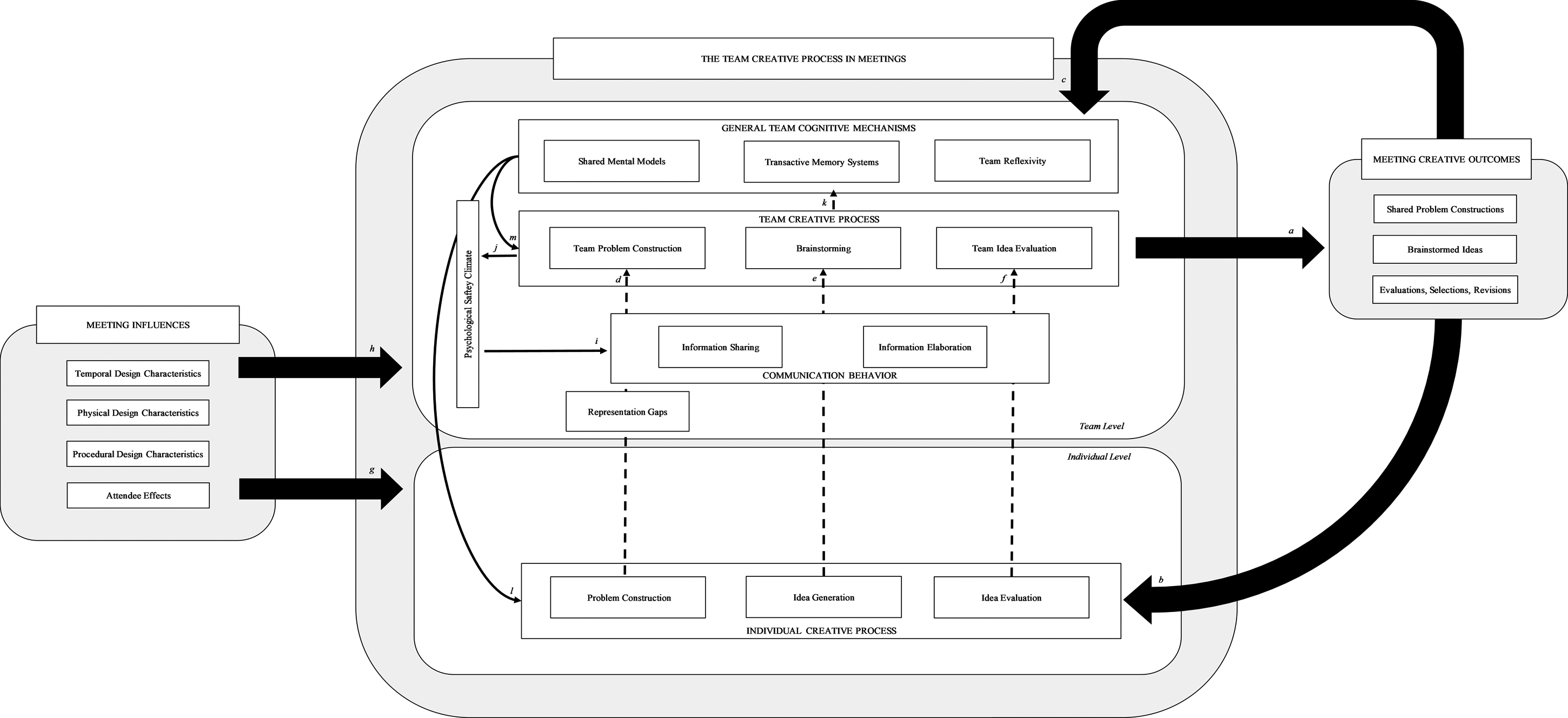
A multi-level model of the team creative process in meetings. Labels a–m are described in text. The starting points of the dashed arrows denote individual-level components that compose team-level processes that are marked by the dashed arrow end points. Dashed arrows were used to distinguish emergent processes from associations related to casual prediction that are indicated with solid arrows. All solid arrows indicate potential direct relationships. Thicker arrows were used when connecting larger model components together.
Additionally, our goal is to outline the processes that occur when teams engage in creative activities in meetings rather than provide a standard tool or technique to facilitate creativity. Several tools and techniques have been designed and marketed, many with accompanying research support, to guide creative thinking (e.g., The Simplex Process, Theory of Inventive Problem Solving, The Four-Step Innovation Process, and others). Although such tools differ in their creative problem-solving prescriptions, their efficacy largely stems from their regulation of underlying cognitive processes that occur in individuals and teams during creative problem-solving. The goal of this paper is to elucidate these core processes as they unfold in meetings, and discuss the meeting factors that influence them in a way that is agnostic to a specific tool. Below, we introduce a sparsely researched element of meetings to better frame the intersection of meetings and creativity literature. Next, we address a literature gap by examining how team-level creative processes could emerge from individual-level creative processes in meetings. We then describe the role of meeting characteristics on creative meeting outcomes.
The model described here provides a number of contributions to the literature and study of team meetings and team creativity. First, this model integrates these two different streams of research in a novel way. Second, the model identifies how team creativity and specifically team creative processes manifest during team meetings. Third, the model applies research from meeting science to highlight team meeting factors that may facilitate or inhibit creativity. Finally, we offer propositions that may be useful in facilitating future research on this topic.
The team creative process in meetings
To understand how creativity occurs in meetings, a formal definition of creativity and an overview of its psychological underpinning is needed. Creativity researchers define creativity as the production of novel and appropriate ideas, solutions, and products (Amabile, 1996). A number of different models outline the various subprocesses involved in producing creative outcomes (e.g., Amabile & Pratt, 2016; Finke et al., 1992; Mumford et al., 1991). Although each model proposes a unique arrangement of cognitive processes, three core subprocesses have been identified as common among the models (Reiter-Palmon & Illies, 2004). Problem identification and construction, idea generation, and idea evaluation and selection are considered core individual-level creative processes. At the team level, these processes have corollaries. To produce creative outcomes, teams engage in team problem construction, brainstorming, and team idea evaluation (Reiter-Palmon, 2018). In team meetings, both individual-level and team-level processes are relevant. We use the terms constructive, generative, and evaluative process to refer to core subprocesses in a way that is indifferent to the level of consideration (individual or team) when distinguishing between creative processes in team meetings. Constructive processes are used to structure ambiguous situations and form plans for producing creative solution. Generative processes are used to produce many possible ideas. These ideas are evaluated and the best idea for implementation is chosen in evaluative processes. See Reiter-Palmon and Sands (2015) for more details on the individual- and team-level forms of these core creative processes.
Although activities associated with creative processes can be key elements of team meetings, meetings research has yet to be cohesively tied to team creativity research. Combining these two research streams requires an understanding of how attendees engage in creative processes. Some meetings research has acknowledged that a meeting purpose can be to produce creative outcomes. For example, Allen et al. (2014), Reinig and Shin (2002), and Volkema and Niederman (1995) recognize brainstorming sessions as a type of meeting. However, existing meeting typologies and taxonomies do not cover the full breadth of processes that serve to produce creative outcome. Empirical work by Allen et al. (2014) suggested the existence of 16 meeting purpose categories that can be arranged into two sets: content meetings and instrumental meetings. Content meetings are meetings that are used to discuss a work topic (e.g., state of business, new product implementation, and ongoing projects). Instrumental meetings use meetings as tools to accomplish work tasks. Two instrumental meeting purpose categories, “To brainstorm for ideas or solutions” and “To identify and propose solutions” (p. 801), involve creative processes. These categories involve constructive and generative processes. Allen et al.'s categories do not explicitly recognize the involvement of evaluative processes; however, team idea evaluation can be implied to occur in content meetings where employees may be discussing creative ideas before, during, or after implementation. There is a need to more comprehensively outline all core creative processes that can occur in team meetings.
Any combination of constructive, generative, and evaluative process can occur in the meeting context. When teams produce a creative outcome or output that will contribute to a creative outcome (e.g., shared problem definition, list of ideas, and evaluations of ideas) in a meeting, one or more team creative processes can be implied to have occurred. Our definition of the team creative process in meetings is derived from creativity research that recognizes that creative processes may occur in stages. Constructive, generative, and evaluative processes may be fragmented or co-occur (Mumford et al., 1991). In meetings, creative processes may occur spontaneously or be brought forth intentionally. Despite the fluidity in how creative processes unfold, teams meet and engage, passively or actively, in these processes when producing creative outcomes (Reiter-Palmon, 2018). Each process produces an output that serves the final meeting outcome. For example, the team problem construction process produces a shared understanding of the problem, brainstorming produces a pool of ideas, and the team idea evaluation process results in the appraisal of ideas. The purpose of modeling team creative processes in meetings is to show how teams engage in these processes to ultimately produce a product, idea, or solution that is novel and appropriate.
“a” in Figure 1 denotes the path from team-level processes that occur in meetings to creative outcomes. These creative outcomes can be terminal products or solutions, or feedback into the team creative process in meetings. This feedback mechanism is necessary as creative processes can have fragmented or cyclical occurrences. Outcomes of one processes may act as inputs into another. For example, team idea evaluations may spur new ways to look at problem, thus affecting team problem construction. Such feedback processes can occur within a single meeting or between meetings. The influence of creative outcomes on team-level creative processes in meetings can occur indirectly through influencing individual-level creative activity (see label b in Figure 1). Team-level creative processes may be altered by emerging from altered individual-level components. Details on the emergence of team-level creative processes from individual-level components in team meetings are presented in a later section. Alternatively, the influence of creative outcomes on the team creative process in meetings may occur more directly at the team level. The influence of creative outcomes my bypass or partially bypass individual-level cognition, affecting team cognition instead. “c” in Figure 1 depicts this possibility. Related team states, such as shared mental models, transactive memory systems, and team reflexivity, may in turn affect how teams engage in team creative processes in meetings. Details on the roles of related team states in the team creative process in meetings are also provided in a later section.
Emergence
The key difference between individual- and team-level creative processes is individual-level processes occur within a person, whereas team-level processes unfold between team members. In team meetings, the individual-level cognitive functions are scaled in a particular way into team-level cognitions manifesting as member interactions (Reiter-Palmon & Sands, 2015). Kozlowski and Klein (2000) described team cognition as a configural or bottom-up construct. Individual-level cognition emerges into a discernable pattern of behavior that can be described as a form of team cognition. Both processes at both levels occur in team meetings and are relevant to the team creative processes in meetings. Understanding the nature of emergence of team problem construction, brainstorming, and team idea evaluations allows researchers to better measure and study creative activity in team meetings.
Team problem construction emergence
Individual-level problem construction results in problem representations. In a team, these representations may differ across group members (Cronin & Weingart, 2007; Reiter-Palmon et al., 2008). The pattern of problem representations, referred to as representation gaps (rGaps; Cronin & Weingart, 2007), would be considered a team state. Effective resolution of a team's rGaps results in establishing a consensual and integrative structure to produce creative solutions to a problem (Cronin & Weingart, 2007; Goh et al., 2013). We describe this emergent team resolution process as team problem construction. The emergence of team problem construction is associated with communication behaviors within team meetings. Meeting characteristics that facilitate these meeting behaviors may also facilitate team problem constructions.
The outcome of team problem construction in team meetings, that is, producing a structure to lead to possible ideas, is the same as in individual-level problem construction. As such, the problem construction process at the team-level likely takes on a similar form. Mumford et al. (1994) described the flow of a person's cognitive activity during problem construction. Problem construction entails the perception of cues in problems that trigger mental representations of previous problem-solving attempts. Goals and constraints of the problem at hand are identified. These elements are screened for relevance to producing a solution and reorganized to structure problem-solving. To reach a consensual structure in a team meeting, member interaction may occur to achieve a similar progression of problem understanding. However, this is not to say that team problem construction holds a compositional emergence in team meetings. Compositional emergence occurs when individual-level and team-level constructs are isomorphic (Kozlowski & Klein, 2000). Both individual- and team-level problem construction involves screening and reorganizing problem goals and constraints to produce a problem-solving structure. However, differences exist between the levels in how screening and reorganization occurs in team meetings. Namely, team behaviors such as communication and information-sharing and the diversity in member's individual-level problem constructions (i.e., rGaps) add further complexity to the team-level process. A strict compositional emergence may not fit with the team problem construction process in team meetings.
Kozlowski and Klein (2000) explain that a close variant of compositional emergence, pooled constrained emergence, can be attributed to processes that involve group decision-making with consensus. In these processes, similar to the problem construction process, members possess both common and unique information or representations. However, in standard decision-making teams, members are more likely to discuss with each other and integrate only information that is common among them (Wittenbaum & Stasser, 1996). The pattern of unique information plays little to no role in the higher-level process. As such, standard team decision-making processes take a more compositional than compilational form of emergence. However, the opposite is true for the team problem construction process in meetings. Effective teams specifically focus on discussing the pattern of unique representations (i.e., rGaps) across members. This notion implies a compilational emergence.
A compilation-type emergence is generally attributed to constructs when a “higher-level phenomenon is a complex combination of diverse lower-level contributions” (Kozlowski & Klein, 2000, p. 11). Team- and individual-level cognition in team problem construction is only functionally equivalent. Individuals may arrive at a plan to solve a problem by restructuring relevant problem elements, while the team may arrive at a plan to solve a problem by reducing rGaps in any number of ways. Additionally, the contribution of each member to the team's construction may not be consistent from member to member. As such, team problem construction as a process will likely adhere to a compilational emergence in meetings.
It is important to note that higher-level processes can be interpreted in many ways. The interpretation of a process can dictate what form its emergence takes (Kozlowski & Klein, 2000). The description of team problem construction as having a compilational emergence only applies when the process is interpreted as cognitions and behaviors used to form a plan. Another way to conceptualize team problem construction in meetings is as a shared understanding of how a problem is to be solved. Research on mental models point to shared understandings being representative of compositional emergence (DeChurch & Mesmer-Magnus, 2010). A team's shared understanding of a problem can be quantified as the degree to which member representations match each other. Here, each team meeting attendee equally contributes to the team's shared understanding value. A compositional emergence fits more with this interpretation of problem construction as each individual's understanding is used to build a conceptualization the team's shared understanding. “d” in Figure 1 depicts the emergence of team problem construction from individual-level problem construction as occurring through rGaps and communication behaviors.
Brainstorming emergence
Unlike the emergence of team problem construction, the emergence of team brainstorming can be considered to preserve the form of its lower-level component processes. When conceptualizing the brainstorming processes, Osborn (1963) described four instructions for optimal brainstorming. First, ideas should not be evaluated or criticized. Second, any idea, regardless of its outlandishness, should be pitched. Third, to produce many ideas, any idea that is thought of should be voiced. Fourth, team members can build ideas off of other ideas presented to the group. Osborn's first three instructions suggest that an individual's ideas, absent of any evaluative processes, should be streamed to the team. That is, individuals’ raw idea generation outputs fill a pool of ideas at the team level. The outputs of idea generation (a set of many ideas) and the output of brainstorming (a pool of many ideas) are both functionally equivalent and similar in content and meaning. For this reason, brainstorming can be considered a shared form of cognition, implying a compositional emergence. A team's brainstorming performance in meetings can be measured as some aggregate of individual idea generations. However, compositional emergence requires consistency in contribution from unit variables to higher-level variables (Kozlowski & Klien, 2000). There may not be consistency in the number or quality of ideas contributed from different attendees during brainstorming activities in team meetings. For this reason, the emergence of team brainstorming from individual idea generation may not be purely compositional. Kozlowski and Klein listed a form of emergence on the compositional–compilational continuum that is close to compositional emergence but does not require equal contribution from units. This form of emergence, referred to as pooled unconstrained emergence, better fits brainstorming activity in team meetings. Pooled unconstrained emergence recognizes that social and group processes can influence the level of an individual's contribution to the group.
Osborn's (1963) brainstorming process identifies the benefits of members building new ideas off of others. This process requires information that is distributed among members to be shared and integrated. van Knippenberg et al. (2004) suggested that information elaboration is especially critical to group performance when the tasks are complex and nonroutine. As the goals of generative processes are often to produce ideas that break from routine and convention, information elaboration may be useful when combining and building upon idea from different sources. Indeed, studies have found that creative outcomes result when group members elaborate on unshared information and perspectives (Huang & Liu, 2021; Toader & Kessler, 2018). “e” in Figure 1 depicts the emergence of brainstorming in team meetings from individual-level idea generation as occurring through communication behaviors (i.e., both information sharing and elaboration).
Team idea evaluation emergence
A gateway to understanding a team idea evaluation process in meetings is understanding differences between intrapersonal idea evaluation (i.e., evaluating one's own ideas) and interpersonal idea evaluation (i.e., evaluating others’ ideas). Several studies have noted differences in interpersonal and intrapersonal idea evaluations (Grohman et al., 2006). In general, people were more able to correctly identify creative ideas evaluating their own ideas. Grohman and colleagues suggested that interpersonal evaluation is more difficult because the evaluator lacks an understanding of an idea's history and genesis. However, these results do not situate evaluation in a team meeting context whereby attendees can share and elaborate on information. An evaluator in a team meeting could have knowledge of another attendee's idea's history, provided that effective team problem construction and brainstorming occurred.
The various ways teams engage in team idea evaluation in meetings (Harvey & Kou, 2013) make pinning down a general type of emergence for the construct difficult. Kozlowski and Klein (2000) noted that higher-level constructs can vary in their form of emergence depending on the qualities of a group or how a construct is measured. In some team meetings, members may choose to integrate diverse forecasts and goal considerations from each member to reach a single, consensual appraisal of an idea. Here, a compilational emergence can be implied as evaluations are only similar in function. A team's evaluations are derived from member forecasts rather than the individual-level evaluations themselves.
In other team meetings, groups may consider the appraisal of an idea to be the aggregate of member evaluations. The average ranking or rating of an idea could define its relative position among a set of ideas, and the highest-scoring idea is selected for implementation. Due to the isomorphism between individual-level and team-level appraisals and the consistency in contribution from member to members, one could argue a compositional emergence here.
Further still, idea evaluation activity in team meetings can fall anywhere in between these approaches. As described earlier, a pooled constrained type of emergence can be attributed to group decision processes that incorporate convergent forms of thinking to reach a single solution (Kozlowski & Klein, 2000). If creative teams only discuss forecasts, goals, standards, and feedback that are common among all members in their meetings, this form of emergence could be appropriate. Reiter-Palmon and Sands (2015) noted a lack of literature on whether teams use similar criteria for evaluations as individuals use, noting that groupthink could change depending on whether novelty or appropriateness is more heavily weighted during evaluation. However, such influences on team members may not occur in every team meeting. In some team meetings, members may disagree and work to a consensual evaluation by discussing unique information among members (Nemeth et al., 2004). Similar to brainstorming, “f” in Figure 1 depicts the emergence of team idea evaluation in team meetings from individual-level idea evaluation as occurring through communication behaviors (i.e., both information sharing and elaboration).
Meeting influences
Structuring meetings to bolster creative activity warrants an understanding of the meeting factors that influence creative processes. Ensuring meeting factors contribute positively to meeting function often falls to meeting leaders (Nixon & Littlepage, 1992; Rogelberg et al., 2012). Meeting leaders can influence meeting function by structuring meetings with appropriate meeting design characteristics and effects (Cohen et al., 2011). These variables include temporal, physical, and procedural characteristics and attendee effects. Odermatt et al. (2015) argue that meeting design characteristics can be considered as input factors into meetings processes that ultimately produce meeting outcomes. As such, we position meeting design characteristics as inputs into the multi-level creative process meeting. Furthermore, these design characteristics and effects can influence individual meeting attendee behavior and cognition as well as social processes (Cohen et al., 2011). “g” and “h” in Figure 1 show the influence of meeting design characteristics and effects on the individual- and team-level blocks of the team creative process in meetings, respectively.
Temporal design characteristics
Temporal design characteristics that influence meetings outcomes include meeting punctuality and meeting length (Odermatt et al., 2015). Literature has noted the benefits of punctually starting and stopping meetings (e.g., Cohen et al., 2011; Leach et al., 2009; Nixon & Littlepage, 1992). However, the applicability of these findings to the team creative process in meetings is unclear. The influence of meeting punctuality on creative processes may be related to a common meetings issue: attendee lateness. Rogelberg et al. (2014) suggested that attendee tardiness may produce negative moods in attendees who arrived on time. Rogelberg and colleagues purported that meeting lateness may negatively influence member relationships and hinder team process. As the success of the team creative process in meetings depends on team social and cognitive processes to produce creative outcomes, limiting tardiness should be beneficial. Leach et al. (2009) suggested that adhering to strict starting and end points discourages attendee lateness. Therefore, the empirical support for the benefits of meeting punctuality likely apply to team meetings when creative outcomes are desired. Meeting facilitators should seek to maintain a punctual schedule to best facilitate the production of creative outcomes in team meetings.
Although strictness in meeting schedule within team meeting may be desired, the benefits of strict between-meeting schedules may not be as straightforward. Teams can vary greatly in how and when they engage in certain process within a creative problem-solving timeline. An observational study by Harvey and Kou (2013) identified various ways that health administration teams would engage in evaluation and ideation processes in meetings. Teams were observed to spend time only brainstorming ideas, evaluating ideas as they are generated, evaluating sets of ideas together, integrating evaluation to revise ideas, or a combination of these. The authors noted that teams sometimes spread and varied these strategies across multiple meetings. Sometimes, a single meeting would contain multiple evaluation-ideation strategies; sometimes, multiple meetings would be needed to complete one evaluation-ideation strategy. These observations suggest that no single set structure for meetings will be effective for all teams. Meeting schedules should fit with the flow that a team desires and fit with the needs of the team and project demands.
Research on meeting length suggest that the influence of meeting length on meeting outcomes may be associated with the particular meeting task at hand (Leach et al., 2009). In general, meeting length has not been definitively linked to positive meeting outcomes (cf., Leach et al., 2009; Cohen et al., 2011). Creativity research has examined the influence of time on creative processes and may provide some guidance on how meeting time should be allotted to optimize team meeting creative processes. Studies have found general patterns in how people produce multiple ideas. The study of such patterns allows researchers to explore conditions most conducive to idea generation. As the idea generation process is based on retrieval mechanisms, the first few ideas are usually associated with standard, recognizable, and easily retrieved features (Nusbaum & Silvia, 2011). Creativity across idea production instances tends to follow a serial-order effect, whereby later ideas tend to be more novel than earlier ones (Beaty & Silvia, 2012). As such, it is important to provide ample time during idea production activities. Meetings with goals to produce many creative ideas should be longer to allow more creative ideas to manifest. Alternatively, when meetings outcomes focus on creative idea evaluations, other time considerations may be necessary. The influence of time on idea evaluation in team meetings is further detailed in a later section.
Similar to the influence of meeting duration on meeting outcomes, the influence of breaks on meeting outcomes is not well-defined (Odermatt et al., 2015). In contrast, research on the influence of breaks on team creativity is a bit more understood. Breslin (2019) conducted an experiment that examined team creative output before and after various break conditions. Members either took an off-topic break where no member interaction occurred (i.e., sitting in silence), an off-topic break where members worked to a common goal without structure provided (i.e., building a model tower), and an off-topic break where members worked to a common goal with comparatively more structure provided (i.e., a sorting task with necessary information distributed among members), or took no break. Breslin observed that off-topics breaks with structured team activity resulted in more original ideas produced after the break than when no breaks are taken. Conversely, off-breaks that only serve to incubate ideas for individuals (i.e., sitting in silence) and off-topic breaks with unstructured group activities resulted in less original ideas after the break than when no breaks are taken. These results suggest that when team meetings involve producing original ideas (e.g., brainstorming meetings), breaks may benefit or hinder meeting outcomes. Breaks can optimize idea generation when the break is a structured off-topic team activity. Additionally, Breslin (2019) found that idea feasibility did not improve from the pre- to post-break period regardless of break condition. The process of idea evaluation is often used to refine ideas for feasibility and appropriateness (Mumford et al., 2002). Breaks may not be as influential on team meeting creative processes when meeting outcomes are focused on idea evaluations.
Physical design characteristics
Two effects of physical meeting design characteristics to consider for optimizing the team creative process in meetings in particular are the effects of the meeting environment on attendee mood and emotion and the effects of meeting communication format on creative processes. Meetings research has noted the positive influence of comfortable environment characteristics (e.g., appropriate temperature, lighting, and space) on perceived meeting quality (Cohen et al., 2011) and effectiveness (Leach et al. 2009). Cohen et al. (2011) suggested that the benefits of environmental characteristics in meetings are driven by affect. At the individual level, the effects of affect on creative processes has been studied relatively extensively (Baas et al., 2008). Positive mood may benefit creative processes through facilitating cognitive flexibility and motivation (Shalley et al., 2004). Similarly, the benefits of positive group affect on team creative performance have been shown to function through team reflexivity and team motivation mechanisms (Shin, 2014).
The extent to which these cognitive and socio-cognitive benefits can come from physical environment characteristics and influence creativity can be inferred in Vithayathawornwong et al. (2003). The authors found that workplace environments that induce dynamic thought and freedom of thought are more likely to facilitate creativity than others. McCoy and Evans (2002) described these environments as environments with high creative potential and showed that they improve creative performance. The characteristics of these environments include those that have spatial complexity, are visually detailed, have a view of natural environments, incorporate natural material into design elements, and have elements that are physically conducive to social interaction. To facilitate creative meeting outcomes, meeting organizers should seek meeting locations that are comfortable. Additionally, holding team meetings in high creative potential environments may lead to improved creative meeting outcomes.
A key element of meeting setting is its role in how social interaction transpires and how information is disseminated (Odermatt et al., 2015). That is, the format of communication is linked to meeting outcomes. In team creativity research, the role of communication format on creative performance focuses on limiting process loss. For example, research on idea generation and brainstorming examines factors that may inhibit or facilitate the production of ideas. In a vacuum, the form of emergence of brainstorming implies that the outcome of brainstorming will be equivalent to the sum of ideas produced by each individual. Osborn (1963) suggested that when conducted in a group setting, individual idea generation may even be improved as members can build ideas off each other. However, in practice, brainstorming performance may not always be greater than individuals generating ideas separately (Diehl & Stroebe, 1991; Putman & Paulus, 2009). Team contextual factors may interfere with the streaming of raw idea generations into a team's pool of ideas resulting in a loss of idea production (Paulus et al., 2002).
Diehl and Stroebe (1987) identified production blocking as most responsible for loss in productivity in brainstorming exercises. Production blocking occurs when a group context bottlenecks the production of ideas (Lamm & Trommsdorff, 1973). For example, a team might have norms that dictate that ideas are to be presented one at a time from member to member. Such turn-taking not only slows the number of ideas produced in a given time but can also cause members to suppress, withhold, or forget ideas (Nijstad et al., 2006). Meeting communication formats that allow for open and unstructured pitching of ideas instead of imposing turn-taking are likely to reduce production blocking effects. Changing the mode of communication is one way to deter inclinations toward turn-taking. A few studies have noted that production blocking issues occur less frequently when ideas are exchanged as electronic text (Dennis & Williams, 2003; Dugosh et al., 2000). Written communication from multiple sources does not seem to produce as much interference to idea exchange as listening to idea pitches face-to-face. Allison et al. (2015) suggested that virtual meetings work best with the use of rich media such as video or audio conferencing tools. However, specifically for meetings or portions of meetings that involve brainstorming activities, switching to the use of text-based communication may provide a productivity advantage. Similarly, although empirical confirmation is needed, Reiter-Palmon et al. (2021) purported that media richness may also be conducive to other team creative processes beyond brainstorming (i.e., team problem construction and evaluation and selection).
Just as communication formats can be leveraged in meetings to reduce process loss in brainstorming, certain technology-based communication may bolster evaluative processes in the team creative process in meetings by mitigating negative social interaction issues. Mueller et al. (2018) proposed that evaluators use social cues and evaluations of others to base their judgments if they understand that appraising an idea is a group process. As with the noted negative influences on brainstorming, Mueller and colleagues suggested that social loafing and evaluation apprehension issues might interfere with evaluation. Selecting ideas from a set naturally requires rejecting others. This potential for negative feedback may cause hesitation and anxiety in some group members (Camacho & Paulus, 1995). Rather than a member offering their own thoughts, they may offer only perspectives that conform to the group. Avoiding this outcome in meetings requires establishing an open and safe climate for giving and receiving feedback in meetings. Indeed, research supports that open communication is positively associated with decision-making activities (Mesmer-Magnus & DeChurch, 2009) and perceived meeting effectiveness (Nixon & Littlepage, 1992). Miranda and Saunders (1995) suggest the use of technology-based group support systems in meetings to reduce the impact of groupthink processes on team productivity. These systems actively focus communication content, equalize participation, and help members reach consensus when disagreements arise.
Procedural design characteristics
How the meeting is conducted is integral to its functioning. Research on meetings suggests that structured meetings produce more positive meeting outcomes than unstructured ones (e.g., Cohen et al., 2011; Leach et al., 2009; Mroz et al., 2018). Meeting procedures can be used to focus attendees on certain tasks and ensure certain operation are conducted (Leach et al., 2009). In the team creative process in meetings, meeting procedural elements can be established to facilitate constructive, generative, and evaluative processes.
Agenda and instructions may be particularly key in the team creative process in meetings. Certain creative processes and components of creative processes unfold naturally when individuals or teams strive to produce creative outcomes. The functioning of processes in their natural occurrence may not always be optimal. For example, by default, some teams may not seek to resolve rGaps and as a result their problem construction may not be as effective as teams that did resolve rGaps. Therefore, implementing meeting procedures call forth active engagement in creative processes may bolster their efficacy in producing creative outcomes.
Redmond et al. (1993) tested whether active engagement in problem construction could be induced using experimental manipulation. The authors found that those who were instructed to make restatement of a marketing campaign problem produced more creative ideas than those who were not instructed. A similar finding of active engagement in problem construction through structured activities was observed in later work (e.g., Vernon & Hocking, 2014, 2016). Instructions can also be beneficial for team problem construction. ReiterPalmon and Murugavel (2018) found that teams that actively engage in problem construction experience less conflict and more satisfaction than teams that do not actively engage in problem construction. In a similar vein, Kauffeld and Lehmann-Willenbrock (2012) found that teams that were observed to have more positive interactions and communications when planning and solving problems had greater meeting satisfaction. These teams also had higher productivity and were more associated with organizational success.
Sauer and Kauffeld (2016) note that communication in meetings tends to occur more often between those who are similar vs. dissimilar. Teams, especially those tasked with producing creative outcomes, are often composed of individuals with diverse expertise. Due to such diversity, large and detrimental rGaps may form and increase due to siloed communication in meetings. One way to reduce these rGaps is through information sharing. In this process, team members discuss shared and unshared information and experiences. The result is an understanding of what is common among members and an alignment of differences. Information sharing can be used to reduce the differences in information that each team member has available to form more aligned problem-solving structures and lead to creative outcomes (Gong et al., 2012; Kessel et al., 2012). Reducing rGaps is key to team problem construction functioning (Cronin et al., 2011). Structuring team meetings to have goals of identifying and resolving differences in problem understanding may cue team members to share their viewpoints, revealing rGaps to the team. Scheduling time in meetings to not only discuss differences in problem representations but also to share and exchange relevant prior experience and knowledge may help align problem representations.
Similar to studies on constructive processes, studies examining generative processes find that instructions influence a person's idea generation. Instructions to “be creative” result in more creative responses, and instructions to “be fluent” result in more ideas produced (Nusbaum et al., 2014). Leach et al. (2009) recommended that meeting goals be clearly defined and a structure should be followed. Instructions matching the creative goals of team meetings could be incorporated with the meeting structure, so attendees’ idea generation process can be properly tuned to desired outcomes (e.g., producing especially creative ideas or producing a large bank of ideas to refine later).
Additionally, a critical barrier to effective idea generation is fixation (Jansson & Smith, 1991). Creative problem-solvers often fixate on recently encountered ideas and known solutions. For this reason, there may be difficulty generating new ideas. Smith et al. (1993) found that the fixation effects of common ideas examples decrease with time. As such, meetings should not be scheduled to occur immediately after attendees would have been exposed to common or existing solutions.
As with constructive and genitive processes, evaluative process may also benefit from instructions. Licuanan et al. (2007) found that encouraging active idea evaluation by providing instruction to focus on original ideas helped people better evaluate highly original ideas. By default, people prefer choosing less risky ideas for implementation (Blair & Mumford, 2007). Blair and Mumford (2007) found that this preference can be mitigated under conditions of time pressure and strict implementation selection requirements. Lonergan et al. (2004) and Rietzschel et al. (2010) found that providing instructions to evaluate and choose creative ideas resulted in preferences for selecting original ideas. Team meetings that include time for evaluating ideas should consider the amount of time allotted. When new solutions are wanted, reducing the amount of time for evaluation may make choosing novel ideas more likely. Additionally, providing strict rules and instructions for evaluators may sway the selection of ideas for implementation. The goals of the meeting (e.g., to choose less risky ideas or trying new ideas) should be considered to better direct idea evaluation activities in meetings.
Allotting time for evaluative process in team meetings may be particularly challenging. Team idea evaluation often follows brainstorming activities (Harvey & Kou, 2013). Time resources may not permit the discussion of every idea produced during brainstorming session. Allotting some time for pruning a list of ideas could ensure teams only discuss what is needed. This pruning process can even be done at the individual level outside the team meeting. Mumford et al. (2001) found that pondering large lists of ideas may not have the same benefits for team creative performance as it does for individual creative performance. Additionally, Girotra et al. (2010) found that groups instructed to first work independently then together outperformed teams that only worked together on idea evaluation tasks. Littlepage (2015) suggested that cognitive activities related to decision-making in meetings may benefit from extended thinking. To avoid hasty choices in meetings, the author suggests that time be provided before meetings that involve decision-making cognitive activities as a means to reduce the influence of automatic and intuition-based cognitions. In the case of team meetings that involve idea evaluation processes, a form of pre-meeting agendas may have some utility. According to Littlepage, sharing the meeting topic before the meeting can provide time for memory retrieval and reflection. It should be noted that this recommendation appears in contrast to the findings of Eisenbart et al. (2016), whereby pre-defined, distributed agenda resulted in conflict in meetings. Eisenbart et al. attributed this result to the forming of strong opinions on decision-making processes. Together these two studies highlight that careful consideration should be given to agendas to best facilitate the team creative process in meetings. There may be benefit in agendas that note what will be discussed in meetings that involve evaluative processes, but these agendas should be careful not to structure how exactly ideas will be evaluated, selected, and revised.
Attendee effects
The role that attendees serve as input in meeting operation is linked to meeting outcomes (Odermatt et al., 2015). Elsayed-Elkhouly et al. (1997) suggested that only necessary personnel should be invited to meetings. This notion may be especially important to consider when meeting activities depend on pooled performance across group members, such as in brainstorming. Diehl and Stroebe (1987) indicated that social loafing can contribute to production loss. Meeting attendees may disengage with the ideation task in brainstorming sessions, relying on the contribution of other team members. Following the advice of Boivie et al. (2016), in meetings with brainstorming activities especially, it is important to keep the meeting size small. Only including relevant employees in brainstorming activities will would keep social loafing to a minimum.
Facilitator and leadership behavior in meetings can be used to facilitate information processing and communication. Regarding team problem construction, it is important to note that rGaps may not always be reduced from simple instruction to share information. Mesmer-Magnus and DeChurch (2009) found that information sharing by default falls to discussions of experience, understandings, and knowledge that is shared among members. Indeed, Littlepage (2015) noted a tendency for meeting participants to discuss common rather than uncommon knowledge during meetings. van Ginkel and van Knippenberg (2008) refer to a process of information elaboration whereby diverse knowledge and task representations are strenuously discussed in decision-making teams. van Knippenberg and van Ginkel (2021) note that unique perspectives are often not integrated as team members seek agreement over integration and elaboration.
Reducing rGaps requires discussing unshared information. This type of information sharing can be accomplished by creating an atmosphere of cooperation and open discussion (Mesmer-Magnus & DeChurch, 2009). Open discussion and effective information sharing and elaboration in team meetings require even participation among members; however, participation among members in group discussion can be uneven (Gibson, 2003). Communication networks play a role in the manifestation and efficacy of information sharing in meetings (Littlepage, 2015). In small group discussions, such as workplace meetings, communication may come from one or two individuals who dominate the discussion. Such a centralized communication network limits participation, damaging meeting effectiveness. Decentralized communication in meetings has been linked to perceived meeting effectiveness (Sauer & Kauffeld, 2013), positive decision-making outcomes (Huang & Cummings, 2011), and functional attendee interactions leading to increased team performance (Sauer & Kauffeld, 2016). Littlepage (2015) suggested that meeting facilitators should decentralize the communication in meetings by encouraging less active participants to contribute and by managing those who are dominating the discussion. Such behavior may be especially critical to facilitate the team creative process in meetings.
Facilitators can also be used to ensure optimal communications during brainstorming. A few studies found that people were more likely to produce original ideas when presented with unusual examples (George & Wiley, 2020; Yagolkovskiy & Kharkhurin, 2016). Meeting climates that encourage breaks from conventions through a focus on unusual ideas may see more creative outputs. Meeting leaders and facilitators can be used to establish and maintain such an atmosphere (Malouff et al., 2012). Research has found that facilitators can have a positive impact on brainstorming (Kramer et al., 2001; Offner et al., 1996). Specifically, leaders and facilitators can guide conversations away from what is considered convention. Additionally, they can acknowledge and reward pitching unusual ideas.
In a similar vein, leader or meeting facilitator behaviors can be used to avert criticisms, helping to maintain an open and psychologically safe environment in meetings during brainstorming. For example, leaders can use consideration behaviors such as sympathy toward various perspectives, encourage participation, and ask for input to keep communication balanced and open among meeting attendees (Odermatt et al., 2015). Furthermore, Lehmann-Willenbrock et al. (2015) found that transformational leadership behaviors are not only conducive to effective team communication patterns in meetings, but can also spur idea production. The authors identified that idea sharing from leaders triggers subsequent idea production from meeting attendees. Malouff et al. (2012) suggested that leaders should actively encourage member participation to improve meeting productivity and satisfaction. This suggestion would be especially true for team meetings that include idea production activity.
Mumford et al. (2001) suggested that the key to effective team evaluation is not just a simple exchange of evaluations on an idea but elaboration and discussion on alternative ideas. Particularly relevant to the team idea evaluation processes are a number of studies that have noted positive relationships between information elaboration and group decision-making and problem-solving (e.g., Breugst et al., 2018; van Ginkel & van Knippenberg, 2008). Meeting attendees may not always engage in information elaboration in the team creative process in meetings. The value of diverse information among meeting attendees may not be realized if team members are unfamiliar with what others know and feel comfortable incorporating their unique perspectives in a discussion. Moreover, common, rather than unique, information is more likely to be shared and integrated into team decisions (Wittenbaum & Stasser, 1996). Sauer and Kauffeld (2013) and Lehmann-Willenbrock et al. (2015) noted that meeting leaders can keep communications on topic and guide conversations to focus on certain topics (i.e., unshared information). This facilitator behavior may be useful to facilitate the team creative process in meetings to ensure teams are able to make effective decisions on creative ideas and solutions.
Leadership could also play a role in how attendees process information to make decisions as a group. Research from Cai et al. (2017) suggests a nuanced relationship between leadership and team information elaboration. The authors found that a group-focused transformational leadership approach, characterized by idealized influence and inspirational motivation that was similar across group members, increases information elaboration. In contrast, when leaders provide individualized consideration and intellectual stimulation in varying degrees across members (i.e., individual-focused transformational leadership), information elaboration decreases. The authors’ findings further suggested that this result is likely due to increases in relationship conflict in a team when members are treated unequally. Following these findings, meetings leaders may find group decision-making in the team creative process in meetings improve when they motivate and inspire meeting attendees as a whole team.
Related team states in the team creative process in meetings
Psychological safety
Many of our recommendations for facilitating team creative process in meetings relate to establishing an open and safe meeting environment to promote member interactions. Psychologically safe environments have been linked to meeting outcomes in general (Allen et al., 2018). The shared belief that the team environment is conducive and respectful of members taking interpersonal risks, that is, psychological safety (Edmondson, 1999), improves communication and the exchange of ideas (Nembhard & Edmondson, 2006). The influence of psychological safety on the team creative process in meetings may be even more important. Psychological safety has been linked to creative outcomes (Hoever et al., 2012; Kessel et al., 2012; Qu & Liu, 2017). Literature on psychological safety suggests its involvement in processes related to group members suggesting ideas (Burke et al., 2006) and receptivity toward feedback (Pearsall & Ellis, 2011). These findings link psychological safety to brainstorming and team idea evaluation processes. Additionally, Reiter-Palmon et al. (2020) posited that psychological safety likely plays a role in resolving misalignments task representation in debriefing meetings. Empirical work has provided support for these connections between psychological safety and team creative performance (Kessel et al., 2012; West & Anderson, 1996).
Though psychological safety is connected to creativity, there are discrepancies in research about the degree to which psychological safety predicts creativity (cf., Baer & Frese, 2003; Huang & Hsieh, 2017; Hulsheger et al., 2009). These empirical inconsistencies suggest that psychological safety may only be indirectly linked to creativity. The utility of psychological safety is in promoting communication by circumventing self-protection (Edmondson & Mogelof, 2006). Post (2012) suggested that psychological safety influences team creative processes through its effect on communication. Shultz-Hardt et al. (2006) have added that psychological safety facilitates the exchange of unique experiences and perspectives, allowing for more effective group decisions. “i” in Figure 1 depicts this proposed indirect effect of psychological safety on team creative processes through communication.
Not only does literature suggest psychological safety can lead to enhanced team creative performance, but research indicates that team creative process can enhance psychological safety. Kahn (1990) suggested that meetings can enhance feelings of psychological safety in individuals. Findings from Reiter-Palmon and Murugavel (2018) suggest that this notion may be especially true when team creative processes occur in meetings. In the study, more positive social interactions were observed in teams that engaged in problem construction. Although no direct empirical results have shown that psychological safety improves specifically due to team creative processes, it is likely that a psychologically safe climate develops over creative work cycles. The influence of team creative processes on psychological safety is shown by “j” in Figure 1.
Improving psychological safety in the team creative process in meetings can stem from meeting climate. West et al. (2016) found that meeting climates that facilitate creativity can be manipulated by introducing cues and objects that induce playful atmospheres part way through meetings. The authors proposed that these atmospheres result in positive affect and psychological safety among attendees, leading to more innovation and meeting productivity.
General team cognitive mechanisms
Similar to the development of psychological safety in the team creative process in meetings, team creative processes likely develop general team cognitions. Team cognitions are emergent team states that facilitate team effectiveness (DeChurch & Mesmer-Magnus, 2010). Key team cognitions related to team creativity include shared mental models (SMMs), transactive memory systems (TMSs), and team reflexivity. Teams can develop and use these general team cognitive mechanisms to facilitate their problem-solving (DeChurch & Mesmer-Magnus, 2010). These cognitive mechanisms are related to but distinct from the team creative processes. Both refer to group-level cognitions; however, these mechanisms apply to teamwork in general rather than specifically to team creative problem-solving. As members spend more time with each other and engage in teamwork, SMM, TMS, and reflexivity improve (DeChurch & Mesmer-Magnus, 2010; West, 1996). These team cognitions mechanisms can, in turn, facilitate individual and team creative processes. Figure 1 depicts general team cognitive mechanisms not only as resulting from team creative processes in general (label k) but as influencing both individual (label l) and team (label m) creative processes. The following sections describe both the direct and indirect, top-down influence of SMMs, TMSs, and team reflexivity on team creative processes.
SMMs
SMMs refer to members’ collective understanding of elements in a performance environment (Cannon-Bowers & Salas, 2001). SMMs can relate to common knowledge among members about the task at hand, the resources available, how the members interact, and how the team is to operate (Cannon-Bowers et al., 1993). SMMs are closely associated with team problem construction activity (Reiter-Palmon et al., 2008; Reiter-Palmon & Sands, 2015) but can also develop from brainstorming and team evaluation processes. Team problem construction processes such as discussing various perspectives and reducing rGaps help build SMMs. Idea exchange during brainstorming and feedback from team idea evaluation may also help align understandings within a team. During the team creative process in meetings, leader may aid the formation of SMMs and may help meeting attendees reach mutual understandings and align their perspectives (Sauer & Kauffeld, 2013).
SMMs may have a top-down effect on the creative process of individual members. Members who understand and share the team's goals and strategies may choose to construct problems in a manner that would align with the team. In this case, effective discussion and debate during team problem construction can reveal to an individual the possible issues in the way they construct the problem. As a result, future problem construction is adjusted to better suit the needs of the team. Consequently, these new problem constructions affect how the individual generates ideas and evaluates their ideas.
Research also suggests that SMMs can influence team functioning more directly. Cooke et al. (2007) noted that strong SMMs make teamwork more efficient. The authors note that teams with high SMMs can conduct complex activities without much communication. Over time, SMMs are likely to improve (DeChurch & Mesmer-Magnus, 2010; Marks et al., 2000). Communication and information exchanges that form the basis for team creative processes also develop SMMs. Creative teams that engage in creative problem-solving might find that their creative processes become more efficient throughout the team's lifecycle as their SMMs develop. This natural increase in SMM can be expedited. Mumford et al. (2001) found that teams that were provided training to improve SMMs were more creative than teams that did not receive such training. However, it should be noted that decreases in communication may not always be beneficial. Certain creative processes such as team problem construction and evaluation require debate and discussion for effective functioning. If a team's knowledge structure is composed only of understandings that are shared, conformity is likely (Cannon-Bowers et al., 1993). Some diversity in mental models is needed for effective team creative processes. Kellermanns et al. (2008) found that in teams where debate and discussion were common, weaker SMMs (i.e., more diversity in mental models) were associated with better team decision-making. These results suggest SMMs alone may not produce creative results; it is their involvement with specific creative processes, which results in creative outcomes.
TMSs
Creative teams often take advantage of members with diverse knowledge and experience to produce creative ideas. TMSs describe a team knowledge structure (Wegner, 1986). A team's TMS represents the collective knowledge held between members and informs members in whom unique information exists. Although TMSs and SMMs both conceptualize knowledge structures, they capture different team properties. SMMs are focused on shared and unshared understandings, whereas TMSs relate to how knowledge is organized, retrieved, and communicated among team members. Members use TMSs to take advantage of their teammates’ knowledge when their own is not sufficient. TMSs have been linked to both standard team performance (Austin, 2003; Lewis, 2004) and team creative performance (Fan et al., 2016; Rong & Xie, 2021). A TMS develops in teams when team members begin to understand each other's knowledge and experiences (Hollingshead, 2001). Members in teams that solve problems creatively discuss their unique knowledge and experience specifically during team problem construction to arrive at a consensual problem structure. Pitching ideas and feedback during brainstorming and team idea evaluation operations can also reveal information about member's knowledge and experiences. Huang and Hsieh (2017) noted that psychological safety can be conducive to TMSs. As such, TMS is likely to form during the team creative process in meetings where psychological safety is necessary and can be developed. TMS is also likely to improve as members continue to interact across multiple meetings.
Once strong TMSs are established in a creative team, members can rely on their teammates’ knowledge and experiences instead of just their own in their individual-level creative processes. Problem construction, idea generation, and idea evaluation generally make use of one's own knowledge and experience to build problem structures, idea sets, and appraisals. Members of creative teams have access to an expanded pool of resources with which to work. Additionally, when team creative processes emerge, combining approaches and ideas may be easier as these individual-level outputs already possess elements originating from multiple members.
Beyond the top-down influence of TMSs on individual-level creative processes, TMSs may also influence team-level creative processes directly. To our knowledge, direct research on TMSs and team creative processes is not available. However, a look into the components of TMSs can provide some indication of how TMSs could influence constructive, generative, and evaluation processes in meetings at a team level. TMSs include components related to the degree of knowledge differentiation within a team (labeled TMS specialization), coordination among members (labeled TMS coordination), and the extent to which members believe each other's knowledge is reliable (TMS credibility; Lewis, 2003). The top-down influence of TMSs on individual-level creative processes relates to TMS specialization; the influence of TMS on team creativity in meetings would fall more on TMS coordination and credibility.
TMS coordination involves entrainment or synchronization among team members in team performance cycles. This coordination may facilitate the brainstorming process. Production blocking issues occur in brainstorming when structured idea exchange procedures interfere with the natural flow of a team. Teams with high levels of TMS coordination may develop their own process for sharing ideas. For example, when teams collectively know who knows what, the focus of idea exchange can be shifted to those with different knowledge and experience to produce ideas that fall into new categories. Understanding each members’ idea generation abilities allows teams to know when to switch to a different member to add to the idea pool in meetings that involve brainstorming.
TMS credibility highlights the importance of trusting that teammates’ knowledge and experience to be useful for the team. This form of trust is especially important in the exchange of feedback during team idea evaluation in meetings. Teams with high TMS credibility may know whose feedback would be most useful for the different solutions that are being evaluated. Moreover, research suggests that debate and discussion benefit team idea evaluation processes (Nemeth et al., 2004); however, large lists of ideas can restrict healthy debate (Mumford et al., 2001). Initial screening can be used to reduce large lists to smaller ones that are ready to be thoroughly discussed in team meetings. High levels of TMS credibility may make this initial screening process occur more smoothly. Members may not need to spend valuable meeting time debating every solution, if suggestions to reject ideas are known to come from credible sources.
Team reflexivity
Team reflexivity refers to the team process of open discussion about goals, strategies, obstacles, and output to adapt their function in different performance environments (West, 1996). The process involves reflection, planning, and action (West, 2000). Team reflexivity can be considered a form of information processing and learning at the team level (Schippers et al., 2015). Like team creative cognition, the reflexivity process is often conducted in team meetings (Reiter-Palmon et al., 2020). These conceptualizations of team reflexivity highlight the similarities that reflexivity has with team creative processes; however, a key difference exists between the two. Reflexivity processes focus on meta-level issues in team problem-solving (Pieterse et al., 2011; Reiter-Palmon et al., 2020), whereas team creative processes are designed to discuss problem-solving itself. That is, during the team reflexivity process team would discuss how they approach structuring problems, generating solutions, and evaluating ideas in general. Discussions may also occur on structuring participation and contribution among team members, identifying team shortcomings, and forming strategies to overcome team issues.
High levels of team reflexivity make teams more adaptable in the face of complex and fluctuating situations (Schippers et al., 2003). These situations are often what organizations call teams to address creatively. Team reflexivity research has shown that team reflexivity is conducive to creative outcomes (Shin, 2014; Shin et al., 2017; Schippers et al., 2015).
Top-down influences of team reflexivity have been shown to work through motivational mechanisms. Teams that engage in reflection promote members’ identification with team goals (Shin et al., 2017). Shin (2014) noted positive affective changes after team reflection processes. Members may be more motivated to apply their creative abilities in a team meeting if they are in a team that reflects on its successes and failures. Thus, output from each member in terms of constructed problem representations, generated ideas, and appraisals in team meetings may improve with higher levels of team reflexivity.
More direct influences of team reflexivity on team creative processes may occur when team creative processes call for integrating dissenting opinions. In each core team creative process, thoughts that go against the common thoughts of other team members may arise. Team meeting attendees may have a unique problem structuring approach, offer unique ideas in brainstorming, or have unique evaluations on an idea. De Dreu (2002) found that teams that engage in reflexivity benefit more from dissenting opinions. Teams that have strategies in place to adapt to novel information can integrate dissenting ideas to form creative outcomes.
Conclusions and future research
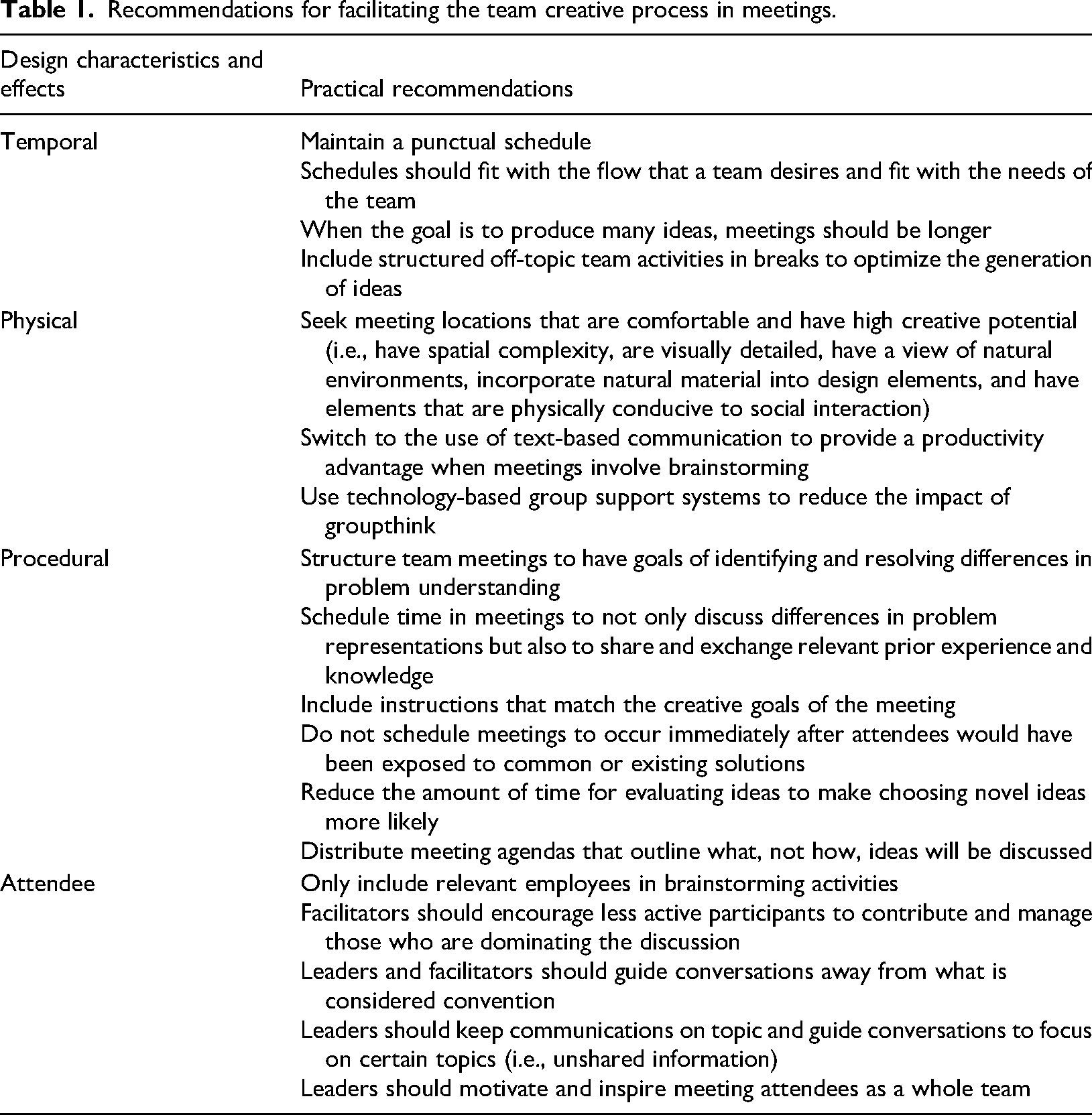
In this article, we reviewed research related to team creativity in meetings and developed a multi-level model of how meetings influence the creative process for individuals and teams. The model brings forward an initial theoretical perspective on the nature of emergence from individual creative cognition to team creative processes. Constructive, generative, and evaluative processes and their influence on each other within and between levels were detailed. Additionally, a second aim of our paper was to synthesize meetings and creativity research in order to understand how meetings factors influence creative functioning. A summary of the proposed practical recommendations is presented in Table 1.
Recommendations for facilitating the team creative process in meetings.
Our proposed model was created using both theoretically proposed relationships and empirically known relationships among individual-level and team-level constructs. However, we note that there is limited research on the team creative process in meetings as a whole. Much of the research on creativity in meetings focuses on one process—that of generation or brainstorming. Future research should look to examine this type of meeting in natural and laboratory settings to better understand how individual and team-level creative processes unfold in meetings. Creative problem-solving is not always a linear process (Mumford et al., 1991), and teams and organizations vary in how they engage in creative processes (Harvey & Kou, 2013). Additional research is needed to understand how and why teams move between processes and study creative processes in meetings in a dynamic fashion. Evaluating team behaviors and member interactions may help accomplish this goal. Methods of coding team interactions used in previous meetings research (e.g., Kauffeld & Lehmann-Willenbrock, 2012; Lehmann-Willenbrock & Allen, 2014) can be especially useful for further studying the team creative process in meetings.
Additionally, as the emergence of team-level constructive, generative, and evaluative processes is central to our model and emphasized by our propositions, we stress the importance of studying the team creative process in meetings using longitudinal designs. Measuring psychological variables at multiple time points (e.g., multiple times per meeting or in multiple meetings) would allow researchers to observe when processes change (Mitchell & James, 2001). Studying variables associated with team processes over time can better elucidate their emergence (Kozlowski & Klein, 2000). Creativity at the individual level is a complex phenomenon; this complexity is only magnified as creativity emerges at the team level. Not all aspects of emergence were able to be detailed in this review article. For example, this review made only a few statements concerning the dynamics of the creative process in meetings. More research is needed on how emergent creative properties evolve within a single meeting and from meeting to meeting.
Further, as the study of creativity in meetings is relatively new, there may be additional meeting characteristics that influence creativity outcomes that have yet to be uncovered. The study of the use of technology as part of meeting characteristics for both fully remote meetings and hybrid meetings should also be included. In addition, the development of more advanced tools that are available for meeting software such as whiteboards, screen sharing, file sharing, and so on adds to the toolbox of meeting facilitators, but has yet to be studied within the context of team meetings that result in creative outcomes (Reiter-Palmon et al., 2021).
Although the model proposed in this article seeks to be thorough in outlining direct and relevant influences on the team creative process in meetings, there are a number of areas of meetings and creativity research that were excluded to be parsimonious. The proposed model is limited to meetings that involve team activity. However, not all meetings involve teams (Olien et al., 2015). For example, meetings that result in creative outcomes may occur between a leader and a follower. Future research should seek to expand the model of the team creative process in meetings to other types of meetings. For such dyads, individual-level creative processes may not emerge into higher-level processes in the manner outlined in the team meetings creative process model. Despite the limitations of the model proposed in this work, we believe the integration of meetings and creativity research strengthens both literatures.
Footnotes
Funding
The author(s) received no financial support for the research, authorship, and/or publication of this article.
