



Abstract
Given the focal role that group and team meetings play in shaping employees’ work lives (and schedules), the scarcity of conceptual and empirical attention to the topic in extant organizational psychology research is a major oversight that stalls scientific understanding of organizational behavior more broadly. With the explosion of meetings in recent years, in part due to the COVID-19 pandemic, some even wonder why organizational psychology has not already figured out meetings from both a science and practice perspective. The purpose of this paper is to synthesize the extant literature on the science of workplace meetings and sort the works by identifying the key features of the meeting phenomenon. The five key features of workplace meetings identified include Leading, Interacting, Managing Time, Engaging, and Relating. We couch these features within a larger framework of how meetings are the intersection of collaboration in organizations and indispensable to organizational success. Against this conceptual backdrop, we reviewed a total of 253 publications, noting opportunities for future research and discussing practical implications.
Plain Language Summary
Given the focal role that group and team meetings play in shaping employees’ work lives (and schedules), the scarcity of conceptual and empirical attention in extant organizational psychology research is a major oversight that stalls scientific understanding of organizational behavior more broadly. With the explosion of meetings that has occurred in recent years, in part due to the COVID-19 pandemic, some even wonder why organizational psychology has not already figured out meetings from both a science and practice perspective. The purpose of this paper is to review the literature on the science of workplace meetings by identifying the core features of the phenomenon and sorting the extant literature along these features. The five core features identified include leading, interacting, managing time, engaging, relating. We couch these features within a larger framework of how meetings are the intersection of collaboration in organizations and a major key to organizational success. Against this conceptual backdrop, we reviewed a total of 253 publications, noting opportunities for future research and discussing practical implications. We conclude our review with an overview of the special issue on workplace meetings, which is an overt attempt to launch research that will fill the theoretical and conceptual gap in the science of meetings.
Meetings in the workplace: a review and research agenda
Meetings are essential in order to accomplish coordination, collaboration, sensemaking, and organizational strategy. Employees currently attend between 11 and 15 meetings every single week, on average. A study of CEOs found that they attend 37 meetings per workweek (Porter & Nohria, 2018). With the rapid rise of remote work and virtual and hybrid meeting practices, the amount of work time spent in meetings has climbed even further, with employees’ weekly meeting time increasing by 10% (roughly three additional meetings per week; Microsoft, 2020). Given these numbers, one would assume that organizational psychologists widely recognize the profound relevance of workplace meetings in shaping employees’ lives and organizational functioning more broadly, and consequently invest the majority of their research efforts into understanding workplace meetings. This is decidedly not the case, however. This paper intends to overcome this problematic divide between organizational life and scholarly focus within organizational psychology by positioning meetings as a standalone research phenomenon.
Specifically, we posit that meetings are central to organizational life, being both constituted and reconstituted by the individuals, groups/teams, and organizations in which the meetings occur (see Figure 1). One cannot initiate a meeting without considering the individuals who would be invited to the meeting, the groups that they come from and will then form when attending the meeting, and the organization(s) they represent. Although many of these thoughts may be automatic for some meeting types (e.g., the staff meeting, Kello & Allen, 2020), other meetings that involve high-stakes decisions or the building of partnerships across institutions may require extensive consideration of these factors. For example, one would not want to try to start a partnership related to shipping logistics between Coca Cola and Pepsi by including a selection of only Pepsi products as drink offerings for the two-hour strategy session.
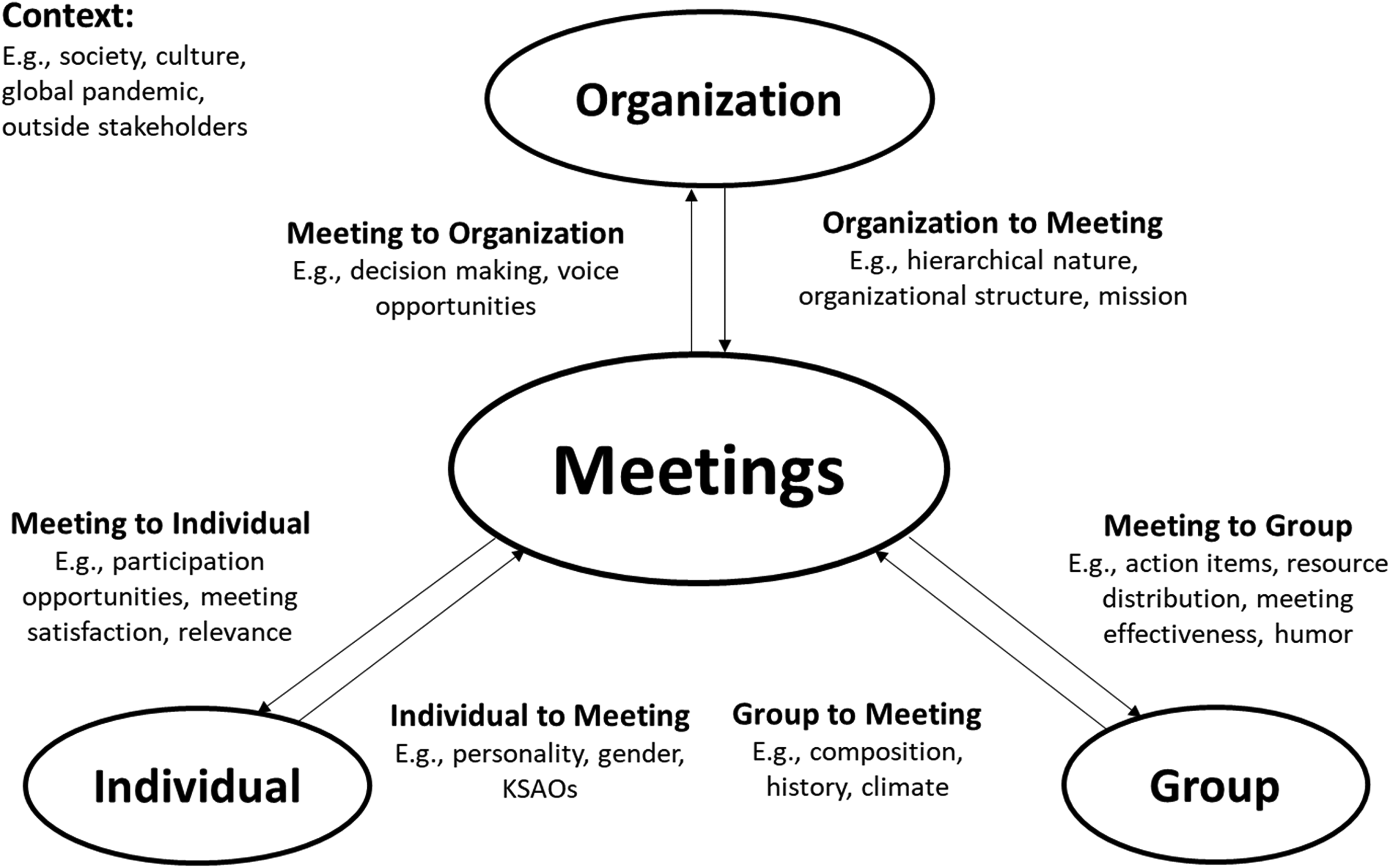
The intersection of the meeting with the various levels of individual, group/team, and organizational functioning.
Understanding the centrality of meetings in organizational life, we identified a major problem that motivated us to engage in the review and research agenda presented here. Specifically, researchers appear to be disconnected and disjointed from one another regarding the nature of the meetings phenomenon. Following best-practice recommendations for literature reviews (e.g., Short, 2009) and using professional networks, we identified publications focused on various aspects of and studies connected to workplace meetings. Because some studies that cover the same overarching topic appear to have been developed and deployed simultaneously, different conceptualizations of the boundaries of what meetings are and are not emerged. No unifying theory or understanding of what meetings are (and are not) has arisen from these disparate studies. Some scholars have investigated counterproductive meeting behaviors (Lehmann-Willenbrock et al., 2016a, 2016b; Yoerger et al., 2017), as one example, whereas others discuss meeting incivility (Odermatt et al., 2018) or negativity episodes during workplace meeting interactions (Gerpott et al., 2020), apparently without awareness of the substantial conceptual overlap of these constructs. One reason for this is that researchers cannot look to a unifying theory of meetings, or even a comprehensive review and guidance for interconnections between relevant constructs within the meeting phenomenon.
Thus, the overarching purpose of the current review is to move towards a framework that can focus researchers on what is important about meetings, while being inclusive of the many researchers contributing to the body of meeting science. We sought to identify the key features of meetings that, if truly understood, would give us a comprehensive understanding of the phenomenon as well as guide much of the needed future research. We begin by defining the research domain and describing the method of our literature review process. We then identify the five key features of meetings that emerged from the review of literature as encompassing the characteristics that enable the meeting as the intersection of individual, group/team, and organizational functioning. Lastly, we address the implications of these findings for the why, how, and what of workplace meetings, in order to establish how the literature paints a picture of organizational life through meetings.
Defining workplace meetings
Meetings across organizations of various sizes and industries have increased in frequency and importance, especially as organizations embrace structures that are more participative (e.g., Porter & Nohria, 2018). Meeting science is, in brief, the study of what takes place just prior to, during, and right after a meeting (e.g., Allen et al., 2015a, 2015b; Lehmann-Willenbrock et al., 2018; Rogelberg, 2019). However, the definition of a meeting, with intellectual roots in anthropology, has evolved over recent years. Schwartzman's (1989) first scientific inquiry of meetings provided a deep and rich description of meetings in a U.S. health organization and similar meetings in non-Western contexts. Critically, meetings were used for the typical, intuitive reasons (sharing information, making decisions, etc.), and were also a venue for organizational leaders to present key aspects of an organization and its culture to members. Schwartzman focused on pre-arranged, work-focused gatherings of three or more people and observed the purposes, processes, and outcomes of their meetings. Researchers slowly began to heed Schwartzman's call for the systematic, scientific study of the meeting itself. In the late 1990s through the mid-2000s, meeting science began to develop as scholars from various fields applied additional methods and techniques to the study of meetings (Allen et al., 2015a, 2015b). Industrial and organizational psychologists sought to understand the experience of employees in meetings via surveys (e.g., Rogelberg et al., 2006), while communication scholars were more interested in the words used and the dialectic meaning derived within meetings (e.g., Tracy & Dimock, 2004). Further, organizational scholars with a focus on groups and teams research introduced dynamic social interaction and sequential analysis of talk in meetings, attempting to tease out meaningful processes within the meetings among groups (Kauffeld & Lehmann-Willenbrock, 2012).
Earlier definitions have described meetings as “organizational communication involving more than two persons” (Svennevig, 2012, p. 3), which aligns with the psychological understanding that a group of two people interacting has different interpersonal and task dynamics than workplace meetings of three or more (cf. Moreland, 2010; Panko & Kinney, 1992). This distinction is probably most on display in the meetings research focused on communicative dynamics over time (e.g., Lehmann-Willenbrock & Allen, 2018). Specifically, the number of paths and directions of communication increases exponentially when transitioning from a two-person to a three-or-more-person interaction (e.g., Person A to Person B to Person A in a dyad versus Person A to Person C to Person B to Person A to Person B and so on in a trio). Meetings of three or more persons have an overt interactional difference that greatly impacts the interpersonal dynamics compared to dyads (e.g., Lehmann-Willenbrock & Allen, 2014). Further, there is a large and robust body of literature on dyads and dyadic interaction that has already received a review (see Gooty & Yammarino, 2011 for a review). We thus decided to exclude the dyadic literature from the scope of our review to provide parameters. However, we encourage the readers to be mindful of this research when exploring their next research question related to meeting science. For our purposes, we adopt the contemporary scholarly definition of workplace meetings (Mroz et al., 2018a, 2018b); i.e., three or more individuals coming together to discuss a work-related matter.
One major question that arose as meeting science began to grow was the degree to which the area of study is simply a repackaging of groups and team science. Olien and colleagues (2015) argued that the specific questions posed by meeting science—for example, how meetings relate to organizational culture (e.g., Schwartzman, 1989), emotional labor in meetings (e.g., Erks et al., 2017), and the effects of meeting preparation on meeting outcomes (e.g., Cohen et al., 2011)—extend beyond traditional team science. That said, meeting scientists need not isolate themselves from team science, nor should team science ignore meeting science. Olien and colleagues further added that “it would be foolhardy to ignore previous bodies of work outside the meetings space that may inform future meeting science” (p. 15). It is important to recognize that meeting science is related to and can be informed by groups and teams science, and vice versa. Given the definition of meetings applied here, some, though certainly not all, of the research reviewed would indeed fall within the scope of groups and teams literature. The distinction between the two rests on whether the authors are also informing their work from the meeting science space, thereby joining these two bodies of literature.
It should be noted that we did not focus on specific meeting types for this review (with the exception of a section on public meetings), but rather sought to present a review of meetings research in general. We understand that a range of types of meetings (depending on specific purpose) can be distinguished within the previously defined scope of workplace meetings, including idea generation and problem-solving meetings (Allen et al., 2014). Our reasoning for not focusing on a specific meeting type or types is twofold. First, some meeting types have received considerable attention from researchers, and reviews of literature on those meeting types are already available (e.g., AARs and debriefs; Allen et al., 2018a, 2018b). Second, the literature on some meeting types is sufficiently limited to prevent reaching overarching conclusions that would necessitate a full review (e.g., McComas, 2003).
Method and organization of review
Workplace meeting research is an interdisciplinary field of literature spanning journals in management, multiple areas of psychology, sociology, communication, and information technology. Figure 2 illustrates the growth of meetings research (i.e., studies that consider meetings as a relevant phenomenon in and of themselves). For the last several years, we have maintained a database of meetings-related articles, with one final search prior to the drafting of this literature review. We utilized literature search procedures outlined by Short (2009) and Landis (2016) that are detailed below to maintain quality control.
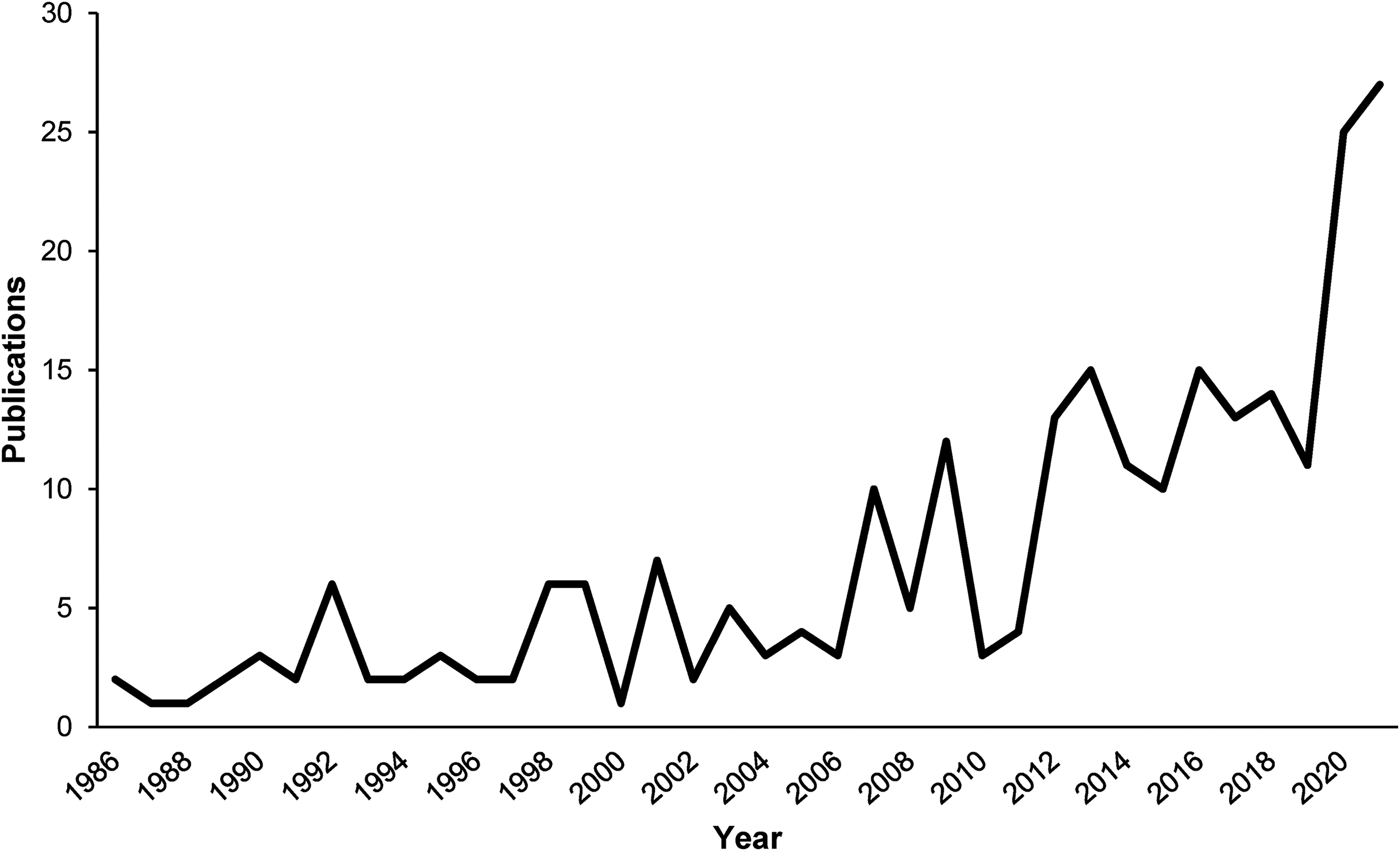
The number of publications focused on workplace meetings by year. We identified 253 publications, and the number has been expanding significantly since the mid-2000s. There were 3 publications between 1950 and 1985 that are excluded from the chart for ease of display.
First, we searched electronic databases including PsycINFO, EBSCO, Google Scholar, and Web of Science for the following keywords related to workplace meetings: “workplace meeting,” “meetings,” “team meetings,” “group meetings,” “organizational meetings,” “meeting science,” and “business meetings.” Second, we conducted targeted keyword searches of the following journals that have published meetings-related content: Administrative Science Quarterly; Academy of Management Journal; Journal of Management; Journal of Organizational Behavior; Journal of Applied Psychology; Journal of Business and Psychology; Management Communication Quarterly; International Journal of Business Communication; Management Research Review; Journal of Management Development; Consulting Psychology Journal; Journal of Managerial Psychology; Small Group Research; Group Processes & Intergroup Relations; Group & Organization Management; Group Dynamics: Theory, Research, & Practice; Discourse Studies; and Journal of Occupational and Organizational Psychology. Next, we reviewed the reference list of all articles to identify meetings-related research that cited or was cited in the initial articles. We then contacted various meetings scholars for assistance in locating any further articles. We identified a total of 307 articles as candidates for the review.
Article selection process
Each article was initially evaluated based on its title, abstract, and keywords. Following that evaluation, articles were reviewed and assessed, and titles were documented for ease of coding and processing. We then removed all papers that appeared in published conference proceedings, edited volumes, and non-peer-reviewed sources. The final publication pool consisted of 253 items, including quantitative, qualitative, and theoretical works. Figure 2 depicts the number of meetings-related publications by year. Since the mid-2000s, the number of papers published yearly has increased significantly, with a peak of 27 papers in 2020.
We each independently reviewed the titles and abstracts of all 253 papers (and frequently the entire papers, when abstracts were not sufficient for grasping the essence and subsequently categorizing the paper) in an effort to identify themes or key features that describe a large portion of the manuscripts. We then came together and finalized a list of five key features of workplace meetings we believed would describe the current literature. We had a 91% agreement across the articles and discussed all disagreements, resolving them such that each article was assigned to only one key feature of workplace meetings as per our framework.
Results
Table 1 provides a summary of the findings across the five key features, including the definition of the key feature, examples from the list of articles, the number of articles that fit the feature, and the percent of the total literature within each feature. The key feature of Leading included 48 articles, representing 19.1% of the reviewed literature. Interacting was addressed in 89 articles, or 35.5%. Managing Time was considered by 39 articles, or 15.5%. Engaging was covered by 53 articles, amounting or 21.1%. Finally, Relating included only 22 articles, or 8.8%.
Thematic analysis of the meetings literature.
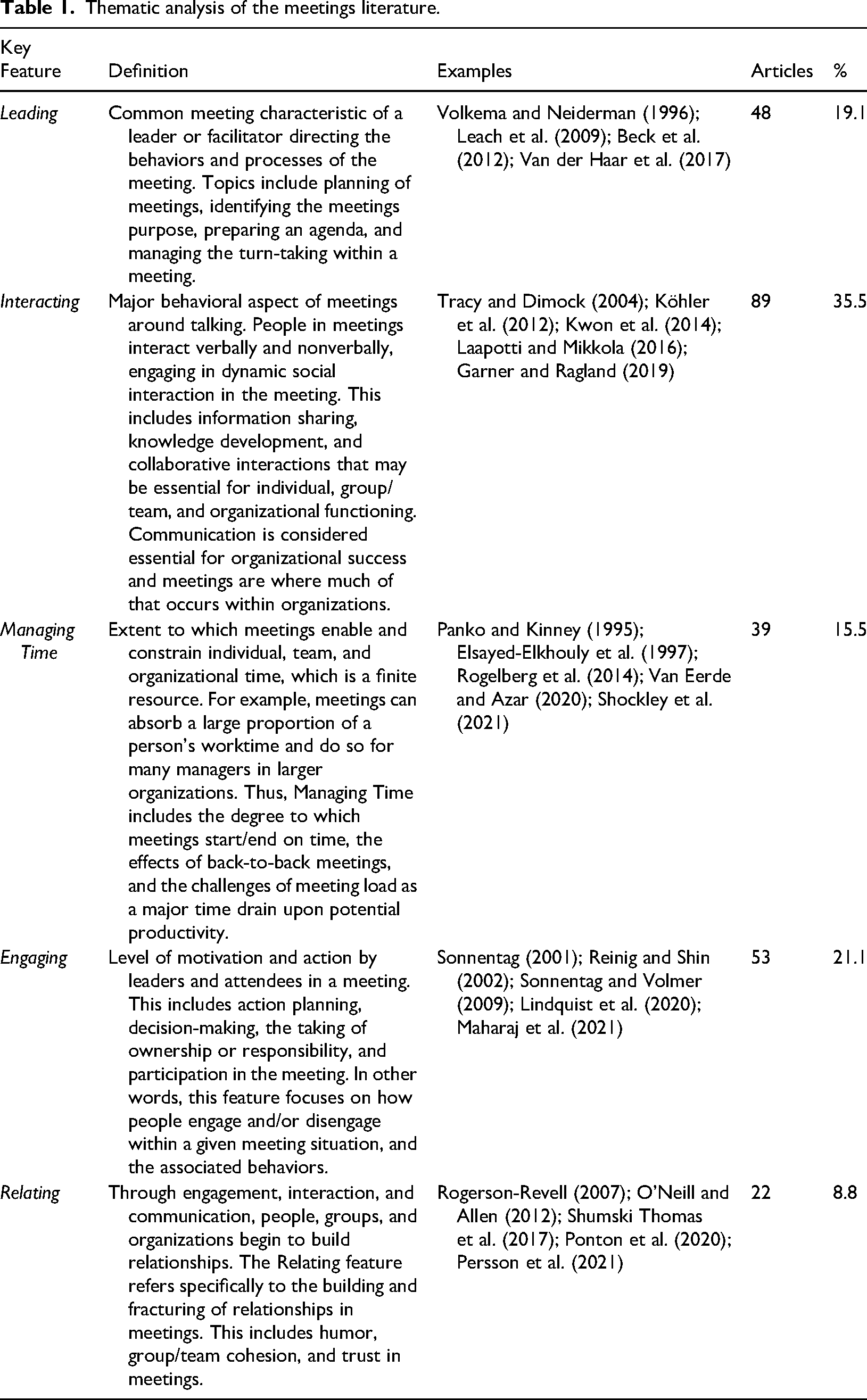
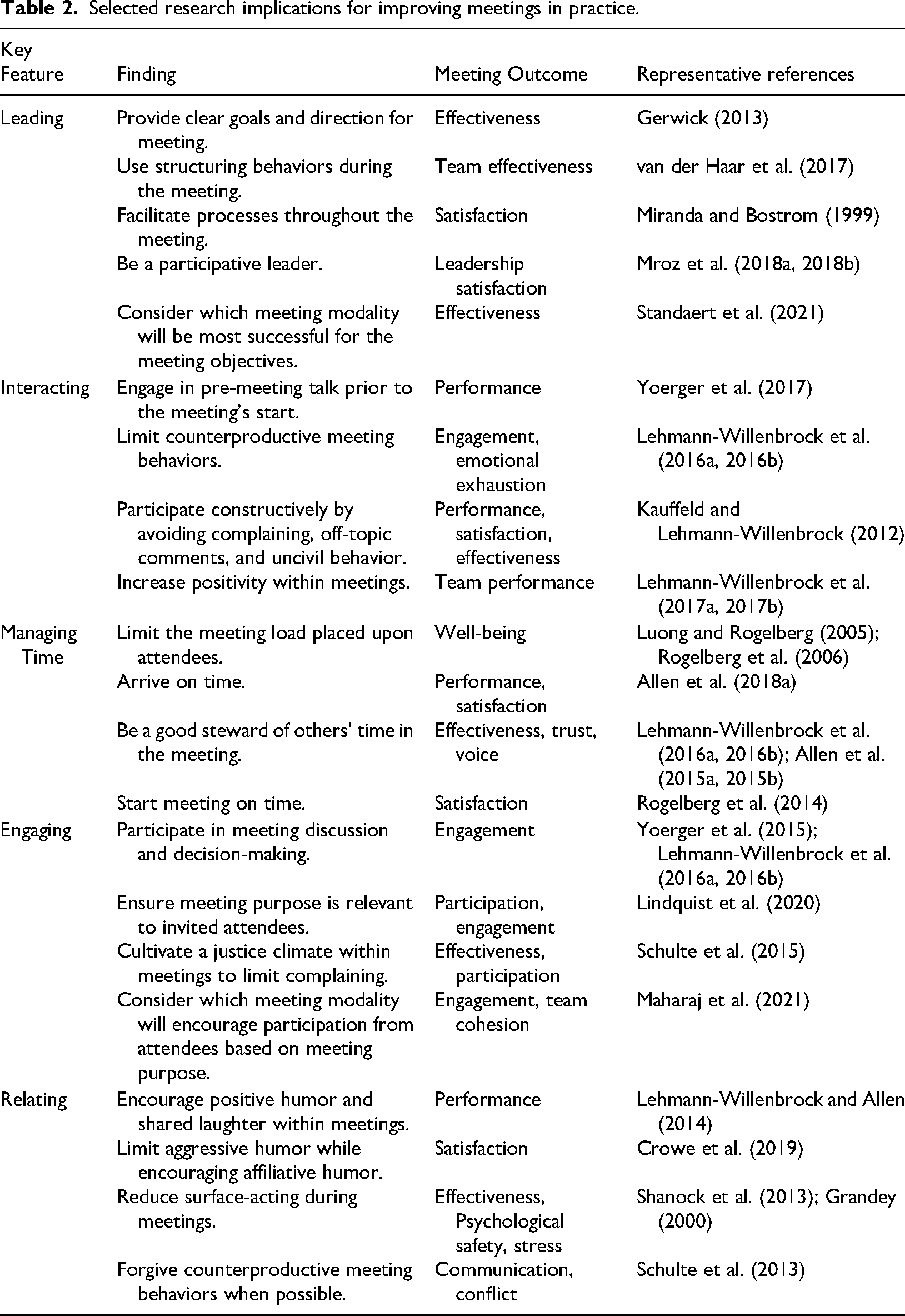
To facilitate practical and meaningful guidance for both researchers and managers, we also created Table 2, which summarizes some of the main findings across the five key features with representative references for further reading. Here we provide a review and critique of the literature based upon these five features in an effort to identify both the current state of the literature and the pronounced gaps therein.
Selected research implications for improving meetings in practice.
Leading
Successful meeting management has become a key leadership task (Çalışkan & Özdemir, 2018; Green & Lazarus, 1991; Myrsiades, 2000). Leading in meetings means selecting appropriate design characteristics (e.g., Carlozzi, 1999; Nixon & Littlepage, 1992), meeting formats (Standaert et al., 2021), or group support systems (GSS) to help facilitate meetings. Recommendations for successful meeting leadership also underscore the importance of good meeting preparation, such as providing clear goals and direction for the meeting (e.g., Gerwick, 2013; Jay, 1976; LeBlanc & Nosik, 2019; Tobia & Becker, 1990).
Inside the meeting, helpful leader behaviors include directing, structuring, contributing ideas and solutions, facilitating decision-making, and setting boundaries(Angouri & Marra, 2011; Lehmann-Willenbrock et al., 2015; Malouff et al., 2012; Pearson, 1989; van der Haar et al., 2017; Wodak et al., 2011). Research on followers’ perceptions of meeting leadership points to the benefits of a considerate (Odermatt et al., 2016) and participative (Mroz et al., 2018a, 2018b) leadership style, as well as a high-quality perceived leader-member exchange (Baran et al., 2012). Moreover, one study showed how perceived power distance and Leader member exchange (LMX) contribute to followers’ emotional labor in meetings (Erks et al., 2017), suggesting that meeting leaders can play an influential role in managing employee well-being.
We draw two conclusions regarding the Leading feature of workplace meetings. First, the literature on leadership practices in and around meetings and the literature on design characteristics of meetings have developed independently for the most part. We therefore strongly recommend integrative studies of how leaders have great control on the design aspects of meetings and how these design characteristics interact with leader behavioral styles inside the meeting to enable or challenge effective meeting practices. Second, we found only one exploratory study that examined ways to actively improve meeting leadership (Perkins, 2009). Given the key role that meetings play in shaping everyday work experiences, attitudes, and well-being, and the substantial time commitment meetings represent in leaders’ work schedules, we encourage organizational psychologists to gather more evidence for actively improving meeting leadership practices.
Interacting
Research on the Interacting feature of meetings has examined a broad range of topics regarding interaction and communication. These include how agenda topics are discussed (Svennevig, 2012), how questions are asked and information is exchanged (Arber, 2008, Demiris et al., 2008), and how group decisions are made and consensus is reached (Barnes, 2007; Huisman, 2001; Kim & Rudin, 2014; Kwon et al., 2014). Counterproductive interaction behavior in meetings, particularly complaining, has been a topic of some interest given its negative meeting outcomes (e.g., Kauffeld & Lehmann-Willenbrock, 2012; Schulte et al., 2013), with research indicating that procedural communication can inhibit and thus counteract this behavior (Klonek et al., 2016; Lehmann-Willenbrock et al., 2013). One study considered how organizational structures are preserved and reproduced in meetings (Laapotti & Mikkola, 2016). However, no study to date has considered contextual influences such as organizational climate on the occurrence of counterproductive meeting behavior. Interacting in meetings also concerns expressions of gender differences and individual identities (Fasulo & Zucchermaglio, 2002; Jones, 1992), individual roles expressed during meetings (Lehmann-Willenbrock et al., 2016a, 2016b; Nissi & Lehtinen, 2016), and leader-follower dynamics in meeting conversations (Chan, 2007; Clifton, 2014; Nielsen, 2009). Team behavioral phenomena that are part of the Interacting feature of meetings include positivity spirals (Lehmann-Willenbrock et al., 2017a, 2017b) and group affective tone (Schneider et al., 2018). Moreover, several studies have considered Interacting in the scope of virtual meetings (Anderson et al., 2007; Markman, 2009; Sox et al., 2014).
Taken together, these findings highlight the richness and complexity of communicative dynamics inside workplace meetings and point to a need for more integrative research approaches to the Interacting feature. Most of what has been studied focuses on one type of behavior or a few behaviors, either verbal or nonverbal, in the flow of interaction in meetings. A more holistic approach to the Interacting feature would account for dynamic interaction processes during meetings, where multiple behaviors are modeled through sequential analysis and other pattern analytic strategies to allow for a predictive approach to meeting processes. Future empirical work on the Interacting feature of workplace meetings can purse multimodal approaches to interaction behavior, considering the interplay of various social signals in workplace meetings (e.g., Lehmann-Willenbrock et al., 2017a, 2017b). For example, previous work at the intersection of organizational psychology and computer science indicates that micro-level behavioral mimicry during meetings contributes to cohesive team interactions (Nanninga et al., 2017). We hope to encourage more of these types of interdisciplinary approaches in order to tackle the complexity of the Interacting feature.
Moreover, more insights into the link between observable interaction behavior and perceptions of the behavior (Beck & Keyton, 2009) would be useful in order to advance our understanding of the Interacting feature. For instance, when a series of behaviors occurs, how do people perceive those behaviors in real time and what do they do as a result of this perception? Knowing the likely next behavior after a given behavior would allow for proactive meeting management (e.g., “They are about to get into a complaining cycle, so I should engage in procedural communication.”), rather than reactive meeting management (e.g., “We have been complaining about this for five minutes, I should engage in procedural communication to get us back on topic.”).
Managing time
Managing Time focuses on how the finite organizational resource of time is allocated and managed in relation to meetings at the individual, team, and organizational level. Interestingly, the temporal characteristics of meetings such as duration represent one of the earlier areas of inquiry in meeting science (e.g., Panko & Kinney, 1995). Elsayed-Elkhouly and colleagues (1997), for instance, explored why nearly one-third of meeting time is wasted time. Their perspective was the time in the meetings was not managed correctly due to a variety of process issues. Luong and Rogelberg (2005) first proposed the stressor approach to the study of meetings when they found that meeting load (number of meetings attended per day and time spent in meetings each day) was negatively related to employee well-being (fatigue, perceived workload, etc.; Rogelberg et al., 2006). These both demonstrate how meeting time absorbs time from other work and that time in meetings is not always used well.
Part of the challenge in managing time in meetings stems from the fact that so much of the behavior in meetings is counterproductive. People believe meetings are time-wasters and often are organized without a defined purpose (Ravn, 2013). In response to these attitudes, meeting attendees and leaders engage in counterproductive meeting behaviors or CMBs (e.g., Lehmann-Willenbrock and colleagues, 2016a, 2016b). The original conceptualization of CMBs by Lehmann-Willenbrock and colleagues (2016a, 2016b) included complaining, criticizing others, shifting responsibility, blaming others, using empty phrases or random sayings, as well as meeting lateness, which is directly associated with the management of meeting time.
Lateness is typically studied as a problem of time management, and lateness has been shown to cause lots of stress (Rogelberg et al., 2014). Meeting lateness refers to attendees arriving to a meeting past the scheduled start time, or to a meeting that begins after its scheduled start time (Rogelberg et al., 2014). Recent cross-cultural findings from China, Germany, Italy, The Netherlands, and the U.S. show that meeting lateness is a pervasive phenomenon, with 44 to 55 per cent of regular meetings starting late because at least one attendee does not show up on time (Allen et al., 2021). Meeting lateness has been observed to result in organizational costs with wasted time and resources (Rogelberg et al., 2012), to damage interpersonal relationships (Mroz & Allen, 2017), to negatively affect the ways groups communicate (Lehmann-Willenbrock & Allen, 2020), and to harm group performance (Allen et al., 2018a, 2018b).
Unfortunately, most of the other CMBs and their associated connection to managing time in and around meetings have not been studied. Recent work events instead turned attention to issues of the potential time drain and fatiguing nature of the modern meeting modality, virtual meetings (e.g., Bennett et al., 2021; Nesher Shoshan & Wehrt, in press). Shockley and colleagues (2021) found that being on camera for virtual meetings created more fatigue, suggesting that individual attendees should leave their camara off in order to protect their well-being. Yet, following this recommendation will negatively affect group processes inside the meeting, including detrimental effects regarding the Interacting, Engaging, and Relating features of meetings. This in turn can impair meeting effectiveness overall, while at the same time contributing further to individual experiences of time drain and fatigue from virtual meetings. Thus, even as more work continues on various CMBs and meeting modalities, major gaps in the current state of the literature suggest a lack of focus once again.
Engaging
Engaging in meetings refers primarily to the level of motivation and action by leaders and attendees in and resulting from the meeting. Good meetings draw attendees in, boost individual participation, and enable collaboration (Olson et al., 1992; Sonnentag, 2001; Sonnentag & Volmer, 2009). Meeting attendee engagement is also a necessary prerequisite for building consensus, making group decisions, and creating commitment to implement solutions (Christiansen & Varnes, 2007; Cox, 1987; Halvorsen & Sarangi, 2015; Kriesberg & Guetzkow, 1950; Leach, 2016; Santos et al., 2017; Yoerger et al., 2015).
The Engaging feature bridges participation in the meeting and beyond. Several studies showed that participation and engagement inside the meeting fosters overall employee engagement on the job (Lehmann-Willenbrock et al., 2016a, 2016b; Yoerger et al., 2015). Participation can be enabled or constrained by the processes that occur inside the meeting (e.g., Allen et al., 2015a, 2015b) as well as contextual influences in the surrounding organizational environment, such as procedural justice perceptions (Schulte et al., 2015).
Yet, the question of how people actually participate in meetings, verbally or by other means, still leaves room for investigation. In an attempt to get more specific, Lindquist and colleagues (2020) explored some of the barriers to participation in meetings. They found that people tend to speak up in meetings when they have something to say. The more relevant the meeting was, the more likely people were to engage and share their ideas. This research stopped short of identifying how those contributions would be actually enacted within the flow of the meeting, however. To address this, research needs to integrate the Engaging and Interacting features of meetings. Building this bridge seems particularly pertinent given the challenges to individual attendee engagement in virtual meetings, such as because of multitasking when there is one virtual meeting after another (Cao et al., 2021). Indeed, recent findings show that meeting attendees experience lower participation in virtual and hybrid meeting formats (Reed & Allen, 2022). Virtual and hybrid meetings introduce new challenges for participation and engagement in meetings. For example, one of the most common phrases in workplace meetings today is “you’re on mute.” Having to repeat one's message because others did not hear it, or not being able to easily hear others, comes with frustrations and hampers the Engaging feature.
Relating
Relating refers primarily to the relationship-generating nature of meetings, and how meetings build and fracture relationships and communities. A prominent example of the Relating feature concerns the use of humor during meetings. Several publications emphasize the benefits of positive humor and shared laughter as a resource that is expressed and utilized in meetings (Kangasharju & Nikko, 2009; Lehmann-Willenbrock & Allen, 2014; Markaki et al., 2010). However, humor use in meetings is not always inclusive. Rogerson-Revell (2007) studied intercultural business meetings and found that humor was used as a means to shift the meeting toward more informality. For the majority or “in-group” in such a meeting, humor can foster collaboration and inclusion by signaling solidarity and power. However, the “out-group” in the meeting can feel excluded. Another study by Crowe and colleagues (2019) found that affiliative humor in meetings has the potential to foster positive meeting experiences, while aggressive humor leads to negative meeting experiences. Hence, humor is not just a side note in meetings, but an important ingredient for the Relating feature.
Whereas shared humor in meetings can be a positive, shared affective experience, research also shows that employees engage in emotional labor in meetings (i.e., faking or changing one's emotions to align with organizational demands), which is a significant source of stress (Grandey, 2000). Employees are more likely to engage in surface acting in meetings when higher-status individuals are present (Nyquist et al., 2018; Shumski Thomas et al., 2017). Surface acting in meetings is negatively related to perceptions of psychological safety and meeting effectiveness (Shanock et al., 2013), and the effect can moderated by job level such that higher-level individuals perceive meetings as less effective when they surface act compared to lower-level meeting attendees (Shumski Thomas et al., 2017). In other words, meetings with higher-level organizational leaders can create a situation where relating and relationship building is constrained by the drain of personal resources spent on engaging in emotional labor.
The massive, global shift in meeting practices toward virtual formats that resulted from the COVID-19 pandemic continues to impact the Relating feature. Meeting science is beginning to address this (e.g., Shockley et al., 2021; Karl et al., 2021). In order to move beyond describing current virtual and hybrid meeting practices and understand the psychological mechanisms that explain how and why Relating may be challenged in virtual and hybrid meeting formats, experimental designs can be implemented to ultimately help identify the optimal meeting modality by task and purpose.
Discussion
The foregoing results from the literature review demonstrated both the wealth of knowledge gained in recent years concerning workplace meetings and the stark gaps in our understanding that need additional attention. To help provide guidance for researchers and practitioners, we provide here a structured set of research implications exploring the five key features around the why, how, and what of meetings at work. We follow this with details for practitioners to consider when seeking to improve workplace meetings in their organizations and conclude with a forward-thinking charge to meeting scientists everywhere to keep going--albeit in a more unified, theory-driven manner.
Research implications: the why, how, and what of meetings at work
There is an undeniable gap when we consider the ubiquitous organizational practice of workplace meetings against the limited amount of scientific attention invested in this phenomenon. However, our review of the field along the five key features of workplace meetings also shows that the literature on the topic is varied, interdisciplinary, and rapidly expanding. Meetings are core to individual, group, and organizational function, as discussed in many of the articles reviewed (depicted in Figure 1). There is continued interest among leaders in organizations to understand how to make meetings more effective, more egalitarian, and simply better (WSJ). Thus, assuming that the trajectory depicted in Figure 2 continues, meeting science will quickly become a core topic in organizational research.
Given what we have learned from research spanning these five key features and the overall framing around meetings as the intersecting point of work life, we found that many important research questions remain. We started to recognize that imagining a better meeting experience and figuring out how to arrive there might motivate researchers, like us, to explore why meetings matter, how they happen, and what happens in them. We review each of these areas here and the questions that came up in our reflections about the five key features and their intersection point within organizational life for employees and leaders.
Why meetings matter
Much previous work has focused on the intricate social dynamics within one meeting, but a major area of needed inquiry concerns insights into the broader organizational meeting space and into dynamic linkages between meetings. For example, while our own research has shown that patterns of shared humor and laughter in meetings matter because they relate to team performance (Lehmann-Willenbrock & Allen, 2014), we know nothing about the ways in which teams use humor across different meetings, or how team outcomes develop relative to fluctuating meeting experiences over time. Regarding the Interacting and Relating key features, we need to track the dynamic interaction patterns over time for individuals in groups as they travel from meeting to meeting and group to group. The findings from such research could help explain current general feelings about meetings (e.g., Allen et al., 2012) as well as provide insights into the patterns that meeting leaders may want to contain, control, or emphasize. Such research may also provide further examples of how meetings intersect with individuals and their groups (see Figure 1).
Future research, for example, can investigate how meeting leaders can encourage meeting citizenship behavior (cf. Baran et al., 2012), boost positivity (Lehmann-Willenbrock et al., 2017a, 2017b), or promote motivation for change when the meeting composition is unstable (Klonek et al., 2015). Moreover, we encourage meeting scholars to think about how meeting factors and organizational outcomes (which are subject to reciprocal influences in the context of one meeting) may be continually shaped from one meeting to the next as depicted in Figure 1. For instance, how does the design of the meeting affect within-meeting dynamics? How do within-meeting experiences—good or bad—affect questions around how future meetings happen, such as the choice to invest effort into a face-to-face meeting, meeting only virtually, or not meeting at all?
Future meeting science should also consider why and how meetings impact employee well-being and performance more broadly. Considerable research has focused on how meeting outcomes relate to individual job attitudes and well-being, but no previous studies have explored the effects of meetings on employee attitudes and well-being over time. Regarding the Managing Time key feature, one might wonder what happens to a person's job attitudes as they move from one meeting to the next all day long. Taken one-step further, what happens when employees’ meeting load (i.e., number of meetings a day and time in meetings) increases to the point that they struggle to get anything done outside meetings? The ever-increasing meeting load drives counterproductive meeting behaviors, some of which include engaging in work-related tasks that are unrelated to the meeting at hand. Employees in remote settings already experience the struggle to do anything outside the many virtual meetings every day (Cao et al., 2021); thus, the sample for studying that phenomenon exists. Some of these questions are easily explored via survey methodologies, while others may require more intensive observational processes to capture the longitudinal effects of meeting attendance on employee attitudes and well-being more broadly.
How meetings happen
Perhaps the most notable and obvious opportunity for new research in this domain consists of bringing together basic meeting procedures (e.g., agenda, room setup, etc.) with both ICT and GSS. This idea cuts across the five key features and embraces the notion of technology in meetings, something that suddenly became important in 2020 for a great number of individuals, groups, teams, and organizations (e.g., Reed & Allen, 2021). Each of these meeting design areas, ICT and GSS, have been shown to improve meetings generally from both a process and outcome perspective. However, it is unclear if bringing them together would create an additive effect or ultimately detract from the meeting due to overly complex design efforts. Experimental setups in controlled laboratory settings with both face-to-face and distributed modalities (e.g., hybrid meetings) would be ideal for manipulating these factors and determining their combined causal relationships to meeting outcomes, such as meeting satisfaction and effectiveness.
More speculatively within the Leading feature, there are a variety of design characteristics that have been identified and that are under the control of the leader, and to some degree, the attendees of meetings. There is a need to query both the human factors and ergonomics literature and involve scientists in these disciplines to discover the optimal meeting room setup across modalities. These questions reside at both the individual-level influence of the meeting and the group influence of the meeting (see Figure 1). Cohen et al. (2011) found that ergonomic factors (e.g., seating and lighting) matter to meeting quality; however, neither human factors nor ergonomics researchers were involved with the design of the study or the interpretation of the results. Meeting scientists can leverage existing knowledge in these fields to design an experimental framework that can help establish which design factors are essential for effective meetings. Meetings occur in very different environments that range from seated arrangements in board rooms to standing meetings next to busy highways (e.g., transportation construction safety briefings). An understanding of what design factors are essential could lead to different decisions on timing and so forth of a meeting in the different meeting locations.
What happens in meetings
Several of the key features of workplace meetings come together in the “what happens in meetings” space, and there are several areas for future research. For example, considering Interacting and Managing Time features, pre-meeting talk appears to make meetings more effective, while late meetings generally result in ineffective overall meetings and team performance. These phenomena could possibly balance each other; e.g., helpful pre-meeting conversation could compensate for the harmful effect of a late meeting. So far, no structured interventions related to pre-meeting talk have been studied in the literature. One possible intervention would be to deploy pre-meeting talk in an environment with a high prevalence of lateness. By training meeting leaders and attendees to engage in pre-meeting interactions in a positive way, the negative behaviors that emerge during the late period could be removed, thereby setting the stage for effective meeting processes, outcomes, and team performance. However, since late individuals would not attend the created pre-meeting space, the benefits for the group as a whole might be limited. More research on the intersection of meeting lateness and pre-meeting talk is needed to test these possibilities both in the field and in the lab where researchers can manipulate degrees of lateness and opportunities for pre-meeting talk.
Another key feature of meetings that is all about what happens in meetings is the Engaging feature. There is ideally a lot of participation by the meeting leader and attendees, as the evidence supports this behavior as being key to both meeting outcomes and job attitudes (Christiansen & Varnes, 2007; Cox, 1987; Halvorsen & Sarangi, 2015; Kriesberg & Guetzkow, 1950; Leach, 2016; Santos et al., 2017; Yoerger et al., 2015). The reviewed research is clear that when people participate in meetings, the meetings are better, and people leave inspired and motivated and even experience employee engagement (Allen & Rogelberg, 2013). In fact, the most important factor to the success of meetings in the new forms that so many people experience now (i.e., virtual and hybrid meetings) appears to be the motivation and engagement of attendees (Reed & Allen, 2022).
Even as research focused on meeting leaders continues to grow, there remains the unexamined question of a difference in perspectives between those who lead meetings versus those who attend. Kello (2015) described meeting management practices and introduced the notion of a meeting leader blindspot; i.e., that meeting leaders may inflate their evaluation of their own meetings as compared to attendees in their meetings. Although others have discussed this as a possible phenomenon (e.g., Rogelberg, 2019), and social psychological principles seem to support the notion (i.e., self-serving bias), no empirical support appears to have been shared in the literature. A simple proof-of-concept study could include a comparison of meeting ratings by both the meeting leader and some (or all) of the meeting attendees. If the meeting leader blindspot is found to exist, intervention work may be needed to normalize leader perceptions of their efforts in relation to their meetings.
A third area for future inquiry builds upon the Interacting and Relating features, with emphasis on the individuals and their teams as influence on and being influenced by their meetings (see Figure 1). Future research may specifically want to consider multitasking and other counterproductive meeting behaviors as compensatory for the bad or dysfunctional meetings that individuals and teams experience. Many of the reviewed studies on counterproductive meeting behaviors argue that these behaviors are problematic because they redirect individual resources away from the meeting. A different perspective of this phenomenon could be that counterproductive meeting behaviors represent individual and team attempts to compensate for the meeting itself being a drain on personal or team resources. Thus, the very behaviors that are problematic may be motivated by ineffective meeting practices (e.g., meetings that lack an agenda or feature ineffective time management), and those behaviors may increase the ineffectiveness and further the cycle of bad meetings. It should be noted that in order to observe whether a downward spiral of bad behavior creates even worse meetings, researchers will need to observe individuals, groups, and teams over time. There is a need for dynamic time-series research designs to see how meetings and the individuals in them behave over time. Time-series research can further illuminate how the dynamic behavioral linkages that emerge in meetings affect individual, team, and organizational outcomes over time.
Implications for practice
Meetings constitute a core area of organizational practice, and more meetings continue to be implemented as a means to cope with complexity. This has implications for organizational psychology at large, given the ways in which meetings shape individual workplace attitudes and behaviors, team processes, and organizations as a whole. The number of working hours spent in various forms of face-to-face, virtual, or hybrid meetings will increase further as organizations continue to deconstruct hierarchies; push for more collaborative, inclusive processes; and embrace the possibilities of remote work (Reed & Allen, 2022).
Research on workplace meetings is especially relevant to organizational leaders, yet many of the compelling research findings we uncovered may be largely unknown outside the community of meetings researchers and other scholars. As such, the phenomenon of workplace meetings is a prime example of the research-practice disconnect. Table 2 synthesizes some of the most actionable findings identified throughout this review, providing a starting point for conversations among organizational scholars and leaders in organizations who run and attend meetings throughout their workdays.
Table 2 also provides a list of practical findings from each of the key features, the meeting outcome they influence, and a representative reference for further reading. For example, under the Managing Time feature, we include the finding that meeting leaders/facilitators should ensure that the meeting starts on time, which relates to both internal meeting processes and after-meeting employee behavior and engagement (Allen et al., 2018a, 2018b). It would be duplicative to discuss each of the findings here, but it is important to consider the audiences that would benefit from seeing this information. For example, one ideal audience for these findings are researchers who read academic journals, who could then deploy these steps for improving their meetings generally. More importantly, sharing the table with leaders in organizations would help them understand both what to do and where to find the science to support changes in their meeting behavior.
To bridge the gap between science and practice, Sokol (2018) suggested that researchers share their findings by publishing short (3–5 pages), digestible, graphically-appealing, and engaging articles in venues likely to be seen by business leaders. We also recommend meetings researchers and researchers in other domains leverage social media and other free outlets for translating meeting science to practice. These tools may be another relatively simple way to increase impact and target leaders in organizations, where research-practice partnerships may emerge as a beneficial side effect.
As mentioned in our discussion of the Relating key feature, another area for consideration is the major disruption that occurred in meeting modality as a function of the COVID-19 pandemic. Face-to-face meetings transitioned to fully online or virtual meetings, and the number of meetings dramatically increased with “check-ins” becoming both necessary and annoying (Reed & Allen, 2021). Early research evidence suggests that making meetings better using many of the practices found in Table 2, with an additional eye to improving the use of technology, can be the key to bringing some humanity back to the organizational workplace meeting environment. However, much additional research is needed concerning employee experiences and psychological mechanisms in virtual and hybrid meeting environments to ensure meeting experiences generate the outcomes needed for sustained individual, team, and organizational success.
Conclusion
Rich opportunities for research remain for researchers who recognize the relevance of meetings for understanding organizational behavior and effectiveness at large. A strength of meeting science is that research questions can actually be driven by practical interest or even by field observations during meetings that researchers attend themselves. However, a potential pitfall of this same approach is the lack of underlying theory and conceptual development across the field. Our review of the extant literature on workplace meetings highlights the distribution of research activities across multiple disciplines, including anthropology, communication, organizational science, industrial/organizational psychology, management, sociology, information technology, and computer science. These different disciplines come with vastly different methodological approaches, theories, and expectations for their respective science. Based on our review, these different disciplines have generally not collaborated in any meaningful way. The result is a broad range of studies that often focus on very specific research questions regarding workplace meetings and yield interesting empirical insights from each discipline's perspective, but often make it challenging to integrate across different fields. Interdisciplinary collaborations should be built to allow for conceptual, methodological, and empirical integration to address complex research questions.
Footnotes
Funding
The author(s) received no financial support for the research, authorship, and/or publication of this article.
