




Abstract

Voters often cite ‘localness’ as a major factor in their political choices. But how local are British politicians?
‘Are you local?’ Edward and Tubbs Tattsyrup’s catchphrase question in the BBC comedy The League of Gentlemen must strike a chord with all politicians. Voters identify localness – being from the local area – as an important attribute. Indeed, party members often believe that party headquarters has too much influence in candidate selection, particularly when outsiders are parachuted into safe seats under the noses of senior local councillors.
So how important is being local for political success? I investigated the relationship between elected politicians’ birthplace and their constituency in the European Union and UK parliamentary elections of 2009 and 2010. Analyses were regional because MEP constituencies are regional, and represent a valid and practical high-level proxy for ‘localism’. It was found that the UK regions, outside London, with the highest number of MPs and MEPs born per head of population were also those with the least politician mobility; the greatest mobility was in south-east England, particularly London. Patterns for MPs and MEPs were fairly similar, except for age, and females were more likely to cross more than one regional boundary than males, particularly for Conservative MPs. Whilst there was considerable politician mobility, the vast majority of MPs and MEPs represented constituencies within their region of birth, or one adjacent.
Has the prevalence in political localism changed since then? Let’s look at the 2015 General Election to compare. That vote saw major changes with a majority Conservative Government, the Scottish National Party winning 56 of the 59 Scottish seats, and the collapse of the Liberal Democrats to just eight MPs. The number of seats that changed hands from 2010 for the parties in England, Scotland and Wales (excluding the Speaker) was 108 (of which the SNP accounted for 50), which compared to 115 seats at the 2010 General Election. However, 80 seats held by the incumbent party involved a new representative, i.e. almost one in eight of all seats. With 30 per cent of MPs being new the question was begged whether there were changes in politician mobility, and so the analyses were repeated for the 2014 and 2015 elected representatives.
Population patterns
The total number of MPs/MEPs born in each UK region per million population was calculated and ranged from 5.8 for the East Midlands to 16.5 for Scotland, with a mean of 10.6 (excluding 41 non-UK MPs/MEPs). Figure 1 shows variations from the national mean for MPs and MEPs for each region. These patterns were similar to 2009/10, with London, Northern Ireland, Scotland and Wales all well above the national mean for both MPs and MEPs, and the South West, East Midlands and West Midlands well below. The situation in East of England, North East, North West and South East were broadly unchanged; but with increased MEPs for East of England and the North West, and a decrease in MEPs for North East. Yorkshire & the Humber moved from below the national mean for both MPs and MEPs to being over for both.
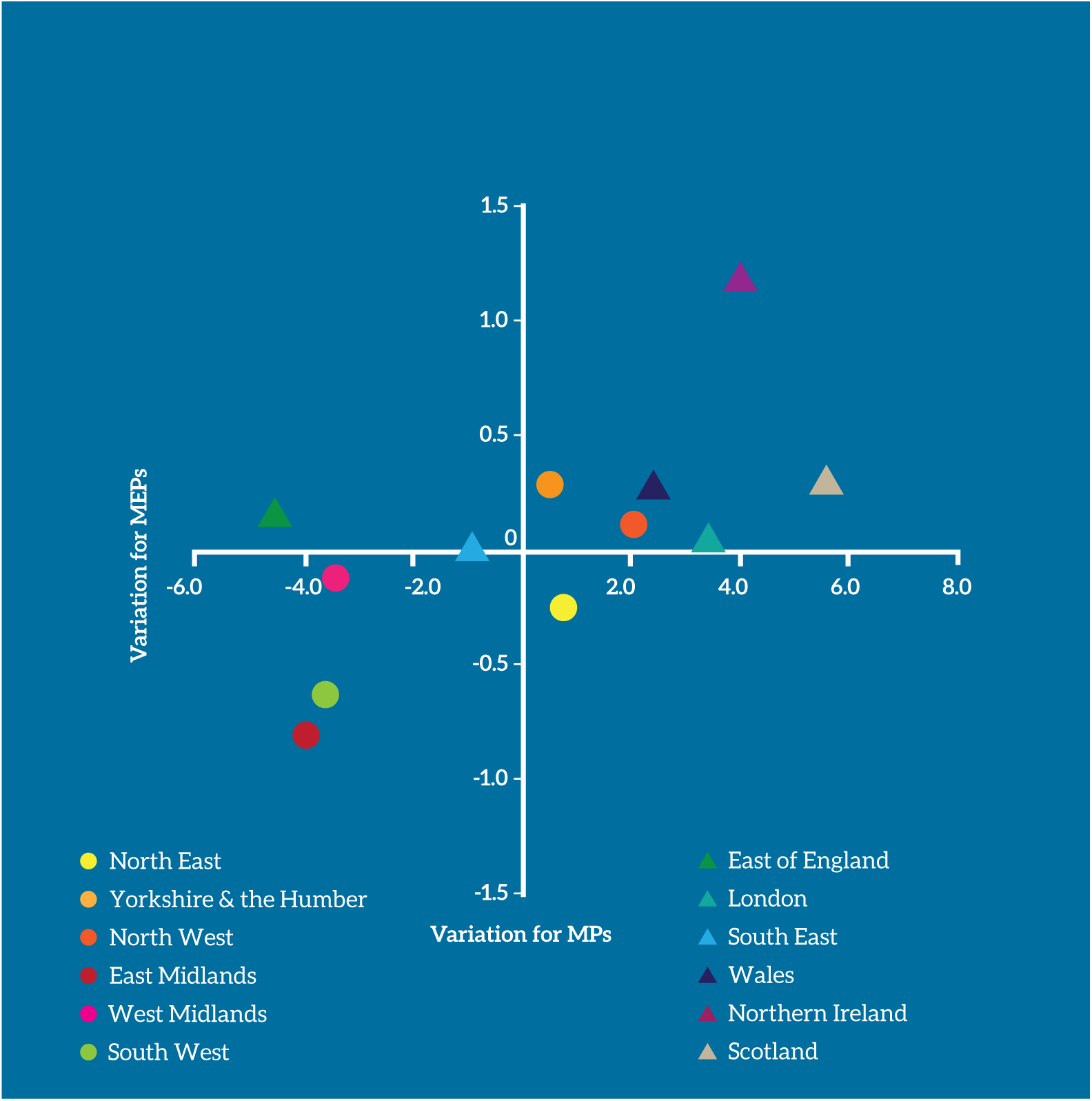
Comparison of regional variations from mean national population rates (per million) for MPs and MEPs (2014/2015)
Politician mobility
The analyses measure ‘politician mobility’ by whether a MP/MEP represents a constituency in his or her region of birth. They also look at whether their constituency is in a neighbouring region, because a MP/MEP could be elected for a constituency that is local to them, but just over a regional border. However, geographically large regions, such as South West, could have politicians who represent constituencies up to 200 miles from their birthplace and still be within the same region. The most mobile are therefore politicians crossing more than one regional boundary. The percentage of MPs elected within their region of birth in 2015 was 47 per cent (up from 44 per cent), increasing to 74 per cent if adjacent regions are included; MPs crossing more than one region was down nearly a point to 26 per cent. The corresponding figures for MEPs in 2014 were 45 per cent, 84 per cent and 22 per cent respectively, similarly showing increased localism.
‘Local’ politicians accounted for 40 per cent of re-elected MPs, compared to 71 per cent of new MPs where the party changed. However, where new MPs replaced the incumbent and the party retained the seat, the figure was 56 per cent. Of those MPs who left the UK parliament, 53 per cent were ‘local’. The patterns for MEPs showed some differences, with a much lower percentage of those leaving the EU Parliament being ‘local’ and a much higher percentage having crossed more than one regional boundary.
Figure 2 shows graphical patterns for the different regions, comparing the patterns for MPs and MEPs separately across their respective elections. Regions below the 45° diagonal have more MPs/MEPs born in those regions than were elected in those regions, i.e. more move out than move in, and the nearer a region is to co-ordinate (100,100) the more ‘self-sufficient’ that region is, suggesting limited or no politician mobility. The further away from this co-ordinate, and the nearer to (0,0), the greater the degree of politician mobility.
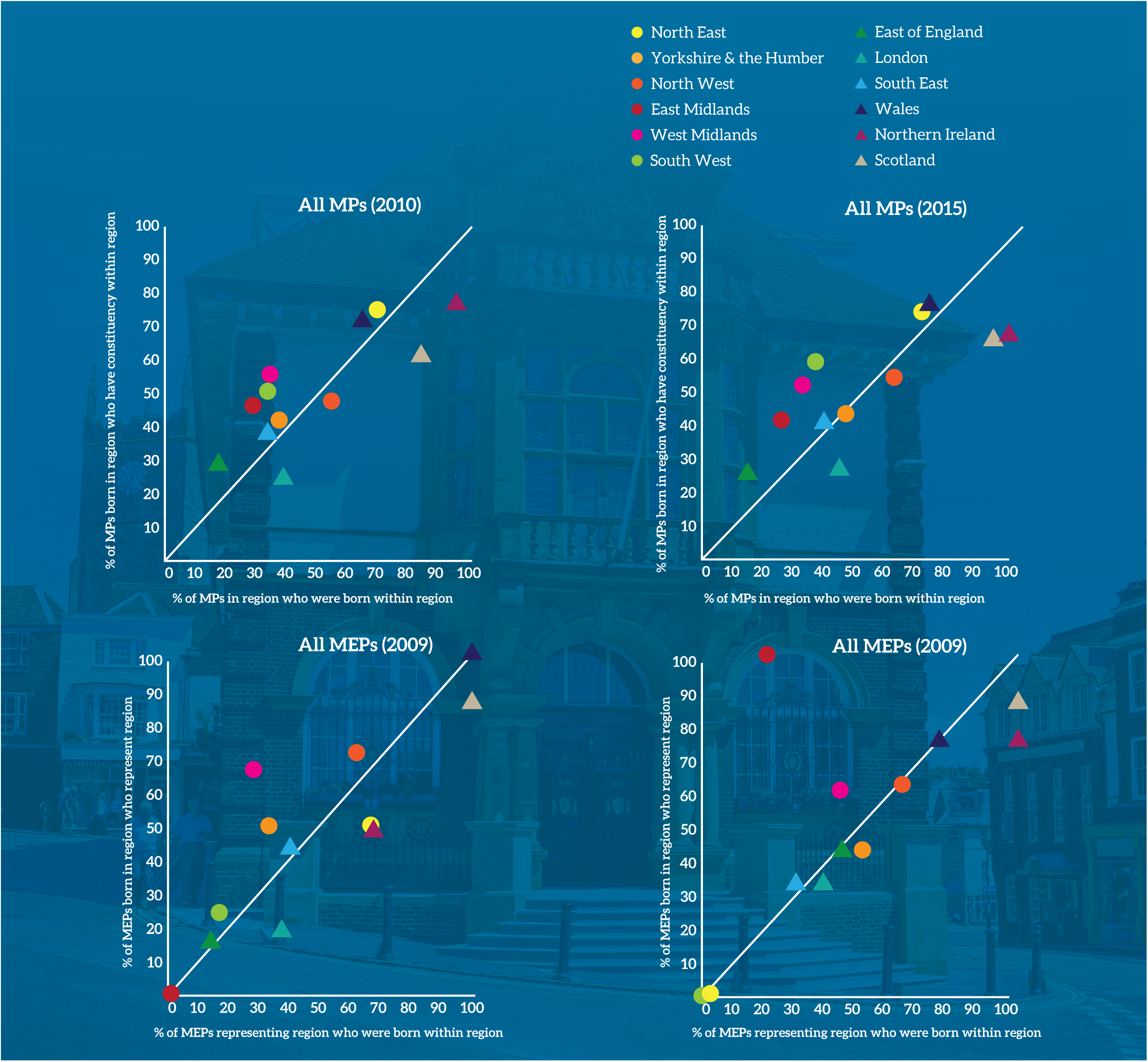
Diagrams comparing mobility for MPs and MEPs at their respective sets of elections
There was great diversity between regions for both MPs and MEPs in both sets of elections. Nevertheless, the regions that most elected ‘local’ candidates in 2014/15 were again Northern Ireland, Scotland and Wales for both types of representative, and the North East of England for MPs. Regions with greatest mobility continued to be East of England, London and the South East, and to a lesser degree East Midlands and Yorkshire & the Humber.
The percentage of ‘local’ MPs stayed generally the same at the 2010 and 2015 General Elections for both the Conservatives (up one point to 35 per cent) and Labour (down one point to 51 per cent), with similar variations for MPs crossing more than one regional boundary. For MEPs, the Conservatives were similar at both elections, but ‘local’ MEPs more than halved for Labour, from 54 per cent to 25 per cent. The latter was balanced by Labour MEPs elected for neighbouring regions (up from eight per cent to 38 per cent). The big winner of the EU elections was Ukip, with its MEPs representing their region of birth increasing from 50 per cent to 65 per cent.
The number of ‘local’ MPs increased for both sexes, to 95 females and 212 males. This was for all political groups for females, although females crossing more than one regional boundary stayed broadly the same at 29 per cent. The Labour Party had greater female representation than the Conservatives, with 99 female MPs compared to 68, and a greater proportion of these were ‘local’: 51 per cent compared to 38 per cent. However, the figures for ‘local’ new female MPs were higher at 63 per cent and 48 per cent respectively. Notably, 37 per cent of female Conservative MPs had to cross more than one regional boundary, compared to 27 per cent for Labour and 13 per cent for all other parties. Interestingly, of new Conservative MPs who crossed more than one regional boundary or were non-UK, there was an equal split between males and females (11:11), whereas for new Labour MPs the split was (1:13). Whether the latter was a result of all female shortlists or parachuting candidates by the Labour Party, or a combination of the two, is open to speculation.
The age distribution of politicians presented notable changes, with MPs born before 1960 accounting for half of MPs in 2010 but only a third in 2015, and MEPs born before 1960 accounting for 70 per cent of representatives in 2009 but just under a half in 2014. The older generations appear more ‘mobile’ than their younger counterparts, with the highest percentages crossing more than one regional boundary. Younger MPs were more ‘local’, particularly if adjacent regions are taken into account: over half of those born after 1969 were ‘local’, and over three-quarters were elected within their native or an adjacent region.
Whether individuals have been parachuted into safe seats is open to interpretation because this accusation can even be made against ‘local’ candidates, as witnessed by the furore caused by Labour’s selection of Liverpool-born Dan Carden for the seat of Liverpool Walton in 2017. Analysing the seats designated as ‘safe’ at the 2010 General Election, ‘local’ MPs fell to 17 per cent for the Conservatives’ Top 100 safest seats and 22 per cent for their Top 150 seats. By contrast, 45 per cent of all other Conservative seats involved a ‘local’ politician. For Labour the loss of its many seats in Scotland had a big impact on the numbers and percentages; the percentage of ‘local’ Labour MPs dropped by up to four points for its Top 100 and Top 150 seats, to 58 per cent and 54 per cent respectively. For all its other constituencies ‘local’ MPs were 47 per cent – up three per cent from 2010. The increase in ‘local’ MPs for all other parties from 62 per cent to 84 per cent was largely due to the extra SNP members, the vast majority of whom were unsurprisingly born in Scotland. The SNP gains similarly affected the percentage of ‘local’ MPs elected where seats changed hands; increasing to 70 per cent from 46 per cent in 2010. Only 14 per cent of all such MPs crossed more than one regional boundary and four per cent were non-UK; this compares to 19 per cent and 6 per cent respectively in 2010.
Local roots
Certain points should be borne in mind when considering these results: the proportion of MPs’ seats changing hands each general election is comparatively limited; politicians are unlikely to have long parliamentary careers unless they represent safe seats; previous political experience is favoured when parties select candidates; the increasing Euroscepticism in the UK; Westminster elections are ‘first-past-the-post’, whilst European elections involve proportional representation, which leads to more representatives from minor political parties; and there can be many reasons why a person might be considered ‘local’ to an area even if they were not born there.
The current climate is such that voters increasingly want MPs with deep local roots, who were born and raised in their constituency or have lived there for many years. Whilst sounding unremarkable, this signifies an important shift in how Britons view representation and the responsibilities of government. This shift is placing great strain on the UK parliamentary system, where it is assumed that MPs’ overriding duty is obedience to party bosses, rather than responsiveness to constituents’ needs. This is arguably reflected by the most striking point from the analyses, which is that it is the older generation of politicians that were most ‘mobile’, crossing regional boundaries, with younger generations being more ‘local’. Therefore, given limited numbers of seats change hands each general election, increases in the percentage of ‘local’ representatives are likely to be incremental as older politicians retire or are defeated at the ballot box.
Extrapolation can be a questionable exercise, but if all future new MPs reflected the distribution of current MPs born in the 1970s/1980s/1990s then, when those born in 1930s/1940s leave parliament, the overall percentage of ‘local’ MPs would increase to 48 per cent and the percentage representing constituencies in their own or an adjacent region to that of their birth will increase to 75. The cumulative effect when the 1950s MPs leave would be to provide figures of 52 per cent and 78 per cent respectively; and when the 1960s MPs leave would be to provide figures of 56 per cent and 79 per cent respectively. These figures support the hypothesis of incrementally increasing ‘local’ representation.
A further stimulus is likely to be the implementation of the Boundary Commissions’ proposed changes to reduce MP numbers to 600, by necessitating selection processes to choose candidates for new constituencies. In some cases this will pit neighbouring MPs from the same party against one another, possibly prompting some older MPs to retire. Where fellow MPs are in direct competition then party members may well choose the most ‘local’, as illustrated by the outcry when Rotherham Labour party members were presented with a shortlist of candidates for the 2012 by-election which they felt did not include a local candidate.
One question that might be asked is how politicians representing constituencies outside their region of birth vote on matters relating to their birth region? For example, in 2015 there were 80 Londoners in seats outside the capital and 27 Scots with seats outside Scotland, although this applies to every region to some extent. Nevertheless, the introduction of metro mayors, the Northern Powerhouse initiatives and perceived under-resourcing of English regions compared to London and the devolved administrations, suggests that localism, primarily in the form of regionalism, is only likely to increase as an issue, which will influence decisions and voting by the electorate and their representatives.
Whether increasing localism is desirable is open to debate, particularly if increasing numbers of independent-minded local MPs stay loyal to their constituencies above all else, meaning greater political instability and deadlock. That Labour has a much greater percentage of ‘local’ MPs than the Conservatives has been highlighted, but the fact that its heartlands are those most likely to be impacted upon by increased regionalism could generate internal tensions between its politicians representing London and the North if greater resources need to be moved from the former to the latter.
Conclusions
The comparisons of politician mobility between the sets of elections serve to illustrate that while there continues to be considerable politician mobility for both MPs and MEPs, there is an increasing level of ‘localism’. This is likely to further increase over time, on an incremental basis, as younger politicians replace their older counterparts, and possibly accelerate when the Boundary Commissions’ recommendations are implemented. The rise of nationalist parties, particularly in Scotland, and regionalism in England are also symptomatic of a wider ‘localism’ shift, which potentially reflects a growing desire in Britons to be represented by people with local roots, in part caused by their disillusionment with the political system and classes. This is something that political parties of all shades will need to take into account, even if it might loosen their power over their MPs and constrain attempts to parachute candidates into favoured seats.
Footnotes
Rob Gandy is visiting professor at Liverpool Business School, Liverpool John Moores University.