




Abstract
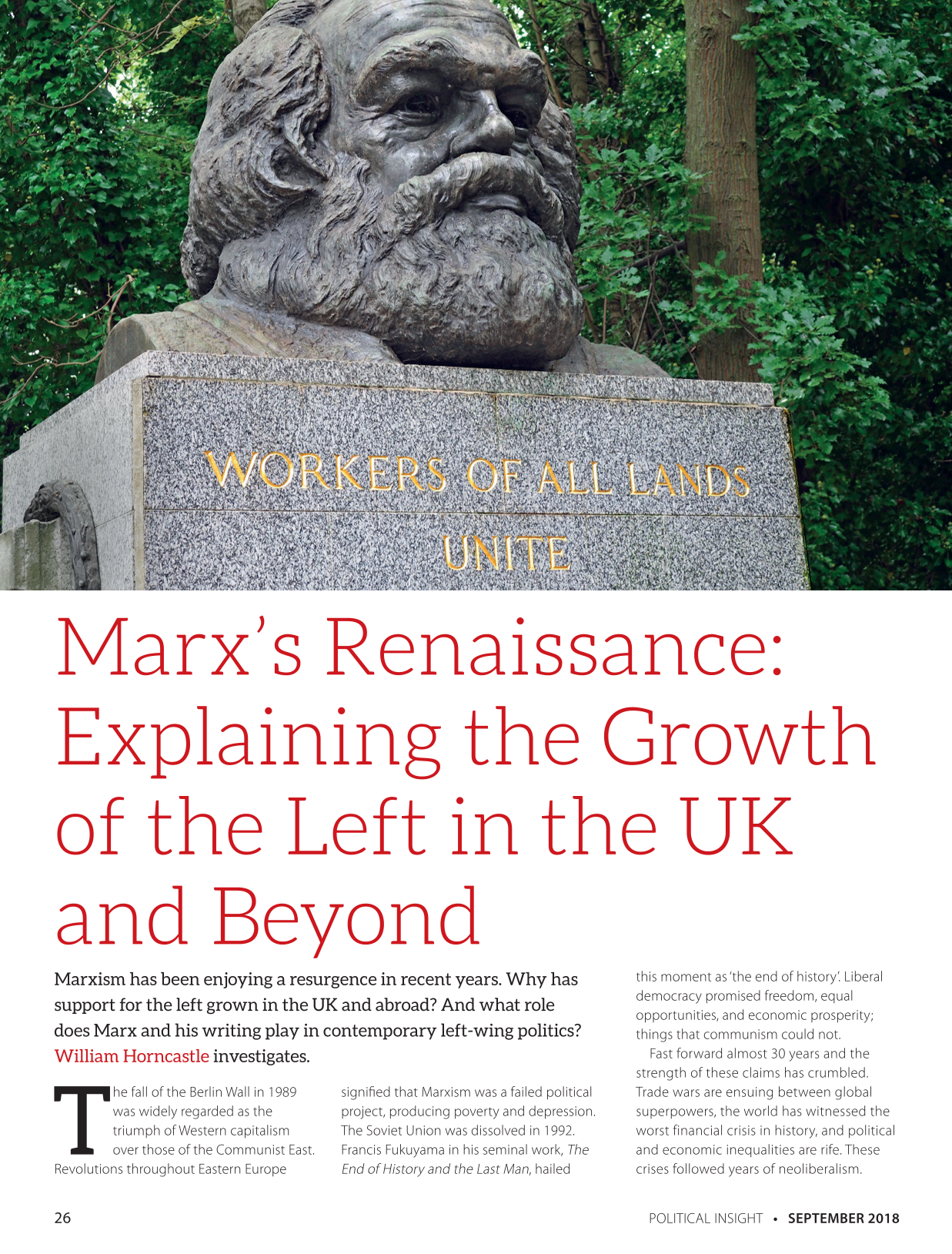
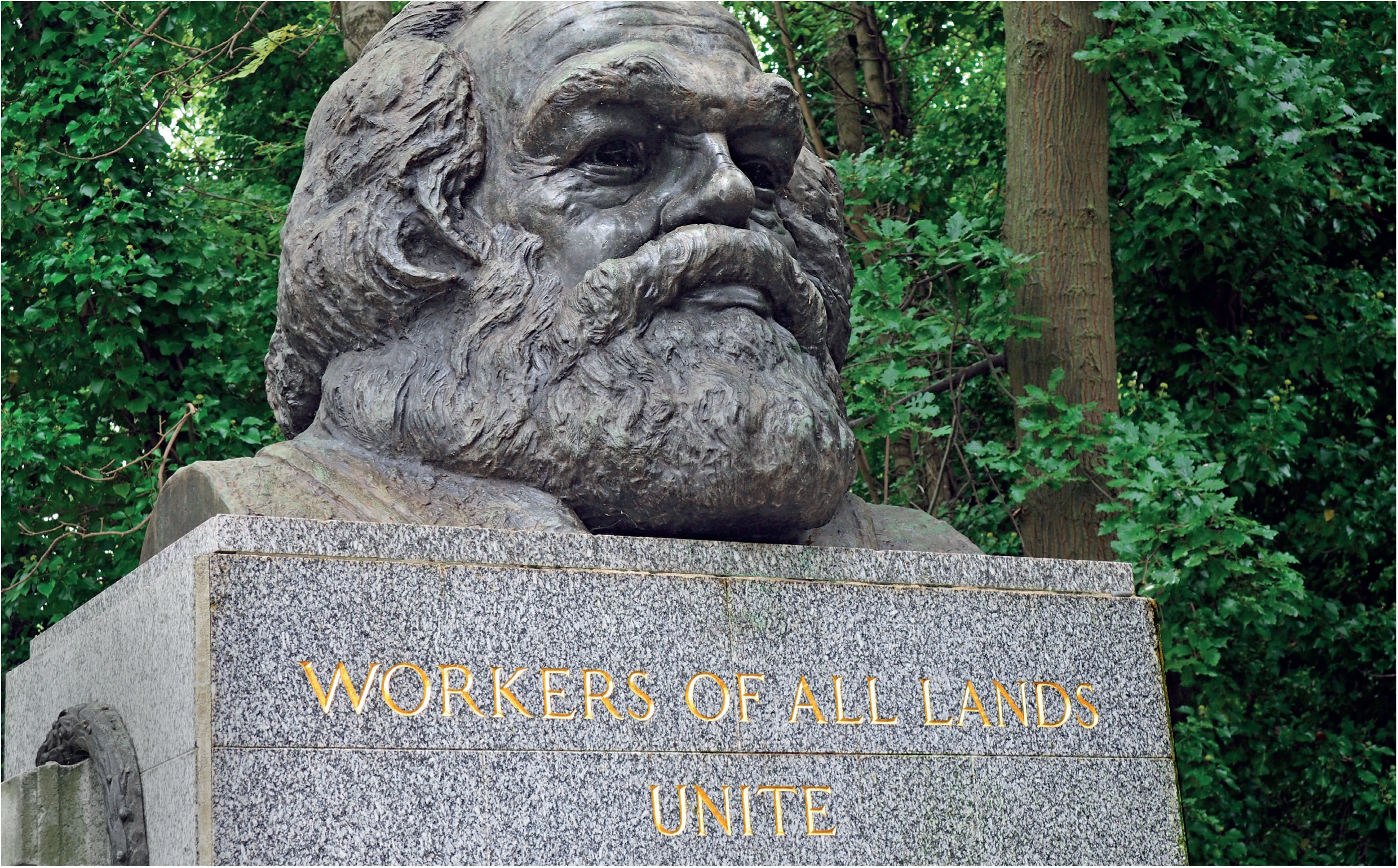
Marxism has been enjoying a resurgence in recent years. Why has support for the left grown in the UK and abroad? And what role does Marx and his writing play in contemporary left-wing politics?
The fall of the Berlin Wall in 1989 was widely regarded as the triumph of Western capitalism over those of the Communist East. Revolutions throughout Eastern Europe signified that Marxism was a failed political project, producing poverty and depression. The Soviet Union was dissolved in 1992. Francis Fukuyama in his seminal work, The End of History and the Last Man, hailed this moment as ‘the end of history’. Liberal democracy promised freedom, equal opportunities, and economic prosperity; things that communism could not.
Fast forward almost 30 years and the strength of these claims has crumbled. Trade wars are ensuing between global superpowers, the world has witnessed the worst financial crisis in history, and political and economic inequalities are rife. These crises followed years of neoliberalism. The deregulation of financial markets under Ronald Reagan and Margaret Thatcher allowed the financial sector to exploit complex financial instruments and create new markets. The bubble led to an inevitable burst, causing shockwaves which unravelled the financial system a decade ago.
The recovery from the crash has been an arduous process, which has left many questioning the origins of the crisis. Many have found solace in Karl Marx, with his writings foreseeing the events of 2008, long before the financial deregulation that preceded the crisis. In his major economic work Capital, Marx worked with the assumption of competitive capitalism against the background of minimal state intervention, precisely the aim of neoliberalism. He was particularly interested in the causes of capitalist crises.
Sales of the Communist Manifesto have increased dramatically since 2008. Here, Marx states that a relentless pursuit of profits will inevitably lead to the destruction of capitalism; ‘What the bourgeoisie... produces, above all, are its own grave-diggers. Its fall and the victory of the proletariat are equally inevitable’.
The renaissance of Marx has been produced through extreme economic and political polarisation. This can be seen by the growth in support for the left coinciding with an increased influence of the far right. As the Labour Party has moved back towards the left under the leadership of Jeremy Corbyn, far right groups such as the English Defence League and Britain First have emerged on the streets. As such, Britain’s political centre is currently experiencing a decline. A myriad of factors has influenced this shift in ideology.
Deregulation and the financial crisis
The deregulation of financial markets has been cited as a major factor in causing the financial crisis. In the UK, a wave of neoliberal deregulation and privatisation began under Margaret Thatcher, with a continuation of such policies under John Major. When Tony Blair came to power in 1997, his ‘New Labour’ mantra moved the Labour Party towards the political centre. The emphasis on the private sector was a feature of Blair’s administration, until his resignation in 2007. Blair’s successor, Gordon Brown, was the unenviable Prime Minister who oversaw the financial crisis and recession that followed.
The government’s response to the financial crisis stood in stark contrast to the dominant neoliberal opposition to state intervention in the market. The largest UK financial institutions, which were a factor in causing the crisis, were bailed out with £500 billion of taxpayer funding. This action was also taken in the US, through a $475 billion (£360bn) package. These measures were pushed through in a bid to prevent the failure of institutions deemed ‘too big to fail’. However, the notion of ‘too big to fail’ is a contradictory term, as individuals and corporations in capitalist societies have equal opportunities, with no state intervention in the marketplace. These are the types of contradiction proposed by Marx when he suggested that in a capitalist system the bourgeoisie produce their own ‘grave-diggers’.
The responses to the financial crisis led to diminishing trust in financial institutions and government. Many see government investment in financial institutions as a safety net for corporate shareholders that is not afforded to the poor. A perceived lack of accountability for financial institutions exists alongside huge bonuses for city executives; £16 billion was paid out in 2008 despite rising losses and government bailouts (Clark, 2008). More generally, under neoliberalism polarisation has been growing internationally, with a relatively small group of billionaires at the top, and increased poverty and insecurity at the bottom – very much the nature of society one gleans from Marx.
Austerity, privatisation and the private finance initiative
Another factor in the diminishing trust in government is the years of austerity that followed the financial crisis. In the UK, government cuts to budgets have left essential services running at much lower efficiency than in previous years. For example, the number of police officers in England and Wales has dropped by around 20,000 since 2009. Tying this in with the increased threat of terrorism and the rise of Islamic State, there is a general feeling of fear amongst many British citizens. Recent terrorist attacks in the UK have occurred at a time of decreased police budgets, which has confounded disapproval towards the political classes.
In addition to this, NHS standards are slowly slipping in relation to years of strong growth in the service. Targets are being missed, with appointment waiting times becoming longer and A&E waiting time targets being missed. The NHS is under mounting pressure to deliver a greater service to an ageing population, whilst working with a budget which has been under severe pressure. The working standards of NHS employees have been diminishing, with a series of strikes by workers who feel under-appreciated in relation to the services that they provide. The NHS crisis is exacerbated by a crisis in social care, leading to the occupation of hospital beds by people who should be discharged to care in the community.
A solution to the problem of building hospitals without increasing public spending has been attempted by successive governments through privatisation and the introduction of the ‘Private Finance Initiative’ (PFI). The PFI is a scheme which allows government to award contracts for building infrastructure to private sector companies, with the state leasing these buildings from the company for a period of years. The PFI was introduced by Major’s Conservatives, however it was widely used under successive Labour governments. Although the number of PFI contracts has been decreasing in recent years, the contracts which are already in place run up to around 2050.
The introduction of PFI is now heavily criticised in many quarters, especially from the Labour party, with the cost of PFI contracts estimated to be 40 per cent higher than conventional means, costing the tax payer around £200 billion (Treasury Committee, 2011). The failure of PFI is epitomised by the collapse of sprawling outsourcing firm Carillion; estimated to cost tax payers almost £150 million in refinancing contracts.
Alongside PFI, there has been privatisation in a number of areas. Around 15 per cent of UK jails are currently run by private companies, leading to repeated claims that costs have been cut to increase profits. The privatisation of the railways since the mid-1990s has been deemed a failure by many observers. Increased rail fares and reduced services have left railways running an inefficient and below-par service. Utility costs have increased alongside this, with private firms often perceived to hold a monopoly over the energy sector.

The privatisation of essential services has left a section of the nation dissatisfied, with the perceived threat of privatising the NHS deemed a step too far. A move to an American-style health service is a fear for some, with huge costs involved often proving prohibitive to some sections of the American public. Nationalisation of essential services is one of the main manifesto priorities of Corbyn’s Labour, with a move back to what are seen as traditional Labour values. This has been cited as a factor in explaining increased support for Corbyn, particularly with stagnation of wages across most of the public.
Wage stagnation and political scandals
When looking at the current working standards of the UK workforce, there is cause for concern. Whilst the average worker enjoyed growth in real wages between the 1960s and early 2000s, this trend ended at financial crisis. Since 2008, the average worker has seen their real wages decrease. According to OECD forecasts, the UK will be one of only four OECD members to experience a decline in real wages in 2018 (alongside Finland, Italy and Mexico), with the largest wage decrease of all member nations.
Although wages are declining, the Conservatives have often claimed that their policies have allowed more opportunities for the unemployed to get back into work. Indeed, this is the case, with unemployment rates dropping every year since 2011. However, alongside this decrease in unemployment has been an increase in the use of zero-hour contracts. These roles offer no assurance of work, irregular hours, and no guarantee of pension contributions. This has resulted in an increased precariat class; those with little opportunity and rights, whose opportunities for social mobility are nonexistent.
With decreasing rights and wage stagnation amongst the average worker, there appears a sense of injustice when looking at government treatment of wealthy interests. The corporate tax rate has been reduced from 30 per cent in 2007, to 19 per cent in 2018. Alongside this, several large corporations have utilised offshore networks to pay little or no UK taxes. This leads to a perception that the government are catering to wealthy interests. One factor that is often cited as a reason for this is the issue of ‘revolving door’ employment. This is an instance in which government ministers move from their public roles into private sector positions in their field of influence, a phenomenon which causes no surprise to readers of Marx.
Factors such as these contribute to the perception that politicians are deemed to be ‘in it for themselves’. These feelings are epitomised by political scandals such as the 2009 parliamentary expenses scandal, where the often-ludicrous expenses of MPs were made public through a Freedom of Information request. The timing of these revelations reduced public trust in government, with MPs’ exuberant claims being made in a period where public service cuts were taking place.
Influence of Marx?
All these factors have gone a long way to reducing public trust in government, leaving many wanting change. The shape that this change may take has caused a huge shift in political preferences, with a diminishing political centre in Britain. An increased relevance of the left has been perpetuated by a mistrust in the relationships between government and the private sector, largely influenced by the financial crisis. Marx’s understanding and critique of capitalism currently appears more relevant than ever, with costs of living increasing and real wages decreasing.
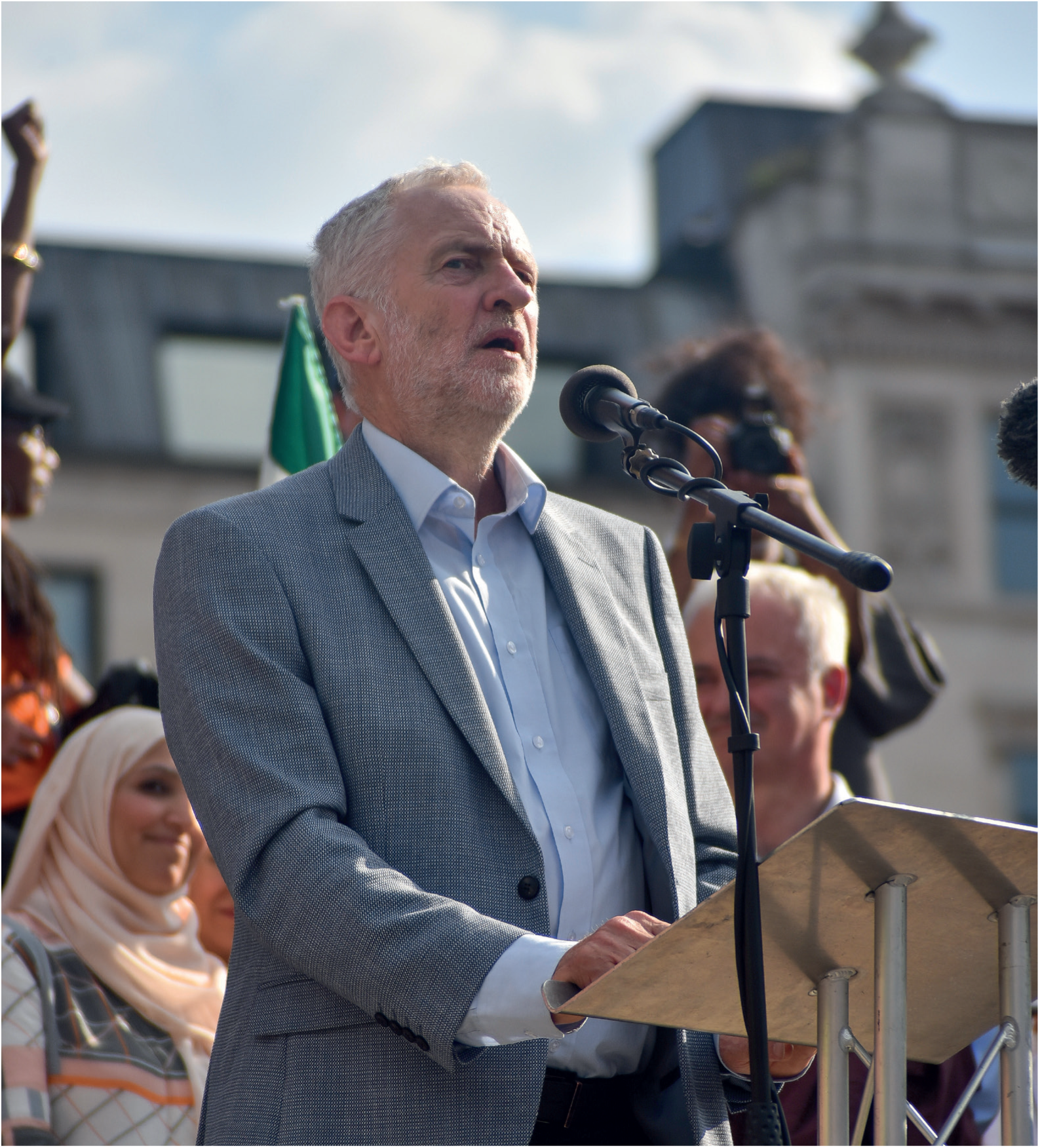
Corbyn has previously praised Marx as someone ‘from whom we can learn a great deal’. However, an association with Marx still appears to have a damaging effect within the right-wing press. A mention of Marx is associated with Lenin and Stalin’s interpretations of Marx’s philosophy, one which underpinned the totalitarian ideology of the Soviet Union. However, the interpretation of Marx’s philosophy in the current British political climate is one of democratic socialism. Corbyn’s Labour manifesto is underpinned by this vision, with his priorities to make a nation that works ‘for the many, not the few’. This will be achieved through re-nationalisation of failing essential public services, as well as increased taxes on the rich. Such positions appear to be a relaxed version of Marx’s philosophy, in which he predicted that a violent revolution would overthrow capitalism. Instead, the democratic socialist model postulates that a socialist economy can be produced through democratic means, with social ownership of production being the end of a gradual process.
This shift to the left is not just being seen in Britain. In New Zealand, for example, Jacinda Ardern was elected as Prime Minister in 2017, stating ‘when you allow markets to decide the fate of your people... that does not serve a country or people well’. Her coalition government has promised increased taxes on multinational companies, an increased minimum wage and free university education. In Europe, António Costa was elected Prime Minister of Portugal in 2015, in a coalition with several left-wing parties. His policies have revolved around reversing austerity measures, as well as tougher labour laws for corporations. These examples have also coincided with several election victories for socialist leaders in Latin America, in nations such as Bolivia, Chile and Uruguay.
Conclusion
President Trump’s victory in the United States and the United Kingdom’s decision to leave the European Union, are often-cited examples of a rightward shift in politics. But at the same time there has been a resurgence on the left, and a growing interest in – at the very least – the language and ideas of Karl Marx. Jeremy Corbyn, who has spoken positively about Marx’s influence, was initially labelled ‘unelectable’ when contesting the Labour leadership contest, however, there is a real possibility that he may become the UK’s next prime minister. Marx’s philosophy predicted the inevitable fall of capitalism, due to its unsustainable nature. Whilst his teachings predicted a violent revolution, the UK is witnessing the potential of a gradual shift towards democratic socialism. It is not entirely clear what the future holds for the UK government, however the relevance of Marx is clearly becoming more prevalent.
Footnotes
William Horncastle is a PhD candidate at the University of Birmingham’s Department of Political Science and International Studies.