




Abstract

© Press Association
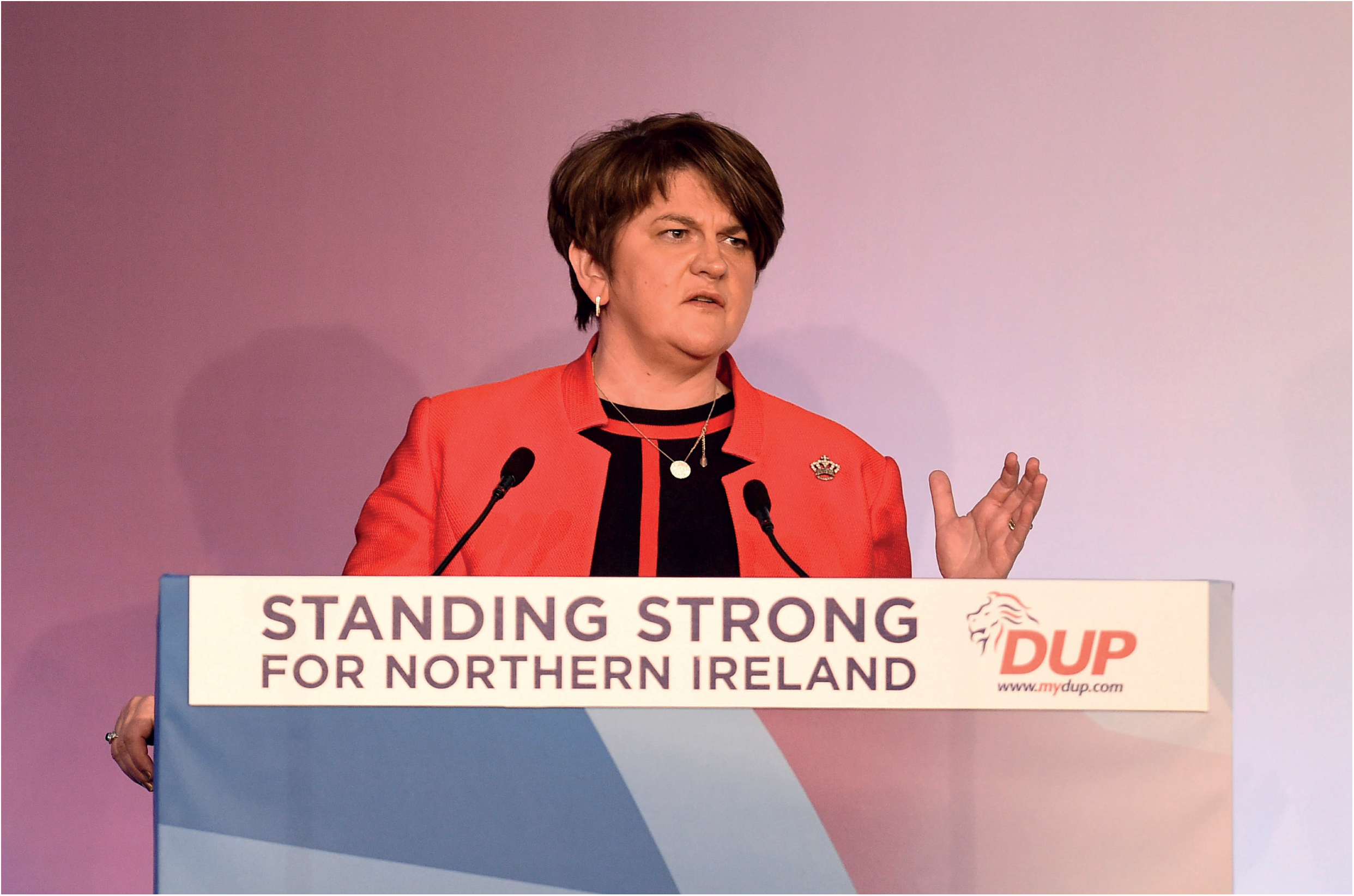
Northern Ireland’s Democratic Unionist Party (DUP) has attracted unprecedented attention amid its confidence-and-supply deal with the Conservative government, support for Brexit and opposition to the EU Withdrawal Agreement. Yet amid the focus upon the contemporary outlook of the DUP, there is much to be learned by examining the party’s development since its formation in 1971. Exploring data from a Leverhulme Trust study of DUP members (Tonge et al. 2014) and analysing the party’s voters from the most recent ESRC Northern Ireland General Election (Tonge et al. 2017) this article assesses the extent to which religion and robustness have shaped the party’s unionism.
How religious is the DUP?
The DUP was created by the Reverend Ian Paisley to fuse staunch advocacy of the Protestant religion with stout defence of Northern Ireland’s place in the UK. Having formed the Free Presbyterian Church two decades earlier, Paisley used the DUP as a political vehicle for his Church’s fundamentalist Protestantism. Free Presbyterianism offers literal interpretations of scripture. The Bible is the true word of God. To be saved, individuals, as sinners, must ‘present’ themselves to God and be ‘born again. Abstinence from a wide range of earthly vices, including drinking alcohol, gambling, and even dancing is required. Catholicism is rejected as idolatrous.
The DUP was born a ‘Protestant Party for a Protestant people, designed to resist what it saw as an expansionist Roman Catholic, Irish republican project to take Northern Ireland out of the UK. Paisley insisted that ‘God will deliver Ulster. The salt of the earth, God’s people, are in this country’. Yet the DUP’s support extended beyond a fervent evangelical core to embrace much more nominally religious loyalists, whose own God-fearing was more marginal. The DUP’s perceived stoutness on the constitutional question was of greater significance for those voters.
The Free Presbyterian Church is tiny, its 10,068 members identified in the 2011 census amounting to 1 per cent of Northern Ireland’s population. Yet the Free Presbyterian Church remains (just) the largest single denominational provider of DUP members (see Table 1). A majority of those Free Presbyterian DUP members were brought up in another Protestant denomination but switched to Paisley’s Church. Roman Catholics form 41 per cent of Northern Ireland’s population, but their numbers in the DUP are miniscule. Half of the DUP’s Westminster contingent are Free Presbyterian.
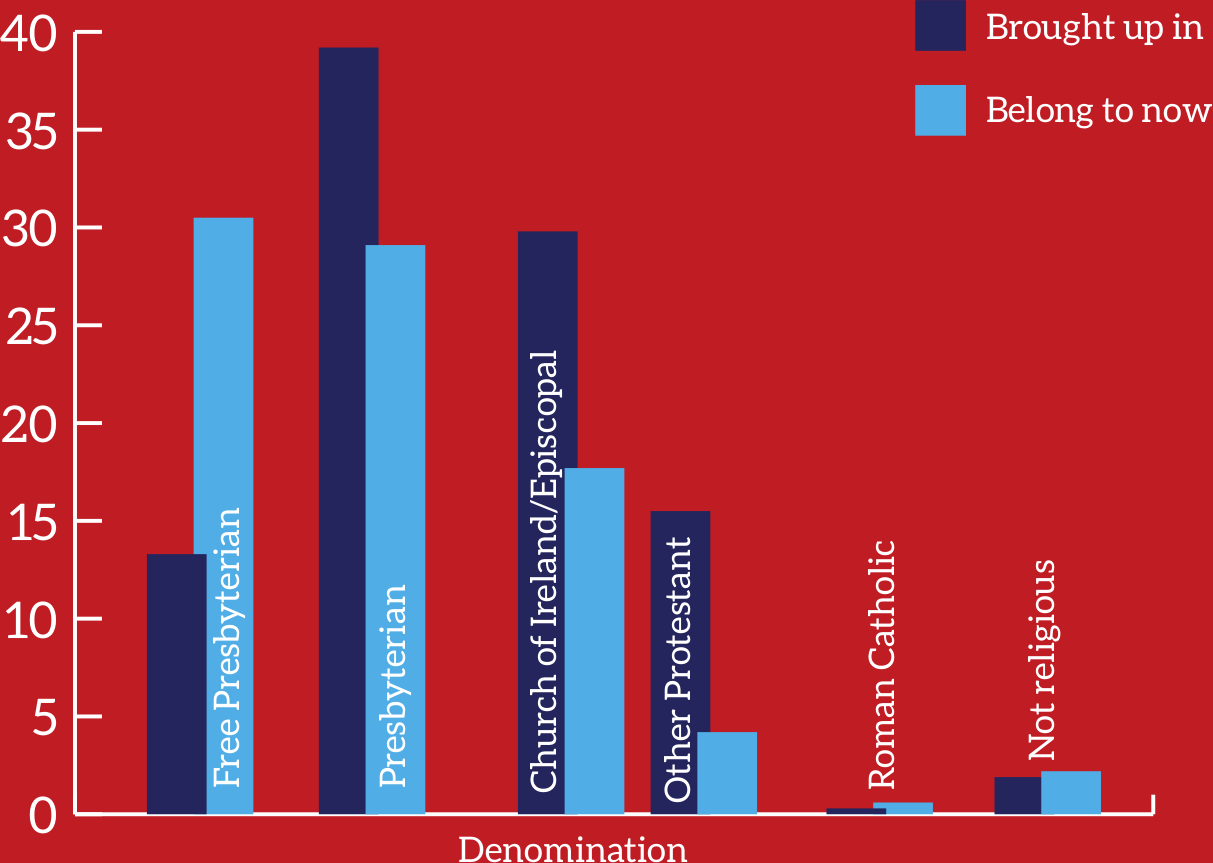
Religious denominations of DUP members, by upbringing and contemporary affiliation (%)
This startling over-representation noted, Free Presbyterian numbers are nonetheless falling. For the first three decades of the DUP’s existence, a majority of members were drawn from that Church. However, when the DUP, having rejected the 1998 Good Friday Agreement, agreed to share power with Sinn Fein in the 2006 St Andrews Agreement, some Free Presbyterians quit the party and Paisley was effectively forced to quit as leader of his Church for doing the deal with Irish republicans.
These days, Free Presbyterianism is certainly not a requirement for advancement in the DUP. Arlene Foster, party leader since 2015, belongs to the Church of Ireland. Along with a fifth of DUP members, Foster defected to the DUP from the Ulster Unionist Party (UUP) partly in protest at the UUP’s support for the Good Friday Agreement. These UUP defectors were concerned far more with robust unionism than Protestant zealotry. They helped the DUP exploit Unionist concerns over the Good Friday Agreement, including the release of paramilitary prisoners, policing changes and power-sharing with republicans. Amid these worries, the DUP overtook the UUP to become the more popular unionist party from 2005 onward.
Thus, political issues, not religious fervour, explain the DUP’s rise to power. The party’s religion was to be more worn more lightly compared to the Paisley era. The DUP’s Westminster leader, Nigel Dodds (a Free Presbyterian) places his party ‘in the great tradition of the European parties where Christian Democracy is a mainstream political view. Most DUP members are highly religious, attending church weekly (Table 2).
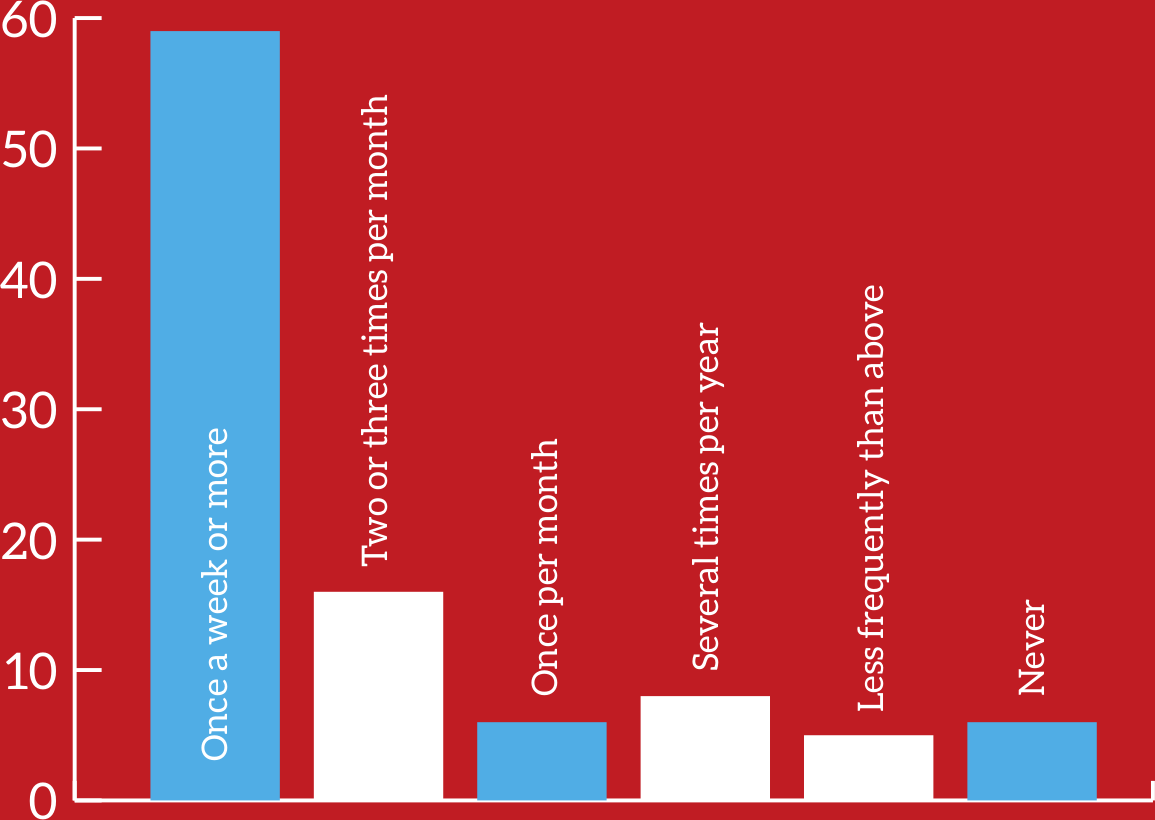
Frequency of church attendance of DUP members
The largest category of religious observers within the party is of those claiming to be ‘very religious’, as Table 3 shows.
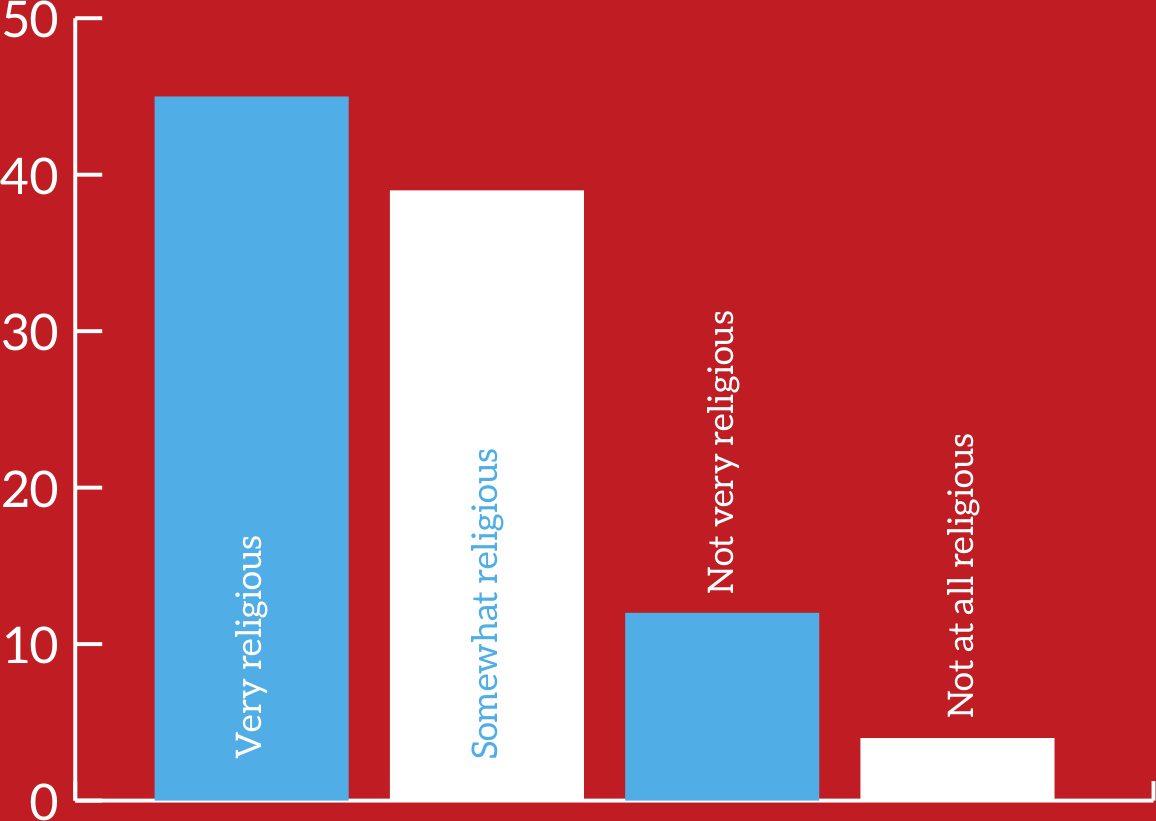
Self-evaluation of religiosity by DUP members
Asked on a scale of zero to ten, with zero meaning no influence and ten meaning maximum influence, how much influence do you think faith and church have upon the DUP?’ responses of party members averaged at 7.3. Asked how much influence faith and church should have upon the DUP, member offered an average figure of 6.8. So, DUP members believe their party is religiously influenced and want this to be the case. DUP MP Paul Girvan argues: ‘Some people say religion and politics should never really mix. I am a total disbeliever in that aspect because I believe politics came about through religion. If you use the Ten Commandments you can formulate almost every law that you need.
Most DUP members believe that there is discrimination against Protestants in Northern Ireland, differing only over its extent. Half think that there is ‘a lot’ of prejudice and a further 42 per cent think there is a ‘little’. On the issues of ‘mixed marriages’ and shared education party members are frank in their concerns, as Tables 4 and 5 indicate.

DUP members’ attitudes to ‘mixed marriages’

DUP members’ attitudes to integrated education
Six of the party’s ten Westminster MPs are members of the Protestant Orange Order, along with half of the party’s 28 Northern Ireland Assembly members elected in 2017. The Orange Order, which prohibits its members from marrying Catholics or participating in Catholic church services, was formally aligned to the UUP until 2005, but that relationship strained over UUP support for the Good Friday Agreement and many Orange Order members switched to backing the DUP. Orange Order marches are regulated by the Parades Commission. The DUP criticised the body for restricting several parades, complaining of a ‘scandalous denial of civil and religious liberties’, insisting that the Parades Commission ‘has failed in its operation. A majority (58 per cent) of DUP members favour unfettered marching rights for the Orange Order.
Morality, modernisation and mammon
The DUP has opposed some significant societal changes introduced by the Westminster government. Perhaps most prominent, as matters devolved to a (non-functioning) Northern Ireland Assembly, are same-sex marriage and abortion, both rejected by the DUP. Almost two-thirds of DUP members believe homosexuality to be wrong. Ian Paisley’s successor as DUP leader, Peter Robinson, once argued that ‘the Supreme Moral Arbiter is Almighty God. And he has decreed that homosexuality is unnatural. That’s the end of the matter. It’s not open to discussion. The DUP’s final domestic election manifesto of the 20th century asserted how the ‘DUP has opposed plans to allow homosexual couples to adopt children in Northern Ireland. The vast majority of people in the province are totally opposed to this measure’ and claimed that ‘a mountain of social science, the world’s major religions, common sense and observation tell us that children have the best chance to thrive in married mother and father-based families’.
The DUP used a Petition of Concern (PoC) five times in the Northern Ireland Assembly to prevent the legalisation of same-sex marriage. A PoC ensures that sizeable support from unionist and nationalist Assembly members (MLAs) is needed to pass a measure in addition to an overall majority. It is a blocking measure as most Unionist MLAs (and all DUP ones) oppose change.
Social conservatism is similarly evident on abortion. Seventy-three per cent of DUP members are opposed to the legalisation of abortion in Northern Ireland and this view is equally common among the 28 percent of party members who are women. The DUP Health Minister from 2011-14, Edwin Poots, asserted:
We would look on abortion very negatively in that it is being used as a form of contraception. There are myriad methods of not getting pregnant. You can engage in sexual activity and not get pregnant… we do see that a person’s life does not begin whenever they leave the womb. It starts before that… It is somewhat farcical that they [elsewhere in the UK] are trying to save babies at24 weeks of age, but that at 23 weeks [the foetus] can be aborted. (Tonge et al. (2014:155).
Yet the DUP has been obliged to accept other societal changes, ranging from the decriminalisation of homosexuality in Northern Ireland in 1982, to the opening of public amenities on a Sunday. Moreover, the party’s base is far less vexed over social issues than the membership. Slightly more DUP voters (44 to 43 per cent) supported same-sex marriage and more favoured the legalization of abortion (43 per cent) than opposed (35 per cent). Many DUP voters do not back the DUP because of its social conservatism. Rather, they support the DUP because of its tough unionism, uncompromising Britishness and eschewal of Irishness. The DUP’s rejection of an Irish Language Act finds much favour among the party’s supporters, with more than 90 per cent opposed.
Much of the DUP’s support is found among working-class loyalists less interested in religious conservatism than in maintenance of the Union and economic improvements for Northern Ireland. The price for the DUP’s parliamentary support for the Conservatives, £1 billion in new funding for Northern Ireland, amounted to £550 per head. In a nod to its support base, the DUP helped ensure no change to pension increases and protection of universal winter fuel payments as part of the deal. Only 4 per cent of DUP voters disagreed with the confidence-and-supply arrangement.
Religion provided the basis of the DUP’s Euroscepticism for decades. Paisleyite denunciations of the EU as a Catholic club, a problem undetected by any other party across Europe, were common. Paisley’s denunciation of the European Community as a ‘beast ridden by the harlot Catholic church’ was one lurid flourish. Post-Paisley, the DUP’s anti-EU approach has shifted from scripture to sovereignty. This change allowed the party, prior to the Brexit referendum, to support David Cameron’s attempts to renegotiate EU membership. The DUP claimed that the EU’s ‘deafness to change in those negotiations’ ensured the retention of its Euroscepticism. Sixty-seven per cent of DUP voters declared themselves Leave supporters at the last election. The DUP opposes the EU Withdrawal Agreement given that its backstop potentially aligns Northern Ireland uniquely to the EU Single Market. Whilst the DUP is united in opposition to the backstop, the DUP is not defined by Brexit, its main priority a common UK departure from the EU.
Conclusion
The sum of DUP parts is a religiously-derived unionism, but one now owing more to sovereignty than to scripture. The DUP offers authoritarian social conservatism, a legacy of its ferocious religious past, fused with a dash of leftish economic populism but its primary message is that of stout defender of the Union and Northern Ireland’s Britishness. The DUP remains a party comprising a deeply religious membership, whose political outlook is unashamedly influenced by faith. Yet the DUP is defined these days more by tough unionism than austere religion, as Free Presbyterianism is no longer the dominant force it was within the party.
The DUP remains influenced by points of Protestant and Christian principle and opposes abortion liberalisation or redefinitions of marriage due to such beliefs. At times the DUP struggled with its transition from a party of bombastic protest to one of power at Stormont and has been embroiled in failures of governance, including the botched Renewable Heating Incentive scheme under which the Northern Ireland Executive wasted millions of pounds. The ‘coalition of crackpots’, as the Daily Mirror described the Conservative-DUP Westminster axis, contains more risks for the Conservatives due to association with a controversial party. The DUP lacks strong challenges from other unionist parties and remains comfortable in its fusion of Britishness, Unionism and Protestantism, garnering support from irreligious working-class unionists and religiously conservative traditionalists.
Footnotes
Jon Tonge is Professor of Politics at the University of Liverpool. He is co-author of books on the four largest Northern Ireland political parties and was Principal Investigator for the three most recent ESRC Northern Ireland General Election studies.