




Abstract

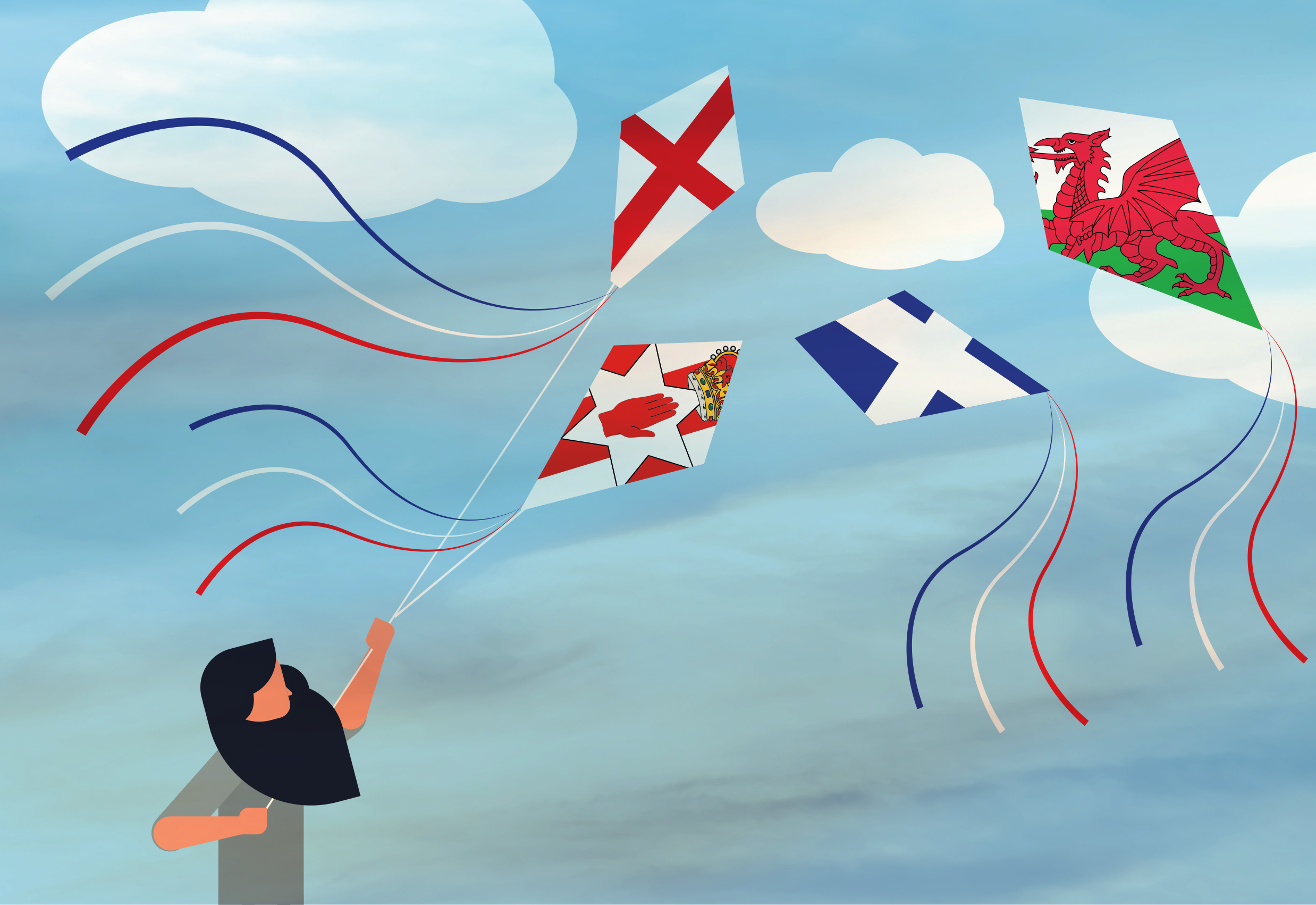
The United Kingdom’s constituent nations are drifting apart with limited serious debate or discussion, writes
Irecently spoke to an academic colleague from a European university who wanted to informally discuss plans to set up a centre for the study of the United Kingdom in his country. I told him it was a good idea. Post-Brexit there is a danger of drift and a failure to understand one another without the daily contact that EU membership delivers. But my main advice was to remind my colleague of the diversity of the UK, that cannot be fully understood through the prism of Westminster.
We could do with some research centres in the UK dedicated to the United Kingdom itself. Instead, too often decision-makers display heroic levels of ignorance and disinterest in the dynamics and workings of the country they seek to govern, and comment upon. This is leading to a conscious, and unconscious, uncoupling of the United Kingdom.
UK unwinding
In May’s elections the differences were on full display. In England, the Tories did badly, but not as badly as elsewhere. In Wales, Labour, which is different from its UK counterpart, ‘won’. In Scotland, the Scottish National Party chalked up its 11th election win in a row and its best ever local election, dispelling any notion of mid-term blues even after 15 years in power. This is partly explained by the continued popularity of the SNP and its plans for independence, which polls suggest is backed by two-thirds of under-55s, as younger working age Scots increasingly fail to identify with the state for which they carry a passport.
Arguably, the most notable result did not take place in Great Britain at all but rather in Northern Ireland, where Sinn Fein won most Assembly seats and the right to nominate a First Minister. The cross-community Alliance Party had its best result ever with the Democratic Unionist Party losing ground. The largest party in the Assembly is now one committed to Ireland’s reunification.
Yet the attention from the metropolitan media was slight. The full results were not available from Northern Ireland until late Saturday but just a few hours later the Sunday political programmes were more focused on Keir Starmer’s dining companions over a campaign curry in Durham. For many of us outside London that reflected a metropolitan parochialism that we are used to. Too often, the media addresses UK politics through the prism of Westminster leading to a distorted view of the country.
That is not harmless, but it is unsurprising. The United Kingdom, the clue is in the name, is a multi-national entity comprising four distinctive constituent parts. However, this is not reflected in Whitehall. The greater devolution introduced in 1999 was not accompanied by parallel constitutional reforms to central government. This has inevitably led to challenges, especially in recent years as voters in Scotland and Wales have joined those in Northern Ireland in backing different parties locally to those in government in Westminster. The informal intra-party fixes that were common when Labour was in power in all the administrations are no longer possible.

Brexit Shockwaves
The growing tensions within the UK became painfully apparent during and after the June 2016 European Union Referendum. That vote came about partly because the Conservatives feared Nigel Farage’s United Kingdom Independence Party (UKIP), a party which has never so much as retained its deposit in a Scottish parliamentary election. The referendum was held just six weeks after crucial Scottish and Welsh parliamentary elections, leaving little time for scrutiny not least over the constitutional consequences including Northern Ireland where EU membership is an integral part of the peace process.
Brexit was and remains an English solution to an English problem. Even the stated goal of returning ‘sovereignty’ is not that simple since the Westminster concept of supreme parliamentary sovereignty is as Lord MacCormick ruled in his 1953 judgement ‘a distinctively English principle which has no counterpart in Scottish constitutional law’.
The impact leaving the EU had on the rest of the UK surprised many ministers. It galvanised support for Scottish independence and re-ignited conversations about Irish reunification. Even the pro-Union First Minister of Wales, Mark Drakeford, has said that his support for the Union was not ‘unconditional.
Brexit has raised fundamental questions about decision-making in the UK. Boris Johnson is a radical Prime Minister making profound changes to the way in which the UK is run including the rights we enjoy as citizens. Yet he carries out his changes to the way the UK is run without a mandate outside of England and remains exceptionally unpopular elsewhere in the UK. In Scotland, voters are increasingly frustrated with Conservative governments they never voted for and a Brexit settlement they resolutely refused to back.
Growing friction
The Conservatives are also looking less committed to the Union. When the Prime Minister called the 2019 snap General Election to ‘get Brexit done’ his party did so fully in the knowledge that they would be sacrificing Scottish Conservatives to make gains in ‘red wall’ seats in England. Scottish Tory MPs had become expendable in return for political gain south of the border. Westminster politics is increasingly not for viewers in Scotland – or even Wales or Northern Ireland.
My Union supporting friends complain that there are very few Whitehall ministers who ‘get the Union’ but instead many senior politicians consider the UK as a unitary entity, a failure that can still extend to some officials. A Scottish minister told me that he once attended a joint ministerial meeting in a cafe because the responsible officials had forgotten to reserve a room. Even in the 2000s with a Labour administration in both Edinburgh and London, leaked documents showed that Whitehall would often invite Scottish ministers to meetings ‘when it is too late to arrange travel and attend’.
This is in stark contrast to other decentralised European states such as Belgium and Germany, where there is a clear delineation in terms of responsibilities between the relevant entities. That is important for the full functioning of a decentralised state. The UK’s lack of a constitution and so-called ‘good chap’ principle of governance, which has clearly failed, means that devolution can easily be overlooked.
As well as affecting day-to-day issues of governance this lack of clarity will continue to cause friction and even block governments from fulfilling manifesto pledges. The SNP has won most seats at every parliamentary election for a decade, including the May 2021 Holyrood elections when voters returned another pro-Independence majority. UK ministers argued that since the SNP had not won a majority – the party fell one seat short – then there was no mandate for a second independence referendum. This logic counts pro-independence Greens, who incidentally had their best-ever result, as being pro-Union and failed to recognise the proportionate system by which MSPs are elected. (Had the 85 per cent of first past the post seats won by the SNP applied to a Westminster election then the winning party would have taken 552 out of 650 seats.)
If politicians and officials do not grasp the true nature of the UK as a multinational state, then Westminster will increasingly be seen as irrelevant and illegitimate.
Drifting apart
Unnoticed and misunderstood at Westminster, the UK is drifting apart. If politicians and officials do not grasp the true nature of the UK as a multi-national state, then Westminster will increasingly be seen as irrelevant and illegitimate. Most unionists argue for some reform of devolution but that would have to include reform of the UK itself. However, questions such as whether the UK needs a written constitution that recognises devolution, an elected second chamber that is democratically accountable or a Constitutional Court that can rule on disputes between different administrations are barely discussed.
Conservatives are unwilling to consider such changes, viewing them as an assault on Westminster parliamentary sovereignty. Labour, meanwhile, is likely to duck the challenge, fearful of looking soft on the SNP, mindful of English voters it needs to win back.
The UK is in existential peril and drifting apart with limited serious debate or discussion. That serves no-one, including those of us who believe in independence. Understanding and respecting our close friends and allies across these islands will be key to our common wellbeing regardless of the Union’s future. We need to understand each other better and Westminster politicians and commentators who say they believe in the UK might want to have a second look at what that means and understand why voters are turning their back on the UK. Maybe that ‘Centre for UK Studies’ isn’t such a bad idea.