



Abstract

© ZUMA Press / Alamy Stock Photo

US political cycles are short. No sooner were the tallies in from last November’s tumultuous midterm elections than the focus had shifted to the 2024 presidential election. The Republicans underperformed in the midterms, but that did not stop former President Donald Trump announcing that he will be standing in 2024. As President Biden gave his State of the Union address in February, the expectation grew that he would run for re-election. Biden has yet to make a formal announcement, but polls suggest most Americans, including a majority of Democrats, doubt the wisdom of an octogenarian president running again.
Before looking at the prospects for 2024, however, it is important to reflect on what happened in the 2022 midterms. These simultaneously confounded the predictions of much of the commentariat, gave greater institutional power to the Republicans and re-framed the landscape for the 2024 campaign.
Understanding the midterms
Ahead of the midterms, there were considerable grounds for pundits to speculate that the Republicans would enjoy being carried along by a ‘Red Wave’ in a similar manner to the midterm elections of 1994 and 2010 (see Table 1) when first term Democrat presidents had seen their party suffer what President Obama dubbed a ‘shellacking’. In addition to the traditional electoral backlash against the incumbent party in midterm elections, reasons for Republican optimism included: the widespread perception that the economy was in poor shape primarily due to the highest inflation rates in 40 years; President Biden’s approval ratings had been stuck underwater since the summer of 2021; the apparent political salience of increased violent crime rates since the COVID pandemic; and by reports of unauthorised crossings at the southern border that had agitated the Republican base. Yet this bank of evidence came with a key caveat - polls did not consistently point to an overwhelming Republican triumph. According to the polling website fivethirtyeight’s model, the largest Republican lead in generic polling about control of Congress through 2022 was 2.7 per cent at the end of April, and from early August through to mid-October the Democrats led in those polls.
Performance of the President’s Party in Midterm elections in First Mandate


The August and September polls led election guru Nate Silver to speculate that 2022 might be ‘an asterisk’ election, where analysis would focus on explaining why the results broke with the norm. In Table 1, the asterisk election was 2002, with 1990 as perhaps a half asterisk. In both cases the Presidents Bush and the Republican Party, benefited from the prominence of, in the first instance, the Gulf War and, in the second, the aftermath of 9/11. Yet, in 2022 Biden’s approval, and the Democrats’ chances, were not bolstered by a sense of the President very visibly acting as Commander-in-Chief, and the domestic political conditions suggested a strong electoral headwind for the incumbent party.
Trump’s continuing high profile did give Democrats a useful political foil and then in early May a leaked Supreme Court decision suggested that Roe v Wade was about to be overturned and that the constitutional right to abortion would be undone. That was confirmed in June, in Dobbs v Jackson Women’s Health Organization. While achieving a long-held goal of the conservative movement, this decision sparked counter activism from pro-choice groups and Democratic party leaders.
If the Democrats controlled the elected institutions of the federal government, the Dobbs decision seemed to confirm that conservatives had charge of the judicial branch and were happy to exercise the power that gave them. On the campaign trail, Democrats shifted from defending their record on the economy to going on the offensive in support of access to reproductive services. Hence there were competing narratives about which issues to prioritise. Republicans emphasised inflation, rising crime and immigration, while Democrats focused on abortion rights and protecting democracy in the face of Trump’s continued lies about the 2020 election result.
In the closing weeks of the campaign the conventional wisdom, or the ‘vibes’, reverted to an expectation of the mean. In all midterm elections since 1934 the president’s party had lost an average of 28 House seats and four Senate seats. The Senate cycle meant that scale of loss was unlikely for the Democrats in that chamber, but even a net loss of one seat would cost them control. Hence, as the Democrats gained a Senate seat and lost only nine in the House, the conventional wisdom flipped again to declare that the ‘Red Wave’ had turned into a mere ripple.
With a little hindsight these post-match analyses somewhat over interpreted the Democrats’ performance. The results were a relief to party leaders but not a triumph. Importantly, many of the close races did tip the Democrats’ way. Going into election day Politico listed six Senate races as toss-ups. Of these, the Democrats won five, with only incumbent Republican Ron Johnson hanging on to Wisconsin by one point. Critically this did mean that Democrats retain control of Senate, which in turn means that they will be able to continue confirming nominations to the ranks of the federal judiciary.
On the other hand, the House elections saw Republicans win 50.6 per cent of the vote to the Democrats’ 47.8 per cent. Some of that is attributable to the fact that the Democrats left 23 seats uncontested while the GOP did not field in 12 (six of these were in districts with an open primary process that left two Democrats competing in the general election). Nevertheless, the GOP did edge the overall ballot in the House and so the oft expressed fears about gerrymandering do not account for the swing in partisan control: Republicans won 222 seats with 51.4 per cent of the two-party vote against the 222 seats that the Democrats won in 2020 with 51.6 per cent of the two-party vote. Nevertheless, losing control of the House by such a small margin did leave Democrats to lament their underperformance in two key states. In Florida, where Governor Ron DeSantis has emerged as a potential 2024 Republican candidate, the electoral map has been redrawn, with Republicans winning 20 of 28 House seats (a net gain of four). While Florida has been trending from purple to red, it was perhaps more shocking for the Democrats to lose four seats in blue New York. Here the courts threw out a redistricting map that looked designed to enable Democrats, and the party underperformed state-wide on election day as crime became a central issue.
Looking forward to 2024
In January 2023, as the new Congress gathered, Democrats amused themselves by speculating on how tough a job the new Speaker, Kevin McCarthy from California, was likely to have in controlling his raucous caucus with such a small majority. It took a remarkable 15 rounds of voting for McCarthy to win the Speakership as a group of his own party refused to back him and he will surely not carry the authority of outgoing Speaker Nancy Pelosi. Nevertheless, Republican control of the House means that little of the President’s agenda will move forward and fights over raising the debt limit loom. Furthermore, rather than having a Select Committee investigate the role of then-President Trump in provoking the riots at the Capitol on January 6, 2021, the House Oversight Committee will now scrutinise the activities of Hunter Biden and look for evidence that his father enabled his questionable financial dealings.
The state of the Democrats
In the circumstances, President Biden gave a robust State of the Union and in a back and forth with Republican legislators, goaded them into shouting that they would not seek cuts in the US’s two biggest federal welfare state programmes, Social Security and Medicare. It was not the speech of someone on the verge of retiring from the political fray, but his position does appear vulnerable. As seen in Table 2, Biden has been underwater in his approval ratings since day 223 of his presidency. By day 750, his approval was below all postwar presidents at that point apart from Carter and Trump, neither of whom won reelection. A Washington Post-ABC News poll at the time of the State of the Union found that 62 per cent of Americans felt that Biden had achieved ‘little or nothing’ or ‘not very much’ in his time in office. There was a significant partisan skew to this poll with 77 per cent of Democrats but only 7 per cent of Republicans crediting the administration with achieving a ‘good amount’. Worryingly for Biden, two-thirds of Independents tended to the more negative judgment.
Presidential Approval at Day 750

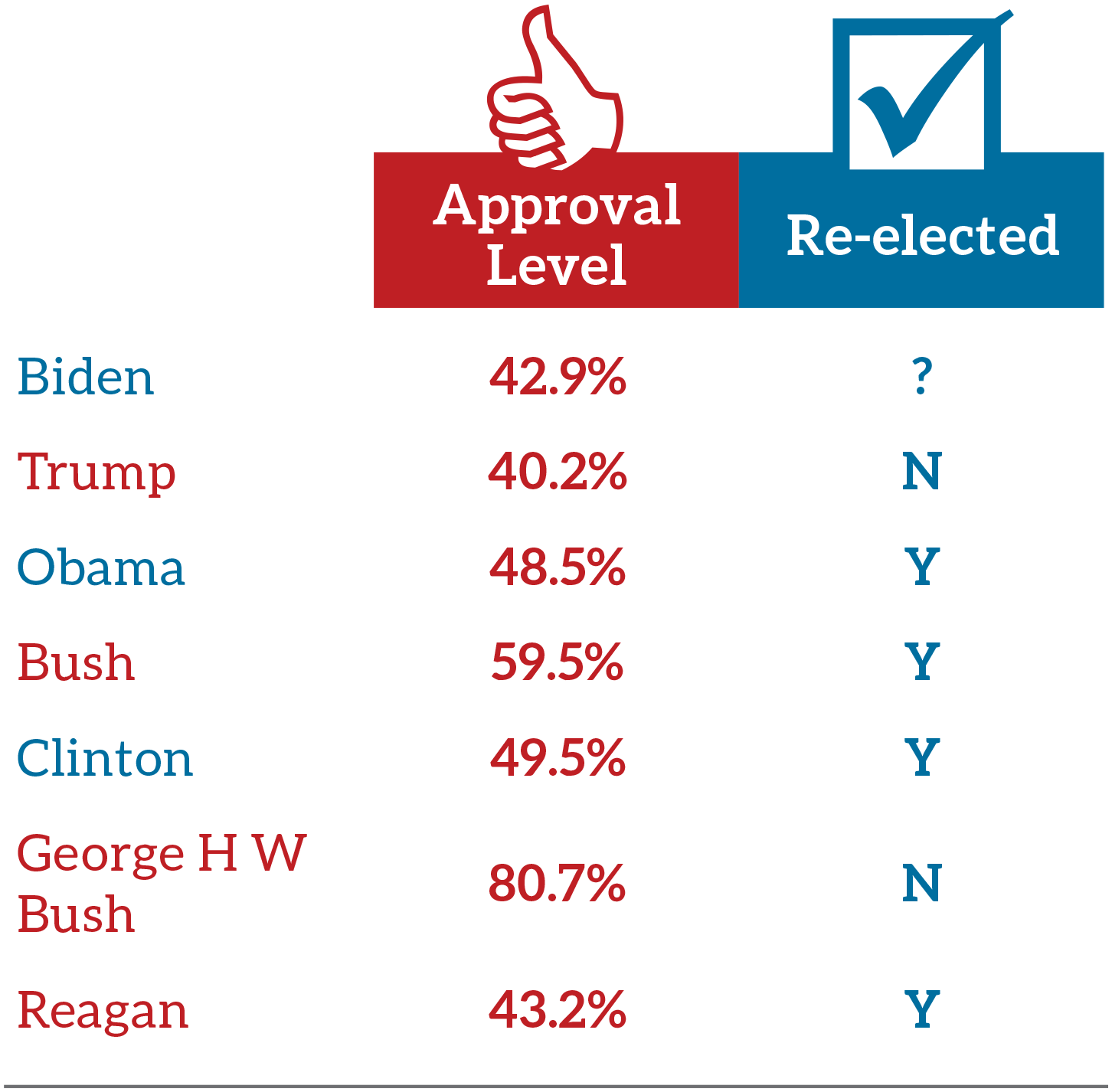
(Source: fivethirtyeight) Presidential approval on day 750 of a presidency.
In addition to these frustrating numbers for the administration, a poll towards the end of January 2023 found only 37 per cent of Democrats wanted Biden to stand again. His age - the President would be 82 at the time of any second inauguration - was a primary source of concern. On the other hand, it might be asked whether those Democrats wishing that Biden would step aside have fully thought through how messy any battle to replace him might become. Any race to replace Biden would likely be especially chaotic since the expectation that he will run again means that those who would potentially vie for the nomination are stymied from any public preparation to do so.
The state of the Republicans
Across the party divide a messy, potentially bloody, struggle is in prospect for the Republican nomination. At one level the battle has been slow to start: by Valentine’s Day 2023 only two serious candidates had put themselves forward to Republican supporters. Donald Trump had declared shortly after the midterms and he was joined by his former Ambassador to the United Nations and Governor of South Carolina, Nikki Haley. Haley’s resume suggests that she is a serious political actor, but the person whose entry into the race is most anticipated is Florida Governor Ron DeSantis.
Speculation that DeSantis was the person who could de-throne Trump from his place atop the Republican Party grew in the aftermath of the 2022 midterm elections. Trump’s credibility as party leader was damaged as some of the more controversial candidates that he had endorsed lost in winnable races. Throughout the Republican primaries high profile party figures who had challenged Trump’s authority were largely rebuked. Notably, Representative Liz Cheney in Wyoming was crushed in her primary. Trump’s authority was not undisputed; in Georgia, Trump’s efforts to defeat Republican incumbent Governor Brian Kemp in the party primary fell far short.
Speculation that DeSantis was the person who could de-throne Trump from his place atop the Republican Party grew in the aftermath of the 2022 midterm elections. Trump’s credibility as party leader was damaged as some of the more controversial candidates that he had endorsed lost in winnable races.
In aggregate, Trump endorsed over 250 candidates and over 80 per cent of these won, but many of these were in safe Republican seats and a handful of high-profile candidates bearing Trump’s imprimatur were defeated. Critically in the Senate races Politico rated ‘toss ups’ -Trumpian candidates in Arizona, Georgia, Nevada and Pennsylvania - lost to their Democratic opponent. Furthermore, in Alaska, where the vote went down to two Republicans pitted against each other in a run-off election, the relatively moderate Republican incumbent Lisa Murkowski, who had voted to convict Trump in the 2021 impeachment trial, held on to her seat against a Trump backed challenger. While Trump’s hold on the party seemed confirmed by the 2022 primary elections, the November midterms loosened that grip.
In contrast, DeSantis had a good election night as he was resoundingly re-elected Governor of Florida, winning by nearly 20 points. In reflecting on the possibilities of a Trump battle with DeSantis, it is important to understand that this will not be about competing political philosophies. To the extent that DeSantis has gained national political recognition for his actions as Florida Governor it has been for stoking up the culture wars, outflanking Trump to the right by using education policy, and what should be taught in classrooms, as a forum for pushing his agenda. In this context, if DeSantis is the nominee, it will be interesting to see if Democrats can successfully pivot to attack his prior record as a member of Congress, when he supported a more traditional conservative agenda including unpopular cuts to Social Security and Medicare. Trump too, will likely target that record, as it was his rejection in the 2016 campaign of these ambitions to downsize the major pillars of the welfare state that upended these longstanding conservative commitments.
Early polling of a Trump against DeSantis match-up for the nomination has been inconsistent; for example, a Reuters/ IPSOS poll in early February gave Trump a 12-point lead while a Monmouth poll put DeSantis ahead by a similar margin. One part of the emerging conventional wisdom that these polls did bear out was that Trump’s chances would be boosted by a larger field rather than straight shoot-out with DeSantis. This analysis reflects how Trump won in an initially crowded field in 2016 as anti-Trump forces were divided between those seen as more regular party candidates. The Republican race remains uncertain. Other potential candidates include former Vice President Mike Pence, Senators Ted Cruz of Texas and Tim Scott of South Carolina, former Secretary of State under Trump Mike Pompeo, and Governors Chris Sununu of New Hampshire and Glenn Youngkin of Virginia.
There is still a long way to go in the race for the White House, and the history of US politics shows that unanticipated events can upend the political landscape. Nevertheless, it seems reasonable to look ahead to a presidential contest in the summer and fall of 2024 between incumbent President Biden and either former President Trump or Governor DeSantis. Either match-up would likely make for ugly politics, with the results far from certain.
Footnotes
Alex Waddan is Associate Professor in Politics at the University of Leicester.