



Abstract
The Internet of Things (IoT) is changing the role of telecommunications service providers in promoting connectivity among people and devices. Through its deployment, the IoT is fostering digitization, technological innovation, and advancement in the telecom industry. Telecom businesses are primarily engaging in IoT platforms through either international collaborations with cloud service providers or local infrastructure deployments. In developing countries, businesses are adopting IoT technology, which is a newly emerging phenomenon. From sim and data sales to new IoT-enabled offerings, telecoms are diversifying their businesses and services. Individuals and businesses can use their services to host IoT devices, applications, and solutions on the IoT platform. This paper discusses IoT technology in telecom in context of a Telecom Company “China Mobile Pakistan” in developing country Pakistan, who is boosting connectivity among people and devices through the deployment of IoT platform OneNET. Through qualitative case study, this paper documents ecosystem, value chain, features, architecture, and functions of IoT platform OneNET. It emphasizes the importance of an IoT platform that aids management, as well as university students, hardware providers, solution providers, equipment suppliers, local application developers, and incubators, in comprehending the complexities of IoT technology for telecoms.
Introduction
The internet of things (IoT) is an evolving phenomena, recognizing as an innovative future technology having wide scope in various fields (Al-Fuqaha et al., 2015). The IoT has evolved as a result of the integration of various technologies, embedded systems, and real-time analytics. The aim of IoT is to expand the connectivity of internet (Aulia and Gunawan, 2019). The IoT is a system consisting of interconnected computing devices and digital machines that share and communicate data over a network. The wireless networks, embedded systems, and others technologies are facilitating the IoT (Brown, 2016). For IoT, network connectivity, operating systems, and platform architectures are evolving (Bansal and Kumar, 2020). The IoT allows exchange of information in safe, efficient, and effective manner (Mishra et al., 2016). The IoT is a useful advancement that bring to the next generation of benefits in terms of productivity and efficiency enabled by revolution of information technology (Behrendt et al., 2017).
The IoT is a technological revolution that leads to efficient resource allocation, sustainable economic growth, and competitiveness on one hand. The impact of IoT is expected to reach 100 billion connected IoT devices through the internet by 2025, with a global economic impact of more than $11 trillion (Attia, 2019). On the other hand, IoT is improving the businesses operating processes and procedures. Moreover, IoT has an impact on business performance, productivity, strategic decisions, and investments and helps businesses stay competitive (Borgia, 2014). Individuals can use the IoT to live and work more intelligently and improve their daily lives through IoT applications and services.
During the last three decades, telecommunication service providers have dominated the information and communication technology industry. The telecommunications sector is going through a digital transformation. The emergence of digital revolution is the primary driver of changing business models. The new revenue-generating prospects inspires telecoms to formulate new strategies and plans, incorporating them into their core business models (Mihailović, 2019). The IoT is changing the role of telecommunications service providers in promoting connectivity between people and devices. Through its deployment, the IoT is fostering digitization, technological innovation, and advancement in the telecom industry (Aulia and Gunawan, 2019). They are developing new innovative IoT-enabled services and solutions for their customers in order to strengthen and improve their business operations (Shoukry et al., 2019, and Andersson and Mattsson, 2015). By establishing broad-ranging new applications, the telecom industry improves, progresses, and grows its operations, infrastructure, and services through digital transformation (Yepez, & Kim, 2018).
Evolving network technologies are generating optimal growth and more revenue by establishing and integrating IoT into ecosystems (Shatila and Gunawan, 2019). The IoT revolution offers telecommunication service providers opportunities to grow their position and businesses as well as to create significant new value in terms of providing better products and services to customers (Shatila and Gunawan, 2019). Telecom improves user experience by streamlining procedures, services, supply chain, and network. Telecom businesses are primarily engaging in IoT platforms through either international collaborations with cloud service providers or local infrastructure deployments (Bansal & Kumar, 2020; Kim et al., 2016; and Marques et al., 2017). According to the GSMA, the telecom services providers are expecting to earn over $1.8 trillion in yearly revenue in the IoT industry by 2026.
In developing countries, businesses are adopting IoT technology, which is a newly emerging phenomenon. From sim and data sales to new IoT-enabled offerings, telecoms are diversifying their businesses and services. Individuals and businesses can use their services to host IoT devices, applications, and solutions on the IoT platform. The IoT is decisively revolutionizing operations, unlocking the true potential in a sustainable development and through connectivity, platform, and solution integration, paving the way for IoT technology (Jell et al., 2018).
However, as an emerging technology, IoT adoption by telecom is a real-time phenomenon that requires detail study. There is a need to study the various aspects of IoT technology in Telecom. Therefore, this paper discusses IoT technology in telecom through exploratory case study in particular organization like Telecom Company (CMPak) who is boosting connectivity among people and devices via the deployment of IoT platform OneNET. This paper examine IoT technology in telecom through documenting ecosystem, value chain, features, architecture and functions of IoT platform OneNET of CMPak. Through this exploratory and qualitative case study one can able to understand the nature and dynamics of IoT technology in telecom. For the case study, the information is collected through discussion with management and documents provided by the management. As a qualitative study, the content analysis technique is employed which is recommended by Benbasat et al. (2002) and Yin (2017). It emphasizes the importance of an IoT platform that aids management, as well as university students, hardware providers, solution providers, equipment suppliers, local application developers, and incubators, in comprehending the complexities of IoT technology for telecoms.
This case study on IoT in Telecommunication is structured as follows: The Internet of Things and Telecommunications section discusses IoT technology in telecom. The China Mobile Pakistan and Internet of Things: A Case Study section provides a case study on IoT platform OneNET of CMPak. The China Mobile Pakistan IoT Way Forward section presents China Mobile Pakistan IoT Way Forward, and the Conclusion section presents conclusion along with case questions.
Internet of Things and Telecommunications
The latest advancements in communication devices and wireless network technology are propelling the internet and telecommunications into a new era (Marques et al., 2017). As an emerging technology, the IoT is paving the way for widespread connectivity by encompassing everything that is connected to the Internet. Existing internet connectivity is transformed into a machine-to-machine (M2M) architecture by IoT technology. The IoT refers to virtual connections between heterogeneous devices that are connected over the Internet (Marques et al., 2017). The IoT connects the physical world with the digital world through physical devices that are embedded with various types of sensor devices. An enormous amount of data can be produced and shared by a large number of internet-connected devices. (Kraijak and Tuwanut, 2015). Also can generate a significant amount of added value through applications and the resulting services.
The connectivity and networking layers in the IoT ecosystem is a telecom network, showing the IoT as part of the telecommunication (Bansal and Kumar, 2020). The telecom industry is one of the largest potential players in the IoT market, according to GSMA. Telecoms, with their key role and ability to connect millions of devices, find themselves in a different environment, with new revenue streams from the connectivity revolution. Telecoms are playing an important part in the IoT value chain.
The IoT has changed the role of telecommunication service providers in fostering connectivity between people and objects (Aulia and Gunawan, 2019). In other words, the deployment of the IoT in telecommunication changes the dynamics of human–computer interaction. The emergence of IoT in telecommunications demonstrates its ability to improve business processes. IoT is being used by telecoms companies to grow their businesses (Aulia and Gunawan, 2019). Telecom improves user experience by streamlining procedures, services, supply chain, and network. Internally, telecoms are utilizing IoT technologies to increase efficiencies and maximize resource utilization. They are developing new innovative IoT-enabled services and solutions for their customers in order to strengthen and improve their business operations (Andersson and Mattsson, 2015, and Shoukry et al., 2019). By establishing broad-ranging new applications, the telecom industry improves, progresses, and grows its operations, infrastructure, and services through digital transformation (Yepez, & Kim, 2018).
As a reliable connectivity providers, Telecoms are leveraging their core strengths from telecommunications infrastructure and connectivity to reclaim the leading position in the communications value chain with innovative, value-added services. Telecoms leverage the IoT to offer a variety of goods and services for value addition to their existing networks (Sethi & Sarangi, 2017). Telecoms are constructing separate networks for their IoT platform. Developers and businesses can utilize these IoT platforms to create their own IoT products and services.
Evolving network technologies are generating optimal growth and more revenue by establishing and integrating IoT into ecosystems (Shatila and Gunawan, 2019). The IoT revolution, offers telecommunication service providers opportunities to grow their position and businesses as well as to create significant new value in terms of providing better products and services to customers (Shatila and Gunawan, 2019). To monetize IoT solutions, telecom companies are adopting creative approaches and apps. Therefore, There are three distinct IoT investment sectors in the telecom industry: “a) Planning, monitoring, and maintenance for IoT network related requirements, b) IoT infrastructure and services for Telecom customers, and c) IoT solutions development” (Ahmed and Ahmed, 2019).
Telecoms are providing IoT solutions and services, such as (i) end-to-end business solutions backend business solutions to solve business problems of their customers in a specific area, (ii) IoT data storage and management services to store, manage, filter, clean, and process IoT-generated data, (iii) data analytics services to perform basic and advanced data analytics, and (iv) IoT connectivity services to support IoT infrastructures of their customers.
China Mobile Pakistan and Internet of Things: A Case Study
In Pakistan, China Mobile Pakistan (CMPak) is a subsidiary of China Mobile Limited. CMPak has adopted the IoT technology from China Mobile Limited who through partnerships connecting the world for developing and scaling up IoT solutions and services. China Mobile Limited is ushering in a new era for the digital world through research and development of IoT solutions and services. Moreover, it is developing application systems and end-to-end infrastructure content for customized solutions to meet user requirements.
China Mobile Pakistan is revolutionizing operations in Pakistan through IoT technology and paving IoT technology through connectivity, platform, and solutions integration. The CMPak is working on innovative IoT solutions and services in Pakistan. It is dedicated to providing best customer services with customized IoT solutions. Through the deployment of the IoT platform OneNET, CMPak is promoting connectivity between devices and people. In this paper, the technological perspectives of the CMPak IoT platform OneNET are explored.
China Mobile Pakistan IoT Ecosystem
The IoT ecosystem is a mechanism that integrates and connects numerous IoT components to ensure an efficient and effective system (Papert and Pflaum, 2017). IoT integrates and devices platforms and applications through communication protocol and interfaces (Bansal and Kumar, 2020).
China Mobile Pakistan IoT ecosystem as exhibited in Figure 1, consists of intelligent, smart, and embedded devices and components to gather and send data they receive from their surroundings. The data received by IoT devices is communicated via connectivity to an IoT gateway or hub. It filters and formats acquired data, as well as classifying and commuting it and translating it into relevant information. The gateway also links to the platform. The platform performs the function like managing, integrating, aggregating, and processing the data, performing security and privacy, and controlling and managing the network. The applications are used to report on the platform’s services and analytical data. The connectivity, networking, and communication protocols that are employed are largely determined by the IoT applications that are being used. IoT ecosystem.
China Mobile Pakistan IoT Value Chain
The IoT technology helps telecoms with an opportunity to not only expand their position, but also to create and generate new value. The IoT in telecom provides telecom service providers to offer initiatives and services beyond network connectivity. Telecoms leverage the IoT to deliver array of products that add value to their current networks. Telecoms explore IoT use cases to develop a wider range of services. Intelligent networks, data analytics, IoT platforms, and cloud services are used in the telecom business for a wide range of industries, from manufacturing to healthcare.
China Mobile Pakistan is expanding its business and services to innovative IoT-enabled services from sim and data selling. It is providing facilities to individuals and businesses to host IoT devices, applications, and solutions on IoT platform. Its IoT value chain includes providing devices, terminals, and chipsets; providing network for the transmission of data; providing IoT platform to manage and integrate devices and to collect, process, and analyze data; and providing the application that uses device data as shown in Figure 2. IoT value chain.
China Mobile Pakistan IoT Solutions and Services
China Mobile Pakistan OneNET is providing IoT solutions and services based on its architecture design which are as follows: (i) end-to-end business solutions backend business solutions to solve business problems of their customers in a specific area, (ii) IoT data storage and management services to store, manage, filter, clean, and process IoT-generated data, (iii) data analytics services to perform basic and advanced data analytics, and (iv) IoT connectivity services to support IoT infrastructures of their customers. i. End-to-End Business Solutions
OneNET offer PaaS tools to solve business problems of their customers in a specific area. ii. Backend Business Solutions
OneNET has a back end that can store, manage, and process data generated by IoT devices, as well as perform simple and advanced analytics on it. Customers can use APIs to connect to the back end and integrate it with their existing corporate applications. iii. Data Analytics and Data Science Services
OneNET provides descriptive, diagnostic, predictive, and prescriptive data analytics services to help their customers to get value from the data generated by IoT devices. iv. IoT Data Storage and Management Services
OneNET stores, filters, clean, and process IoT-generated data of their customers. v. IoT Connectivity Services
OneNET supports IoT infrastructures of their customers by offering managed connectivity services based on the NB-IoT protocol.
China Mobile Pakistan IoT Platform
The IoT network layer includes IoT platforms. IoT platforms are software applications that are specifically built to manage a whole IoT system. They are the IoT system’s backbone. Devices, gateways, and networks are connected to the cloud, server, and applications via an IoT platform (Bansal and Kumar, 2020). All devices can be identified with the help of the platform. For all IoT system devices, they deliver a “Software Development Kit” (Hejazi et al., 2018). These platforms are utilized to describe the IoT system’s business. They act as a link between the cloud and the IoT hardware ecosystem. This is where the ecosystem’s entire control in terms of speed, cost, complexity, business, and data flow is managed (Kim et al., 2016). They recognize devices, comprehend heterogeneous inputs from numerous devices via various protocols, and maintain the system up to dated. It facilitates device integration to enable devices to communicate and perform extremely complicated tasks (Bröring et al., 2017).
China Mobile Pakistan has adopted the IoT technology from China Mobile Limited. It deploys IoT platform OneNET with the support of China Mobile Limited.
China Mobile Pakistan OneNET Platform
OneNET is a PaaS service, with the goal of creating an efficient, robust, and secure application platform for applications and real-world devices. It conforms to a wide range of network environments and common transport protocols for devices, offering rapid access methods and device management services for a wide range of hardware terminals. It provides a wide range of APIs and data distribution features for applications to fulfill the development requirements of diverse industry application systems. 1
In IoT architecture, OneNET platform act as network layer that is considered as a bridge between the devices and applications.
OneNET Platform Architecture
China Mobile Pakistan adopts three-layer IoT architecture, as recommended during the early phases of IoT development (Mashal et al., 2015 and Said and Masud.2013). It compose of three layers: perception layer, network layer, and application layer. Sensors and actuators are dealt with by the perception layer (sensor layer). It is responsible of identifying objects and collecting and transmitting data in terms of physical and environmental factors. Between the perception layer and the application layer, the network layer (transmission layer) functions as a link. It collects data from physical objects via sensors, then stores and transforms it. It is responsible of interconnecting smart objects with network equipment. IoT applications are defined by the application layer. It is responsible of providing services to the applications that are running on it.
The OneNET platform is based on layered approach and the OneNET platform architecture is shown in Figure 3
2
. i. Infrastructure Layer: It is responsible for device intercommunication and protocol standardization. ii. Communication Layer: Through this layer devices shared data to land in IoT platform domain for filtration. iii. Core Layer: It is responsible for data featuring that includes database structuring for connected devices iv. Data Visualization Layer: Through this layer devices shared data being pushed or presented through data visualization tools towards applications. OneNET platform architecture.
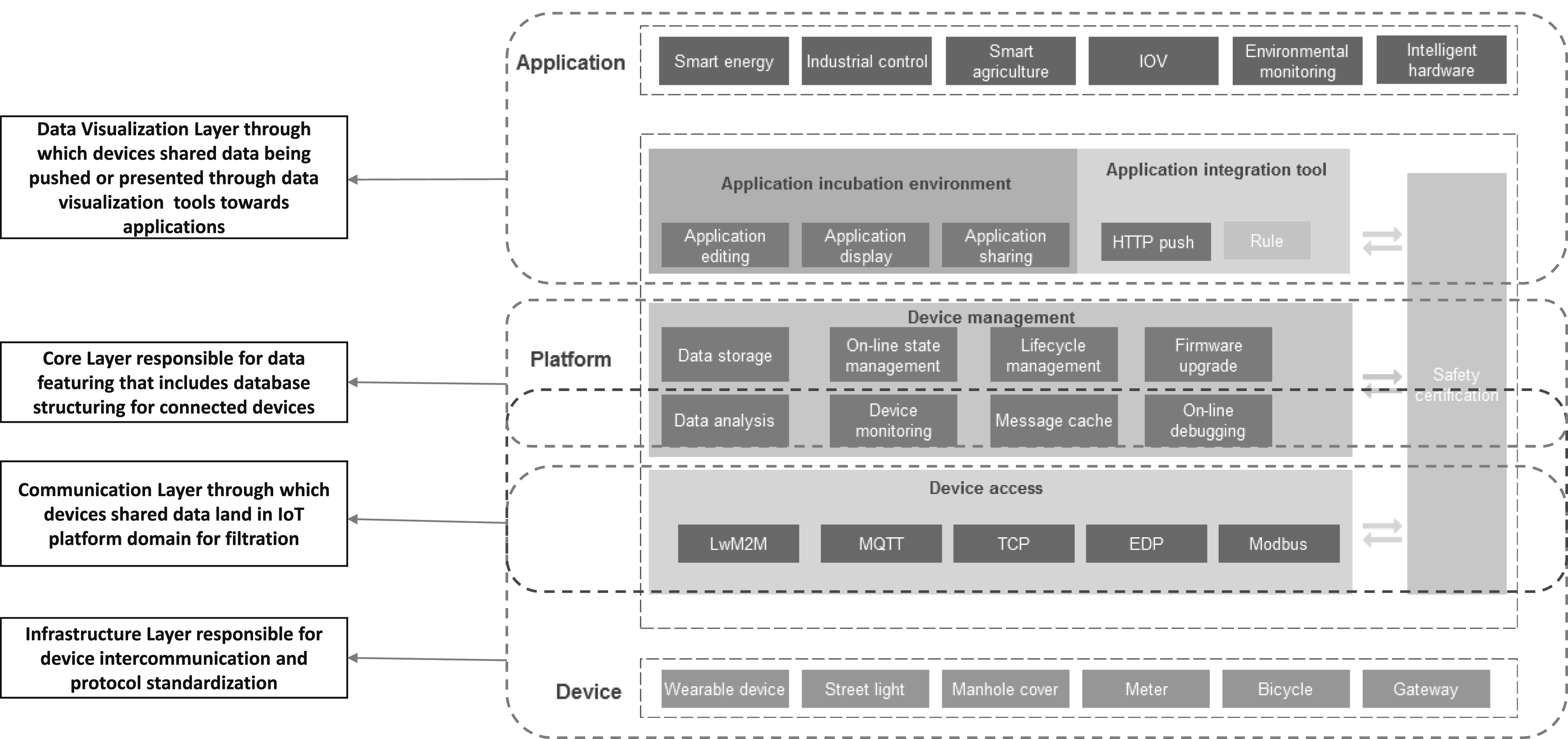
OneNET platform architecture consists of following domains
i. Device Access Device access services include real-time communication with devices through protocol standardization to fulfill the user need for different application scenarios. ii. Device Management Device management services include device monitoring and management, device data storage capacity and analysis, device life cycle and on-line status management to fulfill the user need for different application scenarios. iii. Application Programming Interface Open API interface provides user to use API for managing devices, querying data, interacting with device commands, and executing other operations. iv. http Push The http push services includes data push to filter out frequent periodic report device data and push data with high real-time users' concern to the user’s application server to fulfill high real-time user need for different application scenarios. v. Safety Certification Security certification mechanisms includes user-defined key access rights for the security of user access to devices and applications.
Why OneNET?
As shown in Figure 4, for vertical-based IoT applications, every sensor needs to connect with its separate server or platform for sending device data and then each server or platform transfer data into application for generating device data report. For this, large financial and human resources in terms of investment and technical experts are required to manage so many separate standalone servers. In contrast, for OneNET-based IoT applications, all sensors are connected to one server or platform which serves as a single entity consisting of universal models, protocols, database, and APIs. OneNET IoT platform collects, processes and analyzes device data and provides applications that uses device data to report. It improves business processes and reduces cost as it requires less investment and experts to manage IoT platform. Therefore, OneNET provides a wide range of network environments and common transport protocols for devices, offers rapid access methods and device management services for a wide range of hardware terminals. It provides a wide range of APIs and data distribution features for applications to fulfil the development requirements of diverse industry application systems. Why OneNET.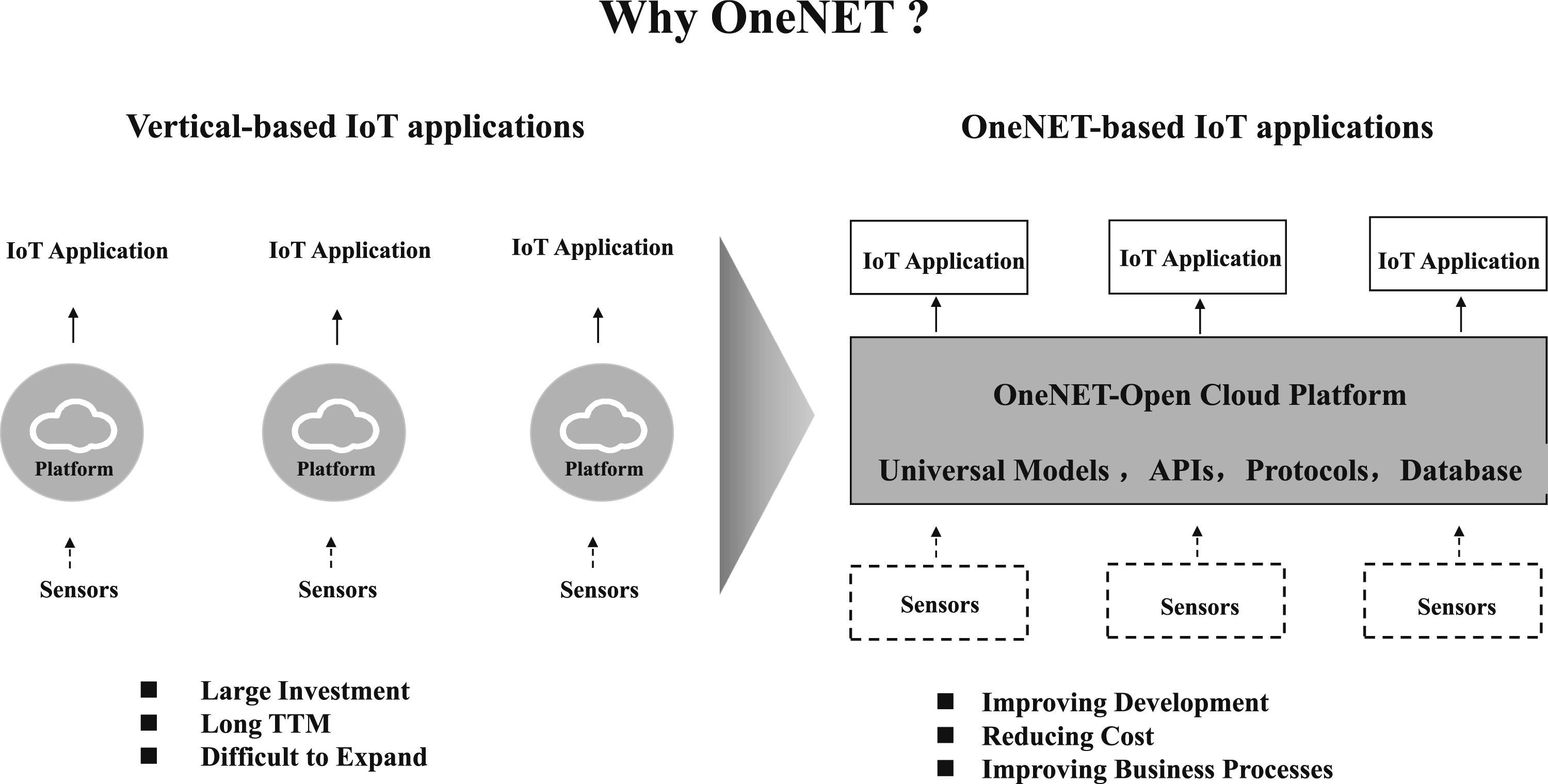
Value of OneNET
The OneNET leverages optimization of resources in terms of financial and human resources. It implies efficient and productive utilization of human resources and hardware resources. It reduces the operation and maintenance costs due to less servers, databases and processes and also reduces O & M workload for people. It also shorten product development time and expands application function according to market needs and adapt to market changes quickly, thus improves the business processes. Thus, OneNET improves resources productivity, reduces costs, and improves business processes as shown in Figure 5. Value of OneNET.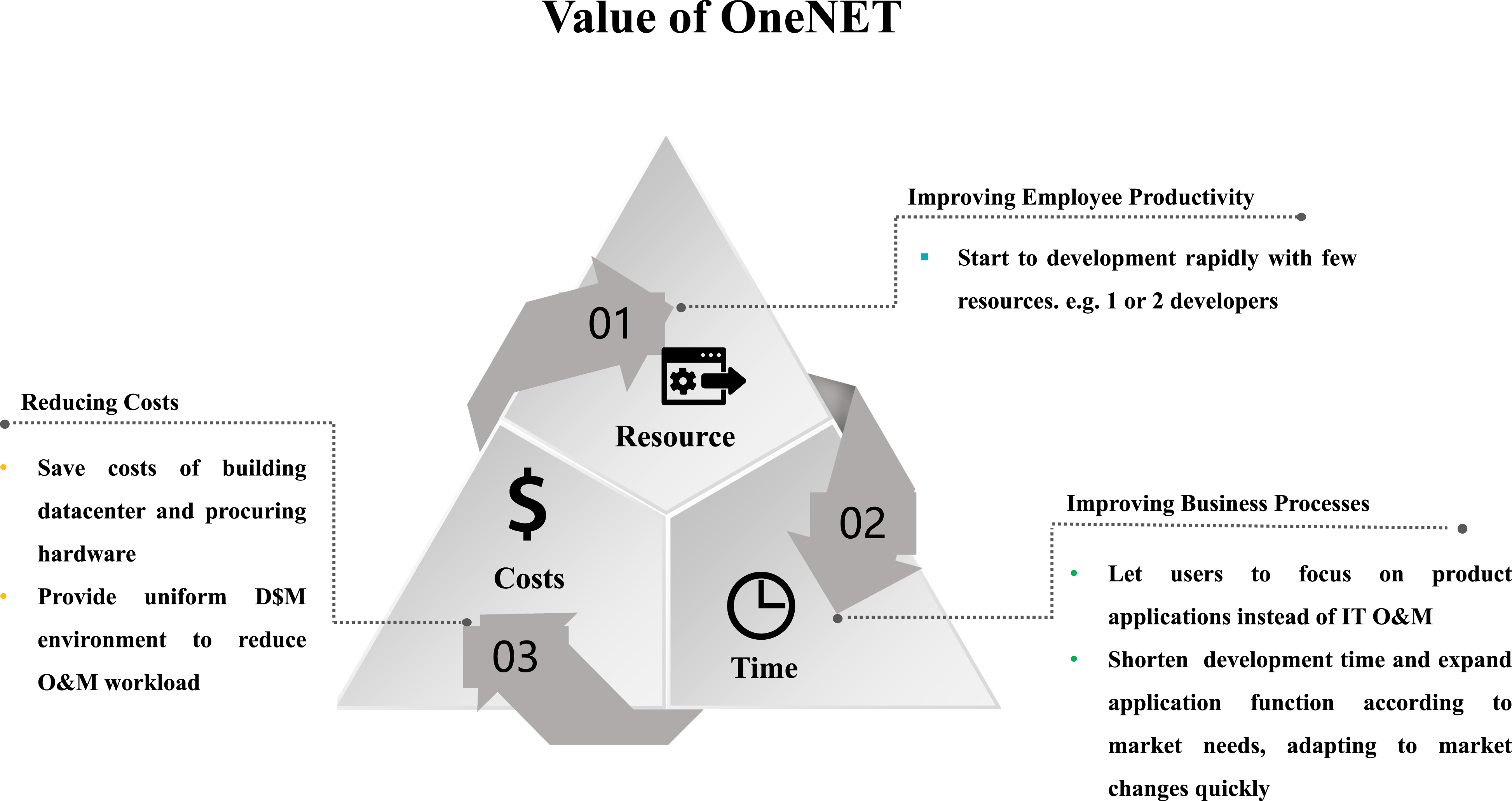
OneNET Platform Main Functions
The main functions of OneNET are as follows: i. Device Access OneNET is providing reliable and safe device access services, supporting main stream protocols including LWM2M (CoAP), MQTT, Modbus, http, TCP, etc., providing different language development SDKs and supporting users protocol customization. ii. Device Management OneNET is providing device life cycle management function, supporting device registration device updates, device queries, and device deletion. It is also providing on-line status management and monitoring, device data storage capacity, and device debugging tools and logs. iii. Data and Access Security OneNET is providing TLS and DTLS encryption channels, supporting private protocol and private encryption for data transmission, supporting secure access authentication mechanisms, and providing multiple data assurance mechanisms. iv. Rich API Support OneNET is providing open API interface and having rich API categories, including device add, delete, and modify, datapoint upload, and datastream creation. v. Application Integration Tool OneNET is providing message queue and http push services and supporting simple rule configuration.
OneNET Platform Supportive Functions
OneNET platform also have several supportive functions or protocols that enables to communicate between the platform and device. Each protocol has its own characteristics such wide coverage, multiple connections, low speed, low cost, low power consumption and excellent framework and other characteristics. Some of them listed below: i. LWM2M: LWM2M protocol is Lightweight M2M protocol with retransmit mechanism based on UDP protocol and mainly for IoT applications based on the narrow band cellular IoT (NB-IoT) scenarios. It focuses on low power and wide coverage (LPWA). It is widely applicable to the environment where power demand is low, high coverage depth, massive terminal device connection, and sensitive device cost. And can be widely used in application scenarios such as intelligent parking, intelligent meter reading, intelligent manhole covers, intelligent streetlights, etc. LWM2M has four major characteristics. a. Wide Coverage: NB-IoT offers a 20 dB boost over the existing network in the same frequency range, which equates to a 100-fold improvement in coverage. b. Big Connectivity: With the potential to enable vast connectivity, one sector of NB-IoT can handle 100,000 connections, it can easily handle a large number of device networking needs. c. Low Power Consumption: Focus on applications with small data volume and small rate, especially for some devices and occasions where batteries cannot be replaced frequently, the standby time of NB-IoT terminal module theoretically can be as long as 10 years. d. Low Cost: The expected cost of one connection module does not exceed $5. ii. MQTT: MQTT protocol is a real-time communication protocol for IoT applications that leverages TCP/IP to establish a network connection. It can shield messages for load content with low cost, and reduce network traffic effectively. MQTT protocol is applicable to scenarios where the device and platform need to maintain long connection. MQTT is characterized by unicast and multicast of messages between devices. It can manage and control real devices in form of application servers without relying on other services (issuing command services, pushing services, etc.).Some of its characteristic and functions are given below: a. Long connectivity protocol b. Platform messaging. c. Subscription, publication, and message push d. Realize message unicast and multicast between devices terminal data point reporting and supported data point types. iii. EDP: EDP protocol is Enhanced Device Protocol which is a fully open TCP-based protocol customized by OneNET platform based on IoT features. It can be widely used in home, transportation, logistics, energy, and other industrial applications. The EDP protocol is useful in situations when a device and platform must maintain a long connection and preserve point-to-point control. The TCP protocol just sends data packets to their destination and does not guarantee that the transmission and arrival orders are the same. The transaction mechanism must be implemented in the upper layer; if a client sends two requests at the same time, the server cannot guarantee the order of resent messages when it returns. EDP protocol is applicable to situations such as long connection data reporting, data transmitting, data forwarding, data storing, and data active downloading. Its features and functions are given below: a. Long connectivity protocol b. Data encryption transmission c. Terminal data point report, and supported data point types d. Send platform message (support for offline messages) end-to-end data forwarding. iv. Modbus: Modbus protocol supported by OneNET is based on TCP connection, namely, Modbus over TCP. As a host, OneNET encapsulates data in TCP data to send and receive data. With simple transparent capability through DTU, it can realize Modbus protocol communication between bus device and platform, which can be widely applied to various industries using Modbus protocol. Modbus communication protocol is an industrial field-bus communication protocol, which is widely used in industrial automation control, and can realize industrial data acquisition, control, and other functions. It can be widely used in DTU + Modbus scenarios (i.e., Bus protocol is Modbus, using DTU to connect platform). Its function and characteristics are stated below: a. Long connectivity protocol b. As Modbus host, periodically issuing host commands c. Determine the content and issuing cycle of a single command by attributes of a single data stream d. Automatically convert data reported by the terminal into data points in data stream e. Processing formula can be preset, to proceed preliminary process on data v. TCP: The user supported by OneNET upload data through TCP transparent, which provides feasibility for any protocol device to access OneNET. The device accesses OneNET through TCP connection. The data can be interacted with OneNET after authentication. OneNET can parse uploaded data and send data to device through user-uploaded self-defined script. It is mainly applicable to user-defined protocol. It can interact with any protocol according to scripts defined by itself, and supports scripts to be modified and uploaded at any time. The protocol supports one connection to transmit multiple device data, and can centrally connect multiple devices to upload and download data. It is widely used in intelligent instruments such as intelligent meters and water meters. Functions of TCP protocol is given below: a. Long connectivity b. User-defined scripts, only support high flexibility c. Support one connection to transmit multiple device data
OneNET Competitive Analysis
OneNET competitive analysis.





China Mobile Pakistan IoT Way Forward
After successful launch of IoT platform, CMPaK IoT has decided to replicate China Mobile Communications Corporation (CMCC) model in Pakistani market and to move in two vertical simultaneously. One is OneNET platform promotion and second is partnerships with the potential IoT market giants. For OneNET Promotions, CMPaK is targeting Universities and leading IoT based incubation centers. The promotional strategy is to offer free of cost OneNET for one year. Hence the students and startups can launch their IoT solutions and products from CMPaK platform.
For OneNET partnerships, CMPaK is offering two models to startups and established IoT companies. First is revenue share model in which they can join as CMPaK FSA vendors and share revenues. In second model, they can use OneNET platform as PaaS for which they will be charged on the basis of connected devices.
Conclusion
The IoT is changing the role of telecommunications service providers in promoting connectivity among people and devices. Through its deployment, the IoT is fostering digitization, technological innovation, and advancement in the telecom industry. Telecom businesses are primarily engaging in IoT platforms through either international collaborations with cloud service providers or local infrastructure deployments. In developing countries, businesses are adopting IoT technology, which is a newly emerging phenomenon. From sim and data sales to new IoT-enabled offerings, telecoms are diversifying their businesses and services. Individuals and businesses can use their services to host IoT devices, applications, and solutions on the IoT platform. The IoT is decisively revolutionizing operations, unlocking the true potential in a sustainable development and through connectivity, platform, and solution integration, paving the way for IoT technology
In this paper, IoT technology in telecom is discussed through exploratory case study in particular organization like Telecom Company (CMPak) who is fostering connectivity among people and devices through the deployment of IoT platform OneNET. China Mobile Pakistan has adopted the IoT technology from China Mobile Limited. It deploys IoT platform OneNET with the support of China Mobile Limited. The CMPak IoT platform known as “OneNET Platform”, its features, functions, and architecture are explored.
OneNET is positioned as a PaaS service, with the goal of creating an efficient, robust, and secure application platform for IoT apps and real-world devices. It conforms to a wide range of network environments and common transport protocols for devices, offering rapid access methods and device management services for a wide range of hardware terminals. It provides a wide range of APIs and data distribution features for applications to fulfil the development requirements of diverse industry application systems. OneNET platform is based on layered approach which includes device access, device management, application incubation tool, application integration tool, and safety certification. OneNET platform also have several supportive functions or protocols that enables to communicate between the platform and device. Each protocol has its own characteristics such wide coverage, multiple connections, low speed, low cost, low power consumption and excellent framework, and other characteristics. OneNET comes with unique features to process data within Pakistan. The bi-directional communication allows OneNET to execute any action with full capability and minimum latency. OneNET platform outperforms in all aspect starting from protocols compatibility, device management, support, to identification and security as compared to other IoT platforms.
Case Questions 1. What is the role of telecoms in IoT ecosystem and IoT value chain? 2. How are Telecoms leveraging IoT Technology? 3. How IoT technology works? What IoT ecosystem CMPak has adopted for implementation of IoT technology? 4. What are the components of IoT Value Chain of CMPak? How they are linked with each other? 5. How is CMPak providing IoT Solutions and Services to Businesses? 6. Which layer of IoT architecture “OneNET platform” belongs to? 7. Discuss the importance and value of OneNET platform of CMPak? 8. What are the main functions of OneNET platform? 9. What are the distinctive features that made OneNET platform to outperform in comparison to others platforms? 10. Which business models CMPak has adopted for OneNET platform?
Footnotes
Declaration of Conflicting Interests
The author(s) declared no potential conflicts of interest with respect to the research, authorship, and/or publication of this article.
Funding
The author(s) received no financial support for the research, authorship, and/or publication of this article.
