



Abstract
While many American businesses were losing consumer trust during the 1920s and 1930s, American Telephone & Telegraph Company (AT&T) maintained a solid reputation. Much of the credit is due to Arthur W. Page, the first vice president of public relations at the mammoth telephone company. Little attention has been paid to the rhetorical strategies Page utilized to construct a compelling image of AT&T in company during that timeframe. In this rhetorical analysis of previously unpublished speeches, we assert that Page shaped company discourse through strategic use of rhetoric. Analysis of his unpublished speeches yielded five themes: conveying company capabilities, embracing societal connectedness, distinguishing AT&T, managing public opinion, and repurposing public relations. Corporate communicators who are currently struggling to gain consumer trust can benefit from understanding the rhetorical strategies that Page employed during a tumultuous time for American business.
Keywords
Introduction
When Arthur W. Page was hired as the first vice president of public relations for the American Telephone & Telegraph Company (AT&T) in 1927, the roller-coaster of American business success was trending downward (Gifford, 1927). Companies were facing entirely new market conditions, loss of product sales, and lessened public trust (Bernays, 1937). Because Page asked to have a say in company policy as a stipulation of his employment (Griese, 2001), he shared responsibility for AT&T’s market reputation and business reality. To boost its market position, the company increased telephone quality, improved customer service, and kept costs low (Griese, 1977). To enhance its reputation, AT&T launched an extensive image restoration campaign buoyed by Bell employees delivering 7,000 lectures and demonstrations to schools and groups in 1940 alone (Broughton, 1943; Page, 1942b). Page articulated the company vision both inside and outside the company (Griese, 1976) before and after his 20 years of working at AT&T; nevertheless, few scholars have considered how he used rhetoric to convey that vision (e.g. Griese, 2001; Remund, 2010). In this rhetorical analysis of previously unpublished speeches, the authors contend that Page utilized a series of rhetorical strategies to construct a compelling image of AT&T.
This study fills an important gap in the literature because little scholarly research has been conducted about Page. Most publications about him have been biographical in nature (Broughton, 1943; Griese, 2001) or situated within broader histories of public relations or AT&T (Cutlip et al., 2000; Griese, 1976; Kielbowicz, 2009). Other references are centered on the Arthur Page Society, an organization of senior-level corporate public relations professionals, or the Page Principles (see Table 1), a codification of ethical corporate public relations viewpoints encapsulating Page’s workplace philosophies. Of additional importance is the fact that the dataset of speeches, made available to the public in 2011, provides scholars with a new vehicle to explore his perspectives (see, for example, Medhurst, 2001; call for ‘rhetorical archaeology’).
The Page Principles.
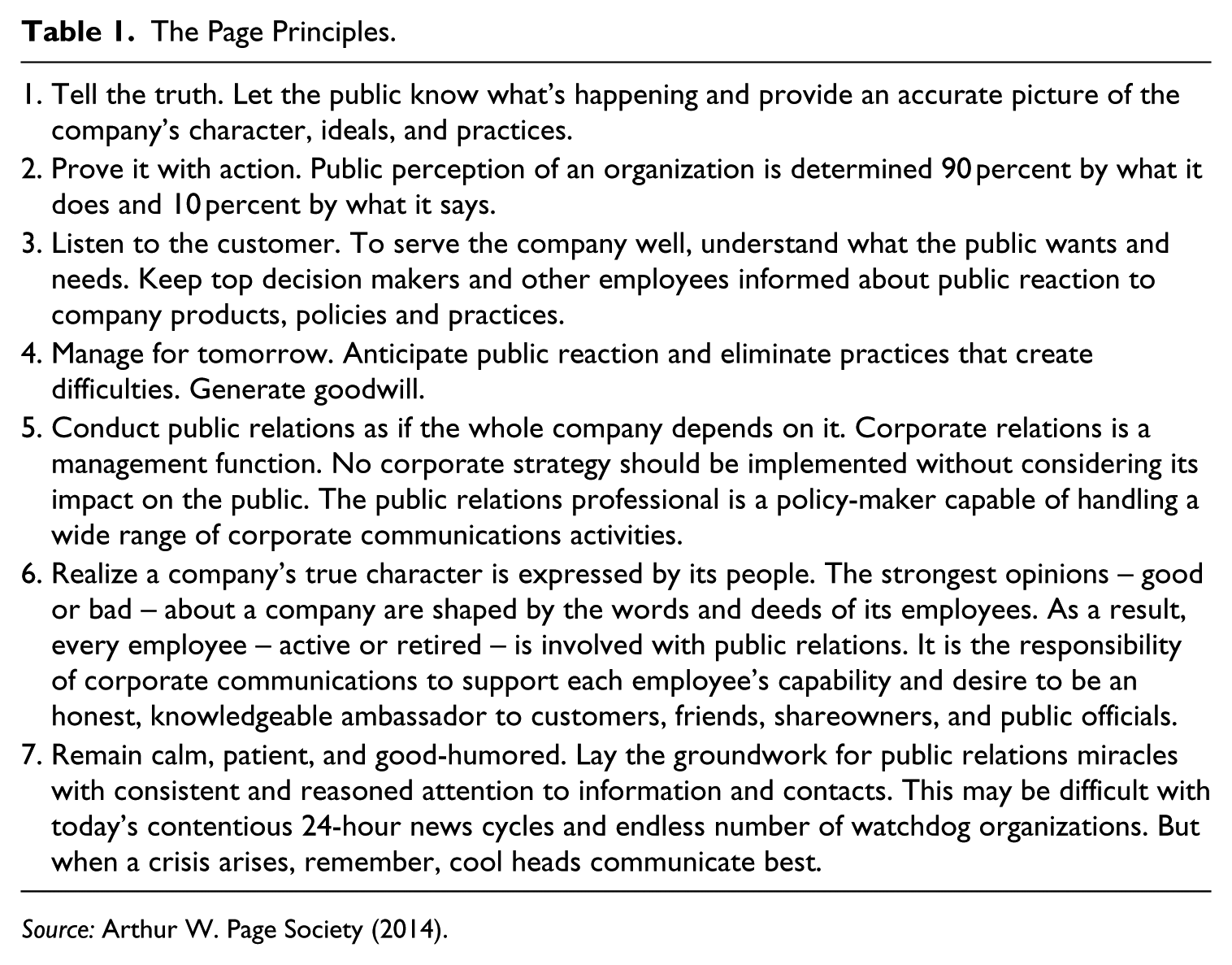
Source: Arthur W. Page Society (2014).
The rhetorical strategies Arthur W. Page utilized during a time of prevailing mistrust of American businesses matter today because corporations are facing similarly low levels of consumer trust (Edelman, 2012). Uncovering Page’s rhetorical approach could enable companies today to construct and better convey corporate identity to their internal and external constituents. Companies facing reputational or operational problems may learn how to enhance their own messages by utilizing rhetorical strategies evident in this study. The modes of discourse dissemination Page used may also aid current corporate communicators. By delivering speeches to publics of different sizes, he took the pulse of public opinion and translated that information into improved customer service. Large corporations today could do the same by holding regional or local conferences to connect with smaller groups. Such smaller speaking settings could also inform companies whose primary research is numbers-driven. AT&T successfully utilized quantitative and qualitative approaches for company research. Corporate executives today may follow suit and employ qualitative means of inquiry to gather company information. A constructivist approach enables companies to investigate the ‘shared social realities humans create by virtue of their interactions’ (Curtin, 2012: 37). Companies currently in business could conduct their own qualitative research in order to gather customer insights and immediately address issues affecting consumer trust.
Literature review
The authors have reviewed two strands of academic literature to situate the study phenomena. The first places the study in historical context and the second positions the study within business discourse scholarship.
Before working at AT&T, Page edited a newspaper his father co-founded called the World’s Work (Remund, 2010). Analysis of Page’s editorials suggested he believed companies had a special obligation to society. He emphasized corporate character, labor rights, and consumer protection among other ideals (Remund, 2010). Page would tout these ideals for years (Griese, 1977), although his actions did not always reflect his words.
When Page began working at the parent corporation of The Bell System, he offered financial incentives to facilitate company support. He paid AT&T managers to network with community leaders and he hired writers to publish flattering feature articles about the company (Olasky, 1987). Even while the company continued its dubious public relations tactics (Broughton, 1943; Griese, 1976, 2001), Page continued to discuss the importance of upstanding corporate character through speeches, letters, and other documents (Griese, 1976).
It became clear where Page’s loyalties lay when restrictive laws began threatening the socioeconomic power held by AT&T and other big corporations (Kovacic and Shapiro, 1999). Rather than join forces with the National Association of Manufacturing to facilitate pro-business sentiments (Tedlow, 1976), Page launched an independent campaign to rebuild trust in AT&T (Griese, 2001: 201). The central component of the AT&T campaign was giving government officials and journalists talking points to publicly endorse the company (Kielbowicz, 2009).
Internal messaging to AT&T audiences appeared to be as important as external messaging to Page. He delivered speeches inside and outside the company, often likening public relations to good customer service (Broughton, 1943; Griese, 1977; Griswold, 1967). He encouraged executives to use company magazines and newspapers, manager-led employee discussions of the annual report, and company films to convey key company messages (Griese, 1977). In order to explore the rhetorical strategies Page utilized for AT&T, the authors first reviewed the literature in which scholars investigated rhetoric within business discourse. Those articles are reviewed next.
Beason (1991) uncovered two rhetorical strategies in his analysis of eight business speeches. Similitude emerged from the ‘high regard that business people placed on unity, company loyalty, and workers who were able to work together’ (p. 333) and the contradictory concepts of expertise and self-criticism. He also identified signalled [sic] ethos. An extension of ethos (appeals exerted by the character of the speaker, that is, speaker credibility), signalled ethos occurs when ‘the communicator’s persona moves toward the forefront of the message, offering a conspicuous opportunity for an audience to focus on what the text suggests about the communicator as a person’ (p. 328). Study results indicated that signalled ethos was effective for enhancing speaker message and image.
Epideictic, in which discourse is used to praise the moral or blame the shameful (Murphy et al., 2014), was evident in an analysis of Mobil Oil’s newspaper column Observations. Crable and Vibbert (1983) found that the company sought public sympathy and support in the columns. The scholars also noted the company portrayed itself as a ‘wise rhetor’ in the columns by appealing to the American value system (p. 394). This particular appeal aligns with Aristotle’s memory canon of rhetoric, in which a speaker taps into the audience’s cultural memory.
ExxonMobil appeared to have utilized Aristotelian rhetoric in its climate change texts. In a rhetorical analysis, Livesey (2002) stated the texts were ‘situated examples of a corporate rhetor’s intentional effort to influence the understandings of the policy-maker audience on an issue of public controversy and to motivate particular actions’ (p. 118). In seeking to influence policy-makers about a complex issue, ExxonMobil was utilizing logos, appeal to reason.
When Cabot (2005) conducted rhetorical analysis of a religious sect’s inaugural address, he found enthymemes, ‘rhetorical arguments from premises and rules’ (Murphy et al., 2014: 69). Analysis also revealed implied questions about the audience’s courage and metaphors, transferring meaning from one concept to another. According to Cabot, these strategies were designed for pathos, appeals to the emotions of the audience (Corbett, 1984).
Emotional appeals are a powerful tool of rhetoric, as noted by Bryant (1953) in a comprehensive overview of rhetorical functions: ‘Men seldom make effective reasonable decisions without the help of emotion, they often make, or appear to make, effective emotional decisions without the help of rational processes or the modification of reasonable consideration’ (p. 416). Arthur W. Page employed emotional appeals in promotional literature at AT&T despite a preference for logos (Griese, 2001), appeals to reason (Corbett, 1984):
AT&T advertising in his tenure was not above portraying as the ‘typical’ AT&T investor a mother preparing snap beans. Nor was AT&T advertising above making patriotic appeals during World War II. The annoying shortage of telephone wire at home was because that American fighter plane in the ad illustration, its wing guns blazing, was firing the telephone wire at a Japanese war plane. (Griese, 2001: 149)
In order to investigate rhetoric in AT&T business discourse, the guiding research question for this study is as follows: How did Arthur W. Page employ rhetoric in speeches he delivered for AT&T from 1927 to 1955? The authors framed their analysis with rhetorical theory, which is described in the next section.
Theoretical framework
For rhetoric to occur, an individual observes or creates an issue, and then ‘offers discourse designed to bring the interests of the audiences to bear on it’ (p. 1). Any discussion of rhetorical theory must begin with the strategies ancient public speakers utilized to engage with audiences. Several of the ancients used artistic proofs: logos (appeals to reason), ethos (appeals exerted by the character of the speaker, that is, speaker credibility), and pathos (appeals to the emotions of the audience). ‘Although the three proofs overlap somewhat, the ethical proof is most concerned with the speaker, the emotional proof with the audience, and the logical proof with the speech itself’ (Corbett, 1984: xvii). The origins of rhetorical theory also include the five canons of rhetoric to persuade the audience: invention (arguments in relation to particular purposes), organization (speech organization and its effect on audience), style (speaker use of language), memory (framing cultural memories), and delivery (dissemination of content) (Foss, 2009).
The historical roots of rhetorical theory are more complex and adversarial than a mere description of speaking techniques. Ancient public speakers in Greece and Rome never fully reached concurrence on issues and ideas related to rhetoric (Marsh, 2001). According to Aristotle, any speaker could employ logos, pathos, and ethos to persuade the public. Speakers did not have to believe the proofs – ethical or otherwise – they simply had to use them effectively. Isocrates vehemently disagreed; for him, consistency of speech and action was a prerequisite of speaker character. Supporters of Isocrates considered the interests of others during debates, seeking to build consensus (Marsh).
Corporate communicators could develop clear and comprehensive messaging using Aristotelian or Isocratean rhetoric. However, making the tough choice between credibility of speaker and credibility of message can have severe consequences:
If an organization tries to create an external perception of being ethical and socially responsible, while in reality it exploits its workforce, then it risks its true character being exposed in the media and thence to customers to the detriment of its overall reputation and commercial successes. (Davies et al., 2004)
According to Cyphert (2010), rhetorical theory can guide the business communication discipline toward a richer understanding of business speakers and communication. We believe the theory holds similar promise for the study of public relations.
Method
The researchers used criterion sampling (Creswell, 2013), wherein cases must meet a particular criteria, to determine the dataset. The criteria for this study were previously unpublished, speeches, and delivered by Arthur W. Page. The speeches, delivered between 1927 and 1955, were obtained from the Arthur W. Page Center for Integrity in Public Communication at The Pennsylvania State University through an online archive. The previously unpublished dataset speeches can be accessed online at http://pagecenter.comm.psu.edu/index.php/research-resources/page-speeches. A total of 36 speech transcripts made up the dataset. Although the dataset is small, qualitative communication researchers determine datasets based on their ‘possession of a specified trait, attribute, or performance’ (Lindlof and Taylor, 2002: 8).
The researcher is the instrument in qualitative research (McCracken, 1988), so both authors analyzed the speech transcripts. They employed rhetorical analysis (Leach, 2000) to ‘unpack the discourse and ask why it was persuasive’ (p. 208). In rhetorical analysis, it is essential to first establish context of the documents in question. Time is an important context of dataset speeches (see Table 2). Arthur W. Page began delivering speeches shortly after his 1927 arrival at AT&T – he gave four speeches that year – and he continued for several years after he left his post in 1946 (Page, 1946) when he began consulting for the company (Brubaker, 2011). ‘The first 15 speeches given from 1927 to 1931 address a variety of the Bell Telephone System executives and employees … Another nine speeches delivered after 1932 address a variety of audiences outside the company’ (Brubaker). Other than 1929 when Page delivered four speeches, he gave two to three speeches yearly between 1928 and 1932, and one speech a year for the remaining years represented in the dataset. Analysis also included consideration of speech kairos (timeliness) and phronesis (appropriateness). ‘In addition to giving the context and paying attention to the audience, considering these two concepts helps to link text, context, and audience together’ (Leach, 2000: 212). The authors referenced audiences and dates as necessary during analysis.
Dataset speeches.

AT&T: American Telephone & Telegraph Company.
Rhetorical analysis involved ascertaining the genre(s) of persuasive discourse (Corbett, 1984) indicated by dataset speeches. The authors read the speeches individually and discussed them throughout the analysis. Evidence of genre emerged from speech theme, word choice, and enthymeme (rhetorical arguments from premises and rules). The authors jointly categorized dataset speeches (Riessman, 2005) as either deliberative/political (for persuasion and dissuasion in public forum) or epideictic/demonstrative (ceremonial occasions; speaking for praise and blame).
The authors also identified canons of rhetoric in the speeches. They wrote self-memos to note invention (arguments in relation to particular purposes), organization (speech organization and its effect on audience), memory (framing cultural memories), delivery (dissemination of content), and style (speaker use of language). Analysis of speech style also included identifying metaphors (transfer meaning from one concept to other) and similitude (placing high regard on unity, company loyalty, and teamwork). Illustrations within speeches were a rich source for determining rhetorical canons. The authors alternated between their memos, the speeches, and the speech context as they conducted analysis.
To uncover artistic proofs, the authors analyzed speeches for audience appeals. They noted usage of logos (appeals to audience through logical argument), pathos (appeals to audience emotions), ethos (speaker credibility), and signalled ethos (conspicuous appeals to audience about speaker credibility and persona). Self-memos and notes in transcript margins enabled authors to identify artistic proofs. They worked inductively, allowing any final rhetorical elements to emerge prior to the last transcript readings.
To convey emic perspectives, the viewpoint that only Page could provide (Daymon and Holloway, 2002), the authors used words from speech transcripts to label each theme. The following findings reveal how Page employed rhetoric to construct a compelling image of AT&T.
Findings
Analysis of dataset speeches revealed several rhetorical elements. The canons of organization, style and delivery were evident in internal and external speeches. Page employed emotional and ethical arguments to persuade listeners. He also utilized illustrative metaphors and similitude to persuade his audiences. By rhetorically analyzing the dataset speeches, the authors uncovered how Page constructed a particular image of AT&T by (1) conveying company capabilities, (2) embracing societal connectedness, (3) distinguishing AT&T, (4) managing public opinion, and (5) repurposing public relations. These specific thematic categories are described in detail next.
Conveying company capabilities: ‘The direct route to the public is through our own people’
The first theme emerged from Page’s insistence that AT&T employees behave in a way that conveyed the company’s capabilities. Three months into the job, Page would utilize signalled ethos to demonstrate his perspective. In the following speech, his reference to another well-known business indicated two things to the audience: (1) Page knew the marketplace well and (2) AT&T was a capable company:
I am certain we can provide a method which will bring to the telephone system the public attention, for, instance, which Henry Ford has for the extreme degree to which he has gone into quantity production. I think if the public understood what the Bell System has done, it would have as large an interest in us as it has in Mr. Ford, and perhaps a higher regard because I think we have done some things of a public service nature which he has not. (Page, 1927c)
Page deftly complimented Ford and positioned AT&T as a future frontrunner. The organization of his speech, beginning and ending with reference to AT&T, enabled Page to convey company capabilities.
According to Page, AT&T was well-known (Page, 1931a), with exceptional new hires (Page, 1930b) and a reputation for meeting public needs. Yet, he understood that conveying company capabilities with every customer interaction was not easy. He admitted as much years later in the following epideictic speech to celebrate the one millionth AT&T investor:
You, therefore, cannot expect that our performance will be perfect. But as you have placed your savings with us, I want you to know that we understand the kind of a public trust we have, with its countless ramifications, and to assure you that while we shall certainly not always judge correctly, we do sit up nights to seek the straight and narrow path in this confused and complicated world. (Page, 1951b)
Page demonstrated similitude between himself and the company when using the word ‘we’ in his speech. He made effective usage of pathos: metaphorically speaking, AT&T employees were ‘sitting up nights’ worrying about investors.
Metaphors were a frequent aspect of speeches Page delivered. In the following speech, he used metaphors to foster character:
In discussing politeness and reasonableness, I do not mean something employees can be trained to put on like a cloak. I am not talking about stage management. I am talking about character – running a business so that the more the employees know about it the better they feel about it, and running it with people who know what they are doing, have a pride in their profession and want that profession held in high esteem by other people because it deserves to be. (Page, 1938a)
He described character by utilizing a metaphorical description of its opposite: it was not ‘a cloak’ or ‘stage management’ and it could not be trained. He would repeat the same story 4 years later to an internal audience of AT&T supervisors (Page, 1942b).
According to Page, every employee held equal responsibility for the fate of the entire company. ‘The direct route to the public is through our own people’ (Page, 1943). Hence, AT&T employees had to express the company capabilities in each customer service experience:
A company may have the best overall public policy in the world in the minds of management, but if the spirit of it is not translated into acts by those who represent the company in contact with the public, it will be largely discounted. (Page, 1942b)
Anyone who came in contact with employees – the ‘original walkie-talkies’ (Page, 1944b) – effectively came in contact with the company. In describing employee contact as two-way radios, Page tapped into the audience’s memory. His metaphor reinforced the importance of employee contacts by referencing a particular technology.
‘Usually people think about the whole business in the terms of their immediate contact with it and if they have a bad contact, they think the whole thing is bad’ (Page, 1928a). Page insisted that AT&T employees behave exceptionally, all day, every day. He expressed his perspective in the rhetorical style of the following speech he delivered at a general operating conference:
How can an organization possibly be successful when the plant executives feel that what ever [sic] happens after the product leaves the factory is the problem of the sales department? Similarly, what becomes of the concern whose auditing department deals only in figures, and has nothing further in view than the end of the fiscal year? What becomes of the concern whose purchasing agent is interested only in the lowest bid, and who is not interested at all in the preservation of good-will [sic]? (Page, 1928c)
By organizing the speech with questions and their implied answers, Page was identifying a specific cultural memory: AT&T employees understood their position in relation to the entire company. He extended the memory by alluding to potential problems that can occur when employees are only concerned with their position rather than the company as a whole. According to Page (1931b), well-informed employees were less likely to respond to customer requests with ‘rumor, gossip or indifference’. He employed epideictic discourse as well as similitude to remind employees that being well-informed would yield perspective about their specific roles:
The more a man knows about the whole business and the purposes of the business he is in, and why it is a good business to be in, the more he will take pride in it and see something in it besides three meals a day, and the better man he is going to be. (Page, 1932b)
Given that 25 of the dataset speeches were delivered to company employees (see Table 2), Page was often able to tell them directly that their behavior should be consistent with company capabilities. In the following speech, he employed metaphor to motivate employees:
I commend this exciting and entertaining game to you. As far as I know, there aren’t many rules that anyone knows of. The only equipment necessary is brains. There are, however, no intermissions and the penalties for too much time out are quite heavy. (Page, 1936)
While the story above suggested phronesis, the same could not be said for the illustration Page shared in another speech. Curiously, he used an illustration of a small business owner to emphasize the importance of customer service at AT&T:
If every telephone company employee acted toward the public in every public contact as if he were the owner of a small business and the person he was dealing with were his best customer, nearly all the problems would be done. (Page, 1928b)
By likening the customer service experience at AT&T to that which took place at a small business when AT&T was anything but, Page portrayed a lack of phronesis and kairos. Notably, the above speech took place when the company was facing anti-business sentiment that was primarily being directed at large corporations. Rhetoric analysis indicates that the corporate vice president used other atypical approaches to construct the company image. One such strategy is examined in the next theme.
Embracing societal connectedness: ‘One of the great agencies of democracy’
A lofty construct of AT&T emerged from the second thematic category. Page (1932a) counseled his audience to view the telephone in terms of the implications of telephone ownership rather than as a product. When Page situated the telephone within a societal context instead of a functional one, he was appealing to pathos, not logos. Speaking at the Lowell Institute (Page, 1932a), he stated that people who previously relied on the postal service to communicate no longer had to wait weeks to connect with loved ones. In-person visits, typically subject to transportation reliability, could now be replaced by telephone calls, according to Page (1936):
We are not therefore just a wire company or a telephone company. We are not limited by the use of any material, device, or name. We are engaged in the social purpose of eliminating distance from human intercourse, – to make it possible for people to congregate in cities if they want to, or live in the suburbs if they want to, or live in the country, on a farm or anywhere else, and go where and when they please and still be able if they want to, to talk or write or sing or send a picture with anyone else with as little inconvenience as possible.
Page (1942c) recast the telephone as an enabling agent when he spoke to company supervisors about customers who desired autonomy. He utilized enthymemes to make his case: without telephones, people had to rely on transportation for outside connections. With telephones, customers could access social service(s) from the comfort of their own homes.
Whether inside (Page, 1936) or outside (Page, 1932a) the company, Page framed the telephone as a community connector. In doing so, he fostered a cultural memory for the company. Miles of telephone poles provided tangible evidence of AT&T’s presence in the community, and Page said the company should leverage that presence. He appealed to the public’s reason, saying the telephone brought ‘safety, comfort, convenience, and a wider range of friendly human contacts to people’s lives’ (Page, 1932a). As a community connector, the telephone fulfilled a basic human need for relationship. He used metaphor to predict greater connectedness in the future. The telephone would one day be used ‘as naturally as the voice to reach anyplace [sic] a customer desired’ (Page, 1932a).
In his speeches, Page encouraged audiences to change their perspectives about telephones from mere devices to facilitators of freedom. He did so by fostering a specific cultural memory. News had previously been available to a select few, he said, but the telephone allowed near unfettered access to information to broader groups of people quicker than ever before. This ‘equalization of opportunity’ (Page, 1932a) that telephones brought meant AT&T had a special obligation to society. When Page (1929a) described the company as uniquely qualified to meet that obligation, he utilized ethos and signalled ethos: ‘Neither the law, medicine, teaching, nor any other profession has any higher standards, or is any more to the public advantage’. Other distinguishing factors that Page referenced in dataset speeches are explored in the next theme.
Distinguishing AT&T: ‘[Not] the ordinary kind of monopoly’
The third theme emerged from Page’s efforts to create a unique corporate story for AT&T. As the largest provider of US telephone service, its strategic positioning seemed sound. What made the AT&T story a tough sell was, ironically, the level of success it had obtained. The company was in the unenviable position of distinguishing itself from corporations that were comparable in size and scope. In the following speech, Page (1930a) referenced this dilemma through appeals to reason and metaphor at a company general operating conference:
What we set out to do very conscientiously was to see if we couldn’t differentiate the Bell System from the common reputation which is held against big business; to give ourselves a different reputation, so that if there should be a tide of opposition against big business, we wouldn’t just be washed along with that tide.
In the speech above, Page contrasted the company position from other corporations. In the speech below, he used comparison to make his case. He tapped into an existing memory of his audience – the founding of the country – to support his idea that the company deserved consumer trust:
Somebody here likened the A. T. & T. set-up with the associated companies to the arrangement of the federal and state governments. I think that is a true analogy, but in our task of selling A. T. & T I would like to remind you of your history, that we are getting along a whole lot better than the fellows who tried to sell that Constitution to begin with. They had a very tough time of it. (Page, 1927c)
Overt reference to public trust was hard to come by during the dataset timeframe. Page made an effort to differentiate AT&T from the then-current understanding of the term monopoly. He used enthymeme to argue his point in one speech. If AT&T were a monopoly, he argued, it would be ‘greedy’, ‘inefficient’, and ‘slothful’ (Page, 1928a). Page (1931a) urged listeners to construct a new cultural memory of a monopoly in the following speech: ‘Although a monopoly, [AT&T] isn’t the ordinary kind of monopoly’. His contradictory references to the company as a monopoly lacked phronesis. They also revealed a propagandistic device Page utilized. By ascribing unattractive labels to other corporations to invoke hate or fear in his favor (Sproule, 2001), Page used the inverse of name calling. He also constructed a new definition of monopoly to position AT&T in a positive light.
In some speeches, Page distinguished the company through comparisons to other industries. Signalled ethos was evident in the following speech in which he differentiated telephones from other industries: ‘We don’t want to be like the buggy makers who stuck to buggies when automobiles came along, nor the transportation companies which limited themselves to rail haulage because they called their business railroading’ (Page, 1936).
He also made effective use of signalled ethos in a lengthy customer service illustration in the following speech:
One of our men was sent out with instructions to remove a telephone because the people had not paid their bill. When he arrived he found that the man who owned the house was ill in bed and about to die. They told him it was true they hadn’t paid the bill and they couldn’t pay the bill; they were sorry but that was the situation. The rule was that he was to take out the telephone (and if he had been a Post Office employee under their rules, he would have had to take it out) but this fellow had sense enough to call up the office and tell them that he thought it was a foolish thing to do, that they ought to leave it in; and he did leave it in. (Page, 1930a)
Even in his customer service stories, Page sought to distinguish AT&T from other corporations. Employees at AT&T seemed compelled to serve: ‘They do it because they are filled with an extraordinary esprit de corps’ (Page, 1934). Page employed pathos to explain this ‘spirit’ in the following speech:
There is a spirit of service which will make people instinctively, without reasoning, tend toward meeting the public point of view and make them automatically keep out of the troubles that some of the other industries have gotten into. (Page, 1927a)
Page (1936) recognized that differentiating AT&T may not go far with cynical consumers. ‘When the public gets an idea that certain business practices should be changed, it picks out a victim, tries him and convicts him under the law it intends to pass’. Speaking at an AT&T conference, Page (1927a) said oil companies, the meat-packing industry, and rail lines had a history of failing to serve the public. What AT&T needed to do, according to Page, was remain vigilant in determining public perspectives. His engagement with public opinion is explored in the next thematic category.
Managing public opinion: ‘Business begins with the public permission’
Page’s (1939) assertion that ‘all business begins with the public permission and exists by public approval’ encapsulates the fourth theme. To maintain its status in the marketplace, AT&T would need a way to ascertain public perception in order to manage it. For Page (1936), that meant ‘top management that has analyzed its overall relation to the public it serves and is constantly on watch for changes in the public desires’. He encouraged employees to create the positive opinion they were seeking in customers. ‘We must assist in the sale of service, creating a better understanding of what constitutes adequate, comfortable and convenient service, and by stimulating a desire on the part of our customers for service’ (Page, 1929b). His reference to establishing, and then selling, customer service reveals a lack of ethos. Likewise, another speech brings speaker credibility into question. According to Page, the company did not have excessive profits, did not play politics, and did not use propaganda (Page, 1931b). In reality, he employed some propaganda devices in his speeches as defined by Sproule (2001).
When Page (1932a) presented the telephone as ‘one of the great agencies of democracy’, he was using glittering generalities. He associated ‘virtue words’ with AT&T to set AT&T apart from other corporations. The speech also provides evidence of transfer, in which ‘the propagandist carries over the authority, sanction, and prestige of something we respect and revere to something he would have us accept’ (p. 136). In this case, the prestige of democracy was carried over to AT&T.
Page’s rhetorical choices were determined by context. He sometimes used emotional appeals. In the following speech, Page (1942a) reminded employees of faltered public opinion during the war:
The last private I talked to told me that when he wanted to get leave he stood in line, when he wanted to report back he stood in line, when he wanted to get something to eat he stood in line – and, in fact, almost every time he wanted to do anything, he stood in line. And consequently he didn’t seem to think it extraordinary that when he wanted to telephone – he stood in line. However, he did notice that he was not treated as well when he was soldiering when he wanted to telephone as he was at home, for there he was not accustomed to standing in line to telephone, even at pay stations.
The story’s conclusion was equally emotional. In it, Page referenced five million other soldiers who might hold the same negative view of the company. He organized the speech for maximum effect: he followed the story with a positive example of customer service which resulted in improved public opinion:
In the last war, the Y. M. C. A. did a very great deal for the soldiers overseas but they did not do it in the manner which the soldiers liked, and in consequence, while the soldiers used the services very extensively they seldom ever mentioned it except as ‘the damn Y’. On the other hand there was a very, very small number of Salvation Army people in France who confined their activities to passing out doughnuts. I don’t suppose one man in 100 in the A. E. F. ever saw the Salvation Army people or a doughnut, but the Salvation Army was known as the one perfect service that the Army got. (Page, 1942a)
Other subject matters required a different artistic proof. He appealed to audience reason when discussing research options to overcome mistrust among certain members of the public (Page, 1929d). He explained that research would ‘inform all employees concerning the general policies and practices of the company’, ‘give contact employees the knowledge they need to be reasonable and polite and the incentive of knowing that those equalities count in pay and promotion’, and ‘get employees and public questions and criticisms back up through the organization so that management may know what the public thinks of the business’ (Page, 1936).
Page supported informal evaluative measures to understand general public sentiment as well as formalized efforts for garnering a comprehensive view of consumer perspectives (Page, 1942c). The company had expanded public opinion research to incorporate any AT&T interactions that could influence public opinion. He credited the public relations team with utilizing internal research results to address public concerns. He employed metaphor and similitude to compliment the team: ‘Turning the searchlight on itself’, a logical approach, would reveal whether AT&T was serving the public interest (Page, 1933).
Page’s rhetoric around public relations is examined in the final theme.
Repurposing public relations: ‘The company’s advocate to the public’
The fifth theme emerged from the multiple purposes Page ascribed to public relations. In some internal speeches (e.g. Page, 1938b), he described public relations as a management and technician function, implying similitude. His references to public relations could be practical; for example, he told employees in one speech that ‘delivering and repeating simple messages could sink into the public consciousness’ (Page, 1927d). But he could be abstract in a later speech, stating the purpose of public relations was ‘to make the public like us more and more in general, over-all and in detail’ (Page, 1927b). He counseled AT&T employees against ‘solving’ public relations issues by ‘running around trying to put salve on each manifestation of public displeasure … meeting one kind of attack here, another kind over there and continually and all the time on the defensive’ (Page, 1928c). However, five years later he stated that public relations could reduce the likelihood of political or press attack (Page, 1932b). These contradictory constructions indicate Page sometimes faltered in the rhetorical canons of delivery and organization.
Page used rhetoric to repurpose public relations, constructing the image that best suited the context. He employed enthymeme to first acknowledge the limits of public relations and then transition to epideictic to explain those limitations:
[The company] may be questioned by one group for having too much debt, and another for not having enough; by one group for having too many college graduates, and another for not having enough … In other words, the public is a somewhat whimsical master. To keep in tune with it means eternal vigilance in watching its moods. (Page, 1938c)
By the time Page was consulting for AT&T as former vice president of public relations, he would effectively repurpose the responsibility of public relations. In a speech to Bell System executives, he said the president of the company was primarily responsible for public relations. But, he continued: ‘if you had a perfect president and perfect line organization, you wouldn’t need any public relations man’ (Page, 1955). He then utilized signalled ethos when he proceeded to list the character traits a public relations manager needed to have: ‘Intimate knowledge of the company, knowledge of public and politics’, and ‘he must be the public’s representative in the company councils and the company’s advocate to the public’. He could very well have been describing his own character traits.
In fact, Page did laud his own capabilities during his tenure at AT&T. His description of the public relations team began with feigned humility in two speeches (Page, 1928c, 1931b). According to Page, public relations did not contribute a great deal (Page, 1928c) and it was merely a ‘staff job’ (Page, 1931b). Immediately after these assertions, Page signalled ethos by listing an expansive set of responsibilities involved in public relations.
Discussion
Analysis of the speeches in the dataset revealed that Page shaped discourse about AT&T by constructing a compelling narrative. He was a gifted orator whose illustrations indicated he understood the power of a good story. He engaged with his audience, varying techniques as the setting required. The dataset speeches served a necessary function during a time when consumer mistrust was rampant. Page used the speeches to construct an image of AT&T that warranted trust. This analysis suggests that his success in this effort was primarily due to his rhetorical capabilities.
Because analysis indicated employees embodied the company, this study supports Beason’s (1991) study about the effectiveness of signalled ethos in company discourse. Page appeared to recognize that his status as a senior company executive could be integrated via specific rhetorical approaches. Epideictic was a key component in previous scholarship about business discourse (e.g. Crable and Vibbert, 1983; Livesey, 2002), but Page used the rhetorical approach sparingly. Coupled with his frequent usage of metaphor to tap into listener’s emotions, these findings align with Griese’s (2001) assertion that Page employed both logos and pathos. As an effective communicator, Page was able to deliver messages in the means most appropriate for the context.
As Griese (1977) and Griswold (1967) noted, Page often used the terms ‘public relations’ and ‘customer service’ interchangeably. Thus, all employees shared responsibility for expressing the company capabilities through superb customer service. Griese (1977) identified a number of approaches Page used to communicate with AT&T employees. This study extends this idea. Employing the style canon, Page used motivational messages to illustrate outstanding customer service as well as frank discussions about the current business climate. This dual-stakeholder approach enabled Page to construct AT&T capabilities.
Embracing social connectedness has been a common theme in research about Page (see, for example, Block, 2000; Remund, 2010). In the dataset, this theme emerged from Page’s (1939) understanding that ‘business exists by public approval’. The speeches analyzed for this study and the editorials analyzed by Remund (2010) suggest Page believed that companies had special obligations to society. Just as Page’s behavior and pronouncements differed previously (Broughton, 1943; Griese, 1976, 2001), his propagandistic tactics stand in sharp contrast to the message. It is clear that Page was demonstrating Aristotelian, rather than Isocratean rhetoric. The fact that Page did not display the character that he advocated lends credence to Moloney’s (2005) assertions about public relations as a ‘communicative expression of competing organizations and groups in pluralist states’ (p. 554). Rather than viewing this finding as a character flaw, the authors refer, instead, to Barney and Black’s (1994) description of public relations’ role. As a legitimate advocate in an adversarial society, Page was responsible for advancing the company’s interest by distributing selectively favorable information.
Speeches in the dataset included direct and indirect comparisons to other companies. Page criticized entire industries yet complimented specific companies. In identifying successful companies in his speeches, he successfully positioned AT&T among them. By criticizing certain industries, he tried to distinguish the company from them. His efforts to differentiate the company align with previous research regarding AT&T’s independent campaign against the anti-business movement (Tedlow, 1976).
It is important to consider Page’s assertion that the company was no ordinary monopoly (Page, 1931a) in context. The company was appealing to Congress to maintain its status as a monopoly (Griese, 1976; Olasky, 1987) while Page was trying to convince its customers and employees that being a monopoly was necessary (see, for example, Griswold, 1967). It is clear that in discourse about monopolies, Page employed logos and pathos to the company’s advantage. As indicated previously, his techniques were consistent with Aristotelian rhetoric, thus loyalty to his employer took precedence (Griese, 2001). In this situation, Page was risking the company reputation while attempting to defend it. His approach was questionable at best and reckless at worst (e.g. Davies et al., 2004). His direct involvement with operational decisions at AT&T could explain these tactics. . He shared responsibility for the company’s market position with other senior management, so Page may have justified the approach to himself as being in the best interest of the company’s bottom line.
When Page complimented company employees for being compelled to provide superb customer service (Page, 1927a, 1934), he was actually shaping company discourse. Once again, he appeared to be constructing an image of AT&T that would primarily benefit the company. Page identified customer feedback as one mechanism (Page, 1939) and public perception research as another (Page, 1933) to manage public opinion. Remund (2010) referenced the importance Page placed on the public, specifically, his opinions about consumer protection. But this study extends (Kielbowicz, 2009) findings about AT&T’s public opinion strategies. In that study, AT&T deployed government officials, journalists, and ‘opinion makers’ in a pro-business campaign. This study suggests the company continue its efforts to manage public opinion during the dataset timeframe as well.
Page also shaped company discourse by repurposing public relations. Of note were his divergent descriptions of the public relations role, which included an ‘image restorer’ (Page, 1927b) and a ‘message disseminator’ (Page, 1927d). In the dataset, Page articulated the strategy of the public relations department and how its efforts supported those of the company as a whole. Kielbowicz (2009) cited a similar approach to AT&T’s pro-business campaign. Page’s identification of specific public relations tactics – particularly those in empirical research – served to raise the status of the profession inside and outside of corporation. However, the motivations revealed in this rhetorical analysis cast the profession in a different light.
Conclusion
Corporations today are facing many of the same issues of consumer mistrust that businesses did following the Great Depression. With trust in corporations at an all-time low (Edelman, 2014), the rhetorical strategies of Arthur W. Page are more relevant now than ever.
By using the principles of rhetoric, speakers can convey company capabilities to internal and external audiences. When a company’s image or operations are suffering, rhetorical techniques can facilitate informed debate. The public venue of speeches is also important. Smaller venues can foster an exchange of dialogue that business speakers may not have elsewhere. Dataset speeches indicate that Page was adept at constructing a particular image of AT&T through rhetorical strategies.
One of the limitations of this study was the size of the dataset. Although it was detailed, the research may have been enhanced with analysis of additional Page documents. Future research could include content analysis of an expanded dataset. Researchers may also consider conducting discourse analysis (Livesey, 2002) of the current dataset to explore speaker identity and social power. Additionally, a new line of rhetorical research could result from applying Greek/Roman rhetorical principles to dataset speeches (e.g. Fox, 1983). Comparative analysis of rhetorical canons of ancient Greece and Rome and canons of rhetoric in ancient Egypt – ‘keeping silent, waiting for the right moment to speak, restraining passionate words, speaking fluently but with great deliberation, and above all, keeping your tongue at one with your heart so that you speak the truth’ (p. 18) – could prove insightful.
Arthur Page constructed a particular image of AT&T when other American businesses faced an uphill battle in consumer confidence. His rhetorical strategies – flawed though some of them were – should continue to be evaluated alongside other business discourse.
Footnotes
Funding
This research received no specific grant from any funding agency in the public, commercial, or not-for-profit sectors.