



Abstract
In this article we focus on the relationship between vision and the hand to develop an understanding of the experience of mobile media use which in turn informs a methodology for researching it; a tactile digital ethnography. Theories of knowing through the hand, and uses of the hand in documentary practice already highlight its significance. We bring these together with our video ethnographies of mobile media use, to show how a focus on the hand offers both new insights into other people’s digital worlds, and an approach to learning about these.
Introduction
On a warm afternoon in Melbourne, Stephen, a man in his late 50s discussed his four mobile devices with Sarah. He described how he used his iPad mini for browsing and watching YouTube videos, often in bed when he couldn’t sleep. Stephen also had three mobile phones: a Windows smartphone, which he took everywhere with him, for phone calls, SMS and emailed documents; a Samsung, inherited from relatives in Singapore, which he kept active on a A$3.00 per month contract with an Australian network but saved the call credit to use during his visits to Malaysia, and just used the phone with his home WiFi, for Facebook and taking photos; and an old HTC that he had bought as a contract package with a phone for his daughter, which he had kept going even though he now had a new phone. However when speaking to his family in Malaysia, Stephen used the landline as they had free calls with their current plan.
Towards the end of our interview, Stephen picked up his Samsung and switched it on. Immediately, our rather matter-of-fact discussion of how mobile media devices and platforms fitted into the complexities of his transnational life was transformed. Scrolling down his Facebook page he showed Sarah and Jolynna some messages that had followed an “incident” on one of his Facebook groups, breaking into laughter as he described how a group member had posted a comment which was perceived as inappropriate by others, leading to the message being removed and the perpetrator having to apologise. We joked over how these groups need to be regulated and Stephen recounted how as the moderator of a different Facebook group, he needed to be similarly vigilant.
This slippage of the private Facebook group into the research encounter was through Stephen’s familiar embodied and sensory relationship to his smartphone. Once he picked up the phone he began habitually scrolling down, into a world that he usually accesses alone. We encountered only a snapshot of this world, in comparison to its actual temporality, meaning, and size, and the people Stephen mentioned remained anonymous to us. Through this encounter we began to understand how the hand is implicated in both guarding people’s privacy, and in accessing the partially hidden digital worlds in which they live part of their lives. This applies both to how the hand is integral to our everyday living with mobile digital technologies, and to how we might learn by researching through hands.
In this article we examine how theories of the hand can inform both how we understand the experience of mobile media use and how we research its use. The importance of the hand in mobile communication has been emphasised in earlier studies such as Richardson’s (e.g., 2010) investigation of the role of haptic (touch) screens on feelings of embodiment. Here we advance this by proposing how attention to the hand can further our understandings of how everyday intimacy and privacy are experienced with mobile media. However, the principles this discussion reveals are more widely relevant when interrogating the methods we might use for researching (through) hand-held mobile media. Locative and mobile media device and app use is difficult to follow and observe as it plays out in everyday life, and interviewing reveals little of the detail of how technologies are actually used and experienced. Indeed, it is not uncommon for participants to show mobile media ethnographers their devices and how they use them. This calls for further reflection on what might be learned through such performative and embodied engagements through the hand, and the methodological implications of this for mobile media research.
Here we develop this discussion by first interrogating how the hand might be conceptualised as a theoretical and practical dimension of mobile media use. We then bring together this understanding of the hand, with an understanding of mobile and locative media to examine the implications for how we treat the hand in research about mobile media. We then chart out an agenda for researching mobile media through hands and video recording. In doing so we draw on ethnographic research into privacy and mobile media amongst intergenerational and intercultural families in Melbourne, Australia, undertaken in 2015. Building on video ethnography literatures (Pink, 2013) as well as on our own and others’ extensive work on mobile media and communication (Hjorth & Pink, 2014; Hjorth & Richardson, 2014; Horst & Taylor, 2014), we argue that a theoretical interrogation of how we know through the hand offers a deeper understanding of what and how we might learn through a tactile approach to digital ethnography. Finally we discuss the wider implications of this approach for mobile media and screen research.
Theorising the hand
Existing approaches to mobile technologies as material culture (e.g., Horst, 2016) as ambient, and as productive of forms of copresence and intimacy (e.g., Hjorth & Richardson, 2014) acknowledge the embodied nature of our relationships with these technologies. Recent research has emphasised the haptic nature of these relationships: Richardson has proposed that the shift from the visual to haptic (touch) changes our embodied relationship to the screen and its content, arguing that mobile devices present “a significant shift in the relational ontology of body and technology” which is “perhaps more intimate, ever-present and affective than any we have thus far experienced” (Richardson, 2010); and Verhoeff has developed the notion of “haptic engagement” (Verhoeff, 2012, p. 163) to understand “interacting with screens” as a “performative act” (Verhoeff, 2012, p. 166) involving agency and experience (Verhoeff, 2012, p. 163).
The hand has been a focus of interest across disciplines such as philosophy (e.g., Heidegger, 1962; Merleau-Ponty, 1962/2002), art history (Jordanova, 1992), and semiotic approaches to sociology and anthropology (e.g., Bezemer & Kress, 2014). However of most relevance to our interests here is the work of the phenomenological anthropologist, Ingold who building on Merleau-Ponty’s approach, and critiquing the focus on the symbolic and cultural of linguistic research paradigms, has conceptualised the hand as an extension of the brain (Ingold, 2013, p. 112). Ingold “invites us to consider the hand in relation to multiple ways of knowing and telling, involving sensing, memory and imagination” (Pink, Morgan, & Dainty, 2015), emphasising the humanity and intelligence of the hand (Ingold, 2013, pp. 111–115), and proposing that the hand has capacities to both know and tell (2013, p. 113) and to “recognize subtle clues in one’s environment and to respond to them with judgment and precision” (2013, pp. 109–110). Thus he sums up that: [T]he hand’s tactility is by no means confined to the fingertips but extends over their entire surfaces, front and back. Gnarled and weathered by the exactions of their respective tasks as are the limbs of tree by the elements, the hands of skilled practitioners bear witness to years of repetitive effort. Not only, then, in touch and gesture, can hands tell. In their bumps and creases they can also be told, both as histories of past practice and, in the telling of fortunes as prophecies for the future. (Ingold, 2013, p. 117)
Ingold’s work is increasingly recognised for its relevance in media scholarship (Moores, 2012; Pink & Leder Mackley, 2013; Verhoeff & Cooley, 2014), and here, implies three ways in which we might see hands as implicated with mobile media: as repositories of memory; as articulate in the present; and as having an orientation towards what will happen next.
In his review of recent theoretical interest in the hand the media scholar Moores notes similar strands. Drawing on Merleau-Ponty’s example of the organ-playing hand, Moores reflects on: the relationship between stabilisation and improvisation in the work of the player (Moores, 2014, p. 199, commenting on Merleau-Ponty, 1962/2002); the philosopher Tallis’s (2003: 29–30) work on “the knowing hand,” which has “exquisite knowledge of the size, shape, surface, texture, density… etc. of the object it manipulates”; the Finnish architect Pallasmaa’s (2009) “thinking hand”; the sociologist Sennett’s (2009) “intelligent hand”; and Sudnow’s “ways of the hand” (2001) in jazz piano (Moores, 2014, p. 199). Building on this and on Ingold’s work, Moores has argued for a phenomenological approach to how people move online. He critiques the notion of “navigating” the Internet, and instead calls for attention to how we feel our ways through online environments, which “is intimately caught up with the habitual movement of human hands, involving deft movements of the fingers or digits on keyboards and various touch-sensitive devices” (Moores, 2014, p. 205).
We extend these existing understandings of the hand by developing the idea of the knowing hand in relation to two theoretical stances relating to mobile and locative media: (a) understandings of how mobile media use generates emotional and sensory feelings through forms of copresence (Horst, 2011; Licoppe, 2004; Richardson & Wilken, 2012) and social media socialities (Bennett, 2012; Gruzd & Haythornthwaite, 2013; Markham, 2014); and (b) notions of mobile play and playfulness (Hjorth & Richardson, 2014). Such approaches, we argue, invite a consideration of how the hand knows and tells and how it generates feeling, beyond its relationship to the materiality of the world and its capacity to write and draw.
To account for how our experiences of the world are felt through the hand, we return to Ingold’s (2013) point that the hand can be thought of as an extension of the brain. It is through being active in the world that the hand achieves this—through its engagement with the environment, as a knowing, telling, sensing, remembering, and imagining part of the body–mind. Thus when we cast mobile devices, their materiality, content, and sociality as technologies of the hand, we ask how they become part of this particular configuration where there is a certain intensity between the hand–mind–device relationship as people and phones move through everyday digital–material environments together. The ways we sense our worlds are complex and, as discussed elsewhere, are not fully understood by either phenomenologists or neuroscientists (see Pink, 2015). It is not our concern here to address that complex problem. However it is commonly understood that the modern western five-sense sensorium does not represent five different sensory channels that correspond with how sensory information is processed between body surfaces (eyes, ears, noses, mouths, and skin) and brains. Instead these sensory modalities are intertwined, as cross-cultural sensory studies (e.g., Geurts, 2002; Howes, 2003) demonstrate. With this in mind, we cautiously refer to the categories of tactility, vision, and sound but note that, for instance, the argument that touch and vision are inseparable, creates productive challenges for thinking beyond ideas of eye–hand coordination and towards asking how the eye and hand know, learn, and sense together.
As Richardson has suggested, “both body and screen are imbricated in a number of complex ontological and embodiment metaphors” (2010). Visualisations on the touch screen are not just seen but they are part of both what the hand incrementally learns and knows, part of how the hand knows and are inextricable from our sensory perception of the wider environments we are in. Therefore as technologies of the hand mobile media are sensed in multiple but entangled ways, they are not simply tactile screens, but are felt and engaged with through a wider field of sensory perception. In addition to this, the visual and audio content of tactile screens participate in how our everyday lives are mediated—both as information and as content that people produce and disseminate through social media and other platforms. However, we stress that through the tactile screen content is necessarily experienced and engaged with corporeally. This requires it to be analysed as a sensory medium, beyond a focus on its representational or symbolic status.
The art historian Stafford, writing of the way we experience images, has suggested that “representations do not hang about in our heads” but rather “the process is not one of representation but manifestation at the interface where the neural and sensory registers dovetail or become superimposed into a whole” (2006, p. 215). Stafford suggests that
[T]his delicate joining of self to world and of world to self [i.e., when we view images], as J. J. Gibson argued in his theory of affordances, is predicated on an organism’s response to the visual features of the environment that matter to it. (2006, p. 215)
Applying this approach to the way we understand mobile media content allows us to move away from the analysis of content and the visuality of the tactile screen as representation, to consider more deeply how people feel their ways through the world with it, and what they might imagine with it. Indeed Ingold’s suggestions as regards how we might comprehend drawings or paintings can be equally applied to the visuality of the tactile screens of mobile media: Should the drawing or painting be understood as a final image to be inspected and interpreted, as is conventional in studies of visual culture, or should we rather think of it as a node in a matrix of trails to be followed by observant eyes? Are drawings or paintings of things in the world, or are they like things in the world, in the sense that we have to find our ways through and among them, inhabiting them as we do the world itself? (Ingold, 2010, p. 16)
The tactile screen implicates the knowing hand as well as the eyes in how we make narratives with and through the (audio)visual content of smartphones.
Finally the ways of knowing through the hand with mobile devices, that we have written about above, also bring together sensory perception and embodied knowing with affective and emotional ways of feeling and being. These might be generated through the stories we narrate with visual and audio content or through social relationships to others and forms of empathy, intimacy, and presence that we “feel” through the tactile screen. We discuss some of these issues further in relation to the use of video to research our relationships to and ways of knowing and feeling through the tactile screen.
The approach outlined above informs our understanding of how the hand is implicated in uses of mobile media. However our reason for elaborating it in this article has a double motive since it also informs our understanding of what a digital-visual-sensory ethnography focus on hands can tell us as researchers. It is one thing to understand theoretically how the hand is implicated in how people use mobile media. However, if our objective, beyond this, is to understand what and how people know and how they experience everyday forms of intimacy and privacy through mobile media, we also need to consider how a research focus on the hand can enable this.
Filming the hand: A digital-visual-sensory ethnography research agenda
Researching how participants use smartphone and tablet apps when they are (often) alone, or with small family groups (often around the TV) is not easily achieved through conventional research methods. It is difficult to observe such activity directly, and observation is likely to reveal the context of use but not its experience. Interviews provide participants’ narratives about what they think they do with their devices, yet do not necessarily bring insights into how these play out experientially. To go beyond these methods we combined ethnographic interviewing, as a conversational entry point into understanding how mobile media are part of family life, with video-recorded demonstrations or reenactments of participants’ uses of their devices and apps, tours of their homes to explore where and how they used them, and collaborative mapping exercises to understand their perceptions of the spatiality of their use outside the home. The reenactments involved participants demonstrating their embodied ways of knowing by showing researchers what they “usually” do, while verbally reflecting on these activities. They were not intended to be repeats of actual events, but ways of collaborating with participants to produce understandings of normally unspoken ways of knowing performed in nonstatic environments (Pink & Leder Mackley, 2014b). Here we discuss the video recording of demonstrations and reenactments of use, focused on the hands, and the insights gained from these methods, some of which were unanticipated. Film scholars tend to agree that the face and the hand are, as Cartwright puts it “the two places we tend to look when we turn to the body to read its surface for expression and feeling” (2012, p. 152). We first outline how hands have figured in existing video research and documentary practice to provide a background to the relevance of hands in communicative and representational genres and forms of empathetic knowing. When understood in relation to the theoretical proposition outlined above, this presents a framework for thinking about researching through hands.
Hands have long since been an important element of the toolbox of ethnographic documentary makers. While a cliché, the cutaway shot of hands during interviews is a standard technique that when performed well offers more than just a smoother edit, by employing the hands as an expressive medium for implying emotional or physical states and inviting empathetic engagements from viewers. However the hand can take on further significance in documentary. For instance the film scholar Nichols has described how imagery of the hand has been used in reenactment filmmaking, describing a scene from Chile, Obstinate Memory (Jeanneau, Michel, & Guzman, 1997) when four of the personal bodyguards for President Allende reenact their role in a presidential motorcade prior to the military coup d’état that toppled his government on September 11, 1973 (Nichols, 2008, p. 76). Nichols convincingly argued that: Nothing captures this temporal knotting of past and present better than a close-up image of the hand of one of the guards slowly fluttering up and down on one of the half-open car windows; the rhythm follows from the cadence of his gait beside the car, but the camera’s close-up view of his delicate grip, the rise and fall of his fingers, and the overt absence of an engulfing crowd attest to the psychically real but fantasmatic linkage of now and then. (Nichols, 2008, p. 77)
The use of hands in reenactment videos has also been important in video ethnography. As Pink and Leder Mackley (2014a) show, reenactments offer ways to release muscle memories of habitual activities never usually spoken about—such as using the hands to switch on and off lights as one goes to bed at night. As Pink et al. (2015) have shown, video-recorded reenactments of health care workers’ uses of disinfectant hand gel has brought to the fore workers’ ways of knowing about safety at work that would have been difficult to articulate without the understandings evoked through the activity of applying the gel. Filming hands has moreover for some time been part of ethnographic film practice. An early example is Baily’s use of film in ethnomusicology research and documentary making, with “a mute Super 8mm camera with its three-minute rolls of film to record patterns of hand and finger movements in playing the Herati dutar (a long-necked lute) . . . in Afghanistan (1973–4)” (Baily, 2009, p. 56). Significant aspects of filming hands are discussed by the anthropological filmmaker and theorist MacDougall in relation to how when watching film we might assume “the existence of a parallel sensory experience in others” (1998, p. 52). He proposes there are three things that take us to the “quick,” which connects us to the consciousness of others (1998, p. 52; or at least makes us feel as if this is happening). The face, MacDougall argues is the “primary site” for the generation of such feelings (1998, p. 51), with the eyes “being the part of the body most carefully watched for disjunctions between social performance and inner feeling,” followed next by the hands, with the voice also playing a part in this (1998, p. 52). The hand and haptic qualities of film have also been discussed by film scholars.
Marks’s work on haptic perception in film is particularly relevant since she insists on the importance of bringing together optical and haptic perception (Marks, 2000, p. 11). In what Marks calls “haptic visuality, the eyes themselves function like organs of touch” (2000, p. 2) and she suggests that quite simply “Looking at hands would seem to evoke the sense of touch through identification, either with the person whose hands they are or with the hands themselves” (2000, p. 8). An example of how this might play out at the intersection of ethnographic and arts practice is demonstrated through a technique that the artist and sociologist Lammer calls empathography (Lammer, 2012). Reflecting on Lammer’s Hand Movies (http://www.corporealities.org/hand-movies/)about the hands of clinicians in surgery, Cartwright argues that “The camera enacts an empathetic gaze through the hands of the videographer, Christina Lammer, who enacts through her instrument of the hand an empathetic relationship of looking closely and with care” (Cartwright, 2012, p. 147).
As these literatures indicate, the hand is implicated in culturally established ways of telling, and implies empathetic ways of knowing in video ethnography, documentary, and feature film. Recent empirical research in the field of eye tracking studies, regarding the viewer’s gaze reinforces this from another perspective. Eye tracking studies show how viewers often focus on the eyes and the gaze of film subjects, to follow their movement and gaze for indications of what is significant. For instance: “when viewing a simple magic trick where an experienced magician in a video waves a hand to make an object disappear, the gaze direction of subjects viewing the video is heavily influenced by the actual gaze direction of the magician in the video clip (Tatler & Kuhn, 2007). If the magician appears to pay attention to his waving hand then subjects follow this misdirection of viewer attention and the magic trick, performed with the other hand, cannot be detected and the magic trick is successful” (Dyer & Pink, 2015). Filmic images of moving hands can also attract the viewer’s gaze. For example analysing a sequence from Sherlock, Redmond, Sita, and Vincs report on how “viewers’ eyes were strongly drawn to follow movement and directional cues and signs” and “where Mrs. Hudson’s fingers scrape along the wall, followed by Sherlock’s fingers retracing her steps . . . we see all viewers making strings of successive fixations—each following these finger movements” (Redmond, Sita, & Vincs, 2015). Collectively the literatures discussed in this section suggest that the possibilities of the hand for research practice merit further interrogation.
Mobile media ethnographies with hands
Because our video ethnography filmed hands, not faces, it was with their hands that participants showed us their social media, other apps, and how they used their devices. We also concentrated visually on hands for ethical reasons: since we were researching privacy, we preserved participants’ own privacy by not video recording or photographing their faces. 1
To return to Ingold “Not only, then, in touch and gesture, can hands tell. In their bumps and creases they can also be told, both as histories of past practice and, in the telling of fortunes as prophecies for the future” (Ingold, 2013, p. 117). When we see hands and put them into the biographical context of what we also know from interviews, talking and other aspects of our ethnographic encounters, this helps us to situate ways of knowing through digital media with biographical knowing and being. The hands that access Facebook, send SMS and WhatsApp messages to their family members are the same hands that have cared, cooked, crafted, laboured, written, and learned and told throughout lives. Thus the attunement of a hand to a smartphone or tablet is always relative—part of its wider attunement to a world it is part of. Contact with the device through the hand is part of a particular configuration of feeling that emerges through that contact, because it engages people directly with the affective and sensory experiences that are part of the forms of sociality, copresence, and playfulness and more that are associated with mobile media. In this section we turn to our ethnographies of technologies of the hand. We discuss two families from the 35 people who participated in our research to highlight the detail of how and what we can learn by researching through hands, and by bringing together the empathetic and visual research knowledge derived from being there at the research encounter and viewing the video with other research materials, as is normal practice in video ethnography (Pink, 2013). We begin with a discussion of Esther and Patrick before turning to Mike.
Esther and Patrick are a middle-class professional couple, aged 58 and 72 respectively, with an adult daughter. We met at their home and Esther walked Sarah around the home, explaining where her devices were kept. She pointed to where she would take her phone out of her bag and leave it on the study desk in their lounge room on arriving home from work and how she always leaves her tablet on the coffee table in case her husband Patrick wants to use it. To show us how she used the devices Esther brought the phone and the tablet to the dining table. Opening the flip cover to show the tablet’s keyboard, she explained, “My daughter bought [it] for me, but I never use it [since] I’m not one to sit and type for hours . . . He doesn’t use the keyboard either,” she said of Patrick who followed up, telling us that “I used to type a lot at work, but since I haven’t been to work, I don’t really do much typing.” This kind of interaction, where Esther began to comment on Patrick’s media use and he continued to explain himself, parallels how they described their use of Facebook where Esther would take the lead since she had a Facebook account and was friends with several of Patrick’s relatives in India. Although Patrick was not on Facebook himself, he saw what his family posted through his wife’s account, which was always left open on the tablet.
A few minutes later, Esther picked up the tablet and turned it on, explaining that her son-in-law had given it to them before he went on an overseas trip, to make using Skype easier than from the desktop. He had taught Esther how to use it, and those past experiences were also invoked through her hands, as she touched the screen to scroll past the clock, which he had set for her, and to open up the Chrome browser, which he had also set up. Touring the device with her fingers, we followed her hands with our eyes as Esther also opened Skype, which she used to communicate with her daughter when her daughter worked overseas.
Esther’s son-in-law had downloaded WhatsApp onto her phone when he put Skype on the tablet and since then, Esther had also used WhatsApp with her daughter. Picking up the phone, she showed Sarah a WhatsApp group chat she shared with her old high school friends in Malaysia, touching the app she revealed the messages, links, and images she would receive throughout the day, sometimes, up to 15, which she considered slightly excessive.
Esther scrolled through the messages noting how she would delete messages that used too much memory, such as videos and memes, complaining that staying in touch with her friends tended to eat up so much of her monthly data. But as she sat back from the phone, these feelings associated with the embodied experience of assessing and deleting messages throughout the day were dissipated as she remarked that “It’s nice to know what they’re up to though and what they’re doing with their lives” and told us about the upcoming reunion they were organising for later in the year.
Esther then opened her The Age newspaper’s online app on the tablet, explaining that it was only the free version, as they didn’t get the full newspaper online, and moving her hand in a flicking motion to show how she would look through it. Similar to the conversation about typing, Esther led the discussion of the newspaper, although Patrick used the app more. Talking about the tablet also involved their hands. Esther scrolled through showing Sarah Patrick’s use, and Patrick added to the spoken conversation while his hands also moved towards and over the screen when he spoke of his newspaper reading (Figure 1). Once she had put her hands on these devices, Esther’s stories also seemed to scroll one after the other, from her son-in-law, to her high school friends in Malaysia, through to her husband’s media use.
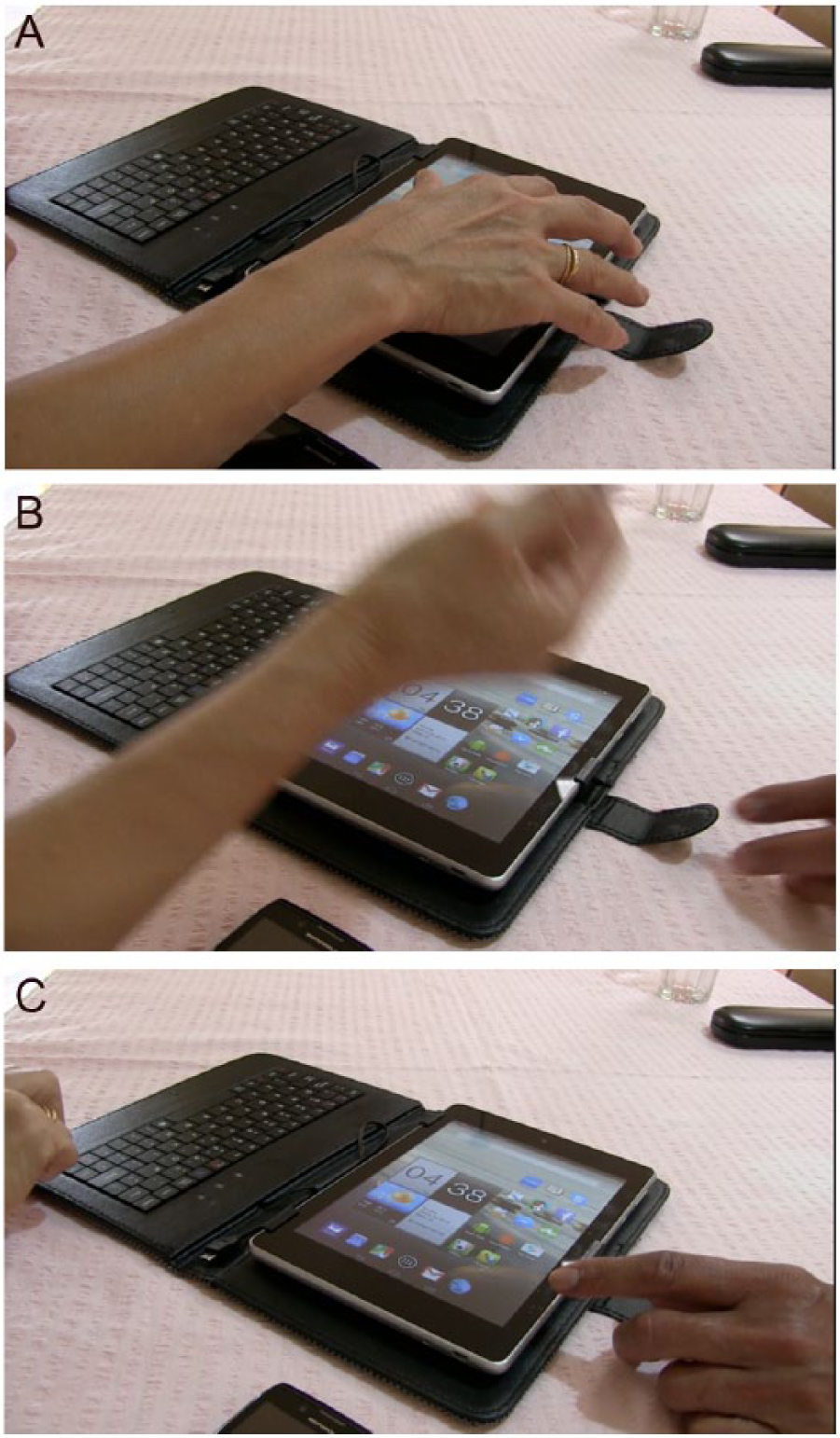
Esther’s and Patrick’s hands move over the iPad, as if drawn to it while performing their uses.
Esther’s hands therefore showed us some of the affective and sensory dimensions of online socialities, copresence, and use of information content through mobile media. Like Stephen, whose example opened this article, her feelings about her participation in social groups through mobile media came to life and became apparent to us in specific ways through her hands. Mike, 47, another participant, similarly brought to the fore the feelings associated with using his device when touring it with his hands. Mike used his iPad mostly for entertainment, commenting on how “After work, I don’t really want to think, I want to sit down and unwind.” Mike spoke quite seriously about his own posts as he opened the 9Gag app, pointing out that he found many things that other people post on Facebook, about family or personal feelings to be inappropriate and was concerned about future consequences of these. Instead he shared things from apps such as 9Gag, which were intended to be light-hearted and humourous.
As Mike scrolled down 9Gag, he began to laugh at some of the videos, he opened up Twitch, a gaming app that allows players to follow and watch other gamers playing on screen in real time, which he spends a lot of time on. When he touched the apps Mike also began to immerse himself in something he enjoyed. In Twitch he opened the profile of a player he followed and he and Jolynna watched his screen for a few seconds, as he compared watching another player to watching television. Mike flicked through more profiles with his fingers, and as he explored the apps the conversation shifted from his verbal explanation of what entertained him, to an embodied way of simultaneously showing and experiencing his playful uses of mobile media, in the environment he usually experienced them. Thus through his handling of the device, we went beyond his initial response that “I like to relax.” Similar to how Stephen broke out into laughter and showed us a playful aspect of his mobile media use, not evident in his interview, once scrolling through Facebook and exploring apps through his hands, Mike showed us the feelings that spontaneously emerge as relaxing becomes something beyond words.
Digital knowing with hands: Activating apps/activating feelings
We have shown how, across a selection of our encounters with research participants, we learned about the feelings, socialities, and playfulness that they “felt” as they accessed apps through a focus on their hands. Putting one’s finger on the screen does not only open apps, but invokes feelings of connection with people, experiences, and activities. Moreover the ways apps are touched, opened, and habitually operated through the hand, is not only evocative of individual emotions or sensations but can create empathetic ways of knowing. Hands are drawn to apps, and when one is showing an app, beyond words, through the hand, other hands might also participate. On video these recordings offer us as researchers, routes through which to likewise engage with how words and hand movements come together to create an intensity of expression around the feelings that using apps can constitute. By letting us follow their hands as they accessed their private, usually family-based digital worlds, our participants opened up routes through which we could study the embodied associations that are experienced through and constituted by touching apps, and how these private worlds are “felt.”
As we have shown, private family digital worlds are not only concerned with closed social media groups online, but also involve sharing devices. For example the way that Esther showed the action of “flicking” through the newspaper is informative. Her hand was just above the screen, to express those experiences and activities as possibilities and also to tell us about her husband’s use of the screen and app, which his hand also moved towards in acknowledgement. Here, we argue that the use of video recording hand reenactments with mobile media apps goes beyond the video being useful simply for capturing data. Instead, the video recordings offered us ways to attend to the encounter differently, that is, to use the videos to tell ourselves a range of different levels of “story” or narrative around participants’ ways of showing us their experiences of using mobile media. They have brought to our attention, for instance, how such movements—flicking, scrolling, tapping, viewing—become implicated in the generation and expression of sentiments which are (contextually) part of how private forms of mobile media use are felt and shared. The key implication of this is to develop the points we have discussed theoretically above towards offering a way to understanding such ethnographic contexts, experiences, and ways of knowing. This means that we need to understand the hand, as it is used to experience and show mobile media use, as a knowing and telling hand. In our encounters we saw how the knowing hands of not only the owners of devices, but also of their secondary users, were drawn into our meetings, and indeed told us more about the ways the devices are used.
To reinforce the significance of a focus on the hand for mobile media studies, we now briefly return to the two strands of mobile media theory highlighted above—copresence and play—and their intersections. We argue that a focus on knowing through the hand offers us new insights into how the affective and sensory elements of these aspects of mobile media might be understood. We have seen how the sociality of online mobile copresence was felt by participants as they began to show us, scrolling through, reading out, and being engaged through their fingertips with the private and often family-based worlds of WhatsApp or Facebook. During our research encounters and when viewing the videos, we could empathise with the playfulness of these engagements, but so too did we feel the sense of irritation that participants sometimes had when there were too many messages or attachments. Likewise, with the rise in mobile gaming we were not surprised that participants often showed us games that they play or observe, either alone or socially, online—ranging from Solitaire to CandyCrush. It is the hands, we argue, that take people into the experiential worlds of such human relationships and playful and emotional forms of experience, which are so ubiquitous in everyday life.
Conclusion
Hands have always had a key role to play in research, in film, and generally in human communication. Ethnographic practice that pays attention to the sensory perception of digital media brings to the fore the ways in which knowing through the hand is both part of everyday life with digital devices and may be part of the research process. If we are to account further for how digital media are part of both the experiential worlds that we live in, and how they mediate our experiences of the world, we need to attend to the unspoken knowledge and experience that is integral to this. To a certain extent, this knowledge, ways of knowing, and sensory perception they reside in, are generated through and communicated by the hand. In this article, we have developed a theoretical argument and a series of examples from our fieldwork that demonstrate how such ways of knowing might be accessed and understood through a video-based research process that attends to the hand. Our point however has not been to simply show how our own research was undertaken. Instead our aim is to advance the more significant point that researching through hands has theoretically supported implications for mobile media research methodology. That is, it offers us novel ways through which to access new knowledge about the use and experience of mobile media. Thus we would urge mobile media researchers to be mindful of what hands can, as Ingold (2013, p. 117) puts it, “tell.”
Footnotes
Acknowledgements
We thank the research participants for their generosity in participating in our project.
Declaration of Conflicting Interests
The author(s) declared no potential conflicts of interest with respect to the research, authorship, and/or publication of this article.
Funding
The author(s) disclosed receipt of the following financial support for the research, authorship, and/or publication of this article: The research discussed in this article focused on the Australia-based part of the Locating the Mobile project, funded by an Australian Research Council Linkage Grant with Intel (LP130100848), 2013–2016 with international partner investigators Genevieve Bell, Baohua Zhao, and Fumitoshi Kato.
Notes
Author biographies
 ).
).