



Abstract
China has in recent years seen the rapid adoption of multifunctional social networking applications such as WeChat. This paper aims to explore if China’s social stratification has influenced the adoption and use of mobile social apps and if social apps such as WeChat can help to bridge the digital divide by providing urban and rural users equal access to diverse information and communication resources. The study is based on 4 months of fieldwork in the Henan Province of central China and combines quantitative data from surveys and qualitative data from semistructured interviews and focus groups. We found that there still exists a digital gap in the adoption and use of mobile social apps such as WeChat between rural and urban China, but such differences are also associated with demographic variables such as age, gender, and education level. Meanwhile, we found that WeChat has become more than a communication tool; it has also played an essential role in everyday problem-solving and information seeking for both rural and urban users. Our qualitative interviews and focus group studies reveal how WeChat influences various aspects of daily life in developing areas in China. We argue that although some divides in information seeking are being overcome, other new divides are emerging.
Keywords
Introduction and background
Mobile Internet has recently seen rapid adoption in China, a country where the Internet now reaches more than half of the total population. Most of the new users, however, are accessing the Internet via mobile devices. And most mobile users, in turn, are mainly using WeChat, an app which combines many functions and on which users rely for many of their everyday needs. In view of this reliance, we ask whether there are gaps or divides in how different groups use mobile apps. In previous research on China there have been extensive discussions concerning digital divides, and in particular about urban–rural divides in Internet or mobile phone use. We will review these studies in what follows, but the debate about the role of the Internet and mobile phones in social development has in recent years moved beyond the question of whether people have access or not (Donner, 2015a). Similarly, our aim is to go beyond adoption versus nonadoption, and also beyond the dichotomy between the highly developed urban east and the far less developed rural west of China. By focusing on people’s everyday information and communication needs, we will show instead that some divides in the use of digital devices are being overcome while new divides are emerging.
Our research addresses the gap in literature on the adoption, use, and domestication of mobile apps, in this case WeChat. We examine these uses among the urban and rural populations in Central China, an understudied region that lends itself particularly to this investigation because this area is neither part of the coastal highly urbanized, higher income part of China nor is it part of the underdeveloped western interior region of China. We adopt a comparative perspective within Central China to see if the urban/rural dichotomy influences the uses of WeChat in a part of the country that is neither high-income nor underdeveloped, but which still evinces urban/rural contrasts. More specifically, we are interested in knowing how mobile apps like WeChat play a role not just in communication but also in human information-seeking practices in everyday life.
As a background, in 2013, 84% of rural Internet users reported using mobile Internet, as opposed to 79% among urban users, making mobile phones the technological device more commonly used among rural as opposed to urban users (China Internet Network Information Centre [CNNIC], 2014, 2015). Further, in 2016, Chinese mobile Internet users accounted for more than 95.1% of the population with Internet access, with 80.7% of new Internet users first gaining online access through mobile devices (CNNIC, 2017). Still, there are gaps in the ways in which rural and urban users adopt the Internet and mobile applications. For example, according to CNNIC (2018), while WeChat has become widespread in China, the adoption of instant messaging apps by rural Internet users is still 10% less than that of urban Internet users.
The urban–rural dichotomy, and more recently the mobile divide, has been a perennial theme in the academic literature on China. Furthermore, the Chinese government’s economic and social policies have recently tried to address the shortcomings of earlier policies that favored urban industries over rural agriculture. There were also problems created by China’s strict household registration policy (the hukou system) that tried to discourage rural-to-urban migration. According to the National Bureau of Statistics of China, the average income per capita in urban China was 3.21 times higher than that in rural China in 2012, higher than the urban-to-rural income ratio in 1979. Chinese rural economic, social, and cultural development has thus lagged far behind urban development, including a far poorer provision of pensions, healthcare, and education. In recent years, the Chinese government has therefore promoted a national informatization plan, which uses the development of ICT infrastructure (village-to-village electricity, gas, and telecommunication network) as a stimulus to the rural economy. Furthermore, government-led construction of 4G and soon 5G networks has also promoted the adoption of mobile Internet.
We focus on WeChat as it is by the far the most commonly used app in China. WeChat was tailored by its developers to be suitable for mobile phone screens and to include many functions. It was launched in 2011 as an instant messaging app to send and receive text or image messages. Within the first few years of its launch, WeChat developers designed new communication functions such as voice and video calls, discovering Nearby Friends, and Moments (sharing and viewing everyday updates on the timeline). However, it is when WeChat started to add functions beyond communication that WeChat became a “Swiss Army knife” app for everyday life. For example, the development of financial functions such as WeChat Pay allowed users to pay or receive money by scanning QR codes. Informational functions such as Public Accounts enable users to subscribe to traditional media accounts or independent blogs and personalize their information flow. By the end of 2017, WeChat had become the most popular social media platform, adopted by more than 87.3% of Chinese Internet users, with more than 938 million active monthly users (CNNIC, 2018; Tencent, 2019). It is thus an example of a versatile and multifunctional app that combines interpersonal communication, mass media broadcasting, and information-seeking and sharing functions (Y. Chen, Mao, & Qiu, 2018). WeChat has become more than a text messaging app and it is embedded in many everyday life routines, including but not limited to shopping, news reading, paying bills, and personal finance management.
Previous research on WeChat has explored its multifunctional features and highlighted its use as an interpersonal and small-group communication tool (L. Chen, Goh, Sun, & Rasli, 2017; Gan, 2018; Harwit, 2017). Compared to Weibo (or Twitter in the Western context), one feature that sets WeChat apart from these services is that users’ Moments on WeChat is visible only to mutually added friends. Thus, it is less public. However, WeChat users who have larger social networks tend to have more diverse access to network resources compared to those with smaller networks (Shen & Gong, 2018). The information-seeking and sharing functions such as Public Accounts and Article Search also play major roles in delivering diverse information to users during crises and for everyday purposes and matters of public concern (Y. Chen, Liang, & Cai, 2018; Gan, 2017; Guo, 2017). In recent years, there has been an increasing number of heated debates on WeChat after the viral spread of articles about issues such as the eviction of migrant workers (Haas, 2017), investigations into abuses in a Beijing kindergarten (Buckley & Kan, 2017), and the outrage over the vaccine scandal (Westcott & Xiong, 2018). There have been only a few empirical studies of the use of apps by rural and urban Internet users. As one study with older adult users notes, while the information “have-less” have benefited from the diversity of information sources and views on WeChat, at the same time these benefits are severely constrained due to the lack of digital skills and limited functionalities on mobile devices (Guo, 2017).
As literature review articles on ICT and China have pointed out, empirical studies in the field predominantly focus on macro-level national policy and political implications of ICTs in China, with far fewer studies about how ordinary Chinese Internet users embed digital technologies in everyday life (Herold & de Seta, 2014; Qiu, 2010; Qiu & Bu, 2013). Qiu (2009), in his review of the field, highlighted the important implications of mobile telephony across the micro (personal life), meso (communities and organizations), and macro (regional and national) levels. Research on mobile phones has also extended from the investigation of technology adoption to the implications for various facets of everyday life (Zheng, Wei, & Nekmat, 2016). While mobile phones used to be seen primarily as communication devices for people to stay connected with each other, in recent years, smartphones have also become an indispensable tool that facilitates information seeking and sharing.
Information practices in everyday life
As already mentioned, recent research has moved beyond adoption and towards what people actually do with smartphones in their everyday lives (sometimes also known as the domestication approach; see Haddon, 2011; Silverstone & Hirsch, 1992). A major gap in this literature, however, has been that scant attention has been paid to how people seek and share information for everyday practical purposes (Savolainen, 2012); that is, apart from how they use mobile phones for interpersonal communication, or for news or political information, which have been extensively studied in China (see Qiu & Bu, 2013). As Schroeder has argued, “searching for and accessing information online has become one of two main everyday online activities—sociability or communicating is the other” (Schroeder, 2018, p. 103). Of course, it is often difficult to separate information from communication as, for example, when links are shared between people. However, it has recently come to the attention of ICT scholarship that the impact of using search engines to look for information, which has become pervasive in everyday life, has been largely overlooked in the social sciences (Haider & Sundin, 2019).
One discipline that has nevertheless examined information behaviours is library and information sciences. Scholars in this field have developed theories and models to study how information interacts with information systems, including digital platforms (Wilson, 1999). Several models focus on how users’ information needs are situated in their psychological, social, economic, political, and technological environment (Wilson, 1997), and how information sources are utilized to bridge knowledge gaps when users encounter problem-solving situations (Dervin, 1998). Compared to communication studies, information-seeking research has more emphasis on the individual or on environmental factors associated with information-seekers (message receiver or audience, in communication studies), and also highlights the contexts of information and communication practices. Savolainen (1995) first introduced a theoretical framework of everyday life information seeking in the study of human information-seeking behaviours in non-work-related contexts, for example, healthcare or hobbies. Drawing from Bourdieu’s theory of habitus, he argues that individuals’ information seeking is influenced by both their social status and cultural capital and their way of life, which are often shaped by personal attitudes and beliefs. While the notion of habitus would draw us too far afield from the concerns of this paper, we share with Savolainen (2008) the focus on everyday routines and how information practices are important for people’s lives outside of the work context.
Another gap is that outside of China, people use a variety of tools such as Google (Waller, 2011) to access and share information. In China, people typically use one or two social media platforms, which combine multiple functions within a single service. And while the dominance of certain social media platforms has sometimes been seen as shaped by the government seeking to control the Internet, Pan (2016) has shown that, in fact, the dominance of a few major services in China is based largely on market competition that has fostered simple and user-friendly functionalities. Tencent’s WeChat has recently become the leading mobile app in China. In this study, we therefore focus on the role of WeChat in rural and urban users’ daily lives.
Everyday information practices and the digital divide
It should not be assumed that where people need practical information and have access to it, they will use it. Many researchers have warned that, as mobile phones become the sole mode of Internet access in developing areas, mobile users might experience the lack of functionalities or have limited mobile data packages compared to multidevice users (Donner, 2015b; Napoli & Obar, 2014). Oreglia (2013), for example, found little use of computers or mobile phones by rural users for gathering practical information about farming techniques, prices, weather, and the like. For these purposes, farmers already had sufficient information through existing channels. She correctly points to the need to study information practices in context, rather than as if new information technologies will bring about changes in practices on their own. Wei (2013) studied the role of mobile technologies in civic engagement and found that mobile phones facilitated conversations in public spheres by disseminating news and information. Huang and Zhang (2017) more recently examined the adoption of WeChat among middle-aged urban Chinese and found that they use WeChat between 60 and 90 minutes per day, often during several long sessions. Approximately half of the participants used one more platform, such as QQ, in addition to WeChat, while approximately a quarter used only WeChat, and the rest more than two platforms.
Previous research has also investigated the social consequences of different levels of access and adoption of ICTs, which is often conceptualized as the “digital divide.” Demographic and socioeconomic variables such as age, education, and gender are often associated with differences in adoption and usage (Scheerder, van Deursen, & van Dijk, 2017). In cases where digital technologies become accessible to most of the population, Internet experience is also a sociotechnical factor accounting for digital inequalities (van Deursen & van Dijk, 2014). The Internet is increasingly embedded in everyday life to identify, search, collect, and share various types of information. In Sweden, for example, Sundin, Haider, Andersson, Carlsson, and Kjellber (2017) examined young people’s information behaviours. The authors found that young people take searching for information for granted, as a part of everyday life (see also Ling, 2012). They rely on Google, and googling something on their smartphone is so mundane that they no longer regard it as a distinguishable activity. Researchers have also shifted their focus to the usage of different Internet devices (Tsetsi & Rains, 2017; Wyatt, Henwood, Hart, & Smith, 2005), where there is a divide among users of Internet platforms (Blank, 2017) or different levels of participation in online platforms (Shaw & Hargittai, 2018). Shift from the divide in access and adoption to the divide in usage and information is thus leading to a rethinking of the concept of the digital divide.
What then about those that Qiu (2009) some time ago called the “information have-less” in China, what kinds of information practices do they engage in? There are even fewer studies that focus on how Chinese Internet users seek, collect, and share information. Yu (2010) has shown in a longitudinal study of information practices that it is not just socioeconomic disadvantages that lead people to be information poor, but also that information poverty is a condition that perpetuates itself; for example, Yu and Zhou (2016) found that information poverty also applied to managers and professionals, in addition to groups like rural migrants that have moved to urban areas. The implication is that if there is little use of communications media, such as computers or mobile phones or newspapers, among these groups, the resulting restricted horizon also leads to limited use of online information resources. It needs to be added that this is not primarily an issue of access to technology, but rather of people’s socially shaped habits and needs. Thus, people do not use mobile phones for purposes for which they might be needed; rather, they stick to what they know. Yu (2010) also suggests that this lack of information was not necessarily perceived as a problem by the people she investigated, while it is clear for the researcher that it has practical and disadvantageous consequences. Clearly, however, in-depth and comparative research is needed to examine if the rural, information “have-less” users are employing digital technologies differently from the urban, information “have-more” users, and this is the question to which we now turn.
Research questions
Previous literature has shown that rural dwellers in China are often late adopters of ICTs (Oreglia, 2015). We ask if there are rural–urban disparities between rural and urban residents in their adoption and use of mobile media. Does the digital divide between rural and urban China also exist in the adoption and use of mobile apps such as WeChat? (RQ1). Based on statistical reports and previous empirical research on mobile apps, we expect to see the same technological gap appear in relation to WeChat. Hence our first hypothesis: Urban mobile users are more likely than rural users to adopt WeChat (H1). Many empirical studies have found Chinese social media users seeking out social connections (guanxi; L. Chen et al., 2017; Yan & Yasseri, 2017), but many of these connections are based on sharing the same hometown (Wang, 2016) and among close relationships (Cui, 2015). We hypothesize that rural users have smaller social networks on WeChat because of geographical constraints and lack of social connections (H2). Further, previous qualitative research has indicated that age and gender are associated with ICT adoption and use (McDonald, 2016; Wallis, 2015), so we expect to see an influence of socioeconomic factors on the adoption of mobile apps (H3) and on the size of social networks on WeChat (H4).
We also investigate if mobile apps such as WeChat are becoming more than a social networking tool. If so, are other functions of WeChat used similarly or differently by rural and urban users? (RQ2). Research on ICT for development has often expected mobile phones and mobile applications to bridge preexisting social and digital divides by empowering people living in developing areas with new access to everyday information. For example, research in India saw the potential of “hybrid forms” of mobile SMS-based social media as an influential source of information for economic development (Donner, 2015a). The use of WeChat for information was found to be associated with higher likelihood of reposting articles from WeChat public accounts (Wei, Huang, & Zheng, 2018). However, we also anticipate that due to lack of Internet experience and digital competencies, rural users are less likely than urban users to use WeChat as a tool for purposes beyond social networking (H5), and that rural users might also have different information needs compared to their urban counterparts (H6). Finally, and more generally, we want to understand how users domesticate mobile social apps, such as WeChat, as multifunctional tools in everyday communication, problem-solving, and information-seeking processes (RQ3). Especially for this final research question, we expect that combining our quantitative analysis with qualitative insights will prove to be essential.
Method
Data collection
Unlike Weibo, which is often considered a public-sphere online platform in China, WeChat is used as a more personal and everyday tool (Gan, 2018). The private nature of mobile phones and of WeChat poses challenges for understanding the embeddedness of mobile apps in everyday life. Furthermore, literature reviews of research on China have suggested that there is a lack of empirical research that combines different methods (Liu, Liang, & Zheng, 2016). Hence, we use a mixed methods approach, triangulating data from surveys, semistructured interviews, and focus groups to provide a comprehensive understanding of the social implications of mobile apps. Data for this study were collected during a 4-month period of fieldwork from February to May 2017, during which, one of the authors spent time in three communities in a county in Henan Province—two rural villages and one urban residential community. Henan is in the central region of China both geographically and in terms of social and economic development—as mentioned earlier, it is not situated in the highly developed coastal region, nor in the underdeveloped and mostly agrarian West of the country.
Survey
Previous research on the Chinese Internet primarily used online surveys to recruit respondents, which provided interesting findings about savvy Chinese Internet users who live in urban areas. However, due to lower education levels and lack of Internet experience, online surveys might be inaccessible or difficult to understand for rural Internet users. To address this issue, we conducted a face-to-face survey of 200 participants, each of which lasted 15 to 20 minutes. The survey instructions were read, and detailed explanations were given about survey questions, using the same transcripts to ensure that all measures were consistent and reliable. We used a purposive sampling technique (Battagila, 2008) to ensure that diverse groups in terms of gender, age, education, income level, and Internet experience were included in our survey. After eliminating incomplete surveys, the complete sample consisted of 152 respondents in three field sites, with a response rate of 76%. The survey consisted of questions about demographic variables such as residence, age, gender, marital status, occupation, monthly income, education level, and mobile social app adoption and use. Questions about the adoption and use of mobile media refer to whether or not the respondents use WeChat, the size of their mobile social network (measured by number of WeChat friends and number of WeChat groups), users’ perception of the role of WeChat in different aspects of everyday life, 1 and use of various WeChat information categories. 2
Interviews and focus groups
After preliminary analysis of the survey data, we selected 13 individuals from the respondents who had diverse socioeconomic backgrounds and experience with technology to conduct semistructured interviews. Two categories of information on WeChat—educational and entertainment—were frequently mentioned by the interviewees. Hence, we recruited another 10 participants from the survey respondents to join three focus groups to further explore these two topics. Participants in each focus group shared similar backgrounds in terms of age and profession. Complementary qualitative data provide additional insights into the motivations for using or not using WeChat, as well as a better understanding of “outliers” such as tech-savvy or nonusers in the surveyed population.
Descriptive statistics of survey data
Table 1 shows the descriptive statistics of the survey. The percentages of male and female respondents were almost equal. Most respondents were young or middle-aged, but there were also adolescents (7.2%) and older adults (10.5%) represented in the sample. More than half of the respondents had education levels equal to or below high school, and the majority (74.3%) of respondents had a monthly income below 3,000 RMB (Renminbi). The rate of mobile phone adoption in Central China is high, with 95.4% of respondents owning at least one mobile phone. Among mobile phone users, 90.3% use mobile Internet. After excluding nonusers of mobile phone and nonusers of mobile Internet, 41.2% of Internet users utilize only their mobile phone to access the Internet; 42.8% of Internet users spend more than 3 hours online; and the majority of surveyed users have over 3 years of Internet experience. However, 74.4% of mobile Internet users have less than 1 Gb mobile data per month.
Descriptive statistics for demographic, mobile Internet adoption, and use variables.
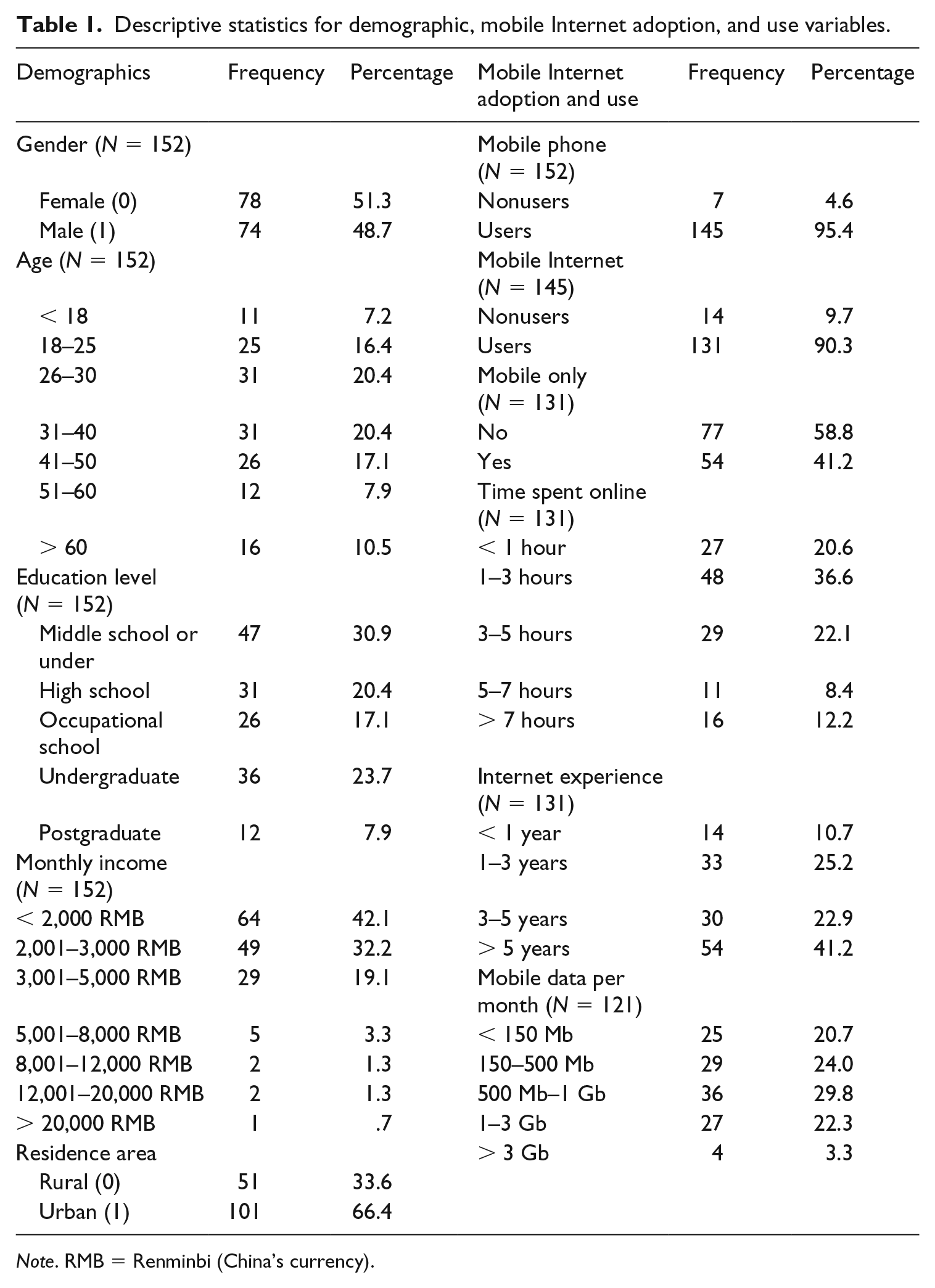
Note. RMB = Renminbi (China’s currency).
Quantitative analysis
The urban–rural gap in adoption and use of mobile Internet and mobile apps
We ran two binomial logistic regressions to see how rural/urban residence (H1) and other demographic variables such as gender, age, monthly income, and education level (H3) associated with the likelihood of adoption of mobile media. The logistic regression model (see Table 2) on the adoption of mobile media was statistically significant, χ2(5) = 38.236, p < .0005, which explains 46.3% of the variance in mobile media adoption, according to Nagelkerke R2. We found that age (p = .006) and education level (p = .025) added significantly to the prediction of adoption of the mobile app, but rural/urban residence (p = .700), gender (p = .523), and monthly income (p = .104) did not add significantly to the prediction.
Logistic regression predicting likelihood of mobile media adoption based on urban/rural residence, age, gender, monthly income, and education level.

Note: Gender is for males compared to females; urban/rural residence is for urban compared to rural.
p < .01. *p < .05. **p < .01. ***p < .001.
We then ran multiple linear regressions to see if rural/urban residence (H2) and other demographic variables (H4) were associated with the size of one’s social network on mobile social apps. The regression model (see Table 3) on the size of the WeChat social network was statistically significant, F(5, 123) = 3.442, p = .006, which explains 8.7% of the variance in the size of social networks on WeChat. Again, rural/urban residence (p = .106) was not a statistically significant factor for social network size. In the model of the size of mobile social network, gender (p = .030) was in fact the only statistically significant demographic variable, with male users more likely than female users to have larger social networks on WeChat.
Multiple linear regression predicting the size of mobile social network based on urban/rural residence, age, gender, monthly income, and education level.

Note. ^p < .10. *p < .05. **p < .01. ***p < .001.
Urban–rural gap, WeChat, and information needs in everyday lives
Next, we explored if there is an urban–rural gap in the use of WeChat for various purposes, including but not limited to social networking (H5). We ran several linear regressions with various perceived functions of WeChat as dependent variables, and demographics as independent variables. Table 4 shows the results of the multiple linear regressions. We found that rural and urban WeChat users do not differ significantly in their use of WeChat as a tool for social, entertainment, health, and information seeking purposes. However, there were significant differences between rural and urban WeChat users in the extent to which they perceive mobile social apps as tools for education (p = .004) and business (p = .009). Urban users were more likely than rural users to utilize WeChat for learning and managing or maintaining businesses. This finding supports our hypothesis that there is an urban–rural gap in the use of WeChat for purposes beyond social networking. Rural users are less likely than their urban counterparts to see WeChat as a tool for self-learning and business. We will provide qualitative analysis later to examine the obstacles for rural residents to benefitting from using WeChat in these two everyday contexts.
Multiple linear regression predicting the perceptions of the role of WeChat in everyday life based on urban/rural residence, age, gender, monthly income, and education level.
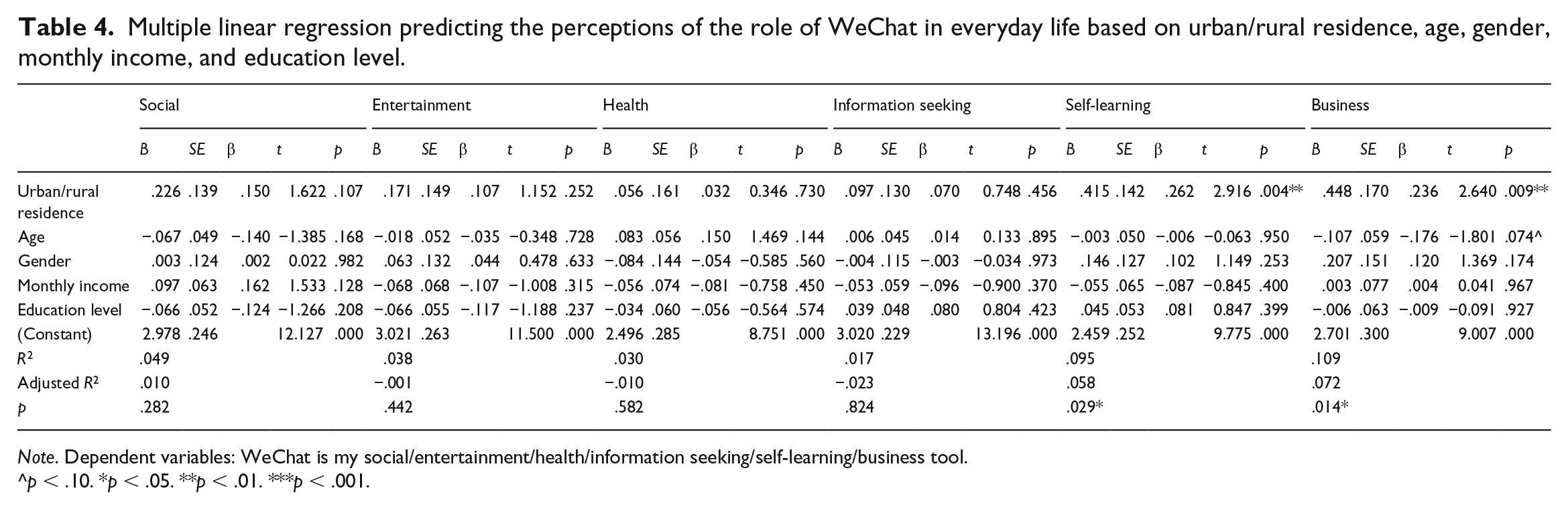
Note. Dependent variables: WeChat is my social/entertainment/health/information seeking/self-learning/business tool.
p < .10. *p < .05. **p < .01. ***p < .001.
To see if there were differences between the everyday life information needs of rural and urban mobile social app users (H6), we ran linear regressions with different types of information needs as dependent variables, and demographics as independent variables. As shown in Table 5, we found that when predicting everyday life information needs using demographic variables, urban/rural residence is not a statistically significant factor. Instead, age and education levels are associated with WeChat users’ needs for employment, self-learning, relationships, and commercial information. Younger generation users are more likely than older generations to seek for information about jobs (p = .0004), self-development (p = .001), and commerce (p = .012). Furthermore, WeChat users with higher education levels are more likely than those with lower educational backgrounds to seek information on employment (p = .029) and relationships (p = .019).
Multiple linear regression predicting information needs in everyday life based on urban/rural residence, age, gender, monthly income, and education level.
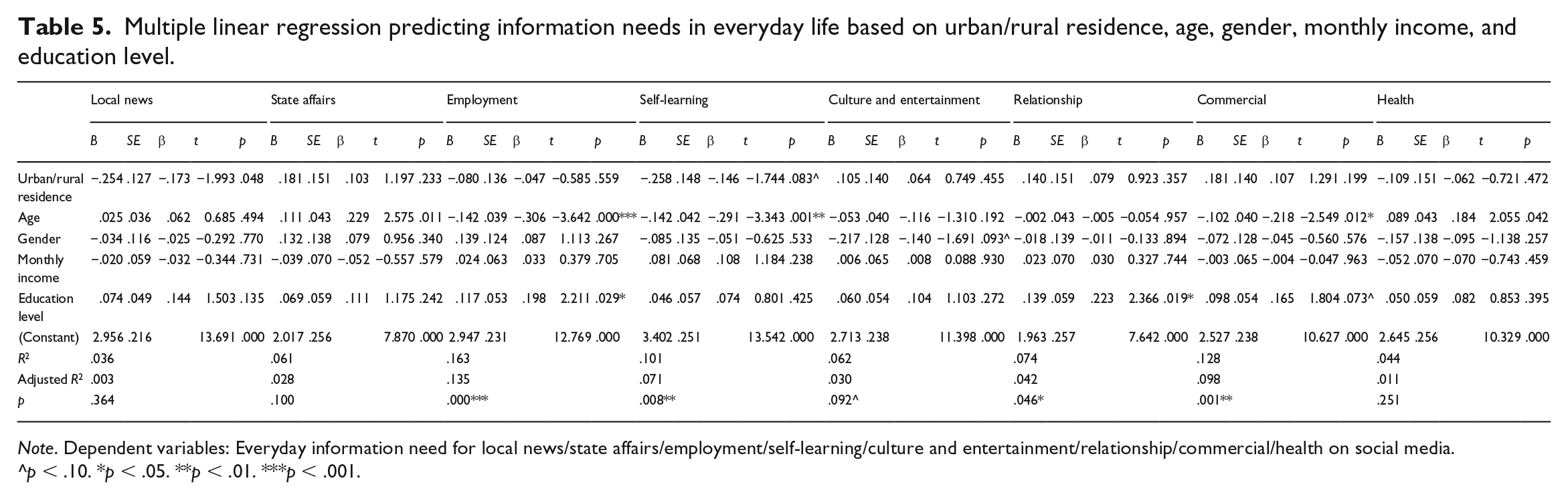
Note. Dependent variables: Everyday information need for local news/state affairs/employment/self-learning/culture and entertainment/relationship/commercial/health on social media.
p < .10. *p < .05. **p < .01. ***p < .001.
Interviews and focus groups
WeChat for education and self-learning
We identified some factors responsible for key differences in WeChat uses based on our quantitative analysis. However, as mentioned, this tells us little about how people perceive their different information needs and the reasons why they use—or don’t use—certain WeChat functions more than others, and how these uses fit into their everyday lives. Hence, we conducted a qualitative analysis.
A key role of WeChat, combining parenting and education, is to allow families to maintain contact with their children when they are being schooled away from home, as well as to facilitate rural education at home or at school. Migrant workers from rural China have contributed enormously to the Chinese economy. However, due to policy restrictions on urban household registration (or Hukou, in Chinese), as well as high living expenses in the cities, many migrant workers leave their children back in their hometowns. There are currently over 6 million left-behind children in China, educated in rural areas while their parents work in urban areas (Xinhua News Agency, 2018). Before the smartphone became widespread in rural China, phone calls were the only meaningful means of communication between migrant parents and left-behind children (Murphy, 2014). Yet the adoption of WeChat by migrant workers now provides new channels of communication such as video calls and voice chats for left-behind children and their parents, thus facilitating emotional bonding within migrant families.
Ms Du is the executive principal of the Qiaoguaiwa Kindergarten at “Village B.” For her, WeChat is a professional tool that helps teachers to maintain daily communications with parents. In “Village B,” most of the parents are busy working in the fields or in other cities, thus they would not otherwise be able to get to the kindergarten in time in case of, for example, an emergency. WeChat is also a platform on which schoolteachers share information about early childhood education. On Ms Du’s WeChat Moments, she sometimes forwards articles about preschool education to parents’ WeChat groups, in this way enhancing their understanding of early childhood development at home and also about their role in supporting children’s education. The strong parents–teacher links also emerged as a topic in the focus groups, in which “perpetual contact” (Katz & Aakhus, 2002) was frequently mentioned by high school and middle school teachers.
Our survey results suggest that rural users have a higher need for information about self-learning; nevertheless, social media platforms like WeChat are used more frequently as a tool for continuing education by urban than by rural users. In the urban field site, WeChat groups enable teachers to exchange information about teaching materials and pedagogical methods. Miss Ruili Du, an English teacher in a local middle school, for example, often collects articles from official accounts on WeChat, including China Education (Jiaoyu Bao), Teachers’ Digest (Jiaoshi Bolan), and English Prose (Yingyu Gongdu), and either shares the English articles in her classes or uses them to teach exam techniques to her students. For Zhai, who teaches mathematics in a rural middle school, WeChat official accounts (see Figure 1) and articles shared by colleagues are her most important information sources for developing teaching skills: The most informative account [on education] is managed by the Education Department of Henan Province, which publishes information about government guidelines on high school entrance exams or provincial workshops for rural middle school teachers. For me, an inexperienced teacher, the most difficult thing is how to build trust but maintain boundaries with students, which I learned mostly through reading posts shared by other teachers on WeChat Moments.
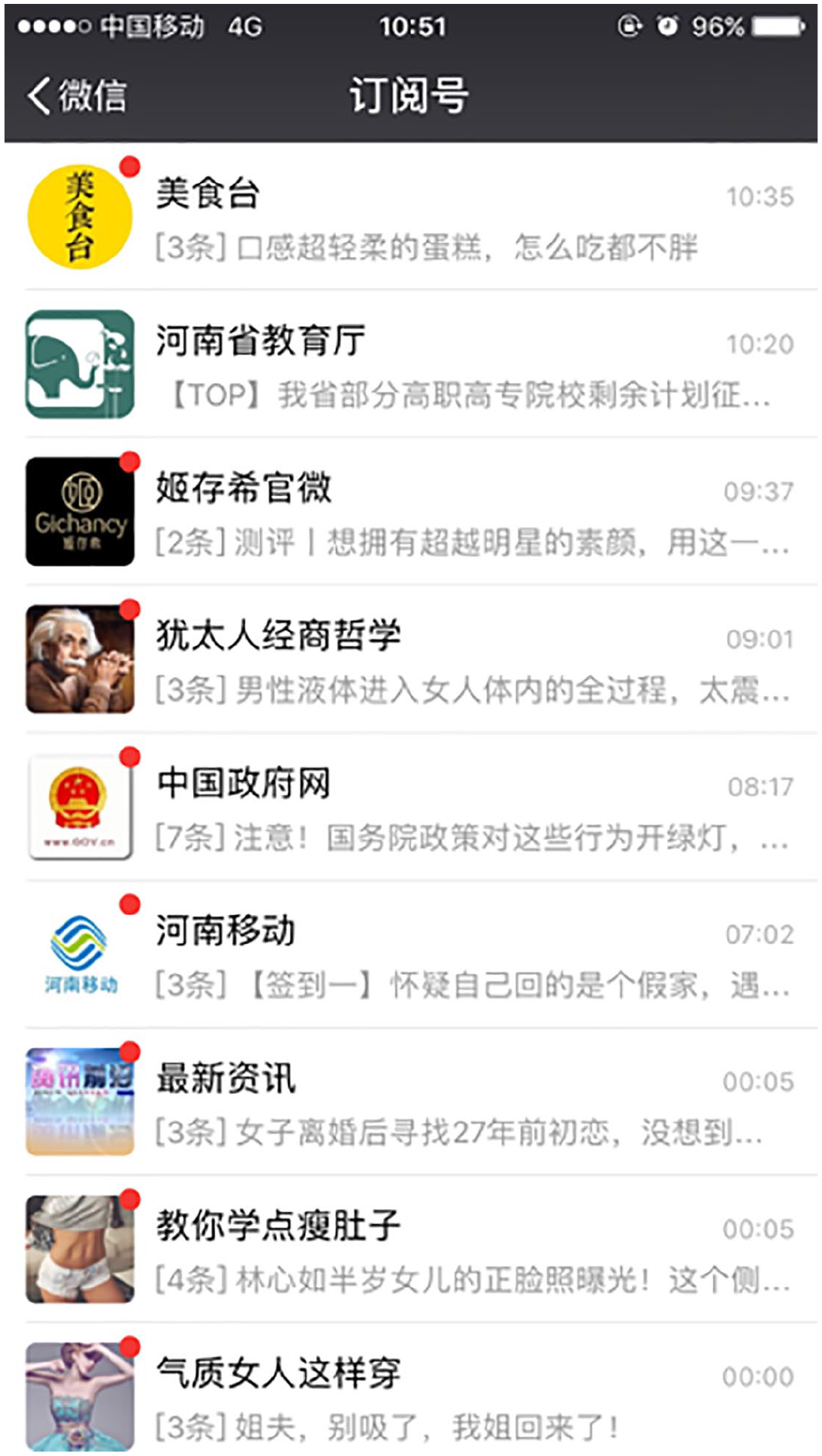
Participant’s screenshot of her WeChat app.
However, Zhai also observes the lack of information skills and information sources among her collogues in rural middle school. One of the main challenges in terms of information-seeking skills is to tell the difference between high-quality teaching materials and online advertisements. According to Zhai, sponsored advertisements on social media are difficult to tell apart, especially for older teachers. Zhai is often an information proxy for her colleagues, helping them in differentiating relevant, open-source materials from sponsored articles.
Information seeking on WeChat for employment and business opportunities
Through our quantitative analysis, we found that urban users are more likely to perceive WeChat as a tool for business and that younger generation users, regardless of their residence, are in greater need for information about employment. From our in-depth interviews, we also identified younger generations in rural China as a social group that has particularly benefited from using WeChat for employment and business purposes. As early adopters of WeChat in rural China, younger generations in the village are more familiar with advanced information functions on WeChat, and they have also accumulated more social connections than other rural residents.
For the younger generations living in rural China, WeChat is a tool to explore the outside world. Xiaopan, aged 18, is preparing for the first major challenge in her life, Gaokao, the Chinese college entrance exam. Her favourite WeChat function is Moments, which allows her to observe the life of others in her situation. She found many of her WeChat friends using the function Shake; they are from all over the country: “The world of strangers that I see on WeChat Moments is different from mine,” she said in the interview. Another interviewee, Huihui, is a 20-year-old college student whose familiarity with ICTs has enabled her to become the centre of her social circle by helping friends to solve technical or informational problems. The dream job for Huihui would be to become a personal assistant in an entertainment agency in Beijing. We watched her as she skillfully switched between multiple mobile applications, including Sina Weibo, WeChat, and 58 Tongcheng, 3 to find information about jobs. She first found a CV template on Weibo, then searched for jobs on 58 Tongcheng, and finally used WeChat to obtain information about her dream job and about the city where she has long wanted to live. For Xiaopan and Huihui, the Internet and social media exemplified by WeChat connect their villages with the rest of the world. Both are the youngest daughters in their families and their parents, perhaps because they are protective of them or because they are retired and want their daughters to remain close, have tried to stop them from leaving Henan Province. However, their daughters have secretly gathered information that could enable them to seek a future life in the city. They cherished the opportunity to explore the outside world online and resist their families, their social circumstances, and perhaps also to overcome their own fears and misgivings. 4
Apart from WeChat offering new windows to job opportunities for young generations living in rural China, working-class users in urban China also find business ideas and build business networks on social media. Gui, who lives in the town centre, is a full-time employee in a pharmaceutical company. For him, WeChat is where he learned how to start a business on e-commerce and social media platforms. Having accumulated experience and social connections on WeChat, Gui now runs a WeChat business that sells fruit in addition to his full-time job, earning more than 3 times the monthly salary of his coworkers. However, those who can take advantage of these opportunities still mostly live in urban areas: In 2014, I joined a WeChat group for car owners in the local area. It was an online group for business “elites” back then since car ownership was not quite common in the county. One of the group members shared his experience of running an online business on WeChat. I paid attention to all the processes involved in e-commerce, from designing the product logo to planning online promotion, and most importantly, I learned from his experience that WeChat Moments could be used to sell local agricultural products such as kiwi fruit. (see Figure 2)

Screenshot of a participant’s WeChat conversation with a customer.
Virtual community and WeChat as information ground
Our interviews also included village community leaders who found WeChat groups useful for their work. How rural governance is organized has been a theme in some research on China (e.g., Tsai, 2007). Mobile social media apps are increasingly used by both local officials and rural residents to create online public spaces for information seeking and sharing (see also McDonald, 2016). Here we can take Chaofeng as an example, he is a group leader in “Village B.” He has two work-related WeChat groups: one is for all the government officials in “Village B,” another is for all the members of the group that he represents. His daily work routine starts with virtual meetings in the officials’ group, and he then forwards documents or messages to the group chats on WeChat. The use of WeChat allows information exchange and means that he no longer has to travel across the village to attend meetings and meet villagers. For villagers, WeChat groups intended for local governance have become a space for sharing information, or what has been called a virtual information ground (Fisher, Landry, & Naumer, 2006). Another example is Mr. Yang, a teacher in “Village B.” He says WeChat groups for village production team members are a platform where fellow villagers share breaking news, “There was a severe car accident that happened in the neighboring province. More than 100 cars collided. I heard about this news on the WeChat group. We all commented on local news there.”
Interviewees from both rural and urban field sites mentioned WeChat as an information source for locally relevant news and everyday information. Some local users, having added thousands of users within the region through a function called Finding Nearby Friends, transformed personal accounts into local news forums, and some even charged for publishing local information. Jing, a young resident living in the rural area, benefits from using such services on WeChat: I added a “platform” on WeChat, which was actually a personal WeChat account owned by a Mr. Du. He posts advertisements such as business promotions, cars or houses to rent, or vacancies for part-time workers on his WeChat Moments. He must have more than 10,000 WeChat friends on all of the accounts that he owns. I contacted him last year to find a house to buy in the town centre and was offered free advertisements on his accounts twice a day, and only 4 to 5 Yuan if I wanted my post to appear more than two times daily. I trusted his platform and really believed that it works more efficiently and reaches a wider audience than posting advertisements in a local newspaper.
Discussion and conclusion
In this paper, we have brought survey data as well as insights from focus groups and interviews in relation to the question of how WeChat is being adopted and used in urban and rural environments in Central China. Instead of finding a simple gap between the two, we uncovered a more complex picture. For example, although both rural and urban Chinese use WeChat for a variety of purposes, one of the main differences between them is that urban dwellers use WeChat more for self-development and business-related purposes. Apart from these differences, the urban–rural digital gap in the adoption and use of the mobile app is accounted for by demographic variables such as gender, age, and education level. This finding echoes previous quantitative research on major predictors of Internet differences in access and usage, indicating that a digital divide exists in the adoption and use of WeChat (van Deursen & van Dijk, 2014). For example, the younger generations are more likely to adopt mobile apps than other age groups, and female app users tend to have fewer WeChat friends than male users. Also, users with higher education levels are more likely to adopt mobile apps. However, we also found intriguing reasons behind these gender, age, and education differences, which are linked to parenting, schooling, job-seeking, and work-related needs.
We found that urban and rural dwellers rely intensively on both the social and information functions of the WeChat app. Both urban and rural dwellers are equally likely to consider WeChat an important information resource, though, as we just mentioned, they have somewhat different information needs. It is therefore necessary to complement these quantitative findings with the results of focus groups and fieldwork observations and interviews. WeChat connects migrant parents and their left-behind children, opens a world of urban lifestyles to the younger generations, and supports middle-aged village leaders in conducting governance tasks. What we see is that WeChat fits the functionalities that people need in their everyday lives, such as connecting families but also for local governance tasks; in short, they have domesticated the technology.
These different uses highlight how the lack of connectedness means that part of the population, rural and older nonusers in particular, are missing out on a useful tool that could benefit their lives. At the same time, they did not recognize this need, as previous studies have also found (see Yu, 2010; Yu & Zhou, 2016). Instead, they regard their information needs as being met, despite evidence to the contrary. This lack of connectedness also points to how WeChat and other similar platforms still have some way to go to turn social media into a tool appealing to nonusers, including those that do not intend to adopt mobile Internet. Furthermore, for rural mobile Internet users in particular, the range of uses is still restricted, which points to a potential lack of rich or diverse uses of the Internet for information seeking (see also Donner, 2015a). People’s circumstances change and thus pupils or young people, for example, may have different needs as they move into different stages of their lives or as circumstances change in their social surroundings.
Mobile technologies have become the sole source of Internet access for almost half of the rural population in China. This paper has moved beyond the existing research agenda on access to digital technologies which is driving government’s and technology developers’ policies, and pointed to new research directions that, combining quantitative and qualitative analyses, provide a fuller understanding of information uses. Researchers have assumed, based on a review of mainly social psychological and experimental studies (in other words, no studies of uses in context), that mobile-only users are disadvantaged compared to multidevice users due to the lack of functionalities on smartphones (Donner, Gitau, & Marsden, 2011; Napoli & Obar, 2014). Yet what we found is that mobile-only users rely on desk computer users to accomplish more complex tasks, while most of their information needs are satisfied through their smartphones. Mobile Internet plays an important role in the Chinese government’s plans for the future. However, we found that some information-related functions of mobile media are more important than others, which points to new research directions and implications for future technology development. As WeChat has become a tool for information seeking, there is a need to explore the role that mobile media play in communication and sociability taking into account that the information practices of urban and rural WeChat users are diverse, which have so far been analysed at a rather general level. Analysing them in context reveals a multiplicity of practices that relate to different ways of life and social roles, rather than general abstract categories—some are problematic, as when mobile phones are used by students to access materials to cheat; others are liberating, as when young women use mobile phones to access information about places that are otherwise “off limits” to them. These and other uses may not be those envisaged for social development by the government or by the developers of mobile media platforms, but they are not less important.
As our examples have shown, the digital divide is no longer simply about access to ICTs for economic and social development, but rather about everyday practices such as providing remote emotional support for children at school, helping to coordinate local administrative meetings, or exploring the possibilities of life in a big city. Moreover, these practices cut across the demographic divides of age and gender that have previously been identified (e.g., elderly and women being disadvantaged by a lack of Internet access). Such divides still exist, as our surveys show, but they relate more to the informational needs of different social groups. Groups and social roles change over time, and people belong to multiple groups and have multiple roles, so they may miss out on or take advantage of different WeChat functions, depending on the size of their social networks or how the information spreads within groups. Our findings therefore point to future directions in research with a more complex conceptualization and contextualization of digital divides.
Footnotes
Acknowledgements
The authors thank Dr. Grant Blank for his comments on the statistical analysis and two anonymous reviewers for their feedback on the paper. We thank all participants for their contributions in the survey, interviews, and focus groups.
Declaration of Conflicting Interests
The author(s) declared the following potential conflicts of interest with respect to the research, authorship, and/or publication of this article: None other than the authors had a role in the study design, data collection, analysis, decision to publish, or preparation of the manuscript.
Funding
The author(s) disclosed receipt of the following financial support for the research, authorship, and/or publication of this article: The Financial support for fieldwork of this study was provided in part by Tencent.
