




Abstract
The Septuagint’s reading of verses 29a and 32a in 1 Samuel 2 may appear to provide an explanation of the difficult readings of the Masoretic text, but in fact, the LXX complicates the matter. There is no definite evidence that the LXX is the original and MT its corrupt variant. I propose that MT מעון “in a temple” in v. 29a and צר מעון “enemy of a temple” in v. 32 not only make sense as they stand but also provide a hermeneutical key to understanding the story of the Elides’ degradation, which focuses on their negative role in the temple at Shiloh.
Keywords
1. Introduction
Despite the assertion that 1 Sam 2.27-36 is nothing less than an insertion by a later editor, 1 this prophetic judgment against Eli not only constitutes a climactic closure to the section describing the evil acts of Eli’s two sons in ch. 2, but also anticipates key elements in the plot of the book of Samuel. 2 This pericope displays a twofold structure of accusation and judgment, and v. 30 serves as a hinge that connects the two structures. The history of Yahweh’s special dealing with the Elides in vv. 27-28 prefaces the accusation against Eli in v. 29 and demonstrates how ungrateful the Elides have been. The divine judgment in vv. 31-33 is augmented by sections that predict the simultaneous death of Eli’s two sons as a sign in v. 34 and that describe Yahweh’s personal appointment of an alternative and trustworthy priest in vv. 35-36. This priest will bring the divine judgment against Eli to completion by replacing the Elide line of priests in the temple service. The oracle’s well-planned structure 3 and its pivotal role in the broader narrative, however, belie the fact that the judgment against Eli is fraught with many textual and interpretive difficulties (Alter 1999, 14 n. 29). Leaving aside the unexpected appearance of the Deuteronomistic figure, the man of God (2.27), there are a variety of textual difficulties between the MT and the LXX that have not yet been resolved.
This article will be devoted to one of those difficulties: the usage of מעון in vv. 29 and 32, especially the phrase צר מעון in v. 32, which is often regarded as an interpretive conundrum in the oracle. 4 Many scholars, who find the MT’s reading unintelligible, have resorted to emendation, based on different readings in the LXX and 4QSama. This paper’s findings show that the MT’s reading is intelligible, and if properly understood, provides a hermeneutical key to understanding the oracle in its broader context.
2. Looking enviously?
A majority of scholars agree that the clauses containing מעון in vv. 29 and 32 of 1 Sam 2 are corrupt and unintelligible. As a result, these scholars resort to various emendations. For instance, Böttcher revocalizes and emends צַר מָעוׄן in v. 32 to צֻר מָעוׄז “a rock of defence.” In order to fit it in the context of judgment, he renders the emended clause והבטת צר מעוז as “and thou shalt look (in vain) for a rock of defence” (Driver 1960, 39). But as Driver correctly points out, להביט with an object does not mean “to look for something non-existent, or not visible, but to look at, or behold something actually in view.” This makes Böttcher’s proposal untenable. Seebass, on the other hand, revocalizes מעון to מֵעֲוׄן “um der Schuld willen” (because of sin/guilt) but despite his assertion that מֵעֲוׄן fits the context of the oracle as a whole, it fails to account for the mention of “my sacrifices and my offerings” in v. 29a, which is a metonymic expression for all types of offerings brought to the temple. The Elides’ contempt for the offerings was not limited to the guilt offering (אששׁם), which is required when a person commits עון (Lev 5). What is worse, Seebass’s proposal requires a major emendation in v. 32 from בכל אשׁר ייטיב את־ישׂראל to כל אשׁר חֲטָאתֶם אֶל קָדְשִׁי “(Alle) was ihr an dem mir Geheiligten gesündigten habt” (all the sin you have committed toward my holy place; Seebass 1966, 76–77). 5 There is no basis for such an emendation.
A more plausible proposal, which was first put forth by Klostermann, is to emend the MT to מְעוׄיֵן, a poel participle of עין meaning “seeing enviously.” 6 While the verbal root occurs in the qere of 1 Sam 18.9, עוׄיֵן את־דוד “(Saul) eyeing David (from that day on),” the real motivation for this emendation is to bring the Hebrew text closer to the reading found in the LXX (cf. ἀναιδεῖ ὀφθαλµῷ “with a shameless eye”). Scholars who read מעוין in place of מעון must understand צר מעון in v. 32 as consisting of two unmarked adverbs; thus the translation “in distress, enviously.” 7 The problem with this emendation is that the phrase לְהַבּׅיט מְעוׄיֵן “to look eyeing” is, to borrow from Segal’s terminology, “un-hebraic” (1920, 208). 8 What is worse is that in order for this emendation to work in v. 29, an additional emendation is necessary: the verb תבעטו “you trample (with disrespect)” must be changed to תביטו “you see.” 9 But as will be shown below, this additional emendation does not do justice to the parallelism between “despising” in v. 29a and “honoring” in v. 29b. Therefore, those who do not favor the additional emendation (from תבעטו to תביטו) take מעון in v. 29a as an excrescence, and leave it untranslated (Alter 1999, 14 n. 29). 10 Despite all these difficulties, it is interesting that the reading מעוין has been well accepted among scholars to the point that it is even suggested in two major Biblical Hebrew lexicons, BDB and HALOT.
Another proposal to align the Hebrew text to the LXX is to take מעון in both v. 29 and v. 32 as related to the rabbinic idiom צר עין or עין צרה “narrow-minded, selfish, envious” (Jastrow 1903, s.v. צַר). This proposal has been offered by many scholars; among the most influential advocates are Cross and McCarter. Cross, in a personal communication to McCarter, argues that תבעטו . . . אשׁר צויתי מעון in v. 29 and והבטת צר מעון in v. 32 are two corrupt variants of the identical original, להביט צרת עין “look enviously at” (Caquot and de Robert 1994, 55). This emendation appears more promising than that of מעוין partly because it is intelligible Hebrew. For the sake of discussion, it is worthwhile to quote Cross’s argument in full.
First of all, whbṭt ṣr mʿwn in 32a and tbʿṭw . . . ʾšr ṣwyty mʿwn in 29a are corrupt variants. We should argue that underlying the text of LXXB is a Hebrew reading: tbyṭ . . . ṣr ʿyn. 4QSama has tbyṭ . . . [ ]. In 29a (MT), ṣwyty is a simple corruption of ṣrt (ignoring matres lectionis): waw and reš regularly are confused in the scripts of the third century B.C. In 32a (MT) ṣr mʿwn is again a simple corruption of ṣrt ʿyn: mem and taw are easily confused in the fourth century; waw and yod were virtually interchangeable in the late Hasmonean and early Herodian eras. For ṣrt ʿyn, compare Gen 42:21 (ṣrt npšw) and the Rabbinic idiom ʿyn ṣrh and variants (called to my attention by Benzion Kaganoff), and, of course, LXX anaidei ophthalmō. (quoted in McCarter 1980, 87)
Although Cross here purports to provide a “scientific” argument for taking LXX ἐπέβλεψας . . . ἀναιδεῖ ὀφθαλµῷ as reflecting an original תביטו . . . צרת עין, his argument is not convincing. 11 First the “original” idiom צרת עין is attested neither in Biblical Hebrew nor in post-biblical Hebrew. As Cross himself admits, the idiom originates, in Cross’s educated guess, from Biblical Hebrew צרת נפשׁו and Rabbinic Hebrew עין צרה. Although the constructions צר(י) עין and עין צרה are well attested in post-biblical Hebrew, 12 the construction צרת עין that Cross postulates as the original of a corrupt variant צר מעון is never actually attested.
Second, Cross’s argument is based on rather dubious assumptions. Even if he is right in claiming that waw and reš may be confused in the third century B.C.E., it does not prove that such confusion did occur with that particular word, צויתי (v. 29). Cross simply assumes the change from צויתי to צרת on the basis of the possible confusion of waw and reš. Moreover, for Cross’s (and McCarter’s) argument to work, another assumption has to be made, that is, no mater lectionis is used for this particular word. But the third century is the period when matres lectionis were heavily used both at the end of and within words. 13 Even if such consonantal confusion did occur with this particular word and a mater lectionis was not used, the preceding אֲשֶׁר still needs to be accounted for. Where does it come from? An ad hoc argument such as an accidental gloss would not be sufficient.
Cross’s suggestion about צר מעון in v. 32a is plagued with a similar problem. The possibility of consonantal confusion between mem and taw in the fourth century does not prove that such confusion did occur with the phrase in question. 14 More problematic is the fact that LXXB, which is the oldest uncial manuscript without hexaplaric influence, omits the entire clause in question in v. 32 (see Table 1). 15 If LXXB gives the original reading and the MT is nothing more than a corrupt variant, then MT v. 32a must be ignored in our reading of the oracle. 16 But as will be shown below, such an omission would deal a serious blow to the literary artifice that the narrator has crafted in the oracle.
Comparison of the MT and the LXX in vv. 29a and 32a 19
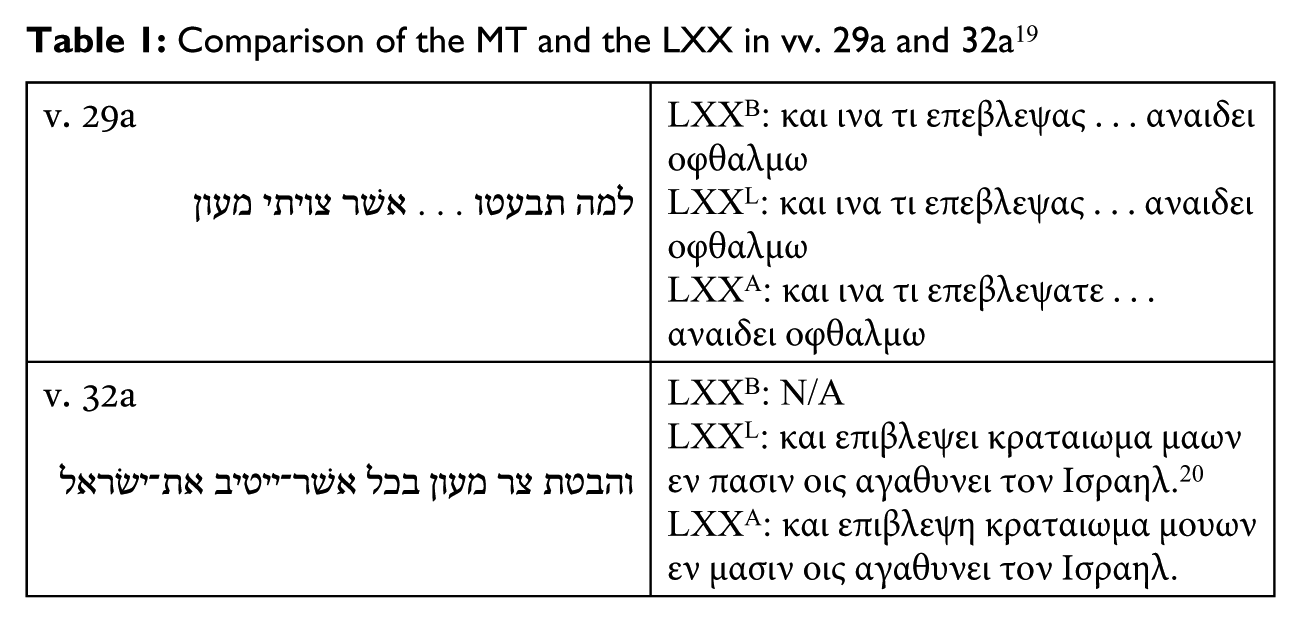
The above discussion leads me to believe that all the proposed emendations, most of which are based on the LXX, have as many difficulties as the MT. 17 The LXX should not be preferred, a priori, over the MT in this particular case. By this, I do not mean that the MT should be favored, a priori, over the LXX. The text-critical values of the MT and the LXX may vary from case to case. Even the agreement of the LXX with 4QSama against the MT does not necessarily decide the matter. The text-critical decision should be made not simply on the basis of the number of witnesses to a particular text, but on the basis of a more comprehensive consideration. In my opinion, it is more plausible to postulate that LXX translators, who did not understand the Hebrew original now retained in the MT, rendered the phrase in the sense of a rabbinic idiom that they were familiar with (לְהַבּׅיט צָרַת עַיִן). They not only misunderstood the Hebrew original on a linguistic level but also missed the literary function of מעון “a temple” in its broader context. The MT readings, מעון in v. 29a and צר מעון in v. 32a, not only make sense as they stand, but also show a sophisticated literary artifice, which provides a hermeneutical key to understanding the narrative’s broader context. 18
3. Eli, 20 enemy of a temple
There are a good number of modern versions that retain the MT’s readings. They translate מעון as “temple” or “(holy) place” (ASV, JPS, KJV, NASB, NET, NIV, NEG, TOB, Lu, Zür). But only a few commentators favor the MT, partly because emendation obviates the need to explain a rather complex interpretive problem. Tsumura is one of the few commentators who retains the MT and explains why. For instance, he renders צר מעון as “a decline of my dwelling” and contrasts it with “the welfare of the people” of the immediately following clause. He goes on to explain, “when the society prospered, the temple usually did too. But, here the decline of the temple despite the prosperity of society is announced as the judgment of God upon the priestly family.” 21 But his explanation is myopic because he understands the phrase only in the immediate context of judgment oracles, rather than as a literary connector in a broader context. Tsumura does not seem bothered by the fact that there was no time during the period in question when the temple declined but the people prospered. 22 My understanding of vv. 29a and 32a is as follows:
Verse 29 למה תבעטו בזבחי ובמנחתי אשׁר צויתי מעון / ותכבד את־בניך ממני להבריאכם מראשׁית כל־מנחת ישׂראל לעמי Why do you scorn my sacrifices and my offerings that I have commanded in
Verse 32 והבטת צר מעון בכל אשׁר־ייטיב את־ישׂראל / ולא־יהיה זקן בביתך כל־הימים Then you shall look,
MT מעון is best rendered as “a holy place” or “a temple” in vv. 29 and 32. Although its literal meaning is “dwelling, habitation,” it is often used figuratively to denote God’s dwelling on earth or in heaven. 23 The problem of understanding מעון as a temple involves its syntactic role in the verses under discussion: How is מעון related to the preceding words צויתי (v. 29a) or צר (v. 30a)?
With regard to the usage of מעון in v. 29a (which falls in the “accusation” section of the oracle), many scholars agree that it is an unmarked adverb. Since a noun denoting a place(-name) is often used as an adverb without a preposition especially in an elevated style such as a poem or prophetic speech, the lack of a preposition (ל “for” or ב “in”) in מעון should surprise no one (GKC, §118d; Joüon–Muraoka, §126h). In this case, we have two equally plausible ways of understanding v. 29a: first, we can postulate an elliptical expression in אשׁר צויתי מעון, which we may render as “which I have commanded to bring into a temple.” This interpretation is supported by Targum Jonathan, which renders the phrase in question as דפקידית לקרבא קדמי בבית מקדשׁי “that I commanded to bring before me into my holy house.” 24 Another possibility is to take מעון as an adverb of the verb תבעטו: “(Why) do you trample (my sacrifices and my offerings . . .) in my temple?” If this is the case, one may argue that the Elide contempt for sacrifice was happening right in the temple. This interpretation establishes a strong connection between the sins of Eli’s sons and the temple.
The rendering of מעון as “a temple” in v. 29 also obviates the need to emend the verb תבעטו “(Why) do you trample,” although the LXX and 4QSama agree against the MT in reading תביטו “(Why) do you see.” 25 The verb בעט occurs only twice in the Hebrew Bible, here and in Deut 32.15. But its basic meaning “to kick, to trample” is ascertained both by its parallelism with the verbs נטשׁ “to forsake” and נבל “to scorn” in Deut 32.15 and through its post-biblical usage. 26 This understanding of the verb puts the two motifs of “making light of” (תבעטו in v. 29a) and “honoring” God (ותכבד in v. 29b) in sharp contrast in v. 29. It is noteworthy that the narrator summarizes the sins of Eli’s sons in terms of “weight” in the hinge verse of this oracle: כי־מכבדי אכבד ובזי יקלו “those who honor (make heavy) me, I will honor, but those who despise (make light) me shall be lightly esteemed” (v. 30). And it is exactly in this context that the MT reading “temple” becomes significant. In ch. 2, the narrator reveals two kinds of sins that Eli’s two sons committed: stealing sacrifices and offerings brought to the temple for God (cf. 1 Sam 2.12-17) and sleeping with women working (צֹבְאוׄת) at the entrance to the tent of meeting (cf. 1 Sam 2.22). 27 Both sins are related to the temple: either they are committed in the temple or against the temple. The Elides were belittling God right in the place where he was to be honored most. If we take מעון “in a temple” as being adverbial to the verb תבעטו “(Why) do you trample,” the connection between the Elides’ sins and the temple is even more strengthened. The same connection appears again in the judgment section (v. 32) of the oracle.
As for MT צר מעון in v. 32a, I translate it as “O enemy of a temple” and understand it as a vocative specifying the subject of the preceding verb הבטת. The object of the verb is couched in the prepositional phrase בכל אשׁר־ייטיב את־ישׂראל that immediately follows the vocative. Thus I translate the entire line as, “Then you shall look, O enemy of a temple, on all the prosperity that shall be bestowed on Israel.” Although the translation “enemy of (or in) a temple” is not new (cf. “an enemy in my habitation” in KJV, “deinen Widersacher in der Wohnung” in Lu, “un adversaire dans ma demeure” in NEG), the understanding of it as a vocative has not yet been proposed. A vocative interposed between a second-person verb and its adjunct is not uncommon in Biblical Hebrew. The first set of examples below shows a vocative interposed between a second-person waw-consecutive perfect and its adjunct. The second set shows a vocative interposed between a second-person imperative and its direct object, and the third set registers a vocative interposed between a second-person imperative and its adjunct.
1a) ושׁמעת ישׂראל . . . אשׁר ייטב לך “You shall listen, O Israel, . . . that it may go well with you” (Deut 6.3)
1b) ובאת אתה וזקני ישׂראל אל־מלך מצרים “You shall go, O you and the elders of Israel, to the king of Egyt” (Exod 3.18)
2a) פדה אלהים את־ישׂראל “Redeem, O God, Israel” (Ps 25.22).
2b) האזינה אלהים תפלתי “Give ear, O God, to my prayer” (Ps 55.2).
2c) ברכו עמים אלהינו “Bless, O peoples, our God” (Ps 66.8).
3a) שׂמח בחור בילדותיך “rejoice, O young man, in your youth.” (Eccl 11.9).
3b) לכו מלאכים קלים אל־גוי “Go, O swift messengers, to a nation.” (Isa 18.2).
The reason that some have not read a vocative here may be related to the difficulty of making sense of such a form. Even Dhorme was able to analyze it as a vocative only after he emended the text to read עֵד מְעוׄיֵן: “Tu contempleras alors, ‘témoin envieux’ [O envious witness], tout le bien que ‘je ferai’ à l’égard d’Israël” (1910, 41).
The idea reflected in v. 32a is similar to that expressed in Ps 23.5: “You prepare a table before me in the presence of my enemies.” Whereas the psalmist speaks from the vantage point of the blessed Israelites, the judgment speech in 1 Sam 2.32 reflects the vantage point of the accursed Elides, who will look on the bountiful table prepared by Yahweh, without really participating in it. 28 A similar idea may also be found in Elisha’s curse against a royal officer in 2 Kgs 7.2: “You shall see it with your own eyes, but you shall not eat of it.”
This particular curse may be put in perspective when we compare and contrast the judgment pronounced against Eli in vv. 31-37 with the promise given to Abraham in Gen 12.1-3. The so-called judgment section of the oracle includes three curses that reverse three blessings bestowed upon Abraham. First the blessing of becoming a great nation (Gen 12.2a) is turned on its head when Yahweh says through a man of God, “I will cut your arm . . . there shall not be an old man in your house forever” (1 Sam 2.31). Second, the blessing of a great name (Gen 12.2b) is also reversed with the prediction that Eli’s descendants will implore the newly appointed high priest for a piece of silver or a loaf of bread, saying, “Please put me in one of the priests’ places, that I may eat a morsel of bread” (1 Sam 2.30). Finally, the promise of “in you all the families of the earth shall be blessed” (Gen 12.3) is turned on its head when the anonymous man of God proclaims that the Elides will merely look on the blessing that shall be bestowed on all Israel. As priests, they should have served as mediators of divine blessing to the people of Israel, but their privilege of becoming the instrument of blessing to the people of Israel is now revoked. As a result, they will simply look at, without participating in, the “bountiful table” that is prepared for all Israelites by Yahweh. 29 This comparison with the Abrahamic covenant seems to be dictated by the hinge verse in the judgment against Eli, where Yahweh says, “For those who honor me I will honor, and those who despise me shall be lightly esteemed” (v. 30). These words are reminiscent of Gen 12.3a, “I will bless those who bless you, and those who curse you I will curse.” It is worth noting here that LXXB actually omits the last of the three curses in v. 32a. Such an omission does no justice to the literary structure that the MT forcefully builds in the oracle against Eli. 30
All of the judgments are owing to the sins that Eli and his sons committed either against the temple or in the temple. In this regard, the phrase “enemy of a temple” may be argued to function as a literary device that connects the accusation section to the judgment section of the oracle. The epithet “enemy of a temple” strongly recalls the evil acts of Eli’s two sons that are described in detail in 2.12-17, 22, and summarized in the oracle as the act of scorning God in the temple (vv. 29a, 30b).
MT צַר מָעוׄן “enemy of a temple” also serves to connect the prophetic speech to a broader context in the narrative. First Samuel 1–4 portrays Hannah and her son in stark contrast to Eli and his sons. Although Hannah was misperceived as בת בליעל “a worthless woman” (1.16), it is Eli’s sons who truly deserve the title בני בליעל “worthless men” (2.12). Moreover, Hannah arose from despair and went to the temple to pray for God’s mercy, whereas Eli sent his servant to the temple to take sacrificial meat by force before the fat had been burnt for Yahweh. 31 Also, Samuel served God in the temple, whereas Eli’s sons violated the women serving at the temple. Thus, the contrast between Hannah-Samuel and the Elides revolves around their attitude to the temple. Although the latter were given the privilege of serving at the temple, they belittled the task and turned themselves into an enemy, not a servant, of the temple. It is interesting to note in this regard that the verbשׁרת “to serve (in the presence the Lord)” is predicative of Samuel three times (2.11, 18; 3.1), whereas Eli’s sons, the priests, are never said to “serve” in the temple in the initial chapters of 1 Samuel. Instead, they are either “doing nothing” at the sanctuary in Shiloh (cf. 1.3) 32 or “despising” the offerings brought to Yahweh (cf. 2.17). Last, it should be noted that the narrator of 1 Samuel uses various terms to denote temple: בית (1.24) היכל (1.9) אהל מועד (2.22). The use of מעון for the temple may be explained as part of the narrator’s literary artifice to diversify the terminology for the temple of Yahweh.
The word צר “enemy” also recalls Peninnah, who is called “the enemy” of Hannah (צרה, v. 6). 33 One thing that Eli and Peninnah have in common is that both of them are stripped of their privilege by Samuel. According to Deut 21.15-17, Peninnah’s firstborn son was entitled to the primogeniture of Elkanah’s household, but the double portion given yearly to Hannah seems to intimate that Samuel may have taken the firstborn right from Peninnah’s firstborn son. Likewise, Eli’s two sons were entitled to succeed Eli as the priests of Shiloh, but Samuel took that position instead. The connection between Peninnah and Eli is also established by the word מריבו “his adversaries” in Hannah’s song (2.10). It not only refers back to Peninnah, Hannah’s enemy, but also forward to the Elides, enemy of the temple. Finally, if we understand צר מעון as “enemy of a temple” denoting the Elides, we may better explain the coincidence between the change of priestly lines and the construction of the Jerusalem temple. Considering that Yahweh destroyed the temple in Shiloh because of the evil acts committed therein (Jer 7.12), it may be argued that he waited until the new priestly line arose before he allowed Israel to have the temple back. As long as the enemies of a temple were priests, it would have been pointless to give the Israelites the new temple to replace the old one in Shiloh.
4. Conclusion
The LXX’s reading of vv. 29a and 32a in 1 Sam 2 may appear to provide an explanation of the difficult MT readings, but in fact, the LXX complicates the issue. There is no definite evidence that the LXX is the original and the MT its corrupt variant. I have proposed that MT מעון “in a temple” in v. 29a and צר מעון “enemy of a temple” in v. 32 not only make sense as they stand but also provide a hermeneutical key to understanding the story of the Elides’ degradation, which focuses on their negative role in the temple at Shiloh. Just as an anonymous man of God pointed out, God revealed himself to Eli’s house in Egypt, chose him out of all the tribes to be his priest, and gave him all the privileges pertaining to a temple servant, but the Elides proved themselves to be evil and ungrateful servants by desacralizing the temple. What they did in the temple or against the temple earns them the title צר מעון “enemy of a temple.” 34
Footnotes
1.
Marc Brettler has, for instance, proposed a four-stage development underlying the final product of 1 Sam 1–2. He identifies 2.27-36 as “Addition C,” added by an exilic editor interested in legitimating the house of Zadok ( , 601–12). McCarter discerns the hand of the Josianic historian in the oracle of doom because it expresses “the Deuteronomistic polemic against the non-Jerusalemite priesthood—the priests of the ‘high places’” (1980, 16).
2.
For the narratival role of this oracle in the story of 1 Samuel, see Birch 1998, 988; Campbell 2003, 56; Fokkelman 1993, 135; Klein 1983, 27; , 168.
3.
The structure of the judgment oracle may be schematized as follows:
Accusation (vv. 27-29)
a. Yahweh’s past dealing with the Elides (vv. 27-28)
b. Accusation against the Elides (v. 29)
Hinge c. “For those who honor me I will honor, and those who despise me shall be lightly esteemed” (v. 30)
b′. Judgment on the Elides (vv. 31-33)
a′. Yahweh’s future dealing with the Elides (vv. 32-36)
a′a. Death of Eli’s two sons (v. 34)
a′b. Appointment of a new priest who will replace the Elides.
4.
Concerning the interpretive difficulty of this phrase, Nowack (1902, 16) says, “tatsächlich spottet צר מעון jeder Erklärung” (in fact, צר מעון defies explanation). See also Alter 1999, 14 n. 32; Cartledge 2001, 61; Dhorme 1910, 40; , 87–88.
6.
Smith 1929, 24; Leimbach 1936, 29–30; , 40–41. See also BDB and HALOT, s.v. מָעוׄן.
7.
The only exception that I am aware of is Dhorme. After further emending צַר to עֵד, he translates the phrase in question as “O envious witness.”
8.
Driver also takes מעוין as “a very doubtful restoration” (1960, 38). See also Stoebe 1973, 116. In a similar , 6:3155) states, “[Alternative expressions have been proposed:] הבטת מְעוֹיֵן, based on the phrase עוין את דוד, and הבטת צר עין, etc. However, these expressions do not solve the enigma of the text, and some of them are not Hebrew at all” (my translation).
אך כל אלו ההגהות אינן מרפאות את .בזה וכיוצא ,והבטת צר עין ,מלשׁון עוין את דוד ,הבטת מְעוׄיֵן)
(.מליצת הכתוב וקצתן אינן לשׁון עברית כלל
9.
Dhorme accepts Budde’s emendation of MT תבעטו to הבטת, translating the latter “as-tu regardé” (did you look; 1910, 40).
10.
See also the translation in ESV and NLT.
11.
It would make sense only to those who already believed the LXX to reflect the more authentic Hebrew Vorlage.
12.
13.
14.
Cross supports his claim based on the LXX, which may have read something similar to his reconstruction. My argument against him raises a fundamental question: When we do not have Hebrew variants to compare, can the versions constitute sufficient circumstantial evidence to support paleographical judgments? In arguing against Cross, I am not denying the value of the versions as circumstantial evidence for such judgments. But I do deny that paleographical considerations should have priority over other considerations in our text-critical decision. The decision should be made on the basis of comprehensive reflection on all relevant factors. Paleographical factors, based on circumstantial evidence, are among them, but are not the most important.
15.
LXXA and LXXL, which reflect recension in the direction of the MT, simply follow the MT in this verse (Bar-Efrat 2007, 93). See also Brooke and McLean 1906, 9; , 59.
18.
For the way in which the oracle of doom adumbrates the plot of the narrative in the Deuteronomistic History, see Caquot and de Robert 1994, 54; , 61–62.
20.
22.
Some scholars assert that “the distress of the temple” may refer to the destruction of the Shiloh temple mentioned in Jer 7.12, though Eli himself did not live to see it (Stoebe 1973, 117; , 33 n. g).
23.
Cf. BDB, HALOT, Even-Shoshan 1966, s.v. מָעוׄן. See Deut 26.15; Jer 25.30; Ps 68.6; and 2 Chr 30.27 for its use as God’s dwelling in heaven. See also Ps 26.8 and 2 Chr 36.15 for its use as God’s earthly dwelling. The lateness of these attestations is not that problematic, because the pericope in question (1 Sam 2.27-36) is generally dated as late. Cf. , 16.
24.
The Leiden Syriac text (OTS) renders מעון in v. 29 as ܡܢ ܡܕܒܪܐ “from the wilderness,” which supports the reading of מעון as a place. Also notice the lack of a pronoun, which agrees with the MT against Targum Jonathan.
25.
Both the Leiden Syriac text and Targum Jonathan agree with the MT in rendering תבעטו as ܐܥܠܝܬܘܢ “(Why do) you act perversely?” and אתון אנסין “(Why do) you rob?”
26.
Although Fokkelman (1993, 569–70) argues that the verb בעט, which is collocated with verbs connoting “eating” and “being fat” in both places (שׁמן “be fat,” עבה “be thick,” כשׂה “gorge” in Deut 32.15 and ברא “be fat” in 1 Sam 2.29), should be rendered as “gorge,” I would stick to the traditional meaning “to kick, trample” or figuratively “to scorn, despise.” This meaning is widely attested in post-biblical Hebrew. See , s.v. בָּׅעַט.
27.
Eli’s sons violated women working “at the entrance to the tent of meeting.” The Hebrew פתח אהל מועד may refer to the main sanctuary of the temple. The use of the nominal chain as an unmarked adverb allows one to interpret that Eli’s sons raped the female workers at the main sanctuary. If this is the case, it would put the sons in stark contrast to Hannah, who prayed her heart out in the sanctuary and received a favorable answer through Eli. Furthermore, the participle צבאות qualifying “women” recalls Hannah’s first recorded words יהוה צבאות “Yahweh of hosts.” This may be a subtle indication that the sins Eli’s sons committed were against the very God of hosts.
28.
The idea of envy, which the LXX seems to add to the text, is not necessary to understanding v. 32a in this way.
29.
This stern reality is most vividly described in v. 36. The Elides will be replaced by another priestly line, which will seek after God’s heart. They will come and ask for a position in the temple in exchange for a morsel of bread; their interest is not to serve God. The morsel of bread is a telling image of the Elides’ impoverishment, which was a result of surrendering the privilege of being the instrument of blessing for others.
30.
LXXA and LXXL retain v. 32a. But the meaning of κραιωτιµα µαων (µουων) is uncertain. What is certain is that it is a literal translation of MT צר מעון. Both Targum Jonathan and the Leiden Syriac text also retain v. 32a: ותהי מסתכל ותהי חזי בעקתא דתיתי על אנשׁ ביתך בחובין דחבתון קדמי בבית מקדשׁי ובתר כין איתי טבתא על ישׁראל “And you will realize and see the distress that will come upon the people of your house, because of the sins you committed in my sanctuary. And after that I will bring goodness upon Israel”; ܘܕܐܚܕ ܬܩܕܐ ܒܡܥܡܪܟ ܟܠ ܕܡܛܐܒ ܒܐܝܣܪܝܠ “Anyone who seizes a ruler’s staff in your dwelling, all the good things in Israel.”
31.
One may argue that it was Eli’s sons, not Eli, who sent the servant to fetch the sacrificial meat (cf. 1 Sam 2.17) but the anonymous prophet, or the biblical author for that matter, implicates Eli in his sons’ sin of treating the offering of the Lord with contempt (1 Sam 2.29).
32.
Fokkelman interprets the narrator’s decision to couch Eli’s two sons in a nominal clause in 1.3 to be in contrast with his decision to describe Elkanah as actively serving God by making an annual trip to Shiloh. In sharp contrast to Elkanah’s act of “going up year by year” to the temple, Hophni and Phinehas are just there (שָׁם). A similar contrast appears in 1.9, where Hannah’s act of “rising up” to go to the temple is juxtaposed with Eli’s inaction, “sitting” on his seat (1993, 34).
33.
Abbreviations
ASV American Standard Version (1901)
BDB Brown, Driver, and Briggs 1907 (in References)
JPS Jewish Publication Society version (1917)
KJV King James Version (1611)
Lu Luther Bibel (1545; Luther revised, 1984)
LXX Septuagint
LXXA LXX Codex Alexadrinus
LXXB LXX Codex Vaticanus
LXXL LXX Lucianic recension
MT Masoretic Text
NASB New American Standard Bible (1971, 1995)
NEG Nouvelle Edition Geneve (1979)
NET NET Bible (New English Translation, 2005)
NIV New International Version (1978)
OTS The Old Testament in Syriac (in References)
TOB Traduction oecuménique de la Bible (1975, 1988, 2010)
Zür Zürcher Bibel (1531, 1931, 2007)