



Abstract
The Revised Jewish Publication Society translation of the Hebrew Bible (RJPS, 2023), an adaptation of the meaning-based English version known as NJPS (1985, 1999), has changed many renderings of the personal noun אִישׁ (usually glossed as “man; person”). This article explains the cognitively based, communication-oriented thinking behind seventy new renderings. In these cases, singular אִישׁ appears in construct with a group name (most often יִשְׂרָאֵל “Israel”) and refers to a specific plurality of persons regarded as a single body. The analysis views אִישׁ as a situating noun, that is, its use profiles its referent in terms of the depicted situation. The proposed motivation for singular collective usage is to make a pragmatic contrast with אֲנָשִׁים (the standard plural of אִישׁ) to situate the participant in the bigger picture. This situation-oriented approach readily yields coherent and informative texts while solving interpretive cruxes. Principles for translating a situating noun are also briefly discussed.
Keywords
A new English translation
In 2023, the Jewish Publication Society and Sefaria.org jointly issued a retranslation of the Hebrew Bible into Modern English idiom, under the title THE JPS TANAKH: Gender-Sensitive Edition. 1 Its shorthand name is RJPS, in which “R” stands for “Revised.” Its base translation was the venerable NJPS (1962–1982; 1985; 1999), which employed a meaning-based approach. 2 To prepare the new version, the present author systematically assessed all renderings of the personal noun אִישׁ. 3
Topic and goal of this article
A set of seventy cases involving אִישׁ has prompted new renderings in RJPS. This article focuses on understanding those cases. An exemplar of this set is Judg 7.23, in which a narrator is describing what turns out to be a successful Israelite revolt led by Gideon against Midianite domination:
וַיִּצָּעֵק אִישׁ־יִשְׂרָאֵל מִנַּפְתָּלִי וּמִן־אָשֵׁר וּמִן־כָּל־מְנַשֶּׁה וַיִּרְדְּפוּ אַחֲרֵי מִדְיָן׃ And now ʾîš yiśrāʾēl rallied [sg.] from Naphtali and Asher and from all of Manasseh, and they [pl.] pursued the Midianites. (NJPS, adapted)
Although אִישׁ is singular in form, each of these two clauses contains a telltale sign that it is being used to refer to more than one person. 4 In the first clause, the verb’s semantics presuppose a collection of individuals: the action described is a mustering or rallying of an entire militia. 5 And in the second clause, the same singular subject is aligned with a plural verb.
Another typical example in the set is Judg 15.10, which reports a question that was posed by certain Judahites to the Philistines in response to the sudden arrival of Philistine troops:
וַיֹּאמְרוּ אִישׁ יְהוּדָה לָמָה עֲלִיתֶם עָלֵינוּ Said [pl.]ʾîš yəhûdâ [sg.], “Why have you come up against us?” (NJPS, adapted)
In this instance and seven others like it, singular אִישׁ follows a plural verb as grammatical subject.
Such usages of אִישׁ are remarkable in that they exist alongside similar ones with the typical plural form, אֲנָשִׁים.
6
Both forms appear in some of the same phrases, sometimes in close proximity.
7
In 2 Sam 15, the following pair of cases actually denote the same referent:
וַיְגַנֵּב אַבְשָׁלוֹם אֶת־לֵב אַנְשֵׁי יִשְׂרָאֵל׃ so Absalom stole the hearts of the men of Israel. (v. 6 ESV) וַיָּבֹא הַמַּגִּיד אֶל־דָּוִד לֵאמֹר הָיָה לֶב־אִישׁ יִשְׂרָאֵל אַחֲרֵי אַבְשָׁלוֹם׃ And a messenger came to David, saying, “The hearts of the men of Israel have gone after Absalom.” (v. 13 ESV)
Do those two constructions differ in meaning? 8 From a cross-linguistic perspective, one would expect so, because languages with singular and plural nominal forms typically place them in some kind of opposition. 9 Yet a number of biblical grammarians and lexicographers, including Gesenius, have treated the singular construction as equivalent to the plural (which explains why their ESV renderings are the same, as shown above). 10 That seems to be the prevailing view in biblical studies. 11 That view is hereby called into question.
The set of interest
RJPS, like NJPS, takes the MT as its source. Thus in this article, the singular or plural morphology of a particular instance of אִישׁ is as given in the Aleppo Codex, the Leningrad Codex, and their family of manuscripts.
For this article, seventy instances of singular אִישׁ were analyzed together. They employ the construct state in six similar expressions, tabulated in order of appearance and distributed as shown in Table 1, found mostly in the books of Judges and Samuel. 12
Distribution of the seventy instances of interest
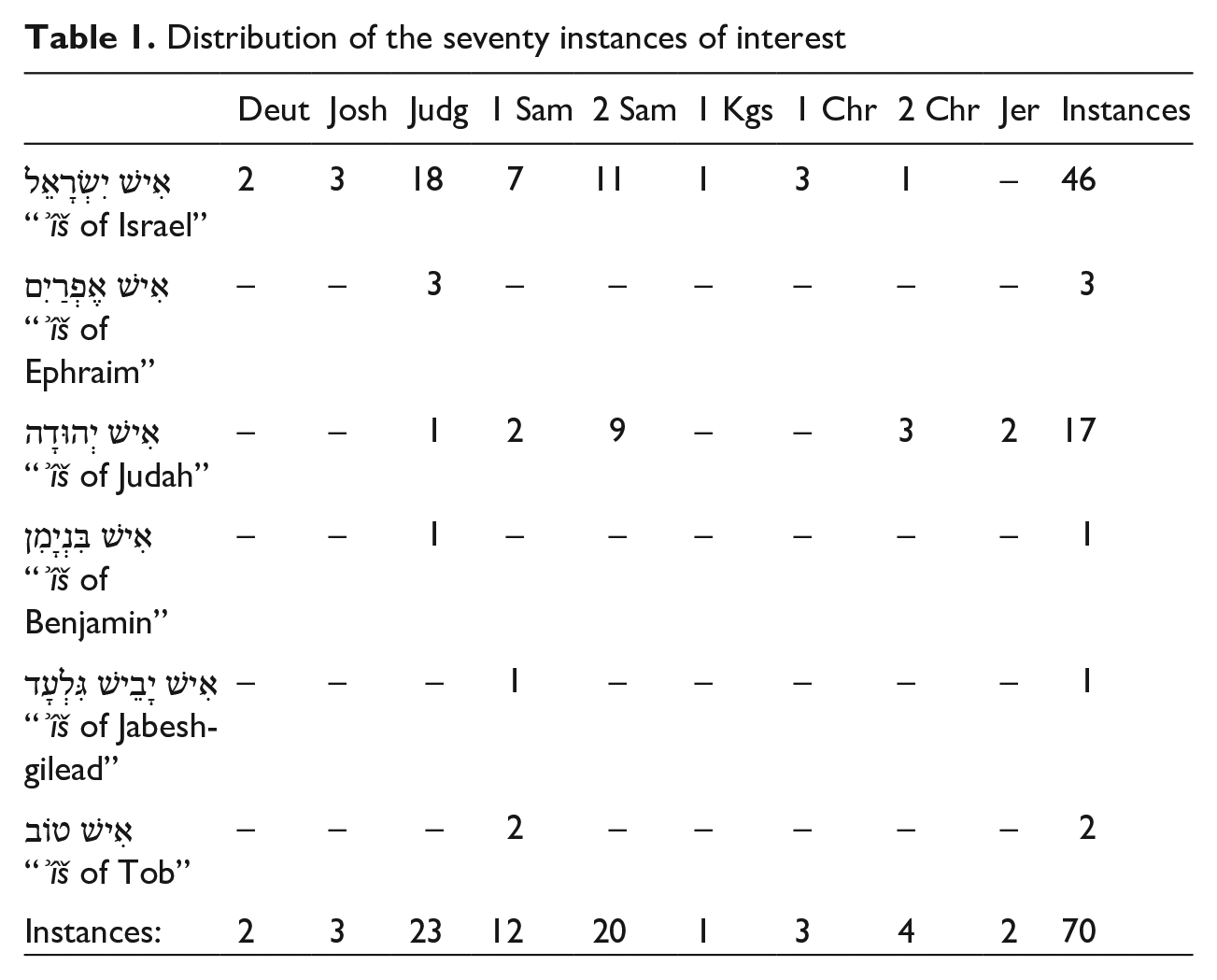
In all seventy cases, אִישׁ is in construct with a proper noun that (depending upon the context) can denote either a certain geographic locale or its associated societal group: Israel, Ephraim, Judah, Benjamin, Jabesh-gilead, and Tob, respectively. In these usages, the narrator or speaker makes reference to a specific entity, rather than to a nonspecific class. 13 What sets these seventy cases apart from other such instances of singular אִישׁ is that these exhibit a semantic duality, referring to a plurality of persons who are treated as a single body. 14 This is not how the vast majority of the Bible’s instances of אִישׁ in the masculine singular construct behave. 15 Tellingly, all seventy cases occur where the depicted situation is constituted by at least two parties coming together, either in conflict or in harmony. Finally, nearly forty percent of all instances occur in just two narratives; both tell a story of internecine warfare among a deeply polarized Israelite populace. These facts will be accounted for shortly.
A situation-oriented analysis
This article reports on a cognitive-linguistic and communication-oriented analysis of the passages in question. The approach is situation oriented.
16
It treats אִישׁ as a special type of word called a situating noun, which is a tool for efficient communication about situations.
17
In the Hebrew Bible, אִישׁ (including its feminine and plural forms) is a preferred and characteristic part of the vocabulary for depicting any situation in a schematic manner. When אִישׁ is used in a referring expression, it prototypically regards its referent not in terms of intrinsic features (as most nouns do) but rather in terms of the situation.
18
For example, when a certain Midianite priest asks his daughters why they have returned home earlier than usual, they reply in terms of the participant whose advent radically altered their usual situation (Exod 2.19):
אִישׁ מִצְרִי הִצִּילָנוּ מִיַּד הָרֹעִים An Egyptian man rescued us from the hand of the shepherds. (Fox 1995)
With just five words, their sketch omits many details, yet it suffices to explain how their situation changed. Their prominent usage of אִישׁ signals that the party in question, newly introduced into the discourse, is an essential participant for grasping the situation that they are depicting. 19
In the Bible, אִישׁ is the default label for the parties to a conflict—that is, a situation with two opposing sides (Stein 2020, §§6.9.2–6.9.8). Using אִישׁ, a speaker can depict a conflict in merely schematic terms because its conceptual structure is already so familiar. Perhaps the most succinct exemplar is 1 Kgs 20.20; it describes the Israelites’ categorical success in battle during an Aramean siege of Samaria:
וַיַּכּוּ אִישׁ אִישׁוֹ … and each of them struck down his opponent. (NJPS)
Given the audience’s general knowledge about battles, it goes without saying (in Hebrew) that participants face each other as adversaries. Hence each opponent can be simply labeled in terms of his participation via the situating noun אִישׁ.
Another telling example occurs in 2 Sam 4.11, when King David states his finding of fact in an assassination case:
אֲנָשִׁים רְשָׁעִים הָרְגוּ אֶת־אִישׁ־צַדִּיק בְּבֵיתוֹ [Two] wicked men have killed an innocent man in his own home. (RJPS)
Why does the king use the nouns אֲנָשִׁים and אִישׁ at all? Everyone in his hearing already knows that only adult males were involved; and both adjectives (רָשָׁע “wicked” and צַדִּיק “innocent”) are elsewhere regularly used as substantives by themselves. The king has no need to employ the nouns apart from their situation-defining function. Notably, while David knows the names of these men, he prefers to label them with the situating noun, even though it is more vague. And although he is addressing the assassins, he prefers to refer to them in the third person, as אֲנָשִׁים. In this prototypical usage, each head noun is profiling its referent as a defining participant—as one of the two sides—in David’s broad-brush summary of the incident.
One side in a two-party conflict
As a translator interpreting the biblical text, the present author perceived the same kind of situation-defining usage in the cases at hand. Let us return to the initial example, describing Gideon’s revolt (Judg 7.23), which is repeated here for convenience.
וַיִּצָּעֵק אִֽישׁ־יִשְׂרָאֵל מִנַּפְתָּלִי וּמִן־אָשֵׁר וּמִן־כָּל־מְנַשֶּׁה וַיִּרְדְּפוּ אַחֲרֵי מִדְיָן׃ And now ʾîš yiśrāʾēl rallied from Naphtali and Asher and from all of Manasseh, and they pursued the Midianites.
The situation of interest is a violent conflict. Conflicts are defined by their opposing parties. The use of singular אִישׁ instructs the audience to regard its referent situationally—as one of those sides, facing a common enemy—and not only as an assemblage of individuals.
In this view, the singular expression is not interchangeable with a plural one. The term אַנְשֵׁי יִשְׂרָאֵל profiles its plural referent only in relation to the people of Israel, while the term אִישׁ יִשְׂרָאֵל profiles them also in relation to the larger situation.
Happily, this finding enables us to solve a longstanding interpretive crux in 1 Chr 10.1. That verse describes the tragic outcome of a battle with the Philistines—and employs singular forms:
וַיָּנָס אִישׁ־יִשְׂרָאֵל מִפְּנֵי פְלִשְׁתִּים … ʾîš yiśrāʾēl fled before the Philistines. (NJPS, adapted)
The problem is that in the earlier parallel account in 1 Sam 31.1, the narrator employed plural forms:
וַיָּנֻסוּ אַנְשֵׁי יִשְׂרָאֵל מִפְּנֵי פְלִשְׁתִּים … the men of Israel fled before the Philistines. (NJPS)
Commentators have differed regarding whether this shift in grammatical number is meaningful or not. 20 The reason that it is indeed meaningful is that if we were to ask, “What happened at that battle?,” it could naturally be answered on either of two levels. The narrator of Chronicles, by invoking the larger situation via a singular referring expression, gives a broad-brush picture, pointing to the scrambling Israelite militia as a whole (see Figure 1, left side). The narrator of Samuel, via a plural referring expression, offers a granular picture, depicting the multitude of Israelite soldiers in retreat (see Figure 1, right side). The difference between these two portrayals is a matter of construal—of how the speaker is directing the audience’s attention (Langacker 2015).

Two ways of depicting the battle at Mt. Gilboa.
Thirty-seven of the seventy instances of אִישׁ are like the ones discussed, in which this singular noun denotes one of the sides in a hostile, two-party conflict.
A contingent in a multi-party conflict
Meanwhile, אִישׁ is used as a label in a smaller yet similar subset of instances—accounting for eighteen cases. The first one is 1 Sam 11.8, in a passage that recounts Saul’s first act of leadership as king, which was to rescue an Israelite city from a siege by the Ammonites.
21
We are told that he mustered the troops; and then the result:
וַיִּהְיוּ בְנֵי־יִשְׂרָאֵל שְׁלֹשׁ מֵאוֹת אֶלֶף וְאִישׁ יְהוּדָה שְׁלֹשִׁים אָלֶף׃ … the Israelites numbered 300,000, and ʾîš yəhûdâ 30,000. (NJPS, adapted)
This usage of אִישׁ profiles its referent as a distinct entity within a larger military force. That is, it regards Judah’s force as one contingent of the available forces under Saul’s unified command, with respect to the coming battle. The singular noun phrase conveys Judah’s distinct identity as a political and military power (a fact that will become more relevant later in the book). The usage is thus similar to the previous example involving אִישׁ יִשְׂרָאֵל: in a situation of forthcoming conflict, the term אִישׁ once again profiles a defining party in terms of that larger situation. 22
Tellingly, the same situation-oriented construal can solve a well-known interpretive crux in 2 Sam 10.6. The Ammonites, having seriously insulted King David, engage mercenaries to assist them in the coming war.
וַיִּשְׂכְּרוּ אֶת־אֲרַם בֵּית־רְחוֹב וְאֶת־אֲרַם צוֹבָא עֶשְׂרִים אֶלֶף רַגְלִי וְאֶת־מֶלֶךְ מַֽעֲכָה אֶלֶף אִישׁ וְאִישׁ טוֹב שְׁנֵים־עָשָׂר אֶלֶף אִישׁ׃ [They] hired Arameans of Beth-rehob and Arameans of Zobah—20,000 foot soldiers— and the king of Maacah 1,000 men and ʾîš ṭôb 12,000 men. (NJPS, adapted)
Scholars have long differed about the intended referent of the noun phrase אִישׁ טוֹב, literally “man of Tob.” 23 Again some say that the singular is equivalent to the plural; thus אִישׁ טוֹב means “men [or: inhabitants] of [the district called] Tob”; 24 others see אִישׁ as the first part of a name—either of the leader of that contingent of twelve thousand troops or of their place of origin; 25 and others read it as the title of a leadership office, akin to מֶלֶךְ “king” in this verse. 26
A situation-oriented construal can make ready sense of the text, with the help of one plausible assumption, as follows. The noun אִישׁ refers straightforwardly to a contribution of forces from the land of Tob, ready to fight on the side of the Ammonites. The evident syntactic parallel of אִישׁ טוֹב with מֶלֶךְ מַעֲכָה “the king of Maacah” presupposes that the latter is also in command of Tob’s contingent—much as 1 Sam 11.8 had told us that Saul was in command both of an Israelite contingent and Judah’s. 27
That presupposition seems quite plausible here, given the geography: Maacah and Tob must have been near each other—for we know that each one was adjacent to the Transjordanian territory of Manasseh. 28 In other words, an alliance of Maacah with its neighbor Tob could easily have been a matter of common knowledge that went without saying in this text. If so, then the narrator uses the singular label אִישׁ to denote Tob’s fighting force in terms of the overall conflict situation, while creating a distinction from the king’s own force. With that, the passage becomes coherent and informative. 29 What makes this solution to the crux more attractive than previous proposals is that it is utterly conventional—as evinced by seventeen similar usages of אִישׁ.
A party to a parley or to a pact
Two smaller subsets in the tabulation of seventy instances will be mentioned only in passing due to space constraints. In a third subset (ten cases), אִישׁ is employed to situate its referent as one of the parties to an intergroup parley. Those parties are engaging in a dialogue that seeks to resolve their conflicting interests. 30 The other subset (five cases) situates the people Israel in its covenant with God, during a rite that formalizes that covenant, by labeling them collectively with כָּל “all” as כָּל־אִישׁ יִשְׂרָאֵל. 31
Discussion
Cognitive linguistic theory (de Blois 2004, 110–11) explains how the basic concept behind אִישׁ, namely to regard an individual human participant in terms of their situation, can be extended to its usage in denoting a group: such usage is motivated by a shift in focus toward the concept’s function, which in the case of אִישׁ is to situate the referent efficiently during communication. The singular noun’s application to a group is an extended meaning, even as it continues to impart its meaning mainly on the discourse level (i.e., in communication between speaker and audience). 32
On what basis do I claim that a situation-oriented meaning is the plain sense? Partly on the grounds of high cognitive availability; that is, this noun’s discourse function in our seventy cases is fully in line with literally thousands of this noun’s attested prototypical usages. Such usages evoke an entrenched, conventional sense of the noun that would have come to mind immediately.
Furthermore, attending to the usual situating function of אִישׁ readily yields a text that is both coherent and informative, which is the hallmark of the plain sense (Stein 2018, 550–52). There is no need for an audience to consider less typical meanings of אִישׁ. This one works right away!
One well-known label might seem obvious to describe these usages of אִישׁ: collective. 33 The problem is the ambiguity of that term. Already in 1996, a linguistic typologist noted that Gesenius’ Hebrew Grammar (Gesenius and Kautzsch 1910) uses it with three distinct meanings without acknowledging the differences (Gil 1996, 68). 34 To be precise, the usages of אִישׁ under study can be called collective in the following sense: it can variously profile a collection of persons as a unified body or profile it as a group of individuals that share something in common. If the syntax displays (singular) number agreement, then the referent is conceptualized at the level of the collection. If instead the verbal agreement or a co-referential pronoun is plural, then the group’s members are in view. Regardless, what sets singular אִישׁ apart from other collective nouns is what it predicates about either the collection or its members: their situatedness. 35
Rendering into English
Now let us return to the issue of faithful translation into English. These passages are challenging because English does not work like biblical Hebrew. In English, a situational nuance in meaning is not conveyed via the domain of grammatical number. Although English does have a situating noun for persons, namely man/woman, its singular form is rarely used collectively. 36 However, a situational nuance can instead be reflected in English lexically via an idiomatic rendering.
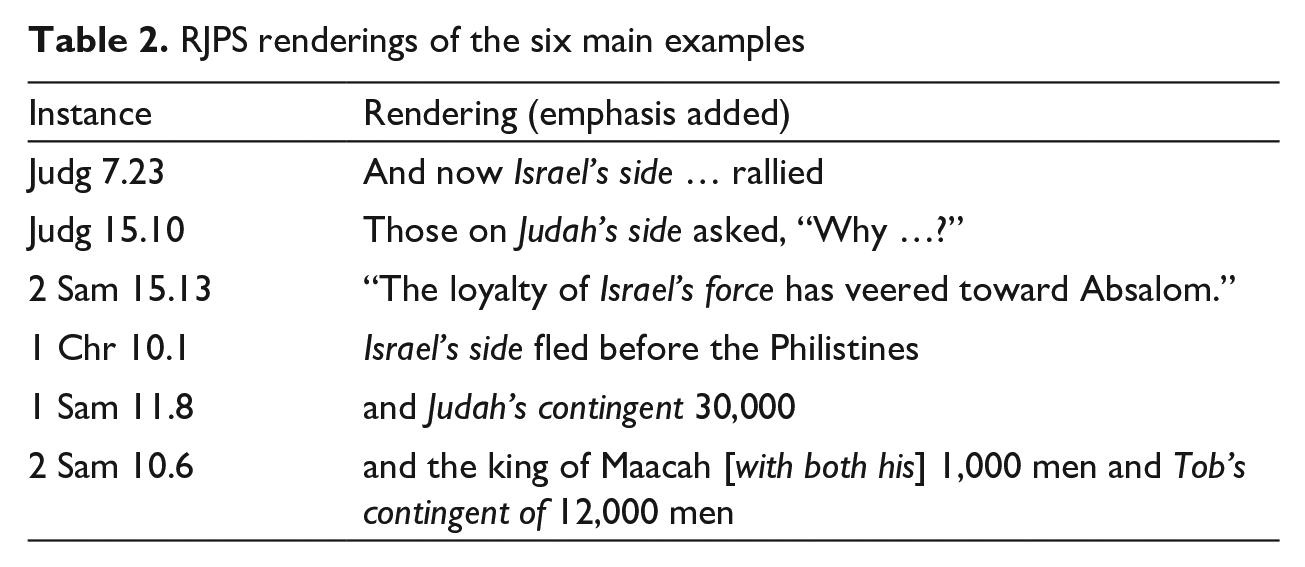
When a situating noun is not available as an equivalent rendering, the next best option is usually a relational noun. 37 Such nouns can convey that the referent should be regarded in relation to something larger than itself—which can point toward the situation. That is the recourse taken by the RJPS translation. To illustrate, it renders the six main examples in this article as shown in Table 2. 38
RJPS renderings of the six main examples
Summary
Both the singular and plural forms of אִישׁ can be employed to refer to a specific group of persons, although the two terms have different pragmatic implications. They regard their referent distinctly, putting attention on different aspects. Hence singular אִישׁ can be placed in a pragmatic contrast with אֲנָשִׁים.
Like other collective terms, singular אִישׁ regards the referenced group as one entity: either as a unified body (signaled by singular number agreement) or as a group whose members share something in common (signaled by plural agreement or co-reference). At the same time, it continues to do what אִישׁ almost always does, which is to profile its referent against the depicted situation. This is the purpose that motivates these usages; it explains why they occur where they occur, and not elsewhere.
This article has discussed and illustrated usages of אִישׁ that employ a “collective” construal of the depicted situation. These are found, appropriately enough, in four conceptually-related situational contexts: two-party conflict; multi-party hostilities; a parley to resolve a conflict; and a rite formalizing Israel’s covenant with God. Such usages reinforce the view that אִישׁ is part of the vocabulary for depicting a situation.
By starting with the prototypical functioning of אִישׁ as a situating noun, this approach explains the motivation for collective usages, which has heretofore eluded biblical scholars. It does so in a linguistically sound manner. And it consistently yields texts that are both coherent and informative—while solving what have been longstanding interpretive cruxes.
Footnotes
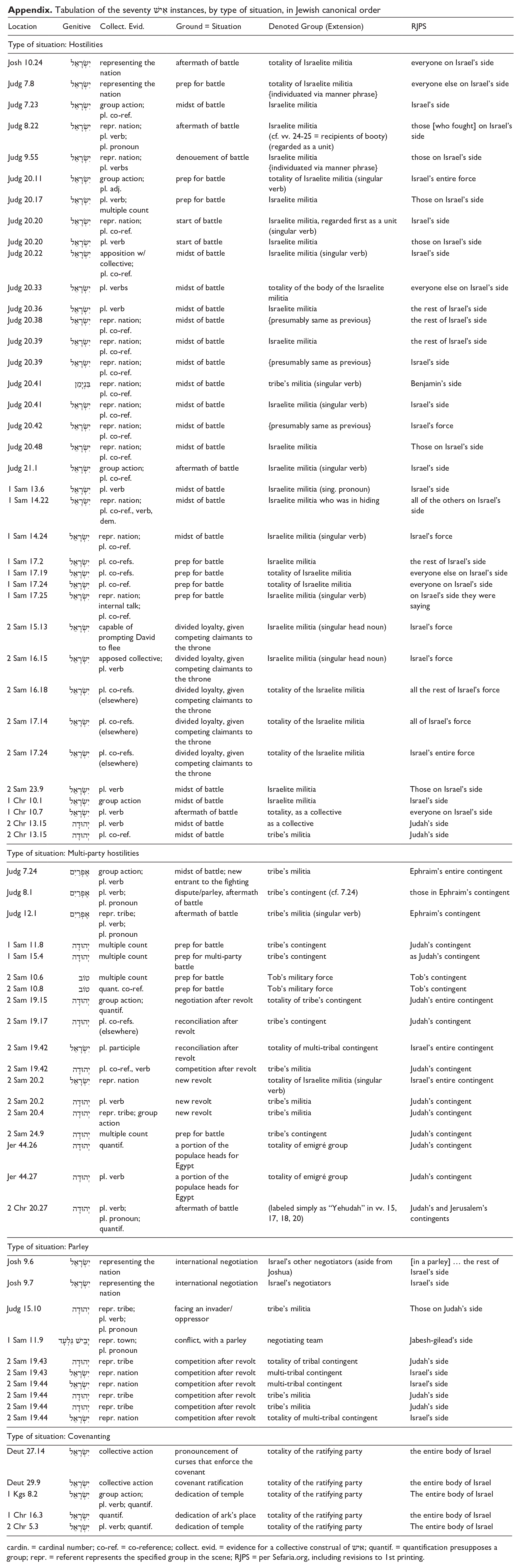
Appendix
Tabulation of the seventy אִישׁ instances, by type of situation, in Jewish canonical order
| Location | Genitive | Collect. Evid. | Ground = Situation | Denoted Group (Extension) | RJPS |
|---|---|---|---|---|---|
| Type of situation: Hostilities | |||||
| Josh 10.24 | יִשְׂרָאֵל | representing the nation | aftermath of battle | totality of Israelite militia | everyone on Israel’s side |
| Judg 7.8 | יִשְׂרָאֵל | representing the nation | prep for battle | totality of Israelite militia
{individuated via manner phrase} |
everyone else on Israel’s side |
| Judg 7.23 | יִשְׂרָאֵל | group action;
pl. co-ref. |
midst of battle | Israelite militia | Israel’s side |
| Judg 8.22 | יִשְׂרָאֵל | repr. nation;
pl. verb; pl. pronoun |
aftermath of battle | Israelite militia (cf. vv. 24-25 = recipients of booty)
(regarded as a unit) |
those [who fought] on Israel’s side |
| Judg 9.55 | יִשְׂרָאֵל | repr. nation;
pl. verbs |
denouement of battle | Israelite militia
{individuated via manner phrase} |
those on Israel’s side |
| Judg 20.11 | יִשְׂרָאֵל | group action;
pl. adj. |
prep for battle | totality of Israelite militia (singular verb) | Israel’s entire force |
| Judg 20.17 | יִשְׂרָאֵל | pl. verb;
multiple count |
prep for battle | Israelite militia | Those on Israel’s side |
| Judg 20.20 | יִשְׂרָאֵל | repr. nation;
pl. co-ref. |
start of battle | Israelite militia, regarded first as a unit (singular verb) | Israel’s side |
| Judg 20.20 | יִשְׂרָאֵל | pl. verb | start of battle | Israelite militia | those on Israel’s side |
| Judg 20.22 | יִשְׂרָאֵל | apposition w/ collective;
pl. co-ref. |
midst of battle | Israelite militia (singular verb) | Israel’s side |
| Judg 20.33 | יִשְׂרָאֵל | pl. verbs | midst of battle | totality of the body of the Israelite militia | everyone else on Israel’s side |
| Judg 20.36 | יִשְׂרָאֵל | pl. verb | midst of battle | Israelite militia | the rest of Israel’s side |
| Judg 20.38 | יִשְׂרָאֵל | repr. nation;
pl. co-ref. |
midst of battle | {presumably same as previous} | the rest of Israel’s side |
| Judg 20.39 | יִשְׂרָאֵל | repr. nation;
pl. co-ref. |
midst of battle | Israelite militia | the rest of Israel’s side |
| Judg 20.39 | יִשְׂרָאֵל | repr. nation;
pl. co-ref. |
midst of battle | {presumably same as previous} | Israel’s side |
| Judg 20.41 | בִּנְיָמִן | repr. nation;
pl. co-ref. |
midst of battle | tribe’s militia (singular verb) | Benjamin’s side |
| Judg 20.41 | יִשְׂרָאֵל | repr. nation;
pl. co-ref. |
midst of battle | Israelite militia (singular verb) | Israel’s side |
| Judg 20.42 | יִשְׂרָאֵל | repr. nation;
pl. co-ref. |
midst of battle | {presumably same as previous} | Israel’s force |
| Judg 20.48 | יִשְׂרָאֵל | repr. nation;
pl. co-ref. |
midst of battle | Israelite militia | Those on Israel’s side |
| Judg 21.1 | יִשְׂרָאֵל | group action;
pl. co-ref. |
aftermath of battle | Israelite militia (singular verb) | Israel’s side |
| 1 Sam 13.6 | יִשְׂרָאֵל | pl. verb | midst of battle | Israelite militia (sing. pronoun) | Israel’s side |
| 1 Sam 14.22 | יִשְׂרָאֵל | repr. nation;
pl. co-ref., verb, dem. |
midst of battle | Israelite militia who was in hiding | all of the others on Israel’s side |
| 1 Sam 14.24 | יִשְׂרָאֵל | repr. nation;
pl. co-ref. |
midst of battle | Israelite militia (singular verb) | Israel’s force |
| 1 Sam 17.2 | יִשְׂרָאֵל | pl. co-refs. | prep for battle | Israelite militia | the rest of Israel’s side |
| 1 Sam 17.19 | יִשְׂרָאֵל | pl. co-refs. | prep for battle | totality of Israelite militia | everyone else on Israel’s side |
| 1 Sam 17.24 | יִשְׂרָאֵל | pl. co-ref. | prep for battle | totality of Israelite militia | everyone on Israel’s side |
| 1 Sam 17.25 | יִשְׂרָאֵל | repr. nation; internal talk;
pl. co-ref. |
prep for battle | Israelite militia (singular verb) | on Israel’s side they were saying |
| 2 Sam 15.13 | יִשְׂרָאֵל | capable of prompting David to flee | divided loyalty, given competing claimants to the throne | Israelite militia (singular head noun) | Israel’s force |
| 2 Sam 16.15 | יִשְׂרָאֵל | apposed collective;
pl. verb |
divided loyalty, given competing claimants to the throne | Israelite militia (singular head noun) | Israel’s force |
| 2 Sam 16.18 | יִשְׂרָאֵל | pl. co-refs. (elsewhere) | divided loyalty, given competing claimants to the throne | totality of the Israelite militia | all the rest of Israel’s force |
| 2 Sam 17.14 | יִשְׂרָאֵל | pl. co-refs. (elsewhere) | divided loyalty, given competing claimants to the throne | totality of the Israelite militia | all of Israel’s force |
| 2 Sam 17.24 | יִשְׂרָאֵל | pl. co-refs. (elsewhere) | divided loyalty, given competing claimants to the throne | totality of the Israelite militia | Israel’s entire force |
| 2 Sam 23.9 | יִשְׂרָאֵל | pl. verb | midst of battle | Israelite militia | Those on Israel’s side |
| 1 Chr 10.1 | יִשְׂרָאֵל | group action | midst of battle | Israelite militia | Israel’s side |
| 1 Chr 10.7 | יִשְׂרָאֵל | pl. verb | aftermath of battle | totality, as a collective | everyone on Israel’s side |
| 2 Chr 13.15 | יְהוּדָה | pl. verb | midst of battle | as a collective | Judah’s side |
| 2 Chr 13.15 | יְהוּדָה | pl. co-ref. | midst of battle | tribe’s militia | Judah’s side |
| Type of situation: Multi-party hostilities | |||||
| Judg 7.24 | אֶפְרַיִם | group action;
pl. verb |
midst of battle; new entrant to the fighting | tribe’s militia | Ephraim’s entire contingent |
| Judg 8.1 | אֶפְרַיִם | pl. verb;
pl. pronoun |
dispute/parley, aftermath of battle | tribe’s contingent (cf. 7.24) | those in Ephraim’s contingent |
| Judg 12.1 | אֶפְרַיִם | repr. tribe;
pl. verb; pl. pronoun |
aftermath of battle | tribe’s militia (singular verb) | Ephraim’s contingent |
| 1 Sam 11.8 | יְהוּדָה | multiple count | prep for battle | tribe’s contingent | Judah’s contingent |
| 1 Sam 15.4 | יְהוּדָה | multiple count | prep for multi-party battle | tribe’s contingent | as Judah’s contingent |
| 2 Sam 10.6 | טוֹב | multiple count | prep for battle | Tob’s military force | Tob’s contingent |
| 2 Sam 10.8 | טוֹב | quant. co-ref. | prep for battle | Tob’s military force | Tob’s contingent |
| 2 Sam 19.15 | יְהוּדָה | group action;
quantif. |
negotiation after revolt | totality of tribe’s contingent | Judah’s entire contingent |
| 2 Sam 19.17 | יְהוּדָה | pl. co-refs. (elsewhere) | reconciliation after revolt | tribe’s contingent | Judah’s contingent |
| 2 Sam 19.42 | יִשְׂרָאֵל | pl. participle | reconciliation after revolt | totality of multi-tribal contingent | Israel’s entire contingent |
| 2 Sam 19.42 | יְהוּדָה | pl. co-ref., verb | competition after revolt | tribe’s militia | Judah’s contingent |
| 2 Sam 20.2 | יִשְׂרָאֵל | repr. nation | new revolt | totality of Israelite militia (singular verb) | Israel’s entire contingent |
| 2 Sam 20.2 | יְהוּדָה | pl. verb | new revolt | tribe’s militia | Judah’s contingent |
| 2 Sam 20.4 | יְהוּדָה | repr. tribe; group action | new revolt | tribe’s militia | Judah’s contingent |
| 2 Sam 24.9 | יְהוּדָה | multiple count | prep for battle | tribe’s contingent | Judah’s contingent |
| Jer 44.26 | יְהוּדָה | quantif. | a portion of the populace heads for Egypt | totality of emigré group | Judah’s contingent |
| Jer 44.27 | יְהוּדָה | pl. verb | a portion of the populace heads for Egypt | totality of emigré group | Judah’s contingent |
| 2 Chr 20.27 | יְהוּדָה | pl. verb;
pl. pronoun; quantif. |
aftermath of battle | (labeled simply as “Yehudah” in vv. 15, 17, 18, 20) | Judah’s and Jerusalem’s contingents |
| Type of situation: Parley | |||||
| Josh 9.6 | יִשְׂרָאֵל | representing the nation | international negotiation | Israel’s other negotiators (aside from Joshua) | [in a parley] … the rest of Israel’s side |
| Josh 9.7 | יִשְׂרָאֵל | representing the nation | international negotiation | Israel’s negotiators | Israel’s side |
| Judg 15.10 | יְהוּדָה | repr. tribe;
pl. verb; pl. pronoun |
facing an invader/oppressor | tribe’s militia | Those on Judah’s side |
| 1 Sam 11.9 | יָבֵישׁ גִּלְעָד | repr. town;
pl. pronoun |
conflict, with a parley | negotiating team | Jabesh-gilead’s side |
| 2 Sam 19.43 | יְהוּדָה | repr. tribe | competition after revolt | totality of tribal contingent | Judah’s side |
| 2 Sam 19.43 | יִשְׂרָאֵל | repr. nation | competition after revolt | multi-tribal contingent | Israel’s side |
| 2 Sam 19.44 | יִשְׂרָאֵל | repr. nation | competition after revolt | multi-tribal contingent | Israel’s side |
| 2 Sam 19.44 | יְהוּדָה | repr. tribe | competition after revolt | tribe’s militia | Judah’s side |
| 2 Sam 19.44 | יְהוּדָה | repr. tribe | competition after revolt | tribe’s militia | Judah’s side |
| 2 Sam 19.44 | יִשְׂרָאֵל | repr. nation | competition after revolt | totality of multi-tribal contingent | Israel’s side |
| Type of situation: Covenanting | |||||
| Deut 27.14 | יִשְׂרָאֵל | collective action | pronouncement of curses that enforce the covenant | totality of the ratifying party | the entire body of Israel |
| Deut 29.9 | יִשְׂרָאֵל | collective action | covenant ratification | totality of the ratifying party | the entire body of Israel |
| 1 Kgs 8.2 | יִשְׂרָאֵל | group action;
pl. verb; quantif. |
dedication of temple | totality of the ratifying party | The entire body of Israel |
| 1 Chr 16.3 | יִשְׂרָאֵל | quantif. | dedication of ark’s place | totality of the ratifying party | the entire body of Israel |
| 2 Chr 5.3 | יִשְׂרָאֵל | pl. verb; quantif. | dedication of temple | totality of the ratifying party | The entire body of Israel |
cardin. = cardinal number; co-ref. = co-reference; collect. evid. = evidence for a collective construal of שיא; quantif. = quantification presupposes a group; repr. = referent represents the specified group in the scene; RJPS = per Sefaria.org, including revisions to 1st printing.
1
The author is grateful to Profs. Ellen van Wolde and Ziony Zevit for their helpful critiques of an early version of this article. Illustrations are courtesy of biblemapper.com (detail from “The Battle at Mt. Gilboa”) and National Gallery of Art (Washington, D.C.), Ailsa Mellon Bruce Fund (detail from “Saul’s Suicide after His Defeat by the Philistines” by Antonio Tempesta).
2
The NJPS translation committee’s goal was “to render the Hebrew text as they believed the original author of that text meant it to be understood by his contemporaries” (Orlinsky 1970, 18). It featured “intelligibility in diction” and a thought-for-thought rendering of the text’s plain sense (17). In turn, the RJPS project has sought to restore those translators’ intent in light of recent changes in English, mainly the increasingly gendered usage of he/him/his/himself and the word man. On this retranslation’s goals and features, see its preface at https://purl.org/jps/rjps-preface. On its methods, see “Notes on Gender in Translation,” https://purl.org/jps/gender. On selected rendering decisions, see  –.
–.
3
Hebraists commonly gloss the masculine singular form of אִישׁ as “man” or “person.” However, those typical glosses clearly fail for the cases treated herein. Masculine forms of אִישׁ appear 2,198 times in the Bible and their evaluation is crucial for gender accuracy in translation due to a combination of two factors. First, contrary to popular belief, אִישׁ in Biblical Hebrew is lexically gendered only minimally (Stein 2019). And second, when its masculine forms are employed in nonspecific (class) reference or non-referentially, the referent’s gender is not specified (Stein 2008; ). Therefore, women may well be in view.
4
Similar constructions appear also in 12.1 and 20.20. Other exemplary cases of this type include Judg 8.1, 22; 15.10; 20.17; 1 Chr 10.1; 2 Chr 13.15.
5
The verb’s plural form וַיִּצָּעֲקוּ “[they] rallied,” although attested elsewhere, is pointedly not used here (cf. the next example, where the verb is plural). This verb (niphal of צעק) appears five more times in the Hebrew Bible; of those, two are singular, with singular אִישׁ as subject (like the present case), while the other three are plural, governing various plural or collective subject noun phrases.
6
The words אִישׁ and אֲנָשִׁים are best viewed as alternate forms of the same frequently occurring word, even though they come from different roots. The linguistic phenomenon called suppletion is known to give rise to irregular alternations of this kind. The relation of אֲנָשִׁים to אִישׁ is akin to the English irregular plural people for the singular person, each term deriving from a different Anglo-French root. On the plural and feminine forms of אִישׁ as suppletive, see , n6.
7
The singular and plural usages do appear synonymous on the surface, for they share collocated words and the same situational contexts. Notably, these variants repeatedly appear together within the same biblical narratives. Consider the following sets: Josh 10.6, 24; Judg 12.1, 4–5; 1 Sam 11.8-15 (three singular and three plural, interspersed); 1 Sam 15.4; 17.25; 17.52.
8
The plural and singular terms do not seem to differ in referential gender, i.e., whether women are in view. The expression כָּל־אַנְשֵׁי מִגְדַּל־שְׁכֶם “all the people of the Tower of Shechem” is clearly gender-inclusive in Judg 9.49, just as כָּל־אִישׁ יִשְׂרָאֵל “all ʾîš yiśrāʾēl” is in 1 Chr 16.3. UBS translators have been advised regarding both אַנְשֵׁי יִשְׂרָאֵל in 2 Sam 15.6 and אִישׁ יִשְׂרָאֵל in v. 13 that they denote “the people of Israel” in general rather than only its males (, 936). In any case, the present article will conclude that the gender profile is beside the point, at least for choosing idiomatic renderings in English.
9
A singular form regards its referent as a unity, whereas a plural form regards it as a group of distinct individuals (Löbner 2013, 80). Because the two forms evoke different meanings and thus offer speakers a choice, linguists commonly speak of a “singular–plural contrast” (e.g., Taylor 2002, 367). See also Hirtle 1982; Eschenbach 1993, 27; , 105.
Grammatical number must be distinguished from a language’s counting system. As Alan Cruse notes, the two systems are “syntactically and semantically distinct” (, 272). Consequently, the fact that ancient Hebrew speakers often used singular אִישׁ non-referentially as a unit of enumeration (e.g., with שִׁבְעִים “seventy” in Num 11.16) is not germane to this article.
10
E.g., Gesenius 1829, 84, s.v. אִישׁ 1.g; Kaddari 2006, s.v. אִישׁ 4; Clines 2018, 319. Likewise for אִישׁ־יִשְׂרָאֵל in our first exemplar in Judg. 7.23, UBS translators were recently advised that it “has a plural sense,” and so also for אִישׁ יְהוּדָה in our second exemplar in 15.10 (, 390, 686).
11
Another approach in the literature treats the singular form as what ; hereafter JM) call a “noun of species”—so that in effect, אִישׁ יִשְׂרָאֵל = יִשְׂרָאֵל “Israel.” JM §135c reads, “almost any singular noun may be used as a noun of species or of category—the generic use—and then it is equivalent to a plural. … The phrases איש יהודה 1 Sam 11.8 and איש ישראל Josh 9.6 are more frequent than the plural אנשי י׳ and express the notion of a generic group better” (467, emphasis in original). Yet this view is at odds with how people use language; it does not account for why speakers repeatedly prefer a longer expression (e.g., אִישׁ יְהוּדָה) over a shorter one (e.g., יְהוּדָה “Judah”) when either could be used to label the same referent. Because a shorter label involves less effort, it should be preferred by default. Thus it stands to reason that a speaker who uses the longer label must somehow find it more informative, contra JM.
12
See the Appendix for a tabulation of the seventy instances. For a caution about the textual instability of verb agreement compared to non-Masoretic texts, see , 478.
Semantically speaking, construct phrasing with a personal noun such as אִישׁ evokes a relationship of affiliation: the persons are identified with their group or place—and they also represent it.
13
The Bible includes additional instances of singular אִישׁ that denote a variety of groups of people; however, because unlike the present cases, those involve nonspecific reference (i.e., reference to a class of entities that exists only in the discourse, also known as irrealis), they do not shed light on the present ones.
14
As already demonstrated, the duality is evident in ways both grammatical and semantic. Additional grammatical clues include singular co-reference while representing a larger body (e.g., Josh 9.7; 1 Sam 13.6), and apposition with an obviously collective term (2 Sam 16.15). Semantic clues include a report of conversation that is internal to the referent, which therefore cannot be a singleton (Judg 20.22; 1 Sam 17.25), and a hearer’s reaction that is well out of proportion to a singleton referent (2 Sam 15.13-14). In addition, the audience’s expectation of textual coherence often demands a group reading even with a singular verb (Judg 20.41; 21.1; 1 Sam 14.24; 17.25; 2 Sam 15.13; 20.2). On semantic duality, see , 64.
For cases with the quantifier כֹּל “all,” see Jacobus Naudé’s finding that “כֹּל with a singular definite noun expresses ‘the totality of the individual members of the specific group or set’” (Van der Merwe, Naudé, and Kroeze 2017, A Biblical Hebrew Reference Grammar [BHRG], 310, §36.5.1(3)).
15
There are 327 instances of the masculine singular construct, per Accordance Bible Software’s module (i.e., the 70 under study comprise 21 percent of the total). Of those, there are another dozen that pair אִישׁ יְהוּדָה with either יוֹשֵׁב יְרוּשָׁלִַם or יֹשְׁבֵי יְרוּשָׁלִַם “inhabitants of Jerusalem.” I have set those cases aside for the time being, due to special challenges in interpretation of the full noun phrase.
16
A situation consists of several elements, such as human participants, that are configured in relationship to each other. Extreme types of situations include a crisis, an emergency, and a predicament. The human mind continually thinks in terms of situations; human cognition seems to be largely devoted to doing so (Yeh and Barsalou 2006). Thus, paying attention to situations, albeit highly abstract, is cognitively basic. See further Stein 2021; 2022; .
17
A situating noun is commonly used to depict a situation, to ask a question about it, to issue a directive to alter it, or to characterize a participant in it. Its use indirectly evokes a situation. See further Stein, forthcoming.
18
The mental habit of attending to situations naturally conditions human communication (Sanford and Garrod 1998; Taylor 2002, 72). As one linguist observed (Lambrecht 1994, 46), “Informing a hearer of something … necessarily involves not only participants but also something to participate in.” While a speaker is depicting a situation, the audience forms a mental representation of it (ibid.). That mental model is typically populated by participants whom the audience must keep track of. The speaker’s orchestration of this model is handled by the audience in automatic and unnoticed ways (, 15, 57–58).
19
I.e., the intrinsic features that the label אִישׁ ascribes to this referent, namely that he is an adult male person, are both incidental to this word’s function in the discourse and a matter of reliance upon a prototype.
20
Several have regarded the change in Chronicles as merely stylistic: Braun 1986, 149, citing Kropat (1909, 11) and Rothstein (1902, 200). Yet as we have seen, a difference in meaning should be expected. Other commentators have treated the change as meaningful by construing the usage of אִישׁ as representative: the purported report that one man/person fled is taken as standing for the whole army (Curtis and Madsen 1910, 180; , 285). However, if אִישׁ יִשְׂרָאֵל can indeed mean “each/every man of Israel” (which is otherwise unattested), then what is the point of adding the universal quantifier elsewhere: כָּל־אִישׁ יִשְׂרָאֵל “each/every man of Israel” (e.g., 2 Sam 20.2)? Neither of the foregoing interpretations seems compelling.
21
Similarly 1 Sam 15.4, but the syntax is unusual, featuring the resumptive use of an accusative (direct object) marker: וַעֲשֶׂרֶת אֲלָפִים אֶת־אִישׁ יְהוּדָה “and 10,000 [as] ʾîš yəhûdâ.” This phrase can be construed as informative per BHRG §33.4.2(2): it signals that “the object is identifiable, animate, and persistent within the context.” I.e., the referent of אִישׁ יְהוּדָה is treated as a distinct entity; אִישׁ is not being used as a mere counting unit. (So also LXX: καὶ τὸν ιουδαν “and Judah,” versus the usual ἄνδρες “men” for counting; Targum: יָת אְנָשׁ יְהוּדָה [direct object marker followed by the Aramaic cognate of אִישׁ followed by “Judah”], versus the usual גֻּבְרָא “men” for counting.)
22
In this verse, the main Israelite contingent is treated as a given, for Saul had called it up (v. 7). Generally the term אִישׁ is not used for a participant whose presence is given. In contrast, אִישׁ succinctly introduces the Judahite contingent that was not individuated in the discourse until now. The latter is reported apart from the Israelite contingent (rather than as part of it), judging from the similar case in 2 Sam 24.9.
23
The expression appears also in v. 8. (In v. 6, upon their arrival, the parties are listed according to the status of their leaders. In v. 8, arrayed on the battlefield, they are listed instead by size.) The same proposed solution applies there.
25
Translations include: LXX, Vulgate, Syriac. Interpreters include: Josephus (Ant. 7.6.1), Joseph Kara (https://mg.alhatorah.org/Parshan/R._Yosef_Kara/Shemuel_II/10.6#m7e0n6), and Abarbanel (at v. 8; ). Cf. the names Ish-baal (2 Sam 2.8; 1 Chr 8.33) and Ishhod (1 Chr 7.18).
26
Jirku 1950; HALOT (Koehler, Baumgartner, and Stamm 2000, 1:43, §3b) accepts Jirku’s proposal.
27
This presupposition explains why Tob’s contingent is elided altogether in the simplified retelling of 1 Chr 19.7, 9. (In v. 7, only the עַם “people” of the king of Maacah is mentioned, while in v. 9 the king stands for all of the troops under his command.)
28
Cf. Josh 13.11; Judg 11.3, 5; 1 Chr 7.14-16.
29
This construal of אִישׁ טוֹב is similar to a proposal by , 197). He then rejects his own idea on the grounds that nowhere else in the Bible is a foreign force labeled with אִישׁ in this manner. Yet the present article finds that domestic forces are so named on a regular basis; why would such a conventional expression not apply likewise to foreign forces? Furthermore, there is no counterexample—no instance of a distinct body of foreign troops being given a different (competing) label while that body is depicted as ready to act in concert alongside, or in the face of, another force. (Rather, foreign forces are usually depicted as an undifferentiated mass, labeled either by nationality or by the king who leads them.)
30
On how this approach resolves the longstanding interpretive crux אִישׁ יִשְׂרָאֵל in Josh 9.6-7, see the commentary in Stein 2023– ().
31
This category differs from the others in two respects. First, the parties are not in conflict. Yet they remain two distinct parties that together constitute the situation of interest. Second, the syntax makes these usages ambiguous as to semantic duality. For example, in 1 Chr 16.3, וַיְחַלֵּק לְכָל־אִישׁ יִשְׂרָאֵל “David distributed [a treat] to kol ʾîš yiśrāʾēl,” does the latter phrase mean “every person in Israel” (which has been its usual rendering), or “the totality of the Israelite party [to the covenant with God]”? Such cases were assessed by emulating the human mind’s standard processing of language (, 550–52): the other sixty-five instances establish that the label אִישׁ יִשְׂרָאֵל situates and expresses semantic duality conventionally; i.e., those pragmatic functions have cognitive priority.
32
Even in the two related cases where the term אִישׁ יִשְׂרָאֵל has only a one-person referent (Num 25.8, 14), it seems to be employed pointedly to indicate one of the sides in an intergroup conflict. If so, then the application of אִישׁ to a group (as one of those sides) is a small step, cognitively speaking.
33
34
35
Singular אִישׁ is like the noun עַם “people” in its collocating with singular verbs of gathering or spreading out (Exod 5.12; 32.1), with singular speech verbs (e.g., Num 21.5; Josh 24.16, 21), and with plural verbs and pronouns. When singular אִישׁ functions collectively, it emulates the third, flexible type of collective noun in Dougald McLaurin’s provisional cognitive-linguistic schema for such nouns (). McLaurin’s main corpus was Deuteronomy. He did not discuss אִישׁ, presumably because its two instances of collective usage in that book (27.14; 29.9) are so subtle; see note 30, above.
36
Collective usages of the singular form man, as attested in major dictionaries, are quite limited: man-of-war as the label for a naval warship, whose crew is regarded as a unit; similarly, Frenchman as a sailing ship that hails from France (OED §25; now rare); and the man as a catch-all phrase for white people, in a race-conscious context (OED §18c). None of these usages is appropriate as a rendering within the biblical contexts of use.
37
A relational noun prompts the audience to relate its referent to something else that in the discourse may be only implicit. For example, use of the role term messenger presupposes related elements: a sender, a message, and a recipient. Relational nouns can thereby indirectly evoke situations. (This explains why in English the relational noun husband is commonly used to render אִישׁ within the context of marriage.) That being said, the cognitive and communicative impacts of a relational noun differ from those of a situating noun, because the latter reflects a more primal conception that is processed more quickly by the mind (Stein, forthcoming).
38
Nearly all English translations, including NJPS, render אִישׁ in most of these instances with a plural, typically as “the men of …” Even the avowedly Hebrew-oriented translator does so. Occasionally a more situational construal is evident, as in “Everyone in Israel is on Absalom’s side!” as the CEV rendering of the clause discussed above in 2 Sam 15.13; and cf. the NJPS rendering of כֹּל אִישׁ יִשְׂרָאֵל in Judg 20.33 as “the main body of Israel’s force.”