



Abstract
Ocean acidification and ocean deoxygenation are consequences of anthropogenic CO2 emissions that remain largely unknown to the general public. Mostly, because lay audiences are not familiar with the complex chain of physical and chemical processes that drive these phenomena. This demands that communicators find clear, simple and psychologically effective language to frame ocean health issues in familiar terms. From antiquity to the Renaissance, and independently across multiple cultures, premodern thinkers have conceptualized the Earth in terms of the human body. This is not surprising given that metaphor lies at the core of human understanding. Building on this premodern tradition, I found a system of mathematical equations that calculates the chemical composition of the human body or the ocean, when forced by human physiological or oceanographic parameters, respectively. Based on this result, I build an extended analogy that introduces the basic functioning of the oceanic CO2 and O2 cycles to the general public. The analogy incorporates ocean acidification and deoxygenation, that have parallels in the acidification and deoxygenation of the human body caused by an asthma attack, providing ocean health communicators with a tool that promotes interest in, and explains the origin of, declining ocean heath. Extending the analogy to the continental domain allows to see the Earth as a superorganism, a perspective that may help promote an environmentally healthier relationship between humanity and the Earth.
Keywords
Introduction
Communicating the science of climate change to leaders, policymakers and the general public is an important aspect of addressing the climate crisis (Bowman et al., 2010; Hassol, 2008; Moser, 2010, 2016; Somerville and Hassol, 2011). Effective climate change communication is necessary to raise public awareness, increase understanding in lay audiences, and advocate for policy change (Moser, 2010). Most communication efforts have concentrated on explaining the link between rising atmospheric CO2 concentrations and global warming, rising sea-level and modified weather patterns (Moser, 2010, 2016; Somerville and Hassol, 2011). A comparatively smaller effort has been directed to explaining the effect of anthropogenic CO2 emissions on interior ocean processes (Schuldt et al., 2016). Thus, ocean health issues such as ocean deoxygenation (Oschlies et al., 2018) and ocean acidification (Caldeira and Wickett, 2003; Gattuso and Hansson, 2011) are not as widely known by the general public as climate change effects (Capstick et al., 2016; Chilvers et al., 2014; Cooke and Kim, 2019).
Ocean acidification (Caldeira and Wickett, 2003; Gattuso and Hansson, 2011; Figure 1) is the decrease in ocean pH that results from the absorption of anthropogenic CO2 from the atmosphere (Khatiwala et al., 2013; Le Quéré et al., 2018). Since the beginning of the industrial revolution, this process has decreased the pH of the surface ocean by 0.12 pH units (Perez et al., 2018), which corresponds to a 30% increase in acidity measured as the concentration of the H+ ion. As the ocean acidifies, the saturation state with respect to calcium carbonate (CaCO3) minerals decreases (Zeebe and Wolf-Gladrow, 2001), and marine calcifying organisms such as calcifying algae, mollusks, and corals experience reduced calcification (Pörtner et al., 2014). In conjunction with rising ocean temperature and changing nutrient concentrations, ocean acidification promotes toxic algal blooms, increases coral bio-erosion and alters sensory perception in fishes (Doney et al., 2020; Gattuso and Hansson, 2011; Pörtner et al., 2014). Ocean acidification has negative consequences for aquaculture and fisheries, and for the human communities that these economic activities sustain (Doney et al., 2020). It is virtually certain (IPCC, 2021), based on the latest generation of Earth System models (Kwiatkowski et al., 2020), that acidification of the surface ocean will continue in response to the rise in atmospheric CO2.
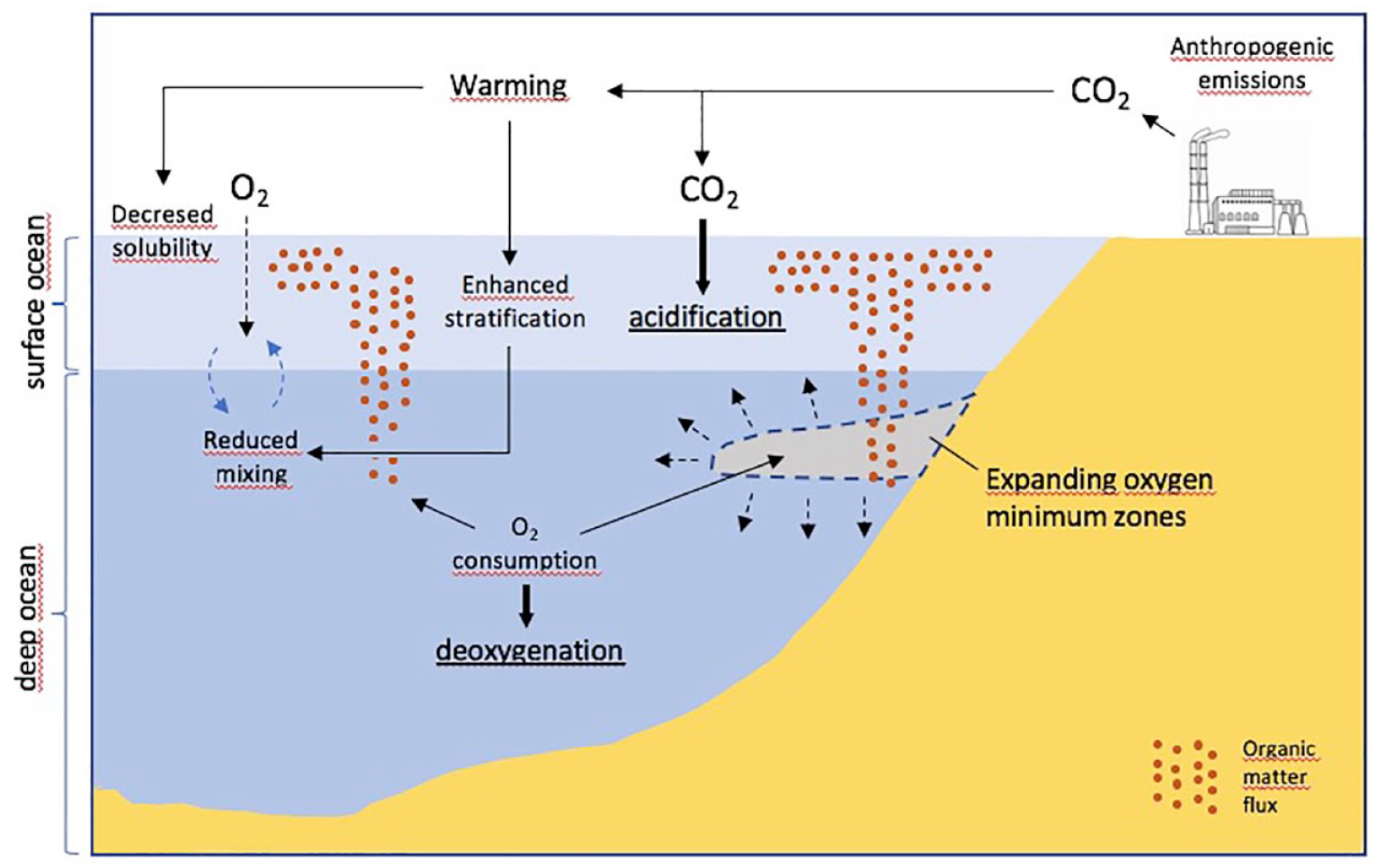
Ocean acidification and ocean deoxygenation: the two main ocean health consequences of anthropogenic CO2 emissions. Ocean acidification occurs when anthropogenic CO2 is absorbed by the oceans and reacts with water, resulting in increased acidity. Ocean deoxygenation is driven by multiple factors including decreased solubility of oxygen in warmer waters and increased stratification of surface ocean waters due to warming, which leads to reduced mixing of oxygen-rich surface waters with deep waters where O2 is consumed by reaction with settling organic matter (see text).
Ocean deoxygenation (Figure 1) is the decrease in dissolved oxygen that follows the warming-induced strengthening of upper water column stratification, and the enhancement of coastal nutrient inputs (Oschlies et al., 2018). As stratification of the upper ocean is strengthened, the ventilation of the ocean interior decreases, resulting in the decline of dissolved oxygen concentration. An additional cause of ocean deoxygenation is the decrease in oxygen solubility with increasing water temperature (Oschlies et al., 2018). The effect is both pervasive—the oxygen content of the first 1000 m of the ocean has decreased by roughly 2% over the 1970–2020 period (Schmidtko et al., 2017)—and local, with the expansion of oxygen minimum zones, where dissolved oxygen concentrations are vanishingly low (Stramma et al., 2008). Earth System models predict that throughout the 21st century ocean deoxygenation will continue under the effect of climate change (Kwiatkowski et al., 2020), with potentially negative consequences for ecosystems and the coastal economies they depend on (Stramma et al., 2008).
Communicating on ocean health implies familiarizing lay audiences with the cascade of cause-effect mechanisms that link increased atmospheric CO2 to evolving ocean chemistry. Faced with this challenge, communicators have to choose the most effective language to frame the issue (Guenther et al., 2023; Lakoff, 2010). Framing, is setting an issue within an appropriate lexical context to achieve a desired interpretation or perspective—be it social, political or scientific (Brugman and Burgers, 2018; Entman, 1993; Fillmore, 1975; Thibodeau and Boroditsky, 2011, 2013). In climate change communication, metaphorical framing—that is, using metaphors to provide context—is common practice (CRED, 2009; Deignan et al., 2019; Hassol, 2008; Moser, 2010; Nerlich et al., 2010; Niebert and Gropengiesser, 2013; Raimi et al., 2017; Somerville and Hassol, 2011; Thibodeau et al., 2017). Alongside physical metaphors (e.g. “greenhouse effect” and “heat-trapping blanket”), a special place is occupied by medical metaphors (Somerville, 2006; Stern and Raimi, 2015) that compare climate change with human health (e.g. “Planet Earth is a sick patient due to climate change”; Press Association, 2015), bridging the gap between the cognitive and affective domains of learning (Chapman et al., 2017; Duit, 1991).
Metaphorical framing has been extended to ocean health communication (Bales et al., 2015; Harrould-Kolieb, 2020; Hawkins and Brennan-Rhodes, 2020; O’Neil and Hawkins, 2019; Schuldt et al., 2016). Thus, ocean acidification is described as “The evil twin of ocean warming” (Pelejero et al., 2010), “Osteoporisis of the sea” (Guinotte, 2005; Volmert, 2014) and “the other CO2 problem” (Doney et al., 2009); while ocean deoxygenation is referred to as “the ocean losing its breath” (Gruber, 2011). Similar to climate change metaphors, ocean health metaphors are provocative statements aimed at sparking interest for ocean health phenomena. But a gap remains between the metaphorical evocation of ocean health issues, and even a rudimentary understanding of their origin.
Making sense of ocean health phenomena requires that metaphors are followed by an explanation of the interconnectedness of natural systems, and of the processes that link anthropogenic causes to ocean change effects (Hendricks and Volmert, 2019; Volmert, 2014). Explanatory metaphors, which are multi-phrase extensions of the metaphors introduced above, have proven to be effective when tested empirically (Hendricks and Volmert, 2019; Volmert, 2014). Thus, seeing the Planet as a Body improves understanding of the interdependency of atmosphere, land and ocean, while introducing the ocean as Climate’s heart, enhances understanding of the role played by the ocean within the planet (Hendricks and Volmert, 2019). Clearly, the human body frame is a powerful vehicle to foster awareness of ocean health issues. Yet, metaphors are not a substitute for content. They do not fill the knowledge gap that prevents the public from arriving to a concrete understanding of ocean health issues (Lindland and Volmert, 2017; Volmert, 2014). Can we move beyond explanatory metaphors to provide explanatory scientific content without exiting the metaphoric Body frame? In other words, are there significant similarities between the ocean and the human body that can be exploited to adopt the human body as a model to deliver specific ocean-related knowledge?
I found the clue to answering these questions in our historical past, in the philosophical quest of pre-modern thinkers to make sense of the unknown earth. From antiquity to the Renaissance, scientific thinkers by the likes of Hippocrates, Seneca and Leonardo da Vinci drew parallels between the Earth and the human body, in an attempt to conceptualize the natural world. They were drawn into this comparison by the intrinsic ability of metaphor to shape human thought. Their efforts over a period of two millennia are a window into how the human mind formulates interpretative models of the unknown Earth, including the ocean. In this paper, I build on this pre-modern tradition and, together with contemporary knowledge of human physiology and ocean biogeochemistry, put it at the service of ocean health communication.
The human Earth metaphor from ancient philosophy to early modernity
The idea that the Earth or the cosmos (intended as the physical universe) are in some way structurally similar to the human body is not new: it is present in ancient Iranian (Götze, 1923), Mesopotamian (Svärd and Nokso-Koivisto, 2014), Indian (Wayman, 1982) and Chinese (Raphals, 2015) philosophical traditions. In western philosophy, this view is embodied in the so-called microcosm-macrocosm analogy developed in ancient Greece, and transmitted to its medieval—Christian, Judaic and Islamic—and Renaissance descendants (Allers, 1944; Barkan, 1975; Debus, 1965; Kraemer, n.d; O’Malley, 1964). This idea views man as a smaller representation of the cosmos, and the cosmos as an anthropomorphic entity: truths about the nature of the cosmos may be inferred from truths about human nature, and vice versa. The following examples illustrate how this idea was deeply rooted and persistent in pre-modern philosophical thinking.
In the words of Socrates (470–399 BC), as related in Plato’s Philebus, the elements in man’s body are derived from elements in the body of the cosmos: whatever man has, the cosmos must have (Wayman, 1982). Accepting these principles, the Greek physician Hippocrates (460–377 BC) developed a physiological and pathological system where the cosmos was a model to explain the human body, and imbalances in the body were a reflection of larger imbalances in the cosmos (Jouanna, 2012; Schluderer, 2018; West, 1971). Later, in the treatise De hebdomadibus, Hippocrates used knowledge of human anatomy and physiology to interpret the earth, giving rise to the makranthropic representation of the world (Le Blay, 2005). Thus, the rocky interior of the earth corresponded to the bones; the weaker parts surrounding it to the flesh; rivers corresponded to the veins; hot springs to the spinal marrow; ponds and marshes to the bowels; seas to the visceral fluids; the air to the breath in the body (West, 1971). Taking this view, it was within man that the key to the cosmological riddle was to be found (Allers, 1944).
The makranthropic view of the earth was the base for interpretations of earthquakes by ancient Greek and Latin philosophers. In his treatise Meteorologica, Aristotle (384–322 BC) claimed that: “We must suppose the action of the wind in the earth to be analogous to the tremors and throbbings caused in us by the force of the wind in our bodies. Thus, some earthquakes are a sort of tremor, other a sort of throbbing” (Le Blay, 2005). Hellenism, and the subsequent Roman conquest of Greece, were vehicles that spread Greek philosophy to the Latin world. Thus, three centuries after Aristotle, the Roman stoic philosopher and politician Seneca (4 BC–65 AD), in his treatise Naturales Quaestiones, saw earthquakes as a disease: “But in our bodies the movement of the veins also preserves its rhythm undisturbed while there is good health but when there is something wrong the movement pulses more rapidly and inhaling and exhaling give signs of effort and exhaustion. In the same way, the earth remains unshaken as long as its condition is normal. When something is wrong, then there is motion just like that of a sick body” (Le Blay, 2005). In summary, while earthquakes for Aristotle are a question of bad digestion, for Seneca they are a consequence of vascular and respiratory malfunction.
The ocean, and more in general the hydrological cycle, were also interpreted by ancient Greek and Latin thinkers using the human body as a model. Earth’s water, in particular, was in turn related to bodily fluids like sweat, urine, or blood. Thus, in Meteorologica, Aristotle addresses the origin of ocean salinity: “the sea is a kind of sweat, exuded by the earth when the sun heats it, which explains its saltiness, all sweat being salty” (Le Blay, 2005), and “. . .the salty sea as the final incarnation of riverine flow appropriately recalls the salinity of urine” (Wee, 2018). Seneca, in his treatise Naturales Quaestiones, turns to blood as the model for earth’s water: “The idea appeals to me that the earth is governed by nature and is much like the system of our own bodies in which there are both veins, receptacles for blood, and arteries, receptacles for air. In the earth, also there are some routes which waters runs, some though which air passes. And nature fashioned these routes so like human bodies that our ancestors even called them ‘veins of water” (Le Blay, 2005).
In medieval Europe, much of Christian philosophical thought was characterized by a subservience to the theological purpose (Hart, 1925). Christian theologians compared man and the cosmos starting from the notion, present in the Gospel, that man was created not only in the image of God, but also of the whole creation (Kurdzialek, 2014). We are confronted here by a microcosmic interpretation of man derived not from an urge to make sense of the natural physical world—like the ancient Greeks and Latins felt—but, rather, from the need to attribute a meaning to the theological mysteries that define the very heart of Christian faith (Kurdzialek, 2014).
The comparison of the cosmos with the microcosmos with a physical scientific purpose was the realm of medieval alchemy. Alchemists believed that all things above and below are connected (Gentner and Jeziorski, 1993), as codified in the medieval doctrine of signatures: “It is through similitudes that the otherwise occult parenthood between things is manifests and every sublunar body bears the traces of that parenthood impressed on it as a signature” (Eco, 1990). The egg, symbolizing the microcosm, was widely used in alchemical metaphors: “The shell of the egg is an element like earth, cold and dry; it has been called copper, iron, tin, lead. The white of the egg is the water divine, the yellow of the egg is couperose [sulfate], the oily portion is fire” (from the manuscript of St. Mark, 10th–11th century, cited in Gentner and Jeziorski, 1993).
The Renaissance revival of the thoughts, views, and ideals of Greek and Latin Antiquity led to the return of the ancient microcosm-macrocosm idea as a tool to conceptualize the human body and the cosmos. The direction taken—makranthropic or microcosmic—depended on the subject matter of study. For the Swiss physician, philosopher and alchemist Paracelsus (1493–1541), man resembled heaven and earth because he was composed of their matter—“hence he must have all their nature and all their parts, down to the last hair” (Jevons, 1964). Like Hippocrates, for Paracelsus there was a profound correspondence between the structure of the cosmos and the structure, working and arrangement of the human body; and health arose from the harmony between one and the other. It was the work of the physician to understand these correspondences, which were the key to how the organs worked in health and disease (Pagel and Rattansi, 1964). It is within this microcosmic view of man, that Paracelsus interpreted epilepsy as “the earthquake of the microcosm” (Von Storch, 1930).
With Leonardo da Vinci (1452–1519), the makranthropic view of the earth was again directed at interpreting large scale geological and hydrological processes. Thus, in his The Motion and Measurement of Water (c. 1500), Leonardo revisits ancient Greek and Latin visions of the earth seen as a human body: Man has been called by the ancients a lesser world, and indeed the term is rightly applied; seeing that man is compounded of earth, water, air and fire, this body of the earth is the same. And as man has within himself bones as a stray and framework for the flesh, so the world has the rocks which are the supports of the earth, and man has within him a pool of blood wherein the lungs as he breathes expand and contract, so the body of the earth has its ocean which also rises and falls every six hours with the breathing of the world. As from the said pool of blood proceed the veins which spread throughout the earth – and is breathed out in baths and volcanoes, such as Mount Etna in Sicily.
Leonardo’s mapping of the ocean onto the blood, and of “breathing” of the earth, onto a character conductible to blood flow “..its pulses” comes several decades before William Harvey’s founding book The Circulation of the Blood (1628).
One of the best-known pictorial representations of the microcosm-macrocosm idea is Leonardo’s drawing Vitruvian Man (1490) (Figure 2). In this drawing, the erect figure of a man fits both within a circle (arms spreadeagled) and a square (arms outspread), where the circle and the square, accepted by Pythagoreanism as the most beautiful shapes, symbolize the macrocosm (Wayman, 1982). But next to the makranthropic view of the earth, a new, more modern vision of geology, developed (Laurenza, 2015). In the Codex Leicester (1506–1510), Leonardo interprets the presence of fossil shells of marine organisms in continental outcrops as due to emersion of previously submerged sediments, and vertical movements of land as due to the effect of sediment erosion and unloading: the times of the microcosm-macrocosm idea as an all-encompassing view of the earth as a material entity imbued with soul were nearing an end.
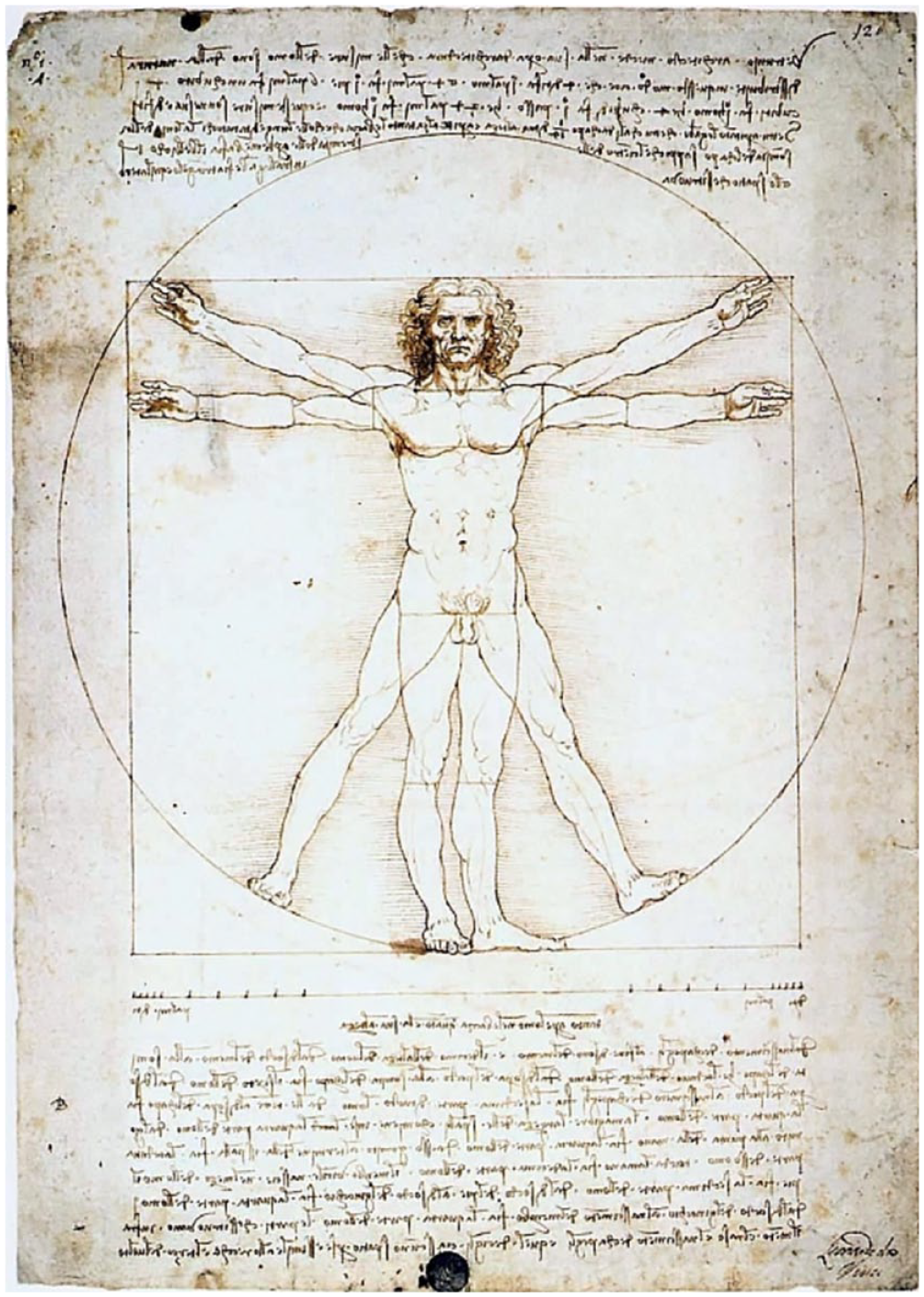
Leonardo da Vinci’s Vitruvian Man (c. 1490) is probably the best-known pictorial representation of the microcosm-macrocosm idea (see text).
Starting with the scientific revolution and the Enlightenment, the use of the microcosm-macrocosm idea to conceptualize the physical universe was supplanted by modern scientific descriptions of the Earth (Oldroyd, 1996). Amongst the last traces of its use can be found in the early work of James Hutton (1726–1797), the father of modern Geology. Hutton, that is most famous for his opus Theory of the Earth (1785), had studied medicine in Leiden, graduating in 1749. His dissertation, On the circulation of blood in the Microcosm (1749), is a study of the chemistry of blood, its modification by physiological processes, its circulation, and purification. It is not surprising, then, that when Hutton went on to investigate the material cycles of the solid Earth, he concluded: “I consider the Earth to be a super organism and that its proper study should by physiology” (McIntyre, 1963). The idea of the human body as a Microcosm of Nature could have led Hutton to realize that like the body, planet Earth is wasted and renewed by the flow of rivers, which keep it in equilibrium, just as the human body is kept in health by the addition of oxygen and nutrients and the removal of wastes by blood (Norwick, 2002). By the time Hutton wrote The Theory of the Earth, however, he had become a mechanically and causally oriented investigator, such that he can be considered the transition between Renaissance science, which emphasized the microcosm-macrocosm idea, and modern science, which rejected interpreting inorganic objects in terms of organic objects (Norwick, 2002).
The fact that the microcosm-macrocosm idea has been so persistent in pre-modern philosophical thought indicates a deep-rooted tendency in the human mind for this kind of comparison (Allers, 1944). This is all the more so if you consider that it probably developed independently in different cultures of antiquity, as implied in the work of the historian of religion Mircea Eliade (Eliade, 1958), whose views on the microcosm-macrocosm idea seem to withstand a recent historical reevaluation of his work (e.g. Ginzburg, 2010; Mirdamadi, 2015). This is not surprising, given the fundamental role played by metaphor in human thought (see next section). The microcosm-macrocosm idea is thus a kind of “symptom” of the thought process guiding man in his quest, during two millennia, to make sense of the unknown Earth (Allers, 1944). We are faced today with the urgency of communicating effectively on Earth’s changing environment to lay audiences. I propose to reconsider the symbolic power of the human Earth metaphor, and use it to explain the challenges that human CO2 emissions impose on the ocean.
The role of metaphor and analogy in thought and communication
Metaphors and analogies play a fundamental role in human cognition and communication. I will distinguish between these two types of similarity based on their ability to foster creative thinking and explain poorly known concepts (Brown and Salter, 2010; Duit, 1991; Gentner, 1983; Gentner and Jeziorski, 1993; Gentner and Markman, 1997; Little, 2000).
Metaphor as an essential component of human thought
Metaphors have been long considered only as figure of speech, a sophisticated device used to embellish discourse. The view of metaphor as a property of language alone, as opposed to cognition or action, follows from the objectivist western philosophical tradition (Lakoff and Johnson, 1980). In this tradition, metaphors are literally false statements that are intended to have a different meaning from the literal meaning (e.g. “anger is heat”). At the root of this view is the myth that the world is made up of distinct objects, with inherent properties and fixed relations among them; that these properties are independent of any people or other beings who experience them; that there is an objective reality, and that words have fixed meanings that can describe this reality correctly. In objectivist tradition, metaphors should always be avoided because their meaning is not clear and precise and does not fit reality in any obvious manner (Lakoff and Johnson, 1980).
This view changed radically with the work of Lakoff and Johnson (1980) in the field of cognitive linguistics, providing evidence that metaphor in language reflects underlying conceptual representations and thought processes. In other words, our ordinary conceptual system, in terms of which we both think and act, is fundamentally metaphorical in nature. Since the work of Lakoff and Johnson (1980), evidence for a fundamental role of metaphors in human thought has been provided by psychological research (Boroditsky, 2000; Thibodeau and Boroditsky, 2011, 2013), the study of gestures (McNeill, 1992), the analysis of discourse (Narayanan, 1997) and of sign language (Taub, 2000), amongst others. This research provides an explanation for the pervasive and universal tendency of pre-modern thinkers to conceptualize the Earth in terms of the human body.
Metaphor and analogy as communication tools
The fundamental role played by metaphor in human thought has important consequences for the concept of truth, and for how the general public understands—and forms its opinion on—issues so disparate as literature, politics and science (Brugman et al., 2017; Semino et al., 2018; Thibodeau and Boroditsky, 2011; Thibodeau et al., 2019; Thibodeau and Boroditsky, 2013). Because human understanding is mostly metaphorical, and because the idea of truth is based on understanding, truth is always relative to a conceptual frame (Lakoff and Johnson, 1980). In other words, one cannot understand the meaning of a given word without access to all the essential knowledge—the frame—that relates to that word (Entman, 1993; Fillmore, 1975). In the case of ocean health, for example, the term ocean acidification is meaningless if it cannot be related to other elements of the ocean health frame (e.g. anthropogenic CO2 emissions, atmosphere-ocean CO2 exchange, surface ocean pH, biological calcification etc.).
When the purpose is communication, it is useful to distinguish metaphors from analogies, based on how information from the source domain is transferred to—mapped onto—the target domain (Gentner, 1983). An analogy is a particular declaration of similarity asserting that a system of relations that holds between objects of the base domain (source of knowledge) also holds between objects of the target domain, regardless of whether or not the objects themselves are intrinsically similar (Gentner, 1983; Gentner and Markman, 1997). A classic example is Rutherford’s analogy: “The hydrogen atom is like our solar system” (Gentner, 1983) (Figure 3). In this analogy, the electron corresponds to the planets, while the atomic nucleus corresponds to the Sun. The strength of the analogy, however, lies in the fact that the electron revolves around (is attracted by) the atomic nucleus just as planets revolve around (are attracted by) the Sun: the mapping is on relations, rather than on object attributes. Analogy, as defined here, is a powerful tool to explain poorly known concepts.
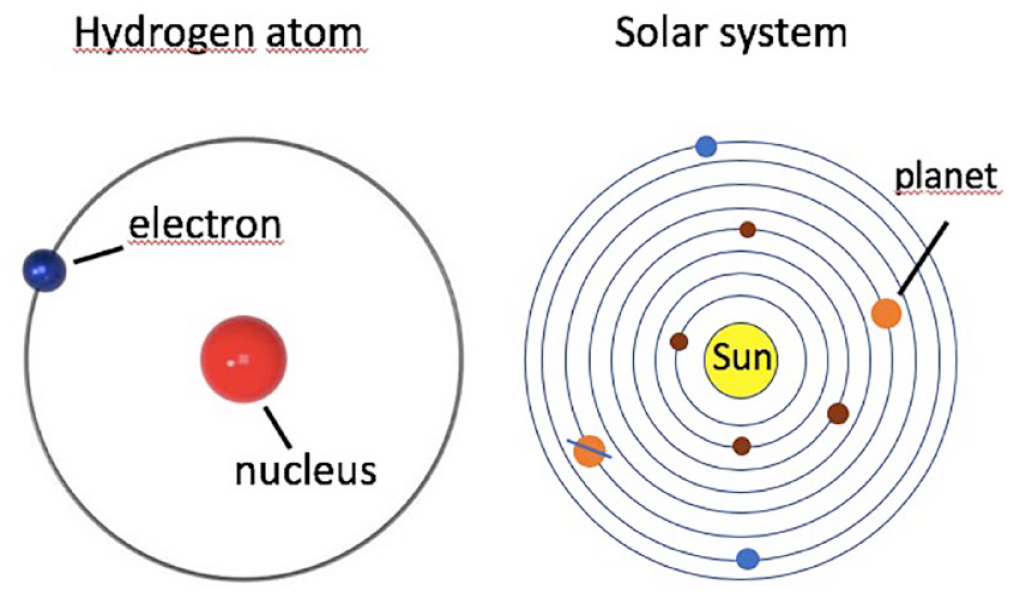
An example of analogy: the electron revolves around (is attracted by) the atomic nucleus just as planets revolve around (are attracted by) the Sun, in Rutherford’s analogy between the hydrogen atom and the solar system (Gentner, 1983).
What, then, is the place of metaphor? Gentner and Markman (1997) propose that metaphors occupy a continuum between analogies—that share many relational, but few attribute, similarities—and mere appearance matches—that share many attribute, but no relational, similarities (e.g. “a sunflower looks like the Sun”). It is clear that while analogies have explanatory power, mere appearances completely lack explanatory power. Metaphors, that may imply both relational and attribute comparisons (e.g. “tires are like shoes”), lie along this continuum (Gentner and Markman, 1997; Gentner et al., 2001). In addition, regardless of the degree to which they integrate relational similarities, metaphors very often have the additional property that the ground of the comparison is hidden (Duit, 1991), resulting in literally absurd or false statements (e.g. “his eyes were burning coals”). The effect produced is that of surprise and provocation, leaving the addressee of the metaphor with the task of revealing—or even creating—the ground of the comparison. In other words, metaphors promote creative thinking. This is evident in art, where the provocation that arises from the coexistence of literal absurdity with figurative truth is used to deliver profoundly evocative messages (Figure 4).

An example of metaphor: the physics is wrong, but there is something in the chemistry. . . (Marc Chagall, Over the Town, 1913).
With these definitions in mind, it is evident that metaphors and analogies are complementary tools for framing ocean health issues (Duit, 1991). Metaphors, next to the role they play in conceptualization, are a provocative means to stimulate interest in ocean health issues, creating an expectation for further information; analogies, by providing basic information, give access to the understanding of how and why ocean health is deteriorating, making the underlying science accessible to the general public. Both should be used to frame ocean health issues effectively.
What the ocean has in common with the human body
Intrigued by the urge that pushed pre-modern thinkers to see the Earth as a human body, I explored the use of the human body as a model to frame ocean health issues. A consistent theme in the pre-modern comparison of the Earth to the human body is the parallel drawn between the water in the hydrological cycle and blood in the human body. I thus start from the idea that the global world ocean corresponds to the complete human circulatory system, and explore if the chemical composition of the ocean can be described with the same mathematical equations that calculate that of the human body. Should this be possible, it would provide a solid basis for using the human body as a model to explain the ocean.
At the base of this approach lies the realization that there are striking similarities in the structure and processes of the oceanic and human carbon cycles (Figure 5), notwithstanding the 19–20 orders of magnitude difference in the volume and carbon mass of compartments between the two systems. Based on these similarities, I set up a carbon cycle model that simulates carbon exchange between two connected reservoirs and the atmosphere (see Appendix for a description of the numerical model). This model is simple enough to ignore the many differences in carbon compartmentalization between the human body and the ocean, but complex enough to consider the main carbon fluxes and processes that regulate acidity (measured as pH) in both systems.
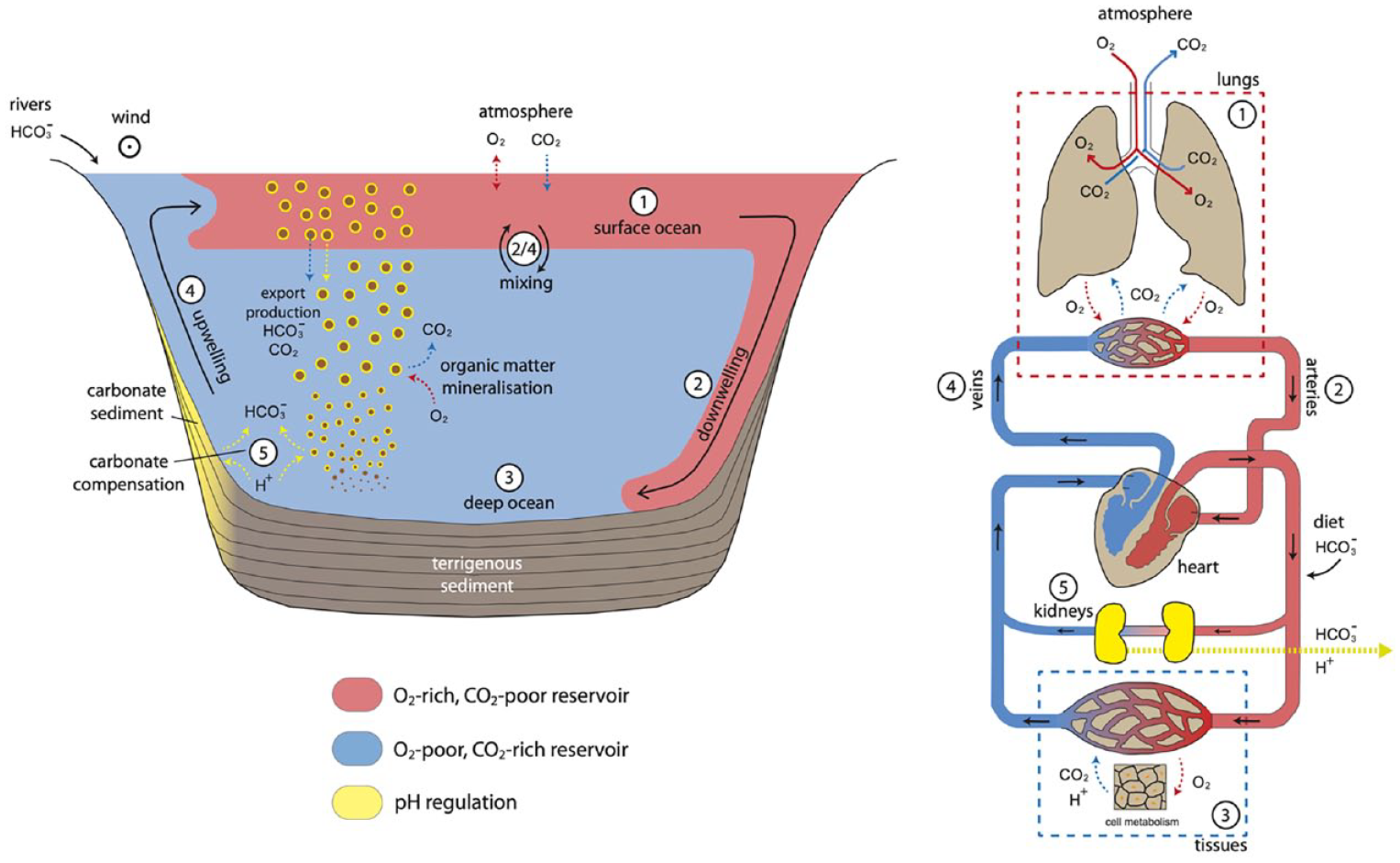
Similarities between the carbon cycle in the ocean and in the human body. The carbon cycle in the ocean is in many ways an analog of the carbon cycle in the human body: both systems exchange CO2 between a relatively CO2-poor reservoir (lungs; surface ocean) and a relatively CO2-rich (body tissues; deep ocean) reservoir; in both systems net acidity is produced internally by metabolic processes in one of the reservoirs (tissue metabolism in the human body; organic matter mineralization in the deep ocean); both systems have a means to stabilize systemic pH via HCO3− addition and H+ removal (kidneys in the human body; carbonate compensation in the ocean). Export production in the ocean represents an additional carbon sink to the surface ocean which has no analog in the human body; this difference arises because the source of carbon fueling organic matter mineralization in the deep ocean is internal to the system (photosynthetic CO2 fixation), while in the human body the source of carbon for tissue metabolism is external (dietary input). Note: numbers refer to the analogies between the oceanic and the human carbon cycles listed in Table 2.
A first indication that the similarities sketched in Figure 5 have a sound physico-chemical basis is the observation that the model calculates pH, pCO2 and HCO3− values characteristic of the human body (Oldroyd, 1996)—or of the ocean (Zeebe, 2012a)—when model parameters are set to their human physiological—or oceanographic—values, respectively (Table 1, Figures A2 and A3 in the Appendix). In these two reference runs, the model captures the contrasts in pH and pCO2 between the relatively basic (pulmonary and surface ocean) and more acidic (body tissue and deep ocean) reservoirs, as they are driven by production of acidity in the body tissues and in the deep ocean (Figure 5). I then used the model to simulate the response of the human body and the ocean to an abrupt increase in CO2.
Carbon cycle in the ocean and in the human body.
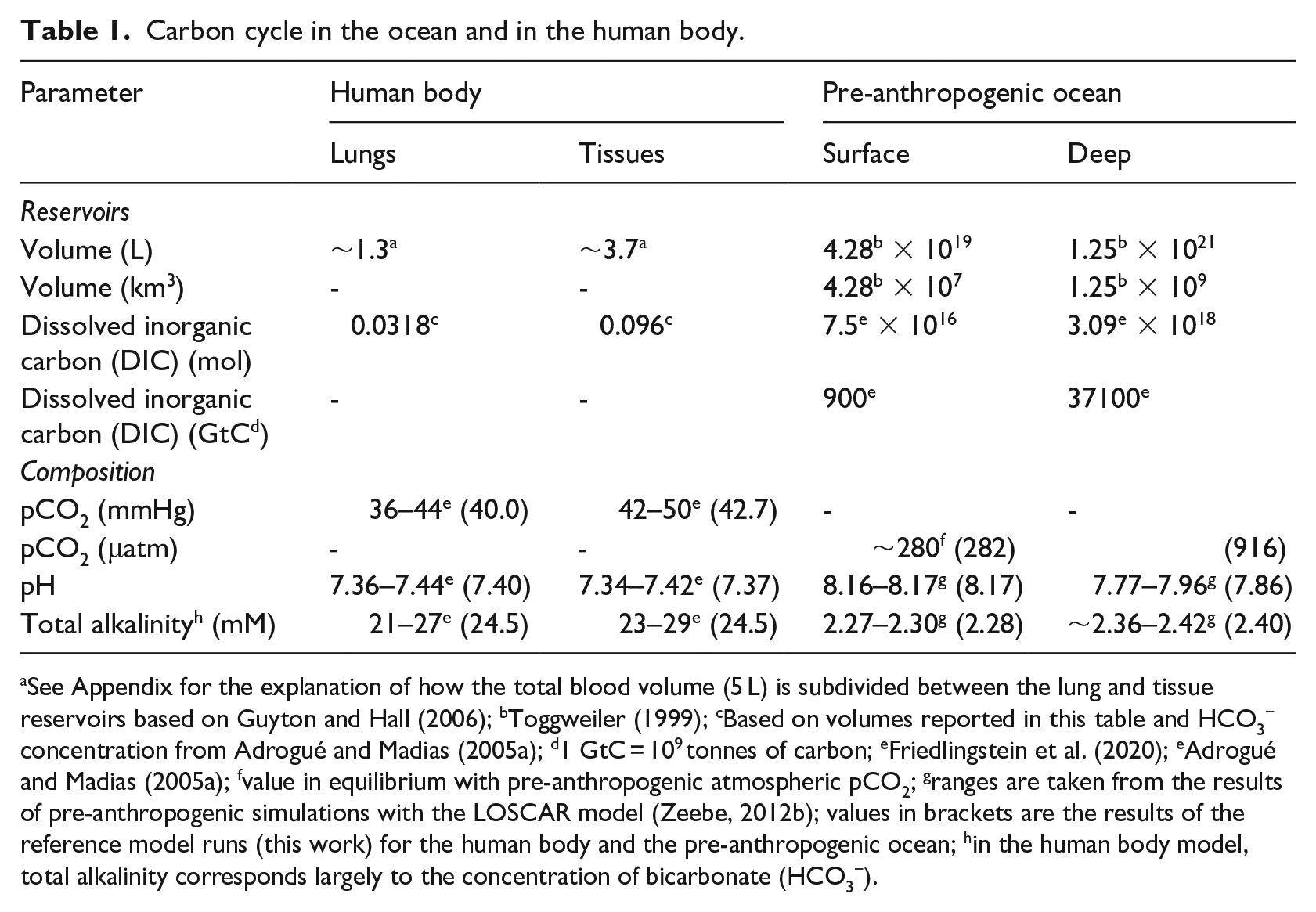
See Appendix for the explanation of how the total blood volume (5 L) is subdivided between the lung and tissue reservoirs based on Guyton and Hall (2006); bToggweiler (1999); cBased on volumes reported in this table and HCO3− concentration from Adrogué and Madias (2005a); d1 GtC = 109 tonnes of carbon; eFriedlingstein et al. (2020); eAdrogué and Madias (2005a); fvalue in equilibrium with pre-anthropogenic atmospheric pCO2; granges are taken from the results of pre-anthropogenic simulations with the LOSCAR model (Zeebe, 2012b); values in brackets are the results of the reference model runs (this work) for the human body and the pre-anthropogenic ocean; hin the human body model, total alkalinity corresponds largely to the concentration of bicarbonate (HCO3−).
Acidification of the human body
In the human body, lung conditions that decrease the efficiency of pulmonary gaseous CO2 exchange result in the internal build-up of CO2 and body acidification, an acid-base disorder known as respiratory acidosis (Adrogué and Madias, 2005b). Typical examples are asthma, chronic obstructive lung disease (COPD), lung fibrosis, and viral lung infections causing MERS, SARS, and Covid-19, leading to acute respiratory distress syndrome (ARDS) (Adrogué and Madias, 2005b). The more affected the pulmonary exchange, the more severe the respiratory acidosis. In the worst cases, acute severe asthma, exacerbations of COPD and protracted, severe ARDS cause a sudden and strong acidification of the body called acute respiratory acidosis that, if protracted in time, can lead to respiratory failure (Vasileiadis et al., 2019).
In the model, if impaired pulmonary gaseous CO2 exchange is simulated, the ensuing CO2 build-up results in a rapid pH drop, with pH falling below normal physiological values in a matter of minutes (Figure 6a), consistent with acute respiratory acidosis (Adrogué and Madias, 2005b). Only on a time scale of several hours do enhanced renal H+ excretion and HCO3− production eventually restore pH to levels that approach the original, physiological pH (Figure 6b–e). This phase, known as chronic respiratory acidosis, is typical of chronic lung diseases such as chronic obstructive pulmonary disease (COPD) and pulmonary fibrosis (Adrogué and Madias, 2005b). The fundamental role played by the kidneys in the long-term regulation of body pH is evident if the model is run simulating impaired pulmonary gaseous CO2 exchange, but keeping renal H+ excretion and HCO3− production rates equal to their values in the reference model run. In these conditions (dashed red lie in Figure 6a), no long-term pH recovery takes place. The robustness of the model as a tool to simulate the acid-base balance in the human body is confirmed by its ability to reproduce the transient pH, pCO2 and HCO3− shifts observed in clinical studies with patients experiencing acute severe asthma (Raimondi et al., 2013), as well as the steady-state pH, pCO2, and HCO3− shifts observed in clinical studies with patients experiencing COPD with variable degrees of severity (González et al., 2018) (Figure 7a and b).
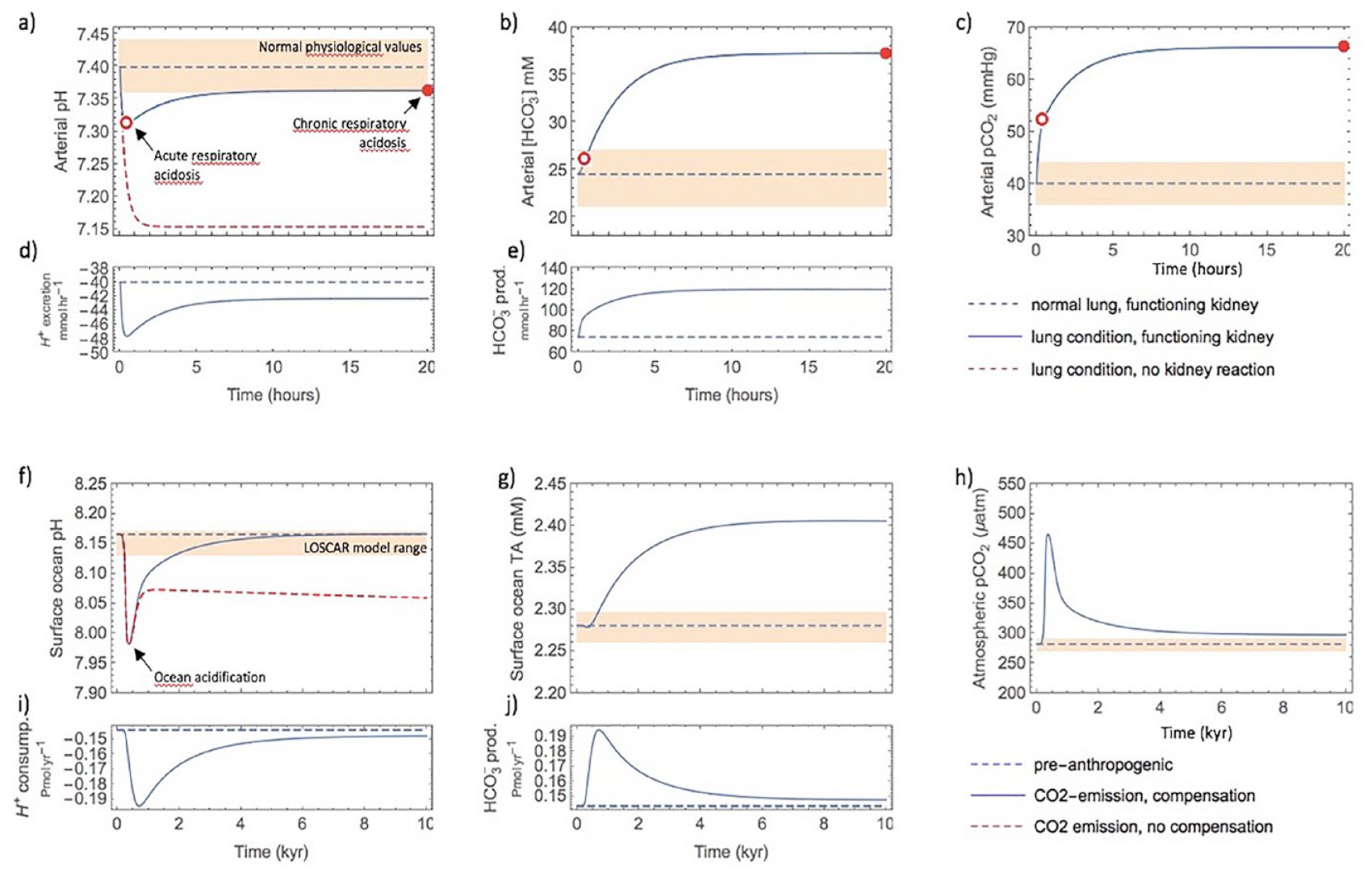
Analogous long-term pH regulation mechanisms in the human body and in the ocean. Reaction of pH, total alkalinity (TA in the ocean, HCO3− in the human body) and pCO2 to an increase in the CO2 load in (a–e) the arteries of the human body and (f–j) the surface ocean. Dashed blue lines represent the results of the reference model runs for the human body and the pre-anthropogenic ocean; solid blue lines represent the result of model runs that simulate carbon cycle perturbations in the human body (respiratory acidosis) and the ocean (ocean acidification); red dashed lines represent the pH in model runs simulating the same carbon cycle perturbations but imposing renal and carbonate compensation H+ and HCO3− fluxes equal to their values in the reference model runs. In panels (a–e), the orange areas represent normal physiological values for arteries, taken from Adrogué and Madias (2005b); red circles and dots represent the model-calculated acute and chronic respiratory acidosis values of pH, HCO3− concentration and pCO2 that also appear in Figure 7a and b; H+ excretion and HCO3− production rates (panels (d and e) respectively) are those associated to renal processes that regulate pH of the human body in the time-scale of hours. In panels (f–j), orange areas represent pre-anthropogenic surface ocean composition calculated by the LOSCAR model (Zeebe, 2012b), while H+ consumption and HCO3− production rates (panels (i and j), respectively) are those associated to carbonate compensation, that regulates oceanic pH in the time scale of millennia.
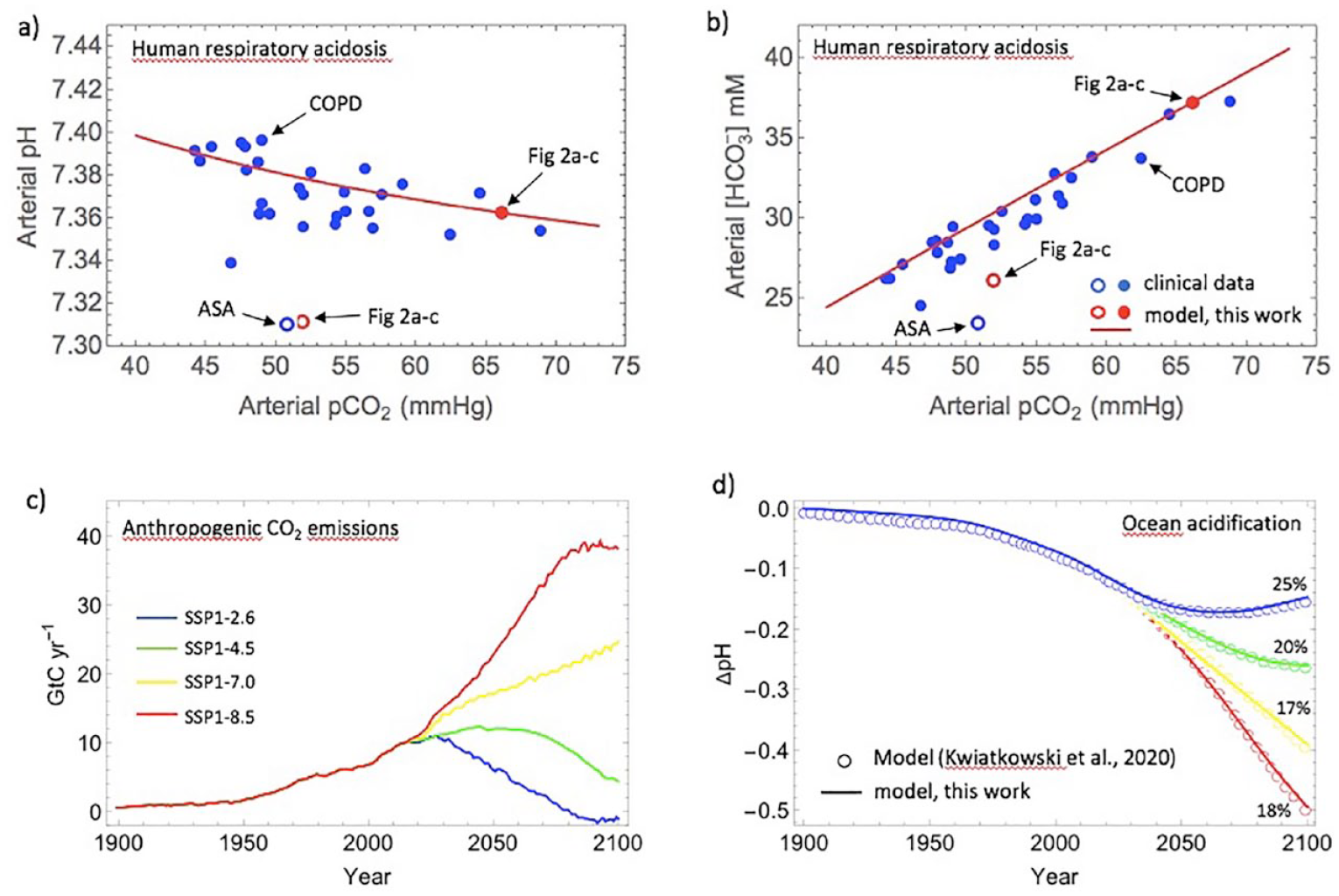
CO2 perturbations: respiratory acidosis (a and b) and ocean acidification (c and d). When applied to the human body, the clinical data (González et al., 2018; Raimondi et al., 2013) and model results (this work) refer to the acute- and chronic-phase arterial pCO2, pH and HCO3− concentration in patients experiencing acute severe asthma (ASA) and chronic obstructive pulmonary disease (CODP); each blue dot represents a patient included in the COPD clinical trial (González et al., 2018), the blue circle represents the average values for patients included in the ASA clinical trial (Raimondi et al., 2013); the red dot in panels (a and b) correspond to the model-calculated (this work), steady state arterial pCO2, pH, and HCO3− composition shown in Figure 6a to c; the red circles in panels (a and b) correspond to the model-calculated (this work) acute state arterial pCO2, pH, and HCO3− composition shown in Figure 6a to c; the span of model calculated arterial pCO2, pH, and HCO3− compositions represented by the red line is obtained by simulating a variable degree of impediment of pulmonary gaseous exchange (see Appendix). When applied to the ocean, the model is forced with standard CO2 emission scenarios (Liddicoat et al., 2021) (panel (c)) used to force Earth System models that simulate future climate change trajectories (Kwiatkowski et al., 2020), including the decrease in surface ocean pH (panel (d)); in panel (d), in order for the model presented in this work (solid lines) to fit the results of Earth System models (empty circles), I considered the presence of a net terrestrial CO2 sink corresponding to 17% to 25% of anthropogenic CO2 emissions (panel (c)) (the present terrestrial CO2 sink is estimated at 18% of anthropogenic CO2 emissions (Friedlingstein et al., 2020)).
Ocean acidification
A surprisingly similar reaction of systemic pH to an increase in CO2 load is observed when the model is applied to simulate the pH shifts induced in the surface ocean by anthropogenic CO2 emissions (Figure 6f–j). Starting from an idealized, pre-industrial oceanic pH, total alkalinity and pCO2 composition (Zeebe, 2012a), the injection in the atmosphere of 1000 PgC (Pg = Petagrams = 1015 g) equivalent CO2 in a time-frame of 500 years results in a decrease of surface ocean pH of 0.2 pH units and an increase in atmospheric CO2 concentration of 180 μatm in the same time-frame of the atmospheric CO2 injection. On the time scale of millennia, the model calculates a recovery of surface ocean pH and atmospheric pCO2, and a build-up of alkalinity in the ocean (Figure 6f–h). These shifts are analogous to those calculated by the LOSCAR model (Figure A3 of the Appendix), a more sophisticated 10-box atmosphere-ocean-sediment model designed specifically to investigate the reaction of the atmosphere-ocean system to carbon cycle perturbations (Zeebe, 2012a). In both the present model and in LOSCAR, the long-term recovery of oceanic pH is driven by the production of HCO3− and consumption of H+ in the deep ocean via carbonate compensation (Figure 5). Carbonate compensation (Broecker and Peng, 1987) is the buffering of oceanic acidity via the dissolution of seafloor and water column, suspended CaCO3. This process will eventually restore oceanic pH to its pre-industrial value (Archer et al., 1998). Carbonate compensation, however, takes place over time scales of millennia, while anthropogenic CO2 emissions and ocean acidification are taking place in the time scale of decades to centuries.
The similarity with the long-term control of pH by the kidneys in the human body is striking, and is confirmed if the ocean model is run with the same CO2 emission scenario, but keeping the rate of carbonate compensation equal to its value in the reference (anthropogenic CO2-emission free) model run: similar to what happens in the human body when an increased pulmonary CO2 load is not compensated by renal processes, oceanic pH decline is not followed by full pH recovery if the rate of carbonate compensation is held constant (Figure 6f). When forced with standard International Panel for Climate Change anthropogenic CO2 emission scenarios (Liddicoat et al., 2021) (Figure 7c), the model presented in this work calculates negative surface ocean pH shifts that are comparable to those predicted by the latest generation of Earth System models (Kwiatkowski et al., 2020) (Figure 7c and d).
This simple analysis shows that the human body and the ocean possess analogous mechanisms that stabilize systemic pH on long time scales, but also that these mechanisms are overwhelmed by short-term CO2 increases. Specifically, in the ocean, anthropogenic CO2 emissions are taking place on a time scale (decades to centuries) that is much shorter than that at which carbonate compensation acts to restore oceanic pH (millennia) (Archer et al., 1998). These results provide a solid basis for developing metaphors and analogies that frame ocean health issues in terms of human health.
Framing ocean health in terms of human health
The challenge in communicating about ocean health is to provide simple and psychologically effective statements that describe how ocean health is deteriorating, while making a mechanistic link to anthropogenic CO2 emissions. This implies providing the necessary cultural background—the frame—into which ocean heath issues develop. In this section, I present an extended analogy between the human body and the oceanic carbon cycles that provides a network of easily accessible, interconnected knowledge linking declining ocean health to anthropogenic CO2 emissions.
First, the unknown “ocean” object is addressed with the introductory analogy: “The ocean is like the human circulatory system” (Table 2, analogy 0). Then, come five analogies that relate unknown elements of the oceanic carbon cycle to more familiar elements of the human body (Table 2, analogies 1–5). These analogies convey in very simple terms the important facts that: (i) the surface ocean exchanges CO2 and O2 with the atmosphere; (ii) ocean mixing allows the exchange of CO2 and O2 between the surface and deep ocean; (iii) CO2 is produced and O2 is consumed in the deep ocean by organic matter degradation; and (iv) carbon cycle processes control the chemical composition of the ocean, including its acidity and oxygenation. These basic carbon cycle facts are a pre-requisite for understanding how anthropogenic CO2 emissions affect ocean health.
Metaphors and analogies between the carbon cycle in the ocean and in the human body.
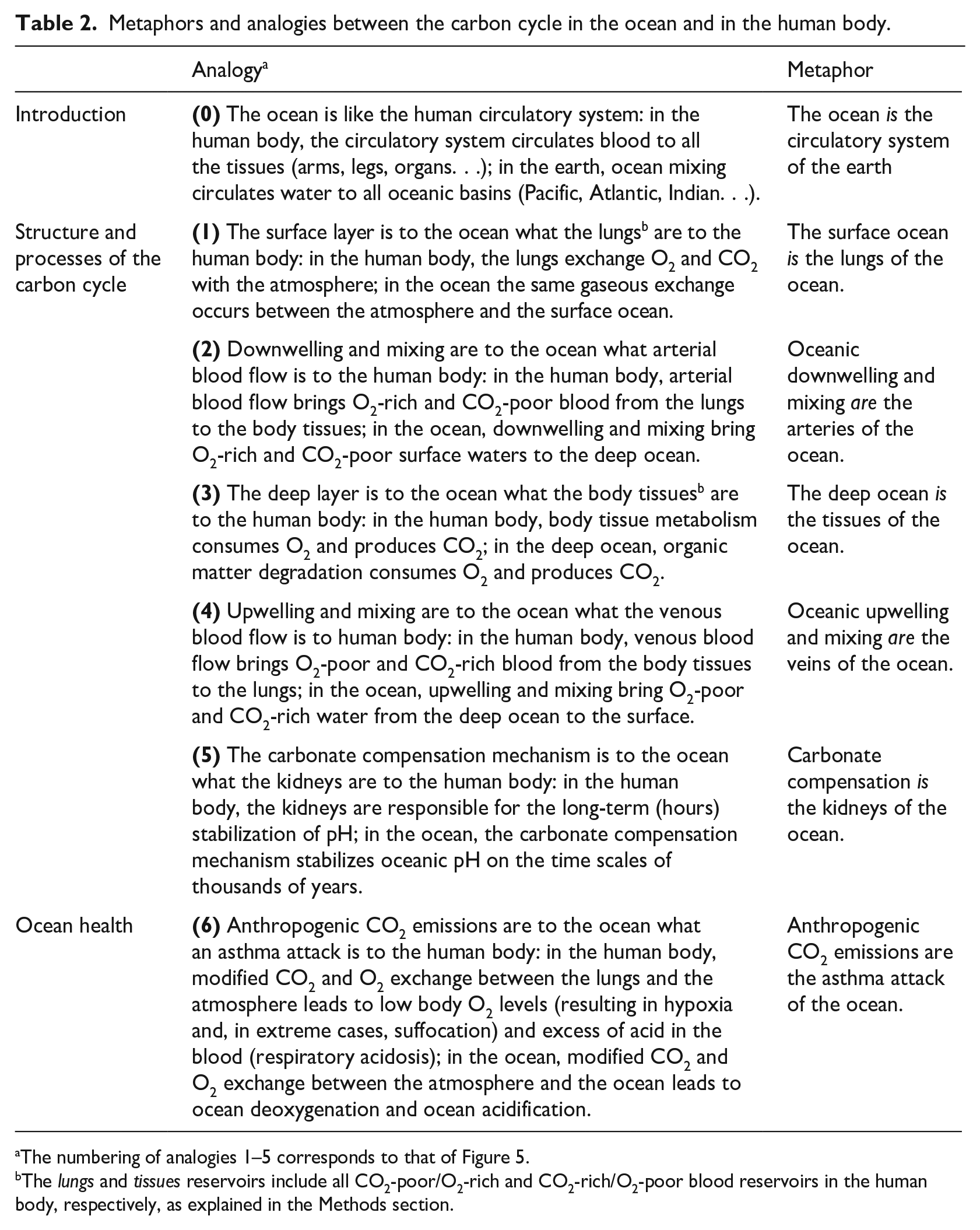
The numbering of analogies 1–5 corresponds to that of Figure 5.
The lungs and tissues reservoirs include all CO2-poor/O2-rich and CO2-rich/O2-poor blood reservoirs in the human body, respectively, as explained in the Methods section.
I then map the consequences of an asthma attack in the human body to the consequences of anthropogenic CO2 emissions on the ocean (Figure 8). During an asthma attack, impaired gaseous CO2 and O2 exchange in the lungs results in low body oxygen levels (hypoxia, and in the worst cases, suffocation), and in the build-up of body CO2 and excess acid in the blood. The net effect on oceanic CO2 and O2 levels caused by anthropogenic CO2 emissions is the same. Care must be taken, however, when carrying out this mapping operation, because the detailed processes by which CO2 and O2 shifts are generated in the human body by an asthma attack, and in the ocean by anthropogenic CO2 emissions, do not correspond fully. In the human body, it is the impaired transfer of gases across the internal surface of the lungs that is the cause, while in the ocean it is a more complex set of mechanisms that include the rise of atmospheric CO2 concentrations, ocean warming and the increased physical stratification of the ocean (Figure 8). This implies keeping analogical mapping at a general level, by declaring that: anthropogenic CO2 emissions modify CO2 and O2 exchanges between the ocean and the atmosphere just as an asthma attack modifies lung-atmosphere CO2 and O2 exchanges. Detailed mapping attempts that involve intermediate ocean processes introduced above (dotted area and dotted arrows in Figure 8) should be avoided.
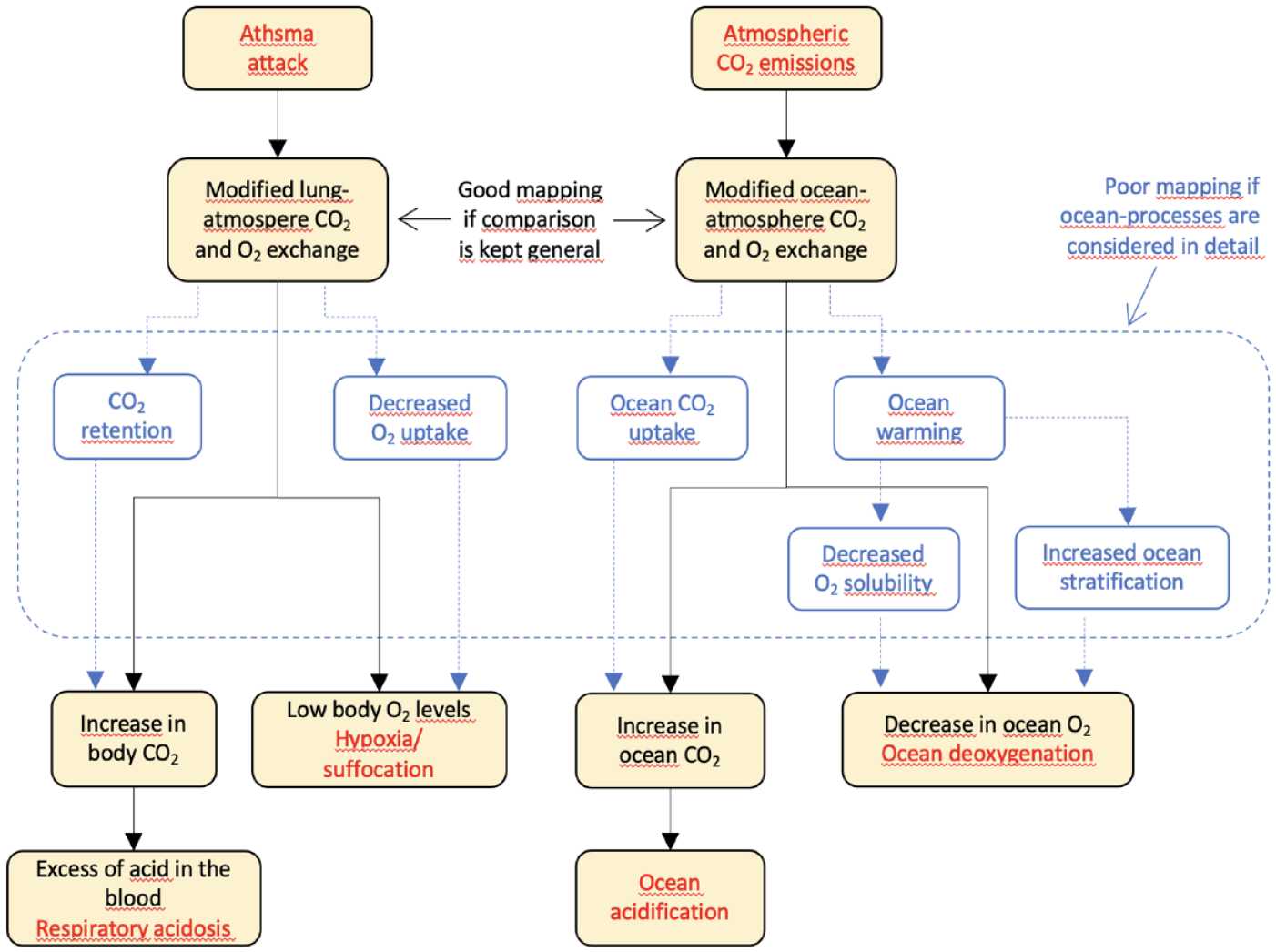
Analogical mapping of the consequences of a severe asthma attack on the human body (base domain) onto the consequences of anthropogenic CO2 emissions on ocean health (target domain). Note that considering ocean processes (ocean warming and its effect on CO2 solubility and stratification) in detail should be avoided because they do not map clearly onto the human body domain.
Based on the above considerations, I propose that the following analogy can be used to raise awareness in the general public for the unfamiliar processes of ocean deoxygenation and ocean acidification, and link them to anthropogenic CO2 emissions:
Anthropogenic CO2 emissions are to the ocean what an asthma attack is to the human body: in the human body, modified CO2 and O2 exchange between the lungs and the atmosphere leads to low body O2 levels (resulting in hypoxia and, in extreme cases, suffocation) and excess of acid in the blood (respiratory acidosis); in the ocean, modified CO2 and O2 exchange between the atmosphere and the ocean leads to ocean deoxygenation and ocean acidification.
Declined metaphorically, the above analogy reads: “Anthropogenic CO2 emissions are the asthma attack of the ocean.”
In Appendix A, I analyze the extended analogy “The ocean is like the human circulatory system” applying the principles of the structure-mapping theory (SMT) of Gentner (1983). SMT presents effective analogies as declarations of similarity that transfer a large number of relational structures from the base to the target domains (see section 3). The numerous relational mappings that arise from the analysis of the human body-ocean analogy support the conclusion that this analogy conveys, as Gentner (1983) put it, “a system of connected knowledge, rather than just an assortment of independent facts.”
Communicating on ocean health using the human body analogy
There is a growing body of literature examining the most effective way to communicate on ocean health issues (Hendricks and Volmert, 2019; Lindland and Volmert, 2017; O’Neil and Hawkins, 2019; Schuldt et al., 2016; Volmert, 2014). The communication tools put forward are: metaphors, that correspond to the definition used in this work; explanatory metaphors, that are multi-phrase extensions of metaphors; and explanatory chains, that are simplified scientific narratives, delivered in lay terms, that do not employ figurative language. Empirical research conducted in the field using surveys and interviews shows that two explanatory metaphors that frame the ocean in terms of the human body are particularly effective: seeing the Planet as a Body improves understanding of the interdependencies between the ocean, land and atmosphere, while seeing ocean as Climate’s heart helps people understand the ocean’s role in the climate system (Hendricks and Volmert, 2019; Volmert, 2014).
Other metaphors specifically address ocean acidification and ocean deoxygenation. Thus, ocean acidification is referred to as “the other CO2 problem” (Doney et al., 2009), “the evil twin of ocean warming” (Pelejero et al., 2010) and “osteoporosis of the Sea” (Guinotte, 2005; Volmert, 2014), while ocean deoxygenation is communicated as “the ocean losing its breath” (Gruber, 2011). The “other CO2 problem” and “evil twin” metaphors lack mapping onto a specific ocean condition and could be applied to any ocean health issue aside ocean warming. The “osteoporosis” metaphor maps a well-known human pathology onto ocean acidification, and hints at a link between the acidifying ocean and the dissolution of some ocean-related component. Finally, the “ocean breath” metaphor links the oceanic process to a well-known human physiological activity (breathing), and the commonly experienced physiological state of being “out of breath.”
Together with providing important information on the effectiveness of communication strategies, field surveys expose important gaps in understanding that need to be addressed (Lindland and Volmert, 2017). Three are considered here. First, lay audiences see the ocean from a “surface” perspective, and are not aware of the diversified nature of oceanic environments, especially the shallow-versus-deep differences in chemical properties. Second, the public does not recognize the relationship between carbon emissions and forms of ocean change other than sea-level rise, like acidification and deoxygenation (see also Harrould-Kolieb, 2020). Third, more in general, lay audiences have little knowledge of the role of the ocean in the carbon and oxygen cycles, and how these cycles play a fundamental role in determining ocean health.
The critical issue is that the public lacks the basic scientific background needed to understand how ocean health phenomena arise. One solution is to embed explanatory metaphors in explanatory chains that provide the necessary context. This has proven to be effective in explaining the succession of cause-effect mechanisms that links anthropogenic CO2 emissions to ocean acidification (Volmert, 2014). But explanatory chains are literal statements, that lie outside of the metaphorical body frame: the communicative power of relating the ocean to a familiar domain is inevitably lost. Can critical background information be delivered while remaining within the human body frame? And, can one single frame be found that both (i) provides basic information of the functioning of the oceanic CO2 and O2 cycles and (ii) uses these notions to connect anthropogenic CO2 emissions to both acidification and deoxygenation phenomena? At the moment, the Planet as a Body, Climates heart and osteoporosis metaphors, while effective in their own right (Hendricks and Volmert, 2019; Volmert, 2014), provide only a loosely connected system of knowledge that achieves these goals only in part.
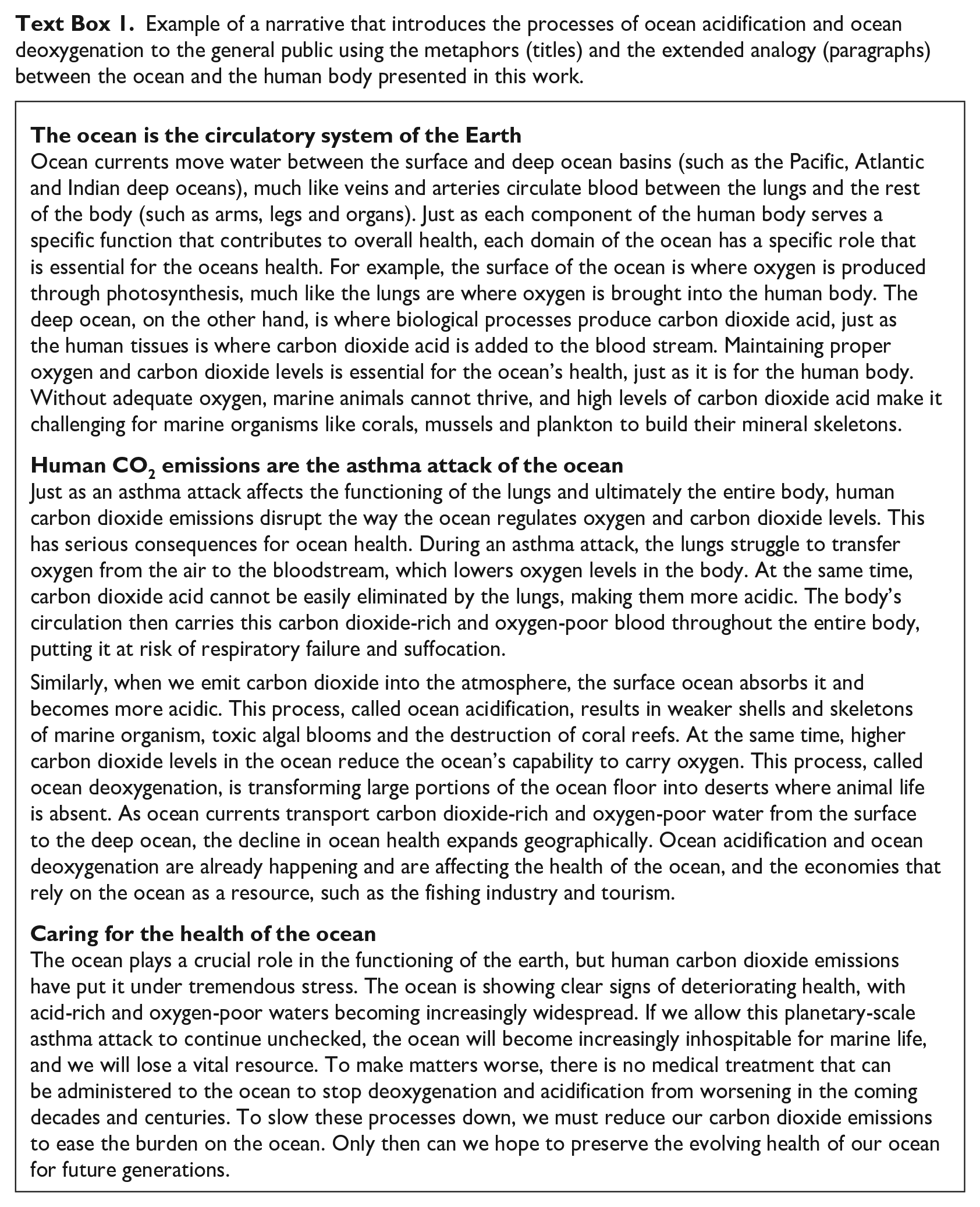
The extended analogy presented in this work provides a solution. By mapping ocean elements onto fundamental building blocks of a functioning human body (lungs, arteries, tissues, veins, kidneys), the message is delivered that the ocean is a complex system, with vertical chemical differentiation and internal interconnectedness and material flow, and that this dynamic system guarantees healthy oceanic levels of O2 and CO2. Ocean health issues—just like in the human body—arise when external forces disrupt the O2 and CO2 cycles. These notions can be easily packaged in the form of short narratives (see Text Box 1) supported by simple sketches such as the one in Figure 5.
Example of a narrative that introduces the processes of ocean acidification and ocean deoxygenation to the general public using the metaphors (titles) and the extended analogy (paragraphs) between the ocean and the human body presented in this work.
The human health frame proposed in this work will have to be tested empirically in the field with surveys and interviews to see if it offers an advantage over existing osteoporosis and ocean breath metaphors. Simple considerations suggest that some improvement is possible. Osteoporosis in an illness that develops over years to decades before appreciable effects on bone strength become apparent. Losing one’s own breath, on the other hand, is not a serious condition and is reversible on very short time scales. There is thus an association of ocean health with slow, or non-critical, physiological conditions, in these metaphors. Ocean deoxygenation and ocean acidification, however, are neither slow processes, nor readily reversible conditions on the human time scale. An asthma attack, on the other hand, is a very rapid, and possibly a serious, event, making it a good candidate base domain in the metaphorical framing of ocean health issues.
Beyond the ocean: The Earth as a superorganism
In section 5, I have mapped the part of the human body under homeostatic control, including the lungs, tissues, veins, arteries and kidneys, onto elements of the ocean. However, the Earth’s surface also includes the continental domain, that contains significant amounts of carbon in soils and the biosphere. These components account for 10% of the total carbon exchange with the atmosphere (Friedlingstein et al., 2020), and make up the thin layer of the Earth’s outer surface, called the Critical Zone (Richter and Mobley, 2009), where natural ecological, hydrological and geochemical processes interact with human activities such as agriculture, mining and urbanization, shaping the environment. Can the human body-ocean analogy be extended to include the Critical Zone? And is there a good reason to build this figurative superorganism?
Accepting the mapping of lungs, tissues, veins, arteries and kidneys onto the ocean domain, and dismissing other body organs (e.g. brain, liver, spleen, pancreas. . .), we are left with the gastro-intestinal (GI) tract, of which I give a very simplified description here (Silverthorn, 2007). Food, after having been mechanically broken down in the mouth by mastication, is transferred to the GI tract (composed of esophagus, stomach and intestine) where it is digested with the intervention of gut biota. Digestion decomposes food in an acidic environment, releasing nutrients. Nutrients are absorbed across the intestinal epithelium and pass into the internal, homeostatic part of the body. Only a portion of the ingested food is transformed into nutrients in the GI tract and then absorbed into the interior of the body; the rest is excreted in the form of feces. As opposed to the internal portion of the body that has a neutral and nearly constant pH (7.36 < pHblood < 7.42), the GI tract has a highly variable chemical composition and pH (1 < pHstomach < 2.5; 6.4 < pHintestine < 7.5; Silverthorn, 2007). This distinction gives rise in popular science writing to the analogy: “. . . the human body is just like a big donut. The GI tract is the donut hole.”
I propose the following correspondence of the human GI tract with the continental domain: the un-weathered, pristine rock substrate, that is external to the superorganism and contains elements essential for life, is the food; physical erosion, that fragments rocks and increases the mineral surface area exposed to chemical weathering, is mastication; soils, and the biota they sustain (both vegetation and microbiota), are the GI tract; chemical weathering, that attacks rocks mostly in an acidic environment and mobilizes cation and anions in the dissolved form, is digestion; cations and anions, mobilized by continental weathering, are the nutrients; vegetation and soil microbiota, that actively participate in the weathering process, are the gut biota; rivers, that transport nutrients liberated by rock weathering to the ocean, are the intestinal epithelial transport; clay minerals, which are the part of rocks that remain in the solid phase after the continental weathering process, are the feces.
A rapid examination of the above attribute matches, and consideration of how the human body and the Earths’ surface carbon cycles operate, highlights numerous possible mappings between relations of the two domains (Gentner, 1983). Some examples are: (i) physical erosion increases the surface area of rocks involved in chemical weathering just as mastication increases the surface area of food being digested, (ii) chemical weathering on the continents is promoted by low soil pH just as the digestive processes in the GI tract of the human body is facilitated by low pH, (iii) soil biota play a fundamental role in the extraction of key cations and anions from rocks during chemical weathering just as gut microbiota play a key role in extracting nutrients from food, (iv) cations and anions released from rock weathering are transported by rivers to the ocean just as nutrients released form digestion of food are transported across the intestinal epithelial into the human body.
These are only a few examples of mapping of relations between attributes of the human GI tract onto those of Earth’s continental domain. Many more can be found. But the important point is that—together with the mapping of relations between the body ‘interior’ and the ocean domain (section 5)—it emerges that the Earth system, with its ocean and continental soils, and marine and continental life, can be seen as a superorganism.
The superorganism discussed in this work is not the first example of a comparison between the Earth and a living organism that contains some elements of modern analogy. Fifty years ago, independent scientist James Lovelock (1919–2022) and biologist Lynn Margulis (1938–2011) developed the Gaia Hypothesis (later the Gaia Theory) (Lovelock, 1972; Lovelock and Margulis, 1974), that sees the Earth’s biosphere, atmosphere, oceans and lithosphere as a complex, self-regulating system, maintaining the planet’s habitability—that is, regulating temperature and surface composition (oxygen, pH, climate..) comfortable for life—in a process reminiscent of human homeostasis, but operating on a planetary scale (Lenton, 1998; Lovelock, 1986, 1989; Lovelock and Margulis, 1974). The controversial idea of a self-regulating Gaia sparked a heated debate among earth scientists and biologists that continues to this day (Barlow and Volk, 1990; Boyle and Lenton, 2022; Doolittle, 2019; Kirchner, 1989; Kleidon, 2002, 2010; Lenton, 1998; Lenton et al., 2018).
While there are advantages and shortcomings to seeing the Earth as a superorganism (some of which are addressed in Latour and Lenton (2019)), it is worth discussing them briefly. James Hutton famously stated “I consider the Earth to be a super organism and that its proper study should by physiology” (McIntyre, 1963). But if Earth is a superorganism, what is its metabolism? The Earth superorganism acquires carbon via the chemical weathering of continental carbon-bearing rocks and the riverine transport of dissolved HCO3− to the ocean, while the energy for carbon fixation into biomass is provided by photosynthesis in the surface ocean. How should we call this metabolism? Heterotrophs are organisms that cannot produce their own carbon compounds from CO2, but instead rely on other sources of organic carbon and nutrients, mainly plant or animal matter. However, the Earth superorganism couples a heterotrophic carbon acquisition mechanism (from the weathering of carbon-bearing rocks) to photosynthetic carbon fixation. Such a living strategy, called photoheterotrophy, is present in prokaryotes such as purple non-sulfur bacteria and green non-sulfur bacteria (Bryant and Frigaard, 2006), but also in some insects like the oriental hornet and some aphids (Valmalette et al., 2012). I thus propose to call Earth’s metabolism geophotoheterotrophy, and accept that this is different from the human heterotrophic metabolism.
Another point is whether the Earth, like (supposedly) living organisms, is a materially open system with respect to carbon, rather than a closed system with minimal carbon exchanges with the exterior and a large degree of internal recycling. The degree of openness to carbon is deduced from the comparison of the rate of internal carbon mixing with the rate of carbon exchange with the exterior. Carbon input by rivers in the form of HCO3− (which represents a carbon flow from the superorganism exterior to its interior) adds about 1.1 × 10¹¹ moles of carbon per day to the ocean (Ridgwell, 2005), and an equivalent carbon loss through sedimentation of carbonate rocks and organic matter is implied by steady state on long time scales. These fluxes are about 120 times smaller than the internal carbon mixing flux between the surface and deep ocean (1.3 × 10¹³ moles of carbon per day; obtained by multiplying the mixing rate of ocean waters of 74 Sverdrups of Wallmann (2003) by a concentration of dissolved inorganic carbon of 2 mmol L−1), effectively implying a “materially nearly closed” system.
Surprisingly, this applies to a considerable degree also to the human body. Consider that the circulatory system in the human body results in a recycling flux of carbon, that permeates all tissues, equal to 180 moles of carbon per day (obtained by multiplying the cardiac output of 5 L min−1 by the concentration of dissolved inorganic carbon in blood equal to 25 mmol L−1). This is 12 times larger than the daily carbon flux though the body (15 moles of carbon per day; assuming carbon uptake from the intestine is balanced by the daily exhaled CO2 flux; Atherton, 2003): the human body is far from being a completely open system with respect to carbon. Based on these estimates, we can state that the ocean internally recycles carbon at a much larger rate than the carbon exchange fluxes with the lithosphere just as the circulatory system of the human body recycles carbon at a rate much larger than the carbon flux from dietary uptake.
The outcome is equally surprising when the comparison is extended to the energy efficiency. Bomb calorimetric measurements show that nearly all of the chemical energy contained in food is taken up by the human body (e.g. 93% in Basolo et al., 2020; Jumpertz et al., 2011), while only a small portion is excreted with feces (about 7%). Is the Earth superorganism even remotely as efficient in harvesting energy as the human body? It would seem that this should be excluded on the basis that only about 0.3% of the incident solar energy on the Earths’ surface is converted to chemical energy by photosynthesis (Kleidon, 2010). However, bomb calorimetry accounts for all of the energy spent by the human body, while photosynthetic primary production is only one of multiple energy-demanding processes involved in the metabolism of the Earth superorganism. Take for example the hydrological cycle and atmospheric circulation—processes that involve an energy flux equal to approximately 30% of Earth’s incident radiation (Kleidon, 2010). These processes are fundamental to the superorganism’s metabolism because they drive continental weathering (Earth’s “digestive system”) and the transport of carbon from the continents to the ocean where it is fixed into organic carbon. As a result, the energy efficiency of the human body is only three times larger (rather than two orders of magnitude larger, if only photosynthesis is considered), than that of the Earth superorganism.
Finally, one cannot fail to notice that there is a major difference in the physical structure of the Earth superorganism, and in its relation to the external environment, compared to the human body. This is a consequence of the very different ratio of water to living carbon in the ocean versus the human body: while in the human body the skeleton and tissues dominate in volume over blood, conferring structure and strength, in the ocean, marine organisms (the “cells” of the superorganism “tissue”), are dispersed in ocean water. Thus, while the human body has internal structure and strength, which conveys motility with respect to its external environment, the Earth superorganism lacks internal physical strength, and is doomed by the laws of gravity to occupy a fixed space on the lithosphere (its food source), without the possibility of moving with respect to it.
The above considerations confirm that the Earth’s lithosphere, ocean, atmosphere and life can indeed be seen as a single superorganism, displaying a form of weak homeostasis conducible to that of the human body. While recent attempts to frame the Earth system in terms of the human body are encouraging (Hendricks and Volmert, 2019; Volmert, 2014), they lack the necessary level of detail in considering the multitude of earthly elements and capture the holistic interconnectedness of these elements only in part. The perspective presented in this work addresses these limitations, providing a frame that allows lay audiences to better conceptualize the Earth system, comprehend the impact of human activities on climate, and foster a healthier relationship between humanity and the Earth.
Conclusion
In this paper I show that, after the necessary simplifications, the oceanic carbon cycle can be conceptualized in terms of the human carbon cycle. This observation has led me to propose the human body as a frame to communicate on ocean health. This idea is not new, since the human body is already used as a base domain to frame ocean heath issues metaphorically. My work goes beyond existing human Earth metaphors because it highlights, using a mathematical model, a striking resemblance in the physical-chemical functioning of the Earth system and of the human body. This shows that the similarity between the Earth and the human body is analogical, rather than just metaphorical. Because of this, it is possible to communicate on ocean health using language—lungs, veins, arteries, asthma, etc.—that is familiar to the general public. It is also possible to link the two most important ocean health issues—ocean acidification and ocean deoxygenation—to a single cause: anthropogenic CO2 emissions. Finally, using the human body as a model to explain the Earth is supported by contemporary research, showing that metaphors play a key role in human cognition, and by the fact that comparisons between the Earth and the human body have been a constant preoccupation of mankind since Antiquity.
Footnotes
Appendix A1—Description of the numerical model
Appendix A2—Tables
Model parameters settings.

| Parameter (units) | Human body | Ocean | ||
|---|---|---|---|---|
| Lungs | Tissues | Surface | Deep | |
| Temperature, T (°C) | 37 | 15 | 4 | |
| Density, den (g cm−3) | 1 | 1.023 | ||
| Salinity, Sd (g kg−1) | 0 | 35 | ||
| Volume, V (L) | ∼1.3 a | ∼3.7 a | 4.28b × 1019 | 1.25b × 1021 |
| Volume, V (km3) | - | - | 4.28b × 107 | 1.25b × 109 |
| Surface area exchanging with atmosphere, S (m2) | 70c | 3.49b × 1014 | ||
| MIX (lit min−1) | 5d | - | ||
| MIX (Sve) | - | 74f | ||
| Atmospheric pCO2 (μatm) | 410g | 280h | ||
| Total dissolved boron, TB (mol kg−1) | 0 | 0.42i × 10−3 | ||
| Maximum carbon export production, (TmolC yr−1) | - | 1309j | ||
| Monod constant for carbon export production, (mol kg−1) | - | 2j × 10−3 | ||
| Ratio of inorganic to organic carbon in export production, PIC:POC (-) | - | 0.24k | ||
| Fraction of carbon export production buried in marine sediments, | - | 0.018j | ||
| Diffusion coefficient for CO2 exchange with the atmosphere, (mol atm−1 m−2 s−1) | 2.46j × 10−6 | 2l × 10−3 | ||
| Rate of HCO3− addition by an external source (diet or rivers), (mol s−1) | 2.31m × 10−7 | 7.55n × 105 | ||
| Production rate of CO2 in the muscular tissues or the ocean, (mol kg−1 s−1) | 3.67o × 10−6 | - | ||
| Production rate of H+ in the muscular tissues, (mol kg−1 s−1) | 1.80o × 10−6 | 0 | ||
| Kinetic constant for HCO3− production, (s−1) | 4.29o × 10−3 | 1.015j × 10−10 | ||
| Renal HCO3− filtration rate, (s−1) | 2.82o × 10−4 | - | ||
| Kinetic constant for renal H+ removal, (s−1) | 71.02o | - | ||
Based on Guyton and Hall (2006), bToggweiler (1999); cBocci (2010); dSilverthorn (2007); eSv—Sverdrup (1 Sv = 106 m3 s−1 = 109 L/s−1; fWallmann (2003); gmodern atmospheric pCO2; hpre-anthropogenic pCO2 (Zeebe, 2012b); iZeebe and Wolf-Gladrow (2001); jfitting parameter; kKoeve (2002); lBroecker and Peng (1987); mbased on drinking 2 L of water per day with [HCO3−] = 10 mM; nbased on Archer et al. (1998) and Berner and Berner (2012) (see text); obased on values reported in Cherif et al. (2020) (see text).
Appendix A3—Figures
Appendix A4—Analysis of the extended analogy “The ocean is like the human circulatory system” using the structure-mapping theory of Gentner (1983)
The structure-mapping theory of Gentner (1983) defines an analogy as an assertion that a relational structure normally applying in one domain can be applied in another domain (Gentner, 1983; Gentner and Markman, 1997). In this Appendix the structure-mapping theory is used to analyze the extended analogy “The ocean is like the human circulatory system.” We start by representing the base and target domains in terms of object nodes (i.e. components of a given domain. . .), and define how the analogy maps object nodes of the base domain (b1, b2,. . ., bn) onto those of the target domain (t1, t2,. . .,tn) (Table A2).
Next, we define attributes and relations in the base and the target domains (Table A3). These are statements (collectively known as predicates) that describe given properties of object nodes. Importantly, attributes, A(bi), are predicates involving only one object node, while relations, R(bi, bj), are predicates involving a relation between two or more object nodes. Predicates from the base domain are carried across to the target domain using the object node substitutions defined in Table A2.
An effective analogy is a comparison in which relational predicates, but few object attributes, can be mapped from base to target (Gentner, 1983). This is the case for the human body-ocean analogy where, due to the very different nature of the domains being compared, there are few easily mappable object attributes. For example, one cannot say: “downwelling currents are separated from the rest of the ocean by a biological membrane, just as arteries are separated from the surrounding tissues by the arterial wall.” In contrast, the numerous structural and functional similarities between the human body and oceanic carbon cycles (Fig. 5) give rise to a high number of relational predicates of the human body domain being mappable to the ocean domain, for example: “the tissues are CO2-rich and O2- poor compared to the lungs, just as the deep ocean is CO2-rich and O2-poor compared to the surface ocean” (Table A3).
In addition to the first-order relations, one can recognize second order relations that take at least one first-order relation as an argument (Table A3), enforcing connections among lower-order predicates. For example, one might map “The fact that CO2 is produced and O2 is consumed in the deep ocean causes the deep ocean to be CO2-rich and O2-poor compared to the surface ocean” from “The fact that CO2 is produced and O2 is consumed in the tissues causes the tissues to be CO2-rich and O2-poor compared to the lungs.” The numerous mapping relations that arise from the analysis of the human body-ocean analogy support the conclusion that this analogy conveys, as Gentner (1983) put it, “a system of connected knowledge, rather than just an assortment of independent facts.”
Acknowledgements
Two anonymous reviewers provided very useful suggestions that improved the manuscript. The text benefited also from useful comments by Pascal Houillier and Nestor Herran.
Declaration of conflicting interests
The author declared no potential conflicts of interest with respect to the research, authorship, and/or publication of this article
Funding
The author received no financial support for the research, authorship, and/or publication of this article.

Code availability
The Mathematica code to implement the numerical model is available from the author upon request.