




Abstract
There is increasing scientific evidence of the link between the changes resulting from human activities on the planet and the increase in the frequency and severity of disasters. In the face of this change, geologists warn that the stable conditions of the Holocene are behind us and that humanity is entering a new geological epoch—the Anthropocene—whose parameters are uncertain and unpredictable. The Anthropocene changes the context in which disasters occur and operate. This has important implications for disaster studies. First of all, disasters need to be reinterpreted within the changing and unpredictable conditions of the Anthropocene. This study aims to reinterpret disasters from the perspective of Anthropocene and discuss its implications for disaster policies. The Anthropocene brings many aspects such as the expansion of time and space horizons, uncertainty in cause-effect relationships, cascading effects, and unpredictable acceleration to the agenda in reinterpreting disasters. These new features of disasters render disaster management a contentious claim. It doesn’t seem possible to manage, control or prepare for disasters under the conditions imposed by the Anthropocene. Instead, it seems a more reasonable option to focus on policies that will increase the resilience of societies by transforming socio-ecological systems by utilizing the potential of disasters to trigger new beginnings.
Introduction
As an interdisciplinary field, disaster management is perhaps one of the study fields where the tension arising from the gap and incompatibility between theory and practice is most visible. Theories can be considered as systematic thoughts that aim to understand and explain the world we live in, as well as the relationships between events and phenomena. However, theories are not only intellectual outputs, but also policy tools that contain directions for dealing with the problems of daily life and generate new ideas for solving problems. In this sense, as Lewin (1951: 169) popularly expressed, “there is nothing so practical as a good theory.”
Disaster studies build a theoretical and conceptual framework for disaster management by providing systematic explanations on why disasters occur, how they can be prevented and how they can be dealt with in order to understand and tackle disasters, which are extremely complex phenomena by nature. Nevertheless, the increasing helplessness of societies in the face of disasters triggers a reconsidering process that will require questioning the claim of disaster management and radically transform the perception of disasters and thus disaster policies.
In the face of planetary change caused by human activities, conventional disaster perception and disaster management approaches are inadequate. This study argues that in the uncertain and unpredictable context of the Anthropocene, the meanings of disaster must be subjected to a new process of social construction. The term Anthropocene, which is essentially a geological term, has been proposed to define the era we are living in and refers to the profound and permanent change that human activity have brought about in the biophysical processes of the Earth (Crutzen, 2002; Crutzen and Stoermer, 2000; Lewis and Maslin, 2015). However, this concept is also used as a powerful cultural metaphor that draws attention to the consequences of human domination over the earth. The term Anthropocene has recently been adopted as a powerful critical perspective in the social sciences, particularly in the analysis of socio-ecological systems, such as urbanization and development (see Dalby, 2016; Moellendorf, 2017; Ruddick, 2015). In a similar approach, this study employs the concept of the Anthropocene as an analytical perspective to reconceptualize disasters.
Examining the historical evolution of disaster studies reveals that the “hazard paradigm” dominated early research. Within this paradigm, disasters were considered to be phenomena caused by natural physical forces. Disasters were generally defined as spatially and temporally concentrated events caused by a natural physical force beyond human control that disrupted a community, thus affecting its ability to function, in line with the etymology 1 of the concept (Barrios, 2017; Cutter, 2021). The main limitation of the hazard paradigm is that it treats disasters as phenomena outside human influence, thereby absolving people of responsibility for them (Etkin, 2016). Following the 1980s, a new view, termed the vulnerability paradigm, started to dominate disaster studies (Barrios, 2017; Cutter, 2021; Etkin, 2016; Wisner et al., 2005). This view placed vulnerability at the center of disaster studies based on the fact that not every place, society and everyone is impacted in the same way by similar or even the same natural/physical event. By emphasizing the susceptibility and coping capacity of societies in the face of the same natural forces or hazards, vulnerability has become a powerful explanatory concept for the root cause of disasters (Wisner et al., 2005). This perspective has led to the prominence of approaches such as pre-disaster preparedness, resilience, capacity building, and empowerment in disaster management (Paton and Johnston, 2001; Pearce, 2003). Resilience, which have gained importance alongside the vulnerability paradigm, remain a key focus in disaster studies (Cutter, 2018; Graveline and Germain, 2022; Kelman et al., 2016; Manyena, 2006).
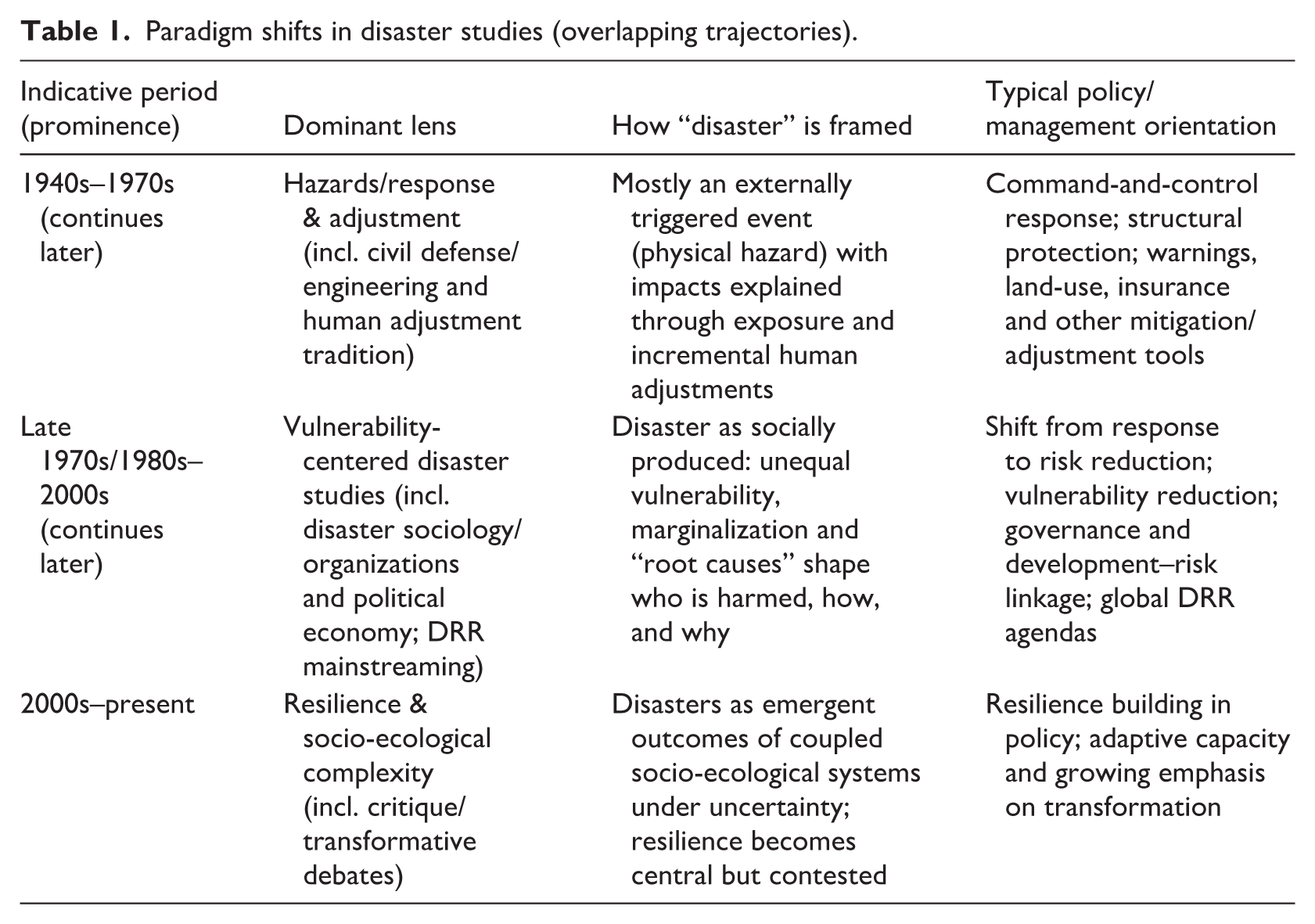
Since the mid-20th century, hazard, vulnerability and, more recently, resilience-oriented perspectives have emerged as partially overlapping paradigms that shape how disasters are defined, explained and governed (Barrios, 2017; Cutter, 2016, 2018, 2021; Karácsonyi and Taylor, 2021; Kelman et al., 2016). Although these paradigms do not simply replace one another in a linear fashion, they indicate shifting emphases from external natural forces, to socially produced vulnerability, to the resilience-oriented governance of complex socio-ecological systems. Table 1 summarizes these overlapping trajectories and the policy orientations they have encouraged.
Paradigm shifts in disaster studies (overlapping trajectories).
The growing interplay between natural and social processes makes it challenging to distinguish their respective impacts, underscoring the need to adopt new approaches in disaster studies that consider integrated and layered effects. In the new and unique conditions of the Anthropocene, disasters can neither be attributed solely to natural factors nor reduced to events that can be controlled or prevented by human interventions. Comprehensive alterations in the biophysical structure of the planet resulting from human activities such as ozone depletion, climate change, loss of biodiversity, and acidification of oceans (Rockström et al., 2009; Steffen et al., 2015), which underpin ongoing discussions about the Anthropocene, have made disasters almost a part of everyday life. It is imperative that the evolving nature of disasters is comprehended, which constitutes a fundamental responsibility for disaster studies. The effort to grasp the changing nature of disasters has important implications for disaster policies. In this sense, resilience, which is a prevailing concept in the literature, needs to be carried beyond its widely accepted meaning through a critical questioning. Currently, the dominant understanding in the disaster resilience literature is to frame resilience as a techno-managerial approach. This approach focuses on building resistance to disasters and adapting to changing conditions rather than questioning the complex socio-ecological processes that cause disasters (Joseph, 2013; Mikulewicz, 2019). Therefore, it excludes resilience from politics and decision-making processes.
In the Anthropocene, where disasters are becoming increasingly unpredictable and elusive, making cities resilient is an essential yet challenging task, especially when considering planetary urbanization. In urban planning and policy, urban resilience is often understood as resistance to disasters rather than as an adaptive or transformative capacity (Holden et al., 2016). To clarify the implications of the call for transformative resilience, it would be helpful to consider it within the broader intellectual context of disaster resilience studies. Resilience definitions are fundamentally based on the system’s ability to maintain and sustain its basic structure and function. Resilient systems are those that withstand, absorb, adapt to, and transform in response to threats and shocks, thereby continuing their structure and function (United Nations Office for Disaster Risk Reduction [UNDRR], 2017). Nevertheless, the system’s ability to retrieve its former structure and functions does not render it resilient. If there is a convergence between the system’s structure and functions and the threats it faces, returning the system to its previous state will only make it more vulnerable (Wisner et al., 2005; Ziervogel et al., 2017). Therefore, “resilience is not just about recovery. It is also about transformation; the city can redefine itself as a new entity that emerges better and stronger after the shock” (Yamagata and Maruyama, 2016: v).
Equilibrium resilience, whereby systems are restored to their previous structure and function through a “bounce-back” process, is not an effective solution for an unpredictable future (Holden et al., 2016; Tierney, 2019). The conditions of the Anthropocene demand transformative resilience, enabling the system to “bounce forward” rather than back (Borie et al., 2019). But at this point, we need to move beyond previous practices that were once considered progressive. Developing ecological and physical infrastructure using nature-based and engineering solutions is undoubtedly vital for building resilience. However, policies aimed at building resilience should not become a manifestation of human arrogance, seeking to combat natural physical forces through increased human intervention (Wakefield, 2022). These alone are not sufficient to make societies resilient. The root causes of vulnerability, disaster, and the Anthropocene are intertwined. These causes have created a historical trajectory in which environmental degradation, inequality and injustice have progressed together. Therefore, building resilience to disasters requires transformation rather than resistance.
This study aims to reinterpret the meaning of disasters through critical questioning by overlapping the themes of Anthropocene, disaster and resilience at the urban level, on the one hand, and to investigate the possibilities of using disasters as a transformative force for multiple urban resilience based on this new meaning on the other. In accordance with this objective, the study seeks answers to the questions of how the Anthropocene will contribute to the reinterpretation of disasters, how disasters can function for radical transformations, what multiple urban resilience means in coping with disasters and how it can be achieved.
While disasters are experienced on a global scale and with almost daily frequency, the vulnerability of societies in the face of disasters is gradually increasing. In an age where cause-effect relationships have become much more complex and uncertain, it is extremely important to be able to generate new ideas and find new ways to cope with disasters. This paper represents an effort in this direction, positioning itself as part of the social construction process aimed at reinterpreting disasters and disaster policies. Situated within a discursive and critical framework, this article adopts an analytical approach based on interpretive and exploratory readings of the literature, guided by the theoretical perspectives of social constructivism and critical theory.
The study consists of three parts that are built on a systematic and critical reading of the themes of Anthropocene, disaster and resilience. The first part of the study aims to highlight to the unique conditions of the Anthropocene and to reveal what these conditions mean for disasters. This section also questions the validity of disaster management in light of the new characteristics of disasters, as well as the potential for disasters to act as a catalyst for transformative change. The second part of the study focuses on disaster resilience in the context of the Anthropocene and the transformative resilience approach. In the third section, policy and implementation options for disaster-resilient urban settlements are evaluated through the concepts of transformative and multi-urban resilience. Finally, the article concludes with a discussion that synthesizes the main arguments and reflects on future directions in disaster studies.
Disasters in the Anthropocene
Anthropocene: Crossing the planetary boundaries
Climate experts have long warned that to maintain the atmospheric conditions of the Holocene, which provided climatic conditions favorable for life, the temperature increase should be restricted to no more than 1.5°C above pre-industrial levels. The 1.5°C target, which was explicitly outlined in the Paris Agreement adopted in 2015 and in the IPCC’s 1.5°C special report (IPCC, 2018), has unfortunately ceased to be an achievable target even under the most stringent mitigation scenarios (IPCC, 2023). The latest of the World Meteorological Organization’s annual climate update reports predicts that “for each year between 2025 and 2029, the global average surface temperature will be between 1.2°C and 1.9°C higher than the 1850-1900, and average the average surface temperature will rise 1.5°C above the 1850-1900 average for at least one year between 2025 and 2029 (86% probability).” The report predicts that temperatures will continue to rise and that at least 1 year between 2025 and 2029 will exceed previous temperature records (currently 2024) with an 80% probability. (World Meteorological Organization (WMO), 2025: 2). Exceeding the safe limit set for the climate triggers a rapid change process toward tipping points that will change the entire dynamics of the earth system.
The latest data from the Planetary Boundaries Framework, first announced by earth system scientists in 2009 (Rockström et al., 2009), reveals that seven of the boundaries 2 for nine critical processes identified to maintain the stability and resilience of the earth system (Richardson et al., 2023; Sakschewski et al., 2025). The Boundaries, which are grounded in the biophysical and chemical processes that regulate the balance of the Earth system, define the safe living and operating space. Together, these boundaries ensure that the Earth remains in a Holocene-like state. The fact that seven of the limits set for nine critical processes have already been exceeded, and that two of these seven limits are core limits—climate change and the integrity of the biosphere—that are capable of changing the equilibrium of the Earth system even if they are exceeded alone, indicates that the safe operating space for the Earth system has been breached. This means that sudden, unpredictable and irreversible changes and disruptions in the Earth system’s equilibrium and functions can occur (Steffen et al., 2015).
In the face of abnormal temperature values measured 40°C and 30°C above normal in both the Arctic and Antarctica, climate scientists have emphasized that temperature expectations in the poles should be reconsidered by drawing attention to unpredictable extremes (Harvey, 2022). Extreme weather phenomena like intense rainfall, flooding, tsunamis, hurricanes, tornadoes, cyclones, landslides, heatwaves, and wildfires occur almost daily in various regions across the globe. Increasingly frequent and severe extreme weather events show that human activities are leading to major and unpredictable disruptions in the biophysical functioning of the Earth system (Cendrero et al., 2020).
The Anthropocene, as a stage in which we are heavily confronted with the unintended consequences of the Industrial Revolution, calls into question all our deep-rooted assumptions about economic growth, technological development, and scientific progress that have been detached from their material foundation (Albritton Jonsson, 2012). Although there are different suggestions as to when the Anthropocene began, for Crutzen, the pioneer of the concept, the Industrial Revolution was a turning point that ushered in unprecedented changes (Crutzen, 2002; Zalasiewicz et al., 2015).
The magnitude of human-induced changes reinforces claims that the relatively stable and predictable climatic conditions of the Holocene are now behind us and that we are entering a new era—the Anthropocene—with uncertain parameters. 3 In the Anthropocene, the notion of an external, given and stable planet is no longer tenable. It is a new Earth system context defined by complex, non-linear, interconnected and unpredictable processes shaped by human activities (Dalby, 2013).
The extensive changes that human activities have caused in the structure of the Earth system have transformed extreme events from rare occurrences into annual, seasonal, monthly, and even daily phenomena. For example, while heavy downpours were once considered extreme weather events, they have now become routine occurrences in many parts of the world, disrupting daily activities, damaging critical infrastructure, and posing a threat to public safety by creating chronic flooding conditions (Cutter, 2021). A worldwide rise in the frequency of these disasters can be seen more clearly in Figure 1.
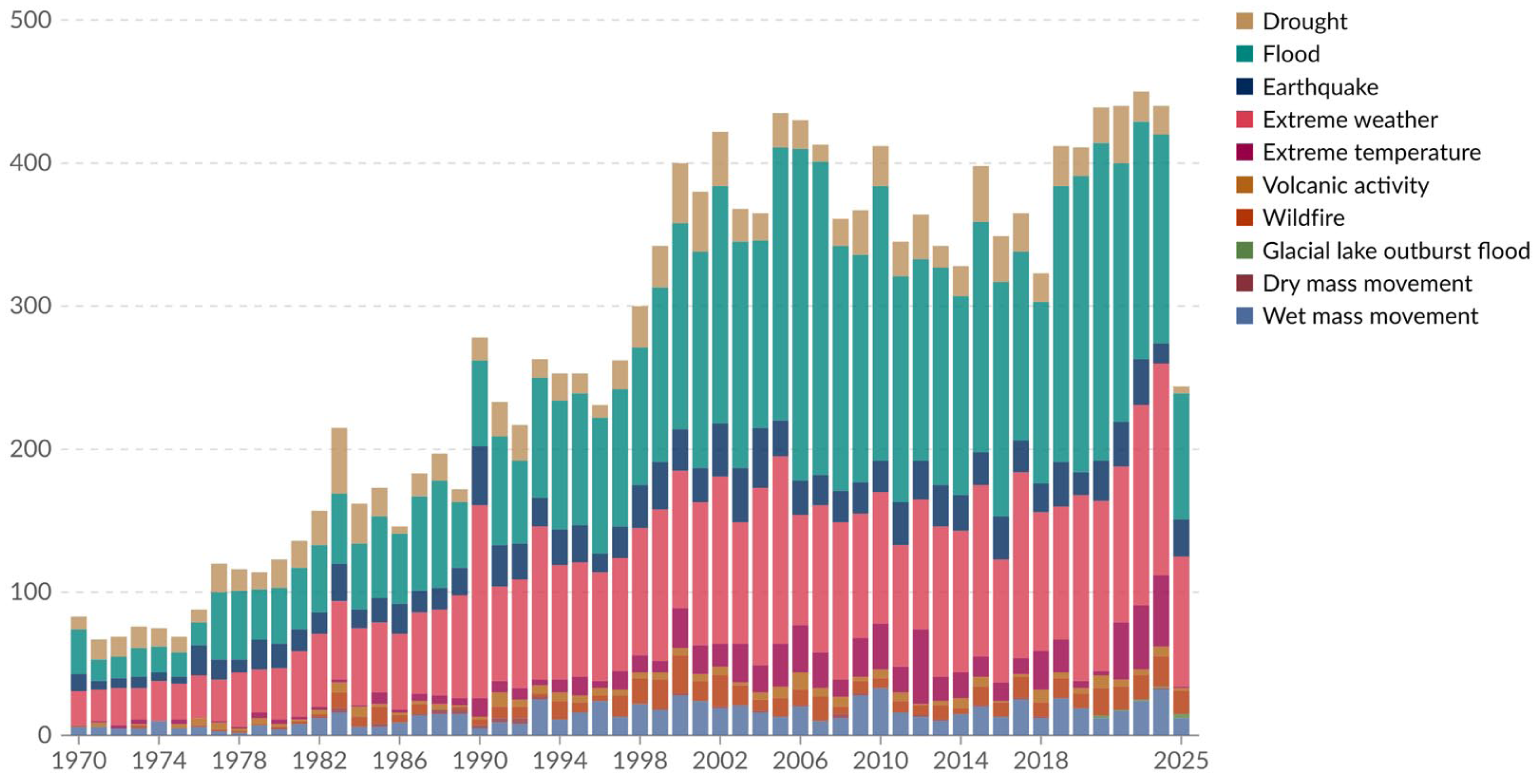
Natural disasters by type reported globally between 1970 and 2025. 4
Redefining disasters: Questioning the new normal
Evaluating the changing nature of disasters in the Anthropocene, Cutter (2021) draws attention to three points in particular. The first of these is the need to move away from viewing disasters as extreme events and focus on chronic events. Cutter points out that the cumulative effects of chronic events have much greater consequences than the impact of a single extreme in a limited time and space. Secondly, Cutter emphasizes that much more attention should be paid to the cascading effects of disasters. The most important feature of the Anthropocene is the dangerous intersection of natural systems, human systems and technological systems (Dalby, 2017). The effects of cascaded disasters, such as the Tohoku earthquake, tsunami, and Fukushima reactor meltdown, which he cites as examples of cascading effects, are carried far beyond the region, creating global consequences. In addition to the pressure of extensive environmental change caused by human activities, the global interconnectedness of systems of production and consumption creates a multiplier effect in terms of disaster risk. According to Cutter, cascading disasters are becoming the norm rather than the exception, thus disasters are no longer events limited to specific space and time. Finally, Cutter points out that the impacts of disasters are concentrated in vulnerable communities, which further increases spatial and social inequalities. Vulnerabilities reinforced by increasing inequality reproduce disaster risk.
Hollis (2023), who states that the need to reconsider the meaning of disaster in the unstable conditions of the Anthropocene, similarly emphasizes three interrelated points. First, in reinterpreting the meaning of disaster, we should move away from the notion of disaster as an interruption in time and space that dominates traditional definitions of disaster. The second point is to question the logic of linear progression regarding the reference point of disasters due to the continuous nature of disasters rather than interruption. In other words, in the unsteady conditions of the Anthropocene, disaster cannot be understood as a temporal segment consisting of a break from normal functioning and then recovering and returning to a state of stability. The third point is that in the context of the intertwining of social and natural systems, it is necessary to think much more comprehensively about determining the cause of disasters. Instead of directly attributing the disaster to a trigger such as an earthquake, flood, hurricane, or drought, it is essential to take into account the cause-effect relationships within the complexity of causality. In this framework, the place of human agency, the role of vulnerability, uncertainty, non-linear emergence and acceleration conditions should be taken into account in analyzing the complexity created by the intertwining of social and natural systems. According to Hollis (2023: 303–304), “Learning to live in the Anthropocene requires not only thinking of disasters as sudden disruptions, but also anticipating and accepting that sudden disruptions are overlaid and interconnected with complex and ongoing socio-natural entanglements and feedback loops that generate continuing instability and uncertainty.”
The widening time horizon of disasters in the Anthropocene is gradually blurring the distinction between the Anthropocene and disasters. This convergence between Anthropocene and disaster has led many researchers to define the Anthropocene as a disaster. For example, Clark (2014) sees the Anthropocene as a disaster to end all disasters, while Knowles (2020) defines the Anthropocene as a disaster, but a slow-moving one. Hollis (2023) underlines the fact that we live in a continuous state of disaster in the Anthropocene. The fact that disasters turn into annual, seasonal, monthly, daily routines and become chronic brings them to the agenda to be seen as the new normal of the Anthropocene. To put it another way, for the Anthropocene, which is characterized as a perpetual state of uncertainty and instability, disasters are becoming the new normal.
It is acknowledged that conceptualizing disasters as the new normal of the age in which we live risks normalizing them and thus moving them out of the political sphere. The reason why the concept of “new normal” is particularly preferred here is that it draws attention to the fact that disasters are no longer exceptional events. Another reason is to point out that disasters are no longer caused by natural causes or accidents or mistakes, but are a structural consequence of existing socio-economic processes. With the concept of manufactured risk, Beck (1992) points out that disasters and the risks that cause them are the result of our own decisions and actions. Therefore, perhaps the first thing that needs to be done to cope with disaster in the Anthropocene is to abandon the claim of disaster management (Bradshaw, 2024). This argument intersects at many points with the claim to rule and control the planet. At the same time, it maintains human agency in modifying the biophysical conditions of the Earth system. For this reason, researchers studying on security in the Anthropocene argue that it is a more reasonable option to transform the current socio-economic system rather than transforming the planet to cope with disasters (Dalby, 2017). From this standpoint, the objective is not to relocate the disaster from the political sphere, but rather to position it at the core of a radical transformation process. However, the scientific evidence which demonstrates that the ecological limits of the planet have already been exceeded, and that environmental change is rapidly approaching tipping points, does not invariably provide the necessary impetus for social transformation. The social tipping points that trigger social transformation are much more complex, and the triggers of transformation are rarely predictable. Considering that disasters are the most important social events with this potential, it can be said that perhaps the most effective way to combat disasters is to transform with them.
Disaster as a transformative force
Clark’s (2014: 21) definition of the Anthropocene as “a disaster to end all disasters” actually points to two opposite meanings of the Anthropocene. On the one hand, the Anthropocene expresses the risk of total collapse in the increasingly unstable conditions of the Earth system. On the other hand, it calls for humans to face the consequences of their actions and decisions in order to avoid such an end. In other words, the Anthropocene can be regarded as a cultural metaphor that encompasses both a planetary apocalyptic narrative and the potential for salvation that can emerge from self-criticism. From this perspective, it can be argued that the Anthropocene has the capacity to transform political goals and preferences, in addition to moral values and beliefs (Kaya, 2019).
In his seminal article questioning the possibilities of a new geopolitics that are capable of responding to challenges of the Anthropocene, Clark (2014), inspired by Kant and Blanchot, sees disasters as moments for generating bold responses for new beginnings. As Clark, inspired by Blanchot (1995), puts it, disaster forces us to perceive, think and act in new ways, even as it destroys our habitual senses and sensibilities. The world ends and begins to turn again (Clark, 2014). In this sense, disasters pave the way for hope and new experiences as well as despair. On the other hand, there is always the risk that the state of emergency and crisis created by disasters will provide legitimacy for interventions that will suspend political freedoms and further reinforce existing power relations and inequalities. However, as Beck points out in his Risk Society Theory, the reflexive nature of manufactured risks involves processes of reflection on the consequences of action, self-criticism and social restructuring (Beck, 1992). In other words, the risk society is also a society that reflects on itself and can liberate itself through self-criticism.
According to Hollis (2023), accepting the complex and contingent reality of the Anthropocene, along with the idea of a fundamentally unknowable future, implies that a definitive solution to disaster management is impossible. Therefore, if managing it is not feasible, alternative ways of coping must be found. At this point, Hollis points to the options of endurance and hope. The endurance option, embodied in Scranton’s (2015) statement we must learn to die in the Anthropocene, is based on the idea that confronting the possibility of (potential) extinction and engaging in a creative adaptation process allows for a new way of thinking—one that embraces death and mortality. Learning to die also involves letting go of the ego, the concept of self, the future, certainty, attachment, and the pursuit of pleasure (Hollis, 2023).
This perspective aligns with Blanchot’s definition of disasters, as highlighted by Clark (2014). Blanchot (1995) positions disasters as events that overturn everything we use to make sense of the world but, in doing so, create an opportunity to perceive reality in new ways, rethink assumptions, and take action. Hope begins at this point and, at its core, signifies a new form of agency that emerges from this reimagined way of thinking and acting. The new agent does not seek to dominate and control, nor does it simply submit. Instead, they adapt through transformation, aligning their values, beliefs and actions with nature. Indeed, White et al. (2001) state that scientific and technical efforts to control disasters have led to new negative consequences in many parts of the world. Mileti (1999) also point out that cultural shifts including social values and beliefs are needed in addition to scientific and technical efforts.
Similarly, Matthewman (2015) defines disasters as a kind of revelation and emphasizes that they should be seen as events that expose the true nature of societies. By lifting the veil, disasters lay bare a society’s failures, shortcomings, inequalities, and reveal who is privileged and who is excluded. He also notes that disasters not only expose the dark side of society but also revive our human emotions and create motivation for change. They unleash the social energy necessary to transform toward a better life and more harmonious social relations.
Disasters such as floods, cyclones, heat waves, droughts, and wildfires are occurring more often and severe, threatening the lives and livelihoods of communities around the world. The processes that generate the environmental changes and risks that lead to these disasters are largely linked to existing socio-economic and political structures. These structures, and the inequalities of power and wealth they harbor, lead to an unequal distribution of the impacts of disasters. Impacts concentrated at the bottom of the wealth ladder further increase social vulnerability. Vulnerabilities combined with economic decline, poverty, food crises, and epidemics trigger new crises. This means that the Anthropocene is also an era of multiple crises with the potential to trigger major transformations. Disasters and crises that are linked and intertwined with the development of modern industrial civilization require a confrontation and radical questioning of existing structures and power relations. This questioning undoubtedly paves the way for demands and opportunities for transformation toward a more sustainable future.
Disaster resilience: Building resilience through transformation
Living under the uncertain and unpredictable conditions of the Anthropocene reshapes our sphere of meaning. This suggests that not only disasters, but also disaster policies, need to be reinterpreted. Resilience, which has been placed at the center of disaster management through the vulnerability paradigm, is one of the policy approaches that needs to be reinterpreted. In the literature, resilience is assessed through two meanings of the concept adapted from engineering and ecological disciplines (Methmann and Oels, 2015). The first of these is resilience in the field of engineering as durability or flexibility. Here, resilience refers to the durability or flexibility of the system to maintain its basic structure and functions against the impacts or stresses to which it is exposed. Resilience as flexibility refers to the system’s capacity to bounce back from stress and regain equilibrium. Ecological resilience, in contrast, refers to the ability of the system to maintain its functioning rather than regain a balanced state after an impact. Here, resilience refers to the ability of the system to absorb change and adapt to changing conditions (Holling, 2013).
The fact that the concept of resilience has recently been adopted by different disciplines has brought a new approach to resilience onto the agenda: socio-ecological or transformative resilience. This meaning of resilience has emerged to examine the ways in which co-evolving socio-ecological systems can handle disruptions and how they can evolve with these disruptions. Transformative resilience is not just about being resilient to disturbance. It is also about the opportunity to reorganize, reconstitute and choose new trajectories in the face of pressures and disruptions (Bourbeau, 2013). In accordance with this understanding, resilience is defined not solely as the capacity for recovery, adaptation and ongoing functioning. Instead, it is characterized as the capacity for regeneration, renewal and reorganization in the face of disruption or stress. In a resilient social-ecological system, disruption give rise to opportunities for regeneration (Folke, 2006). In socio-ecological systems where coping and adaptive capacities are no longer sufficient for resilience, transformability becomes an important option for resilience. Transformability is “the capacity to create a fundamentally new system when ecological, economic, or social (including political) conditions make the existing system untenable. Transformability means defining and creating new stability landscapes by introducing new components and ways of making a living, thereby changing the state variables, and often the scale, that define the system” (Walker et al., 2004: 7).
Resilience policies, which fail to interrogate the risks that cause disasters and reduce disaster management to a techno-managerial approach, are ill-suited to address the complex and intertwined socio-ecological systems of the Anthropocene. The complex human-nature interaction that leads to disasters requires a re-evaluation of the structures and systems that cause disasters in the first place. Current resilience policies, heavily influenced by the neoliberal approach, divert society from the notion of investigating the underlying causes of disasters (Joseph, 2013). This approach shifts responsibility for resilience from the state to the individual. The resilient individual must adapt to social and global changes. This resilience approach focuses on adaptation, overlooking the fact that people are political actors who can seize opportunities to effect significant social change and reduce their vulnerability to disasters. However, resilience encompasses not only adapting to shocks and stress but also transformative activities that significantly reduce these stress factors (Tierney, 2019). Therefore, the process of re-conceptualizing resilience should be shaped by a questioning and transformative motive. In this regard, the insights offered by the Anthropocene into the intricate relationship between human agency and environmental change serve as a pivotal starting point.
The Anthropocene discourse contains a schizophrenic attitude that trivializes human agency while presenting humans as a geological force powerful enough to change Earth system processes (Hollis, 2023). In other words, the Anthropocene narrative implicitly or explicitly embraces the idea that humans are both powerful enough to change the planet and incapable of coping with changing conditions. Resilience policy in the Anthropocene should be positioned precisely between these two positions. First, resilience must not become a human conceit. That is, no matter how sophisticated and well-designed, the responses produced by a techno-managerial resilience approach will not eliminate disaster risk (Wakefield, 2022). Making buildings more resilient to disasters, building embankments against sea level rise or installing solar panels to reflect sunlight back into space will not make societies more resilient to disasters alone (McDonald, 2018). Secondly, societies should not be reduced to passive actors who are helpless in the face of disasters and only need to adapt to change. In other words, socio-ecological systems’ capacity to transform and cope with disasters should not be ignored. In transformative resilience, systems can improve themselves in the face of pressure and develop resilience against disasters by acquiring new functions (Methmann and Oels, 2015).
Resilience, therefore, should not be understood as the struggle of the subject, who has lost faith in the possibility of securing itself, to constantly adapt to changing conditions. For in such an understanding, resistance ceases to be a political potential aimed at getting rid of what threatens and endangers (Evans and Reid, 2013). What resilience expresses here is “the impossibility and fallacy of even thinking that we can resist danger; instead, it is an acceptance of the necessity of living with constant exposure to endemic hazards. Resilience as acceptance and adaptation means sacrificing any political vision of a world in which we can live better lives free from danger, and instead seeing the future as an endemic terrain of catastrophe that is dangerous and unsafe by design” (Evans and Reid, 2013: 95). The transformative vision, however, makes resilience a strategy for societies to reorganize and cope with disasters.
In Gotham and Campanella’s (2010), conceptualization of transformative resilience, “resilient communities, cities, or regions do not just return to a pre-trauma state or the status quo, but have the capacity to reinvent themselves with new relationships, modes of organization, and networks.” The concept highlights how urban ecosystems can undergo transformation in the face of crisis and stress. From this perspective, transformative resilience proposes that urban ecosystems can reorganize and reinvent themselves by learning from traumatic experiences (Gotham and Campanella, 2010). Transformative resilience also requires consideration of the different dimensions of resilience. Transformative potential cannot be expected from resilience policies that do not take into account all elements of social-ecological systems. An integrative approach enables risks and hazards to be assessed holistically rather than in isolation. Resilience policies developed with a transformative approach are of key importance for reducing disaster risk and increasing disaster resilience in cities, which are highly complex socio-ecological systems.
Rapid change, global uncertainties, and increasingly frequent and severe disasters show that urban areas should be prepared for an unpredictable future, open to crises and shocks. Building the future of cities on solid and sustainable foundations depends on transformative urban plans and policies that focus on resilience. Transformative resilience policies are multidimensional in nature and do not reduce resilience to the resilience of specific systems against specific threats. Transformative urban resilience policies, aligned with the complex nature of socio-ecological systems, aim to transform the system in a way that ensures harmony between the natural and social elements of urban settlements.
Transformative resilience policies for urban socio-ecological systems
In the context of the Anthropocene, where the management of disasters is becoming increasingly challenging, it is imperative to examine resilience not merely as a managerial approach, but rather as a transformative objective. This new perspective transcends the confines of a techno-managerial approach, situating resilience at the core of social reconstruction in the face of disasters. In the context of this understanding, resilience policies should be evaluated from a holistic perspective within the framework of a systems approach. This approach enables an assessment of resilience that is not constrained by the confines of singular risks, but rather encompasses the multifaceted nature of risks and threats. Adopting a holistic perspective on resilience, one which considers diverse dimensions, engenders a range of resilience areas and policies that are mutually reinforcing in practice. In the subsequent section, urban resilience policies and practices that have the potential to address ecological, social, economic and institutional resilience in response to multiple crises and disasters with a transformative vision will be evaluated.
Ecological resilience: Ecosystems and diversity
Cities are the most tangible manifestations of human agency on the planet and, in a sense, the symbolic centers of the Anthropocene. However, cities are also ecosystems and their existence depends on the continuity of ecosystem functions. Urban ecological resilience is therefore primarily about reducing pressure on ecosystems. Cities produce 70% of global carbon dioxide emissions and consume about three quarters of all natural resources (International Union for Conservation of Nature and Natural Resources (IUCN), 2023). These two data alone are sufficient to summarize the enormous pressure that cities put on ecosystems. Urbanization results in the degradation and fragmentation of natural habitats, limiting and homogenizing species diversity, altering the hydrological cycle, energy flow, and food chain, reducing the resilience of ecosystems and making systems vulnerable (Alberti and Marzluff, 2004).
In fact, there has been an interest in the application of ecological knowledge to urban design for a long time. The interest of design disciplines in ecological science was initially based on the design of habitats for the conservation of natural land cover and biodiversity. Subsequently, a growing interest in the application of ecological principles to urban design has led to the emergence of ecological design approaches that recognize the social and biological importance of green spaces embedded in the built environment. These approaches aim to incorporate ecological principles into all urban systems (Pickett et al., 2014). In this way, not only the natural ecosystems of the city, but also the built environment has become the subject of ecological design.
Many ecosystem services such as temperature stabilization, coastal protection, rainwater absorption, and clean air, etc. depend on biodiversity and well-functioning ecosystems. Urban ecosystems themselves must therefore be resilient in order to be a source of ecological resilience for rapidly changing complex urban social-ecological-technological systems (McPhearson et al., 2023). In order to transform cities so that they are flexible, adaptable and resilient to an increasingly uncertain future, solutions must be found to reduce pressures on ecosystems. Policy alternatives to make cities more ecologically resilient are increasing. These include nature-based solutions based on green and blue infrastructure (Konijnendijk, 2021), energy transition and energy efficiency (Koutra et al., 2022), urban mobility and transportation planning rural-urban integration and urban agricultural practices (Deelstra and Girardet, 2000).
The key point regarding transformative resilience is to no longer view nature as a passive backdrop and resource provider for cities. As complex socio-ecological systems, cities should be seen as spaces that coexist with and evolve alongside nature. Therefore, urban ecological resilience requires a development path that is compatible with nature and the boundaries of ecosystems.
Social resilience: Social capital and networks
Social resilience is among the most critical dimensions of urban resilience, as it is directly linked to vulnerability to disasters. Resilient societies and cities cannot be built without ensuring basic well-being and social cohesion for all. It is therefore important that urban policies are planned in such a way that no member of society is disadvantaged. Social resilience is first and foremost a matter of inclusion. Inclusion is a sustainability principle that aims to ensure social cohesion by contributing to a more just and equitable development of society. Inclusion means that no one living in the city should be discriminated against or left behind on the basis of gender, ethnic and cultural differences, age, or disability. Inclusion requires everyone to have equal rights and opportunities to access education, health, justice, and employment; to take part in decision-making processes and to be heard; and to have equal access to urban services, resources and opportunities (UN, 2015; UN-Habitat, 2022).
In order to increase social cohesion and solidarity in cities, the creation of public spaces and practices that enable coexistence and co-production, and the encouragement of collective initiatives that will increase solidarity and loyalty, especially at the neighborhood or district scale, are prominent practices in this field. The degree of community cohesion and general level of trust expands the possibilities for collective action and assistance in times of crisis. Therefore, social cohesion and solidarity is one of the most important elements that increase the resilience of communities, especially in times of disaster (Herslund et al., 2016).
Community resilience emphasizes the importance of societal elements and the connections between them, such as social values, experience, social networks, collaborative governance, and economic diversity. The aim is to operationalize the elements that make a society strong and build community resilience through self-organization (Berkes and Ross, 2013). The way to build a resilient society depends on building capacity in areas such as reducing inequalities in the distribution of economic resources, involving local people in the risk reduction process and developing the collective efficacy of the community, building organizational links and institutional cooperation, increasing social support, and creating reliable sources of information that support resilience and decision-making and can function when confronted with uncertainty (Norris et al., 2008).
Economic resilience: Just and circular economy
The cities of the 20th century were shaped with an understanding that accepted the city as the driving force of growth. Cities, which emerged as centers of agglomeration economies driven by the concentration of non-agricultural economic activities—particularly industry—have undergone a development trajectory in which urban space has increasingly functioned as a medium for capital accumulation. This process has occurred in parallel with the expansion of the construction and housing sectors. Especially in the first quarter of the 21st century, this course of development, accelerated by neoliberal economic policies and globalization, has been reproduced with discourses such as local development, global city, competition between cities in a way to reinforce the assumption that cities are the locomotive of growth.
This process has led to the uncontrolled growth of cities, swallowing up the surrounding rural areas and increasing environmental pressures. The current economic structure has also exacerbated inequality, poverty and spatial segregation, rendering the urban economy less ecologically and socially sustainable. Therefore, policy initiatives that will create fundamental changes in the economic structure of cities are crucial for urban resilience. In this context, practices that will restructure the city’s economic system from a linear model to a circular economy attract attention. Circular economy, which is one of the main tools for achieving a sustainable economy, is based on the principle of reusing, not wasting and not generating any waste within a closed, circular system. As centers that consume significant amounts of resources and produce waste, cities play a key role in the circular economy (Calisto Friant et al., 2023).
A circular economy that focuses solely on resource efficiency is insufficient for urban resilience. It needs to be complemented by other elements of economic restructuring. For the resilience of communities, a social circular economy based on social justice, inclusivity and well-being is essential (Mies and Gold, 2021). To improve social justice through circular economy policies, it is important to promote policies that repurpose unused building stock, non-profit production co-operatives, and social consumption (repair, reuse and sharing; Barbaro et al., 2022). In this process, it is necessary to establish inclusive decision-making processes that will enable cities to transition to the circular economy in line with the principles of just transition, and to democratize decision-making processes through mechanisms such as participatory budgeting. In the context of such a broader interpretation of the circular economy, underused infrastructure and buildings can be renovated and reused for social housing or other socio-ecological purposes; new employment opportunities can be created through the relocalization of production and consumption activities; local community projects such as food cooperatives, sharing centers, and repair points can help reuse valuable resources and strengthen social ties and networks.
The circular urban economy is also seen as a strategy for the post-growth city (Savini, 2024). In the context of this strategy, the way out of the urban crisis is not through a transition to carbon-neutral urban infrastructure, but by reorienting the entire socio-ecological and economic system away from its dependence on growth and toward circular, regenerative and restorative systems. Such a vision of the urban future is based on a rights-based approach that includes universal basic income, health security and housing.
Another important issue for the resilience of the urban economy is reducing external dependency. In sudden crises and shocks (disasters, wars, etc.), possible supply constraints in meeting the basic needs of cities such as water, food and energy pose a vital problem for cities. Therefore, self-sufficiency represents a key components of urban resilience (Hodson and Marvin, 2009). Limiting urban development in line with the capacity of the bioregion and diversifying economic activities are the main policy areas to be considered in this context.
Political and institutional resilience
As the vulnerability paradigm (O’Keefe et al., 1976; Wisner et al., 2005) and Beck’s (1992) theory of risk society, or more recent and quantitative discussions such as the Planetary Boundaries Framework (Richardson et al., 2023) make clear, disasters today are largely human-induced. In other words, the era of multiple crises we are living in is the result of decisions, policies and actions taken or not taken. Therefore, restructuring the political processes and institutional structures that shape these decisions and practices within the scope of transformative resilience is an important dimension of urban resilience. Cities are revolutionary places. They have been the scene of many political conflicts and protests, and have been the site of social change and technological innovation. Cities therefore have the potential to experiment with more radical and innovative policies, strategies and approaches than other levels of government. Urban challenges force city governments to undertake transformative actions, making them key drivers of transformation toward sustainability and transformative actors of the global system.
The historical link between the city and democracy keeps radical municipalist ideas alive as an imagination. This imagination contains hope and potential that can emerge from a crisis or local disorder. In this sense, radical municipalism can be seen as a political orientation that does not simply respond to the crisis, but sees it as an opportunity to shake up and transform the system. Radical municipalism can be seen as a range of strategies, frequently emerging from crisis contexts, that seek to expose and exploit state and market failures, the weaknesses of patriarchal forms of organization, and class contradictions and conflicts (Roth et al., 2023). Crises crystallize and intensify systemic contradictions, creating a stronger impetus and potential for transformation.
Radical municipalism aims to make a definite break with the state-led municipalism of today. The idea of radical municipalism is based on four transformative fields of action: (i) reorganization of the economy; (ii) democratization of political decision-making; (iii) feminization of politics; and (iv) ecological transformation (Roth et al., 2023). Each of the fields of action can be understood as a response to the crises of our age. The crisis of capitalist accumulation and social reproduction, the crisis of representative democracy, the crisis of patriarchal privilege and domination, ecological degradation and the climate crisis. Radical municipalism does not aim to steer citizens to existing participation mechanisms and encourage participation, but to create new forms of decision-making. In this way, it seeks to develop practices that both broaden and deepen democracy for all social segments and all levels of government.
Local governments play a key role in the protection of human rights and in the promotion and development of rights-based approaches. Indeed, the responsibilities of local governments are not limited to the provision of infrastructure services; they are also responsible for meeting the basic needs of city dwellers, such as security, as well as their needs for a decent life and self-fulfilment. It is therefore important for local governments to develop and implement urban development strategies that are rights-based rather than market-based (Brenner et al., 2012). The adoption of rights-based policies, based on the human dignity of urban dwellers in the context of a set of rights that are integral to urban life, such as the right to the city, the right to housing, the right to food, the right to education, the right to participation, the right to health, the right to the environment, the right to accessibility, the right to public space and the right to energy, is an important component of transformative resilience.
Whatever challenges cities face in the future, city governments will play a critical role in reconciling the needs and expectations of citizens with the capacities and responsibilities of institutions. To fulfill this critical role effectively, it is necessary to establish multi-level governance models. Viewing urban governance as a broad partnership of local governments, civil society, citizens, national governments and international city networks, and strengthening cooperation at all levels, leads to more resilient governance structures. Partnerships between local governments, private sector and civil society organizations will enable more innovative and creative ideas to be generated, while the strong synergy of the partnership will ensure that results are achieved more quickly and effectively.
Conclusion
Disasters, which have increased in frequency and severity especially in the last 50 years, threaten the lives and livelihoods of billions of people and cause thousands of deaths, irreparable losses and economic costs every year (Ritchie et al., 2022). Although disaster studies, a field that is gradually developing with the contributions of different disciplines, constitute a strong basis for disaster policies, the vulnerability, and helplessness of societies in the face of disasters continue to increase. At this point, how the problem is defined is a decisive issue for policy. Therefore, it is important to grasp the changing nature of disasters in order to develop effective policies against disasters.
The permanent and comprehensive changes caused by human activities in the geophysical structure and processes of the Earth system have significantly altered the context of disasters. This means that the traditional perception and conceptual framework of disasters is no longer an appropriate basis for effective disaster policies. Therefore, disasters need to be redefined within the context of the unpredictable conditions of the Anthropocene, where human impact and natural processes are increasingly intertwined.
The intertwining of socio-ecological systems in the Anthropocene makes disasters much more complex. Disasters can no longer be seen as temporally and spatially bounded events caused by some natural physical forces as is the case in the hazard paradigm. Similarly, it is not possible to explain disasters only in terms of the vulnerability of societies. When redefining disasters in the Anthropocene, the role of human agency must be considered from two perspectives. On the one hand, it constitutes the root causes of disasters through socio-economic and political structures and the inequalities and vulnerabilities they produce. On the other hand, the changes caused by human activities on a planetary scale create a new Earth System context dominated by uncertain and unpredictable conditions. Thus, the issue of the naturalness of natural disasters, inherent in the vulnerability paradigm, is brought back to the agenda in both its explicit and implicit meanings (O’Keefe et al., 1976).
With the dual impact of human agency and the intertwining of socio-ecological effects, disasters are gradually shifting from being a cross-section in time and space to becoming chronic routines with global impacts. Additionally, some new features such as cause-effect relationships becoming much more uncertain and chaotic, cascading or combined effects leading to synergistic results, unpredictable emergence and acceleration conditions need to be taken into account in the reconceptualization of disasters. Disasters, which have become the new normal in the context of the unstable conditions of the Anthropocene, are no longer exceptional situations.
The re-conceptualization of disasters in the Anthropocene raises the question of what policies should be consistent with this new conceptualization. First of all, the challenges of the Anthropocene make disaster management a questionable claim. This is because the Anthropocene imposes an uncertainty and unpredictability that invalidates all data underlying disaster management. Unprecedented extreme records in data such as temperature, precipitation, drought etc. limit our capacity to explain disasters. Although resilience continues to be the dominant approach in combating disasters, current resilience policies are shaped by an understanding that recognizes disasters as manageable phenomena. Therefore, resilience policies need to be restructured in line with the changing nature of disasters. This restructuring should aim for a transformative change process that combines the challenges of the Anthropocene with the opportunities of resilience. Because in the current conditions, combating disasters cannot be achieved by creating a temporary or even exclusionary resilience against disasters with a techno-managerial approach or by adapting to changing conditions. Considering disasters as initiations that trigger transformation and resilience as a process of transformative change enables both addressing the structural causes of disasters and mitigating the effects of disasters.
Attributing a transformative function to resilience requires thinking about it within a systems approach and addressing its various dimensions from a holistic perspective. It is difficult to expect a transformative effect from resilience policies developed by assessing hazards and risks in isolation. Transformative policies that are implemented in the context of the environmental, social, economic, political and institutional dimensions of resilience will enable cities to become more resilient to disasters. As transformative policies to be developed through different dimensions of resilience target not only disasters, but also the structures and processes that cause disasters, they will also form the basis for moving cities toward a sustainable future. Giving resilience a transformative meaning and function is undoubtedly a radical demand. However, in the face of the challenges posed by the Anthropocene and disasters, it should be emphasized that this radical demand is based on real problems rather than a utopian vision of the future. For this reason, questioning the possibilities of transformation as well as the techniques of disaster management will be an important theme for future disaster studies.
Footnotes
Acknowledgements
The authors declare that there are no acknowledgments for this article.

Ethical considerations
This study did not involve any human or animal subjects; therefore, ethical approval was not required.
Consent to participate
Informed consent was not required for this study as it did not involve human participants or the collection of personal data.
Funding
The authors received no financial support for the research, authorship, and/or publication of this article.
Declaration of conflicting interests
The authors declared no potential conflicts of interest with respect to the research, authorship, and/or publication of this article.
Data availability statement
No new data were created or analyzed in this study. Data sharing is not applicable to this article.