




Abstract
One of the most important factors affecting quality of life is recreation, due to its positive role in social and physical health. Adaptive recreation can be difficult to access, largely because market availability for adaptive equipment, outside of assistive devices for daily living tasks, is extremely limited. The purpose of this project is to develop an open-source repository of affordable Sport and Recreation Activity Assistive Technology in response to idea submissions from the disability community. Prototypes are developed using predominantly 3D printing coupled with commonly available assembly materials, a fabrication approach that allows for rapid and reasonably affordable development of custom solutions. Each prototype follows a defined project methodology: need identification, design (prototyping and evaluation), fabrication testing, and dissemination. To date, several devices have been designed and made available with full documentation, including swim paddles, an attachment for a miniature golf club, billiards stick handles, a game piece mover, a cornhole bag adaptation, an arm prosthetic vehicle shifter adaptor, and a curling stone push stick attachment. All device designs, part files, bills of materials, and assembly instructions are accessible through a publicly available repository so that end users or their support networks can download and fabricate the devices themselves.
Introduction
Participation in sports and recreation is far more than a leisure activity for people with disabilities — it is a central component of rehabilitation, community reintegration, and long-term wellbeing. Studies have demonstrated recreation to be a primary determinant of life satisfaction, ranking above employment, health, and financial resources as a predictor of overall quality of life. 1 ,2 Leisure activities promote connection with friends and family and facilitate community integration, 3 while regular physical activity reduces anxiety, lowers blood pressure, enhances sleep quality, and metabolic health. 4
The rehabilitative and psychosocial benefits of adaptive sports participation have been documented in detail in peer-reviewed literature. Cooper and colleagues established through a consensus statement that physical activity and health are inseparably linked for people with disabilities. They emphasize that research and policy must prioritize physical activity as a cornerstone of disability health promotion. 5 Building on this foundation, Cooper and De Luigi demonstrated that wheelchair sports are an important rehabilitative tool for people with severe chronic disabilities. They note that participation in adaptive sports builds strength, flexibility, and stamina while fostering a more positive outlook on life. They also show that the sports wheelchair movement has historically driven meaningful advances in everyday wheelchair technology. 6 The psychosocial dimension of adaptive sports has been further documented by Sporner and colleagues. These authors found that participation in the National Veterans Wheelchair Games and the National Disabled Veterans Winter Sports Clinic was associated with significant improvements in psychosocial outcomes among veterans with disabilities. This reinforces adaptive sports events as powerful rehabilitation platforms. 7 Research has highlighted persistent equity gaps in adaptive sports access. It is particularly noted that individuals with complex disabilities and high support needs — including power wheelchair users — face disproportionate barriers due to insufficient technology, limited program availability, and classification systems that do not accommodate their needs. 8
Despite this well-established evidence base, assistive technology devices available on the market range from expensive high-tech prosthetic devices, wheelchairs, and robotic systems9–13 to homemade items constructed from craft supplies and household materials.14,15 Most available devices address activities of daily living, with relatively few targeting sports and recreation specifically. Bowling illustrates the range of existing adaptations — retractable-handle balls, ball pushers, and ramps — each designed for different levels of functional ability, reflecting the principle that people want to perform as much of an activity as independently as possible. Yet for many sports and recreational activities, little or no assistive technology exists, leaving people with disabilities effectively excluded from participation.
Three-dimensional (3D) printing offers a promising pathway to address this gap. Its speed, affordability relative to traditional manufacturing, and capacity for custom design make it well suited for developing Sport and Recreation Activity Assistive Technology (SRAAT) that fits the needs of individual users. Major sports manufacturers including Nike, Adidas, and Under Armour are already leveraging rapid prototyping capabilities for product development, 16 and independent designers are increasingly demonstrating what is achievable at low cost with strong materials.17,18 The capabilities of 3D printing, combined with widely available hardware (bolts, Velcro, glue, nylon straps), can produce durable, effective solutions that fill the gap between expensive high-tech commercial devices and low-cost but limited homemade alternatives. These devices could increase the inclusion of people with mobility and manipulation disabilities in community sports and recreation.19,20
The present project aims to develop or enhance at least 30 SRAAT using an iterative, participatory design method. The goal is to enable people with mobility and manipulation disabilities to participate in sport and recreation activities with their friends, families, peers, and communities. All completed designs, including part files, drawings, bills of materials, and assembly instructions, are posted on a publicly available repository for end users to download and fabricate.
Method
This project followed the structured methodology illustrated in Figure 1 (enhanced using ChatGPT), guiding each device from idea submission to a vetted, publicly available product. End users — including people with disabilities, physical education instructors, coaches, and adaptive sports organizations — identified gaps in SRAAT and proposed possible solutions. Each project proceeded through three phases: (a) need identification, (b) design, prototyping, and evaluation, and (c) fabrication testing and dissemination. The underlying design philosophy was to allow the person using the device to do as much of the activity as they wish, with only the assistance that is necessary and desired. All devices were designed with a target material cost of $100 or less per unit. SRAAT development methodology: From idea to repository.
Identify activities and devices for prototyping
Input was solicited from people with mobility disabilities, coaches, instructors, and organizations including Paralyzed Veterans of America, Move United, and Achilles International. A web portal was created to allow stakeholders to submit ideas and communicate needs, with options for varying levels of developed solutions. The development team specifically targeted activities with the greatest participation across large populations (maximizing impact) and activities with the least existing assistive technology (maximizing need fulfillment). Targeted sports included pickleball, curling, table tennis, cornhole, disc golf, and miniature golf, among others. Once a project fit within the project scope, a working group was formed comprising the development team, the idea initiator(s), and additional stakeholders as needed to establish detailed design requirements and specifications.
Design, prototype, and evaluate the SRAAT
Once design requirements were established for each project, devices were designed and prototyped using 3D printing and/or readily available manufacturing processes (sewing, bolting, gluing, cutting) as appropriate. The Participatory Action Design and Engineering (PADE) framework was employed throughout, with potential end users and other stakeholders involved in all stages of the design process. Stakeholders reviewed designs, either in-person or via video conferencing if they were remote from the development laboratory. They then picked up or were shipped the prototypes to trial the device and provided structured feedback to guide iterative revisions. Devices were considered ready for the repository once there was a consensus between the development team, the users, and the stakeholders that the devices satisfactorily met design requirements and passed user evaluation. This was primarily accomplished when the device tester(s) reported no further design modifications were needed.
Repository of vetted designs for SRAAT
Completed SRAAT designs were curated and deposited in a publicly accessible repository, functioning similarly to established assistive technology and 3D printing platforms such as the NIH 3D Print Exchange.21–25 This repository is distinguished from general-purpose repositories in that all designs were substantially tested and include detailed instructions for reproduction and assembly. Each entry provides: part files for download, a bill of materials with suggested suppliers, recommended materials and manufacturing processes based on testing, assembly instructions for multi-part devices, and a resources section on 3D printing and other fabrication approaches — including options for users without access to a personal 3D printer, such as on-demand industrial SLS printing services.26–30
Results
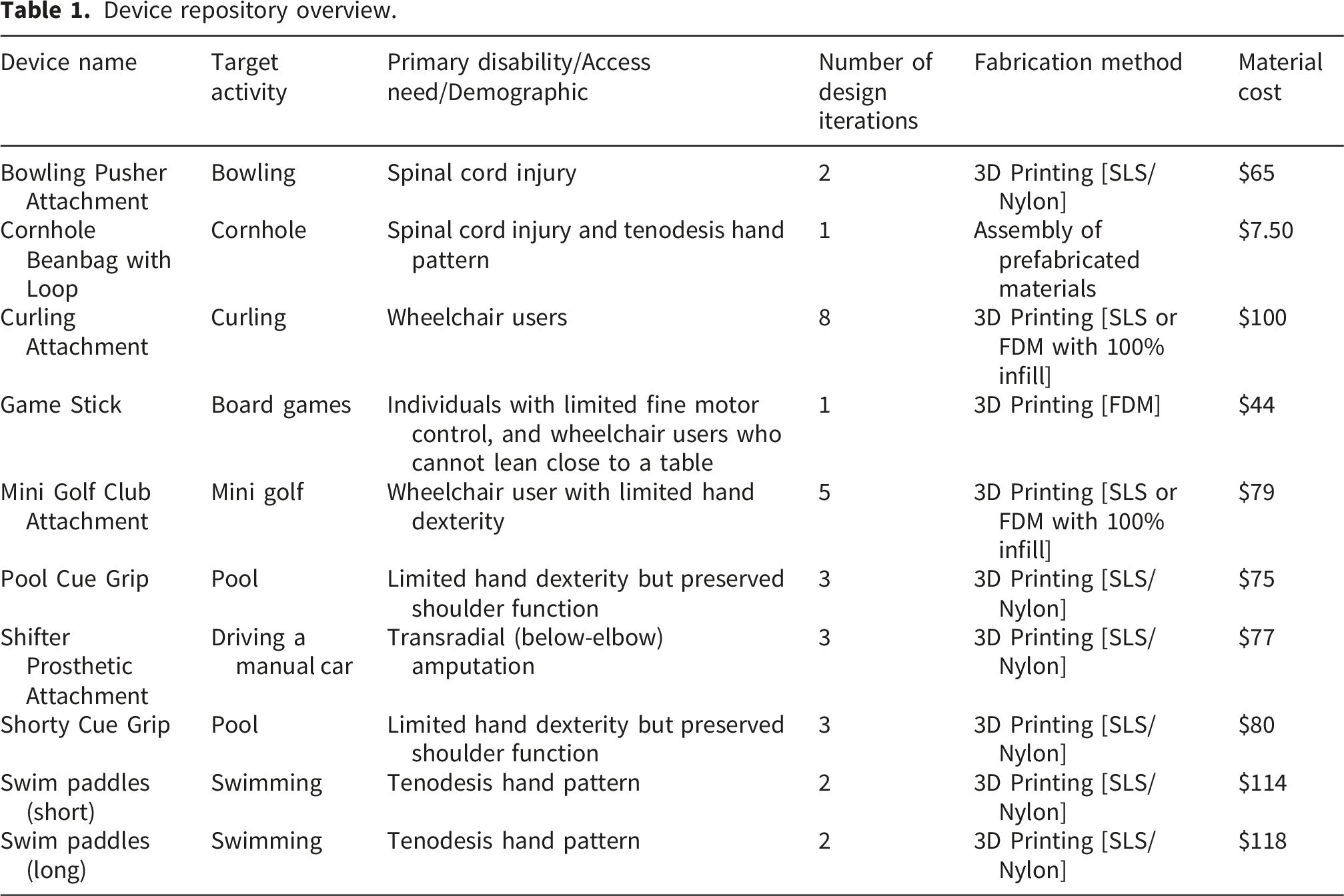
Device repository overview.
Billiards stick handles (pool cue grip and shorty cue grip in the above table)
Designed for a user with limited hand dexterity but preserved shoulder function, this device addresses the inability to grip a billiards cue. A prior self-made solution — a hand strap attached with a hot glue gun — failed quickly in use. Two versions were developed: a fixed-clamp version providing a more secure attachment at a preset location, and an adjustable-clamp version using wing nuts that allows the handle to be repositioned along the cue shaft for shots at different distances from the table edge (Figure 2). Pool cue grip (left) and shorty cue grip (right).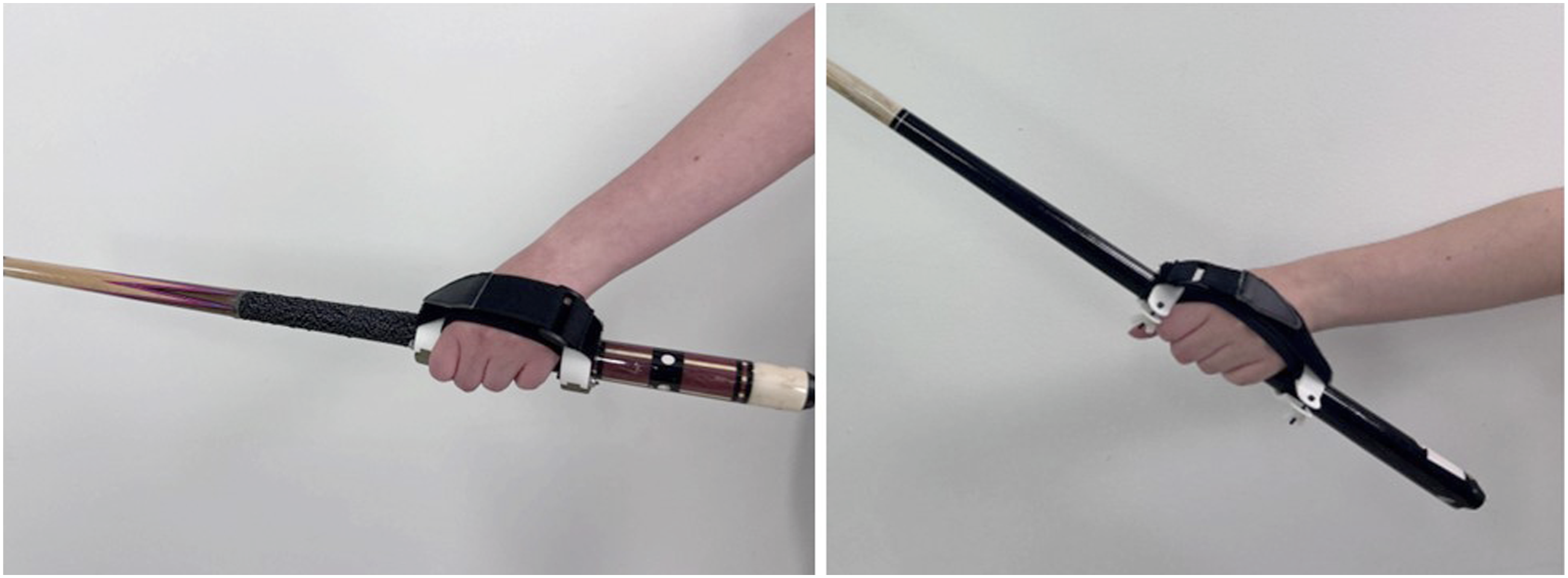
Cornhole bag
Designed for individuals with spinal cord injury and tenodesis hand pattern requiring adapted grasp and release, this modification addresses the difficulty of gripping and throwing a standard beanbag. The solution is minimal and manufacturable without 3D printing: a large fabric loop is zip-tied to the corner of a standard beanbag, allowing the user to hook one or more fingers through the loop rather than grasping the bag. This design exemplifies the principle that effective SRAAT does not always require advanced fabrication (Figure 3). Cornhole bag in use and closeup of added loop.
Curling attachment
Designed to address the known durability limitations of currently available adaptive curling delivery sticks, this device allows wheelchair users to deliver a curling stone from a seated, upright position. Existing bracket-style delivery sticks are prone to breakage during use. The SRAAT solution is a three-part 3D-printed bracket assembly. A wing-head screw at the stone-handle end allows adjustment of where the broom handle contacts the stone handle, giving the user control over the rotational velocity of the stone during delivery; a key skill in competitive curling (Figure 4). Curling attachment prototype.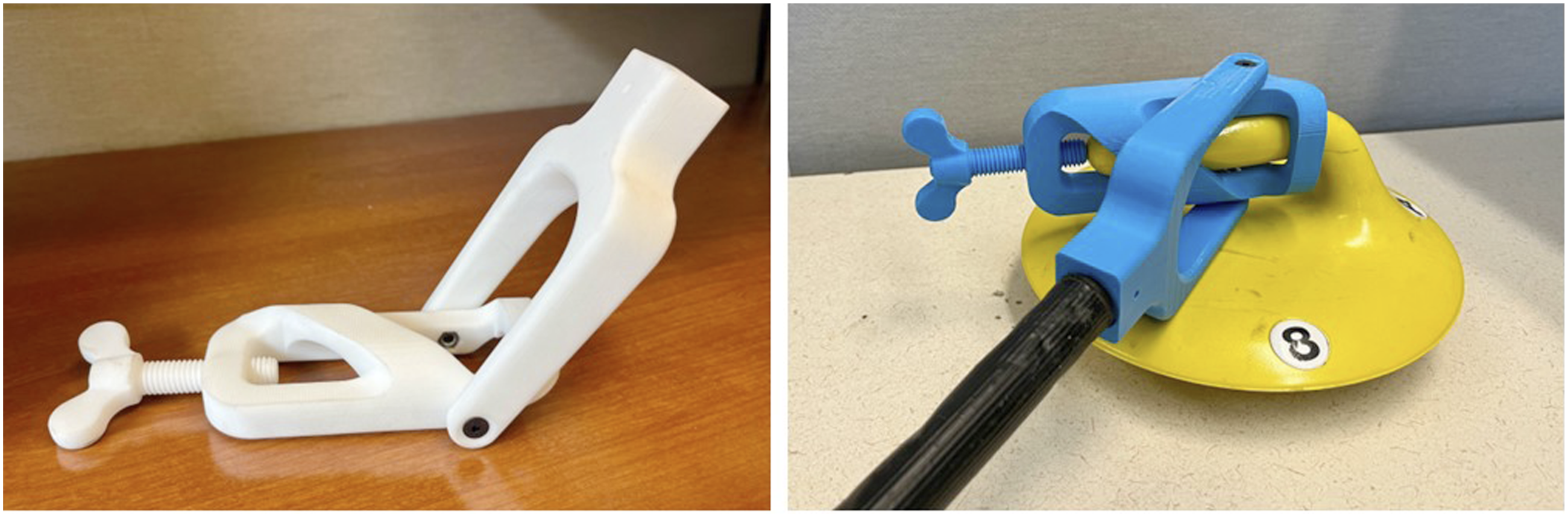
Game piece mover
Developed to enable individuals with limited fine motor control, as well as wheelchair users who cannot lean close to a table, to independently manipulate game pieces during board games. The device consists of a lightweight dowel rod with a 3D-printed hook at one end and a 3D-printed handle with Velcro strap at the other. The strap secures the user’s hand to the handle, while the hook enables sliding game pieces around the board with large, proximal arm movements rather than fine finger dexterity (Figure 5). Game piece mover and prototype in use.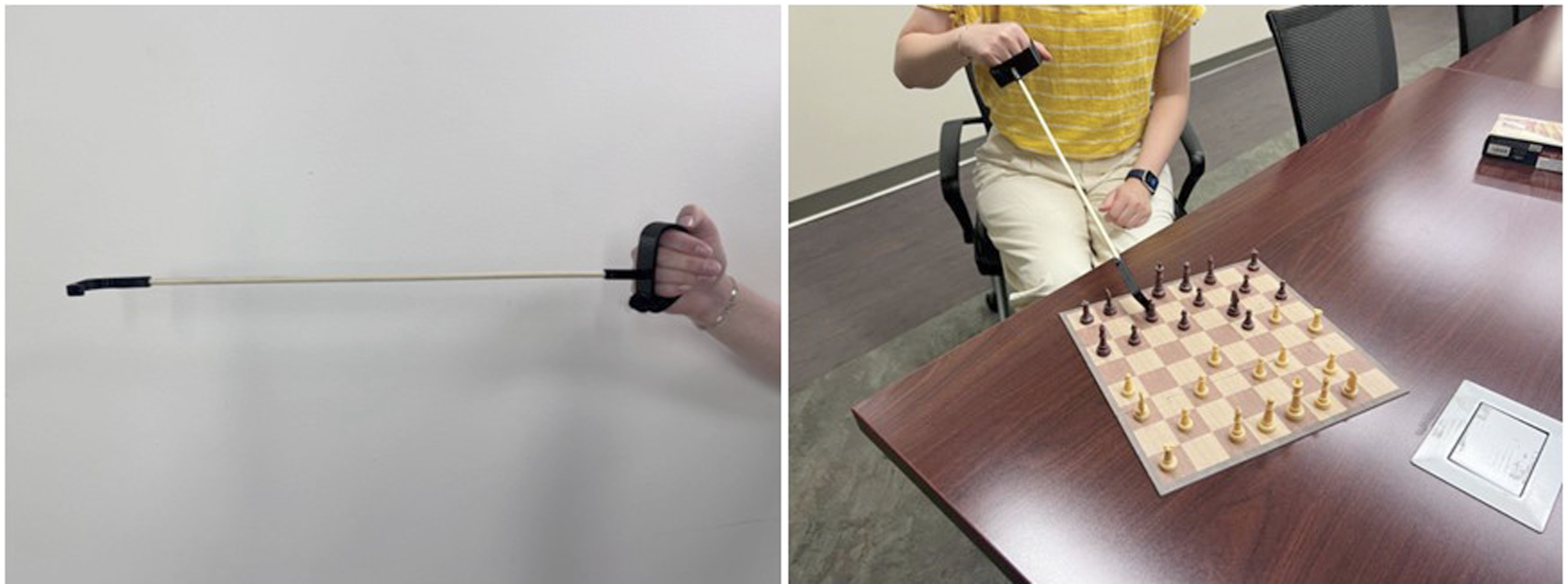
Miniature golf putter attachment
Developed for a wheelchair user who had previously been playing by having a companion duct tape a putter to his forearm, this device is a solid mounting bracket with two clamps that secure the putter shaft and two Velcro straps that wrap around the user’s forearm. It allows the user to independently maneuver the club head to the ball without hand grip (Figure 6). Digital rendering of mini golf attachment and prototype in use.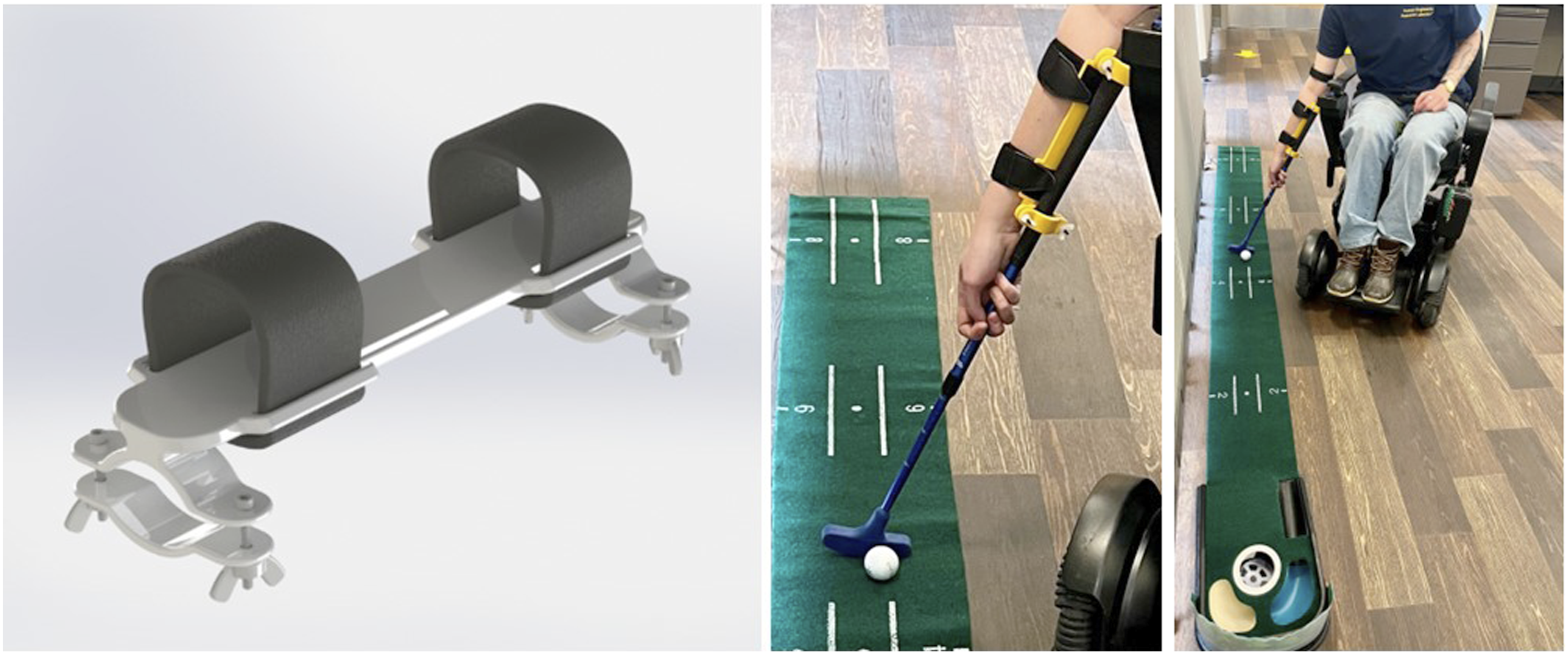
Prosthetic hand shifter
Designed for a person with a transradial (below-elbow) amputation of the right arm who wished to drive a standard transmission vehicle without remaining attached to the gear shift for the entire trip. The prior homemade solution — a hose clamp squeezing the shifter knob — effectively locked the prosthesis and arm to the shift lever. The SRAAT device is a cup with a quick-release terminal device connection and three spring detents, allowing the cup to snap onto standard shifter knobs with sufficient retention for driving but releasing with approximately 5 lbs. of upward force as needed (Figure 7). Exploded view, built gear shifter, and underside of gear shifter cup.
Swimming paddles
A swimmer with limited hand dexterity resulting from spinal cord injury — specifically, a tenodesis hand pattern requiring a near-fisted rather than flat hand position sought swimming paddles that would provide additional resistance for shoulder strengthening. Standard commercially available paddles require a flat hand to secure them. After iterative design and testing, a final design was developed with a “rock climbing” grip configuration on the back surface. Two versions were fabricated using selective laser sintering (SLS) with nylon: one requiring active grip by the user, and one with wrist straps for individuals who cannot maintain grip independently (Figure 8). 3D renderings and action shots of swimming paddles for someone with tenodesis hands.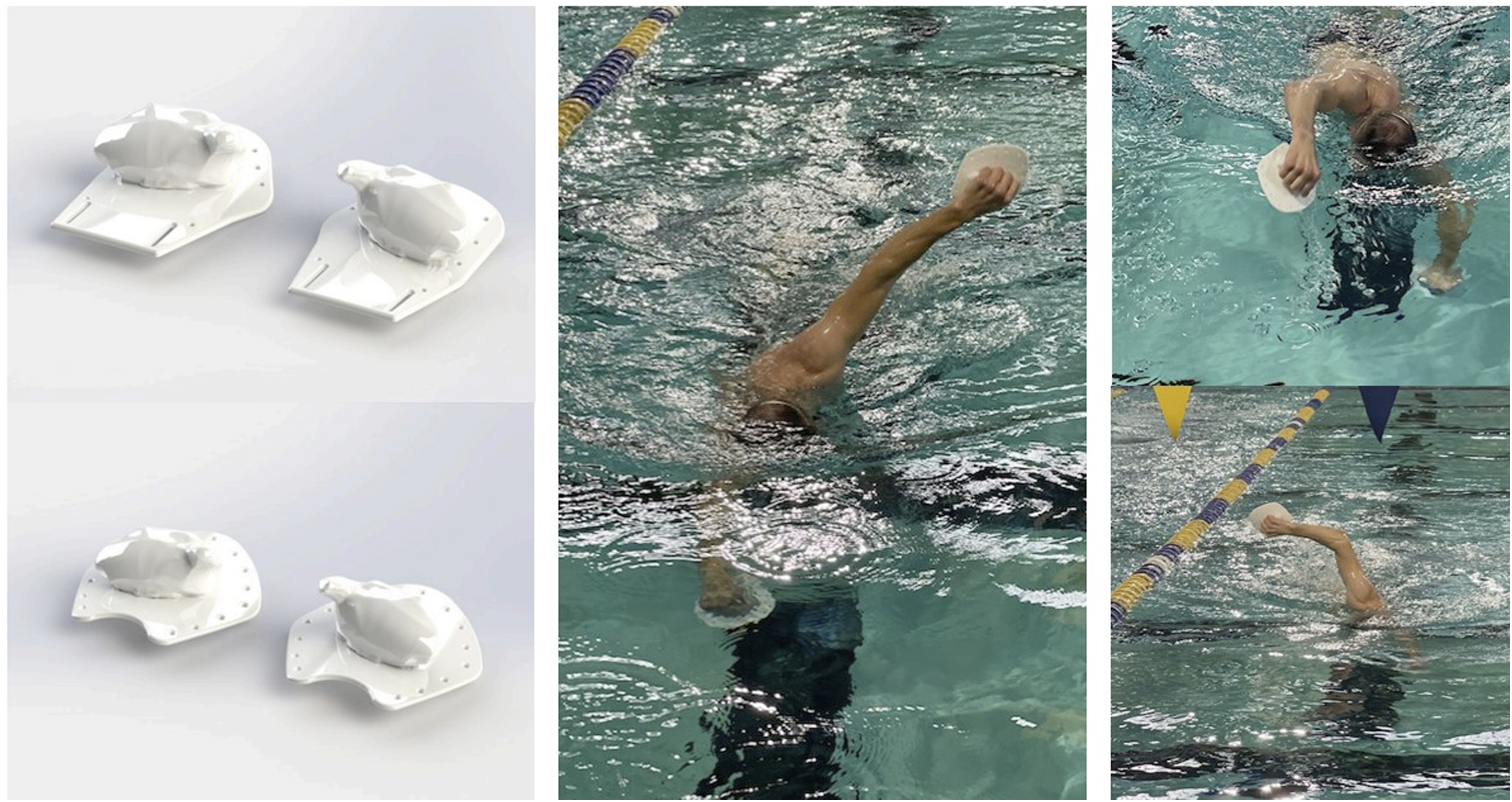
Discussion
The benefits of recreation are both clear and widespread, affecting long-term social 3 and physical 4 wellbeing. Participation in adaptive sports and recreational activities takes individuals beyond basic functional recovery and toward a quality of life characterized by genuine community belonging. Wheelchair sports and adaptive recreation are not supplementary to rehabilitation; they are a core part of it, and they have historically been a catalyst for technological innovation that benefits the broader disability community. 5 The devices developed in this project directly support that mission by reducing the technology barriers that prevent people with disabilities from accessing the sports and recreational activities that their peers without disabilities take for granted.
This project demonstrates through proof of concept that affordability, durability, and customizability can be achieved simultaneously. Eight of the ten current devices can be reproduced for $100 or less using on-demand SLS printing services, with the remaining two costing under $120. While SLS yields the most durable final product, FDM printing at lower infill densities provides a less expensive alternative for users with access to desktop printers. For their cost, the devices offer substantially more durable, reusable, and dignified solutions than prior homemade alternatives — as illustrated by the miniature golf attachment replacing duct tape on a forearm, or the cornhole bag loop replacing an improvised and unreliable grip strategy.
In some cases, the SRAAT designs have comparable versions available on the market but were still requested to be built for the repository. Depending on the device, this could be due to currently available versions being easily breakable, too expensive, or not an ideal fit for the user’s needs. The curling attachment was requested due to expense and the rate that these attachments tend to break. Ultimately, the version in the repository cut the production cost in half (compared to the cost of purchasing one online 31 ). However, not all projects were automatically cheaper. Our swim paddles are more expensive to produce than versions available to purchase, 32 but offer an ergonomic grip uniquely suited to tenodesis that was not widely available in the current market.
Many of the designs include multiple versions or adjustable features, providing agency to end users in how they engage with the sport and at what level of independence or challenge. This reflects the project’s core philosophy: the goal is never to do the activity for the person, but to remove the barrier that was preventing them from doing it themselves.
The PADE methodology was applied consistently across all device development cycles. The success of this approach adds to a growing body of evidence demonstrating the value of centering people with lived experience of disability in the design of technologies intended to serve them.33–38 Critically, PADE not only produces better-fitting devices but also ensures that the solutions address real, prioritized needs rather than assumptions about what people with disabilities want or require.
The low-cost fabrication methods used in this project also suggest a viable dissemination model. Makerspaces, university engineering labs, and rehabilitation centers with access to 3D printers could adopt the repository’s open-source designs and engage local disability community members in further PADE cycles to expand and adapt the available SRAAT. This is particularly relevant given documentation that access inequities in adaptive sports are substantial and that individuals with the most complex support needs remain systematically underserved. 8
Limitations and future directions
As this is a new project, several limitations should be acknowledged. First, long-term durability of the designs under real-world conditions of regular use has not yet been formally assessed; future work should include structured durability testing protocols. Second, the generalizability of each device beyond the individual for whom it was originally designed remains largely untested. As the repository grows and is accessed by a broader user population, iterative feedback from new users will be essential to identify where designs require modification or expansion to accommodate greater diversity of body types, disability characteristics, and activity goals. Third, outcomes data on the impact of device use on participation frequency, quality of life, and psychological wellbeing have not yet been collected; a longitudinal follow-up study using validated outcome measures would significantly strengthen the evidence base for this approach. Finally, while the target material cost of $100 or less was largely achieved, cost barriers in 3D printing access, particularly in lower-income communities and rural areas, remain a practical consideration that future dissemination strategies should address. Further exploration of how many projects can be reproduced with FDM printing (as opposed to SLS printing) at lower cost, while remaining long-lasting, would be a worthwhile path to reducing any financial barriers to accessing the repository devices.
Conclusion
Adaptive sports and recreation are important for people with disabilities and meaningfully enhance quality of life, community integration, and physical and psychological wellbeing. This project demonstrates that the PADE approach can be effectively applied to develop low-cost, easy-to-make adaptive sports and recreation equipment that is affordable, durable, and customizable to the individual. Several prototypes have been designed, fabricated, and made publicly available, with initial satisfaction reported by end users. Ongoing work will continue to expand the repository, assess long-term durability and generalizability of existing designs, and collect longitudinal outcome data on the impact of SRAAT access on participation and quality of life.
Footnotes
Author contributions
Jonathan Duvall: Conceptualization, Data curation, Investigation, Methodology, Writing - original draft. Lynn Priestley: Data Curation, Validation, Writing – original draft. Rory Cooper: Conceptualization, Funding Acquisition, Supervision, Writing – review & editing. Ian Rice: Conceptualization, Funding Acquisition, Supervision, Writing – review & editing.
Funding
The authors disclosed receipt of the following financial support for the research, authorship, and/or publication of this article: The contents of this article were developed under a grant from the National Institute on Disability, Independent Living, and Rehabilitation Research (NIDILRR grant number REGE23000233).
Declaration of conflicting interests
The authors declared no potential conflicts of interest with respect to the research, authorship, and/or publication of this article.
Disclaimer
NIDILRR is a Center within the Administration for Community Living (ACL), Department of Health and Human Services (HHS). The contents of this article do not necessarily represent the policy of NIDILRR, ACL, or HHS, and you should not assume endorsement by the Federal Government. ChatGPT was used to enhance  .
.