



Abstract
In this article I examine public evaluations of quality of governance in East Asia and analyze the effects of perceived governance quality on regime support. I distinguish between two modes of governance, democratic and law-based, and examine which mode of governance matters. It was found that East Asian democracies suffered various governance deficits in the eyes of their publics. It was also revealed that a weak rule of law remained the most notable governance malaise across much of the region. The micro-level analysis shows that perceived quality of governance shaped regime allegiance and institutional confidence but not all aspects of governance mattered. It was shown that law-based governance served as the major source of regime support regardless of regime types. On the whole, public support for the prevailing system of government across much of the region depended on quality of law-based governance as well as national economic performance. Yet, evidence indicates that democratic governance encourages citizen skepticism of the ongoing political order, supporting the thesis of assertive citizenship. Overall, the findings suggest that establishing a strong rule of law constitutes one of the major challenges to regime consolidation across much of East Asia.
Keywords
Public disaffection with institutions of democracy is seen as one of the causes of the recent protest movement around the world ( Economist Intelligence Unit, 2013). 1 Indeed, a growing number of critical or assertive citizens now constitute a prominent feature of the political landscape across much of the democratic part of the globe (Dalton and Welzel, 2014; Norris, 1999). A wealth of public opinion data shows that citizens’ confidence in political institutions declines in trilateral democracies, although their support for democracy remains high (Dalton, 2004; Nye et al., 1997; Pharr and Putnam, 2000). Such a phenomenon is hardly exclusive to established democracies in the West (Diamond and Plattner, 2008). Recent cross-national survey data reveal that new democracies in East Asia are no exceptions (Chang et al., 2013; Chu et al., 2008; Park, forthcoming; Park and Chang, 2013). The gap between public expectations and governance performance seems to widen across much of the region.
Dissatisfaction with governance performance is likely to undermine support for the prevailing system of government. Low levels of system support in turn are expected to diminish institutional capacity and effectiveness, which is likely to further worsen governance performance, producing more disaffection with the ongoing political order. Hence, reducing the gap between public expectations and governance performance constitutes one of the key challenges, especially to democracies, old and new, based on citizen consent. In this regard, I examine public evaluations of governance performance and their effects on regime support in the context of East Asia.
In their contribution to this special issue, Welzel and Dalton (forthcoming) argue that norms associated with assertive citizenship spread as countries experience social modernization and that assertive culture rather than allegiant culture produces better governance, suggesting that critical attitudes toward political institutions would improve governance performance. In this study, however, I assume that perceived governance performance reflecting actual performance shapes support for the prevailing system of government. Yet, I am aware that public expectations informing standards of evaluation are likely to change or diverge as a result of social modernization and political development.
The article is organized into five sections. The first section discusses two modes of governance largely associated with liberal democracy and links perceived quality of governance to regime support. The second section deals with data and measurement. The third section examines public perceptions of quality of governance, democratic and law-based. The fourth section analyzes the effects of perceived quality of governance on regime support at the individual level. The final section highlights the key findings and explores their implications for regime consolidation.
Analytical framework
Modes of governance
Bevir (2011) observes that the word “governance” is ubiquitous. He defines it as the patterns of rule that are “hybrid and multijurisdictional with plural stakeholders who come together in networks” (p. 2). He highlights four distinctive features of governance. The first is a hybrid feature, combining administrative systems with market mechanisms and non-profit organizations. The second is a multijurisdictional and often transnational nature. The third is an increasing range and plurality of stakeholders. The last is the complex networks of stakeholders and government agencies. However, the specific meaning of the term varies widely from one discipline or theory to another (Pierre, 2000). In development theory and practice from which this study draws its meaning, the concept of governance largely refers to political institutions including older forms of the state (bureaucratic or hierarchical institutions), reflecting the state-centric perspective (Pomerantz, 2011).
In the same vein, the World Bank (1992) considers governance “the manner in which power is exercised in the management of a country’s economic and social resources for development” (p. 1). More specifically, the World Bank’s “good governance” project defines it as: the traditions and institutions by which authority in a country is exercised. It includes (1) the process by which governments are selected, monitored and replaced, (2) the capacity of the government to effectively formulate and implement sound policies, and (3) the respect of citizens and the state for the institutions that govern economic and social interactions among them. (Kaufmann et al., 2009: 5)
Fukuyama (2013) more narrowly defines governance as “a government’s ability to make and enforce rules, and to deliver services, regardless of whether that government is democratic or not” (p. 350). He emphasizes the bureaucratic or administrative mode of governance by relating “good governance” to the executive or administrative function of any government. He distinguishes between four approaches to evaluating quality of governance. Each emphasizes procedures, capacity, outputs, and autonomy, respectively. Considering the limitations of approaches emphasizing procedures or outputs, he sees “good governance” as the result of an interaction between state capacity and autonomy.
Rothstein and Teorell (2008) emphasize quality of government as impartiality in the exercise of public power. By focusing on the implementation of laws and policies, they consider governance to pertain to the output side of government rather than the input side. Agnafors (2013) develops “a more complex definition” of good government. He defines quality of government as “a positive descriptive characteristic of exercises of public authority that surpass the threshold of each of seven necessary components” (p. 442). Both Rothstein and Teorell and Agnafors consider governance related to the exercise of public authority.
By contrast, democracy researchers develop a more comprehensive meaning of democratic governance. For instance, Diamond and Morlino (2004) distinguish between three dimensions of democratic governance—procedural, substantive, and results—and identify eight components associated with them, namely the rule of law, participation, competition, vertical and horizontal accountability, freedom, equality, and responsiveness. These components reflect not only access to public power but also the exercise of public power.
Norris (2012) explicitly distinguishes between democracy and governance and then combines them to develop a theory of democratic governance. The democracy dimension pertains to the extent to which citizens have the capacity to express their demands and to hold elected officials to account. On the other hand, the governance dimension pertains to the extent to which state agencies have the capacity to enforce laws and implement policies. She maintains that “expanding either the demands of democracy or the supply of governance alone is regarded as insufficient; instead the combination of both factors working in tandem is predicted to provide the conditions most conducive to prosperity, welfare, and peace” (p. 38). This perspective echoes the view that “a successful liberal democracy” requires a balanced combination of three sets of institutions—the (effective) state, the rule of law, and institutions of accountability (Fukuyama, 2011).
Following these lines of inquiry, I adopt a power-based definition of governance and distinguish between three modes of governance, namely bureaucratic, law-based, and democratic. Bureaucratic or administrative governance concerns the exercise of public authority on the basis of professional norms and expertise. Law-based governance concerns the exercise of public authority in accordance with the rules of society. Democratic governance concerns the exercise of public authority accountable to the public. While the first mode of governance highlights the effective use of state power, the other two emphasize constraining state power. In this sense, they represent two competing mechanisms of controlling the executive action, namely the rule of law and democratic accountability. In this study I primarily focus on these two modes of governance largely because of a lack of data on bureaucratic governance.
Linking perceived governance quality to regime support
There has been much scholarly effort to identify determinants of citizen political support in democracies, old and new (Dalton, 2004; Norris, 1999; Nye et al., 1997; Pharr and Putnam, 2000). Among recent attempts, Putnam and his colleagues (Putnam et al., 2000) propose a general framework based on evidence from trilateral democracies. They maintain that confidence in institutions is “a function of the information to which citizens are exposed, the criteria by which the public evaluates government and politics, and the actual performance of those institutions” (p. 23). Assuming that perceived performance reflects actual performance, they offer two explanations associated with institutional performance. One has to do with the capacity of state agencies to deliver what citizens want and the other, the commitment of state agencies to professional or ethical standards of conduct. While the first is largely related to the effective use of state power, the second is associated with no abuse or misuse of state power. Similarly, Norris (2011) develops two performance-based explanations. The process performance explanation emphasizes procedural aspects of governance largely associated with constraining state power. On the other hand, the policy performance explanation emphasizes policy outcomes basically related to the effective use of state power or policy capacity.
Considering these and other prior theory and research (Evans and Whitefield, 1995; Gilley, 2006; McAllister, 1999; Miller and Listhaug, 1999; Weatherford, 1987), I assume that the manner in which state power is exercised shapes support for the ongoing political order, and develop an analytical framework linking perceived governance performance to regime support. In this study, both law-based governance and democratic governance are considered to represent two modes of the exercise of public authority. Law-based governance pertains to the extent to which the exercise of public authority is subject to the rules of society. I identify three aspects of this mode of governance—impartiality, law-abidingness, and control of corruption. They are essential for fair, consistent, and honest enforcement of law. Democratic governance pertains to the extent to which the exercise of public authority is made accountable to the public. I identify three aspects of this mode of governance—political freedom, popular control, and electoral competitiveness. They are essential for public contestation for power.
In addition, I pay particular attention to two alternative accounts for regime support. One is associated with policy performance explanation, especially the economic performance thesis. In this account, regime support is shaped by state effectiveness or capacity to solve economic problems such as economic growth, inflation, and unemployment (Lipset, 1959). The other is associated with the winner-loser thesis which emphasizes that election outcomes impact regime support (Anderson et al., 2005; Holmberg, 1999). In this perspective, regime support is expected to be higher among those who voted for the party in power while lower among those who voted for the opposition.
Data and measurement
Data
The analysis is based on data from the Asian Barometer Survey (ABS hereafter). The ABS, formerly the East Asian Barometer, was launched in 2000 as the region’s first comparative survey of public attitudes toward democracy and governance. Now in its fourth round, the ABS is a rich data source with its innovation in measuring some theoretical concepts including quality of governance. I used the questions available in the third round of the ABS (ABS III hereafter) (see Appendix). 2 The survey year and sample size for each country was as follows: Cambodia (2012 and N = 1200), China (2011 and N = 3473), Indonesia (2011 and N = 1550), Japan (2011 and N = 1880), Malaysia (2012 and N = 1214), Mongolia (2010 and N = 1210), Philippines (2010 and N = 1200), Singapore (2010 and N = 1000), South Korea (2011 and N = 1207), Taiwan (2010 and N = 1592), Thailand (2010 and N = 1512), and Vietnam (2010 and N = 1191). The sample countries may be classified into three regime types. Considering Freedom House ratings at the time of each survey, seven of them (Indonesia, Japan, Mongolia, Philippines, South Korea, Taiwan, and Thailand) may be considered electoral democracies; two (Malaysia and Singapore), pseudo-democracies or competitive authoritarian regimes (Levitsky and Way, 2010); and three (Cambodia, Vietnam, and China), officially or actually single-party authoritarian regimes.
Measuring regime support
Our dependent variable is regime support, an attitude toward the prevailing system of government, democratic or authoritarian. Considering prior theory and research, I distinguish between two levels of regime support. 3 The first level pertains to underlying values and principles of the ongoing political order. To measure regime support at this level I choose two questions: one captures a sense of pride in the system and the other, willingness to exit from the system or preference for alternatives to the system. Neither questions use the word “democracy,” to avoid “socially desirable” responses from respondents. Hence, it does not capture democratic support, one of the properties used to distinguish between allegiant and assertive citizens (Welzel and Dalton, forthcoming). By combining responses to both questions, I construct a seven-point index of regime allegiance. Of the sample countries, Vietnam (5.01) displayed the highest score. It was followed by Thailand (4.55), Malaysia (4.37), Cambodia (4.18), and Singapore (4.16), all above the mid-point (3). In contrast, South Korea (2.42) registered the lowest score. It was followed by Japan (2.96), the Philippines (3.04), Mongolia (3.09), and Taiwan (3.11), all below or close to the mid-point. It is evident that public allegiance to the prevailing system of government was stronger in non-democracies than democracies except for Thailand.
The second level pertains to specific institutions of government. To measure regime support at this level, I select two questions: one measures confidence in the national government and the other, confidence in parliament. Confidence in institutions is one of the properties distinguishing between allegiant and assertive citizens (Dalton and Welzel, 2014). By combining responses to both questions, I construct a seven-point index of institutional confidence. Of the sample countries, Vietnam (5.21) again registered the highest score. It was followed by China (4.97), Cambodia (4.10), Singapore (4.09), and Malaysia (3.94), all above the mid-point (3). In contrast, South Korea (1.66) again exhibited the lowest score. It was followed by Japan (1.80), Mongolia (2.27), Taiwan (2.30), and the Philippines (2.77), all below the mid-point. As in regime allegiance, public confidence in institutions was greater in non-democracies than democracies. 4
The empirical relationship between regime allegiance and institutional confidence was positive in all sample countries, democratic or authoritarian, but the strength varied from one country to another. Cambodia (r = 0.470) displayed the strongest relationship. It was followed by Vietnam (r = 0.426) and Malaysia (r = 0.425). In contrast, Thailand (r = 0.148) exhibited the weakest relationship, followed by the Philippines (r = 0.254). The relationship was stronger in non-democracies than democracies, especially faltering democracies.
Measuring perceived quality of governance
I distinguish between two modes of governance, democratic and law-based. They correspond to two measures of the World Bank’s Worldwide Governance Indicators (WGI). The WGI consist of six aggregate measures of governance: “Voice and Accountability,” “Political Stability and Absence of Violence,” “Government Effectiveness,” “Regulatory Quality,” “Rule of Law,” and “Control of Corruption” (Kaufmann et al., 2009). Of them, “Voice and Accountability” reflects the quality of democratic governance and both “Rule of Law” and “Control of Corruption” reflect law-based governance. 5 As noted earlier, I consider three aspects of democratic governance: political freedom, popular control, and electoral competitiveness. First, political freedom is measured by combining responses to two questions: one captures freedom of speech and the other, freedom of association. Second, popular control is measured by combining two questions: one captures people’s power to select and replace those in authority and the other, people’s power to monitor those in authority and to hold them accountable for their actions. Lastly, electoral competitiveness is measured by combining responses to two questions: one captures fairness in electoral contest and the other, the meaningfulness of elections.
I also consider three aspects of the law-based dimension: impartiality, law-abidingness, and control of corruption. First, impartiality is measured by combining responses to two questions: one captures equal treatment for the poor and the other, equal treatment for ethnic minorities. Second, law-abidingness is measured by combining responses to two questions: one captures government bound by law and the other, no legal impunity or consistent enforcement of rules. Lastly, control of corruption is measured by combining responses to two questions: one captures corruption in the national government and the other, corruption in sub-national governments. 6
Perceived quality of governance
Democratic governance
I first examine how East Asians view the quality of democratic governance in their own country. Democratic governance is here considered to be of a high quality when the exercise of public authority is made accountable to the public. Hence, democratic governance performance may be rated as strong when freedom of association and freedom of expression are guaranteed, people are able to choose and control those in authority, and elections are competitive and meaningful.
First, political freedom is one of the important requirements of democratic governance. In particular, both freedom to form and join organizations and freedom of expression constitute institutional guarantees of public contestation for power (Dahl, 1971). Table 1 shows the percent giving affirmative responses to the questions used to measure political freedom.
Perceived quality of governance.
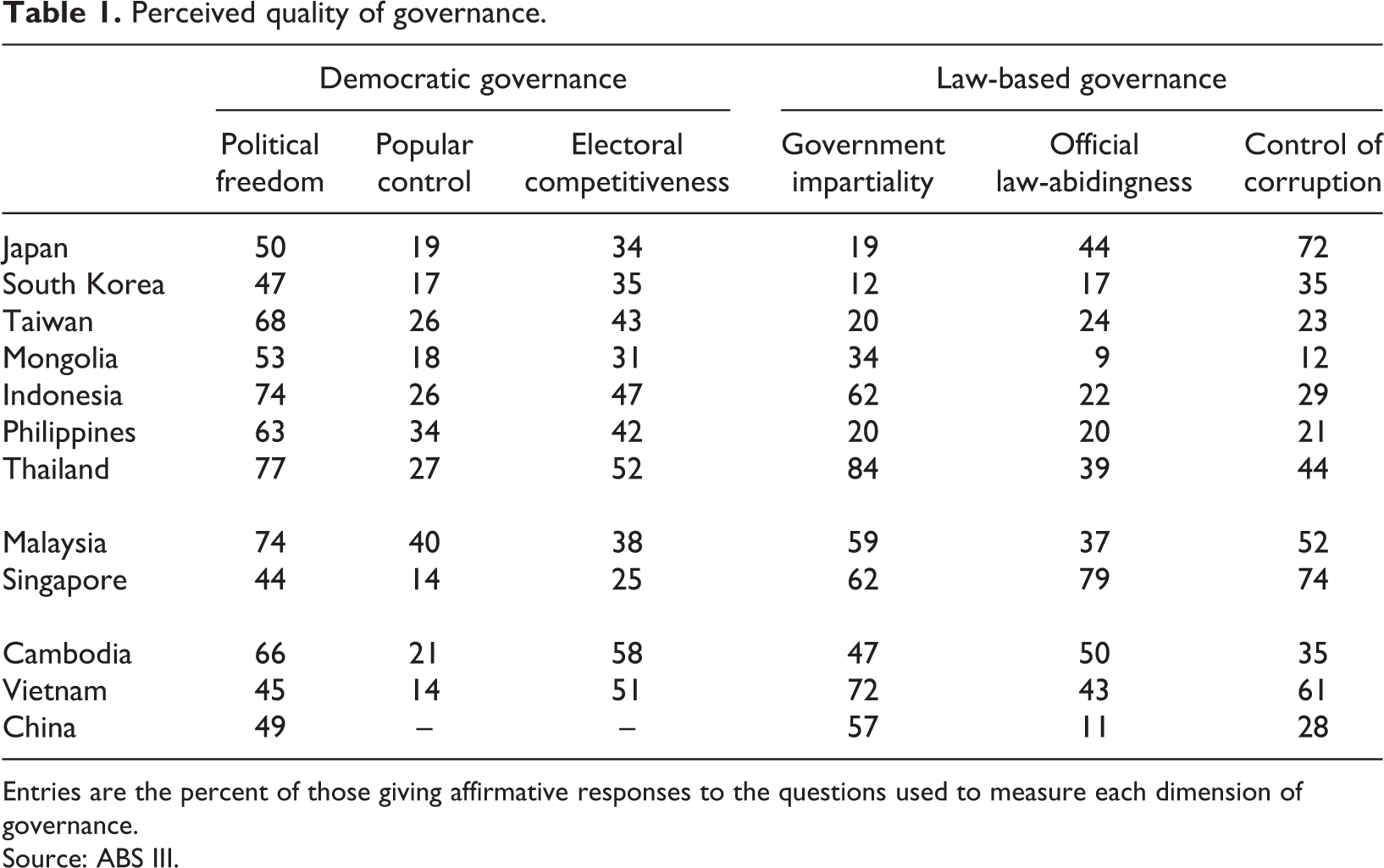
Entries are the percent of those giving affirmative responses to the questions used to measure each dimension of governance.
Source: ABS III.
In eight of the 12 countries surveyed, majorities held favorable evaluations. The four exceptions were South Korea, Singapore, Vietnam, and China, most of which were non-democracies. Even in these countries large, not small, minorities believed they enjoyed political freedom. Thailand displayed the highest level of public approval. It was followed by Indonesia, Malaysia, Taiwan, and Cambodia. In these countries, large majorities made positive evaluations. Overall, in the eyes of citizens political freedom hardly constituted a governance problem across much of the region.
Second, popular control or vertical accountability is one of the hallmarks of democratic governance. Of two types of accountability, vertical and horizontal, vertical accountability or people’s power concerns the relationship between citizens and government leaders (Diamond and Morlino, 2004). Although electoral punishment or reward constitutes the ultimate means of accountability, venues of popular control extend beyond elections and include the interaction between voters and their elected representatives in between elections. Table 1 shows the percent giving affirmative responses to the questions used to measure popular control.
In none of the 11 countries surveyed did majorities make favorable evaluations. As expected, Singapore and Vietnam displayed the lowest level of public approval. These authoritarian regimes were followed, surprisingly, by South Korea, Japan, and Mongolia, all electoral democracies. Interestingly, Malaysia, an authoritarian regime with a facade of competitive elections, displayed the highest level of public approval. Overall, in the eyes of citizens popular control remained a governance problem across the region regardless of regime types.
Lastly, as a “Schumpeterian” thin definition of democracy emphasizes, free, fair, and competitive elections constitute one of the core features of democratic governance. Competitive elections entail a level playing field between incumbents and opposition. Competitive elections with meaningful choices serve as the people’s ultimate means to hold those in authority to account for their actions. Table 1 shows the percent giving affirmative responses to the questions used to measure electoral competitiveness.
In only three of the 11 countries surveyed did majorities have favorable evaluations. They included Cambodia, Thailand, and Vietnam. Although Cambodia and Vietnam remained officially or actually single-party authoritarian regimes, they fared better than most democracies, old and new. As expected, Singapore, a dominant-party regime with a facade of competitive elections, displayed the lowest level of public approval. It was followed by Mongolia, Japan, South Korea, and Malaysia. Overall, in the eyes of citizens electoral competitiveness remained a governance problem across much of the region.
In brief, of three aspects of democratic governance examined, popular control over government turned out to be most often lacking across the region. By contrast, the political freedom essential for meaningful contestation of power appeared to be least often lacking. The finding suggests that a lack of effective popular control constituted one of the major sources of governance malaise in the region.
Law-based governance
I now turn to the question of how East Asians view the quality of law-based governance in their own country. The rule of law is the hallmark of law-based governance. Kleinfeld (2006: 34–35) distinguishes between its five different goals: “making the state abide by law, ensuring equality before the law, supplying law and order, providing efficient and impartial justice, and upholding human rights.” Considering ends-based definitions, I focus on three aspects of law-based governance: impartiality, law-abidingness, and control of corruption. Law-based governance is considered to be of a high quality when public authority is exercised in accordance with the rules of society. Hence, when the government treats every citizen equally, when public officials abide by rules with no impunity, and when the government is free of corruption, law-based governance performance may be rated as strong.
First, government impartiality emphasizes that the law is impartially and fairly applied to every citizen. Impartiality reflects the basic principle of equality before the law. Potential threats to equal treatment include gender, race, religion, ethnicity, socioeconomic status, political orientations and so on. Of them, this study focuses on two—economic status and ethnicity. Table 1 shows the percent giving affirmative responses to the questions used to measure government impartiality.
In six of the 12 surveyed countries’ majorities gave favorable evaluations. They included Thailand, Vietnam, and Indonesia. By contrast, in Japan, South Korea, Taiwan, Mongolia, and the Philippines only small minorities made a favorable evaluation. Interestingly, ethnically homogenous countries fared worse than ethnically diverse ones. Not surprisingly, single-party communist regimes fared better than most capitalist democracies. Overall, in the eyes of citizens government impartiality hardly constituted a governance problem across much of the region.
Second, official law-abidingness, or binding public officials to rule by law, is widely considered the sine qua non of the rule of law. It protects citizens from the arbitrary exercise of state power. Moreover, it entails no impunity to law-breaking officials. Table 1 shows the percent giving favorable responses to the questions used to measure official law-abidingness.
In only two of the 12 countries surveyed did majorities hold favorable evaluations. They included Singapore and Cambodia, all non-democracies. Notable is that Singapore displayed the highest level of public approval. In all democracies except for Japan and Thailand only tiny minorities considered their government leaders bound by law. Mongolia, an unlikely democracy in the region, displayed the lowest level of public approval. China exhibited the second lowest level, suggesting little check on official arbitrariness and impunity. Overall, in the eyes of citizens official law-abidingness remained a governance problem across the region regardless of regime types.
Lastly, although corruption is closely related to law-abidingness, I distinguish between them because control of corruption is generally treated as an end in itself. Official corruption largely refers to the extent to which public authority is used for private gains (Johnston, 2001). It includes corruption at the national and local levels. Corruption at the national level tends to take grand forms involving high-level officials and policy-making. By contrast, corruption at the local level tends to take petty forms involving low-level officials and law enforcement and public service delivery. Table 1 shows the percent giving favorable responses to the questions used to measure control of corruption.
In only four of the 12 countries surveyed did majorities have favorable evaluations. They included Singapore, Japan, Vietnam, and Malaysia, most of which were non-democracies. Notable is that Singapore displayed the highest level of public approval. It was closely followed by Japan. Both were clearly distinguishable from their neighbors. By contrast, Mongolia displayed the lowest level of public approval. It was followed by the Philippines, Taiwan, China, South Korea, and Cambodia. Overall, in the eyes of citizens control of corruption remained a governance problem across much of the region.
To sum up, of three aspects of law-based governance examined, official law-abidingness proved to be most often lacking across the region. By contrast, government impartiality appeared to be least often lacking. The finding suggests that a lack of formal legality making the state abide by law constituted one of the major sources of governance malaise in the region.
One of the puzzles that emerges from the above analysis is that closed and repressive regimes fared better in public evaluations of democratic governance, if not law-based governance, than open and democratic regimes. This is largely consistent with the findings of the macro-analysis of World Values Survey data by Dalton and Shin (2014). Evidently, there exists a gap between expert-based evaluations and public perceptions. This may raise the question of whether public evaluations of governance are spurious. Perhaps citizens in closed and repressive regimes may be less informed or misinformed about politics and government than citizens in open and democratic regimes. Or public expectations informing the standards of evaluation may differ between regime types as a result of social modernization and political development. Whatever the reason, in this study I consider ordinary people, informed or uninformed, or assertive or allegiant, the final arbiters of governance performance, whose views matter to regime stability.
Perceived quality of governance and regime support
In this study, citizens’ evaluations of the exercise of public authority are hypothesized to shape their attitudes toward the prevailing system of government. In this section, I first examine the linkage between perceived quality of governance and regime support at the individual level and then explore whether macro-level governance performance explains cross-national variation in regime support.
Bivariate analysis
I begin with the simple correlation between perceived quality of democratic governance and regime allegiance. As presented in the first column of Table 2, of three aspects of democratic governance only electoral competitiveness was significantly related to regime allegiance in every country examined. Cambodia displayed the strongest relationship. It was followed by Malaysia. The finding suggests that even a facade of competitive elections might serve as a source of regime allegiance, even if they do not guarantee a level playing field. Political freedom also fared well. In 10 of the 12 countries surveyed it was significantly related to regime allegiance. The two exceptions were the Philippines and Vietnam. It is interesting that in the Philippines more political freedom might mean lower support for democracy-in-practice. As in electoral competitiveness, Malaysia displayed the strongest relationship. It was followed by China. This finding suggests that more political freedom, even if limited, might encourage regime allegiance in authoritarian political settings. Popular control performed less well. In six of the 11 countries surveyed it was significantly related to regime allegiance. Moreover, the direction of the relationship remained mixed. In Japan, South Korea, and Taiwan, all more affluent democracies, it was positive but weak, suggesting that popular control might constitute only a minor source of democratic allegiance. By contrast, in the Philippines, Malaysia, and Vietnam it was negative, suggesting that increased people’s power might undermine regime allegiance in either more unstable democratic or authoritarian political settings.
Correlation between perceived quality of governance and regime allegiance.
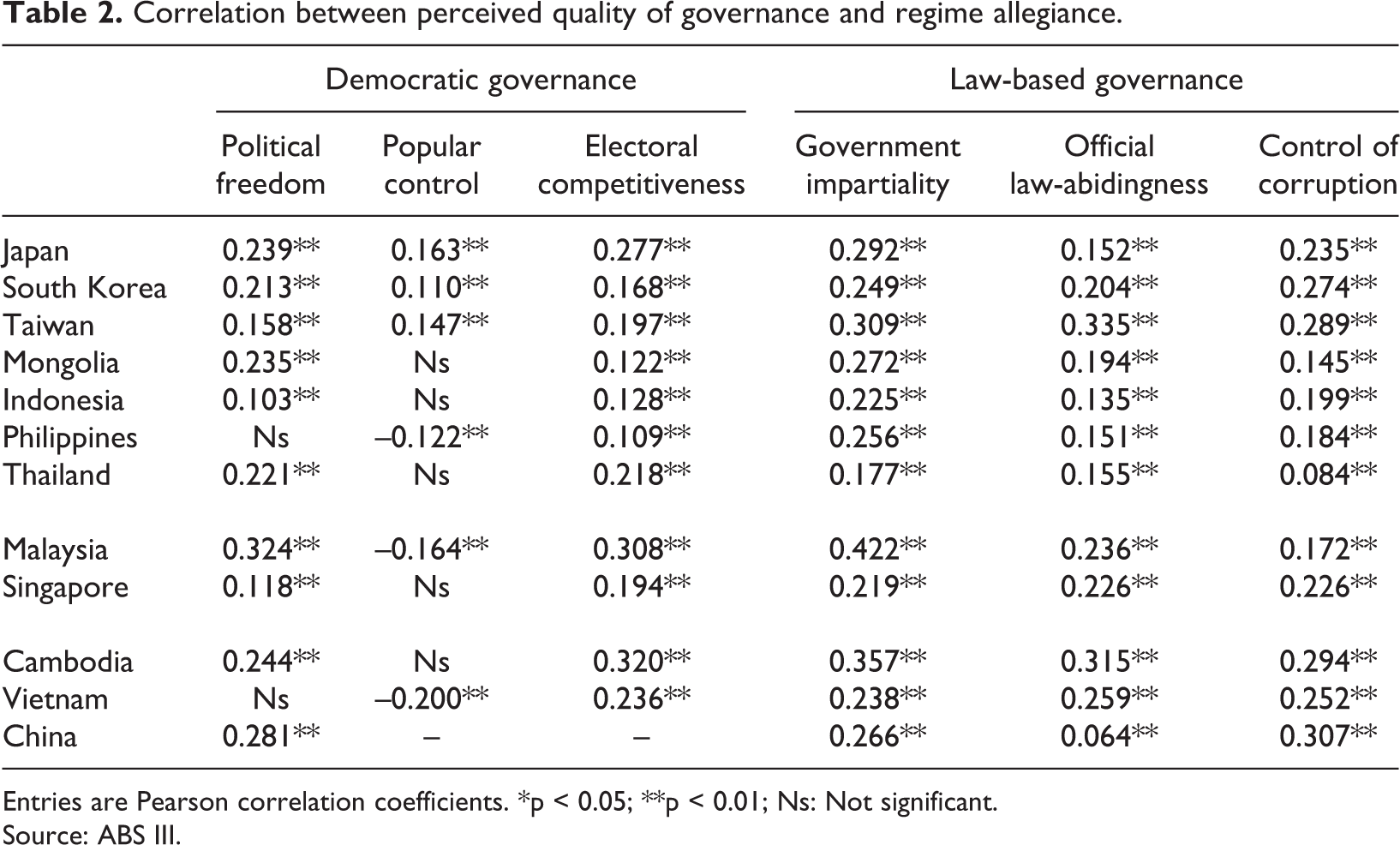
Entries are Pearson correlation coefficients. *p < 0.05; **p < 0.01; Ns: Not significant.
Source: ABS III.
The aspects of law-based governance fared better. As presented in the second column of Table 2, in every country surveyed government impartiality was significantly linked to regime allegiance. In democracies and authoritarian regimes alike, impartial treatment by government bred regime allegiance. Interestingly, Malaysia, where ethnic Malays and other indigenous people received preferential treatment, displayed the strongest relationship, suggesting that ethnic discrimination might serve as a major source of political discontent. Similarly, official law-abidingness was significantly related to regime allegiance in every country surveyed, democratic or authoritarian. Taiwan displayed the strongest relationship. It was followed by Cambodia. In less affluent democracies the relationship remained significant but weak. Likewise, control of corruption was significantly linked to regime allegiance in every country surveyed. China, where the incidence of corruption was high, displayed the strongest relationship. It was followed by Cambodia. As was the case for law-abidingness, in less affluent democracies the relationship remained weak, albeit significant. Overall, regime allegiance was more consistently related to perceived quality of law-based governance than that of democratic governance.
I now turn to the simple correlation between perceived quality of governance and institutional confidence. As presented in the first column of Table 3, in seven of the 12 countries examined political freedom was significantly related to institutional confidence. The exceptions were Taiwan, Indonesia, the Philippines, Thailand, and Vietnam, most of which were new democracies. Yet, the relationship, if any, tended to be weak. Popular control fared worse. In only five of the 11 countries examined was it significantly, albeit weakly, related to institutional confidence. Even the direction of the relationship remained mixed. In Japan, South Korea, and Taiwan the relationship was positive. By contrast, in Thailand and Malaysia the relationship was negative, indicating that more people’s power might erode confidence in institutions. Of three aspects of democratic governance electoral competitiveness fared best, suggesting that even a facade of contestation mattered. In all countries examined except for the Philippines it was significantly related to institutional confidence. Overall, the relationship between democratic governance performance and institutional confidence remained largely weak.
Correlation between perceived quality of governance and institutional confidence.
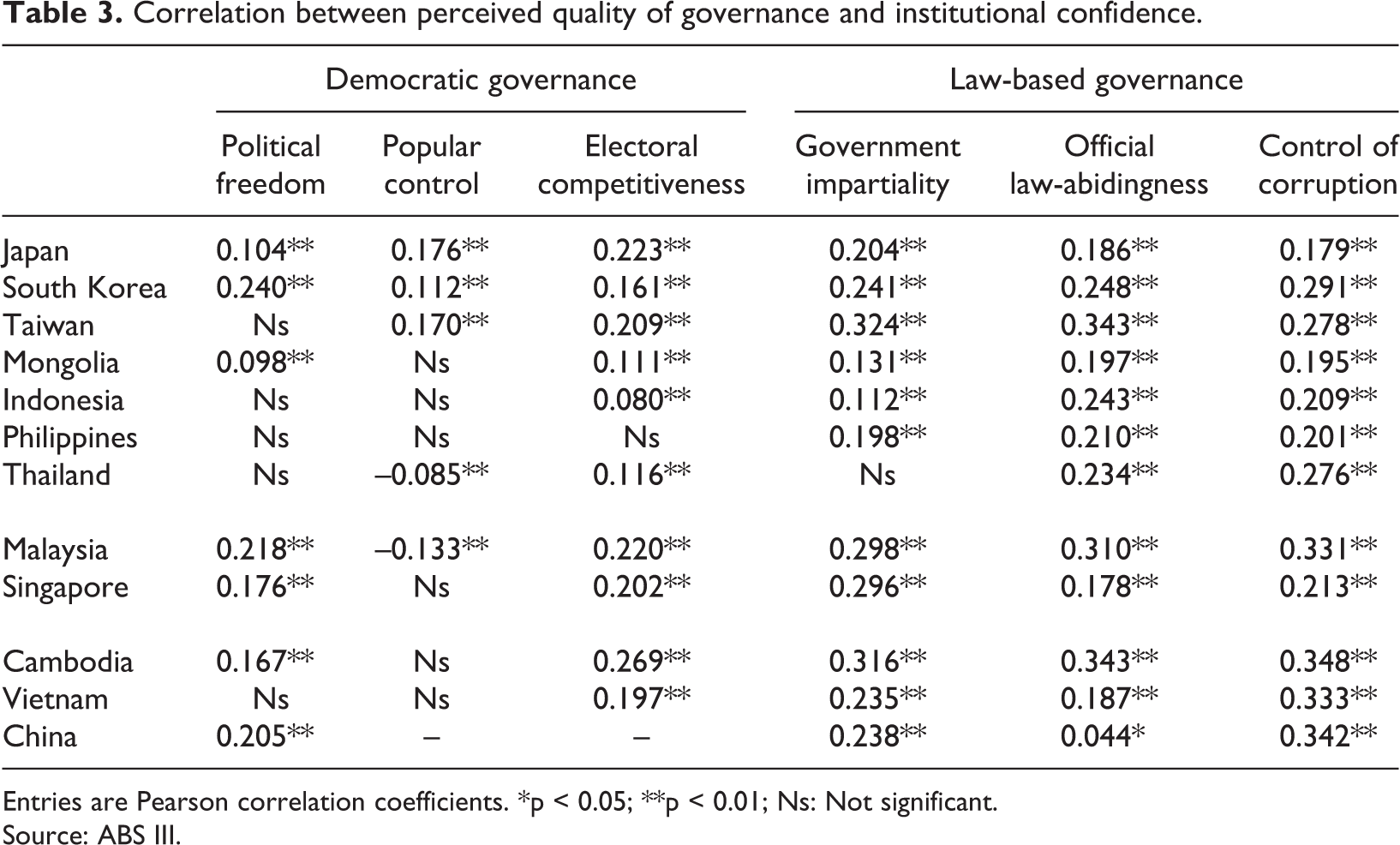
Entries are Pearson correlation coefficients. *p < 0.05; **p < 0.01; Ns: Not significant.
Source: ABS III.
As shown in the second column of Table 3, aspects of law-based governance were more strongly and consistently related to institutional confidence. Government impartiality was significantly related to institutional confidence in every sample country except for Thailand. Notable is that the relationship was stronger in authoritarian regimes, suggesting that equal treatment might enhance institutional confidence in closed and repressive political regimes. The other aspects of law-based governance also fared better. In every country examined official law-abidingness was significantly related to institutional confidence. Taiwan and Cambodia displayed the strongest relationship. They were followed by Malaysia. In China the relationship was significant but negligibly weak. Similarly, in every country examined control of corruption was significantly related to institutional confidence. Cambodia displayed the strongest relationship. It was followed by China, Vietnam, and Malaysia. This finding suggests that official corruption might constitute a major source of political cynicism in closed and repressive political regimes.
In brief, in more affluent democracies law-based governance was most often related to regime support. This pattern was also found in authoritarian regimes. By contrast, in less affluent democracies neither law-based governance nor democratic governance was strongly related to regime support. Overall, quality of law-based governance mattered more to regime support than that of democratic governance regardless of regime types.
Multivariate analysis
In this section I examine the relative importance of two modes of governance in shaping regime support. To do that, I performed OLS on all aspects of the governance modes and estimate their independent effects on regime support country by country. 7
Regime allegiance
Table 4 presents the results of micro-level analysis for regime allegiance. The explanatory power of our model varied from one country to another. The model worked best in Malaysia where nearly two-fifths of the variance was accounted for. In six of the 10 countries examined the model accounted for more than one-fifth of the variance. The model worked most poorly in the Philippines, Indonesia, Thailand, and South Korea, all new democracies. The model seemed to work better in authoritarian regimes in which political legitimacy was often based on substantive rather than procedural performance.
Individual-level model for regime allegiance in 10 countries: OLS.
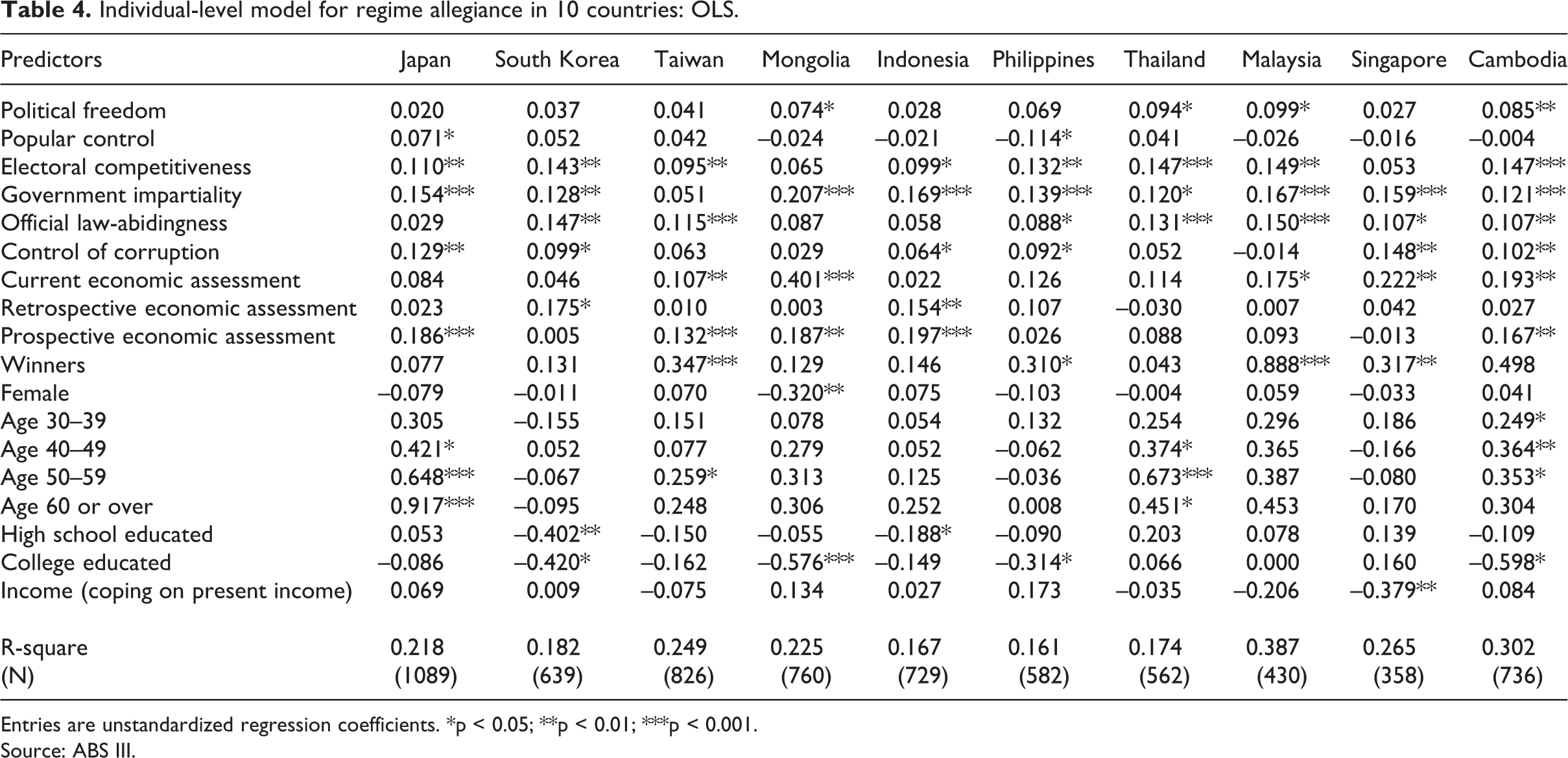
Entries are unstandardized regression coefficients. *p < 0.05; **p < 0.01; ***p < 0.001.
Source: ABS III.
As presented in Table 4, political freedom had significant effects in only four of the 10 countries examined. Popular control had effects in only two of the 10 countries. The effects were even in the opposite direction. By contrast, electoral competitiveness had effects in eight of the 10 countries. Of aspects of democratic governance, competitive and meaningful elections most often had effects on regime allegiance. Yet, the effects remained largely small.
The aspects of law-based governance fared better. Impartiality had effects in nine of the 10 countries examined. Law-abidingness had effects in seven of the 10 countries. Control of corruption had effects in six of the 10 countries. Of aspects of law-based governance, equal treatment by government proved to be the most consistent, if not always the strongest, predictor of regime allegiance.
As regards the magnitude of effects, government impartiality was the strongest predictor in six of the 10 countries while electoral competitiveness and official law-abidingness were both the strongest predictors in two. This finding suggests that quality of law-based governance served as a more important source of regime allegiance across the region. Overall, government impartiality most often contributed to regime allegiance, democratic or authoritarian. It was closely followed by electoral competitiveness, law-abidingness, and control of corruption. In contrast, political freedom and popular control, hallmarks of democratic governance, remained as a negligible source of regime allegiance, democratic or authoritarian.
As compared with governance performance, national economic performance less often had significant effects. Current and prospective evaluation had effects in five of the 10 countries. Retrospective evaluation fared worse: it had effects in only two of the 10 countries. Interesting is that in authoritarian regimes current evaluation more often mattered. By contrast, in democracies prospective evaluation more frequently mattered. Notable is that in eight of the 10 countries national economic performance had stronger effects than any governance performance. Two exceptions were the Philippines and Thailand, faltering new democracies at the time of the survey.
The winner-loser thesis was substantiated in only four of the 10 countries. Being winners instead of losers had effects in Taiwan and the Philippines as well as in Singapore and Malaysia. The first two were presidential democracies while the latter two, competitive authoritarian regimes. The findings indicate that the impact of being winners was more notable in presidential than parliamentary democracies. Moreover, being winners had large effects in competitive authoritarian regimes which lacked a level playing field. The findings suggest that regime types as well as forms of government might be related to the winner-loser gap in regime allegiance.
Finally, of socio-demographic variables gender had effects in only one of the 10 countries. Age groups had effects in only four of the 10 countries. Education groups had effects in just five of the 10 countries. Income, as measured by coping on present income, had effects in only one of the 10 countries. Overall, social background variables thought to be associated with socialization, modernization, or generational replacement proved to be poor predictors of regime allegiance across much of the region.
Institutional confidence
Table 5 presents the results of micro-level analysis for confidence in institutions. The explanatory power of the model also varied from one country to another. The model worked best again in Malaysia where more than two-fifths of the variance was accounted for. In seven of the 10 countries examined the model accounted for more than one-fifth of the variance. The model worked poorly in Mongolia, Japan, and the Philippines, all democracies. Overall, the model seemed to work better in authoritarian regimes in which political legitimacy was often based on outcomes rather than procedures. Interesting is that the model worked better in accounting for institutional confidence than regime allegiance. In eight of the 10 countries the model accounted for more variance in institutional confidence than regime allegiance, suggesting that the former captured more specific regime support than the latter.
Individual-level model for institutional confidence in 10 countries: OLS.
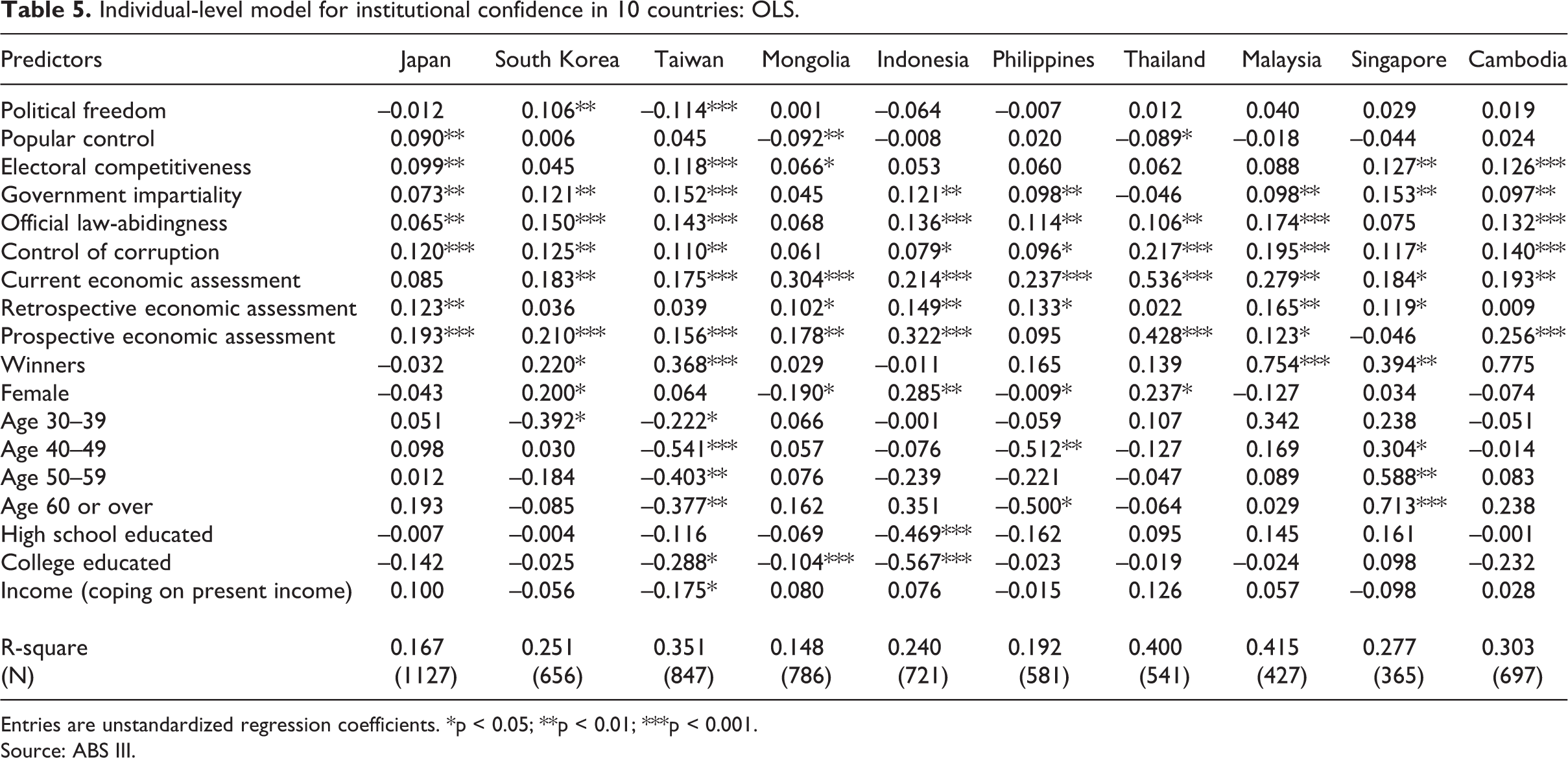
Entries are unstandardized regression coefficients. *p < 0.05; **p < 0.01; ***p < 0.001.
Source: ABS III.
As presented in Table 5, political freedom had effects in only two of the 10 countries examined. They were South Korea and Taiwan. Yet, the effects were in the opposite direction: in South Korea political freedom contributed to institutional confidence whereas in Taiwan the opposite was the case. Popular control had effects in only three of the 10 countries. They included Japan, Mongolia, and Thailand, all democracies. In Mongolia and Thailand the effects were negative, indicating that increased people’s power would lower confidence in institutions. Electoral competitiveness fared better. It had effects in five of the 10 countries. The exceptions were South Korea, Indonesia, the Philippines, and Thailand, all new democracies. In authoritarian regimes even a facade of competitive elections would increase confidence in institutions.
The aspects of law-based governance fared better. Government impartiality had effects in eight of the 10 countries examined. The two exceptions were Mongolia and Thailand. Similarly, law-abidingness had effects in eight of the 10 countries. The two exceptions were Mongolia and Singapore. Control of corruption also had effects in nine of the 10 countries. The only exception was Mongolia. It is intriguing that in Mongolia no aspect of law-based governance contributed to institutional confidence. Overall, law-based governance more often had effects on confidence in institutions than democratic governance did.
Of all aspects of governance, it turned out that law-based governance served as a more consistent contributor to institutional confidence. No aspect of democratic governance emerged as a stronger predictor than aspects of law-based governance. In particular, key features of electoral democracy such as political freedom and popular control hardly served as major sources of institutional confidence.
National economic performance fared far better in accounting for confidence in institutions. Current assessment had effects in nine of the 10 countries. Prospective assessment had effects in eight of the 10 countries. In contrast, retrospective assessment performed less well: it had effects in six of the 10 countries. As compared with governance performance, national economic performance emerged as the strongest predictor of institutional confidence in most sample countries, democratic or non-democratic.
Being winners instead of losers had effects in only four of the 10 countries examined. They included South Korea, Taiwan, Malaysia, and Singapore. This finding again indicates that the impact of being winners was greater in competitive authoritarian regimes than electoral democracies and that among electoral democracies it was greater in presidential systems than parliamentary ones. The findings suggest that regime types as well as forms of government might be linked to the winner-loser gap in institutional confidence.
Finally, for the socio-demographic variables, gender had effects in four of the 10 countries though the direction of the relationship remained mixed. Age groups had effects in just four of the 10 countries. In Taiwan, the old tended to have less confidence in institutions of democracy than the young. By contrast, in Singapore the old tended to have more confidence in institutions of pseudo-democracy than the young. Education groups had effects in only three of the 10 countries. In Taiwan, Mongolia, and Indonesia people with college education tended to have less confidence in institutions of democracy than those without high school education. Income, as measured by coping on present income, had effects in only one of the 10 countries. As in regime allegiance, social background variables thought to be associated with socialization, modernization, or generational replacement proved to be poor predictors of institutional confidence across much of the region.
To sum up, rule of law more often had effects on regime allegiance than democratic accountability. This pattern was also found for institutional confidence. The findings indicate that not only in democracies but also in authoritarian regimes, support for the prevailing system of government more often depended on whether public authority was exercised in accordance with the rules of society. 8 In more affluent countries the influence of economic performance in increasing regime allegiance seemed limited. By contrast, in less affluent countries it played a notable role. The finding also shows that as the level of electoral democracy deepened, law-based governance became more relevant in shaping regime support. Nonetheless, economic performance stood out as one of the most important contributors to institutional confidence, if not regime allegiance, across much of East Asia. In most new democracies free and fair elections themselves may not guarantee higher regime support. The outstanding sources of regime support appear to be rule of law as well as national economic condition. Public support for the prevailing system of government seemed to reflect less the influence of socio-cultural changes than the impact of governance performance and economic outcomes.
Summary and conclusion
In this article I examine public evaluations of governance quality in East Asia and explore whether perceived governance performance impacts regime support and which mode of governance matters most or least. In this study governance refers to the exercise of public authority. Two modes of governance are distinguished: democratic and law-based. One pertains to the institutions by which the exercise of public authority is made accountable to the public and consists of three aspects—political freedom, popular control, and electoral competitiveness. The other pertains to the institutions by which the exercise of public authority is made in accordance with the rules of society and consists of three aspects—impartiality, law-abidingness, and control of corruption. Hence, perceived quality of governance refers to evaluation of the extent to which current institutions of governance measure up to these standards of good governance. It is hypothesized that perceived governance performance shapes support for the prevailing system of government.
It was revealed that public evaluations of governance diverged from expert-based assessments across much of East Asia. In the eyes of their publics, more affluent democracies fared worst while competitive authoritarian regimes fared best. It seems that the more a county was democratic, the more likely its citizens were to be critical of governance performance. It could be the case that democracies actually performed worse than authoritarian regimes. It could also be the case that citizens in democracies were more informed about the realities of governance than their counterparts in authoritarian regimes. Another important reason is that the quality of governance citizens expected was higher in democracies than in authoritarian regimes because citizen expectations rose with additional democratic improvement or qualitatively changed with social modernization (Dalton and Welzel, 2014). In any case, East Asian democracies remained far short of citizen expectations of good governance. The region’s third-wave democracies suffered various governance deficits in the eyes of their publics.
It was found that for democratic governance popular control over government or vertical accountability turned out to be least institutionalized across East Asia. Even democracies in the region remained largely lacking in meaningful electoral competitiveness. It was also found that for law-based governance most political regimes including democracies remained weak in government law-abidingness. Control of official corruption was not adequately provided. Overall, a weak rule of law remained the most notable symptom of governance malaise across much of the region.
It was discovered that governance performance impacted regime support but not all aspects of governance mattered. Law-based governance served as a more notable source of regime support regardless of regime types. It was found that the condition of the national economy greatly influenced institutional confidence, if not regime allegiance, especially in less affluent democracies. Moreover, citizens in open and inclusive regimes were more critical of the prevailing system of government than those in closed and repressive regimes, attesting the thesis of the emergence of assertive citizenship. Overall, at the individual level regime support across much of East Asia seemed to depend on law-based governance as well as national economic performance. One of the major challenges for East Asian democracies to sustain or increase public support in the midst of economic uncertainties is to improve quality of governance primarily by establishing or strengthening the rule of law.
Footnotes
Declaration of conflicting interests
The author(s) declared no potential conflicts of interest with respect to the research, authorship, and/or publication of this article.
Funding
The author(s) disclosed receipt of the following financial support for the research, authorship, and/or publication of this article: This work was supported by the Ministry of Education of the Republic of Korea and the National Research Foundation of Korea (NRF-2015S1A3A2046562).
Notes
Appendix
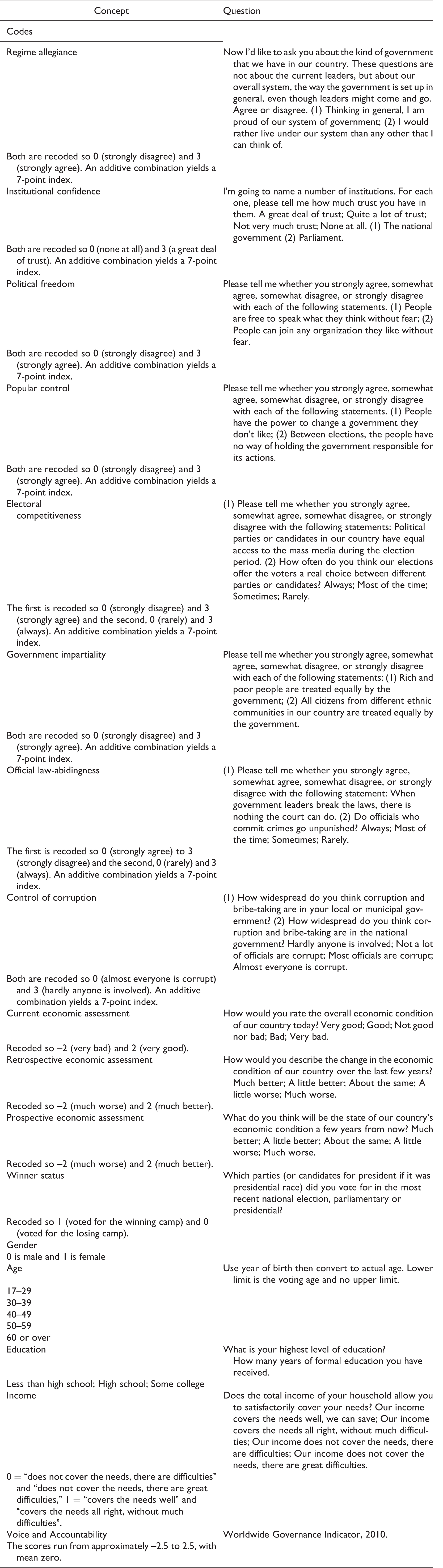
| Concept | Question | Codes |
|---|---|---|
| Regime allegiance | Now I’d like to ask you about the kind of government that we have in our country. These questions are not about the current leaders, but about our overall system, the way the government is set up in general, even though leaders might come and go. Agree or disagree. (1) Thinking in general, I am proud of our system of government; (2) I would rather live under our system than any other that I can think of. | Both are recoded so 0 (strongly disagree) and 3 (strongly agree). An additive combination yields a 7-point index. |
| Institutional confidence | I’m going to name a number of institutions. For each one, please tell me how much trust you have in them. A great deal of trust; Quite a lot of trust; Not very much trust; None at all. (1) The national government (2) Parliament. | Both are recoded so 0 (none at all) and 3 (a great deal of trust). An additive combination yields a 7-point index. |
| Political freedom | Please tell me whether you strongly agree, somewhat agree, somewhat disagree, or strongly disagree with each of the following statements. (1) People are free to speak what they think without fear; (2) People can join any organization they like without fear. | Both are recoded so 0 (strongly disagree) and 3 (strongly agree). An additive combination yields a 7-point index. |
| Popular control | Please tell me whether you strongly agree, somewhat agree, somewhat disagree, or strongly disagree with each of the following statements. (1) People have the power to change a government they don’t like; (2) Between elections, the people have no way of holding the government responsible for its actions. | Both are recoded so 0 (strongly disagree) and 3 (strongly agree). An additive combination yields a 7-point index. |
| Electoral competitiveness | (1) Please tell me whether you strongly agree, somewhat agree, somewhat disagree, or strongly disagree with the following statements: Political parties or candidates in our country have equal access to the mass media during the election period. (2) How often do you think our elections offer the voters a real choice between different parties or candidates? Always; Most of the time; Sometimes; Rarely. | The first is recoded so 0 (strongly disagree) and 3 (strongly agree) and the second, 0 (rarely) and 3 (always). An additive combination yields a 7-point index. |
| Government impartiality | Please tell me whether you strongly agree, somewhat agree, somewhat disagree, or strongly disagree with each of the following statements: (1) Rich and poor people are treated equally by the government; (2) All citizens from different ethnic communities in our country are treated equally by the government. | Both are recoded so 0 (strongly disagree) and 3 (strongly agree). An additive combination yields a 7-point index. |
| Official law-abidingness | (1) Please tell me whether you strongly agree, somewhat agree, somewhat disagree, or strongly disagree with the following statement: When government leaders break the laws, there is nothing the court can do. (2) Do officials who commit crimes go unpunished? Always; Most of the time; Sometimes; Rarely. | The first is recoded so 0 (strongly agree) to 3 (strongly disagree) and the second, 0 (rarely) and 3 (always). An additive combination yields a 7-point index. |
| Control of corruption | (1) How widespread do you think corruption and bribe-taking are in your local or municipal government? (2) How widespread do you think corruption and bribe-taking are in the national government? Hardly anyone is involved; Not a lot of officials are corrupt; Most officials are corrupt; Almost everyone is corrupt. | Both are recoded so 0 (almost everyone is corrupt) and 3 (hardly anyone is involved). An additive combination yields a 7-point index. |
| Current economic assessment | How would you rate the overall economic condition of our country today? Very good; Good; Not good nor bad; Bad; Very bad. | Recoded so –2 (very bad) and 2 (very good). |
| Retrospective economic assessment | How would you describe the change in the economic condition of our country over the last few years? Much better; A little better; About the same; A little worse; Much worse. | Recoded so –2 (much worse) and 2 (much better). |
| Prospective economic assessment | What do you think will be the state of our country’s economic condition a few years from now? Much better; A little better; About the same; A little worse; Much worse. | Recoded so –2 (much worse) and 2 (much better). |
| Winner status | Which parties (or candidates for president if it was presidential race) did you vote for in the most recent national election, parliamentary or presidential? | Recoded so 1 (voted for the winning camp) and 0 (voted for the losing camp). |
| Gender | 0 is male and 1 is female | |
| Age | Use year of birth then convert to actual age. Lower limit is the voting age and no upper limit. | 17–29 |
| Education | What is your highest level of education? How many years of formal education you have received. | Less than high school; High school; Some college |
| Income | Does the total income of your household allow you to satisfactorily cover your needs? Our income covers the needs well, we can save; Our income covers the needs all right, without much difficulties; Our income does not cover the needs, there are difficulties; Our income does not cover the needs, there are great difficulties. | 0 = “does not cover the needs, there are difficulties” and “does not cover the needs, there are great difficulties,” 1 = “covers the needs well” and “covers the needs all right, without much difficulties”. |
| Voice and Accountability | Worldwide Governance Indicator, 2010. | The scores run from approximately –2.5 to 2.5, with mean zero. |