




Abstract
Migrant remittances have been linked to improving the quality of government and political accountability in the developing world. The argument is that migrants have the capacity to withhold remittances to their families when they deem that their local governments are blighted with corruption and bureaucratic inefficiency. Relatedly, migrants also empower citizens in sub-national regions by providing funds to family members who become less beholden to clientistic ties with political parties which concomitantly foster state-level corruption. Thus, relatives of migrants also become social agents who will increasingly expect better governmental performance and demand higher levels of political accountability at the sub-national level. Using data provided by the Philippine National Statistics Office and the National Statistical Coordinating Board of the Philippines (NSCB hereafter), the study provides empirical evidence that the number of migrants (by province) and the amount of remittances sent by migrants are positively associated with governmental effectiveness and higher levels of human development at the provincial level. It is also found that opportunistic shirking on the part of the sub-national governments is also not occurring, as remittances also induce provincial governments to spend more on their citizens, which will likely lead to better public goods provision. The overall findings imply that just like their counterparts from other developing countries, Filipino migrants are agents of democratic accountability.
Introduction
Migrant remittances have been linked to improving the quality of government and political accountability in the developing world. The argument is that migrants have the capacity to withhold remittances to their home governments when they deem that the state is blighted with corruption, bureaucratic inefficiency, or governmental mal-performance. This is attributed to the fact that migrants usually identify with their host country’s political culture where host state governments are characterized by the efficient delivery of public goods and services and higher levels of political accountability. As a result, migrants can be construed as social agents of change as they use their earning capacity to influence the growth of national economies and influence public goods provision.
The Philippines is an excellent case to explore the effect of migrant remittances on the quality of government. This is because it is one of the few countries in the developing world whose labor force has largely been exported overseas as a result of a poor labor market since the 1970s. According to Hewison and Young (2006), Filipino remittances have sustained the growth of the Philippine economy by constituting a large percentage of the yearly GDP growth rate of the nascent democracy. Recent statistics provided by the Central Bank of the Philippines estimate that in 2011 more than 9.5 million overseas Filipinos resided and worked abroad and that they accounted for US$20 billion in remittances (Central Bank of the Philippines, 2012). Estimates from the World Bank officially put the number of overseas foreign workers closer to 15–20 million since 2005 (World Bank, 2004, 2006, 2010, 2012). The beneficiaries of these remittances are extended to family members whose everyday livelihoods are dependent on the money sent by their relatives overseas.
Considering the large impact migrants and remittances have on the Philippine economy and society at large, it is important to explore and investigate empirically the purported positive or negative effects of remittances on economic, social, and political outcomes. Such studies are few and far between, and mostly look at the effect of remittances on economic growth, income inequalities, educational outcomes, and familial relations. Rodriguez’s (1998) seminal work provides empirical evidence that Filipino migrants may increase income inequalities which may inadvertently lead to losses in the domestic economy in the long term. However, Yang’s (2008) follow-up study published 10 years later confirms the positive effect Filipino remittances have on expanding local businesses, private enterprises at the household level, and state expenditures on education. A more nuanced contribution also finds that Filipino migratory patterns reduce the labor supply of non-migrant relatives, increasing dependence on remittances in the long term. Remittances also lead to an increase in household spending based on leisure activities among the most-educated households indicating higher levels of social mobility. However, this mobility is not constant across all socio-economic groups, which promotes a certain degree of income inequality (Rodriguez and Tiongson, 2001). Others have also looked at the effect of Filipino migrants on decreasing the school performance of children of migrants and their self-reported scores on social well-being (Battistella and Conaco, 1998; Parreñas, 2005). More recently, empirical work by Cortes (2015) finds that the children of migrant mothers tend not to perform well in primary school (as compared to those children of migrant fathers), even when controlling for remittances. But none of the studies above have explored the dimension of if Filipino migrants and the remittances they send have political consequences—more specifically, if migrants and remittances are correlated in improving effective governance at home at the sub-national level, which is the major objective of this study. This is particularly an important question to explore because research in comparative politics has shown that remittances sent by an overseas workforce can have several effects in terms of increasing prospects for expanding the political voice of citizens, thus facilitating political empowerment (Burgess, 2005; Brady et al., 1995; Pérez-Armendáriz and Crow, 2009; Tyburski, 2012). Kurtz (2004), in his ethnographic analysis, finds that Mexican voters in the Northern region are less likely to be beholden to the politics of client-patronage as their dependence on state handouts is replaced by the existence of a steady stream of revenue coming from their immediate relatives working in the United States. Tyburski (2012) asserts that this allows Mexican voters in the North to threaten the political dominance of the ruling party. Thus, citizens in northern Mexico were more likely to defect and support the political opposition in regional and national elections. Therefore, the reduction in clientelistic ties and the exit of voters in their support of the ruling party have made the ruling party more pro-active in initiating reforms aimed at improving infrastructure development and the quality of public service in the countryside (Kurtz, 2004).
This study explores how remittances can affect the quality of government and governmental performance. Take note that this study does not focus on the performance of the Philippine national government but rather its focus is on the performance of Philippine provinces—the country’s sub-national regions. This in itself is novel and can increase the generalizability of this study to the corpus of empirical work on global migrants because, as suggested by Sybblis and Centeno (2017: 800), “[t]he global move toward decentralization and the seeming retreat of social groups to their distinct corners imply that subunits (both states and local governments), sectors and regions may have more explanatory value” in understanding political dynamics that are at play. Further, most of the extant work on linking remittances and migrants on governmental performance tends to be assessed and examined from a cross-national perspective, using nation-states as the units of analysis. It largely neglects the temporal and cross-sectional variations within regions or sub-national units in many of these countries. Thus, this study can better inform us if remittances and migrants have substantive impacts on regional governments, granted that remittances have increasingly been seen as facilitating local development and political accountability in peripheral and rural regions of developing states (Rempell, 2005).
Using data provided by the Philippine National Statistics Office, the Philippine Overseas Employment Administration (POEA hereafter), and the NSCB of the Philippines, I find evidence that the raw number of migrants (by province) and the amount of remittances sent by migrants are positively associated with governmental effectiveness and effective public goods provision at the provincial level. The results are consistent even when I use an instrumental variable (amount of rainfall) in Two Stage Least Squares (2SLS hereafter) regression modeling that mitigates for endogeneity and simultaneity concerns. The implications of the study suggest that just like Mexico, Filipino migrants can be construed as agents of democratic accountability and political reform.
This study proceeds in several parts. The first section elucidates on the theory of how remittances promote better governance globally and in the Philippines. The second section elaborates on pessimistic accounts of how remittances contribute to governmental mal-performance and corruption and negatively affect the effective distribution of public goods. The next section justifies the selection of the Philippines as a case to explore the research question at hand. The fourth section presents the data, formalizes the research design, and presents the empirical findings. The final section concludes and offers implications/limitations of the results of the study.
How migrants and remittances promote better governance
Extant scholarship in comparative politics has increasingly noted how migrant remittances are a manifestation of globalization that can strengthen democratic accountability and performance (Burgess, 2005; Kurtz, 2004). This is because migrants and their immediate kin (who benefit from their earnings) have been categorized as concentrated interest groups that “are economic actors with large scales of production, proximate locations, and high product homogeneity that can sway political outcomes and influence policy” (Tyburski, 2012: 339).
Empirical work has documented that remittances have improved poverty rates in the developing world as well as facilitating the rise of a middle-class segment (Adams and Page, 2005). Others have also explored how migrants have facilitated human capital development, effective diaspora networks that respond to national crises in times of natural disasters or economic recessions, and the efficient transfer of technology and cultural norms that can trigger cultural transformations (Clemens et al., 2015). Recently there has been recognition that migrant behavior can actually go beyond its developmental contributions and that migrants can be construed as agents of social and political change. For example, there is a burgeoning line of research documenting how remittances may actually contribute to and facilitate better access to public services, governmental performance, and infrastructure development in the developing world, including Asia, Africa, the Middle East, and Latin America (Adams, 1998; Adams and Page, 2005; Adida and Girod, 2011; Ahmed, 2002; Chaudhry, 1989; Chimhowu et al., 2005; Cohen and Rodriguez, 2005; Edwards and Ureta, 2003; Frank and Hummer, 2002; Hildebrandt et al., 2005; Lopez-Cordova, 2006; Woodruff and Zenteno, 2007). More importantly, these studies convey a correlation between remittances and the quality of governance measured in terms of improved school enrollment, lower levels of literacy, and improving infant mortality rates.
Levitt (1998) was one of the first scholars who argued about the transformative role of migrants due to their power to affect political dynamics in their hometowns. This is because the money that migrants send back to family members also generates what is conceptually defined as ‘social remittances’ which can have an impact on normative behaviors, systems of social practice, and the density of social capital in local communities. Thus, through the financial dependency of families on migrant remittances, migrants can gain the upper hand in terms of influencing the development of political ideas, values, and ideologies in local communities. Therefore, migrants can play a role in the political socialization of citizens back in their countries of origin, especially as it pertains to civics and political participation. Imbued in this is a hierarchical dynamic where migrants influence citizens back in their communities as these form ever-denser networks that increase over time. These networks shape what acceptable forms of political behavior are (Tarrow S, 2011). More recently, Faist and Fauser (2011) also conceptualize migrants as agents of change because they are a critical mass that can demand political accountability through such dense social networks.
Singer (2010) and Frankel (2011) also allude to how remittances are long-term investments that are not associated with the state. Since they mostly escape taxation and state interventionism on how they are allocated and dispersed, they can threaten public officials to perform or risk political survival.
Using this theoretical position, Tyburski (2012) finds that Mexican states (during the period 2001–2007) that received a higher number of remittances had lower levels of state-level corruption—indicative of good governance, even when controlling for economic performance, political competition, economic openness, and other demographic characteristics like population and the persistence of income inequality. As such, remittance income empowers migrants as providers and suppliers of public goods and services and may be seen by state authorities as rival providers or suppliers of public goods. Implicit in this new relationship is how the government may find it necessary to improve performance (and hence reduce corrupt activities) or risk being labeled by the public as irrelevant, leading to the loss of elective office or party dominance in the next electoral cycle. Thus, there is pressure to perform among state officials so as to maintain a semblance of political legitimacy. The critical link is how the government can be compelled to perform amid rising expectations and demands from migrants and their families, as they become more critical about the inherent incompetence of governmental officials through dismal bureaucratic performance and the inefficient distribution of public goods.
O’Mahony’s (2012) empirical analysis of 81 developing states during 1990–2005 discovers that remittances actually increase in number and frequency during election year cycles especially during a time where an incumbent is not seeking re-election, that is when all or both political rivals in an election are true challengers. This phenomenon is actually more prevalent among poorer nation-states that have large migrant populations. This goes to show that remittances have the capacity to make or break the electoral chances of political challengers, empowering them especially if they run on a pro-reform or populist agenda. Thus, electoral outcomes that are influenced by the influx of remittances on election cycles may facilitate better governance in the long term.
Pfutze’s (2014) analysis of migrant remittances in Mexico also finds that these diffused ‘resources’ had an impact in making Mexican elections at the municipal level more competitive, weakening the dominance of dominant parties, and empowering the opposition parties, which had the effect of weakening the prevalence of client-patron relations. In sum, remittances can reduce the prevalence of vote buying, empower political challengers, and promote democratic change in states that are shackled by dominant one-party systems that utilize autocratic tendencies (Escribà-Folch et al., 2015).
The positive effects of migrant remittances on political accountability can also be seen as emanating from cultural transmission effects. Pérez-Armendáriz and Crow (2010) find that in the Mexican context, recipients report higher levels of political activism when they have relatives overseas who send them remittances. Thus, migrants may encourage their relatives back home to be more pro-active in demanding for better governance, as migrants become assimilated to a new political culture where governmental responsiveness to citizen demands is common place.
Lastly, migrants from the developing world show that they are likely to be agents of reform and call for more governmental accountability in their home states, because many opt to return and thus are labeled as return migrants (Batista and Vicente, 2011). Thus, while employed overseas, temporary migrants may pressure their home states to establish reforms by influencing social networks back at home (like family) or withhold remittance as a form of collective protest. This is related to an outward migrant’s desire to have more responsive and accountable institutions when they return which will impact their posterity and their desire for a prosperous future.
How Filipino migrants promote good governance and public goods provision
Another realm in which migrants and the remittances can improve governmental performance is through Migrant Hometown Associations (HTAs hereafter) (Orozco and Lapointe, 2004). According to scholars, Filipino HTAs began to grow in scope and relevance beginning in the 1970s and are officially organized at the provincial level. For example, the Ilocanos (from Ilocos Norte and Ilocos Sur provinces) who temporarily migrated to Hawaii were pioneers in pooling resources to help developmental projects in their home provinces, as they pressured their local governments to improve basic infrastructure (Okamura, 1983). According to Okamura (1983: 344), the first Filipino HTAs in the United States were active in forming associations among migrants “that donated money to their hometowns for the construction of health centers, a water tank, an electric power plant, for repairs to the municipal building and town plaza, to assist schools, churches, and hospitals, and for walkie-talkies and uniform.”
Today, Filipino HTAs’ basic objectives can be classified as falling under three categories (see Liamzon, 2010). Some target areas back in their hometown for rural development and assistance to spur economic growth. Migrants pool their money and send it directly to local businesses and establishments to encourage entrepreneurial growth in the provinces. Such direct financial transfers help private institutions and establishments rival the state in providing public goods, especially when the state is seen by migrants as incapable of or inefficient in the distribution of resources. Second, some Filipino HTAs empower local communities in their hometown by pooling resources to donate medical equipment, school supplies, and even basic infrastructure materials like bricks, nails, and roofing material to help build clinics, schools, and community centers. Some of these activities are coordinated between HTAs and local Non-Governmental Organizations, non-profit organizations, and churches in the provinces, often obviating the direct involvement of local regional, provincial, or municipal governments. Third, these HTAs function to help solve regional crises that may arise by sponsoring and encouraging dense networks of campaign drives if a local community in their provinces is affected by a natural disaster such as a typhoons, earthquake, fire, or landslide. Thus, the HTAs function as a mechanism for migrant communities to maintain local and cultural ties with their hometowns. These philanthropic activities empower local communities, occurring in a backdrop where most want to improve the quality of life indicators in their hometowns as these eventually become their retirement enclaves after working overseas for many years. Where these Filipino HTAs can make a difference in generating good governance and better public goods provision in Philippine provinces is that they can function as non-state rivals to local governments. Thus, Filipino HTA behavior can induce local governments to perform in terms of ensuring the effective provision of public goods so that they can continue to be relevant and have vertical legitimacy with citizens.
In other contexts, HTAs have arranged partnerships with local governments to provide for better services, especially in the realms of health care, education, community development, and electrification programs (Liamzon, 2010).According to Liamzon (2010), these collaborative partnerships, which are similar to what is practiced in Mexico’s 3X1 program, 1 are compelling provincial governments in the Philippines to perform better because local officials want to be relevant amid pressure to perform due to the fear of not being re-elected. To substantiate the efficacy of these partnerships in spurring better governance, Fernandez (2008) cites that in 2006, Governor Oscar Moreno of Misamis Oriental province committed to a 1:1 matching program for every peso raised by overseas HTA organizations for key developmental projects in health, basic services, and infrastructure. After Moreno implemented this new policy, 15 provincial governors followed his lead. Furthermore, a study by the Economist Intelligence Unit (2008) cites the province of Pangasinan in Luzon as a successful case study where Filipino migrants from that province successfully established multiple HTAs in many regions of the world through active networking, and partnered with local government officials to improve rural development projects, including improving health clinics, roads, latrine lines, and policing.
Salazar (2012: 10) also cites that the Cordillera region of Luzon has benefitted from the Igorot Global Organization where a dense network of migrants pressured the local government in the provinces of Abra, Benguet, and Ifugao to be more pro-active in contributing towards socio-economic, health, and environmental programs. Similarly, the Morong Balikbayan Association is also a recognized Filipino global HTA that benefitted the province of Rizal in Luzon, in an effort to improve basic infrastructure by partnering and making the local government commit to improving public goods provision (Salazar, 2012: 10). Landon (2014: 1), in her study on Tarlac province in Luzon, also finds that dense emigrant networks do not encourage local governments to abandon their duties of being the sole provider of public goods—rather, HTAs from Tarlac “supplement and complement the local government’s” task of public goods provision. Landon concludes that the presence of remittances “make the local government aware of the needs in the community.” Thus, local government officials in Tarlac became more responsible and accountable (Landon, 2014: 1). Other HTAs like PANDI (Philippine Advocates for Neighborhood Development) of Bulacan province in Luzon have also taken charge of using migrant networks and remittances from that province to provide for medical and dental services and community development infrastructure projects which have long been neglected by the province (Opiniano, 2014).
In sum, the proliferation of Filipino HTA activity should lead to better governance and the provision of public goods, as local governments risk losing the electoral support of the masses. Such threats can induce governments to perform in order to achieve vertical accountability so long as these non-state rivals exist. In other circumstances, remittances influence local governments to partner up with MHAs, as a way to maintain legitimacy, which can only benefit citizens in the long term in terms of enhancing their quality of life.
The potential negative effects of migrant remittances on governance
However, there are scholars who regard remittances as a resource curse (Abdih et al., 2012). Empirical research has shown that remittances may actually promote political apathy among recipients. Studies explain how economic recessions are positively correlated with a spike in the frequency and amount of remittances (Clarke and Wallsten, 2003; Yang and Choi, 2007). As a result, recipients no longer have the incentive to vote, hold rallies and demonstrations, or take pro-active steps to hold incumbents accountable. In the absence of any type of vertical accountability from voters, remittances can promote corruption as levels of political activism and participation decline (Goodman and Hiskey, 2008).
Remittances can also drastically affect governmental performance, as states take advantage of their windfall potential. Empirical analyses by Abdih et al. (2012) and Ahmed (2012, 2013) demonstrate that remittances drastically improve household incomes. As these incomes accrue, recipients no longer become beholden to social services provided by the state in terms of education, healthcare, and public goods provision. Since rising incomes attributed to middle- and upper-income households tend to remain constant over time, the government may shirk their obligation to provide for the common good, thus lowering incentives for the state to promote better governance in terms of improving public services through spending. In fact, remittances could facilitate higher levels of corruption, as money ear-marked for public goods provision is diverted away for the personal gain of political incumbents and party bosses. As such, state authorities increasingly rely on these remittances to sustain public services. To substantiate, research by Adida and Girod (2011) and Calero et al. (2009) shows that remittances have practically financed the establishment of sanitation facilities, clean water facilities, and access to education in Mexico and Ecuador, which may induce the local and national governments to abandon their commitment to public goods provision and divert these funds elsewhere.
Given the propensity for corruption and the pervasiveness of client-patronage at the local level in the Philippines (De Dios and Ferrer, 2001; Doronila, 1985), we cannot discount how Filipino remittances can have negative effects on public good provision. In the context of Philippine politics, the government may shirk their obligations to provide for public goods, with the expectation that relatives abroad can provide for those needs as remittances create a “fiscal space” that opportunistic politicians may target for corruption (Martin, 2013).
Filipino migrants as agents of political reform
The Philippines is an excellent case to look at the effects of long-term remittances on governance and public goods provision. According to World Bank (2012) data, the amount of remittance inflows (in US$ million) from Philippine migrants has been steadily increasing since 1977, attaining a pronounced upward trajectory since 1998, which is around the time of the Asian Financial Crisis, and has not abated since it peaked in that same year. Estimates by the Asian Development Bank (2008) (ADB) find that about 12–14% of the GDP of the Philippines is constituted by the remittances sent by overseas Filipino workers. The Central Bank of the Philippines (2012) also reports that in 2009 there were an estimated 9 million overseas Filipino workers, nearly a tenth of the estimated population of the Philippines (estimated at 95 million). The collective remittances they sent in 2009 amounts to US$15.8 billion, which is equivalent to around 11–12% of the Philippine economy. As a result, the Philippines’ consumption growth rate was at an all-time high of 5%, far higher than the annual economic growth rate of less than 2% in 2009. In 2014, the World Bank estimated that Filipino public remittances amounted to around US$26 billion, which is the third highest in the world after India and China, beating Mexico (which ranks fourth) whose public remittances only amounted to about US$22 billion (World Bank, 2013). This phenomenon led many political analysts to suggest that the best export of the Philippines are its people who are also highly sought after because of their education level, skill-set, fluency in the English language, and cultural adaptability (Economist, 2010).
Philippine remittances have also been linked with improving political development in their home country. For example, Licuanan et al. (2015) find that that migrant associations render philanthropic assistance in sectors that the government cannot effectively reach, and can potentially rival the state for public goods provision. The only study that directly links Filipino remittances to promoting good governance and democratization at home is Kessler and Rother’s (2016) analysis on Filipino return migrants. One key finding is that the Filipino migrant diaspora from Hong Kong led to social activism and legislation at home that improved the quality of life of return migrants, including their families, communities, and beneficiaries.
In sum, it is evident that empirical research on the political impact of remittances has been scant. More empirical work is needed considering how scholars have labeled Filipino migrants not only as national heroes who help sustain the Philippine economy (McKay, 2012; Magalit-Rodriguez, 2010), “but as important brokers of social and political capital and as benefactors of their home country” (Le Espiritu, 2003: 85). Furthermore, they are also increasingly recognized by the Philippine government as an overseas community that can “influence and even shape the destiny of the homeland” (Le Espiritu, 2003: 85).
More recently, the political influence remittances have on changing political dynamics in the Philippines is increasingly evident as migrant organizations have organized successful protests called “Zero Remittance Days” (Jaymalin, 2015a; Santos, 2015). One of the political party-lists in the Philippine legislature called ‘Migrante’ has organized these trans-national protests with the participation of migrants from Europe, Asia, and the Middle East. The goal of these highly-publicized events is to withhold sending remittances to relatives on a single day as a way to change government policy or openly protest corruption, inefficiency, bureaucratic red tape, and demand accountability from the government. Since a large proportion of the Philippine GNP is dependent on these remittances, the collective withholding of this money in one day is estimated to generate a US$3 billion loss in the national economy according to one estimate by a Filipino Senator (Ager, 2015). What is notable about these ‘single day’ withholdings of remittances is that they have influenced many family recipients to protest governmental malfeasance or risk not getting the money they need for financial survival.
An example of when one of these protests was able to influence governmental policy was when the Benigno Aquino administration was forced to reverse its policy of taxing ‘Balikbayan boxes’
2
sent by migrants, which the government had earmarked as a possible way to earn additional revenue amounting to 600 million pesos. In 2015, the Aquino government was criticized by migrant organizations on how Balikbayan boxes had increasingly been inspected and taxed heavily by the Bureau of Customs. In response, migrant organizations sponsored protests to openly challenge the government (Jaymalin, 2015b). These prompted representatives of the party-list Migrante to claim: The migrant sector is a force to reckon with. Those who have insulted us will feel the brunt of OFWs [Overseas Foreign Workers] and their families’ ire this coming election season. We have millions of overseas absentee voters, we have millions of relatives back home who are voters. Let today’s Zero Remittance Day serve as a preview of the migrant sector’s unity come election time. (Santos, 2015: A-1)
Based on a thorough review of the literature and contemporary events, there have been no studies that directly examine if Filipino migrants and the remittances they send have an effect in promoting better democratic governance and public goods provision at the sub-national level, which requires further analysis. It is the goal of this study to ascertain if there is an empirical relationship granted that previous research in other regions of the world points to contradicting results.
Research design
Operationalizing the variables
To test whether or not migrants and their remittances have any positive or negative effects on the quality of governance and the provision of public goods, I employ a data-set provided by the POEA and the Philippine Migrant Right Watch (PMRW). These organizations provide data for the total number of migrants and the remittances they send back to their province of origin for 77 out of the 81provinces in the Philippines. 3 It is important to note here that this data-set is a largely truncated sample of Filipino migrants, as it excludes migrants who chose not to return to the Philippines and as a result relinquished their Filipino citizenship. It also excludes data on Filipino migrants who chose not to remit. The POEA does not provide data on these migrants—so the results presented here do not capture their potential political influence which is beyond the scope of this study.
The key determinants behind migratory patterns out of the Philippines are usually demarcated by major differences in motivations as to why Filipinos seek labor outside the home country. Some Filipino migrants, especially the highly affluent and the educated, may be motivated to leave because of bad governance, the absence of social mobility, corruption, the lack of meritocracy in a country plagued by nepotism, cronyism, and client-patronage, and inferior public goods provision. For others, especially among the very poor, the key motivation is based on financial survival and the need to provide for families to escape the cycle of poverty. This latter category is mostly Filipino migrants who have manual skills and do not engage in skilled labor.
The POEA does not provide data that makes a distinction between migrant types based on push or pull factors and motivations (e.g. highly skilled versus manual skilled migrants). Thus, exploring the nuanced differences as to whether or not the latter or the former are more likely to send remittances and contribute to better local governance is beyond the scope of this study because data is simply unavailable.
However, the POEA does provide data based on disaggregating the type of migrants between land-based workers and sea-based workers. It is important to delineate operationally the difference between these two types of migrants because the former constitutes the major bulk of Philippine migrants overseas, whilst the latter is also a sizeable number of Philippine migrants working in the shipping industry, which is a predominantly male-dominated occupation composed of Filipino seafarers, engineers, cooks, and staff in cruise ships. These latter contribute more remittances compared to land-based workers because they have lower levels of household expenses while stationed overseas—most do not have to pay for rent, utilities, or transportation costs. Furthermore, being male-dominated, sea-based work tends to be paid better compared with land-based work, since Philippine society still puts a premium on the social status of men as ‘providers’ in a society that continues to value a patriarchal social structure. For example, research has shown that male migrants contribute more remittances than their female counterparts to sustain the livelihoods of their immediate and extended families back in the Philippines (Magalit-Rodriguez, 2010). 4 Sea-based workers also tend to focus on accumulating savings as most see their occupational status as temporary, with many returning back home permanently to open small businesses after their labor contracts expire (Magalit-Rodriguez, 2010). Orozco et al. (2006) suggest that empirical studies on the political, economic, and social effects of remittances should be sensitive to its gendered effects, thus the data presented by the POEA pays heed to this important concern as it includes grand totals for both types of migrants and the remittances they send.
The POEA gives the total number of land- and sea-based migrants from each province and the total amount of remittances in Philippine pesos for three years—2000, 2003, and 2006—and has not since been updated (Philippine Overseas Employment Administration (POEA) (n.d.)) (see Institute for Migration and Development Issues (IMDI), 2010). I obtain the average value of the total number of land- and sea-based workers for each province and convert the value to its natural log because of its highly skewed distribution. The total number of migrants is an independent variable of significant importance considering how the number of migrants from each of the 77 provinces is a good proxy for the density of HTAs. As discussed earlier, Filipino HTAs created a critical mass of migrants who pooled resources to send financial aid directly to their local communities (provinces). Previous empirical work has shown that the higher the density and number of migrants from the same region the more effective they are at networking and pooling resources overseas in their effort to improve living conditions in their local regions by remitting money collectively (Orozco and Rouse, 2007).
The second independent variable is a proxy for financial contributions by individual migrants, or what is known in the literature as private-to-private financial transfers. However, the total amount of remittances needs to be weighted by the economic wealth of each sub-national unit, as suggested by Tyburski (2012) in his analysis of remittances’ positive effects in curbing state-level corruption in Mexico. Following his lead, I create a weighted value for remittances which is the amount of remittances sent to each of the 77 provinces by land- and sea-based migrants (in Philippine pesos) divided by each province’s Gross National Income (in Philippine pesos). 5 I then convert this value to its natural log to correct for the skewed distribution of the values, generating a weighted remittance value for each of the 77 provinces.
These variables constitute the two main independent variables of the study. They are run separately in the regression models as stand-alone independent variables to avoid collinearity, because they are essentially capturing the same measure as they are highly correlated where the Pearson’s r correlation coefficient is 0.8789 and statistically significant at p < 0.001. I combine the grand total of both land and sea migrants in the regression models presented because this accounts for the cumulative effect of Philippine migrants at the sub-national level, as suggested by other scholars (Talento, 2004). 6
Good governance is the primary dependent variable of this study. It is an elusive concept and one that is very difficult to operationalize. It encompasses a whole host of factors ranging from corruption, bureaucratic quality, and the efficient provision of public goods and services, to rule of law entrenchment. 7 For the purposes of this study, I adopt the operational definition of good governance as one that was formulated by Bueno De Mesquita et al. (2000, 2004), who argued that incumbents are re-elected based on how they distribute public goods and services to their constituents. They differentiate public goods from private goods because private goods are “targeted at narrow bands of supporters that are crucial for the incumbent to retain office, whereas public goods increase the welfare of everyone in the state” (Bueno de Mesquita et al., 2000: 64). Thus, public goods provision caters for majoritarian or populist concerns. It has a salient impact in terms of influencing electoral outcomes as incumbents rely on it as a tool to prolong their hold on power. As public goods provision becomes entrenched in a given society, collective societal pressure promotes governmental accountability as voter expectations on the quality of government services can only increase over time.
To measure good governance, I utilize the Good Governance Index measure (GGI hereafter) provided by the NSCB. This measure, which is only available for two years (2005 and 2008), is an aggregate measure of the administrative, political, and economic governance in each province. The three realms that constitute the GGI are collated from various data sources provided by the national government that include aspects concerning inflation rates, crime rates, voter turn-out rates, primary and secondary enrollment rates, health outcomes, and infrastructure development for all Philippine provinces. 8 The GGI for each province is computed as the weighted arithmetic average of the Economic Governance Index (EGI), the Political Governance Index (PGI), and the Administrative Governance Index (AGI). Since the PGI has only two available indicators, more weights were given to the EGI and AGI. The GGI and its component indices attempt to measure the following important dimensions of good governance: a) sustainable management of resources through generation of adequate financial resources and responsiveness to/alleviation of poverty (through EGI); b) rule of law through improvement of internal and external security, law enforcement, and administration of justice (through PGI); c) efficiency of the delivery of services on health, education, and power supply (through AGI); and d) people’s empowerment and participation. This measure has been used previously in extant research as it is considered a valid measure of governance at the Philippine provincial level (Tusalem and Pe-Aguirre, 2013).
Using an additive aggregation technique, a good governance score is given to each province, ranging from a minimum GGI score of 79 to a maximum of 182, with higher scores connoting better quality of governance. Because we are interested in the change in governance measure over time and considering that the data is only available for two years, I construct the GGI score change variable, which is derived by subtracting the 2008 GGI value from the 2005 GGI value. This gives us minimum and maximum value changes over a three-year period, with higher values connoting improvement in the quality of government over time. This method of ascertaining change on the quality of governance over time is also congruent with Tyburski’s cross-sectional (2012) analysis of Mexican states depicting a strong negative relationship between remittances and state-level corruption.
Added to the GGI index, I also employ a set of dependent variables that delve into the quality of public goods provision provided by each province in 2005 and 2008 along two dimensions: a) the quality of public infrastructure; and b) the quality of health outcomes. These figures are also provided by the NSCB’s (n.d.b) ‘countryside in figures’ data. The first dimension includes the proportion of households that have access to functional (sanitary) toilets. For this figure, I subtract the 2005 value from the 2008 value, thus higher scores connote marked improvements in the quality of sanitation facilities by the province over time. Furthermore, employing such variables as proxies for the quality of public goods provision is congruent to other empirical studies that treat public perceptions about the quality of sanitation and water facilities as a manifestation of effective governance in rural India (Chhibber and Nooruddin, 2004). The second dimension of public goods provision includes the infant mortality rate per 1000 births (in percentage). To determine if health outcomes substantively improved over time for each province, I subtract the 2005 value from the 2008 value, such that higher values connote drastic improvements in child mortality rates.
How do these measures relate to effective public goods provision? To justify the selection of these variables as a manifestation of the extent that they are provided by the provincial government, I rely on the Local Government Code of the Philippines (Republic of the Philippines, 1991), which has specific provisions on how provincial governments have a responsibility to allocate as part of the general public services funds for sanitation facilities in Philippine provinces and how provincial governments need to invest such funds on “generalized health services for the public which include access to primary health care, maternal and child care, subsidized medicine, and medical equipment” (Republic of the Philippines, 1991: I-367). For example, the social service funds of all provinces come from Executive earmarks and provincial taxes on property ownership and businesses. Such assets are appropriated to each of the provinces and provincial governments are given the authority to solely disburse and allocate the money to develop, fund, and increase in scope “infrastructure facilities such as roads, bridges, water supply systems and electricity grids” (Republic of the Philippines, 1991: I-366).
Furthermore, based on the revised Local Government Code of the Philippines, “The province is considered the largest form of local government that assumes the developmental role of providing for the overall development direction of the province and subunits under it, such as component cities and municipalities” (Salvador, 2010: 198). Since 1991, the Philippine national government has transferred most, if not all, regulatory and service delivery authority functions such as social welfare services, maintenance of infrastructure, utilities, and health care delivery to the provinces and their affiliated municipalities, which largely reflects a governance based on decentralization and subsidiarity (Salvador, 2010: 202). Additionally, under the new code, provinces and their municipalities also have the obligation and jurisdiction to create additional revenue streams through taxation (mostly of property) or other licensing fees that they can use to harness new assets that improve or enhance public service delivery (Salvador, 2010: 205). 9
These selected measures have inherent weaknesses considering how migrant remittances may empower households with increased income capacities to bypass governmental assistance and avail themselves of better sanitation facilities through their own financial means, or commit their families to private clinics and hospitals to avail better health care. We need to be cognizant of these validity and reliability issues when assessing the regression models that will be presented later. Nonetheless, research by Durand and Massey (1992, 2004) suggests that remittances induce households to make short-term investments, purchasing immediate private consumption goods such as limited home construction, clothes, food, vehicles, and basic immediate necessities. Thus, we can assume that most migrant families will still rely on and expect that their local governments will continue to provide for the distribution and allocation of public goods. This is a more likely scenario in rural Philippine provinces, where migrants need to financially support not just their immediate families but their extended kin as part of their collective cultural responsibility (McKay, 2012). This behavior is still implicit among poorer migrant families that use most of the remittances sent to them on consumable or luxury items, thus relying and depending on the local government to continue to provide for public goods. However, it is important to note how remittances can free regular citizens from patronage and give them the political autonomy to oust incumbents. The power to free oneself from patronage can induce politicians and governments to perform or risk political expulsion.
A set of control variables is employed in the analysis, specifically those that are seen to have an effect either on effective governance or public goods provision. They include the raw population of each province (converted to its natural log), the poverty incidence among families in each province, the open unemployment rate for each province, the Gross National Income of each province (converted to its natural log), and the total amount of provincial government expenses for general public services for each province (converted to its natural log). 10 These data are collected from the Philippine Census and the Philippine National Statistics office for 2000, 2003, and 2006 (Philippines National Statistics Office (n.d.b)). Each of these figures is averaged values for the years 2000, 2003, and 2006 consistent with the temporal frame of the independent variables. Regional dummies for two distinct island groups that constitute the Philippines are also created, more specifically a Visayan and Mindanao dummy, with the reference category being Luzon. This is done because political power is concentrated in the island group of Luzon, and it is expected that Luzon will benefit more from better governance because of its close proximity to Manila where the national government (the Executive branch and Congress) is headquartered. 11 These regional dummies are based on the classifications made by the Philippine government’s Department of the Interior and Local Government (DILG, 2014). Finally, I code for whether or not each province is controlled by a provincial governor who belongs to a political dynasty, such that incumbent governors in 2000, 2003, and 2006 who are related to someone who has served in a provincially or nationally elected office by the first or second degree of consanguinity or through marriage are coded as 1, and all else 0. 12 This is because past empirical work on Philippine politics has shown how dynastic entrenchment in domestic politics has been linked to inferior governance (McCoy, 2009; Sidel, 1999; Tusalem and Pe-Aguirre, 2013).
Hypotheses
Based on the theoretical discussions advanced earlier, extant studies are not definitive as to the positive or negative effects of migrants and remittances on good governance and public goods provision. In light of how most studies examining the effect of remittances on political, economic, and social outcomes are based on within country region-/district-level designs, and how a preponderance of them have been conducted in Mexico (Aparicio and Meseguer, 2012; Pérez-Armendáriz and Crow, 2010; Tyburski, 2012), there is a lack of studies that seek to assess the perceived positive relationship between remittances and good governance in the rest of the developing world where migrants contribute to effective public goods provision. From my knowledge, this is the first empirical study that examines the purported positive effects of Filipino migrants on provincial level political and social development using macro-level data.
The following hypotheses are formulated in light of the perceived positive benefits of remittances on effective democratic governance. H1: An increase in the number of (land-based and sea-based) migrants and remittances at the Philippine provincial level is positively associated with an improvement in good governance (as measured by the GGI index). H2: An increase in the number of (land-based and sea-based) migrants and remittances at the Philippine provincial level is positively associated with an improvement in the quality of public infrastructure as measured by improved access to sanitation facilities. H3: An increase in the number of (land-based and sea-based) migrants and remittances at the Philippine provincial level is positively associated with an improvement in health outcomes as measured by a marked improvement in infant mortality rates.
Estimation techniques employed
The data used in this analysis involves 77 out of 81 Philippine provinces. Remittance data are not available for the Ilocos Norte, Cotabato, Compostela Valley, or Dinagat (Islands) provinces. There are data limitations that preclude me from using time-series analysis because of data restrictions imposed by the availability of the dependent variables. For example, the GGI index and the dependent variables concerning public infrastructure and health outcomes are only available for two years (2005 and 2008). The NSCB of the Philippines started collecting these data since 2005, and has collected them in three-year intervals since, but the data for 2012 and 2015 have been embargoed from public use.
To ensure that endogeneity is mitigated in the modeling, the research design lags the data for the total number of land-based and sea-based workers and the total amount of remittances by using their average values from 2000 to 2006. The control variables utilized which include the poverty incidence ratio, open unemployment rates, the gross national income, population, the dynastic presence of a governor, and provincial government expenditures are also naturally lagged as they are all collated and averaged from the period years 2000–2006. Although we cannot rule out simultaneity completely, the way the data is arrayed ensures that migrants affect good governance and public goods provision as the former temporally precedes the latter. This empirical strategy that pays close attention to endogeneity and moving averages is similar to one that was used by Tyburski (2012) in his study on Mexican remittances.
For the sake of robustness, I also employ a model which omits 2006 data from remittances and the total number of migrants (including the control variables) to ensure the strict standardization of the variables in reference to the time frame selected. These alternative models mimic the original models presented in Tables 1–3, where the effect of remittances and the number of migrants on all dependent variables continues to show statistical significance at conventional levels in the expected direction. 13
The effect of remittances and migrants on GGI.

Unstandardized co-efficients are reported; GMM robust standard errors in parentheses based on a two tailed test. Levels of significance: ***p < 0.01; **p < 0.05; *p < 0.10.
The effect of remittances and migrants on improvement in sanitation (toilets).
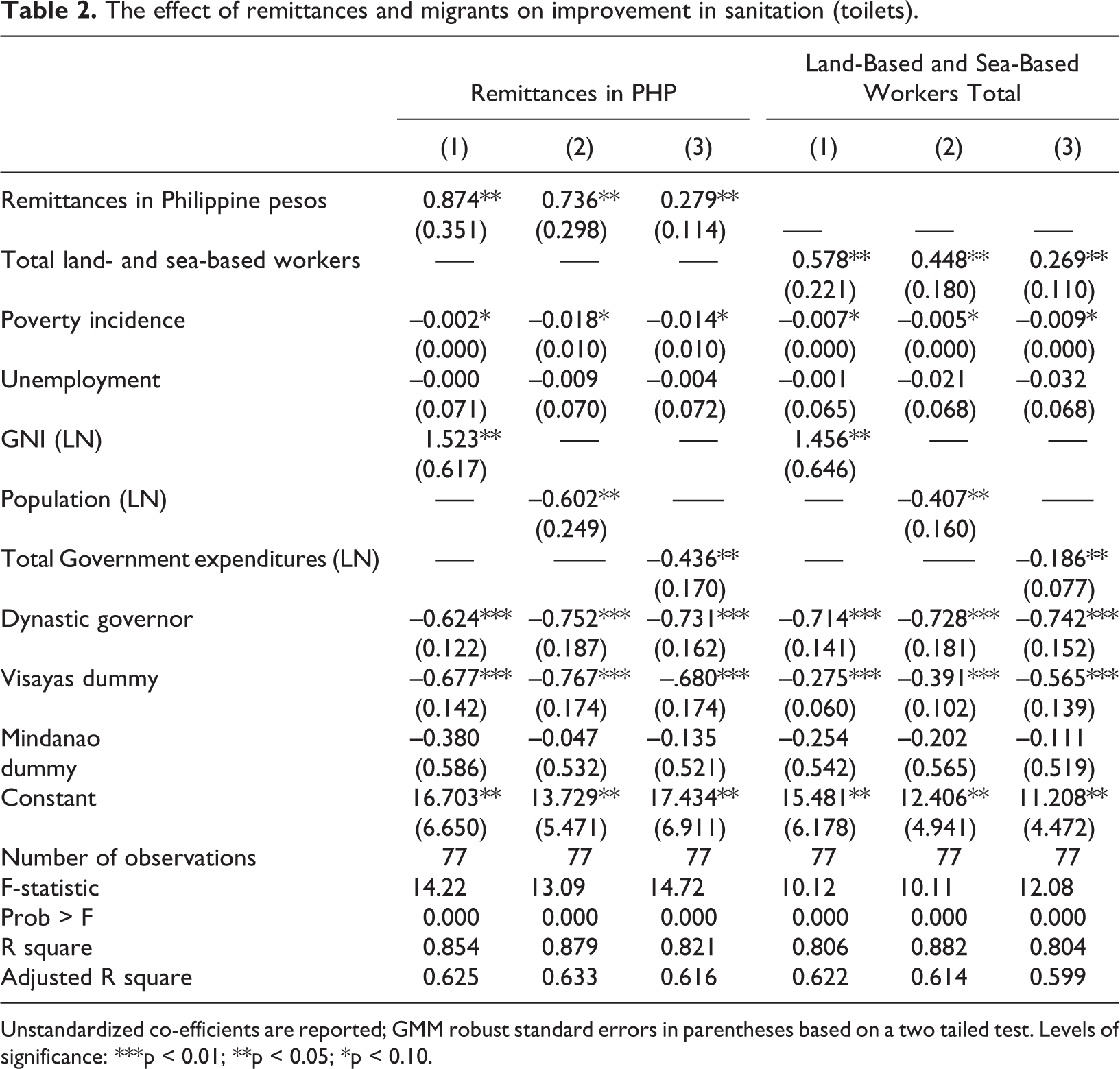
Unstandardized co-efficients are reported; GMM robust standard errors in parentheses based on a two tailed test. Levels of significance: ***p < 0.01; **p < 0.05; *p < 0.10.
The effect of remittances and migrants on improvements in infant mortality.

Unstandardized co-efficients are reported; GMM robust standard errors in parentheses based on a two-tailed test. Levels of significance: ***p < 0.01; **p < 0.05; *p < 0.10.
Furthermore, endogeneity is obviated in this study by employing 2SLS regression analysis, with the selection of annual rainfall averaged from 2000–2006 for each province. Scholars recommend that rainfall data is an appropriate instrumental variable in analyzing the effect of migrant remittances on the domestic Philippine economy, considering how it is still largely an agrarian-based economy (Yang and Choi, 2007). Other empirical work has also standardized rainfall as an instrumental variable in examining the impact of remittances on development in states that are largely agrarian, including Kenya (Bang et al., 2016), Guatemala (Adams and Cuecuecha, 2010), and Mexico (Lopez-Cordova, 2006).
Bang et al. (2016: 399) posit that in many countries in the developing world, rainfall is the most recommended and appropriate instrumental variable to obviate endogeneity concerns because, “rainfall constitutes a critical input for agricultural production, so that an unexpected deviation from the usual level may cause crop failure and hence, migration out of rural areas.” Thus, in examining the impact of household remittances in Kenya, they tapped rainfall as the instrumental variable of choice. Likewise, Adams and Cuecuecha (2010) also justified the use of average rainfall as an instrumental variable in their analysis of how remittances affect economic investment in Guatemala. In a related vein, recent empirical work in India by Sarsons (2015) finds that rainfall shocks are a good instrument for income, hence variations in rainfall amounts can trigger social dislocation and induce political violence.
This is especially relevant considering how migratory patterns in the Philippines, which is still a largely agrarian country, are mostly affected by rainfall patterns. 14 For example, in provinces that have lower levels of annual average rainfall, periodic droughts have affected peripheral economies which can induce a critical mass of citizens to seek employment opportunities overseas. Conversely, provinces with abundant rainfall are more likely to have sustainable agricultural economies that can employ more citizens and curb outward migration rates. Sometimes, other provinces are confronted with too much rainfall, such that it destroys the arability of soil, which can trigger outward migratory patterns. Thus, I employ average annual rainfall data from all the provinces which is derived from the Philippine Atmospheric, Geophysical, and Astronomical Services (PAGASA). 15
The 2SLS models are run using STATA version 12.0, with the command ‘ivregress’ accounting for endogenous and exogenous regressor(s), correcting for heteroskedasticity. Heteroskedasticity is apparent in the modeling after conducting Breusch-Pagan and Cook-Weisberg tests where the null hypothesis that there is constant variance is rejected. To account for this, I employ Generalized Methods of Moments robust standard errors as recommended by Hall (2005). Lastly, I run separate models, paying heed to possible collinearity issues. For example, the control variables—provincial level GNI, provincial level expenditures for social services, and population—are all correlated, where such variables are correlated above a Pearson’s r-value of 0.800. Thus, I present the analysis by separating them and treating them as stand-alone control variables in the modeling. Multi-collinearity diagnostics are then performed using Variance Inflation Factor (VIF hereafter) averages for each model. VIF average scores for each model show that scores are well below the threshold of 3.00, indicative that the modeling has no collinear variables (Wooldridge, 2010).
Results
I begin the analysis by looking at the second stage results of the 2SLS regression models. The core results depicted in Table 1 indicate that all the remittance variables are strongly associated with the GGI, which yields statistical significance at p < 0.01. Substantively, Figure 1 shows the predicted effect of remittances (weighted by the GNI of each province) on the change in the GGI index, while holding all control variables constant at their means and modes. What we find is a strong positive relationship, such that provinces that receive more remittances from migrants are more likely to see a marked increase in the GGI index from the years 2005–2008. Notable in the analysis is how the dummy variable that represents the presence of a governor from a political dynasty is also associated with a marked decrease in the GGI index, which is statistically significant at p < 0.05. This is consistent with research depicting how Philippine political dynasties are linked with inferior governance because political families facilitate the lack of political accountability as client-patron ties are entrenched. To substantiate, dynastic candidates have an incumbency advantage by providing private goods to a close circle of loyal supporters, preventing potential challenges from the opposition from arising, which are more likely to initiate political reforms (Mendoza et al., 2012). Furthermore, the gubernatorial dynasty variable is consistently statistically significant with the co-efficient signs in the expected direction even in the models where the dependent variables taps into public infrastructure and health outcomes, indicative of its pernicious role in promoting substandard governance, which comports with the findings of Tusalem and Pe-Aguirre (2013).

Good governance: The effect of remittances on the GGI.
The next analyses delve into the effect of the remittance variables on public goods provision, as it pertains to public infrastructure. Table 2 shows that the number of migrants from each province and the amount of remittances sent are positively associated with marked improvements in sanitation facilities, achieving statistical significance at p < 0.05. Using the CLARIFY program (Tomz et al., 2003), the substantive positive effect of remittances on improving sanitation among Philippine provinces is rather substantial. For example, a one standard deviation increase in remittances (adjusted for each province’s GNI) will likely generate a net positive increase of 2.587% in the proportion of households with access to functional toilets. Figure 2 also depicts the predicted estimates, conveying the positive relationship between the natural log of remittances (weighted by the GNI of each province) and the change of proportion of households with access to improved sanitation, while holding constant control variables at their means and modes. These estimates convey that migrants (both sea-based and land-based) and the amount of remittances they send have an association with better provisions of public goods.
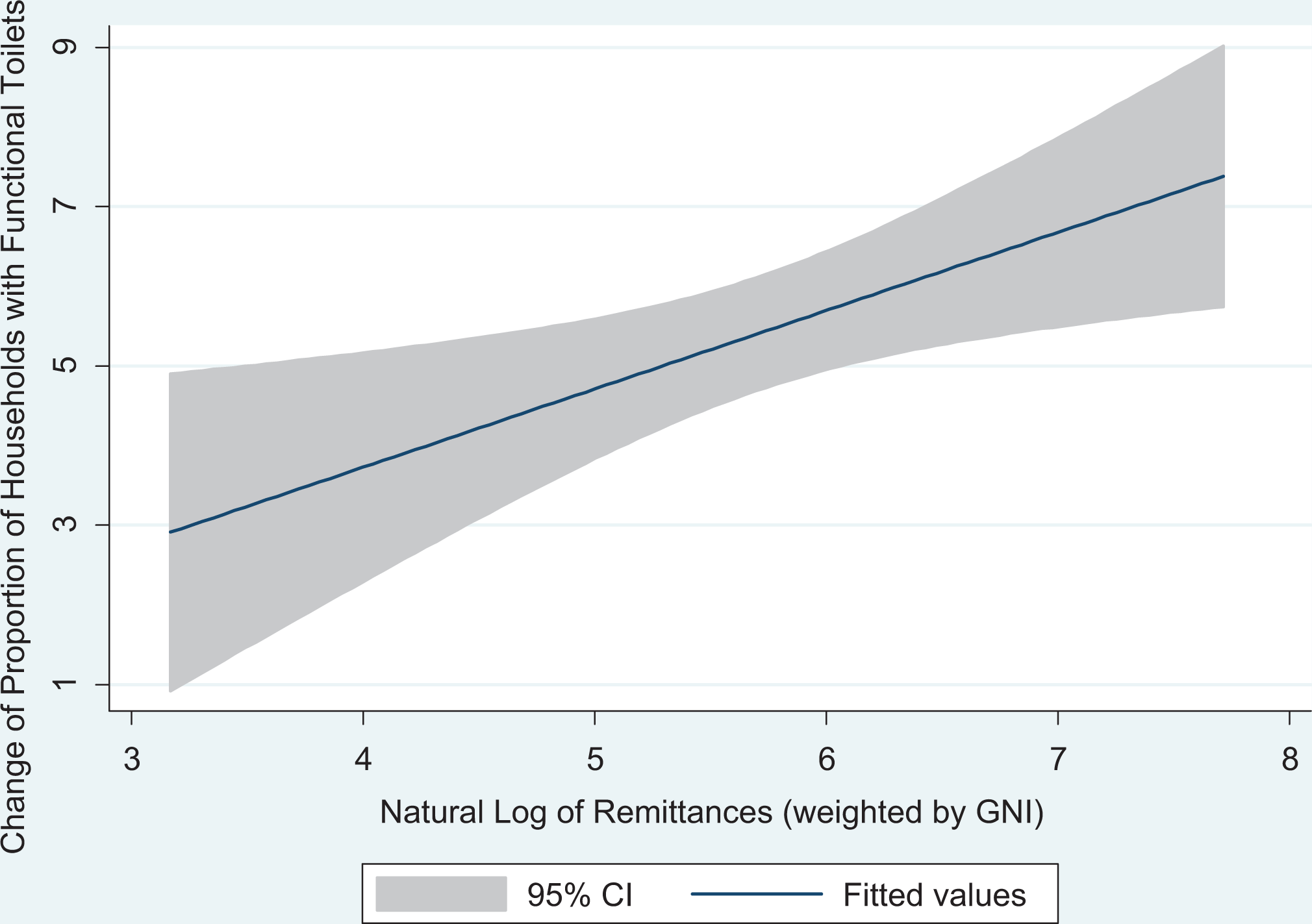
Infrastructure: The effect of remittances on change in access to functional toilets.
Finally, what is the effect of migrants and remittances on health outcomes? Table 3 shows that the main independent variable—remittances, is strongly correlated with improvements in infant mortality, which is statistically significant at p < 0.01. Figure 3 depicts a strong positive linear relationship between the natural log of remittances weighted by each province and improvements in infant mortality rates. To substantiate, we see that a shift from the natural log of remittances (weighted by each province’s GNI) from 3 to 7 is associated with a change in the infant mortality score from +1 to +5 (while holding constant control variables at their means and modes), indicating that provinces with higher levels of remittances are likely to see a distinct improvement in their infant mortality rates.
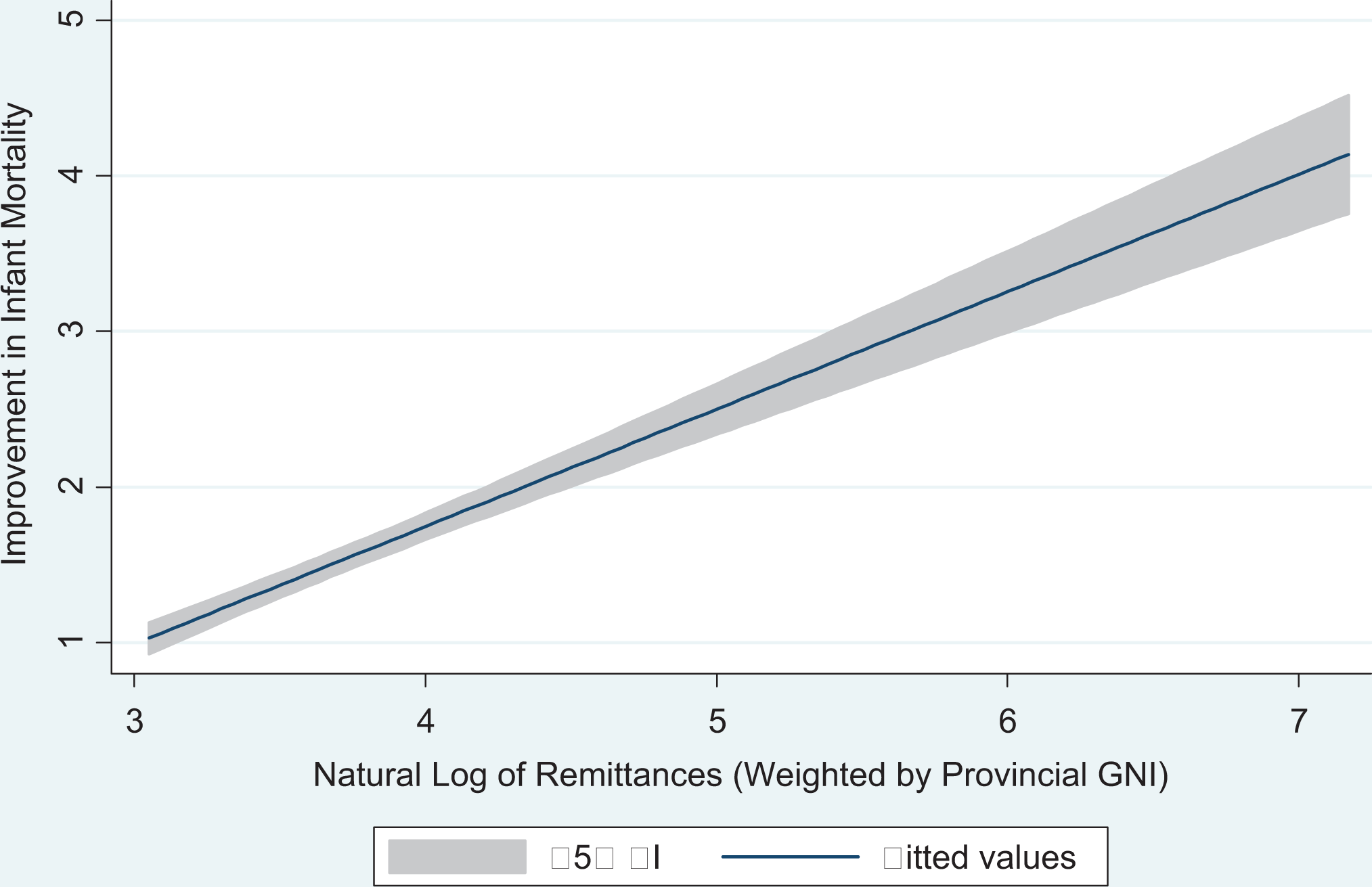
Public goods provision (health outcomes): The effect of remittances on change in infant mortality.
However, one needs to be careful in assessing these results, considering that provinces may have achieved better health outcomes not because of better quality public clinics or hospitals established by the local government, but because they have more resources to avail of private medical care in more affluent neighboring provinces or in Manila, which are deemed to be of better quality.
Lastly, the total number of land-based and sea-based migrants, in all the models employed, have co-efficient signs in the expected direction and achieve statistical significance at conventional levels. This is not surprising because both the amount of remittances sent to each province and the number of migrants from each province is highly correlated. In sum, the findings presented here convey that migrants can be construed as social agents who are associated with good governance and public goods provision as it pertains to effective governance, infrastructure development, and improving health care outcomes at the provincial level.
A note of caution is needed considering how local governments may shirk their obligation of providing for public goods (Abdih et al., 2012). More specifically, remittance flows may inhibit local governments from cutting off spending as windfall revenue from migrants accrues. A way to examine if Filipino overseas remittances induce local governments to perform better is to empirically test if Filipino remittances themselves exert a positive effect in overall provincial-level spending when holding constant all control variables at their means and modes. This will also allow us to understand if substitution based on corruption is occurring. Figures 4 and 5 demonstrate that remittances in terms of monetary flows and the total number of land and sea migrants have an overall positive effect on generalized provincial government expenditures which are all significant at p < 0.01 based on a two-tailed test. These estimations convey that migrants and remittances have a positive correlation with aggregate (generalized) provincial-level spending, corroborating how Philippine migrants seem to be non-state rivals when it comes to public goods provision. Their presence could pressure local governments to spend more on public services, which can only improve the quality of local government over time.
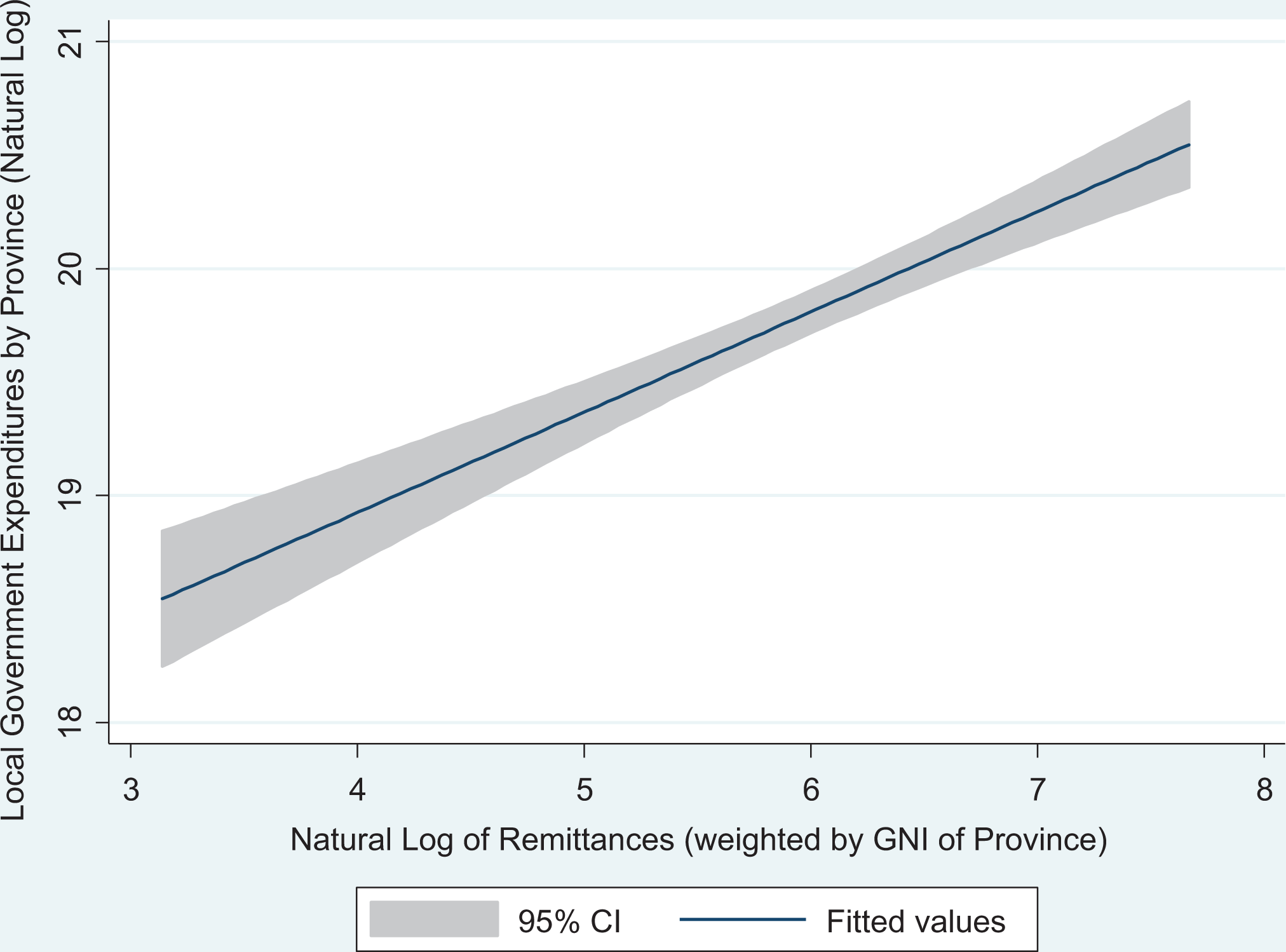
The effect of total remittances in Philippine peso on aggregate local governmental expenditures.
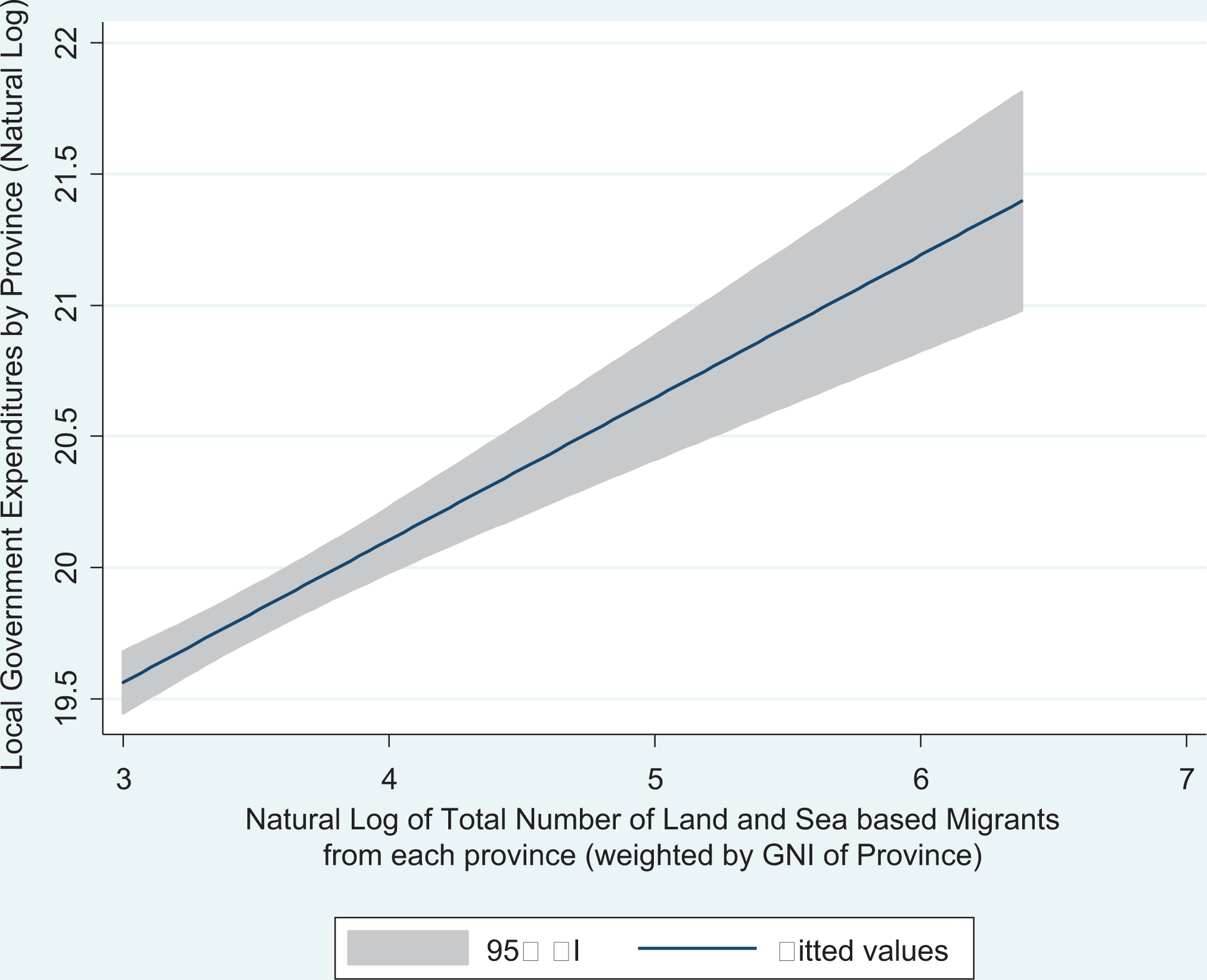
The effect of the number of migrants (by province) on aggregate local government expenditures.
Discussion and conclusion
This study’s aim is to address the growing debate around whether or not migrant remittances are a cure or a curse in promoting governmental accountability at the local level in a developing country. Using the case study of the Philippines, findings indicate that migrants and the remittances they send back to the provinces promote better governance and marked improvements in public goods provision pertaining to infrastructure and better health outcomes. The results contribute to the literature on remittances’ effects on political outcomes, which has mostly been examined in the context of Mexico (Adida and Girod, 2011; Pfutze, 2014; Tyburski, 2012) or cross-national large N-analyses (Abdih et al., 2012; Ebeke, 2012; O’Mahony, 2012). Similar to the results in Mexico, the findings corroborate how migrant remittances tend to be beneficial to political accountability, rather than a curse: Filipino migrants and the remittances they send back home seem to contribute to better governance. Filipino migrants also influence their relatives to have a more globalist outlook by emulating Western standards of political behavior and by holding local politicians to the higher standard of accountability and expectations that are seen in their host countries in Western Europe, Australia, and North America (McKay, 2012). Through cultural and social transmission, migrants can influence their families to be more responsible citizens in demanding for and initiating political reform (Pérez-Armendáriz and Crow, 2010). The results here comport with Tyburski’s (2012: 348) assessment that “[r]emittances represent an international resource exogenous to domestic politics that can balance state-society relations.”
The relationship between migrants and remittances on the one hand and good governance on the other can also be explained by the fact that a large percentage of Filipino migrants are manual laborers who are stuck in a life cycle that propagates a life of ‘temporary migration.’ Most do return to the homeland and they have more to gain in using their hard-earned money that they remit and the money they save to exact changes in the performance of their local governments. In fact, what is quite interesting is that some of these temporary migrants who have returned are currently the heads and leaders of local non-governmental organizations and public-sector agencies tasked with keeping the national and local government accountable—most especially former migrants from Hong Kong and other host nations that have democratic regimes (Kessler and Rother, 2016). To substantiate, in developing countries like the Philippines, scholars contend that remittances have become the new political weapon of the weak, “that can either fuel further exit or empower political voice by making available resources to new groups” (Kapur, 2005: 350).
The Philippines has been labeled by experts as a closed political system where client-patronage thrives at the local level, and where dynastic politics is the norm (Sidel, 1997, 2008). The political party system in the Philippines is not institutionalized, and nor are parties represented by programmatic agendas or ideological based platforms (Manacsa and Tan, 2005). Winning elections at the local and national levels is all determined by personalities, name recognition, familial ties, party bosses, and patronage networks which matter more than ideas about political reform or the battle of ideologies (Hutchcroft and Rocamora, 2003). As a result, scholars have labeled the political system as entrenched in corruption, where political accountability can be bought and is largely non-existent (Hicken, 2008, 2014). Thus, the findings here are quite contrary to the pessimistic rendering of Philippine politics as devoid of political accountability. The results shed light on how the process of migration may have positive spillover effects in terms of promoting local government responsiveness and good governance emanating from domestic pressure from financially empowered households and their relatives overseas that control the purse-strings. Truly, Filipino migrants, long labeled as unsung heroes, have not only been credited for promoting economic development in their hometowns, but are also credited for influencing families back home to be less beholden to political patrons and to be more critical of the local governments’ failings.
The implications suggest that migrants can facilitate the process of ‘exit’ (Hirschman, 1970; Tyburski, 2012), such that their contributions can induce local governments to perform as a way to prove their legitimacy. For instance, remittances may constrain incumbents from relying on patronage as migrant households become financially empowered. The process of weakening the so-called ties between patrons and clients through migrant contributions may in fact promote and heighten competitive elections, such that incumbents may provide for better governmental performance or risk political expulsion. As this behavior among migrants and recipients becomes institutionalized, political accountability through good governance becomes reified (Germano, 2013; Pfutze, 2012).
Of course, a major limitation of the study is that it does not test if remittances promote competitive elections and the lack of support or the reduction in support for incumbents among provincial voters. Nor does it directly examine if remittances actually weaken the process of clientelism. Future studies should further unpack the theoretical linkage between migrants, recipients, and political incumbents so that we can be more confident that Filipino migrants are indeed agents of political change and reform. Future studies need also to focus on whether or not remittances lead to the local government substituting them to other areas of development, or whether they can induce the government to engage in political malfeasance through misappropriating earmarked funds for personal gain by relying on remittances as a revenue stream that can induce opportunistic shirking.
Finally, it is important to note that this study is solely a macro-level assessment of how remittances improve governance and public goods provision. Future studies should explore how micro-level assessments of migrants and recipients evaluate the quality of government. Following the lead of scholars who have explored the micro-foundations of remittances and how remittance flows increase support for democracy and demand for political change/accountability among migrant families (Pérez-Armendáriz and Crowe, 2009), it would be interesting to examine if remittances have a positive effect in orienting recipients to become more politically active and involved (through voting and unconventional forms of political behavior). Other areas of research should examine if remittances make migrants and their families more receptive to democratic values, more likely to demand accountability when it comes to expecting the efficient distribution of goods and services from the state and local governments, and less tolerant of governmental malfeasance such as bribery, corruption, and clientelism. Thus, future work should examine if the macro-level results presented here comport with the micro-level analysis of Filipinos who have migrant family members overseas.
Lastly, one last limitation of the study is that it is likely that local governments subvert revenues for local development for private, personal gain indicative of corruption. In the words of Licuanan et al. (2015: 104), migrant contributions in the Philippines “can crowd out public resources and may therefore not necessarily increase the provision of public goods and services.” However, the empirical results presented here indicate that substitution based on corruption is not occurring as remittances have a positive relationship on overall provincial spending which can only improve the quality of local government. This illustrates that Filipino migrants may have the capacity of ‘voice’ and ‘exit,’ making them potential agents of continued reform. The effect of remittances on good governance may not be intentional, but is a result of a positive inadvertent effect that compels local governments to spend as provincial governments face new rivals in their desire to remain politically relevant and legitimate to voters.
Footnotes
Acknowledgements
I would like to thank the participants of the panel on Migrants and Democracy from the 2015 annual meeting of the Midwest Political Science Association in Chicago for their constructive comments, suggestions, and advice. I would also like to acknowledge Veena Kulkarni, John Linbergh, and Karen Thomas for their comments in reading earlier drafts of the manuscript.
Declaration of conflicting interests
The author(s) declared no potential conflicts of interest with respect to the research, authorship, and/or publication of this article.
Funding
The author(s) received no financial support for the research, authorship, and/or publication of this article.