




Abstract
Based on a comparative survey conducted in 2016, this article explores the social actions of young people in Taiwan, Hong Kong, and Macao from the perspective of social injustice and social frustration as advanced by Gurr (2011). Applying a two-dimensional model of perceptions of social and individual fairness, it is found that young people in Taiwan and Hong Kong have higher levels of frustration and show greater tolerance and acceptance towards radical confrontational approaches than those in Macao. Furthermore, in Hong Kong, young people with a higher level of both social and individual unfairness display more interest in local politics, are more likely to take part in social movements, and are more inclined to agree to a radical confrontational approach.
Introduction
The aim of this article is to shed light on the social actions of young people in Taiwan, Hong Kong, and Macao from the perspective of social justice and social frustration, through the use of territory-wide opinion survey data gathered in 2016 in the three societies. In 2014, large-scale social movements first erupted in Taiwan (the “Sunflower Movement” in March), then spread to Macao (the “Against the Bill of Greed and Privilege Movement” in May) and Hong Kong (the “Occupy Central Movement” in September). Young people, i.e. those born in the 1980s and 1990s, not only took the lead in these movements, but were also staunch followers and supporters (Chen and Yen, 2017; Hsiao and Wan, 2018; Wong, 2017). Serious social problems, such as high housing costs and declining upward social mobility; the development of post-materialistic values in young people, which has stirred up a great desire for a more democratic government; and Mainland China’s continuous rise, which has caused young people to worry about becoming more dependent on the Mainland or about their own diminishing competitiveness, are considered to have been the main causes of these movements (Au, 2017; Lim and Ping, 2015; Ng, 2016).
Taiwan, Hong Kong, and Macao are three affluent, open, and highly internationalized Chinese societies; however, it is believed that the causes of the 2014 movements in these places were different, and thus their pattern of development varied greatly. Much research attention has been paid to the features and modus operandi of these movements, but there have been few attempts to study them from a comparative angle. In this article, an attempt is made to fill this gap by examining similarities and differences in the three societies in terms of how young people view their socio-economic situation, their sense of fairness, and their political aspirations. Applying a two-dimensional model of perceptions of social and individual fairness, we explain young people’s political aspirations in three societies and argue that young people with a stronger feeling of unfairness are more likely to take part in social movements, and more inclined to agree to a radical confrontational approach.
Social frustration and social movements revisited
Throughout history, numerous social movements, large and small, local or national, have occurred. Some brought about dramatic changes, but some died unnoticed. In recent years, there has been a significant change from violent to non-violent movements, as the latter can enjoy a “moral advantage” over the former, and can garner more attention but provoke little animosity or distrust (Shaykhutdinov, 2010: 179). Regardless of their form, social frustration or displacement remains a key explanation of the cause of such movements (Gurr, 2000; McAdam and Tarrow, 2000; Schock, 2005).
In his masterpiece Why Men Rebel, Gurr (2011) advanced the concept of perceived deprivation to include relative deprivation, which Merton (1968) and Stouffer et al. (1949) had advocated, to distinguish it from absolute deprivation. He defined relative deprivation as “actors’ perception of discrepancy between their value expectations and their value capabilities” (Gurr, 2011: 24), i.e. the disparity between what people expect they deserve and what they can actually get. He further argued that when relative deprivation mounts, frustration is bred. Although frustration does not necessarily lead to rebellion, if no effective method is taken to channel the discontent or to address the anger, collective violence is likely to occur.
After Gurr, many scholars examined social movements from socio-political perspectives. For instance, Tilly (1978) argued that throughout history, many social movements provoked by political mobilization have taken place. Social and political developments such as the expansion of capitalism, state building, urbanization, and industrialization have been major factors triggering social movements of different scales. Following Tilly’s work, Tarrow (2011: 13) shed light on the “modern ‘repertoire’ of collective action” by suggesting that state building and the expansion of capitalism around the globe produced contentious politics, and therefore became a key factor behind mass social movements. Skocpol (1994) raised the important question of why social revolutions happened in some countries but not in others. She asserted that the structure of some regimes and societies made them more vulnerable to challenges from social movements. In short, apart from socio-psychological perspectives, socio-political perspectives offer alternative explanations that can broaden the understanding of social movements.
In 2011, in a note Gurr wrote for the 40th anniversary of Why Men Rebel, he evaluated the applicability of his “Why Men Rebel model” to the social and global context of the 21st century and, in particular, fine-tuned the concept of relative deprivation. Interestingly, instead of relative deprivation, he used terms such as grievances and a sense of injustice. He suggested that these new terms could better “capture the essence of the state of mind that motivates people to political action” (Gurr, 2011: x). This means that Gurr still believes that “how people interpret the situations in which they find themselves”—a socio-psychological perception or interpretation—is critical to understanding socio-political behavior.
Gurr’s observations raise a fundamental question that echoes the theme of this article: Why do young people who live in an affluent society from which they benefit become inclined to protest? His fine-tuning of the concept of relative deprivation to encompass grievances and a sense of injustice clearly offers an important explanation, as mixed feelings of grievance and injustice seem to have been influential factors in the social movements that fomented in Taiwan, Hong Kong, and Macao in 2014, where young people seem to have been the most frustrated group. A simple research question is: Why are young people’s hearts full of grievances and a strong sense of injustice?
Sense of fairness as an explanation
In recent years, studies have highlighted social movements from the angle of the perception of social fairness or, to use Gurr’s term, a sense of injustice. The implication is that individuals consider their efforts and outcomes with special reference to the social system and opportunities for upward social mobility. This sentiment affects one’s view of social justice, and therefore one’s judgement of the government’s performance and its legitimacy to rule. Specifically, if one considers that one’s input is far greater than the resulting outcome, one may become frustrated. If one sees the cause of this frustration as lying not in oneself, but in others, especially in society, discontent and grievances could arise (Alesina and Angeletos, 2005; Anand, 2001; Fehr and Schmidt, 1999; Konow, 2003).
We may ask: what is fairness? Sen’s (2009: 54) answer was that fairness is being unbiased, with no prejudices, and with impartiality. In Rawls’s (1999) view, fairness is a foundational principle for the prior development of justice, while justice is the first virtue of social institutions. That explains why, in prosperous and stable societies, there is a strong emphasis on a sense of fairness; while protests and social movements are more common in societies where injustice prevails (Skocpol, 1994). In fact, empirical research has indicated that social relationships are associated with perceptions of social comparison, social cues, and social identification, which ultimately can affect one’s social judgement “in the eye of the beholder” (Lamertz, 2002: 19). Although a sense of fairness is the foundation for social stability and economic prosperity, when using this concept for analysis, it should be borne in mind that fairness is not a matter of reasoning, and “evaluations of justice may be anything but straightforward” (Sen, 2009: 4).
Notwithstanding the intricacy of the concept, if we want to better understand people’s sense of fairness, a two-dimensional model of the perception or assessment of fairness could offer insightful explanations, as judgements of fairness can fundamentally affect one’s social relationships and social actions. The first dimension is a sense of social fairness, while the second dimension is a sense of individual fairness. A sense of social fairness refers to perceptions of the existence of procedural justice, a fair distribution of wealth, social equality, and equality of opportunity for upward social mobility. In short, it is an overall evaluation of a society’s openness or of the fairness of a social system. A sense of individual fairness refers to an individual’s feelings about the effort or input that he/she makes in relation to the result or outcome. It is a personal assessment of what one gives and takes. By combining these two dimensions of perception, we can capture what Gurr (2011: xi) refers to as “where people stand in society and what goods and bads they experience from governments.”
If we simplify these two dimensions to a “yes/fair” or “no/unfair” dichotomy, we get 2 x 2 = 4 responses. That means that there is a category of people who consider both the social and individual dimensions to be fair (the “double satisfaction” group), and another who think the opposite, i.e. that both dimensions are unfair (the “double frustration” group). There is a category of people who think that the social dimension is unfair but that the individual dimension is fair (the “social frustration” group), while another category of people who think that the social dimension is fair but that the individual dimension is unfair (the “social satisfaction” group) (Figure 1).
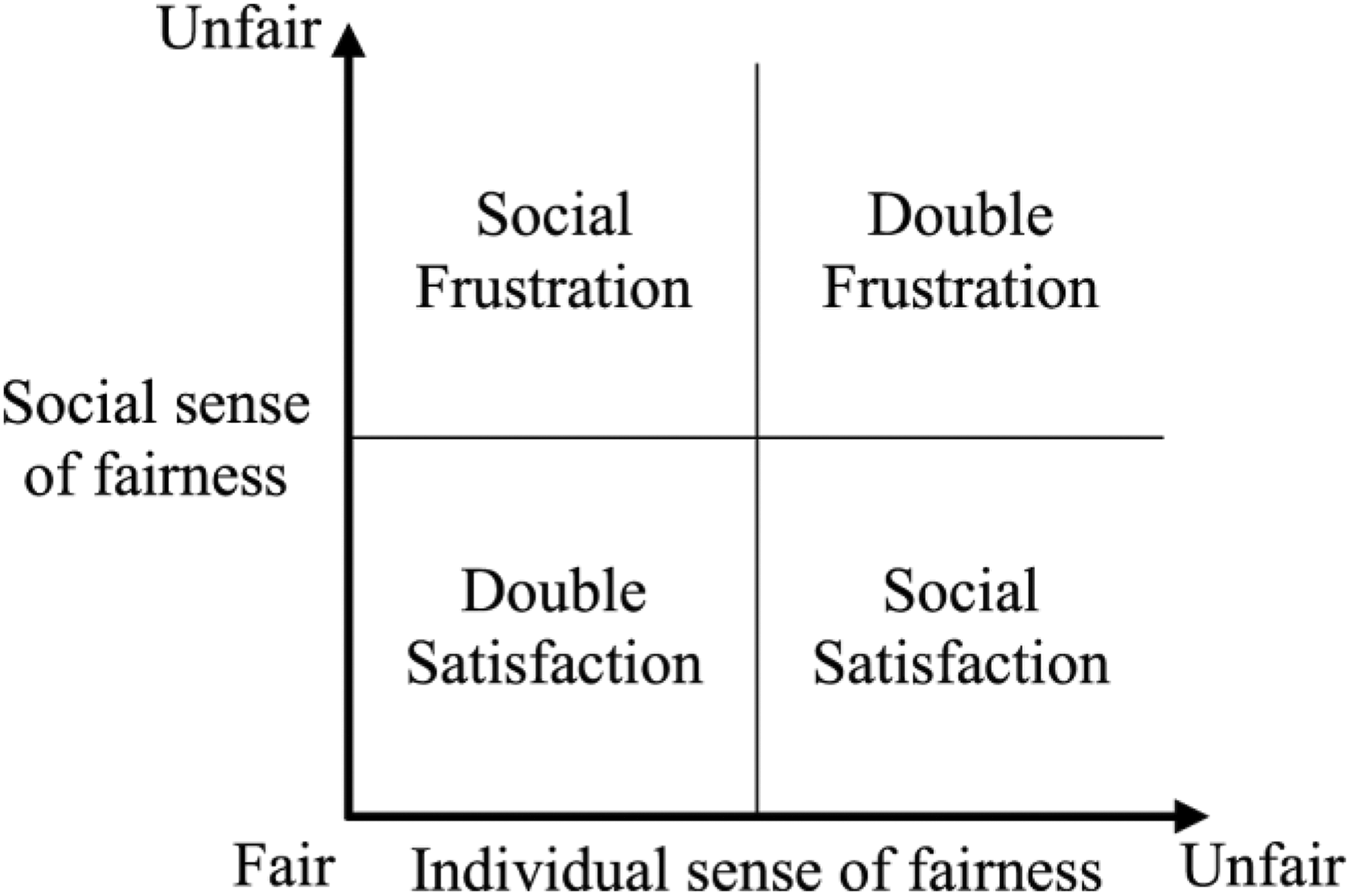
A two-dimensional model of perceptions of social and individual fairness.
One can reasonably speculate that those who fall under the “double satisfaction” category will regard both their social and individual lives with a sense of complacency, since they consider both dimensions to be fair. Thus, they will have few grievances and will not take part in protests or social movements. Those who fall under the “social frustration” and “double frustration” categories will feel discontented and nurture a sense of grievance, since they consider society or the social system to be unfair. Therefore, they will have a strong reason to take social action to make society function in a way that is fairer to them. Those under the “double frustration” category will have a stronger feeling of unfairness and may resort to radical social action if tempted. Those under the “social satisfaction” category may blame only themselves and not society even if they have grievances, since they perceive society to be fair and consider their setbacks to be their own fault. Therefore, they may have little interest in taking part in social movements.
If we use this model of perceived social and individual fairness to explain protests, social movements, or mass social mobilizations, we can have a better understanding of the levels, types, and sources of frustration or grievance that exist. In addition, since a sense of fairness can be highly subjective and can easily be stimulated, an understanding of it can alert policy makers to public sentiments or social feelings. Thus, in subsequent sections we use this model to examine the views of young people in Taiwan, Hong Kong, and Macao regarding their social and individual dimensions of fairness, and their political aspirations.
Data and measures
In April 2016, we conducted a comparative telephone survey simultaneously in Taiwan, Hong Kong, and Macao. This consisted of two separate sets of surveys for youths (aged 18 to 35) and non-youths (aged 36 or above) in each society. 1 The survey adopted a two-stage probability sampling. First, a fixed set of landline telephone numbers was randomly selected. Second, an eligible household member was randomly chosen for an interview. About 1000 people in each society were successfully interviewed for the two sets of surveys. 2
Sense of fairness was measured using two questions. One measured the sense of social fairness by asking, “Do you think that there are sufficient opportunities for young people to move upward?” 3 Another measured the sense of individual fairness by asking, “Do you think that your living standard is fair compared with the efforts that you put into your job?” 4 Based on these two questions, the respondents were categorized into one of the following four groups: (1) double satisfaction, (2) social satisfaction, (3) social frustration, and (4) double frustration (Figure 1). 5
Political aspirations were measured by four indicators, including (1) interest in local politics, (2) voting participation, (3) participation in social movements, and (4) endorsement of radical social action. The respective survey questions and response categories are: “Do you have an interest in local politics?” (1 = strongly uninterested, 2 = uninterested, 3 = interested, 4 = strongly interested); “Did you vote in the last election?” (0 = no, 1 = yes); “Did you take part in the Sunflower Movement (Taiwan) / Occupy Central Movement (Hong Kong) / Against the Bill of Greed and Privilege Movement (Macao)?” (0 = no, 1 = yes); and “Do you agree that the use of radical confrontational means is necessary to press the government to answer your appeal?” (1 = strongly disagree, 2 = disagree, 3 = agree, 4 = strongly agree). The higher the score of the above indicators, the higher the level of interest in politics, the more active the engagement in political protests, and the greater the level of support for resorting to radical actions to press the government.
Personal socio-demographic attributes were included in regression analysis as control variables, including gender (0 = male, 1 = female), age group dummies, education (0 = secondary or below, 1 = tertiary or above), ancestral home (Taiwan) / place of birth (Hong Kong and Macao) (0 = others, 1 = Mainland China), 6 subjective class dummies, and partisan support dummies.
Findings
Frustrated youth are the majority
In 2014, large-scale, youth-led social movements broke out in Taiwan, Macao, and Hong Kong. Different explanations have been put forward about the causes, ways of mobilization, and impact of these movements. But there have been few discussions on the issue of perceptions of social and individual fairness, as well as on such perceptions in the aftermath of these movements. The movements in both Taiwan and Macao ended with the successful achievement of the protestors’ specific demands, while in Hong Kong the movement ended in failure. Two years after the movements, we could still sense greater frustration among Hong Kong youth.
Figure 2 presents the sense of fairness among youths and non-youths in the three societies, arranged using a two-dimensional model. The patterns differ substantially. In Taiwan, around one-fifth of youths and non-youths expressed “double frustration,” while 55.1% of youths and 62.4% of non-youths expressed “social frustration.” Only around one-tenth of both groups indicated “social satisfaction,” while a greater proportion of youths (18.0%) than non-youths (9.9%) indicated “double satisfaction.” In Hong Kong, a higher proportion of youths exhibited “double frustration” (15.5%) and a lower proportion exhibited “double satisfaction” (12.8%) than non-youths (8.4% and 18.4%). Conversely, Hong Kong youths voiced higher “social frustration” (61.9%) and lower “social satisfaction” (9.8%) than non-youths (53.3% and 20.0%). In Macao, both youths and non-youths expressed “double satisfaction” and “double frustration” in more or less the same proportions (around 25% and 11%, respectively). But, a higher proportion of youths indicated “social frustration” (38.4%) and a lower proportion indicated “social satisfaction” (25.0%) than non-youths (27.6% and 36.0%).
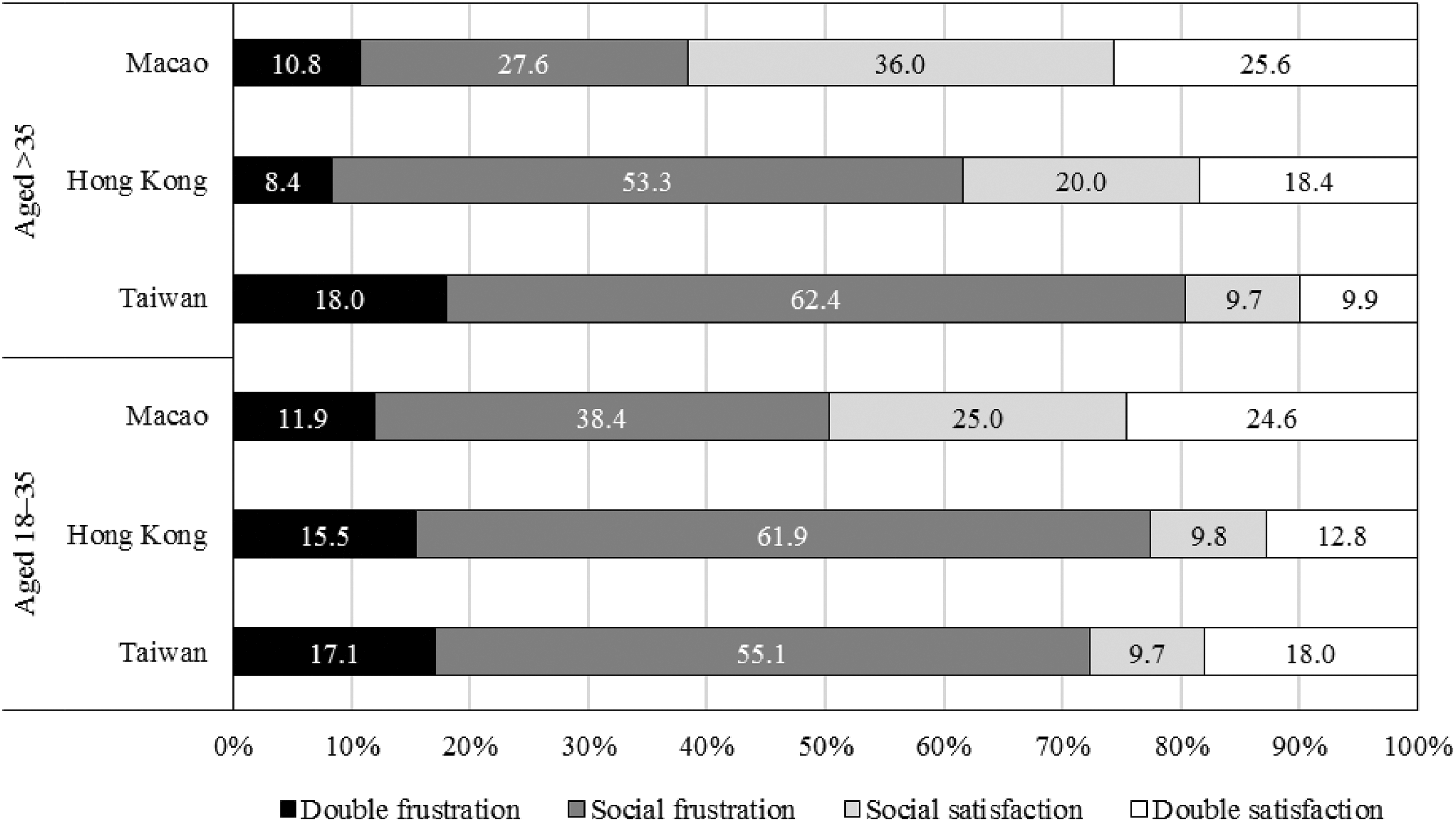
Sense of fairness (%).
The following findings should be noted: (1) A higher proportion of people in both age groups in Taiwan voiced “double frustration,” with non-youths showing a higher level of frustration. (2) In Macao, levels of frustration were lower or levels of satisfaction were higher, although the level of frustration of youths was higher than that of non-youths. (3) Levels of frustration in Hong Kong were between those of Taiwan and Macao, with a higher proportion of youths expressing “double frustration” and “social frustration” but a lower proportion expressing “social satisfaction” and “double satisfaction” than non-youths. Thus, one can reasonably speculate that there may be fewer opportunities for large-scale social movements in Macao than in Taiwan and Hong Kong. If movements do occur in Taiwan and Hong Kong, those in Taiwan may involve all age groups, while those in Hong Kong may be concentrated among the young.
Having made a comparison of the sense of fairness among youths and non-youths in the three societies, we now narrow our focus to the socio-economic attributes of young people and their sense of fairness. Since the “social satisfaction” and “double satisfaction” groups expressed similar views on social fairness, we grouped them into one group for cross-tabulation with the “double frustration” and “social frustration” groups.
One can see significant differences in the two variables of age and subjective class (Table 1). Specifically, in Taiwan, a higher proportion of “double frustration” and a lower proportion of “satisfaction” were observed among older groups of youths, but “social frustration” remained more or less the same across age groups. In Hong Kong, the lowest proportion of “double frustration” but the highest proportion of “social frustration” were found among people aged between 18 and 24, while the opposite pattern was noted among people aged between 25 and 29. A higher proportion of those expressing “satisfaction” was seen among relatively older groups of youths than among the youngest group. In Macao, the highest proportion of “double frustration” was observed among people aged between 25 and 29, while the lowest proportion of “social frustration” and the highest proportion of “satisfaction” were noted among the oldest group of youths.
Young people’s sense of fairness by socio-economic attributes (%).
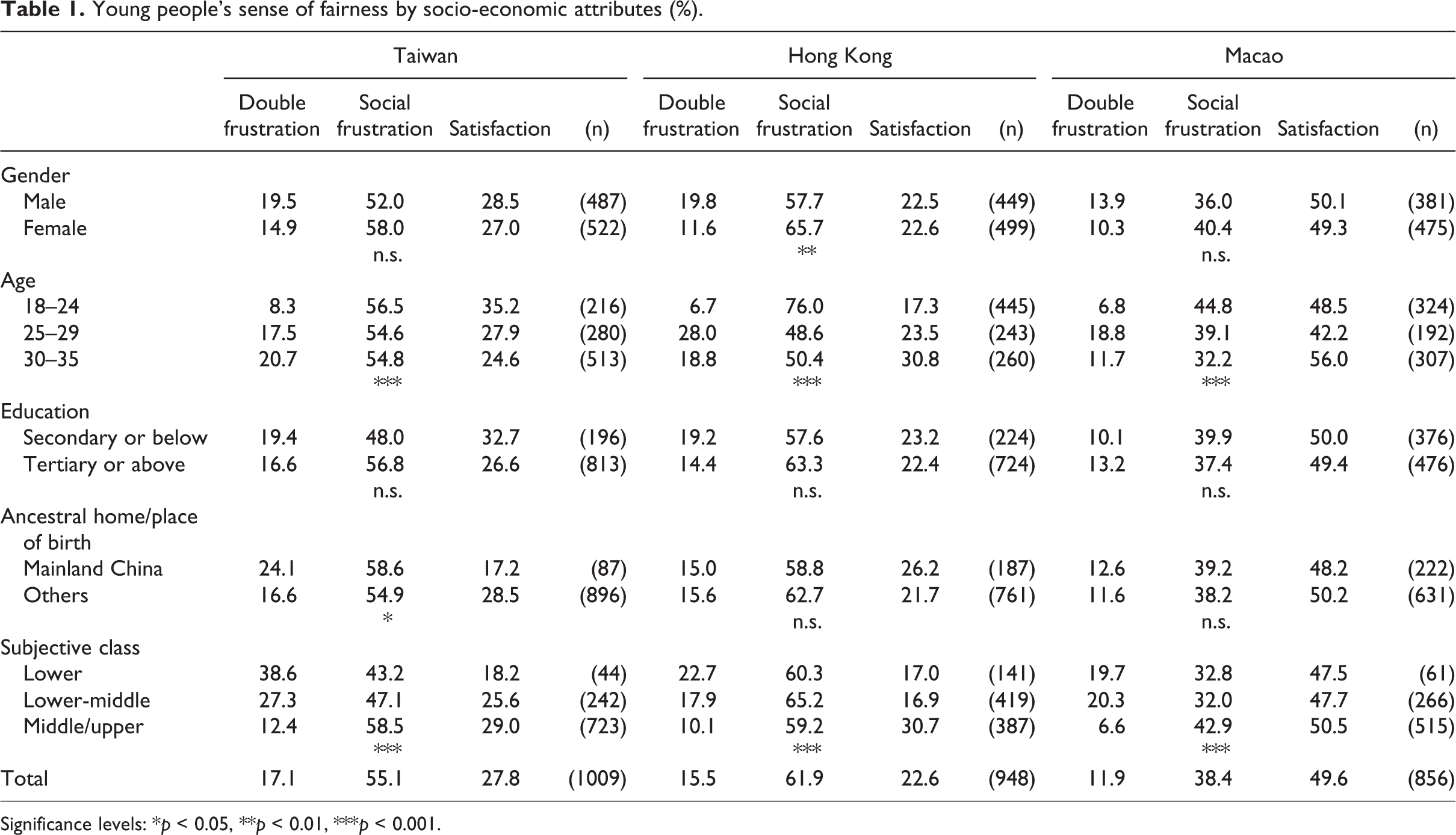
Significance levels: *p < 0.05, **p < 0.01, ***p < 0.001.
Subjective class was another attribute in which variations were observed among young people in the three societies. A roughly similar pattern was seen of the lower the class, the higher the proportion of those who expressed “double frustration” and the lower the proportion indicating “satisfaction.” Minor differences were seen in “social frustration.” In Hong Kong, a higher proportion of “social frustration” was observed among those who identified themselves with the lower-middle class, as compared with the middle/upper class in Taiwan and Macao. As such, one can argue that the lower a young person’s subjective class, the higher the level of frustration felt by that person.
Judging from the survey data, one may get a sense that the young people of Macao and the society as a whole are more “contented” than the equivalent groups in Hong Kong and Taiwan, and understand why both youths and non-youths were able to quickly return to leading normal lives after the 2014 movement. By contrast, it may not come as a surprise to see that both youths and non-youths in Taiwan and Hong Kong remain frustrated. Interestingly, in Hong Kong the younger their age, the more frustrated people are, while in Taiwan the opposite is the case. This difference is worth further analysis in the future.
Sense of fairness and political aspirations
Although the protest objectives, scale of action, scope of impact, counterforces, short-term achievements, and socio-economic costs of the movements that broke out in 2014 in Taiwan, Hong Kong, and Macao differed noticeably, their predominantly young participants had something in common: they were more inspired to take part in politics, more dissatisfied with the government’s performance, and more likely to call for democracy than those of older age groups. Their methods of mobilizing or sharing information were also similar, i.e. they mainly used the Internet and social media.
In the past, young people were considered to be mostly uninterested in politics (Pontes et al., 2018). However, the 2014 movements not only showed young people leading and participating in politics, but doing so with fervency. This came as a surprise to many people. Nevertheless, if one views events from the perspective of perceived fairness, it is easier to understand the political aspirations of the young participants. Table 2 shows young people’s interest in local politics, participation in formal and informal politics, and attitude towards radical social action.
Young people’s political aspirations by sense of fairness (%).
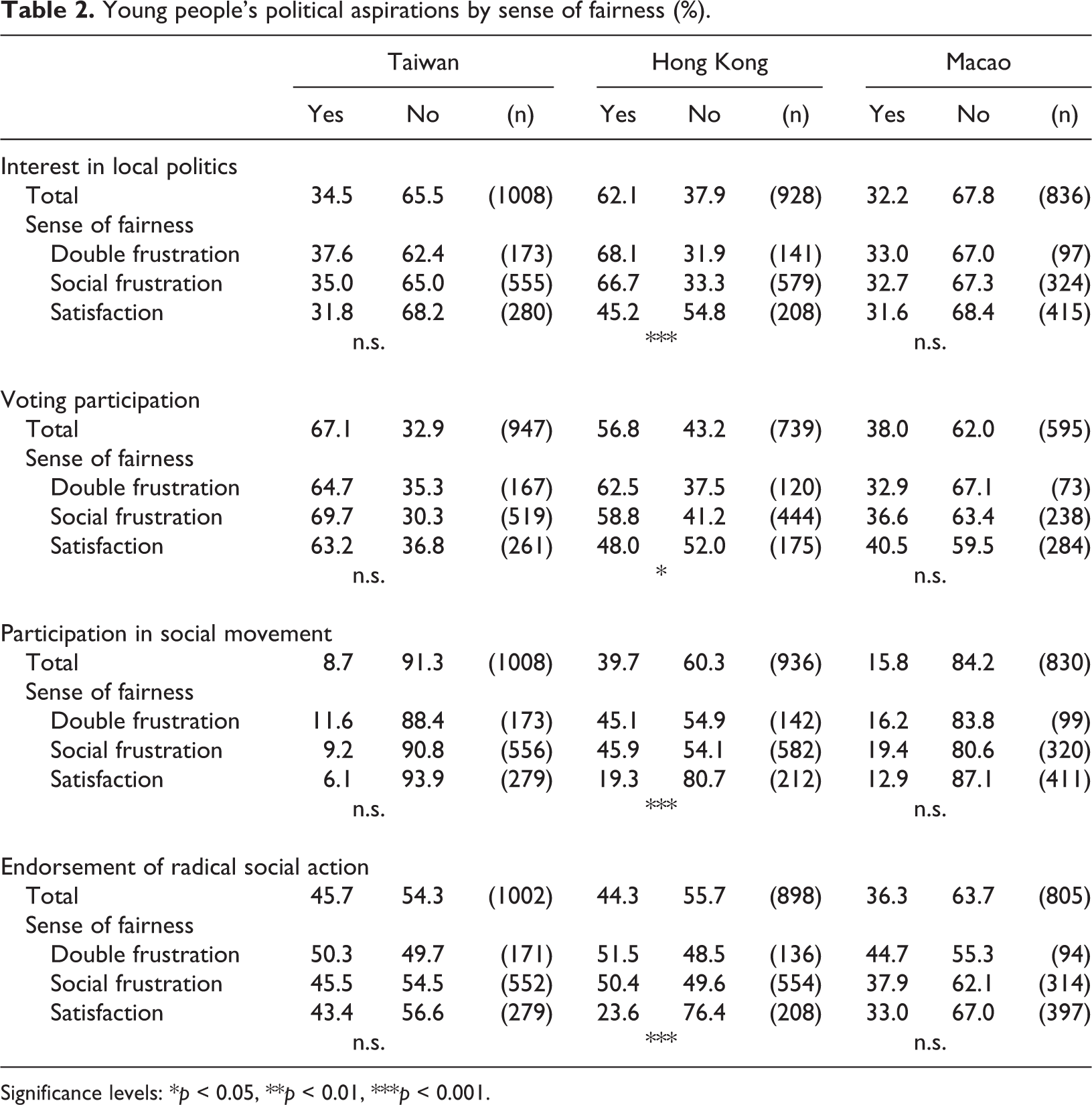
Significance levels: *p < 0.05, **p < 0.01, ***p < 0.001.
It is clear that young people in Hong Kong are far more interested in politics than their counterparts in Taiwan and Macao. In addition, the greater their frustration, the higher their political interest—68.1% and 66.7% of Hong Kong young people who expressed “double frustration” and “social frustration” indicated that they had an interest in local politics, as compared with 45.2% of those who voiced “satisfaction.” Obviously, frustration is a key factor in arousing the political interest of Hong Kong young people; however, this is not the case in Taiwan and Macao.
To a certain extent, political awareness or interest is a preliminary precondition for political participation. Casting a vote is a basic expression of participation in formal politics. When asked whether they had voted in the last election, the young people in the three societies gave different replies. First, a far higher proportion of youths in Taiwan and Hong Kong than in Macao indicated that they had cast a vote. Second, there was little variation in voter turnout between Taiwan and Macao youth with different senses of fairness. In Hong Kong, the greater the frustration, the higher the proportion of those who cast a vote. But in Taiwan and Macao, a sense of fairness may not have been a factor in mobilizing young people to vote.
One of the major concerns regarding youth in the three societies is their active participation in contentious movements. When asked whether they had taken part in the 2014 movement, the results were interesting. The proportion of those who indicated “yes” was lowest in Taiwan and highest in Hong Kong, with Macao lying in between. However, given the much bigger size of Taiwan’s population and the differences in scale and duration of the movements in the three places, it is understandable that Taiwan would have a low “participation rate” while Hong Kong would have the highest rate. Another striking fact is that a higher proportion of young people who voiced “double frustration” or “social frustration” took part in the 2014 movements, but only in Hong Kong was the difference statistically significant.
As mentioned earlier, non-violent social movements have attracted more attention in recent years because the moral advantage of engagement in non-violence often results in greater public support than would be the case were violence to be employed. The 2014 movements also promoted this fundamental idea. Nevertheless, one can expect that if grievances are not settled before long, frustrations may mount and violence could ultimately break out. When asked whether they agreed that the use of radical means is necessary to press the government to answer their appeal, the proportion of youths who replied in the affirmative was higher in Taiwan and Hong Kong than in Macao. It is clear that not a small proportion of young people endorse the use of radical protest tactics if deemed necessary. Again, only in Hong Kong were the variations in attitudes among people with different senses of fairness statistically significant.
From expressions of political interest to casting a vote in an election, then to taking part in a contentious movement and endorsing radical social action, variations can be seen in the three societies. In Hong Kong, those who belonged to the “double frustration” and “social frustration” groups showed greater political interest and a greater inclination to vote, and were more likely to have taken part in the Occupy Central Movement and more apt to believe that radical confrontational means are necessary to press the government to respond. By comparison, in Taiwan and Macao, there were no statistically significant differences among the responses of the different groups, implying that young people in Hong Kong are more divided in their perceptions or assessments of fairness. On the other hand, in Taiwan and Macao, the perception of injustice is not the determining cause of whether young people will act in a radical manner.
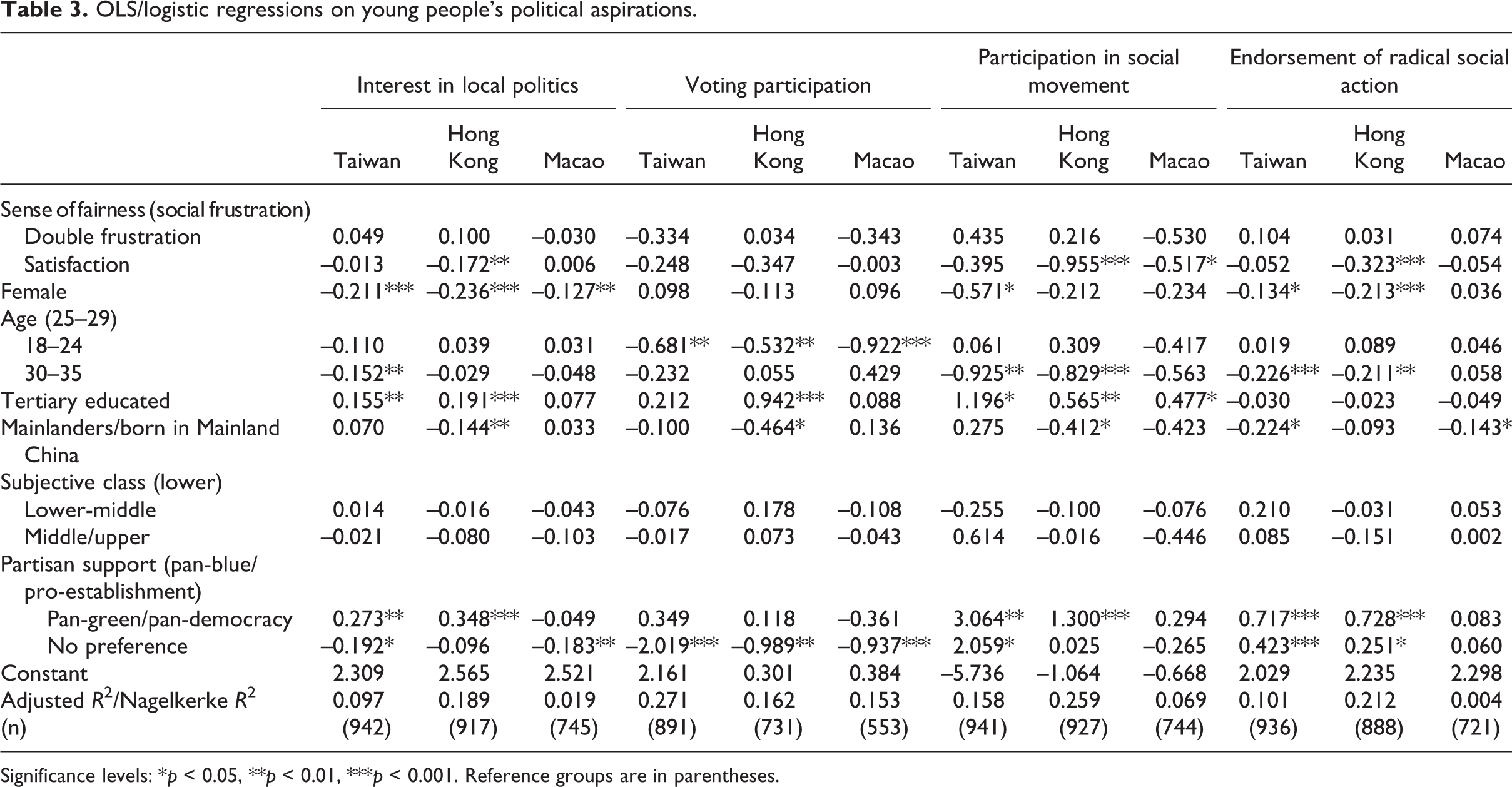
We ran regressions to examine the relationship between a sense of fairness and political aspirations. An OLS linear regression was used for interest in local politics (1 = strongly uninterested, 2 = uninterested, 3 = interested, 4 = strongly interested) and endorsement of radical social action (1 = strongly disagree, 2 = disagree, 3 = agree, 4 = strongly agree), and a logistic regression was used for voting in the last election and participation in a social movement (0 = no, 1 = yes). Socio-demographic factors and partisan support were included as control variables. Table 3 displays the results of the regression. Sense of fairness was the independent variable and “social frustration” was the reference group.
OLS/logistic regressions on young people’s political aspirations.
Significance levels: *p < 0.05, **p < 0.01, ***p < 0.001. Reference groups are in parentheses.
For interest in local politics, two dummies for sense of fairness failed to pass the level of significance in Taiwan and Macao, indicating that there was no significant correlation between a sense of fairness and political interest in these places. In Hong Kong, the coefficient for “satisfaction” was found to be negative and statistically significant at the 0.01 level, but the coefficient for “double frustration” was insignificant. This suggests that there was no significant difference in political interest between the youths who belonged to the “double frustration” and “social frustration” groups, and that these two groups had a higher level of political interest than those who belonged to the “satisfaction” group.
Regarding voting in the last election, in the three societies two dummies for sense of fairness failed to pass the level of significance. This implies that there is no evidence of a relationship between a sense of fairness and voting in the last election. Youths belonging to the “double frustration” or “social frustration” group were not more likely to vote in an election than those belonging to the “satisfaction” group. Feeling frustrated did not necessarily motivate the young people in the three places to participate more in the formal political process.
However, a sense of frustration did encourage informal political participation by young people in Hong Kong and Macao. With regard to participation in the 2014 movements, in Hong Kong the coefficient for “satisfaction” was found to be negative and statistically significant at the 0.001 level, and the coefficient for “double frustration” was found to be insignificant. The pattern of association is similar in Macao, with the coefficient for “satisfaction” significant at the 0.05 level. Only in Taiwan did the two dummies for sense of fairness fail to pass the level of significance. These findings show that Hong Kong and Macao young people who belonged to the “double frustration” or “social frustration” group were more likely to have participated in the 2014 contentious movement than those who belonged to the “satisfaction” group. In Taiwan, no significant difference in participation in the Sunflower Movement was seen between those belonging to the “frustration” groups or the “satisfaction” group.
With regard to attitudes towards radical social action, the findings are basically consistent with those for political interest and participation in the social movement. The two dummies for sense of fairness failed to pass the level of significance in Taiwan and Macao, indicating that in these two societies young people belonging to the “frustration” groups held similar attitudes towards the use of radical protest tactics as those belonging to the “satisfaction” group. But, in Hong Kong, compared with those belonging to the “satisfaction” group, young people belonging to the “double frustration” or “social frustration” group tended to agree that radical confrontational means are necessary to press the government to answer their appeal.
In short, Hong Kong young people with different senses of fairness were more divided in terms of political interest, taking part in social movements, and in their view of the necessity of taking radical protest tactics than young people in Taiwan and Macao. In Hong Kong, those belonging to the “double frustration” and “social frustration” groups had a stronger interest in local politics, a greater inclination to take part in the Occupy Central Movement, and were more likely to agree that it is essential to resort to radical confrontational means to press the government to answer their appeal. But in Taiwan and Macao there were no significant differences between those belonging to the “frustration” groups or the “satisfaction” group. This clearly shows that the political divide between the winning team and the losing team is much wider among the young generation in Hong Kong than is the case in the other two societies.
Discussion
The spreading of a student-led social movement with wide support among young people from Taiwan to Macao, and then to Hong Kong in 2014, is unprecedented for the period following the Second World War. Although the movements in Taiwan and Macao were successfully settled, the appeal of Hong Kong youth seems to have gone unanswered. Many attempts have been made to explain the phenomenon. Inspired by Gurr’s (2011: ix) argument that “to build a more peaceful and secure world, we need to begin by analyzing the minds of men—and women—who oppose bad governments and unpopular policies,” an alternate perspective is put forward in this article, which involves combining the perception of fairness from the social and individual dimensions to examine the issue of youth activism. We put forward the commonly neglected, but very important, factor of the subjective assessment of social justice, social equality, and equality of opportunity for advancement and, more importantly, examine how these relate to an individual’s evaluation of the efforts that one has made and the outcomes that were obtained.
Based on the survey data, it is found that the level of frustration in Macao is lower than in Taiwan and Hong Kong. In Taiwan and Hong Kong, frustration has reached an alarming level, such that both the public and the government can no longer ignore it. Although Gurr's theory cannot explain socio-political phenomena in three Chinese societies, it addresses part of them.
Admittedly, the problem in Taiwan is more acute, as “double frustration” seems to be high among both youths and non-youths, with non-youths having more grievances. In Hong Kong, the problem seems to be largely a “youth problem,” as young people have expressed a high level of “double frustration” and “social frustration” and a low level of “double satisfaction,” while the level of “double frustration” among non-youths remains low and of “double satisfaction” relatively high. In Macao, although youths voiced a higher level of frustration (double and social) than non-youths, both levels are low when compared to Taiwan and Hong Kong. Since the focus of this article is on youths, we will refrain from further discussions of issues related to non-youths.
A number of explanations have been given of the 2014 wave of social movements in the three societies. The impact of China (Hsiao and Lin, 2008), the rise of post-materialism among youth (Inglehart, 1997), and declining upward social mobility (Chang, 2013; Lui, 2009) are the three most commonly cited arguments. These arguments can explain some aspects of the phenomenon in some of these societies, but clearly not all. For example, they do not explain why the low level of frustration in Macao also led to the eruption of a student-led contentious movement in 2014. In fact, the impact of China is greater in Macao than in Taiwan and Hong Kong, and young people there have also been inculcated with post-materialistic values. But levels of frustration were lowest in Macao. The materialistic basis of the socio-economic development of these societies and a sense of fairness with regard to the social and individual dimensions seem to be two critical factors that can offer a broader understanding of the phenomenon.
Social mobility is an important indicator of socio-economic development. A brief examination of the trajectory of the social mobility of young people in the three societies can shed light on why social movements broke out in these places. A key argument relating to the issue of social mobility is that in recent decades, higher education has expanded rapidly in Taiwan, Hong Kong, and Macao. However, as in many Western societies, the tremendous improvement in the levels of education of young people did not necessarily lead to a rise in their earning power or job competitiveness. Thus, the expansion of higher education has resulted in “overeducation,” “education devaluation,” or “a deflation in academic qualifications” (McGuinness, 2006; Meroni and Vera-Toscano, 2017; Montt, 2017; Rubin and Kazanjian, 2011). In other words, the most critical question is whether the pace of economic growth, i.e. material improvements, can keep pace with the expansion in higher education. Macao’s economic growth seems to have largely kept up with the expansion in higher education, Hong Kong’s growth has partially kept up, while Taiwan’s has lagged behind. There are several key objective indicators of the situation, such as the percentage of young people attending tertiary institutions, wages and salaries, and better job positions—particularly in the administrative and managerial ranks (Zheng et al., 2016).
One can argue that since economic growth in Macao has kept up with the expansion of higher education, young people do not feel a greater sense of unfairness, and levels of frustration have remained low. Conversely, since the rapid expansion of higher education in Taiwan and Hong Kong has not been met with a similarly rapid pace of economic growth (i.e. not enough well-paying jobs have been created to absorb the newly educated youth), young people there consider that the setbacks they are encountering are not their fault but a social problem. Therefore, levels of frustration are high in both Taiwan and Hong Kong. In fact, there is plenty of empirical evidence revealing that people may attribute their lack of upward social mobility to the issue of social injustice (Gugushvili, 2016; Rodriguez-Bailon et al., 2017).
Given that levels of frustration in Macao were low, we may ask why the young people in Macao took to the streets in 2014? Again, it was an issue of fairness. The Macao government proposed a bill that would offer generous compensation packages for the Chief Executive and other principal officials. This was considered unfair. As Sen (2009: 4) has mentioned, “Justice is not a matter of reasoning at all.” The above measure provoked the young people of Macao into taking to the streets to voice their opposition.
Taiwan’s young people also share a strong sense of unfairness and injustice and are also motivated to take part in a variety of social movements; however, this sense of injustice is not the only driving force behind their opting to resort to radical social action. Something of more general or more universal value such as democracy and democratic governance might be another crucial political psychological motivation that would lead young activists to take radical action to press the government.
Policy implications and conclusion
To conclude, unlike previous studies, this article analyzed the contentious movements that erupted in Taiwan, Hong Kong, and Macao in 2014 from the perspective of the social and individual dimensions of justice, and from a comparative angle. It makes a theoretical contribution by proposing a two-dimensional model of perceived social and individual fairness to advance Gurr’s concept of relative deprivation. It also enriches our understanding of the grievances and sources of frustration felt by young people, which is correlated with the occurrence of social movements, especially in three open and highly internationalized Chinese societies.
Following the above line of thought, if the governments in the three societies want to pursue policies that will lead to a stable society, it is fundamental to maintain a vigorous materialistic base of socio-economic development and a fair social system. A vigorous materialistic base primarily refers to economic growth. Only when the economy expands can more employment opportunities be created. Thus, any government that wants to accomplish a stable and harmonious social environment must strive to invigorate the economy.
The creation of wealth leads directly to the issue of the distribution of wealth. The creation of more wealth may bring about more social problems, especially the problem of social injustice, if that wealth is in the hands of a tiny proportion of the population. In other words, any responsible government is required to take necessary actions to ensure equality of opportunity and procedural justice, and especially to guard against the emergence of monopolies, nepotism, or cronyism.
The policy to rapidly expand higher education clearly needs to be further evaluated and examined. Higher educational qualifications connote better chances at achieving upward social mobility. If the expansion of higher education is demand-driven, this can lead to positive results. However, if the expansion is merely about postponing the effort to deal with certain social problems, for instance tackling the rise in youth unemployment, more negative outcomes will result as the newly educated find that they may not be able to get a good job when they join the labor market. Furthermore, any responsible government should avoid expanding the number of places in institutes of higher education, while neglecting the quality of the education that is delivered. The government should devote an equal amount of resources and attention to vocational training. It is a clear fact that the mismatch in higher education policies, vocational training, and labor market demand is the breeding ground of frustration and grievances among young people.
Due to their higher levels of frustration, the young people of Taiwan and Hong Kong showed greater tolerance (a higher approval rate) than their counterparts in Macao towards the idea of resorting to radical confrontational approaches to press the government to respond to their appeals, if needed. Governments in both places need to pay great attention to this alarming phenomenon. Apart from boosting their economies and providing more vocational training to allow youths find better jobs, it may be necessary to take measures to stabilize the property market as well as offer housing subsidies to alleviate the frustration felt by young people. Of course, young people have to bear in mind that radical confrontation runs counter to the trend of non-violence. If they resort to such means, they may lose their “moral advantage” and provoke animosity and distrust.
As mentioned, in Rawls’s view, fairness or justice is the first virtue of social institutions. Undoubtedly, a just society is a key element of social stability and economic prosperity. However, as Sen indicated, people can have a highly subjective idea of what fairness means. When formulating or carrying out social policies, governments must pay due attention to key principles such as procedural justice, the fair distribution of wealth, social justice, equal rights, and equal opportunities. When the key principle of social justice is violated, a sense of unfairness is felt, and frustration and grievances mount. Gurr (2011: ix) cautioned that “people’s justifications or beliefs about the justifiability and utility of political action” are an important aspect of understanding protests and social movements. Hence, any failure to address the issue of social justice and people’s sense of fairness can lead to detrimental outcomes for the government as well as society.
There are some limitations to this article. The current design relies solely on quantitative data. However, fairness and frustration are highly subjective matters; thus, it would be useful to include qualitative data for an integrated analysis. Moreover, this article focuses on ordinary youth who were followers or supporters, not on the student leaders. Alternate views and considerations might be brought to light if those leaders were interviewed. In short, in a future or follow-up study, the research design could be broadened, while the research goal could be more focused on exploring how a sense of fairness can be cultivated, by comparing the views of leaders and followers.
Footnotes
Declaration of conflicting interests
The author(s) declared no potential conflicts of interest with respect to the research, authorship, and/or publication of this article.
Funding
The author(s) disclosed receipt of the following financial support for the research, authorship and/or publication of this article:This research project was funded by the Public Policy Research Funding Scheme from the Central Policy Unit of the HKSAR Government.

Notes
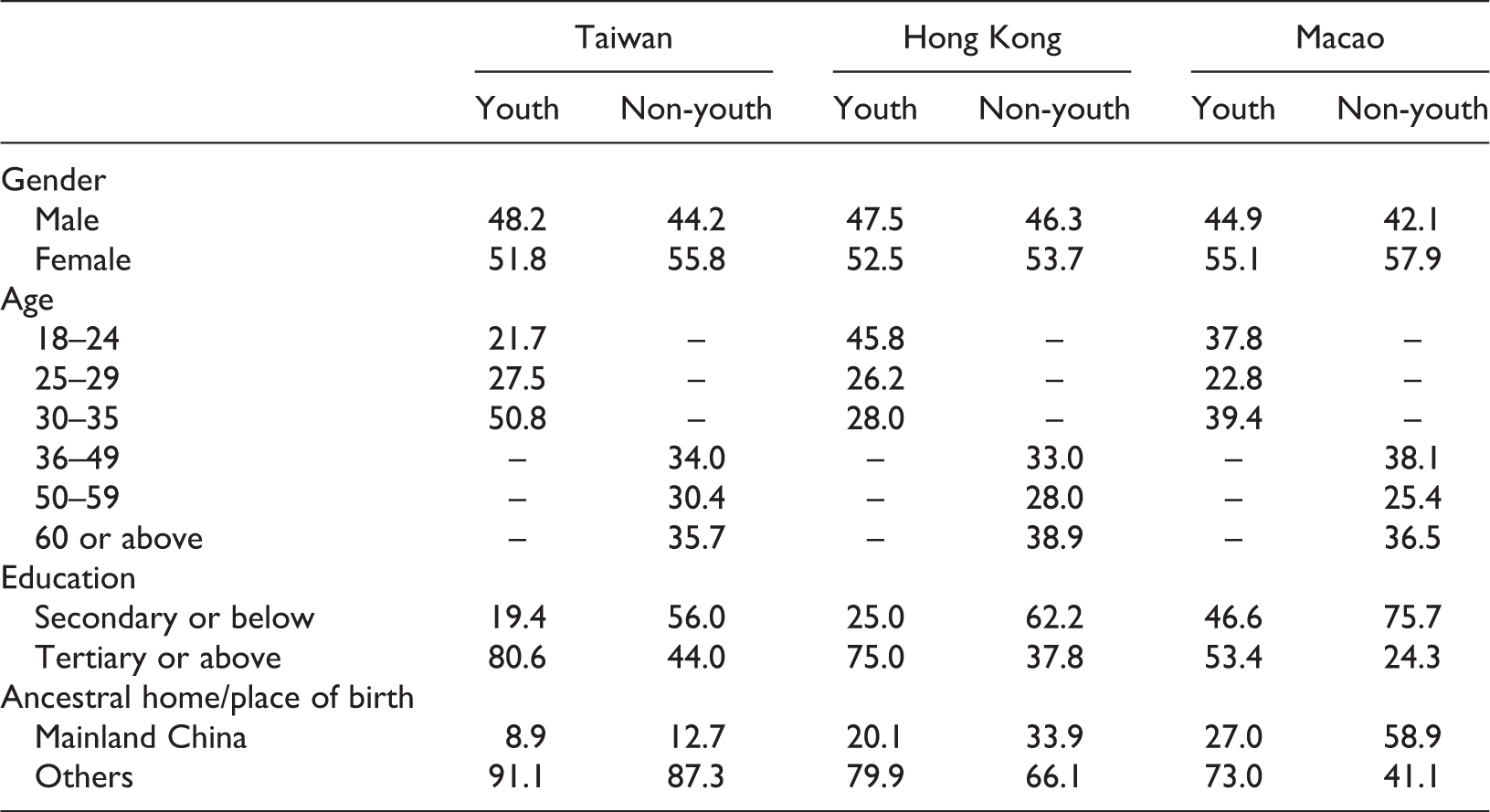
Appendix 1. Social background of the respondents in the surveys (%)
| Taiwan | Hong Kong | Macao | ||||
|---|---|---|---|---|---|---|
| Youth | Non-youth | Youth | Non-youth | Youth | Non-youth | |
| Gender | ||||||
| Male | 48.2 | 44.2 | 47.5 | 46.3 | 44.9 | 42.1 |
| Female | 51.8 | 55.8 | 52.5 | 53.7 | 55.1 | 57.9 |
| Age | ||||||
| 18–24 | 21.7 | – | 45.8 | – | 37.8 | – |
| 25–29 | 27.5 | – | 26.2 | – | 22.8 | – |
| 30–35 | 50.8 | – | 28.0 | – | 39.4 | – |
| 36–49 | – | 34.0 | – | 33.0 | – | 38.1 |
| 50–59 | – | 30.4 | – | 28.0 | – | 25.4 |
| 60 or above | – | 35.7 | – | 38.9 | – | 36.5 |
| Education | ||||||
| Secondary or below | 19.4 | 56.0 | 25.0 | 62.2 | 46.6 | 75.7 |
| Tertiary or above | 80.6 | 44.0 | 75.0 | 37.8 | 53.4 | 24.3 |
| Ancestral home/place of birth | ||||||
| Mainland China | 8.9 | 12.7 | 20.1 | 33.9 | 27.0 | 58.9 |
| Others | 91.1 | 87.3 | 79.9 | 66.1 | 73.0 | 41.1 |