



Abstract
The socio-political conditions of Pakistan are not good for many religious and ethnic minority groups. This study explores the frustration and motivation of Muslim and non-Muslim young students around political participation in this environment. A survey research design was followed to achieve this objective. Seven-hundred secondary school students affiliated with Hindu, Christian, Muslim and Ahmadiyya communities participated in the study. A self-reported questionnaire was used to gauge the respondents’ political efficacy, attitude towards democracy and motivation for expected political participation in the country. The findings demonstrate students’ concerns, to varying extents, about the performance of political institutions in the country. The religious affiliations of the participants have significant influence on their motivation to contribute to political affairs. The results are alarming for a country with an uncertain democratic record for religious and ethnic minorities.
Introduction
The political system of Pakistan has faced two major challenges throughout the course of its more than 70 years history, i.e. military interventions and religious fundamentalism (Akhtar et al., 2006). Overt and covert military interventions have provided media and other state institutions opportunities to infuse instability and uncertainty in the political atmosphere of the country (Shah, 2014b; Waseem, 2012). The defiance of powerful public institutions against the accountability of democratic forums has declined the people’s confidence in political institutions (Waheed and Abbasi, 2013). Trust deficit generally leads towards de-legitimation of political authority in both normal and emergency circumstances (Van der Meer, 2017). People rely on their social and moral conscience rather than constitutional, legal and political prerogatives of the state organs in uncertain and inconsistent political environments (Schofield, 2009). Religious fundamentalism has hampered the Pakistani political culture in two ways. First, many radicalized religious groups continuously labelled the democratic electoral system as an un-Islamic and infidel one. This has generated intellectual distance from democracy and democratic institutions in people’s minds. Secondly, religious and politico-religious parties made discriminatory amendments in the constitution which discouraged the equal participation of religious minorities in Pakistani politics.
Democracy, in the modern context, is characterized by the equal involvement and participation of all people in defining and locating political power through transparent elections and equitable voting rights (Lansford, 2011). Two major approaches to defining democracy are constitutional and process oriented. The former approach focuses on studying constitutional provisions mandatory to qualify for democracy. The latter concept, however, concentrates on meeting the process-oriented criteria of democracy, especially the equal participation of all people in the overall political and voting process (Woolf, 2009). Representative democracy requires constitutional and practical provisions, simultaneously, to ensure the contribution and participation of all people in decisions about law and politics.
In Pakistan, the political situation did not remain open for common people. In terms of constitutional and legal provisions, the country did not demonstrate equality and impartiality for all social and religious communities. Consequently, the political participation of the common people associated with marginalized communities was not remain balanced (Hasanie, 2013). The country witnessed serious attacks of militant groups on election campaigns of liberal and secular political parties in the 2018 general elections. The assassinations of Governor Punjab, Salman Taseer and Federal Minister, Shahbaz Bhatti were also among major setbacks to progressive and secular politics in Pakistan (Gregory, 2012).
The left-wing political parties initiated some important steps (when they were in power) to widen the political space for marginalized communities. Seats were reserved for women and minority religious groups in senate as well as in national, provincial and local assemblies. Attempts were made in and outside parliament to create a political environment conducive for the political participation of all Pakistani nationals regardless of their sex, cast, language or religion. Efforts were also made to reduce the role of the military in the political process (Shah, 2014a). A question, however, arises about how young people affiliated with different religious communities respond to these initiatives and to what extent they are ready to participate in national politics. The literature demonstrates that the political victimization and isolation of targeted religious and ethnic groups create distractions in the real politics of any state. It is understandable that minority groups face various socio-political challenges in this context, including a major dilemma of identity crises (Saeed, 2017). Religious politics – which remained prominent in Pakistan – not only contributed to the constitutional development of the country; it also provided the opportunity to various sectarian-based groups to assert their position in mainstream politics (Mukherjee, 2010). These groups, resultantly, strengthened their position as political bargainers and attempted to curtail the political space for their opponents. Religious minorities remained major victims of these politico-religious pressure groups. This article unveils how Muslim and non-Muslim secondary school students respond in this socio-political scenario of Pakistan. The views of students affiliated with majority and minority religious groups on major indicators of politics and democracy are collected and analysed to understand the likeliness of their political participation.
The current study
The purpose of the current study was to investigate the political efficacy, the attitudes towards democracy and the expected political preferences of young students associated with different religious communities in Pakistan. The researchers sought the answers to the following research questions: To what extent do the students in the sample demonstrate positive attitude towards democracy in Pakistan, and does the profile differ for students affiliated with Christian, Hindu, Muslim and Ahmadiyya communities? To what extent do the students in the sample anticipate their future political participation, and do the students affiliated with Christian, Hindu, Muslim and Ahmadiyya communities differ in their choices?
Research method
A quantitative research approach was followed to execute the study. Seven-hundred secondary school students, selected through purposive sampling technique, participated in the study. Among the participants, 165 students belonged to the Christian community and 140, 205 and 190 students were affiliated with Hindu, Muslim and Ahmadiyya communities respectively. The mean age of the participants was 15.2 years. Female students made up 45.7% of the sample. Two major criteria were followed in selecting the sample. First, only students enrolled in public sector schools were included in the sample. Secondly, only students from heterogeneous classes (in the context of religious affiliation) were selected. A research instrument to measure the political efficacy, political participation and attitude towards democracy of the participants was developed on a four-point Likert type scale ranging from 1 (strongly disagree) to 4 (strongly agree). Items for the instrument were borrowed from the IEA Civic Education Study (Schulz, 2004) and the World Values Survey (http://www.worldvaluessurvey.org), and were modified to achieve the research objectives of this study. The final instrument consisted of 35 items divided into three sections and 14 factors. The section ‘political efficacy’ consisted of three factors: internal political efficacy, external political efficacy and cynicism (an adverse factor which demonstrates the prevalence of pessimism about the contemporary political system in the respondents). The second section, ‘attitude towards democracy’, had seven factors which examined the respondents’ attitude towards the significance of democracy, satisfaction with democratic performance (human rights), trust in political institutions, support for controlled democracy (military or religious bodies overlook the democratic process), support for liberal democracy, support for masculine democracy (males are given legal or social privilege in the democratic process) and traditionalism (a view in which family and local traditions/norms of the group are given preferences on modern democratic principles). The third section, ‘political participation’, had four factors that focused on examining the electoral behaviour of the respondents and their expected participation in politics, social movements and protests. Sample items included in the instrument include ‘I am able to understand most political issues easily’, ‘I shall get information about candidates before voting in an election’ and ‘Religious authorities interpret the law’. A pilot study was conducted to check the validity and reliability of the instrument by distributing it to 100 secondary school students. All subscales demonstrated a high reliability co-efficient ranging from 0.745 to 0.923. Special measures were followed to secure the privacy and confidentiality of the collected information. Permission to collect data was sought from the school heads/managers, providing information about the research objectives and instruments. Informed consent was obtained from all individual participants included in the study prior to the distribution of research instruments. The participants were given the choice to leave the study at any stage if they felt uncomfortable or had any other problem during completion of the questionnaire. Collection of personal identification and any other form of personal identifiers was avoided to ensure the anonymity of the responses. The collected data were stored in an officially provided encrypted computer, which ensured the privacy of the collected data. Only researchers had access to the data files.
Findings of the study
The data demonstrate discouraging trends of internal and external self-efficacies in the students of all four communities. The prevalence of cynicism, on the other hand, is higher in the respondents. Although the students accepted the political significance of democracy, they did not have much trust in political institutions or satisfaction with their performance in ensuring human rights in the country. The majority of Muslim and non-Muslim students expected active participation in voting (electoral behaviour) and social welfare movements as part of their political activities but their attitude towards participation in protests was discouraging (Table 1). Two-way mixed ANOVA and LSD post-hoc tests were run to compare the political attitudes of students affiliated with different religious communities.
Mean scores showing the students’ opinions on different factors of political participation and attitude towards democracy.
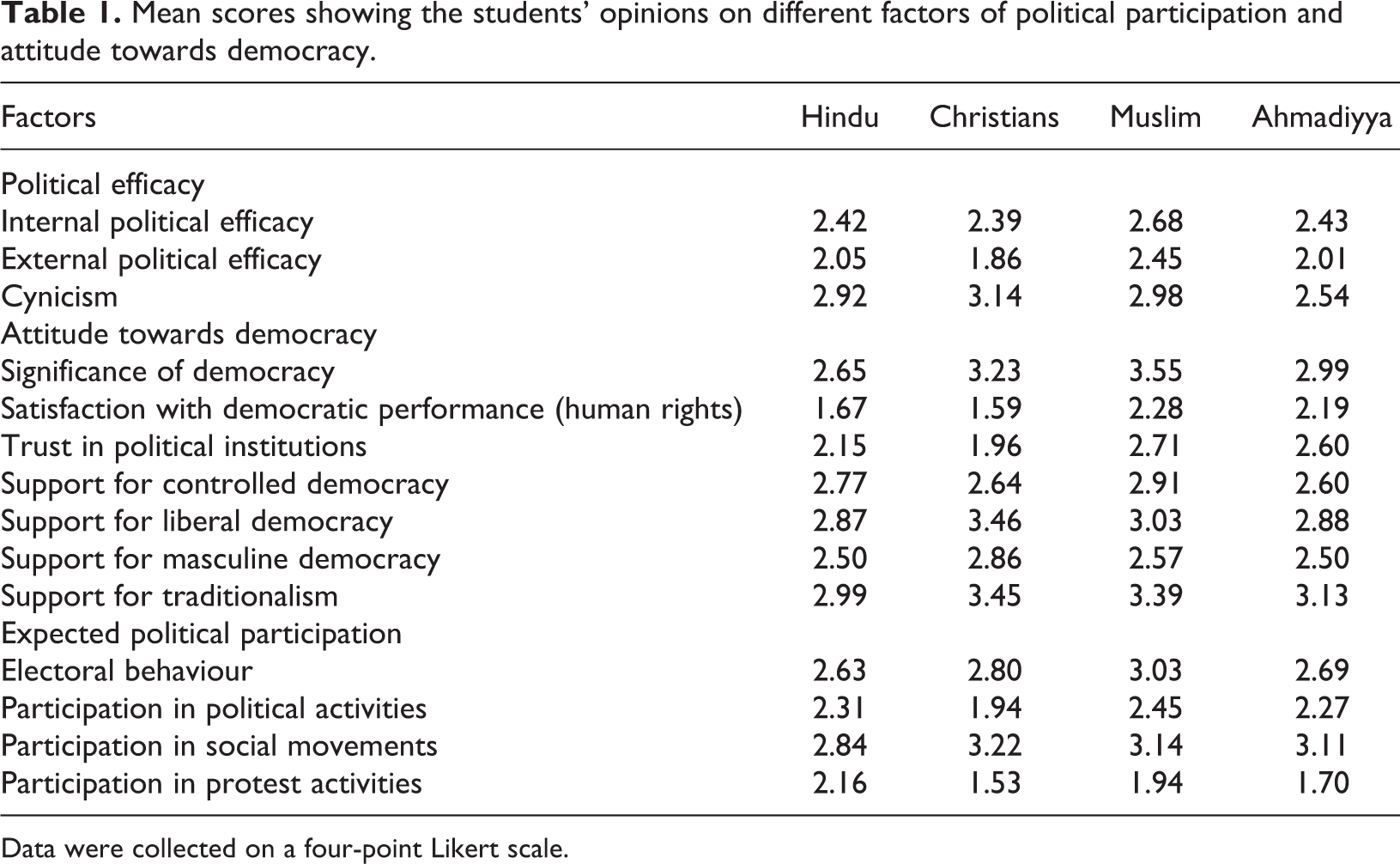
Data were collected on a four-point Likert scale.
Political efficacy
A two-way mixed ANOVA was run to find out the between and within effects of the variables, with the four groups of secondary school students as the between groups variable (four levels: students’ affiliations with Hindu, Christian, Muslim and Ahmadiyya communities) and the indicators of political efficacy as the within groups variable (three levels: internal political efficacy, external political efficacy and cynicism). The results are drawn from the mixed ANOVA and LSD post-hoc test, and are presented in Figure 1 and Table 2.

Line chart of the means showing internal political efficacy (1), external political efficacy (2) and cynicism (3) while differentiating the secondary school students affiliated with Hindu, Christian, Muslim and Ahmadiyya communities.
Results of the LSD post-hoc test revealing the impacts of secondary school students’ affiliations with Hindu, Christian, Muslim and Ahmadiyya communities on their political efficacy.
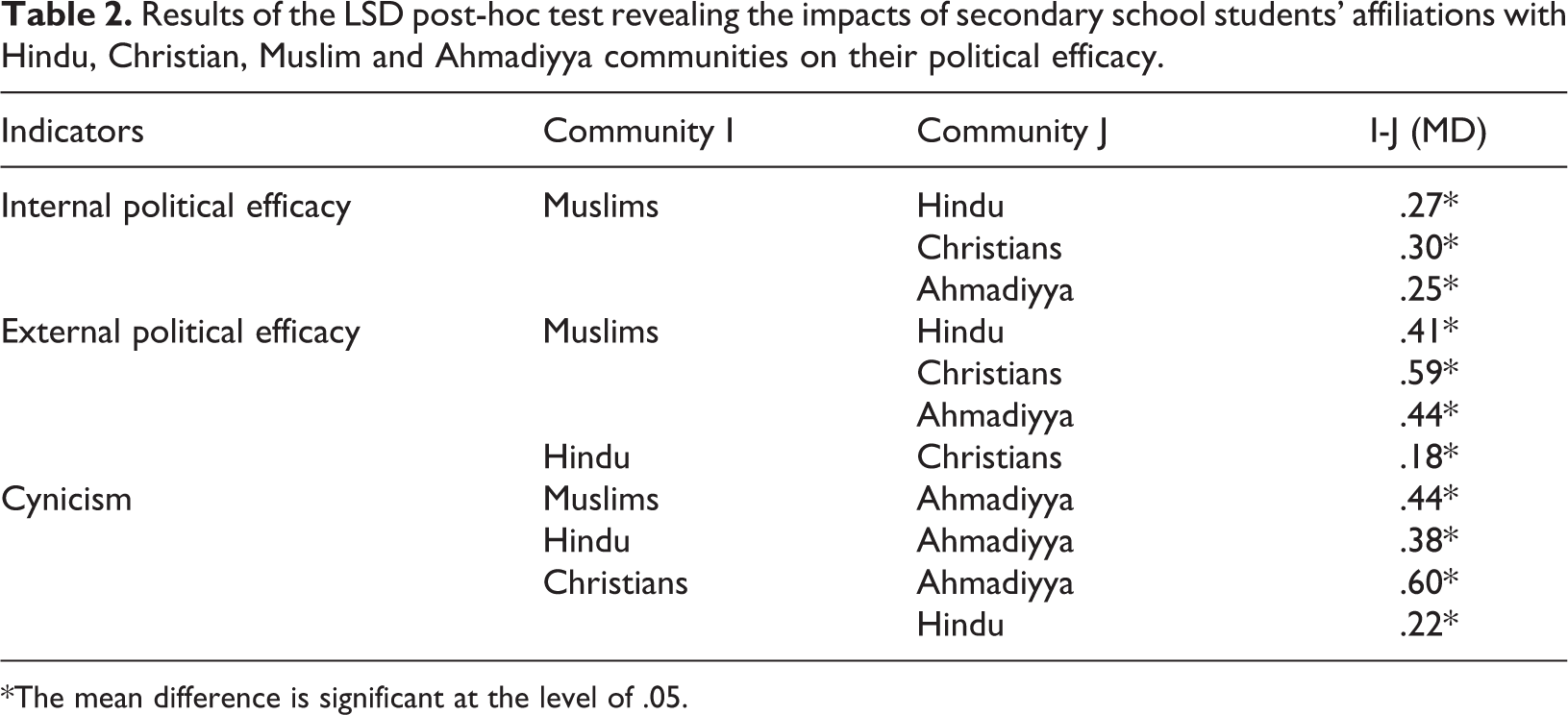
*The mean difference is significant at the level of .05.
Th main effect of the affiliations with different religious communities is significant, F(3, 696) = 21.469, p < .001, indicating that the students with Muslim backgrounds demonstrated higher internal and external political efficacies than those affiliated with Hindu, Christian and Ahmadiyya communities. The prevalence of cynicism was higher in the Christian students and lower in those associated with the Ahmadiyya community.
The main effect of the indicators of political efficacy is significant, F(3, 696) = 215.61, p < .001, indicating that the students demonstrated lower external political efficacy and higher cynicism regardless of their affiliations with different religious communities.
The political efficacy and religious affiliation interaction is significant, F(3, 696) = 11.628, p < .001, indicating that the prevalence of cynicism as an adverse aspect of political efficacy is higher in all four groups of students than their internal and external political efficacies. This gap is significantly greater for the students with Christian backgrounds scoring highest for cynicism and lowest for internal and external political efficacies.
Attitude towards democracy
A two-way mixed ANOVA with four groups of secondary school students as the between groups variable (four levels: students’ affiliations with Hindu, Christian, Muslim and Ahmadiyya communities) and indicators of attitude towards democracy as the within groups variables (seven levels: significance of democracy, democratic performance (human rights), trust in political institutions, support for controlled democracy, support for liberal democracy, support for masculine democracy, support for traditionalism) was run to find out the between and within effects of the variables. The results are drawn from the mixed ANOVA and LSD post-hoc test and are presented in Figure 2 and Table 3.
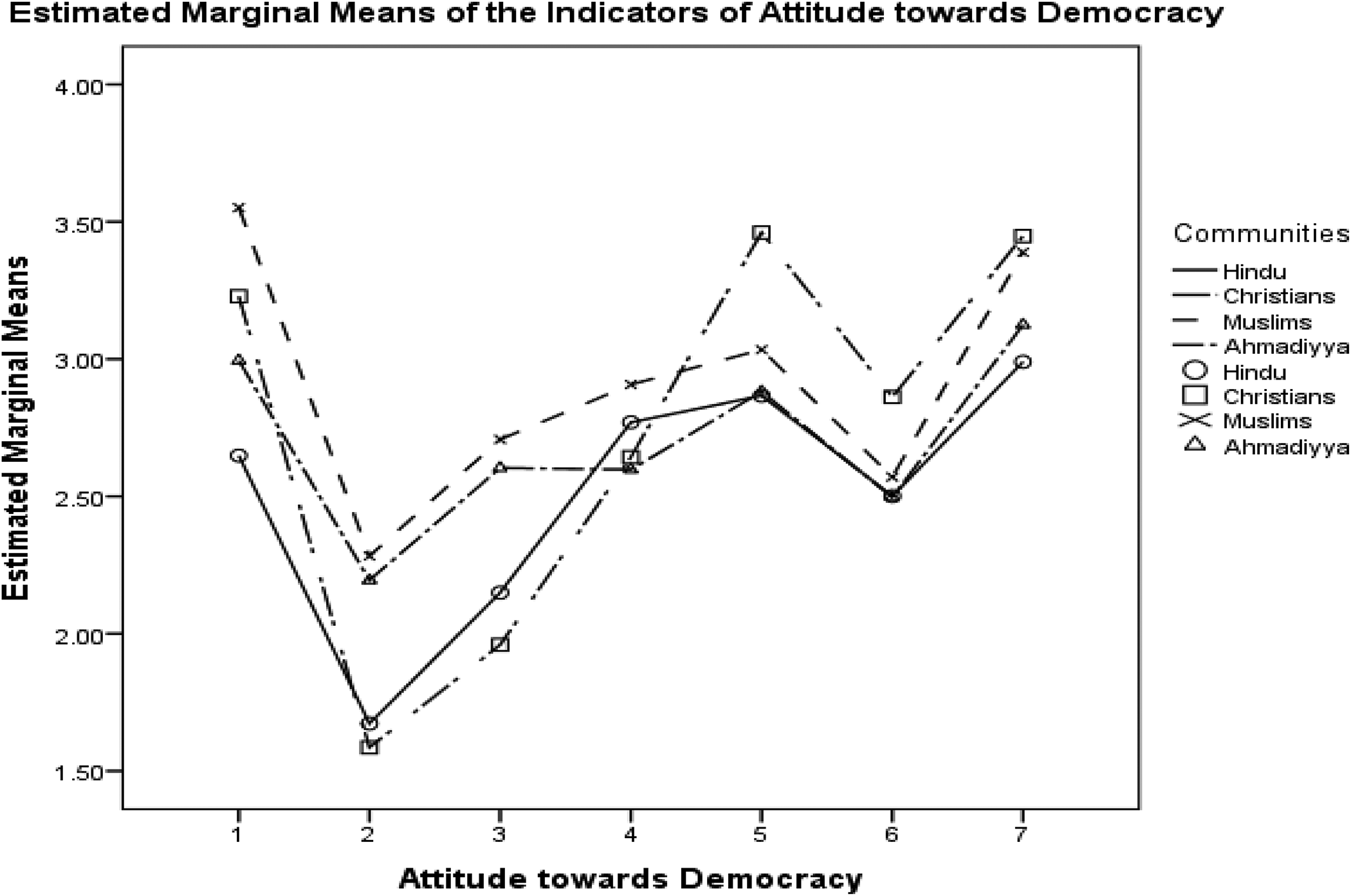
Line chart of the means showing the significance of democracy (1), democratic performance (human rights) (2), trust in political institutions (3), support for controlled democracy (4), support for liberal democracy (5), support for masculine democracy (6), support for traditionalism (7) while differentiating the secondary school students affiliated with Hindu, Christians, Muslims and Ahmadiyya communities.
Results of LSD post-hoc test revealing the impacts of secondary school students’ affiliations with Hindu, Christian, Muslim and Ahmadiyya communities on their attitude towards democracy.
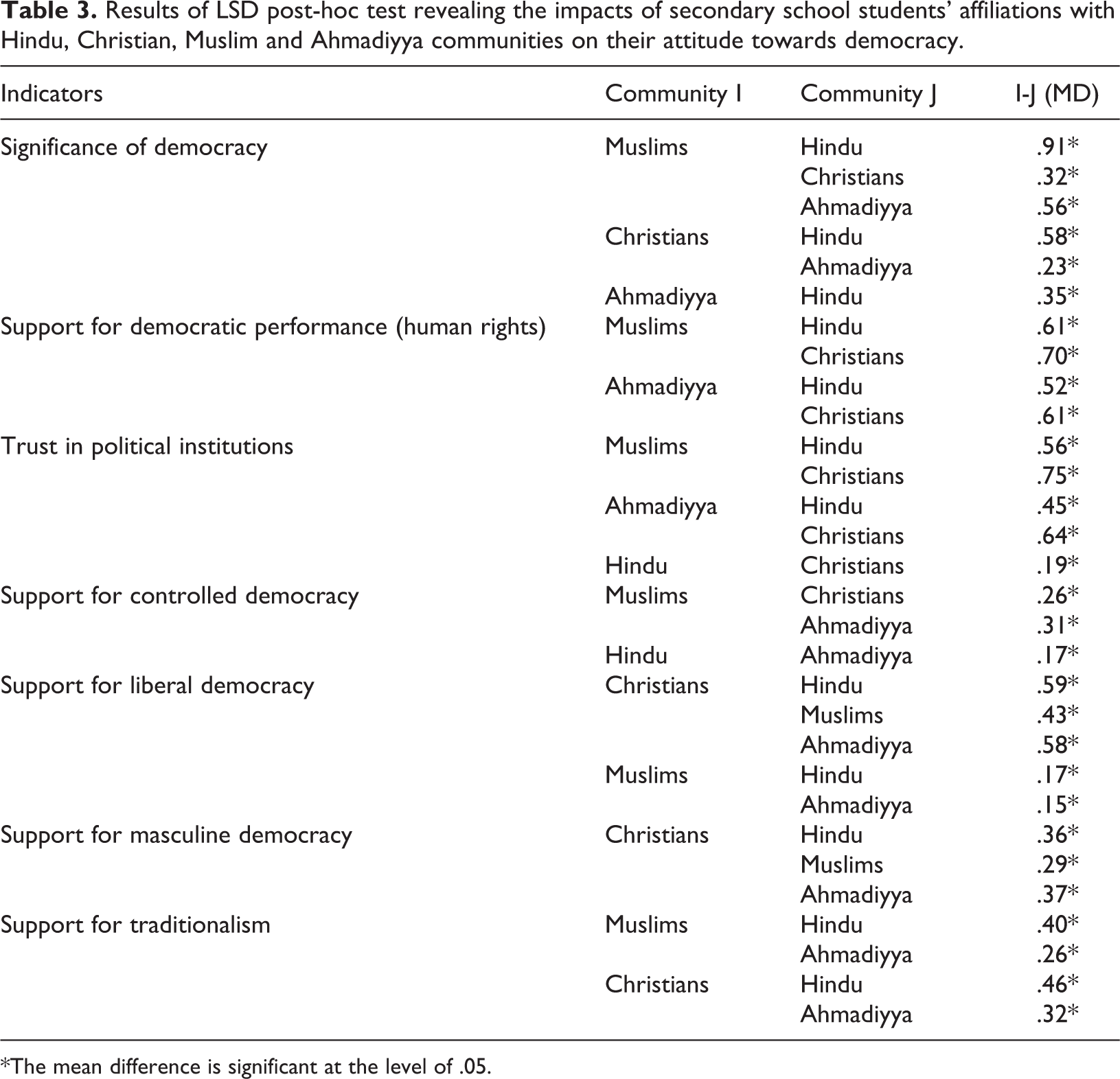
*The mean difference is significant at the level of .05.
The main effect of the affiliations with different religious communities is significant, F(3, 696) = 29.49, p < .001, indicating that the Muslim students demonstrate a higher acceptance for the significance of democracy, democratic performance (human rights), trust in political institutions and support for controlled democracy than the students affiliated with Hindu, Christian and Ahmadiyya communities. The Christian students demonstrate higher support for liberal democracy, masculine democracy and traditionalism than the students affiliated with Hindu, Muslim and Ahmadiyya communities.
The main effect of the indicators of attitude towards democracy is significant, F(3, 696) = 267.96 p < .001, indicating that the students demonstrate a lower acceptance for democratic performance for assuring human rights regardless of their affiliations with religious communities. The students affiliated with Hindu, Christian and Ahmadiyya communities demonstrate higher support for traditionalism. The Muslim students, however, demonstrate higher acceptance for the significance of democracy.
The interaction between attitude towards democracy and religious affiliation is significant, F(3, 696) = 18.512, p < .001, indicating that the support for traditionalism is higher in the students affiliated with Hindu, Christian and Ahmadiyya communities. Support for the significance of democracy is higher in the Muslim students. The acceptance for democratic performance (in the context of human rights) is lesser in the four groups of students. This gap is significantly greater for the Christian students scoring highest for supporting traditionalism and lowest for accepting democratic performance in assuring human rights.
Expected political participation
A two-way mixed ANOVA, with the four groups of secondary school students as the between groups variable (four levels: students’ affiliations with Hindu, Christian, Muslim and Ahmadiyya communities) and indicators of expected political participation as the within groups variable (four levels: expected electoral behaviour, expected participation in political activities, social movements and protest activities) was run to find out the between and within effects of the variables. The results are drawn from the mixed ANOVA and LSD post-hoc test and are presented in Figure 3 and Table 4.
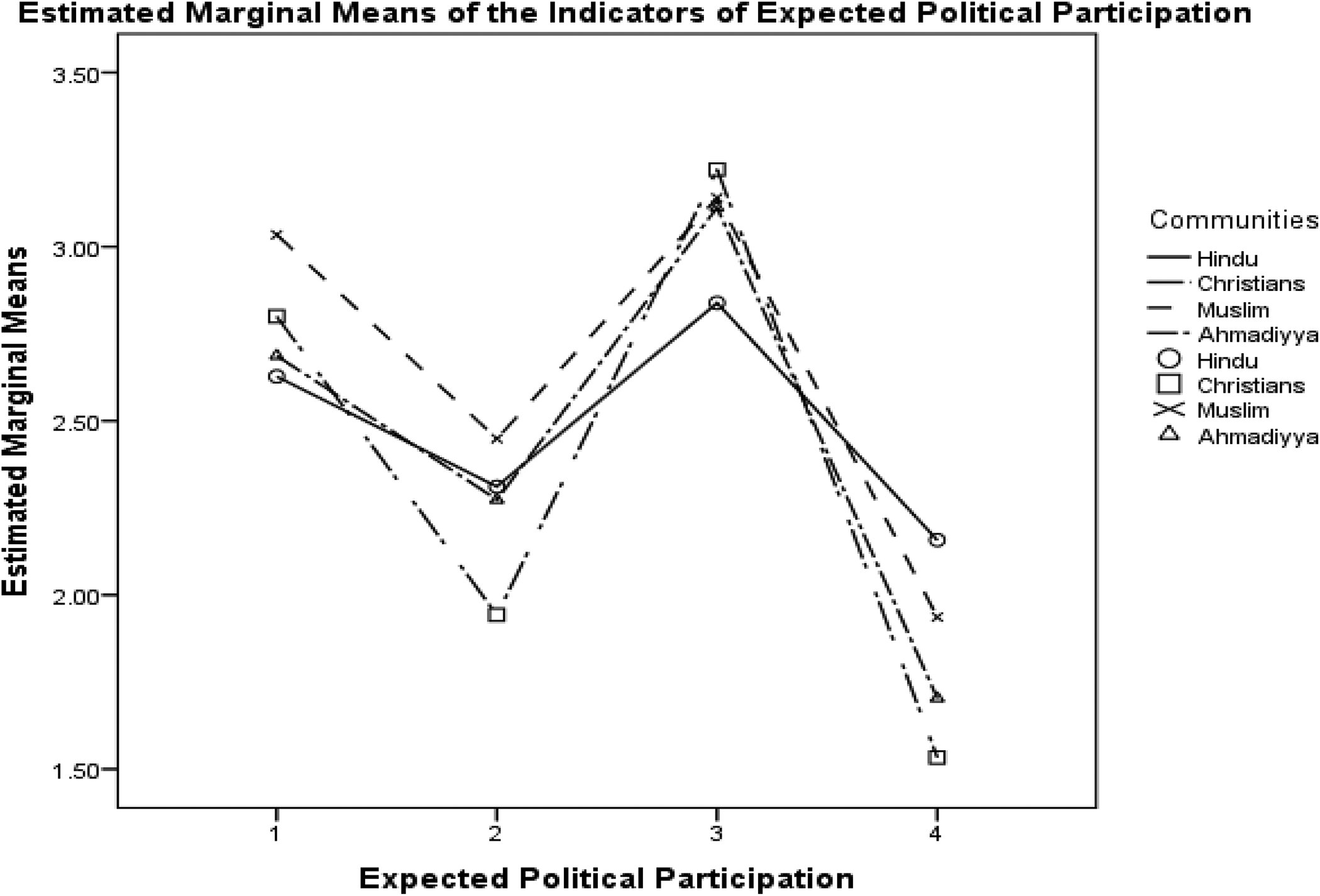
Line chart of the means showing the expected electoral behaviour (1), and participation in political activities (2), social movement activities (3) and protest activities (4) while differentiating the secondary school students affiliated with Hindu, Christian, Muslim and Ahmadiyya communities.
Results of LSD post-hoc test revealing the impacts of secondary school students’ affiliations with Hindu, Christian, Muslim and Ahmadiyya communities on their expected political participation.
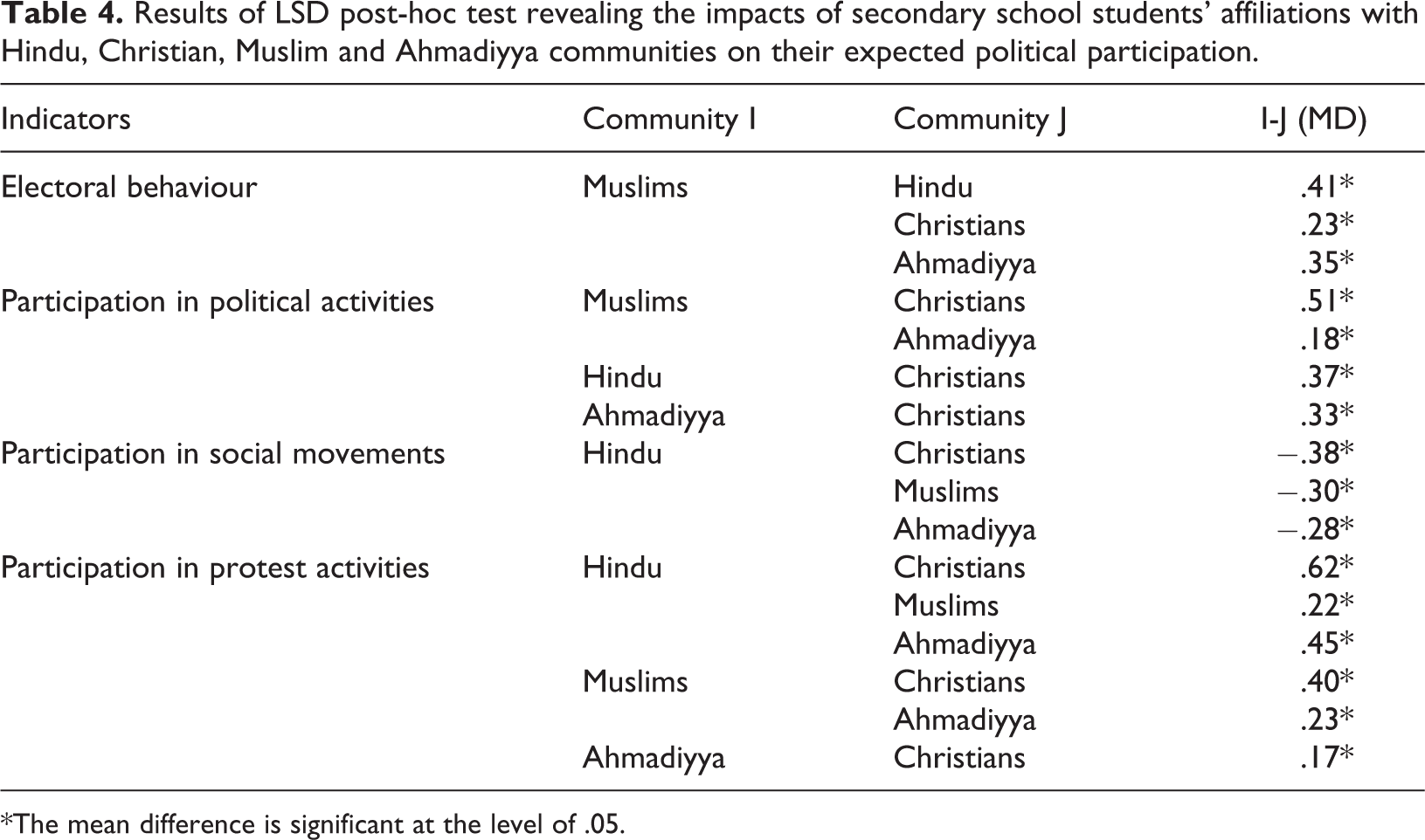
*The mean difference is significant at the level of .05.
The main effect of the affiliations with different religious communities is significant, F(3, 696) = 9.409, p < .001, indicating that the Muslim students demonstrated higher expected electoral behaviour and participation in political activities than the students affiliated with Hindu, Christian and Ahmadiyya communities. The students associated with the Christian community demonstrated higher expected participation in social movements and lower expected participation in protest activities than those affiliated with the Hindu, Muslim and Ahmadiyya communities.
The main effect of the indicators of expected political participation is significant, F(3, 696) = 436.83, p < .001, indicating that the students demonstrate higher expectations for participating in social movements and lower expectations for participation in protest activities regardless of their affiliations with religious communities.
The expected political participation and religious affiliation interaction is significant, F(3, 696) = 14.131, p < .001, indicating that the level of expected participation in social movements is higher in all four groups of students and expected participation in protest activities is lower in all four groups of students. This gap is significantly greater for the students with Christian backgrounds scoring highest for expected participation in social movements and lowest for expected participation in protest activities.
Discussion
People’s political behaviour, associated with different ethnic and religious factors, varies depending on multiple factors (Just, 2017). This study looks at three aspects of the expected political behaviour of young students affiliated with one majority (Muslim) and three minority religious communities (Christian, Hindu and Ahmadiyya) in Pakistan. The findings endorse a well-established belief that Pakistani youth are disillusioned with the active politics of the country (Lall, 2014). We further find that the disillusionment is comparatively higher in non-Muslim youth; this attitude is understandable in prevailing social and political environment on the country. The students with a Muslim background demonstrated comparatively higher internal and external political efficacies than those associated with the Hindu, Christian and Ahmadiyya communities. One reason for this disengagement may be the students’ dissatisfaction with the performance of democracy in ensuring human rights in the country. The extent of dissatisfaction in Muslim students was comparatively lower than those affiliated with the Hindu, Christian, and Ahmadiyya communities. The dissatisfaction was higher in the students with a Christian background. The cynicism in the students and their dissatisfaction with the performance of democracy in ensuring human rights in Pakistan may be interpreted with the deteriorated law and order situation in the country. Many religious and sectarian-based militant and semi-militant groups function in the country and target the fundamental rights of their opponent’s religious, ideological and political groups and individuals. Researchers at the Brown University estimated that more than 52,000 Pakistani civilians and combatants died and more than 50,000 people were wounded between 2005 and 2014 in different terrorists incidents, including suicide attacks and car bombings (Rajan, 2015). Such violent incidents promote pessimism in the common people regardless of their religious affiliations (Shahar et al., 2009). The students affiliated with minority groups, however, are more vulnerable to the fear of insecurity and helplessness in the current scenario.
The state institutions are also involved in another type of human rights violation. Military coups, selective judicial activism and the inefficiency of public institutions in the cases of target killing and missing persons may be presented as a few examples in this regard. Many discriminatory laws and government policies restrict the active political participation of non-Muslim citizens. The opportunities and provisions of fundamental rights are not equal for all citizens, which ultimately influences the perceptions of deprived groups about the role of democratic institutions in solving their key issues (Rahman, 2012). This might be a reason that the students of non-Muslim backgrounds in the study demonstrated the least trust in political institutions. The trust deficit is comparatively higher in the Christian students who concurrently show higher dissatisfaction with the performance of democracy in ensuring fundamental human rights in Pakistan. The trust in political institutions remains deteriorated in the students with Hindu and Ahmadiyya backgrounds as well. The assassinations of Salman Taseer and Shahbaz Bhatti (who came to support Asia Nourin, a Christian woman sentenced under blasphemy law and later released on Supreme Court order) in 2011, and the support of the common people for their assassins, maximized the distrust of the Christian community and other minority groups on democratic and security institutions in the country (Gregory, 2012). The Muslim students, whose community is in the majority and does not face the direct threat of such violence, demonstrated a comparatively higher trust in political institutions. The distrust of political institutions emerges in the students’ divided opinions on the likeliness for controlled democracy. The participants, affiliated with the four communities, support the supervision and monitoring of political institutions by non-political institutions including the judiciary and the military. This support for controlled democracy is higher in the Muslim students than in their non-Muslim counterparts.
The participants associated with the four groups showed an encouraging tendency of participating in the electoral process compared to taking part in violent protests and other non-electoral political activities. They demonstrated a higher tendency for participating in social and philanthropic activities as well. Detachment from agitation and support for productive socio-political activities seem a catalytic sign for the future of Pakistani politics – a politics that is currently characterized by religious, patriarchal and violent domination (Ispahani, 2015). Religious minorities feel a threat to their identity in the national and ideological discourse of Pakistan (Rais, 2007). The non-Muslim students’ support for the interpretation of democratic norms in their own religious and cultural contexts is understandable in the context of prevailing threats to their identities. But the likeliness of religious and cultural interpretation of democratic principles in the Muslim sample is viewed in the context of Islamization in the overall society as well as in the curriculum and instructional models of Pakistani academic institutions.
Conclusions
The findings of the current study rely on the existing status of participants’ attitudes towards democracy and their plans for political participation. It is argued that human rights violations, discrimination and hostilities against marginalized religious communities influence the young students’ political beliefs and their motivation to take part in political affairs. The study concludes that the prevalence of internal and external self-efficacies was lower in the non-Muslim participants than in their Muslim counterparts in Pakistan. The prevalence of cynicism, however, was higher in all participants, with Christian students at the top and Ahmadiyya students at the bottom. The students, despite cynicism, were aware of the significance of democracy for their individual and collective wellbeing. Dissatisfaction is also evident in the students’ perceptions about the performance of democratic institutions in ensuring basic human rights. The extent of dissatisfaction with democratic performance in ensuring human rights in the country varied between the participants. The Muslim students showed comparatively less dissatisfaction than those affiliated with non-Muslim communities. The Christian students, however, demonstrated higher dissatisfaction in this regard. Similar conclusions are drawn in the case of trust in political institutions. The Christian students had least trust in the political institutions, whereas the Muslim students had comparatively more confidence in them. It is important that the students claimed to support liberal democracy in the country but simultaneously wanted religious, cultural and indigenous interpretations of democracy. The interaction between likeliness for traditionalism and distrust on political institutions led the research participants to support controlled democracy in the country. The support for controlled democracy was higher in the Muslim students and lower in the Ahmadiyya students.
The study concludes that the students showed a higher tendency to participate in electoral politics in the future. Significant differences, however, were found among the four groups in this regard. The tendency of participating in electoral politics was higher in the Muslim students and lower in the Hindu students than for their counterparts in other communities. The four groups ruled out the tendency of participating in non-electoral political activities and agitation in the future; rather, they supported participation in political activities that are social and philanthropic in nature. The intention to ignore protests and agitations was lower in the Christian students. The Christian students also showed a higher tendency of participating in politically motivated humanitarian and philanthropic activities.
The participants, irrespective of their religious affiliations, supported democracy in the country. Significant variances were, however, found in the extent of their support. The students were committed to participating in electoral and humanitarian political activities. However, there is need to build and strengthen students’ trust in political institutions. One solution to take away from this study is improving the performance of democratic institutions, especially in ensuring the basic human rights of all citizens. This would strengthen the students’ trust on political institutions and reduce the pessimism and disappointment about the prospects of democracy in Pakistan.
Footnotes
Declaration of conflicting interests
The author(s) declared no potential conflicts of interest with respect to the research, authorship, and/or publication of this article.
Funding
The author(s) received no financial support for the research, authorship, and/or publication of this article.
