



Abstract
The Belt and Road Initiative (BRI) has attracted support and critique for its legitimacy and potential success. Its opponents see challenges more than prospects because of American inattention and resistance, and its proponents see prospects more than challenges because of the attention from the rest of the world. While both sides use valid reasons for their explicit or implicit views, they focus on the legitimacy by its taken-for-granted status. The BRI project as innovation is at the legitimisation process stage. To address the legitimisation of the BRI project innovation, we use rhetorical theory to analyse the Chinese official report in 2019, the American versus European media response to the BRI project and the US direct response to the BRI in the Indo-Pacific Strategy in 2019. Our exploratory findings show insights into the subjects, industries and regions. Firstly, the American media attention far exceeds the European media attention. Secondly, the American media attention and direct response to the BRI highlight the political issues, and the European media attention highlights economic issues. The Chinese official report mentions European countries, and excludes the USA. Thirdly, it uses Pakistan more frequently than other countries or regions in its achievement report, but the US has not mentioned Pakistan at all in its Indo-Pacific Strategy. Fourthly, the US political logic diverges from the logic of the BRI project, while the European economic logic converges to the logic of the BRI project. Based on these findings, we contribute to the legitimisation process of innovation, rhetorical theory and policy implications in the world.
Keywords
Introduction
The Belt & Road Initiative (BRI), also known as ‘One-Belt-One-Road’, has attracted two types of arguments on its prospects and challenges. One argument highlights the scope and size of the BRI project (Callahan, 2016). One highlights the achievements. By the end of 2019, the project had 64 partner countries, which accounted for 64% of the world population and 30% of global GDP ( Belt & Road News, 2019). Geographically, the BRI project links three continents through land and sea routes, offers varieties of infrastructural facilities and contributes to socio-economic, institutional development. Within the broader framework, the BRI project has produced other institutions, such as the AIIB (Asian Infrastructure Investment Bank), which enlisted 100 member countries in 2019. The other highlights its challenges, bringing ideas of risks and legitimacy. It contends that the BRI project lacks legitimacy because the US has ignored it, and without the US endorsement it faces a legitimacy issue (Nordin and Weissmann, 2018). American avoidance and subtle resistance undermine its legitimacy (Brakman et al., 2019; Cheng, 2016; Rolland, 2017). Therefore, despite its size and scope, the BRI project lacks the taken-for-granted status in the eyes of the US (Rolland, 2017).
Although these accounts inform on some aspects of the BRI project’s legitimacy challenges, they confuse the legitimisation process with the legitimacy product. This literature raises a valid question that every innovation needs the legitimacy of the audience, and some of those ideas are competitors—just like the US is a competitor to China. They confuse the issue because the BRI project is an innovation going through the legitimisation phase, and this phase requires compatible analysis of the legitimacy process rather than legitimacy product. This conceptual difference arises because the taken-for-granted status of an entity implies that it has reached the highest level of acceptance, and it is no more an innovation (DiMaggio and Powell, 1983; Suchman, 1995). The BRI project is passing through the legitimisation stages that require subtleties in the relevant evidence as opposed to incoherent opinions. The incoherence between the focus on the legitimisation process and evidence from the legitimate product raises questions about the relevant theory to explain this development.
To address this contentious issue, we narrow the focus of the exploratory analysis of the legitimisation process and link it to compatible theory and evidence. On the theory side, rhetorical institutionalism explains the legitimisation process of innovation (Green, 2004; Suddaby and Greenwood, 2005). The rhetorical theory explains the innovation in a critique-response fashion at the product, technology, organisation and national levels (Black, 1978). On the evidence side, we assessed the US media attention to the BRI project and compared it to the European media attention. As a benchmark, the European media attention to the BRI project fills the incoherence gap. Together, the rhetorical theory and the American media response formulate the framework in which the rhetor’s innovation attracts the audience’s criticism. In other words, the Chinese official report on the BRI project proposes its logic to the world and justifies its role to its audiences by answering implied questions. In this iterative cycle in the legitimisation process, the rhetor proposes the innovation and the audience may raise questions needing justification (Bitzer, 1968; Green, 2004; Suddaby and Greenwood, 2005). In this analogy of the rhetor, intermediary communication devices and the audience in rhetorical theory (Black, 1978; Burke, 1966), we introduce three actors in our framework: China, as the rhetor of innovation, the US and Europe as the audience and the media as the intermediary. Therefore, the media, as an intermediary mechanism, shows the attention level of the audience to the innovation.
Legitimacy scholars place the media between the rhetor and the audience in the legitimisation process (Deephouse et al., 2008). The scope of the media coverage helps analysts evaluate and predict the legitimisation process of innovation, and many empirical studies have validated the impact of the media in the research on issue salience (Foot and Walter, 2015; Freedman, 2015; Hameiri and Jones, 2016; Loke, 2016). Likewise, authors of media narratives explain the relevance of the issue and its importance in the public mind (McCombs, 2004). The media not only links the two sides, the innovation and the audience response, but also it alters the collective logic and action (Shiller, 2019). Therefore, we raise the question of the American media support and the intensity (attention) and scope of the coverage to explore the development in the legitimisation process. Adopting the content analysis method, we focus on the (i) subjects, (ii) industries and (iii) regions in the media coverage in the USA, and then we contextualise these findings in the Chinese official report on the BRI achievements and the US response to them.
The study aims to make three contributions. Firstly, it explores the phenomenon of the innovation of the BRI project at its legitimacy formation stage. The BRI project innovation is going through the natural critique stages, which supports its development. By understanding the process of legitimisation of the innovation associated with the BRI project, we can assess its dynamics and formation rather than the format (taken-for-granted status). Secondly, it contributes to rhetorical theory for the institutionalisation of innovative ideas by linking the rhetor with the audience through the mediator—the US and European media. From the rhetor’s innovation to the audience’s critical response, rhetorical institutionalism explains the cycle. Thirdly, it offers general implications of the model and analysis for its relevance across contexts and levels for future research on this or similar topics.
Theoretical framework
Legitimacy theory
Management and organisational scholars have developed the importance of legitimacy concepts in the innovation of ideas and technologies (Deephouse et al., 2008). In organisational theory, legitimacy is “a generalised perception or assumption that the actions of an entity are desirable, proper, or appropriate within some socially constructed system of norms, values, beliefs, and definitions” (Suchman, 1995: 572). The definition holds multiple qualities of legitimacy. First, it is a socially constructed phenomenon, which has roots in collective norms and assumptions. Second, any innovation (a new idea, technology or organisation) requires legitimacy for survival and growth, which implies that innovation lacks legitimacy, and that the legitimacy status of a thing lacks innovation. In other words, once the innovation reaches a taken-for-granted status, it is no more an innovation. Third, the legitimacy of the innovation comes from the audience, and audiences vary in relevance, levels and influence. Fourth, because of different norms and values among audiences, the tension between audience groups is natural because they carry a different logic to that of the sponsor of the innovation. Fifth, once the legitimacy of innovation has gained taken-for-granted status among its audience, the audience raises no more questions. In short, the legitimisation process precedes the taken-for-granted status of innovation (Elsbach, 1994).
In the rhetorical theory perspective, the legitimisation process links the rhetor’s innovation with the audience’s response to innovation through different logics. Partially, the audience logic differs from the rhetor’s logic, which generates questions from the audience, seeking justification from the innovation sponsor (the rhetor) (Neilsen and Rao, 1987). A level of consensus can emerge of coevolution between the rhetor’s logic and the audience’s logic towards the taken-for-granted status of the innovation (Suchman, 1995). Interdisciplinary authors refer to the legitimisation of innovation to rhetorical institutionalism in its full circle (Burke, 1966; Greenwood and Hinings, 1996). Management scholars have applied this rhetorical institutional theory to the legitimacy building of organisational functions and departments (Suddaby and Greenwood, 2005). Since every innovation requires legitimacy for its diffusion (Schumpeter, 1942), the rhetorical theory and the legitimisation process have coevolved.
The history of technology and innovation reveals that most innovative ideas and technologies face resistance in legitimisation. For instance, atomic energy faced resistance early on (Whitney, 1950). Innovation in higher education has faced resistance at the legitimisation stage (Evans and Leppmann, 1970). Likewise, management development has triggered questions and demanded justification in the legitimisation process (Currie, 1999). Currently, biotechnology is facing its share of resistance in the legitimisation process (Bauer, 1997). The resistance to the BRI project innovation at the legitimisation is no exception (Brakman et al., 2019), and it will need rhetorical theory to explain its process, as previous innovation instances relied on rhetorical institutionalism.
Rhetorical theory and the legitimisation process
Starting with the formalisation of rhetorical theory (Burke, 1966), the academic literature has developed it in the context of rhetorical institutionalism, which explains the antecedents, process and consequence of legitimisation of an innovation (Green, 2004; Greenwood and Hinings, 1996). For instance, organisations legitimise their innovative practices and structures through an iterative process between the rhetor and audience. In this interaction, the role of criticism from the audience is as a natural response. From critical perspective theory, scholars of capitalism refer to similar dynamics to explain the conceptual legitimacy of the idea of capitalism when it emerged from resistance (Boltanski and Chiapello, 2005). These analogies suggest that rhetorical theory explains and supports the legitimisation process because it takes criticism as an inherent part in the development of an innovation.
The BRI project meets these conditions of being an innovative technology, structure, practice and institution (OECD, 1997; Schumpeter, 1942). As a technology, the BRI project is an innovative venture spanning across industries, countries and regions. As a structural innovation, it reflects new actors, regions, organisations and inter-organisational relations. A change in the organisation or technology defines an innovation (OECD, 1997; Schumpeter, 1942). The BRI project goes beyond these simple definitions of innovation. Instead, it is an innovation that varies from the institutional level to the practice level. From the institutional innovation perspective, the BRI project is a system of innovation rooted in the Old Silk Road (Brakman et al., 2019). It is also a source of institutions and has a new institution, the AIIB (Asian Infrastructure Investment Bank). The AIIB has enlisted 100 member countries in the world. Likewise, the BRI project produced institutional innovation in the education sector by forming Sino-foreign cooperation between universities, science centres and industries (Malik, 2020). In practice, the BRI project combines general policy with local practice in the host country, making another type of innovation. In this sense, the BRI project is an innovation at the legitimisation stage.
As noted earlier, the legitimisation process rests on criticism and questions about innovation as one of its fundamental conditions, in which the audience raises concerns and questions and the rhetor provides justification in light of those questions (Green, 2004; Greenwood and Hinings, 1996; Suchman, 1995). Without the audience’s questioning, the rhetor’s innovation remains unclear, which implies the lack of attention without which the innovation will not survive or diffuse. In other words, the lack of questions suggests two possibilities. First, the innovation and legitimacy status contradict each other. The innovation ceases to be so when it reaches taken-for-granted status. Second, the attention of the audience is a scarce resource, which correlates with the dominant logic. The innovation can attract the attention of its audience when it dominates on the preference scale of the audience (Neuman, 1990; Nigam and Ocasio, 2010; Webster, 2011). Together, the combined logic of scarcity and attention explains the legitimisation process (Sillince et al., 2012; Suddaby and Greenwood, 2005). Since the BRI project is in the legitimisation process, it meets the scarcity and attention logic.
Between the rhetor and audience, the national media take the mediating position in the legitimisation process (Cronen, 1973; McCombs and Shaw, 1972), and rhetorical theory explains this mediation between the background ideas and foreground communication (Kornprobst and Senn, 2016). Just as media-driven communication links the process to the antecedents and consequence of institutional change (Campbell, 2004), rhetorical institutionalism combines the rhetor’s innovation and the audience response through intermediaries. Indeed, between the rhetor and the audience, there “are other social actors, such as the media, who make or convey implicit or explicit legitimacy assessments as a side-effect of their routine operations” (Deephouse et al., 2008: 69). For practical purposes, just “counting the number of organisations or the number of media articles, with greater numbers indicating greater legitimacy”, is “more appropriate for emerging industries, organisations, or practices, than for more established ones” (Deephouse et al., 2008: 53). If the BRI project is an innovative structure, purpose, design and strategy, then media analysis is suitable for the legitimisation process.
Media attention complements rhetorical theory for assessing the legitimisation process for several reasons. First, within the rhetorical theory framework, the media complements two sides of the logic, reducing asymmetries between the innovation and audience (McCombs, 2004; McCombs and Shaw, 1972). For instance, it links the audience’s questions and the rhetor’s justification (Andrews and Caren, 2010; Etter et al., 2016). Second, the media attention influences the rhetor and audience through inclusion versus exclusion mechanisms of the issues, which enables media agenda-setting (Cronen, 1973; McCombs and Shaw, 1972; Markus, 1987, 1990; Tichenor et al., 1970). Third, media attention introduces situational contingencies in the legitimisation process (Alvesson, 1993; Bitzer, 1968; Watson, 1995). For instance, it can support the tone (positive or negative attributes) for the subjects, industries and regions related to the issue (Kiousis and McCombes, 2004; McCombs and Shaw, 1972; Palmgreen and Clarke, 1977). The media play an intermediary role in the legitimisation process of an issue between the rhetor and audience.
Figure 1 depicts the empirical model for the analysis of the linkage at three levels. At the first level, it links rhetorical theory to institutional theory, making it rhetorical institutionalism. At the middle level, the model links the rhetor and the audience. The top-down arrow shows the rhetorical position of the BRI project in the official narrative. The bottom-up arrow implies criticism of the American side, which we capture through the primary media coverage. At the third level, it links three issues in the media coverage: subjects, industries and regions associated with the BRI project. Each of these three contextual issues reflects diversity and intensity in the US and European media coverage. Together, the model captures the political and economic logic of the rhetor and the audience in the analytical form.

Conceptual model of institutionalism. Analogy: Social and artistic criticism of the notion of capitalism (Boltanski and Thevenot, 2006) is like social and artistic criticism of the BRI project.
Building on prior literature within the rhetorical theory on the legitimisation process, we use a topology for the empirical analysis. Earlier writers assessed political communication on the issue of salience at the macro level (Cronen, 1973). Then the management and organisational literature adopted the role of the media in the legitimisation process in organisations through the rhetorical theory mechanism (Green and Li, 2011; Suddaby and Greenwood, 2005). Recently, the economic literature has explored the role of collective narratives in economic issues (Shiller, 2019). With these insights, we capture the ideas depicted in a topology in Table 1. The typology captures four possibilities of the American media coverage vis-a-vis Europe. Within those possibilities, it explores three issues: subjects, industries and regions in the context of the BRI in media coverage. Some earlier accounts had compared the US with Europe but in different contexts (Olson, 1971). The current topology focuses on the coverage of the BRI project in the convergence-divergence analysis.
Media attention and legitimacy.
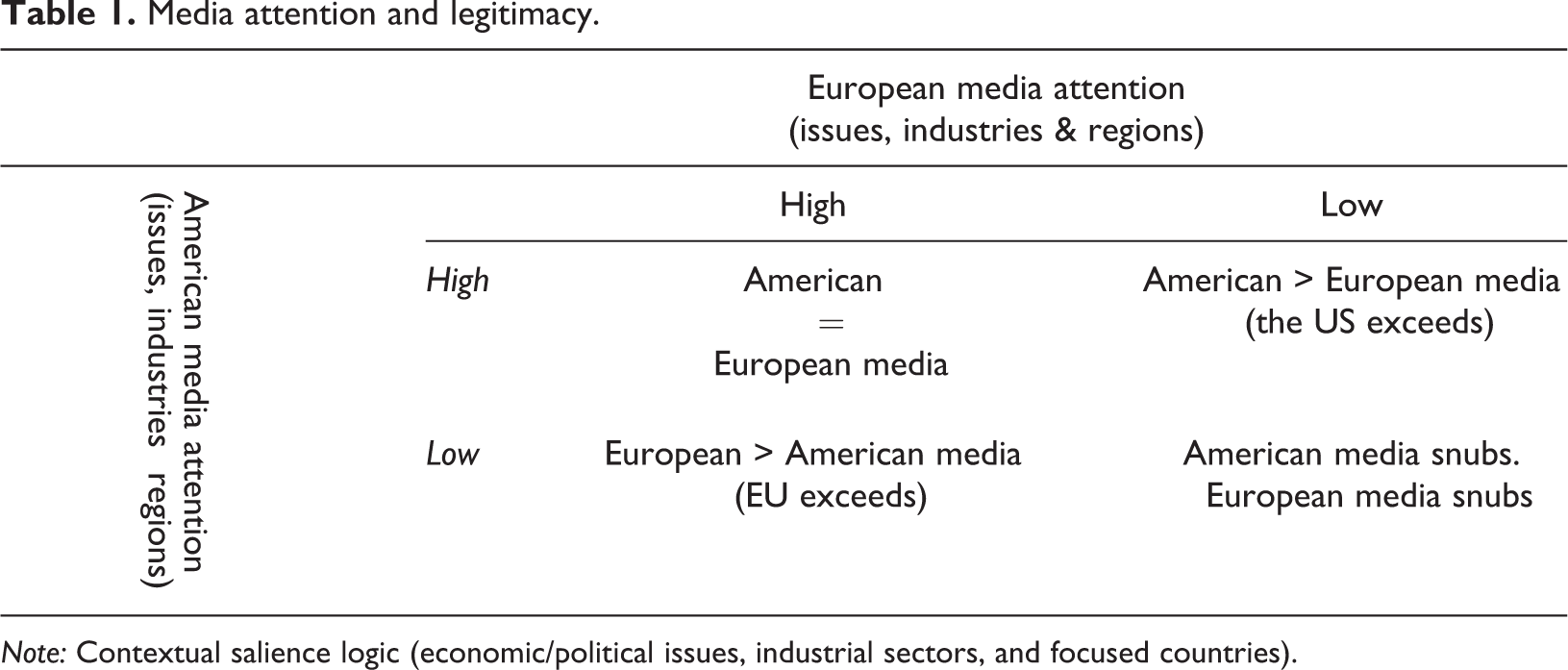
Note: Contextual salience logic (economic/political issues, industrial sectors, and focused countries).
The literature alludes to two types of converging-diverging logics: economic and political. The political discourse stresses that the US resists the BRI project (Gabusi, 2017). For instance, one author suggests that the “Hard and soft infrastructure, Moscow to Singapore and Vladivostok to Lisbon, all roads will lead to China. Despite its size, diversity and intensity, it has not attracted attention from the United States” (Rolland, 2017). At best, this quote points to the intentional avoidance of the US, and at worst it implies American subversion (Cheng, 2016). In another view in the political discourse (Ross, 2019), the literature points out that the US uses political lenses to support the East Asian nations against the potential rise of China. Moreover, some authors bring the role of military power as a legitimisation mechanism (Summers, 2016). Therefore, the political devices in the topology take the place of explanation and explanandum devices in the sense of theory development (Swedberg, 2014).
The economic devices and perspectives dominate in the discourse in the theorising process in other writings (Jessop and Sum, 2018). The notion of economic uncertainty arises from the innovative activities in the world, threatening the existing economic order and related institutions, and the BRI project appears to have come to upset them through a radical innovation in the world order (Andornino, 2017). The economic logic suggests that the existing world order, which consists of American and European dominance, feels threatened by these radical changes in the BRI project (Vangeli, 2017). Since the rhetor’s logic and the audience’s logic interact through the media attention at the middle point (Markus, 1987; Oliver et al., 1985; Perrow, 1986), the audience accounts may diverge or converge to the Chinese’s logic of the BRI project innovation. In other words, the Chinese BRI report and the American response may differ on some issues and coverage on others.
Methods
The research question addresses the issue of the legitimisation process of the BRI project by exploring the American response through media coverage. In this context, the BRI project qualifies innovation in technology, inter-organisational relations and inter-regional integration, capturing the physical and structural perspective. Any of these innovations (technology, organisation structure or inter-organisational relations) requires a legitimisation process (Schumpeter, 1942), and all of these components fit into the BRI project. It links the Chinese rhetorical position and the US and European response for comparative analysis. In response to the rhetor’s BRI project innovation, the audience responds, and between the two sides in this process the media plays a leading role in legitimacy formation. The theory explains the central role of the media in legitimacy (Suchman, 1995), and the evidence guides and supports the analysis of organisational legitimacy and management innovation (Deephouse, 2000). These contingencies (issue-specific, industry-specific and country-specific) support the research question and legitimisation process in the BRI project section in the rhetorical institutionalism.
Sample
Starting from a single media report, we draw the sample based on media entries on the BRI project from 2014 to 2019. The media coverage of the innovation in our analysis meets several conditions. First, we divide the media into two institutional categories: political and economic. The political media include economic issues with less intensity and diversity, and the economic media include political issues with less intensity and diversity. This enabled us to systematise inquiry from the Factiva and Lexus Nexus electronic databases. Second, we narrowed the focus of the media attention to three types (subjects, industries and regions). The subject type captured political and economic issues and their components at various levels. These subjects coincide with industries and sectors. Likewise, the regional focus explains the dominant regions in the eyes of the audience related to the BRI project. In short, three subjects and media coverage set the context for the sample of this study.
Third, we developed the sample from three sources: Factiva (https://professional.dowjones.com/factiva), an official Chinese report ( Belt & Road News, 2019) and the US official report on the Indo-Pacific Strategy (US Department of Defense, 2019). Factiva is an intelligence system that supplies global news coverage through a digital inquiry based on analytics. We gathered raw textual data from this system, before coding it. The data from Factiva supported comparable evidence to analyse US vs European attention to the BRI innovation. Both the American and European audiences supported further analysis in comparison to the rhetorical accounts in the Chinese official report for the purpose, implications and achievements ( Belt & Road News, 2019). Like the American and European media coverage, we frame the BRI project-specific rhetoric into subjects, industries and regions. The third source of the data builds on the US strategic report on the Indo-Pacific Strategy (US Department of Defense, 2019), in which we find a direct response to the BRI project’s innovation. It includes subjects, industries and regions.
Media and mediation
Institutional theories explain the role of the media as a bridge between the rhetor and the audience through communicative devices, frames and social structures (Bourdieu, 2005; Campbell, 2004; Hollingsworth, 2003). Likewise, the media differentiates diverse levels of salience of an issue. As a representative of the rhetor and audience, the media’s attention increases the salience of an issue, and its inattention weakens it (Kiousis and McCombes, 2004; McCombs and Shaw, 1972). Besides increasing the salience, the media aligns the audience’s questions with the issue and demands justification from the rhetor. Since criticism demands justification (Boltanski and Chiapello, 2005), the media coverage links both sides of the equation: the rhetor’s innovation and the audience critique. Hence, the media is the core actor in assessing salient issues at various levels (McCombs, 2004).
The mediating role of the media, according to media theorists (Carroll, 2011), comes in three parts: (i) the quantity of media coverage increases the salience of the issue, (ii) the tone of the media coverage reflects the judgement and (iii) the topics covered in the media reflect the context and scope of the coverage. In the first case, we relate the media coverage quantity to the legitimisation process in the media (Deephouse et al., 2008). The level of attention reflects the first point. The tone of the media attention varies across levels and contextual analysis. For our purpose in the BRI project legitimacy, we limit it to political and economic tones. Besides the media quantity and tone, the last point of the media coverage reflects the topics of attention. Following the framework, we focus on the subject, industries and regions to assess the mediating role of the media in the legitimisation process. Since the media institutions are well developed in the USA and Europe, the analysis of the media coverage warrants the empirical analysis of a salient issue (Neuman, 1990). Indeed, the BRI project has become a salient issue in the world.
Analysis
An explorative question and textual data lead to an inductive approach to the data analysis. Although content analysis serves qualitative and quantitative approaches (Krippendorff, 2004), we adopt the quantitative approach for comparative analysis between the rhetor and audience on the one hand and between issues on the other. For the comparative analysis, the quantitative analysis of the textual data suits our research question: it captures the issue-specific intensity of the media attention, and it points out the dominant logic in the study. This method in the content analysis fits the exploratory question and textual data at three stages in the process (Weber, 1986). The first stage (axial) identifies meaning-making units from the direct and indirect meanings of the textual data (Krippendorff, 2004). The second stage (thematic) maps their links based on the integrated meanings, and the third stage (theoretical) further integrates and evaluates for political versus economic interpretation (Malik, 2019). The data analysis progresses from the identification of the categories based on the contents to the interpretation in the context.
Findings
Following the legitimisation process in the rhetorical framework, we present data in descriptive statistics, from the rhetor’s perspective to the audience’s perspective. As noted earlier, the rhetor’s perspective includes the scope and intensity of the subjects, industries and regions in the Chinese official report ( Belt & Road News, 2019). Likewise, the audience’s perspective includes the data on these issues, industries and regions in two sources: the US government’s comparable to the rhetor, and the American media versus the European media. The European media attention provides a benchmark for the comparative analysis. Both parts make up three charts, and every chart has two dimensions: positive and negative. Since we subtract the European score from the American score, the positive values (USA-Europe > 0) appear on the upper side of the neutral line; the negative values (USA-European < 0) appear on the lower side of the neutral line.
Official Chinese BRI report
Subjects
Figure 2 shows salient subjects (issues) in the official report on the BRI project on the diversity and intensity dimensions. A list of concepts captures the scope and intensity of those concepts. In the rhetor’s perspectives, economic, social, infrastructural, cultural, technological and transaction issues dominate in the subjects. While these issues in the rhetor’s perspective reflect economic issues, they minimally refer to politics, power, control, competition and defence in the official narratives of the BRI report. For instance, technological innovation (internationalisation and economic development) takes the top position. Management innovation (alliance and cooperation) takes the second position. Although 90% of the official report relates to these issues, it entirely ignores the political issue, directly and indirectly. Moreover, it excludes concepts related to conflicts, tension and competition.
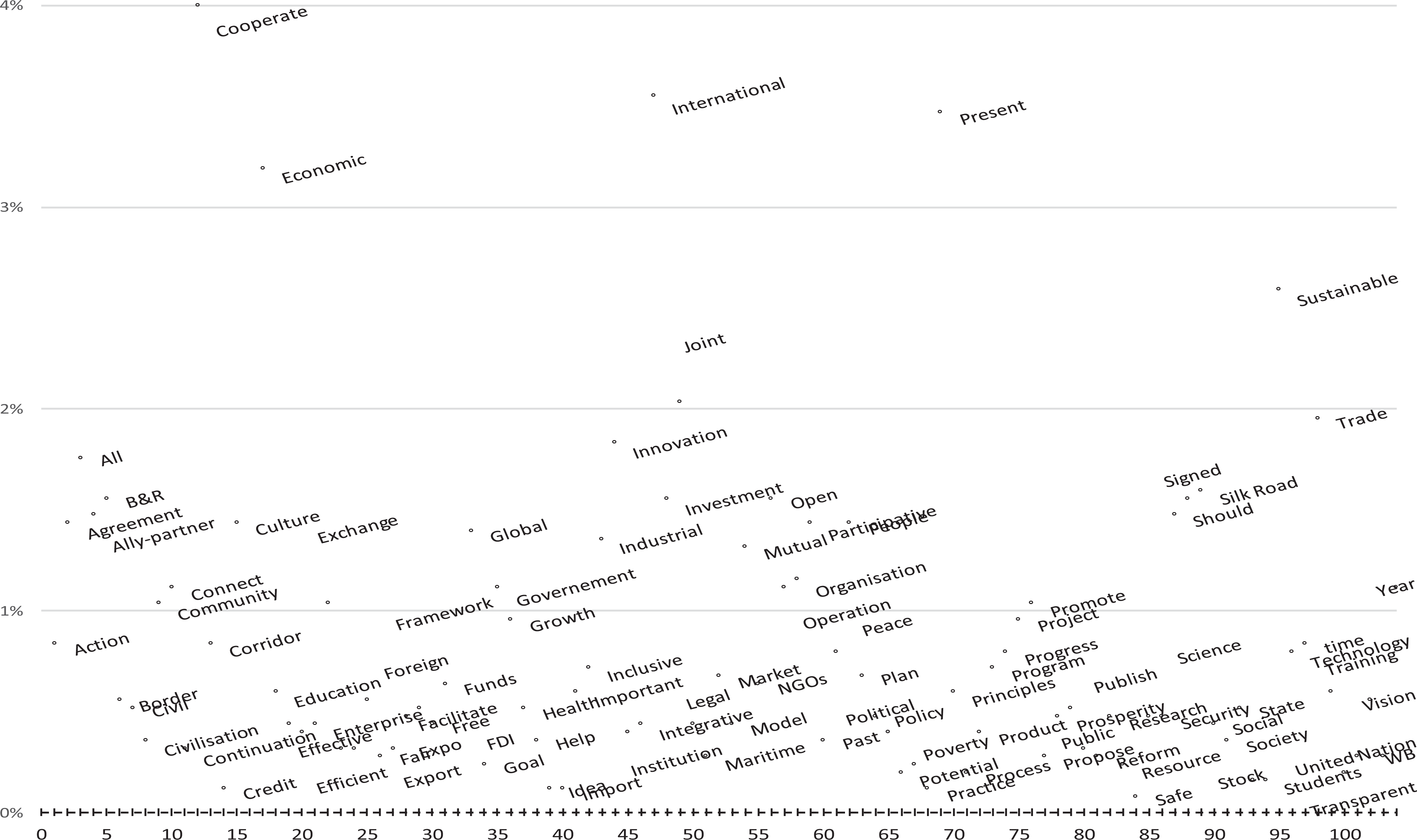
BRI subject salience in the report.
Industries
Figure 3 shows similar patterns about the media coverage on industries (sectors) in the BRI official report. The chart shows more than 40 sectors, at varying levels of frequencies in the Chinese official report on the achievements of the BRI project. In this report, the financial sector, cultural sector, international trade and railway and general infrastructure make up 33% of the industry concepts. In the second position, security, media, services and enterprises make up the middle part of the chart. A quarter of the media attention deals with the energy and technology sectors in the report, showing the rhetor’s perspectives.
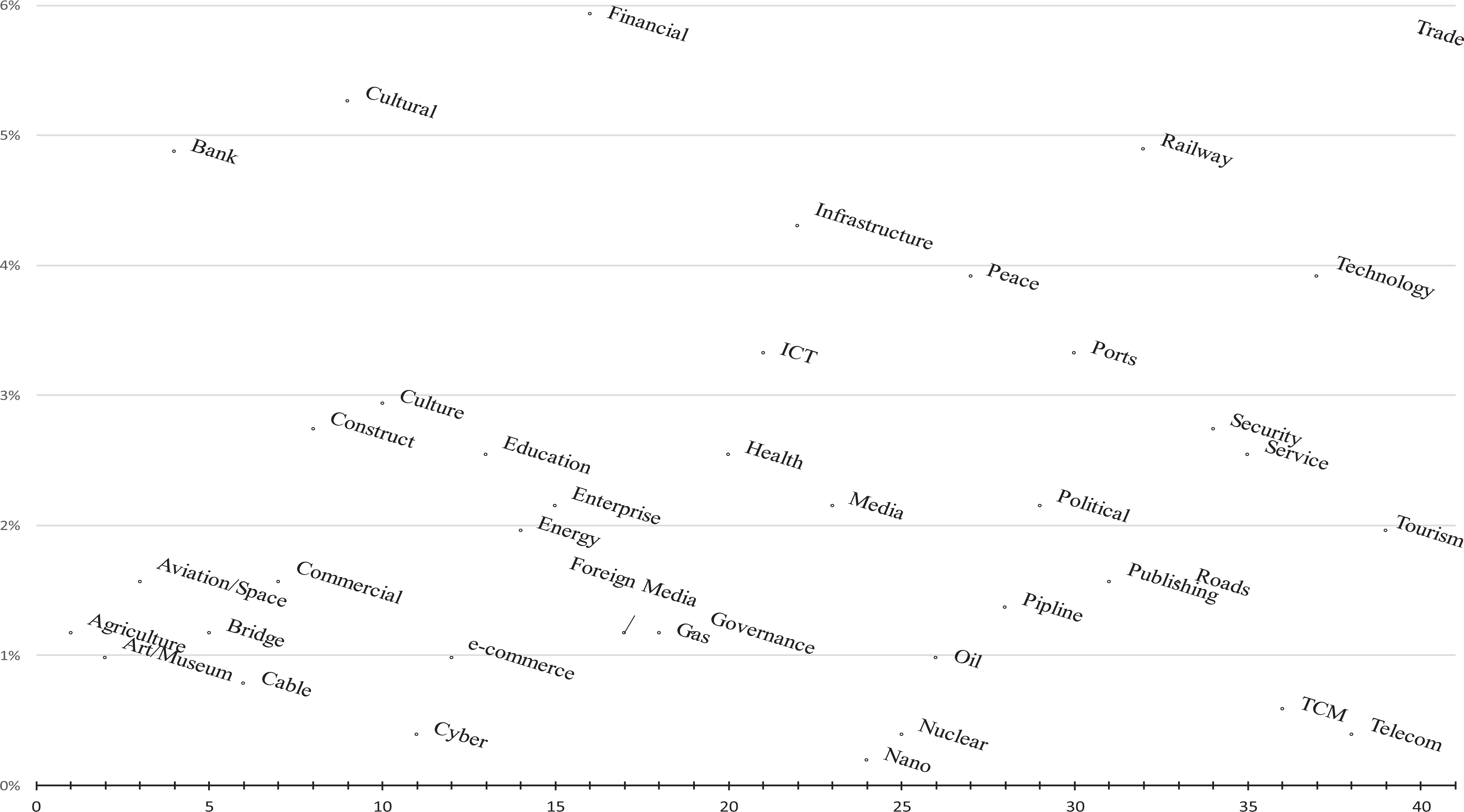
BRI sector salience in the report.
Regions
Figure 4 reports the regional importance in the BRI project report from the rhetor’s perspective. Some 64 regions (countries and groups) take various levels of attention in the report. Pakistan, Europe and Russia take the dominant places in the official rhetoric, followed by Italy, Kazakhstan, Beijing and Africa. Besides individual countries and regions, the report refers to international organisations such as the United Nations and the World Bank.

BRI regional salience in the report.
American media attention
Subjects
Figure 5 shows the subject salience in the American media compared to the European media. The subjects below the neutral line show European media attention about the diversity and intensity of topics related to the BRI, and above the neutral line the US media attention shows the diversity and intensity of issues. The position of diverse topics shows the European media covering 22 out of 68 topics, and American media covering 46 topics. Topics like politics, military power, the legislative/executive entities of the US government and monetary policy issues dominate in the US media coverage. By contrast, the European media intensifies its coverage on economic and commercial issues, reflecting a closer association with the logic of the narratives in the Chinese report. As the official report of the US government shows (US Department of Defense, 2019), military power, politics and global control dominate in the discourse. The European audience reflects some economic issues presented in the BRI project (Appendix A).

BRI subject salience in the US media.
Industries
Figure 6 shows the diversity and intensity of industrial sectors in the American and European media. The European media include 14 out of 58 sectors, and the US media coverages 44 out of 58 sectors. Likewise, the intensity of the industrial sectors indicates that financial services, commerce, commodities and energy appear important to the US. Railroads and other commercial sectors appear important to the Europeans. Therefore, the US attention spans more sectors than Europe in response to the BRI project innovation.

BRI industry salience in the USA media.
Regions
Figure 7 shows the regional diversity and intensity in the American media vis-a-vis the comparative category of the European media. The diversity of regions shows the European media’s attention to 46 out of 88 regions related to the BRI project. The American media attention includes some 42 regions. Most of those regions and countries show similar attention in America and Europe, as they appear near the middle position. However, they differ in some critical areas. The American audience focuses on North America, East Asia, North Korea, Asia, Japan and the Middle East; the European media gives coverage to Russia, Bulgaria and Serbia among those regions related to the BRI project. In contrast, East Asia and North America attract the attention of the American audience, and Russia attracts the attention of the European audience. This comparative analysis of the subject, industries and regions reveals explicit and implicit issues.
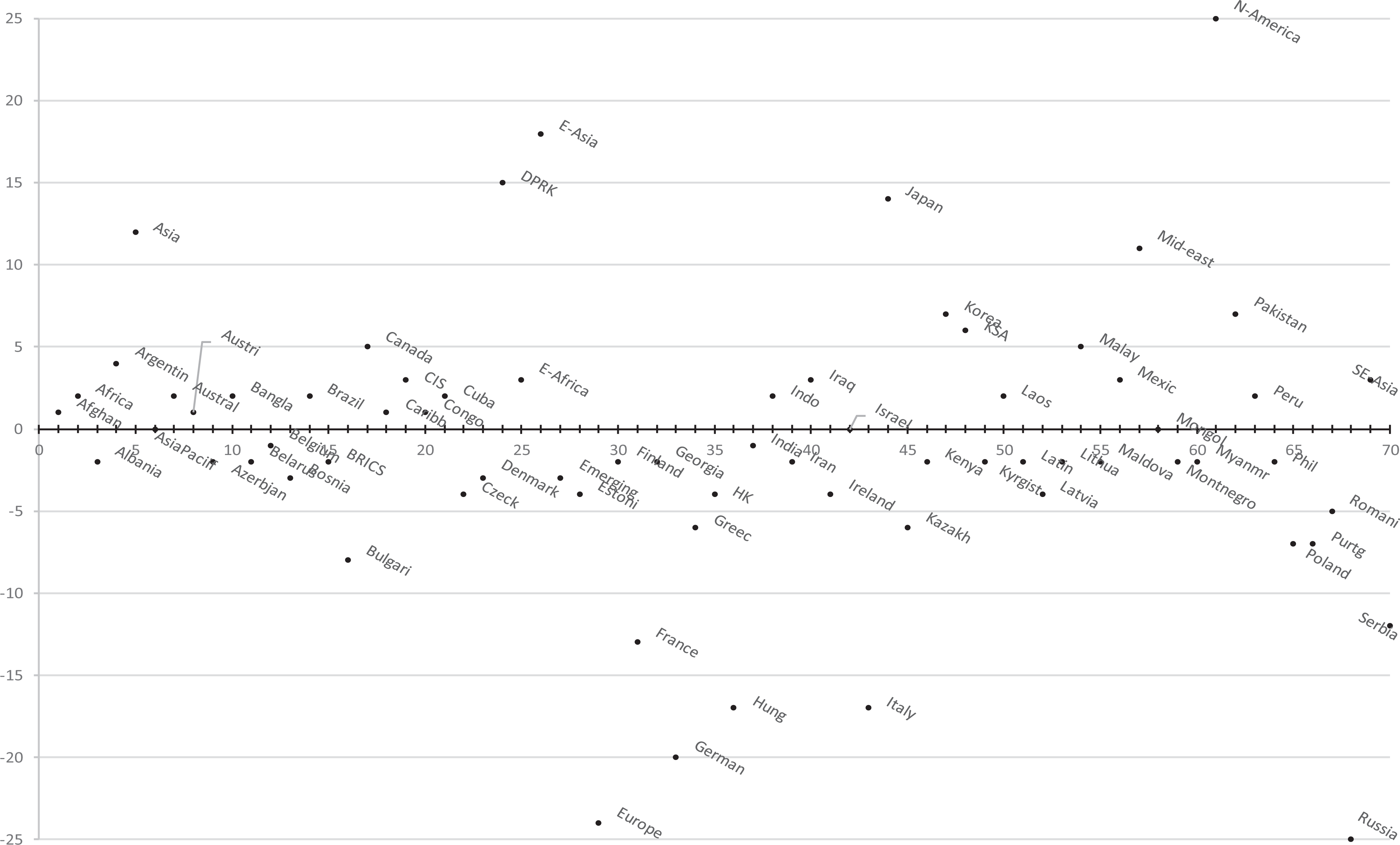
BRI regional salience in the US media.
Figure 8 shows the direct response of the US to the BRI project innovation. The focus of this part of the information has two levels of surprises. Less surprising is that the focus of the entire report is on threat, military force, power, control and influence. What is surprising is that Pakistan is missing from the US report on its Indo-Pacific Strategy. The rest of South Asia and East Asia have ample attention in the report. The BRI project starts from Pakistan, and it has become a cornerstone in the BRI project development. Hence, either the US has not mentioned Pakistan because it has a separate policy for it, or it considers Pakistan equal to the BRI project, which is mentioned in the strategic response.
A brief review in appendices summarises the differences in subjects, industries and regions. Appendix A shows the dominant logic of the three actors about the subjects in the media coverage. While the Chinese attention reflects the logic of cooperation and relationships, the American and European attention reflects the logic of international influence: political and economic. The Chinese logic of cooperation focuses on the future development, the American logic (Figure 8) focuses on political issues of the past and action for the future (US Department of Defense, 2019) and European attention reflects the issue of the international trade of physical goods (economic efficiencies). Thus, the American narrative diverges from the official report, and the European narratives converge to the Chinese logic in the BRI project.
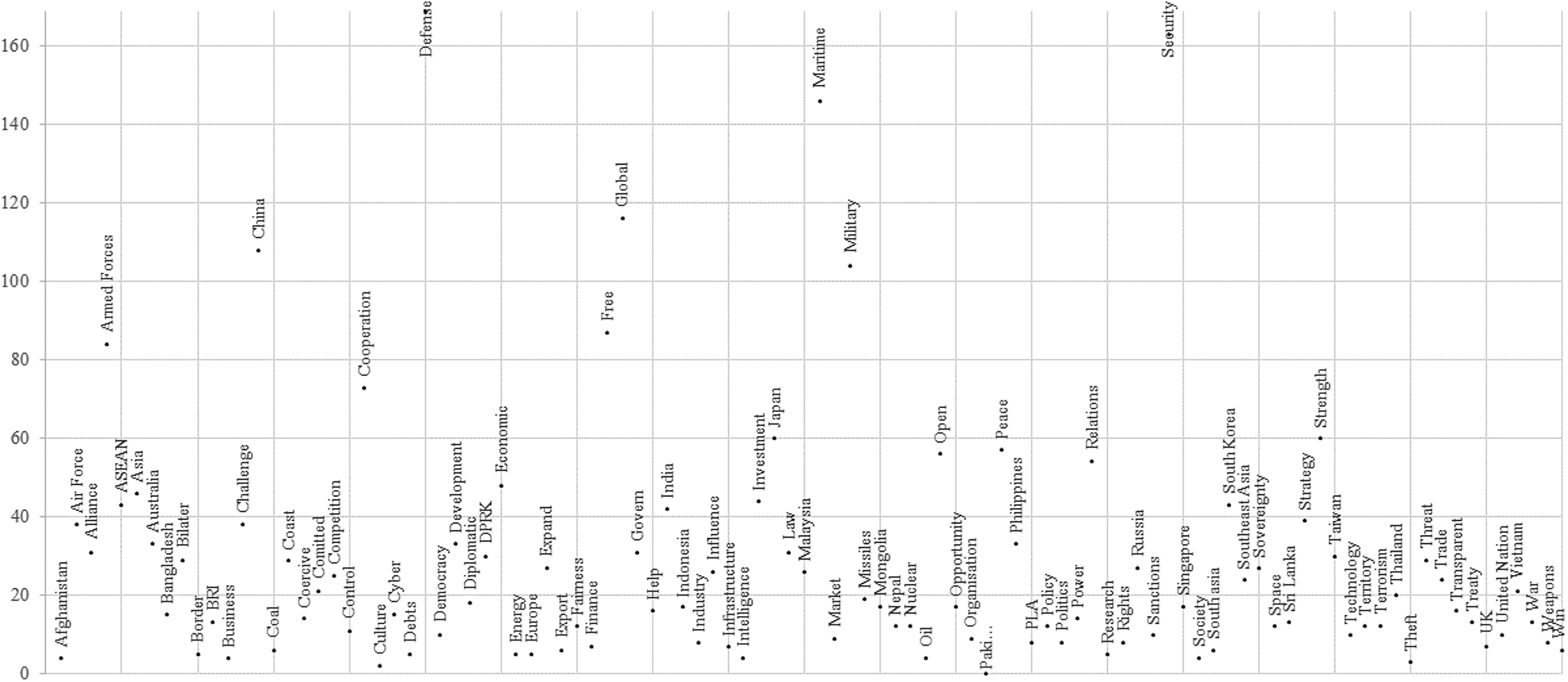
The US Indo-Pacific Strategy in response to the BRI.
Appendix B draws a comparison between the rhetor (China) and the audience (the USA and Europe) on regional importance and attention. Like a salient subject in the media coverage, regional salience differs among the three parties: the US, Europe and China. While the Chinese report mentions Pakistan at the top of the list, the US has entirely excluded it from its Indo-Pacific Strategy (US Department of Defense, 2019). It gives importance to China and makes several references to Russia (Figure 8). These preferences for regional attention indicate subtle differences in the dominant logic. Overall, the American media gives coverage to the BRI project more than the European media; the American media uses a political tone with the BRI versus European media; the American media uses multiple issues compared to the European media.
Discussion
Despite the size and span of the BRI project, its legitimacy has faced questions and scrutiny because of its uncertain future. Because it is an innovation on a grand scale (Callahan, 2016), it needs legitimacy to succeed. Moreover, the BRI project faces legitimacy challenges because it lacks American support (Rolland, 2017). Another similar perspective suggests that the lack of military support, which is a necessary complementary tool, hampers its progress (Cheng, 2016; Overholt, 2015). Some authors explain that the American hegemony in the world will hamper the BRI project because of the rise of Chinese power in the world (Mearsheimer, 2018). This view becomes evident in the Indo-Pacific Strategy as a response to the BRI project (US Department of Defense, 2019). These accounts suggest that the legitimacy challenge to the BRI project innovation arises at various levels—inattention to strong resistance and subversion of the US to the BRI.
However, these authors build on the assumption that legitimacy is a binary phenomenon, whereas its process is a process of gradation. A new idea passes through the legitimisation process towards the legitimate product. Rhetorical institutionalism explains this legitimisation process towards the taken-for-granted status of that idea (Burke, 1966; Green, 2004; Greenwood and Hinings, 1996). Although some writers have acknowledged it as a multidimensional innovation (Callahan, 2016), they have misplaced the focus away from the legitimacy process. No author has alluded to a role of the rhetorical theory in the legitimisation process through justification. Since a new idea draws criticism and justification before becoming a taken-for-granted institution (Boltanski and Chiapello, 2005), we used this analogy in the legitimisation process of the BRI project—the Chinese proposition, the American media criticism and the Chinese justification.
Firstly, the American media attention has increased for the BRI in absolute terms and relative terms in the European media. Simple media coverage warrants that innovation is the legitimisation process, and the salient innovation position in media coverage (Deephouse et al., 2008). Secondly, the audience critique of innovation is an essential part of the legitimation process (Green and Li, 2011; Schmidt, 2008). The evidence from the US response to the BRI project indicates sharp criticism of the project. If the theory holds, then the legitimisation process of the BRI project is on track. Thirdly, the American media reflects political issues towards the BRI project, and the European media reflects economic issues. Previous authors have observed similar patterns due to different logics (Kopper and Peragovics, 2019). For instance, Chinese logic differs from the audience, and the audience logics differs from each other in the context of the BRI project (Liu et al., 2018; Nölke et al., 2015). We find similar patterns. The Chinese position shows economic benefits, the American position shows a political threat and the European media highlights economic competition. Lastly, the Chinese report versus the American and European media coverage differs on regional attention. China highlights the importance of Pakistan, Europe, Russia, Kazakhstan and Italy; the American media includes the entire Asian contingent; and the European media focuses on Russia, among others.
Based on this preliminary evidence and descriptive analysis of the textual data, we can make some informed inferences about the future of the BRI project. Although it will take different trajectories than planned, because the environment is continuously in the evolutionary process, the BRI project is going through the usual processes. Human intervention such as strategic opposition by the audience is a natural response of the competitors of the innovation (US Department of Defense, 2019). Because of the significance of the BRI project innovation, the response is justifiable. Likewise, natural causes such as pandemics may alter its rhythm, but it does not mean they reverse it. Instead, we speculate that the legitimisation process continues over the ensuing decades. Indeed, the tension between the US and China on multiple issues will induce alterations, explicit and tacit. This analysis can show whether the rhetor and audience contradict in their logics.
For instance, the US uses a singular and liberal logic in judging and managing its global affairs (US Department of Defense, 2019). It uses the transaction cost argument and rewards based on the direct cost-benefit parameters in the short term. The Chinese logic of analysis builds on complex systems in managing global affairs (Belt & Road News, 2019). Likewise, in legislative thinking, the Chinese and Americans differ. Most US politicians hold law degrees; most Chinese legislators hold engineering degrees (Malik and Huo, 2019). Naturally, their values and norms differ when they interact internally or externally. Then comes the allies in the region. Two different examples offer a distinctive example of competing logics.
While China and the US had formed strategic alliances with Pakistan since the latter’s foundation, Sino-Pak relationships have further integrated, and the American-Pak relationships have disintegrated vis-a-vis India. While Pakistan joined the US block, India joined the Soviet Block. Now this has been reversed. India has become the major strategic partner in the Indo-Pacific Strategy, and Pakistan is missing from its report. One reason is that India is a larger market than Pakistan for US businesses. Second, the US does not need Pakistan as much as it needed it in the Cold War period. Third, the US needs to counter China, whereas Pakistan is not the ideal choice as an instrument against the Soviet Union that it once was. Fourth, the US economic cost-benefit analysis determines its decisions. For instance, the US strategy with its other partners in the Pacific—Japan and South Korea—shows economic signs more than other value systems in the narratives. The American president has asked its allies to pay for the American forces in Japan and South Korea. Likewise, in the Middle East, the US president has mentioned clearly to the Saudi Arabian government that American support for the royal family has a price. Saudi Arabia buys weapons from the US worth hundreds of billions of dollars. This ‘pay-as-you-go’ contractual mechanism of the USA is different from that in the Chinese style adopted in the BRI project. The Chinese is more sustainable, and the American is primarily transitive.
Overall, the historical lessons show that the US responses have short-term memory. The US abruptly enters and exits international alliances, agreements and conflicts, and changes affinities quickly. China has a long memory span, with stable direction and processes, supporting the outlook of the BRI innovation. The rest of the world varies on this path between the two ends—China on the one end of long-term relationships and the US on the other end of short-term relationships. This does not mean that the American contractual mechanism and style always have a short time span. US membership of NATO (North Atlantic Treaty Organisation) survived decades before their recent exit from it. Likewise, the US alliance with Israel has survived for decades. In other cases, the American contract has been short-lived. The Iranian deal in 2015 survived two years, the agreement on climate change survived several years and its membership (support) survived decades. The costs and benefits dictate its preferences. China, on the other hand, forms durable alliances. Comprehensive strategic partnership between China and many countries in the Middle East reveals its long-term strategic preferences rather than petty calculations.
This analysis makes a threefold contribution: the phenomenon of the legitimisation process, support for the rhetorical theory and general implications. To tackle the legitimisation process of the BRI project, we point out some incoherence in the legitimacy argument in earlier studies. The coherent assumption suggests that innovation needs legitimacy and that legitimacy forms from gradual processes. The prior literature overlooks the legitimisation dynamics and jumps to the prospects and challenges of the BRI project. To make it a coherent argument, we aligned the legitimisation process with the innovation of the BRI project. Since the entrepreneurial experience of the national system in China differs from that of the US, and the BRI project innovation is a testament to it (Malik and Huo, 2019), we expect normal survival and growth of the BRI project in a coevolutionary manner.
Secondly, this exploratory study contributes to rhetorical theory of the legitimacy development process at a macro project level in two ways. In the first instance, it offers a conceptual model to complement future research. Researchers may gather more data and perform analysis to confirm it, or they may extend it. Future authors may add antecedents, moderators and consequences for further analysis of this model. In another instance, this research contributes to rhetorical institutionalism. Rhetorical institutionalism explains the process of legitimising rather than the status of legitimacy (Callahan, 2016). Management scholars apply the rhetorical approach to communication within the organisational context; socio-economic scholars apply it to institutional change and to national and global issues (Campbell, 2004). Sometimes economic tools serve diplomatic goals, and other times diplomacy serves the economic strategies behind rhetorical tools (Callahan, 2016). Therefore, the rhetorical institutionalism and legitimisation process is coherent with innovative strategies.
Thirdly, this exploratory research expands the scope of rhetorical theory across concepts, contexts and levels. At the conceptual level, the rhetorical legitimisation process symbolises institutional change and standard-setting. In a typical situation, it connects the rhetor’s innovation with the audience’s attention through the mediator (media). In addition to the conceptual elaboration to the legitimisation process of the BRI innovation, it introduces a model for a cross-contextual analysis. For instance, the innovation of technology, products, processes or organisation needs legitimisation processes across levels. The dominant subjects, industries and regions in the analytical model can link the future at the organisational, sectoral, national and international levels of analysis.
We add several limitations here. First, this study analyses secondary data in the text rather than surveys or interviews. The survey data may provide what decision-makers in the USA and China think versus what the media says about them. Second, this study is a snapshot of the media, and the media is rapidly changing with the increasing change in political, economic and natural events (e.g. the current pandemic). The situation was different at the start of this study in 2018 to how it is in the middle of 2020. Third, this study captures structures but not processes at the local level. Countries change their affiliations, and new blocks emerge. We can hardly know new entries into and exits from the BRI project. For instance, Iran has entered the BRI project in 2020 with a US$400 billion investment from China to Iran. For more than a decade, India was building a port and road link to Afghanistan and Central Asia. Fourth, China-India conflict in Kashmir is another evidence of change. Nepal, Sri Lanka and Bangladesh have distanced from India and come closer to China. In contrast, Australia has become closer to India and the US even closer. Thus, the article provides some underlying theoretical assumptions rather than the necessitated changes in the world.
Footnotes
Declaration of conflicting interests
The author(s) declared no potential conflicts of interest with respect to the research, authorship, and/or publication of this article.
Funding
The author(s) received no financial support for the research, authorship, and/or publication of this article.

Appendix
Top 20 regions in the media attention.

| Top 20 | China | USA | Europe |
|---|---|---|---|
| 1 | Pakistan | East Asia | Russia |
| 2 | Europe | Asia | Europe |
| 3 | Russia | Europe | East-Asia |
| 4 | Kazakhstan | North America | Germany |
| 5 | Italy | Russia | Asia |
| 6 | Beijing | Japan | Italy |
| 7 | Africa | Africa | France |
| 8 | United Nation | North Korea | Hong Kong |
| 9 | Myanmar | Hong Kong | Switzerland |
| 10 | Mongolia | South Korea | Hungary |
| 11 | Laos | Middle East | Africa |
| 12 | ASEAN | India | Serbia |
| 13 | WB | Pakistan | Ukraine |
| 14 | EU | Switzerland | Spain |
| 15 | Thailand | Canada | India |
| 16 | Singapore | Germany | Japan |
| 17 | Mekong | France | Belgrade |
| 18 | Indonesia | Indonesia | Poland |
| 19 | Eurasia | Singapore | Portugal |
| 20 | Serbia | Vietnam | Greece |