



Abstract
This article aims to understand the development of the Sino–Sri Lankan relationship from ancient to contemporary times and its overall impact on the Indo–Sri Lankan relationship and on India as a leader in the South Asian region. China has been investing heavily in Sri Lanka and several other South Asian countries in the name of economic development and upliftment. It has formed diplomatic ties with Sri Lanka and has provided immense economic, military and other forms of assistance and has reduced India’s involvement. The building of the Maritime Silk Route and the Belt and Road Initiative have been dream projects for China, and so the article analyses the assistance provided in terms of strategy that the Chinese may be planning. Based on the facts and evidence provided, the article will end on a scenario that could most likely take place based on the trajectory of the events and relationships.
Introduction
Sri Lanka and China have shared a relationship since ancient times. Sri Lanka, also known as the ‘pearl’ of the Indian Ocean, lies in a geographical location which gave it a tremendous strategic advantage as mid-way between Rome and Beijing on the ancient Maritime Silk Route. After Sri Lankan independence in 1948, both countries re-established their modern diplomatic ties and developed common interests in the field of bilateral trade, investment and collaboration. Since then, China has invested in Sri Lanka economically and militarily. It gave its complete support during the Sri Lankan Civil War and also defended Sri Lanka against the censure of international organizations. The relationship between the two Asian countries seems to be one of growth and development when viewed on the surface.
India and Sri Lanka have had strong ties since ancient times as well. Both countries have shared a bond on cultural, religious, intellectual and linguistic matters. Trade and investment have been stable, and there is a similar contribution in culture, defence and education. The two nations share a good understanding on international issues, and a significant number of projects for Internally Displaced Persons (IDPs) and burdened segments of the populace in Sri Lanka have aided in building a stronger bond between the two nations (Ministry of External Affairs, 2019). The problem of the Tamils of Indian origin has always persisted, but it heightened to the extent of civil war in Sri Lanka which came to an end in 2009. India was openly against the human rights violations during the civil war, which made Sri Lanka stray away from India and lean towards China.
South Asia is being considered as a region for contention and competition between India and China, and the latter has been trying to increase its political and economic impact there. Both India and China have ambitions to be the regional hegemon. So it becomes important to analyse the trajectory of the Sino–Sri Lankan relationship and the impact it will have on India on a long-term basis. India has used bi- and multi-lateral strategies, in contrast to China which has focused more on bilateral relationships to establish itself as a leader in the South Asian region.
Ancient Sino–Ceylon relationship
Ever since ancient times, Ceylon (Sri Lanka’s name until 1971) and China have had a strong relationship. There existed trade and diplomatic ties, and Buddhist monks and nuns used to travel between both countries. A vital record is of the Chinese monk Fa-Hsien, who started his travel in 399 AD and sojourned two years in Sri Lanka to study Buddhism. A rock named Pahiyan-gala or Fa-Hsien rock is found to this day in the Kalutara district in the southwest of the country (Wickramasinghe, 2005). His two-year travelogue portrayed the Buddhist treasures in the nation, and his Chinese interpretation of Pali and Sanskrit Buddhist writings were well known (Mendis, 2017). Marco Polo was sent by Kublai Khan, the founder of the Yuan Dynasty, to Sri Lanka in 1284 and 1293 with the intent to take the sacred tooth relics of the Buddha back to China. The common Buddhist culture in both countries and commercial and political considerations established a strong foundation. Between 19 BC and 1459 AD, at least 27 Sri Lankan diplomatic missions were sent to China (Wickramasinghe, 2005).
Trade relations between the two countries had existed from as far back as the 1st century AD. Trading ships from various parts of the world flocked to the ancient Sri Lankan port of Mantota where several archaeological findings have been excavated. A variety of goods were imported from China including, gold, silver and copper coins, coloured satin material, coloured silk gauzes and white porcelain ware (Sastri, 1972). A variety of goods were exported from Sri Lanka as well, which included gems, pearls, spices, ivory, muslin and elephants. At various archaeological excavation sites, Chinese ceramics and earthenware have been found that are believed to have been imported from the 1st up to the 15th century AD (Sudharmawathie, 2017). In the early 15th century, Unlo, Emperor of the Ming Dynasty, sent Cheng-Ho, a commander of the Chinese expeditionary fleet, to survey China’s trade affairs in the Indian Ocean. He visited Ceylon with the intention of establishing trade relationships with the country, which is confirmed by the Tri-Lingual (Chinese, Persian and Tamil) slab inscription installed in Galle (Zeylanica, 1993).
During the Ming Dynasty, Admiral Zheng-He’s fleet entered Sri Lanka and engaged in the Ming–Kotte War that took place in 1410. Zheng-He’s aim was to establish Chinese superiority and stability over the maritime routes in the waters around Ceylon and Southern India. The Chinese won the Ming–Kotte War in the southern districts of Ceylon, and soon a new king was installed, nominated by the Ming emperor (Dreyer, 2007). Economic and diplomatic relationships improved rapidly between the two countries, and Chinese fleets experienced no hostilities. Since then, a peaceful bilateral relationship was established between the two countries which carried on over centuries and took the form of a modern diplomatic relationship after the period of colonialism was over.
Modern diplomatic relationship
After being under the colonial rule of the Portuguese, the Dutch and lastly the British, Sri Lanka got its independence from colonial rule in 1948. The People’s Republic of China (PRC) came into existence on 1 October 1949 in Beijing. Sino–Sri Lankan friendly relations were laid under the direction of the five principles of peaceful coexistence. Independent Sri Lanka and the new-born PRC worked in cooperation to promote sustainable development of the cordial connection between the two nations (Wang, 2014). On 7 January 1950, the Sri Lankan government recognized the PRC and informed the Republic of China’s (Taiwan) consul in Sri Lanka that the relations between them were suspended. This was the beginning of bilateral relations between the PRC and Sri Lanka (Jiang, 2017).
In 1952, the two nations began a new chapter in their economic bilateral relationship by signing the Sino–Lankan Rubber-Rice Pact, which remained operational for 30 years. The 1952 pact was significant because China entered into an agreement with a nation that was non-communist, and the pact was highly important for the economies of both nations. The signing of this pact caused western countries to take the action of revoking aid to Sri Lanka. The Sino–Sri Lankan relationship, however, stayed strong and continued to deepen (Asirwatham, 2018). In 1957, diplomatic relations were formally established. Prime Minister Sirimavo Bandaranaike visited China in 1964. Sri Lanka voted for China’s acceptance to the United Nations and even co-sponsored the draft resolution that helped China’s admission to the UN Security Council (UNSC) and World Trade Organization (WTO) in 1971 and 2001 respectively. Sirimavo Bandaranaike had developed a close relationship with Zhou En-Lai, and they cooperated on diplomatic and economic initiatives. In 1962, during the Sino–Indian war, China was the first to launch a full-scale attack on Indian land, but Sri Lanka remained silent and thus lent tacit support to the Chinese incursion (Diven, 2016).
During Sri Lankan President Rajapaksa’s visit to China in 2013, the two nations decided to upgrade their friendship to a strategic cooperative partnership. Several high-level visits by the heads of State of the two nations have taken place in subsequent years. For the first time in 28 years, a Chinese President visited Sri Lanka in September 2014.
Xi Jinping, the President of China, during his visit said: China and Sri Lanka are friends and partners of mutual trust and interdependence…the Chinese people are striving to realize the ‘Chinese Dream’ of achieving the great rejuvenation of the Chinese nation, Sri Lanka has put forward the ‘Mahinda Vision’ of national rejuvenation and development, and the objectives of the two sides correspond with each other. (Mission of the People’s Republic of China to the European Union, 2014)
Since the independence of Sri Lanka, the citizenship of Indian Tamils in Sri Lanka has always been an issue. These are the people who were brought to Sri Lanka by the British to work on plantations and eventually settled down there. Years of prolonging the issue turned it into an ethnic crisis and caused the formation of the Liberation Tigers of Tamil Eelam (LTTE). According to the Ministry of External Affairs (2019): During the course of the conflict, India supported the right of the Government of Sri Lanka to act against terrorist forces. At the same time, it conveyed its deep concern at the plight of the civilian population, emphasizing that their rights and welfare should not get enmeshed in hostilities against the LTTE.
The matter was taken to the United Nations Human Rights Council (UNHRC) in 2009, where India was against the genocide that took place in 2012 but China took an active pro-Sri Lanka position by denying the genocide had ever taken place. This move by the Chinese brought Sri Lanka and China closer together, and India’s choice harmed Indo–Sri Lankan relations. The head of the State of Sri Lanka, Percy Mahendra Rajapaksa, had a robust pro-China tilt not only for these but also because of personal reasons of policies against India which he displayed in the latter half of his tenure (Singh, 2018).
The Government of Sri Lanka had been pursuing an anti-India policy since the time of the administration of Premdasa, who gained electoral capital during the 1998 elections by claiming an anti-India policy and amassing the public vote with his nationalist intentions (Gamage, 2017). Sri Lanka had been upset ever since the Research and Analysis Wing (RAW) allegedly funded, armed and trained the Tamil militant group to destabilize Sri Lanka (DeVotta, 2010). Even during Kumaratunga’s administration, India refused to help the Sri Lankan Army personnel trapped by the LTTE, which caused a setback in the relations between the two nations.
Another reason for the ‘pro-China’ tilt is the Hambantota Port which was first offered to India to develop but was rejected because the project seemed economically unviable. It was then offered to China which readily accepted it as the port was strategically important and the development now posed a threat to India’s own ports, such as the Visakhapatnam Port in Andhra Pradesh (Gamage, 2017).
With diminishing relations with India and in need of a powerful ally, the Chinese took this opportunity and started to provide Sri Lanka with economic assistance in the name of development and upliftment of the country.
Economic assistance
In 1963, Sri Lanka and China signed an agreement on commercial maritime relations. The China–Sri Lanka Joint Trade Committee and an Agreement on Economic and Trade Cooperation were signed in 1982 and 1984 respectively, and the two agreements were fused together to form the Sri Lankan–Chinese Joint Commission in 1991 (Asirwatham, 2018). The Sri Lankan–Chinese Business Corporation Council was established in 1994 to improve trade and business relationships further. A memorandum of understanding on Trade and Economic Cooperation was signed in 2013, where both the nations agreed to establish a joint working group to work out the feasibility of free trade agreements and Sri Lankan exports to China. The two countries have now turned into major trading partners with a total trade turnover of US$4262 million in 2019 (Embassy of Sri Lanka in the People’s Republic of China, 2020).
Figure 1 shows the annual growth rate of imports from the leading import partners of Sri Lanka (India and China) for the period of 2015–2018. It shows that despite India being the top source of imports, the rate of growth for Chinese imports is a lot more. In 2018, we can see that imports from China were just a little behind India and that they soon will overtake them.
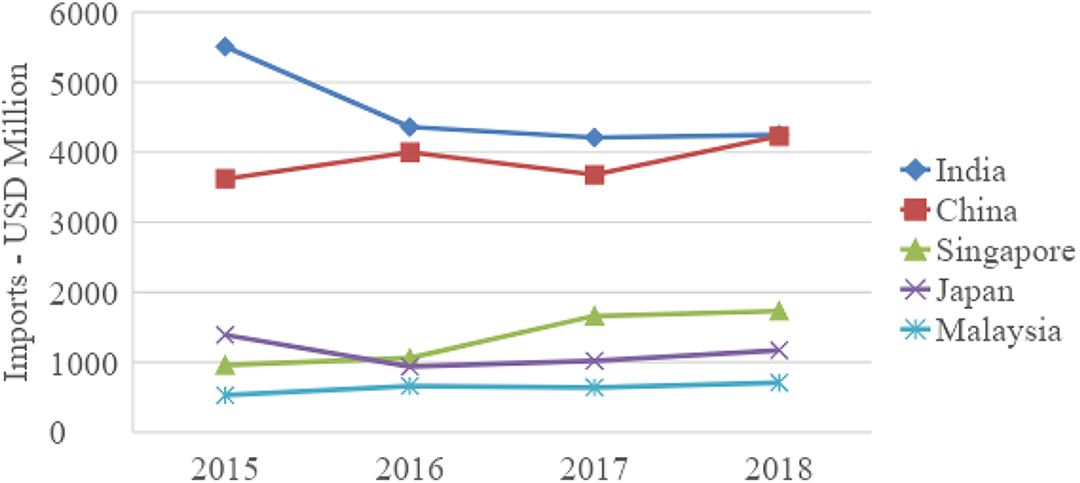
Sri Lanka’s product import from top five importing partners from 2015 to 2018.
Figure 2 shows the foreign direct investment (FDI) inflow in Sri Lanka annually from 2015 to 2017, and it is visible that China has become the largest FDI contributor and has left India far behind. A gradual increase in investment by India is noticeable but is low in comparison to China. The inflow from China has risen from US$150.78 million in 2015 to US$628 million in 2017, an approximate increase of 316 per cent. Meanwhile, we see that India’s inflow rose from US$67.84 million in 2015 to US$174 million in 2017, an estimated increase of 156 per cent. Hong Kong proves to be another major player and remains one of the top contributors.

Foreign direct investment inflow to Sri Lanka from China and other main destinations from 2015 to 2017.
China is a significant contributor to Sri Lanka’s push for economic growth and development. It has aided Sri Lanka with grants and loans for priority development projects. The Chinese have funded a number of projects in Sri Lanka. These include the Hambantota Port, Mattala International Airport, the Colombo–Katunayake Expressway, the Greater Kurunegala Water Supply and Sewerage Project, the Narocholai Coal Power Plant, the Moragahakanda Multipurpose Development Project, the Matara-Kataragama Railway Line and the Colombo International Financial City (Asirwatham, 2018) (Figure 3).
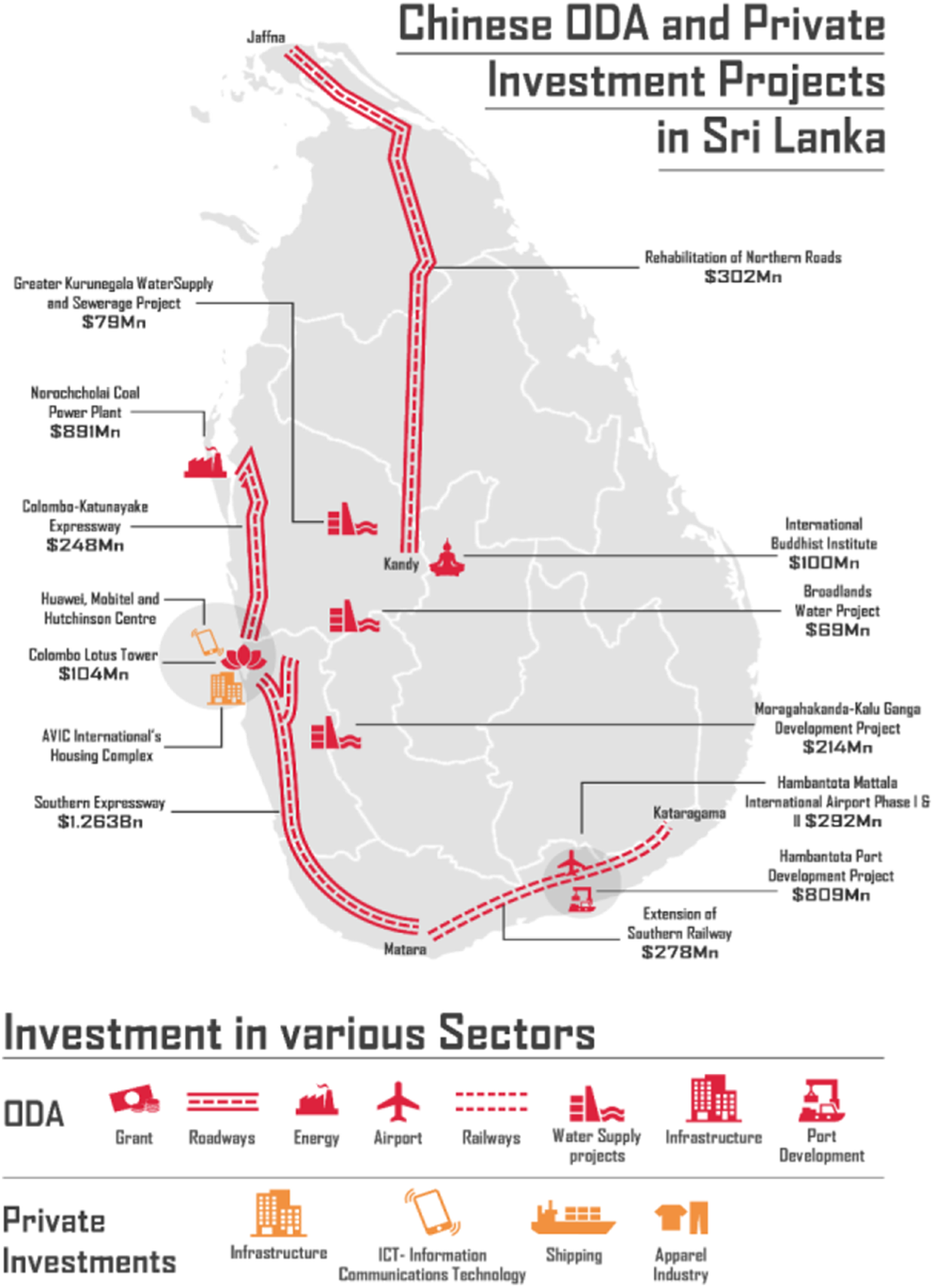
Major projects in Sri Lanka that were funded by China.
Sri Lanka has also agreed to actively participate in China’s Belt and Road Initiative (BRI), and the Colombo International Financial City and the Hambantota Port are two prominent projects included in it. Sri Lanka believes that being a part of the BRI will help it become a trade and maritime hub in the Indian Ocean, by developing suitable infrastructure to promote trade, investment and tourism. A report by the Asian Development Bank reports it to be the only South Asian port with the facility of a deep-water terminal that can accommodate even the 18,000-tonne container ship. This would help in increasing the volume of trade on a large scale. The ‘Colombo Port City’ is planned to be developed as a ‘financial, residential and entertainment hub on the Indian Ocean region’ (Zhu and Lu, 2018). The Xinhua reported that ‘Invested and developed by the China Communications Construction Company Limited (CCCC), Colombo Port City is the largest project between China and Sri Lanka under the China-proposed BRI, especially the Twenty-first Century Maritime Silk Road’ (Haimin, 2017).
The Chinese continue to extend their support by offering their Chinese navigation system, the Beidou Navigation System, to South Asia. The chair of Tatwah Smartech Cai Xiarou announced an investment of US$30 million in the Sri Lankan satellite company, SupremeSAT (Singh, 2018). In 2018, the Bank of China opened its first branch in Colombo. This massive Chinese investment in the country has helped Sri Lanka to build infrastructure and provide a powerful impetus to Colombo to reform its economic policies for more significant foreign investment.
Figure 4 shows the ongoing projects in Sri Lanka by the Government of India as of 2020. In comparison with the projects run by the Chinese, Indian projects are focused mainly on building housing, schools and hospitals, i.e. projects that are focused more on social welfare. On the other hand, Chinese projects are much larger in size as well as the investments required. Chinese projects are also more focused towards large-scale infrastructure development, namely projects that will directly provide impetus to the economy of Sri Lanka and help to boost it.

Ongoing projects in Sri Lanka by Government of India under development cooperation.
The amount of investment and influence by the Chinese in Sri Lanka has increased substantially, alarming India and powerful nations like the USA, Japan etc. The Chinese claim that these investments, whether private or State-funded, are for the development of the region. But critics claim that the infrastructure investments, especially Hambantota, could be converted into a surveillance station. The authorities have denied such claims and no evidence has been brought to light (Samaranayake, 2011). Former Indian Navy commander Gurpreet Khurana has stated that: ‘China and the countries involved maintain that the transport infrastructure being built is purely for commercial use. There is no decisive evidence at this point to assert otherwise because these facilities are in nascent stages of development’ (Samaranayake, 2011).
The Port of Djibouti is a prime example to draw a parallel from to better understand the Chinese intentions. Djibouti expanded its economic ties with China and an International Monetary Fund (IMF) report shows that ‘Djibouti’s public external debt is estimated to have risen from 50% of GDP in 2016 to 104% by the end of 2018, much of it is based on Chinese lending’ (Blanchard and Collins, 2019). Since 2000, China has provided over US$1.5 billion for major infrastructure projects, which include development of port facilities, a railway, two airports and a pipeline to supply water to Djibouti from Ethiopia.
The report by Blanchard and Collins (2019) states that: A division of Chinese technology company Huawei, Huawei Marine, is linking Djibouti with Pakistan via an undersea fiber-optic cable…In Pakistan, the cable would connect to a land-based link to China. US officials have expressed concern that data carried by these cables may be vulnerable to espionage.
From the evidence above, it is clear that the Chinese have a substantial hold over the economics of Sri Lanka and can be very influential. And the involvement is not only limited to economic assistance but military too.
Military assistance
The military ties between Sri Lanka and China have increased substantially over the years. As indicated by the Stockholm International Peace Research Institute (SIPRI, 2020), information suggests that China is the second largest arms producer in the world. In 2007, President Mahinda Rajapaksa’s visit to China led to a US$37.6 million deal to purchase arms for the fight against LTTE. In 2008, Sri Lanka received US$75 million worth of Chinese arms shipments, US$10 million more than in 2006 (Samaranayake, 2011).
When compared in terms of arms deals, India is far behind China and has not delivered as many weapons. These facts show us that the Chinese are more invested and interested in providing arms to Sri Lanka. There is also a visible difference in the equipment provided; India has either provided Offshore Patrol Vessels (OPVs) or air search radars, but the Chinese have sold fighter jets, tanks, armoured personnel carriers (APCs), air search radars, guns, IFCs and even a frigate (Tables 1 and 2).
Transfers of major weapons: Deals with deliveries or orders made for 1950 to 2019 (China and Sri Lanka).

The ‘No. delivered’ and the ‘Year(s) of deliveries’ columns refer to all deliveries since the beginning of the contract. The ‘Comments’ column includes publicly reported information on the value of the deal. Information on the sources and methods used in the collection of the data, and explanations of the conventions, abbreviations and acronyms, can be found at SIPRI. Information generated: 15 July 2020.
Source: SIPRI arms transfers database.
Transfers of major weapons: Deals with deliveries or orders made for 1950 to 2019 (India and Sri Lanka).
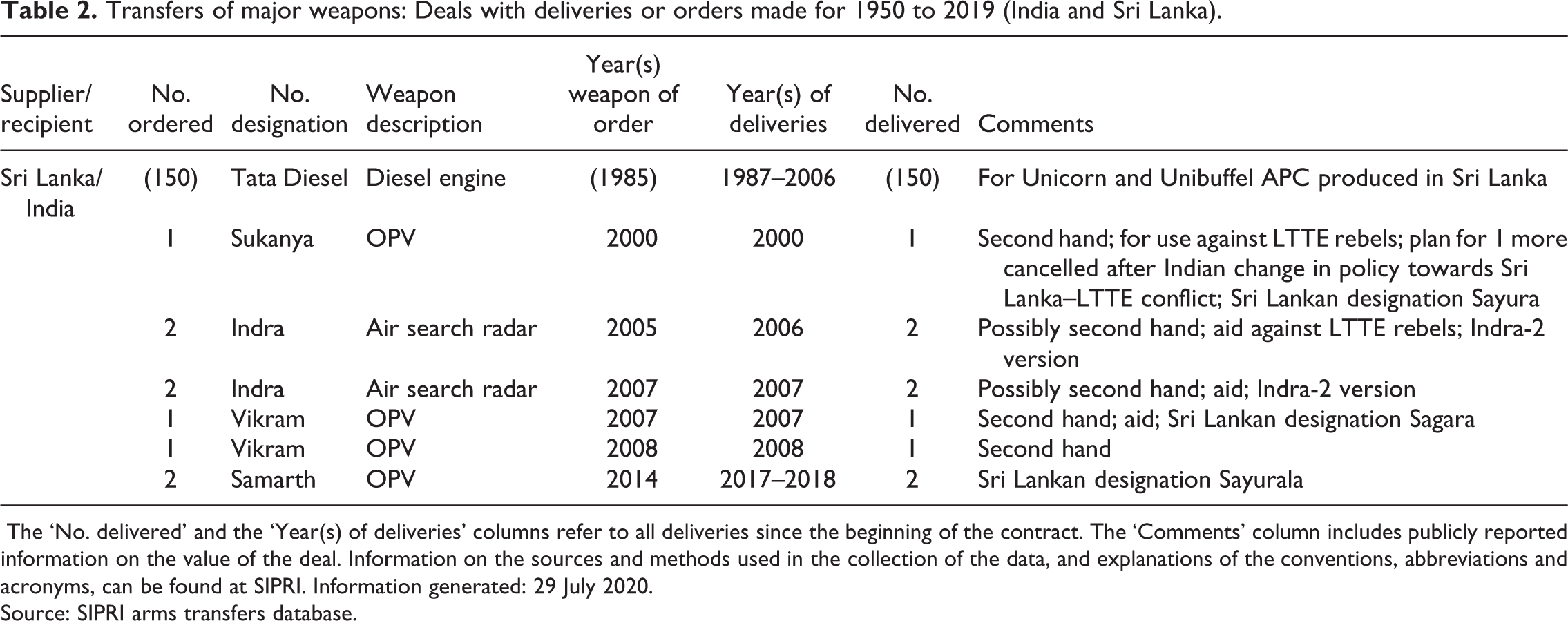
The ‘No. delivered’ and the ‘Year(s) of deliveries’ columns refer to all deliveries since the beginning of the contract. The ‘Comments’ column includes publicly reported information on the value of the deal. Information on the sources and methods used in the collection of the data, and explanations of the conventions, abbreviations and acronyms, can be found at SIPRI. Information generated: 29 July 2020.
Source: SIPRI arms transfers database.
In 2009, it was declared that four senior Sri Lankan officers would be incubated at the National Defense University and that China would likewise train another 40 officers (Samaranayake, 2011). On the conclusion of the Defence Cooperation Dialogue held in 2016, two agreements were signed: the first provided US$2.6 billion for military assistance; the second provided an Offshore Patrol Vessel (OPV) to Sri Lanka (Business Standard, 2016). In October 2011, a delegation of the People’s Liberation Army visited Sri Lanka and agreed to offer additional training to Sri Lankan officers, provide aid for the SLAF’s Defence College and the chance for joint naval training and surveillance (Wheeler, 2012).
Over the last few years, military cooperation has been deepening. Wang Yiwei, Director of the Centre for International Studies at the Renmin University of China, claims that small nations in the South Asian region like Sri Lanka are seeking active cooperation (with China) because of their concern for Indian military strength (Patranobis, 2017). The defence and maritime security cooperation agreement has given China the rights to explore Sri Lanka’s ocean for the wreckage of treasure, which has raised alarms in Washington and New Delhi (Mendis, 2017).
Seeing the increasing military cooperation between China and Sri Lanka, India also decided to step up its military ties with Sri Lanka. In 2019, the Defence Secretary Sanjay Mitra visited Sri Lanka where he met the Chief of Defence Staff Admiral Ravindra Wijegunaratne, Sri Lankan Defence Secretary Hemasiri Fernando and the President of Sri Lanka Maithripala Sirisena. Both countries agreed on building and training Sri Lankan armed forces and increasing the number of training personnel from Sri Lanka (Samatha, 2019).
Since 2012, there have been several Indo–Sri Lankan Defence Dialogues to review the security and defence cooperation issues between the two countries. Since 1992, the trilateral naval exercise called ‘Dosti’ has been taking place between India, Sri Lanka and the Maldives. The 14th trilateral exercise was held in the Maldives in 2018. India also hosted a delegation of 160 Sri Lankan military personnel and their families in Gaya, Bihar in 2018 and also handed over a second, advanced offshore patrol vessel in the same year. Given the strategic importance of Sri Lanka and the geographical advantage it has in the Indian Ocean, India would not want to diminish its relations with Sri Lanka.
India has always been perceived as a regional power or hegemon in South Asia, and, in regard to India’s regional power ambitions, smaller nations like Sri Lanka turn to international organizations or great powers like China for political, economic and military support to manage their conflict (Wagner, 2016). The Chinese are capitalizing on that fear by selling weapons to these small nations and winning their support. This could be seen as a long-term strategy by the Chinese to create resentment and fear of India in Sri Lanka and other South Asian countries and to emerge as a saviour in times of dire need. Despite having a large number of material resources and supremacy in the region, India has hardly ever managed to establish itself as a regional power in the long-term perspective (Wagner, 2016). Maintaining its supremacy in the region is important for India to keep a check on the ever-increasing Chinese power.
China’s strategy behind the assistance
China introduced the idea of the 21st century Maritime Silk Road, which is part of the ambitious project called the BRI, earlier known as the One Belt One Road. It is China’s attempt to rebuild the ancient Silk Route that connected China to Europe through both land and sea routes. The project covers 65 countries and almost 60 per cent of the world’s population (Djankov and Sean, 2016). Sri Lanka is an important stop and lies on one of the world’s busiest trade routes. It is considered to be a favourable factor for the bilateral relationship. China considers it as a friendly way of economic and trade cooperation and cultural exchange in the new era. Sri Lanka has a major role to play in this project and the construction of the Maritime Silk Road will not only promote bilateral economic and trade cooperation but will also be of international significance (Wang, 2014). Under the project, Sri Lanka has received financing of up to US$8 billion from China (Wijayasiri and Senaratne, 2018).
During Xi Jinping’s official visit to Sri Lanka in 2014, Rajapaksa appreciated the time-honoured friendship and bilateral relations and stated that ‘Sri Lanka is willing to continuously develop the strategic cooperative partnership with China, and will firmly support China on issues concerning China’s core interests and major concerns’. He claimed that ‘building the 21st Century Maritime Silk Road coincides with Sri Lanka’s vision of building offshore shipping center in the Indian Ocean’. Rajapaksa offered to jointly construct and operate the Hambantota Port and the Colombo Port City to ‘accelerate the bilateral free trade negotiations, and strengthen cooperation in such fields as economy and trade, energy, agriculture, infrastructure construction, and health care’ (Mission of the People’s Republic of China to the European Union, 2014).
Sri Lanka is considered to be ‘the pearl of the Indian Ocean’. This is no mere metaphor given the importance attributed to the strategic chokepoints in the Indian Ocean Region (IOR) in China’s ‘string of pearls’, and having a secure line of communication is of cardinal importance since it ensures an uninterrupted, constant supply of much-needed natural and petroleum resources through the Indian Ocean (Figure 5). With China building mega ports in Pakistan, the Maldives, Sri Lanka, Bangladesh and Myanmar, India’s fear of entrapment in this string has heightened. The Indian Ocean continues to become insecure as a consequence of naval arms races between China and India. Sri Lanka is turning out to be a ‘buffer state’ plagued by a security dilemma, and it is essential for it to be equidistant in this tripartite relationship (Gunaratne, 2020).
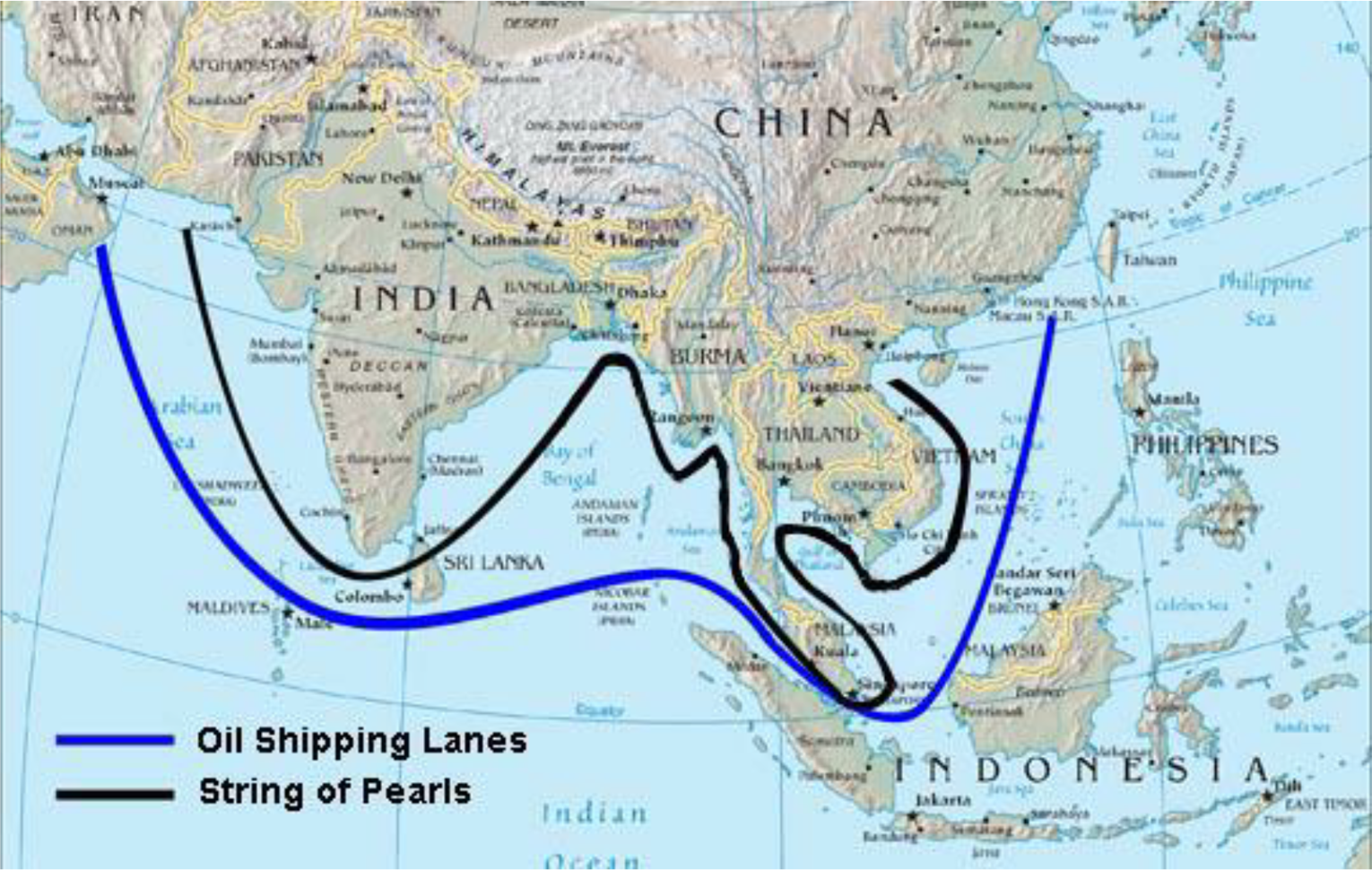
Sri Lanka’s strategical location between both the oil shipping line and the string of pearls.
According to the ‘string of pearls’ theory, the Chinese Navy will use Indian Ocean ports to create a strategic passage through Europe and East Asia and, given the strategic mistrust between China and India, some experts see these investments as an effort to flex its muscles along the Indian Ocean and, in case of an emergency, to use these ports to deprive any major rivals of the opportunity to manoeuvre (Marantidou, 2014; Tarabay, 2018). Although there is a lack of evidence to prove this theory, as well as the ‘potential military use’, it still has the potential to trigger hostilities and worry in India and other geopolitical competition. These concerns turned into reality in 2014 when Chinese submarines and a warship were spotted docking into port in Sri Lanka. The sighting of a Chinese submarine in the region was an uncommon occurrence, and it caused anxiety for other nations. The Chinese efforts could be interpreted as an attempt to secure its new ‘pearl’ and thereby gain a foothold in a region that has historically been outside its area of influence (Samaranayake, 2011). The example of the port in Djibouti can be used to draw a parallel to understand the situation better.
The militarization of the port of Djibouti, strategically located on the Bab el Mandeb strait, a chokepoint between the Red Sea and the Gulf of Aden, by the Chinese is concerning and a warning to India and other western powers. The Chinese have deployed over 2500 peace-keeping troops and have promised to support programmes on law and order, peacekeeping, antipiracy and counter terrorism (Blanchard and Collins, 2019). China has also agreed to take the port on lease and has developed the port for naval rest and resupply and facilities to host ‘a few thousand’ personnel (Blanchard and Collins, 2019).
The two major infrastructure projects, the Colombo Port City and the Hambantota Harbour, have already been given at lease for 99 years to the Chinese government. This occurred when the Sirisena–Wickremesinghe government – campaigning for ‘good governance’ – realized that they are incapable of paying back the loans acquired by the previous regime of President Mahinda Rajapaksa (Mendis, 2017). The deal signed on 29 July 2019 also included giving China Merchants Port Holdings (CMPort), a 1500-acre industrial zone. Seventy per cent stake is to be held by CMPort and the remaining 30 per cent by the Sri Lanka Ports Authority (Singh, 2018). Reports suggest that the foreign debt of Sri Lanka increased to 94 per cent of GDP in 2015 from 36 per cent in 2010. Sri Lanka was allocating 95 per cent of all government revenues to service its debt, and for this it needed a US$1.5 billion bailout from the IMF (Chowdhury, 2016). The Chinese government invested US$1.5 billion in the port because the southernmost part of the island is well connected to prominent shipping lanes and the port would help in reducing Chinese dependence on existing shipping lanes and gain major control in the Indian Ocean Region. China appears as a good option for loans as compared to e.g. the World Bank and the IMF, which are considered to be intrusive; Chinese loans are not intrusive and are straightforward but come with major strings attached (Mendis and Wang, 2018). Chinese corporations bring in their machinery from China and even their workforce and rarely recruit local people, which causes a significant loss to the domestic economy in terms of jobs and other avenues (Singh, 2018).
The Indian Ocean is becoming increasingly important to the world economy and global trade because it is an essential trade channel to connect the Asia-Pacific region, which is the energy and resource centre (Ghosh, 2017). The Indian Ocean is one of the regions with the most concentrated ocean shipping lanes on the planet – the petroleum route and trade channel. It is numerous nations’ key help, including China. Sri Lanka has a unique geopolitical location; it has an important strategic status with the rise of the Indian Ocean’s importance.
Projects run by the Chinese government with Sri Lanka are all publicly stated to be in favour of the development and growth of the island nation. The projects are highlighted to be of importance for the bilateral relationship, cooperation, people-to-people exchanges, traditional trade and investment, maritime cooperation, traditional friendship and political trust. But the move by the Chinese to take over the port and give loans which they know cannot be repaid shows us a different side that does not conform to the idea of development.
Concerned about the strategic implications of the project and the infringement of India’s sovereignty, India refuses to be a part of the BRI and has turned down the invitation to attend it twice. India openly opposes the BRI and is against the luring of South Asian republics into the Chinese influence. The West and Japan, along with India, have been observing China’s increasing presence in Sri Lanka and its involvement with the BRI under the Rajapaksa regime. Sri Lanka is now trapped in a power rivalry involving major powers like the USA, India, China and Japan. And with the increasing debt and burdens, Sri Lanka is sacrificing its autonomy around the management of its infrastructure by e.g. leasing the Hambantota Port. China’s strategic control over these infrastructures can influence the decision making of these countries. Under the BRI, China will build highways, oil and gas pipelines, aviation links, railway lines, transmission lines and telecommunication networks that claim to bring together the world but may also pose a threat to globalization and free trade (Wijayasiri and Senaratne, 2018). There are also concerns about China militarizing the ports and other projects (Samaranayake, 2011). Technical experts need to keep a continual oversight to guard against security-related concerns and maintain public trust in the projects (Wignaraja et al., 2020).
Ni Lexiong, a Chinese scholar, suggests that ‘while our nation’s economic structure is completing the epic shift from an inward leaning to an outward leaning one, the choice of a sea power strategy has become an urgent task’ (Rath, 2005). The Chinese advances are in accordance with Alfred Mahan’s theory which suggests how protection of one’s own lines of communication and developing the capacity to disrupt those of adversaries is important to establish control over the seas. China has been effectively able to disrupt India’s line of communication by establishing it with Sri Lanka, Myanmar, Pakistan, the Maldives and other South Asian countries. This gives China the ability to operate far from its national shores and to bring the Maritime Silk Route under its control. This may not augur well with India and its neighbours, and can have unwanted consequences for the world order as well.
Impacts on India
The developing relations between China and Sri Lanka not only affect the respective countries but also create ripples that have a direct impact on India. The implications of the budding relationship affect India on various fronts.
Political implications
After the end of the civil war in Sri Lanka in 2009, India supported the Government of Sri Lanka to act against terrorist forces but also conveyed its concern for the plight of the civilian population. And then in 2012, India voted against the Sri Lankan government in the UNHRC and China voted in favour, thereby strengthening its ties even more. With the victory of Maithripala Sirisena in the presidential elections of 2015, relations with Sri Lanka also changed. Prime Minister Narendra Modi’s visit to Sri Lanka in 2015, more than 28 years after the last visit by an Indian prime minister, have helped in re-establishing good relations (Wagner, 2016). Prime Minister Modi and President Maithripala Sirisena discussed issues of regional importance and Modi said: ‘it gives me confidence and optimism about the future of our relations’ (TNN, 2015). Both sides decided to reduce non-tariff trade barriers and simplify trade, and the central banks of both nations have entered into an agreement to help keep the Sri Lanka rupee stable.
After the 2018 elections in Sri Lanka, Mahindra Rajapaksa’s government came into power again, and his visit to New Delhi in late November 2019 gives us a clue as to the impact on the political relations for India. During the visit, several issues were covered, giving hope for collaboration but also leaving broader questions about the future lingering. Prime Minister Modi said in the conference that Sri Lanka is important not only to India but also to the entire Indian Ocean Region, and added that ‘stability, security and prosperity’ is a fundamental element in maintaining peace and prosperity in the Indo-Pacific region (Ministry of External Affairs, 2020). Sri Lanka is contended with the comfort level in relationship that exists between Modi and Rajapaksa (Rajagopalan, 2020).
Rajapaksa claimed that all previous projects started by former Prime Minister Ranil Wickremasinghe would be brought to a halt. He also claimed that the Sri Lankan government would not grant any more projects like the Mattala Airport to other countries, and defended the Chinese on the repayment of loans by claiming that they helped them in the rebuilding and development of Sri Lanka post war (Rajagopalan, 2020). He criticized the previous government for giving away real estate in the Indian Ocean such as the Hambantota Port to ease the debt. Rajapaksa also stated that India is a ‘relation’ whereas others are friends.
The developments so far show us that Sri Lanka is maintaining a neutral relationship with India, and use of the word ‘relation’ is a beautiful wordplay to give a feeling of warmth but also exhibit a neutral undertone. Mattala Airport or Hambantota Airport could have been a strategic point for India to have surveillance on the Chinese and keep a check but to not be able to invest anymore can backfire on India. Defending the Chinese also represents a very pro-China tilt when the whole world knows that Sri Lanka is now in a debt trap, a tried and tested method of the Chinese, and getting out of it may not be easy. Apart from political implications, India is also facing security issues because of the growing Sino–Sri Lankan relationship.
Security/defence
There has been a lot of discussion by strategists and international relations experts on the growing relations between Sri Lanka and China and its impact on India. The Chinese move on Hambantota and Colombo Port has adversely affected India’s strategic interests in the region. The tensions rose especially in 2014 when increasing Chinese submarines and warships were seen docking and refuelling. In the annexure of the India–Sri Lanka Accord of 1987, the two countries agreed that ‘Trincomalee or any other port in Sri Lanka would not be made available for military use to any country in a manner which is prejudicial to India’s interests’ (https://www.indiannavy.nic.in/te/operation.htm). The fact that Sri Lanka did not abide by this and cited various excuses and justification raises concerns and a need to be cautious. However, in 2017, Sri Lanka refused docking of a Chinese submarine – the idea being to cater to the security interests of India.
In the words of David Brewster, ‘Control over Hambantota airport will give India considerable control over how the port is used. It is difficult to conceive of the Chinese Navy developing a significant facility at Hambantota without also controlling the airport’ (Chandran, 2017). If India is able to gain control over the functioning of the airport, it may relieve itself of some of its security concerns vis-a-vis the presence of the Chinese Navy at Hambantota and in the Indian Ocean (Singh, 2018). India has also been offered the same facilities as China in terms of using the port. But the same port that handles 70 per cent of India’s shipping is being modernized by the Chinese and is under the control of China. The Chinese can always turn these projects into a disadvantage for India in a conflict. Such a scenario can also have a significant impact on the economy of India.
Economic impact
Growing Sino–Sri Lankan relations have not only strategic but also economic impacts for India, which is equally bad for the country. The India–Sri Lanka bilateral trade volume stood at US$4.86 billion in 2011 compared to US$4.002 billion in 2012, a decline of 17.59 per cent. Meanwhile, bilateral trade with China has been on the increase from nearly US$2.2 billion in 2011 to US$2.6 billion in 2012, an 18 per cent increase (Embassy of Sri Lanka in the People’s Republic of China, 2020). And there has been a decline in the trade between Sri Lanka and India in the light of the UNHRC incident where India supported the UNHRC’s allegation of a genocide taking place. China has banked on all such opportunities, and it is possible for the Chinese to outgrow India and become the largest trading partner. In 2011, Sri Lanka’s Central Bank allowed the Chinese currency yuan (renminbi) to be used in bilateral transactions; on the other hand, the Indian rupee still does not have the same privilege, despite India being Sri Lanka’s largest trading partner and one of the largest investors and donors (Manoharan, 2014).
Even during the COVID-19 pandemic, the Chinese have given a concessionary loan of US$500 million along with 50,000 medical masks and 1008 COVID-19 test kits to Sri Lanka to fight the battle against the virus. This assistance is US$100 million more than the support provided by India in the form of currency swap of US$400 million. India has a large number of cases of COVID-19 globally and needs surplus resources to curb the spread of the virus.
New Delhi has to come to terms with the reality of China becoming increasingly influential in the South Asian region. India needs to realize the concerns of smaller neighbours and deliver its promises on time. Chinese influence in Sri Lanka is prevalent from the fact that leaders from both China and India are frequently visiting, underpinning the importance of Sri Lanka for India and the role it plays in India’s strategic concerns.
The visit of the Chinese President Xi Jinping to Sri Lanka after 28 years marks an important moment in Sino–Sri Lankan relations. It is also the same year when the submarine docking incident took place. Both the nations expressed a need for each other and promised cooperation and support. All these events reflect a strategic move by the Chinese to grow closer to Sri Lanka and to take a step closer towards fulfilling the dream project of the Maritime Silk Road. And Indian Prime Minister Modi’s visit in 2015, also after more than 28 years, reflects the growing concern of increasing friendship between Sri Lanka and China. India offered its assistance to infrastructure projects and committed to promoting prosperity in the neighbourhood and realizing the vision of Sri Lankan leadership for a stable, peaceful and prosperous Sri Lanka.
Conclusion
For China to realise its Asian dream, it has to live up to its promises of delivering mutually beneficial development. For as long as the suspicion remains that Beijing’s much-vaunted ‘win-win’ diplomacy really represents a double victory for China – and that its friendly words about shared commercial gain are really a smokescreen for more self-interested objectives – it will fail to win the trust of its neighbours. (Miller, 2017)
All the Chinese investments up until now that have been officially recorded point to the fact that they were made for the infrastructural and economic development of Sri Lanka. China claims to do this not only in Sri Lanka but also in various other South Asian countries like Pakistan, the Maldives, Bangladesh and Myanmar and many others, as a way to promote these small nations and help them grow. Any intention of militarizing the port or establishing surveillance has not been proved. Still, the act of Rajapaksa’s government of allowing Chinese submarines to dock in Sri Lanka has raised the alarm and suspicion not only for India but also the USA and other western nations.
India has always been considered the protector and the regional hegemon of the Indian Ocean, namely the South Asian region, and China’s increasing influence with Sri Lanka and other South Asian countries puts India in a tricky position. The BRI and the Maritime Silk Road initiative of the Chinese government force us to think that there is much more to these projects than just connecting the world and resurrecting the ancient Silk Route. The Chinese may be planning to control the world’s major trade routes by establishing ports in every major country on the map and may also increase their military presence, thereby putting the whole of the South Asian region under their dominance.
Considering the amount of investment in Sri Lanka for strategic and economic benefits, cosying up of the Government of Sri Lanka towards China and Rajapaksa’s anti-India policies amounts to a tricky position where India is not only being sidelined but is also losing its influence in the region. Realistically, it is difficult for India to compete with China on the basis of projects because of limited resources and a primary need for domestic development. India has always considered South Asia to be its sphere of influence. Still, with the increasing presence of China, it is being forced to compete for leadership in the region. It is a hard fact to accept, but China has become a major player in the region, especially with the cordial relations it has established with Sri Lanka, Pakistan, the Maldives, Bangladesh and other South Asian countries. It will pursue its agendas further. China has used financial leverage to gain control of critical infrastructures in numerous countries, including Sri Lanka. The activities in Djibouti have a resemblance to what is happening in Sri Lanka: investment in infrastructure, debts reaching the GDP level of the nations, leasing of ports and slow involvement of the Chinese armed forces in the region.
India, in the last few years, has been proactive in the ‘neighbourhood first’ approach. Its benign image and soft power have appeal in the region, and, to make it more influential, they are now being accompanied by economic and military benefits. India is now increasing its influence again in the South Asian region and trying to retake the lost control. Sri Lanka is an essential link for China not only to put the string of pearls theory in motion but also to fulfil its dream project of the Maritime Silk Road. The Rajapaksa government in Sri Lanka might make it difficult for India to regain its lost influence because of the pro-China attitude of the new Sri Lankan government. Still, India needs to engage in proactive diplomacy and convince Rajapaksa to formulate a favourable political situation. Any sort of external pressure on the Rajapaksa government can prove to be counterproductive as the nationalist sentiments could make resolution difficult. India also needs to start delivering on its promises in a timely fashion. Use of the South Asian Association for Regional Cooperation and other international platforms is another method to maintain its influence in the region. India could also partner with other countries like the USA, Japan or Australia which are also wary of the increasing Chinese influence to counter it and not let it turn into a hegemony of one nation.
Footnotes
Acknowledgements
The author is grateful to Pratik Bhalerao and M Mayilvaganan for providing detailed comments on previous drafts; and to the National Institute of Advances Studies (NIAS), where much of the research was conducted during an internship. The views expressed are solely those of the author and not of any organization with which he is affiliated.
Declaration of conflicting interests
The author(s) declared no potential conflicts of interest with respect to the research, authorship, and/or publication of this article.
Funding
The author(s) received no financial support for the research, authorship, and/or publication of this article.
