




Abstract
This article examines how Indonesia's presidents have managed Civil–Military Relations (CMR) from the final decade of Suharto's authoritarian rule (1988) to the democratic consolidation of the Joko Widodo era (2024). It argues that presidential strategy – rather than institutional inertia or external pressure – has been the principal driver of the country's evolving civil–military balance. Six distinct strategies are identified across the period: authoritarian absorption (Suharto), disengagement (Bacharuddin Jusuf (BJ) Habibie), confrontation (Abdurrahman Wahid-Gus Dur), neutrality (Megawati Sukarnoputri), institutional balancing (Susilo Bambang Yudhoyono-SBY) and technocratic containment (Joko Widodo-Jokowi). The analysis integrates Huntington's concept of subjective control with Schiff's concordance theory to explain why presidential actions varied in their effectiveness. Drawing on 45 elite interviews, legal and policy documents and triangulation with quantitative indices (Varieties of Democracy Institute (V-Dem), Freedom House and Bonn International Centre for Conflict Studies (BICC) - Global Militarization Index (GMI)), the study demonstrates that Indonesia's CMR evolved through negotiated adaptation rather than linear reform. The findings contribute to comparative debates on democratic control of the armed forces in post-authoritarian contexts.
Keywords
Introduction
Indonesia's democratic transition has been shaped by persistent tensions between the formal architecture of civilian supremacy and the informal endurance of military influence. Although post-Suharto reforms – such as separating the National Police (Polisi Republik Indonesia, POLRI) from the Indonesian National Armed Forces (Tentara Nasional Indonesia, TNI), abolishing TNI parliamentary seats and restructuring the armed forces – marked major milestones, they failed to dismantle the deeper institutional and informal mechanisms of military power. The TNI continues to exert influence through informal political channels, bureaucratic networks and its territorial command structure (Crouch, 2010; Mietzner, 2006a, 2006b; Sebastian and Gindarsah, 2013). Much of the literature focuses on legalistic or structural dimensions of reform and on normative models of military professionalism (Croissant et al., 2010; Mietzner, 2003), yet insufficient attention has been given to presidential agency in mediating, navigating or reproducing these arrangements.
This article fills that gap through an actor-centred approach that foregrounds presidential leadership in shaping reform trajectories. Rather than attributing outcomes solely to regime type or formal institutional design, the analysis examines how successive presidents navigate inherited constraints while exercising strategic manoeuvre to reshape civil–military power relations. This perspective reveals how leaders forge coalitions, manage informal power structures and calibrate their engagement with the military under conditions where veto players, informal pacts and patrimonial logics continue to determine political outcomes.
Building on this framework, the article develops a typology of presidential strategies – ranging from Suharto's absorption, BJ Habibie's disengagement, Abdurrahman Wahid's confrontation, Megawati Sukarnoputri's neutrality, Bambang Yudhoyono's institutional balance and Joko Widodo's technocratic containment – as a heuristic for analysing the fluid and often contradictory nature of CMR in hybrid regimes. Comparable systems such as Thailand, Nigeria, Myanmar and Egypt exhibit similar patterns of selective reform, co-optation and accommodation as presidents balance military influence with regime stability (Albrecht, 2005; Barany, 2012; Croissant and Kamerling, 2013; Croissant et al., 2010). The Indonesian case thus provides a critical lens for understanding democratic governance as a negotiated, rather than consolidated, process shaped as much by elite calculation as by institutional design.
To situate this typology within a coherent theoretical structure, the article adopts Schiff's (1995) concordance theory as the primary analytical lens. Concordance theory emphasises consensus among the military, political elites and citizenry across four domains – social composition of the officer corps, political decision making, recruitment patterns and the military's societal role. This framework is especially useful in hybrid regimes where civilian control does not derive from strict institutional separation but rather from negotiated alignment. Drawing on Levitsky and Way (2010), Croissant et al. (2010) and Alagappa (2001), the article argues that democratic oversight in Indonesia emerges not from linear transformation but from negotiated compromises embedded within evolving political settlements. Huntington's (1957) model – which presumes a linear progression from subjective to objective control – serves as a useful contrast: Indonesia's experience departs from this teleology, instead revealing a pattern of contextual concordance and negotiated compromise.
Additional theoretical tools deepen the analysis of why presidential strategies unfold as they do. Skowronek's (1993) theory of political time helps explain how each president inherits distinct institutional legacies that condition strategic options. Tsebeli'’s (2002) veto player theory clarifies why the military continues to act as a persistent veto player resisting deep reform. Slater's (2010) protection pact theory further illuminates how elite coalitions prioritise regime cohesion over accountability. These perspectives collectively demonstrate how Suharto-era legacies – particularly the dual function (dwifungsi) doctrine, territorial command structure and military-linked business networks – continue to constrain the scope and depth of civilian oversight.
Empirically, the study draws on elite interviews and field research revealing that presidential strategies emerge less from ideological commitment to democratic norms than from pragmatic assessments of political risk, institutional inertia and elite alignment (Aspinall, 2005; Slater, 2010). In particular, despite formal legal restraints on military jurisdiction – particularly over internal security – the TNI continues to play as a central role in governance (Mietzner, 2006a, 2006b; Sukma, 2013). The persistence of informal authority and the embedding of military figures in civilian bureaucracies illustrate that civilian supremacy in Indonesia remains a negotiated, contingent outcome rather than a settled institutional end state (Alagappa, 2001; Aspinall, 2013).
Institutional change, therefore, should be understood as gradual and negotiated rather than abrupt or revolutionary. Insights from historical institutionalism – particularly Thelen's (1999) concept of institutional evolution and Mahoney and Thelen's (2010) model of layered change – explain how reform often proceeds by adding new technocratic or civilian layers atop enduring military prerogatives.
Accordingly, this article makes three key contributions. First, it offers original empirical insights from primary fieldwork and elite interviews, highlighting the strategic calculations of actors directly shaping reform. Second, it introduces a flexible typology of presidential strategies applicable to other hybrid regimes undergoing negotiated transitions. Third, it reconceptualizes civil–military reform in Indonesia as a dynamic process driven by historical legacies, institutional constraint and elite accommodation rather than linear democratization. This reframing invites broader reflection on how civilian control is continually negotiated, sustained and strategically deferred in post-authoritarian states.
Problem statement
Indonesia's CMR have transitioned from Suharto's centralized system during the New Order era to a more hybrid democratic model, yet the military (TNI) continues to wield significant influence across various societal domains. This persistence is attributed to the active role of successive presidents who have reshaped the military's political involvement through strategies of inclusion, co-optation and containment, in ways that align with their political interests. The study explores how these presidential strategies have influenced the evolution of CMR through different political phases, from the last decade of the New Order to the Reformasi period beginning in 1998, and into the most recent administrations. It posits that achieving stable civilian supremacy is not solely reliant on formal reforms but also on negotiated agreements between military elites, political figures and society. While formal reforms have dismantled some structures of military power, such as abolishing dwifungsi and removing military representation in parliament, informal networks of military influence remain robust, especially within bureaucracies and local governance.
The analysis examines each presidency's context and reform efforts, revealing that institutional boundaries, command hierarchies and accountability mechanisms have dynamically evolved. Utilizing comparative indicators like the BICC GMI, V-Dem's Liberal Democracy Index and Freedom House scores, it highlights the complex relationship between democratization and militarization, showing that civilian governance and military influence have developed concurrently, thus indicating the challenges of genuine democratic consolidation in Indonesia. Figure 1 visualizes the trajectories of democratization and demilitarization in Indonesia from 1988 to 2024, drawing on data from V-Dem (v2x_libdem), Freedom House (political rights and civil liberties) and the BICC GMI, with detailed sources provided in Appendix A.
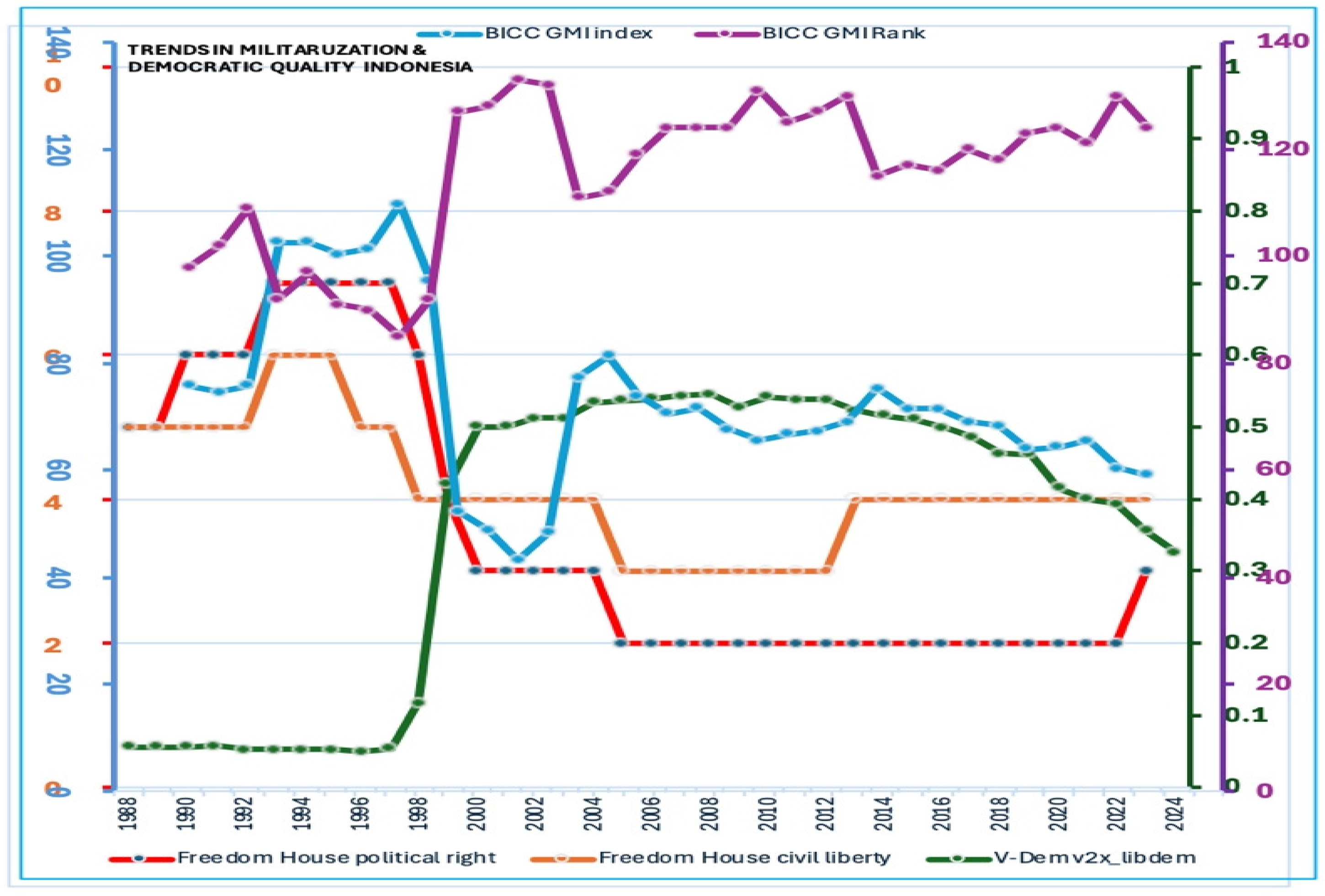
Democratization and demilitarization trajectories, 1988–2024: Data from V-Dem (v2x_libdem), Freedom House (political rights and civil liberties) and BICC GMI.
The temporal scope of 1988–2024 captures both the final decade of New Order authoritarianism and the successive cycles of reform and recalibration following Suharto's fall. During the entrenched authoritarianism phase (1988–1998), Indonesia saw the consolidation of civil–military fusion or absorption, centralized decision making and the repression of dissent – legacies that continued to shape post-1998 governance. V-Dem scores remained below 0.1, Freedom House ratings ranged from 5 to 7 and the GMI fluctuated between 75 and 110, reflecting the TNI's pervasive role under dwifungsi across governance, administration and society.
The Reformasi transition (1998–2004) marked a period of disengagement under BJ Habibie (Habibie, 1998–1999), confrontation under Abdurrahman Wahid (Gus Dur, 1999–2001) and neutrality under Megawati Sukarnoputri (Megawati, 2001–2004). V-Dem scores rose from 0.117 to 0.501, Freedom House improved to 3–4 and the GMI fell to 45–50, reflecting the dismantling of dwifungsi, POLRI's separation from TNI and the military's exit from parliament. Each president employed distinct strategies to reform institutions, manage military influence and advance democracy consolidation, illustrating the complex, non-linear nature of Indonesia's political transition. Still in reformasi transition, during the institutional stabilization or balancing phase (2004–2014) under Susilo Bambang Yudhoyono (SBY, 2004–2014), democratization plateaued: V-Dem hovered near 0.53, Freedom House scores stabilized at 2–3 and the GMI rose slightly to 70–80. Civilian supremacy was consolidated procedurally, yet the TNI remained central in internal security, disaster relief and peacekeeping, maintaining a managed equilibrium rather than full demilitarization.
The post-Reformasi phase under Joko Widodo (Jokowi, 2014–2024) reflects managerial democracy with technocratic containment, where democracy indicators diverged – V-Dem declined from 0.511 to 0.326, Freedom House ratings stagnated and GMI remained at 60–70. Persistent militarization alongside democratic erosion illustrates renewed executive reliance on the TNI in infrastructure, military operation other than war and local governance – a form of bureaucratic militarization emphasizing efficiency and regime stability over participatory accountability.
Nevertheless, Indonesia's civil–military transformation has been cyclical and non-linear. Early Reformasi gains show inverse democratization–militarization trends, while later plateaus and declines highlight the enduring influence of presidential agency, elite negotiation and dwifungsi legacies. The persistent TNI presence within civilian structures underscores Indonesia's hybrid democracy – formally demilitarized yet continuously shaped by the strategic reintegration of military power.
Theoretical framework
This study analyses Indonesia's CMR from the late New Order period to democratic consolidation through a unified theoretical architecture that places Schiff's (1995) concordance theory at its centre. The framework interprets CMR not as a binary struggle between civilian and military authority but as a continuously negotiated arrangement shaped by institutional legacies, elite coalitions and presidential strategies. This emphasis on negotiated legitimacy aligns with the article's core contribution: demonstrating how presidential strategies of CMR management evolve within shifting configurations of elite and societal concordance.
As a conceptual point of departure, the analysis critiques Huntington's (1957) classic dichotomy between objective and subjective control. Although influential for explaining military professionalism in stable democracies, Huntington's model does not adequately capture Indonesia's transitional context, where presidents exercised authority through decrees, regulatory reforms and institutional restructuring while still relying on bargains with entrenched military elites. Rather than rejecting Huntington outright, this study employs his model as a contrast, illustrating why Indonesia's CMR trajectory diverges from linear expectations of democratization and professionalization.
To explain this divergence, the analysis adopts Schiff's concordance theory as its primary analytical lens. Concordance theory posits that stable civilian control rests on negotiated agreement between the military, political elites and the public over four domains: the military's social role, recruitment patterns, decision-making authority and the military’s broader societal embeddedness. This perspective is especially relevant in Indonesia, where historical norms, societal expectations and the military's longstanding legitimacy shape the boundaries of acceptable reform. Integrating Huntington's institutional distinctions with Schiff's emphasis on negotiated legitimacy enables a more nuanced understanding of how institutional legacies, elite bargains and presidential agency jointly structure military authority.
This analysis emphasizes the significance of the TNI's historical dwifungsi doctrine, which justified the military's roles in defence and socio-political spheres. In the post-1998 Reformasi era, dismantling dwifungsi required renegotiating public expectations and reducing the political elite's reliance on military resources. While some scholars do not interpret Indonesia's CMR through Schiff's concordance theory, existing literature – including contributions by Crouch (2010), Mietzner (2006a, 2006b) and Kingsbury (2003) – illustrate how elite negotiations, public opinion and institutional compromises have influenced presidential reform trajectories. Janowitz's (1960) adaptive model further shows how militaries adjust their roles to remain relevant in democratizing settings – an adaptation reflected in Indonesia's evolving civil–military arrangements.
Through this concordance-orientated lens, the evolution of presidential strategies becomes clearer. Under Suharto, subjective control peaked as the dwifungsi doctrine embedded the military deeply within governance, producing a model of civil–military absorption sustained by elite and societal concordance. This consolidation established enduring institutional structures that subsequent leaders struggled to dismantle (Crouch, 2007; Mietzner, 2009). Habibie's early Reformasi reforms, including the separation of POLRI from TNI and the abolition of TNI's parliamentary seats, represented a strategy of disengagement, although elite–societal concordance remained fragile (Mietzner, 2009; Sebastian and Iisgindarsah, 2011). Gus Dur's dismissal of General Wiranto exemplified a confrontational strategy that attempted to impose objective control without securing elite or societal consensus, resulting in institutional crisis (Hicken, 2009; Levitsky and Way, 2010; Warburton and Aspinall, 2019). In contrast, Megawati adopted a neutral, accommodative strategy, preserving stability through tacit elite consensus (Aspinall and Mietzner, 2019).
Under SBY's administration, institutional consolidation combined the rhetoric of profesionalisation (Mietzner, 2006a, 2006b), with presisten of patronage, thereby harmonizing elite and military legitimacy with broader societal expectations. Jokowi redeployed retired military officers into civilian bureaucracy – termed technocratic containment – wherein military actors were placed in civilian roles not through formal power sharing but merely under a development discourse emphasizing efficiency, often justified by a need for discipline, expertise and loyalty (Aspinall and Mietzner, 2019; Laksmana, 2019; Lee, 2009; Sebastian et al., 2018). Hence, Jokowi's governance reflects Jessop's (2007) ‘strategic selectivity’, whereby state agencies pursue differentiated logics under a single nominal framework, producing incoherent or competing security policies. This approach prioritized short-term stability while entrenching informal military prerogatives and blurring civil–military boundaries (Aspinall and Mietzner, 2019; Khairurrizqo, 2024). Indonesia's hybrid democratic structure (Aspinall et al., 2015) requires presidents to manage power through formal institutions, and also by negotiating with entrenched elites and informal networks. Across presidencies, the interplay of presidential agency and elite–societal concordance shaped the resilience – or fragility – of reform.
The persistence of military influence also resonates with broader elite-centred transition theories. Transitions are negotiated rather than revolutionary, often preserving authoritarian legacies (Finer, 1974; O’Donnell and Schmitter, 1986; Stepan, 1988), while institutional layering explains how democratic norms grafted onto authoritarian structures create hybrid governance (Mahoney and Thelen, 2010; Thelen, 1999). Complementary analytical tools further illuminate Indonesia's path dependency: Skowronek's (1993) political time captures how presidents inherit opportunity structures; Tsebeli'’s (2002) veto player theory clarifies the military's capacity to obstruct reform; and Slater's (2010) protection pacts explain enduring elite dependence on coercive institutions. These mechanisms have preserved military access and political relevance (Case, 2013; Croissant et al., 2010; Kurlantzick, 2013). The interplay of presidential strategies, elite bargains and institutional legacies defines the real contours of civilian control (Alagappa, 2001; Sambhi, 2021). Synthesizing these insights situates Indonesia's CMR along a continuum of negotiated authority rather than a simple civilian–military dichotomy. By linking presidential strategy to evolving configurations of elite and societal concordance, the framework reveals a path-dependent, adaptive model where formal reform, informal control and negotiated legitimacy intersect, producing a distinctive post-authoritarian governance structure.
Methodology
This study employs a qualitative, multi-method design to examine how successive Indonesian presidents shaped and sustained civilian control over the military from 1988 to 2024. Guided by a constructivist epistemology (Guba and Lincoln, 1994), it interprets political strategies, legitimacy claims and institutional adaptations as socially constructed within historically and culturally embedded contexts. Rather than seeking universal causal laws, the research analyses how elite actors perceive and negotiate the boundaries of civil–military authority in Indonesia's evolving democratic landscape.
Primary data derive from 45 semi-structured elite interviews conducted between 2022 and 2023 with active and retired TNI officers, senior police officials, legislators, presidential advisers, diplomats and civil-society representatives. Participants, aged from their 30s to 70s, were selected via purposive and snowball sampling to ensure institutional and professional diversity (Noy, 2008; Palinkas et al., 2015). Interviews, lasting 60 to 120 minutes, followed a flexible protocol focused on perceptions of presidential authority, the TNI's political and territorial roles, attitudes towards civilian oversight and expectations of the military's role in national security and development. Ethical approval was granted by the researcher's university ethics committee (Ref. ETH2122-0470), and anonymity, informed consent and secure data storage were maintained throughout in line with standard practices of rigorous academic research (Silverman and Marvasti, 2008). Quotations were cross-verified and, when translated, checked by bilingual reviewers. The researcher's positionality as a long-term interlocutor of Indonesia's civil–military institutions was continuously reflected upon to mitigate interpretive bias. The study reached thematic saturation, acknowledging the inherent limitations of non-generalizability and retrospective recollection. Appendix B summarizes anonymized participant profiles, including interview codes, affiliations and dates.
Transcripts were analysed using hermeneutic and thematic content analysis (Braun and Clarke, 2006; Thompson, 1981) through a hybrid inductive–abductive approach (Timmermans and Tavory, 2012). Codes were derived from participants’ terminology – such as netral TNI, dwifungsi, and reformasi – and detailed codebook and theme map-linking categories to interpretative constructs are presented in Appendix C.
Documentary analysis complements the interviews, encompassing presidential decrees, parliamentary records, defence white papers, cabinet speeches and legal instruments, including Law No. 3/2002 on Defence, Law No. 34/2004 on the TNI, successive drafts of the National Security Bill (Rancangan Undang-Undang Keamanan Nasional, RUU Kamnas) (2006–2019) and sectoral laws such as Law No. 5/2018 on Counterterrorism and Law No. 23/2019 on the Management of National Resources for State Defence (Pengelolaan Sumber Daya Nasional untuk Pertahanan, PSDN). These were triangulated with academic studies, media reports, think-tank analyses and party manifestos (Bowen, 2009; Yin, 2018). Secondary datasets from V-Dem, Freedom House and the BICC GMI were integrated to provide comparative measures of democratization and militarization, enabling systematic evaluation of military influence relative to democratic performance across presidential periods. For a full list of legal, policy and institutional documents consulted in the study's documentary review, see Appendix E.
By combining elite interviews, documentary evidence and quantitative indicators, the study constructs a coherent evidence-to-claim chain linking presidential agency, elite negotiation and institutional adaptation. This multi-layered approach offers interpretive depth, empirical triangulation and a robust, historically grounded account of Indonesia's evolving civil–military landscape, advancing both the empirical understanding of Indonesian politics and the theoretical development of CMR in hybrid democracies.
Indonesia's civil–military landscape and presidential strategies to manage political costs
New order era (ORBA-Suharto): Authoritarian absorption
Under President Suharto, the dwifungsi doctrine institutionalized a civil–military fusion, expanding the role of the Armed Forces of the Republic of Indonesia (Angkatan Bersenjata Republik Indonesia, ABRI) beyond national defence into political and economic governance. ABRI, the predecessor of today's TNI, included the army, navy, air force and, at the time, the police. This configuration epitomized Huntington's (1957) concept of subjective civilian control, in which the military protected regime survival rather than democratic norms. Suharto's presidency converted the armed forces into instruments of executive consolidation – militarizing civilian authority instead of professionalizing the military. As Janowitz (1960) notes, such bureaucratic militarization blurs civil–military boundaries, enabling coercive governance in which the military becomes both guardian and enforcer of political order.
The depth of this militarization is reflected empirically in Figure 1, where Indonesia's democratic indicators remained at their lowest historical levels – V-Dem below 0.1 and Freedom House at 5–7 – while the country's GMI stayed extremely high (75–110), confirming the dominance of ABRI across governance and society during the New Order.
Suharto's authoritarianism rested on what Slater (2010) terms a protection pact: a reciprocal bargain granting institutional privilege in exchange for loyalty. Through dwifungsi, ABRI became embedded across state structures, evaded civilian oversight and reinforced elite dominance (Aspinall, 2005; Crouch, 2007; Lee, 2009). As a former Military Regional Commander explained, this system was not merely strategic but deeply ideological: ‘The ABRI dual function concept is the soul, determination and spirit of ABRI's service, to carry out the Indonesian nation's battle in state defence and national welfare to achieve national goals based on Pancasila and the 1945 Constitution’ (ID-38, 10 November 2022, Jakarta). As a result, ABRI dominated national security policymaking and extended its presence into virtually every domain of governance, as a Commander of the Air Forces Special Task Forces explained: ‘ABRI dominates national security policymaking, making other agencies invisible’ (ID-08, 7 July 2022, Jakarta).
The military's dominance in Indonesia was sustained through coercive power, and also through institutional layering and conversion – subtle yet enduring strategies described by Mahoney and Thelen (2010). These tactics embedded ABRI within state structures while avoiding open confrontation.
This deep entrenchment is illustrated by the territorial command system, which operated as a vertically integrated network of surveillance and control extending down to provincial and village administration. A Rear Admiral and current head of research at the Republic of Indonesia Defence University (RIDU) noted: ‘This territorial system allowed the military to permeate local governance, effectively acting as a nationwide watchdog’ (ID-20, 5 September 2022, Sentul). This form of administrative militarism – combining coercive authority with bureaucratic management – produced what Schiff (1995) later called a ‘high-concordance regime’, in which elites, the military and parts of society shared an understanding that stability and unity required a strong military hand. Suharto's legitimacy thus rested on both coercion and negotiated consent. As the Deputy Head of Police Science College (Sekolah Tinggi Ilmu Kepolisian, STIK) reflected: ‘ABRI carried out collaborative operations, such as garrison patrols and the establishment of the National Stability Coordination Agency (Bakortanas), to maintain security while simultaneously holding government positions’ (ID-13, 19 August 2022, Jakarta).
Another example is the civilian oversight body the National Defence and Security Council (Dewan Pertahanan dan Keamanan Nasional, Wanhankamnas), which existed only technically and was functionally marginalized. As a Professor of International Relations (IR) at a major Indonesian university observed: ‘Its main responsibilities included gathering information and carrying out security research through collaboration among ministries. However, it faced limitations in terms of authority and capability when it came to implementing policies’ (ID-14, 19 August 2022, Jakarta). In practice, this consolidation produced what might be termed subjective control reinforced by concordance: the military accepted subordination to presidential command because it was simultaneously granted political and economic privilege (Schiff, 1995). As the Deputy STIK summarized: ‘The Indonesian military is responsible for national security, with the ABRI's dual functions to participate in politics, economy, governance and diplomacy’ (ID-13, 19 August 2022, Jakarta).
This dynamic also exposes the economic dimension of Suharto's protection pact (Slater, 2010). His Security for Prosperity (Keamanan untuk Kemakmuran) principle – embedded in the Trilogi Pembangunan doctrine of equitable development, economic growth and national stability – explicitly linked political order to economic performance, thereby legitimizing military involvement in both social governance and economic regulation. This pattern reflected Huntington's warning that subjective control can devolve into authoritarian developmentalism when national progress is equated with political obedience. A mid-ranking police officer who served at Interpol summarized: ‘Suharto focused more on maintaining stability rather than implementing extensive reforms in governance since he believed that political and social order were crucial for economic progress’ (ID-42, 11 February 2023, Jakarta).
The Development Order (Orde Pembangunan) codified a trade-off between economic growth and political freedom. As a retired Rear Admiral who served as Rector at a prominent maritime university in Indonesia recalled: During Suharto's era the ‘Development Order’, also known as Orde Pembangunan in Indonesian, coined development as synonymous with stability. It focused on drawing in investments by establishing a climate with modest wages instead of giving priority to anti-corruption measures and robust legal structures. (ID-37, 31 October 2022, Jakarta)
These arrangements sustained high elite concordance. As Figure 1 shows, high militarization and low democracy coexisted, empirically confirming the durability of authoritarian absorption throughout the late New Order.
Suharto maintained dominance through institutional design, and through elite co-optation linking personal loyalty to regime survival. Military promotions and cabinet appointments depended on presidential trust rather than institutional merit. As the expert of IR recounted: ‘Pak Harto chose Benny [Moerdani] because Benny was loyal … The national policymaking of the New Order is centralized, but its application is still sectoral. The stabilization and stabilization test goes to Pak Harto, and the responsibility remains Pak Harto’ (ID-14, 19 August 2022, Jakarta). This patronage structure deepened subjective control, as political participation was mediated directly through presidential favour. Tri Soetrisno's ascent from commander to vice president exemplified this loyalty-based circulation of elites (ID-14, professor's note, 19 August 2022, Jakarta). Similarly, a postgraduate at RIDU observed: ‘Every official who will occupy various public positions is first examined by the military (Territorial Command) whether it is appropriate and not related to prohibited organizations’ (ID-22, 25 August 2022, Jakarta).
The legislature, meanwhile, was reduced to a ceremonial adjunct of executive power. A former United Nations special Rapporteur explained: ‘One could say that the legislative branch functioned largely as a rubber stamp – it merely signed off on executive decisions … Whatever the president wanted at that time would become reality’ (ID-44, 4 January 2023, Jakarta).
Even the police, nominally civilian, became extensions of regime enforcement. As a former Regional Police Chief recalled: Polri – tasked with public security and law enforcement – was required to ensure the victory of the Golkar [Golongan Karya, Functional Groups Party] political party in elections … Failure to do so carried career sanctions. There were extrajudicial and extra-structural institutions like Kopkamtib [Komando Operasi Pemulihan Keamanan dan Ketertiban, Operational Command for the Restoration of Security and Order] and Laksusda [Pelaksana Khusus Daerah, Regional Special Implementing Authority] headed by military commanders, with fearsome powers beyond the legal framework. (ID-43, 6 September 2022, Jakarta)
These intertwined mechanisms – subjective control, concordance, institutional layering and protection pacts – explain how Suharto's authoritarian absorption endured. Executive power operated through bureaucratic militarization, transforming formal subordination into functional symbiosis. Civilian and military elites coexisted in a negotiated order prioritizing stability and economic growth over accountability.
Finally, in the late 1990s, the consensus underpinning this concordance fractured. Economic crisis, generational change and elite rivalry destabilized the protection pact. As a veteran legislator with three decades of serviced observed: ‘Later on, some started to oppose him – even generals who had risen through the ranks under Suharto, like Hendropriyono and Agum Gumelar’ (ID-34, 23 September 2022, Jakarta). This fragmentation exposed the paradox of Suharto's strategy: dwifungsi secured dominance yet fostered intra-elite competition over resources and patronage. When the 1997–1998 Asian Financial Crisis hit, the very mechanisms sustaining loyalty – personalized control and ideological concordance – accelerated regime collapse.
Thus, the Suharto era (1988–1998) represents a paradigmatic case of authoritarian concordance: a system stabilizing CMR through executive absorption rather than institutional balance. The evidence shows how historical events (centralization, militarization, developmentalism) interacted with mechanisms (subjective control, elite co-optation, protection pacts, institutional layering) to yield empirical outcomes visible in Indonesia's low-democracy, high-militarization equilibrium. Both the qualitative evidence and quantitative indicators in Figure 1 – low democracy, high militarization – converge to show how deep militarization structured governance. Suharto's model achieved stability through authoritarian absorption, although its legacy was a path-dependent structure that later presidents could renegotiate – yet never fully dismantle.
The reform era: Presidential strategies and civil–military recalibration (Habibie → Gus Dur → Megawati → SBY)
The Reformasi period marked Indonesia's uneven recalibration of CMR following Suharto's authoritarian absorption. Reformist presidents faced the dual challenge of dismantling militarized governance while stabilizing a fragile democracy. The separation of POLRI from the TNI and the formal abolition of dwifungsi signalled initial steps towards professionalization and civilian oversight (Mietzner, 2006a, 2006b; Sukma and Prasetyono, 2003). Yet, as Mahoney and Thelen (2010) argue, deeply entrenched systems rarely transform through rupture alone. Reformasi reflected institutional layering – new democratic norms were grafted onto existing structures, while the TNI retained significant embedded authority. Huntington's (1957) model of objective civilian control remained aspirational.
O’Donnell and Schmitter's (1986) theory of negotiated transitions is especially relevant: reforms proceeded only insofar as they were acceptable to entrenched military actors. Presidential strategies – Habibie's disengagement, Gus Dur's confrontation, Megawati's neutrality and SBY's institutional balance – embodied different calibrations of executive agency and military adaptation. While the Reformasi period saw rapid improvements in political liberalization, as Figure 1 shows, quantitative indicators such as GMI, V-Dem and Freedom House reveal that these gains did not correspond to full demilitarization. The persistence of the TNI territorial command and its influence over local governance highlighted the enduring legacies of dwifungsi, revealing a tenacious tension between normative reform and practical continuity.
Habibie (1998–1999): Disengagement through controlled reform
President Habibie's brief yet pivotal tenure marked the opening phase of Indonesia's post-Suharto civil–military recalibration. Inheriting power amid economic and political crisis, he navigated societal demands for reform alongside entrenched military prerogatives. His leadership exemplified O’Donnell and Schmitter's (1986) negotiated transition, wherein democratization advanced only within limits acceptable to the armed forces. As a retired Rear Admiral at the National Resilience Institute (Lembaga Ketahanan Nasional, Lemhannas) explained: ‘The priority of the transition is to restore national stability after the demands for reform that consumed the nation's energy, yet stabilizing the nation amidst reform demands constituted a significant achievement’ (ID-05, 20 July 2022, Jakarta).
Habibie initiated foundational shifts: separating POLRI from the TNI, abolishing dwifungsi and advancing civilian oversight later codified under Law No. 3/2002 on State Defence. Yet, as Mahoney and Thelen (2010) note, these reforms layered democratic norms atop enduring authoritarian structures rather than transforming them. The TNI remained the implicit guarantor of national stability, the ‘tutelary guardian’, tolerating reform so long as core prerogatives were preserved (Stepan, 1988).
Figure 1 reflects this duality: V-Dem's Liberal Democracy Index rose sharply during Habibie's term (from 0.117 to approximately 0.30+), signalling rapid political opening; Freedom House ratings improved modestly, showing limited rights protections; and the GMI remained high – well above 70 – revealing persistent militarization despite democratic gains. This aligns with Huntington's (1957) observation that transitions often shift authority ‘from the barracks to the palace’ without achieving objective civilian control.
Strategic-cultural inertia reinforced these limits. Despite Indonesia's archipelagic geography, the defence thinking remained land centric. As a mid-level researcher at the Parliamentary Expertise Agency noted: ‘We are an archipelago country, but the concept of defence is the concept of the continent. The army's egocentricity is still very strong’ (ID-32, 25 September 2022, Jakarta). Such doctrinal rigidity illustrates Thelen's (1999) idea of path-dependent adaptation: institutional persistence under new legitimating narratives. Habibie preserved the territorial command system, sustaining the structural foundations of army dominance. His growing reliance on decrees and bureaucratic mechanisms deepened perceptions of executive isolation, weakening legislative support.
This structural tension surfaced most dramatically in the 1999 East Timor referendum. The decision to offer East Timor self-determination – one of the boldest assertions of civilian leadership in Indonesian history – reflected Habibie's technocratic and insulated decision-making style. As the Deputy Head of STIK recalled: ‘Even Ali Alattas [prominent officials like the Foreign Minister] did not know that Pak Habibie had given East Timor the option of joining or leaving Indonesia’ (ID-13, 19 August 2022, Jakarta). By bypassing the Ministry of Foreign Affairs and the TNI high command, Habibie imposed civilian primacy without building the institutional foundations for objective control and generating institutional frictions. A professor of IR described the flawed currency conversion during foreign-debt restructuring against the release of Timor-Leste as further evidence of unilateralism: Without consulting the TNI, Habibie made a wise decision to liberate Timor-Leste by renegotiating the country's foreign debt, where Habibie mistakenly converted USD cash into Yen or Euros at first. Decentralization of national security policy has taken place, and elections and government reconstruction continue to be a challenge. (ID-14, 21 August 2022, Jakarta)
His weak political base became visible during the 1999 People's Consultative Assembly (Majelis Permusyawarhan Rakyat, MPR) General Assembly, where his accountability report was rejected – not via impeachment but merely through the refusal to reappoint him. As a former regional legislator and active professor recalled: It was only after Pak Habibie was not accepted at the MPR that the commotion began. Pak Habibie was not impeached but his accountability was rejected at the MPR session. East Timor to break away from Indonesia. So, the orientation is to restore the economy first, then reunite a society that has begun to divide. (ID-11, 15 August 2022, Meranti)
This reflects O’Donnell and Schmitter's (1986) insight: transitional leadership rests less on legality than on elite consensus, which Habibie lost. By excluding military consultation, Habibie violated Schiff’s (1995) principle that effective CMR require concordance between elites, the military and citizens. Formally, the TNI complied; substantively, it retained significant operational autonomy, embodying Stepan's (1988) ‘tutelary power brokers’.
Although dismissing Habibie as a mere transitional caretaker would be misleading, as the Rear Admiral at Lemhannas emphasized, stabilizing the nation ‘after the demands for reform’ was itself extraordinary in a polity where dissent had long been equated with disorder (ID-05, 20 July 2022). Habibie broke the psychological barrier of military inviolability and initiated the conceptual separation between governance and security – changes his successors would later institutionalize.
Despite symbolic civilian gains, Figure 1 shows persistent militarization during Habibie's era: GMI remained high, and Freedom House scores showed only partial improvement. Habibie advanced democracy indicators and codified civilian authority, although militarization persisted. His leadership illustrates Huntington's (1957) caution that subjective control without professionalization merely shifts domination ‘from the barracks to the palace’. Habibie's tenure marked the beginning of symbolic civilian leadership; the dismantling of dwifungsi, the separating POLRI and the reinforcing of civilian command. Yet, significant structural changes were not realized, calling into question the effective distribution of power. The East Timor referendum exemplified both the expression of civilian power and its constraints, illustrating Habibie's partial successes in transforming the political landscape, which would shape the paths of his successors – Gus Dur, Megawati and SBY – in their ongoing negotiation of reform and control.
Gus Dur (1999–2001): Confrontation and the costs of civilian assertion
President Gus Dur governed Indonesia during one of the most turbulent phases of Reformasi, openly confronting entrenched military power to assert civilian supremacy. Unlike Habibie's cautious disengagement, Gus Dur pursued a far more assertive approach: civilianizing the Ministry of Defence, curtailing the Komando Teritorial (Territorial Command) and abolishing TNI's reserved parliamentary seats under MPR Decree No. VI/2000, reflecting Huntington's (1957) objective civilian control and emphasizing professional subordination of the military rather than reliance on presidential authority.
He also pursued structural innovation through bureaucratic reorganization, including the establishment of the Ministry of Marine Affairs and Fisheries (Presidential Decree No. 136/1999) to dilute military influence within the state apparatus (Budianta et al., 2002; Mietzner, 2009; Satria, 2011). Yet implementation faltered due to weak institutional capacity. As the professor of IR observed: ‘Gus Dur's technique of humanizing the TNI did not match good governance. Political parties were not prepared to appoint ministers, and the recruiting process was chaotic’ (ID-14, 19 August 2022, Jakarta).
Feaver's (1999) agency theory helps explain this dynamic: the civilian principal must secure military compliance, yet in transitional democracies this often conflicts with persistent autonomy inherited from authoritarian regime (Bruneau, 2005; O’Donnell and Schmitter, 1986). The TNI retained Stepan's (1988) tutelary authority – functioning as guardians of national unity and intervening when civilian actions threatened core prerogatives. Figure 1 reflects this tension: as political liberalization accelerated (V-Dem rising towards 0.40–0.50), the GMI remained high – well above 70 – indicating that militarization persisted despite expanding democratic space. Freedom House scores improved only modestly (from 5–6 to around 3–4), revealing that democratic openings remained fragile and uneven.
Gus Dur's efforts to dismantle dwifungsi doctrine directly threatened TNI interests, escalating tensions between civilian authorities and the military. The confrontation reached a critical juncture in February 2000, when Gus Dur moved to dismiss General Wiranto – then Coordinating Minister for Political and Security Affairs – following findings by the Indonesian Human Rights Commission (Komisi nasional hak asasi manusia-Komnas, HAM) and United Nations inquiries linking him to the 1999 East Timor violence (The Jakarta Post, 1 February 2000). A Police Commissioner as head of the Sub-Directorate regional police observed: ‘Removing Wiranto, separating the police and prohibiting active officers from holding civilian posts – these were like slapping the TNI. It created a lot of friction’ (ID-01, 13 June 2022, Jakarta). This illustrates Tsebeli'’s (2002) veto player logic: crossing elite tolerance thresholds provokes counter-mobilization. As a senior legislator and speaker of parliament's house noted: ‘The TNI gradually withdrew its support to the Wahid Government … due to his policies that marginalized the TNI's role in the political sphere’ (ID-31, 22 September 2022, Jakarta).
By challenging the TNI without securing broader elite support, Gus Dur fractured Schiff's (1995) concordance between military, political actors and society. The persistence of a high GMI seen in Figure 1 during this period confirms that structural militarization outpaced formal reforms, producing a reformist surge without substantial demilitarization.
Beyond structural opposition, Gus Dur challenged the TNI's ideological self-image, rooted in the ideology of Pancasila nationalism and anti-communism. As the IR professor noted, his reforms involved ‘taking away its political power’ (ID-14, 19 August 2022, Jakarta), including attempts to repeal MPR decrees banning Indonesia's Communist Party (Partai Komunis Indonesia, PKI). This provoked further resistance. Following Thelen's (1999) notion of drift, formal reforms failed to shift underlying norms, allowing the TNI to retain informal authority as the guardian of national unity (Croissant et al., 2010).
The political ramifications of this drift became clear during the corruption controversies (Bulogate and Bruneigate), which exposed Gus Dur's vulnerability to elite manipulation. Although evidence was often contested, these controversies provide political justification for impeachment (Aspinall, 2005; Kingsbury, 2005). As the Speaker of Parliament's house explained: ‘Gus Dur's short tenure made the policy unsustainable … The TNI rejected and disobeyed parliament's request for Wahid's resignation over the Bulogate and Bruneigate scandals’ (ID-31, 22 September 2022, Jakarta).
Tsebeli'’s (2002) framework clarifies these dynamics: Indonesia's fragmented political environment empowered multiple veto players – including parliamentary coalitions, party oligarchies and the TNI – to block structural reform and preserve the status quo. Ultimately his impeachment in July 2001 reflected elite negotiation rather than mass mobilization (Aspinall and Mietzner, 2010).
Gus Dur's presidency thus represents a pivotal moment in Indonesia's CMR evolution. His assertive reforms challenged TNI prerogatives and redefined civilian authority norms, yet structural limitations – residual military autonomy, fragmented civilian coalitions and the incomplete dismantling of authoritarian institutions – constrained consolidation. Figure 1 captures this mixed outcome: democratization indicators (V-Dem, Freedom House) improved significantly, while the GMI remained high, demonstrating Indonesia's hybrid configuration of political openness without full military withdrawal. Nonetheless, his confrontational approach established precedents for subsequent presidents, including Megawati and SBY, who pursued civilian control more cautiously and with greater attention to elite consensus.
Megawati (2001–2004): Neutrality and legal accommodation
President Megawati's administration represented a transition from confrontation to cautious equilibrium: deliberate restraint or neutrality. Ascending after Gus Dur's impeachment, she inherited a fragile political environment and a wary military. Her approach resembled Feaver's (1999) agency logic: allowing limited military autonomy to secure political stability, while strengthening civilian authority through legal means rather than political contestation. Megawati's leadership recalibrated the Reformasi dynamic from confrontation to accommodation: unlike Habibie's disengagement or Gus Dur's direct challenges, she restored balance through neutrality, grounded in procedural caution and elite cohesion rather than structural transformation.
Her reforms were through legal codification. Law No. 2/2002 on the Police and Law No. 3/2002 on State Defence were formally institutionalized, although they created new layers of ambiguity. As the Parliament's house speaker recalled: ‘This reform was a milestone for law enforcement professionalism’ (ID-31, 22 September 2022, Jakarta). Yet the separation of POLRI from the TNI did not eliminate military influence. Informal command networks, territorial structures and local presence preserved significant TNI authority in domestic security affairs. The same legislator noted: ‘Megawati promoted legal reforms such as the Law on State Defence … but her administration also lost territorial claims [e.g. Sipadan–Ligitan]’ (ID-31, 22 September 2022, Jakarta). The International Court of Justice's ruling on Sipadan–Ligitan underscored the limits to presidential influence in security and foreign policy, revealing enduring institutional inertia from the New Order.
Megawati's presidency exemplified a hybrid CMR. Defence Law Articles 7 and 9 preserved the TNI's authority for ‘military operations other than war’, maintaining territorial command structures alongside democratic norms – an example of Mahoney and Thelen's (2010) institutional layering. While these laws projected reform, expansive interpretations of ‘national security’ continued to justify military involvement in domestic affairs.
To manage this tension, Megawati cultivated Schiff's (1995) elite concordance, negotiating boundaries between civilian and military actors rather than radically restructuring them. This is consistent with O’Donnell and Schmitter's (1986) negotiated transition, wherein civilian authority expands only with limits tolerable to power holders. Hence, military autonomy persisted, particularly through local territorial networks, stabilizing Indonesia's fragile post-authoritarian order. In Huntington's (1957) terms, her strategy embodied subjective civilian control, sustaining dominance through consensus, deference and negotiation rather than professionalization.
Figure 1 aligns with this equilibrium: during Megawati's term, V-Dem rose modestly (to around 0.50), indicating the gradual institutionalization of democratic norms, while the GMI remained in the 45–50 range, showing persistent militarization despite legal reforms. This coexistence of democratic procedures and military autonomy reflects Megawati's restrained, legality-based approach – a deliberate neutrality designed to maintain elite cohesion while embedding military influence within a rules-based framework. By the SBY era, Indonesia had achieved enhanced legal clarity although retained enduring institutional inertia, stabilized by strategic restraint from both civilian and military elites.
SBY (2004–2014): Institutional balancing and the limits of reform
President SBY marked the institutional balancing of Indonesia's CMR. As a retired general and Indonesia's first directly elected president, he possessed a unique dual legitimacy that enabled him to advance reform without provoking institutional resistance. His approach, embodying what Skowronek (1993) conceptualizes as ‘bridge leadership’, connected authoritarian legacies with democratic norms. As the professor of IR recalled: ‘He adopted a methodical approach to improve the TNI and civilian oversight’ (ID-14, 19 August 2022, Jakarta).
SBY's strategy was grounded in institutional routinization. Unlike the ad hoc or confrontational approaches of earlier administrations, he strengthened civilian control through policy instruments and bureaucratic procedures rather than abrupt executive decrees. Yet he remained prepared to exercise decisive authority when necessary. When the Minister of Defence resisted the civilian court jurisdiction over military personnel, SBY intervened directly to enforce compliance (postgraduate of RIDU, ID-21, 22 August 2022, Jakarta). This shift from personalist authority to institutionalized oversight aligned with O’Donnell and Schmitter's (1986) depiction of democratic consolidation as negotiated equilibrium – where stability emerges through consensual adaptation rather than conflictual rupture.
Strategically, SBY reorientated Indonesia's defence doctrine. The 2005 Defence White Paper and Strategic Defence Review placed renewed emphasis on external defence – especially maritime and border security – thereby diluting the army's long-standing dominance over internal security affairs. This recalibration was widely recognized in academic and policy circles. As the IR professor noted: ‘Real reform began with SBY … he knew the meaning of government, democracy and international relations’ (ID-14, 19 August 2022, Jakarta).
SBY also diversified defence procurement, reducing Indonesia's dependence on the United States and expanding partnerships with European suppliers. An Air Vice Marshal who served as Chief of the National Search and Rescue Agency (Kepala Badan Nasional Pencarian dan Pertolongan, Kabasarnas) explained this strategic shift: ‘We didn’t want to depend on America anymore, so we shifted to Europe’ (ID-33, 22 September 2022, Jakarta).
These developments constituted substantive gains. Although public trust remained uneven due to the enduring legacy of militarized governance, SBY succeeded in redirecting national security priorities towards external threats and a more professional, civilian-led defence sector. The speaker of the house of Parliament captured the essence of this shift: ‘SBY's priority was to reorientate national security towards external threats while fostering a professional and civilian-led defence policy’ (ID-31, 22 September 2022, Jakarta).
One of SBY's most notable breakthroughs was his resolution of the long-standing Aceh conflict. The 2005 Helsinki Peace Agreement with Free Aceh Movement (Gerakan Aceh Merdeka, GAM) marked a decisive departure from coercive suppression, signalling a transition to negotiated settlement as a national security norm. A veteran legislator with three decades of serviced recalled: ‘Threats were many in Aceh at that time, because of the demands for independence from GAM. Mr SBY's era was over [when it ended]’ (ID-34, 23 September 2022, Jakarta). Selected postgraduates at RIDU echoed this emphasis on diplomacy: ‘The diplomatic approach to the subversive GAM movement … led to peace talks in 2005’ (ID-27 & ID-28, 24–25 August 2022, Jakarta).
Yet beneath this reformist momentum, structural constraints persisted. The clearest example was the National Security Bill, drafted in 2006 to harmonize the roles of the TNI, POLRI and intelligence agencies under strengthened civilian coordination. Despite its strategic rationale, the bill stalled in parliament due to powerful inter-agency resistance. Ministries, parliamentary factions and the police feared that it would recentralize authority in ways reminiscent of New Order practices. An RIDU postgraduate summarized the political calculus behind its stagnation: ‘In early 2007, the discussion of the National Security Bill stopped … SBY's need for Polri's support was stronger than to continue the bill’ (ID-28, 25 August 2022, Jakarta). These concerns were widely shared. A retired Air Marshal and Lemhannas' expert articulated the deeper institutional suspicion: ‘In SBY's era, the National Security System Bill appeared, but many people suspected that it would become a new umbrella to return to the old New Order model. The suspicion persists’ (ID-12, 16 August 2022, Jakarta).
These stalled reforms reflect the logic of a hybrid regime, where formal institutional changes conceal continued elite dominance (Malesky and Schuler, 2010). The failure of the National Security Bill exemplified Tsebeli'’s (2002) veto-player paralysis, as actors with conflicting preferences hindered reform. Persistent distrust between the TNI and POLRI over internal security roles and military adjudication further exposed the limits of Indonesia's democratic consolidation. The unresolved question of whether active-duty soldiers who had committed a civil crime should face civilian courts illustrated this tension: legal reform collided with political calculations that protected military autonomy.
SBY's choice to avoid direct confrontation reflects Feaver's (1999) agency dilemma: civilians must assert authority without provoking military resistance. This cautious approach preserved political stability although allowing judicial ambiguity and inter-agency rivalry to continue, confirming Schiff's (1995) argument that civil–military concordance rests on pragmatic compromise rather than full institutional alignment.
Figure 1 reinforces thus pattern: during SBY's presidency, V-Dem's Liberal Democracy Index levelled off around 0.53, Freedom House scores were at 2–3 and the GMI rose slightly to the 70–80 range. These trends indicate democratic consolidation without deep demilitarization, supporting the argument that SBY professionalized the security sector while preserving a controlled balance rather than pursuing structural transformation.
Theoretically, SBY's tenure illustrates Thelen's (1999) gradual transformation through adaptive layering: inherited structures were adapted within democratic norm rather than dismantled. Yet the stalled National Security Bill and unresolved military-court jurisdiction underscore the limits of incremental reform. Even under cautious, technocratic leadership, Indonesia's CMR remained a hybrid equilibrium – democratic in form yet continuously shaped by enduring tutelary military influence.
Post reform (Jokowi, 2014–2024): Technocratic containment
During Jokowi, Indonesia shifted towards managerial, performance-driven governance that appeared civilian but reproduced a hybrid civil–military balance. Rather than dismantling post-authoritarian entanglements, Jokowi recalibrated them through technocratic containment: absorbing military influence into developmental and bureaucratic programmes. This approach did not strengthen Huntington's (1957) ‘objective control’. Rather, it resembled Schiff's (1995) concordance model, where civilian and military actors negotiate roles within an expanding state apparatus. The proliferation of security authorities under Jokowi illustrates this institutional evolution. As the Professor of IR observed: This means that Civil Authority is also layered in the Prosecutor, the Judiciary and there is the Ministry of Defence … and there are security forces under the Governor Civil Service Police Unit [Satuan Polisi Pamong Praja, POL PP] starting to mushroom. (ID-14, 19 August 2022, Jakarta)
This expansion includes the Indonesian Maritime Security Agency (Badan Keamanan Laut, BAKAMLA), the National Narcotics Agency (Badan Narkotika Nasional, BNN), the State Intelligence Agency (Badan Intelijen Negara, BIN) and other specialized bodies – multiplying security actors while diffusing accountability. Similarly, the former regional legislator who served as a professor noted: ‘Reforms in Indonesia have led to the formation of auxiliary/special state institutions’ (ID-11, 15 August 2022, Meranti). A retired Air Marshal from Lemhannas added: ‘The country's comprehensive security system involves various authorities including the National Police Commission, Komnas HAM and the Witness and Victim Protection Agency [Lembaga Perlindungan Saksi dan Korban, LPSK]’ (ID-12, 16 August 2022, Jakarta). These dynamics reflect Mahoney and Thelen's (2010) layering – new bodies built atop longstanding ones – and Thelen's (1999) view of institutional change emerging through elite bargaining rather than formal redesign.
Formally, Indonesia's security architecture is grounded in Law No. 3/2002 on State Defence and Law No. 34/2004 on the TNI. Law 3/2002 (Arts. 2–3) defines defence as a government function executed by the Ministry of Defence and the TNI under civilian control; Art. 7 mandates cross-ministerial coordination. Law 34/2004, Art. 3(1), requires a professional, non-political military. Yet, as interviewees emphasized, these provisions have not produced clear authority. One postgraduate at RIDU explained: ‘Has not optimally carried out its functions … including the equal position between the Minister of Defence and the TNI Commander’ (ID-28, 25 August 2022, Jakarta). Another RIDU postgraduate noted: ‘The Ministry of Defence … has not demonstrated strong authority … civilian control over the military is still far from ideal’ (ID-22, 25 August 2022, Jakarta). Instead of hierarchy, Institutional parity has sustained ambiguity – falling short of Huntington's objective control and forming only a fragile concordance.
Moreover, Jokowi institutionalized a technocratic strategy by channelling military influence into non-combat administrative roles, particularly through appointing active and retired officers to civilian positions in BIN, BAKAMLA, state-owned enterprises (Badan Usaha Milik Nagara, BUMN) and various developmental agencies. As the senior IR academic noted: ‘The country is also working on managing defences at sea … the State Intelligence Agency is being sharpened to better manage natural disasters’ (ID-14, 19 August 2022, Jakarta). A retired Vice Admiral and former Chief of BAKAMLA explained the social logic: ‘Many generals are unemployed, and retiring may not provide a position’ (ID-17, 15 August 2022, Sukabumi).
Appendix Table D documents these appointments. This preoccupation stabilized elite relations and embedded military perspectives within civilian bureaucracies – illustrative of Mietzner's (2020) ‘civilianized militarism’. In another instance institutionally, Jokowi strengthened the Coordinating Ministry for Political, Legal and Security Affairs (Kementerian Koordinator Politik, Hukum, dan Keamanan, Kemenko Polhukam), legally grounded in Law 3/2002, Art. 7. While enhancing policy harmonization across the presidency, ministries, TNI and POLRI, its expanded authority also concentrated decision making in the executive, producing efficiency although diminished transparency – consistent with Jessop's (2007) strategic selectivity.
The suspended National Security Bill exemplifies this institutional stasis. Designed to operationalize Law 3/2002, particularly Art. 9 on defence resource mobilization, the bill repeatedly deadlocked due to disputes between the Ministry of Defence, POLRI and the TNI over jurisdiction and military accountability. As a postgraduate of RIDU explained: ‘The Ministry of Defence … is mandated to discuss the National Security Bill … however, discussions … were deadlocked’ (ID-28, 25 August 2022, Jakarta).
Legislative inertia preserved structural ambiguity: policy remained formally civilian, yet the distribution of coercive power stayed contested. Figure 1 reflects this: V-Dem scores declined, Freedom House stagnated and the GMI remained high throughout 2014–2024.
Crisis governance further strengthened executive discretion. Jokowi’s reliance on President decrees (Putusan Presiden-Perppu) – during COVID-19 and over mass organization regulation – bypassed parliamentary deliberation. As a retired Air Marshal and expert at Lemhannas warned: ‘A “black swan” scenario in which power consolidation under the pretext of crisis management could pose unforeseen threats to democratic order’ (ID-12, 16 August 2022). This aligns with scholarship on technocratic consolidation in transitional democracies (Carothers, 2002; Mietzner, 2006a, 2006b; Slater, 2010; Tsebelis, 2002).
Similarly, Jokowi extended Buzan's (1991) ‘comprehensive security’ by fusing security with economic and infrastructural policy through Nawa Cita (Nine Principles of the Indonesian Government's Development Agenda) and the National Medium-Term Development Plan (Rencana Pembangunan Jangka Menengah Nasional, RPJMN) (Bappenas, 2014; Setkab, 2015), enabled by Law 3/2002, Art. 20(1), permitting the mobilization of national resources for defence. As a retired major general who served as regional military commander explained: ‘The central government's policy of issuing export ban decisions on certain commodities … is an effort to protect … resource resilience and maintain national security’ (ID-03, 21 June 2022, Jakarta). This developmentalist agenda normalized civil–military convergence in economic governance while limiting scrutiny.
Figure 1's indicators reflect this technocratic containment: throughout Jokowi's tenure, V-Dem's Liberal Democracy declined from 0.51 to 0.33, Freedom House stagnated and the GMI remained high (60–70). This shows democratic erosion coupled with stable militarization, supporting the argument that Jokowi embedded – rather than reduced – military influence within a civilian managerial framework.
Conclusively, Jokowi transformed Reformasi's democratic aspirations into technocratic containment: integrating military personnel into civilian governance, maintaining elite loyalty and leaving military influence intact beneath a civilian facade. This aligns with Mahoney and Thelen's (2010) layering, Slater's (2010) and Tsebeli'’s (2002) elite-pacts dynamics and Skowronek's (1993) argument that leaders constrained by institutional inheritance rely on performance legitimacy rather than structural reform. Compared with previous presidents – Habibie (disengagement), Gus Dur (confrontation), Megawati (neutrality) and SBY (institutional balancing) – who pursued legal and procedural demilitarization, Jokowi embedded security governance within a technocratic–managerial framework that immersed rather than confronted military influence. This produced a hybrid equilibrium – civilian in procedure, militarized in practice – consistent with Schiff's concordance logic rather than Huntington's model of objective civilian control.
Comparative analysis and synthesis of the typology of presidencies
Indonesia's CMR have evolved through continuous negotiation between presidential authority, entrenched elites and societal expectations. This trajectory reflects Skowronek's (1993) argument that presidents inherit institutional legacies that both empower and limit executive action. Suharto's dwifungsi created a lasting authoritarian settlement that displaced Huntington's (1957) model of objective civilian control. After his fall, reforms attempted to demilitarize the state, yet – as Slater's (2010) protection pacts and Tsebeli'’s (2002) veto player theory indicate – the same military networks that sustained the regime also constrained the depth of transformation.
Building on this trajectory, the following diagram 1.1, translates these institutional dynamics into a visual schema, illustrating how the interplay of presidential agency, inherited constraints and elite negotiation produced distinct phases in Indonesia's CMR. By situating each presidency within the depth of structural legacies and the scope of executive manoeuvre – consistent with Skowronek's (1993) notion of political time and the limiting effects of protection pacts and veto players (Slater, 2010; Tsebelis, 2002) – the diagram clarifies why reform momentum varied across periods. It highlights how Suharto's entrenched authoritarian settlement cast the longest institutional shadow, while the shorter Reform Era produced a more fragmented recalibration of civil–military norms, setting the stage for the differentiated strategies of the Post-Reform Era.
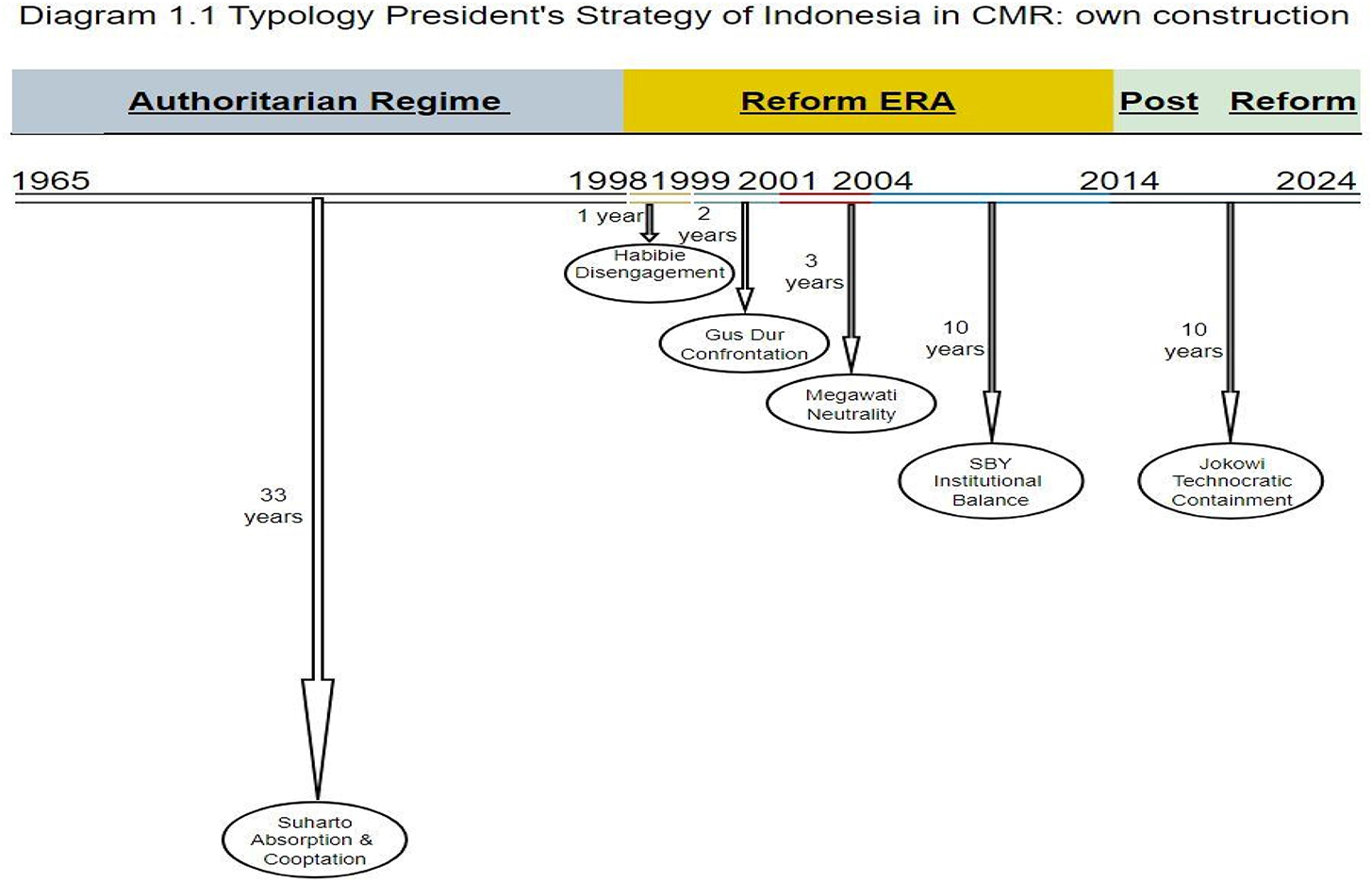
Diagram 1.1 of typology president's strategy of Indonesia, projecting the maps how successive Indonesian presidents have adapted CMR management from 1965 to 2024, distinguishing three political periods: the Authoritarian Regime (1965–1998), the Reform Era (1998–2014) and the Post-Reform Era (2014–2024). Downward arrows indicate the depth of institutional and cultural influence on CMR, while the length of each presidency indicates how far leaders embedded their strategic approaches in state institutions. Suharto's lengthy rule produced the most durable legacy, whereas the brief Reform Era left a more contested imprint on civil–military norms. The timeline illustrates that CMR evolution has been shaped not only by formal democratization but also by persistent elite and bureaucratic networks. Comparative analysis of presidential strategies reveals that Indonesia's CMR operates less as a site of democratic consolidation than as an arena of institutional negotiation, offering theoretical and empirical insights for scholars of transitional governance and hybrid regimes.
Table 1 extends this trajectory by translating these historical and theoretical patterns into a comparative framework, clarifying how successive presidents navigated inherited constraints, elite alliances and changing societal expectations to shape distinct CMR outcomes. Whereas the timeline traces longitudinal evolution, the table distils these dynamics into cross-presidential contrasts that illustrate Indonesia's CMR as a negotiated institutional arena rather than a linear path towards democratic consolidation. By juxtaposing qualitative narratives, legal reforms and quantitative indicators, it synthesizes how strategies from New Order absorption to early Reformasi disengagement (Habibie), confrontation (Gus Dur), neutrality (Megawati) and institutional balancing (SBY) to post-Reform Jokowi's technocratic containment produced varied yet interconnected configurations of CMR.
Table 1 shows how Indonesian presidents navigated the tension between civilian authority, elite accommodation and military influence. The quantitative indicators of V-Dem and Freedom House situate each administration within broader democratic trajectories, revealing how formal democratization did – or did not – translate into substantive CMR change, while the GMI underscores the persistence of militarization rooted in dwifungsi. The comparative pattern demonstrates that CMR evolution is non-linear and path dependent, shaped by presidential strategy, elite negotiation and societal concordance.
Comparative evolution of presidential strategies and CMR outcomes in Indonesia, 1966–2024: Own construction.
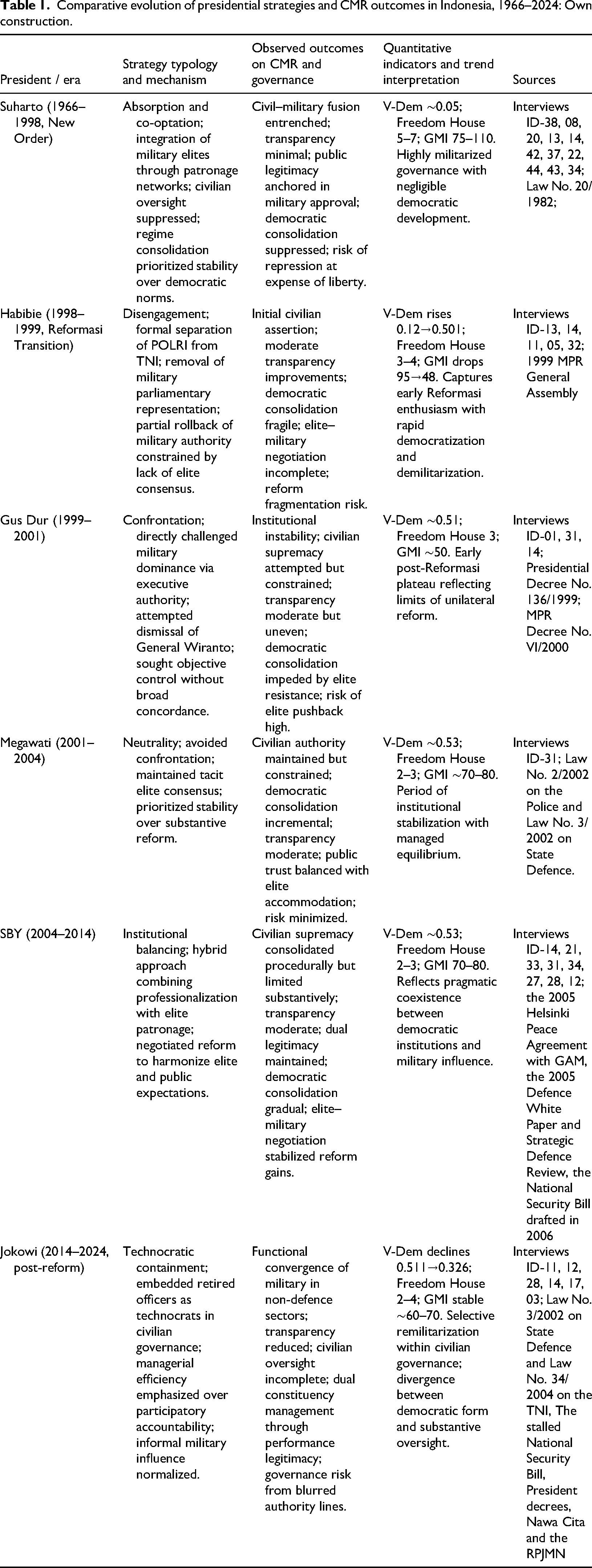
This highlights Indonesia's hybrid governance model, where formal democratization coexists with enduring military influence, illuminating the ongoing negotiation between civilian authority and military prerogatives in transitional CMR contexts. Nevertheless, the historical curve of Indonesia's CMR becomes analytically coherent when read through Huntington's (1957) distinction between subjective and objective control and Schiff's (1995) concordance theory, which together illuminate how presidential strategies correspond to distinct reform typologies that emerged through negotiated rather than revolutionary change.
Under Suharto, absorption defines the regime's approach: military officers were systematically embedded in civilian institutions through patronage networks and dwifungsi, producing a form of subjective control sustained by elite–societal concordance that absorbed the military into state governance rather than subordinating it (Crouch, 2007; Slater, 2010).
Habibie marked a shift towards disengagement, eliminating military parliamentary seats and the POLRI–TNI separation; yet, as Schiff's framework predicts, these steps towards Huntington's concept of objective control lacked durable consolidation because elite agreement was fragile and societal expectations regarding the military's sociopolitical function remained contested (Mietzner, 2009; Sebastian and Iisgindarsah, 2011). Gus Dur attempted confrontation, most visibly through his effort to dismiss General Wiranto. Yet, the absence of elite concordance and the fragility of transitional institutions made unilateral moves unsustainable, revealing the limits of objective control within a negotiated transition (Hicken, 2009; Levitsky and Way, 2010).
Megawati, by contrast, adopted a strategy of neutrality, prioritizing elite accommodation and political stability over reform, thereby maintaining consensus without shifting the structural balance between civilians and the military, consistent with Schiff's emphasis on negotiated agreement as a condition for institutional change (Aspinall and Mietzner, 2019). SBY pursued institutional balancing, blending professionalization rhetoric aligned with objective control with patronage-based alliances that preserved military autonomy. This layered democratic reforms onto authoritarian-era practices, resulting in hybrid governance arrangements that reflect Thelen's (1999) institutional layering.
Jokowi introduced technocratic containment, integrating retired and serving officers into civilian agencies and strategic technocratic roles – neither a return to dwifungsi nor a move towards objective control – thereby consolidating executive authority, securing elite loyalty and limiting substantive oversight through managerial incorporation (Aspinall and Mietzner, 2019; Laksmana, 2019). In contemporary governance, the military's involvement extends into disaster management, cybersecurity and infrastructure development, effectively merging civil and military domains. This enduring role reflects a continuity from the New Order to post-Reformasi governance, wherein the military maintains indirect influence hidden in the justification of national security and societal resilience, as noted in the works of Buana and Gusti (2024) and Diplomat (2016) . Across presidencies, these typologies trace a continuum from absorption to containment, demonstrating that Indonesia's CMR evolves through adaptive, negotiated recalibration: civilian authority advances only when elite alignment allows, while military influence persists through institutional layering, accommodation and technocratic integration, consistent with broader theories of elite-pact transitions (O’Donnell and Schmitter, 1986; Stepan, 1988).
Several limitations warrant note. First, the analysis relies on publicly available policy documents, secondary sources and elite interviews, which may understate informal negotiations and subtle mechanisms of military influence. Second, it does not incorporate grassroots perspectives or public opinion that could illuminate societal attitudes towards CMR. Third, regional variations – such as in Aceh, Papua or Sulawesi – are not fully examined, despite their distinct civil–military dynamics. Finally, the study does not fully integrate global influences – international norms, donor pressures or transnational security cooperation – which could further clarify external drivers and constraints on reform.
Conclusion and policy recommendations
This article develops a typology of presidential strategies – Suharto's absorption, Habibie's disengagement, Gus Dur's confrontation, Megawati's neutrality, SBY's institutional balancing and Jokowi's technocratic containment – to explain how Indonesia's post-authoritarian leaders have managed CMR. Drawing on agency-based analysis, institutional path dependency and elite constraint theory, it shows that CMR outcomes depend less on formal democratization than on presidential choices within enduring power configurations (O’Donnell and Schmitter, 1986; Skowronek, 1993; Tsebelis, 2002). Schiff's (1995) concordance theory which emphasizes consensus between the military, elites and the citizenry helps to explain how Indonesia's CMR has evolved through negotiation rather than strict civilian supremacy. Huntington's (1957) model of objective civilian control complements this perspective, clarifying how presidents balance military autonomy with civilian oversight via performance legitimacy and elite bargaining.
In Indonesia's contemporary democratic era, technocratic containment has been applied as a governance strategy whereby the president avoids direct military confrontation by integrating retired officers into civilian institutions as technocratic actors, preserving elite cohesion and projecting administrative neutrality, representing a strategic evolution from the more overt civil-military management styles of previous leaders (Laksmana, 2019; Lee, 2009; Sebastian et al., 2018). Although this can enhance stability and bureaucratic efficiency, it risks re-legitimizing military influence, blurring institutional mandates and undermining accountability. This hybrid mode is formally civilian yet structurally dependent on informal vetoes and negotiated elite consensus, diverging from Huntington's principle of clear civilian–military separation.
While the strategy reflects Indonesia's particular post-authoritarian configuration, it is not a uniquely Indonesian phenomenon. Similar patterns of bureaucratic absorption and elite accommodation can be found in other semi-democratic or hybrid regimes, such as Thailand, Egypt, Myanmar or Ethiopia, where political leaders must manage powerful militaries without the structural or normative backing of consolidated democratic institutions (Albrecht, 2005; Barany, 2012; Croissant and Kamerling, 2013; Croissant et al., 2010). As such, technocratic containment offers a broader conceptual insight into how civilian leaders in constrained environments pragmatically navigate the trade-offs between reform and regime stability.
This article advocates for specific institutional and normative reforms to enhance civilian supremacy and democratic consolidation in Indonesia. It emphasizes the establishment of an Independent Civil-Military Oversight Body, which would be a civilian-led institution reporting directly to the President and the Audit Board (Badan Pemeriksa Keuangan, BPK). This body would have the authority to audit military expenditures, evaluate CMR and ensure compliance with constitutional rules, incorporating representatives from various sectors including civil society and academia, while remaining independent from parliamentary commissions – particularly Commissions I and III – focusing on cross-institutional accountability, oversight of emergency powers and the monitoring of non-security appointments of military personnel.
Further, the article calls for the professionalization of civilian security roles within the MOD, the National Security Council (Dewan Ketahanan Nasional) and related agencies, suggesting the development of recruitment and training programmes, as well as career advancement pathways for experts in areas such as policy analysts, defence economics, legal experts and strategic planning supported by scholarship and exchange programmes with international defence education institutions.
It also proposes a civil-military role review mechanism to be conducted every three to five years. This review, coordinated by Komnas HAM, LPSK and BPK, would assess the involvement of military personnel in non-security sectors such as infrastructure, logistics and natural resource management. The results should be published and made accessible to the public to ensure transparency and enable legislative or executive corrective action. Moreover, it advocates for reforming appointment guidelines for ministerial and regional positions to prevent the appointment of active or retired military officers to non-security roles without public vetting. A ‘cooling-off period’ for retired generals is also suggested to promote neutrality in bureaucratic appointments.
The creation of multi-stakeholder dialogue platforms is recommended to facilitate discussions between parliamentarians, civil society, academic experts and military representatives to regularly deliberate on national defence policy, strategic posture and security sector modernization. These forums – operating at both national and regional levels – would enhance participatory governance and promote a shared understanding of civilian oversight imperatives. Finally, the article underscores the need for greater transparency in defence budgeting, procurement , and operational expenditures. It recommends the publication of annual public defence white papers alongside multi-layered auditing mechanisms that incorporating independent observers from civil society and academia. Such measures would help minimize rent seeking and shadow budgeting, while strengthening anti-corruption safeguards and ensuring greater institutional accountability.
Indonesia's CMR demonstrates a persistent tension between formal reform, pragmatic governance and institutional inertia. While democratic structures exist, genuine civilian authority remains constrained by elite bargains and informal networks. Without addressing these structural and normative conditions, technocratic containment may entrench hybrid governance rather than facilitating democratic consolidation. The study emphasizes the need for more in-depth empirical research into how technocratic governance, which is often regarded as neutral and efficient, can become a means of military re-empowerment. Sustained reform, civic engagement and scholarly attention are therefore critical to recalibrating CMR, strengthening civilian expertise and fostering a security culture aligned with rule-based governance and long-term democratic aspirations.
Supplemental Material
sj-pdf-1-acp-10.1177_20578911261419894 - Supplemental material for Presidential strategies and civilian control of the military in Indonesia: Managing political costs from authoritarianism to democratic consolidation
Supplemental material, sj-pdf-1-acp-10.1177_20578911261419894 for Presidential strategies and civilian control of the military in Indonesia: Managing political costs from authoritarianism to democratic consolidation by Zayu Rizki Safitri in Asian Journal of Comparative Politics
Footnotes

Funding
The author received no financial support for the research, authorship, and/or publication of this article.
Declaration of conflicting interests
The author declared no potential conflicts of interest with respect to the research, authorship, and/or publication of this article.
Supplemental material
Supplemental material for this article is available online.
References
Supplementary Material
Please find the following supplemental material available below.
For Open Access articles published under a Creative Commons License, all supplemental material carries the same license as the article it is associated with.
For non-Open Access articles published, all supplemental material carries a non-exclusive license, and permission requests for re-use of supplemental material or any part of supplemental material shall be sent directly to the copyright owner as specified in the copyright notice associated with the article.
